
The dishes are done, the television is off, and the same argument starts again. This time it's about your mother's visit, or your son's marks, or money that never quite stretches. Nobody in the room is cruel. Everyone is tired.
Most families in that moment aren't looking for a diagnosis. They want a time and a place where someone trained can help them hear each other without the conversation collapsing again. Online family counselling offers exactly that, without a travel plan, a waiting room or a neighbour's curiosity.
What follows is a practical walkthrough of the options: the formats, the question of who attends, what a first session looks like, and where the honest limits sit. Read it as you would listen to a counsellor over tea, one part at a time.
Online Family Counselling Formats Compared
Online family counselling is therapy delivered by video, phone or secure chat with one or more members of a household, by a qualified psychologist, psychotherapist or counsellor. It isn't one service. It's a small set of formats, and each one suits a different kind of strain.
| Format | Who usually attends | Best suited for | Typical focus |
|---|---|---|---|
| Couple therapy | Two partners | Marital discord, communication breakdown, decisions about separation | Conflict patterns, trust, intimacy and shared goals |
| Family systems therapy | Parents, adult children or the wider household | Intergenerational conflict, in-law tension, shared stress | Roles, boundaries and communication across generations |
| Parenting support | One or both parents, sometimes with a child | Parenting stress, school-related strain, behavioural concerns | Routines, discipline approaches and managing emotions at home |
| Caregiver or individual coaching | One family member | Stress, anxiety or burnout when others won't join | Coping skills, boundaries and emotional regulation |
Two examples make the difference concrete. Say you married two years ago and the arguments keep circling back to your in-laws. Your partner thinks you're distant; you think your partner reports everything to their mother. That's family systems work, because the pattern involves three or more people, not one person's mood.
Now say a father is worried that his fourteen-year-old has stopped attending school and won't say why. Nothing about the marriage is in question. That's parenting support, where the counsellor helps both parents agree on routines, consequences and how to talk to their child without turning it into an interrogation.
What Counselling Is Not
Counselling works on communication, well-being, resilience and how a household copes with stress, anxiety or depression. Psychiatric treatment is a separate medical pathway, and any decision about medication belongs to a psychiatrist. If a counsellor suspects that anxiety or depression needs medical review, the responsible step is a referral, not a promise that talking alone will fix it.
Work often arrives in the session before anyone names it. A recent review reported that 59% of Indian employees experienced work-related burnout in 2024, and cited an 83% impact from stress or burnout among Indian information-technology and cybersecurity professionals (Springer review of workplace well-being). That pressure rarely stays at the office. It shows up as short tempers at dinner, broken sleep, and parents with nothing left by the time homework starts.
A simple match: ask which single relationship is causing the most strain this month. The format that names that relationship is the one to book first.
Counselling can support emotional regulation, compassion and resilience alongside care for anxiety and depression. The aim of a first block of sessions is usually steadier communication, not a rebuilt personality.
Why Online Family Support Is Growing in India
Say a mother in a district town notices her son's marriage is fraying. The nearest clinic is a four-hour bus ride away, and sitting in that waiting room would be seen by people she knows. She has a smartphone, a data pack and a quiet hour after lunch. That is enough to make the first call.
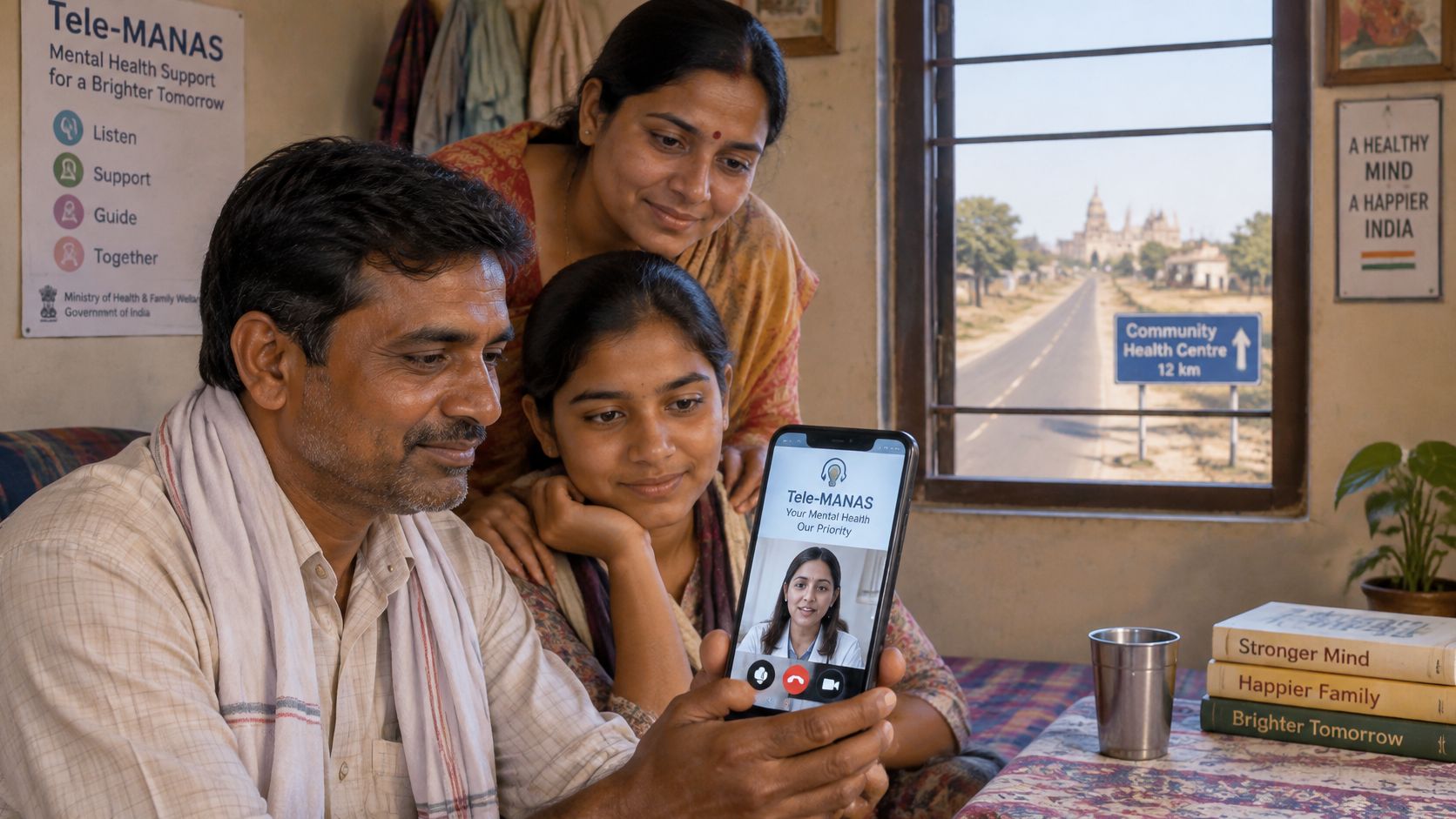
Public systems have noticed that gap. India's national Tele-MANAS programme, the digital arm of the District Mental Health Programme, launched on 10 October 2022 and is reached on the toll-free number 14416. By 31 July 2025 it had set up 53 operational cells across all 36 States and Union Territories, handled more than 24 lakh calls, and offered support in 20 languages (Rajya Sabha annexure on Tele-MANAS).
A mobile application followed on 10 October 2024, and video consultation was added as a further service. For families, the practical effect is simple: relatives can ask for help without travelling. Audio-only calls matter too, because a household with a weak signal or one shared phone can still reach a counsellor.
- Relationship conflict between partners or across generations.
- Parenting stress, especially around school, screens and discipline.
- Marital difficulty, including decisions about separation.
The short video below gives a sense of how a remote session feels from the inside.
Demand spans generations. By 12 March 2026 the programme had handled more than 34.34 lakh calls, with approximately 7% of callers aged 13 to 17 and 70% between 18 and 45 (Ministry of Health reply on Tele-MANAS usage). Those two brackets need different things. A teenager usually needs a parent in the room. A 30-year-old is more likely to be calling about a marriage, a job or a parent who won't listen.
What This Means for Your Family
The unmet need behind those calls is large. A population-based Indian study in BMJ Open found a 79.1% treatment gap for current depressive disorders, higher among women at 80.1%, people in lower-income groups at 81.0% and residents of cities with fewer than one million people at 87.3% (BMJ Open study on the depression treatment gap). That last figure explains why a free national line matters so much outside the metros.
A public line is a starting point, not the whole journey. Ongoing work on a marriage, a parent-child rift or a household recovering from a crisis usually needs a regular counsellor and several months of sessions. That's the space private online counselling fills once the helpline opens the door.
Deciding Who Attends Joint, Parallel or Individual Sessions
A wife may be afraid of what happens after the call ends. A father may refuse to join at all. A daughter may have no private room, and no phone of her own. The assumption that the whole family will appear on one video call breaks down more often than people expect, so the first clinical decision isn't the counsellor or the platform. It's who attends, and there are three ways to answer it.
- Joint sessions bring several people into one call, with a shared goal and ground rules agreed beforehand.
- Parallel sessions give each person their own time with a counsellor, often inside one coordinated plan, so nobody has to speak in front of someone they fear.
- Individual or caregiver coaching supports one person when others won't or can't join, and it still shifts the household because one member's responses change.
The three formats work like the difference between a family meeting, separate conversations through a mediator, and coaching a single player who then plays differently back home. None of them is second best. Each is the right answer to a different situation.
Coercion, unequal digital access, fear of retaliation, stigma, or an absent or abusive relative can all make a shared call unrealistic. Indian tele-mental-health guidance already recognises consultations initiated by family members and services designed for caregivers, and demand for remote support of this kind is high. What published guidance says less about is the messy middle: how consent works when one relative calls on behalf of another, and how a counsellor protects someone from retaliation once the laptop closes.
Consent Is Not a Formality
An adult has to agree to their own participation, and a careful counsellor asks each person privately whether they're joining by choice. If you're booking for a parent or a partner, frame it as an invitation rather than an ambush. "I'm going to talk to someone about how we argue. You're welcome to join whenever you want" lands very differently from a booked slot someone discovers on the family calendar.
In households with a history of threats or violence, separate support with safety planning comes before any joint conversation. A shared call can raise risk for the person with the least power in the room.
| Situation | Safer starting point | Why it matters |
|---|---|---|
| Everyone is willing and no safety concerns exist | Joint family session | Shared goals and open communication build trust |
| One person refuses to join | Individual or caregiver coaching | Respects consent while still supporting the household |
| History of threats, abuse or violence | Separate individual support with safety planning first | Joint sessions can increase risk for the person at greatest danger |
| Child or adolescent in conflict with a parent | Parallel sessions: parent support and child counselling | Each person can speak freely without fear of reprisal |
| Partners with unequal power or fear of speaking | Individual sessions before any joint work | Protects the quieter voice and builds confidence to speak |
When someone refuses, three things help. Keep the invitation neutral and repeatable, so it can be accepted later without loss of face. Book caregiver coaching for the rest of the household, so the burden doesn't sit on the one person who agreed. Revisit the decision after a few months, because relatives often change their minds once they watch the household shift around them.
In a crowded home, attendance and privacy are the same problem. A participant who joins from a bed in a common room will censor every sentence. Small fixes go a long way: earphones so the counsellor's voice stays private, a session timed for when the house empties, a chair on the balcony or in a parked vehicle, and an agreed neutral label such as "a work call" for anyone who asks. If even that isn't possible, individual audio sessions or message-based check-ins keep the work moving until a safer arrangement exists.
Safety comes first, and the joint call is one option among several, never a measure of family loyalty.
How an Online Family Session Unfolds, Step by Step
Video counselling can be as effective as face-to-face work for several conditions, and telephone counselling shows medium-to-large effects for depression and anxiety, according to reviews summarised by India's Centre for Mental Health Law and Policy. What that evidence doesn't settle is the family question: what happens when a spouse, an in-law or a child can overhear everything, or expects to know what was said.
Those are practical problems with practical answers. The sequence below is the one that protects everyone involved, and it starts before the first call.
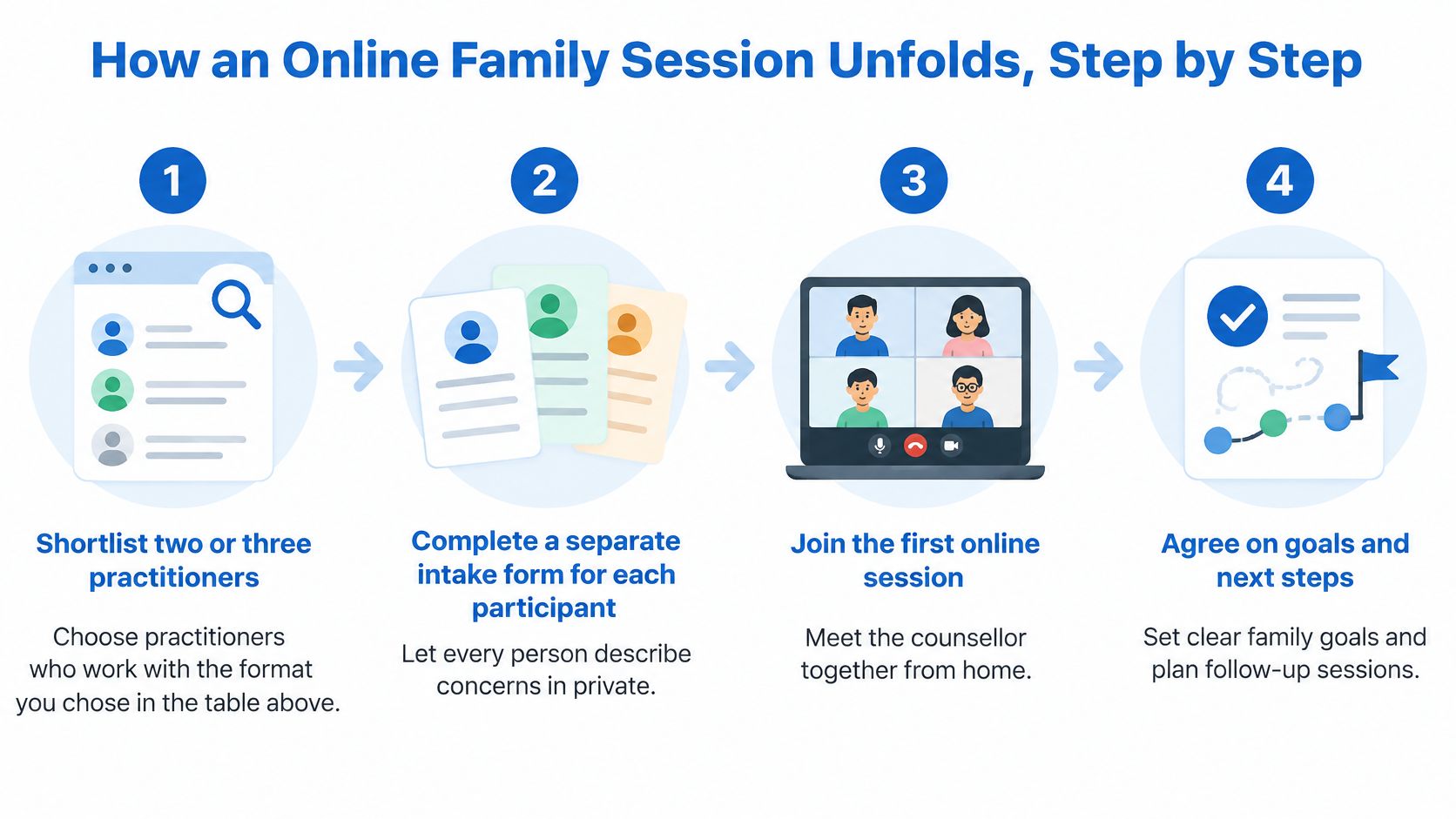
- Shortlist two or three practitioners who work in your chosen format. A couples therapist and a child counsellor aren't interchangeable, and the format you picked matters more than the platform.
- Complete a separate intake form for each participant. Private forms let each person describe concerns they'd never say aloud in front of a parent or partner, and they give the counsellor an early read on risk.
- Agree in writing to any joint session. Include what each person will and won't share outside the room, so nobody spends the week bracing for a disclosure.
- Run a technology check. Test the video, confirm a phone number for audio fallback, and settle on one platform rather than switching apps mid-conversation. National design notes for digital mental health stress multilingual intake, audio fallback and documented consent for every participating family member (review of India's tele-mental-health infrastructure).
- Ask one question before every call: can you speak freely right now? Agree a pause word that lets either person stop a line of questioning without a scene.
- Use neutral notification wording. "A scheduled appointment" on a shared phone protects people whose relatives read their messages.
- Use headphones and close chat windows. Shared devices and open notifications leak more than most families realise.
- Hear the confidentiality limits before the first session. Ask what must be shared when someone is at risk, and choose the language everyone is most comfortable in.
Inside the Session
A first session is calmer than people fear. The counsellor sets one shared goal, maps how the arguments usually start and who gets pulled in, then agrees two or three short practices for the week. A common one is a five-minute conversation after dinner with phones face down.
Follow-up usually runs weekly at first, then fortnightly as things steady. That rhythm is what separates counselling from a one-off conversation with a sympathetic friend.
How to judge a session: everyone leaves with one clear goal for the next conversation. Agreement is a bonus, not the test.
Being Heard in a Shared Home
Shared housing, data costs, low digital literacy and a household that switches languages mid-argument are real constraints, not excuses. Say them out loud in the first five minutes. A counsellor can move to audio, slow the pace, or run parallel sessions if a joint call isn't producing honesty.
The hard truth is that online delivery can widen access while narrowing safety, if nobody checks who is present in the room. That check is worth the awkward minute.
What the Evidence Shows and Where It Stops
The clearest India-specific account of online family work isn't a trial. It's a case series, and it's worth reading closely because it shows the shape of good care rather than a magic number.
In a technology-enabled case series, a patient living with depression and family discord received pharmacotherapy, individual counselling, family psychoeducation focused on communication and expressed emotion, and scheduled follow-ups through tele-consultation. The patient reported an approximately 60% reduction in depressive symptoms after four months and improved family harmony by six months (case series on technology-enabled collaborative care).
Why the Combination Mattered
The lesson sits in the combination, not in any single element. Medication review handled the biology. Individual counselling gave one person a private space. Family psychoeducation changed how the household talked and how much emotional heat each member carried. Tele-follow-up kept the plan alive between sessions, which is where families usually drift.
Structured this way, a service can watch for:
- Symptom scores moving in the right or wrong direction.
- Adherence to prescribed medication, without judgement.
- Early relapse signals such as sleep loss or withdrawal.
- Shifts in family functioning, like who has stopped speaking to whom.
That matters most for families facing travel, stigma or a shortage of specialists, because the alternative is often no follow-up at all.
This was a case series, not a controlled trial. The 60% figure is an implementation signal, useful for designing a service and unreliable as a benchmark for your own household. Anyone quoting it as a guaranteed outcome is overselling.
Where Screening Stops
Screening has one job: to sort relationship strain from something that needs clinical escalation. Severe depression, self-harm risk, psychosis and domestic violence belong in a different pathway from routine conjoint counselling.
An online questionnaire about anxiety, depression or burnout is informational, not diagnostic. A flagged result is a prompt to speak with a professional, not a verdict about you or your family.
For anyone in immediate distress, Tele-MANAS on 14416 runs round the clock. Any risk of self-harm, psychosis or violence needs in-person or emergency care, not a scheduled family session next Thursday.
Choosing a Counsellor and Booking Your First Session
By this point the decision is narrower than it looks. You're choosing one format, one practitioner and one first session.
What to Check Before You Book
- Registration and qualification. Confirm the person is a psychologist, psychotherapist or counsellor, and ask where they trained.
- Experience with your format. Family systems work and parenting support draw on different skills.
- Language. Ask which language sessions run in, and whether switching mid-session is possible.
- Fees, session length and cancellation terms, in writing, before the first call.
- How they explain confidentiality and safety. A vague answer is an answer.
Four things should slow you down: a promise of a cure, pressure to buy a long package before a first conversation, no intake questions at all, and unclear rules about who will see what you share. None of those are signs of a confident practitioner.
We bring psychologists, therapists and counsellors into one directory so families can compare and book in one place, and our team can be reached at support@detalks.com if a booking or privacy question needs answering before you commit.
Four Steps to a Booked Session
- Write down each person's main concern in plain words, one sentence each.
- Shortlist three practitioners who fit the format you chose earlier.
- Book one first session in the format that suits the household, even if that means one person attending alone.
- Ask about privacy, record-keeping and cancellation before you pay.
Keeping the Wider Picture in View
India's National Mental Health Survey found about 10.6% of Indian adults living with a mental disorder, with treatment gaps for different disorders ranging from 70% to 92% (National Mental Health Survey findings). That gap isn't a failure of willpower. It's distance, cost, stigma and too few practitioners in smaller towns.
Good work addresses both sides of the ledger: stress, anxiety, depression and burnout on one side; resilience, compassion, gratitude and a sense of purpose on the other. A family that learns to argue better is also a family that can enjoy more.
Reaching out early, even for a single conversation, counts as progress. The goal is suitable help and a steadier home, not a promise of cure.
DeTalks brings psychologists, therapists and counsellors together in one directory, so you can compare practitioners who work with couples, with whole families or with one person at a time, and book a first session without leaving home. Choose the format that fits your household rather than the one that sounds most thorough, and take that single step this week. Visit DeTalks to browse practitioners, read how they work and book your first conversation.