Tag: online therapy

  • 12 Best Self Esteem Quizzes to Understand Yourself Better

    12 Best Self Esteem Quizzes to Understand Yourself Better

    Understanding your self-esteem is a key part of your overall well-being. It affects how you see yourself, your relationships, and how you manage challenges like stress and anxiety.

    Taking a moment for self-reflection can be a powerful first step toward self-awareness. That’s why we’ve gathered a list of the best online self esteem quizzes to help you check in with yourself.

    This guide will explore 12 carefully selected quizzes, from the respected Rosenberg Self-Esteem Scale to others focused on building resilience. For each quiz, we will share what it’s for, how long it takes, and what to keep in mind.

    It's important to clarify: these assessments are informational, not diagnostic. They offer helpful insights for personal growth but don't replace professional mental health support for issues like anxiety or depression. Other tools, like the Wheel of Life tool, can also offer a broader view of your well-being.

    1. Rosenberg Self-Esteem Scale (RSES) – Open Source Psychometrics Project

    For a quick, research-backed look at your overall self-worth, the Rosenberg Self-Esteem Scale (RSES) is a classic starting point. This version is a straightforward and respected self-esteem quiz that is free and takes only about two minutes to complete.

    An image showing the Rosenberg Self-Esteem Scale quiz interface on the Open Source Psychometrics Project website, with a question and multiple-choice answers.

    This scale is known for its directness and academic credibility. It gives you a single score reflecting your general feelings about yourself, helping you build a foundation for resilience and self-compassion.

    Key Details

    Feature Details
    Purpose To quickly measure global self-esteem using a widely recognised psychological tool.
    Time to Complete Approximately 2 minutes.
    Cost & Access Completely free; no registration required.
    Who It's Best For Anyone seeking a fast, scientifically grounded check-in on their overall sense of self-worth.
    Important Note The feedback is brief and not personalised. It’s an informational tool, not a diagnostic one for anxiety or depression.

    This quiz is ideal for a reliable benchmark. However, its main limitation is its lack of detailed advice; it's a starting point for reflection, not a treatment plan.

    Website: Rosenberg Self-Esteem Scale

    2. Psychology Today – Self‑Esteem Test

    The self-esteem screener from Psychology Today is an excellent, user-friendly choice for a quick check-in. It offers a 20-item questionnaire that feels approachable for anyone exploring their personal growth and well-being.

    A woman smiling while using a laptop, representing a positive experience with the Psychology Today Self‑Esteem Test.

    This test stands out by connecting you to a rich library of mental health articles. After your quiz, you can easily find articles on topics like resilience, anxiety, or the benefits of counselling.

    Key Details

    Feature Details
    Purpose To provide a general audience with an accessible, quick screener for self-esteem with links to further reading.
    Time to Complete Approximately 3-4 minutes.
    Cost & Access Free to take; no registration is needed to view the score and a brief report.
    Who It's Best For Individuals new to self-assessment or those looking for a simple quiz connected to a wider library of resources.
    Important Note This is an informational screener, not a formal diagnostic tool. The analysis is limited in depth.

    This test is ideal for a straightforward evaluation with easy access to more information. While the results lack deep, personalised advice, it’s a great starting point for reflection.

    Website: Psychology Today Self-Esteem Test

    3. PsychTests by Queendom – Self‑Esteem Test

    For a more detailed analysis, the Self-Esteem Test from PsychTests by Queendom is an excellent option. This in-depth questionnaire explores multiple sides of your self-esteem, giving you a richer picture of your self-perception.

    A screenshot of the PsychTests by Queendom Self-Esteem Test, showing a question with a scale for answers.

    What makes this one of the more insightful self esteem quizzes is its two-part results. You get a free "Snapshot" report, with an option to purchase a full, detailed report that includes personalised advice for happiness and well-being.

    Key Details

    Feature Details
    Purpose To provide a detailed, multi-faceted analysis of self-esteem with both free summary and paid in-depth reporting options.
    Time to Complete Approximately 15-20 minutes.
    Cost & Access Free for a snapshot report; a fee applies for the full, detailed analysis. Registration is optional but allows saving results.
    Who It's Best For Individuals wanting a comprehensive look at their self-esteem, complete with subscale scores and structured feedback.
    Important Note The most actionable insights are part of the paid report. The test is informational and is not a substitute for professional therapy.

    This test is ideal if you’re ready for more than just a score and want to understand the different parts of your self-worth. The main downside is that the most detailed results are behind a paywall.

    Website: PsychTests Self-Esteem Test

    4. Project Implicit – Self‑Esteem IAT (Implicit Association Test)

    For those curious about self-esteem beyond conscious thought, the Self-Esteem Implicit Association Test (IAT) offers a fascinating look. This test measures the automatic, subconscious connections you have between yourself and positive or negative ideas.

    An image showing the Project Implicit Self-Esteem IAT interface, with instructions for a sorting task.

    The IAT is different from standard self-esteem quizzes because it measures reaction times, revealing automatic mental links. This can be a powerful tool for self-reflection, showing how your gut-level feelings might differ from what you consciously believe.

    Key Details

    Feature Details
    Purpose To measure implicit (automatic, subconscious) self-esteem through a reaction-time-based task.
    Time to Complete Approximately 10 minutes.
    Cost & Access Completely free; guest access is available without registration.
    Who It's Best For Individuals interested in psychology and exploring the unconscious aspects of their self-concept.
    Important Note The results are for educational purposes only and are not a clinical diagnosis. It's best taken on a laptop or desktop.

    This test is ideal if you want to explore the psychological underpinnings of your self-worth. However, it's abstract and doesn't offer practical steps for managing challenges like low self-esteem or anxiety.

    Website: Project Implicit – Take a Test

    5. IDRlabs – Self-Esteem (Self-Concept) Test

    For a more detailed look into your self-concept, the IDRlabs Self-Esteem Test provides a slightly deeper dive than a simple screener. This quiz is based on a respected psychological tool and takes under five minutes to complete.

    This test stands out by offering a more nuanced view of how you see and value yourself. It delivers instant, visually organized results that break down your self-concept, providing a fuller picture than a single score.

    Key Details

    Feature Details
    Purpose To measure different aspects of self-concept based on a recognised psychological instrument.
    Time to Complete Approximately 3-5 minutes.
    Cost & Access Completely free; no registration needed.
    Who It's Best For Individuals curious about a multi-faceted view of their self-perception, beyond a single self-esteem score.
    Important Note The results are for informational purposes and are not a substitute for a professional diagnosis of anxiety or depression.

    This quiz is an excellent choice for a user-friendly experience with more granular insights. It’s a good starting point for self-reflection but lacks the personalised guidance for building resilience that professional counselling can offer.

    Website: IDRlabs Self-Esteem Test

    6. Psych Central – Self‑Esteem Test

    Psych Central offers a short, medically reviewed self-esteem quiz that is an excellent entry point for personal reflection. This 18-question test uses clear, accessible language to help you think about your feelings of self-worth and well-being.

    Psych Central – Self‑Esteem Test

    What makes this quiz stand out is its gentle and informative approach. The results are presented with readable explanations that encourage self-compassion and suggest seeking professional support, such as therapy, if needed.

    Key Details

    Feature Details
    Purpose To encourage self-reflection on self-esteem with medically reviewed content and guide users toward next steps.
    Time to Complete Approximately 3-4 minutes.
    Cost & Access Completely free; no registration required, though email sign-up for more resources may be offered.
    Who It's Best For Individuals looking for a simple, context-rich quiz that connects results to broader mental health information.
    Important Note This is not a formal diagnostic scale. Its primary value is educational and to encourage further self-exploration.

    This test is ideal if you appreciate a quiz that is part of a larger, credible mental health resource library. It’s a great starting point for initial insights combined with supportive, actionable guidance.

    Website: Psych Central – Self‑Esteem Test

    7. Nemours KidsHealth – “How’s Your Self‑Esteem?” (Teens)

    Designed for adolescents, this quiz from Nemours KidsHealth offers a safe space for teens to reflect on their self-perception. It uses relatable language to explore topics like self-talk, social comparison, and resilience in an age-appropriate way.

    Nemours KidsHealth – “How’s Your Self‑Esteem?” (Teens)

    This quiz is unique because it guides users to a library of articles on confidence, body image, and dealing with setbacks. This approach provides immediate, constructive content to help teens understand their feelings and build happiness.

    Key Details

    Feature Details
    Purpose To provide a teen-focused, educational tool for reflecting on self-esteem with links to supportive articles.
    Time to Complete Approximately 3 minutes.
    Cost & Access Completely free; no registration required. Printable materials are available for educators.
    Who It's Best For Teens, parents, and educators seeking a reliable, non-clinical starting point for discussions on self-worth.
    Important Note This is a reflective, educational quiz, not a psychological assessment. It does not provide a score or diagnosis.

    The main strength of this quiz is its trusted, educational framing. It doesn't produce a score but instead encourages self-reflection, making it a supportive learning tool rather than a measurement instrument.

    Website: Nemours KidsHealth Self-Esteem Quiz

    8. Mind Tools – Self‑Confidence Quick Quiz

    For professionals looking to connect self-worth to career performance, the Mind Tools Self-Confidence Quick Quiz offers a practical, workplace-focused view. It frames questions around professional assertiveness, decision-making, and goal achievement.

    Mind Tools – Self‑Confidence Quick Quiz

    This quiz stands out by focusing on actionable self-confidence in a work setting. After the quiz, users receive feedback and specific tips for managing workplace stress, building resilience, and improving job effectiveness.

    Key Details

    Feature Details
    Purpose To assess self-confidence in a professional context and provide actionable tips for career development.
    Time to Complete Approximately 5-7 minutes.
    Cost & Access The quiz can be purchased as a one-off downloadable product or accessed for free with a Mind Tools Club membership.
    Who It's Best For Working professionals, team leaders, and HR managers seeking a tool for personal or team development workshops.
    Important Note This is a skills-development tool, not a psychological assessment. It measures situational confidence, not clinical anxiety or depression.

    This resource is ideal for individuals who want to translate feelings of self-worth into professional gains. It’s a targeted career-coaching exercise rather than a general psychological check-in, helping address issues like burnout.

    Website: Mind Tools Self-Confidence Quick Quiz

    9. Manastha (India) – Self‑Esteem Assessment

    For individuals in India seeking a structured path from assessment to care, Manastha provides a valuable service. This India-based mental health platform offers a self-esteem assessment alongside others on topics like anxiety and workplace stress.

    An image of the Manastha self-esteem assessment landing page, showing a clean interface and an option to start the test.

    Manastha's key feature is its direct integration of self esteem quizzes with professional counselling services. After the assessment, you can book a session with an Indian psychologist, creating a smooth journey from insight to support.

    Key Details

    Feature Details
    Purpose To assess self-esteem and provide a direct pathway to professional counselling services within India.
    Time to Complete Approximately 8 minutes.
    Cost & Access This is a paid assessment; you must purchase it on their website to access the questions and report.
    Who It's Best For Users in India who want an assessment that is directly connected to regional therapy and counselling options.
    Important Note The assessment's underlying scale is not detailed publicly. Its main function is as a paid gateway to the platform’s services.

    This platform is a practical choice if your goal is not just to take a test but to find professional help in India. It is less of a free informational tool and more of an entry point into a paid mental well-being and therapy ecosystem.

    Website: Manastha Self‑Esteem Assessment

    10. Mind.Help (India) – Self‑Esteem Test

    Mind.Help, an India-based mental health platform, provides a free self-esteem quiz for a quick self-check. This tool combines a brief screening with relevant, localized educational content, making it useful for those in an India-first context.

    Mind.Help (India) – Self‑Esteem Test interface showing a question and response options.

    This platform stands out by putting the quiz within a broader context of mental well-being. After your score, the site guides you to articles on topics like building resilience and understanding low self-esteem.

    Key Details

    Feature Details
    Purpose To offer a quick self-esteem screening supported by contextual educational articles and next steps.
    Time to Complete Approximately 3-4 minutes.
    Cost & Access Completely free; no registration required.
    Who It's Best For Indian users or anyone seeking a fast self-assessment with immediate access to related mental health information.
    Important Note This is a screening tool, not a formal diagnostic instrument. The feedback is general and not a substitute for professional counselling.

    This test is excellent for accessibility and provides helpful guidance. It serves best as an initial step to increase self-awareness and explore topics like anxiety or workplace stress, pointing you toward further learning.

    Website: Mind.Help Self‑Esteem Test

    11. Attachment Project – Self‑Esteem Test (RSES‑based)

    For those looking to understand how self-worth connects with relationship patterns, the Attachment Project offers a valuable perspective. It uses the scientifically validated Rosenberg Self-Esteem Scale (RSES) but frames the results within attachment theory.

    A woman sitting thoughtfully by a window, symbolising self-reflection prompted by the Attachment Project's quiz.

    This test stands out by connecting your self-esteem score to your attachment style (e.g., secure, anxious). This approach bridges the gap between a general self-esteem quiz and a more personalized exploration of your well-being.

    Key Details

    Feature Details
    Purpose To measure self-esteem and connect the results to attachment theory for relational insights.
    Time to Complete Approximately 3-4 minutes.
    Cost & Access Free to take; email registration is required to receive the full, detailed report.
    Who It's Best For Individuals curious about how their relationship dynamics and attachment style affect their overall self-worth.
    Important Note The report is educational, not a clinical diagnosis. The site also markets related courses on attachment.

    This is one of the more insightful self esteem quizzes if your goal is to examine how relationships shape your feelings. The main trade-off is the email requirement for the full analysis, which includes marketing.

    Website: Attachment Project – Self-Esteem Test

    12. Coral Ehr – Rosenberg Self‑Esteem Scale (Free Online Assessment)

    For those who appreciate the credibility of the Rosenberg Scale but want more guidance, this version is an excellent choice. It provides the classic 10-item questionnaire in a clean, simple format that is free and requires no sign-up.

    An image of the Coral Ehr website showing the Rosenberg Self-Esteem Scale, with questions and a four-point answer scale.

    What sets this version apart is the immediate context provided with your score. Instead of just a number, you get a clear breakdown into low, average, and high self-esteem bands, with brief tips and potential next steps.

    Key Details

    Feature Details
    Purpose To measure global self-esteem using the RSES and provide clear scoring bands with interpretive context.
    Time to Complete Approximately 2 minutes.
    Cost & Access Completely free; no registration needed.
    Who It's Best For Individuals who want the reliability of the Rosenberg Scale plus extra guidance on understanding their results.
    Important Note The advice is general. While helpful for reflection, it is not a substitute for professional counselling or a diagnostic tool for anxiety or depression.

    This quiz is ideal if you're looking for a reliable benchmark with an added layer of interpretation. It's a helpful first step in understanding your overall sense of self-worth and exploring positive psychology concepts like compassion.

    Website: Coral Ehr – Rosenberg Self‑Esteem Scale

    Comparison of 12 Self‑Esteem Quizzes

    Test Core Features UX & Quality Price / Value Target Audience Unique Selling Point
    Rosenberg Self‑Esteem Scale (Open Psychometrics) ✨ Validated 10‑item RSES; instant score ★★★★ fast, ad‑light (~2 min) 💰 Free 👥 Researchers & quick self‑checkers 🏆 Classic RSES; minimal friction
    Psychology Today – Self‑Esteem Test ✨ 20 plain‑English items; on‑page scoring ★★★★ consumer‑friendly (~3 min) 💰 Free 👥 General public, therapy explorers ✨ Linked resources & guidance
    PsychTests by Queendom – Self‑Esteem ✨ In‑depth with subscales; snapshot + paid report ★★★★ detailed, longer 💰 Free snapshot / Paid full report 👥 Users wanting deep feedback 🏆 Premium graphs & tailored advice
    Project Implicit – Self‑Esteem IAT ✨ Reaction‑time implicit self‑evaluation ★★★ academic; best on desktop 💰 Free 👥 Researchers & introspective users ✨ Measures implicit attitudes
    IDRlabs – Self‑Concept Test ✨ Robson SCQ model; visual results ★★★★ user‑friendly, quick 💰 Free 👥 Casual users seeking nuance ✨ Visual, explanatory presentation
    Psych Central – Self‑Esteem Test ✨ 18 Q, medically reviewed, supportive framing ★★★★ mobile‑friendly, editorial oversight 💰 Free 👥 Readers seeking trusted quick check ✨ Clinically reviewed context
    Nemours KidsHealth – Teens ✨ Teen‑appropriate language; educator materials ★★★★ short, age‑appropriate 💰 Free 👥 Teens, parents, schools 🏆 Pediatric trusted source & resources
    Mind Tools – Self‑Confidence Quick Quiz ✨ Workplace focus; actionable tips ★★★ practical; business‑oriented 💰 Club member or one‑off purchase 👥 Professionals & HR ✨ Actionable workplace improvement tips
    Manastha (India) – Self‑Esteem Assessment ✨ 16 Q; automated report + booking option ★★★ region‑relevant (~8 min) 💰 Paid 👥 Indian users wanting integrated care ✨ Direct link to local therapists
    Mind.Help (India) – Self‑Esteem Test ✨ Fast screening with educational articles ★★★★ free, contextual content 💰 Free 👥 Indian users for quick self‑check ✨ Localized education & next steps
    Attachment Project – RSES‑based ✨ RSES framed by attachment theory; email report ★★★★ narrative report (email required) 💰 Free (email) 👥 People exploring relationship links ✨ Attachment‑focused interpretation
    Coral Ehr – Rosenberg RSES (Practitioner) ✨ RSES with scoring bands & reliability notes ★★★★ informative, no signup 💰 Free 👥 Practitioners & curious users ✨ Reliability notes + next‑step guidance

    From Insight to Action: Your Path Forward

    Taking a moment to explore your inner world with a self-esteem quiz is a courageous first step. These tools offer a valuable snapshot, providing a language for feelings that can be hard to put into words.

    However, the real journey begins now. A score from any of these self esteem quizzes is not a final judgment but a signpost, offering clues about your strengths and where you might need more support.

    Turning Awareness into Meaningful Change

    The insights you've gained are most powerful when they inspire action. The path forward is about building a more resilient, compassionate, and authentic relationship with yourself. Consider these supportive takeaways as you decide what to do with your results.

    If your score suggested low self-esteem, please know your worth is not defined by a number. This score is simply a sign that you may be carrying a heavy burden of self-criticism, which can be linked to challenges like anxiety or depression. This is an ideal time to consider professional support.

    The Role of Professional Support

    You do not have to walk this path alone. Persistent feelings of worthlessness that interfere with your daily life are important signals that it's time to reach out.

    A qualified therapist or counsellor provides a safe, non-judgmental space to explore your feelings. Therapy is a proactive tool for building mental fitness, helping you develop practical skills for lasting self-worth and resilience. Your journey toward stronger self-esteem is yours to define, and every step is a move in the right direction.


    If you've taken one of these self-esteem quizzes and feel ready to turn your insights into lasting change, professional support can be your next step. DeTalks offers confidential online counselling and scientifically-backed assessments to help you understand yourself better and connect with a qualified therapist in India. Explore your options and begin your journey towards greater well-being today at DeTalks.

  • Unlock Your Potential with Cognitive Behavioral Therapy Online

    Unlock Your Potential with Cognitive Behavioral Therapy Online

    Deciding to focus on your mental well-being is a courageous step, and it’s one worth feeling good about. This guide is here to walk you through cognitive behavioural therapy online—a practical, proven approach for navigating life's challenges. Think of it as a mental toolkit that helps you manage everything from stress and anxiety to building a more resilient and compassionate you.

    Starting Your Path to Well-Being With Online CBT

    Life can often feel demanding, and the constant pressure on our time and energy can be draining. This makes having strong mental health support more important than ever. Whether you're a professional in India navigating burnout, a student facing exams, or just someone aiming for a more balanced life, knowing your options is the first step toward well-being.

    A smiling young man works on a laptop at a bright desk with a plant and tea.

    Why Consider Online Therapy Now?

    The pressures of modern life can leave us feeling stretched thin, and it's completely normal to feel the weight of anxiety or low moods. It's vital to have effective tools to manage these feelings. Online therapy shines by removing many traditional barriers, making professional counselling accessible from your own space, on your own schedule.

    Platforms like DeTalks are designed to connect you with qualified therapists who specialise in CBT, making it simpler to find the right support. Whether you’re in a bustling Indian city or a quieter town, the aim is to provide a professional and welcoming space. Here, you can feel heard and begin building a path toward greater well-being.

    Online CBT isn’t just about managing problems. It’s a proactive way to build self-awareness and inner strength, helping you develop skills for long-term resilience and happiness.

    Building Skills for a Better Life

    At its core, online CBT is a partnership between you and your therapist. It's a structured approach that helps you see the link between your thoughts, feelings, and actions. Once you spot unhelpful patterns, you can learn to reframe them, leading to healthier responses to stress, anxiety, and other challenges.

    This form of counselling gives you tools to:

    • Manage workplace stress and avoid burnout with practical coping strategies.
    • Ease symptoms of anxiety and depression by breaking cycles of unhelpful thoughts.
    • Cultivate resilience so you can bounce back from setbacks with more confidence.
    • Nurture self-compassion and happiness by changing your inner dialogue.

    To enhance your journey, you can also explore complementary practices like mindfulness. Resources for guided meditation scripts can be a great way to center yourself between sessions. This guide will show how online CBT equips you with supportive takeaways for a more fulfilling life.

    Understanding How Cognitive Behavioural Therapy Works

    Think of Cognitive Behavioural Therapy (CBT) as learning to become a curious observer of your own mind. It’s a practical approach that helps you map the connections between your thoughts (the 'cognitive' part), your emotions, and your actions (the 'behavioural' part). CBT is based on a powerful idea: it’s often not events themselves that cause distress, but the meaning we give them.

    This relationship is often shown as the ‘cognitive triangle,’ where thoughts, feelings, and behaviours constantly influence each other. An unhelpful thought can spark a difficult feeling, which then pushes you toward an action that reinforces the original thought. This can create a challenging cycle that feels hard to break.

    Let's take a common work scenario that many people in India and globally can relate to. Imagine you receive some unexpected feedback from your manager.

    • Thought: Your mind might jump to, "I'm a failure. I can't do anything right."
    • Feeling: That thought could trigger feelings of anxiety, shame, or deep sadness.
    • Behaviour: In response, you might avoid your manager or overwork yourself to compensate.

    This kind of spiral is incredibly common, especially in high-pressure environments that contribute to workplace stress. CBT gives you the tools to pause that cycle. By learning to question that first automatic thought, you gain the power to change how you feel and, ultimately, how you react.

    A Collaborative and Goal-Oriented Approach

    One of the most appreciated aspects of CBT is its focus on the present. While your past is important, sessions concentrate on tackling the challenges you're facing right now. It's a true partnership where you are the expert on your life, and the therapist is your guide, offering their knowledge of CBT techniques.

    Together, you'll set clear, achievable goals, whether it's feeling less anxious, managing stress, or building more resilience and self-compassion. The therapy is active and structured, designed to arm you with practical skills you can use immediately. This is why it has become such an effective form of counselling for challenges like anxiety and depression.

    CBT empowers you to become your own therapist. The skills you learn are designed for long-term use, providing a lasting toolkit for well-being and personal growth.

    Learning to Challenge Unhelpful Thinking

    A core part of the CBT process involves identifying what are sometimes called ‘cognitive distortions’ or unhelpful thinking styles. These are mental shortcuts our brains develop over time. They are very common, but they often paint a picture that is negatively skewed and not entirely accurate.

    Some examples include:

    • All-or-Nothing Thinking: Seeing things in extremes. If your performance wasn't perfect, you see it as a complete failure.
    • Catastrophising: Automatically jumping to the worst-possible conclusion. A bit of feedback means, "I'm definitely going to be fired."
    • Overgeneralisation: Taking one negative event and letting it define everything. "I made a mistake, so I must mess everything up."

    A good therapist helps you gently spot these patterns in your own thinking. The goal isn't to force "positive thinking," but to foster a more accurate and compassionate perspective. You'll learn to question these thoughts, look for evidence, and develop more balanced ways of seeing situations.

    This kind of support is more accessible than ever, thanks to telehealth. Across the globe, including India, people are embracing digital solutions for mental health. With 60% of people open to online therapy and 55.5% preferring digital options, there is a clear demand for support like online CBT. You can explore the latest teletherapy statistics to see the full picture.

    Comparing Online CBT and In-Person Therapy

    Deciding between online and in-person therapy is a personal choice, and there's no single right answer. Both online and in-person Cognitive Behavioural Therapy have unique advantages. The goal here is to help you understand the differences so you can make a choice that truly supports your mental well-being journey.

    Let's start with the most obvious benefit of cognitive behavioural therapy online: its accessibility. For a vast and diverse country like India, this is a game-changer. Suddenly, the right therapist can be in another city, but still available to you.

    This format also brings incredible convenience. If you're a busy professional or juggling family commitments, having a session without a commute makes it possible to fit vital self-care into a packed schedule. Many people also find that being in their own home creates a sense of comfort that makes it easier to open up.

    The Core Difference: How Does it Feel?

    While the proven techniques of CBT remain the same, the experience itself differs. In-person therapy is the traditional model where you're in the same room, making it easier to pick up on non-verbal cues. For some, this physical presence is key to building a strong connection.

    Online therapy builds this connection through a screen, which requires a stable internet connection and a private, quiet space. While the dynamic is different, it is a myth that the therapeutic bond is weaker. Countless people have built strong, trusting relationships with their therapists online.

    The most crucial factor for success in therapy—online or in-person—is the quality of the relationship you build with your therapist. A strong, trusting connection is the bedrock of progress, no matter the medium.

    The core principle of CBT—the interplay between our thoughts, feelings, and actions—is what you'll work on in either format.

    A concept map illustrating the core components of Cognitive Behavioral Therapy (CBT), showing how thoughts, actions, and feelings mutually influence each other in a continuous cycle.

    This therapy helps you see how changing one element—like an unhelpful thought—can create a positive ripple effect, improving how you feel and what you do.

    Online vs In-Person CBT: A Feature Comparison

    Feature Online CBT In-Person CBT
    Accessibility Excellent; access therapists from anywhere, overcoming geographical limits. Limited; requires you to be near the therapist’s office.
    Convenience High; no travel time, flexible scheduling fits into busy lives. Lower; requires commuting and scheduling around office hours.
    Comfort Can be higher, as you are in your own familiar and private space. Can be comforting for those who prefer a formal, neutral setting.
    Non-Verbal Cues Limited to what is visible on camera. Full range of body language and non-verbal cues are present.
    Technology Requires a stable internet connection and a private device (laptop, phone). No technology required beyond what the clinic uses for scheduling.
    Anonymity Can feel more private or anonymous, which some people prefer. Less anonymity due to physical presence in a clinic or waiting room.

    This table shows the "best" option depends on what you prioritise: convenience and accessibility, or the dynamic of a shared physical space.

    Is Online CBT as Effective? The Indian Context

    A common question is whether online therapy is as good as the "real thing." Research shows that for many challenges like anxiety and depression, online CBT is just as effective as face-to-face sessions. In India, the online format has shown unique advantages for managing issues like workplace stress and burnout.

    Post-pandemic, telehealth consultations for mental health in India soared by 500%, showing that online platforms are filling a critical need. You can find more data on how the global cognitive behavioural therapy market is evolving. The choice is yours, and both paths can lead to the same destination: building skills for better mental well-being and lasting resilience.

    Who Actually Benefits from Online CBT?

    It's a common myth that you need to be in crisis to start therapy. While online Cognitive Behavioural Therapy is very helpful for specific challenges, its true strength is its versatility. It's for anyone looking to build a more fulfilling life, whether that means tackling a problem or simply wanting to grow.

    Think of online CBT as a practical way forward if you're dealing with the constant buzz of anxiety, the heavy feeling of depression, or the relentless pressure of workplace stress. It can help you get unstuck and find your footing again.

    Support for Life’s Common Hurdles

    Life throws curveballs that can feel overwhelming, but online therapy makes getting support much easier. This is especially true if you're juggling a demanding schedule or live in an area with few local options.

    Online CBT is particularly effective for:

    • Working Professionals: If you're in a high-pressure career, you know how real burnout is. CBT offers tools to manage that stress, challenge perfectionism, and create a healthier work-life balance.
    • University Students: The academic world brings its own pressures, from exam nerves to social anxiety. A confidential online space can make a huge difference to your focus and well-being.
    • Anyone Navigating Relationship Issues: Difficulties with a partner, family, or friend can be draining. CBT helps you communicate more clearly, manage emotional reactions, and build stronger connections.

    Online CBT meets you where you are. It’s designed to fit into your life, not the other way around, providing support that feels both practical and deeply personal.

    A Powerful Tool for Personal Growth

    You don't need a specific issue to benefit from therapy. Many people use online CBT proactively to build a stronger, more resilient mindset and improve their overall quality of life. It’s less about fixing what’s broken and more about building what’s strong.

    This is where therapy shifts from just managing problems to actively cultivating well-being and happiness. Instead of only focusing on the negative, CBT can help you build skills for genuine, lasting fulfillment. You can work on building resilience, practicing self-compassion, and improving your emotional awareness.

    This need for accessible support has become clear. In India, the years after the pandemic saw a huge jump in people seeking cognitive behavioural therapy online, especially in areas with fewer mental health professionals. With its flexible scheduling, online CBT became a crucial resource for people managing job stress, anxiety, and relationship troubles. You can read the full research on teletherapy adoption in India to get a clearer picture of its impact.

    Whether you're looking for healing or growth, online CBT has something to offer. The journey begins with recognizing you want something to change and taking that first step. Most importantly, you don't have to do it alone—effective, accessible help is available.

    What to Expect in Your Online CBT Session

    So, you’ve decided to try online CBT. It’s natural to wonder what happens once you log in for your first session. A CBT appointment is a surprisingly straightforward and active process.

    Forget the image of passively lying on a couch; this is a collaborative effort. Your therapist brings expertise in CBT techniques, and you bring the most important part: your own life experience. It's a team approach aimed at improving your well-being.

    Person taking notes during an online therapy session with a therapist on a laptop screen.

    From the moment you connect, the goal is to create a space where you feel heard and understood. Your therapist is there to guide you, not judge you, using proven methods to help you move forward.

    The Structure of a Typical Session

    One of the great things about cognitive behavioural therapy online is its structure. While there's always flexibility for what you need, most sessions follow a clear path to ensure your time is used effectively. This helps you see real progress, whether you're tackling anxiety or workplace stress.

    Here’s a rough guide to how a typical online counselling session flows:

    • A Quick Catch-Up: Sessions usually start with a brief check-in on how your week has been. You'll also touch on any practices you tried since your last meeting.
    • Setting the Focus: Next, you and your therapist will decide together what to focus on for the session. This ensures the session is centered on what matters most to you right now.
    • Getting to Work: This is the heart of the session, where you'll explore a specific challenge, thought pattern, or situation. The goal is to gently untangle the connections between your thoughts, feelings, and actions.
    • Learning a New Tool: Your therapist will likely introduce a practical CBT skill that fits the problem. This is how you build a mental toolkit for lasting resilience.
    • Planning the Next Step: Before you sign off, you’ll recap the main points and agree on a small 'action plan' to try before the next session. This is key to applying what you learn in your daily life.

    This focused approach helps make cognitive behavioural therapy online feel empowering. You should leave each session with more clarity and a practical tool you can start using immediately.

    Common CBT Exercises Explained Simply

    A big part of CBT involves hands-on exercises that are simple yet effective tools. They help you notice the mental habits that might be holding you back. For instance, you might use a 'Thought Record' to jot down a situation, the automatic thought it triggered, and how it made you feel. Then, you work together to find a more balanced and helpful way of looking at it.

    Another common tool is the 'Behavioural Experiment,' where you act like a scientist investigating your own fears. If you're anxious about speaking in a meeting, you might design a small experiment to test your prediction that something awful will happen. It’s a way to challenge fears with real-world evidence, whether you're navigating depression or building self-compassion.

    CBT exercises are like a workout for your brain. They aren't about judging your thoughts but about observing them with curiosity and learning to respond in healthier, more helpful ways.

    It's important to clarify that any worksheets or assessments you use are informational tools to guide the conversation. They are not diagnostic. The aim of CBT is to equip you with supportive, life-long skills for navigating challenges with more confidence and calm.

    Finding the Right Online Therapist for You

    Choosing a therapist is perhaps the most important step in your journey. This isn't about finding the "best" therapist, but the right one for you. That personal connection is the bedrock of effective cognitive behavioural therapy online.

    When you look through profiles on a platform like DeTalks, take your time. A well-written profile offers a glimpse into a therapist's qualifications, expertise, and philosophy on counselling. Pay attention to whether their words feel warm, professional, and like someone you could talk to.

    What to Look For in a Therapist's Profile

    As you browse, notice the specialisations they list. If you're grappling with workplace stress or persistent anxiety, look for professionals who highlight these as their focus. This means they have experience and will understand the nuances of what you’re facing.

    Trust your gut on that initial sense of connection, as it is often a good predictor of a strong therapeutic fit. This trust is crucial for effective therapy. Keep an eye out for these specifics:

    • Qualifications and Credentials: Look for their degrees and professional licenses. This confirms they have the right training and are accountable to a professional board.
    • Areas of Specialisation: Do their skills align with your needs? Whether it's anxiety, depression, or building resilience, you want someone with relevant experience.
    • Therapeutic Approach: Their profile can give you clues about their style. Are they direct and structured, or do they lean towards a more exploratory, compassionate approach?

    Getting Deeper Insights with Assessments

    To give you a head start, platforms like DeTalks often provide psychological screening tools. These private questionnaires can offer a clearer picture of your current mental and emotional state. They can help you spot patterns in your own thinking, which is a fantastic starting point for therapy.

    It is very important to be clear on what these assessments are—and what they aren't.

    The screening tools available on DeTalks are informational, not diagnostic. Their purpose is to provide you with insights that can help you and your therapist better understand your needs and guide your sessions. They are not a substitute for a professional diagnosis from a qualified practitioner.

    Think of these tools as a compass, not a map; they help point you in the right direction. Sharing these results with your therapist can make your first session more productive by providing a snapshot of your current levels of anxiety or capacity for resilience. The goal is not a quick cure, but to find an ally who can equip you with practical tools to build a stronger, more balanced life.

    Common Questions About Online CBT

    Thinking about starting cognitive behavioural therapy online? It's completely normal to have questions. In fact, it’s a great sign that you're thoughtfully considering your path forward. Let's clear up some common uncertainties so you can feel confident and ready.

    Perhaps the biggest question is whether it works as well as in-person therapy. A mountain of research shows that for common challenges like anxiety and depression, online CBT is just as effective. The strength of the trusting, collaborative relationship you build with your counsellor is what truly matters.

    How Long Does Online CBT Usually Take?

    Another common question is about the timeline. CBT is a focused, goal-oriented approach, and a standard course of therapy usually falls between 12 to 20 sessions. Of course, this can be shorter or longer depending on your unique needs and goals.

    Your therapist will work with you to map out a plan that feels right. Whether you're tackling workplace stress or looking to build more resilience, the goal is to give you practical skills for long-term well-being, not to keep you in therapy forever.

    What Technology Do I Need for My Sessions?

    You don’t need a high-tech setup for cognitive behavioural therapy online. Keeping it simple means you can focus on what's important—your session.

    Here’s a quick checklist of the basics:

    • A Private, Quiet Space: This is essential. You need a confidential spot where you feel safe and comfortable enough to speak freely.
    • A Stable Internet Connection: A reliable connection is key to making sure your conversation flows naturally without frustrating interruptions.
    • A Device with a Camera and Microphone: Any modern laptop, tablet, or smartphone will do the job perfectly.

    It can also be helpful to understand how mental health therapy practices operate behind the scenes. This gives you insight into the professional standards that ensure a secure experience.

    Your privacy is paramount. Reputable online therapy platforms use secure, encrypted video software to safeguard your information, ensuring your sessions are a truly confidential space for you to heal and grow.

    This focus on security is a core part of professional online counselling. Our aim is to provide supportive takeaways, not promises of a quick fix. Your journey is about gaining skills for lasting well-being.


    Ready to find the right support for your journey? On DeTalks, you can browse a directory of qualified professionals who specialise in cognitive behavioural therapy. Explore our therapists and take the next step toward well-being today at https://detalks.com.

  • OCD Symptoms Test: A Guide to Understanding Your Thoughts

    OCD Symptoms Test: A Guide to Understanding Your Thoughts

    If you're exploring this topic, it shows you're taking a thoughtful step towards understanding your well-being. An OCD symptoms test is a supportive tool for self-reflection, and it's important to know it is not a diagnosis. Think of it as a private, gentle way to gain clarity about your thoughts and feelings.

    What Is an OCD Symptoms Test and Should You Take One?

    A thoughtful young man looking at a checklist on his smartphone, sitting at a table.

    Taking an online test for OCD symptoms can feel like a big step, but its purpose is to offer insight, not judgment. These questionnaires help you notice patterns, like recurring thoughts (obsessions) and repetitive actions (compulsions), that may be causing you stress. They provide a confidential first look into your experiences.

    This process can be a powerful way to move from confusion toward understanding. The questions act as a guide, helping you reflect on specific thoughts and behaviours you might not have connected before.

    A Tool for Self-Awareness, Not Diagnosis

    It is essential to clarify that an online assessment cannot replace an evaluation by a qualified professional. Only a trained therapist, psychologist, or psychiatrist can provide a diagnosis. They use a comprehensive approach, including detailed clinical interviews, to understand your unique situation.

    So, how does a self-screening test help? It plays its own important role in your journey toward better well-being.

    • It offers a starting point. The results help you organize your concerns, making it easier to explain what you're experiencing if you choose to seek counselling.
    • It builds self-awareness. Answering specific questions helps you see how symptoms might affect your daily life, from managing workplace stress to your personal relationships.
    • It can reduce uncertainty. Instead of wondering if something is "wrong," a test provides a structured way to explore your experiences, which can quieten the anxiety that comes from not knowing.

    Before taking a specific test, it can be useful to understand more about mental health screenings in general. Viewing them as simple check-ins for your mental health helps put their role into a supportive perspective.

    To make the distinction even clearer, here’s a quick comparison of what a self-screening test offers versus a professional diagnosis.

    Understanding Self-Screening vs Professional Diagnosis

    Aspect Online OCD Symptoms Test (Self-Screening) Professional Diagnosis
    Purpose To provide a private, preliminary insight into your symptoms and build self-awareness. To provide a definitive, clinical confirmation of a mental health condition.
    Process Answering a standardised questionnaire online, usually taking 5–15 minutes. In-depth clinical interviews, observation, and standardised diagnostic assessments with a trained professional.
    Outcome A score or result that suggests the likelihood of symptoms being present and their severity. A formal diagnosis based on established criteria (like the DSM-5), which is required for treatment planning.
    Limitation Cannot diagnose OCD or any other condition. It is an informational tool only. Requires finding a qualified professional, and can involve costs and waiting times.
    Next Step Helps you decide whether to seek professional help and gives you a clear way to describe your concerns. Leads to a personalised treatment plan, such as therapy, medication, or a combination of both.

    As you can see, both are valuable, but they serve very different functions in your mental health journey.

    From Insight to Action

    The purpose of an OCD symptoms test is not to receive a label, but to gather information that empowers you. The results can act as a bridge, connecting what you’ve discovered about yourself with the expert support that can make a real difference. If the test suggests your symptoms are causing significant distress, it may be a good sign that talking to a therapist is a positive next step.

    This is all about building self-compassion. Acknowledging that you’re struggling and taking steps to understand why is an act of strength and an investment in your own happiness. The journey from worry to clarity is a hopeful one, and a self-assessment can be a supportive first step.

    Understanding Obsessions and Compulsions

    Before exploring what an OCD symptoms test might show, it's helpful to understand what obsessions and compulsions feel like. Let's move away from clinical language and see them as two parts of a cycle that can feel difficult to break.

    A distressed young man with a thought bubble, contemplating a closed door with his hand on the handle.

    It’s crucial to know this cycle is a recognized pattern of the brain and behaviour, not a flaw in your character. Understanding this is a key step toward self-compassion and building the resilience needed to move forward with your life.

    What Are Obsessions?

    Obsessions are intrusive, unwanted thoughts, images, or urges that appear without invitation. They can trigger intense feelings like anxiety, disgust, or a sense of dread. These thoughts often clash with your personal values, and you don't want them there.

    For example, you might be trying to work, but your mind keeps showing an image of your house on fire because you fear you left an appliance on. This isn't a fleeting thought but a persistent alarm, creating significant workplace stress. This sticky, distressing thought is an obsession.

    An obsession can feel like an unwanted song stuck on a loop, demanding your attention and insisting that if you don't listen, something awful will happen.

    These intrusive thoughts are a global challenge, and they are not uncommon in India. In fact, local studies show that the prevalence of OCD symptoms is around 3.3%. You can learn more about these OCD statistics and their global context by exploring the research.

    And What Are Compulsions?

    Compulsions are the repetitive behaviours or mental acts you feel driven to perform to reduce the noise of an obsession. These actions, like checking, counting, or praying, are done to ease the overwhelming anxiety or prevent a feared outcome. The challenge is that any relief they bring is only temporary.

    If the obsession is a fire alarm, the compulsion is frantically trying to turn it off. For the person worried about the house fire, this could mean driving back home multiple times to check appliances. It might even become a complex ritual they believe is necessary to keep their family safe.

    These actions are not enjoyable; they feel like urgent, non-negotiable tasks. Not performing them can cause intense panic, leaving a person feeling trapped in a cycle.

    The Cycle in Action

    Let’s see how obsessions and compulsions work together, creating a powerful loop that can affect your overall well-being.

    • Obsession: An unwanted thought appears, such as, "What if this food is contaminated and will make my family sick?" This thought causes a sudden wave of intense anxiety.
    • Compulsion: To ease that fear, you feel an overwhelming urge to perform a ritual. You might wash vegetables in a very specific way or repeat a silent prayer until it "feels right."
    • Temporary Relief: Performing the act brings a brief moment of calm. The anxiety subsides, and for a moment, you feel safe again.
    • Reinforcement: This short-lived relief reinforces the behaviour. Your brain learns the ritual "worked," making it more likely you'll repeat it the next time the obsession arises.

    This exhausting and isolating cycle is often linked with feelings of depression. It's important to remember these are symptoms of a condition, not personal failings. An OCD symptoms test is designed to shed light on this pattern, offering a starting point for finding effective counselling or therapy.

    A Practical Guide to Common OCD Screening Tools

    When you take an OCD symptoms test online, you are often using a simplified version of the tools a professional might use. These are thoughtfully designed questionnaires that help give structure to your experiences. Knowing a bit about them can make the process feel less intimidating.

    Remember, these are screening tools, not diagnostic ones. Their purpose is to provide a structured way for you to reflect on your thoughts and behaviours, acting as a starting point for self-awareness.

    Demystifying the Questionnaires

    Most online tests are based on scientifically validated assessments used in therapy and clinical research. One of the most recognized is the Yale-Brown Obsessive Compulsive Scale (Y-BOCS). Online screeners often borrow its principles to understand how symptoms might be impacting your daily life.

    These tools can be seen as a compassionate guide. They ask questions that gently explore the space intrusive thoughts and compulsions take up, helping to quantify experiences that can feel chaotic.

    The Obsessive-Compulsive Inventory-Revised (OCI-R)

    One common questionnaire you might encounter is the OCI-R, which is designed to be direct. It can help you see which types of OCD symptoms might be most prominent for you. The questions are often grouped into categories, providing a clear picture of your unique challenges.

    The OCI-R typically focuses on six key areas:

    • Washing: Looks at feelings of contamination and the need to wash.
    • Checking: Focuses on the urge to repeatedly check things like locks or emails.
    • Ordering: Relates to the need for things to be arranged perfectly or "just right."
    • Obsessing: Focuses on the intrusive thoughts themselves, separate from any action.
    • Hoarding: Explores difficulty in discarding items others might see as unimportant.
    • Neutralising: Looks at mental rituals, like counting or repeating a phrase to "undo" a thought.

    As you rate how much each statement has bothered you, patterns begin to emerge. For many, this process is validating, as it shows that their struggles have a name and can be understood.

    Understanding the “Why” Behind the Questions

    The questions in an OCD symptoms test are crafted to measure two important things: the frequency of your symptoms and the distress they cause. This distinction is what separates a personal quirk from a mental health concern affecting your well-being.

    Remember, these assessments are not about judging you. They are informational tools to translate private struggles into a format that can be shared with a professional, paving the way for effective counselling.

    For example, a question might ask: "How much time is occupied by your obsessive thoughts?" This is a practical way to understand the impact on your life, such as causing workplace stress or affecting relationships.

    A question about the anxiety you'd feel if you couldn't perform a compulsion helps measure the ritual's power. High distress scores can signal a difficult cycle where anxiety or even depression may be intertwined with OCD symptoms. Understanding your experience this way can make the path toward building resilience feel more manageable.

    How to Interpret Your Test Results Safely and Mindfully

    After receiving your results, take a moment to breathe. The most important thing to remember is that an online test score is not a diagnosis. It is simply a signpost, suggesting it might be helpful to talk with a professional.

    Think of your score as a "conversation starter." It gives you language to describe your experiences, which can make the first conversation with a therapist feel less overwhelming. This perspective shifts the focus from self-diagnosis to taking a positive, proactive step for your well-being.

    Understanding What Scoring Ranges Mean

    Most screening tools provide a score in a range, such as mild, moderate, or severe. These labels are not about you as a person but are meant to measure the impact symptoms may be having on your daily life. A higher score often means these thoughts and behaviours are taking up significant time or causing distress.

    Here’s a general way to think about what those ranges might indicate:

    • Mild: Symptoms are present and may cause some anxiety, but you can generally manage them without major disruptions.
    • Moderate: Symptoms are more persistent, causing distress and likely interfering with your job or social life. This may contribute to workplace stress.
    • Severe: Symptoms feel intense and time-consuming, often taking up over an hour a day. They likely cause serious problems and may be accompanied by significant anxiety or depression.

    This flowchart offers a simple, visual guide for your next steps, regardless of your score.

    Flowchart for OCD test result interpretation, guiding action based on score relative to a threshold.

    The bottom line is that any score reflecting genuine distress is a valid reason to seek support.

    A Bridge From Insight to Professional Action

    It's normal to feel overwhelmed after seeing your score, but you are not alone. In India, studies show the prevalence of OCD symptoms among college students is between 3.8% and 6.7%. This highlights how common these challenges are.

    In this group, an OCD symptoms test might find moderate severity in around 4.3% of young adults, often alongside higher levels of anxiety and depression. You can learn more about mental health trends in Indian youth and see that what you're feeling is a recognized human challenge.

    Your test results are a bridge, not a destination. They connect your private self-awareness with the professional support system ready to help you build resilience and move toward greater happiness.

    The goal is not to fixate on a number but to use it as motivation. A high score is a clear signal that it may be time to speak with a trained professional who can provide a formal assessment and guide you through effective therapy. The true value of an OCD symptoms test is that it empowers you to take that next step with confidence.

    Common Misconceptions About OCD You Can Ignore

    If you've just taken an OCD symptoms test, you may be dealing with many confusing feelings. It is easy to get caught up in myths about OCD, so let's clear up some common misconceptions. This can help you move forward with more self-compassion.

    These stereotypes can create barriers, making it difficult for people to seek the therapy and support they need. Understanding the facts is a powerful step for your own healing and helps create a more compassionate world for everyone.

    It Is Not Just About Being Neat

    The biggest myth is that OCD is just a personality trait for people who love being clean. Liking a tidy space is a preference. For someone with OCD, the drive for order is fueled by intense anxiety and fear, not pleasure. The temporary relief from a compulsion is very different from the satisfaction of a clean room.

    It Is Not a Sign of Weakness or a Character Flaw

    OCD has nothing to do with willpower or character. It is a recognized neurobiological condition. The intrusive thoughts (obsessions) are not a reflection of who you are; in fact, they often represent your greatest fears and are the opposite of your values.

    Understanding that you are not your thoughts is a cornerstone of building resilience. What you're experiencing are symptoms of a treatable condition, not a personal failure.

    The compulsions are your brain's misguided attempt to reduce distress. Seeing it this way can help lift the weight of shame and make it easier to seek effective counselling. It takes enormous strength just to navigate a day with these symptoms.

    Everyone Is Not a Little Bit OCD

    While many people have an occasional odd thought or double-check a lock, the difference with clinical OCD is the scale and impact. For a diagnosis, obsessions and compulsions must be very time-consuming (often over an hour a day) or cause major life problems. This might look like workplace stress from constant re-checking or social avoidance due to contamination fears, which is why the condition is often linked to depression.

    A Few Reminders for Yourself:

    • What you're going through is real and significant.
    • Your intrusive thoughts are just thoughts; they don't define you.
    • Reaching out for help shows incredible strength and self-awareness.

    By letting go of these myths, you can focus on your path to feeling better. You are not alone, and the journey toward improved mental health is one filled with hope.

    Your Next Steps Toward Healing and Resilience

    Woman on couch having a video call with another woman on a laptop in a bright room.

    Taking an OCD symptoms test is a brave first move. It’s a step out of uncertainty and into understanding. This is not about getting a label, but about gaining clarity to take meaningful action toward your own healing.

    The path ahead is about learning more about yourself and finding the right support. With help, you can manage these challenges and build a life with more peace and balance. You don't have to do it alone.

    Finding a Qualified Therapist

    Your most important next step is to connect with a mental health professional who understands OCD. Finding someone with specialized expertise is key.

    Look for therapists trained in evidence-based treatments for OCD. The two most effective approaches are:

    • Exposure and Response Prevention (ERP): A type of Cognitive Behavioural Therapy (CBT) where you gradually face fears in a safe way while resisting compulsions. This process teaches your brain that anxiety fades without the ritual.
    • Cognitive Behavioural Therapy (CBT): A broader approach that helps you identify and reframe unhelpful thought patterns. CBT provides practical strategies to change how you think and behave.

    Addressing Related Challenges

    It is common for OCD to co-occur with other concerns like anxiety and depression. The exhaustion of managing symptoms can also create significant workplace stress.

    Reaching out for support is a powerful act of self-care and a testament to your strength. It marks the beginning of your journey to reclaim your peace of mind and overall well-being.

    Good counselling will address these interconnected issues. A skilled therapist can provide coping strategies to manage your mood, reduce stress, and improve your quality of life. You can learn more by reviewing these frequently asked questions about counselling.

    Building Resilience and Self-Compassion

    Therapy is more than reducing symptoms; it's about building a stronger, more resilient you. A great therapist will also weave in principles from positive psychology to help you develop long-term stability and happiness.

    This process is about:

    • Building Resilience: Learning to navigate life’s setbacks and manage difficult emotions.
    • Developing Self-Compassion: Treating yourself with the kindness you’d offer a struggling friend.
    • Enhancing Well-being: Focusing on what brings you joy, meaning, and purpose.

    In India, data shows that while OCD affects all walks of life, co-occurring depression is found in up to 60% of individuals. The good news is that evidence-based therapy like ERP offers real hope, proving effective for 65-80% of people who commit to it. You’ve taken the first step with the OCD symptoms test; now, let the next one be reaching out for the support you deserve.

    Frequently Asked Questions About OCD Tests

    It’s natural to have questions after taking a step to understand your thoughts better. Here are some clear, straightforward answers to common queries about OCD self-assessments.

    Can an Online Test Actually Diagnose Me with OCD?

    No, an online OCD symptoms test is a screening tool, not a diagnostic one. It is designed to help you privately spot patterns that might align with OCD symptoms. A formal diagnosis of OCD can only come from a qualified mental health professional after a thorough evaluation.

    What Should I Do If My Score Is High?

    A high score can be unsettling, but view it as helpful information. It suggests the symptoms you’re experiencing may be causing significant distress or interfering with daily life. It is a strong sign that now might be a good time to talk to a professional.

    Are the Results of an OCD Symptoms Test Kept Private?

    Yes. Reputable platforms that offer mental health tools are built on trust and privacy. When you take an OCD symptoms test on a trusted site, your individual results are confidential. This privacy creates a safe space for you to be honest with yourself, which is the first step toward gaining insight into your mental well-being.

    Is OCD Something That Can Be Cured with Therapy?

    While "cure" is not a term mental health professionals typically use, OCD is a very treatable condition. With the right support, people can and do regain control of their lives. Evidence-based therapy, especially Exposure and Response Prevention (ERP), has a high success rate. The goal is to build your resilience so that intrusive thoughts no longer trigger intense anxiety or depression, allowing you to be in control, not the OCD.


    Ready to take the next step on your journey to understanding and well-being? DeTalks offers a safe, confidential space to explore your mental health. Find a qualified therapist or take a scientifically validated assessment today.

  • Finding a Therapist for Stress: A Guide to Building Resilience and Well-being

    Finding a Therapist for Stress: A Guide to Building Resilience and Well-being

    Feeling overwhelmed, like you're constantly running on empty, is more than just a side effect of a busy life. It's a clear signal that your inner resources are stretched thin. Deciding to see a therapist for stress is a powerful, proactive step towards regaining your balance and investing in your long-term well-being.

    Why Talking to a Therapist for Stress Can Help

    A woman therapist consults with a male client in a bright, modern office with a model airplane.

    Navigating life’s pressures alone can feel challenging and isolating. A therapist acts as a skilled guide, helping you understand your emotional landscape and find a clearer path forward. This supportive partnership is what makes counselling for stress so effective.

    In places like India, where professional and personal pressures can be high, we often feel the need to appear strong all the time. Therapy offers a confidential space to lower that guard without judgment. It’s a place to explore the roots of your stress, whether it's workplace stress, family expectations, or personal anxieties.

    Building Your Mental Toolkit for Well-being

    A therapist does more than listen; they equip you with practical tools to enhance your mental well-being. This process helps you move from reacting to stress to responding with intention. It's about building lasting resilience and self-compassion.

    With their guidance, you can learn to:

    • Identify the specific thoughts and situations that trigger your stress.
    • Gently challenge and reframe unhelpful thought patterns that contribute to anxiety.
    • Develop practical coping skills for immediate relief when you feel overwhelmed.
    • Cultivate inner strengths like compassion and happiness to navigate future challenges.

    Therapy isn't about eliminating stress, but about changing your relationship with it. It’s learning to navigate life's challenges with greater confidence and calm, fostering a more positive and resilient mindset.

    This journey unfolds at your own pace, with a professional guide supporting you. Working with a therapist for stress helps you move from just surviving to truly thriving, creating a path to a more balanced and fulfilling life.

    Recognising the Signs You Might Need Support

    A distressed man sits on a bed, hiding his face in his hands, with a steaming mug nearby.

    It can be difficult to notice when everyday stress turns into something more serious. We all face pressure, but when it starts to feel like a constant weight on your shoulders, it's a sign to pay attention. These changes can be subtle, slowly becoming a new, exhausting normal.

    Recognising these shifts is an act of self-awareness and strength. If stress is consistently impacting your happiness, work, or relationships, considering professional counselling can be a helpful step. Finding a therapist for stress is a proactive choice for your overall well-being.

    When to Seek Help: Common Signs to Look For

    How do you know when it's time to reach out? Stress affects your mood, body, and behaviour. If you recognise several of the signs below in your own life, it may indicate that the load has become too heavy to carry alone.

    This is not a diagnostic checklist but an informational guide to help you reflect on your experiences.

    Signs It Might Be Time to Talk to a Therapist

    Area of Life Common Signs of Chronic Stress
    Emotional Well-being You feel constantly irritable, anxious, or overwhelmed. Things you used to enjoy no longer bring you pleasure. You might feel a persistent sense of dread or sadness that you can't shake off.
    Mental Clarity Concentration feels impossible. You struggle to make decisions, your memory feels foggy, or you have racing thoughts that keep you up at night. Minor tasks feel like huge hurdles.
    Physical Health Unexplained headaches, stomach problems, or frequent colds have become common. You feel exhausted all the time, even after a full night's sleep. Muscle tension and aches are your new norm.
    Work or School Procrastination has taken over, and your performance is slipping. You feel disengaged or cynical about your work, and the pressure feels unbearable.
    Relationships You find yourself snapping at loved ones or withdrawing from social activities. You feel isolated and disconnected, even when you're around people you care about.
    Behavioural Habits You're relying more on unhealthy coping mechanisms, like overeating, excessive drinking, or zoning out online. You've stopped taking care of yourself—skipping meals, exercise, or hygiene.

    If this list resonates with you, please know you are not alone. In India, workplace stress is a significant concern, with research indicating that a large portion of adults experience moderate stress from professional demands. You can read the full research about mental health trends in India for more context.

    These signs are not a sign of failure. They are your mind and body’s way of signalling that you are carrying too heavy a load and may benefit from support.

    Paying attention to these signals is an act of self-compassion. It's the first step toward building the resilience needed to navigate life’s challenges with greater ease and seeking help is a sign of strength.

    Therapeutic Approaches for Stress and Well-being

    Two individuals sit at a table during a counseling session with a notebook showing a 'Thought' diagram.

    When you begin working with a therapist for stress, you gain access to proven methods tailored to your needs. Therapy is a collaborative process where a skilled professional guides you using evidence-based techniques. The goal is to build practical, lifelong skills for managing your thoughts and feelings.

    Learning about these approaches can help demystify the process of counselling. Let's explore some of the most effective therapies used for stress, anxiety, and burnout, as well as for cultivating positive states like resilience and happiness.

    Cognitive Behavioural Therapy (CBT)

    Cognitive Behavioural Therapy (CBT) is a widely researched and effective approach for managing stress and anxiety. It is based on the idea that our thoughts, feelings, and actions are interconnected. Unhelpful thought patterns can trigger difficult emotions, which in turn lead to unhelpful behaviours.

    A CBT therapist helps you identify and understand these automatic thought patterns. You then learn to gently question them and shift towards more balanced perspectives. It's a practical, hands-on approach that gives you concrete tools to manage everything from workplace stress to personal worries.

    Acceptance and Commitment Therapy (ACT)

    Acceptance and Commitment Therapy (ACT) offers a different perspective: learning to change your relationship with your thoughts and feelings. It teaches that difficult emotions are a natural part of life, and fighting them can be exhausting. ACT helps you accept their presence without letting them control you.

    With an ACT therapist, you will focus on a few key areas. You'll learn to notice your feelings without being overwhelmed, clarify what truly matters to you (your values), and take meaningful action toward a life aligned with those values, even when stress is present. This fosters psychological flexibility and resilience.

    Mindfulness-Based Approaches

    When we are stressed, our minds often race between past regrets and future worries. Mindfulness-based approaches, like Mindfulness-Based Stress Reduction (MBSR), gently guide your attention back to the present moment. Through practices like guided meditation, you learn to observe your thoughts without judgment.

    Mindfulness is not about emptying your mind, but about observing your thoughts and feelings as they come and go, without getting carried away by them.

    This practice creates a vital pause between a stressful event and your reaction. In that space, you find the freedom to choose a more thoughtful response. Exploring related practices like therapeutic yoga can also be a wonderful way to connect mind and body, building a stronger foundation for well-being.

    How to Find a Therapist You Truly Connect With

    Finding the right therapist is a personal journey, and the connection you feel is key. This relationship, known as the therapeutic alliance, is one of the most important factors for successful therapy. You need to feel safe, seen, and understood to do the meaningful work of healing and growth.

    Taking the first step to find a professional is a hopeful act of self-care. It's worth taking the time to find someone who feels like a true partner in your corner. This person will help you navigate stress, build resilience, and learn to manage anxiety for the long term.

    Starting with the Essentials

    A few practical checks can help you create a shortlist of qualified and ethical professionals. In India, look for psychologists registered with a recognized body like the Rehabilitation Council of India (RCI). This registration ensures they have met specific training and ethical standards.

    Also, consider their area of focus. If you're dealing with challenges like workplace stress, anxiety, or depression, look for a therapist for stress who lists these as core areas of their practice. This ensures they have the right experience to support you.

    The Importance of the Right Fit

    The most qualified therapist may not be the right one for you if you don't feel a comfortable connection. That "fit" is the gut feeling of trust that allows you to be open and honest. It’s the difference between speaking with a clinical expert and a warm, empathetic human who truly understands.

    A good therapeutic fit means you feel respected, heard without judgment, and confident in your therapist's ability to guide you. This foundation of trust is where real growth and healing happen.

    This connection is built on empathy and a shared understanding of your goals. Trust your instincts; if an initial conversation doesn't feel right, it’s perfectly okay to continue your search.

    Questions to Ask a Potential Therapist

    Most therapists offer a brief initial consultation, often free of charge. This is your opportunity to ask questions and see if their style aligns with your needs. Having a few questions prepared can help you feel more confident in your choice.

    Here are a few helpful questions to consider:

    • What's your approach to helping people with stress and anxiety? This helps you understand their therapeutic style.
    • How do you help your clients build practical coping skills? This shows their focus on equipping you with real-world tools.
    • Can you describe what a typical session with you is like? This gives you a sense of their process and manages expectations.
    • How do you work with clients to track progress? This shows they are invested in your journey toward well-being.

    Finding the right therapist is a deeply personal process. By combining practical checks with a focus on human connection, you can find a professional who will be a powerful ally on your path to feeling better.

    Choosing Between Online and In-Person Therapy

    Today, finding the right therapist for stress means you have more options than ever. A key decision is whether to meet in a physical office or connect online. There is no single "best" choice—it all depends on what suits your life and makes you feel most comfortable.

    For some, traditional in-person therapy provides a dedicated, quiet space away from daily distractions. Going to an office can create a helpful mental separation, allowing you to focus entirely on yourself. This setting can make it easier to build rapport without technical interruptions.

    The Rise of Online Counselling

    Online counselling has made mental health support more accessible, especially in a country like India. It removes the stress of travel and makes it easier to fit a session into a busy schedule. This is a great benefit for people in smaller towns or anyone with mobility challenges.

    Many people also find it less intimidating to open up from the comfort of their own home. It can lower the initial barrier to starting therapy, helping you feel at ease from the very first call. This flowchart outlines the essential steps for finding a therapist, regardless of the format.

    A flowchart on finding a therapist, detailing steps like credentials, consultation, and rapport.

    The core steps—checking credentials and ensuring a good connection—remain the same for both options. To help you decide, here is a simple comparison.

    Comparing In-Person and Online Therapy

    Feature In-Person Therapy Online Therapy
    Environment A dedicated, neutral, professional office setting. Your own familiar, private space (home, office, etc.).
    Convenience Requires travel and scheduling around commute times. No travel needed; highly flexible and easy to fit in.
    Accessibility Limited to professionals in your local area. Access to a wide pool of therapists across the country.
    Connection Direct, face-to-face interaction without technology. Relies on a stable internet connection for video/audio.
    Comfort Level Can feel more structured and formal. May feel less intimidating and more relaxed for some.
    Anonymity Less anonymity due to visiting a physical location. Offers a greater sense of privacy and discretion.

    Ultimately, both paths can lead to the support you need for your well-being.

    What Is Right for You?

    The best choice is the one you will stick with. Whether you are dealing with anxiety, workplace stress, or want to build more resilience, a good therapist can support you in either setting.

    The goal is to find a supportive, professional partnership. Whether that happens in a physical room or through a video call, the quality of the connection is what matters most for your growth.

    Consider your lifestyle, comfort with technology, and the environment where you feel safest to open up. With trusted platforms offering secure sessions, you can build an effective, healing relationship no matter the distance.

    Taking Your First Step Toward a Calmer Life

    Deciding to find a therapist for stress is a sign of strength and a commitment to your own well-being. It’s a proactive choice to build a more fulfilling and balanced life. While the process might seem new, getting the right support is often more straightforward than you might imagine.

    Platforms like DeTalks are designed to simplify your search. You can browse profiles of qualified professionals who specialize in stress, anxiety, and burnout. This helps you find someone whose approach to counselling and expertise aligns with your needs.

    Using Self-Assessments for a Clearer Picture

    As you begin, you may come across self-assessment tools. These can be a helpful way to organize your thoughts and feelings, giving you a clearer starting point for your first conversation with a therapist. They are purely for your personal reflection and information.

    It is important to remember that these tools are informational and not a substitute for a professional diagnosis. They simply offer a private, structured way to map out what you have been experiencing.

    "Beginning therapy is not about admitting defeat; it is an act of profound self-love. It's giving yourself the space to heal, grow, and build the resilience needed to navigate life with greater peace and purpose."

    This journey is about more than just overcoming a difficult time; it’s about creating lasting positive change. The skills you learn in therapy—from managing workplace stress to practicing self-compassion—become a permanent part of your toolkit. You’ll be better equipped to handle life's challenges and build a life defined by calm and purpose.

    Your Questions About Stress Therapy, Answered

    Taking the first step into therapy is significant, and it's natural to have questions. Let's clarify some common queries people have when considering a therapist for stress. Our goal is to make the process feel clear and approachable.

    How Long Will I Need to Be in Therapy for Stress?

    There's no single answer, as the timeline is unique to you and your goals. For some, a few months is enough to build effective coping strategies. For others, particularly if stress is linked to deeper issues like trauma or ongoing anxiety, longer-term support may be more beneficial.

    Your therapist will work with you to set goals and will regularly check in to ensure you are moving in a helpful direction together. It is a collaborative process focused on your well-being.

    Is What I Say in Therapy Actually Private?

    Yes, confidentiality is a cornerstone of therapy. It is a strict ethical requirement for all professionals. This creates a safe space where you can speak openly without fear of your information being shared.

    The only exceptions are rare situations involving immediate risk of harm to yourself or others. Your therapist will explain these limits clearly at the beginning, so you feel fully informed.

    Think of the therapeutic relationship as a secure vault for your thoughts and feelings. This trust allows for genuine exploration and healing, freeing you from carrying your worries alone.

    What if I Don’t Click with the First Therapist I See?

    That is perfectly okay and quite common. Finding the right fit is crucial for a successful therapeutic experience. The connection you have with your therapist—the 'therapeutic alliance'—is one of the strongest predictors of positive outcomes in therapy.

    If the first person you meet doesn't feel right, don't be discouraged. View it as a step in the process of finding the right partner for your journey. Platforms are designed to help you find a professional who truly understands you.


    Seeking support is a courageous step towards managing stress and building your resilience. Exploring your options is the beginning of a path to a calmer, more balanced life. Book your first session today.

  • A Guide to Taking a Mental Health Assessment Online

    A Guide to Taking a Mental Health Assessment Online

    Taking the first step to understand your mental health is a brave and positive move. An mental health assessment online is a private, gentle way to gain personal insight. Think of it as a helpful check-in for your mind, not a formal diagnosis.

    Your First Step to Understanding Your Mind

    Exploring your well-being can feel overwhelming when you're not sure where to start. An online mental health assessment offers a comfortable and private starting point, helping you put words to your feelings. It's a simple opportunity to check in with yourself, just as you would for your physical health.

    A woman with short dark hair thoughtfully works on a laptop at a bright table.

    These tools explore a wide range of your well-being, from common challenges like workplace stress and burnout to feelings associated with anxiety or depression. The process can help you recognize patterns you might not have noticed on your own.

    But it’s not just about challenges. A key part of mental health is recognizing your strengths. Many assessments also highlight positive psychology, measuring qualities like:

    • Resilience: How you bounce back from difficult situations.
    • Compassion: Your capacity for kindness toward yourself and others.
    • Happiness: Your general sense of contentment and life satisfaction.

    A Guide, Not a Diagnosis

    It is very important to remember that these assessments are informational tools. They offer helpful clues and can point you in a supportive direction, but they do not replace a diagnosis from a qualified therapist or doctor.

    Think of the results as a conversation starter. They can help you organize your thoughts before considering therapy or counselling, empowering you to have a more focused discussion with a professional if you choose to.

    This guide will walk you through what these assessments are and how they can support your journey toward feeling better. Platforms like DeTalks offer these tools to help people in India and globally find clarity. Exploring resources like a dedicated mental health page can also provide extra support as you begin to understand your mind.

    What Is a Mental Health Assessment Online?

    An online mental health assessment is like a thoughtful, guided conversation with yourself. It uses a series of carefully crafted questions to give you a snapshot of your current emotional state. This helps you make sense of your feelings with more clarity.

    The main purpose is to screen for common challenges like depression and anxiety, or to measure positive qualities like resilience. Good assessments are often scientifically validated tools designed to gather specific information, helping to paint a clearer picture of your inner world.

    Remember, these assessments offer valuable insights but are meant to be informational guides. They are excellent for self-reflection and building awareness but do not provide a formal medical diagnosis.

    A mental health assessment online is a private, secure space to explore your thoughts and feelings. It paves the way for a deeper understanding of your own mind and is the first step in a personal journey of self-discovery.

    Taking this first step can be empowering. It helps you organize your thoughts and identify specific areas you might want to work on, such as managing workplace stress or building personal resilience.

    A Bridge to Understanding and Support

    In India, the need for accessible mental health tools is significant. The National Mental Health Survey found that 10.6% of adults experience a mental health condition, yet the gap between needing and receiving care can be as high as 90%. A mental health assessment online helps bridge this gap by offering initial screenings for conditions like depression and anxiety from your own device. You can find more details in these important mental health findings from the survey.

    Platforms like DeTalks place scientifically validated tools directly in your hands. You can take them confidentially to better understand issues like stress and burnout before deciding if therapy is a helpful next step for you.

    This easy access helps make mental health support feel less intimidating. It provides a private starting point for anyone curious about their emotional well-being.

    Focusing on Both Strengths and Challenges

    A truly helpful assessment doesn't just look for problems; it also highlights your strengths. It considers the whole picture, from the challenges you may be facing to the positive qualities you already have.

    Here’s a glimpse of what you can explore:

    • Identifying Challenges: These tools can help you spot signs related to anxiety, stress, and burnout, allowing you to recognize patterns that may be affecting your daily life.
    • Discovering Strengths: Many assessments also measure concepts from positive psychology, like your capacity for resilience, your level of compassion, and your overall sense of happiness.

    Seeing both your challenges and your strengths provides a more balanced view of your mental state. This perspective is vital for personal growth and for deciding what kind of support, such as counselling, might be right for you.

    Exploring the Different Types of Online Mental Health Assessments

    The term mental health assessment online covers a variety of tools, each designed to explore a specific aspect of your inner world. Just as a doctor uses different instruments, these assessments come in various forms to provide the clarity you are looking for.

    Some assessments offer a broad overview of your emotional landscape, while others focus on a particular feeling or challenge. Knowing the difference helps you choose the tool that best fits your needs.

    This image below shows the typical journey—from an initial check-up to gaining insights and planning your next steps.

    Online assessment concept map showing a check-up process, including screening, insights, and guidance.

    The process often starts with a screening, which leads to personalized insights. These insights can then guide you toward helpful next steps.

    Screening Tools for Specific Concerns

    The most common type of mental health assessment online is a screening tool. Think of these as a quick, preliminary check-in to help you spot early signs of specific mental health challenges.

    For example, if you have been feeling constantly on edge, an anxiety screener can help you understand those feelings better. If a persistent low mood is making it hard to enjoy things, a screener for depression could offer some initial perspective.

    It is vital to understand these are not diagnostic tools and do not give you a label. They simply provide a starting point for self-awareness and can help you decide if it’s time to talk to a professional for counselling.

    Measures for Well-being and Resilience

    Mental health is not just about the absence of problems; it is also about nurturing your strengths. Well-being and resilience measures shift the focus from what might be challenging to what is already strong within you.

    Instead of looking for symptoms, these assessments explore your inner resources, such as:

    • Your overall sense of happiness and life satisfaction.
    • Your capacity for self-compassion and kindness.
    • Your ability to bounce back from stress and adversity.

    Recognizing your strengths is just as important as identifying your challenges. It can empower you to find more joy, build better relationships, and cultivate a stronger sense of purpose and well-being.

    A resilience assessment can be an incredibly affirming experience. It shows you the skills you already possess and can lean on during difficult times—a powerful reminder of your own inner strength.

    Workplace Stress and Burnout Assessments

    In today's fast-paced world, workplace stress is a major factor in our overall well-being, especially for professionals and students across India. Specialized assessments exist to measure how your job or studies are impacting you.

    These tools can help you gauge things like:

    • Burnout levels: Are you feeling emotionally drained or cynical about your work?
    • Job satisfaction: How fulfilled do you feel in your current role?
    • Work-life balance: Is your professional life impacting your personal time?

    The insights from a workplace assessment can be a valuable reality check. They might encourage you to set healthier boundaries or realize that therapy could help you develop better coping mechanisms for professional pressure. Platforms like DeTalks offer tools to help you find balance.

    How to Find and Trust an Online Assessment

    With many options for a mental health assessment online, choosing a trustworthy one is the most important first step. You want to know it’s credible, secure, and created by professionals. Getting this right empowers you and protects your privacy.

    A tablet on a wooden desk displaying an app interface with options like 'Pronivacy' and 'Expert Development'.

    The growth of digital health tools is clear. In India, the market for mental health apps, which often include these assessments, is rapidly expanding, making it even more critical to choose wisely. You can read more in this market growth report.

    Your Checklist for a Credible Assessment

    To ensure the mental health assessment online you choose is reliable, here is a simple checklist. These are signs of quality that can give you confidence in the tool you're using.

    • Is it scientifically validated? A validated assessment has been tested by researchers to confirm it reliably measures what it claims to. It's an evidence-based tool designed for real insight, not just a quiz.

    • Does it have a clear privacy policy? Your personal information is sensitive. A reputable platform will be transparent about how it handles your data, so look for a clear policy before you begin.

    • Was it developed by mental health professionals? The best assessments are created by experts like psychologists and therapists. Their involvement ensures the questions are thoughtful, relevant, and grounded in a real understanding of topics from workplace stress to personal resilience.

    Prioritising Your Privacy and Security

    Feeling safe is essential when exploring something as personal as your mental health. Trustworthy platforms invest in security to protect your information at every step.

    A key sign of a platform's dedication to privacy is its use of practices like secure and HIPAA-compliant document sharing. This shows they take their responsibility to safeguard your data seriously, creating a safe space for self-discovery.

    Remember, an assessment is meant to be a supportive and informational tool. It should never leave you feeling judged or exposed, so always choose platforms that are transparent about their methods and security.

    Taking a few minutes to check these points makes a real difference. Choosing a credible assessment ensures the insights you receive are not only useful but are also handled with the care and respect you deserve.

    How to Make Sense of Your Assessment Results

    Receiving your results from a mental health assessment online can bring a mix of emotions. Remember that these results are not a final judgment, but simply a snapshot of how you are feeling right now.

    Think of your scores as helpful signposts, not permanent labels. They are a starting point for looking inward and understanding your mind a little better, which is a powerful step toward improving your well-being.

    Understanding Your Scores as Signposts

    Most online assessments present results in categories like low, moderate, or high. This is not a grade but a way to highlight areas that might benefit from more attention.

    A high score for anxiety, for example, simply suggests you are currently experiencing symptoms that align with anxiety. This insight is the first move toward finding practical ways to cope, whether through counselling or mindfulness techniques.

    An online assessment result is a conversation starter, not a conclusion. It is a tool to help you ask better questions about yourself and guide you toward the right support for your needs.

    Adopting this mindset transforms the experience from one of judgment to a journey of discovery. This is a much healthier way to approach personal growth.

    When Results Suggest a Challenge

    If your results from a mental health assessment online indicate a potential challenge, like symptoms of depression or high workplace stress, try not to feel discouraged. See it as a clear signal that it might be time to talk to someone.

    A therapist can offer a proper evaluation with the context that a digital tool cannot provide. Your assessment results can be a fantastic way to start that conversation, helping you and your therapist focus on what matters most. This one step can be the beginning of finding effective strategies and support through therapy.

    When Results Highlight Your Strengths

    Your assessment might also shine a light on your strengths, such as strong resilience or a great capacity for compassion. This is just as valuable and offers an invitation to lean into these positive qualities.

    Think of these results as a green light to build on what’s already working for you. You could explore activities that nurture these strengths, such as:

    • Mindfulness exercises to improve self-awareness.
    • Gratitude journaling to boost feelings of happiness.
    • Connecting with others to share your compassion.

    Recognizing and building your inner resources is a vital part of long-term mental well-being. These strengths are your anchor, providing stability during life's challenges.

    From Insight to Action: What Happens Next?

    You’ve completed an online mental health assessment—what's next? Taking that confidential and accessible step puts you in control of your well-being and gives you the clarity to decide what to do.

    A hand holds a smartphone displaying an 'English Theory Directory' app in a bright room.

    Think of your assessment results as a bridge from wondering about your mental state to taking clear, actionable steps. Platforms like DeTalks are designed to guide you across that bridge, ensuring you feel supported from the start.

    Turning Your Results into Real Support

    You don't have to figure it all out alone. The next phase is about finding the support that feels right for you, and you have options.

    Here are a few ways to move forward:

    • Explore Professional Counselling: If your results point toward challenges with anxiety or depression, you can browse a directory of qualified therapists and start online counselling.
    • Dive into Self-Help Resources: If you want to handle workplace stress better or build your resilience, a library of self-help articles can provide practical techniques.
    • Nurture Your Strengths: If your assessment highlighted positive traits like compassion or happiness, you can find resources to build on those strengths for long-term well-being.

    Everyone's path is different. The choice is yours, whether you decide to start therapy, learn new coping skills, or focus on your positive qualities.

    An online mental health assessment is the start of a journey toward greater self-awareness and a kinder relationship with yourself. It's not a quick fix but a supportive first step.

    Your Supportive Takeaways

    This is an ongoing journey, not a final destination. Your mental health needs consistent care, and an assessment simply provides a map to start.

    This process is about building skills, understanding your emotional patterns, and learning to navigate life with more confidence. Taking an online mental health assessment is a powerful act of self-care. You have taken a brave step to understand yourself more deeply, and the support you need to continue is available.

    Frequently Asked Questions

    It’s completely normal to have questions before taking a mental health assessment online. Here are some common ones to provide clarity and help you feel more confident.

    Are Online Mental Health Assessments Accurate?

    Reputable online assessments are scientifically validated screening tools, offering a reliable snapshot of your current mental state. They are very good at indicating potential areas of concern.

    However, they are informational and not a substitute for a formal diagnosis from a qualified professional. They are a useful first step to help you decide if it’s time to speak with a therapist about your well-being.

    Is My Privacy Protected When I Take an Assessment?

    Your privacy is a top priority. Trustworthy platforms use secure, encrypted technology and have clear privacy policies to protect your personal information and results.

    Before starting any assessment, always take a moment to read the privacy policy. It is important to know you are in a safe, confidential space.

    A secure platform ensures your journey of self-discovery remains yours alone. This privacy is essential for honestly exploring challenges like anxiety or workplace stress without fear of judgment.

    What Should I Do After I Get My Results?

    Your results are a guide for your next step. If they suggest you might be struggling with something like depression or high stress, consider it a helpful nudge to connect with a professional.

    If your results highlight strengths like strong resilience, that’s wonderful! You can then look for resources to build on that foundation. The results are there to give you the insight to take a meaningful next step.

    Can an Online Assessment Replace Therapy?

    No, an mental health assessment online is a tool for self-awareness and screening, but it cannot replace therapy. It does not offer the personalized guidance and human connection you get from professional counselling.

    Think of an assessment as a starting point. It provides valuable information to help you decide the best way forward on your mental health journey.


    Taking that first step can feel like the biggest one, but understanding your mental health is a worthwhile journey. DeTalks offers a range of confidential, science-backed assessments to give you the clarity you’re looking for. Explore our tools and find the right path forward for you at https://detalks.com.

  • Your Guide to Online Counseling for Couples in India

    Your Guide to Online Counseling for Couples in India

    Deciding to explore online counselling for couples is a powerful statement about your commitment to your relationship. It’s a way to create a private, comfortable space to work through challenges and reconnect, all from home. This modern approach to therapy makes getting professional support easier than ever, giving you tools to build a stronger, more resilient partnership.

    How Online Counselling Can Strengthen Your Partnership

    A smiling Indian couple on a couch having an online video consultation with a female therapist.

    If you're reading this, you might be looking for a way forward in your relationship. Perhaps you feel stuck in the same arguments or simply feel distant from each other. Juggling work, family, and personal life can strain even the strongest connections.

    Online therapy offers a supportive setting to navigate everything from everyday stresses to deeper issues like anxiety or depression that may impact your relationship. The goal is to turn difficult moments into opportunities for growth and to improve your overall well-being.

    A Safe Space to Heal and Grow

    Online counselling provides a neutral space where a trained therapist guides the conversation. This ensures both partners have a chance to speak and feel heard without judgment. This process is key to understanding emotions and identifying the root causes of friction.

    The point of therapy isn’t to decide who is right or wrong, but to build understanding and compassion. It’s about learning to express your needs while hearing your partner's, creating a foundation of trust.

    This guided dialogue helps you move past old arguments and start rebuilding intimacy. For more on working through relationship issues, this dedicated couples therapy resource is a helpful starting point.

    Building Skills for a Resilient Future

    Effective online counselling provides practical skills for a lifetime. It empowers you with tools to improve communication, manage conflict, and enhance your emotional connection.

    Here’s a glimpse of what you can learn:

    • Communicate with compassion: Share your feelings and needs clearly and kindly, avoiding criticism or blame.
    • Manage conflict constructively: Learn to handle disagreements in a way that brings you closer together.
    • Enhance emotional connection: Re-ignite the friendship and affection at the heart of your partnership.

    These are life skills that contribute to a happier, healthier relationship and build long-term resilience.

    What Are the Real Benefits of Choosing Online Therapy?

    Choosing to get support for your relationship is an act of care. With online counselling for couples, you bring that support right into your home, fitting it into your life without disruption. It makes the process feel more approachable and less intimidating.

    This shift to digital well-being has made professional guidance more available than ever. It removes practical barriers like traffic or conflicting schedules, so you can focus your energy on each other.

    It Just Fits Into Your Life

    Online therapy respects your time and your space. You can connect with a qualified therapist from wherever you both feel comfortable, whether that's your living room or even from two different cities.

    This flexibility is particularly helpful for couples in India juggling demanding careers, family duties, or long-distance relationships. Booking a session during a lunch break or after the kids are asleep makes consistency easier, and consistency is key to making progress.

    Online therapy doesn't replace human connection; it makes professional support more accessible. By removing physical barriers, it creates a unique space for couples to be more open in their own environment.

    Being in a familiar setting often helps you feel more relaxed and open. This can lead to more productive conversations, turning counselling into a positive, proactive part of your routine.

    A Safe Space for Tricky Conversations

    Privacy is the foundation of good therapy, and online platforms prioritize this. They offer a discreet, confidential space to discuss personal challenges like workplace stress and anxiety without the concern of a public waiting room.

    This security encourages the honesty needed to address conflicts and heal. When you both feel safe, you are more likely to share what’s really on your mind, opening the door to greater understanding and well-being.

    The growth in online mental health services shows a clear need for this kind of accessible support. In fact, India's therapy landscape is rapidly evolving, driven by growing awareness around mental well-being and modern pressures.

    Building a Stronger, More Resilient Partnership

    Online counselling does more than address current problems; it equips you with skills for long-term resilience. It's not just about getting through a rough patch, but learning to face future challenges as a stronger team.

    Therapy provides practical tools to handle common relationship friction. Here’s a glimpse of what you can gain:

    • Stress Management Skills: Learn to support each other when workplace stress or personal anxiety is high.
    • Constructive Conflict Resolution: Discover healthier ways to discuss needs and resolve disagreements without blame.
    • Genuine Empathy: Develop a deeper sense of compassion for each other's perspectives and experiences.

    These skills are the foundation of a healthy relationship and individual well-being, helping prevent burnout and reduce the risk of more serious issues like depression.

    Finding a Therapy Approach That Fits Your Needs

    Starting online counselling for couples is a great first step. The next is recognizing that therapy isn't a one-size-fits-all solution. Every relationship is unique, and finding the right approach can make all the difference.

    Think of different therapy approaches as toolkits for building a better relationship. Some focus on daily behaviors, while others explore deeper emotional patterns. Knowing the options helps you choose a path that aligns with your goals, whether it's improving communication or boosting your overall well-being.

    The Gottman Method: Building a Stronger Relationship House

    Based on decades of research, the Gottman Method provides a practical blueprint for a healthy relationship. It focuses on building friendship, trust, and managing conflict constructively. This approach is highly practical and skill-based.

    Your therapist will guide you through exercises to strengthen your connection. You’ll learn to understand each other's inner worlds, express appreciation, and respond to bids for attention. This is a direct way to improve daily interactions and build lasting resilience as a team.

    The Gottman Method teaches that small, positive moments are the foundation of a strong partnership. By learning to handle disagreements gently and nurture your friendship, you create a relationship that can withstand life's storms, including pressures from workplace stress and anxiety.

    For example, a couple might practice a "softened start-up" to raise an issue, beginning with "I feel…" instead of blame. This simple change can turn a potential fight into a productive conversation.

    Emotionally Focused Therapy: Tuning Into Your Emotional Music

    Emotionally Focused Therapy (EFT) concentrates on the emotional bond that holds you together. It helps you understand the deeper feelings and unmet needs that fuel your conflicts. This can feel like learning to hear the "emotional music" playing beneath your arguments.

    A fight is often about an underlying fear of disconnection. An EFT therapist helps you identify these negative patterns, such as one partner pursuing while the other withdraws. It's a powerful approach for couples feeling emotionally distant.

    The benefits of online therapy make this work more accessible.

    Flowchart illustrating the benefits of online therapy, highlighting accessibility, privacy, and proactive care.

    As the flowchart shows, online counselling for couples combines accessibility, privacy, and proactive care. This creates a supportive space for you to focus on your emotional connection and shared well-being.

    Cognitive-Behavioural Therapy: Rewriting Your Relationship Scripts

    Cognitive-Behavioural Therapy (CBT) for couples explores the link between your thoughts, feelings, and actions. It helps identify unhelpful assumptions or "scripts" you may have about your partner and the relationship. This method is practical and goal-oriented.

    A CBT therapist helps you challenge these negative thought patterns. For instance, if you think, "They never listen," you might feel angry and withdraw. CBT teaches you to pause, examine the evidence, and reframe the thought, which can change how you feel and react.

    This approach is helpful for specific challenges like communication roadblocks linked to anxiety or depression. It provides concrete tools to change unhelpful behaviors and improve your dynamic.

    Comparing Popular Couples Therapy Approaches

    Here is a quick overview of these common therapy models to help you understand their focus.

    Therapy Approach Primary Focus Best For
    The Gottman Method Building friendship and managing conflict with practical, skill-based tools. Couples who want concrete strategies to improve their daily interactions.
    Emotionally Focused Therapy (EFT) Strengthening the emotional bond and breaking negative interaction cycles. Couples feeling emotionally distant or needing to rebuild trust.
    Cognitive-Behavioural Therapy (CBT) Identifying and changing negative thought patterns and behaviours. Couples dealing with specific issues linked to mental health.

    The best approach is the one that resonates with both of you and your goals.

    So, Which Approach Is Right for You?

    Choosing the right therapy is a conversation between you, your partner, and your therapist. The ideal method depends on your unique challenges and what you hope to achieve.

    • Choose the Gottman Method if: You want practical tools to become better friends and navigate conflict constructively.
    • Consider EFT if: You feel emotionally disconnected and want to get to the root of your arguments to rebuild intimacy.
    • Explore CBT if: You need to tackle specific negative thoughts and behaviours with clear, actionable strategies.

    Many therapists use an integrative approach, blending techniques to tailor therapy for you. Effective counselling provides a structured roadmap to help you reconnect and build a stronger partnership.

    What to Expect From Your First Online Session

    Starting online counselling for couples can bring a mix of hope and nervousness, which is completely normal. Knowing what to expect can ease any apprehension and help you both feel more prepared.

    Think of the first session as a foundation-building opportunity. It’s a chance for you to get to know your therapist, and for them to get to know you.

    The Initial Intake and Goal Setting

    Your first meeting will begin with practical details, like confidentiality and how the online platform works. From there, the conversation will shift to you and your relationship's story.

    The therapist will want to understand what brought you to counselling, exploring both the good times and the challenges. This is not an interrogation, but a gentle exploration to help the therapist understand your dynamic.

    Remember, the first session is about setting the stage for future work. It’s a chance to create a shared vision for what a healthier, more connected relationship looks like for you.

    You might discuss communication styles, recurring arguments, or external pressures like workplace stress. This initial conversation is crucial for setting meaningful goals together.

    What a Typical Session Looks Like

    A standard 60-minute session is a guided conversation where your therapist acts as a neutral facilitator. Their role is not to take sides but to help you both gain new perspectives and communicate more effectively.

    Here’s a general idea of the flow:

    • A Gentle Beginning: The session usually starts with a check-in to see how you are both doing.
    • Guided Dialogue: You'll each have a chance to speak without the conversation spiraling into blame.
    • Skill Introduction: Your therapist may introduce a practical tool, like a new communication technique.
    • Supportive Closing: You'll review key takeaways, and you might receive a small task to work on before your next meeting.

    This structure helps turn difficult conversations about topics like anxiety or resentment into opportunities for healing.

    A Quick Word on Assessments

    Your therapist might use a short questionnaire to gather more insight into your relationship dynamics. These are informational tools, not diagnostic tests. They are simply used to gather information.

    Think of them as a way to fine-tune the process. The information helps your therapist tailor the therapy to your specific needs, ensuring the approach is as helpful as possible. The goal is always to equip you with the understanding needed to build resilience and a stronger connection.

    How to Find the Right Therapist for You Both

    Person holding a tablet showing diverse professional headshots, with a blurred couple in a counseling session.

    The connection you build with your therapist is fundamental to your success. It’s worth taking the time to find a professional who feels right for both of you. This is about finding the best fit for your unique partnership and goals.

    Your therapist should be a trusted ally who creates a balanced space where you both feel safe and understood. This comfort makes it possible to discuss difficult topics, from managing anxiety to navigating workplace stress. A good fit will motivate you both to engage in the process and build lasting resilience.

    What to Look for in a Couples Therapist

    When searching for online counselling for couples, knowing what to look for can make a significant difference. You want someone with specific experience in relationship dynamics.

    Here are a few key things to consider:

    • Credentials and Qualifications: Ensure the therapist is a licensed mental health professional, such as a psychologist or clinical social worker. This confirms they have the right training and adhere to ethical standards.
    • Specialisation in Couples Therapy: Look for someone who specializes in couples or marriage counselling and is trained in evidence-based methods.
    • A Therapeutic Approach That Resonates: Read the therapist’s profile to see if their philosophy aligns with your goals.

    Platforms like DeTalks can simplify this search. They provide detailed profiles where you can review a therapist's qualifications, specialities, and approach to therapy.

    Important Questions to Ask During a Consultation

    Most therapists offer a short, free consultation call. This is your chance to interview them and get a feel for their style.

    Your initial consultation is a chemistry check. Pay attention to how the therapist makes you both feel. Do they listen actively? Do you feel respected? This first impression is often a strong indicator of the therapeutic relationship to come.

    Having a few questions ready can guide the conversation and help you make a confident choice.

    Consider asking questions like these:

    1. What is your experience with couples facing issues similar to ours?
    2. How do you ensure both partners feel equally heard and supported?
    3. Could you describe your general approach to couples counselling?
    4. What can we expect from the first few sessions?
    5. How do you help couples set and work towards their goals?

    A warm, empathetic, and professional tone is a great sign. Choosing the right person is a proactive step toward building a stronger foundation for your relationship and overall well-being.

    Navigating the Cost of Couples Counselling in India

    Let's discuss the practical side: the investment. Understanding the cost of online counselling for couples in India can help you commit to the process with clarity. The good news is that online therapy often makes professional support more affordable than traditional sessions.

    This accessibility is a key reason for online therapy's growing popularity in India. By reducing overheads like rent and travel, digital platforms can offer more competitive pricing. This means more couples can access the support they need to improve their relationship and well-being.

    Understanding Session Rates and Packages

    The cost for online counselling for couples in India is quite competitive. Online session costs are often lower than in-person meetings, putting professional help within reach for more people.

    Generally, you can expect online couple therapy sessions to be priced between ₹900 and ₹1,500. For marriage counselling, the range is often around ₹800 to ₹1,400. You can learn more about therapy pricing in India for a deeper breakdown.

    Many platforms also offer packages, such as bundles of four or eight sessions, which usually come with a discount. This approach saves money and encourages commitment to the process, which is essential for lasting change.

    Investing in your relationship is one of the most powerful decisions you can make. Viewing therapy as an investment in your shared happiness and resilience reframes the experience as a positive step toward a better future.

    Simple Logistics and Complete Confidentiality

    The logistics of online therapy are simpler and more flexible. Therapists often offer evening and weekend appointments to fit around work schedules. Payments are handled securely online, keeping the process smooth.

    Most importantly, your privacy is taken seriously. Reputable platforms use secure, encrypted video technology to ensure your conversations remain confidential. This creates a safe space to discuss sensitive topics like anxiety or workplace stress, allowing you both to open up honestly.

    Common Questions About Online Couples Counselling

    It’s normal to have questions when considering online counselling for couples. Let's walk through some common queries to help you feel more confident about this positive step for your relationship.

    Our goal is to clarify the process so you can see counselling as a proactive way to build a stronger, happier partnership.

    Is Online Counselling as Effective as In-Person Therapy?

    Yes, research has shown that online therapy can be as effective as traditional sessions for many issues, including relationship dynamics, anxiety, and depression. The key to success is the connection you build with your therapist and your commitment to the process.

    For many couples, being in the comfort of their own home makes it easier to be vulnerable. While it's a common worry to ask, "does couple counselling work for different problems?", the evidence and success stories confirm that it does.

    What if My Partner Is Hesitant to Try Therapy?

    It’s common for one partner to be more eager than the other. Approach the conversation with empathy, not pressure. Frame it as a way for you both to learn new skills for handling life's challenges, like workplace stress, as a team to improve your well-being.

    A great way to start is by suggesting you try just one session without any long-term commitment. Experiencing the supportive, non-judgmental space a therapist creates can often ease initial fears. Present therapy as a tool for building resilience together.

    This collaborative approach is gaining traction. As noted in this trend in couples therapy, many young couples in India are proactively seeking to build healthy relationship foundations.

    Is Everything We Discuss Kept Confidential?

    Absolutely. Confidentiality is a cornerstone of all therapy. Licensed therapists are legally and ethically bound to protect your privacy. Reputable online platforms use secure, encrypted technology to ensure your conversations remain private.

    This secure environment is vital for creating a safe space to talk honestly. Knowing your discussions are protected makes it easier to address sensitive topics, which is necessary for making real progress.


    At DeTalks, we're here to help you find the right path forward for your relationship. Our platform is designed to connect you with qualified, compassionate therapists who specialise in working with couples. Explore our directory and take that first step toward a more connected and resilient relationship by visiting https://detalks.com.

  • Depression Treatment Online: Hope & Support from Home

    Depression Treatment Online: Hope & Support from Home

    Feeling overwhelmed is a natural part of life, but you don't have to navigate it alone. Exploring depression treatment online is a courageous first step toward feeling better, offering professional support in a space where you feel safe and comfortable.

    Finding Support from the Comfort of Your Home

    Taking the first step toward mental well-being requires courage, and it's a journey where you deserve to feel supported. Life's challenges, like workplace stress, burnout, or persistent feelings of sadness and anxiety, can feel isolating. Simply acknowledging these feelings is an act of self-awareness.

    Fortunately, technology makes getting professional help more accessible than ever. Online therapy provides a confidential space to explore your thoughts and feelings with a trained professional, right from your home. This removes practical barriers like travel and scheduling, allowing you to focus on your well-being.

    A Path Toward Resilience and Well-Being

    Online counselling is about more than managing difficult moments; it's about building a stronger, more resilient you. The process focuses on developing practical skills to navigate life's ups and downs with greater confidence. It's a journey toward rediscovering a sense of purpose and joy.

    Therapists often draw from positive psychology to help you focus on your strengths, cultivate resilience, and foster happiness. You might learn skills like self-compassion or mindfulness, which are tools for lasting well-being.

    "The curious paradox is that when I accept myself just as I am, then I can change." – Carl Rogers

    This quote captures the essence of healing: it begins with self-acceptance. Therapy offers a judgment-free space to explore who you are, fostering the self-compassion needed for growth and helping you understand that your struggles don't define you.

    What to Expect from This Guide

    This guide will walk you through the world of online depression treatment in a clear, straightforward way. We'll cover what online therapy looks like, the types of services available, and how to find a professional who feels right for you. Our goal is to empower you to make an informed choice for your mental health.

    We will explore these key areas:

    • Understanding Online Therapy: What is it, and how does it help with challenges like anxiety and depression?
    • Building Resilience: Practical ways to cope with workplace stress and other life challenges.
    • The Role of Assessments: How certain tools offer useful insights, remembering they are informational, not diagnostic.
    • Finding Your Path: How to choose a therapist and begin your journey toward greater happiness and balance.

    Think of this guide as a supportive companion on your path to well-being. It's designed to give you the knowledge and confidence to take a meaningful step toward a healthier life.

    What Online Depression Treatment Really Means

    A person sitting comfortably at home and using a laptop for an online therapy session, looking calm and engaged.

    So, what does depression treatment online actually involve? It means having professional mental health support that fits into your life, whether you're at home, at work, or traveling.

    This approach removes the hassle of travel and waiting rooms, creating a direct, private connection to a qualified therapist through your device. This is structured, professional counselling designed to help you address real challenges. Whether it's a low mood, feelings of anxiety, or workplace stress, online therapy offers a dedicated space to learn practical coping skills with an expert's guidance.

    The Core of Online Counselling

    At its heart, online therapy is a partnership built on a trusting relationship with your counsellor. Together, you can explore thought and behavior patterns that may contribute to feelings of depression.

    The process is collaborative and tailored to you. A therapist might use methods like Cognitive Behavioural Therapy (CBT) to help reframe unhelpful thoughts or teach mindfulness to manage stress. The goal is to equip you with tools to enhance your overall well-being and build lasting resilience.

    Online therapy offers more than just a listening ear; it provides a structured framework for personal growth, helping you build self-compassion and develop the strength to navigate life's challenges with greater confidence.

    This framework supports sustainable change by helping you understand the connections between your thoughts, feelings, and actions. This empowers you to make conscious choices that lead to a healthier, more fulfilling life.

    Making Support Accessible in India

    Online therapy is transforming accessibility, especially in India, where an estimated 56 million people are affected by depression. Digital platforms bridge this gap by offering a convenient and often more affordable alternative to traditional therapy. You can learn more about the role of online therapy in India and its growing impact.

    Online therapy effectively removes common barriers to getting help:

    • Geographical Distance: Connect with a skilled therapist from anywhere, whether in a major city or a remote town.
    • Scheduling Conflicts: Flexible scheduling, including evenings and weekends, accommodates busy lives.
    • Privacy and Comfort: Discussing personal matters from a safe space can make it easier to open up and reduce stigma.

    Building Resilience and Well-Being

    The journey of online therapy is not just about managing challenges; it’s about actively cultivating positive mental health. This means shifting focus from merely surviving to truly thriving. A key part of this is developing resilience—the ability to bounce back from life's difficulties.

    Your therapist can help you recognize your strengths and values, fostering self-compassion and teaching you to be kind to yourself. This process lays a foundation for long-term emotional well-being and a life filled with meaning. It's important to remember that any online assessments are informational tools to start a conversation, not a substitute for a professional diagnosis.

    Exploring Different Online Therapy Formats

    Online therapy offers a range of approaches designed to fit your needs and comfort level. The goal is to find a communication style that feels natural and allows you to be open with your therapist.

    For some, the direct connection of a video call feels most like traditional therapy. For others who experience anxiety with live conversation, text-based therapy provides space to reflect and write. Let's explore these formats.

    Comparing Online Therapy Formats

    Choosing the right format can significantly impact your experience. Here’s a comparison of common online therapy methods to help you decide what works best for you.

    Therapy Format How It Works Best For Considerations
    Live Video/Voice Calls Scheduled, real-time sessions with a therapist via secure video or voice chat. It’s a direct, face-to-face conversation. Building a strong therapist relationship, picking up on non-verbal cues, and having a structured, dedicated appointment time. Requires a private space and a stable internet connection. Can feel intense for those anxious about live interaction.
    Text & Messaging Therapy You send messages (text, audio, or video clips) to your therapist anytime. They reply at scheduled times. It's asynchronous. People with busy schedules, those who express themselves better in writing, or anyone needing ongoing, in-the-moment support. Lacks the immediacy of a live chat and misses non-verbal cues. The connection can feel less personal for some.

    Ultimately, there is no single "best" format—only the one that is best for you. Your choice shapes your interaction, so consider what would make you feel most supported.

    The Therapeutic Techniques Behind the Screen

    The format is the how, but the therapeutic technique is the what. Online therapists use the same evidence-based methods as in-person clinicians to help you navigate depression and anxiety.

    One of the most widely used methods is Cognitive Behavioural Therapy (CBT). CBT helps you identify, challenge, and change unhelpful thought patterns and behaviors. For example, you might work with your therapist to reframe an automatic negative thought into a more constructive one.

    Evidence shows these structured online methods deliver real results.

    A bar chart comparing the improvement rates of Online CBT (68%), Medication Management (55%), and Peer Support (42%) for depression treatment.

    As you can see, structured therapy like online CBT often leads to significant improvements for people seeking support.

    Therapists also integrate other powerful techniques during online counselling, including:

    • Mindfulness-Based Practices: These teach you to stay in the present moment without judgment, such as through guided breathing exercises.
    • Psychodynamic Therapy: This approach explores how past experiences may shape your present feelings, leading to self-awareness.
    • Positive Psychology Interventions: This technique focuses on building your strengths and practicing gratitude to cultivate resilience.

    A quick reminder: any assessments your therapist uses are informational tools to guide your sessions. They are not a formal diagnosis but a compass to point you in the right direction.

    The Rise of Digital Mental Health Support

    A person smiling while participating in an online therapy session on their tablet, feeling supported and understood.

    The conversation around mental health in India is changing for the better as stigma fades. More people now recognize that caring for emotional well-being is a sign of strength.

    Technology has been a major driver of this shift, breaking down barriers that made professional help feel out of reach. With online platforms, a meaningful conversation with a qualified therapist is now just a click away. Choosing depression treatment online is a modern, practical way to invest in yourself.

    Overcoming Traditional Barriers with Technology

    For years, accessing mental health support involved overcoming many obstacles. Finding a nearby therapist, scheduling appointments, and managing social anxiety were common challenges.

    Online therapy eliminates these problems. It allows you to connect with a professional from your own space, making it easier to attend sessions consistently. This convenience lets you focus on what truly matters: your healing journey.

    Online therapy creates a bridge to support, ensuring that compassionate, professional care is available to anyone, regardless of their location or circumstances. It democratises access to well-being.

    This accessibility is especially helpful when dealing with depression or anxiety, as it brings support directly to you. This makes taking that crucial first step feel much more manageable.

    A Growing Acceptance and a Strong Legal Framework

    The shift to digital mental healthcare is supported by a strong foundation. The online mental health market in India was valued at USD 133.47 million and is expected to reach USD 451.73 million by 2033, showing a growing demand for accessible teletherapy.

    India's Mental Healthcare Act, 2017, gives every person the right to access mental healthcare with dignity. This legislation gives online therapy legitimacy, assuring you receive recognized, professional support. This blend of social acceptance and legal backing confirms that online counselling is an effective path for managing workplace stress or building emotional resilience. Technologies like voice software in healthcare are also improving support services behind the scenes.

    Empowering You on Your Journey

    Ultimately, the rise of digital mental health is about putting you in control. It empowers you to find a therapist and therapy style that fits your life, where you can focus on building positive habits like managing stress and cultivating self-compassion.

    Remember that online assessments are conversation starters, providing initial insights to discuss with a professional. They are not a formal diagnosis. Real, effective help is closer than ever, and choosing online support is a powerful step toward a healthier, more balanced life.

    How to Choose the Right Online Therapist

    A diverse group of professional therapists' profile pictures arranged in a grid, conveying choice and accessibility.

    Finding a therapist you connect with is one of the most important parts of your therapy journey. This therapeutic relationship creates a safe space to open up and begin healing. A good online counsellor brings expertise, empathy, and understanding to your sessions.

    This connection is vital for successful depression treatment online. When you feel seen and heard, you are more likely to build the trust needed for real progress. Choosing a therapist is a personal decision, so take your time to find someone who feels right for you.

    Look for the Right Qualifications and Specialisations

    First, ensure your therapist is properly qualified with credentials like a Master’s degree in psychology or social work. Reputable platforms like DeTalks simplify this by vetting all therapists in their network.

    Consider their specializations. Finding a professional with experience in what you're facing—whether it's depression, anxiety, or workplace stress—can make a significant difference. Reading their profiles can help you see if their expertise aligns with your needs.

    Understanding Their Therapeutic Approach

    Every therapist has a unique style or therapeutic approach. Some use Cognitive Behavioural Therapy (CBT) to reframe thoughts, while others use mindfulness to build resilience. The most important thing is finding an approach that resonates with you.

    Think about what you hope to achieve in your sessions. Are you looking for practical strategies or a deeper exploration of your past? Answering this will help you find a therapist whose methods align with your goals for improving your well-being.

    The goal isn’t to find a perfect therapist, but to find a therapist who is perfect for you—someone whose approach makes you feel supported, understood, and hopeful about the journey ahead.

    This mindset transforms the search from a task into an empowering choice. You are selecting a partner for your mental health journey.

    Use the Initial Consultation Wisely

    Most platforms offer an initial consultation, which is a great opportunity to see if a therapist is a good fit. Use this low-pressure meeting to ask questions and get a feel for their communication style.

    Here are a few questions you might ask:

    • What is your experience helping people with challenges like mine?
    • Could you explain your therapeutic approach in simple terms?
    • What can I expect in our first few sessions together?

    It's okay if the first person you speak with isn't the right one. Trust your intuition. Finding the right therapeutic relationship is a crucial step toward building resilience and finding a path to greater self-compassion and happiness. Remember, assessments are for guidance, not diagnosis.

    Your Next Steps Toward a Healthier Mind

    Taking the first step is a powerful act of self-care. Choosing depression treatment online is a courageous decision to prioritize your well-being.
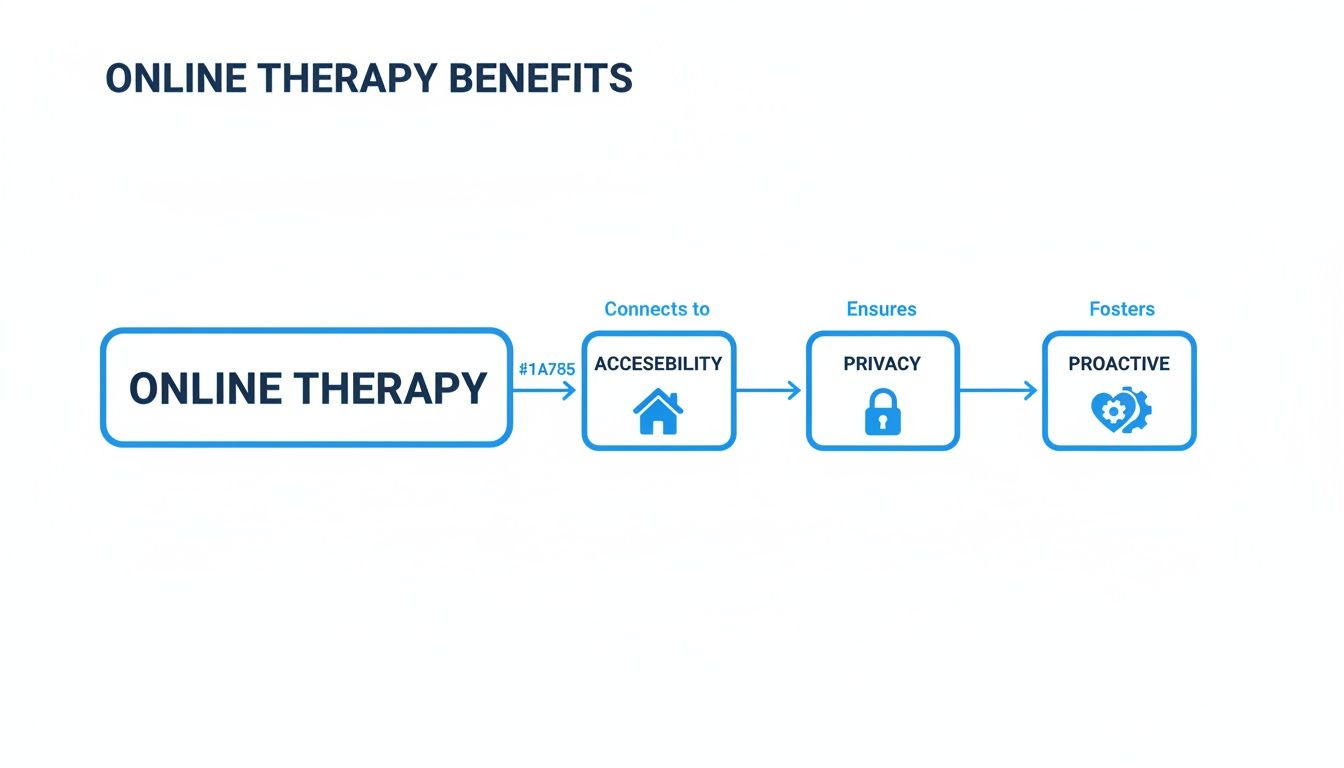
    The path to feeling better is personal, and the goal is not an overnight fix. It’s about gradually building skills to support your long-term mental health. Online therapy offers a supportive space to learn and practice these skills at your own pace.

    Embracing a Path of Self-Compassion

    As you begin, remember to be kind to yourself. Progress isn't always linear, and some days will be harder than others.

    Celebrate small wins, like showing up for a session or trying a new coping technique. These moments are the building blocks of resilience. Online counselling provides a non-judgmental space to explore your feelings and understand that struggling with anxiety or workplace stress is part of being human.

    True well-being comes not from the absence of problems, but from the confidence that you have the tools to handle them. Online therapy is about empowering you with those very tools.

    This sense of empowerment is at the core of therapy. It helps shift your perspective from feeling overwhelmed to feeling capable and ready to navigate life's challenges.

    The Growing Accessibility of Online Support

    If you're considering online support, you are not alone. In India, technology has made seeking mental health help more accessible and accepted than ever.

    One survey showed that about 61% of female and 55% of male respondents have used digital wellness tools. You can learn more about technology's role in mental health statistics to see how it's improving access to support. This growing acceptance means quality care is within reach for many. Platforms like DeTalks offer a safe starting point to browse professionals and find someone you connect with.

    Remember, any initial questionnaires or assessments are simply tools to start the conversation, not a final diagnosis. Taking this step is an act of hope and an investment in your happiness and a more resilient life.

    Frequently Asked Questions About Online Therapy

    It's normal to have questions when considering online therapy. You're taking an important step, and you deserve to feel clear about how it works. Here are answers to some common queries to help you feel more empowered.

    Is Online Therapy as Effective as In-Person Therapy?

    Yes, for many people, research shows that online therapy is just as effective as in-person sessions, especially for mild to moderate depression and anxiety.

    Therapeutic methods like Cognitive Behavioural Therapy (CBT) translate well to a digital format. The success of counselling depends on your connection with the therapist, which is entirely possible to build online. For more answers, you can check out Buddypro's FAQ section.

    How Is My Privacy Protected in Online Counselling?

    Reputable platforms use bank-level encryption and secure technology to ensure your conversations remain confidential. Therapists are also bound by the same strict professional codes of confidentiality as in a physical office.

    To protect your privacy, find a quiet space for your sessions where you won't be interrupted.

    Choosing a platform that is upfront and transparent about its privacy policies is crucial. It lets you relax and focus on what truly matters: your journey toward building resilience and self-compassion, without a second thought about your data.

    What Should I Expect from My First Session?

    Your first session is a low-pressure conversation for you and your therapist to get to know each other. You'll discuss what brought you to therapy, the challenges you're facing (like workplace stress), and your goals.

    Your therapist will ask about your background to better understand your situation. This is also your time to ask them questions and see if their approach feels like a good fit. The goal is to create a safe foundation to build upon. Remember, any initial screening tools are informational and not a formal diagnosis.


    Ready to take the next step in a supportive, confidential space? At DeTalks, you can connect with qualified professionals who can help you navigate life's challenges and build a path toward greater well-being. Explore our network of therapists and begin your journey today at https://detalks.com.