
Tag: psychologist vs psychiatrist

  • Can a Psychologist Prescribe Medication in India?

    Can a Psychologist Prescribe Medication in India?

    In India, psychologists cannot prescribe medication because they aren't medical doctors. Prescribing authority stays with psychiatrists and other registered medical practitioners under the country's mental-health and medicines framework.

    A college student notices sudden panic attacks before lectures. Their heart races, their breathing feels difficult, and they start avoiding crowded places. When they search for help, they find the words psychologist, clinical psychologist, counsellor, psychotherapist, and psychiatrist used almost interchangeably. One website says therapy is enough, while another suggests medication.

    That confusion is understandable. The professional titles sound similar, but the training and legal authority behind them are different. Choosing the right first appointment can make it easier to receive timely support for anxiety, depression, workplace stress, burnout, relationship difficulties, or a period of major change.

    A Common Question You Are Not Alone in Asking

    For the student with panic attacks, the practical answer is clear. A psychologist in India can provide psychological assessment, counselling, and therapy, but cannot prescribe, renew, change, or stop medication. If medication might be appropriate, the person needs an evaluation with a psychiatrist or another registered medical practitioner who has prescribing authority.

    The confusion often begins with the names. A psychologist and a psychiatrist both work in mental healthcare, but they don't follow the same professional route. A psychiatrist is a medical doctor trained to assess health conditions and manage medicines. A psychologist is trained in psychology, assessment, and talk-based interventions.

    That difference doesn't make one professional more important than the other. A person managing panic, depression, trauma, or severe workplace stress may benefit from both. The psychiatrist can review whether medication is suitable, while the psychologist can offer structured therapy to understand thoughts, emotions, behaviours, and coping patterns.

    Practical rule: If your question is “Can this professional prescribe medication?”, check whether the person is a registered medical practitioner, not whether their title includes the word “clinical”.

    India's mental-health needs are broad. The National Mental Health Survey findings estimated that nearly 150 million people in India live with one or more mental disorders, representing about 10.5% of the population. That makes clear, accessible navigation more than a matter of terminology.

    Workplace concerns also deserve attention. A 2022 study of 1,764 white-collar employees in urban India found that nearly 29% showed moderate-to-severe signs of depression, 55% showed moderate-to-severe signs of anxiety, and 78% had moderate-to-high stress, as reported in the Indian Journal of Psychiatry. The same research reported that about 99% had moderate-to-high psychological well-being, a useful reminder that people can experience distress and still have resilience, compassion, hope, and capacity for happiness.

    This guide looks at the training behind each role, the legal boundary, the titles people confuse, the limited international exception, and the practical pathway when someone may need therapy, medication, or both.

    How Psychologists and Psychiatrists Are Trained Differently

    The distinction becomes easier when you look at three areas: training, regulation, and daily work. These areas overlap in purpose, but they lead to different responsibilities.

    Training follows different paths

    Psychologists study psychology, human behaviour, emotions, cognition, assessment, and therapeutic methods. In India, clinical psychologists are professionally regulated by the Rehabilitation Council of India, while psychiatrists qualify through a medical pathway that begins with MBBS and continues with an MD or DNB in Psychiatry, typically involving about three years of supervised postgraduate residency after the basic medical degree. This difference is described in the overview of psychiatrist qualifications and registration in India.

    A psychologist's education supports work such as psychometric testing, diagnosis support, behavioural formulation, and evidence-based therapy. A psychiatrist's medical education includes the assessment of physical health, medical causes of symptoms, and the effects, risks, and interactions of medicines.

    The important point isn't the length of either course. It's the type of authority the training provides. Studying mental health doesn't automatically mean a professional has been trained or licensed to prescribe.

    Regulation sets the boundaries

    A registered psychologist may work within psychological assessment and therapy. A registered psychiatrist is a medical practitioner who can assess whether medication is appropriate and manage that treatment within their authorised scope.

    Counsellors and psychotherapists may also provide valuable talk-based support, depending on their training and professional setting. Their title alone doesn't grant prescribing authority. Before booking, ask about the person's qualification, registration, area of practice, and experience with the concern you want to discuss.

    Daily work often complements itself

    A psychologist may help someone identify unhelpful thinking patterns, develop coping skills, process grief, improve relationships, or work through trauma. Approaches can include cognitive behavioural therapy, behavioural interventions, supportive counselling, and other structured forms of psychotherapy.

    A psychiatrist may evaluate persistent depression, severe anxiety, bipolar disorder, schizophrenia, or other conditions where medication may form part of care. The psychiatrist also monitors response, side effects, and the need to continue, adjust, or review a prescription.

    These roles can work together without competing. Therapy addresses psychological and behavioural needs, while psychiatric care can address medication and medical management when required.

    What Indian Law Says About Who Can Prescribe

    The legal answer rests on two parts of India's healthcare framework. The Mental Healthcare Act, 2017 governs mental-health care and treatment nationwide, while the Drugs and Cosmetics Rules, 1945 provide the medicines-related boundary that matters when a prescription is involved.

    In everyday language, a psychologist may assess and treat through psychological methods, but isn't authorised to prescribe allopathic medicines. A psychiatrist, as a registered medical practitioner, can prescribe within their professional scope. The Mental Health First Aid India guidance on mental-health professionals explains the practical distinction: psychologists don't have a medical degree and therefore don't prescribe medicines, while psychiatrists do.

    The medicine rules add an important layer. Only a registered medical practitioner can prescribe Schedule H drugs under the Drugs and Cosmetics Rules, 1945. Psychologists, whether they work in counselling, clinical practice, or another psychology setting, aren't medical practitioners and can't write, alter, continue, or discontinue such a prescription. This legal boundary is also discussed in the India mental-health report covering prescribing authority and Schedule H drugs.

    What this means for a patient

    A psychologist might say, “It may be useful for you to have a medication evaluation.” That is a referral or clinical recommendation, not a prescription. You would then see a psychiatrist or another authorised prescriber for the medical assessment.

    An ayurvedic or Unani practitioner registered under the relevant system may prescribe within that system's rules. That limited authority doesn't extend to psychologists. A professional's ability to provide mental-health care and a professional's ability to prescribe are separate questions.

    The separation protects patients. Medication can affect sleep, mood, alertness, physical health, and other medicines a person may be taking. A prescriber needs the relevant medical training and legal authorisation to make those decisions safely.

    Comparing the Four Roles People Often Confuse

    Titles can be less useful than responsibilities. The following comparison gives a practical starting point, but qualifications and scope can vary by practitioner, so verify registration before beginning care.

    Professional Training and registration What they do Can prescribe?
    Clinical psychologist Psychology training with professional regulation through the Rehabilitation Council of India where applicable Psychological assessment, psychometric testing, diagnosis support, and evidence-based therapy No
    Counselling psychologist Psychology training focused on counselling and psychological support; verify the practitioner's qualification and registration Talk therapy for adjustment, stress, life transitions, relationships, and emotional concerns No
    Psychiatrist Medical training through MBBS followed by postgraduate psychiatry training, with registration as a medical practitioner Medical assessment, diagnosis, medication evaluation, prescribing, and medication management Yes, within authorised scope
    Counsellor or psychotherapist Training may focus on a counselling approach or specific therapeutic method; check the person's credentials Structured talk-based support, coping skills, emotional support, and behaviour change No

    A clinical psychologist may conduct an assessment or use therapy for depression, anxiety, trauma, behavioural difficulties, and other concerns. An assessment can help organise information and guide the next step, but it's informational and supportive, not a diagnosis by itself. A qualified practitioner must interpret the findings in context.

    A counselling psychologist or psychotherapist may be a sensible first choice for grief, relationship conflict, exam stress, burnout, workplace stress, or a difficult life transition. A psychiatrist may be the better first appointment when symptoms are severe, persistent, medically complicated, or possibly linked to a condition where medication needs urgent consideration.

    People who work in healthcare communications may also find it useful to find playbooks for psychiatrists when developing clearer information about psychiatric care and professional roles.

    There isn't a universal session length or fee that applies across India. Cost, availability, appointment format, location, and practitioner experience differ, so ask about these details directly rather than relying on a general price label.

    The Prescribing Psychologist Exception Around the World

    The answer isn't identical in every country. In a small number of jurisdictions, specially trained psychologists have limited prescribing authority under tightly defined conditions, often involving additional education in psychopharmacology, medical collaboration, and supervision.

    That model is different from ordinary psychology practice. It doesn't mean that every psychologist can prescribe, and it doesn't mean that a psychology degree is automatically equivalent to medical training. The authority depends on the local law, the practitioner's additional qualification, and the safeguards attached to prescribing.

    Some systems have also explored limited prescribing roles for specially trained psychologists connected with military services or pilot programmes. Other countries have approached the idea cautiously, with professional discussion and restricted experimentation rather than a broad change for all psychologists.

    India follows a clearer division. Under the Drugs and Cosmetics Rules, 1945, prescribing authority is tied to registered medical practitioners. A psychologist in India therefore cannot prescribe medication just because they have advanced experience, use the word “clinical”, or work in a hospital alongside doctors.

    Why the international difference matters

    Readers sometimes see an overseas article about “prescribing psychologists” and assume the same rule applies in India. It doesn't. Professional titles travel easily across websites, but legal authority doesn't.

    The safest approach is to identify the country where the professional is practising, then check the registration system and scope of practice that applies there. Someone who can prescribe in one jurisdiction may not have that authority after moving to another.

    For an Indian patient who wants both forms of care, collaborative treatment is the practical local equivalent. A psychologist can provide therapy, while a psychiatrist handles medication evaluation and management. The two professionals can communicate, with the patient's consent, so that therapy goals and medical care remain aligned.

    When to Choose Therapy, Medication, or Both

    The right first step depends on the person's symptoms, safety, daily functioning, and preferences. There isn't a single route that fits everyone, but a simple decision pathway can reduce uncertainty.
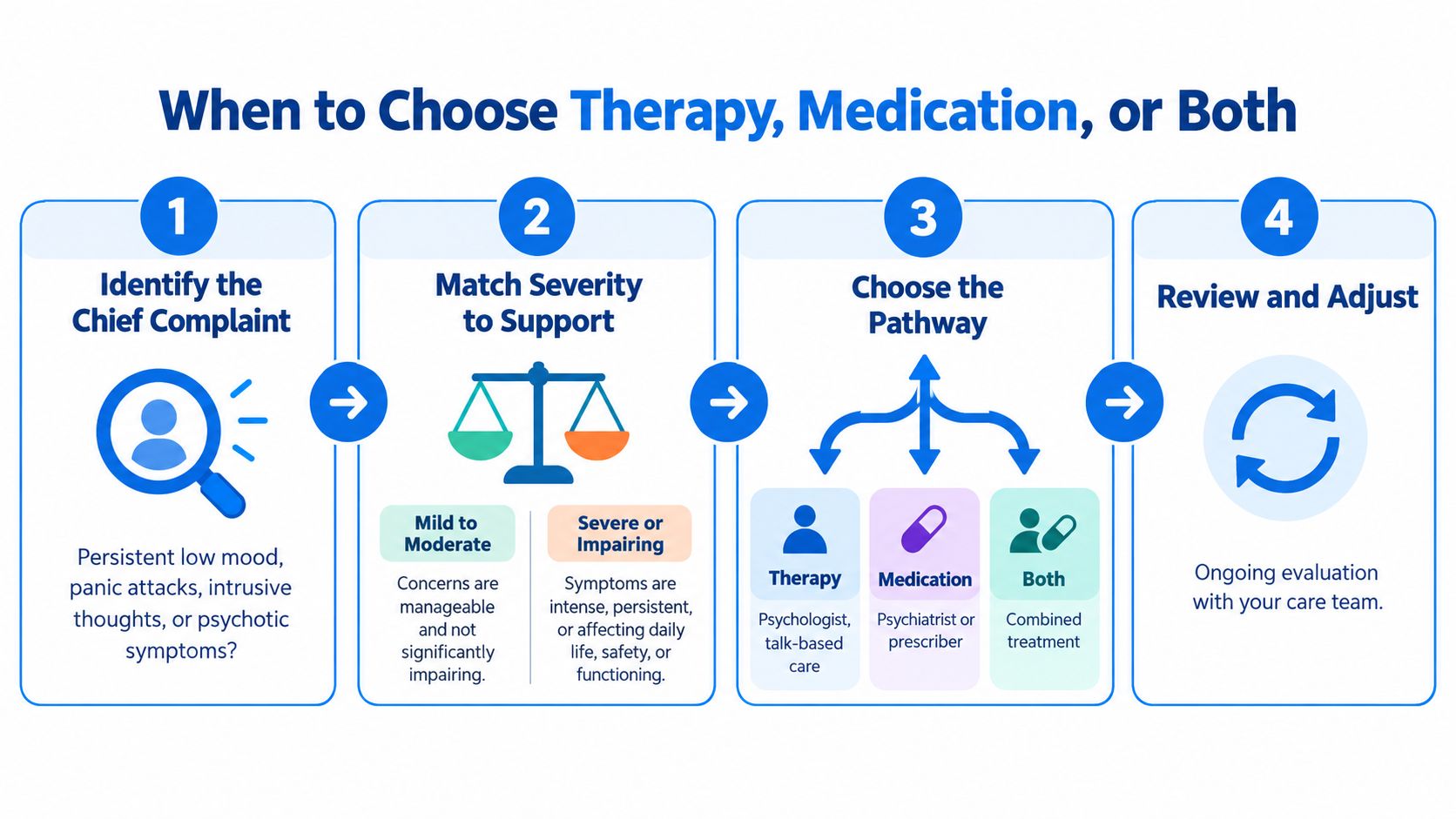
    A four-step infographic illustrating how to choose between therapy, medication, or both for mental health support.

    Step one identify the main concern

    Start with what's happening, not with a professional title. Persistent low mood, repeated panic attacks, intrusive thoughts, major changes in sleep or energy, or experiences that seem disconnected from reality may justify booking a psychiatrist first, because a medical evaluation may be needed.

    For situational stress, grief, relationship strain, habit change, mild anxiety, or workplace burnout, a psychologist or trained therapist may be a useful first contact. Therapy can help you understand triggers, practise new responses, and rebuild routines.

    Step two consider severity and safety

    Ask whether the concern is affecting work, study, relationships, sleep, eating, or basic self-care. A person who can't function, has rapidly worsening symptoms, or has already tried therapy without enough improvement may need psychiatric input as well as ongoing therapy.

    Urgent help is needed when there are thoughts of suicide, plans or intent to self-harm, serious self-injury, or signs of a manic episode such as very little need for sleep combined with unusually high energy, impulsive behaviour, or rapidly escalating activity. In immediate danger, contact local emergency services or go to the nearest emergency department.

    Step three choose one route or combine care

    Therapy may be the main support. Medication may be part of care after a psychiatrist's evaluation. Both can be appropriate, particularly when symptoms are persistent or significantly impairing, or when a psychiatrist recommends psychotherapy alongside medication.

    If you already see a psychologist, ask for a warm handoff. This might mean requesting a referral to a psychiatrist, asking whether the psychologist collaborates with one, and agreeing on what information can be shared. If you already see a psychiatrist, ask whether therapy could support recovery, coping, relationships, or relapse prevention.

    A combined plan isn't a sign that someone has failed at therapy or needs to depend on medication forever. It's a way of matching different forms of support to different parts of a person's experience.

    Here's a short visual summary of the decision process:

    Clearing Up Common Misconceptions About the Clinical Label

    The word clinical describes an area of psychology. It generally points to work involving mental-health assessment, psychological difficulties, and therapy. It doesn't mean the professional is a medical doctor, and it doesn't create prescribing authority.

    A clinical psychologist may be highly trained in assessment and psychotherapy. They may evaluate symptoms, use psychometric tools, provide evidence-based interventions, and suggest that a client consider a psychiatric consultation. They still can't write or refill a prescription in India.

    An M.Phil, Psy.D, or another advanced psychology qualification doesn't automatically turn a psychologist into a medical prescriber. The key questions are: what was the person's professional training, which body regulates the role, and what does Indian law allow that practitioner to do?

    Online profiles can add another layer of uncertainty. A person may describe themselves as a “clinical therapist” or “clinical counsellor”, but the adjective alone doesn't confirm the same status as a registered clinical psychologist. Look for clear information about qualifications and relevant registration, rather than assuming that a polished title carries a particular legal meaning.

    The India-focused explanation of what a clinical psychologist does reflects the role distinction between assessment and therapy on one side, and medication prescribing on the other. When a clinical psychologist recommends that you speak to a psychiatrist, that recommendation is part of responsible care, not an indication that the psychologist can prescribe personally.

    The label “clinical” should reassure you that the practitioner works with psychological concerns within their training. It shouldn't be read as a medical credential.

    Moving Forward With Clarity and Care

    Knowing who can prescribe is useful, but it's only one part of finding support. The broader question is what kind of help fits your current situation: therapy for patterns, emotions, relationships, and coping; psychiatric care for medication and medical assessment; or coordinated support involving both.

    Seeking help can be a resilience-building step. You don't need to wait until distress becomes overwhelming, and you don't need to decide the entire treatment plan before your first appointment. A psychologist, counsellor, or psychiatrist can help clarify the next step after listening to your concerns.

    Before booking, consider these practical checks:

    • Verify credentials: Ask about relevant professional training and check applicable RCI or medical registration details.
    • Prepare a short summary: Note when symptoms began, how they affect daily life, relevant health information, current medicines, and what support you've already tried.
    • Ask about collaboration: If you may need both therapy and medication, ask whether the provider can coordinate with another qualified professional.
    • Treat screening results carefully: Online assessments can offer useful information about symptoms, well-being, resilience, or stress, but they're not diagnostic tools on their own.
    • Discuss your preferences: Tell the practitioner whether you're seeking therapy, exploring medication, or unsure which route fits.

    Mental healthcare also includes more than illness management. Therapy and counselling can support compassion, happiness, emotional balance, self-esteem, mindfulness, purpose, and resilience, including for people who are functioning well but want to grow. Workplace stress, burnout, anxiety, and depression deserve care, while positive psychology reminds us to notice strengths and sources of meaning too.
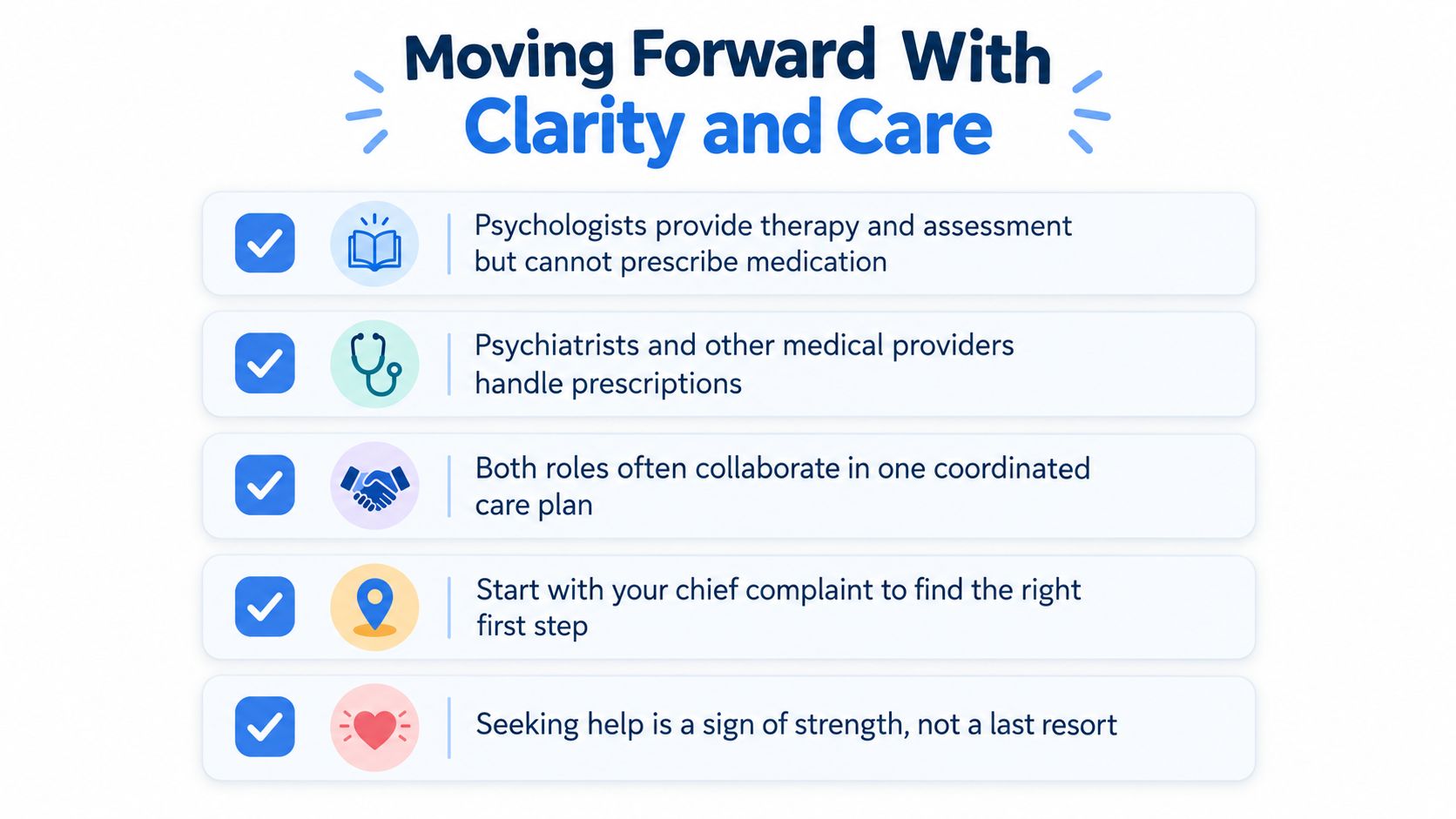
    An infographic titled Moving Forward With Clarity and Care comparing the roles of psychologists and psychiatrists.

    You can start with a psychologist for therapy, a psychiatrist for a medication evaluation, or both through a coordinated plan. What matters is choosing a qualified professional, asking clear questions, and giving yourself permission to seek support before a crisis.


    DeTalks helps people across India find and book sessions with psychologists, therapists, counsellors, and other mental-health professionals, while its confidential assessments are designed to provide information and guide the next step, not replace a diagnosis. Visit DeTalks to explore support for anxiety, depression, workplace stress, burnout, relationships, resilience, and overall well-being.

  • Psychologist vs Psychiatrist for Depression: How to Choose

    Psychologist vs Psychiatrist for Depression: How to Choose

    You're sitting with your phone in your hand, searching for help because getting out of bed has started to feel difficult, work no longer feels manageable, or your thoughts keep circling the same painful concerns. Then another question appears: should you book therapy with a psychologist or consult a psychiatrist about medication?

    The answer isn't a contest between two professions. It's a practical decision based on your symptoms, safety, daily functioning, medical history, and access to care. In India, that decision is also shaped by a serious shortage of mental-health professionals, so the most realistic starting point may be the qualified provider you can reach soonest, with referral when your needs change.

    Understanding the Two Professionals

    Riya has been feeling low for several weeks. She's withdrawn from friends, is struggling to concentrate at work, and has stopped doing things she once enjoyed. She isn't sure whether she needs a counselling session, a medical appointment, or both.

    A psychologist is trained primarily in talk therapy, behavioural interventions, and psychological assessment. For depression, a psychologist may help someone understand patterns of thinking, rebuild daily routines, work through grief or relationship stress, and develop coping skills through approaches such as cognitive behavioural therapy, interpersonal therapy, or behavioural activation.

    A psychiatrist is a medical doctor specialising in mental health. Psychiatrists can assess and diagnose mental-health conditions, consider physical or medication-related contributors, prescribe antidepressants when appropriate, and manage treatment when symptoms are severe or medically complicated.

    The simple distinction: psychologists mainly provide psychological therapy and assessment. Psychiatrists provide medical evaluation and can prescribe medication.

    In India, a clinical psychologist may have training such as an M.Phil in Clinical Psychology or a Psy.D, alongside the registration required for practice. A psychiatrist generally completes an MBBS followed by an MD in Psychiatry. Exact qualifications and registration should always be checked before booking.

    A comparison chart showing the differences between psychologists, who provide talk therapy, and psychiatrists, who provide medical treatment.

    India's access problem makes this distinction especially important. The National Mental Health Survey found that 10.6% of Indian adults had a diagnosable mental disorder, with lifetime prevalence at 13.7%, and reported a treatment gap of 70% to 92%. Government reporting also notes only 0.75 psychiatrists per 100,000 people, compared with the WHO-referenced benchmark of 3 per 100,000. These figures come from the Government of India's mental-health reporting.

    That shortage means the psychologist-vs-psychiatrist decision is often a triage question, not a perfect theoretical choice. You might begin with a psychologist for structured therapy and be referred to a psychiatrist if medication, medical assessment, or urgent support becomes necessary.

    Training and How Each Assesses Depression

    The two professionals look at depression through different but complementary lenses. A psychologist's assessment usually explores emotions, thoughts, behaviour, relationships, stressors, coping patterns, and the effect of symptoms on daily life.

    A psychiatrist also asks about mood, sleep, appetite, motivation, concentration, anxiety, substance use, and safety. Because psychiatry is a medical speciality, the assessment can also consider physical contributors, medication side-effects, substance effects, or symptoms that may point towards another condition.

    What a psychologist may explore

    A psychologist may use a structured clinical interview, behavioural observation, and validated screening tools such as the PHQ-9 or Beck Depression Inventory. These tools can organise information about symptom intensity, but they don't replace a professional evaluation.

    The psychologist may also develop a formulation, which is a working explanation of how your thoughts, behaviours, relationships, history, and current circumstances interact. If there are concerns about attention, memory, learning, or cognitive functioning, psychological or neuropsychological testing may be considered.

    What a psychiatrist may add

    A psychiatrist's evaluation includes a psychiatric interview and a medical review. They may assess whether symptoms fit diagnostic criteria used in systems such as the ICD or DSM, while also considering physical health and medication history.

    Neither assessment is automatically “better”. One offers detailed psychological understanding, while the other adds medical diagnosis, risk assessment, and prescribing authority.

    Aspect Psychologist Psychiatrist
    Core training Psychology training, with clinical or counselling specialisation Medical training followed by specialist psychiatry training
    Primary focus Thoughts, emotions, behaviour, relationships, and coping Mental health diagnosis, medical factors, risk, and medication
    Assessment style Interviews, behavioural observation, screening scales, and psychological testing Psychiatric interview, medical review, diagnosis, and medication evaluation
    Depression treatment Psychotherapy, behavioural interventions, and counselling Medication management, medical care, and referrals for therapy
    Can prescribe medication Generally no Yes
    When collaboration helps When therapy needs medical support or symptoms persist When medication works alongside ongoing psychotherapy

    Training shortages have been documented for years. A 2013 Government of India release on the National Mental Health Programme listed 11,500 psychiatrists required versus 3,800 available, and 17,250 clinical psychologists required versus 898 available. The imbalance helps explain why coordinated care, tele-mental health, and referral pathways matter in India.

    What Treatment Looks Like With Each Professional

    Treatment feels different depending on whom you see first. With a psychologist, the work is usually conversational but structured. You may discuss recent situations, identify patterns, practise new responses, and agree on small activities between sessions.

    Psychotherapy can include CBT, interpersonal therapy, behavioural activation, or other evidence-based approaches. The focus might be rebuilding sleep and daily routines, reducing avoidance, challenging harsh self-judgements, improving communication, or processing a difficult life event.

    Sessions are often regular, with progress reviewed over time. Therapy requires participation between appointments, and its benefits may build gradually. That can feel demanding when motivation is low, but it also gives you skills that can support long-term well-being.

    A psychiatrist's first appointment usually centres on symptom history, diagnosis, safety, medical context, and whether medication could help. Follow-up appointments review changes in mood, sleep, appetite, anxiety, functioning, and side-effects, allowing the treatment plan to be adjusted.

    The practical trade-off

    Therapy is time-intensive and depends on a good working relationship with the psychologist. It generally doesn't involve medication side-effects, but it may feel frustrating if symptoms are so severe that you can't engage consistently.

    Medication can be important when depression is moderate or severe, when functioning has deteriorated, or when a person needs medical stabilisation. It requires monitoring, patience, and honest communication about unwanted effects. Never start, stop, or change an antidepressant without speaking with the prescribing doctor.

    Indian clinical guidance places psychotherapy most often as an initial treatment for minor depression and mild-to-moderate major depression, while antidepressants are usually preferred when medication is needed for mild, moderate, or severe depressive episodes. The Indian clinical practice guidelines explain this treatment distinction.

    A comparison chart showing how treatment differs between psychologists who offer talk therapy and psychiatrists who prescribe medication.

    For moderate or severe depression, combined care is often practical. A psychiatrist can manage medication while a psychologist provides regular therapy, provided both professionals communicate and the person understands who is responsible for each part of care.

    Typical Depression Care Pathways in India

    A person in a smaller Indian city may find a psychologist nearby, while psychiatric appointments are available only through a visiting specialist, telehealth service, or distant hospital. That reality makes depression care a triage decision, not just a choice between two job titles. Stepped care starts with support that matches current needs and adds specialist input when symptoms persist, worsen, or affect safety.

    The opening step can include psychoeducation, self-help resources, lifestyle support, or brief counselling. A psychologist, counsellor, primary-care doctor, community service, or trained tele-mental-health professional may help clarify what is happening and whether structured treatment or medical assessment is needed.

    A flexible staircase

    1. Early information and support: Learn about depression, track symptoms, involve someone you trust, and strengthen sleep, meals, activity, and daily routine.

    2. Brief counselling or structured therapy: For mild or uncomplicated symptoms, a psychologist may provide behavioural activation, CBT-informed work, or another suitable therapy approach.

    3. Review when progress is limited: If symptoms continue, interfere more with daily life, or raise questions about the diagnosis, psychiatric consultation can add medical assessment and discuss medication.

    4. Ongoing coordinated care: Therapy and medication may continue together. Follow-up can then be adjusted according to symptom response, risk, side-effects, and personal circumstances.

    The ICMR Standard Treatment Workflows for depression describe a stepped approach. For mild depression, care may begin with behavioural activation, brief counselling, yoga or meditation, and frequent follow-up. If there is no improvement in 4 to 6 weeks, pharmacotherapy may be considered. For moderate or severe depression, SSRIs such as escitalopram or fluoxetine are commonly used. Improvement may begin around the second week, adequate response is assessed by about six weeks, and continuation treatment typically lasts 6 to 9 months.

    District Mental Health Programme services, government hospital psychiatry OPDs, medical colleges, and tele-mental-health services may all form part of this pathway. Availability differs by location, so ask a local hospital how referrals work rather than assuming every service is offered in the same way.

    In tier-2 and tier-3 cities, a local psychologist may provide regular therapy while a visiting or tele-psychiatrist reviews medication and risk. Scheduling, records, referrals, and follow-up can also be supported by digital systems. Organisations building this infrastructure may seek clinical software development support to set up healthcare technology responsibly.

    Coverage depends on the public scheme, hospital, insurer, policy terms, and referral rules. Ask about Ayushman Bharat eligibility, outpatient coverage, therapy limits, psychiatric consultations, and reimbursement before relying on a service.

    A visual chart titled India's Stepped-Care Pathway for Depression showing five progressive levels of mental health support.

    Matching the Right Professional to Your Situation

    Choosing a first appointment is a triage decision, especially where India's mental-health workforce is unevenly distributed. Severity matters, but so do the symptom pattern, speed of change, daily functioning, physical health, previous treatment, and any safety concern. The aim is to start with the right level of support and make referral easier if the picture changes.

    Three situations

    Mild and recent symptoms: You feel low, disconnected, or unmotivated, yet you can manage basic responsibilities and have no thoughts of harming yourself. A psychologist is often a sensible starting point for therapy, behavioural activation, routine-building, and emotional support.

    Moderate symptoms with partial functioning: Sleep is disrupted, rumination continues, work or study is becoming difficult, and you are withdrawing from people. A psychologist and psychiatrist may need to work together. If therapy brings limited improvement after 4 to 6 weeks, medication can be considered alongside therapy, following the assessment and care plan made by a qualified professional.

    Severe or high-risk symptoms: Active suicidal thoughts or plans, psychotic symptoms, extreme agitation, catatonia, sudden loss of functioning, or signs that could indicate bipolar disorder call for urgent psychiatric or emergency assessment. Weekly talk therapy alone should not be the only response when safety, reality testing, or basic functioning is seriously affected.

    Severity Typical presentation Recommended starting professional Treatment focus Escalation trigger
    Mild Low mood, reduced interest, manageable disruption Psychologist or qualified counsellor Therapy, behavioural activation, counselling, routine support Symptoms persist, worsen, or significantly affect daily functioning
    Moderate Sleep and concentration problems, rumination, partial functioning Psychologist with psychiatric referral, or both Structured therapy, review of medication need, coordinated care Limited response, worsening function, medical complexity, or safety concerns
    Severe Serious impairment, suicidality, psychosis, catatonia, or possible bipolar features Psychiatrist or emergency service urgently Safety planning, medical assessment, medication, and higher-level care Immediate emergency support when danger is imminent

    The table is a starting guide, not a diagnosis. An assessment tool can help organise what you are noticing, but it remains informational, not diagnostic. A qualified professional must interpret the full picture, including medical history and safety.

    Workplace stress can complicate the choice. A review of workplace mental health research in India reports wide variation in depression, anxiety, and workplace-stress findings across Indian studies. Therapy can address boundaries, burnout, anxiety, and coping. A psychiatrist may be needed when symptoms become severe, functioning drops sharply, or a medical component needs assessment.

    Practical Guidance for Referrals and First Sessions

    You don't need to arrive at the first appointment with the correct label. Bring a short account of what has changed, when it began, how it affects sleep and functioning, what you've tried, and whether you've noticed thoughts of self-harm.

    Check the professional before booking

    In India, verify that a clinical psychologist has appropriate Rehabilitation Council of India registration. For a psychiatrist, check medical registration through the relevant state medical council or the applicable MCI or NMC pathway.

    Titles can be confusing, and not every person offering “counselling” has the same training. Ask what qualification the provider holds, what registration applies, and whether they regularly work with depression.

    Questions that make the first session useful

    • Experience: “How do you usually assess and treat depression?”
    • Method: “Which therapy approach do you use, and how will we know whether it's helping?”
    • Frequency: “How often would you suggest sessions at the beginning?”
    • Coordination: “If you think I need medication, how do you refer to or work with a psychiatrist?”
    • Costs: “What are the fees, cancellation rules, and likely follow-up arrangements?”
    • Access: “Do you offer tele-consultation, and how do you handle urgent concerns?”

    A current therapist can refer you to a psychiatrist without ending therapy. Share consent for relevant information to be exchanged, especially medication history, symptom changes, risk concerns, and treatment goals.

    Urgent help matters more than provider preference. Active suicidal plans, recent self-harm, sudden personality change, hallucinations, delusions, severe confusion, or inability to care for basic needs require urgent psychiatric or emergency attention.

    Government hospital OPDs, medical colleges, private hospitals, tele-consultation platforms, and community organisations can all be starting points. If cost is a concern, ask about sliding-scale arrangements, public services, employer support, and insurance terms. A Bengaluru workplace survey found that only one in four people received mental-health support at work, according to the White Swan Foundation workplace mental-health survey, so don't assume your employer's programme is the only option or that support is automatically available.

    Supportive Takeaways for Moving Forward

    The psychologist-vs-psychiatrist decision becomes clearer when you ask three questions: How severe are the symptoms? How safe am I right now? What kind of help can I access consistently?

    For mild or moderate depression without urgent safety concerns, therapy with a psychologist is often a reasonable first step. A psychiatrist becomes more important when medication may be needed, symptoms are severe, a physical contributor is possible, previous treatment hasn't helped, or risk is increasing.

    Combination care isn't a sign that you've failed at therapy or that medication has “won”. It allows two professionals to work on different parts of the same problem. One may support medical stability while the other helps you rebuild routines, relationships, confidence, and coping skills.

    Progress rarely moves in a straight line. You may need to adjust the therapy approach, seek a second opinion, change professionals, add psychiatric care, or return to an earlier step. Finding a different provider when the fit isn't right is a practical part of care, not a personal failure.

    Concerns that deserve compassion

    Cost can make people delay care. Stigma can make them minimise symptoms. Family opinions may create pressure, and fear of medication may come from stories that don't match their own health needs.

    You don't have to settle every concern before asking for help. Write down your questions and ask the professional to explain benefits, risks, alternatives, monitoring, and what happens if the first plan doesn't suit you.

    Positive psychology belongs here too. Resilience, compassion, happiness, gratitude, emotional balance, and purpose aren't substitutes for depression treatment, but they can become meaningful parts of well-being as care progresses. Support can address workplace stress, anxiety, burnout, loneliness, relationship strain, and the habits that help you feel more connected to life.

    An infographic titled Supportive Takeaways for Moving Forward, outlining four key points for seeking mental healthcare.

    Assessments can help you describe patterns, but they're informational, not diagnostic. Use them to prepare for a conversation, not to decide on medication or label yourself.

    In the next 48 hours, choose one small action: list three symptoms and when they began, book an initial psychology session, contact a psychiatrist, or ask someone you trust to help make the call. You don't need to predict the entire journey. You only need to make the next safe, informed step.


    DeTalks helps you explore psychologists, therapists, and mental-health professionals by concern, including depression, anxiety, stress, and workplace well-being, while its assessments are intended to offer informational insight rather than diagnosis. Visit DeTalks to review suitable support options and take one practical step towards care.