
Two people answer the same twenty questions about how they've been feeling since a frightening experience. One gets a green tick and a note to relax. The other gets a red warning and a list of helplines. Both answered, and neither of them changed. What separated them wasn't the trauma. It was the questionnaire, the cutoff score, and the way the result was explained.
People looking for a PTSD test online deserve to know that gap exists before typing their answers into a box. A screening tool can be useful, and it can also mislead in both directions when nobody tells you what the number is designed to do.
India makes that clarity urgent. The National Mental Health Survey 2015-16 found that 10.6% of adults currently experienced a mental disorder, with lifetime prevalence at 13.7%, and estimated that about 150 million people needed mental health intervention (National Mental Health Survey 2015-16). A short, private check can be a first step for some of them. It can't be the last one.
What an Online PTSD Test Can and Cannot Tell You
Think of an online PTSD test the way you'd think of a symptom checklist you fill in at home before a doctor's appointment. It helps you notice patterns, find words for what's been happening, and walk into the conversation prepared. It is not a scan, a blood test or a verdict. Nobody has ever been diagnosed by a form.
Here's how the two experiences line up.
| Feature | Online PTSD test | Clinical assessment |
|---|---|---|
| Purpose | Identifies possible symptoms for follow-up | Confirms or rules out a diagnosis |
| Who interprets | You, using the score guidance provided | A trained mental-health professional |
| Trauma history | Usually a brief self-report | Detailed interview covering timeline and history |
| Symptom duration | Often asks about the past month only | Confirms symptoms persist and cause impairment |
| Overlapping conditions | Rarely separates depression, anxiety or complex PTSD | Differentiates overlapping conditions |
| Output | A score band and a suggested next step | A diagnosis and a personalised care plan |
The table carries the comparison. What it can't show is how much judgement sits inside the right-hand column. A clinician asks what happened, when your symptoms started, how often they appear and what they stop you from doing.
A questionnaire can flag the clusters that matter. It picks up intrusive memories, avoidance, heightened alertness, emotional numbing and sleep disturbance. What it can't do is confirm that the event you have in mind meets the clinical definition of trauma, or that your symptoms have lasted long enough and interfered enough to count.
Which questionnaire you take matters as much as the answers. An Indian review of 56 studies found 25 different PTSD-screening methods in use, with versions of the Impact of Events Scale appearing in 14 of them (Frontiers in Psychiatry). Different tools, languages and cutoffs will sort the same person into different bands.
A useful rule: a screen tells you where to look, not what you have.
So what is it good for? Organising a jumble of symptoms into something you can describe out loud. Preparing for a first session with a counsellor or therapist. Noticing that the way you've been sleeping, snapping and avoiding since March is worth acting on rather than pushing through.
How to Take an Online PTSD Test Accurately
A screen is only as useful as the answers you put into it. These seven habits take about ten minutes and make the difference between a score that helps and one that misleads.
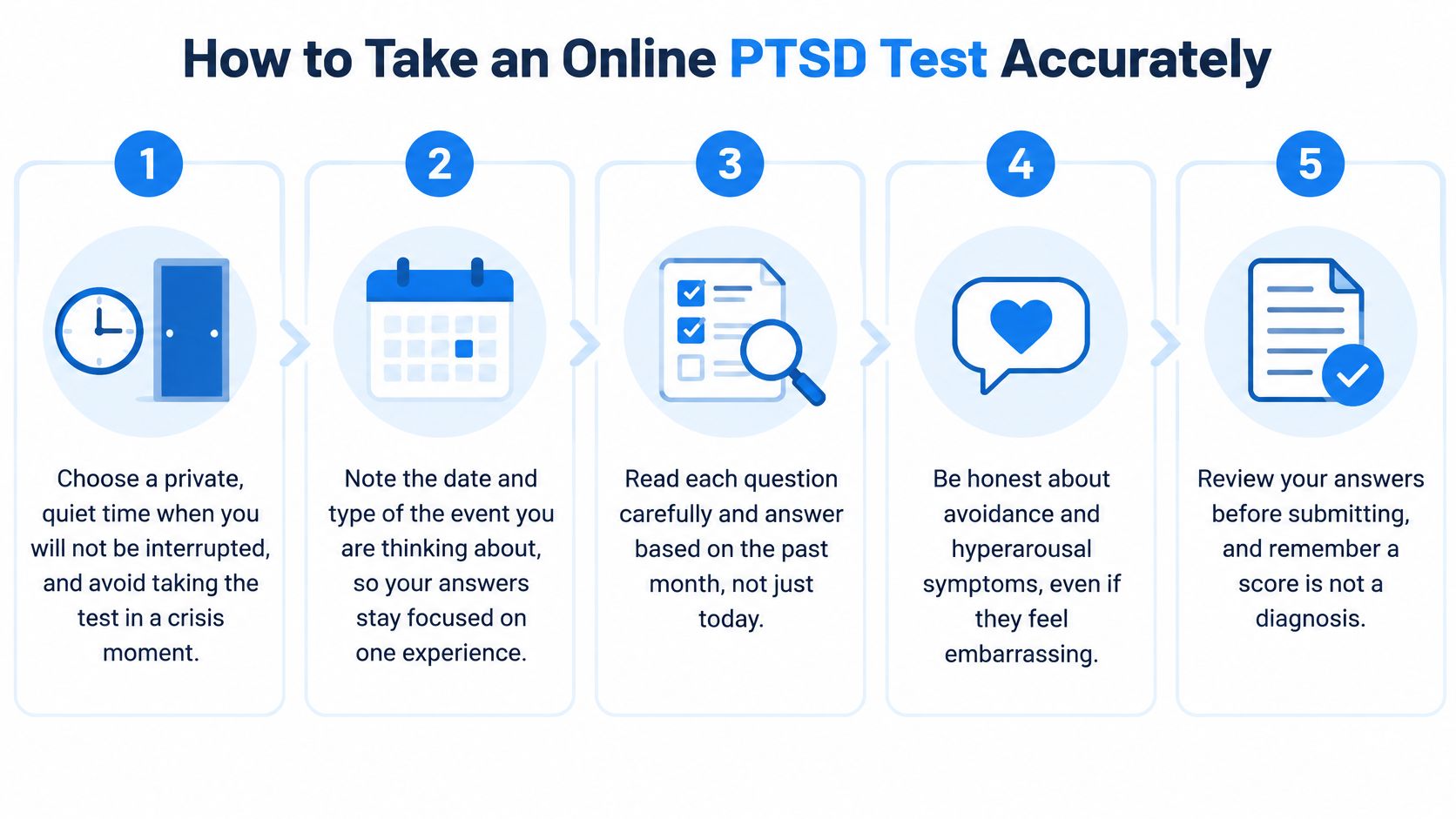
- Choose a private, quiet moment. Not during a crisis, not in a crowded room, not on a commute. You'll answer more openly when nobody can glance at the screen, and openness is the whole point of the exercise.
- Note the date and type of the event. Many questionnaires ask you to keep one experience in mind. Write the date down first so your answers stay anchored to a single trauma instead of drifting between three.
- Check which timeframe the questions use. Most PTSD screens ask about the past month. If this one asks about the past week, your answers describe a different window and you should read the result that way.
- Answer for how you've felt, not how you think you should. The questions about avoidance and jumpiness are the ones people soften, because admitting you've stopped taking a certain road feels dramatic. Softening them costs you the information you came for.
- Answer the safety question openly. If a question asks about self-harm or feeling unsafe, saying yes triggers help you need. Follow the emergency guidance on the page immediately rather than finishing the quiz first.
- Record your total and band before reading any interpretation. Write the number down. It stops a reassuring paragraph from talking you out of something you already noticed.
- Pause for a day before acting on the result. A score is a prompt, not an emergency, unless the safety question says otherwise. Sleep on it, then reread the next-step guidance in the morning when you can think clearly.
One more thing worth knowing: alcohol, a run of bad sleep or a fresh shock can all shift your answers by a few points. If the result surprised you, retake the test after a week and compare the two. Persistent symptoms across two weeks tell you far more than one rough afternoon does.
Reading Your Online PTSD Test Score
Whatever number you're looking at, it isn't a diagnosis. A score describes symptoms you reported during one window of time. A qualified professional decides whether those symptoms add up to PTSD, and what else might be going on.
| Score band (0-80 scale) | What it may indicate | Suggested next step |
|---|---|---|
| Below 33 | Few PTSD symptoms reported at this threshold | Keep up well-being habits and retest if symptoms change |
| 33 and above | Reaches the cutoff used in one Indian flood study; indicative only | Book a clinician evaluation for a full assessment |
| Any score with thoughts of self-harm | Safety concern overrides the total score | Contact emergency services or a helpline now |
Most online tools adapt the PCL-5, a 20-item symptom screener scored from 0 to 80, and one Indian flood study used 33 or above as its threshold (Nepal Journal of Epidemiology). Nationally established Indian cutoffs aren't available yet, so treat every band as indicative rather than official. A band is guidance, not a border between well and unwell.
Below 33. Few PTSD symptoms showed up at that threshold. That's reassuring, and it isn't a clean bill of health, especially if you answered quickly or skipped the avoidance questions. Keep doing the things that hold you steady, and retest in a few weeks if something changes.
33 and above. You've crossed the line one Indian study used to flag people for further assessment. Book an evaluation with a qualified clinician. Take the score with you, along with the date of the event and a short list of what's changed in your sleep, work and relationships.
If any answer raised thoughts of self-harm or of not being safe, the total score is irrelevant. Contact emergency services or a helpline now.
The timeframe matters when you read your own result. A score taken during a brutal week after a breakup, a job loss or a hospital stay may look very different from one taken in a calmer month. If you want to understand what sits behind the questions, the 17 symptoms of PTSD explained walks through each cluster one by one, which is useful preparation before you describe your own experience to a counsellor.
When a Score Overlaps With Anxiety, Depression or Burnout
A high score on a PTSD test online rarely arrives alone. Anxiety, depression, grief, broken sleep and plain exhaustion travel with trauma symptoms so often that a single number can't tell you which one is driving the result.
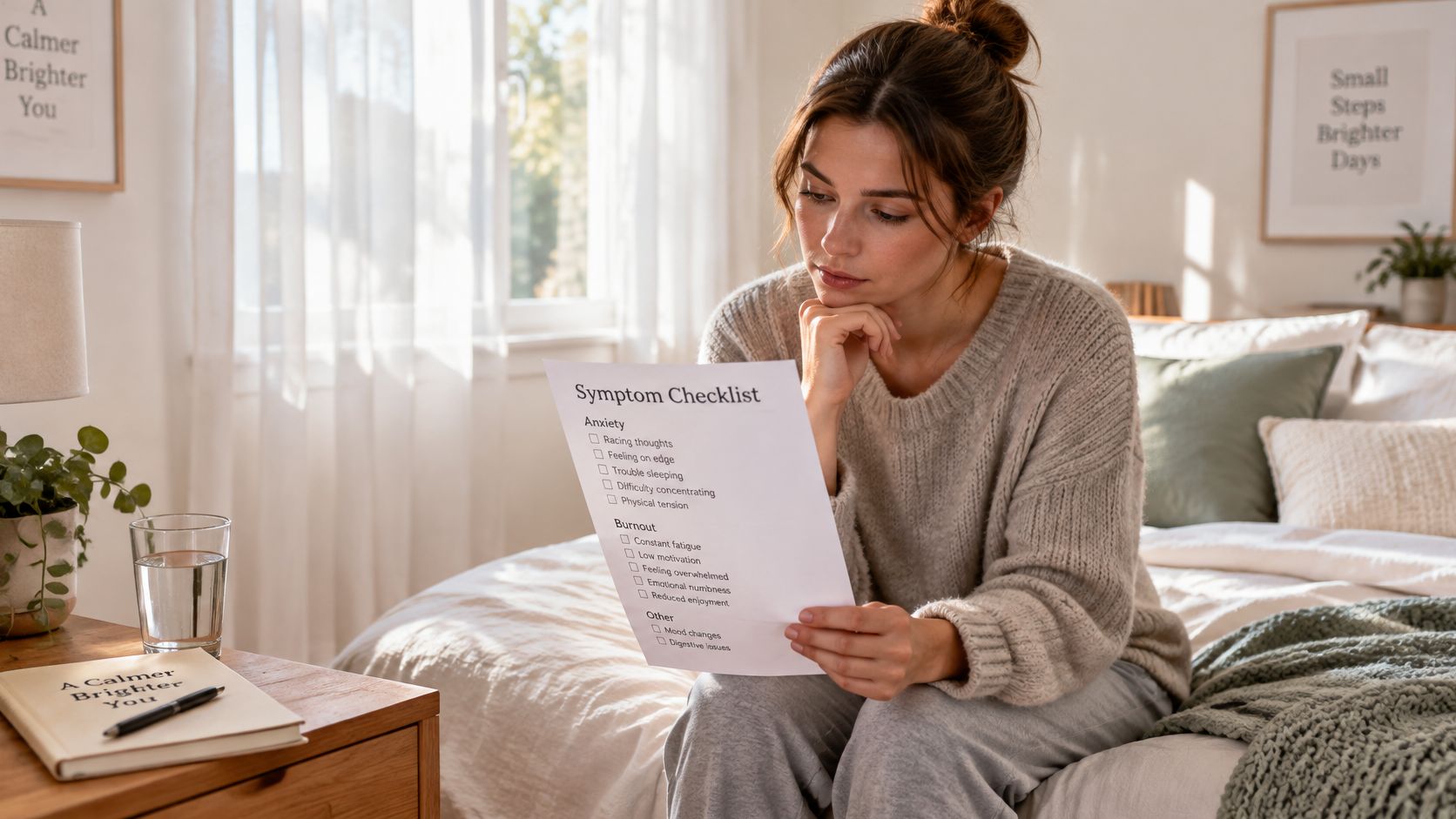
Five patterns that can look like PTSD
- Anxiety. Constant worry, a tight chest and a startle response that fires at small noises can mimic hyperarousal.
- Depression. Low mood, lost interest and deep fatigue look a lot like the numbing and withdrawal that follow trauma.
- Grief. Longing, disbelief and vivid images of someone who died can feel like intrusive memories.
- Sleep problems. Broken nights on their own produce irritability, poor concentration and a jumpy nervous system.
- Burnout. Long hours, impossible targets or harassment at work leave people flat, detached and reactive, which reads like avoidance.
The overlap changes what helps. A clinician works out which pattern is primary, because therapy for trauma looks different from therapy for depression or for workplace burnout. Getting the label wrong sends you down the wrong route for months.
Scale makes the point. In a 2025 study of 538 urban college students in Mysore, 20.8% met ICD-11 criteria for PTSD and 15.2% met criteria for complex PTSD (Indian Journal of Psychological Medicine). A yes or no quiz would flatten two distinct groups into one result and lose the difference entirely.
Complex PTSD, in everyday words, comes from trauma that was repeated or prolonged, often abuse or neglect over years rather than a single event. It adds difficulty managing emotions, a persistent sense of being damaged or worthless, distrust of the world and trouble holding relationships together. If your history is long rather than one moment, say so early when you speak to a professional.
If you'd like a calmer walk-through of how these symptoms show up day to day, this short video is a good place to start.
Overlap is normal, not a sign that you're imagining things. While a clinician clarifies the picture, the basics still count: steady sleep, movement, contact with people you trust, and a little self-compassion on the days you get none of that right. Resilience is built in small repeats, not one heroic week.
Why PTSD Figures Differ Across Groups in India
A single number can make PTSD look either vanishingly rare or practically inevitable. Neither reading survives a look at who was measured, how close they were to the trauma, and which tool was used.
| Population or study | Reported PTSD figure | What it tells you |
|---|---|---|
| General Indian adult population (National Mental Health Survey 2015-16) | About 0.2% | Low national figure from a structured diagnostic survey, not proof that trauma is rare |
| Natural-disaster studies (cross-cultural review) | Average 31% | Prevalence shifts with event, timing and sample |
| Orissa cyclone survivors, three months after (1999) | As many as 89% above cutoff | Severe, close-in trauma can produce very high rates |
| Tsunami child survivors (2004) | 1 of 177 (about 0.6%) above cutoff | Results depend on who is tested and when |
| Indian disaster-affected populations (pooled meta-analysis) | 38% | A pooled estimate across studies with varied methods |
| Community screening in Indian-administered Kashmir | 3.76% to about 25% | Screening-based ranges, not locally validated diagnostic rates |
Read the first row carefully. That 0.2% comes from a structured diagnostic survey of 39,532 people across 12 Indian states, not from a symptom checklist filled in at home (National Mental Health Survey). A low national rate means most adults don't meet full criteria at any one time. It doesn't mean trauma is rare, and it certainly doesn't mean your own reaction is overblown.
The disaster rows tell a different story. Natural-disaster studies averaged 31%, and as many as 89% of Orissa cyclone survivors assessed three months after the 1999 event met the study's cutoff, because that group was exposed directly and recently (cross-cultural review of disaster research). The 2004 tsunami finding, 1 child in 177, shows how much age and timing change the picture.
Pooled estimates carry their own warning. A meta-analysis of Indian disaster-affected populations put PTSD at 38% while flagging very high heterogeneity between the studies it combined (analysis of Indian disaster survivors). In Indian-administered Kashmir, community estimates ran from 3.76% to about 25%, and the review behind them noted that its 19% finding was a screening-based estimate of probable PTSD rather than a locally validated diagnostic rate (Frontiers in Psychiatry).
A figure describes a group. It never describes you.
What does that mean for your own result? If you've lived through a disaster, violence, an accident or a sudden loss, a positive score deserves prompt professional evaluation, particularly when symptoms are affecting work, study, sleep or relationships. Proximity and recency matter, and so does getting an answer early.
Next Steps When Therapy Feels Out of Reach
Knowing you need help and getting it are two different problems in India. The mental-health treatment gap has been estimated at 70% to 92%, linked to limited awareness, stigma and a shortage of professionals, while public-facility use for mental-health services sits at about 10% against a target of 15% (Press Information Bureau). A result screen that says "seek professional help" isn't a plan. A plan has steps, costs and a name attached to it.
A graded plan, starting with safety
- Handle danger first. If you're in immediate danger or having thoughts of suicide, contact emergency services or a helpline today. Nothing further down this list matters until that's addressed.
- Tell one person. A family member, a friend, a colleague you trust. Having someone sit with you while you make the first call makes the call far more likely to happen.
- Try public and tele-mental-health services. Government hospital psychiatry departments, district mental health programme clinics and phone or video consultations cost little or nothing. Ask what the wait looks like and what you should do if things worsen in the meantime.
- Compare private therapy and counselling. Before booking, ask four questions: what you'll pay per session, how long each session runs, how much of their practice is trauma work, and how you'll both judge whether it's helping.
- Look for cultural fit. A therapist who speaks your language and understands your family setup and workplace stress will get to the point faster than one who doesn't.
Privacy stops people more often than cost does. You can ask any therapist how records are kept, who can see them and what they're required to share. If cost is the barrier, ask directly about sliding scales and supervised trainee clinics, which often charge less than a senior private practice.
Three paths from your score
Lower band, but something still feels off. Keep your well-being habits going, track your sleep and mood for two weeks, and retest. If the second score is higher, or the sleep problems and tension persist, that pattern is your reason to book an evaluation.
Higher band, or daily life is affected. Book a clinician evaluation and bring three things: the score, the date of the event, and a written list of what you've stopped doing. That last item is easy to forget and is what a clinician notices fastest.
Any safety concern. Contact emergency services or a helpline now, before you finish reading this page. Escalate the same day if you feel detached from reality, unable to function, or flooded by memories you can't interrupt.
If you'd rather not search alone, DeTalks lists psychologists, therapists and counsellors across India, and you can browse profiles and book a session when you feel ready.
A test is a snapshot of one month, not a life sentence. Healing from trauma takes time, and it tends to move when someone qualified is alongside you. Reaching out is a skill rather than a weakness, and only a trained professional can make a diagnosis.
If your score has left you with more questions than answers, DeTalks gives you a private place to take a confidential screening assessment and, when you're ready, to browse psychologists, therapists and counsellors who can look at the whole picture with you. You can read profiles at your own pace and book a session only when it feels right. Start at DeTalks and take the next step on your own terms.