Tag: relationship anxiety

  • Feeling Insecure in Your Relationship? How to Build Trust and Confidence

    Feeling Insecure in Your Relationship? How to Build Trust and Confidence

    Insecurity in a relationship is that persistent, nagging feeling of doubt about where you stand with your partner. It’s a deep-seated anxiety that you’re not quite good enough, turning what should be a source of comfort into a source of stress.

    What Relationship Insecurity Actually Feels Like

    Living with insecurity in a relationship often feels like a constant, low-level hum of anxiety. It's the inner voice that questions your partner's love, analyses their every move, and casts a shadow of doubt over your connection.

    Instead of feeling like a safe harbour, your relationship can start to feel like unstable ground. This experience, while deeply personal, is also very common. Many people grapple with these feelings, which can stem from past heartbreaks, low self-worth, or even family pressures, especially common in the India-first context but relatable globally.

    The Emotional Undercurrent of Doubt

    When you peel back the layers, relationship insecurity is almost always driven by fear. It's the fear of being abandoned, the fear of not being truly seen, or the fear of simply being inadequate.

    This fear can filter your daily life together. A delayed text might feel like a sign of fading interest, and a quiet evening can seem like proof of emotional distance, causing significant anxiety.

    This heightened sensitivity can sometimes be linked to concepts like rejection sensitive dysphoria, where even small slights feel overwhelming. This can trap you in a painful cycle of seeking reassurance, feeling momentary relief, and then having the anxiety rush back, taking a toll on your well-being.

    "Insecurity whispers lies that our deepest fears are truths. It tells us we are unlovable and that abandonment is inevitable, turning our relationships into a stage for a self-fulfilling prophecy."

    Recognising the Signs in Yourself

    Learning to spot the signs of insecurity in your thoughts and actions is the first step toward change. This isn't about blame; it's about building self-awareness to break the cycle and improve your well-being.

    To help you identify these patterns, here's a quick summary of common behaviours and the fears often hiding beneath them.

    Quick Guide to Common Signs of Insecurity

    Sign What It Looks Like Underlying Fear
    Constant Reassurance Seeking Frequently asking, "Do you love me?" or "Are we okay?" after minor interactions. Fear that your partner's love is fragile and can disappear at any moment.
    Overthinking & Misinterpreting Reading negative intentions into neutral actions, like a short text or a quiet mood. Fear of being secretly disliked or that something is wrong and you're missing it.
    Comparing Your Relationship Feeling that your connection pales in comparison to what you see on social media or among friends. Fear that your relationship is flawed or not "as good" as it should be.
    Conflict Avoidance Staying silent about your needs or feelings to avoid a potential disagreement or upsetting your partner. Fear that expressing yourself will lead to rejection or abandonment.

    Seeing your behaviours in this table can be a moment of realisation. Acknowledging these feelings with compassion is how you begin to build resilience and foster a happier, healthier connection.

    Uncovering the Roots of Your Insecurity

    Feelings of insecurity rarely come from nowhere. To find your footing, it's helpful to gently explore where these feelings first took hold, not to assign blame, but to understand yourself with more compassion.

    Our earliest bonds with caregivers often teach us what to expect from love, a concept known as attachment theory. These experiences create an internal 'map' that guides how we connect as adults, sometimes locking in patterns of anxiety.

    For instance, if a caregiver was unpredictable, you might develop an anxious attachment style, constantly seeking reassurance. If showing emotion was discouraged, you might adopt an avoidant style, keeping partners at a distance to prevent getting hurt.

    How Your Past Shapes Your Present

    Beyond childhood, painful romantic experiences—like betrayal or an unexpected breakup—can leave deep emotional scars. These wounds can make it difficult to feel safe in a new relationship, contributing to stress and anxiety.

    One betrayal can plant a seed of fear that history will repeat itself. It’s a self-preservation instinct, but it can also prevent you from feeling truly relaxed and secure with someone new.

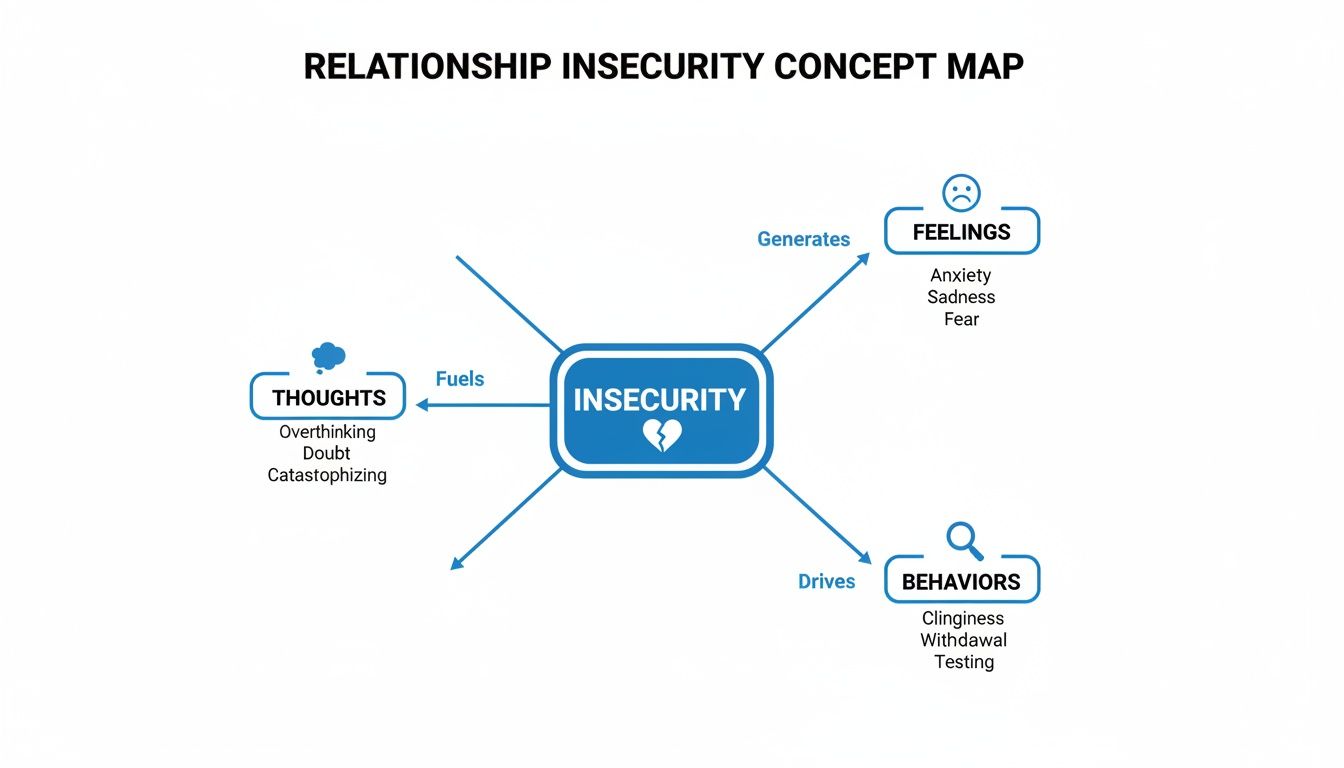
    This concept map shows how these internal states of doubt, anxiety, and fear are often interconnected.

    A concept map illustrating relationship insecurity, showing doubt as fuel, anxiety as a cause, and fear driving avoidance.

    As you can see, these feelings often feed each other in a loop. Anxiety fuels doubt, which then amplifies your fear, continuing the cycle and impacting your well-being.

    The Inner Critic and Self-Esteem

    That nagging voice of insecurity is often amplified by a harsh inner critic and low self-esteem. When you don't feel worthy of love deep down, it’s hard to believe that someone else could genuinely give it to you.

    This internal self-doubt can make you dismiss compliments or second-guess your partner’s intentions. This mindset keeps you on high alert for rejection, sometimes sabotaging the very connection you want to protect.

    Insecurity thrives in the gap between how we see ourselves and how we believe our partner sees us. The smaller we make that gap by building self-worth, the less room there is for doubt to grow.

    Here in India, these personal struggles can be compounded by cultural pressures. Family expectations or societal ideas about relationships can add another layer of inadequacy if your life doesn’t fit the mould.

    A study adapted by IIT Delhi found that over 60% of young Indian adults feel insecure in unsupportive relationships. This research reinforces that emotional neglect significantly increases loneliness and mental health risks like anxiety and depression. You can read the full research about these findings to learn more.

    Understanding where your insecurity comes from is a crucial step. It allows you to see your feelings not as a flaw, but as a response to your experiences, building a foundation for resilience.

    How Insecurity Shows Up in Your Daily Life

    Insecurity rarely stays inside our heads; it spills out, shaping our actions and interactions. Understanding these behaviours with compassion is the key to changing them and improving your well-being.

    When you're feeling insecure, behaviours like seeking reassurance or feeling jealous are often misguided attempts to calm a deep fear. They aren't character flaws, but rather signals of underlying anxiety.

    A distressed woman sits on a sofa, ignoring her phone, while a couple stands blurred in the background.

    The Constant Need for Reassurance

    One of the most common signs of insecurity in relationships is a relentless need for validation. It’s that urge to ask, "Do you still love me?" or seek confirmation that everything is okay after a minor issue.

    While reassurance offers temporary relief from anxiety, the doubt soon returns. This creates an exhausting cycle for both partners, impacting overall happiness.

    Suspicion and a Lack of Trust

    When you don't feel worthy of love, it's hard to trust your partner's feelings are genuine. This doubt can morph into suspicion, leading to behaviours like checking their phone or social media.

    This is a common struggle. A survey in urban Indian centres found that 28% of couples grapple with insecurity tied to suspicions of infidelity, often worsened by digital communication. You can discover more insights about these findings on relationship insecurity in the full study.

    These actions, born from fear, erode the trust that holds a relationship together. They create a tense atmosphere that can cause a partner to pull away, damaging the connection you fear losing.

    "Insecurity often convinces us that if we just find enough evidence, we can finally relax. In reality, the search itself is what keeps the anxiety alive, preventing true connection and well-being."

    Creating Conflict to Test Commitment

    Sometimes, insecurity shows up by picking fights as a subconscious way to test a partner's loyalty. The hidden logic is, "If they stay and fight with me, it must mean they really care."

    This behaviour might involve blowing a small issue out of proportion to trigger a strong emotional response. It's a desperate plea for connection but often creates a cycle of stress and emotional burnout.

    This tactic usually backfires, causing a partner to feel like they are walking on eggshells. Recognising these patterns with compassion is the first step toward choosing responses that build trust and resilience.

    The Toll Insecurity Takes on You and Your Partner

    Insecurity in a relationship creates a ripple effect, impacting the well-being of both people. For the person struggling with these feelings, the constant state of anxiety and stress can be exhausting.

    This relentless emotional state can contribute to symptoms of anxiety and even depression. It's a heavy weight that makes it difficult to feel secure not just in the relationship, but in yourself.

    A sad man and woman sit back-to-back on a bed, looking down in silence.

    The Impact on Your Partner

    For the other person, the experience can be just as challenging. They may feel unfairly mistrusted, confused, and emotionally drained by the cycle of conflict and reassurance, leading to burnout.

    This "walking on eggshells" dynamic can breed resentment. Even the most patient partner can feel worn down, turning a supportive partnership into a source of strain similar to workplace stress.

    "When one partner is constantly trying to soothe the other's insecurity, the relationship shifts from a partnership to a caretaker dynamic. This imbalance erodes intimacy and replaces connection with a sense of obligation and fatigue."

    The Slow Erosion of Trust and Intimacy

    Together, this cycle slowly dismantles the foundation of a healthy relationship. Trust becomes brittle, and both emotional and physical intimacy fade as honest conversations are replaced by guarded interactions.

    The relationship can get stuck in a painful loop, leaving both partners feeling lonely. In India, this breakdown can have serious consequences, with lack of emotional safety being a driver of relationship distress.

    Research shows that women in insecure relationships often report higher levels of anxiety and depressive symptoms. You can learn more about these relationship findings and their broader impact.

    From Burnout to Resilience

    Dealing with insecurity in relationships is about rebuilding a shared sense of safety and nurturing individual well-being. Acknowledging the challenge is the first step toward building resilience and happiness.

    Support through therapy or counselling can help both partners learn healthier ways to communicate and connect. The goal is to develop the compassion and skills needed to navigate these feelings as a team, turning a cycle of anxiety into an opportunity for a stronger bond.

    Building a Foundation of Security and Resilience

    Understanding insecurity is the first step, but healing begins with action. The goal is to build a sense of safety from the inside out through small, steady steps toward emotional well-being.

    The journey involves inner work to strengthen your sense of self and developing skills with your partner. Together, these paths help create a more trusting and secure bond.

    A person writing in a journal with a pen, enjoying tea and a plant in natural sunlight.

    Cultivating Security From Within

    Lasting security starts with feeling secure in yourself. When your self-worth doesn't depend on your partner's every action, the natural ups and downs of life together feel less threatening.

    A great starting point is self-compassion. This means treating yourself with the same kindness you would offer a friend, quieting the harsh inner voice that fuels your anxiety.

    Here are a few practical ways to start building that inner security:

    • Mindfulness and Grounding: When anxious thoughts spin, mindfulness brings you back to the present. A few deep breaths can calm your nervous system, creating a pause between a trigger and your reaction.
    • Challenge Your Thoughts: Insecure thoughts are often automatic and not based in reality. Question them by asking, "Is this fear based on facts, or is it an old story I'm replaying?"
    • Build Genuine Self-Worth: Focus on your strengths, values, and accomplishments outside of your relationship. Hobbies and friendships create a stable foundation, allowing your relationship to add to your life rather than define it.

    "By not fully choosing her every day, by focusing on what bothered me rather than what I adored about her, I deserted her… Like a precious fragrant flower I brought proudly into my home but then failed to water, I left her alone." – Bryan Reeves, Relationship Coach

    This quote highlights the importance of being intentional. Building security means consciously focusing on the good, both in yourself and your partner, which is a cornerstone of resilience.

    Strengthening Your Relational Skills

    Insecurity lives in the dynamic between two people, so improving communication and trust is crucial. These skills help you both handle challenges with respect and understanding, reducing triggers for anxiety.

    Use Healthier Communication Techniques

    Good communication is the lifeblood of a secure partnership. Sharing your needs and fears without accusation invites your partner to respond with empathy instead of defensiveness.

    Here are a few powerful techniques to try:

    • Use 'I Feel' Statements: Instead of saying, "You never listen," try, "I feel unheard when we discuss this." This focuses on your experience, not your partner's perceived failure.
    • Practise Active Listening: Give your partner your full attention. Reflect back what you hear—"It sounds like you're feeling…"—to ensure you understand.
    • Choose the Right Time: Avoid heavy topics when either of you is stressed or tired. Find a calm, dedicated time to talk.

    Set and Respect Healthy Boundaries

    Boundaries are not walls; they are guidelines that teach others how you want to be treated. They are essential for protecting your emotional well-being and preventing resentment.

    A boundary can be as simple as, "I need some quiet time after work," or, "It's not okay to raise your voice at me." Communicating your limits kindly is an act of self-respect that makes a relationship feel safer.

    These strategies are the building blocks of a more secure connection. If these steps feel difficult, professional therapy or counselling can offer a supportive space to learn and practice these skills.

    Knowing When to Seek Professional Support

    While self-work is powerful, sometimes a guide can help navigate tougher challenges. Recognizing when you need professional support is a sign of strength and an investment in your happiness and well-being.

    If insecurity in your relationship is causing significant distress or fuelling harmful behaviours, it may be time to reach out. Persistent feelings of anxiety, burnout, or sadness are clear signals that extra support could help.

    What to Expect from Therapy

    Therapy or counselling is a supportive process designed to help you feel safe. A therapist acts as a skilled guide, helping you untangle complex emotions and find healthier ways of thinking and behaving.

    In individual therapy, you can explore the roots of your insecurity in a private space. Couples therapy provides a structured environment for both of you to improve communication with a neutral professional to guide you.

    Engaging in something like a Counseling Therapeutic Intervention can be a crucial step toward healing. It’s about equipping yourself with the right tools to build a stronger dynamic and greater resilience.

    Finding the Right Support for You

    Finding a therapist who understands relationship dynamics is vital. Platforms like DeTalks connect you with qualified professionals across India who specialise in relationship issues, anxiety, depression, and workplace stress.

    It’s also helpful to understand the role of online psychological assessments.

    Please note: Psychological assessments found on platforms like DeTalks are helpful informational tools for self-insight. However, they are not diagnostic and should never replace a full evaluation by a qualified mental health professional.

    Seeking professional help is about choosing a path toward greater well-being and resilience. It's not about a quick cure but about learning skills to handle life's emotions with more compassion, building a future founded on trust and authentic connection.

    Your Questions on Relationship Insecurity Answered

    It's natural to have questions when navigating the complexities of insecurity in relationships. Here are answers to some of the most common concerns.

    Can Our Relationship Truly Recover from Deep Insecurity?

    Yes, recovery is possible with commitment from both partners. It happens when the insecure partner works on self-worth and coping skills, while the other partner offers patience and understanding.

    Open communication, consistent trust-building actions, and professional guidance through therapy or counselling are cornerstones of healing. This shared journey can build resilience and make your bond stronger.

    Am I to Blame for My Partner's Insecurity?

    Insecurity is rarely about one person; its roots often lie in past experiences and self-esteem. While their insecurity is not your fault, your actions can either help or hinder the healing process.

    You are not responsible for fixing their insecurity, but you can help create a safe environment. Being reliable, honest, and open contributes to the well-being and happiness of you both.

    Remember, the goal isn't to assign blame but to build understanding. Insecurity is the problem, not the person feeling it. Working together with compassion is the most effective path forward.

    How Can I Tell If It's My Insecurity or a Real Problem?

    Look for objective evidence to tell the difference. Are your fears tied to specific, repeated behaviours that have broken trust, or is it a general feeling of anxiety even when things are good?

    Talking to a trusted friend or therapist can offer clarity. If your partner is consistently dishonest or dismissive, that's a relationship problem. If you feel anxious with a dependable partner, the feeling likely stems from personal insecurity.


    If you're looking for professional guidance to navigate these challenges, DeTalks is here to help. Explore our directory of qualified therapists and take the first step toward building a more secure and fulfilling relationship today at https://detalks.com.

  • Navigating Insecurity in a Relationship and Building Lasting Trust

    Navigating Insecurity in a Relationship and Building Lasting Trust

    Feeling insecure in a relationship can be a painful and confusing experience. It's often a deep-down fear that you aren't enough, or that your partner might leave, turning small worries into major internal stress.

    This guide is a supportive space to explore these feelings. We will look at what causes insecurity, how it affects you, and most importantly, what steps you can take to build a stronger sense of self and a more secure partnership.

    What Does Relationship Insecurity Actually Feel Like?

    Living with relationship insecurity is like having an internal alarm that’s overly sensitive. It constantly scans for threats, often seeing danger where there isn't any. This isn't a flaw in your character; it's a very human response that often stems from past experiences and self-perception.

    This constant state of high alert can be emotionally draining. It makes it hard to relax and truly enjoy the connection you have with your partner, even during happy moments.

    The Emotional Weight of Insecurity

    When you're caught in a cycle of insecurity, your mind can feel like a battlefield of worry and doubt. This isn’t just a passing thought—it’s a heavy emotional load that can lead to constant stress and anxiety, affecting your overall well-being.

    You might find yourself replaying conversations or analysing your partner’s actions, searching for hidden meanings that confirm your fears. This emotional turmoil makes it difficult to feel present and can create a barrier to true intimacy, leaving you feeling isolated.

    You're Not Alone in This

    It’s important to know that feeling insecure is a widely shared human experience. Across India and the world, many people grapple with these same feelings, often made worse by the pressures of modern life and social media.

    This insecurity can show up in several common ways:

    • Needing constant reassurance: You may feel a frequent need to ask if everything is okay or if your partner still loves you.
    • Comparing your relationship: You might look at other couples, online or in real life, and feel that your own connection falls short.
    • Fearing conflict: You may avoid disagreements, fearing that any argument could threaten the entire relationship.

    Insecurity can whisper lies that you're unlovable or destined to be left. Learning to challenge this inner voice is a powerful first step toward healing and resilience.

    Recognising how common these feelings are can reduce feelings of shame and isolation. By acknowledging these emotions with compassion, you can begin to address their roots and build a happier, more secure relationship with yourself and your partner.

    Understanding the Psychological Roots of Your Insecurity

    Insecurity in a relationship rarely begins with a recent event. Its roots often run much deeper, connected to our earliest experiences with caregivers, which form a blueprint for how we connect with others later in life.

    Psychologists often use attachment theory to explain these patterns. This theory suggests that our first bonds shape our expectations for love, trust, and intimacy in adult relationships.

    How Your Attachment Style Shapes Your Relationships

    Our early experiences create an attachment style, which is your unique way of connecting with others. Understanding your style can provide clarity on your emotional reflexes in relationships and is a key step toward feeling more secure.

    For many, understanding your attachment style through self-assessments can be an enlightening experience. Remember, these tools are informational and not a clinical diagnosis, but they can offer valuable insights.

    Here’s a brief overview of common styles:

    • Secure Attachment: If your caregivers were reliable and supportive, you likely feel confident in your relationships, trust your partner, and see conflict as manageable.
    • Anxious Attachment: Stemming from inconsistent care, this style can lead to craving deep connection while constantly worrying about abandonment, creating a need for frequent reassurance.
    • Avoidant Attachment: If your caregivers were emotionally distant, you may have learned to be highly independent, feeling uncomfortable with too much closeness and preferring to handle problems alone.

    Recognising your style is not about blame, but about fostering self-compassion. It helps you understand the "why" behind your feelings, which is essential for building emotional resilience.

    Concept map illustrating relationship insecurity, showing how it connects with thoughts, feelings, and behaviors.

    As this map shows, insecurity is a painful cycle. Anxious thoughts trigger difficult emotions, which then lead to reactive behaviours like seeking constant validation or emotionally withdrawing.

    Other Factors That Fuel Insecurity

    While attachment is a major factor, other life experiences can intensify insecurity in a relationship. These events can amplify old fears, making it hard to feel safe even with a loving partner.

    Past betrayals, for example, can make you more guarded in future relationships as a form of self-protection. Low self-esteem also plays a significant role, acting as a filter that makes you doubt your own worthiness of love and acceptance.

    Your mind will always believe what you tell it. Feed it faith. Feed it truth. Feed it with love.

    Furthermore, mental health conditions like anxiety and depression are deeply connected to relationship insecurity. They can create persistent worry or a negative outlook, contributing to emotional burnout and making it hard to see situations clearly.

    In India, these psychological roots have a tangible impact on relationships, mixing with modern pressures like workplace stress. Understanding where your insecurity comes from is the first step toward healing, allowing you to see it not as a personal flaw but as a learned response that can be changed.

    How Insecurity Affects Both You and Your Partner

    In a relationship, insecurity is a shared burden that can create distance and tension, affecting both individuals. It quietly erodes the connection, leaving both partners feeling exhausted and misunderstood.

    Understanding its impact on each person is crucial for finding a way forward together. By recognising these dynamics, you can begin to address them with empathy and build a healthier bond.

    A sad couple sits back-to-back on a sofa, representing distance and relationship problems.

    The Internal Storm of the Insecure Partner

    If you are the one struggling with insecurity, your inner world may feel like a constant state of high alert. This persistent undercurrent of anxiety and stress is draining and can lead to emotional burnout.

    This vigilance makes it difficult to be present and enjoy moments with your partner. You may desperately want to feel closer, but your own fears can inadvertently push that connection away.

    The Exhaustion of the Supporting Partner

    For the supporting partner, loving someone with deep insecurity can be emotionally taxing. You might find yourself constantly offering reassurance and choosing your words carefully, which can lead to frustration and helplessness.

    Over time, this dynamic can wear down trust and lead to resentment. To protect their own mental well-being, the supporting partner might begin to withdraw, unintentionally creating the very distance the insecure partner fears.

    Insecurity can starve a relationship of its oxygen—the spontaneity, trust, and joy that help it thrive. Both partners end up feeling isolated, trapped in a cycle of hurt and misunderstanding.

    The Destructive Cycle and Its Impact

    Insecurity often creates a painful, repeating cycle in a relationship. It may start with the insecure partner's fear, which leads to questioning or accusations. The other partner, feeling unfairly judged, may become defensive or withdraw.

    This reaction can feel like "proof" of the original fear, intensifying the anxiety and perpetuating the cycle. This pattern erodes trust and makes open communication feel risky. In some contexts, as seen in India and globally, unresolved relationship insecurity can contribute to serious domestic conflict. For more details, you can read the full analysis of domestic violence reports.

    Breaking this cycle requires empathy from both people. It involves building personal resilience, seeking support through therapy or counselling, and learning new communication strategies that foster connection instead of conflict.

    Actionable Strategies to Cultivate Security and Resilience

    Understanding the source of your insecurity is the first step, but turning that awareness into action is where real change begins. This involves building your inner strength while learning healthier ways to connect with your partner.

    By creating a solid foundation of security within yourself, you create a stable anchor for your relationship to flourish. This journey toward happiness and well-being starts with you.

    A man and a woman in a deep conversation at a table with a notebook and tea.

    Building Your Inner Security First

    Before you can build a secure partnership, you must cultivate a secure home within yourself. This is about being a compassionate friend to yourself, especially during moments of vulnerability. It involves using practical techniques to manage difficult emotions and challenge unhelpful thoughts.

    A powerful first step is to practise self-soothing when anxiety arises. Instead of immediately turning to your partner for reassurance, try a grounding exercise to create a sense of calm and control.

    Here are a few simple yet effective techniques:

    • The 5-4-3-2-1 Grounding Method: When your mind is racing, pause and name 5 things you can see, 4 things you can touch, 3 things you can hear, 2 things you can smell, and 1 thing you can taste. This pulls your attention into the present moment.
    • Mindful Breathing: Place a hand on your stomach and focus on slow, deep breaths. This simple action helps calm your nervous system and breaks the cycle of panic.

    Another helpful strategy is to gently question your insecure thoughts, a core technique in modern counselling. Instead of accepting fears as facts, use a journal to explore them with curiosity.

    Writing down your fears allows you to see them for what they are—thoughts, not truths. It creates the space needed to challenge them and choose a more balanced perspective.

    Try these journaling prompts inspired by cognitive-behavioural therapy (CBT):

    1. What is the insecure thought I’m having? (e.g., "My partner is losing interest in me.")
    2. What evidence actually supports this thought? (Be objective and stick to facts.)
    3. What evidence contradicts this thought? (Recall moments of connection and love.)
    4. What’s a more balanced, compassionate way to see this? (e.g., "My partner is dealing with workplace stress, and it's not a reflection of their feelings for me.")

    This process strengthens your mental well-being by training your brain to break free from automatic negative thought patterns, building your emotional resilience.

    Strengthening Your Connection Together

    While individual work is crucial, fostering security is also a team effort. Effective communication can transform your relationship from a source of anxiety into a safe haven of support.

    Learning to share your feelings without blame and to listen with empathy is key. To build a deeper bond, it's essential to understand how to be more emotionally available.

    Communication Scripts for Tough Conversations

    Finding the right words when you feel vulnerable can be challenging. Using a structured approach helps you express yourself clearly and constructively. The "I feel" statement is a classic tool for this reason.

    Instead of saying: "You never text me back. You obviously don't care." (This sounds like an accusation.)
    Try saying: "I feel anxious when I don't hear from you for a while. A quick text to say you're busy would help me feel more secure."

    This approach focuses on your feelings and needs, inviting your partner to be part of the solution rather than putting them on the defensive. This compassionate communication style, often taught in therapy, helps break cycles of conflict and builds a happier, more connected partnership.

    When It’s Time to Bring in a Professional

    While self-help strategies are valuable, sometimes a guiding hand is needed. Reaching out for professional support is a sign of strength and a commitment to your well-being and the future of your relationship.

    Think of it as a proactive investment in your happiness. If insecurity in a relationship is causing constant distress or leading to persistent anxiety or depression, an expert can offer the tools you need to move forward.

    Recognising the Signs You Need Support

    Deciding to see a therapist can feel like a big step, but certain patterns indicate you could benefit from professional guidance. It's about a persistent, draining dynamic that you can't seem to solve alone.

    Consider seeking professional help if you experience:

    • Constant Conflict: Small issues frequently escalate into major fights about trust or commitment.
    • Emotional Exhaustion: You and your partner feel perpetually drained or burnt out from the stress.
    • Controlling Behaviours: Insecurity leads to actions like checking phones or monitoring social media, eroding trust.
    • Loss of Intimacy: Emotional and physical closeness has been replaced by suspicion and distance.

    In India, relationship insecurity often manifests as a deep fear of abandonment. For instance, the research into relationship dynamics shows how these fears can create destructive patterns. Professional support can help identify and address these issues early on.

    How Therapy and Assessments Can Point the Way

    Professional counselling provides a safe, neutral space to explore the roots of insecurity without blame. A therapist can guide you and your partner in learning healthier communication skills and building individual resilience.

    Platforms like DeTalks also offer scientifically-backed psychological assessments that can serve as a starting point for understanding your emotional patterns.

    A Quick Note: These assessments are fantastic for gaining insight into your emotional patterns and relationship dynamics. However, they are informational tools, not diagnostic ones. They are never a substitute for a full evaluation by a qualified professional.

    These assessments can provide clarity and help you decide if individual therapy or couples counselling is the right path for you. Seeking help is a compassionate choice for yourself and your partner, opening the door to healing and a more secure, loving connection.

    Burning Questions About Relationship Insecurity

    Let's address some common questions about insecurity to provide extra clarity. These answers can help you as you work toward building a stronger, more secure bond.

    Is a Little Insecurity Normal in a Relationship?

    Yes, moments of doubt are a normal part of being human. The problem arises when insecurity in a relationship becomes a constant state, shaping your reactions and damaging the connection.

    The goal isn't to eliminate insecurity entirely, but to build emotional resilience so these feelings don't take control. This helps protect the trust you and your partner have built.

    Can My Partner Fix My Insecurity for Me?

    While a supportive partner is a great asset, they cannot fix your insecurity for you. Lasting security is an inside job, as it often stems from your past experiences and self-perception.

    Your partner can create a safe environment, but the work of challenging negative thoughts and building self-worth is a personal journey. This is where individual therapy or counselling can be transformative for your overall well-being.

    True security is an inside job. Your partner can be a wonderful ally, but the real work of building self-worth and challenging fear is a journey you must take for yourself.

    How Do I Talk to My Partner About Their Insecurity?

    Approach the conversation with empathy and gentleness. Use "I" statements to share how their behaviour affects you, such as, "I feel hurt when it seems like you don't trust me."

    Choose a calm moment for this discussion, not during a conflict. Reaffirming your care for them can also help, and you might suggest couples counselling as a way to learn better communication tools together as a team.

    Will Insecurity Ever Fully Go Away?

    While it may not vanish completely, its influence can significantly decrease. With self-awareness, new coping strategies, and a stronger bond with your partner, you'll learn to see insecure thoughts as just thoughts, not facts.

    Over time, that loud voice of insecurity can become a quiet whisper you can easily manage. This shift helps in managing related feelings of anxiety or depression, allowing you to build lasting trust in yourself and your relationship.


    If insecurity is casting a shadow over your life and relationship, please know you don't have to face it on your own. DeTalks is here to connect you with experienced therapists who can equip you with the right tools for building a more secure and joyful connection. Take the first step and explore our network of professionals to begin your healing journey at https://detalks.com.

  • Navigating the Fear of Losing Someone You Love

    Navigating the Fear of Losing Someone You Love

    The fear of losing someone is a deeply human experience, not a weakness. It is a natural echo of the strong connection and love you feel for another person. This feeling can be a passing worry or a persistent anxiety that affects your day.

    This guide will help you understand this complex emotion. We will explore why these feelings are valid and normal, while helping you find supportive ways to manage them.

    The Universal Fear of Losing a Loved One

    When you love someone, their presence brings joy and security to your life. The thought of them being gone can trigger a powerful, unsettling fear. In a way, this feeling is a testament to the strength of your bond.

    In cultures like India, where family and community are central to identity, this fear can feel particularly sharp. The thought of losing a parent, partner, or close friend can feel like losing a piece of yourself. This shared human emotion connects us all.

    From Natural Concern to Overwhelming Anxiety

    A healthy concern for the people we care about is completely normal. It becomes a challenge when that concern turns into overwhelming anxiety that disrupts your daily life and well-being.

    This shift often happens subtly, starting with small worries that slowly grow. Over time, these fears can chip away at your peace of mind and sense of security.

    The real danger isn’t that we will lose the people we love—that is an inevitable part of life. The danger is that the fear of loss will keep us from fully living and loving in the present moment.

    This guide will help you navigate this complex emotion. We will explore why your feelings are valid, while also helping you recognise when they might signal a deeper issue, like an anxiety disorder or depression, that needs more support.

    Understanding the Broader Impact

    Living with the constant stress of worry can take an emotional and physical toll. It can contribute to workplace stress, make it difficult to focus, and in some cases, lead to burnout.

    In India, strong family bonds can sometimes intensify this experience. Studies show that a significant portion of the population faces mental health challenges, with conditions like depression and anxiety often linked to the fear of loss within relationships.

    Many also struggle with anticipatory grief, especially when a loved one is ill. You might find this resource on understanding pre-grief when a loved one has cancer helpful. Together, we will explore practical ways to build resilience and find emotional balance, so you can love deeply without being controlled by fear.

    The Psychological Roots of This Deep-Seated Fear

    The thought of losing someone can feel overwhelming because of our psychological wiring. Our earliest experiences and basic human need for connection shape this fear. It is fundamentally tied to how we first learned to form bonds as children.

    Attachment theory helps explain why we fear loss so much. As children, we rely on our caregivers for safety and security. If those bonds are dependable, we build an internal sense of security that supports us throughout life.

    This foundation doesn't mean we never fear loss. It gives us the resilience to navigate that fear without it taking over our lives. A strong start helps us build healthier relationships later on.

    How Early Attachments Shape Adult Fears

    If a caregiver was inconsistent or emotionally distant, a child learns that connection is unpredictable. This can plant a seed of anxiety about abandonment that continues into adulthood.

    This early programming often shows up as:

    • Anxious Attachment: A constant need for reassurance and worry that a partner will leave.
    • Avoidant Attachment: A tendency to pull away from intimacy to avoid the potential pain of loss.

    These are not character flaws but deeply ingrained survival strategies. Recognising their origin is a crucial first step toward feeling more secure in your relationships today.

    The Echoes of Past Grief and Trauma

    Previous experiences with loss can amplify our fears. A sudden death or painful separation can teach our brain to see intimacy as a potential threat. This can lead to a state of high alert, where you are always looking for signs that something might go wrong.

    This protective mechanism can go into overdrive, fuelling a cycle of anxiety. Your mind is trying to prevent you from getting hurt again, but this can lead to workplace stress, depression, and emotional exhaustion.

    "When we’ve been hurt by loss before, our fear becomes a shadow that follows us into new relationships. It whispers that history will repeat itself, making it difficult to trust in the present moment and fully embrace the love we have."

    Healing involves gently teaching our nervous system that the past does not have to define the future. Research on what the brain learns when we cope with grief shows that our brains can learn new, healthier patterns.

    When Separation Anxiety Continues

    Separation anxiety is not just for children; it can continue or appear for the first time in adulthood. It is a powerful fear that something terrible will happen to a loved one when you are apart.

    This can strain relationships and impact your own well-being. With compassionate self-awareness and professional counselling, you can find strategies to manage these intense feelings. Therapy provides a safe space to build emotional independence and healthier connections.

    Recognising the Signs in Your Life and Relationships

    Understanding the roots of the fear of losing someone is important, but seeing how it affects your life is the next step. This fear is often a quiet hum of anxiety that subtly shapes your thoughts and actions.

    Recognising these signs is an act of self-compassion. It allows you to understand yourself better and build more secure ways of connecting with others.

    Common Emotional and Behavioural Signs

    When this fear takes hold, it can show up in many ways. These behaviours are coping mechanisms your mind has developed to protect you from potential pain.

    Common signs include:

    • Needing Constant Reassurance: Frequently asking loved ones for comfort about your relationship.
    • Avoiding Deep Connections: Pushing people away to prevent the eventual heartache of loss.
    • Overthinking and "Catastrophising": A missed phone call leads your mind to the worst-case scenario.
    • Physical Symptoms of Anxiety: A racing heart, tight chest, or sleepless nights due to worry.

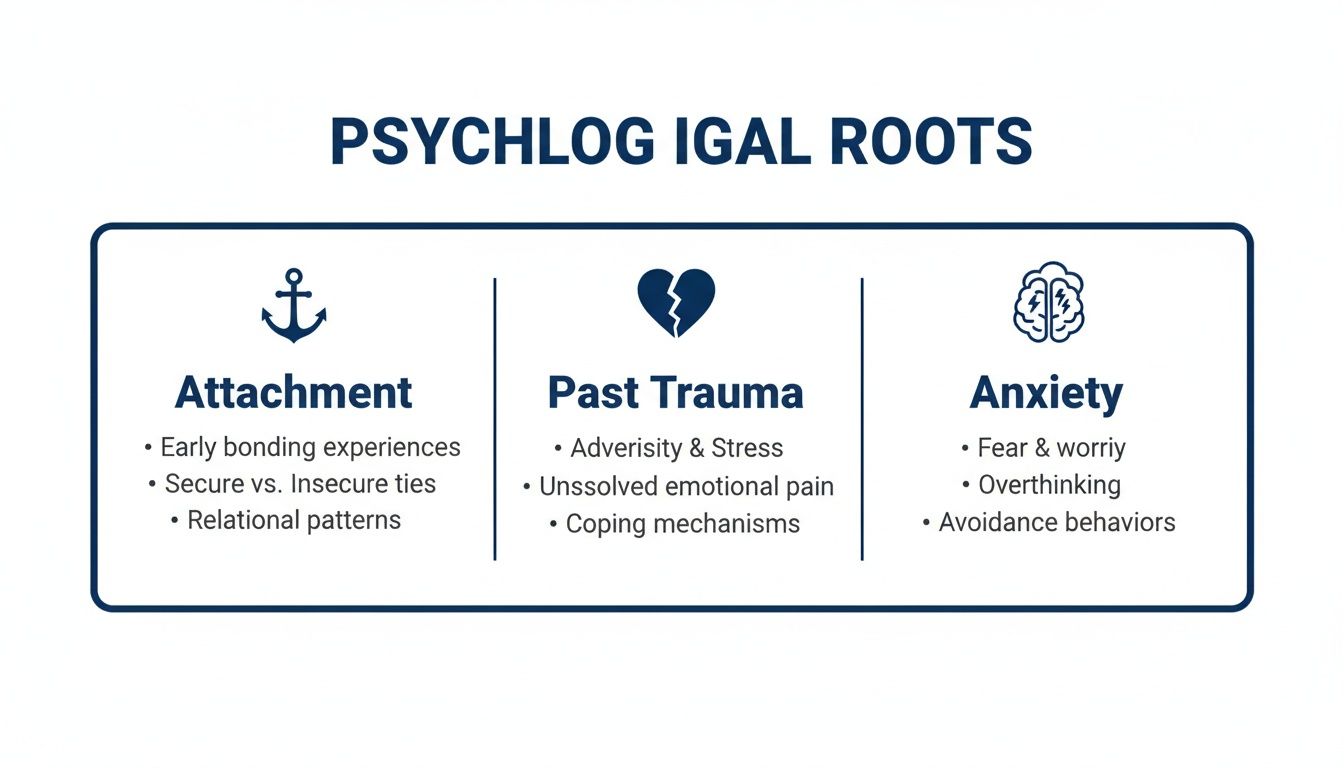
    This infographic breaks down the psychological roots—attachment styles, past trauma, and general anxiety—that often feed these signs.

    Infographic illustrating psychological roots like attachment, past trauma, and anxiety and their factors.

    These deep-seated factors can fuel emotional and behavioural patterns. Breaking this cycle often starts with conscious awareness and support.

    Healthy Concern vs Unhealthy Anxiety About Losing Someone

    It is normal to care about your loved ones. However, it is crucial to distinguish between natural concern and unhealthy anxiety that disrupts your life. One is an expression of love; the other is a symptom of fear.

    This table can help clarify where your feelings might fall. Please remember this is for informational purposes and is not a diagnostic tool.

    Aspect Healthy Concern Unhealthy Anxiety
    Thoughts "I hope they have a safe trip." "What if they get into an accident? I need to track their location constantly."
    Feelings You feel calm after checking in and knowing they are safe. You feel a persistent sense of dread that doesn't go away even with reassurance.
    Behaviours You encourage their independence and enjoy your own time. You become clingy, possessive, or try to control their activities to keep them "safe."
    Impact on Life Your concern does not interfere with your work, sleep, or daily routines. Your worry causes significant distress, leading to workplace stress and relationship strain.

    Realising your concern has become unhealthy is an empowering first step. It is the moment you can start seeking support through self-help or professional counselling. Building resilience always begins with honest self-awareness.

    How This Fear Plays Out at Work and University

    The fear of losing someone follows you into all parts of life, including high-pressure environments like work or university. This anxiety can quietly influence your focus, performance, and overall well-being.

    Professionals may be far from ageing parents, while students navigate academia away from their support systems. Understanding how this fear appears in these settings is key to managing its impact.

    Workplace Stress and the Weight of Worry

    For many professionals in India, moving for a career can turn natural concern for loved ones into a source of constant workplace stress. Every unanswered call can trigger a jolt of anxiety during a busy workday.

    This emotional load makes it hard to concentrate and can lead to burnout. The pressure to appear in control often forces you to hide this internal struggle, which can increase feelings of isolation.

    In the modern workplace, the biggest challenge is often the invisible one—the emotional baggage we carry from home. The fear of loss can quietly eat away at productivity and morale, making everyday work stress feel ten times heavier.

    This has real consequences. A staggering number of Indians grapple with anxiety disorders and chronic stress, many rooted in these exact fears. You can learn more about India's mental health challenges on Statista.

    Academic Pressure and Shaky Support Systems

    For students, university is a time of immense pressure and change. Friendships formed during these years become a primary support system, making the fear of losing these connections intense.

    A small disagreement can feel catastrophic, triggering anxieties about being left alone. This emotional focus can impact studies, leading to missed classes and lower grades. This can create a downward spiral of more anxiety and potential depression.

    Building emotional resilience during these years is crucial. University counselling services can provide tools to manage both your studies and emotional health.

    Balancing Compassion with Performance

    The way forward is to acknowledge this fear with compassion while building skills to manage its impact. Ignoring it only leads to burnout and a decline in your well-being.

    A few things to keep in mind:

    • Acknowledge the Feeling: It’s okay to worry. The goal is to stop it from controlling you.
    • Find Your People: Confide in a trusted colleague, friend, or counsellor.
    • Create Healthy Boundaries: Set specific times to check in with family to create mental space.
    • Look After Yourself: Mindfulness, exercise, and sleep can boost your resilience.

    Navigating this fear requires a mix of self-compassion and practical strategies. Professional therapy and counselling offer a safe space to develop these skills.

    Practical Steps to Cope and Build Emotional Resilience

    Person writing notes in a journal with a pen, steaming coffee, and a plant on a sunlit desk.

    Understanding your fear is a huge first step, but change happens through action. Building emotional resilience is about learning to manage fear so it no longer runs your life. This journey involves small, steady steps that help you feel more grounded.

    These strategies are tools for your emotional toolkit. As you begin, remember to be patient and kind with yourself. This is a practice, not a race.

    Ground Yourself with Mindfulness

    When the fear of losing someone leads to spiralling thoughts, mindfulness can be your anchor. It is the simple act of paying attention to the present moment without judgment. This helps pause the cycle of anxious thoughts.

    A simple technique is the 5-4-3-2-1 grounding exercise. Stop and notice:

    • Five things you can see.
    • Four things you can feel.
    • Three things you can hear.
    • Two things you can smell.
    • One thing you can taste.

    This exercise pulls your focus back to the safety of the present. Regular practice can reduce the intensity of your anxiety and restore a sense of calm.

    Explore Your Feelings Through Journaling

    Writing down your thoughts is a safe way to release them. Journaling helps you untangle the emotions tied to your fear of loss, making them feel more manageable.

    You don't need to be a great writer; just let your thoughts flow. Try these prompts to get started:

    • What is my deepest fear about losing this person?
    • What is a happy memory I can focus on today?
    • What is one thing I can do for my well-being right now?

    This habit helps you process feelings, spot thought patterns, and treat yourself with more compassion.

    Embrace Radical Acceptance

    Much of the pain from this fear comes from fighting reality. Radical acceptance means acknowledging life as it is, without struggling against things you cannot control. It frees you from resisting the unpredictable nature of life.

    Radical acceptance is not about giving up. It is about freeing yourself from the draining struggle against the inevitable. It lets you redirect your energy from worry to living fully in the present moment.

    This mental shift is liberating. When you accept that you cannot control everything, you can focus your energy on what you can influence—like the quality of your relationships and your own happiness.

    Strengthen Your Own Identity and Support System

    Sometimes, fear is intense because our sense of self is tied up with another person. Building your own interests and friendships is vital for emotional independence and creates a solid foundation.

    This is especially important for young adults in India facing academic and social pressures. The fear of loss adds another layer to mental health challenges, as detailed in this official press release on youth mental health from PIB.

    A varied support system provides multiple sources of comfort. If feelings of depression or workplace stress become too much, professional counselling can offer guidance to build these essential life skills.

    When to Seek Professional Support for Your Well-Being

    Recognising you might need help is a sign of strength. While self-help strategies are useful, sometimes the fear of losing someone is too heavy to carry alone. Professional support offers a safe space to unpack these feelings and build healthier coping mechanisms.

    If the fear constantly interferes with your life, that is a clear signal it might be time to see a therapist or counsellor. It is an investment in your well-being.

    Key Indicators to Consider

    It can be difficult to know when worry has become a more serious issue. If the fear is causing you distress or disrupting your daily life, it is worth seeking professional guidance.

    Look for these signs:

    • Disruption to Daily Life: The fear makes it hard to focus at work or keep up with responsibilities, increasing workplace stress.
    • Physical Symptoms of Anxiety: Frequent panic attacks, a racing heart, or constant muscle tension.
    • Relationship Strain: Your behaviour, driven by fear, starts to damage your relationships.
    • Persistent Sadness or Hopelessness: The anxiety begins to look more like the signs of depression.

    It is important to remember that online assessments are for personal insight only and are not diagnostic tools. Only a qualified mental health professional can provide an accurate diagnosis.

    What Does Therapy for This Fear Look Like?

    Therapy is a collaborative and supportive journey. A therapist partners with you to understand your fears and develop personalised strategies in a non-judgmental space.

    A common and effective method is Cognitive-Behavioural Therapy (CBT). CBT helps you identify and challenge unhelpful thought patterns that fuel your fear. It teaches you to replace worst-case scenarios with more balanced and realistic thoughts.

    Finding the right therapist is crucial for building your resilience. Platforms like DeTalks can connect you with qualified professionals who specialise in anxiety, grief, and relationship issues. Taking that first step can lead to greater emotional freedom and a calmer mind.

    Frequently Asked Questions

    It is normal to have questions when dealing with a powerful emotion like the fear of losing someone. Here are some common questions to help you make sense of what you're feeling.

    Is It Normal to Constantly Worry About My Loved Ones' Safety?

    A certain amount of concern is natural. However, when worry becomes constant, intrusive, and disrupts your peace of mind, it may have crossed into unhealthy anxiety.

    If the worry feels overwhelming and out of your control, talking to a counsellor can help you find a more balanced and manageable perspective.

    Can the Fear of Losing Someone Ruin a Relationship?

    Yes, it can. This fear can drive behaviours like needing constant reassurance or becoming possessive, which can push people away. These actions often create the very distance you are trying to avoid.

    Working through this in therapy can help you understand the root of the fear. You can then develop healthier ways to connect with your partner and strengthen your bond.

    What Kind of Therapy Is Best for Dealing with This Fear?

    Several effective approaches can help. Cognitive-Behavioural Therapy (CBT) is excellent for challenging anxious thoughts and building more realistic perspectives.

    Attachment-Based Therapy explores how early life experiences may be shaping your current anxieties. A good therapist will work with you to find the best approach for your story, helping you build resilience and more secure connections.


    If this article resonates with you, know that you do not have to navigate these feelings alone. Professional support can provide guidance and compassion on your journey toward better well-being. Exploring therapy or counselling is a positive step toward managing anxiety and building stronger, healthier relationships. When you’re ready, DeTalks can connect you with skilled therapists. Take the first step toward finding your balance by exploring therapists on DeTalks today.

  • Overcome insecurity in relationship: Build Confidence and Trust

    Overcome insecurity in relationship: Build Confidence and Trust

    Feeling a pang of insecurity in your relationship is a common human experience, not a personal flaw. It’s that nagging worry or anxiety about your partnership, a knot in your stomach that whispers fears of rejection or abandonment. This feeling isn’t a sign of weakness; think of it as a signal from your heart, telling you something needs attention.

    What Does it Mean to Feel Insecure in a Relationship?

    A hand gently waters a wilting potted plant on a sunlit windowsill.

    Imagine your relationship is like a plant. For it to thrive, it needs the right environment—sunlight of trust, water of reassurance, and the solid ground of a stable emotional foundation. When these elements are missing, the plant naturally shows signs of stress, and your sense of security in a relationship works in much the same way.

    This feeling of insecurity in a relationship is more than simple jealousy or mistrust. It’s a complex mix of emotions that can stem from past experiences, current life pressures, or deep-seated anxieties about the future.

    You're Not Alone—This is a Common Feeling

    First things first: it’s completely normal to feel this way. Especially in a place like India, where family and societal expectations add another layer of pressure, navigating relationships can feel challenging. You are not the only one wrestling with these feelings of unease.

    This feeling is simply a message. Just as physical pain warns you of an injury, emotional insecurity points to a need for better communication, deeper understanding, or personal healing. Acknowledging it without judgment is the first step toward building a stronger, more connected partnership.

    This guide is here to help you unpack those feelings in a supportive way. We’ll explore common causes and signs, and share practical steps to nurture your emotional well-being. Remember, this journey is about making progress, not achieving an impossible standard of perfection.

    “Insecurity is a natural response to perceived threats to our connection with a loved one. Viewing it as a cue for introspection, rather than a character flaw, opens the door to growth, compassion, and a more secure bond.”

    How It Affects Your Well-being

    When insecurity lingers, it can start to wear you down. It can feed a constant cycle of anxiety, create distance between you and your partner, and sometimes spiral into feelings of depression. The endless worry is draining and can spill over into other parts of your life, increasing workplace stress.

    But there is a positive side. Confronting these feelings can spark incredible personal growth and build resilience. As you learn to navigate your insecurity, you develop powerful self-awareness and sharpen your communication skills. The goal isn’t to erase insecurity forever, but to learn how to manage it with kindness, which can lead to greater happiness and a stronger relationship.

    Understanding the Roots of Relationship Insecurity

    Hands cradle a young plant, old photo, boy figurine, and phone in soil, symbolizing roots and growth.

    That nagging feeling of insecurity rarely appears out of nowhere. It often grows from seeds planted long ago or is nurtured by the pressures of our daily lives. Getting to the root of these feelings is a huge step toward healing and building stronger relationships.

    Think of your emotional reactions like a familiar path in a forest. The more a path is used—whether carved by childhood experiences or past heartbreaks—the easier it is to slip back onto it. Understanding where these paths came from helps you consciously choose a new direction with more self-compassion.

    Generally, the causes of insecurity in a relationship fall into two main areas: the internal patterns we carry within us, and the external pressures from the world around us.

    Internal Patterns: The Stories We Tell Ourselves

    Our inner world is a rich tapestry of memories, beliefs, and learned behaviours that shape how we experience love. These internal patterns are often the main source of the anxiety and doubt we feel in our partnerships.

    A major influence is our early attachment style, the blueprint for relationships we formed as children. If our caregivers were consistently loving, we likely developed a secure attachment, making it easier to trust. But if that care was unpredictable, we might have an anxious attachment style, which can trigger a deep fear of abandonment in adult relationships.

    Low self-worth is another powerful internal driver. If you don’t feel worthy of love and respect, it's incredibly difficult to believe someone else when they offer it to you. That inner critic can twist a simple misunderstanding into "proof" that you’re not good enough, trapping you in a painful cycle of doubt.

    Remember, these patterns are not your fault. They are learned responses that developed to protect you. Acknowledging them with kindness is the first step toward rewriting your story and building emotional resilience.

    Past betrayals can also leave deep, lasting scars. If a previous partner was unfaithful, it can feel almost impossible to trust again, even with a dependable new partner. Your mind is trying to shield you from getting hurt again, but this constant watchfulness can create unnecessary stress.

    External Pressures: The Weight of the World

    Our relationships don’t exist in a bubble; they are constantly influenced by society, finances, and cultural norms. These external forces can easily fuel the fire of insecurity.

    In India, for example, relationship dynamics are often deeply connected to economic and social pressures. A study found that 41% of Indian adults report feeling insecure in their romantic relationships sometimes. For 55% of those, economic uncertainty was a major factor. You can read the full research about these connection challenges to see how intertwined these issues are.

    This data shows how easily outside stressors can create an environment where insecurity can flourish.

    • Financial Uncertainty: Worrying about your job or income creates immense workplace stress that spills into your personal life. This instability can erode your confidence and make you feel more dependent on your relationship for safety, which is a recipe for anxiety.
    • Social and Family Expectations: In many Indian families, there are powerful expectations around marriage, career, and lifestyle. The pressure to live up to these ideals can leave you and your partner questioning if you’re "good enough," fuelling feelings of inadequacy and even depression.
    • The Social Media Effect: It’s hard to feel good about your relationship when you’re constantly seeing curated, "perfect" versions of others' lives. This comparison culture creates unrealistic benchmarks that can make you doubt your own partnership.

    Understanding both the internal and external roots of your insecurity in a relationship is empowering. It helps you see how outside forces might be affecting your feelings. With that clarity, you can nurture your well-being and find the right support, whether through self-reflection, honest conversations, or professional counselling.

    Spotting the Signs of Insecurity in Your Relationship

    It’s one thing to know what relationship insecurity is, but another to see how it plays out in your life. Think of these signs not as personal flaws, but as signals your mind is sending for your attention. If you can look at these patterns with curiosity instead of judgment, you’re already on the path to feeling more secure.

    Insecurity often shows up in two ways: through your actions (behaviours) and your feelings (emotional triggers). The feelings frequently drive the actions. Learning to spot both can help you untangle the knot of anxiety and confusion.

    Behavioural Clues You Might Notice

    These are the outward actions that often point to a shaky feeling inside. You might see yourself or your partner doing things to gain control or seek constant validation. These actions are often just an attempt to quiet the anxious voice in your head, even if they end up making things worse.

    For example, do you find yourself needing a lot of reassurance, like repeatedly asking, "Do you still love me?" Other common habits include checking your partner’s phone, monitoring their social media, or relying on them for all your emotional needs.

    Try to see these behaviours as a cry for connection, not an accusation. Shifting your perspective this way can change everything. It moves the conversation from blame to understanding and opens up a space where you can both heal and grow together.

    Another classic pattern is starting arguments just to test your partner's commitment. It’s a subconscious way of checking if they’ll stick around when things get tough. While it might feel like a way to get the security you crave, it often just pushes your partner away, creating a self-fulfilling prophecy.

    The Emotional Triggers Beneath the Surface

    Underneath these actions are powerful emotions that can feel overwhelming and seem to appear out of nowhere. Getting good at naming these emotions is a game-changer for managing how you react.

    A constant, nagging anxiety about the future of the relationship is a major sign. You might be stuck in a loop, worrying your partner will leave, even with no real reason to think so. This often goes hand-in-hand with intense jealousy over small things.

    Living in this state of high alert is draining and can lead to burnout or contribute to feelings of depression. It’s important to remember that these feelings are real and valid, even if they aren't an accurate reflection of your relationship. They are often just echoes from your past that haven't fully healed yet.

    To help you connect the dots, we’ve created a table with some common signs. Please remember, this is an informational guide to help you reflect, not a diagnostic tool.

    Recognising Signs of Relationship Insecurity

    Category Common Manifestations Example in Daily Life
    Thoughts Assuming the worst about your partner's intentions or feelings. "They haven't replied to my message in an hour; they must be angry with me or losing interest."
    Feelings Pervasive jealousy, anxiety, or a deep-seated fear of being abandoned. Feeling a surge of panic when your partner mentions spending time with friends without you.
    Behaviours Seeking constant reassurance or checking up on your partner. Repeatedly asking your partner, "Are we okay?" after a minor disagreement.

    Seeing these signs in yourself is an act of self-care. It provides the clarity you need to address the real issues, build your inner resilience, and find the right support, whether through personal strategies or professional counselling.

    Actionable Steps for Building a Secure Connection

    A young Asian couple sits on a couch, talking intensely. The woman holds a checklist notebook.

    Understanding where your insecurity comes from is the first big step. Now comes the empowering part: turning that understanding into positive action. Let's walk through some practical ways to build a stronger, more secure bond—with your partner and with yourself.

    Think of these strategies not as quick fixes, but as small, consistent habits that build emotional resilience over time. By learning to calm your mind, question your fears, and talk openly, you can lay the groundwork for a much healthier relationship.

    Practise Self-Soothing Techniques

    When a wave of anxiety or panic hits, your first job is to calm your nervous system. Self-soothing techniques are simple, mindful actions you can do anywhere to bring yourself back to the present moment and reduce the intensity of overwhelming feelings.

    Consider them a kind of emotional first aid. For instance, the 5-4-3-2-1 grounding exercise is incredibly powerful. Just pause and quietly name:

    • 5 things you can see
    • 4 things you can touch
    • 3 things you can hear
    • 2 things you can smell
    • 1 thing you can taste

    This simple act pulls your focus away from racing thoughts and grounds you in your physical surroundings.

    Another fantastic tool is deep belly breathing.

    • Place one hand on your chest and the other on your stomach.
    • Breathe in slowly through your nose for a count of four, feeling your belly expand.
    • Hold for a moment.
    • Then, breathe out slowly through your mouth for a count of six.
    • Continue this for a few minutes until you feel a sense of calm.

    This type of breathing directly counteracts the fight-or-flight response that fuels insecurity in a relationship, sending a signal to your brain that you're safe.

    Challenge and Reframe Negative Thoughts

    Insecure feelings are often powered by what experts call Automatic Negative Thoughts (ANTs). These are the critical voices that pop into our heads, often without us realizing it. The key is to stop accepting them as fact and start questioning them, a practice known as cognitive reframing.

    First, just notice when these thoughts show up. The next time your mind jumps to, "They're definitely going to leave me," pause. Ask yourself: "Is that thought 100% true? What evidence do I have for it? What evidence do I have against it?"

    “Our thoughts are not facts. By learning to observe them with curiosity instead of judgment, we can separate our true selves from the stories of fear our minds create, paving the way for greater peace and happiness.”

    Then, look for a more balanced, kinder perspective. Instead of, "They haven't texted back; they must be mad," you could reframe it as, "They might just be busy at work. Their response time doesn't define how they feel about me." This small mental shift can stop a minor worry from spiraling into major workplace stress or a relationship conflict.

    Use Clear Communication Scripts

    Voicing your fears and needs without sounding accusatory is a cornerstone of trust. When you're feeling insecure, it's easy for "I'm worried" to come out as "You always…," which puts your partner on the defensive. Using simple communication scripts can help you express yourself constructively.

    The key is to use "I feel" statements, which center the conversation on your emotions. For example, instead of saying, "You never listen to me," try this: "I feel unheard when we discuss important topics, and it makes me feel anxious about our connection."

    Here are a few scripts you can adapt:

    • To express a need: "I feel a little disconnected lately. Would you be open to spending some quality time together this weekend?"
    • To share an insecurity: "I've been feeling some anxiety about [specific issue]. Could you share your perspective? It would help me feel more secure."
    • To set a boundary: "I feel overwhelmed when we argue via text. Can we agree to discuss sensitive topics in person?"

    To truly build a secure connection, it's helpful to explore strategies for navigating communication breakdown in relationships. When you can state your needs kindly and clearly, you're not attacking your partner; you're inviting them to be part of the solution.

    Build Your Self-Esteem Outside the Relationship

    A solid sense of self is the ultimate antidote to relationship insecurity. When your self-worth isn’t completely tied to your partner's approval, you bring a calmer, more resilient energy to your partnership.

    Make it a priority to invest in activities and people that make you feel capable and valued on your own. This could mean reconnecting with friends, dusting off a hobby, or chasing a personal goal. Every small accomplishment builds your confidence from the inside out.

    Cultivating a life that feels full and meaningful on your own terms is vital for your overall well-being. It ensures you're in the relationship because you want to be, not because you need your partner to feel whole. This independence helps create space for a more authentic and secure love to grow.

    When to Consider Professional Support

    While working on yourself is powerful, sometimes the weight of insecurity is too heavy to lift alone. Reaching out for professional support isn’t a sign of failure. It is a courageous step toward healing and an investment in your long-term happiness and well-being.

    The thought of seeking help can feel intimidating. However, certain signs suggest it might be the most compassionate choice for yourself and your relationship. If you notice insecurity is fuelling constant arguments, or if you feel like you're always walking on eggshells, it may be time. These patterns can create a draining cycle of stress that is tough to break without an outside perspective.

    Recognising It Is Time to Reach Out

    A clear signal is when the insecurity in a relationship starts affecting your daily life. Perhaps you can’t concentrate at work because you’re consumed by worry, or you've started withdrawing from friends. If you're noticing ongoing symptoms of anxiety or depression, that is a definite sign that professional support could be beneficial.

    Another indicator is when insecurity feels tangled with older issues, like past trauma or a lifelong struggle with low self-esteem. A good therapist can help you gently unpack those experiences in a way self-help guides cannot. They provide the specific tools and support needed to heal from the root, helping you build genuine, lasting resilience.

    “Therapy is not about being ‘fixed.’ It's about being seen, heard, and guided as you discover the strength you already possess. It’s a proactive choice for a healthier, more authentic life.”

    Individual Therapy vs Couples Counselling

    Knowing your options can make the process feel more manageable. Both individual therapy and couples counselling have unique strengths, and the best fit depends on your needs.

    • Individual Therapy: This is your dedicated space to explore the internal roots of your insecurity, whether that means building self-esteem, healing from the past, or managing anxiety and workplace stress.
    • Couples Counselling: This brings you and your partner together to work on communication and rebuild trust. It’s a collaborative setting where you can both learn to handle disagreements better and understand each other’s emotional worlds.

    Often, a combination of both can be a powerful approach. You might work on personal triggers in individual therapy while attending counselling with your partner to strengthen the relationship itself. Please remember that this guide is informational, not diagnostic—a professional can help you find the best path forward.

    Seeking support is an act of profound strength. Platforms like DeTalks are a great starting point for exploring qualified therapists and finding someone who feels like the right fit for your journey.

    A Final Word on Your Journey Forward

    An open notebook with handwritten text and a cup of tea on a wooden table with sunlight.

    Tackling insecurity in a relationship isn’t about finding a quick fix; it's a personal journey of growth. The path forward is about progress, not perfection. The most important thing you can bring along is compassion for yourself.

    Simply understanding where these feelings come from is a huge first step. From there, it’s a process of patiently unlearning old habits and practising healthier ways of connecting. It's the small, consistent efforts that build lasting security.

    Gentle Reminders for the Road Ahead

    Every step you take, no matter how small, builds your emotional resilience and contributes to your overall well-being. Keep these supportive takeaways in mind as you move forward.

    • Your Feelings Are Messengers, Not Monsters: When insecurity pops up, try to meet it with curiosity, not criticism. See it as a signal pointing to a need that isn't being met or an old wound that needs your attention.
    • Self-Compassion Is Key: You will have good days and tough days. On the hard ones, treat yourself with the same kindness you’d offer a close friend who was struggling.
    • Small Steps Lead to Big Changes: Don't try to change everything at once. Focus on one small thing, like using a breathing exercise when you feel anxious. These little wins add up over time.

    Ultimately, building security in your relationship starts with building a stronger, more trusting relationship with yourself. When you know your own worth, you bring a calmer, more confident, and compassionate energy to your partnership.

    Reaching Out Is a Sign of Strength

    If this journey feels overwhelming, please remember that asking for help is an act of courage. Professional therapy or counselling offers a safe, non-judgmental space to explore these feelings, especially if they’re linked to issues like depression or workplace stress.

    You have it in you to create a more secure and loving connection. By understanding your emotions, being kind to yourself, and reaching out when needed, you are taking charge of your own happiness and emotional freedom.

    Frequently Asked Questions

    It's completely normal to have questions when you're working through feelings of insecurity in your relationship. Let's tackle some of the most common ones that come up on the path to building a more trusting and connected partnership.

    Can Relationship Insecurity Ever Be Cured?

    It’s more helpful to think of managing relationship insecurity rather than "curing" it, as everyone feels uncertain now and then. The real goal is to develop emotional resilience and coping skills so these feelings don't dictate your actions or harm your well-being.

    With self-awareness, open communication, and sometimes professional guidance, you can dramatically lessen insecurity's hold on you. Over time, you can build a genuine, lasting sense of security from within.

    Is It My Partner's Responsibility to Make Me Feel Secure?

    This is a tricky one. While a supportive partner is a cornerstone of a healthy relationship, your core sense of security is ultimately your own to cultivate.

    Your partner can offer reassurance and be a reliable presence. However, the deepest roots of insecurity often grow from our own past experiences. A partnership works best when both people take responsibility for their own emotional health while also supporting each other. Placing the entire burden of your security on your partner can create unhealthy dynamics and add stress to the relationship.

    How Do I Talk to My Partner About My Insecurity?

    Bringing this up requires courage and a gentle approach. The key is to use "I" statements to share your feelings without making your partner feel blamed, which helps keep the conversation collaborative.

    For instance, instead of saying, "You make me feel insecure," try framing it like this: "Lately, I've been feeling some anxiety when [mention a specific situation], and I'm working through it. Would you be open to talking with me about it?" This simple change invites them to be part of the solution with you.


    At DeTalks, we believe everyone deserves to feel secure and understood. If you are struggling with insecurity or looking to build a healthier relationship with yourself and others, we are here to help. Explore our directory of qualified therapists or take a confidential assessment to gain deeper insight into your emotional well-being by visiting DeTalks.

  • How to Stop Overthinking Your Relationship: Finding Peace and Security

    How to Stop Overthinking Your Relationship: Finding Peace and Security

    Realizing your thoughts are signals, not facts, is the first step to stop overthinking your relationship. It’s about learning to gently question worst-case scenarios and return to the present moment. Opening up to your partner can replace anxious guesswork with real clarity, building the trust that quiets your mind.

    Understanding Why You Overthink Your Relationship

    Do you replay conversations on a loop or constantly analyse your partner’s every move? If so, you’re not alone. This mental treadmill is incredibly common, and understanding its roots is the first step toward peace.

    This habit is not a character flaw; think of it as a protective instinct that's gone into overdrive. At its core, overthinking often feels like an attempt to gain control when things feel uncertain, driven by stress or anxiety.

    The Connection Between Past Hurts and Present Worries

    Our past relationships create a mental blueprint for what we expect from love. If you've been hurt before, trusting a new partner can feel challenging, leading you to dissect their actions for hints of dishonesty.

    Similarly, if you grew up where affection felt unpredictable, you might develop an anxious attachment style. This can leave you constantly seeking reassurance, trapping you and your partner in a draining cycle of overthinking.

    Overthinking is the mind's way of trying to control outcomes to avoid being hurt again. It feels like preparation but often leads to mental exhaustion, contributing to feelings of anxiety or depression.

    How Cultural Pressures Can Fuel Overthinking

    In India, cultural and family expectations can add another layer of complexity. The pressure to please family or follow traditional timelines can turn happy relationship milestones into sources of stress and worry.

    For example, societal timelines for marriage can create a sense of urgency, causing you to overanalyse if your relationship is "the one." Seeking this external validation can disrupt the natural flow of a partnership.

    This is a real issue in India, where gaps in social support can intensify relationship distress. Research from the CDC links loneliness to increased stress and depression. In an Indian context, factors like heavy family involvement can increase this pressure, making it vital to build emotional resilience.

    From Self-Criticism to Self-Compassion

    Recognizing these patterns isn't about blame; it’s about cultivating self-compassion. You developed these habits to protect yourself, which shows how deeply you care, even if it's causing pain now.

    Acknowledging the roots of your overthinking allows you to treat yourself with kindness. This shift is fundamental for building the inner foundation needed to change these thought patterns, often with support from therapy and counselling.

    How to Recognise Your Overthinking Triggers

    Before you can learn how to stop overthinking your relationship, you must become a curious observer of your mind. The key is understanding what kicks off the thought spiral in the first place, spotting the spark before it becomes a wildfire of anxiety.

    Often, these triggers are small, seemingly harmless moments. A vaguely worded text, a change in routine, or a social media post can activate deep-seated fears and send your mind racing.

    Identifying Your Unique Triggers

    Think of yourself as a detective gathering clues about your own thought patterns. The goal isn't to judge but simply to notice. Your triggers are personal but often fall into common categories.

    Some of the most frequent ones include:

    • Vague Communication: A short "OK" text or delayed response can feel like a sign of anger, even when it’s not.
    • Changes in Routine: If your partner usually calls after work but forgets, your mind might jump to worst-case scenarios.
    • Social Media Comparisons: Seeing friends' posts can trigger insecurities about your own relationship's pace or quality.
    • Moments of Disconnection: A quiet evening can be misinterpreted as a red flag that the relationship is failing.

    When you can name these situations, you can prepare for them. Knowing a vague text is a personal trigger allows you to pause and question the automatic negative thought instead of letting it hijack your emotions.

    This infographic shows the deeper roots—like past hurts, anxiety, and fear—that often fuel our reactions to everyday triggers.

    It’s a great reminder that our mind’s response is often connected to deeper emotional patterns, not just the event itself.

    Spotting Unhelpful Thought Patterns

    Once you've identified your triggers, the next step is to notice the mental habits they set off. These are flawed lenses that colour how you see reality, almost always leading to more anxiety and emotional burnout.

    Learning to spot them is a crucial skill for improving your mental well-being, which you can develop on your own or with guidance through counselling. Let's look at some common thought patterns and how to gently challenge them.

    Common Overthinking Patterns and How to Reframe Them

    Overthinking Pattern What It Sounds Like A Healthier Reframed Thought
    Catastrophising "We had a small argument. This means we’re totally incompatible and we’re going to break up." "We disagreed, which is normal. We can talk about this when we're both calm and find a way forward."
    Mind-Reading "They're being quiet. They must be angry with me for what I said earlier." "They seem quiet. I can't know what they're thinking. Maybe they're just tired from work. I'll ask them how their day was."
    "Should" Statements "A perfect partner should always know what I need without me having to ask." "It's not fair to expect my partner to be a mind-reader. I need to communicate my needs clearly and kindly."
    Black-and-White Thinking "If we don't move in together by next year, this relationship is a complete failure." "Relationships progress at their own pace. What matters is that we're both happy and feel secure right now."

    Becoming familiar with these patterns is incredibly empowering. It helps you see them for what they are: just thoughts, not facts.

    Unfortunately, negative past experiences can make these thought patterns feel more real. In India's evolving dating scene, finding emotional security can be a real challenge. Research shows that negative relationship experiences, like cheating (42%), are a major factor in psychological distress. You can read the full research about these relationship anxiety findings to understand more.

    By simply naming the pattern—"Ah, that's catastrophising again"—you create a small but powerful space between yourself and the thought. This separation gives you the power to choose how you respond instead of being swept away by the emotion.

    This process of identifying triggers and patterns is the first, most important step toward building resilience. It's not about trying to eliminate worry but about learning to manage it, transforming you from a passive victim of your thoughts into an active participant in your emotional health.

    Actionable Techniques to Calm Your Mind Now

    When your mind races with relationship worries, you need practical, in-the-moment tools to find your footing. Think of this as your first-aid kit for an overthinking spiral—simple techniques you can use anywhere to bring peace back to your mind and body.

    These strategies are about gently shifting your focus and calming your nervous system. This creates breathing room between you and the overwhelming emotions, giving you the power to respond with clarity instead of fear.

    A woman meditating peacefully on a rug in a bright bedroom next to a bed and open notebook.

    Ground Yourself with Sensory Awareness

    One of the quickest ways to break a thought loop is to pull your attention into the world around you. Grounding techniques use your five senses to anchor you in the present, sending a powerful signal to your brain that you're safe right now.

    A simple but effective method is the 5-4-3-2-1 technique. Wherever you are, pause and gently identify:

    • 5 things you can see: Look around and name five objects. Notice their colour and shape.
    • 4 things you can feel: Tune into physical sensations, like the texture of your shirt or the ground beneath your feet.
    • 3 things you can hear: Listen closely for sounds you might have been ignoring, like birds chirping or your own breath.
    • 2 things you can smell: Take a moment to notice any scents in the air, like coffee or fresh air.
    • 1 thing you can taste: Focus on whatever taste is in your mouth, or take a sip of water.

    This exercise forces your brain to switch gears from abstract worry to concrete, sensory input, which can dramatically lower the intensity of your anxiety. It’s a discreet and powerful tool you can use anytime.

    Contain Your Worries with a 'Worry Time'

    This might sound strange, but giving your worries a designated appointment can stop them from taking over your day. This cognitive strategy involves scheduling a limited window—say, 15 minutes each evening—to intentionally think about your relationship concerns.

    When a worry appears during the day, acknowledge it and then mentally "reschedule" it. You can tell yourself, "I'll give that my full attention tonight at 6 PM," which helps you reclaim a sense of control over intrusive thoughts.

    This isn’t about ignoring your feelings. It's about training your brain that you decide when to engage with anxious thoughts, building mental discipline and resilience over time.

    Overthinking in relationships often connects to broader mental health challenges. This is a growing concern in India, particularly among young adults navigating anxiety and stress. A 2021 study highlighted over 5 million cases of anxiety disorders among youth in regions including India, linking the mental health burden to persistent worrying.

    Untangle Your Thoughts with Journaling

    Getting thoughts out of your head and onto paper is a time-tested way to reduce their power. Journaling gives you a private space to explore your fears without judgement, helping you see them more objectively.

    Use specific prompts to guide your reflection, shifting from worry to problem-solving. This helps you understand the root of your feelings and build a path towards happiness.

    Journaling Prompts for Relationship Anxiety:

    • What is the specific fear underneath this worry? Am I afraid of being abandoned, rejected, or misunderstood?
    • What’s a more compassionate or balanced way of looking at this situation?
    • What evidence do I have that my fear is true? What evidence do I have that it isn't?
    • If my best friend were in this situation, what would I tell them?

    Journaling consistently helps you spot recurring triggers and thought patterns. To take this a step further, you can explore actionable self-discipline techniques that build mental fortitude against intrusive thoughts. These small, steady actions create lasting well-being and a quieter mind.

    Building a Stronger Foundation with Communication

    While managing your own thoughts is a massive step, the long-term solution to stop overthinking your relationship often comes from strengthening the connection itself. A foundation of open, honest communication and trust can naturally quiet the anxiety that fuels thought spirals.

    Your partnership can shift from a source of stress to your greatest source of support and well-being. This starts when you learn to share your insecurities in a way that feels constructive, not accusatory, turning worry into connection.

    A happy couple sits across a table, holding hands and smiling lovingly at each other.

    Voicing Your Needs Without Blame

    One of the biggest barriers to open talk is the fear of sounding needy or starting a fight. A simple and powerful technique is using "I" statements. This shift in framing lets you express your feelings without putting your partner on the defensive.

    For instance, instead of, "You never text me back, it feels like you don't care," you could try a softer approach. An "I" statement reframes it: "I start to feel a bit anxious when I don't hear from you. A quick text would help me feel more secure."

    See the difference? The second version invites empathy and opens the door for a conversation about how you can both feel more connected and supported, fostering compassion between you.

    Starting the Conversation About Insecurity

    Bringing up your insecurities takes courage and vulnerability. Choose a calm moment when you’re both relaxed and can truly listen—definitely not in the middle of a disagreement.

    Here are a few gentle ways to begin:

    • "I've been feeling a bit anxious about us lately, and I think it's my own stuff, but I'd love to talk it through with you."
    • "Can we set aside some time to connect? Sometimes my mind runs away with worries, and just talking to you helps."
    • "I sometimes create stories in my head when I'm feeling insecure. Could you help me understand what's real?"

    These conversation starters create a sense of teamwork. You aren't just dropping a problem in your partner's lap; you're inviting them to help you build more resilience together.

    The goal of sharing isn't just to get reassurance. It’s to build a shared understanding where both of you feel emotionally safe, which is a powerful defence against anxiety and depression.

    Setting Boundaries for Mutual Security

    Healthy boundaries are not walls; they are guidelines that help both of you feel respected and secure. They are crucial for protecting your mental energy and stopping the burnout that comes from constant worry.

    Setting a boundary can be as simple as saying, "I need some quiet time after a long day at work to recharge." Or it could be agreeing not to have serious discussions over text, where tone is easily misread.

    These mutual agreements reduce uncertainty, a massive trigger for overthinking. When you both respect each other's needs, there's far less room for anxious guesswork. For more on this, you can find great tips for building a strong relationship that focus on communication and trust.

    When to Seek Professional Support

    Learning to manage overthinking on your own is a huge achievement, but it's just as important to know when to ask for help. Reaching out for professional support isn't a sign of failure; it’s a proactive step toward protecting your mental well-being.

    Sometimes, the thought spirals persist, affecting your daily life, your work, and the very relationship you're trying to protect. When overthinking becomes relentless, it might be tangled with deeper patterns of anxiety or even depression. You don't have to navigate it alone.

    Recognising the Signs You Might Need Support

    It can be tough to know the line between normal worries and something more serious. A good rule of thumb is to look at the impact on your ability to function and enjoy your day.

    Here are a few signals that it might be time to talk to a professional counsellor or therapist:

    • Your Anxiety Is Constant: You feel on edge most of the time, with physical symptoms like a racing heart or tight chest.
    • It’s Derailing Your Life: Overthinking makes it hard to focus at work or enjoy hobbies, leading to mental burnout.
    • You Feel Hopeless: The thoughts are overwhelmingly negative, and you're starting to believe things are doomed to fail.
    • Your Coping Methods Are Unhealthy: You're leaning on emotional eating, drinking more, or withdrawing from others.

    While online assessments from platforms like DeTalks can offer helpful insights, please remember they are for informational purposes only. They are not a substitute for a professional diagnosis from a qualified mental health expert.

    How Therapy Can Help Break the Cycle

    Therapy provides a safe, non-judgemental space to explore the roots of your relationship anxiety. A trained professional can help you connect past experiences to current thought patterns with an objective perspective.

    A good therapist will equip you with practical, evidence-based skills to challenge unhelpful thoughts and manage your emotions. This is about building genuine, long-term resilience and learning to communicate your needs clearly.

    Think of therapy as an investment in your future happiness. It empowers you with personalised tools to not only stop overthinking your relationship but also to handle future challenges like workplace stress with more confidence.

    Taking That First Step

    Making that initial call can feel like the hardest part, especially when you’re already overwhelmed. In India, while the conversation around mental health is improving, there can still be hesitation. Frame it as an act of self-care.

    Platforms like DeTalks are designed to make this process less intimidating, helping you find qualified professionals who are the right fit. Taking this step is a powerful move away from just surviving and toward truly thriving.

    Your Top Questions About Overthinking, Answered

    When you're dealing with relationship anxiety, it's natural to have questions. Let's tackle some of the most common ones to provide clear, reassuring answers and reinforce the practical steps you can take.

    Is It Normal to Overthink a Little in a Relationship?

    Yes, a certain amount of reflection is healthy. Thinking about your relationship and your partner’s feelings helps you nurture a strong connection and handle small issues before they grow.

    The trouble starts when thoughtful reflection turns into a constant, looping cycle of worry. If your thoughts cause you distress or keep you up at night, the pattern has stopped being helpful and is hurting your well-being.

    Can Overthinking Actually Hurt My Relationship?

    Unfortunately, it can. When you're trapped in your head, it's easy to become distant or irritable. It can also create a dynamic where you constantly seek reassurance, which can become draining for both of you.

    Over time, this cycle can chip away at trust and intimacy. The good news is that you can break this cycle. By learning how to stop overthinking your relationship, you can rebuild that foundation of security.

    The real damage isn't from the thoughts but from the behaviours they trigger. When you react to fears as if they're facts, you can end up pushing away the person you want to be close to, which can fuel more anxiety and depression.

    How Do I Know If It’s My Intuition or Just Anxiety?

    This is a great question. The difference is in the feeling. Intuition usually feels like a quiet, calm "knowing" in your gut. It brings a sense of clarity, even if the message is difficult.

    Anxiety, on the other hand, is loud and chaotic. It's packed with "what if" scenarios and feels urgent and panicky. Anxiety-driven thoughts spiral, leaving you feeling more confused and exhausted, not clear. Learning to tell them apart is a massive step toward building emotional resilience.

    • Intuition: Feels like a calm, deep signal. It provides clarity without an emotional storm.
    • Anxiety: Feels like a noisy, frantic alarm. It creates confusion and emotional chaos.

    Will I Ever Stop Overthinking Completely?

    The goal isn't to silence every worry forever. The real aim is to change your relationship with your thoughts. With practice, you can learn to notice an anxious thought starting without getting swept away by it.

    Think of it as building a new muscle. The more you practise grounding techniques, challenge negative thoughts, and communicate openly, the stronger your "overthinking management" muscle gets. The thoughts might still pop up, especially during times of workplace stress, but they'll have much less power over you.

    This journey is about progress, not perfection. Every time you choose a healthier response, you're rewiring your brain for more peace. If the thoughts feel too big to handle on your own, remember that therapy and counselling are wonderful resources for building these skills with professional support.


    At DeTalks, we believe everyone deserves to feel secure and happy in their relationships. If you're finding it hard to break free from the cycle of overthinking, our platform is here to connect you with qualified therapists and counsellors across India who can provide support and practical tools.

    Ready to take the first step toward a calmer mind and a stronger connection? Explore our resources at https://detalks.com.

  • How to Stop Obsessing Over Someone and Reclaim Your Peace

    How to Stop Obsessing Over Someone and Reclaim Your Peace

    Feeling like you can't stop thinking about someone is a very human experience, and you are not alone in this. The path forward begins with understanding why it's happening, then taking gentle steps to create distance and refocus on your own well-being. This journey is about noticing your thoughts, identifying what might be missing in your life, and shifting your attention back to your personal growth.

    Understanding Why You Can't Stop Thinking About Them

    A person sitting alone on a windowsill, looking out thoughtfully, representing introspection and loneliness.

    It's common for our minds to become preoccupied with thoughts of another person. These intense feelings often come from a place of vulnerability. Understanding their origin is the first step toward finding balance and peace.

    Often, fixating on someone is a sign of deeper, unmet needs. It might be loneliness, the pain of a breakup, or a dip in self-esteem. These feelings can create an emotional gap that our minds try to fill with an idealised version of someone, which is a natural way we try to cope.

    Getting Trapped in a Thought Loop

    Have you ever felt like your thoughts are stuck on a repeating loop? This pattern, known as rumination, involves replaying conversations, memories, and "what-if" scenarios without reaching any conclusion. This mental cycle can fuel anxiety and create significant stress, making it difficult to focus on other areas of your life, like work.

    In the Indian context, societal and family pressures around relationships can add another layer of complexity. Expectations to meet certain milestones can intensify these obsessive thought patterns, making them harder to break.

    The link between obsessive thinking and mental health is well-documented. For instance, research on obsessive thoughts in India found that such symptoms can be more pronounced in urban settings, highlighting how our environment impacts our well-being.

    What Fuels the Fixation?

    Obsessive thinking often stems from a few common psychological triggers. Identifying these within yourself can help you approach your feelings with more compassion and less judgment.

    • Filling an Emotional Void: When you feel lonely or disconnected, fixating on someone can provide a temporary sense of connection.
    • Low Self-Esteem: We might put others on a pedestal when we feel we are lacking something ourselves, seeking their approval as a substitute for self-worth.
    • Past Wounds: Unresolved pain from previous relationships can lead us to subconsciously seek a "do-over," obsessing over a new person to try and fix what went wrong before.

    It's important to remember these thought patterns are not a reflection of your worth. They are signals from your mind, pointing to areas of your life that need kindness, attention, and healing. Acknowledging this is a powerful step toward regaining control.

    Practical Ways to Reframe Obsessive Thoughts

    A person calmly meditating, surrounded by gentle light, symbolising mental clarity and peace.

    Breaking free from an obsessive thought cycle is about taking small, deliberate steps. These techniques help interrupt the loop and reclaim your mental space. The goal is not to force the person out of your mind, but to gently redirect your focus and challenge the narrative you have built.

    One effective method is thought-stopping. When you notice yourself spiralling, consciously interrupt the thought. You can picture a stop sign or say "stop" to yourself, then immediately shift to a positive distraction, like calling a friend or listening to a song. This simple act helps weaken the neural pathways that fuel the obsession over time.

    Challenging Your Inner Story

    Another powerful approach is cognitive reframing, which involves questioning the story you tell yourself. Obsessive thoughts often create an unrealistic, idealised image of a person. By consciously challenging this image, you can bring yourself back to a more grounded reality.

    For example, instead of thinking, “My life would be perfect with them,” a reframe would be, “I admire certain things about them, but I know one person cannot solve all my problems or guarantee my happiness.” Practices like mindfulness can help you observe these thoughts without getting carried away. You can explore mindfulness exercises for anxiety to get started.

    Remember, reframing isn’t about denying your feelings but about introducing a dose of reality. This act can reduce the thought's emotional power and help you build resilience.

    A Practical Guide to Shifting Your Thoughts

    It's important to recognise that obsessive thinking can be connected to challenges like anxiety and depression, making it harder to break the cycle alone. Having a few planned responses can be very helpful when your mind starts to spiral. The table below offers a simple guide for replacing common obsessive thoughts with healthier alternatives.

    Challenging Obsessive Thoughts with Balanced Alternatives

    This guide helps you identify a common obsessive thought and consciously replace it with a more realistic perspective, which can help reduce the anxiety it creates.

    Common Obsessive Thought A Balanced, Realistic Alternative
    "I need to know what they're doing right now." "Their activities don't affect my well-being. I can focus on my own tasks and find peace in my day."
    "They are the only one who can make me happy." "My happiness comes from within. I am responsible for my own joy and fulfilment."
    "If I just try harder, they will see how perfect I am." "I am worthy of connection just as I am. I don't need to change myself to earn someone's affection."
    "Replaying our last conversation will give me clarity." "Going over it again and again causes more anxiety. I will let go and focus on the present moment."

    Using these reframing techniques consistently is like building a muscle. It requires patience and self-compassion, but with practice, you can regain control and find peace of mind.

    Grounding Exercises for Immediate Calm

    A person sitting in a calm, mindful pose with a serene natural background, representing grounding and presence.

    When your mind is caught in a spiral of obsessive thoughts, grounding exercises can offer immediate relief. These tools pull your attention out of the mental chaos and anchor you in the present moment. They are simple, discreet, and can be done anywhere to manage sudden waves of stress.

    The goal isn't to fight your thoughts, which can often make them stronger. Instead, these techniques create distance, giving you needed breathing room. This shift in focus helps calm your nervous system and puts you back in control.

    The 5-4-3-2-1 Sensory Method

    Reconnecting with your immediate surroundings is a practical way to halt a rumination spiral. The 5-4-3-2-1 technique directs your brain to the tangible world, away from the repeating loop of "what-ifs."

    Take a moment wherever you are and try this:

    • See 5 Things: Look around and name five objects, noticing details like the colour, shape, or texture.
    • Touch 4 Things: Shift your focus to physical sensations, like the feeling of your clothes or the surface of a table.
    • Hear 3 Things: Tune into the sounds around you, such as distant traffic, the hum of a fan, or your own breathing.
    • Smell 2 Things: Notice any scents in the air, whether it’s coffee, soap, or the smell of rain.
    • Taste 1 Thing: Finally, focus on what you can taste, like the lingering flavour of your last meal or drink.

    This exercise acts as a circuit-breaker, interrupting the obsessive pattern and demonstrating your ability to redirect your focus.

    A key part of improving your well-being is acknowledging thoughts without letting them define you. Grounding exercises are a first line of defence, helping you create a peaceful mental space.

    Mindful Breathing for Inner Stillness

    Mindful breathing is another powerful tool. When we experience stress, our breathing often becomes shallow, which can worsen anxiety. Deliberately slowing your breath sends a calming signal to your brain.

    Find a comfortable position and gently close your eyes if you wish. Place a hand on your stomach, and simply notice your breath. Then, slowly inhale through your nose for a count of four, and exhale slowly through your mouth for a count of six.

    Repeating this cycle for just a few minutes can have a significant calming effect. It cuts through mental chatter and helps you find a moment of peace, empowering you to regulate your emotions.

    Reclaiming Your Life with New Habits

    While shifting your mindset is crucial, taking tangible action is where you truly regain your freedom. These new habits are empowering choices that help you reconnect with yourself outside of this fixation. A great place to start is by managing your digital world, as constant social media access can fuel obsessive thoughts.

    Creating Healthy Digital Boundaries

    Setting digital boundaries is about giving your mind the space it needs to heal. You don't need a dramatic gesture; small, consistent steps are often more effective. A good first move is to mute their accounts, which stops their updates from appearing in your feed without the finality of blocking.

    Another practical technique is scheduling "worry time." Allot a specific, short period—perhaps 15 minutes each evening—to allow these thoughts. When the time is up, deliberately switch to a different, pre-planned activity. This trains your brain that these thoughts don't get to dominate your entire day.

    Taking control of your digital space and schedule sends a powerful message that your peace of mind comes first. This is about creating a calm, supportive environment for yourself.

    Reconnecting with Your World

    Obsessive thoughts can make your world feel very small, pushing out people and activities you once enjoyed. The antidote is to consciously rebuild those connections and rediscover your interests. Think about what you loved to do before this fixation began and put those activities back on your calendar.

    • Reconnect with friends: Reach out to a friend for a simple coffee or walk. The goal is to be present with someone who cares about you.
    • Explore new interests: Trying something new can create fresh neural pathways and build confidence. Consider a new class, hobby, or volunteer opportunity to invest your energy in positive experiences.

    Integrating meaningful self-care practices into your daily routine is also vital. Every step you take to reinvest in yourself, your friendships, and your passions helps loosen the obsession's grip.

    Building Resilience Through Self-Compassion

    A person gently holding their own hands in a gesture of self-comfort and compassion.

    Lasting healing often begins when you nurture your relationship with yourself. Obsessing over someone else can signal an unmet need for internal validation. Practising self-compassion helps you meet those needs and build a foundation of strength that doesn't depend on others.

    This journey is an opportunity to transform a painful experience into genuine personal growth and build lasting emotional resilience. Treating yourself with the same kindness you would offer a friend can soothe the inner turmoil that fuels the obsession.

    Cultivating a Kinder Inner Dialogue

    Your inner voice can be your harshest critic, especially when you're stuck in obsessive thoughts. The goal is to shift that internal conversation from judgment to compassion. This is crucial for managing the intense anxiety and stress that come with rumination.

    Journaling can be a powerful tool for this. It offers a safe space to untangle your thoughts and feelings without fear of judgment.

    Try these prompts to get started:

    • What might this obsession be telling me about what I truly need right now?
    • If my best friend were going through this, what supportive advice would I offer?
    • What are three things I appreciate about myself today?

    Please remember, any self-reflection or assessments are for informational purposes only and are not a substitute for a professional diagnosis. They are tools to guide your understanding on your path to well-being.

    Anchoring Yourself in Your Values

    When you're fixated on someone, it's easy to lose sight of who you are. Reconnecting with your core values provides a powerful anchor and a sense of purpose that is entirely your own. This internal compass helps guide your decisions and builds self-esteem from within.

    Take a moment to reflect on what is most important to you—perhaps it's creativity, honesty, or community. Once you have a clearer picture, start making small, intentional choices that align with those values. Every action reinforces your identity and proves you can create a fulfilling life on your own terms, which is a vital step in breaking free.

    When Professional Support Is the Next Best Step

    While self-help strategies are valuable, seeking professional guidance is a sign of strength. If obsessive thoughts are consistently disrupting your daily life, extra support can make a significant difference. Choosing therapy or counselling is a proactive step toward reclaiming your well-being.

    A trained professional offers a safe, non-judgmental space to explore these thought patterns. They can provide structured, personalised strategies to help you move forward.

    Knowing When It's Time for Help

    Consider how these obsessions are impacting your life. If you're constantly feeling overwhelmed by anxiety or a persistent sadness, those are important signals.

    It might be time to talk to someone if you notice:

    • Constant emotional distress: Your mood depends heavily on the other person's actions or perceived feelings.
    • A dip in daily functioning: You struggle to focus at work, neglect responsibilities, or withdraw from friends and hobbies.
    • Physical side effects: You experience sleep problems, appetite changes, or persistent fatigue from emotional burnout or workplace stress.

    It's important to clarify: any assessment checklist is for informational purposes, not for diagnosis. It can, however, be a useful guidepost to help you understand when professional support for your mental well-being may be beneficial.

    What Support Looks Like in India

    Seeking therapy is becoming more widely accepted across India, with many professionals offering sessions both in-person and online. A therapist can help you build emotional resilience and develop healthier coping mechanisms.

    In some cases, obsessive thoughts can be linked to conditions like depression or anxiety. We know from findings on mental health treatment accessibility in India that while effective therapies exist, access can sometimes be a challenge. A professional can provide clarity and equip you with the tools to break the cycle and move toward a more balanced state of mind.

    Supportive Takeaways and Next Steps

    As you move forward, it's natural to have questions. This journey is not about finding a quick cure, but about building lasting skills for your emotional well-being. Here are a few final thoughts to support you.

    How Long Does This Take?

    There is no set timeline for healing, as everyone's journey is unique. The duration depends on the depth of your feelings and how consistently you can apply new coping strategies. Instead of focusing on the calendar, celebrate small victories, like successfully redirecting a thought or enjoying an afternoon without rumination.

    Is It Normal to Feel Worse Before It Gets Better?

    Yes, this is a common part of the process. When you begin to consciously change long-held thought patterns, it can initially increase feelings of anxiety or sadness. This discomfort is often a sign that you are doing the difficult but necessary work of creating healthier neural pathways. Be gentle with yourself, and if the feelings become overwhelming, consider reaching out for professional counselling.

    What if I Have a Setback?

    Setbacks are a normal part of any learning process, not a sign of failure. If you find yourself slipping into old habits, approach the moment with compassion, not criticism. Gently guide yourself back to the tools you've learned, whether it's a mindfulness exercise or reaching out to a supportive friend. Each time you steer yourself back on course, you strengthen your resilience.


    If you feel that professional guidance could support you on this journey, help is available. DeTalks is a resource for finding qualified therapists and counsellors across India who specialise in managing challenges like obsessive thoughts, anxiety, and depression. You can find the right support for your well-being at https://detalks.com.