Tag: relationship counselling

  • Marriage Counselling Gurgaon: Strengthen Your Bond in 2026

    Marriage Counselling Gurgaon: Strengthen Your Bond in 2026

    Some couples search for marriage counselling in Gurgaon late at night, after another circular argument, a silent dinner, or a week where both people were too tired to talk properly. Nothing dramatic may have happened. You may feel that warmth has been replaced by logistics, deadlines, and small hurts that never got repaired.

    That moment can feel lonely. It can also be the start of something steady and constructive.

    In a city rhythm shaped by long commutes, workplace stress, family expectations, and constant digital distraction, many couples struggle to protect emotional closeness. One partner may be carrying anxiety, the other may be dealing with burnout, and both may still care a great deal for each other. Counselling isn't a sign that the relationship has failed. Often, it's a sign that you're willing to learn better ways to care for it.

    India's broader social context matters here too. The country has a very large married population, including about 192 million married women aged 15+ recorded in the 2011 Census, which helps explain why relationship support services matter in urban hubs such as Gurgaon, as noted in this overview of marriage counselling statistics in India. The same national picture also reminds us that Gurgaon-specific counselling use rates aren't clearly published, so people often have to rely on practical guidance rather than local utilisation data.

    Starting the Conversation About Your Relationship

    A common Gurgaon story goes like this. Two people are doing their best. One leaves early for Cyber City, the other is juggling meetings, family calls, and household decisions, and by the end of the day both are drained.

    They still love each other, but their conversations now sound functional. Did you pay the bill? Who's picking up groceries? Why didn't you call? Underneath those lines are usually softer feelings. I miss you. I feel alone. I don't know how to reach you without another fight.

    Why this search takes courage

    Typing "marriage counselling Gurgaon" into a search bar can stir up shame, fear, or confusion. Many people worry that seeking therapy means the relationship is broken. It doesn't.

    A healthier way to look at it is this. Couples often seek support when their usual ways of coping stop working. That's not weakness. That's awareness.

    Practical rule: If the same painful pattern keeps repeating, new tools usually help more than more of the same argument.

    Counselling can support couples facing active conflict, but it can also help people who want more understanding, resilience, and emotional safety. Some come because trust has been shaken. Some come because stress, anxiety, or depression has changed the tone of the home. Others come because life has become so busy that the relationship has moved to the bottom of the list.

    What often confuses couples

    People often assume they need a dramatic reason to ask for help. In reality, smaller ongoing strains can wear a bond down over time.

    You don't need to prove that things are "bad enough." You only need to notice that what you're doing now isn't helping enough.

    A few examples may feel familiar:

    • Conversations derail quickly. A small issue turns into criticism, defensiveness, or shutdown.
    • The relationship feels flat. You're living together, but not really connecting.
    • Stress spills over. Workplace stress, anxiety, sleep problems, or low mood start shaping how you speak to each other.
    • Compassion has dropped. Both of you feel judged more than understood.

    Marriage counselling in Gurgaon can offer a neutral space to slow these patterns down. That space matters, especially when home no longer feels calm enough for a real conversation. The point isn't to decide who is right. The point is to help both people feel heard, clearer, and better equipped for what's next.

    What Marriage Counselling Actually Is

    Many people picture marriage counselling as a room where a therapist listens to complaints and then decides who is wrong. Good couples therapy doesn't work like that.

    A better comparison is a relationship health check-up with skill-building. The therapist isn't a referee. They're closer to a communication coach who helps both partners notice unhelpful habits, practise better ones, and understand the emotions driving the conflict.

    A diagram illustrating that modern marriage counselling involves communication coaching, conflict resolution, and emotional support services.

    What happens inside the room

    In most sessions, the therapist helps you talk in a more organised way. That may include taking turns, listening without interruption, checking that you've understood what your partner meant, and pausing a conversation before it escalates.

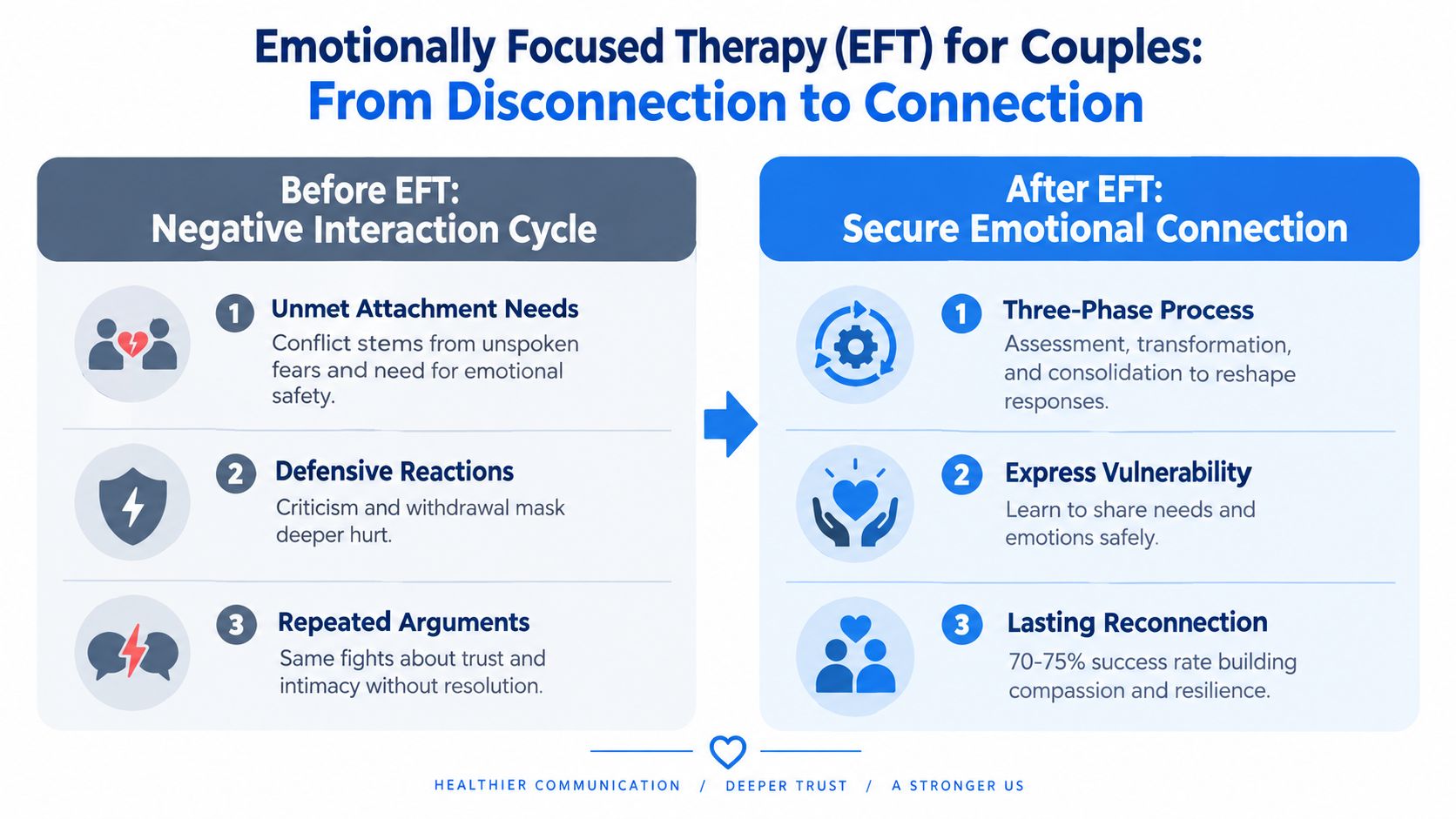
    Structured models are often used for exactly this reason. Approaches such as the Gottman Method and Emotionally Focused Therapy are designed to reduce negative interaction cycles, and one summary of independent user data notes that 71% of therapy users reported noticeable relationship improvement, with 34% saying better communication was the main gain in evidence-based couples therapy.

    That doesn't mean every session feels easy. It means the process is usually active and practical.

    What counselling is trying to improve

    A strong therapist pays attention to patterns such as these:

    Area What it may look like now What therapy helps build
    Communication Interrupting, mind-reading, blame Clearer expression and active listening
    Conflict Repeating the same argument Slower, more constructive disagreement
    Emotional connection Distance, numbness, avoidance More openness, empathy, and reassurance
    Daily partnership Stress-driven teamwork Shared problem-solving and resilience

    Positive psychology offers valuable insights for couples. They don't only need fewer fights. They also need more kindness, appreciation, hope, and moments of genuine connection.

    What it is not

    Marriage counselling isn't mind-reading, and it isn't magic. It also isn't a diagnostic label applied to your relationship.

    If a therapist uses questionnaires or check-ins, those are informational, not diagnostic. They help map patterns, stress points, communication habits, and strengths. That information can guide therapy, but it shouldn't be used to shame either partner.

    Good couples therapy helps both people move from "Who's the problem?" to "What pattern are we stuck in, and how do we change it together?"

    That shift often reduces blame. It also creates room for compassion, which is one of the strongest foundations for resilience and well-being in any long-term partnership.

    Signs It Might Be Time to Seek Support

    Most couples don't need a checklist to know something feels off. They usually need permission to take their discomfort seriously.

    You might be functioning well on the outside and still struggling in private. That's common. A relationship can look stable to friends and family while the two people inside it feel disconnected, exhausted, or emotionally unsafe.

    Patterns worth noticing

    Try reading these as informational signposts, not a diagnosis.

    • You keep having the same argument. The topic changes, but the emotional script stays the same.
    • You feel more like co-managers than partners. Home runs, but affection and curiosity have faded.
    • One or both of you avoid hard conversations. Silence starts to feel safer than honesty.
    • Trust has been shaken. It may involve secrecy, broken promises, or a sense that the bond no longer feels steady.
    • Stress is changing the relationship. Anxiety, depression, burnout, or family pressure starts affecting patience, intimacy, and daily communication.

    In India, this overlap between mental health and relationship strain is important. The National Mental Health Survey of India estimated that 10.6% of adults had a current mental disorder, with a treatment gap of about 70% to 92% depending on the condition, which highlights how many people carry distress without timely support, as discussed in this review of marriage counselling and mental health need in India.

    Why waiting can make things harder

    Couples often postpone therapy because they hope things will settle on their own. Sometimes they do. Often, though, unresolved stress gets folded into everyday life.

    A missed call becomes proof of not caring. A tired reply becomes rejection. A practical disagreement turns into a deeper story about being unseen.

    Small ruptures aren't small if they happen every week and never get repaired.

    If you're trying to make sense of serious long-term strain, it can also help to understand broader legal and relational patterns that lead couples apart. This overview of the primary causes of marital dissolution can be useful for context, especially if you're trying to distinguish between ordinary conflict and deeper structural problems.

    A gentle question to ask yourselves

    Instead of asking, "Is our relationship bad enough for counselling?" try asking:

    1. Are we handling stress in a way that protects the relationship, or drains it?
    2. Do we feel heard when difficult topics come up?
    3. Are we becoming more compassionate with each other, or more defensive?
    4. If nothing changed for six months, would that feel acceptable?

    You don't need to wait for a breaking point. Support can be appropriate when you want more calm, more clarity, and a better way forward.

    Online vs In-Person Counselling in Gurgaon

    For many couples in Gurgaon, the biggest obstacle isn't willingness. It's logistics.

    One partner may travel. The other may work late. You may live in different cities for part of the month, or struggle to find a private hour that doesn't involve traffic, office calls, and family interruptions. This is one of the least discussed parts of marriage counselling in Gurgaon, even though it shapes whether therapy is realistic at all.

    To make the choice easier, start with format before you think about deeper technique.

    A comparison chart highlighting the pros and cons of online versus in-person counselling in Gurgaon.

    When online counselling fits better

    Online therapy often works well for busy professionals and couples managing changing schedules. It can also help when one partner is in Gurgaon and the other is elsewhere.

    A useful review of current content gaps notes that couples often need answers about hybrid sessions, evening availability, and support for partners living apart, yet many resources don't address those practical concerns directly. That gap is highlighted in this discussion of common marriage counselling questions and access issues.

    Online sessions may suit you if:

    • Your schedules are unpredictable. Logging in from home or office is often easier than coordinating travel.
    • One partner travels often. Continuity matters in therapy, and remote access can reduce missed sessions.
    • Privacy at a clinic feels difficult. Some couples prefer the discretion of joining from a familiar place.
    • You want to begin quickly. Online options can reduce the delay caused by commuting and location matching.

    That said, online doesn't work well for everyone. If your internet is unstable, your home lacks privacy, or one partner disengages more easily on screen, sessions may feel less grounded.

    A short explainer on different support formats can also help if you're comparing therapy with broader guided growth options such as a coaching platform, especially when your goals include communication habits, accountability, or personal development alongside counselling.

    When in-person sessions help more

    Some couples feel safer talking in a therapist's office because the space is neutral. You're not surrounded by chores, notifications, or the emotional residue of the last argument in the living room.

    In-person sessions may be a better fit if:

    Format question Online may fit if In-person may fit if
    Privacy You can find a quiet room Home doesn't feel private
    Scheduling You need flexibility You can protect travel time
    Connection style You focus well on screen You open up better face-to-face
    Location needs You live apart or travel You're both usually in Gurgaon

    This video gives a simple overview many couples find helpful before making that call.

    A practical middle path

    Many couples do best with a hybrid arrangement. They may start in person to build rapport, then move some sessions online when travel or work gets heavy.

    If you're speaking to a therapist for the first time, ask direct logistical questions. Do you offer evening slots? Can one partner join remotely if needed? How do you handle rescheduling? These details aren't minor. They often determine whether counselling becomes a routine or another source of stress.

    How to Choose a Qualified Marriage Counsellor

    Finding a therapist can feel harder than admitting you need one. Search results are crowded, profiles can sound similar, and it's not always clear what makes someone right for couples work.

    A good starting point is to look for specialisation, credentials, and fit. General listening skills matter, but couples therapy needs specific training because the therapist is working with a relationship dynamic, not just two separate individuals.

    An infographic titled How to Choose a Qualified Marriage Counsellor in Gurgaon with four numbered tips.

    What to look for first

    Guidance for marriage counselling in Gurgaon consistently emphasises choosing someone with couples-therapy specialisation and licensed credentials, and also notes that many Delhi-NCR providers serve the wider region while offering Hindi and English sessions, which can improve engagement and fit, as described in this overview of couples counselling in Delhi-NCR.

    When you're reviewing profiles or speaking to a therapist, focus on these points:

    • Training for couples work. Ask whether they specifically work with couples, not only individuals.
    • Professional qualifications. Look for accredited degrees and relevant licensing or supervised clinical training.
    • Language comfort. If one or both partners express emotions better in Hindi or a mix of Hindi and English, that matters.
    • Experience with your pattern. Frequent conflict, emotional distance, recovery after trust rupture, intimacy strain, and work-related stress can require different emphasis.

    Questions worth asking in a first call

    You don't need to impress the therapist. You need enough clarity to judge whether their approach feels safe and useful.

    Try asking:

    1. How do you work when one partner speaks more than the other?
    2. What happens if sessions become heated?
    3. Do you meet each partner individually at any point?
    4. How do you stay neutral without taking sides?
    5. What's your approach to online or hybrid sessions?

    The right counsellor doesn't promise quick fixes. They explain their process clearly and make space for both partners.

    If you're comparing remote and office-based formats across cultures or mobile lifestyles, this guide to therapy choices for expats can offer a useful lens. It isn't Gurgaon-specific, but it helps couples think through privacy, language, and practical fit in a grounded way.

    Red flags that deserve attention

    Some concerns show up early. Trust your reaction if something feels off.

    • The counsellor quickly picks a hero and a villain.
    • They push personal values instead of helping you explore your own.
    • They dismiss concerns about anxiety, depression, or workplace stress as secondary.
    • They can't explain confidentiality, structure, or how they handle conflict.

    You can also use directories to narrow options. For example, DeTalks lets people browse therapist profiles, compare specialisations, and explore assessments that are informational, not diagnostic, which can help you understand concerns around well-being, resilience, stress, or relationship strain before booking.

    Your First Sessions Costs and Logistics

    The first few sessions are usually less dramatic than people expect. Most couples don't walk in and reveal everything immediately. The early work is often about slowing down, giving the therapist a clear picture, and deciding whether the fit feels right.

    What usually happens first

    In an opening session, the therapist may ask about the history of the relationship, the current concerns, and what each partner hopes will change. You may be asked about communication patterns, recent stress, family context, and whether anxiety, depression, burnout, or major life changes are affecting the relationship.

    Those conversations are for understanding, not judging. If the therapist uses forms or screening tools, treat them as informational, not diagnostic.

    A simple way to think about the first stage is:

    • Session one. Understanding the problem as each partner sees it.
    • Session two. Noticing patterns, triggers, and strengths.
    • Session three. Agreeing on goals and deciding how to work together.

    The logistics couples often forget to ask about

    Practical planning is essential. Before you begin, ask about session length, cancellation policy, online options, language, and whether one partner can join remotely if travel comes up.

    You should also ask how the therapist handles confidentiality in couples work. That avoids confusion later.

    Your first sessions are also for you to assess the therapist. You don't have to continue with someone who doesn't feel like a good fit.

    About fees and planning

    Costs in Gurgaon vary by therapist, training, setting, and format. Since no verified local fee range is provided here, it's better to ask each provider directly rather than rely on generalised estimates.

    That may feel inconvenient, but it can also help you compare thoughtfully. Some couples prioritise specialist training. Others need evening timing, hybrid access, or a Hindi-speaking therapist because those practical details make regular attendance possible.

    The wider demand for these services also makes sense in context. India's very large urban-married population, including about 192 million married women recorded in the 2011 Census, points to a broad underlying need for relationship support in cities such as Gurgaon, as noted earlier in the linked demographic overview. In everyday terms, that means you're not unusual for considering counselling. You're part of a large group of couples trying to manage modern married life with more care.

    Common Questions About Couples Therapy

    Many couples reach this point and still have a few worries left. That's normal. The questions below tend to matter most.

    What if my partner refuses to come

    Start smaller than "We need therapy." You might say, "We're stuck in the same argument and I'd like help learning how to talk better." That often feels less threatening.

    If your partner still says no, individual therapy can still help. One person changing how they respond can shift the tone of a relationship, even before joint sessions begin.

    How long does it take to see results

    There isn't one fixed timeline. It depends on the issue, the level of stress around it, how safe both partners feel being honest, and how consistently you attend.

    What matters early is not instant harmony. It's whether you begin to notice clearer communication, less escalation, more understanding, and a stronger sense that both of you are working on the same problem.

    Is everything confidential

    Therapists usually explain confidentiality at the start, and you should ask if anything feels unclear. In couples work, it's especially important to understand how private disclosures, joint sessions, and record-keeping are handled.

    Don't guess. Ask directly in the first consultation.

    Will the therapist tell us whether to stay together

    A thoughtful counsellor usually won't make the decision for you. Their role is to help you understand patterns, values, needs, and options with more honesty and less chaos.

    That can support repair. It can also help couples make difficult decisions with more clarity and less harm.

    Are assessments part of couples therapy

    Sometimes, yes. A therapist may use questionnaires or structured reflection tools to understand stress, communication habits, or emotional well-being.

    Those tools are informational, not diagnostic. They support insight. They don't define your relationship.

    Can counselling help if work stress is the real problem

    Often, yes. Workplace stress rarely stays at work. It can reduce patience, increase irritability, affect sleep, and leave very little energy for connection.

    Couples therapy can help partners talk about stress without turning each other into the enemy. That shift often supports resilience, compassion, and day-to-day well-being at home.

    A couple sitting on a couch consulting with a professional counselor in a warm, comfortable office setting.

    How can we find and book a therapist through DeTalks

    Keep it simple.

    Search for therapists who work with couples, review their specialisations, check language and session format, and shortlist the ones that match your practical needs. If you're unsure where to begin, use the platform to compare profiles, look at available support areas such as anxiety, depression, burnout, and relationship concerns, and book an initial conversation to test fit rather than chase certainty.

    The first step doesn't need to solve everything. It only needs to move you from feeling stuck to feeling supported.


    If you're ready to take that step, DeTalks can help you explore therapists, compare practical options like online or in-person sessions, and find support that fits your relationship, schedule, and well-being needs.

  • Marriage Counselling in Pune: Find Expert Support

    Marriage Counselling in Pune: Find Expert Support

    You may be sitting across from each other at the dining table, speaking mostly about bills, children, parents, or work, while the deeper conversation never happens. Or maybe every discussion turns into the same argument, and both of you leave feeling unheard, tired, and more alone than before.

    That's often the moment couples begin looking for marriage counselling in Pune. Not because the relationship is beyond repair, but because the current way of coping isn't working anymore.

    Counselling can help when stress, anxiety, depression, workplace stress, burnout, family pressure, or unresolved hurts start shaping the relationship more than care and companionship do. It can also help when nothing is “dramatically wrong” but the warmth, safety, and resilience in the relationship have faded. Many couples wait too long because they think therapy is only for crisis. It isn't.

    Good counselling is structured, practical, and respectful. It gives both partners a space to slow down, understand the pattern they're stuck in, and learn a better way to respond to each other. It also helps couples separate what belongs to the relationship from what may need individual support for well-being.

    If you're hesitant but hopeful, that hesitation is understandable. Most couples want clarity before they book. They want to know when counselling makes sense, what kind of therapy to choose, how to judge a counsellor, what sessions may look like, and what the cost might be. Those are sensible questions, and they deserve direct answers.

    Introduction

    You may be sitting in the same home, managing the same responsibilities, and still feel far apart. One of you has stopped bringing up difficult topics because the conversation goes nowhere. The other is trying to keep daily life stable, while wondering when the relationship became so careful, tense, or distant.

    This is a common starting point for couples who look for marriage counselling in Pune. The relationship is often not beyond repair. The problem is that the current pattern between you is no longer helping either of you.

    In practice, I see couples reach this point after months or years of strain from work pressure, parenting fatigue, in-law conflict, relocation, grief, anxiety, or old resentments that were never properly addressed. These pressures do not always create the problem on their own, but they can reduce patience, weaken connection, and turn ordinary disagreements into repeated emotional injuries.

    Marriage counselling gives the relationship a structured place to slow down. The work is not about choosing a winner. It is about identifying the interaction cycle that keeps both partners stuck, improving effective communication in Indian relationships, and deciding what needs repair, what needs clearer boundaries, and what may also need individual support.

    That practical clarity is often what hesitant couples need most. Before booking, many want straight answers about cost, session format, how to judge whether a counsellor is qualified, and whether using a verified platform such as DeTalks can make the first step feel safer and simpler. Those concerns are reasonable. Good guidance should address them directly.

    A useful counsellor also looks at the trade-offs in the room. Sometimes the relationship is carrying stress that began outside it. Sometimes one partner needs individual care alongside couple work. Sometimes both people are committed but have very different expectations about trust, intimacy, family involvement, or repair after hurt. Clear counselling helps couples sort these issues carefully instead of arguing about all of them at once.

    One more point is worth keeping in view. Self-assessments and online screening tools can support reflection, but they are informational, not diagnostic. They can point to patterns. They do not replace a proper clinical evaluation.

    Recognising When Your Relationship Needs Support

    Some signs are obvious. Frequent fights, mistrust after betrayal, or a complete collapse in communication are hard to ignore. Other signs are quieter, and couples often dismiss them for months.

    A relationship may need support when both partners are still committed, but the bond no longer feels emotionally safe or nourishing. You may still be functioning as a team while feeling lonely inside the marriage.

    An infographic listing six common signs that a romantic relationship may need professional support or counseling.

    Signs that often get overlooked

    These patterns deserve attention even if there hasn't been a major crisis:

    • Emotional distance. You live together, manage responsibilities, but rarely feel close.
    • Avoidance of difficult topics. Important conversations keep getting postponed because they always end badly.
    • Loss of shared joy. You're no longer curious about each other, and even peaceful moments feel flat.
    • Repeating conflict loops. The topic changes, but the emotional pattern stays the same.
    • Private resentment. One or both of you keep score, withdraw, or become sarcastic instead of direct.
    • Stress spillover. Workplace stress, burnout, anxiety, or family conflict keeps entering the relationship.

    For many Indian couples, communication is further shaped by family roles, duty, indirect expression, and differing expectations about marriage. If you want a simple companion resource on this, this piece on effective communication in Indian relationships offers a useful cultural lens.

    When couples therapy may not be the first step

    Not every relationship problem should begin with joint sessions. Existing Pune-focused content often mentions communication problems and infidelity, but gives far less guidance on when couples work is unsuitable or when individual therapy should come first, as noted by Mansa Clinic Pune's marital counselling page.

    That distinction matters. Couples counselling may not be appropriate as a first step if:

    • There are safety concerns such as domestic violence, coercive control, or fear of retaliation after sessions.
    • One partner is being forced to attend and cannot speak freely.
    • Severe addiction or acute mental health instability is dominating the situation.
    • The primary need is individual stabilisation first, especially when anxiety, depression, trauma, or intense anger make joint work too volatile.

    If one person doesn't feel safe telling the truth in the room, couples therapy can become performative rather than helpful.

    What support can do at this stage

    Marriage counselling doesn't require a dramatic breaking point. It can help couples catch a harmful pattern before it becomes the relationship's normal language.

    A good therapist looks at three levels together: how you communicate, what you each feel underneath the conflict, and what you both do when tension rises. That's where change becomes possible. Not through advice alone, but through repeated practice in a safer structure.

    Understanding Your Therapy Options in Pune

    You may already know you need help and still feel stuck on one practical question. What kind of counselling are we signing up for?

    Many couples in Pune come in expecting a free-form conversation about the week's argument. Good couples therapy is usually more structured. The method shapes what happens in the room, what kind of homework you may get, and how quickly you can tell whether the process fits your situation.

    A comparison chart outlining the pros and cons of EFT and CBT for couples therapy in Pune.

    Structured couples therapy has a real evidence base, and different models help in different ways. In practice, the most useful question is not which approach sounds impressive. It is which approach matches the pattern your relationship is stuck in.

    Two common approaches you'll hear about

    Approach Best understood as Often helps with Possible trade-off
    Emotionally Focused Therapy Repairing the emotional bond Disconnection, insecurity, repeated emotional fights, trust ruptures It can feel emotionally intense
    Cognitive Behavioural Therapy for couples Changing the thoughts and habits that drive conflict Poor communication habits, blame cycles, practical problem-solving It may feel more skills-based than deeply emotional

    Emotionally Focused Therapy, or EFT, is often a good fit when the underlying problem sits underneath the argument. One partner pushes for contact. The other withdraws. The content of the fight changes, but the cycle stays the same. EFT helps couples identify that cycle, slow it down, and respond with more honesty and less self-protection.

    Cognitive Behavioural Therapy for couples is often easier for couples who want a clearer framework from the start. It focuses on reactions, assumptions, behaviour, and the habits that keep conflict going. If the relationship is being worn down by criticism, defensiveness, poor repair attempts, or rigid interpretations of each other's intent, this approach can be very effective.

    Neither model is automatically better. EFT may suit couples who feel emotionally far apart but still want closeness. CBT-based work may suit couples who say, “We keep having the same practical fight and need tools we can use this week.” Many counsellors also draw from more than one approach, which is why it helps to ask how they work in practice rather than relying on labels alone.

    If you like doing structured exercises between sessions, these improve communication with worksheets can be a useful supplement. They do not replace counselling, but they can make difficult conversations more concrete.

    Online or in-person in Pune

    Format matters too. I often see couples choose online sessions for convenience, then realise privacy is the bigger issue. If one of you is attending from a flat where parents, children, or house staff are within earshot, honesty can drop fast.

    Online counselling often works well for couples with long commutes, demanding schedules, travel, or work timing that makes clinic visits hard to sustain. Attendance is better when the process fits real life.

    In-person counselling can work better when discussions escalate quickly, when one or both partners dissociate or shut down, or when being physically present helps both people stay engaged. Some couples also speak more openly in a neutral office because home is already loaded with tension.

    Choose the format that makes truthful conversation and regular attendance more likely. A workable option is better than an ideal one you cannot maintain.

    How to Choose the Right Marriage Counsellor

    A counsellor's style affects the process more than people expect. Credentials matter, but so does whether both partners feel respected, understood, and emotionally safe in the room.

    Pune has a broad and growing mental health network. Water Psychology's marriage counselling page highlights that one senior psychologist has 14 years of experience in relationship and marriage counselling, and it also points to affordable options through organisations such as the Center for Mental Health Law & Policy, Chaitanya Institute for Mental Health, and Schizophrenia Awareness Association. That range is useful because it means support isn't limited to one type of clinic or budget level.

    A practical shortlist

    When you compare counsellors, pay attention to these factors:

    • Relevant experience. Ask whether they regularly work with couples, not just individuals.
    • Fit for your issue. Infidelity, parenting conflict, intimacy concerns, cultural differences, and workplace stress can require different strengths.
    • Clear method. A good therapist should be able to explain how they work in plain language.
    • Balanced stance. Neither partner should feel the therapist is quickly taking sides.
    • Comfort level. If one or both of you feel judged, guarded, or shut down, progress usually slows.

    What good fit feels like

    Therapeutic fit isn't mystical. It's practical. Both people feel they can speak without being humiliated, interrupted, or simplified.

    Look for a counsellor who can hold complexity. In many Indian marriages, conflict includes not just the couple but also parents, caregiving expectations, money decisions, fertility pressure, career trade-offs, and differing ideas about gender roles. The therapist doesn't need to share your background, but they should understand that these pressures are real.

    A useful first consultation often reveals a lot. Notice whether the therapist asks thoughtful questions, explains boundaries, and gives both partners room to speak.

    You don't need instant comfort. You do need enough trust to keep showing up honestly.

    Key Questions to Ask Before Your First Session

    Most couples spend more time comparing restaurants or schools than comparing counsellors. That's understandable, because therapy feels personal and unfamiliar. Still, asking direct questions before your first session can save money, confusion, and emotional fatigue.

    This is also where many couples shift from passive hope to informed choice.

    A helpful infographic featuring key questions for couples to ask before their first marriage counselling session.

    A useful benchmark comes from SentiO's article on marriage therapy outcomes, which says marriage counselling success is commonly cited at about 70% to 80% improvement in relationship satisfaction, and emotionally focused approaches are often associated with roughly 70% to 75% recovery among distressed couples, with about 90% showing measurable improvement by treatment end. The same article also suggests practical vetting questions, such as whether the therapist uses a manualised method, how progress is measured, and whether there is a review point after 6 to 10 sessions.

    Questions worth asking directly

    You don't need to ask everything in one call, but these questions are useful:

    1. What kind of couples therapy do you use most often, and why?
      This tells you whether their work is structured or improvised.

    2. Have you worked with concerns like ours before?
      You don't need a dramatic case match. You do need relevant familiarity.

    3. How do you measure progress?
      Strong answers may mention communication quality, distress levels, emotional responsiveness, conflict repair, or attendance consistency.

    4. When do you usually review whether therapy is helping?
      A clear review point protects couples from drifting through sessions without direction.

    5. How do you work when partners want different things?
      This matters if one person wants repair and the other is uncertain.

    6. Do you recommend any individual sessions as part of the process?
      Sometimes that helps clarify personal stress, anxiety, or depression without derailing the couples work.

    To hear another perspective before booking, this video may help you think through the first conversation with a counsellor.

    Why these questions matter

    Couples often ask about success rates first. That's understandable, but it's not the most useful opening question. A better question is whether the therapist has a method, a way to track change, and a plan when one partner disengages.

    Good counselling isn't just supportive. It is organised. If there's no structure, couples can leave each session feeling intense emotion but little movement.

    Navigating Costs and Session Structure in Pune

    Cost uncertainty stops many couples before they ever make contact. That hesitation makes sense. In Pune, many counselling pages explain benefits but say very little about actual fees or how sessions are organised.

    An infographic detailing the costs and structure of marriage counselling services in Pune, India.

    One concrete reference point comes from Counselling with Neha, where a 55 to 60 minute session is listed at ₹5500. The same source highlights a wider information gap in Pune. Many sites don't explain price bands or pathways to affordable care clearly, which can make counselling feel inaccessible even before a couple explores options.

    What usually affects fees

    Fees can vary for reasons that are reasonable, but not always obvious to clients:

    • Experience and specialisation. Therapists with long-standing couples practice may charge more.
    • Session length. Couples sessions are often longer or more demanding than individual work.
    • Format. Online and in-person sessions may be priced differently.
    • Initial process. Some therapists start with a joint intake, while others meet each partner individually first.

    If affordability is a concern, ask directly whether there are lower-cost options, reduced-fee slots, or referrals to organisations offering affordable counselling. Many couples delay therapy because they assume all providers are beyond budget, and that assumption isn't always correct.

    How sessions are often structured

    A typical process is more deliberate than many people expect. The early phase usually focuses on history, current pain points, goals, and the pattern that keeps repeating. After that, the work becomes more active.

    A peer-reviewed Indian study on couple counselling available through PMC notes that retention is a major challenge. The researchers expected about 20% attrition by 3 months and a further 30% by 12 months, projecting that only 141 of 252 eligible couples would remain for final evaluation. In practical terms, that's why good therapists pay attention to early alliance, attendance, and clear review points.

    A simple way to plan

    When you ask about structure, look for answers to these practical points:

    Question Why it matters
    How often do we meet? Consistency shapes momentum
    Are sessions joint only, or sometimes individual? This affects comfort and clarity
    How will we know if it's working? It keeps the process grounded
    What happens if one partner misses sessions? Attendance problems often weaken outcomes

    The right plan should feel realistic. If both of you already struggle with time, setting an unrealistic schedule can create one more source of conflict.

    How to Take Your First Step with DeTalks

    It often starts the same way. One partner says, "Let's at least talk to someone." The other agrees in principle, but then the practical questions take over. Who do we choose? Will the counsellor understand our issue? What if we spend money and feel no connection after the first session?

    That hesitation is reasonable. Couples rarely need more advice about why therapy matters. They need a clear way to begin without adding more stress to an already strained relationship.

    A useful first step is to make your search specific. Do not look for a counsellor in the abstract. Look for someone who regularly works with the problem you are facing now, whether that is trust after infidelity, repeated conflict, parenting pressure, emotional distance, anxiety affecting the relationship, or work stress that keeps entering the marriage. A verified platform such as DeTalks helps reduce guesswork because you can review profiles, compare focus areas, and check practical details before you book.

    Keep the first decision small.

    The first appointment is not a commitment to months of therapy with one person. It is a structured consultation to see whether the fit is workable for both partners. In practice, this mindset helps couples book earlier and judge the process more fairly. You are not asking, "Is this the perfect counsellor forever?" You are asking, "Can this person understand our pattern, stay balanced, and offer a plan we can realistically follow?"

    Before you book, write down:

    • The pattern you want help with most right now
    • Your practical limits, such as budget, timing, language, location, or privacy needs
    • What each partner wants to be different in the next few months

    If your answers differ, that is not a problem. It is useful information. A good couples counsellor expects mixed goals at the start and helps turn them into something clear enough to work on together.

    Some couples also arrive with results from self-check tools on stress, anxiety, depression, resilience, or relationship strain. Those tools can help organise your thoughts, but they do not replace an assessment. Their value is simple. They help you describe what has been hard and ask better questions in the first session.

    A good beginning is often modest and practical: a shortlist, one booking, one honest conversation. That is usually how couples move from avoidance to action, with more clarity and less fear.

  • Husband and wife relation after marriage: Husband and Wife

    Husband and wife relation after marriage: Husband and Wife

    Some couples notice the subtle change. The late-night calls become grocery lists. The playful flirting gets replaced by reminders about bills, parents, deadlines, and sleep.

    That doesn’t mean love has disappeared. In most marriages, it means love is changing shape.

    A healthy husband and wife relation after marriage isn’t built by staying exactly as you were during courtship. It grows when two people learn how to live, decide, rest, disagree, and care for each other in ordinary life. That shift can feel comforting, confusing, and sometimes painful, all at once.

    The Unspoken Shift After 'I Do'

    A couple may start married life feeling close in every way. They talk constantly, miss each other quickly, and feel excited by even small moments together. Then, a few years later, the same couple may wonder why everything feels more serious.

    One partner may think, “We don’t laugh like we used to.” The other may think, “I’m trying so hard, but all we talk about is responsibility.” Both can be loving. Both can feel lonely.

    This is more common than many people realise. In India, a 2022 Tata Institute of Social Sciences study found that 45% of urban couples cited adjustment issues and lack of compatibility as primary reasons for marital discord within the first 5 years of marriage.

    Marriage changes daily life in ways dating usually doesn’t. You start sharing routines, family expectations, financial decisions, personal habits, and private stress. Love is still there, but it now has to live alongside practical life.

    Marriage is less like a photograph and more like a living home. It needs care, repair, warmth, and room for change.

    In the Indian context, this shift can feel even heavier because marriage often joins not only two individuals, but also two family cultures. Food habits, spending styles, gender roles, religious practices, and views about work can suddenly become daily topics instead of abstract ideas.

    That’s why a change in the husband and wife relation after marriage shouldn’t be read as proof that something is broken. Often, it’s the first real stage of building a shared life.

    What many couples misunderstand

    • Less intensity doesn’t always mean less love: Early excitement naturally settles.
    • More conflict doesn’t always mean incompatibility: Sometimes it means hidden expectations are finally becoming visible.
    • Feeling tired isn’t the same as feeling disconnected: Workplace stress, anxiety, and burnout can make affection harder to show.

    When couples understand this early, they stop blaming themselves and start responding with more compassion.

    From Romance to Partnership The Real Journey Begins

    Marriage begins with emotion, but it survives through structure. That doesn’t sound romantic, yet it is often what creates lasting safety.

    Think of marriage like a garden. In the beginning, the first blooms come quickly. Colours are bright, attention is easy, and both people naturally move towards each other. Later, the garden needs watering, pruning, patience, and protection from harsh weather. It can become richer with time, but not by accident.

    A flowchart diagram illustrating the progression from the romance phase of marriage to a long-term partnership.

    Why the feeling changes

    Early romantic love often runs on novelty. Everything is new. You’re discovering preferences, values, habits, and dreams.

    Long-term partnership is different. It depends more on trust, reliability, memory, and emotional safety. Instead of asking, “Do you still get excited by me?” married life starts asking, “Can I depend on you when life gets hard?”

    That’s a deeper question. It also brings pressure.

    Personality also adapts

    Marriage doesn’t only reveal personality. It can shape it. Longitudinal findings discussed in this Psychology Today summary on how marriage changes your personality note that husbands often show an increase in conscientiousness, reflecting adaptation to responsibility, while wives may show a decline in neuroticism as they settle into a stable partnership.

    In plain language, people often become more organised, responsible, or emotionally steady because marriage asks for it. A husband may become more careful about planning, money, and consistency. A wife may feel calmer in some areas because the relationship brings routine and belonging.

    Still, adjustment isn’t always smooth. Growth can look awkward before it looks stable.

    Partnership is made of ordinary moments

    A mature marriage often includes things that look less dramatic from the outside:

    • Shared routines: Who cooks, who calls the plumber, who remembers medicines.
    • Invisible care: Bringing tea without being asked, checking in after a hard meeting, waiting up after a late commute.
    • Emotional steadiness: Not solving everything, but staying present.

    Practical rule: Don’t compare your settled marriage to your early romance. Compare it to the kind of life you’re trying to build together.

    When couples understand this, they stop chasing the exact feeling of the beginning. They start protecting the bond they have now.

    Navigating the Five Key Shifts in Your Relationship

    Most marital strain doesn’t come from one dramatic event. It comes from repeated shifts that couples don’t always know how to name.

    A loving husband and wife hold hands while sitting together on a comfortable sofa in their sunlit home.

    NFHS-5 data suggests a correlation between spousal conflict and a 35% drop in reported relationship satisfaction within 3 to 7 years of marriage, often linked to emotional and sexual intimacy challenges. That matters because many couples begin to struggle in exactly these everyday areas, not because they don’t care, but because they stop noticing the shift.

    Emotional intimacy becomes quieter

    Before marriage, emotional intimacy often means long conversations, constant reassurance, and visible excitement. After marriage, it may become quieter. Sitting together in silence can feel loving to one partner and distant to the other.

    Confusion often starts. One person feels comfort. The other feels neglect.

    A strong marriage learns both languages. It keeps the comfort of familiarity, but also makes space for active warmth. A short check-in after work or a gentle “How are you really doing?” can restore emotional closeness.

    Practical partnership takes centre stage

    Dating is about meeting. Marriage is about running a shared life.

    Laundry, meals, relatives, transport, health appointments, and planning don’t look romantic, but they strongly affect relationship well-being. If one partner carries the mental load alone, resentment can grow even if love remains.

    A useful question is not “Who does more?” but “Does this feel fair to both of us right now?”

    Sexual connection shifts from novelty to meaning

    Sex in marriage often changes because life changes. Fatigue, anxiety, resentment, parenting pressure, body image concerns, and workplace stress can all affect desire.

    This doesn’t mean the relationship is failing. It often means the couple needs emotional safety, honest conversation, and less shame around discussing intimacy. For many married couples, sexual connection improves when pressure reduces and tenderness increases.

    Money becomes relational, not just practical

    Before marriage, spending can feel personal. After marriage, money starts carrying emotional meaning. Security, freedom, duty, status, generosity, and fear all show up in financial conversations.

    In India, this can become more layered because couples may also balance support for parents, family expectations, and the move between joint and nuclear household thinking. A budget discussion is rarely only about numbers. It is often about values.

    Roles keep evolving

    Marriage doesn’t freeze identity. People change through work, illness, parenthood, grief, success, disappointment, and ageing.

    A wife may want more space for career growth after years of prioritising family. A husband may want a more emotionally expressive role than he saw growing up. If the marriage doesn’t allow these updates, both partners can feel trapped inside old expectations.

    A simple way to notice where the strain is

    • If you fight about chores often: the deeper issue may be fairness.
    • If sex feels tense or avoidant: the deeper issue may be emotional distance or exhaustion.
    • If money talks become heated quickly: the deeper issue may be fear, control, or insecurity.
    • If one partner says “You’ve changed”: the deeper issue may be unspoken role renegotiation.
    • If conversations stay surface-level: the deeper issue may be lost emotional intimacy.

    Naming the shift reduces blame. It helps couples work on the underlying problem instead of attacking each other’s character.

    Common Stressors That Can Test Your Bond

    Many marriages don’t break under one big issue. They get worn down by pressure that enters the home every day.

    In urban India, this pressure can be intense. Commutes are long, work follows people home, family obligations remain strong, and many couples are trying to build emotional closeness while functioning in constant fatigue.

    A 2024 NIMHANS report indicated a 35% increase in anxiety and depression among dual-career couples in urban India, and 28% of women in metropolitan areas cited financial disagreements as a primary source of marital conflict, as noted in this PMC-linked summary.

    Internal pressure inside the relationship

    Some stressors grow within the couple’s private dynamic.

    A small misunderstanding becomes a pattern. One partner shuts down. The other pursues harder. After a while, even simple conversations feel loaded.

    Unaddressed anxiety, low mood, irritability, or emotional exhaustion can also change tone at home. A person may sound cold when they’re overwhelmed. Their partner may hear rejection instead of distress.

    When stress isn’t named, couples often personalise it. They assume “you don’t care” when the fuller truth may be “you’re depleted”.

    External pressure around the relationship

    Other stressors come from outside.

    Workplace stress can make a gentle person impatient. Burnout can reduce affection. Financial uncertainty can make both partners defensive. Extended family expectations can create loyalty conflicts, especially when boundaries aren’t discussed clearly.

    In many Indian marriages, these pressures are not minor. They shape daily routines, privacy, and decision-making.

    Common Marital Stressors and Resilience Strategies

    Common Stressor What It Feels Like Resilience-Building Action
    Workplace stress Short temper, emotional absence, low energy at home Create a transition ritual after work, such as tea, a walk, or ten quiet minutes before serious talk
    Financial disagreement Repeated arguments, blame, fear about the future Schedule calm money conversations and separate planning from criticism
    Family expectations Guilt, divided loyalties, confusion about boundaries Agree privately on shared boundaries before speaking to relatives
    Emotional withdrawal Silence, distance, “roommate” feeling Start with low-pressure connection, such as one daily check-in
    Anxiety or depression Hopelessness, irritability, avoidance, feeling misunderstood Seek professional support early and treat mental well-being as a shared concern, not a personal flaw

    Stress is a test of teamwork

    A couple doesn’t need a perfect life to have a strong marriage. They need a way to respond to pressure without turning on each other.

    That response may include rest, clearer roles, kinder communication, therapy, counselling, or practical planning. Resilience isn’t about never struggling. It’s about returning to each other with honesty and care.

    Building Resilience The Art of Communication and Repair

    Strong couples don’t avoid all conflict. They learn how to recover from it.

    A middle-aged couple is sitting at their kitchen table having a serious and thoughtful conversation together.

    Research based on the Gottman method shows that couples who maintain a 5:1 ratio of positive to negative interactions experience 40% lower divorce ideation, and responding positively to a partner’s bids for attention 9 out of 10 times predicts higher relationship satisfaction, according to this discussion of two marriage statistics.

    What the 5 to 1 idea looks like in real life

    This doesn’t mean pretending everything is fine. It means a marriage needs more moments of goodwill than moments of criticism.

    Positive interactions are usually small:

    • A soft start: “Could we discuss something?” instead of “You never listen.”
    • Visible appreciation: thanking your partner for ordinary effort.
    • Shared humour: a laugh in the kitchen counts.
    • Gentle touch: a hand on the shoulder, a warm greeting, eye contact.

    Negative moments also tend to be small but powerful. Sarcasm, dismissive replies, eye-rolling, contempt, and cold silence can stay in the body long after the words end.

    Bids for connection matter more than grand gestures

    A bid for connection is any small attempt to reach your partner. “Look at this message.” “I had a difficult day.” “Come sit with me.” “Taste this.”

    When a partner responds, even briefly, they are saying, “I see you.” That builds trust over time.

    A marriage often grows stronger through tiny daily turns towards each other, not through rare dramatic displays.

    Here’s a useful distinction. Not every bid needs a deep conversation. Some only need presence.

    For couples who regularly fight about money, structure can reduce heat. A shared system for planning can help, and practical guides on managing joint finances as a couple can support calmer discussions around spending, saving, and shared responsibility.

    Repair is a skill, not a personality trait

    Some people assume good communicators are born that way. Usually, they learn.

    Repair means stopping damage before it spreads. It includes:

    1. Naming the moment: “We’re getting tense. Let’s slow down.”
    2. Taking a pause: not storming off, but agreeing to return.
    3. Owning your part: “I spoke sharply. I’m sorry.”
    4. Returning with one issue only: avoid bringing in every old hurt.

    A short visual explanation can help couples see how these patterns work in practice.

    Communication that supports well-being

    Helpful communication isn’t only about problem-solving. It also protects well-being.

    When couples speak with care, they reduce unnecessary anxiety. When they repair after conflict, they lower emotional overload. When they respond to bids, they create safety that supports resilience, affection, and even daily happiness.

    A simple nightly question can go far: “What felt heavy for you today, and what helped?”

    That question invites honesty without turning the home into an interrogation room.

    When and How to Seek Professional Support

    Some marital problems can be worked through with better habits. Others need guided help.

    If the same arguments repeat without resolution, if one or both partners feel emotionally numb, if separation is being mentioned often, or if depression, anxiety, substance use, or severe burnout are affecting daily life, professional support can make a real difference.

    Therapy is not a last resort

    Many people still think therapy or counselling means the marriage is close to collapse. That belief stops couples from seeking help when support would be most useful.

    In reality, therapy can function like preventive care. It gives couples a structured place to speak openly, slow down reactive patterns, and learn better ways to respond to pain.

    A professional counselor talking to a husband and wife during a supportive therapy session at home.

    What couples counselling often involves

    A good therapist usually helps the couple do a few practical things:

    • Map the pattern: who withdraws, who pursues, what triggers escalation.
    • Improve communication: not just speaking more, but speaking more safely.
    • Clarify hidden expectations: around intimacy, work, family, parenting, or roles.
    • Support individual mental health: because relationship pain and personal distress often interact.

    If alcohol use is affecting safety, trust, or family functioning, relationship support may also need addiction-focused help. In that situation, practical reading such as how to help an alcoholic husband can offer an additional layer of guidance.

    Assessments can inform, not label

    Some couples also benefit from psychological assessments. These can help people reflect on personality patterns, stress, coping style, emotional triggers, or relationship habits.

    It’s important to keep this clear. Assessments are informational, not diagnostic. They can guide self-understanding and conversations with a qualified professional, but they shouldn’t be used to label a partner or “prove” who is right.

    Seeking support is not an admission of failure. It’s often an act of responsibility towards the relationship and towards your own mental health.

    In the Indian context, where family privacy and stigma can make couples hesitate, even one skilled counselling conversation can begin to reduce shame and confusion.

    Your Path Forward Nurturing a Lasting Partnership

    A good marriage isn’t one that never changes. It’s one that keeps adapting without losing kindness.

    The husband and wife relation after marriage becomes stronger when couples stop chasing perfection and start practising attention, repair, fairness, and emotional honesty. Some seasons will feel light. Others will ask for patience, therapy, counselling, and more deliberate care for well-being.

    Resilience in marriage often looks ordinary. It’s a softer tone after a hard day, a better boundary with work, a more respectful money conversation, a pause before saying something hurtful, and the courage to ask for help when anxiety, depression, or burnout enter the relationship.

    Keep the goal simple. Stay reachable to each other. Stay curious. Let the marriage grow as the people inside it grow.


    If you’d like support for your relationship or your own mental well-being, DeTalks can help you connect with qualified therapists, explore confidential assessments, and find guidance for anxiety, depression, workplace stress, burnout, and relationship challenges. These tools can offer useful insight and direction, and any assessment should be understood as informational, not diagnostic.

  • What Is Couples Therapy and How Can It Help Your Relationship

    What Is Couples Therapy and How Can It Help Your Relationship

    Couples therapy is a supportive space where you and your partner work with a trained professional to navigate your relationship's challenges. It's much more than a last resort; think of it as proactive care for your partnership. It is a dedicated time to improve communication, manage conflict, and build a deeper emotional connection.

    Taking this step is a positive move toward building the future you both want, together.

    Defining Couples Therapy: A Space for Growth

    At its heart, couples therapy is a guided conversation in a safe, non-judgmental setting. It’s a space where you and your partner can talk openly about your feelings and experiences.

    A therapist acts as a neutral guide, helping you both understand each other's perspectives more clearly. The goal isn't to assign blame, but to build empathy and find constructive ways to move forward as a team.

    For a quick overview, here's a simple breakdown of what this type of counselling involves.

    Couples Therapy at a Glance

    Key Aspect Description
    What It Is A form of psychotherapy focused on improving the relationship between two intimate partners.
    Who It's For Any couple seeking to improve communication, resolve conflict, or deepen their connection—not just those in crisis.
    Primary Goals To foster understanding, build stronger communication skills, and equip partners with tools for a healthier, more resilient relationship.

    This table provides a snapshot, but the experience itself is tailored to each couple's unique needs and history.

    What Does Therapy Actually Address?

    Couples seek therapy for many reasons, from specific conflicts to a general feeling of emotional distance. Sometimes, challenges like stress or anxiety can impact a relationship in quiet, unseen ways.

    Therapy is versatile and can help with:

    • Improving Communication: Learning how to listen and be heard without conversations escalating into arguments.
    • Resolving Conflicts: Finding productive ways to handle disagreements instead of repeating the same fight.
    • Navigating Life Transitions: Getting support through major events like marriage, parenting, or career changes.
    • Rebuilding Trust: A structured, safe path to healing after a significant breach of trust.

    More Than Just Solving Problems

    While therapy is excellent for tackling challenges, it's also about strengthening what is already working well. It’s a chance to nurture the positive aspects of your relationship, fostering greater intimacy, compassion, and happiness.

    A core principle of couples therapy is that it's an investment in your shared future. It’s not a sign of failure but an act of courage and commitment to creating a more fulfilling life together.

    By addressing the root of your emotions, you can break cycles of recurring arguments that often lead to anxiety and burnout. Any assessments used are informational tools to guide conversation, not to provide a diagnosis. This process helps you build a partnership based on genuine respect, understanding, and resilience.


    The Rising Acceptance of Couples Therapy in India

    A positive shift is happening in India, where the conversation around relationships is evolving. More couples now see therapy not as a last resort, but as a wise, healthy choice for their partnership's well-being.

    Modern life can be demanding, and pressures from careers, workplace stress, and urban living can create friction. As traditional family structures change, many couples are creating new paths for themselves, which can be challenging to navigate alone.

    In response, younger generations are challenging old stigmas around mental health. They are proactively seeking guidance, even before marriage, to build a strong foundation. This approach is not about weakness; it reflects wisdom and a commitment to emotional health.

    Seeking therapy is not an admission of failure. It is an act of profound strength, courage, and deep commitment to the health and happiness of your relationship.

    This shift shows a deep desire to face life's challenges as a team. By investing in professional counselling, couples build the resilience needed to manage both internal disagreements and external pressures like anxiety or burnout.

    A New Generation Embraces Proactive Well-being

    Today’s younger couples, particularly millennials and Gen Z, understand that emotional health is just as vital as physical health. They are more open to discussing feelings and actively seeking practical tools to strengthen their relationships, leading to a surge in demand for couples therapy. We see this especially with unmarried partners who want to build a solid foundation before committing to marriage.

    The data supports this trend. In recent years, platforms like YourDOST have seen a significant increase in young Indian couples seeking therapy. They reported a 20-fold increase in sessions booked by unmarried couples between FY2023 and FY2025. This included a 1,034% jump in FY2023-24 and another 103% spike in FY2024-25. You can explore more data on this emerging trend to see how the 19-25 age group is prioritizing emotional wellness.

    This proactive approach helps couples master essential skills early on, such as:

    • Effective Communication: Learning to express needs clearly and listen with empathy before misunderstandings grow.
    • Conflict Resolution: Finding healthy ways to disagree without causing emotional harm.
    • Building Shared Goals: Aligning on future plans, values, and what you want to create together.

    Navigating Modern Relationship Stressors

    The pressures on modern Indian couples are multifaceted. Juggling demanding careers with personal lives can lead to burnout and create emotional distance. Balancing family expectations while forging your own path can add another layer of stress.

    Couples therapy offers a neutral space to address these specific challenges. A therapist can help you see how external forces, such as workplace stress or family dynamics, affect your relationship.

    By identifying these triggers, you can learn to support each other through them, turning potential conflicts into opportunities for connection and compassion. It’s about building a shared toolkit to face life’s challenges as a united front, dedicated to each other’s well-being and happiness.

    Exploring Different Approaches to Couples Counselling

    There is no single "correct" way to approach couples therapy. A skilled therapist uses various well-researched methods to create a plan that fits your relationship's unique dynamic and goals.

    Understanding these different approaches can demystify the process and help you feel more confident. Some methods focus on changing behaviours, while others explore emotions or build practical skills. Your therapist will select the right combination to help you build a stronger, healthier connection.

    In today's world, pressures from demanding careers, evolving family roles, and the fast pace of urban life all contribute to the challenges couples face.

    This image highlights how external stressors shape what couples bring to therapy, influencing the focus of the sessions. Below, we'll explore some of the most respected and widely used approaches in couples counselling.

    Comparing Common Couples Therapy Methods

    Each therapeutic model offers a unique lens for viewing and improving a relationship. The table below provides a quick look at what each one focuses on and the kinds of challenges it is best suited to address.

    Therapy Approach Main Focus Best For Couples Experiencing
    Gottman Method Building practical skills for friendship, conflict management, and shared goals based on extensive research. Frequent arguments, poor communication, a sense of disconnection, or a desire for a proactive "relationship check-up."
    Emotionally Focused Therapy (EFT) Identifying and changing negative emotional cycles to create a secure, deep emotional bond between partners. A loss of intimacy, feelings of betrayal or mistrust after an affair, or patterns of emotional withdrawal and pursuit.
    Cognitive Behavioural Therapy (CBT) Pinpointing and reframing unhelpful thoughts and behaviours that contribute to conflict and negativity. Specific behavioural issues (like anger management), anxiety affecting the relationship, or repetitive, unproductive fights.
    Imago Relationship Therapy Understanding how childhood experiences and wounds unconsciously shape partner selection and current conflicts. Recurring arguments that feel like they're about the same old thing, or a feeling of being misunderstood by your partner.

    This isn't a complete list, but it covers the core methods you're most likely to encounter. An experienced therapist will often integrate elements from different approaches to tailor the therapy specifically to you.

    The Gottman Method: Building a Strong Foundation

    The Gottman Method is like a blueprint for a healthy relationship, developed from decades of research observing real couples. It focuses on the practical, everyday actions that make a partnership strong. The goal is to build what its founders, Drs. John and Julie Gottman, call the “Sound Relationship House.”

    Therapy centres on strengthening friendship, managing conflict constructively, and creating shared meaning. You’ll learn tangible skills, such as how to communicate better and show appreciation, to improve your daily interactions.

    Emotionally Focused Therapy (EFT): Getting to the Heart of the Matter

    Emotionally Focused Therapy (EFT) explores the "why" behind your arguments. It is based on the idea that conflicts often stem from our core emotional needs for safety, connection, and feeling valued.

    An EFT therapist helps you and your partner identify and interrupt painful, repetitive cycles. The goal is to create new, positive patterns where you can both express your needs safely and feel heard.

    At its core, EFT helps partners understand the raw emotions driving their reactions. It's about learning to hear the call for connection hidden beneath the anger or withdrawal.

    This focus on emotional connection helps you move from distress to a place of compassion and support, which is vital for long-term well-being.

    Cognitive Behavioural Therapy (CBT) for Couples

    You may have heard of Cognitive Behavioural Therapy (CBT) for individuals, and the principles are similar for couples. It focuses on the link between thoughts, feelings, and behaviours within the relationship.

    CBT helps partners identify and challenge unhelpful thought patterns that fuel conflict. It provides tools to question and reframe automatic, negative thoughts into more balanced and realistic ones. This structured approach teaches practical skills in communication and problem-solving.

    An Integrative Approach for Modern Indian Couples

    In practice, many therapists in India use an integrative approach, blending techniques to suit a couple’s specific needs. This is particularly effective for addressing the unique mix of traditional values and modern pressures that many urban Indian couples face.

    For example, a pioneering Couple Enrichment Clinic in Bangalore has offered preventive therapy since 2011. A study of couples who attended between 2023 and 2024 showed an integrative approach was highly effective in promoting relational health. This culturally adapted therapy helps couples build resilience before major crises occur. You can learn more about these findings on preventive relational health.

    The main takeaway is that there is no single "best" type of therapy. An experienced counsellor will use the most appropriate tools to help you achieve your goals as a couple.

    Navigating Your First Couples Therapy Sessions

    Walking into your first therapy session can bring a mix of hope and nervousness, which is completely normal. Knowing what to expect can ease any anxiety about the process.

    The first few sessions are about building a foundation of trust and understanding. Your therapist's main goal is to get to know you as individuals and as a couple in a safe, supportive environment.

    The Assessment Phase: Understanding Your Story

    During these initial meetings, the therapist will gather information to understand the full picture of your relationship. They will likely meet with you together and may also schedule individual time with each of you to understand both perspectives.

    It is important to know that any assessments used are informational, not diagnostic. They are simply tools to help the therapist gain clearer insight into your dynamic, ensuring the therapy is tailored to your specific needs.

    The goal of the initial sessions is alignment. It's about making sure you, your partner, and your therapist are all on the same page, feeling comfortable and ready to move forward together.

    This collaborative start is crucial for building a strong therapeutic alliance, or a sense of trust and rapport. This connection is one of the biggest factors in successful therapy.

    Setting Clear and Achievable Goals

    After understanding your relationship's landscape, the focus will shift to setting goals. This is a team effort where you and your partner define what a healthier relationship looks like to you.

    These goals provide your sessions with a clear purpose and direction. They could include:

    • Learning how to disagree constructively.
    • Rebuilding trust after a betrayal.
    • Figuring out how to manage work stress as a team.
    • Rediscovering intimacy and connection.

    Your therapist will work with you to outline a clear path forward. You can find helpful structured treatment plan examples online that show how therapists map out the journey. Having this roadmap can make the process feel more concrete and help you track your progress.

    What Comes Next

    You will also discuss practical details, such as how often you'll meet, which is often weekly at the start. The duration of therapy varies depending on your unique situation and goals.

    The first few sessions are designed to create a secure, respectful space where you both feel seen and heard. It is the starting point of a constructive journey toward a stronger, more connected partnership.

    When Should You Consider Couples Therapy?

    Sometimes, signs that a relationship needs support are quiet, like a slow drift apart or a recurring argument that never gets resolved. You might start to feel more like roommates than partners.

    Recognizing these patterns isn't about blame; it's about acknowledging that your partnership is facing a challenge. It's an opportunity to address small issues before they become bigger problems.

    It Often Starts with Communication

    A breakdown in how you talk to each other is a common sign that support is needed. Conversations may feel tense, leaving you both feeling unheard and misunderstood.

    Does any of this sound familiar?

    • Constant Criticism: Feedback feels like a personal attack, putting you both on the defensive.
    • Emotional Shutdown: During conflict, one or both of you withdraw, making connection difficult.
    • Avoiding the Hard Stuff: You avoid important topics because it feels easier than starting another fight.

    These communication traps often point to deeper, unspoken needs. Counselling provides a safe space to voice those needs and build a foundation of understanding and emotional safety.

    When Outside Stress Invades Your Relationship

    Life's demands, such as high-stress jobs, financial worries, or family challenges, can drain your energy and affect your relationship. It is common for workplace stress to spill over into home life.

    Major life changes, like a new job or the loss of a loved one, can also strain a partnership. If you find yourselves turning away from each other during tough times, a therapist can help you build more resilience as a team.

    Reaching out for help isn’t a sign of failure. It's an act of courage and a powerful commitment to the health of your relationship. Many couples see the warning signs and start seeking support when you don't want a divorce because they are invested in making things better.

    This proactive approach is becoming more common. As social norms in India shift, the need for interventions like couples therapy is rising. Data from the National Family Health Survey (NFHS-5) shows divorce rates have increased by 50% in the last two decades, often fueled by communication issues and modern life pressures.

    The goal of therapy is to equip you with tools to face these pressures together. It's about turning shared challenges into opportunities to grow closer, creating a partnership that is not only resilient but also happier and more compassionate.

    Ready to Start? Here’s How DeTalks Can Help

    Deciding to start couples therapy is a significant and courageous step. We have made the process on DeTalks straightforward and private, putting you in control.

    Your journey begins by exploring our directory of qualified mental health professionals. This is a space to find guides who can help you and your partner reconnect.

    Finding Your Therapist

    The connection you have with your therapist is key to a positive outcome. You need to find someone you both feel comfortable with and trust.

    Our platform allows you to filter your search by specialists in couples therapy and narrow it down by specific issues, such as anxiety or communication challenges. You can review detailed therapist profiles to understand their approach and background. Reading these together can be your first collaborative step toward healing.

    Get a Head Start with Self-Assessments

    If you are curious about your starting point, we offer a library of scientifically validated psychological assessments. These are not tests to pass or fail, but tools to provide insight into your emotional landscape and relationship dynamics.

    It's important to know these assessments are purely informational, not diagnostic. They are designed to encourage self-reflection and provide a starting point for conversations in therapy.

    Taking an assessment is like getting a map before a journey. It doesn’t tell you where you have to go, but it helps you understand your starting point, making the path ahead much clearer.

    What to Ask a Potential Therapist

    Most therapists offer a short, free consultation call, which is a great opportunity to see if it’s a good fit. It helps to go into that chat with a few questions prepared.

    You might want to ask:

    • What is your experience working with couples who have issues similar to ours?
    • What is your primary therapeutic approach for couples?
    • What can we expect from our first few sessions?
    • How will we track our progress?

    Asking these questions helps you feel confident that you are on the same page from the start. It's about finding a partner in this process who can help you build a stronger, more resilient, and happier relationship.

    Common Questions About Couples Therapy

    Deciding to start couples therapy often brings up questions, which is completely normal. Let's walk through some common concerns to help you feel more comfortable.

    Understanding what therapy is—and what it isn’t—can make a significant difference. When you replace uncertainty with clarity, you can focus on reconnecting and building a healthier relationship.

    Is Couples Therapy Only for Relationships in Crisis?

    Absolutely not. While therapy can be a lifeline for couples in crisis, it is also highly effective for prevention. Think of it as a "tune-up" for your relationship. Many partners use therapy to deepen their bond, prepare for a life change like marriage, or simply improve their communication skills.

    Being proactive about your relationship's health is a positive step. Just as you might have a yearly physical for your body, counselling helps maintain your relationship's well-being, making it more resilient and happy for the long term.

    What if My Partner Is Unwilling to Go to Therapy?

    This is a common challenge. The key is to approach the conversation from a "we" perspective. Instead of focusing on what's wrong, express your desire to be a better team and improve things for both of you.

    Suggesting a single trial session can feel less intimidating. Many therapists will also work with one partner initially, teaching skills that can positively shift the dynamic at home. Often, this positive change encourages the other partner to join.

    Remember, the goal is to present therapy as a collaborative effort—a tool to help you both build a stronger team, not a battlefield to decide who is right or wrong.

    How Long Does Couples Therapy Usually Take?

    There is no one-size-fits-all timeline. The duration depends on your goals and the challenges you are working through. It is different for every couple.

    Some couples find that a shorter-term plan of 6-12 sessions is enough to address a specific issue. For others with long-standing patterns or significant past hurts, a longer-term commitment may be more beneficial. Your therapist will discuss a plan that fits your needs after the first few sessions.

    Is Online Couples Therapy as Effective as In-Person Sessions?

    For most couples, yes, online therapy has proven to be just as effective as in-person sessions. The factors that make therapy successful—a strong bond with your therapist and commitment from both partners—are achievable online.

    Virtual sessions also offer convenience for couples with busy schedules or those who live far from a therapist’s office. The success of your therapy depends more on your engagement than on whether you are meeting in person or on a video call. It is an effective way to address issues like workplace stress, anxiety, and even feelings of depression that may be impacting your relationship. The supportive takeaways aim to build resilience, not promise an instant cure.


    Ready to take the next step toward a stronger, more connected relationship? DeTalks makes it simple to find qualified therapists who specialise in couples counselling. Browse our directory of professionals and book your first session today.

  • Navigating Relationships with a Narcissistic Partner: Signs and Healing

    Navigating Relationships with a Narcissistic Partner: Signs and Healing

    Being in a relationship with a person who has narcissistic traits can be a confusing and draining experience. It often leaves you questioning your reality and self-worth. This dynamic can create an imbalance where their needs consistently overshadow yours, pulling you into a cycle of highs and lows.

    What a Relationship with a Narcissist Can Feel Like

    A distressed woman in the passenger seat of a car, as a man drives on a highway.

    If you constantly feel on edge or exhausted by your partnership, please know those feelings are valid. Being with a partner with narcissistic traits can feel like being a passenger in a car where the driver keeps changing the destination without telling you. It can leave you feeling disoriented and powerless.

    At its core, this kind of relationship often involves a significant power imbalance where your partner's need for admiration sets the rules. This dynamic can lead to serious emotional distress, contributing to anxiety, chronic stress, and eventually, burnout.

    The Emotional Rollercoaster

    Many of these relationships start with an intense and exciting "idealisation" phase, where they shower you with affection. You might feel like you've found your soulmate. This initial connection can feel incredibly strong and validating.

    Then, the dynamic can shift, and the person who once praised you may begin to criticise or devalue you. This sudden change is jarring and can leave you scrambling to regain their approval. It's a difficult cycle that can impact your mental health.

    "The end of a relationship with a narcissistic partner is unlike any other breakup. It involves shattering an entire reality. Yet, in that shattering, there is a profound opportunity for healing and rediscovering yourself."

    This cycle of idealisation and devaluation is a common pattern in a narcissist in relationships. It is an emotional rollercoaster designed to keep you seeking their approval, often at a great cost to your own well-being.

    Building Resilience and Finding Clarity

    Understanding these patterns is a crucial first step toward reclaiming your sense of self. It's not about diagnosing your partner but about recognising how the dynamic is affecting you. This awareness is where you can begin to build resilience and practice self-compassion.

    What you are experiencing is real, and your feelings are normal reactions to a challenging situation. Acknowledging this truth is your first move toward healing, often with the support of professional counselling or therapy.

    Recognising the Red Flags of a Narcissistic Partner

    Identifying the specific behaviours of a narcissistic partner can be difficult. You might have a nagging feeling that something is wrong but struggle to pinpoint it. Let's break down some common red flags to help you connect the dots.

    These patterns often start in a way that feels wonderful, which makes them hard to spot. Over time, however, these behaviours can reveal a cycle designed to control rather than connect. Recognising them is the first step toward protecting your emotional health.

    The Dazzling Start: Love Bombing

    At the beginning, you may be swept off your feet by an overwhelming display of affection known as love bombing. You are placed on a pedestal and celebrated as the perfect partner. This intense idealisation is meant to forge a powerful bond very quickly.

    You might receive extravagant gifts or hear declarations of love much sooner than feels natural. While it can seem like a fairy tale, this phase often lays the groundwork for future manipulation. It’s the "too good to be true" stage that can make it so painful to leave later.

    The Mind Game: Gaslighting

    After the initial high, you may notice a disturbing shift where your reality is questioned. Gaslighting is a manipulation tactic that can make you doubt your own perceptions, memories, and sanity. It is a slow erosion of your self-confidence.

    For example, your partner might deny saying something you clearly remember, using phrases like, "You're just being too sensitive." Over time, this constant invalidation can lead to significant anxiety and a sense that you can no longer trust your own judgment.

    This tactic is particularly damaging because it isolates you from your own intuition. When you can no longer trust what you know to be true, you may become more dependent on the person causing the confusion.

    Understanding what a healthy emotional connection looks like can highlight the lack of emotional availability common in these dynamics. Learning how to be more emotionally available can offer a helpful contrast.

    The Slow Erosion: Devaluation and Criticism

    Once the love-bombing phase has you emotionally invested, a pattern of devaluation often begins. The same person who once adored you may now find fault in everything you do. It can start subtly with backhanded compliments or small jabs disguised as jokes.

    This often escalates to overt criticism about your appearance, intelligence, or choices. A partner might praise you in public but dismiss your feelings or tear down your achievements in private. This behaviour can chip away at your self-esteem, leading to feelings of anxiety and depression.

    The Three-Phase Cycle

    The dynamic with a narcissist in relationships often follows a predictable cycle. Understanding these stages can help you see the bigger picture and realise the shifts in behaviour are part of a pattern, not a reflection of your worth.

    The Narcissistic Relationship Cycle Explained

    This table breaks down the three main phases of a relationship with a person with narcissistic traits to help identify recurring patterns.

    Phase Their Behaviour (What You See) Your Feeling (How It Impacts You)
    Idealisation Intense praise, over-the-top affection, and constant attention. They present themselves as your perfect match. Euphoric, seen, and deeply loved. You feel an incredibly strong, almost magical connection.
    Devaluation Non-stop criticism, dismissal of your feelings, and gaslighting. The praise vanishes, replaced by fault-finding. Confused, anxious, and inadequate. You're always on edge, trying to win back their approval.
    Discard Abruptly ending things, often with shocking cruelty and blame. They might just disappear without a word. Shocked, heartbroken, and worthless. You are left feeling completely abandoned and disposable.

    This cycle rarely ends with the discard and can repeat, reinforcing an unhealthy attachment. Understanding this cycle is a crucial step toward finding support to build your resilience and protect your well-being.

    The Toll on Your Mental and Emotional Well-Being

    Being in a relationship with a narcissistic partner can slowly erode your sense of self. It takes a profound toll on your mental health, leaving an emotional weight that feels heavy to carry alone. Recognising this impact is a compassionate first step toward healing.

    The constant cycle of being put on a pedestal only to be torn down can create chronic unease. This emotional rollercoaster often leads to persistent anxiety, as your nervous system remains on high alert. It is an exhausting way to live.

    This destructive pattern is often visualised as a cycle of love bombing, devaluing, and discarding.

    A diagram illustrating the narcissistic relationship cycle: love bomb, devalue, discard, and repeat.

    Seeing this laid out can help you realise that these behavioural shifts are part of a predictable pattern—they are not a reflection of your worth.

    From Anxiety to Burnout

    Over time, living in this heightened state of stress can lead to something deeper than just worry. Many people experience symptoms of depression, like a persistent low mood and a loss of interest in things they once loved. Your world can start to feel smaller.

    This prolonged emotional strain can eventually lead to complete burnout, a state of emotional, physical, and mental exhaustion. It might feel like you have nothing left to give—not to your partner, your work, or even yourself.

    In a relationship with a narcissist, your emotional needs may be consistently dismissed. This invalidation can chip away at your self-esteem and make you question your own perceptions of reality.

    This erosion of confidence is a significant blow to your overall well-being. It can even spill over into your professional life, increasing workplace stress and feeding a sense of inadequacy.

    Understanding the Impact as Trauma

    It can be helpful to view the effects of such a relationship through the lens of trauma. This is not about assigning a diagnosis but acknowledging that prolonged emotional distress is a genuinely traumatic experience. Your body and mind are having a normal reaction to an abnormal situation.

    Complex trauma can develop from the repeated emotional harm common in these relationships. Recognising these responses as trauma-related can be incredibly validating. It helps shift your perspective from, "What's wrong with me?" to, "What happened to me?" which is a powerful step toward self-compassion.

    Cultivating Resilience and Happiness

    Despite the immense challenges, remember your capacity for healing and resilience. Resilience is about integrating your experiences and growing stronger because of them. You can learn to rebuild your self-worth and find happiness again.

    This journey starts with small, intentional acts of self-care. It involves reconnecting with hobbies, friends, and activities that bring you joy. Every step you take to prioritise your own well-being is an act of reclaiming your life.

    Understanding Narcissistic Traits Versus NPD

    It's helpful to distinguish between someone showing narcissistic traits and someone who has Narcissistic Personality Disorder (NPD). The difference is like feeling sad versus experiencing clinical depression. This distinction helps in navigating the situation with clarity and empathy.

    Most of us can be selfish or crave attention at times, especially under stress, but these moments don't define a personality disorder. Human behaviour exists on a spectrum. This helps us avoid labels while still acknowledging the pain that a narcissist in relationships can cause.

    The Spectrum of Narcissism

    Think of narcissism as a continuum, with healthy self-esteem at one end and NPD at the other. NPD is a mental health condition defined by a pervasive pattern of grandiosity, a need for admiration, and a lack of empathy. Most people fall somewhere in the middle, occasionally showing traits like self-absorption.

    For example, a colleague under intense workplace stress might become unusually self-centred for a short period. While their behaviour might be hurtful, it is different from the destructive patterns of NPD that affect all aspects of a person's life.

    Disclaimer: It is important to remember that only a qualified mental health professional can make a formal diagnosis. This guide is informational and intended to empower you, not to serve as a diagnostic tool.

    Why the Distinction Matters for Your Healing

    Understanding this distinction is not about excusing hurtful behaviour but about protecting your mental health from anxiety and burnout. When you understand what you are dealing with, you can set realistic expectations. This clarity helps you focus on what you can control: your responses, boundaries, and path to resilience.

    This knowledge is the first step toward getting the right kind of help. Whether you are dealing with someone with strong narcissistic traits or someone who may have NPD, professional counselling can provide you with valuable tools. A therapist can help you develop coping mechanisms and rebuild your self-worth.

    Practical Strategies for Setting Boundaries and Coping

    A woman stands by an open door, bathed in warm morning sunlight, looking outside.

    Moving from understanding to action is a major step in reclaiming your life. Setting boundaries with a narcissist in relationships can feel intimidating but is essential for your well-being. The key is to start with small, manageable steps.

    These strategies are not about changing your partner but about changing how you interact with them. By creating emotional distance and setting clear limits, you can shield yourself from the constant impact of their behaviour. This process helps you manage the anxiety and stress these dynamics often create.

    Establishing Clear and Firm Boundaries

    The first step in setting a boundary is defining your limit and communicating it calmly and firmly. Using "I" statements helps you express your needs without starting a conflict. This approach focuses on what you will do, which is within your control.

    For instance, instead of saying, "You can't yell at me," try framing it as, "I am not willing to continue this conversation if you're yelling." Sticking to your boundary is crucial. Each time you enforce it, you reinforce its importance to both them and yourself.

    The Grey Rock Method

    When dealing with manipulation, the "Grey Rock Method" can be an effective technique. The goal is to become as uninteresting as a plain grey rock. This means keeping conversations short, factual, and emotionally neutral.

    A person with narcissistic traits often thrives on emotional reactions. By not providing that reaction, you become a less satisfying target. The Grey Rock Method is a powerful tool for disengaging and reducing the daily stress of the interactions.

    "Your healing cannot and should not be rushed. The depth of your pain reflects what you endured. Honour that by giving yourself permission to take all the time you need."

    This approach protects your inner peace by allowing you to opt out of their emotional chaos. It is a quiet act of resilience that conserves your energy for your own healing.

    Rebuilding Your Support System and Self-Worth

    Relationships with narcissistic partners can be isolating, which makes reconnecting with your support system vital. Reach out to trusted friends and family who see and value you. Rebuilding these connections is a powerful reminder of who you are outside the relationship.

    At the same time, consciously invest in things that bring you joy. This could be joining a class, reviving a hobby, or spending time in nature. These activities are concrete steps toward rebuilding the self-esteem that may have been eroded.

    Creating a Safety Plan

    If you ever feel emotionally or physically unsafe, creating a safety plan is the top priority. This is a practical and empowering step to ensure you are protected. A therapist or a domestic violence support service can be invaluable in this process.

    A safety plan might include identifying a safe person to call or a safe place to go. It could also involve keeping a small bag with essentials in a secure location. Taking these steps can help you regain a sense of control in a chaotic environment.

    How to Find the Right Professional Support

    Choosing to seek professional help is a profound act of self-care and strength. If you are constantly on edge, battling anxiety, or feel you’ve lost yourself, it may be time to talk to someone. These feelings are valid signals that you need support.

    In India, conversations around mental health are becoming more open, making it easier to seek help. Choosing therapy or counselling is a courageous move toward healing. It offers a safe space to process your experiences and develop tools for lasting resilience.

    When Is It Time to Seek Help?

    Knowing when to reach out is a personal decision, but some common signs include persistent self-doubt or a feeling of sadness you can't shake. If stress from your relationship is affecting other areas of your life, such as your work or friendships, that is another key indicator. Professional guidance may be helpful if you feel alone, anxious, or have lost touch with your own needs.

    Finding a therapist is not about admitting defeat; it’s about investing in your well-being and future happiness. A good counsellor can act as a guide, helping you find your way back to yourself.

    Finding a Therapist Who Understands

    When dealing with a narcissist in relationships, finding the right therapist is key. It is important to find someone experienced in narcissistic abuse, complex trauma, and difficult relationship dynamics. Not all therapists have this specialised training, so feel empowered to be selective.

    As you search, look for professionals who list these areas as specialities. Platforms like DeTalks can simplify this process by allowing you to filter therapists by their expertise. This helps ensure you connect with someone who understands the nuances of what you are facing.

    Disclaimer: Online psychological assessments are informational, not diagnostic. A formal diagnosis can only be provided by a qualified mental health professional, but these tools can offer valuable insights for your first therapy session.

    Questions to Ask a Potential Counsellor

    Before committing to sessions, it is a good idea to have an initial chat with a potential therapist. This is your chance to see if their approach feels right for you. You deserve to feel heard, respected, and comfortable.

    Here are a few questions you could ask:

    1. What is your experience working with clients who have been in relationships with narcissistic individuals?
    2. Which therapeutic approaches do you use for issues like complex trauma, anxiety, and rebuilding self-esteem?
    3. How do you create a safe and non-judgmental space for your clients?
    4. Can you explain how you help someone learn to set boundaries and build resilience?

    Healing is a journey, not a race, focused on rediscovering your strength and practicing self-compassion. The right professional support can provide a roadmap, guiding you toward a healthier, more peaceful life.

    Frequently Asked Questions

    When you are dealing with the effects of a narcissistic relationship, it is normal to have many questions. It's common for the same doubts and fears to surface repeatedly. Let’s walk through some of them to help you find more clarity.

    Can a Narcissist Change for Someone They Love?

    In theory, anyone can change, but for someone with deep-seated narcissistic patterns, it is a very difficult and rare process. Real, lasting change requires significant self-awareness and a strong commitment to long-term therapy. The desire for change must come from within them, not from external pressure.

    Am I to Blame for What Happened?

    No, you are not to blame. After experiencing gaslighting, it is natural to feel guilt or wonder if you could have done something differently. However, the manipulation and control tactics used by a narcissist are about their needs, not your worth or actions.

    Your reactions were normal for someone in a confusing and challenging situation. Feeling hurt, trying to fix things, or getting angry does not make you the problem. Practicing self-compassion is an important first step in healing.

    How Do I Heal After Leaving a Narcissistic Relationship?

    Healing is a gradual journey of returning to yourself and rebuilding your emotional well-being. The path often includes giving yourself permission to grieve, reconnecting with your support system, and creating emotional safety through boundaries. Working with a professional counsellor can help you process the experience and build resilience.

    This process is about rediscovering who you are and learning to trust yourself again. It is about moving toward a future where you can experience genuine happiness and peace.


    If you are struggling and need someone to talk to, DeTalks can connect you with therapists who understand narcissistic abuse. Start your healing journey by visiting https://detalks.com today.

  • Discover Psychological Facts About Crushes in India

    Discover Psychological Facts About Crushes in India

    Have you ever wondered why a particular person suddenly occupies your every thought? A crush can be a magical and confusing experience, filled with excitement but also potential stress and anxiety. Understanding the science behind these intense feelings offers clarity and helps you navigate them with greater self-awareness.

    These feelings are driven by powerful psychological forces, from your brain's chemical reactions to subtle mental shortcuts. This article explores key psychological facts about crushes, examining both the exhilarating aspects and the challenges, like workplace stress from an office crush. We'll also touch on how building resilience and well-being can help manage this emotional rollercoaster.

    Deeper frameworks like attachment styles also shape our attractions. To explore this further, you can delve into how attachment styles and self-worth influence our romantic inclinations. The insights here are for informational purposes, not diagnosis, designed to empower you with a better understanding of your emotional landscape.

    1. The Mere Exposure Effect: Familiarity Breeds Attraction

    Have you noticed your feelings for someone growing stronger the more you see them? This is the Mere Exposure Effect, a psychological principle explaining that we tend to like people simply because they are familiar to us. This is a fundamental fact about crushes, showing why closeness and regular contact are so powerful.

    Each time we see someone, our brain processes their presence with more ease, creating a subtle feeling of comfort. Over time, we start to associate this pleasant, safe feeling with the person, which can pave the way for a crush to develop. It is your brain recognising them as a familiar part of your world.

    Real-World Examples

    The Mere Exposure Effect is common in daily life, especially in India where community and workplace interactions are frequent. An office romance can blossom from months of sharing a workspace, just as a classmate might seem more appealing after many shared lectures. Even a neighbour can become the object of affection after repeated, brief encounters.

    This effect highlights a key insight: Attraction isn't always a dramatic, love-at-first-sight event. More often, it's a quiet, gradual process built on simple, consistent presence.

    How to Apply This Insight

    Understanding this principle can help you navigate your social interactions with more awareness.

    • Be Mindfully Present: Position yourself in shared spaces naturally, like joining a club or a group activity where your crush is present. The goal is genuine interaction, not forced encounters.
    • Focus on Quality Interactions: While frequency matters, the quality of interaction is key. A simple, warm greeting or a brief, positive conversation is more effective than just being a silent presence.
    • Use Social Media Thoughtfully: Seeing someone's profile repeatedly can intensify your feelings. Engage with their content in a low-pressure way, like a thoughtful comment on a post that genuinely resonates with you.

    By understanding the Mere Exposure Effect, you can see how familiarity quietly builds the foundation for attraction.

    2. The Dopamine Rush Phenomenon: The Brain’s Reward System

    That exhilarating feeling you get from a simple interaction with your crush is driven by your brain chemistry. This excitement comes from dopamine, a chemical linked to pleasure, motivation, and reward. When we have a crush, our brain’s reward system releases dopamine in response to that person.

    This process is amplified by unpredictable interactions, like wondering if they’ll text back or smile at you. Because the reward isn't guaranteed, our brain craves it more intensely. Each positive signal feels like a win, creating a powerful cycle of anticipation that can impact our emotional well-being.

    The Dopamine Rush Phenomenon

    Real-World Examples

    You’ve likely experienced the dopamine rush without realising it. Think of the sudden excitement when your crush likes your social media post or the simple anticipation of seeing them. That feeling is your brain’s reward circuit lighting up, and it's a universal experience.

    This effect reveals that the intensity of a crush is deeply rooted in our brain’s fundamental reward mechanisms, making the emotional highs feel incredibly potent and desirable.

    How to Apply This Insight

    Understanding dopamine’s power can help you manage these intense feelings and maintain your emotional well-being.

    • Recognise the Feeling: Acknowledge when you’re experiencing a dopamine high. Simply naming the feeling can help you respond thoughtfully instead of impulsively.
    • Maintain Balance: Invest time in other activities and friendships that bring you joy. This creates other sources of positive feelings, reducing your reliance on your crush for happiness.
    • Practise Mindfulness: When feelings of anticipation or anxiety become overwhelming, mindfulness techniques like deep breathing can help ground you and calm your nervous system.
    • Set Healthy Boundaries: Limit how often you check their social media. Constant checking can increase feelings of stress and anxiety, feeding an unhealthy cycle.

    3. The Halo Effect in Romantic Attraction

    Do you ever find yourself thinking your crush is perfect in every way? This is explained by the Halo Effect, a mental shortcut where one positive trait makes us see all their other qualities positively. If we find someone physically attractive or funny, we may unconsciously assume they are also kind and intelligent.

    This idealisation is a key reason why crushes can feel so intoxicating. We aren't just attracted to the person we see, but also to the perfect version of them our mind has created. This can sometimes lead to disappointment when we discover they are a complex human with flaws, just like anyone else.

    Real-World Examples

    The Halo Effect is constantly at play in our social lives. You might assume a physically attractive person is also successful, or admire someone's professional achievements and believe they are emotionally mature. This happens everywhere, from university campuses in Delhi to corporate offices in Mumbai.

    This insight reveals that the intensity of a crush often comes from the story we tell ourselves about a person, not just from who they actually are.

    How to Apply This Insight

    Understanding the Halo Effect helps you approach your feelings with more clarity and realism.

    • Look for Evidence: Instead of assuming your crush has certain positive traits, consciously look for real-world proof. Observe how they interact with others in different situations.
    • Explore Different Contexts: Get to know them in various settings. Seeing them in different environments, both relaxed and stressful, gives you a more rounded view of their personality.
    • Ask Deeper Questions: Move beyond surface-level chats. Gently inquire about their values and goals to understand who they are beneath the halo.
    • Acknowledge Your Bias: Simply being aware that you might be idealising your crush is a powerful first step. It allows you to pause and evaluate your feelings more realistically.

    4. Stress Response and Attraction Confusion

    Have you ever felt your heart pound during an exciting event and suddenly developed feelings for the person next to you? This could be due to a fascinating psychological fact: our brains can mistake feelings of arousal from stress or excitement for romantic attraction. This is especially relevant in high-pressure environments common in India's workplaces and bustling cities.

    When we are in an intense situation, our body produces a stress response: a racing heart and a rush of adrenaline. If someone is with us, our brain might incorrectly label these physical symptoms as attraction. Instead of thinking, "This situation is making me anxious," our mind concludes, "This person is making my heart race."

    Stress Response and Attraction Confusion

    Real-World Examples

    This phenomenon is more common than you might think. A classic 'office crush' can blossom during a period of intense workplace stress and tight deadlines, where shared pressure creates a powerful bond. Even sharing a scary movie or a thrilling adventure can create the conditions for your brain to confuse fear with romantic feelings.

    This insight reveals that the context of our interactions is just as important as the person themselves. Intense environments can act as a catalyst, amplifying or even creating feelings of attraction.

    How to Apply This Insight

    Understanding this can help you gain clarity on your feelings and support your emotional well-being.

    • Observe Your Feelings in Calm Settings: Before acting on a crush that developed in a high-stress environment, try spending time with them in a relaxed situation. See if the spark remains when the external excitement is gone.
    • Wait for Stress to Subside: If a crush forms during a period of intense work stress or anxiety, give yourself time for things to normalise. True attraction will persist beyond the stressful event.
    • Seek Genuine Connection: Ask if you enjoy the person's company during mundane activities, like grabbing a quiet coffee. A lasting connection is often built on shared values and personality, not just shared adrenaline.

    By recognising how stress can influence attraction, you can better understand your feelings and nurture authentic connections.

    5. The Reciprocity Principle: Liking Those Who Like Us

    Have you ever found your interest in someone growing the moment you suspected they might like you back? This is the Reciprocity Principle, which suggests we have a natural tendency to like people who show signs of liking us first. This creates a positive feedback loop where perceived interest fuels our own attraction.

    When someone shows interest in us, it affirms our value and makes us feel good. Our brain associates this positive feeling with the person, making them seem more appealing. This is a fundamental social mechanism that helps build connections and mutual trust.

    Real-World Examples

    This principle is seen everywhere. Imagine your feelings for a coworker intensifying after they praise your idea in a meeting. Or think of how your attraction to someone grows when they start saving you a spot in your favourite class. Even simple acts can deepen your feelings if they signal interest.

    This insight reveals that attraction is often a two-way street. The belief that our feelings might be returned can be the very catalyst that strengthens them.

    How to Apply This Insight

    Understanding reciprocity can help you decode your feelings and navigate social cues with more clarity.

    • Look for Consistent Patterns: A single smile might be simple friendliness. Look for multiple, consistent signs of interest, like them regularly initiating chats, before assuming reciprocity.
    • Gauge Their Baseline: Observe how your crush interacts with others. If they are equally friendly with everyone, their behaviour towards you may not be a special sign of interest.
    • Be Mindfully Open: Showing subtle, genuine interest yourself can initiate the cycle of reciprocity. A sincere compliment or a thoughtful question can open the door for them to reciprocate.
    • Avoid Over-analysing: It's easy to get lost trying to interpret every little sign. If you feel a strong connection, gentle and direct communication is often the clearest way forward when the time feels right.

    6. Parasocial Relationships and Celebrity Crushes

    Have you ever felt a genuine emotional connection to a celebrity, an influencer, or a fictional character? This is a parasocial relationship, a one-sided bond with media figures we've never met. This psychological fact explains why these crushes can feel surprisingly real and intense.

    Our brains are wired for social connection and don't always distinguish between real and screen-based interactions. When we repeatedly see a celebrity or follow a character's journey, our mind processes this as a form of social interaction. This creates a sense of intimacy and familiarity, activating the same brain pathways as real-life relationships.

    Real-World Examples

    Parasocial relationships are a common part of modern life, from Bollywood fans in India to K-pop followers globally. Think of the affection fans feel for a musician whose lyrics seem to speak directly to them. This also extends to the bonds people form with influencers who share their lives daily.

    This phenomenon reveals a fascinating aspect of human psychology: our capacity for connection is so strong that it can thrive even without reciprocation, finding a home in the one-sided world of media.

    How to Apply This Insight

    Understanding parasocial relationships can help you navigate these feelings in a healthy and balanced way.

    • Maintain Healthy Perspective: Gently remind yourself of the one-sided nature of the connection. Enjoy the admiration and inspiration, but recognise the difference between a media persona and a real person.
    • Use Your Crush as Inspiration: Let your admiration for a public figure motivate you. If you admire their creativity or confidence, channel that into your own personal growth.
    • Balance with Real Connections: Ensure you are also investing time and energy into your real-life relationships with friends and family. Parasocial bonds should not replace genuine, mutual connections.
    • Recognise Potential Impacts: Be mindful if a celebrity crush starts to negatively affect your real-world relationships or self-esteem. If it does, consider therapy or counselling to refocus on your immediate world.

    7. The Scarcity Effect in Romantic Interest

    Have you ever found yourself more drawn to someone who seems a little distant or hard to get? This is the Scarcity Effect, a principle stating that we place a higher value on things we perceive as rare or difficult to obtain. This can dramatically intensify our feelings of attraction and lead to anxiety.

    When someone doesn’t immediately reciprocate our interest, our brain interprets their attention as a scarce and therefore more valuable resource. The pursuit becomes more compelling, and the potential reward feels more significant. This psychological trigger can amplify a mild interest into a full-blown crush.

    Real-World Examples

    The Scarcity Effect often fuels the classic "playing hard to get" dynamic. Consider the intense crush you might develop on someone who seems "out of your league" or is emotionally unavailable. A person who is mysterious or selective with their attention can seem far more intriguing than someone who is openly interested.

    This highlights a crucial insight: The intensity of a crush is not always a reliable indicator of a healthy connection. Sometimes, it’s just our brain reacting to the perceived rarity of someone's affection.

    How to Apply This Insight

    Understanding this principle can help you evaluate your feelings more objectively and build healthier connections.

    • Evaluate Beyond Availability: When you feel a strong pull towards someone unavailable, pause and ask if the attraction is based on their actual qualities or just the challenge. Focus on their values, kindness, and compatibility instead.
    • Recognise Manipulation vs. Authenticity: Be aware that some people may intentionally create a sense of scarcity. Prioritise connections with those who show genuine, consistent interest.
    • Value Reciprocation: Don't mistake a lack of interest for a sign of high value. A healthy relationship is built on mutual effort, not a one-sided pursuit, and supports your overall well-being.

    By understanding the Scarcity Effect, you can navigate attraction with greater awareness, investing your emotional energy in connections that are truly promising.

    8. The Proteus Effect and Identity Shifting

    Have you ever found yourself suddenly interested in a band you’d never heard of, just because your crush mentioned them? This is the Proteus Effect, where we unconsciously alter our behaviours and interests to align with what we believe our crush finds attractive. It shows how a crush can influence our identity.

    This temporary identity shift is a subconscious effort to increase our chances of being liked back. Your brain identifies the qualities your crush appreciates and encourages you to adopt them to create a sense of similarity. This is an adaptive mechanism aimed at fostering a bond and signalling "we are the same."

    Real-World Examples

    The Proteus Effect is common in the early stages of a crush. Someone might start going to the gym after learning their crush is a fitness enthusiast. Another example is changing your fashion sense to match what you think your crush values, a relatable experience for many young people in India.

    This effect reveals how deeply a crush can influence our identity, pushing us to explore new versions of ourselves in the hope of winning someone's affection.

    How to Apply This Insight

    Understanding this tendency can help you navigate your feelings with greater self-awareness and authenticity.

    • Maintain Self-Awareness: Acknowledge when your interests are changing. Ask yourself if this new hobby genuinely resonates with you or if it’s solely to attract your crush.
    • Distinguish Growth from People-Pleasing: Use the crush as inspiration for positive growth and building resilience. But avoid changes that contradict your core values just for validation.

    • Communicate Authentically: Don’t hide your genuine interests. True connection is built on authenticity, not a manufactured persona. Share your real passions and see if there's a genuine spark.

    By recognising the Proteus Effect, you can harness its motivational power for positive self-improvement while staying true to yourself.

    Psychological Facts About Crushes: 8-Item Comparison

    Item Implementation Complexity 🔄 Resource Requirements ⚡ Expected Outcomes 📊 Ideal Use Cases 💡 Key Advantages ⭐
    The Mere Exposure Effect Low – natural, unconscious process Minimal – repeated exposure needed Increased attraction through familiarity Frequent physical or social interaction settings Builds natural connections; works without effort
    The Dopamine Rush Phenomenon Medium – depends on unpredictable positive cues Moderate – interaction variability Heightened excitement and craving for interaction Early-stage romantic interactions Enhances motivation and memory of positive moments
    The Halo Effect in Romantic Attraction Low – automatic cognitive bias Minimal – perceptual Idealized perceptions, intensified attraction Initial attraction and first impressions Facilitates bonding, creates positive impressions
    Stress Response and Attraction Confusion Medium – occurs under emotional arousal Moderate – novel or stressful events Intense but sometimes misleading romantic feelings Exciting or high-stress environments Sparks connections in adventurous situations
    The Reciprocity Principle Medium – relies on social cue interpretation Moderate – requires social interactions Mutual attraction feedback loops, increased confidence Situations with perceived mutual interest Builds confidence, identifies compatibility quickly
    Parasocial Relationships and Celebrity Crushes Low – one-sided, media-based Low – media consumption Genuine emotional bonds despite lack of real interaction Media and celebrity fandom Safe exploration of romantic feelings; emotional comfort
    The Scarcity Effect in Romantic Interest Medium – psychological assessment Low – perception-based Increased value of unavailable partners, intensified desire Pursuit of selective or elusive partners Motivates growth and passion in dating
    The Proteus Effect and Identity Shifting Medium – unconscious behavior changes Moderate – requires identity shifts Temporary identity modifications to align with crush’s preferences Self-presentation and impression management Encourages new experiences and personal growth

    Navigating Your Feelings with Clarity and Compassion

    The journey through a crush is a whirlwind of emotions, but it is far from random. The psychological facts about crushes reveal a fascinating interplay of brain chemistry and human needs. Understanding these mechanisms empowers you to step back from the intensity and observe your feelings with greater awareness.

    Recognising these patterns is the first step towards navigating them effectively and building emotional resilience. When you understand that proximity fuels attraction or scarcity can amplify interest, you gain control over your emotional responses. This awareness is crucial for enjoying the happiness of a crush without letting anxiety disrupt your overall well-being.

    From Insight to Action: Supportive Takeaways

    The goal isn't to remove the magic from attraction but to approach it with wisdom and self-compassion.

    • Practise Mindful Observation: When a crush develops, pause and reflect. Ask yourself: Is this attraction influenced by frequent exposure, stress, or something else? Acknowledging the drivers can ground you in reality.
    • Challenge Your Assumptions: Actively question the Halo Effect. Recognise that your crush is a whole person with flaws and complexities, just like you. This balanced perspective can prevent disappointment.
    • Focus on Your Own Growth: Crushes often highlight what we admire. Use these feelings as a catalyst for personal development. You might consider improving your emotional intelligence to gain clarity.

    Understanding the psychology of crushes transforms them from a source of potential stress into an opportunity for self-discovery. These experiences teach you about your emotional patterns, boost your resilience, and prepare you for healthier connections.

    If you find that crushes consistently trigger significant anxiety, stress, or feelings of depression, exploring these patterns with professional therapy or counselling can be helpful. It offers a safe space to build self-esteem and develop skills for your long-term well-being. Seeking support is a powerful act of self-care.


    Ready to explore your emotional patterns with professional guidance? DeTalks connects you with qualified therapists who can help you navigate relationship challenges, manage anxiety, and build lasting resilience. Start your journey towards greater self-awareness and healthier connections today at DeTalks.