Tag: self-worth

  • A Guide to Know What Your Worth and Build Real Confidence

    A Guide to Know What Your Worth and Build Real Confidence

    Let's be honest. The path to truly know what your worth is can feel incredibly lonely. It often seems like everyone else has it figured out, while you're stuck measuring your value against job titles, bank balances, or the highlight reels you see on social media.

    But here’s the secret: genuine self-worth isn’t something you achieve or win. It's an internal truth you uncover and learn to protect. It's about looking inward, past all the noise, and recognising the value that has always been a part of you.

    Your Path to Understanding Your True Worth

    A solitary figure walks on a misty path lined with trees towards a pink sunrise.

    If you're feeling lost or find yourself questioning your value, please know you’re not alone. It’s a deeply human experience, not a personal failing. Our world celebrates the constant hustle, and it's far too easy to get our self-perception tangled up in what we do rather than who we are.

    This guide is meant to be a supportive conversation, a gentle hand on your shoulder. We're not about quick fixes or hollow affirmations. Instead, we'll walk a sustainable path toward building genuine resilience and emotional strength. The goal isn't to create something new, but to help you remember the value that's been there all along.

    What Does Self-Worth Really Mean?

    At its core, self-worth is the unwavering belief that you are inherently valuable, deserving of love and respect, simply because you exist. It has nothing to do with your latest success or your most recent mistake.

    It's often confused with self-esteem, but they are very different. Think of it like this: your self-esteem is the weather—it can be sunny one day and stormy the next, changing with your performance and external feedback. Your self-worth, however, is the landscape itself—the solid ground beneath your feet that remains constant, no matter the forecast. When that foundation is strong, you can handle challenges like workplace stress, anxiety, or disappointment with far more grace.

    Interestingly, how we feel about ourselves is often tied to our finances. Financial stress can chip away at our sense of value, making us feel 'less than'. That's why it's so important to examine our relationship with money and begin cultivating a positive Money Mindset as part of this journey.

    Why This Journey Matters Now

    In today’s fast-paced world, especially in India, the pressure to succeed is immense. The expectations from our careers, families, and society can easily become the yardstick by which we measure our entire value. Over time, this quiet, constant pressure erodes our inner well-being.

    This can show up in many ways, including:

    • Persistent anxiety and the feeling of never being "good enough."
    • Struggles with depression that often stems from a gap between expectations and reality.
    • A profound sense of being disconnected from your own needs and desires.

    Recognising your inherent value is the first step toward navigating life’s challenges with greater confidence and well-being. It is a quiet act of self-compassion that ripples through every aspect of your life.

    This is where we begin. We’ll offer real-world examples and practical steps to help you reconnect with your intrinsic value. By understanding what self-worth truly is—and what it isn't—you can start building a more authentic and fulfilling life, grounded in the unshakeable knowledge of your own worth.

    Recognising the Signs of Low Self-Worth

    Do you ever find yourself deflecting a compliment with a quick, "Oh, it was nothing," or agreeing to yet another request you don't have the energy for? These aren't just quirks; they’re often real, everyday signs that your sense of self-worth might be running low. Learning to spot these patterns is the first real step to understanding and building your inherent value.

    Most of the time, these behaviours develop so quietly that we don't even notice them in ourselves. They slowly become habits, contributing to a constant hum of anxiety, a lack of motivation, or even feelings linked to depression. Putting a name to these struggles isn't about judging yourself; it's about awareness, and that's where the power to change begins.

    The Inner Critic and the Fear of Falling Short

    One of the most common signs is a relentless inner critic. This is that nagging voice in your head that blows your mistakes way out of proportion while completely dismissing your wins. It’s the voice that insists you aren’t smart enough, talented enough, or simply good enough, no matter what you accomplish.

    For instance, maybe you nail a presentation at work, but instead of feeling proud, your first thought is, “They’re just being nice,” or “If they only knew how much I stressed, they wouldn’t be so impressed.” This kind of thinking is exhausting. It drains your confidence and can make you shy away from new opportunities simply because you're afraid you won't be perfect.

    This constant self-doubt creates a painful cycle of workplace stress, where every single task feels like a high-stakes test of your worth as a person. It's an incredibly draining way to live.

    The People-Pleasing Pattern

    This often goes hand-in-hand with another common pattern: people-pleasing. This usually stems from a deep-down belief that your value is directly tied to how much you do for other people. You might find it almost physically painful to say ‘no’, even when you're completely overwhelmed.

    Does any of this sound familiar?

    • Staying late at the office to help a colleague, even though it means cancelling your own plans.
    • Agreeing to social events you’re dreading because you’re terrified of disappointing a friend.
    • Keeping your real opinions to yourself in a group just to make sure everyone likes you.

    This isn't just about being kind; it’s a search for validation from the outside world. When your own well of self-worth is low, you look to others to fill it for you.

    Over time, this behaviour is a fast track to burnout. Building resilience starts with learning that your worth is inherent—it doesn't depend on keeping everyone around you happy.

    The Comparison Trap

    In a world of curated social media feeds, it’s incredibly easy to fall into the comparison trap. Low self-worth acts like fuel for this fire, pushing you to constantly measure your life, your career, and your relationships against the highlight reels of others. You scroll past a friend's holiday photos or a former classmate's promotion and feel that familiar sting of inadequacy.

    This constant score-keeping creates a warped sense of reality, where it feels like everyone else has it all figured out. It completely invalidates your own unique path, with all its messy, beautiful, and challenging parts. This pattern will quietly steal your joy, making it impossible to appreciate how far you've actually come. Working with a professional through counselling or therapy can be a game-changer in helping you break this cycle and focus on your own journey.

    Seeing yourself in these descriptions is not a failure. Think of it as finally turning on the light in a dark room. By understanding these behaviours for what they are, you can start the compassionate work of building a stronger, more authentic relationship with yourself.

    The Hidden Costs of Undervaluing Yourself

    When you don’t believe in your own value, the consequences aren't just in your head. They show up in your bank account, your career path, and your overall well-being. It’s that hesitation to speak up in a meeting, the reluctance to take credit for your work, or the nagging feeling that you aren’t quite ready for a bigger role you secretly want.

    This isn't just about feelings—it has real, tangible costs. Over time, that quiet self-doubt can lead to missed promotions, stagnant salaries, and deep-seated burnout from always trying to prove you’re good enough. Each time you let a chance to negotiate your salary or lead a project pass you by, you’re leaving money and growth on the table. Learning to know what your worth isn’t a fluffy, feel-good exercise; it’s one of the most critical investments you can make in your future.

    The Economic Toll of Low Self-Worth

    The problem is bigger than just one person’s career. When feelings of inadequacy spiral into chronic anxiety or depression, the economic impact is massive. The World Health Organization estimates that in India, the economic loss from mental health conditions will reach a staggering USD 1.03 trillion between 2012 and 2030. Much of this stems from lost productivity as people, especially young professionals, struggle with internal battles that sap their energy and potential. You can learn more about India's mental health landscape and its economic ripple effects.

    This isn't just a number. It represents millions of individuals whose potential is being held back. Investing in your mental well-being and building a strong sense of self is an act of personal empowerment, but it also contributes to a healthier, more innovative society for everyone.

    This infographic shows some of the most common internal experiences tied to low self-worth, including self-criticism, people-pleasing, and fear of failure.

    Infographic illustrating signs of low self-worth: 70% self-criticism, 60% people-pleasing, 50% fear of failure.

    These patterns are what fuel the exact behaviours that keep us stuck. It’s a vicious cycle: feeling unworthy leads to actions (or inaction) that seem to confirm our deepest fears about ourselves.

    How It Shows Up in the Workplace

    The workplace is often a pressure cooker where our insecurities become glaringly obvious. Your performance is measured, your contributions are evaluated, and your confidence (or lack thereof) is always on display. This pressure can turn quiet self-doubt into full-blown career sabotage.

    Think about it. Does any of this sound familiar?

    • Dodging the Spotlight: You actively avoid high-visibility projects, telling yourself you’re not ready, when the real fear is, "What if I fail and everyone finds out I'm a fraud?"
    • Becoming the Office Martyr: You’re the first to volunteer for extra work and the last to say "no." You’re terrified that setting a boundary will make you seem like you’re not a team player.
    • Downplaying Your Wins: During your performance review, you gloss over major accomplishments and instead focus on tiny slip-ups, almost apologising for your successes.

    These behaviours do more than just make you feel bad; they send a clear message to your colleagues and managers about how you value yourself. And if you don't see your own value, it makes it that much harder for them to see it, too.

    Let's look at how these mindsets play out side-by-side in a typical work environment. This table contrasts the common thoughts and actions of someone with low self-worth against someone who operates from a place of healthy self-worth.

    Low Self-Worth vs Healthy Self-Worth at Work

    Area of Impact Low Self-Worth Behaviours Healthy Self-Worth Behaviours
    Feedback Views all criticism as personal failure; becomes defensive or withdrawn. Sees feedback as data for growth; can separate the critique from their identity.
    Opportunities Avoids new challenges or leadership roles due to fear of not being good enough. Actively seeks out stretch assignments and isn't afraid to take calculated risks.
    Boundaries Says "yes" to everything to please others, leading to overwork and resentment. Sets clear, respectful boundaries around workload and personal time without guilt.
    Recognition Downplays achievements ("It was nothing") or gives all the credit away. Confidently accepts praise and can articulate their specific contributions.
    Salary Accepts the first offer without negotiation; rarely asks for a raise. Researches their market value and is prepared to advocate for fair compensation.

    Seeing these behaviours laid out can be a real eye-opener. It helps you pinpoint exactly where self-doubt might be silently shaping your professional life, giving you a clear starting point for change.

    Believing in your worth isn't about arrogance. It's about having the quiet confidence to own your skills, advocate for your needs, and pursue the growth you deserve.

    Building Resilience Against Workplace Stress

    Constantly feeling like you have to prove yourself is exhausting. It’s a direct line to chronic workplace stress and feeling completely drained. When your self-worth is low, every task feels like a test of your value, and every bit of constructive feedback feels like a personal attack. Living in that high-alert state simply isn’t sustainable.

    This is where building a stronger sense of self becomes your greatest asset. It acts as a buffer, helping you build resilience by untangling your identity from your job performance. A project that doesn’t go as planned becomes a learning opportunity, not proof of your incompetence. Critical feedback becomes useful information, not a confirmation of your worst fears.

    Getting there isn't always a quick fix. It takes time and consistent effort. For many, professional counselling or therapy is an essential step in untangling those deep-seated beliefs that have been holding them back for years. Reaching out for that kind of support is a profound sign of strength—it's you, deciding you’re ready to build an inner foundation strong enough to weather any storm.

    Practical Ways to Nurture Your Self-Worth

    An open notebook with a pen and a steaming cup of tea on a sunlit wooden table.

    Knowing where low self-worth comes from is one thing; doing something about it is where the real work—and the real change—happens. Think of this section as your personal toolkit, filled with gentle, effective exercises you can start using right away.

    These aren’t quick fixes. Instead, they are compassionate habits you build over time. Each small practice is like a deposit into your well-being account, and with consistency, they create powerful momentum, building lasting resilience and a much deeper, kinder relationship with yourself.

    Tame Your Inner Critic with Cognitive Reframing

    We all have that harsh inner voice. It’s the one that blows our flaws out of proportion while completely ignoring our successes. It’s often the single biggest obstacle to feeling worthy.

    A technique we often use in therapy, cognitive reframing, is about learning to challenge these automatic negative thoughts. It’s not about pretending everything is perfect; it’s about being a fair judge rather than a relentless critic.

    For instance, say you make a mistake on a work project. The inner critic immediately jumps in with, “I’m a failure. I can’t do anything right.” That thought alone can trigger a spiral of shame and anxiety.

    The goal is to catch that thought and gently question it. Ask yourself: “Is one mistake really proof of total failure? What about all the things I’ve done well?” Then, you can reframe it with a more balanced and truthful perspective: “I made a mistake, and that’s disappointing. But it’s a chance to learn, not a reflection of my entire worth.”

    By consistently practising this, you slowly strip the power from your inner critic. It's a crucial part of the journey, and a big piece of that is overcoming limiting beliefs that keep you stuck.

    Journal Your Way to Self-Discovery

    Journaling is so much more than just writing down what happened in your day. It’s a completely private space where you can explore your real thoughts and feelings without any judgement. It helps you untangle the mental chaos and reconnect with what actually matters.

    As you learn to know what your worth is, a journal can become your most honest and supportive friend.

    If you’re not sure where to begin, try one of these prompts for just 5-10 minutes a day:

    • The Strengths Spotter: Write down three things you did well today, no matter how small. Maybe you listened patiently to a friend, solved a tricky problem, or simply managed to get out of bed when you felt low. This exercise trains your brain to see your capabilities, not just your perceived faults.
    • The "I Am" List: Forget about what you do for a moment and focus on who you are. Are you kind? Curious? Resilient? Loyal? This helps untangle your inherent worth from your external achievements.
    • The Gratitude Log: List three specific things you’re grateful for. Gratitude is a powerful antidote to feelings associated with depression and has been proven to improve overall well-being by rewiring your focus towards the good.

    Your journal isn’t a performance. It's a space for messy, honest reflection that builds self-awareness and compassion, one page at a time.

    Practise the Art of Setting Boundaries

    A solid sense of self-worth is built on the foundation of healthy boundaries. It’s the quiet but firm act of saying "no" to things that drain your energy, compromise your values, or disrespect your time.

    This can be incredibly challenging, especially if you’ve always been the agreeable one. But setting boundaries is a skill you can learn, and having a few simple scripts in your back pocket makes it so much easier.

    Professional Scenario: Your boss asks you to take on yet another project when your plate is already overflowing.

    • Instead of: "Yes, of course." (while inwardly groaning)
    • Try: "Thank you for thinking of me for this. My focus is currently on [Project A] and [Project B]. To give this new project the attention it deserves, could we discuss which of my current priorities I should de-prioritise?"

    Personal Scenario: A friend asks for a last-minute favour that would completely derail your quiet evening.

    • Instead of: "Sure, no problem." (while feeling exhausted)
    • Try: "I’d love to help, but I can’t tonight as I’ve set this time aside to recharge. Can we find another time to connect this week?"

    Notice how these responses are polite, firm, and don’t over-explain. They respect both you and the other person. Each time you set a boundary, you send a powerful message to your subconscious: “My needs are valid.” This is absolutely fundamental for preventing workplace stress and personal burnout.

    The Modern Pressures on Young Adults' Well-Being

    A young man sits on a sofa, holding a phone, looking out a bright window.

    If you’re a young adult and feel completely overwhelmed, you’re not imagining it. There's a growing awareness that modern life is placing an immense strain on the mental well-being of younger generations. This is a global issue, but it hits particularly hard in the high-pressure environments common across India.

    And it’s not just a feeling; the numbers tell a stark story. A 2024 global mental health report shows a concerning picture for young adults in India. Those between 18-34 years old rank 60th out of 84 countries in a key mental health study, highlighting significant challenges compared to older generations. You can read the full research about these mental health findings to get a deeper sense of this generational gap.

    Understanding the Mental Health Landscape

    So, what does this data mean for your daily life? It’s not just about feeling bouts of anxiety or depression. Think of it more as your overall mental fitness—your internal capacity to navigate life's inevitable ups and downs.

    A struggle in this area often shows up in very practical ways, making it harder to feel grounded and capable. You might notice challenges in a few key areas:

    • Emotional Regulation: Struggling to manage your feelings without them spiralling out of control.
    • Focus and Concentration: Finding it difficult to maintain the mental clarity needed for your studies or work.
    • Stress Management: Feeling like you can’t cope with pressure or bounce back from small setbacks.
    • Social Relationships: Lacking the energy or emotional bandwidth to nurture healthy connections with others.

    When these core abilities are chipped away, it’s easy to see why it becomes so difficult to know what your worth is. You might start to internalise these struggles, believing they're a personal failing rather than a natural response to extraordinary external pressures.

    The Real-World Pressures You Face

    These statistics aren't abstract—they are a direct reflection of real-world challenges. For young Indians, the journey to build a stable life is often a gauntlet of intense competition. From securing a place in a good university to landing a decent job, the pressure to succeed is relentless and often amplified by social expectations.

    This often leads to chronic workplace stress. Long hours, impossible deadlines, and sometimes even difficult workplace dynamics can slowly erode your sense of self and push you toward burnout. To make matters worse, many of the traditional support systems that once acted as a safety net are not as strong as they used to be for everyone.

    It's crucial to validate your own experience: feeling overwhelmed is a perfectly normal reaction to an abnormally demanding environment. It is not a sign of weakness.

    Simply acknowledging these pressures is a powerful first step. The goal isn't to get stuck on the negative, but to see your situation with clarity. From that clear vantage point, you can start to find hope and seek out the right kind of support.

    A Path Toward Rebuilding and Resilience

    The good news? None of this is permanent. Your mental well-being isn't a fixed trait you're stuck with; it's a dynamic state that you can absolutely improve with the right tools and support.

    For instance, engaging with self-assessments can give you a clear, non-judgemental snapshot of where you are right now. While these tools are for informational insight, not diagnosis, they can illuminate your patterns of thought and emotional responses in a really helpful way.

    Professional support through counselling or therapy offers a dedicated, safe space to unpack all these pressures. A therapist can equip you with practical strategies for building resilience, managing anxiety, and navigating tough workplace dynamics. It’s a proactive step toward reclaiming the clarity, focus, and sense of purpose you need not just to survive, but to truly thrive.

    When to Seek Professional Support for Your Well-Being

    While building up your self-worth on your own is incredibly powerful, it’s just as important to know when to bring in a guide. Reaching out for professional support isn't a sign of weakness; it's an act of profound self-awareness and strength.

    Deciding to start therapy can feel like a huge step. But at its core, it's just a conversation—a confidential chat with someone trained to help you make sense of your inner world. It's you actively choosing to invest in your long-term well-being.

    How Do You Know When It’s Time to Reach Out?

    Sometimes the signs are impossible to ignore, but often they're much more subtle. A good rule of thumb is this: if your mental and emotional state is consistently getting in the way of your daily life, it might be time to consider counselling.

    Keep an eye out for these common flags:

    • A persistent feeling of hopelessness. It’s more than just a bad mood. It’s when you’ve lost interest in things you used to love, and it feels like that grey cloud just won't lift. This can be a sign of depression.
    • Anxiety that takes over. We all worry, but this is different. This is when fear and anxious thoughts constantly disrupt your work, your relationships, or your ability to just switch off.
    • You feel like you're barely coping. The pressure just keeps mounting. Maybe it’s workplace stress or personal struggles, but your usual ways of managing aren't cutting it anymore and you feel completely overwhelmed.
    • Your emotions feel out of control. Are you experiencing intense mood swings, sudden irritability, or flashes of anger that feel disproportionate to the situation? This can take a toll not only on you but on those around you.

    Acknowledging these patterns is your first real step toward change. Therapy gives you a safe, non-judgemental space to unpack these feelings and learn new ways to manage them.

    What Actually Happens in Therapy?

    Let's clear up a common misconception: therapy isn't about "fixing" a broken person. Think of it as a partnership. You're in the driver's seat, and the therapist is your trusted navigator, helping you read the map of your own mind.

    A therapist offers a neutral perspective, helping you untangle complex thoughts and see patterns you might have missed. They won't give you the answers, but they will give you the tools to find them yourself. You'll learn to build resilience, communicate your needs, and truly know what your worth is.

    It’s a journey of self-discovery, designed to empower you to become your own best advocate. Remember, any assessments you take online are for informational insight, not diagnosis. Only a qualified professional can provide a formal evaluation and create a plan tailored just for you. Taking that step is a courageous investment in your own happiness.

    Supportive Takeaways

    As you start working on your self-worth, it's completely normal for questions and a few uncertainties to come up. Let's walk through some of the most common concerns people face on this journey.

    How long does this journey take?

    This is a very common question, and the honest answer is that it’s different for everyone. Building self-worth isn’t like flipping a switch; it's more like nurturing a garden. It’s a deeply personal process, not a race.

    Some people feel a real shift in just a few weeks of dedicated practice, especially when they start setting boundaries and being kinder to themselves. For others, particularly if you're unravelling deep-seated beliefs, it can be a longer path that benefits greatly from professional therapy. The real key is to be patient with yourself.

    Focus on celebrating the small victories—every time you reframe a negative thought or say "no" to something that drains you, you're building lasting resilience.

    Remember, this is a practice of coming home to yourself, not a performance for anyone else. Be gentle with your timeline and trust your own pace.

    Can I build self-worth if I am struggling at work?

    Yes, absolutely. It's incredibly easy to wrap our identity in our job title or how productive we are. But your worth is inherent—it’s who you are, not what you do. While setbacks at work or periods of workplace stress can definitely knock your confidence, they don’t change your fundamental value as a human being.

    In fact, tough times like these can be a powerful opportunity to reconnect with the parts of you that have nothing to do with a job: your kindness, your creativity, your sense of humour, or simply your strength for getting through a difficult day. Professional counselling can be a massive help here, giving you the space to untangle your worth from your career achievements.

    Are online assessments a formal diagnosis?

    That’s a great question, and the answer is no. It’s a crucial distinction. Think of online assessments as a helpful guide—like a map that shows you the terrain of your inner world. They are fantastic informational tools for spotting patterns related to things like anxiety or depression.

    They give you valuable insights and can point you toward the right kind of support. However, they are for informational purposes only and cannot replace a formal diagnosis from a qualified mental health professional. The assessments are simply a powerful first step in gathering information on your journey to greater well-being.


    Finding the right professional to guide you can make all the difference. At DeTalks, you can browse a directory of qualified therapists and take confidential, science-backed assessments to understand yourself better. It’s all about finding the path that’s right for you. Start your journey today at DeTalks.

  • What Causes Low Self Esteem and How to Build Your Confidence

    What Causes Low Self Esteem and How to Build Your Confidence

    Low self-esteem isn't a character flaw or something you're born with. It's often a lens that becomes smudged over time, shaped by early life experiences, social pressures, and our own inner thoughts.

    If this feels familiar, please know you are not alone on this journey. Understanding where these feelings come from is the first gentle step towards healing and self-acceptance.

    Unpacking the Roots of Low Self-Esteem

    Getting to the heart of what causes low self-esteem is the first step toward rebuilding it. It’s rarely a single event but a slow build-up of past experiences, our interactions with the world, and the stories we tell ourselves.

    Everyone’s journey is different because this is such a personal mix of factors. For some, the seeds were planted by a critical parent, while for others, they grew from intense workplace stress or social media pressure. Pinpointing these origins helps build self-compassion.

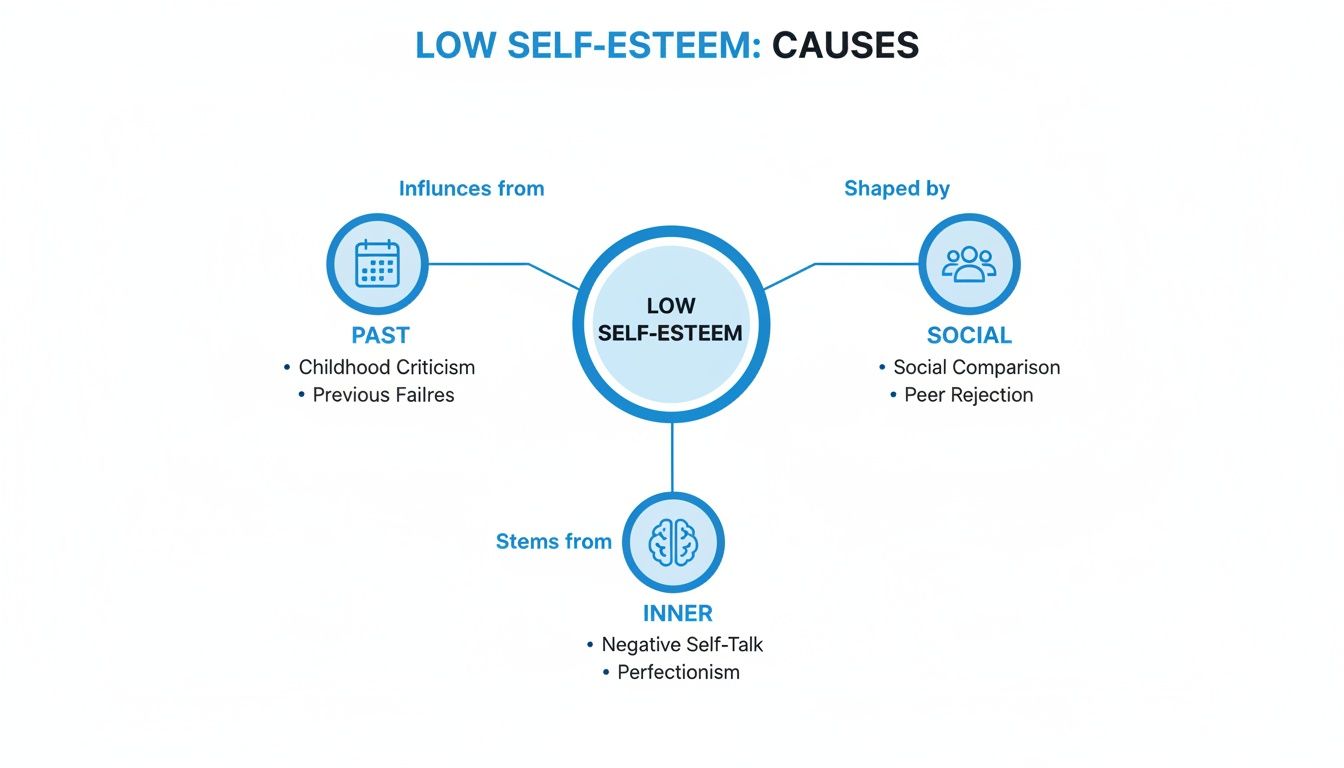
    This diagram helps to visualise how these different areas—our past, our social world, and our inner life—all connect.

    A diagram illustrating the causes of low self-esteem, categorized into past, social, and inner factors.

    As you can see, our view of ourselves doesn't form in a vacuum. It’s a dynamic interplay between historical, external, and internal forces.

    Primary Factors That Shape Your Self-Esteem

    To help make sense of it all, let's briefly look at the primary factors that influence our self-worth. The table below summarises the main cause categories we'll be exploring in more detail throughout this guide.

    Cause Category Brief Description Common Examples
    Early Life Experiences Foundational events and relationships from childhood that shape our core beliefs about ourselves. Unsupportive parenting, bullying, academic struggles, difficult childhood friendships.
    Life's Challenges & Trauma Significant negative events that can shatter our sense of safety and competence. Abuse, neglect, major illness or injury, loss of a loved one, significant failure.
    Relationships The quality of our connections with others and how they impact our sense of value and belonging. Toxic relationships, social isolation, break-ups, lack of a support system.
    Cognitive Patterns Ingrained habits of thinking that distort reality and reinforce negative self-perceptions. All-or-nothing thinking, catastrophising, harsh self-criticism (the "inner critic").
    Mental Health Conditions Conditions like anxiety and depression that are deeply intertwined with, and often fuel, low self-esteem. Generalised anxiety disorder, social anxiety, major depressive disorder.
    Social & Cultural Factors Broader societal messages and pressures that dictate standards for success, beauty, and worth. Media portrayals, unrealistic beauty standards, workplace competition, discrimination.
    Biological Factors Our inherent temperament and genetic predispositions that can make us more vulnerable to low self-esteem. A naturally sensitive temperament, genetic links to mood disorders.

    Understanding these areas can help you connect the dots in your own life. This awareness is the first step toward making meaningful changes for your well-being.

    It’s vital to remember that exploring these causes is about gaining understanding, not assigning blame. The aim is to achieve clarity so you can start treating yourself with more kindness and compassion.

    While self-help is powerful, professional support can offer a safe space to work through these issues. Remember, any self-esteem assessments are for informational purposes to guide your journey; they are not a clinical diagnosis. This knowledge is your foundation for building resilience and a more authentic sense of happiness.

    How Your Earliest Years Shape Who You Are Today

    Think of childhood as the foundation of a house. A foundation laid with care and support creates a strong structure, but one marked by criticism or neglect can lead to cracks in your self-worth later in life.

    From the start, we look to our caregivers to understand our place in the world. Their reactions—their smiles, words, and attention—are the first mirrors we see. Encouragement teaches us we are capable and valuable.

    On the other hand, a childhood filled with harsh words or unrealistic expectations can form a negative self-image. These early messages often become a nagging inner critic that stays with us for decades.

    Your Family and First Relationships

    The family home is our first school, where we learn powerful lessons about our value. The way our parents treated us sent signals about whether we were "good enough," shaping feelings of anxiety later on.

    A child with critical parents might grow up fearing failure and feeling they always fall short. Similarly, a child who feels ignored can internalise the belief that they don’t matter, damaging their core sense of worth.

    A crucial takeaway is that a child's inner voice often records their parents' voices. Awareness of this pattern, often with professional support through therapy or counselling, allows it to be changed. The goal is not blame, but understanding.

    Navigating School and Friendships

    Outside the home, the classroom and playground become the next test of our self-worth. This is where we start measuring ourselves against others, and a few tough experiences can leave a lasting impact.

    Consider these common situations:

    • Academic Pressure: In a culture like India's, where academic success is highly valued, not performing well can feel like a deep personal failure. This can lead to intense workplace stress later in life.
    • Bullying and Social Rejection: Being excluded or made fun of by peers is incredibly painful. These experiences can sow the seeds of social anxiety and make it hard to trust people.
    • The Comparison Trap: Constant comparison to a "smarter" sibling or a "more popular" classmate can breed resentment. This makes a child doubt their own unique talents and feel inadequate.

    These early social tests can be a huge factor in developing low self-esteem and may contribute to challenges like anxiety and depression. Understanding these origins is the first step toward rewriting your story and improving your well-being.

    The Weight of Social Pressure and Modern Expectations

    While our early years lay the foundation, adult life introduces new challenges that can chip away at our self-worth. It's easy to measure our value by external achievements, making our self-esteem fragile and dependent on others' opinions.

    Child's hands holding a vibrant green seedling in soil, symbolizing growth and family future.

    It often feels like we are on a treadmill, always chasing the next promotion or lifestyle goal. Tying our identity to these external goals can make any setback feel like a personal failure, stirring up feelings of inadequacy and anxiety.

    The High Stakes of Academic and Career Pressure

    In many cultures, including India, the pressure to be a top performer at school and work is immense. This focus on exam scores and prestigious jobs creates a constant fear of not being good enough, leading to significant workplace stress.

    This pressure is a major source of distress for young people, fuelling low self-esteem. In fact, a recent report on the mental health of Gen Z found that a significant number of young people are struggling, much of it stemming from this relentless chase for success.

    When your value is tied to your performance, you believe you are only as good as your last success. This mindset makes it difficult to build lasting resilience because any setback feels like a direct hit to your identity.

    This environment leaves little room for discovering who you are outside a narrow definition of success. Support through therapy or counselling is vital for helping people find their worth beyond these external benchmarks and improve their overall well-being.

    Comparison Culture and the Social Media Effect

    Social media is another powerful force shaping how we see ourselves. These platforms can ironically leave us feeling more alone and inadequate as we scroll through curated "highlight reels" of others' lives.

    This endless stream of idealised images sets unrealistic standards for happiness and success. It's easy to fall into the comparison trap, where our own life, with its normal ups and downs, seems disappointing.

    This constant social scoreboard can trigger a cascade of negative feelings:

    • Feelings of Inadequacy: Your own achievements can suddenly feel insignificant next to the polished perfection you see online.
    • Increased Anxiety and FOMO: The "Fear of Missing Out" becomes a constant worry that everyone else is having more rewarding experiences than you are.
    • Distorted Self-Image: Unrealistic beauty filters and lifestyle portrayals can do a number on your body image and overall sense of self-worth.

    This digital comparison game is a direct line to low self-esteem and is often linked to rising rates of anxiety and depression. The need for online validation can replace the steady work of building genuine, internal self-worth.

    How Your Inner Critic Shapes Your Reality

    It’s not just past events or outside pressures that determine how we see ourselves. One of the most powerful forces is the constant chatter inside our own heads, often called the "inner critic."

    Imagine your mind has a radio station that’s always on. Is it playing a supportive soundtrack or a loop of harsh self-criticism? This internal monologue is a major driver of what causes low self esteem.

    From a rooftop, a young man views the city skyline and illuminated buildings at twilight.

    This is the part of you that whispers doubts, replays mistakes, and constantly compares you to others. Over time, this negative thinking can start to feel automatic and true, chipping away at your confidence and feeding feelings of inadequacy.

    The Downward Spiral of Negative Thinking

    Our brains are naturally wired to notice negative experiences more than positive ones. When this tendency goes into overdrive, it creates thought patterns that warp our reality and keep our self-esteem low.

    This creates a tough cycle: a negative thought sparks a negative feeling, which influences your behaviour. This can seem to confirm the original thought, reinforcing the loop and impacting your overall well-being.

    The link between thoughts and feelings is fundamental to our mental state. Persistent negative self-talk is deeply connected to ongoing challenges like anxiety and depression. Understanding this connection is the first step toward taking back control.

    Common Thought Patterns That Damage Self-Esteem

    These mental traps are common ways of thinking that many of us fall into. Here are a few to watch out for:

    • All-or-Nothing Thinking: You see everything in black and white. If you aren't perfect, you see yourself as a total failure.
    • Jumping to Conclusions: You assume the worst without any real evidence, like mind-reading ("I know they think I'm incompetent").
    • Emotional Reasoning: You take your feelings as facts. For instance, "I feel like a loser, so I must be one."
    • Magnification and Minimisation: You blow your mistakes out of proportion while brushing off your strengths and achievements.

    These thought patterns contribute to everything from workplace stress to social isolation. In India, this inner critic is often amplified by digital life, with one study on the impact of social media on Indian youth highlighting how online pressures can worsen stress and anxiety.

    Remember, these thoughts are not facts. With awareness and practice, often with help from therapy or counselling, you can learn to challenge your inner critic, build mental resilience, and practice self-compassion.

    Practical Strategies to Build Resilience and Self-Compassion

    Knowing what causes low self-esteem is one thing; building confidence is a journey of small, consistent actions. The real work is in cultivating your inner strength and learning to treat yourself with kindness.

    A person sits at a dressing table, gazing at their reflection in a sunlit room.

    Think of resilience as a muscle that gets stronger with use; it helps you bounce back from setbacks faster. Self-compassion is the gentle inner voice that gives you permission to struggle, a perfect antidote to the harsh inner critic.

    Starting with Small, Achievable Steps

    Trying to change your self-perception all at once can be overwhelming. Starting small creates a positive feedback loop where small wins build momentum and reinforce a healthier self-image.

    Here are a few simple yet powerful techniques:

    • Journal to Challenge Your Inner Critic: Spend a few minutes each day writing down your thoughts. When a negative belief appears, challenge it with evidence that proves it wrong.
    • Set Tiny, Attainable Goals: Break large objectives into bite-sized pieces, like going for a 10-minute walk. Each completed task builds your confidence.
    • Rediscover Joyful Activities: Re-engage with a hobby that makes you feel competent and happy. This shifts your focus from perceived flaws to moments of enjoyment.

    These actions are the building blocks for a stronger sense of self. They help focus on your achievements and genuine moments of happiness.

    Cultivating a Supportive Environment

    Your surroundings and the people you connect with have a massive impact on your mental well-being. It is important to be intentional about who and what you allow into your daily life.

    Setting healthy boundaries is a powerful act of self-respect. Learning to say "no" to things that drain your energy is critical for managing workplace stress and protecting your emotional resources.

    Your digital world needs boundaries, too. Curating your social media feed by unfollowing accounts that trigger comparison or anxiety can significantly improve your mood.

    Learning to overcome challenges is crucial for self-worth. For more detailed guidance, you can explore how to build mental resilience and thrive through adversity. Building these skills is a key part of the journey.

    Knowing When and How to Find Professional Support

    Self-help strategies are valuable, but sometimes the journey requires a guide. Reaching out for professional help through therapy or counselling is a courageous act of self-care and a powerful step towards lasting change.

    A therapist or counsellor offers a safe, confidential space to explore the roots of your low self-esteem without judgment. They can help you connect past experiences to present feelings and build personalised strategies for emotional resilience.

    What to Expect From Therapy

    Taking the first step can feel daunting, so knowing what to expect can ease any anxiety. Your first session is usually a conversation to share your story and goals, and to see if you and the therapist are a good fit.

    Therapy is a collaborative process, not a quick fix. You and your therapist work together to help you gain a deeper understanding of yourself and develop tools for your well-being.

    Remember, any assessments you might encounter are for informational purposes only. They are designed to offer insights and guide your journey, not to provide a clinical diagnosis or label.

    Finding the Right Support in India

    Finding the right mental health professional is crucial. Platforms like DeTalks make this easier by offering a directory of qualified professionals across India.

    When you start your search, keep these things in mind:

    • Check Credentials: Ensure they are a qualified psychologist or counsellor with relevant experience in areas like anxiety, depression, or self-esteem.
    • Understand Their Approach: Different therapists use different methods. A brief chat can help you see if their style feels right for you.
    • Trust Your Gut: The connection with your therapist is key. It’s okay to speak with a few professionals before finding one who feels right.

    Building self-esteem is a gradual process. Professional support can provide the tools and encouragement you need to navigate challenges like workplace stress or past trauma, helping you on your journey to a happier, more authentic you.

    Your Self-Esteem Questions, Answered

    It's normal to have questions as you explore your relationship with yourself. Here are some common ones, answered with clarity and support.

    Can Low Self-Esteem Be a Symptom of a Mental Health Condition?

    Yes, low self-esteem and conditions like anxiety or depression often have a two-way relationship. Each can make the other worse.

    For instance, a persistent feeling of worthlessness is a key aspect of depression. That's why building a healthier sense of self is a central part of effective therapy.

    Is It Possible to Completely Overcome Low Self-Esteem?

    It's more helpful to see it as an ongoing practice of self-kindness and resilience, much like maintaining physical fitness. It requires consistent, gentle effort.

    The goal is not to silence self-doubt forever but to manage it when it appears. With practice and often with professional counselling, you can learn to treat yourself with compassion.

    Remember, healing isn't a straight line. You will have good days and tough days. The real win is in continuing to show up for yourself, patiently and kindly, through it all.

    How Does Workplace Stress Affect Self-Esteem?

    Workplace stress can be very damaging to self-esteem, especially in high-pressure or unsupportive jobs. Constant demands and a fear of failure can lead to self-doubt.

    When your value gets tangled up in your job, any stumble can feel like a personal failing. Learning to separate your identity from your career is vital for protecting your well-being.

    Are Self-Esteem Assessments Accurate?

    Self-esteem quizzes can be handy starting points to notice patterns in your thinking. They can offer a way to begin a conversation with a therapist.

    However, it's important to remember they are a snapshot in time, not a diagnosis. Treat the results as a guide for curiosity, not a final verdict.


    Taking steps to understand and nurture your self-esteem is a sign of true strength. If you’re looking for a professional to support you on this path, DeTalks is a safe place to find qualified therapists and scientifically-backed assessments to guide your journey. Find the right person to talk to at https://detalks.com.

  • How to Respect Yourself: A Guide to Building Lasting Confidence

    How to Respect Yourself: A Guide to Building Lasting Confidence

    Learning how to respect yourself means honouring your own needs, values, and boundaries. It isn't built on grand gestures but through small, consistent actions that form the foundation of genuine well-being. This quiet inner confidence helps you handle everything from workplace stress to personal challenges with greater resilience.

    Understanding What Self-Respect Truly Means

    A person sitting peacefully on a rock, looking out over a misty valley at sunrise, symbolizing self-reflection and well-being.

    Self-respect has nothing to do with arrogance; it is a core part of your mental health. It shapes how you see the world and provides a deep, internal validation that anchors you, regardless of external praise or criticism. This inner strength helps you navigate life's inevitable challenges, from daily frustrations to significant hurdles like anxiety and depression.

    When self-respect is low, you might constantly seek others' approval, struggle to say "no," or fall into a cycle of harsh self-criticism. These patterns can lead to burnout and reduce your happiness. Building self-respect involves unlearning these habits and cultivating a kinder, more compassionate inner voice.

    The Connection Between Respect and Resilience

    Resilience is the ability to bounce back from adversity, and it is built on a foundation of self-respect. When you value yourself, you are more likely to protect your well-being during stressful times. This could mean taking a needed break when you feel overwhelmed by workplace stress or seeking counselling to work through difficult emotions.

    This connection is supported by research. A study highlighted that individuals with lower self-respect were more likely to report symptoms of depression. This shows the protective role that feeling valued and assertive plays in our emotional balance.

    Core Pillars of Self-Respect

    To build this inner strength, it's helpful to understand its key components. Exploring topics like How to Be a Confident Man can offer insights, as genuine self-esteem is built from the inside out. Let's look at the areas that create a strong sense of self.

    Core Pillars of Self-Respect

    A quick look at the fundamental components of self-respect we'll explore in this guide.

    Pillar What It Means for You
    Setting Boundaries Protecting your time, energy, and emotional well-being without guilt.
    Self-Compassion Treating yourself with the same kindness you'd offer a good friend.
    Personal Growth Actively investing in your skills, health, and what makes you happy.
    Supportive Environment Surrounding yourself with people who uplift and validate you for who you are.

    Fostering self-respect is an ongoing commitment to honouring yourself. It is a journey that empowers you to build a more authentic, balanced, and fulfilling life.

    Setting Healthy Boundaries to Honour Yourself

    A person's hands gently pushing away a tangled mess of strings, symbolizing the creation of clear personal space and boundaries.

    Learning how to respect yourself often comes down to setting healthy boundaries. Think of a boundary not as a wall, but as a way to protect your time, energy, and peace of mind. In doing so, you teach others how you expect to be treated.

    This can feel difficult at first, especially in cultures where saying 'no' might be seen as unhelpful. However, consistently failing to set limits can lead to workplace stress and personal burnout, which can harm your mental health over time.

    What Healthy Boundaries Look Like in Daily Life

    Boundaries are often small, quiet choices you make every day to prioritise your needs. It's about recognising these moments and acting on them.

    For instance, a healthy boundary could be:

    • Politely declining an extra project when your schedule is already full.
    • Telling a friend, "I'd love to support you, but I don't have the emotional capacity for a heavy conversation right now."
    • Stepping away from negative office gossip.
    • Leaving work on time to protect your personal life.

    These are not aggressive actions. They are calm, clear statements about what you need to stay balanced and well.

    "When you speak to yourself with the utmost respect, I promise you that your life…will quickly improve. The energy of the words you use permeates your experiences and influences your self-worth and behaviour."

    This gets to the heart of it—boundaries start internally. They begin with respecting your own needs enough to communicate them.

    How to Communicate Your Needs with Confidence

    The fear of setting a boundary is often about how the other person will react. The key is to be firm yet kind, focusing on your needs rather than their behaviour. This simple shift can ease tension and lead to a more understanding conversation.

    Try this simple, three-part framework:

    1. State the situation factually: Start with a neutral observation. "I've noticed I'm taking on projects that are pushing my deadlines back."
    2. Explain how it affects you: Use "I" statements to share your feelings. "I feel overwhelmed and stressed when my workload gets this high."
    3. Clearly define what you need: Be direct about the necessary change. "From now on, I need to complete my current tasks before I can consider taking on anything new."

    Using this structure turns a potentially difficult exchange into a constructive one. It’s a skill that builds resilience and helps you feel less anxious.

    If setting boundaries consistently feels challenging, exploring it through counselling can provide personalised tools and support. Remember, this is a practice that becomes more natural with time.

    Choosing Self-Compassion Over Self-Criticism

    A person sitting in a comfortable chair by a window, journaling in a notebook with a warm cup of tea beside them, illustrating a moment of quiet self-compassion.

    Many of us have a persistent inner critic that focuses on every mistake and dismisses accomplishments. Over time, this can lead to feelings of inadequacy, anxiety, and even depression. A key part of learning how to respect yourself is to consciously replace that critical voice with a kinder, more supportive one.

    This is the essence of self-compassion. It's about treating yourself with the same warmth you would offer a friend during a hard time. It means accepting that being human involves imperfection, and that is okay.

    Understanding Your Inner Dialogue

    The first step is to simply listen to how you talk to yourself. When you make a mistake, is your reaction harsh or forgiving? This internal voice has a significant impact on your overall well-being.

    A study in India noted that while many people have stable self-esteem, a significant portion struggles with low levels. This suggests many are dealing with a harsh inner critic, making the path to self-respect challenging. You can explore the findings on self-esteem fluctuations and mental health for more context.

    Practical Ways to Cultivate Self-Compassion

    Shifting from self-criticism to self-compassion is a gradual practice. It requires patience and a commitment to building new, supportive mental habits.

    Here are a few ways to get started:

    • Reframe Your Thoughts: When you catch yourself in a negative spiral, pause and challenge the thought. Instead of, "I failed that presentation," try, "That was tough, but I did my best and I know how to improve."
    • Practise Mindful Self-Kindness: When you feel overwhelmed, place a hand over your heart and breathe. Offer yourself gentle words like, "This is a difficult moment. I will be kind to myself."
    • Journal Your Feelings: Writing without judgment can be a powerful release. It helps you process difficult emotions and gain a clearer, more compassionate perspective.

    By practising radical self-respect, you lighten your energy field and emotional state. You then can give much-deserved unconditional love to your body-confidence journey… and yourself.

    Choosing self-compassion is a profound act of self-respect. It strengthens your mental health, giving you the resilience to handle workplace stress with more grace. If your inner critic feels too overwhelming, seeking therapy or counselling can offer a supportive space to learn these skills.

    Investing in Your Personal Growth and Well-being

    A person watering a small plant that is growing in a pot on their windowsill, signifying nurturing personal growth.

    Actively investing in yourself is one of the most powerful ways to build self-respect. This means intentionally nurturing your mind, body, and spirit. It is a quiet affirmation to yourself that you are worthy of your own time and care.

    You don't need to make grand changes; lasting growth often comes from small, consistent daily actions. It's about carving out moments in your life for things that truly fulfil you. For example, finding just 20 minutes a day for a hobby or taking a short walk at lunchtime can significantly improve your well-being.

    Nurturing Your Mind and Emotional Health

    Prioritising your mental health is a fundamental part of respecting yourself. This involves being honest about your feelings and taking deliberate steps to support your well-being.

    Here are a few practical places to start:

    • Mindfulness and Meditation: A few minutes of mindfulness each day can help manage anxiety and stress. Many apps offer guided sessions for beginners.
    • Journaling for Clarity: Writing down your thoughts can help you untangle them. Journaling provides a private space to explore emotions and gain perspective.
    • Learning Something New: Engaging your brain by learning a new skill builds confidence and fosters a growth-oriented mindset.

    This commitment to personal growth often benefits your professional life. Learning how to build confidence at work can make you feel more empowered and valued in your career.

    Seeking Professional Support is an Act of Strength

    Sometimes, we need guidance on our growth journey. Reaching out for therapy or counselling is a courageous move toward becoming healthier. Recognising you need support and seeking it is a profound act of self-respect. A therapist provides a safe space to work through challenges like workplace stress, anxiety, or depression.

    While online assessments can offer initial insights, they are for informational purposes only and are not a substitute for a professional diagnosis. They can be a starting point for self-awareness, not the final word. Every step you take to invest in your growth sends a powerful message: you are valuable and worthy of care.

    Shape an Environment That Feeds Your Self-Worth

    Self-respect doesn't grow in isolation; it thrives or withers based on your environment. The people you surround yourself with and the spaces you inhabit can either nurture your confidence or subtly damage it. Take an honest look at your relationships and surroundings to see what supports your well-being.

    A significant part of learning how to respect yourself is making deliberate choices about who gets your time and energy. Move towards people who energise and validate you, and create distance from those who leave you feeling drained or insecure.

    Choose Your Company Wisely

    Intentionally spend time with friends, family, and colleagues who listen and celebrate your successes. It also means creating healthy distance from those who are persistently critical or dismissive. This isn't about cutting people off, but about managing your exposure to negativity.

    This could mean:

    • Making more time for a supportive friend.
    • Politely limiting time with a critical relative.
    • Collaborating with positive, team-oriented colleagues.

    These small changes can reduce background anxiety and create mental space for self-worth to grow. You are simply protecting your peace.

    An environment of respect and validation isn't a luxury; it’s a fundamental need for building lasting resilience and happiness. When you surround yourself with positivity, you give yourself the best possible chance to thrive.

    Interestingly, a supportive environment can be found in unexpected places. Research in East Midnapore, India, found that rural students reported slightly higher self-esteem than their urban peers. This suggests strong community ties can be incredibly powerful. You can explore how social factors influence self-worth in this research if you're curious.

    Craft a Physical Space That Respects You

    Your physical surroundings are as important as your social ones. A cluttered, chaotic space can reflect and amplify feelings of workplace stress or being overwhelmed. Creating a calm, organised space that feels like you is a powerful act of self-care.

    You don't need a major overhaul. Start small by clearing your desk, adding a plant to your room, or hanging art you love. When your external world feels orderly, it sends a strong message to your inner world that you are in control and you matter.

    If your environment is a source of distress, talking to a professional can help. Therapy or counselling offers a safe space to develop strategies for building a life that truly supports you. Please remember, any information here is for guidance and not a substitute for a professional diagnosis.

    The Road Ahead: Making Self-Respect a Daily Practice

    Building self-respect is a continuous practice, much like tending a garden. It requires consistent, conscious choices every day to honour who you are and what you need. This journey is deeply personal, and every small step is a genuine victory.

    The tools we've discussed—setting boundaries, practising self-compassion, and investing in your growth—are your allies. These are not just ideas; they are skills that build real emotional resilience.

    It is also vital to consider your surroundings. Chronic workplace stress or draining relationships can erode your self-worth. Protecting your peace is a fundamental part of learning how to respect yourself.

    Your journey to self-respect is a process of commitment, not perfection. Be patient with yourself, embrace the learning curve, and know that you are deeply worthy of your own respect, every single day.

    If you find yourself wrestling with anxiety or the heavy weight of depression, reaching out for help is a sign of strength. Professional support through therapy or counselling is an investment in your relationship with the most important person in your life: you. These are supportive takeaways, not promises of a cure.

    Got Questions? Let's Talk About Self-Respect

    As you begin this journey, some common questions may arise. These answers are meant to offer clarity and support along the way.

    Isn't Self-Respect Just the Same as Self-Esteem?

    That's a great question. While they sound similar, there's a key difference. Self-esteem is often tied to your performance and achievements; it can fluctuate with successes and failures.

    Self-respect is steadier. It is an underlying sense of honour for who you are, your values, and your needs, regardless of external circumstances. This stable foundation is what truly supports your long-term well-being.

    Is It Even Possible to Build Self-Respect in a Toxic or Difficult Situation?

    Yes, it absolutely is. In fact, challenging environments are often where self-respect becomes your most powerful tool for managing workplace stress and preventing burnout. The key is to focus on what you can control.

    You can start small by setting one manageable boundary, practising a moment of self-compassion, or giving yourself credit for navigating a tough day. These internal shifts build incredible resilience over time.

    Building self-respect in a tough situation isn’t about changing everything at once. It’s about reclaiming your power, one small, consistent act of self-care and boundary-setting at a time.

    So, How Long Does This Whole Self-Respect Thing Take?

    There is no finish line. Building self-respect is not a project to complete but a lifelong practice. It is a conscious choice you make every day.

    Instead of focusing on a timeline, focus on the daily process. You will notice gradual shifts as you consistently apply these ideas. Celebrating small wins reinforces your foundation of self-worth and can be a powerful way to manage feelings of anxiety or depression.