Tag: setting boundaries

  • How to Deal with a Narcissistic Parent: Reclaim Your Peace in 2026

    How to Deal with a Narcissistic Parent: Reclaim Your Peace in 2026

    The journey to cope with a narcissistic parent often starts with finally seeing their behaviour for what it is. This is not about diagnosing them, but about recognizing patterns so you can protect your own mental peace and well-being.

    Understanding the Signs of a Narcissistic Parent

    Growing up with a narcissistic parent can leave you with a constant, draining sense of anxiety and self-doubt. Understanding that their behaviour is not your fault is the first step toward healing and building your resilience.

    Realising this isn't about labelling your parent, which is a job for a professional. Instead, it’s about validating your experiences and understanding that the constant criticism and emotional distance are a reflection of their issues, not your worth.

    Core Traits and Common Behaviours

    While every family is different, certain behaviours are common. Recognizing these can help you understand the dynamic.

    • A constant need for admiration: Conversations often circle back to them, and they expect their needs and achievements to come first.
    • A profound lack of empathy: They may struggle to understand your feelings, often dismissing them or becoming angry that your emotions are taking the spotlight.
    • A sense of entitlement: This parent may act as if the world owes them something, expecting you to meet their needs without question.
    • Manipulative behaviours: This can include guilt-tripping, gaslighting (making you doubt your own memories), or using the silent treatment to punish you.

    These dynamics can lead to long-term challenges, including anxiety, depression, and workplace stress, as the patterns learned in childhood carry into adult life.

    You are not imagining it. That heavy feeling of being responsible for your parent’s happiness, the persistent guilt, and the nagging thought that you’re never quite good enough—these are the shared experiences of many adult children of narcissistic parents.

    The Indian Context and Cultural Nuances

    In India, cultural values of respecting elders can make it hard to acknowledge these challenges. Phrases like "parents always know best" can be used to silence disagreement, making it difficult to set boundaries.

    This cultural backdrop can increase feelings of isolation and guilt when you try to create distance or push back. You may worry about being seen as disrespectful by family and community, adding to the emotional burden and contributing to mental health challenges like anxiety.

    The Emotional and Mental Impact

    Dealing with a narcissistic parent can take a real toll on your mental health. In a family-centric culture like India's, the impact can be severe, often contributing to low self-esteem and feelings of confusion.

    Learning how to deal with a narcissistic parent is vital for your long-term well-being. For more insights into these challenges, resources are available at organizations like the Newport Institute.

    How to Set and Enforce Healthy Boundaries

    Setting boundaries is one of the most important things you can do for your mental health. This is not about punishing your parent, but about protecting your own emotional well-being by deciding what behaviour you will accept.

    This can feel difficult, especially in cultures where respecting elders is paramount. However, true respect cannot come at the cost of your own sanity.

    Why Boundaries Are Your Lifeline

    Without clear boundaries, you remain open to constant criticism and emotional demands, which can lead to anxiety and burnout. Setting these limits is an act of self-preservation that helps you reclaim your identity.

    It is your right to protect your emotional space. This flowchart can help you see the pattern.

    Flowchart illustrating steps to recognize a narcissistic parent, asking if you feel unheard and if they lack empathy.

    When you realize their dismissiveness is not about your worth but a sign of their own issues, it becomes easier to detach. Their reactions are not your fault.

    A Practical Guide to Drawing the Line

    Start small by focusing on one or two interactions that drain you the most. This approach is more manageable than trying to change everything at once.

    Common areas to start with include:

    • Emotional Boundaries: You can refuse to be their therapist or get pulled into their drama. You are not responsible for managing their emotions.
    • Time Boundaries: You control your own schedule. You can limit the length of phone calls or the frequency of visits.
    • Information Boundaries: Decide what you are comfortable sharing about your job, relationships, or personal life. Your privacy is a right.

    Frame the boundary around what you will do, not what you demand of them. For instance, say, "I'll be turning my phone off after 9 PM," instead of "You have to stop calling me so late."

    Talking the Talk: Scripts That Actually Work

    When you communicate a boundary, be direct, calm, and brief. Long explanations can give them an opportunity to argue or make you feel guilty.

    Supportive Takeaway: You do not owe anyone a long explanation for protecting your peace. A simple, "That doesn't work for me," is enough.

    Here are a few practical scripts that can be adapted to your situation.

    Practical Boundary-Setting Scripts and Their Purpose

    Situation Example Script Underlying Goal
    Unsolicited Advice or Criticism "I appreciate your perspective, but I'm going to handle this my own way." To assert your autonomy and stop the conversation from turning into a lecture.
    Emotional Dumping "It sounds like you're having a really tough time. I can't talk right now, but I hope you feel better." To show empathy without taking on their emotional burden. You exit the conversation.
    Unannounced Visits "It’s a surprise to see you! In the future, please give me a call first to make sure it's a good time." To establish that your time and space must be respected.
    Demands for Your Time "I'm not available to talk now, but I can call you tomorrow at 4 PM." To take control of your schedule and show you will not drop everything for them.
    Guilt-Tripping "I'm sorry you feel that way, but my decision isn't going to change." To acknowledge their feeling without accepting the guilt. You hold firm.

    These simple but firm statements are tools for creating a healthier dynamic over time.

    Brace for Impact and Hold Your Ground

    When you first set a boundary, expect pushback. Your parent might react with anger, play the victim, or try to guilt you. This is a test to see if you are serious.

    Your job is to remain firm. Every time you hold your ground, you strengthen your resilience and reinforce the new dynamic.

    This process is challenging, and professional counselling can make a world of difference. A therapist can provide support and help you build the confidence you need to maintain your boundaries.

    Your Healing Journey: Managing the Emotional Aftermath

    Once you start setting boundaries, your focus can turn inward to healing. This involves addressing the emotional toll of your upbringing, which can include chronic stress, anxiety, or depression.

    This journey is about building resilience and learning to listen to your own voice. You are learning to give yourself the kindness and validation that may have been missing.

    A person writes in a notebook on a table next to a steaming cup of tea by a sunlit window.

    Making Space for Grief

    A vital part of healing is allowing yourself to grieve. You are not just grieving painful memories, but also the supportive parent you deserved but never had.

    This grief can be complex, involving sadness, anger, and even relief. All these feelings are valid, and letting yourself experience them without judgment is a key step toward emotional well-being.

    How to Re-parent Your Inner Child

    "Re-parenting" means giving yourself the support and unconditional love you needed as a child. It is a powerful way to heal and build self-worth.

    Here are a few ways to practice this:

    • Talk back to your inner critic: When you hear that harsh, judgmental voice, gently counter it with words of compassion.
    • Acknowledge your own wins: Celebrate your achievements, no matter how small they seem. You don't need external praise.
    • Comfort yourself when you’re down: Sit with difficult feelings and offer yourself the comfort you need, rather than dismissing your emotions.

    This practice helps you build a strong foundation of self-worth that is not dependent on anyone else's approval.

    Practical Tools for Emotional Health

    Looking after your emotional well-being is an active practice. Weaving a few simple habits into your daily life can help manage anxiety and build inner strength.

    Try introducing some of these into your routine:

    • Mindfulness and Grounding: When emotions are overwhelming, simple grounding techniques like focusing on your breath can calm your nervous system.
    • Journaling for Clarity: Writing things down provides a safe space to process events and untangle confusing emotions, reaffirming your reality.
    • Finding Joy Again: Reconnect with hobbies that bring you genuine joy, helping you rediscover parts of yourself outside of your family dynamic.

    Supportive Takeaway: Your emotional well-being is a necessity. Taking time for self-care is a fundamental way to honor yourself and your healing journey.

    Building Resilience and Self-Compassion

    Resilience is not about being invulnerable; it's about how you recover. Every time you hold a boundary or show yourself compassion, you build that resilience.

    Self-compassion is the perfect antidote to a harsh inner critic. It means treating yourself with kindness, especially when you feel you've made a mistake. As you continue on this path, looking into resources for healing from narcissistic parenting can offer valuable support.

    Professional counselling or therapy can offer a safe space to work through these feelings. Take it one day at a time, and remember to celebrate every small step you take towards a more peaceful life.

    When and How to Seek Professional Support

    While self-help is valuable, reaching out for professional support can be a powerful step. Acknowledging you need help is a brave decision to protect your well-being.

    In India, discussing family issues can feel uncomfortable, but seeking therapy or counselling is not admitting defeat. It is bringing in an expert to help you heal in a confidential and non-judgmental space.

    Signs It’s Time to Seek Help

    Deciding to get support is a personal choice, but some signs indicate it might be time. A professional can offer tools to help you get back on solid ground.

    Consider seeking help if you notice these patterns:

    • You feel overwhelmed by feelings of depression, hopelessness, or constant anxiety.
    • You find yourself in unhealthy relationship dynamics that feel similar to your childhood.
    • You feel stuck and unable to process your anger, grief, or confusion.
    • Your physical health is suffering from chronic workplace stress and emotional exhaustion.

    If this sounds familiar, know that you are not alone and that effective help is available.

    Understanding Your Therapeutic Options

    Finding a therapeutic approach and a therapist that make you feel safe is key. Two excellent methods for these challenges are trauma-informed care and Cognitive Behavioural Therapy (CBT).

    Trauma-informed care acknowledges the lasting impact of your experiences. A therapist using this approach prioritizes your emotional safety, creating a secure environment to process memories. You can find more on this at resources like trauma therapy for healing from narcissistic abuse.

    Cognitive Behavioural Therapy (CBT) is a practical approach that helps you identify and challenge negative thought patterns, such as "I'm not good enough." This can be a game-changer for your emotional resilience.

    Supportive Takeaway: Taking the first step toward professional help is an act of profound self-compassion. It's a declaration that your emotional health matters.

    How to Find the Right Support in India

    Accessing quality mental health care in India is becoming easier. Platforms like DeTalks offer a directory of qualified therapists and counsellors, many specializing in family conflict and trauma.

    Research shows how vital this support is. A study mentioned by Bridgewater State University highlights that individuals who seek therapy report lower rates of depression. Confidential platforms help break down barriers to getting help.

    The Role of Psychological Assessments

    If you are not ready for therapy, a psychological assessment can be a gentle first step. These tools can offer a clearer picture of your emotional state.

    It is important to clarify: these assessments are informational, not diagnostic. They cannot diagnose your parent, but they can help you understand how your upbringing has affected your levels of anxiety, self-esteem, and resilience, guiding you toward the right support.

    Building a Fulfilling Life Beyond Family Dynamics

    Moving forward is about consciously building a life that feels authentic and joyful. It is about shifting from surviving to thriving.

    This is a gradual process of self-discovery. It is the ultimate act of resilience, showing that while you cannot change the past, you have the power to create your future.

    A smiling boy riding a bicycle through a sunny park with city buildings in the background.

    Cultivating a Strong Support System

    Surround yourself with people who see and support the real you. Healthy relationships can recalibrate your sense of what connection should feel like.

    Seek out friends and mentors who listen with empathy and offer support without strings attached. These relationships become a chosen family, reminding you that connection can be safe and nourishing.

    Pursuing Your Passions and Defining Your Values

    What makes you, you? Now is the time to reclaim passions that may have been sidelined or criticized in your childhood.

    Rediscovering activities that bring you genuine joy is vital for your well-being and builds a strong sense of self. These are just for you, free from anyone else's judgment.

    At the same time, consciously define your personal values, such as honesty, compassion, or creativity. Living a life aligned with your own values is a powerful way to reclaim your identity.

    Supportive Takeaway: You are the architect of your own happiness. Every choice that aligns with your true self helps build a foundation for a joyful future.

    Breaking the Cycle of Narcissism

    A common fear is, "What if I become like them?" Recognizing the patterns is the first and most critical step in ensuring they stop with you.

    Breaking the cycle is an active practice. It involves self-awareness, practicing empathy, and committing to healthy communication.

    Ultimately, learning how to deal with a narcissistic parent culminates in learning how not to be one. That is a powerful and positive legacy to build for your own happiness.

    This journey is not about finding a "cure." It is about building a life so rich and meaningful that the past loses its grip, leading to a future of true fulfilment.

    Answering Your Lingering Questions

    If you are grappling with the possibility that you have a narcissistic parent, you likely have many questions. Let’s walk through some common concerns.

    Can a Narcissistic Parent Ever Change?

    This is often the first, most painful question. It comes from a deep hope that the parent you love could become the parent you need.

    The difficult truth is that meaningful change is rare. True change requires self-reflection and empathy, which are often the very things a person with these traits struggles with.

    Instead of waiting for a change that may never come, focus on what you can control: your reactions, your boundaries, and your own healing.

    Is It Normal to Feel Guilty for Setting Boundaries?

    Yes, feeling guilty is a normal and expected part of this process. You were likely conditioned from a young age to manage their emotions, so taking a step for yourself can feel like a betrayal.

    Supportive Takeaway: This guilt is a conditioned response. Recognizing it as a reflex, not a reflection of your character, helps disarm it.

    Over time, and with support from counselling, this feeling will lessen. You will internalize that setting boundaries is an act of self-preservation and helps build resilience.

    What Is the Difference Between a Strict Parent and a Narcissistic Parent?

    This is a critical distinction, especially in cultures like India's where parental authority is highly valued. The difference lies in the why behind their actions and their capacity for empathy.

    • A strict parent sets high standards out of love and a genuine desire for your success. They can apologize and feel empathy for your struggles.
    • A narcissistic parent’s rules are about their own needs for control and their public image. They often see their child as an extension of themselves and lack genuine empathy.

    A strict parent might raise a disciplined adult, but a narcissistic parent often leaves a legacy of emotional wounds, anxiety, and even depression.

    How Can I Explain My Situation to Friends or a Partner?

    Explaining this dynamic to someone who hasn't lived it can be isolating. You might be met with well-intentioned but unhelpful advice.

    Instead of using clinical labels like "narcissist," describe the specific behaviours and their impact on you. For example, "When my parent dismisses my feelings, it makes me feel anxious and doubt myself."

    Sharing a helpful resource, like this article, can also offer insight. Ultimately, the validation you need may come from a therapist or a support group of people who truly understand.


    If these questions resonate with you, please know you don't have to navigate this journey alone. DeTalks provides a confidential, supportive space to connect with professionals who understand. Take the first step toward clarity and peace by exploring our network of qualified therapists at https://detalks.com.

  • How to Deal with Toxic Family Members and Reclaim Your Peace

    How to Deal with Toxic Family Members and Reclaim Your Peace

    Navigating relationships with family members who cause harm is a delicate process. It requires a blend of firm boundaries, clear communication, and prioritising your own well-being and resilience. Protecting your peace is not selfish; it is a necessary act of self-preservation.

    Recognising the Signs of a Toxic Family Dynamic

    It can be painful when family, who are meant to be a safe haven, become a source of stress. The first step in learning how to deal with toxic family members is to identify the specific behaviours causing harm. This is not about blame, but about gaining clarity for your mental health.

    In many Indian families, cultural norms of respect can make it hard to admit a dynamic is unhealthy. We might dismiss constant criticism as "their way of showing care" or excuse emotional manipulation. However, seeing the line between a normal disagreement and a toxic pattern is crucial for your happiness.

    Unpacking Toxic Behaviours

    A toxic behaviour is a consistent pattern of actions that leaves you feeling drained, anxious, or devalued. These behaviours create an environment of constant stress that goes beyond simple disagreements.

    Some of the most common signs include:

    • Constant Criticism: It feels like nothing you do is good enough. Your choices are perpetually judged or belittled.
    • Emotional Manipulation: This may appear as guilt-tripping ("After all I've done for you…") or being made responsible for their moods.
    • A Lack of Empathy: Your feelings are often dismissed or invalidated. When you express hurt, you might be told you're "too sensitive."
    • Controlling Behaviour: They try to control your decisions, friendships, or life path, either openly or through subtle guilt.

    Over time, these patterns can harm your self-esteem, leading to challenges like anxiety, depression, and even workplace stress as the strain spills over. These dynamics are complex, and data often points to intergenerational clashes as a source of conflict. You can find more information exploring family estrangement and its underlying causes.

    It’s one thing to hear about these behaviours, but it’s another to see how they stack up against normal, healthy conflict. This table breaks it down.

    Toxic Patterns vs Healthy Disagreements

    Behavior Healthy Disagreement Toxic Pattern
    Focus Aims to resolve a specific issue. Aims to control or blame a person.
    Communication Open, respectful, even when angry. Uses insults, sarcasm, or the silent treatment.
    Aftermath You feel heard and move towards a resolution. You feel drained, anxious, and devalued.
    Respect Boundaries are respected. Boundaries are consistently ignored or violated.
    Accountability People take responsibility for their part. Blame is shifted; apologies are rare or insincere.

    Please note: This table is for informational purposes only and is not a diagnostic tool.

    Seeing it laid out like this can be an eye-opener. Healthy disagreements are about solving a problem together, while toxic patterns are often about power and can leave you feeling worse.

    This diagram offers another way to visualise the key differences.

    A concept map showing healthy versus toxic relational dynamics and their characteristics.

    As you can see, healthy interactions are built on a foundation of respect and aim for resolution. Toxic ones, on the other hand, are often about control and create a cycle of negativity.

    Moving Past Guilt and Shame

    Recognising these signs in your own family almost always comes with feelings of guilt. You might think, "But they're my family," or "I shouldn't feel this way." These feelings are a completely normal and valid part of this difficult journey.

    Your feelings are valid. Recognising a challenging dynamic is not a betrayal; it is an act of self-compassion. You are not responsible for others' behaviour, but you are responsible for protecting your own peace.

    Accepting that your family dynamic is a source of anxiety or burnout does not make you a bad person. It makes you aware enough to take the next step. Professional counselling or therapy can offer a safe, non-judgmental space to process these heavy emotions and build a path forward.

    How to Set Boundaries That Actually Work

    A pensive young man sits at a kitchen table, as blurred family members argue behind him.

    When you're figuring out how to deal with toxic family members, most advice focuses on setting boundaries. Think of boundaries not as walls to shut people out, but as fences that protect your inner peace and well-being. They simply define what is acceptable to you.

    In many Indian families, the idea of setting personal limits can feel disrespectful. A crucial first step is to see boundaries as an act of self-respect. This is essential for building resilience and breaking free from cycles of anxiety and burnout.

    What a Boundary Actually Looks Like

    Boundaries are the personal rules—physical, emotional, or digital—that you set to protect yourself. Without them, you might feel constantly drained or resentful. Figuring out your limits requires honest self-reflection; pay attention to what leaves you feeling exhausted or uncomfortable.

    • Emotional Boundaries: These protect your feelings. An example is refusing to take the blame for a relative’s bad mood or walking away from gossip.
    • Physical Boundaries: This is about your personal space. It could be asking relatives to call before visiting or stating you're not comfortable with certain physical affection.
    • Time and Energy Boundaries: These guard your most precious resources. This might look like limiting phone calls to 15 minutes or deciding to stay at a family function for only two hours.

    Once you know your limits, the next step is communicating them. This is often where we get stuck, fearing an argument or a cold shoulder.

    Scripts for Communicating Your Limits Calmly

    Communicating a boundary is a skill that gets easier with practice. The most effective approach is firm but gentle. Using "I" statements allows you to express your needs without pointing fingers, which makes the other person less defensive.

    Here are a few scenarios and some scripts you can adapt:

    Scenario 1: Deflecting Intrusive Questions
    A relative asks invasive questions about your personal life at a family gathering.

    • What you can say: "I appreciate you asking, but I prefer to keep that private. How was your recent trip?"

    Scenario 2: Limiting Draining Phone Calls
    A family member calls to complain for long periods, leaving you drained.

    • What you can say: "It’s good to hear from you. I only have about 15 minutes to talk, but what’s on your mind?"

    Scenario 3: Saying No to Unreasonable Demands
    A sibling asks for last-minute favours that create chaos and workplace stress.

    • What you can say: "I understand this is important to you, but I can’t help on such short notice. I need to stick to my commitments."

    The goal of a boundary is not to control someone else's behaviour but to protect your own peace. The only people who get upset when you set boundaries are the ones who benefited from you having none.

    What to Do When Your Boundaries Are Tested

    Your boundaries will be tested, especially when you first start. People used to you having no limits may react with anger or try to guilt-trip you. This is the moment that matters most.

    If you back down, you teach them your boundaries are not firm. Stay consistent, even when it feels uncomfortable, to reinforce that you are serious about your well-being. If someone keeps pushing, you can calmly repeat your boundary and, if needed, remove yourself from the situation.

    This process can be tough and might bring up feelings of guilt or even depression. Professional therapy or counselling can be a game-changer, providing tools to build confidence and develop lasting resilience.

    Communicating Your Needs Without Starting a War

    A serene woman with closed eyes gently opens a door, with soft light and a flowing white fabric appearing in a hallway.

    Voicing your needs to a family member who causes harm can feel intimidating. After years of having your feelings dismissed, the thought of speaking up can be scary. But communication is a skill you can learn, and there are gentle ways to express yourself that don't have to lead to conflict.

    The key is to reframe the goal: it’s not about winning an argument, but about calmly stating your reality. This simple mental shift is a powerful first step in regaining a sense of control over your own life.

    Using I-Statements to Own Your Feelings

    One of the most powerful tools you have is the ‘I-statement’. Starting a sentence with “you” (e.g., “You always criticise me”) can sound like an attack, making the other person defensive. By using an ‘I-statement’, you center the conversation on your feelings, which no one can argue with.

    Instead of saying, “You make me feel guilty,” you could try, “I feel hurt when jokes are made about my career choices.” This shifts the focus from blame to your personal experience, opening the door for a real conversation. This approach is invaluable, and you can find more insights on how family dynamics impact mental health from Local News Matters.

    Disengaging With the Grey Rock Method

    Sometimes, the goal is not to be heard, but simply to get out of a draining interaction. This is where the ‘Grey Rock Method’ comes in handy. The idea is to make yourself as uninteresting as a plain grey rock so the other person gets bored and moves on.

    This tactic is useful for dealing with manipulative or drama-seeking relatives. It involves giving short, non-committal answers and keeping personal information to yourself.

    How to Practise the Grey Rock Method:

    • Keep answers short: Use one-word replies like “Okay,” “I see,” or “Uh-huh.”
    • Avoid direct eye contact: Look just past them or focus on something neutral.
    • Stick to boring topics: If you must make conversation, talk about the weather or traffic.

    The Grey Rock Method isn’t about being rude; it’s a strategic withdrawal. You are choosing not to provide the emotional fuel a person craves, protecting your own energy.

    This helps you stay calm and centered, reducing the anxiety and stress these encounters usually create.

    Know When to Walk Away

    Perhaps the most important communication skill is knowing when the conversation is going nowhere. If you have calmly stated your feelings and the other person continues to provoke you, it is perfectly okay to end the interaction. Your peace is more important than having the last word.

    Have a few simple exit lines ready so you don’t have to think on the spot. They don't need to be dramatic.

    Sample Exit Lines:

    • “I’m not comfortable with where this conversation is going, so I'm going to step away.”
    • “It’s clear we won’t agree on this. Let’s change the subject, or I’ll have to go.”
    • “I need a break from this conversation. I'm going to get some fresh air.”

    Walking away is not weakness; it is a profound act of strength and self-respect. If these conversations feel too overwhelming to handle alone, professional counselling or therapy can offer a safe space to practise these skills and build the confidence you need.

    Protecting Your Well-Being and Building Resilience

    Being around family members who cause harm is exhausting and takes a real toll on your health. Over time, that relentless stress can lead to chronic anxiety, feelings of hopelessness resembling depression, and burnout. This is about learning to protect your own peace and build the long-term resilience you need.

    This isn’t just about surviving tough family moments. It’s about creating a foundation of self-care and support that allows you to thrive, no matter what is happening around you.

    Practising Emotional First Aid After Draining Encounters

    It is normal to feel shaky or upset after a tough conversation. Your nervous system needs a moment to regulate, and giving yourself that space is a form of essential emotional first aid.

    Here are a few practical things you can try:

    • Take a Mindful Pause: Find a quiet spot and focus on your breath. This simple act anchors you in the present and can stop a spiral of stressful thoughts.
    • Move Your Body: Stress floods your body with cortisol. A quick walk, simple stretches, or even just shaking out your arms can help release that tension.
    • Connect with a Safe Person: Text or call a friend who understands. Sometimes, having someone validate your experience is incredibly powerful and reassuring.

    These small, immediate actions create a crucial buffer, helping you protect your energy before it gets completely drained.

    Journaling to Process Difficult Emotions

    A person writing in a notebook at a sunlit table with a cup of tea and a potted plant.

    After a difficult interaction, your thoughts can feel like a tangled mess. Journaling provides a private, judgment-free space to get everything out of your head, often bringing surprising clarity. You don't need a special notebook; just start writing whatever comes to mind.

    Journaling isn't about creating a perfect story. It's about giving your own feelings a voice and taking back the narrative. When you write it down, you are validating your own reality.

    If you are unsure where to begin, these prompts might help:

    • What specific moment from that interaction made me feel exhausted or anxious?
    • What boundary do I wish I had been able to set?
    • What is one kind, compassionate thing I can do for myself right now?

    Cultivating a Supportive Chosen Family

    One of the most painful parts of a challenging family dynamic is the loneliness it can cause. Building a "chosen family" of friends, mentors, and peers who respect and support you is a lifeline. This network offers the empathy and understanding you might be missing.

    Nurturing these healthy relationships is one of the most powerful things you can do to build resilience and counteract negativity. Building this network takes time, but every positive connection strengthens your overall well-being. If this process feels overwhelming, remember that counselling or therapy can be an invaluable source of support.

    Deciding When to Limit Contact or Walk Away

    You've tried communicating and setting boundaries, but the relationship continues to be a source of pain. The thought of stepping back from a family member can feel monumental, especially in cultures where family ties are highly regarded. This is not about punishing someone; it’s an act of profound self-preservation.

    It is you, finally deciding that your mental health and well-being are non-negotiable. Sometimes, creating distance is the only way to protect your peace when all other efforts have been exhausted.

    Signs It Might Be Time to Create Distance

    There is no magic formula for knowing when to pull back, as it is a deeply personal decision. However, certain red flags may indicate a relationship has become more destructive than supportive, often leading to chronic anxiety or depression.

    It might be time to create space if you notice a family member consistently:

    • Ignores your boundaries: They repeatedly steamroll over the limits you've calmly put in place.
    • Relies on harmful behaviours: This includes emotional manipulation, gaslighting, or constant criticism.
    • Refuses to be accountable: They never apologise and instead twist the situation or blame you.
    • Makes your life worse: You feel drained, on edge, sad, or unsafe after every interaction.

    When these patterns are present, you are caught in a cycle where healing is nearly impossible. Stepping away can provide the clear air you need to recover and build your resilience.

    Navigating Low-Contact and No-Contact

    Creating distance doesn't have to be an all-or-nothing event. You can decide how much space you need to feel safe.

    • Low-Contact: This is about reducing exposure. You could shift from weekly calls to a brief text once a month, or decline some family invitations.
    • No-Contact: In cases of severe and unrelenting harm, cutting off all communication might be the only healthy option. This is a tough road, but it can be a necessary step toward long-term healing.

    If you are contemplating this, you are not alone. There is growing awareness of the impact of family conflict on mental health and well-being, showing this is a widespread challenge.

    Choosing to limit contact is not a failure. It is a courageous decision to prioritise your mental health when a relationship consistently undermines it. This is an act of profound self-compassion.

    This path is often layered with complex emotions, and professional counselling can be a lifeline. A therapist can help you navigate guilt, process grief, and validate your decision. In cases involving an ex-partner, resources like those on co-parenting with an abusive ex spouse can provide crucial strategies.

    Frequently Asked Questions About Toxic Family

    It’s natural to have questions when you’re trying to make sense of a difficult family situation. These dynamics can be confusing and isolating. Let's walk through some of the most common concerns.

    What if They Get Angry When I Set a Boundary?

    Expect some pushback. When you set a new boundary, you are changing the unspoken rules of the relationship. A relative's anger or attempts to guilt-trip you are often a sign that the boundary was needed.

    The challenge is to stay calm and hold your ground. You don't need to get into a debate or justify your decision.

    You can say something like, “I understand this is upsetting, but this is what I need to do for myself, and it’s not up for discussion.” How you enforce the boundary matters more than their initial reaction.

    Am I a Bad Person for Considering No-Contact?

    Absolutely not. Protecting your mental and emotional health is a brave act of self-care. It's a decision that often comes after years of trying everything else.

    Going no-contact is a valid and sometimes essential step, especially when a relationship is harming your well-being and fuelling anxiety or depression. A professional counsellor can provide a safe space to process the heavy emotions that often come with this decision.

    How Do I Explain My Decision to Other Family Members?

    This can be tricky. You do not owe anyone a detailed explanation for a decision made to protect your health. It is helpful to have a simple, firm, and honest statement ready.

    • You could try saying: "My relationship with [Name] isn't healthy for me, so I’m taking space. I’d appreciate your support by respecting my decision."

    Resist the urge to gossip or defend your choice. Keep your response short, then change the subject.

    Can a Family Member Who Causes Harm Ever Really Change?

    People can change, but it requires a huge amount of self-awareness and hard work. Real change isn't just a few weeks of good behaviour; it means they take full accountability for their past actions and consistently behave differently over time. This often requires them to seek their own professional help, like individual therapy.

    While you can hold out hope, it is crucial not to put your own healing on hold waiting for it to happen. Focus on what you can control: your boundaries, your recovery, and your resilience.

    What if the Situation Involves Threats or Safety Concerns?

    Your safety always comes first. If a family member's behaviour ever makes you feel physically unsafe or escalates into threats, please take it seriously. This is no longer just a "toxic dynamic"—it is a dangerous situation.

    Create immediate physical distance. If you have serious concerns, learning how to seek a protective order can be a critical tool for your safety. Please do not hesitate to contact local authorities or organizations that specialize in domestic safety.


    Navigating family conflict is a personal and often painful process. Instead of promising a cure, the goal is to build your own resilience, protect your well-being, and find a path toward greater peace and happiness. You have the strength to manage these challenges and create a healthier life for yourself.

    If you’re finding it hard to set boundaries or need a safe space to be heard, professional support can make a significant difference. At DeTalks, we can connect you with qualified therapists who provide the guidance you need. Explore our network and find the right support for you at https://detalks.com.

  • How to deal with negative friends: 7 practical steps to protect your energy

    How to deal with negative friends: 7 practical steps to protect your energy

    Navigating friendships that leave you feeling more drained than uplifted is a common challenge. Learning how to deal with negative friends involves setting boundaries to protect your emotional energy. This guide offers supportive steps to understand the impact of these relationships and foster your own well-being.

    The Hidden Toll of Negative Friendships on Your Well-Being

    A distressed young man sits alone on a couch, looking down with a somber expression.

    A friend should be a source of support, but sometimes you may walk away from your time together feeling exhausted or anxious. If this sounds familiar, you're not alone. These kinds of friendships can subtly affect your mental peace and overall happiness over time.

    Recognising this pattern is the first step toward reclaiming your energy. Understanding how these dynamics can lead to stress or burnout empowers you to protect your well-being and build emotional resilience.

    Understanding the Emotional Cost

    Friendships should add joy to our lives, but some connections can become a source of ongoing stress. This often happens when interactions are consistently one-sided or pessimistic. Over time, exposure to such negativity can affect your self-esteem and outlook on life.

    Perhaps you've shared good news, only to be met with a cynical comment that deflates your joy. Or maybe conversations always revolve around their problems, with no space for your experiences. This constant emotional work is draining and can lead to resentment.

    In India, the connection between social circles and mental health is significant, highlighting a globally relatable issue. Studies show that negative peer groups can increase feelings of anxiety. You can explore the broader context of mental health trends in India30475-4/fulltext) to see how our relationships and well-being are linked.

    Recognising the Signs of a Draining Friendship

    Identifying the specific behaviours that drain you is an important step. This isn’t about labelling someone as a "bad friend" but observing the dynamic and how it makes you feel. Think of this as an informational assessment for your own well-being, not a diagnostic judgment.

    Comparing what you feel with a healthy, supportive connection can bring clarity.

    Spotting the Difference Between Supportive and Draining Friendships

    This table helps you quickly identify the emotional impact of different friendship dynamics, clarifying whether a connection is nurturing or draining your energy.

    Behavior Pattern How It Feels in a Negative Friendship What a Supportive Friendship Looks Like
    Sharing News You hesitate to share good news, fearing jealousy or dismissal. You're excited to share because you know they'll celebrate with you.
    Conversations The talk is dominated by their complaints and problems. You feel like a sounding board. There's a mutual exchange. You both get to share, listen, and feel heard.
    Emotional State You feel mentally and emotionally exhausted after spending time with them. You feel energised, understood, and uplifted after you hang out.
    Your Problems Your challenges are minimised, ignored, or turned into a competition. They listen with empathy and offer genuine support, even if it's just an ear.
    Boundaries They consistently overstep your boundaries and dismiss your needs. They respect your limits and understand when you need space.

    Seeing these differences can validate your feelings and provide a starting point for change.

    Here are a few more specific signs that a friendship may be taking a negative toll:

    • You feel emotionally exhausted after spending time with them. Instead of feeling recharged, you feel depleted, like your energy has been siphoned off.
    • Conversations are dominated by their negativity. They might complain endlessly, focus on problems, or dismiss any positive perspective you offer.
    • You hesitate to share your own successes or joys. You hold back good news because you anticipate a critical or dismissive response.
    • You feel unheard or unappreciated. Your thoughts, feelings, and experiences are regularly overlooked or made to feel small.

    Acknowledging these patterns is an act of self-compassion. It means you are tuning into your emotional needs and recognising that your well-being matters. This is the foundation for building healthier, more supportive relationships.

    Learning how to handle negative friends is a skill that strengthens your emotional resilience. It gives you the power to manage difficult interactions, whether navigating workplace stress or personal relationships. Professional guidance through therapy or counselling can also provide valuable tools for this journey.

    Getting to Grips with Different Patterns of Negative Behaviour

    Three diverse individuals expressing negative emotions: a sad woman, an angry man, and a confused man.

    Before you can decide how to handle a draining friendship, it helps to pinpoint what is causing the issue. This is about observing behaviours calmly, not applying unhelpful labels.

    When you see these dynamics as patterns, the goal shifts from blame to understanding. This assessment is informational, not diagnostic, and serves as a tool to protect your own well-being.

    The Constant Complainer

    We all need to vent sometimes, but for some friends, complaining is their main way of communicating. The Constant Complainer often focuses on what's wrong, and their pessimism can be contagious. You might walk away from conversations feeling heavy and exhausted.

    For example, you might be excited about a new project, only for them to respond with a comment about workplace stress. This can deflate your positivity and pull the conversation back into a negative cycle.

    The Crisis Magnet

    Some friends seem to move from one drama to the next, expecting you to be their constant support. The Crisis Magnet often operates with an intensity that demands your immediate attention. While you want to be there for a friend, it becomes exhausting when crises are constant.

    Your evenings might be interrupted by calls over minor issues, which can fuel your own anxiety. This constant state of alert leaves little room for a calm, balanced friendship.

    The Subtle Critic

    This pattern can be tricky because the negativity is often disguised as a "joke" or "helpful" advice. The Subtle Critic makes small, cutting remarks about your choices or dreams. These comments can wear away at your self-esteem over time.

    For instance, if you share a new goal, they might say, “Are you sure you can stick with that?” While it may sound like concern, the underlying message is one of doubt. This can impact your mental health and contribute to feelings of depression.

    Understanding these patterns isn't about boxing someone in. It's about naming the behaviours that drain your energy, which helps you choose the right strategy for your situation.

    The Competitive Friend

    With this friend, life can feel more like a competition than a shared journey. The Competitive Friend might subtly one-up your stories or downplay your achievements. This dynamic makes it difficult to celebrate your wins without them trying to top you.

    Imagine sharing photos from a nice holiday, and they immediately start talking about their own more "exotic" trip. This constant competition creates a tense atmosphere where you can never fully relax.

    Learning how to deal with negative friends starts with recognising these patterns. By identifying the root behaviour, you can protect your own peace of mind.

    Building this awareness is a great boost for your emotional resilience. Once you see the pattern, you are less likely to take the negativity personally. This allows you to make conscious choices about how you engage, improving your overall well-being with support from counselling or therapy if needed.

    Practical Ways to Start Setting Healthy Boundaries

    Setting boundaries is a powerful act of self-respect that protects your emotional energy for the people and things that matter. Here, we'll explore kind but firm ways to manage draining interactions. These strategies can help reduce personal anxiety and manage workplace stress.

    The goal is not to create conflict but to create the mental space you need to thrive.

    Start Small, Stay Consistent

    You don’t need a dramatic confrontation to set a boundary. The most effective way is to start with small, consistent actions that gently redraw the friendship's lines. This approach is less intimidating for everyone involved.

    A simple first step is to limit the time you spend together. If long hangouts become negative, suggest a quick coffee instead. This allows you to connect without getting stuck in a negativity loop.

    Another gentle tactic is to redirect the conversation when it turns negative.

    • Limit your availability: It's okay not to be on call. Try saying, "I only have about 15 minutes before my next task, but I'd love to catch up quickly!"
    • Redirect the spiral: If a friend is complaining, you could say, "That sounds really tough. On a different note, did you see that movie we talked about?" This acknowledges their feelings but shifts the focus.
    • Bring in reinforcements: Suggest meeting in a larger group. The presence of others can naturally dilute the intensity of a one-on-one conversation.

    Lead with Empathy, Follow with a Boundary

    This powerful technique involves acknowledging your friend's feelings before stating your own need or limit. It shows you are listening and you care. This is a way of saying, "I hear you, and this is what I need."

    This approach helps prevent the other person from becoming defensive. You are being honest about what you can offer in that moment. It's a compassionate way to protect your mental health.

    "I can hear how frustrated you are, and I'm sorry you're going through that. Right now, I don't have the emotional space to talk about stressful topics. Could we chat about something else?"

    This script is both honest and kind, communicating care and a clear limit. This is crucial for building your resilience. For more on this, explore this guide on practicing boundaries in conversations.

    Use "I" Statements to Own Your Needs

    When communicating a boundary, your choice of words matters. Using "I" statements focuses on your feelings and needs, which is less likely to be seen as an attack. It turns a potential confrontation into a conversation.

    Instead of an accusatory "You're always so negative," try framing it from your perspective.

    Here are a few examples:

    • "I feel a bit overwhelmed when our chats focus a lot on problems."
    • "I need our time together to feel more balanced for my own well-being."
    • "I find it hard to be supportive when I'm feeling drained myself."

    This is a cornerstone of healthy communication that can lower stress. Empathetic yet firm responses can have a positive impact on your well-being.

    Be Prepared for How They Might React

    When you start setting boundaries with someone used to you having none, they may not react positively. Be prepared for some resistance, confusion, or even frustration. It is a natural response to a change in the dynamic.

    Your role is to stay calm and hold your ground without needing to over-explain or apologize. A simple, firm, and consistent response is your best tool.

    If they push back, you could say, "I understand this feels different, but it's what I need for my own well-being right now." Consistency reinforces the new boundary and validates your needs. This is vital for managing anxiety and preventing feelings of depression, and therapy or counselling can offer a space to practice these skills.

    Navigating the Decision to End a Friendship

    Choosing to end a friendship is one of the toughest decisions you can make. It's often a last resort after you've tried setting boundaries and communicating your needs, but nothing has changed. This isn’t giving up; it’s a powerful act of self-care and a recognition that your mental well-being is a priority.

    If you consistently feel drained, anxious, or small after seeing a friend, it’s fair to question if the relationship is healthy for you. When your boundaries are repeatedly ignored, it's a sign that the dynamic is unlikely to change on its own.

    Knowing When It’s Time to Let Go

    There's no magic formula, but some signs are clear. Do you feel dread before seeing them? Do you walk on eggshells during conversations? Does your self-esteem drop after you spend time together? These indicate the friendship may be more harmful than helpful, and building resilience is more important than enduring a draining connection.

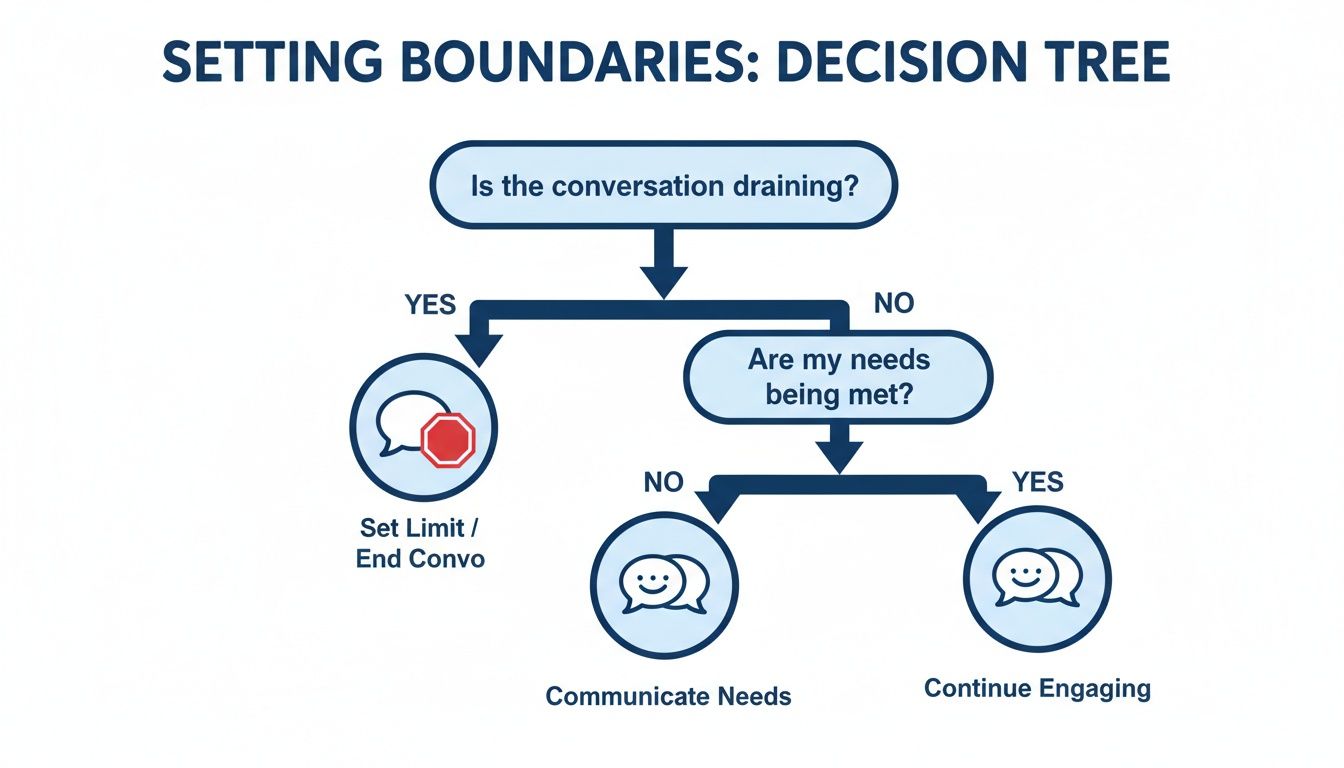
    This visual decision tree can help you map out your feelings and decide on the next steps when a conversation starts to drain you.

    Decision tree for setting boundaries in conversations: assess if draining, if needs are met, then act.

    Your emotional response—whether you feel drained or energized—is a valid signal. Trust it when deciding whether to set a new boundary or create distance.

    Different Approaches for Different Friendships

    How you end a friendship depends on the relationship. Not every parting requires a dramatic conversation.

    • The Gradual Fade-Out: For casual friendships, slowly pulling back can be the kindest and least confrontational path. This might mean taking longer to reply to messages and politely declining more invitations.
    • The Direct Conversation: With close, long-term friends, a direct but gentle conversation is often the most respectful approach. It honours your history while being clear about your need to step away.

    It's okay to outgrow friendships. Acknowledge the good times you shared, but don't let guilt keep you in a dynamic that harms your mental health and contributes to feelings of anxiety or depression. Your peace is a priority.

    Gentle Scripts for a Difficult Talk

    If you choose a direct conversation, focus on your feelings using "I" statements rather than placing blame. The goal is to be clear and compassionate, not to start an argument.

    Here are a few ways you could phrase it:

    • "I’ve been thinking a lot about my own well-being lately, and I’ve realised that our friendship dynamic isn't healthy for me right now. I need to take a step back."
    • "I value the friendship we’ve had, but I feel we’ve grown in different directions. For my own mental health, I need to create some space."
    • "I feel that our conversations often leave me feeling drained, and I need to focus my energy on more balanced and supportive relationships."

    It's also worth considering your online presence. Learning how to strategically remove friends for improved well-being can be an important part of protecting your energy in the digital world.

    Ending a friendship is a loss, and it's normal to feel sad or guilty. Be kind to yourself, lean on supportive friends, and consider talking to a counselling professional if the feelings are overwhelming. This is a brave move toward a happier, healthier life.

    Cultivating Positive Connections and Rebuilding Your Circle

    Joyful diverse friends sharing a laugh on a park bench bathed in warm light.

    Letting go of a draining friendship creates space for healthier, more uplifting connections. Think of this as a new beginning focused on nurturing your social well-being. It's an opportunity to intentionally build a support system that truly enriches your life.

    This process is a crucial part of building resilience. It involves consciously choosing who gets your time and energy. By focusing on quality over quantity, you can create a social circle that champions your personal growth and happiness.

    What Makes a Friendship Healthy

    Before building new connections, it helps to be clear on what you're looking for. A healthy friendship is built on mutual respect, where both people feel seen and valued. It’s a two-way street where support flows in both directions.

    These relationships have a few key ingredients:

    • Shared Joy: You celebrate each other's successes without envy. Their wins feel like yours, and vice versa.
    • Genuine Support: During tough times, you can count on them for empathy and a listening ear, not judgment.
    • Mutual Respect: You honour each other's boundaries, opinions, and life choices, even when they differ.
    • Trust and Safety: You feel safe to be your authentic self, knowing you can be vulnerable without fear.

    When friendships have these qualities, they become a buffer against life’s challenges, from workplace stress to feelings of anxiety or depression. These are the connections that refuel your spirit.

    Reconnecting with Old Friends and Finding New Ones

    Rebuilding your social circle doesn’t have to mean starting from scratch. You can start by rekindling positive connections that may have faded over time. A simple message is all it takes to reach out to a friend who always made you feel good.

    At the same time, stay open to forming new bonds. Joining a class or community group around your interests is a great way to meet like-minded people. In India, for example, joining a local book club or a volunteer organisation can introduce you to people who share your passions.

    Investing in positive relationships is an act of self-care. It's about surrounding yourself with people who reflect the person you are and want to become, fostering a genuine sense of belonging and well-being.

    This isn’t about rushing to fill a void. It's about mindfully curating a community that aligns with who you are.

    The Power of Positive Psychology in Friendships

    Positive psychology offers valuable insights into creating a thriving social life. It encourages us to focus on strengths like compassion, gratitude, and optimism. Applying these principles to your friendships can deepen connections and boost your own happiness.

    A simple practice is to express gratitude, like sending a quick text to a friend to say their chat lifted your spirits. Another is to be a "positive responder" by reacting with genuine enthusiasm to a friend's good news. This amplifies their joy and reinforces your supportive bond.

    These actions help build social capital—the supportive network of relationships that contributes to better mental health.

    Ultimately, learning how to deal with negative friends leads to self-discovery. It teaches you to value your emotional health and empowers you to build authentic connections. If this process feels challenging, seeking guidance through therapy or counselling can provide invaluable support on your journey to a resilient and joyful life.

    Your Questions, Answered

    Navigating a difficult friendship can bring up confusing feelings. It’s normal to feel unsure about what to do next. Let's walk through some common questions about handling friendships that have become challenging.

    This is supportive guidance, not a substitute for professional advice. If you feel stuck, reaching out for therapy or counselling is a sign of strength.

    Am I a Bad Person for Distancing Myself from a Negative Friend?

    Not at all. Stepping back to protect your mental well-being is an act of self-care. Healthy friendships should be reciprocal; they should lift you up, not consistently pull you down.

    When a friendship leaves you feeling drained or anxious, creating distance is a healthy response. It's about protecting your energy so you can be present in your own life. Taking care of yourself allows you to be a good friend to others and, most importantly, to yourself.

    What If My Negative Friend Has Depression or Is Going Through a Tough Time?

    This is a compassionate question and a very difficult situation. The key is to find the balance between supporting a friend and protecting your own mental health. You can offer a listening ear and encourage them to seek professional help.

    At the same time, you must protect your own emotional reserves. It's okay to set a boundary by saying something like, "I care about you and I'm sorry you're going through this, but I don't have the emotional capacity to give you the full support you need. Have you considered talking to a counselling professional?" Supporting a friend should never come at the cost of your own mental health, especially if it's contributing to your own feelings of anxiety or depression.

    How Do I Handle a Negative Friend I Cannot Avoid?

    This is a common challenge with colleagues experiencing workplace stress or even certain family members. When physical distance isn't possible, the goal is to create emotional distance. This is where firm and consistent boundaries are essential.

    Keep interactions brief, polite, and focused on necessary topics. Make a conscious effort not to get drawn into their complaints or drama.

    An effective technique for this is 'grey rocking,' which involves making yourself as uninteresting as a plain grey rock.

    • Keep your answers short and non-committal. Use simple replies like "I see," or "Okay."
    • Don't overshare. The less personal information you give, the less they have to comment on.
    • Stick to neutral ground. Talk about impersonal topics like the weather or a work project.

    This approach makes you a less satisfying target for negativity and helps conserve your emotional energy. It can also help to interact with them in group settings to diffuse the intensity.

    Learning to hold your emotional boundaries is a powerful skill for building resilience. It reminds you that you can stay calm and centred, no matter what someone else is doing. You are not responsible for managing their emotions.

    When Should I Consider Therapy for a Friendship Issue?

    Reaching out for professional support is a smart move if a friendship is causing you serious distress. It might be time to consider therapy if a relationship is triggering your anxiety, harming your self-esteem, or leaving you feeling completely overwhelmed.

    A therapist can help if you feel guilty about setting boundaries or notice a pattern of draining friendships. Professional counselling provides a safe space to work on communication, build emotional resilience, and learn how to foster healthier, more fulfilling connections.


    If you're looking for guidance on how to build healthier relationships and improve your overall well-being, DeTalks is here to help. Our platform connects you with qualified therapists and provides scientifically validated assessments to give you deeper insights into your mental health. Take the first step towards a more balanced and fulfilling life by exploring our resources at https://detalks.com.

  • How to Politely Say No with Confidence and Compassion

    How to Politely Say No with Confidence and Compassion

    Saying 'no' is a skill that blends clarity with kindness. It often means giving a simple, honest reason without a long, complicated story. Finding this balance helps you respect your own limits while showing respect for the person asking, which is vital for your well-being.

    Why Learning to Say No Is Essential for Your Well-being

    It’s often easier to say 'yes' to every request, especially when we want to avoid disappointing others. However, always agreeing can lead to chronic stress, anxiety, and even burnout. This pressure can be stronger in cultures that value group harmony, like in India, where saying 'no' can feel like a major social misstep.

    When you can't set boundaries, your mental health can suffer. Consistently putting others' needs first may chip away at your self-esteem over time. This pattern can leave you feeling exhausted, resentful, and sometimes lead to feelings of depression.

    Reclaiming Your Time and Building Resilience

    Learning how to politely say no is an act of self-respect, not selfishness. It's a key tool for protecting your mental energy and building resilience against challenges like workplace stress. Mastering this skill creates space for greater happiness and compassion in your life.

    This skill is a game-changer for several reasons:

    • It Prevents Burnout: Saying 'no' to overcommitment protects your mental and physical energy.
    • It Fosters Authentic Connections: Honest communication builds relationships based on mutual respect and understanding.
    • It Boosts Self-Confidence: Each time you hold a boundary, you reinforce your self-worth.
    • It Creates Space for What Matters: Saying no to distractions allows you to say a wholehearted 'yes' to your priorities.

    Saying 'no' allows you to care for yourself first, giving you more genuine energy to offer others. It is a necessary strategy for long-term happiness and well-being.

    To say no with confidence, you first need to understand what matters most to you. Taking time for defining your core values provides a clear guide for your decisions. When your 'no' is rooted in your principles, it becomes easier to deliver with conviction and kindness.

    If setting boundaries feels overwhelming, support is available. Therapy or counselling offers a safe space to explore people-pleasing habits and learn assertive communication. It's important to remember that any assessments you encounter are for informational purposes and are not a substitute for a professional diagnosis.

    Understanding the Psychology of People-Pleasing

    A worried man with clasped hands sits at a table in a group therapy session.

    If you find it difficult to say "I can't," you are not alone. This struggle is often rooted in common human fears, like fear of conflict or letting someone down. For many, agreeing is an automatic response developed over time.

    These feelings can be intensified by cultural expectations. In many societies, including India, being helpful and agreeable is highly valued. When your sense of worth is tied to what you do for others, learning how to politely say no can feel uncomfortable, sparking internal conflict.

    The Link Between Boundaries and Well-being

    Struggling to set healthy boundaries is directly linked to your mental and emotional health. Consistently putting others first can erode your self-esteem and leave you feeling overwhelmed. This is a common path toward heightened workplace stress, persistent anxiety, and even feelings of depression.

    The constant pressure to be agreeable drains your energy and can lead to resentment and burnout. Recognising this connection is the first step toward building genuine resilience and protecting your well-being.

    Once you start exploring the psychological reasons behind your automatic 'yes,' you can begin to gently change them. This self-awareness, guided by compassion, is the foundation for communicating your needs clearly.

    Cultural Pressures and the Fear of Saying No

    In many collectivist cultures, group harmony is a priority, making a simple 'no' feel disruptive. A national survey in India highlighted that 72% of people with mental health concerns struggled to refuse requests due to cultural norms, which worsened their anxiety. You can learn more about how social expectations impact mental health by reading the full report on maternal mental health risks.

    This pressure creates a difficult cycle of guilt and obligation, often driven by a few common fears:

    • Fear of Rejection: Worrying that setting a boundary will cause others to distance themselves.
    • Fear of Being Seen as Selfish: Believing that putting your own needs first is wrong.
    • Fear of Harming Relationships: Anxiety that saying 'no' could damage a bond with a friend, relative, or colleague.

    Understanding these fears is about self-compassion, not self-judgment. If these challenges feel too difficult to manage alone, seeking professional therapy or counselling can provide a safe space to build healthier responses. Remember, assessments are informational tools and not a replacement for a diagnosis from a qualified professional.

    1. Have a Few Go-To Phrases Ready

    Often, the hardest part of saying no is finding the right words in the moment. Having a few simple, polite phrases prepared can make a huge difference, taking the anxiety out of the situation. Think of these as your toolkit for responding with confidence instead of stress.

    The goal is to be clear yet kind, communicating your limits without making the other person feel dismissed. A little preparation helps build your resilience and protects your mental well-being.

    Quick & Simple Scripts for Everyday Moments

    You don't always need a long explanation for your 'no'. For many daily requests, a straightforward and polite response is enough. These are perfect for low-stakes situations where you just need to be clear without much fuss.

    For instance, if a colleague asks for a coffee break when you're busy, a simple response respects both of your time. A brief, kind decline is often all that is needed.

    Try one of these:

    • "Thanks so much for thinking of me, but I won't be able to make it."
    • "I appreciate the offer, but I'm going to have to pass this time."
    • "That sounds lovely, but I can't commit to that right now."

    These short phrases work because they are polite, firm, and clear. They don't leave room for negotiation, which helps you avoid the guilt that can come from over-explaining.

    Empathetic Ways to Say No in Sensitive Situations

    Sometimes, a request calls for more warmth, especially with family, friends, or key colleagues. This is where an "empathetic no" comes in. It involves acknowledging the request and the person's needs before you decline.

    This approach helps prevent workplace stress and personal misunderstandings. It shows you care about the person, even when you cannot say yes to their request.

    When you say no, you're not just declining a request; you're teaching others how to treat you. A kind and firm 'no' builds respect and strengthens your relationships.

    Here’s how you can frame an empathetic no:

    • Acknowledge and Decline: "I can see you need help with this, and I wish I could, but I don't have the capacity right now."
    • Offer a Small Alternative (if you wish): "I can't take on the full project, but I could spare 15 minutes to help you brainstorm."
    • Gently State Your Priorities: "I'm dedicating this weekend to my family, so I won't be able to join. I hope you have a wonderful time!"

    To make it even easier, this quick reference table offers a few go-to phrases for different scenarios.

    Your Go-To Phrases for Saying No Politely

    Situation Simple & Direct Phrase Empathetic & Explanatory Phrase
    A Colleague's Request "Thanks for asking, but I can't take that on right now." "I appreciate you trusting me with this, but my plate is full. Perhaps [Another Colleague] could help?"
    A Friend's Invitation "I'll have to pass this time, but thank you for the invite!" "That sounds so fun! I'm bummed I'll miss it, but I'm completely swamped this week. Can we catch up soon?"
    A Family Member's Favour "I'm not able to help with that, sorry." "I know this is important to you, and I wish I could. Unfortunately, I've already committed to something else."
    An Unwanted Sales Pitch "Thank you, but I'm not interested." "I appreciate you taking the time to explain, but this isn't the right fit for me at the moment."

    Bookmark this page or write down the phrases that feel most natural to you. Having them ready can make all the difference when you need to respond in the moment.

    Learning how to politely say no is a skill that gets easier with practice. If you find these conversations trigger intense feelings of anxiety or depression, speaking with a professional through therapy or counselling can be very helpful. Please remember, any self-assessments are for information only and not a substitute for a professional diagnosis.

    Setting Professional Boundaries to Prevent Burnout

    A businessman in a suit pointing at a wall calendar with marked dates, discussing a schedule.

    The modern workplace, especially in a competitive environment like India, constantly tests our ability to say 'no'. With 24/7 connectivity, requests often blur the lines between our work and personal lives. While it may seem like saying 'yes' is the path to success, it's more often a direct route to workplace stress and burnout.

    Weak boundaries are a major cause of professional exhaustion. Always taking on extra tasks or agreeing to unrealistic deadlines drains your mental and emotional energy, harming your well-being and job satisfaction.

    Strategic Communication for a Sustainable Career

    Learning how to politely say no at work is about being strategic, not uncooperative. When you frame your refusal as a thoughtful decision, you protect your professional reputation and your ability to produce high-quality work. This signals that you understand your priorities and are committed to delivering on them.

    A well-communicated 'no' reinforces your value and shows you're a reliable team member who thinks things through. This practice builds resilience and helps you maintain a healthier relationship with your job, steering you away from the anxiety and depression associated with burnout.

    Establishing clear professional boundaries is one of the most effective proven strategies to prevent burnout. This isn't just about surviving your job; it's about building a sustainable and fulfilling career.

    Practical Scenarios and How to Handle Them

    Let's walk through a few common workplace situations and how to navigate them with grace and firmness.

    • When Asked to Take on a New Project: Offer a thoughtful alternative instead of a flat 'no'. Try, "I'd love to help with that. Right now, my focus is on the quarterly report. Could we revisit this next week, or is there something I can delegate to make room?"
    • Declining a Non-Essential Meeting: Your focus time is valuable, so protect it. You could politely say, "Thanks for the invitation. To stay on track with my deadlines, I won’t be able to join, but please send over the key takeaways afterwards."
    • Pushing Back on an Unrealistic Deadline: Communicate concerns proactively. You might say, "I can definitely complete this task. To do it well, I'll need until Friday. A Wednesday deadline would compromise my other projects. Can we adjust the timeline?"

    Protecting your time is a mark of a professional who understands their limits and is committed to excellence. A strategic 'no' is a powerful tool for career longevity and well-being.

    The pressure to be a "yes-person" contributes to 81% of working professionals reporting that their workplace stress worsens when they can't decline extra tasks. In demanding industries, this culture of overcommitment has led to higher rates of depression among employees who struggle to set firm boundaries.

    If you consistently feel overwhelmed, seeking professional counselling can provide personalised strategies. A therapist can offer a supportive space to build stronger communication skills. Remember, any assessments are for informational purposes only and not a substitute for a professional diagnosis.

    Navigating Personal Relationships with Healthy Boundaries

    Two Asian women having a friendly conversation in a bright, modern living room.

    Declining requests from family and friends can be the most emotionally challenging part of setting boundaries. Deep-rooted expectations, especially within many Indian family cultures, can make a 'no' feel like a personal rejection. This fear can trap you in a cycle of saying 'yes' at the expense of your own mental well-being.

    However, learning how to politely say no is about building healthier, more honest relationships. Setting boundaries with compassion sends a clear message: you value both the relationship and your own needs. In the long run, this creates a foundation of mutual respect that strengthens your connections.

    Communicating with Compassion and Clarity

    The key to navigating personal dynamics is blending warmth with firmness. Acknowledge the other person's feelings and validate their request while holding your ground. Your goal is to honour your limits while preserving the relationship.

    For example, if a family member asks for a last-minute favour you can't manage, try saying: "I know this is really important to you, and I wish I could help. Unfortunately, my plate is full today." This response is both caring and clear.

    This is a common struggle, as nearly 65% of young adults feel significant interpersonal anxiety from not knowing how to refuse requests without guilt. Research also shows that couples who set healthy boundaries report stronger dynamics. You can explore more about how mental health and relationships are linked on ruralhealthinfo.org.

    Practical Examples for Friends and Family

    Here are a few real-world scenarios and how to handle them gracefully.

    • Declining a Social Invitation: Your friend invites you out, but you need a night in. Be kind and honest: "That sounds like fun, thank you for thinking of me! I'm a bit run down and need a quiet evening. Can we catch up next week?"
    • Managing Family Obligations: You're asked to attend an event that clashes with your needs. You could say: "I love our family get-togethers, but I won't be able to make this one. I'll be thinking of you all and can't wait to see photos!"
    • Turning Down a Request for Money: This is always a sensitive topic. A gentle but firm approach is: "I care about you, but I'm not in a position to lend money right now. I'd be happy to help you brainstorm other options if you like."

    Setting boundaries is an act of self-compassion that creates healthier and more resilient relationships. It's about saying 'yes' to your own well-being.

    If these conversations consistently bring up overwhelming guilt or anxiety, talking to a professional can help. Counselling offers a safe, neutral space to explore these feelings and build confident communication skills. Always remember that online assessments are for informational purposes and not a substitute for a diagnosis from a qualified professional.

    Supportive Takeaways for Your Journey

    Learning to say no is a journey, not a destination. It's a practice of self-compassion that builds confidence and resilience over time. There will be moments of uncertainty, and that's perfectly okay.

    Remember that every small step you take is a victory for your well-being. By honouring your limits, you create more space for happiness, authentic connections, and a more balanced life. Be patient and kind to yourself as you learn this valuable skill.

    What If Someone Gets Upset When I Say No?

    This is a common fear, and it's valid. The key is to remember that you are responsible for your actions, not for someone else's reactions. Their feelings often reflect their own expectations, not your worth.

    Instead of getting defensive, stay calm and acknowledge their feelings. You can say, “I understand you’re disappointed, and I hear you. For now, I have to stand by my decision.” This shows empathy while holding your boundary.

    How Do I Say No to My Boss Without Risking My Job?

    Saying no at work requires a strategic approach. Instead of a flat "no," frame it as a conversation about priorities. This shows you are engaged and thoughtful, not uncooperative.

    Try saying: "I'm happy to take that on. To ensure I do a great job, could we review my current tasks? I want to be clear on what should take priority." This positions you as a proactive team member focused on quality.

    How Can I Stop Feeling So Guilty Every Time I Say No?

    Guilt can be a heavy feeling, especially if you're used to being a people-pleaser. The best way to ease this is to start small. Think of it like building a new muscle.

    Begin by declining a small favour or an invitation you're not excited about. Each time you do so and see that things are okay, you teach your brain that setting boundaries is safe. You reinforce that your well-being matters.

    Is It Okay to Just Say "No" Without an Explanation?

    Yes, absolutely. "No" is a complete sentence. You do not owe anyone a detailed explanation for your choices. A simple and polite, "Thank you for the offer, but I'm not able to," is perfectly acceptable.

    While a brief, honest reason can sometimes soften the 'no' with loved ones, you should never feel pressured to justify your boundaries. In high-pressure situations, a simple, firm 'no' is your most effective tool.


    If you find that guilt, anxiety, or workplace stress consistently gets in your way, you don't have to navigate it alone. Professional support can make a significant difference in your journey toward better well-being.

    At DeTalks, we connect you with qualified therapists who specialise in building confidence and resilience. Explore our network of professionals and find the support you need to thrive.

  • Navigating Relationships with a Narcissistic Partner: Signs and Healing

    Navigating Relationships with a Narcissistic Partner: Signs and Healing

    Being in a relationship with a person who has narcissistic traits can be a confusing and draining experience. It often leaves you questioning your reality and self-worth. This dynamic can create an imbalance where their needs consistently overshadow yours, pulling you into a cycle of highs and lows.

    What a Relationship with a Narcissist Can Feel Like

    A distressed woman in the passenger seat of a car, as a man drives on a highway.

    If you constantly feel on edge or exhausted by your partnership, please know those feelings are valid. Being with a partner with narcissistic traits can feel like being a passenger in a car where the driver keeps changing the destination without telling you. It can leave you feeling disoriented and powerless.

    At its core, this kind of relationship often involves a significant power imbalance where your partner's need for admiration sets the rules. This dynamic can lead to serious emotional distress, contributing to anxiety, chronic stress, and eventually, burnout.

    The Emotional Rollercoaster

    Many of these relationships start with an intense and exciting "idealisation" phase, where they shower you with affection. You might feel like you've found your soulmate. This initial connection can feel incredibly strong and validating.

    Then, the dynamic can shift, and the person who once praised you may begin to criticise or devalue you. This sudden change is jarring and can leave you scrambling to regain their approval. It's a difficult cycle that can impact your mental health.

    "The end of a relationship with a narcissistic partner is unlike any other breakup. It involves shattering an entire reality. Yet, in that shattering, there is a profound opportunity for healing and rediscovering yourself."

    This cycle of idealisation and devaluation is a common pattern in a narcissist in relationships. It is an emotional rollercoaster designed to keep you seeking their approval, often at a great cost to your own well-being.

    Building Resilience and Finding Clarity

    Understanding these patterns is a crucial first step toward reclaiming your sense of self. It's not about diagnosing your partner but about recognising how the dynamic is affecting you. This awareness is where you can begin to build resilience and practice self-compassion.

    What you are experiencing is real, and your feelings are normal reactions to a challenging situation. Acknowledging this truth is your first move toward healing, often with the support of professional counselling or therapy.

    Recognising the Red Flags of a Narcissistic Partner

    Identifying the specific behaviours of a narcissistic partner can be difficult. You might have a nagging feeling that something is wrong but struggle to pinpoint it. Let's break down some common red flags to help you connect the dots.

    These patterns often start in a way that feels wonderful, which makes them hard to spot. Over time, however, these behaviours can reveal a cycle designed to control rather than connect. Recognising them is the first step toward protecting your emotional health.

    The Dazzling Start: Love Bombing

    At the beginning, you may be swept off your feet by an overwhelming display of affection known as love bombing. You are placed on a pedestal and celebrated as the perfect partner. This intense idealisation is meant to forge a powerful bond very quickly.

    You might receive extravagant gifts or hear declarations of love much sooner than feels natural. While it can seem like a fairy tale, this phase often lays the groundwork for future manipulation. It’s the "too good to be true" stage that can make it so painful to leave later.

    The Mind Game: Gaslighting

    After the initial high, you may notice a disturbing shift where your reality is questioned. Gaslighting is a manipulation tactic that can make you doubt your own perceptions, memories, and sanity. It is a slow erosion of your self-confidence.

    For example, your partner might deny saying something you clearly remember, using phrases like, "You're just being too sensitive." Over time, this constant invalidation can lead to significant anxiety and a sense that you can no longer trust your own judgment.

    This tactic is particularly damaging because it isolates you from your own intuition. When you can no longer trust what you know to be true, you may become more dependent on the person causing the confusion.

    Understanding what a healthy emotional connection looks like can highlight the lack of emotional availability common in these dynamics. Learning how to be more emotionally available can offer a helpful contrast.

    The Slow Erosion: Devaluation and Criticism

    Once the love-bombing phase has you emotionally invested, a pattern of devaluation often begins. The same person who once adored you may now find fault in everything you do. It can start subtly with backhanded compliments or small jabs disguised as jokes.

    This often escalates to overt criticism about your appearance, intelligence, or choices. A partner might praise you in public but dismiss your feelings or tear down your achievements in private. This behaviour can chip away at your self-esteem, leading to feelings of anxiety and depression.

    The Three-Phase Cycle

    The dynamic with a narcissist in relationships often follows a predictable cycle. Understanding these stages can help you see the bigger picture and realise the shifts in behaviour are part of a pattern, not a reflection of your worth.

    The Narcissistic Relationship Cycle Explained

    This table breaks down the three main phases of a relationship with a person with narcissistic traits to help identify recurring patterns.

    Phase Their Behaviour (What You See) Your Feeling (How It Impacts You)
    Idealisation Intense praise, over-the-top affection, and constant attention. They present themselves as your perfect match. Euphoric, seen, and deeply loved. You feel an incredibly strong, almost magical connection.
    Devaluation Non-stop criticism, dismissal of your feelings, and gaslighting. The praise vanishes, replaced by fault-finding. Confused, anxious, and inadequate. You're always on edge, trying to win back their approval.
    Discard Abruptly ending things, often with shocking cruelty and blame. They might just disappear without a word. Shocked, heartbroken, and worthless. You are left feeling completely abandoned and disposable.

    This cycle rarely ends with the discard and can repeat, reinforcing an unhealthy attachment. Understanding this cycle is a crucial step toward finding support to build your resilience and protect your well-being.

    The Toll on Your Mental and Emotional Well-Being

    Being in a relationship with a narcissistic partner can slowly erode your sense of self. It takes a profound toll on your mental health, leaving an emotional weight that feels heavy to carry alone. Recognising this impact is a compassionate first step toward healing.

    The constant cycle of being put on a pedestal only to be torn down can create chronic unease. This emotional rollercoaster often leads to persistent anxiety, as your nervous system remains on high alert. It is an exhausting way to live.

    This destructive pattern is often visualised as a cycle of love bombing, devaluing, and discarding.

    A diagram illustrating the narcissistic relationship cycle: love bomb, devalue, discard, and repeat.

    Seeing this laid out can help you realise that these behavioural shifts are part of a predictable pattern—they are not a reflection of your worth.

    From Anxiety to Burnout

    Over time, living in this heightened state of stress can lead to something deeper than just worry. Many people experience symptoms of depression, like a persistent low mood and a loss of interest in things they once loved. Your world can start to feel smaller.

    This prolonged emotional strain can eventually lead to complete burnout, a state of emotional, physical, and mental exhaustion. It might feel like you have nothing left to give—not to your partner, your work, or even yourself.

    In a relationship with a narcissist, your emotional needs may be consistently dismissed. This invalidation can chip away at your self-esteem and make you question your own perceptions of reality.

    This erosion of confidence is a significant blow to your overall well-being. It can even spill over into your professional life, increasing workplace stress and feeding a sense of inadequacy.

    Understanding the Impact as Trauma

    It can be helpful to view the effects of such a relationship through the lens of trauma. This is not about assigning a diagnosis but acknowledging that prolonged emotional distress is a genuinely traumatic experience. Your body and mind are having a normal reaction to an abnormal situation.

    Complex trauma can develop from the repeated emotional harm common in these relationships. Recognising these responses as trauma-related can be incredibly validating. It helps shift your perspective from, "What's wrong with me?" to, "What happened to me?" which is a powerful step toward self-compassion.

    Cultivating Resilience and Happiness

    Despite the immense challenges, remember your capacity for healing and resilience. Resilience is about integrating your experiences and growing stronger because of them. You can learn to rebuild your self-worth and find happiness again.

    This journey starts with small, intentional acts of self-care. It involves reconnecting with hobbies, friends, and activities that bring you joy. Every step you take to prioritise your own well-being is an act of reclaiming your life.

    Understanding Narcissistic Traits Versus NPD

    It's helpful to distinguish between someone showing narcissistic traits and someone who has Narcissistic Personality Disorder (NPD). The difference is like feeling sad versus experiencing clinical depression. This distinction helps in navigating the situation with clarity and empathy.

    Most of us can be selfish or crave attention at times, especially under stress, but these moments don't define a personality disorder. Human behaviour exists on a spectrum. This helps us avoid labels while still acknowledging the pain that a narcissist in relationships can cause.

    The Spectrum of Narcissism

    Think of narcissism as a continuum, with healthy self-esteem at one end and NPD at the other. NPD is a mental health condition defined by a pervasive pattern of grandiosity, a need for admiration, and a lack of empathy. Most people fall somewhere in the middle, occasionally showing traits like self-absorption.

    For example, a colleague under intense workplace stress might become unusually self-centred for a short period. While their behaviour might be hurtful, it is different from the destructive patterns of NPD that affect all aspects of a person's life.

    Disclaimer: It is important to remember that only a qualified mental health professional can make a formal diagnosis. This guide is informational and intended to empower you, not to serve as a diagnostic tool.

    Why the Distinction Matters for Your Healing

    Understanding this distinction is not about excusing hurtful behaviour but about protecting your mental health from anxiety and burnout. When you understand what you are dealing with, you can set realistic expectations. This clarity helps you focus on what you can control: your responses, boundaries, and path to resilience.

    This knowledge is the first step toward getting the right kind of help. Whether you are dealing with someone with strong narcissistic traits or someone who may have NPD, professional counselling can provide you with valuable tools. A therapist can help you develop coping mechanisms and rebuild your self-worth.

    Practical Strategies for Setting Boundaries and Coping

    A woman stands by an open door, bathed in warm morning sunlight, looking outside.

    Moving from understanding to action is a major step in reclaiming your life. Setting boundaries with a narcissist in relationships can feel intimidating but is essential for your well-being. The key is to start with small, manageable steps.

    These strategies are not about changing your partner but about changing how you interact with them. By creating emotional distance and setting clear limits, you can shield yourself from the constant impact of their behaviour. This process helps you manage the anxiety and stress these dynamics often create.

    Establishing Clear and Firm Boundaries

    The first step in setting a boundary is defining your limit and communicating it calmly and firmly. Using "I" statements helps you express your needs without starting a conflict. This approach focuses on what you will do, which is within your control.

    For instance, instead of saying, "You can't yell at me," try framing it as, "I am not willing to continue this conversation if you're yelling." Sticking to your boundary is crucial. Each time you enforce it, you reinforce its importance to both them and yourself.

    The Grey Rock Method

    When dealing with manipulation, the "Grey Rock Method" can be an effective technique. The goal is to become as uninteresting as a plain grey rock. This means keeping conversations short, factual, and emotionally neutral.

    A person with narcissistic traits often thrives on emotional reactions. By not providing that reaction, you become a less satisfying target. The Grey Rock Method is a powerful tool for disengaging and reducing the daily stress of the interactions.

    "Your healing cannot and should not be rushed. The depth of your pain reflects what you endured. Honour that by giving yourself permission to take all the time you need."

    This approach protects your inner peace by allowing you to opt out of their emotional chaos. It is a quiet act of resilience that conserves your energy for your own healing.

    Rebuilding Your Support System and Self-Worth

    Relationships with narcissistic partners can be isolating, which makes reconnecting with your support system vital. Reach out to trusted friends and family who see and value you. Rebuilding these connections is a powerful reminder of who you are outside the relationship.

    At the same time, consciously invest in things that bring you joy. This could be joining a class, reviving a hobby, or spending time in nature. These activities are concrete steps toward rebuilding the self-esteem that may have been eroded.

    Creating a Safety Plan

    If you ever feel emotionally or physically unsafe, creating a safety plan is the top priority. This is a practical and empowering step to ensure you are protected. A therapist or a domestic violence support service can be invaluable in this process.

    A safety plan might include identifying a safe person to call or a safe place to go. It could also involve keeping a small bag with essentials in a secure location. Taking these steps can help you regain a sense of control in a chaotic environment.

    How to Find the Right Professional Support

    Choosing to seek professional help is a profound act of self-care and strength. If you are constantly on edge, battling anxiety, or feel you’ve lost yourself, it may be time to talk to someone. These feelings are valid signals that you need support.

    In India, conversations around mental health are becoming more open, making it easier to seek help. Choosing therapy or counselling is a courageous move toward healing. It offers a safe space to process your experiences and develop tools for lasting resilience.

    When Is It Time to Seek Help?

    Knowing when to reach out is a personal decision, but some common signs include persistent self-doubt or a feeling of sadness you can't shake. If stress from your relationship is affecting other areas of your life, such as your work or friendships, that is another key indicator. Professional guidance may be helpful if you feel alone, anxious, or have lost touch with your own needs.

    Finding a therapist is not about admitting defeat; it’s about investing in your well-being and future happiness. A good counsellor can act as a guide, helping you find your way back to yourself.

    Finding a Therapist Who Understands

    When dealing with a narcissist in relationships, finding the right therapist is key. It is important to find someone experienced in narcissistic abuse, complex trauma, and difficult relationship dynamics. Not all therapists have this specialised training, so feel empowered to be selective.

    As you search, look for professionals who list these areas as specialities. Platforms like DeTalks can simplify this process by allowing you to filter therapists by their expertise. This helps ensure you connect with someone who understands the nuances of what you are facing.

    Disclaimer: Online psychological assessments are informational, not diagnostic. A formal diagnosis can only be provided by a qualified mental health professional, but these tools can offer valuable insights for your first therapy session.

    Questions to Ask a Potential Counsellor

    Before committing to sessions, it is a good idea to have an initial chat with a potential therapist. This is your chance to see if their approach feels right for you. You deserve to feel heard, respected, and comfortable.

    Here are a few questions you could ask:

    1. What is your experience working with clients who have been in relationships with narcissistic individuals?
    2. Which therapeutic approaches do you use for issues like complex trauma, anxiety, and rebuilding self-esteem?
    3. How do you create a safe and non-judgmental space for your clients?
    4. Can you explain how you help someone learn to set boundaries and build resilience?

    Healing is a journey, not a race, focused on rediscovering your strength and practicing self-compassion. The right professional support can provide a roadmap, guiding you toward a healthier, more peaceful life.

    Frequently Asked Questions

    When you are dealing with the effects of a narcissistic relationship, it is normal to have many questions. It's common for the same doubts and fears to surface repeatedly. Let’s walk through some of them to help you find more clarity.

    Can a Narcissist Change for Someone They Love?

    In theory, anyone can change, but for someone with deep-seated narcissistic patterns, it is a very difficult and rare process. Real, lasting change requires significant self-awareness and a strong commitment to long-term therapy. The desire for change must come from within them, not from external pressure.

    Am I to Blame for What Happened?

    No, you are not to blame. After experiencing gaslighting, it is natural to feel guilt or wonder if you could have done something differently. However, the manipulation and control tactics used by a narcissist are about their needs, not your worth or actions.

    Your reactions were normal for someone in a confusing and challenging situation. Feeling hurt, trying to fix things, or getting angry does not make you the problem. Practicing self-compassion is an important first step in healing.

    How Do I Heal After Leaving a Narcissistic Relationship?

    Healing is a gradual journey of returning to yourself and rebuilding your emotional well-being. The path often includes giving yourself permission to grieve, reconnecting with your support system, and creating emotional safety through boundaries. Working with a professional counsellor can help you process the experience and build resilience.

    This process is about rediscovering who you are and learning to trust yourself again. It is about moving toward a future where you can experience genuine happiness and peace.


    If you are struggling and need someone to talk to, DeTalks can connect you with therapists who understand narcissistic abuse. Start your healing journey by visiting https://detalks.com today.

  • A Practical Guide on How to Self Love Daily

    A Practical Guide on How to Self Love Daily

    Learning how to self love isn't a single decision but a gentle, daily practice. It means choosing to treat yourself with kindness, making peace with your imperfections, and consistently prioritising your own well-being. At its heart, it’s about building resilience and compassion from the inside out, so your sense of worth comes from within.

    What Self-Love Actually Means and Why It Matters

    Self-love is often mistaken for bubble baths and spa days, but it goes much deeper. It is the foundational respect you have for yourself that shapes your thoughts, feelings, and actions every day.

    It’s about shifting away from a harsh inner critic and learning to speak to yourself with the warmth you would offer a friend. In a culture like India, where community needs often come first, prioritising yourself can feel unfamiliar. But it's not selfish; it's essential for building the emotional strength needed to navigate life.

    The Connection to Your Well-Being

    A lack of self-love can make you more vulnerable to life's challenges. It can turn a simple mistake into a source of spiralling anxiety or transform workplace stress into burnout. A consistently critical inner voice can erode your confidence, leaving you susceptible to sadness and even depression.

    Conversely, cultivating self-love helps build an internal support system. It equips you with the tools to manage stress, bounce back from setbacks, and maintain a healthier perspective. For a deeper look, understanding what self-compassion is offers a practical framework for your mental wellness.

    A Look at Self-Love in India

    Globally, India's Self-Love Index score is 52, just one point below the global average of 53, according to a report from The Body Shop and Ipsos. This suggests many in India are on this journey, but there is still room for growth in nurturing our inner well-being.

    To understand this better, let's explore the key components of a self-love practice.

    Core Pillars of Self-Love

    Pillar What It Means in Practice
    Self-Compassion Treating yourself with kindness when you fail or feel inadequate, instead of self-criticism.
    Boundaries Saying "no" to things that drain your energy and protecting your mental and emotional space.
    Self-Acceptance Embracing all parts of yourself—the good, the bad, and the messy—without judgement.
    Prioritising Needs Recognising and honouring your own needs for rest, nourishment, and joy.
    Mindfulness Staying present with your thoughts and feelings without getting carried away by them.

    Each pillar works with the others to create a strong, supportive relationship with yourself.

    Self-love is not a final destination but a continuous practice. It's about choosing to show up for yourself with kindness, especially on the days when it feels the most difficult. This commitment is a powerful step toward lasting well-being.

    Committing to this journey can genuinely improve your life. Here are some of the benefits:

    • Improved Resilience: You can handle life's ups and downs with greater emotional balance.
    • Healthier Relationships: Valuing yourself helps you nurture respectful and supportive connections with others.
    • Reduced Anxiety and Stress: A kind inner voice is a powerful tool for soothing anxiety and managing daily stress.
    • Greater Happiness: Accepting yourself fully creates space for a more authentic and lasting sense of joy.

    This guide provides practical, actionable steps for your journey. While therapy is a valuable resource, the small habits you build daily are the true cornerstones of a healthy relationship with yourself.

    Understanding the Barriers to Loving Yourself

    Have you ever wondered why being kind to yourself can feel so difficult? The journey to self-love starts not with forcing positive thoughts, but with gently understanding what stands in the way.

    Often, the biggest roadblocks are internal, like old thought patterns and painful memories. Others come from external pressures and expectations. The goal isn't to judge these barriers, but to see them clearly, as awareness is the first step toward compassion.

    The Harsh Inner Critic

    We all have that nagging inner voice that is quick to point out mistakes and dismiss successes. This inner critic often echoes critical messages we heard from others long ago.

    It's the voice that whispers you’re not smart enough after an error at work or not attractive enough when you see your reflection. Living with this constant commentary is exhausting, fuelling feelings of anxiety and inadequacy that can lead to burnout. Learning how to self love means learning to see this voice as a misguided attempt to protect you.

    The Weight of Societal and Family Expectations

    In India, cultural and family pressure to follow specific life paths is strong. We are often measured by external benchmarks like academic success, career choices, or marriage. When our lives don't match that blueprint, it's easy to see it as a personal failure.

    This can take a heavy toll, especially on young people, contributing to rising rates of depression and other emotional challenges. You can read more about the findings on adolescent mental health in India to understand this issue better.

    Self-love involves gently separating your self-worth from the expectations of others. It’s about learning to define success and happiness on your own terms.

    Lingering Effects of Past Experiences

    Our pasts shape us in ways we don't always realise. Painful events can create limiting beliefs that run in the background of our minds, such as "I am not worthy of love."

    These old wounds can become major barriers, causing us to self-sabotage or avoid taking chances. Acknowledging this pain is a courageous act of self-love. For many, a safe space like therapy or counselling is key to processing these experiences and writing a kinder story for themselves.

    Common Roadblocks to Watch For

    Identifying specific patterns can be incredibly helpful. Here are a few common ones you might recognise:

    • Perfectionism: The belief that you must be flawless to be worthy of love, which creates an intense fear of making mistakes.
    • Comparison: Constantly measuring your life, body, or career against others, especially on social media.
    • Unresolved Guilt or Shame: Holding on to past mistakes and letting them define who you are today.
    • Neglecting Your Needs: A habit of putting everyone else first, which often leads to feeling drained and resentful.

    Remember, identifying these patterns isn't about finding more flaws. It's about gathering information to know which areas of your life need more gentleness and attention. This is the foundation for building lasting resilience and well-being.

    Cultivating Daily Self-Compassion Practices

    Young Asian man meditating peacefully at a desk in a bright room, practicing self-love.

    The real work of self-love begins with actively practising kindness toward yourself. This isn't about grand gestures but about the small, consistent choices you make every day to build a more supportive inner voice.

    Self-compassion means responding to your own mistakes and imperfections with the kindness you’d offer a friend. Building this skill creates an internal source of strength, helping you navigate everything from workplace stress to personal setbacks with greater resilience.

    From Self-Criticism to Self-Kindness

    The first step is simply to notice how you talk to yourself. When you make a mistake, do you immediately call yourself "lazy" or an "idiot"? Awareness is the crucial starting point for change.

    Once you catch that critical voice, gently reframe the thought. Instead of, "I can’t believe I said that," try, "That wasn’t my most articulate moment, but everyone has off-days." This shift removes the harsh judgment that fuels anxiety.

    Mindful Self-Compassion in Action

    Mindfulness is a powerful tool for paying attention to the present moment without judgment. When paired with compassion, it helps you acknowledge difficult feelings without letting them take over your day.

    Here’s a simple two-minute breathing exercise you can do anywhere:

    • Settle into your chair with your feet flat on the floor. Gently close your eyes or lower your gaze.
    • Take three slow, deep breaths, in through your nose and out through your mouth.
    • Place a hand over your heart or on your lap, feeling its warmth and gentle pressure.
    • Acknowledge whatever you're feeling by silently saying, "This is a moment of stress."
    • Offer yourself a phrase of kindness, like, "May I be kind to myself," or, "It’s okay."
    • Take one last deep breath and slowly bring your awareness back to the room.

    Practices like this help build new neural pathways for self-compassion, improving your overall well-being.

    Rewriting Your Inner Story with Journaling

    Journaling is another effective way to challenge negative self-talk in a private, judgment-free space. The simple act of writing can bring clarity to overwhelming emotions, like anxiety or feelings linked to depression.

    Don't worry about writing perfectly; just five minutes a day is a great start. If you feel stuck, try one of these prompts:

    • What’s one thing I did today that I can feel proud of, no matter how small?
    • If my best friend were going through this, what kind words would I offer them?
    • What is one of my needs that I’ve been ignoring? How can I honour it this week?
    • Write a letter of forgiveness to yourself for a past mistake you've been holding onto.

    Your inner world is like a garden. Journaling helps you pull out the weeds of self-criticism and plant the seeds of self-compassion. With consistent care, a kinder, more resilient version of you will begin to grow.

    Using Affirmations That Actually Feel Genuine

    Positive affirmations can feel inauthentic if you're struggling with deep-seated inadequacy. The secret is to craft affirmations that feel believable to you right now.

    Instead of making a huge leap, try using "bridge" statements. These acknowledge where you are while gently pointing you toward where you want to go.

    Instead of This (If It Feels Fake) Try This More Believable Affirmation
    "I love my body completely." "I am learning to appreciate my body for what it can do."
    "I am a confident person." "I am open to building more confidence in myself."
    "I am completely free from anxiety." "I am capable of handling my anxiety with kindness."

    These gentler statements make the practice feel more honest and effective. They are a practical step in learning how to self love without feeling like you are pretending. Remember, this journey is about progress, not perfection.

    If negative beliefs feel deeply entrenched, these practices may not be enough on their own. When workplace stress, anxiety, or low self-worth feel too heavy to carry alone, seeking professional counselling or therapy is a courageous act of self-care.

    How to Set Boundaries for Better Well-Being

    Setting boundaries is one of the most practical ways to show yourself love. It isn't about building walls but about defining your personal space to protect your energy and mental health.

    Many of us, especially in India where community ties are central, struggle with saying "no." However, constantly prioritising others' needs can lead to resentment, anxiety, and burnout. Setting a boundary is an act of self-respect that strengthens relationships in the long run.

    Understanding Different Types of Boundaries

    Boundaries appear in nearly every area of our lives, and getting good at setting healthy boundaries is key to protecting your energy. The first step is to notice where you need them most.

    Here are the main types:

    • Emotional Boundaries: These protect your feelings, allowing you to empathise without absorbing others' stress.
    • Physical Boundaries: This relates to your personal space, privacy, and comfort with physical touch.
    • Digital Boundaries: This involves managing your online life, such as not checking work emails after hours or limiting social media.

    Weak boundaries are a fast track to workplace stress and exhaustion. Every boundary you set sends a powerful message: "My well-being matters."

    Practical Phrases for Setting Boundaries Politely

    Saying the words out loud is often the hardest part because we fear conflict. The key is to be clear, kind, and firm without needing to over-explain or apologise.

    Here are a few real-life examples:

    Scenario 1: At Work
    Your boss assigns another project when you're already overwhelmed.

    • Try: "Thank you for trusting me with this. My plate is full right now, and I couldn't give this the focus it deserves. Can we discuss priorities?"

    Scenario 2: With Family
    A relative gives unsolicited advice that is starting to wear on you.

    • Try: "I appreciate that you care so much. For this, though, I need to figure it out for myself. I'd rather we talk about something else."

    Scenario 3: With Friends
    A friend calls to vent for hours, leaving you drained.

    • Try: "I can tell this is weighing heavily on you. I only have about 15 minutes before I have to go, but you have my full attention until then."

    A boundary isn't a rejection of someone else. It's an acceptance of yourself and your own limits. This is foundational for building resilience and preventing the kind of burnout that can lead to feelings of depression.

    Navigating the Aftermath of Setting a Boundary

    When you first start setting boundaries, some people may not like it, especially if they are used to you always saying "yes." This is a normal reaction, but it doesn't mean you've done anything wrong.

    Hold your ground with compassion and calmly repeat your boundary if needed. Over time, the people who respect you will adjust. You are teaching others how to treat you, which is a cornerstone of self-love and long-term happiness.

    If setting boundaries consistently fills you with extreme anxiety, or if people repeatedly violate them, it might be worth exploring this in therapy. A counsellor can provide tools and a safe space to build this vital skill.

    Knowing When to Seek Professional Support

    The journey toward self-love is deeply personal, often built through daily practices. But sometimes, these tools may not feel like enough, and that's perfectly okay.

    Reaching out for professional support isn’t a sign of failure. In fact, it’s one of the most courageous acts of self-care you can take.

    Recognising you need help is a profound expression of self-love. It means you value your well-being enough to seek guidance when challenges like persistent workplace stress or sadness feel too heavy. A therapist or counsellor offers a safe, confidential space to explore these feelings without judgment. This assessment is for informational purposes and not a clinical diagnosis.

    This decision tree can help you map out how to communicate your needs when you're feeling overwhelmed—a crucial skill for protecting your mental health.

    A decision tree illustrating how to set boundaries when feeling overwhelmed, offering two paths based on needs communication.

    As the visual guide shows, simply acknowledging that you're overwhelmed is the first step toward taking action to support yourself.

    Signs It Might Be Time for Counselling

    How do you know when it’s time to seek support? If certain patterns persist, professional help could make a real difference. Here are a few common indicators to look for:

    • Persistent Low Mood: Feeling sad, empty, or hopeless most days for more than a couple of weeks, which can sometimes be a sign of depression.
    • Overwhelming Anxiety: Worry and fear are interfering with your work, relationships, or daily routine.
    • Difficulty Coping: Feeling consistently overwhelmed by life and struggling to manage stress.
    • Relationship Strain: Your personal struggles are creating conflict or distance in your relationships.

    What to Expect from Therapy

    The idea of therapy can feel intimidating, especially with the misconceptions that still exist in India. A therapy session is simply a dedicated time for you to talk through your thoughts and feelings with a trained professional.

    A good therapist listens with empathy, helps you spot unhelpful patterns, and gives you practical strategies to build resilience. It's a collaborative process aimed at empowering you to navigate life with greater self-awareness and compassion.

    Seeking therapy is not about "fixing" something that is broken. It's about investing in your own well-being, learning new skills for living, and building a stronger, more compassionate relationship with yourself.

    The Proven Impact of Professional Guidance

    This kind of structured support has a real, measurable impact. For example, research on targeted programmes in India has shown how effective they can be.

    One study in Gujarat found that after an assertiveness training programme, adolescents' average self-esteem scores jumped from 11.33 to 21.16. This highlights the power of guided intervention. You can learn more about these encouraging research findings and see the data for yourself.

    This shows that working with a professional can provide the tools needed to build a stronger sense of self-worth and genuine happiness. Whether you’re navigating anxiety, depression, or simply want to learn how to self love on a deeper level, counselling is an invaluable resource.

    Got Questions About Self-Love? Let's Talk.

    When you first start exploring how to love yourself, it's normal for questions to arise. This path is personal and can feel complex at times. Here are some honest answers to common questions we hear.

    Isn't Focusing on Myself a Bit… Selfish?

    This is a common concern, especially in cultures that prioritise family and community. But the answer is a firm no.

    Genuine self-love isn’t about shutting others out; it’s about ensuring your own cup is full so you have something left to give. When you're running on empty, it's impossible to be the patient, present, and resilient person you want to be for others. Looking after your well-being isn't selfish—it's the foundation that allows you to be a supportive partner, parent, or friend.

    How Long Until I "Get" This Self-Love Thing?

    Self-love is more of a lifelong practice than a destination. There’s no final exam to pass.

    That said, you can start feeling small but powerful shifts quickly. After a few weeks of consistent effort, you might notice you’re catching your inner critic faster or that it’s easier to challenge a negative thought. Deeper work, like building solid boundaries or healing old wounds, naturally takes more time, so be patient with yourself through the process.

    The goal here is consistency, not perfection. Every tiny step forward counts. Each moment of self-kindness is a win on your journey toward accepting and loving yourself more fully.

    These Positive Affirmations Just Feel Fake. Am I Doing It Wrong?

    This is a completely valid feeling. When your self-worth has taken a hit, repeating "I am worthy" can feel like a lie. The trick is to start with statements that feel more believable right now.

    Instead of making a big leap, use "bridge statements" that honour where you are while gently nudging you in a kinder direction.

    • Instead of "I am worthy," try: "I am willing to believe I could be worthy."
    • Instead of "I love myself," try: "I am learning to be kinder to myself."
    • Instead of "I am a confident person," try: "I am taking small steps to build my confidence."

    This softer approach makes the practice feel more genuine and less like a chore.

    Can I Really Practice Self-Love When I'm Dealing with Depression or Anxiety?

    Yes, absolutely. In fact, self-compassion practices can be a powerful support when navigating challenges like anxiety or depression. Being kind to yourself in a tough moment can help soothe your nervous system and interrupt the cycle of self-blame.

    However, it’s crucial to remember that these practices are a support system, not a substitute for professional help. If you're struggling, please reach out for professional support through therapy or counselling. A good therapist can give you personalised tools and a safe space to heal.


    At DeTalks, we know that taking that first step can feel daunting. Our platform is designed to make it easier, connecting you with qualified therapists and offering scientifically validated assessments to help you understand what you need. These assessments are for informational purposes only and are not a substitute for a clinical diagnosis. Find the right support for your journey today at DeTalks.

  • How to Ignore Someone Who Hurt You and Heal

    How to Ignore Someone Who Hurt You and Heal

    Choosing to ignore someone who hurt you is a powerful step towards protecting your peace. It’s a conscious decision to reclaim your emotional energy and focus on your own healing, rather than getting caught in a cycle of pain.

    This approach isn’t about avoiding conflict, but about prioritizing your mental well-being. By stepping back from a hurtful situation, you create the space needed to move forward with clarity and strength.

    Why Ignoring Someone Can Be a Powerful Act of Self-Care

    When someone causes us pain, our first instinct might be to confront them or seek an apology. While these feelings are valid, staying engaged can sometimes lead to prolonged stress, anxiety, and emotional burnout.

    Learning to ignore someone who hurt you is an act of self-preservation, not weakness. It's a choice to stop investing your energy into a situation that brings you down, allowing you to focus on your own well-being.

    The Psychology Behind Strategic Disengagement

    Ignoring someone is more than just silence; it's a psychological tool for creating an emotional buffer. This distance helps prevent their actions from continuing to affect your inner peace and mental health.

    This act of disengagement can break the cycle of replaying hurtful memories, which often contributes to feelings of anxiety and sometimes depression. It is a practical strategy for building emotional resilience.

    In India, this approach is a common way to manage emotional distress and regain stability. You can find more information about these coping strategies on this mental health resource.

    By choosing to ignore someone, you are not saying the hurt didn't happen. You are saying that your peace is more important than the conflict, and your future is more valuable than your past pain.

    Protecting Your Mental Energy

    Every interaction and thought consumes emotional energy. Constantly focusing on someone who has hurt you drains this energy, leaving you with less for your own happiness, goals, and well-being.

    Image

    Strategically ignoring someone helps you conserve your energy in several ways:

    • It Reduces Rumination: You stop obsessively replaying the hurtful situation, freeing up mental space.
    • It Lowers Emotional Reactivity: With less engagement, the person has less power to trigger an emotional response from you.
    • It Builds Self-Compassion: This choice reinforces the message that you deserve peace and that protecting your well-being is a priority.

    This shift in focus from them to you is a vital part of healing. Exploring this further through professional counselling or therapy can provide additional support and guidance.

    Here are some practical ways to create the emotional distance you need to heal.

    Ignoring someone who hurt you isn't just about silence; it's about creating space for your own recovery. Think of it as building a protective boundary to reduce their influence over your emotional state.

    This act of self-preservation helps you regain a sense of calm and control. When you learn to disengage emotionally, you reduce the daily anxiety and stress that can come from difficult relationships.

    Try the Grey Rock Method

    When you can't completely avoid someone, like a colleague or family member, the 'grey rock method' is useful. The idea is to become as uninteresting as a grey rock in your interactions.

    You remain emotionally non-responsive, keeping answers short and factual. By not sharing personal feelings, you remove the emotional reaction they may be seeking.

    For example, if a difficult colleague asks about your weekend, a simple, "It was quiet, thanks," is enough. Over time, the lack of engagement often causes them to lose interest.

    Set Your Digital Boundaries

    In today's connected world, protecting your peace means setting digital boundaries too. Social media can be a source of painful reminders, making it difficult to move on and protect your mental well-being.

    Here are a few steps you can take to protect your online space:

    • Mute or Unfollow: This allows you to stop seeing their content without the potential drama of blocking them.
    • Restrict or Block: For a firmer boundary, blocking them prevents all contact and creates clear separation.
    • Be Mindful of Mutual Friends: You might need to temporarily mute mutual contacts if their posts frequently feature the person.

    This visual guide breaks down the core steps for creating emotional distance and protecting your mental health.

    Infographic about how to ignore someone who hurt you

    As the infographic shows, the journey begins by acknowledging your feelings, then moves to setting boundaries, and finally shifts the focus back to your own healing and growth.

    Practice Mindfulness to Manage Your Thoughts

    One of the biggest challenges is managing intrusive thoughts about the person or situation. These thoughts are common and can feel powerful because they often relate to things we care about.

    Mindfulness can help you observe these thoughts without getting carried away by them. It teaches you to acknowledge their presence and then gently guide your focus back to the present moment.

    When a thought about the person arises, simply notice it without judgment and let it pass. This practice is a key skill for building emotional resilience and is often taught in therapy.

    Remember, a thought is just a thought. You don't have to engage with it, believe it, or act on it. Letting it pass without judgement is a skill that strengthens over time.

    This technique, often used in counselling, helps you stop investing energy in past hurts. It empowers you to redirect that focus towards your own happiness and well-being.

    How to Set and Enforce Clear Boundaries

    A person setting a boundary by holding their hand up in a stop gesture, with a calm expression.

    Boundaries are essential when you're moving on from someone who has hurt you. They are the clear lines you draw to protect your emotional energy and support your well-being.

    Setting boundaries is an act of self-respect. It reinforces your decision to prioritize your own peace and communicates that you are committed to your healing journey.

    Figure Out Your Personal Lines in the Sand

    Before you can enforce a boundary, you need to know what your limits are. Take some time to reflect on what leaves you feeling drained, anxious, or disrespected in interactions.

    Identifying specific triggers—like certain topics of conversation or unwanted contact—helps you understand where a boundary is needed. This clarity is the first step toward protecting yourself.

    "A boundary is a clear statement of what is okay for you and what is not okay. It's not a request; it's a declaration of your needs and limits, crucial for maintaining emotional balance."

    Establishing these lines is vital for your mental health. You can find helpful strategies for setting boundaries and practicing self-care to prevent burnout for more guidance.

    How to Communicate Your Boundaries Without a Fight

    Communicating boundaries doesn't require a confrontation. A simple, direct, and calm approach is often the most effective way to express your needs.

    You don't need to provide a lengthy explanation; a simple 'no' is a complete sentence. Having a few phrases ready can help you respond confidently without feeling flustered.

    Here are a few examples you can adapt:

    • For unwanted requests: "I'm not able to help with that right now."
    • For intrusive questions: "I'd prefer not to discuss my personal life, thank you."
    • To stop contact: "I need some space right now and won't be responding to messages."

    These statements are polite but firm, helping you avoid additional anxiety or conflict.

    Dealing With Mutual Friends and Awkward Social Events

    Navigating relationships with mutual friends can be challenging. They may not understand your need for distance and might try to mediate, which can be draining.

    You don't have to share all the details with them. A simple and consistent response is often the best approach to maintain your boundary respectfully.

    Try saying something like, "I appreciate your concern, but this is a personal matter I'm handling privately." This respects their friendship while reinforcing your decision and building your own resilience. Professional counselling can also offer a supportive space to navigate these social challenges.

    Navigating Social and Workplace Situations

    Knowing how to ignore someone who hurt you is one thing, but it can be difficult when you can't avoid them. Encounters at work or social events can create stress and anxiety.

    With a clear plan, you can handle these moments gracefully and protect your peace. The goal is to be polite but firm in your boundaries, managing any awkwardness without adding to your workplace stress.

    Strategies for Group Settings

    When in a group with this person, aim for polite but distant interactions. You can acknowledge their presence without engaging in a deep conversation, keeping any necessary communication brief and neutral.

    For example, on a work project, keep all discussions focused strictly on the task. If they ask a direct question, provide a short, factual answer to maintain a professional boundary.

    This is a common coping mechanism. Research has shown that many professionals choose to minimize contact with those who have caused them emotional pain, often feeling an immediate reduction in stress. You can explore the research about these mental health findings for more insight.

    Handling Questions from Others

    It's likely that friends, family, or colleagues may notice the distance and ask questions. Remember, you are not obligated to explain your personal life to anyone.

    Having a simple, prepared response can help you feel more in control. This allows you to set a boundary without feeling put on the spot.

    Your boundaries are for your protection, not for others' understanding. A simple, consistent response is often more effective than a detailed explanation.

    You could say something calm like, "I'm focusing on my own well-being right now and choosing to keep some distance." This is an honest reply that politely signals you don't wish to discuss it further, which can help reduce follow-up anxiety.

    Here are a few phrases you can adjust to your situation:

    • For a curious coworker: "I prefer to keep my focus on our work."
    • For a well-meaning friend: "I appreciate your care, but I'm handling this in my own way."
    • For a family member: "I'm being civil, but for my own peace, I'm choosing not to engage more than I have to."

    Handling these situations is about reinforcing your decision to prioritize your mental health. If the emotional weight feels too heavy, professional counselling or therapy can offer a safe space to develop coping skills and build resilience.

    Turning Your Focus to Healing and Growth

    A person journaling in a notebook with a calm, natural background.

    Ultimately, this process is about your healing, not about them. Learning to ignore someone who hurt you frees up significant emotional energy that you can now invest back into yourself.

    This experience, while painful, can be a catalyst for positive change. By turning your focus inward, you can transform hurt into an opportunity for building resilience, practicing self-compassion, and moving forward with a renewed sense of purpose.

    Rechanneling Your Emotional Energy

    Consider the energy spent replaying conversations or worrying about future interactions. That energy is now yours to redirect toward things that bring you joy and fulfillment.

    This is a conscious choice to invest in your own growth and happiness. It's a crucial step in recovering from the emotional impact of anxiety and moving toward a healthier state of mind.

    This mindset is becoming more common, especially among young adults in India. Recent studies, like the India Youth Mental Health Survey findings, show that ignoring as a coping strategy is often linked to lower levels of immediate distress.

    Practical Steps for Self-Investment

    Investing in yourself doesn't require grand gestures. Small, consistent actions can lead to significant healing and help you rebuild your sense of self-worth.

    Here are a few tangible things you can start doing today:

    • Journal to Process Feelings: Writing down your thoughts and emotions can be a powerful way to process them without judgment.
    • Rediscover Your Passions: Reconnect with hobbies you love or explore new interests that spark your curiosity and excitement.
    • Connect with Nature: Spending time outdoors, even for a short walk, can reduce stress and improve your mood.

    These actions are not just distractions; they are deliberate acts of self-care. They remind you of your own value and support your journey toward well-being.

    "Healing doesn't mean the damage never existed. It means the damage no longer controls our lives."

    This is a powerful reminder that your past does not have to define your future. Every step you take toward your own well-being is a victory.

    Building Resilience for the Future

    This challenging experience has taught you valuable lessons in emotional resilience. You have learned how to protect your peace, set boundaries, and prioritize your mental health—skills that will serve you throughout your life.

    This journey is a testament to your strength. Choosing to grow from hurt is an empowering act, and remember, professional counselling can offer valuable support if you feel stuck.

    Knowing When It’s Time to Ask for Help

    Ignoring someone who hurt you is a powerful strategy for self-protection. However, some pain is too deep or complex to navigate alone, and seeking professional help is a sign of strength.

    If you find that feelings of sadness, anger, or anxiety are persistent and affecting your daily life, it may be time to talk to a professional. Struggling with sleep, changes in appetite, or a loss of interest in activities you once enjoyed are all signs that support could be beneficial.

    What Therapy and Counselling Can Truly Offer

    A therapist or counsellor provides a safe, confidential, and non-judgmental space to explore your feelings. They can help you understand the root of your pain, develop healthy coping skills, and build lasting emotional resilience.

    Please note: the information here is for educational purposes and is not a substitute for professional diagnosis. Your mental health journey is unique, and expert guidance is always recommended.

    In therapy, you can learn to identify and change unhelpful thought patterns that keep you feeling stuck. Just as you might consult an expert for other challenges, like finding a behaviorist for a pet, professional support for your own well-being offers specialized guidance to help you heal.

    Taking That First Step Towards Healing

    Often, the most challenging step is deciding to seek help. Fortunately, conversations around mental health are becoming more open in India, making it easier to find qualified support.

    Starting counselling can help you heal from this specific hurt and equip you with tools to handle future challenges. If you're experiencing signs of depression or significant workplace stress, a professional can provide the guidance you need to move forward. You do not have to carry this burden alone.


    At DeTalks, we're firm believers that the right support is essential for a healthier, more resilient life. Our platform is designed to connect you with qualified therapists and provides scientifically validated assessments to help you understand your needs and start your healing journey. Take the first step with DeTalks today.