
If you're not feeling good, how do you know whether you need rest, a change in your daily life, or professional care? Advice to stay positive misses that important question, especially when you can't explain whether the problem is in your body, your mood, or the situation around you.
You don't need the perfect name for what's wrong before asking for help. Start by noticing the pattern, checking how urgently you need support, and choosing a manageable next step.
What Makes You Feel Not Good and How to Sort It
Not feeling good is common, and it often has more than one cause. You might be grieving while sleeping poorly, or dealing with workplace stress alongside a physical health problem.
Many people in India recognise this overlap. In 2024, 53% of urban Indians said they'd experienced stress severe enough to affect daily life during the previous year, according to Ipsos's World Mental Health Day survey.
Start with patterns, not labels
The most useful distinction isn't whether your discomfort is real. It's whether emotional, physical, situational, or substance-related factors might be contributing.
Common causes of feeling not good, sorted by type
| Cause type | Common examples | Typical signs | First step |
|---|---|---|---|
| Emotional | Grief, loneliness, exam anxiety, low self-esteem | Persistent worry, low interest, tearfulness | Name the feeling and talk to one trusted person |
| Physical | Thyroid problems, anaemia, low vitamin D, chronic pain, poor sleep | Fatigue, body aches, appetite or weight change | Book a general physician check-up |
| Situational | Workplace stress or harassment, family conflict, money pressure, a recent move | Symptoms that rise in one setting, such as before work or on Sundays | Reduce the trigger where possible and seek support |
| Substances or medicines | Alcohol, nicotine, excess caffeine, some prescribed drugs | Mood dips after use, disturbed sleep | Review use with a doctor or pharmacist |
These are possibilities, not explanations you can confirm yourself. Fatigue doesn't automatically mean a vitamin deficiency, and worrying before work doesn't rule out an anxiety disorder.
Hormonal shifts, including changes around menstruation, can also be relevant. A doctor can consider these alongside your health history rather than assuming that everything is caused by stress.
Notice what changes across your week
Say you feel tense before opening work messages but more settled when you're away from them. That suggests your working conditions deserve attention, although it doesn't establish the whole cause.
Now consider tiredness that stays with you on workdays, holidays, and after rest. If it comes with unexplained weight change or persistent pain, a medical check-up is a more useful starting point than pushing yourself harder.
The World Health Organization's India mental-health guidance supports considering symptoms and daily functioning together. In practice, note when the feeling began, what your sleep and appetite are like, any medicines or substances you use, and what you're struggling to do.
Starting question: Does this feeling follow a body pattern, a mood pattern, or a particular place or person?
You may notice several patterns at once. This reflection helps you describe what's happening, but it's not a diagnosis, and you don't have to solve the cause before seeking care.
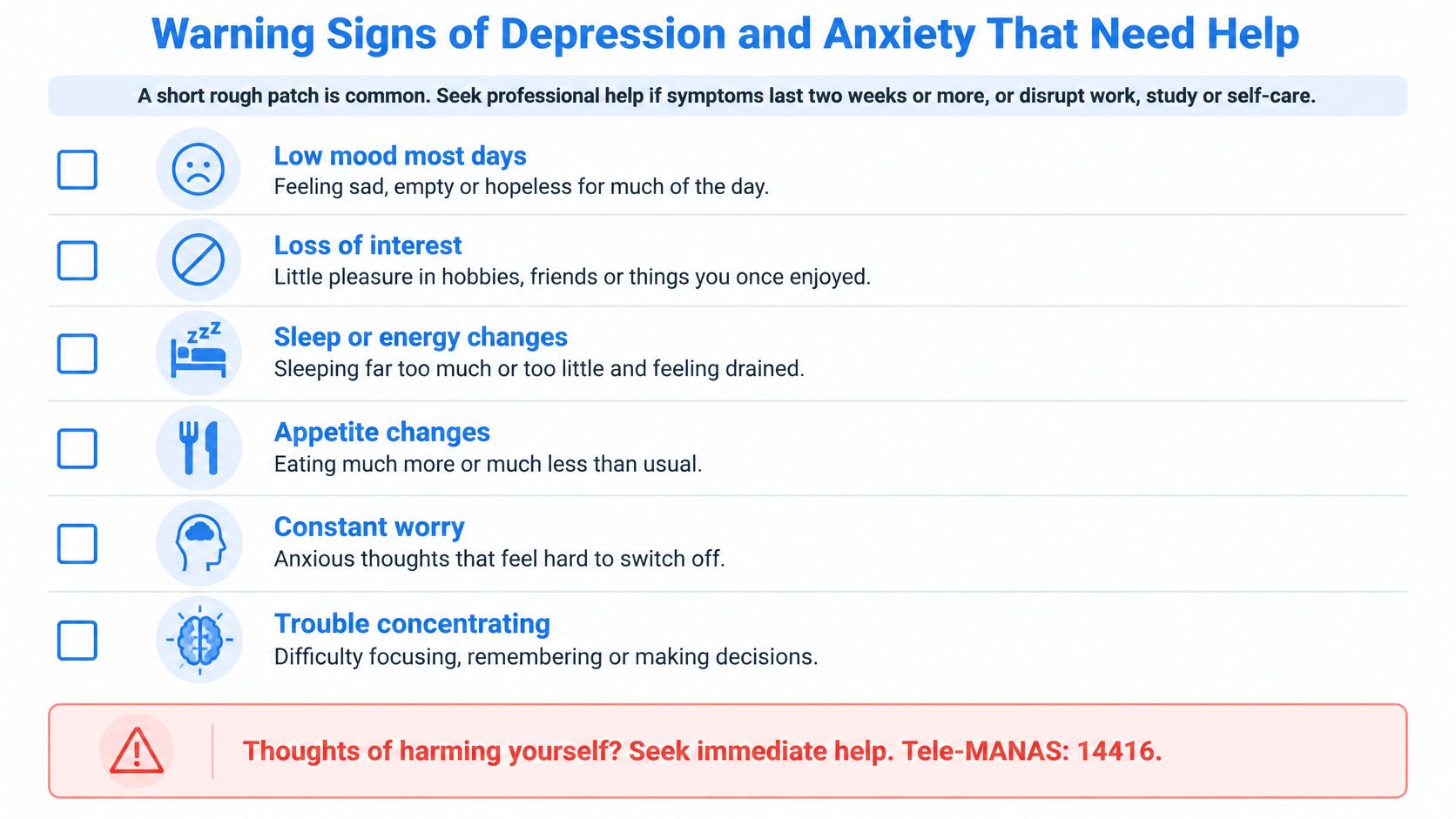
Warning Signs of Depression and Anxiety That Need Help
A difficult day can pass, while a pattern that persists or disrupts daily life deserves closer attention. Symptoms lasting about two weeks or more, or symptoms that interfere with work, study, or self-care, warrant professional attention. The National Mental Health Survey of India discusses mental health through symptoms and their effect on functioning.
You do not need to wait two weeks if you are struggling substantially or feel unsafe. The length of time matters, but so does how severe the symptoms are and what they prevent you from doing.
Watch for changes from your usual self
One hard day on its own does not establish depression or anxiety. Look for changes that keep returning or begin to affect ordinary routines:
- Low mood or emptiness: Feeling sad, flat, or hopeless most days.
- Loss of interest: Finding little enjoyment in friends, hobbies, or familiar activities.
- Sleep and energy changes: Sleeping much more or less, or feeling unusually drained.
- Appetite or weight changes: Eating noticeably differently without intending to.
- Poor concentration: Struggling to focus, remember, or make everyday decisions.
- Hard-to-control worry: Feeling caught in anxious thoughts or having panic-like episodes.
- Withdrawal: Avoiding people, classes, work, or everyday responsibilities.
- Substance reliance: Increasingly using alcohol or other substances to cope.
This checklist is a way to organise what you have noticed, not a diagnosis. You can use it to explain your concerns to a doctor or counsellor.
Match the action to the urgency
Use these timings as practical guides, not as reasons to delay care. Worsening symptoms, severe physical symptoms, or safety concerns call for a faster response.
Urgency levels for persistent symptoms
| Pattern | What it may suggest | Suggested action | Timing |
|---|---|---|---|
| Mild low mood or tiredness that eases within a few days | Short-term stress or a difficult week | Self-help steps and rest | Monitor for two weeks |
| Symptoms lasting about two weeks or more | Possible depression or anxiety | Visit a doctor or counsellor | Within one to two weeks |
| Fatigue, weight change, or persistent pain alongside mood symptoms | Possible medical cause | See a general physician for a check-up | Within a few days |
| Symptoms that stop work, study, or daily care | Significant effect on functioning | Consult a psychologist or psychiatrist | As soon as possible |
| Thoughts of self-harm or suicide, or feeling unsafe | Crisis | Contact emergency services or go to the nearest emergency unit; involve a trusted person | Immediately |
If you might act on thoughts of self-harm, do not stay alone. Ask someone you trust to stay with you while you reach urgent support. If you can do so safely, move away from anything you could use to harm yourself.
Hearing or seeing things others do not, severe confusion, or unusually high energy with very little sleep and risky behaviour also needs urgent assessment. Self-help is not enough for these changes.
Online assessments are informational, not diagnostic. A qualified clinician can consider symptoms, risk, health history, and circumstances together. For mild distress without warning signs, the daily habits for emotional wellbeing in the self-help steps below can help, though they are not a substitute for evaluation.
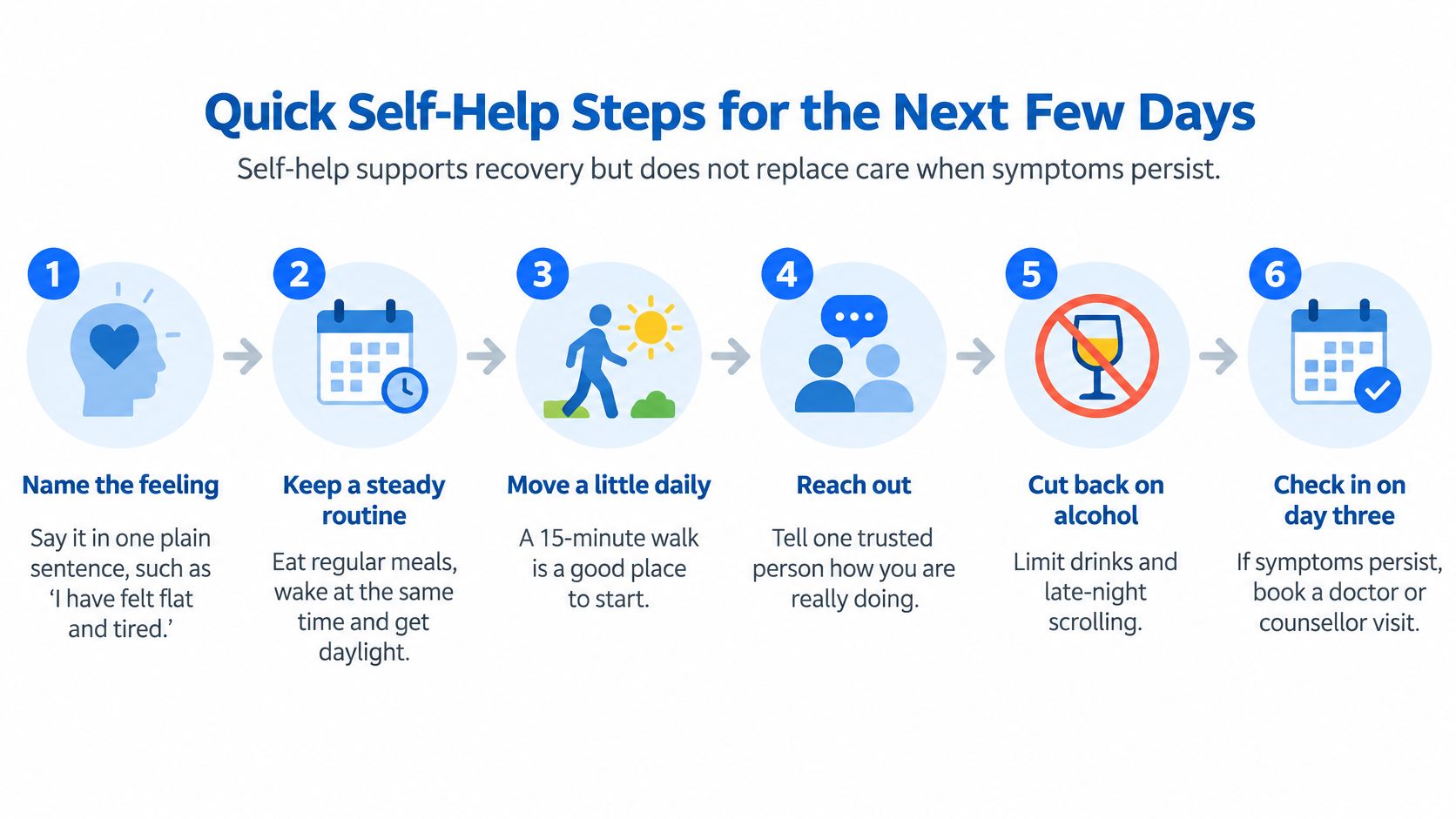
Quick Self-Help Steps for the Next Few Days
Self-help can make daily life more manageable while you recover or arrange support. It doesn't replace care when symptoms persist, worsen, or affect your ability to function.
Choose actions small enough to do on a difficult day. A complicated wellness plan can become another source of pressure.
Make the basics easier to repeat
Name the feeling plainly. Write a sentence such as: I've felt flat and tired since Monday, especially after work. A specific description gives you something concrete to discuss; avoid turning it into a judgement such as being lazy or failing.
Check the basics for three days. Aim for regular sleep and waking times, drink water through the day, and plan three simple meals so food doesn't disappear when you're busy. These are practical anchors, not a test of discipline; missing a meal doesn't mean you should abandon the day.
Try gentle movement. Start with 10 minutes of daylight walking or comfortable movement if your health allows, without expecting a particular result within a week. Don't wait for strong motivation, and stop if you develop pain, dizziness, or other concerning symptoms.
Reduce a manageable trigger. Choose something specific, such as a late-night scrolling session or an unnecessary commitment. Don't make yourself responsible for solving harassment, unsafe relationships, or impossible workloads through better habits alone.
Contact someone you trust. Send a short message explaining that you're not feeling great and would appreciate a call or some company. Ask for what you need, because the other person may otherwise assume you want advice rather than listening.
Keep a brief evening record. Note your mood, sleep, and the main event of the day on a phone note or calendar for two weeks. Keep it short enough to maintain, and avoid repeatedly checking or scoring yourself throughout the day.
Know when to change the plan. If symptoms last beyond about two weeks, worsen, or interfere with working, studying, or looking after yourself, arrange professional care rather than adding more self-help tasks. You can continue supportive routines alongside treatment, but they shouldn't remain your only response.
If you prefer instructions for gentle movement, you can explore guided mobility training from GrabGains. Choose comfortable movements rather than treating exercise as something you must complete despite feeling unwell.
The visual below offers a compact reminder of everyday supports.
Adjust rather than judge
A check-in after the first few days is a chance to notice what's happening, not a deadline for feeling better. If a walk is too much, sit outside; if cooking feels difficult, choose an easy meal.
A useful routine fits your present capacity. It doesn't require you to pretend you have more energy than you do.
Building Resilience With Self-Compassion and Small Habits
Resilience means recovering with support, not never feeling low. Someone can be capable, caring, and hardworking while still needing help with anxiety, exhaustion, or burnout.
Support may look as ordinary as having someone sit beside you without demanding an explanation.

Practise kindness without denying difficulty
Self-compassion means responding to yourself as you would to a friend. Instead of blaming yourself for struggling, acknowledge that the day is difficult and decide what support would help.
This isn't lowering your standards or avoiding responsibility. You can recognise a missed deadline without deciding that it defines your worth.
Build recovery into ordinary life through small, repeatable choices:
- Notice a good moment: Keep a daily three-line gratitude note, naming something specific, why it mattered, and how you felt. You don't have to claim that the whole day was good.
- Make room for meaning: Cook a familiar dish, tend a plant, or learn a few chords. Choose something that offers interest or a sense of skill, not another performance target.
- Keep a safe connection: Arrange a weekly conversation with someone who doesn't require you to act cheerful.
- Ease into the evening: Put work materials away, lower stimulation, and choose a quiet activity before bed.
Make room for happiness without forcing it
Workplace and study pressures can leave little space for recovery. In 2025, 29% of Indians said they'd experienced stress that affected how they lived their daily lives, according to Ipsos's Health Service Report.
That makes small recovery routines worth protecting before pressure peaks. Happiness needn't be a permanent mood or another goal you're failing to reach; it can include brief moments of enjoyment alongside a genuinely difficult period.
If a video format suits you, take a pause with this resource.
These habits support well-being and emotional balance. They aren't cures for depression or anxiety, and needing treatment doesn't mean you lack resilience.
Why Saying I Am Fine Stops People Getting Help
Have you ever said, “I'm fine, just tired,” because you couldn't explain what felt wrong? When distress is hard to name, a simple answer can feel safer than discussing it. Fear of judgement, concerns about privacy, and pressure to manage alone can also delay asking for help.
Start without needing a label
People may notice changes in sleep, concentration, or mood before they recognise them as signs of emotional distress. Stigma and expectations of self-reliance can make it harder to speak up, even when someone wants support. You do not need to identify a condition before describing what has changed.
Try beginning with something specific:
- Write privately first: Note what has changed and what feels difficult.
- Use everyday descriptions: You might say you have not been sleeping well or have felt flat for weeks. You do not need to name a disorder.
- Bring support: Ask someone you trust to accompany you or help arrange an appointment.
- Choose a less exposing first contact: A helpline, doctor, or counsellor may feel easier than starting with a family conversation.
Ask about privacy directly
Before sharing sensitive details, ask the professional how confidentiality works and when they may need to involve someone for safety. If you are considering a college service, you can ask whether counselling information is kept separate from academic records.
You don't have to prove that your distress is serious enough before asking someone qualified to help you understand it.
A first conversation can focus on one practical concern, such as sleep or concentration. You can share more as trust develops, rather than trying to tell your whole story at once. If you are unsure what to call the problem, describing its effects is a useful place to begin.
Counselling, Therapy and Other Support Options in India
Support options and how to reach them in India
| Option | Best for | Who provides it | How to access |
|---|---|---|---|
| General physician | Physical causes and a first check-up | Medical doctor | Local clinic or hospital |
| Psychiatrist | Diagnosis and medication when needed | Medical doctor with psychiatry training | Hospital or clinic appointment |
| Clinical psychologist | Assessment and talk therapy | Psychologist with clinical training | Private practice or hospital |
| Counsellor | Stress, relationship strain, grief and life transitions | Trained counsellor | Private practice, college or community services |
| Therapist | Ongoing structured therapy | Qualified mental health professional | Direct booking or online platforms |
| Tele-MANAS | First conversation at any hour, in several languages | Trained counsellors and mental-health specialists | Call 14416 or 1-800-91-4416 |
| Workplace support | Job stress and harassment | HR team or employee assistance programme | Ask HR or check company policy |
| DeTalks directory | Finding and booking psychologists, therapists and counsellors | Listed mental health professionals | Browse the directory on the platform |
For a free first conversation, India's National Tele-Mental Health Programme, Tele-MANAS, provides toll-free access on 14416 or 1-800-91-4416, around the clock, with language choice and connections to trained counsellors and mental-health specialists. It can be a starting point when you're unsure which service to approach or can't easily travel.
Match the professional to your main concern
Choose a general physician first when physical symptoms are prominent, new, or unexplained. Bring your symptom notes and a list of medicines, supplements, and substances you use; the doctor can decide whether examination, tests, or referral would help.
Counselling may suit grief, relationship strain, life changes, and workplace stress. A clinical psychologist can offer assessment and psychological treatment, while a psychiatrist can assess mental-health conditions and prescribe medication when appropriate.
The word therapist can describe professionals with different backgrounds. Ask about qualifications, relevant experience, and the approach they use rather than relying on the title alone.
Check practical fit before booking
Ask about language, appointment format, fees, cancellation terms, and experience with your concern. If privacy at home is difficult, consider whether an in-person appointment would let you speak more freely than an online session.
You can also ask how progress is reviewed and what happens if you need a different level of care. A suitable professional should be able to explain their role and the limits of their service.
For job-related distress, HR or an employee assistance programme may help with workload, leave, or reporting harassment. Check confidentiality arrangements, and remember that personal counselling doesn't replace an employer's responsibility to address unsafe conditions.
Directories and online booking services can make finding ongoing care easier. They support, rather than replace, emergency services, and any assessments they offer are informational, not diagnostic.
Choose Your First Step Today
You don't need to make every decision today. Choose the route that matches what's happening:
- Physical symptoms: If you have fatigue, unexplained weight change, or persistent pain, book a general physician check-up this week, sooner if symptoms are worsening. Bring a short note of the pattern.
- Persistent emotional distress: If the feeling has lasted about two weeks, arrange a counsellor, psychologist, or therapist visit within one to two weeks. If it's disrupting work, study, or self-care, seek an earlier appointment; the DeTalks directory or Tele-MANAS on 14416 can help you start.
- Immediate safety concerns: For thoughts of self-harm, suicide, or loss of safety, call 112 or go to the nearest emergency unit now. Ask a trusted person to stay with you.
For milder difficulties, choose two or three manageable self-help actions and make a human connection this week. Not feeling good is common and often has an identifiable cause, though understanding it may take professional assessment.
Assessments are informational, not diagnostic, and asking for help early is sensible. Small routines, self-compassion, and connection can support well-being without promising a cure. Choose one small step today.
DeTalks offers a directory of psychologists, therapists, and counsellors, alongside informational assessments to help you organise your concerns. If you're not feeling good and want support choosing a professional, visit DeTalks to explore listed providers and book a conversation.