Welcome to the world of therapy—a space designed for growth, healing, and self-discovery. This guide is here to explain the core techniques of counselling in a simple, warm way. These are structured, proven methods that therapists use to help you navigate life's challenges, from everyday anxiety and workplace stress to building deeper happiness.
Think of these techniques as a practical toolkit for building resilience and nurturing your mental well-being. This journey is about understanding yourself better and finding supportive ways to move forward.
Your Journey into Counselling Techniques
Deciding to start counselling is a brave and powerful step towards a healthier, more fulfilling life. It’s a partnership where a trained professional uses specific, thoughtful approaches to help you make sense of your thoughts, feelings, and behaviours. The entire process is designed to create a safe, supportive space for you to heal and grow.

In this guide, we'll walk through everything from foundational skills like active listening to powerful, structured approaches like Cognitive Behavioural Therapy (CBT). Our aim is to give you a clear, empathetic overview, showing how different techniques are matched to different needs. Understanding these methods helps demystify what happens in a therapy session, making it feel much more approachable.
The Evolution of Counselling in India
The practice of counselling in India has grown immensely, blending global knowledge with local understanding. Early psychological labs, like the one at Calcutta University in 1915, laid the groundwork for modern mental health support.
Today, the field has moved far beyond simple advice-giving, embracing evidence-based methods to address common challenges like anxiety and depression. This shift reflects a global move towards care that truly works, tailored to be relatable and effective for people across India and the world.
Why Understanding These Techniques Matters
When you know the basics of counselling techniques, you become an active partner in your own healing journey. Understanding the "why" behind your therapist's approach allows you to engage more deeply and build a stronger therapeutic relationship.
This knowledge is helpful for managing issues like workplace stress and for cultivating positive qualities like resilience, compassion, and happiness. It’s about finding what works for you and gathering the tools to build a more balanced life.
The most important thing to remember is that therapy is not a one-size-fits-all solution. The rich variety of techniques ensures that the support you receive can be tailored to your unique personality, background, and goals.
For those considering a professional path in this field, grasping adult learning theory principles can make a world of difference in mastering these techniques. Ultimately, this journey is about finding what works for you and gathering the tools to build a more resilient, balanced life.
The Power of Being Truly Heard
Every meaningful counselling journey starts with something simple, yet incredibly profound: being truly heard. Active listening and empathy are the bedrock techniques of effective therapy. At its core, therapy provides a unique space where you can feel completely seen and understood, often for the very first time.
When a counsellor truly tunes in, they are listening for the feelings beneath your words, which builds a powerful sense of trust. For anyone navigating the fog of depression or the constant buzz of anxiety, this simple act of being understood can be the first real step towards healing.
What Active Listening Really Means
Active listening is a structured way of hearing and responding that creates genuine understanding. It is one of the most vital techniques of counselling, involving more than just staying quiet while you talk. It's a fully engaged, dynamic process.
Your therapist acts as an emotional mirror, reflecting back your thoughts and feelings without judgment. This helps you see your own emotions more clearly and feel validated for having them. This is especially important when you’re wrestling with overwhelming feelings from workplace stress or difficult relationships.
Here’s what it looks like in practice during therapy:
- Undivided Attention: Your therapist shows they are focused entirely on you with their body language and focus. It’s a non-verbal way of saying, "You matter."
- Paraphrasing for Clarity: They might rephrase what you’ve said, like "It sounds like you're feeling completely overwhelmed." This isn't just repetition; it's a check to ensure they understand.
- Reflecting Feelings: A good therapist listens for the emotion behind your words, saying something like, "That must feel incredibly frustrating."
The Role of Empathy in Building Trust
If active listening is the 'how', then empathy is the 'why'—it's the soul of the therapeutic connection. Empathy is the ability to genuinely step into your shoes and understand your experiences from your point of view.
This authentic understanding forges the therapeutic alliance, the strong, trusting bond between you and your counsellor. Research shows that a strong alliance is one of the biggest predictors of a positive therapy outcome, no matter which techniques of counselling are used.
A therapeutic relationship built on empathy creates a safe harbour. It’s a space where you can be vulnerable without fear of judgement, allowing for deeper exploration and growth toward better well-being.
Empathy tells you that your feelings are valid, which is an incredibly powerful experience. When someone truly understands, the weight of carrying difficult emotions alone begins to lift. For anyone looking to foster this in other settings, exploring community circle questions to spark deeper connection can offer practical ideas.
From Listening to Healing
Active listening and empathy are powerful healing actions in themselves. This foundation is what allows all other therapeutic techniques to work effectively. It creates a stable ground from which you can start to build resilience and explore real change, transforming the counselling room into a space of safety.
Ultimately, being truly heard is a fundamental human need. When that need is met within a professional, caring environment, it opens the door to self-compassion, new insights, and lasting positive change.
How CBT Retrains Your Brain for Well-Being
Of all the modern techniques of counselling, few are as widely practiced as Cognitive Behavioural Therapy, or CBT. The idea at its heart is simple and powerful: your thoughts, feelings, and actions are all connected. When you change one, the others follow.

This means that if you can learn to change unhelpful thought patterns, you can directly influence your emotional well-being and how you act. CBT is a hands-on, skill-building approach that gives you the tools to navigate life’s challenges long after your sessions are over.
The CBT Triangle in Action
Let’s make this real with an example of workplace stress. Imagine you have a big presentation coming up, and the thought, "I'm going to mess this up," pops into your head. That thought triggers a knot of anxiety in your stomach, which then leads you to avoid practicing.
CBT works by showing you how to break this cycle at the source: the thought. A counsellor helps you spot these automatic patterns and gives you practical strategies to challenge that initial negative thought, building emotional control and resilience.
"CBT is less about dwelling on the past and more about equipping you with practical skills for the present and future. It’s an active, collaborative form of therapy where you learn how to retrain your brain for healthier responses."
Modern counselling in India has been profoundly shaped by these cognitive-behavioural techniques. Structured approaches like CBT have gained serious traction in both research and clinical practice. You can dig deeper into the growth of these methods in psychotherapy with Indian clients.
Key CBT Tools for Your Everyday Life
CBT is a collection of practical tools, and your therapist acts as a coach, guiding you through exercises to reshape how you think and act. While some assessments might be used to identify patterns, they are always informational tools, not rigid diagnostic labels.
Here are a couple of the most common and powerful CBT techniques:
- Cognitive Restructuring: This is the core skill of identifying, questioning, and changing unhelpful thoughts. You learn to catch "automatic negative thoughts" and examine the actual evidence for and against them.
- Behavioural Activation: This technique is a game-changer for tackling depression and low motivation. It involves intentionally scheduling positive activities into your day to counteract the tendency to withdraw and help lift your mood.
The table below summarises some key CBT techniques and where they are most helpful.
Common CBT Techniques and Their Applications
| CBT Technique | What It Does | Commonly Used For |
|---|---|---|
| Cognitive Restructuring | Identifies and challenges negative or irrational thought patterns. | Anxiety, depression, phobias, low self-esteem |
| Behavioural Activation | Schedules positive, rewarding activities to combat withdrawal. | Depression, apathy, lack of motivation |
| Exposure Therapy | Gradually exposes a person to their fears in a safe setting. | Phobias, panic disorder, obsessive-compulsive disorder (OCD) |
| Journaling | Tracks thoughts, feelings, and behaviours to identify patterns. | General anxiety, stress management, self-awareness |
| Problem-Solving Skills | Breaks down overwhelming problems into manageable steps. | Stress, anxiety, decision-making difficulties |
These techniques are the building blocks of CBT, helping you develop a more balanced and realistic perspective on life's challenges.
Putting CBT into Practice
So, what does this look like in the real world?
Example 1: A Student with Exam Anxiety
- Automatic Thought: "If I fail this exam, my future is ruined."
- Cognitive Restructuring: A therapist would help the student challenge this by reframing it: "This exam is important, but my worth isn't defined by a grade."
- Behavioural Activation: Instead of avoiding study out of fear, the student creates a structured study plan with small, achievable goals to build confidence.
Example 2: A Professional Facing Workplace Burnout
- Automatic Thought: "I can't cope with this workplace stress. I'm a complete failure."
- Cognitive Restructuring: A counsellor helps them question this, reframing the thought to: "I'm feeling overwhelmed, which is normal. I need to find better strategies to manage my workload."
- Behavioural Activation: The professional intentionally schedules restorative activities, like taking a proper lunch break or dedicating time to a hobby, to fight burnout.
With practice, these CBT skills start to feel natural. You learn to pause, notice your thoughts without judgment, and choose a more helpful way forward, building lasting pathways to greater mental well-being.
Fostering Growth with Person-Centred Therapy
Person-centred therapy is built on a simple yet powerful idea: you already have the capacity to grow and find your own answers. The therapist is not an expert with all the solutions, but a genuine, supportive guide on your journey.
This gentle form of therapy is all about helping you tap into your own inner resources. It creates a safe, non-judgemental space where you can freely explore your true feelings, build self-worth, and uncover the path that feels right for you. It's a journey of self-discovery, perfect for anyone looking to grow, boost their self-esteem, or find a clearer sense of purpose.
The Three Core Conditions
For person-centred therapy to work, the therapist cultivates a nurturing environment based on three core conditions. When a therapist embodies these qualities, they create the ideal soil for emotional growth and healing.
These conditions are:
- Unconditional Positive Regard: The therapist accepts you completely, without any "ifs" or "buts." You are valued for exactly who you are.
- Empathy: The therapist works hard to understand your world from your point of view, helping you feel truly seen and understood.
- Genuineness (or Congruence): Your counsellor is real with you, without a professional mask. This encourages you to be your true self, too.
This approach is fantastic for improving your overall well-being by strengthening your relationship with yourself. It helps you move away from a harsh inner critic and towards a place of genuine self-acceptance and compassion.
How Person-Centred Counselling Feels in Practice
Unlike more structured therapies, a person-centred session feels more like a natural conversation. The session flows based on whatever you feel is most important to talk about that day. The focus is on your immediate experience—what you’re thinking and feeling in the here and now.
Let's say you come to a session feeling overwhelmed by workplace stress. A person-centred therapist would first listen with deep empathy as you talk about feeling inadequate. They might reflect back with something like, "It sounds incredibly draining to feel like you have to be perfect all the time."
Hearing your experience mirrored back without judgement is incredibly powerful. This process validates your feelings, helps you untangle them, and builds your resilience from the inside out.
Who Benefits Most from This Approach
While its core principles are a cornerstone of any good counselling relationship, this approach is brilliant for certain goals. It's an excellent choice if you're grappling with self-esteem, figuring out your identity, or feeling "stuck" in life.
It's also a powerful way to work through mild to moderate anxiety and depression. By nurturing a strong sense of self-worth, it empowers you to manage your emotional world with more confidence. The skills you learn—like self-acceptance and trusting your inner voice—are tools you can carry with you for life.
A Look at Other Powerful Counselling Methods
The world of therapy is rich and varied, and different challenges call for different tools. Understanding the breadth of options can make the journey towards feeling better seem more hopeful. Specialised techniques offer unique pathways to healing, whether you're navigating family dynamics or processing a painful past.
Exploring these different techniques of counselling reveals that support should be shaped to fit your life story and goals. It’s not about finding one "best" method, but about discovering the approach that resonates with you.
Understanding Our Connections with Systemic and Family Therapy
Sometimes, the problems we carry are tangled up in our relationships. Systemic and Family Therapy looks at us not in isolation, but within the context of our family and community. The core idea is that our struggles often emerge from the systems we're a part of.
Instead of singling out one person as "the problem," this form of therapy explores the unspoken rules and communication habits within a group. It’s useful for resolving family conflicts or helping partners communicate better, aiming to forge healthier connections for everyone.
The image below shows the core conditions of Person-Centred Therapy, which often provides a vital foundation for relationship-focused approaches.
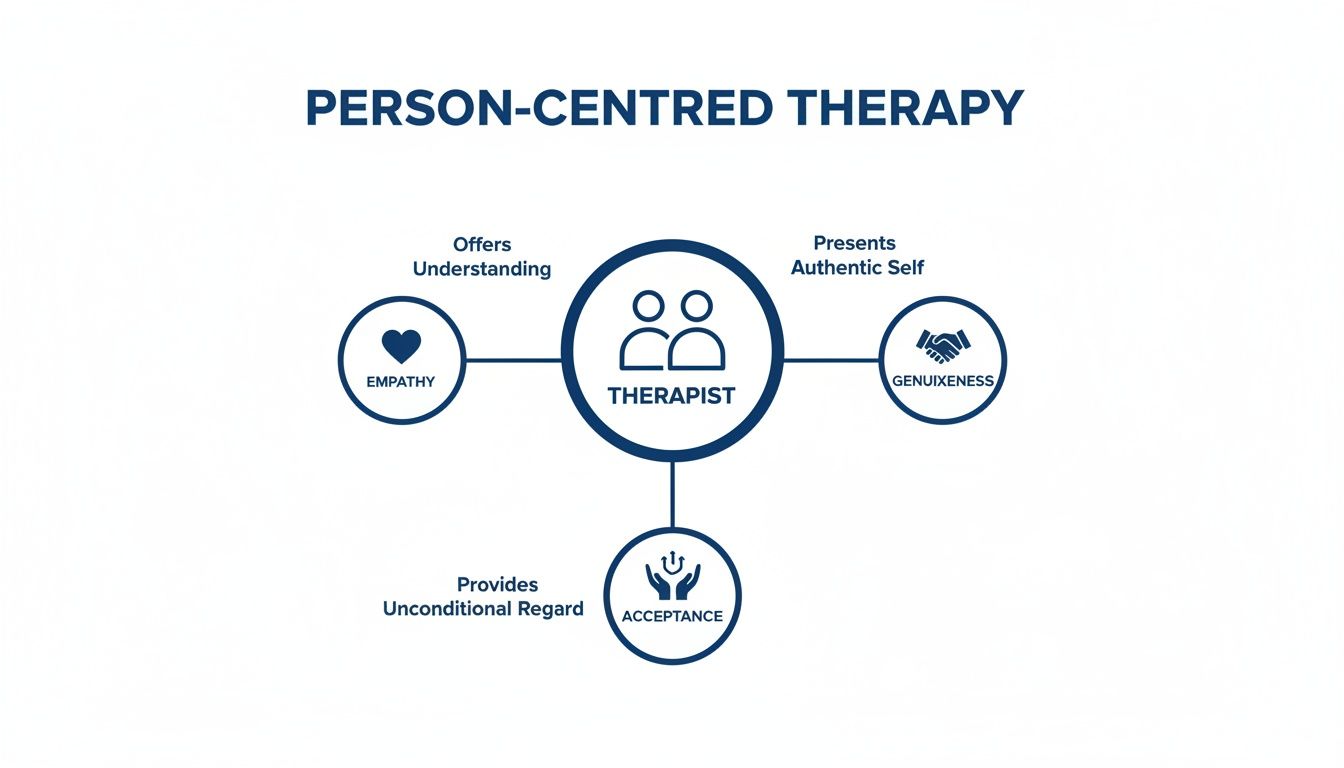
It’s a great visual reminder of how a therapist’s empathy, genuineness, and unconditional acceptance create the safe space needed to explore sensitive relationship issues.
Finding Your Own Drive with Motivational Interviewing
Have you ever felt completely stuck, knowing you need to make a change but lacking the motivation? That's where Motivational Interviewing (MI) comes in. It’s a collaborative counselling style designed to help you unearth and strengthen your own internal drive for change.
A therapist using MI acts as a partner, helping you explore your own reasons for wanting something different. This technique works wonders for making lifestyle changes or breaking unhelpful habits. Because it’s built on respect for your autonomy, it empowers you to become the expert on your own life and build the resilience to follow through.
Motivational Interviewing is based on a powerful idea: real, lasting change comes from within. A therapist's role is simply to help you find your own compelling reasons to grow, making the whole process feel more authentic and sustainable.
In India, counsellors are brilliant at adapting Western models like these to better fit local culture. You can learn more about how Indian therapists adapt these models to provide care that’s both culturally sensitive and highly effective.
Healing from Trauma with EMDR
For anyone who has experienced trauma, certain memories can get "stuck," causing ongoing distress, anxiety, or other difficult symptoms. Eye Movement Desensitization and Reprocessing (EMDR) is a structured therapy developed to help people process these traumatic memories.
During an EMDR session, the therapist guides you to focus on a memory while engaging in bilateral stimulation, like following their fingers with your eyes. This process helps the brain reboot its natural healing system, allowing you to reprocess the memory so it loses its disruptive emotional charge. EMDR is a well-researched technique for helping people find relief from the heavy weight of past trauma.
Each of these methods shows that no matter what you're facing—from workplace stress to deep-seated trauma—there are effective techniques of counselling out there. The journey is about finding the right key to unlock your own path to healing and growth.
Finding a Therapist Who's Right for You
Taking that first step towards counselling is a huge win, and often the hardest part of the process. Now, let's talk about how to find a therapist and an approach that genuinely clicks with who you are. The secret isn't finding the "best" technique, but discovering what feels right for you.
Remember, starting therapy is a proactive move towards building your well-being and resilience, not a quick fix. The connection you have with your therapist is one of the biggest factors in your progress, so it pays to find someone you trust.
Starting Your Search with DeTalks
Trying to find a qualified professional can feel overwhelming. Platforms like DeTalks make the process much clearer. You can easily browse profiles of verified therapists, read about their specialties, and get a sense of the techniques of counselling they use.
As you look, see whose approach resonates with you. Maybe the practical nature of CBT appeals to you, or perhaps the gentle, self-exploratory space of Person-Centred therapy feels more fitting. Whatever it is, trust your gut.
What to Look for in a Therapist
When sifting through profiles, a few key things can help you narrow the field. A great therapeutic relationship is built on trust, respect, and feeling that someone truly understands you.
Here are some practical points to keep in mind:
- Specialisation: Does the therapist have experience with what you're dealing with, like workplace stress, anxiety, or relationship troubles?
- Therapeutic Approach: Do they focus on a technique that interests you? Many therapists are integrative, but it’s helpful to know their main style.
- Initial Consultation: Many therapists offer a short introductory call. This is your chance to ask questions and check the vibe. Do you feel comfortable opening up to them?
It's completely okay to chat with a few different therapists before you decide. This is your journey, and finding a partner you connect with is the most important ingredient for success.
Using Assessments to Point You in the Right Direction
If you’re looking for more clarity on what you need, the scientifically validated psychological assessments on DeTalks can be a great resource. These tools can offer useful insights into your emotional patterns, personality, or specific challenges like depression.
It’s crucial to remember that these are for information, not diagnosis. They act as a helpful starting point, giving you and a potential therapist some shared language for your first conversations. Your path to healing is your own, and finding the right support is a powerful first step.
Frequently Asked Questions
It’s completely normal to have questions when you’re thinking about starting counselling. Let's walk through some of the most common ones to help clear things up.
How Do I Know Which Counselling Technique Is Right for Me?
The good news is, you don’t have to have this figured out beforehand. A skilled therapist will get to know you first, often drawing from different techniques of counselling to create a plan that fits you perfectly.
Those first few sessions are about conversation and connection. Your therapist will focus on understanding what you're going through, and together you will decide on the best way forward.
Are Online Therapy Sessions as Effective as In-Person Ones?
Yes, they absolutely can be. Research confirms that for common concerns like anxiety and depression, online therapy works just as well as face-to-face sessions. It offers a level of convenience that can make all the difference when you're juggling a busy life or dealing with workplace stress.
What truly makes therapy work is the connection you have with your therapist. That sense of trust and rapport is the foundation for real progress, whether online or in an office.
What Is the Difference Between Counselling and Therapy?
You'll often hear these words used to mean the same thing, and that's generally okay. Both involve a trained professional helping you improve your mental health in a supportive way. Some might say counselling is for shorter-term problems, while therapy tackles deeper patterns, but in practice, the lines are blurry.
The real goal for both is the same: to help you understand yourself better, learn new ways to cope, and build a more satisfying life. The most important thing isn't the label, but finding a qualified person you feel a genuine connection with.
How Long Does Counselling Usually Take?
There’s no one-size-fits-all answer, as everyone's journey is different. Some people get what they need in a few sessions, while for others, exploring deeper-rooted issues like chronic anxiety might mean longer-term support is more helpful.
It’s something you and your therapist will figure out together. The focus is always on your progress and what you need to feel confident and supported, not on a rigid schedule.
This guide is meant to offer supportive takeaways, not promises of a cure. The journey toward well-being is personal, and finding the right person to talk to is the most important step you can take. DeTalks makes that step easier by connecting you with verified therapists and providing informational assessments to help point you in the right direction. You can start exploring your options and find a professional who understands you at https://detalks.com.