
In a 2024 study published in the Journal of Nature and Science of Medicine, 37.9% of 672 Indian adolescents aged 13–19 met the study threshold for depressive symptoms. That's a finding from one study, not a diagnosis of every teenager who feels low. It does, however, challenge the idea that distress is something young people should push through.
For many families, the difficult question isn't whether a mental-health app exists. It's whether a teen can speak without being overheard, use a shared phone safely, complete identity checks and return to a professional they trust.
Online therapy for teens needs to fit real family life. A useful starting point is to consider the young person's needs, privacy and safety together, rather than choosing a platform first.
Signs That Counselling May Help Now
Look for changes that last more than a couple of weeks and disrupt school, sleep, food, friendships or home life. This is a practical prompt to pay attention, not a rule that families must wait before asking for help.
A teenager may withdraw from friends, worry constantly, panic before exams or snap at people more often. Another may keep attending school while feeling empty, exhausted or unable to enjoy anything.
Notice changes rather than labels
The infographic offers a starting point for a calm conversation about what feels different.
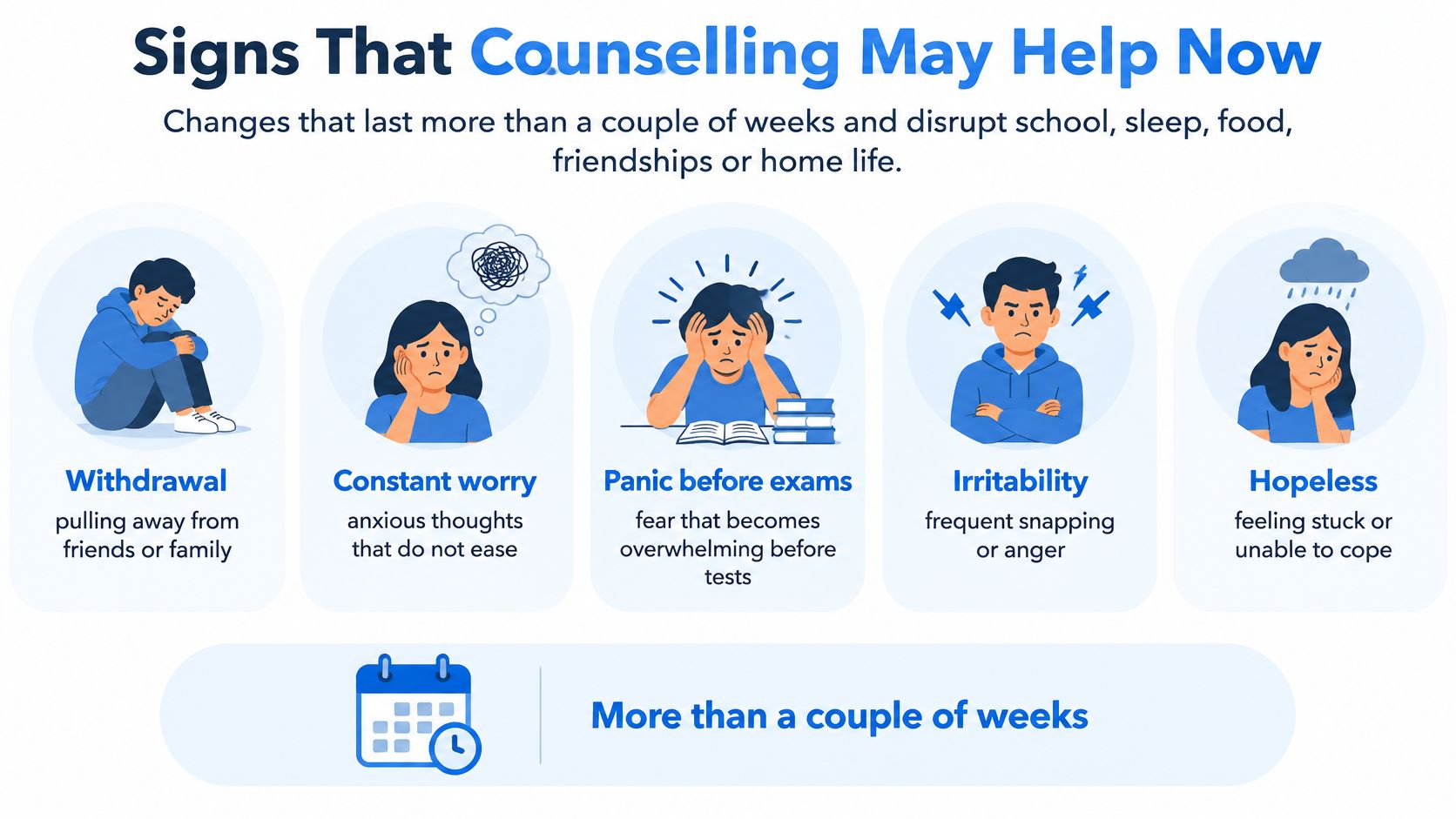
Compare your teen with their usual self, not with a sibling or classmate. Falling grades after a capable start, missed meals, disrupted sleep or abandoning a favourite activity can help you describe the concern without accusing them of laziness.
- Withdrawal: They stop meeting friends or spend family time trying not to be noticed.
- Constant worry: Reassurance brings little relief, and ordinary decisions become exhausting.
- Panic before exams: Fear interferes with preparation, attendance or the ability to settle.
- Irritability: Frequent anger may sit alongside sadness, shame or overwhelm.
- Hopeless comments: Statements about being trapped, worthless or unable to cope deserve a direct, caring response.
India's National Mental Health Survey 2015–16 found that 7.3% of adolescents aged 13–17 had a mental disorder, with similar rates among boys and girls, representing nearly 9.8 million young people who may need active intervention. That scale supports early access to help, not attaching a label to an individual child.
Urgent safety concern: Talk of suicide, a recent attempt or being unable to stay safe needs same-day emergency or in-person assessment, not a wait for a video appointment. If danger is immediate, stay with the teen and seek emergency help.
Make room for quieter needs
Counselling isn't reserved for a visible crisis. A teen who completes homework but feels persistently lonely can use support to explore emotions, practise self-compassion and rebuild routines that leave room for rest and happiness.
Exhaustion that resembles burnout and risky coping, such as using substances to escape feelings, also deserve attention. A professional can help distinguish emotional concerns from other health needs.
Learning to recognise strain now may support later well-being, including how a young person approaches workplace stress. Parents reflecting on their own habits may find workplace wellbeing advice from Fluidwave useful, without treating adult work advice as adolescent treatment or assuming therapy prevents future burnout.
Assessments are informational, not diagnostic. Screening questions can organise the story for a professional, but they can't diagnose anxiety or depression.
This week's choice: Sit together and note what changed, how long it has lasted and whether daily life has become smaller. Let the teen add what adults haven't noticed.
When Online Therapy Fits a Teen
Choose the first step by asking whether your teen can use it safely, privately and willingly. Familiarity with a smartphone doesn't automatically make a young person comfortable discussing painful feelings through it.
In an Indian adolescent mixed-methods study, 71.3% had never accessed mental-health services, while 68.2% preferred text-based interaction; the same study reported personal smartphone ownership of 82% and frequent internet use of 94%. Connectivity alone therefore doesn't explain the gap, and a lower-pressure format may matter.
Which first step fits this teen
| Situation | First step | Why it fits |
|---|---|---|
| Exam stress, anxiety or low mood with a private phone | Scheduled online therapy, text if the teen prefers it | Cuts travel and may reduce discomfort about seeking help; text suited many adolescents in the study |
| Shared phone or fear that parents will find out | Agree a privacy plan before booking | Alerts, invoices and chat previews can expose counselling |
| Active self-harm or a medical emergency | In-person or emergency services the same day | Remote care should not replace available in-person emergency help |
| Weak internet or a rural connection | Audio or messaging, then a local referral | Video may drop, and a helpline alone isn't a full course of care |
| Family conflict or parenting stress | Family sessions with a verified adult | Minor consultations generally need an identified adult |
| Distress that continues after a helpline call | Repeated therapy with the same professional | A helpline supports and refers; it doesn't replace ongoing work |
These findings describe access and preferences, not proof that remote care is clinically equivalent to clinic treatment. Nor does a preference for texting mean every therapist offers text sessions or that messaging is sufficient for every concern.
A teen may like typing because it gives them time to choose words. Another may find waiting for a written reply unsettling and prefer a scheduled audio conversation.
Check the practical fit
Ask what the proposed format includes. A live text appointment, occasional messages between sessions and an automated chatbot are different services, with different expectations about professional involvement and response times.
For a rural family, language matching and continuity can matter as much as the internet connection. Ask whether the professional can work in the teen's preferred language, switch to audio when appropriate and identify nearby care if remote support stops being sufficient.
The national telemedicine guidance makes clear that clinicians must judge whether remote care is sufficient and that emergency care shouldn't rely on telemedicine when in-person alternatives are available. A workable plan therefore includes more than a successful video test.
Any quiz used to guide this choice is informational screening, not a diagnosis of anxiety or depression.
This week's choice: Select the row that best describes the teen's present situation. Resolve its main obstacle before booking, rather than choosing the most convenient-looking app.
How CBT DBT and Family Sessions Work
Say a teenager feels sick before studying for the boards and thinks a disappointing result would ruin their future. Online therapy should offer more than reassurance or an app-generated label: it should provide a planned conversation, a shared understanding of the problem and manageable practice between meetings.
The main approaches can overlap, but they give families useful language for asking what a therapist proposes.
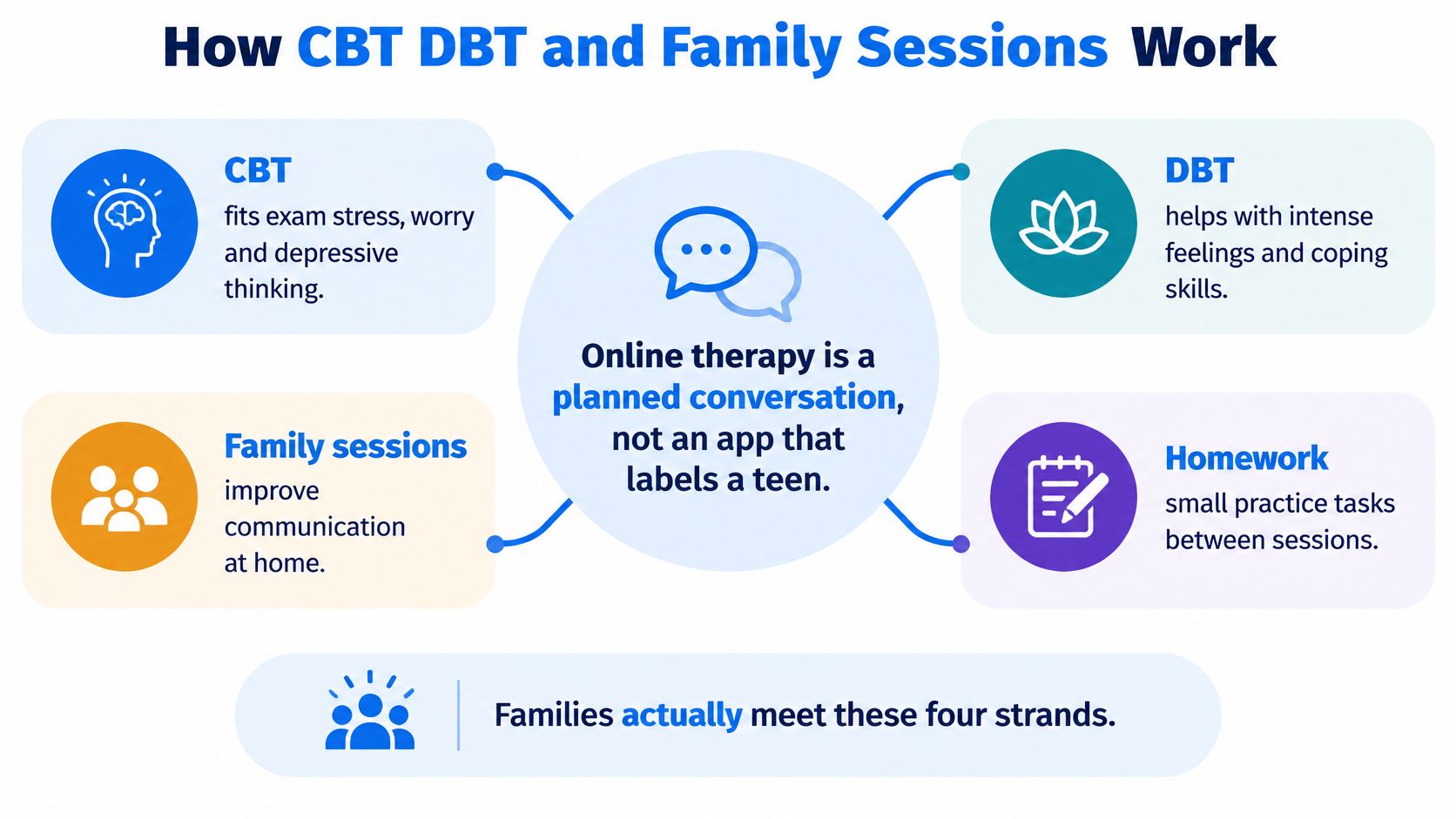
Skills for thoughts and strong feelings
Cognitive behavioural therapy, or CBT, explores links between thoughts, feelings and actions. The teen and therapist might examine the prediction that they'll fail the boards, consider evidence for and against it, and replace an all-night revision attempt with a smaller study task and a fixed sleep cut-off.
The point isn't to insist on positive thinking. It's to test a harsh prediction and practise a behaviour that makes daily life more manageable.
Dialectical behaviour therapy, or DBT-informed skills, can help a teen work with intense emotions and urges. For example, after a painful friendship argument, the therapist might help them name the emotion, notice an urge without acting on it and rehearse a safer response.
Where self-harm thoughts are involved but there isn't an immediate emergency, this work needs an individual safety assessment and a written safety plan. Skills practice isn't a substitute for urgent care when a young person can't remain safe.
The video below offers another way to approach the discussion about therapy.
Work on relationships and everyday support
In family sessions, the problem might be a repeating argument about marks, screen use or curfews. The therapist helps people describe what happens, listen without interrupting and agree who will do what differently.
The teen isn't put on trial. Parents may also need to change how they express worry, set expectations or respond when a conversation becomes heated.
Supportive counselling can give a lonely or exhausted teen space to understand what they're carrying. Work may include rebuilding routines, asking for help, practising compassion and finding small, personally meaningful sources of enjoyment.
| Approach | A coaching comparison | A practical example |
|---|---|---|
| CBT | A skills drill | Test a prediction and try a smaller action |
| DBT-informed work | A storm plan | Practise coping before emotions become overwhelming |
| Family sessions | A team huddle | Agree how to handle an argument differently |
| Supportive counselling | A steady warm-up | Restore routines and identify reliable support |
Homework shouldn't feel like another examination. It might mean noticing a thought, rehearsing a boundary or trying a gentler bedtime routine, then discussing what helped and what didn't.
This week's choice: Name the main difficulty and ask a qualified professional which approach fits it. The professional should also judge whether remote sessions are enough; no approach promises a cure.
Privacy Consent and What Parents Can See
Confidential care doesn't mean anonymous care. India's Telemedicine Practice Guidelines expect identification of the patient and practitioner, and minors generally consult with an adult whose identity is verified; older telepsychiatry guidance also describes age and relationship checks for patients under 16 and explicit consent when a family member initiates a consultation.
These requirements support safety, but they can make access harder for 16–17-year-olds, young people with controlling or unsupportive parents and anyone using a shared device. Families need an explanation of both identity requirements and session privacy before a teen is asked to disclose sensitive information.
The visual summarises the distinction between being identified and having every detail shared.
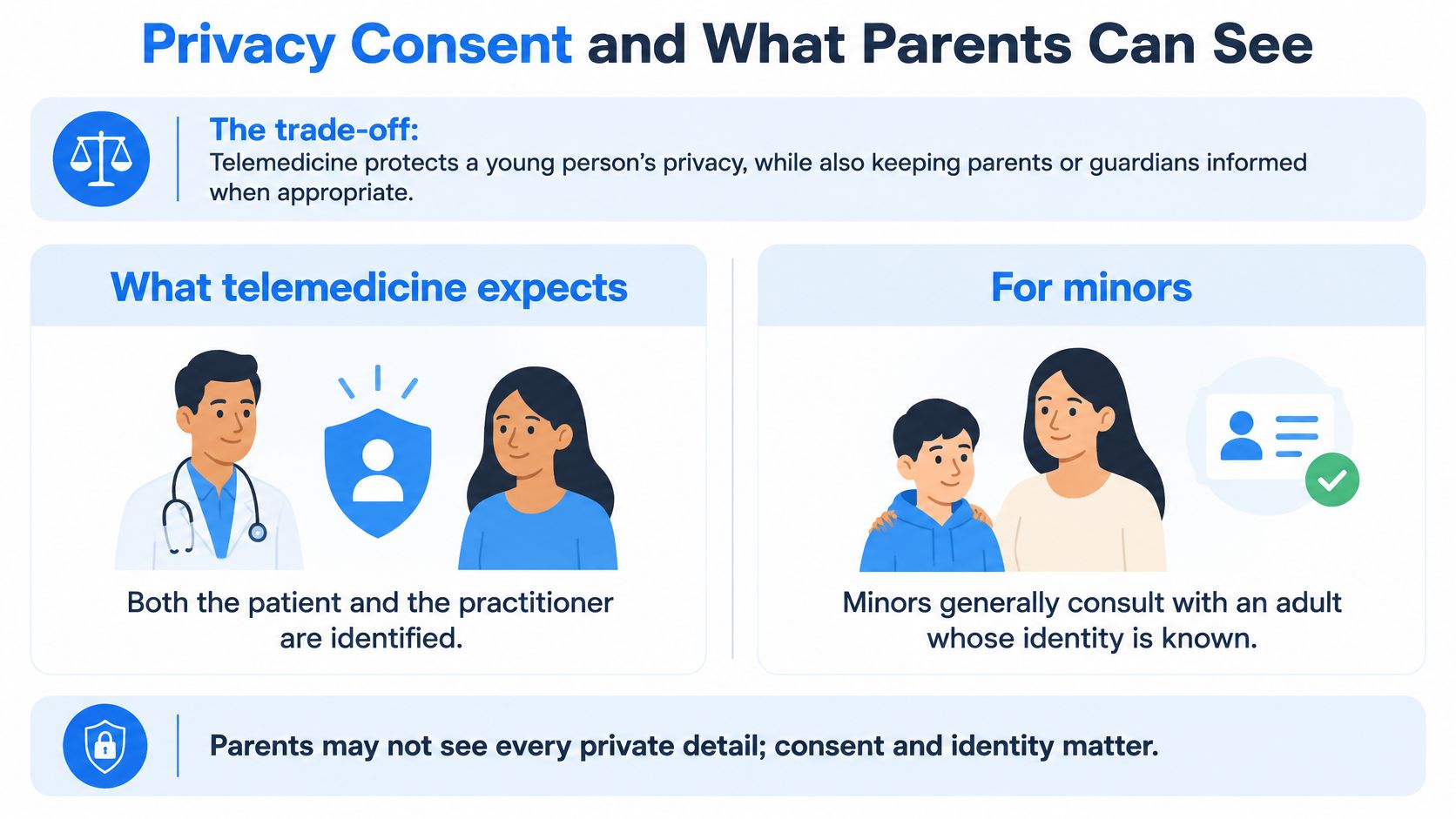
What parents can see in online therapy
| Question | Usual answer | What to arrange |
|---|---|---|
| Can parents hear the session? | Not unless the teen agrees or safety requires disclosure | Ask for private time even after a parent verifies identity |
| Will bills or alerts reveal counselling? | They can on a shared email, payment trail or lock screen | Use a private login and discreet notifications |
| What if the therapist hears self-harm risk? | Confidentiality may yield to a safety plan involving a responsible adult | Name the emergency contact before the first session |
| Must a minor be identified with an adult? | Yes in Indian telemedicine practice; under-16 guidance includes additional checks | Complete identity and relationship checks honestly |
| Is an online screening a diagnosis? | No, it is informational only | Discuss persistent anxiety or depression with a qualified professional |
A parent's involvement in consent doesn't mean the session should become a report home. Ask the therapist to explain what can remain private, what general progress information may be shared and which safety concerns require action.
A teenager can request private time after identity checks. The clinician should explain what's possible within the care arrangement, rather than making either the parent or teen guess.
Protect the record as well as the conversation
A closed bedroom door won't help if a chat preview appears on the family handset. Check notification previews, email access, saved passwords, shared cloud accounts and whether payment records could reveal the appointment.
Use a separate login where it's safe and practical, and agree how the therapist may contact the teen. Don't assume a platform can hide invoices, delete clinical records or prevent someone with device access from seeing activity.
Privacy is something the family and clinician arrange together. It isn't a promise that nothing will ever be shared.
If risk emerges, the therapist may need to involve a responsible adult or arrange emergency assessment. Ask how they'll explain that step to the teen and what happens if the usual guardian is part of the safety concern.
Parents can make disclosure easier by avoiding demands for a transcript. A more useful question is whether there's something they can change at home to support the work.
These privacy questions also apply outside India, although the identity and consent rules described here are India-specific. This week's choice: Agree, preferably in writing, what parents will and won't be told, who receives messages and whom the therapist should contact in an emergency.
Public Helplines and a Teen Therapist on DeTalks
A helpline works like a first-aid station: it steadies the person in front of it and sends them onward if they need more care. Ongoing therapy works more like a course of physiotherapy, where the same professional builds on each session. Families can use either, or both, as long as they don't expect a single support call to do the work of treatment.
According to the Press Information Bureau's Tele-MANAS update, the programme launched on 10 October 2022 as a free, 24/7 service, and by 3 March 2026 it had 53 operational cells across all 36 states and union territories, supported 20 languages, handled more than 3.434 million calls and directed 19,135 callers to mental-health professionals. These national totals don't isolate teenagers, although school and adolescent-health programmes use Tele-MANAS alongside counselling initiatives.
Public helpline or ongoing teen therapy
| Need | Best fit | Why |
|---|---|---|
| Immediate emotional support at night | Tele-MANAS helpline | Free, round-the-clock support with multilingual access |
| Language match and referral to a professional | Tele-MANAS helpline | Can support the conversation and direct callers towards professional care |
| Same therapist across weeks for anxiety or low mood | Online therapy on DeTalks | Continuity needs a booked professional |
| Family stress or resilience skills over time | Online therapy on DeTalks | Structured sessions rather than one-off support; ask each professional directly about their experience with adolescents |
| Emergency, or clinician says remote care isn't enough | In-person or emergency care | Remote work isn't sufficient for the situation |
Tele-MANAS can be a useful starting point when distress rises at night or cost and distance make a clinic difficult to reach. It also forms part of a wider public system that includes Adolescent Friendly Health Clinics, peer education and Adolescent Health and Wellness Days.
For repeated work, the DeTalks directory lets families browse psychologists, therapists and counsellors and book a session. Since profiles may not spell out every specialisation, ask each professional directly how much of their practice involves adolescents. DeTalks assessments can offer insights into a teen's inner world, but they're informational, not diagnostic.
Compare the working arrangements
Before choosing a professional, ask how they begin with a reluctant teen. A helpful explanation covers the opening conversation, parental involvement and how the young person can raise concerns about the fit. A useful answer might describe what the clinician does when a teen says almost nothing in the first session, rather than promising rapport from day one.
Also discuss language, appointments around school, what happens if video fails and how the clinician responds if risk rises. Ask about session length, expected review points and fees rather than assuming every appointment works the same way.
This week's choice: Decide whether the immediate need is a supportive conversation or repeated therapeutic work. If it's ongoing care, shortlist professionals on DeTalks, ask each one about their experience with adolescents, and compare their explanations of privacy, communication and safety before booking.
How to Prepare a Teen for Session One
Preparation should make the appointment easier, not turn it into a family investigation. The teen doesn't need a polished account or the right psychological words.
Use the day before to remove avoidable obstacles. This visual gives the broad outline, with a fuller practical sequence below.
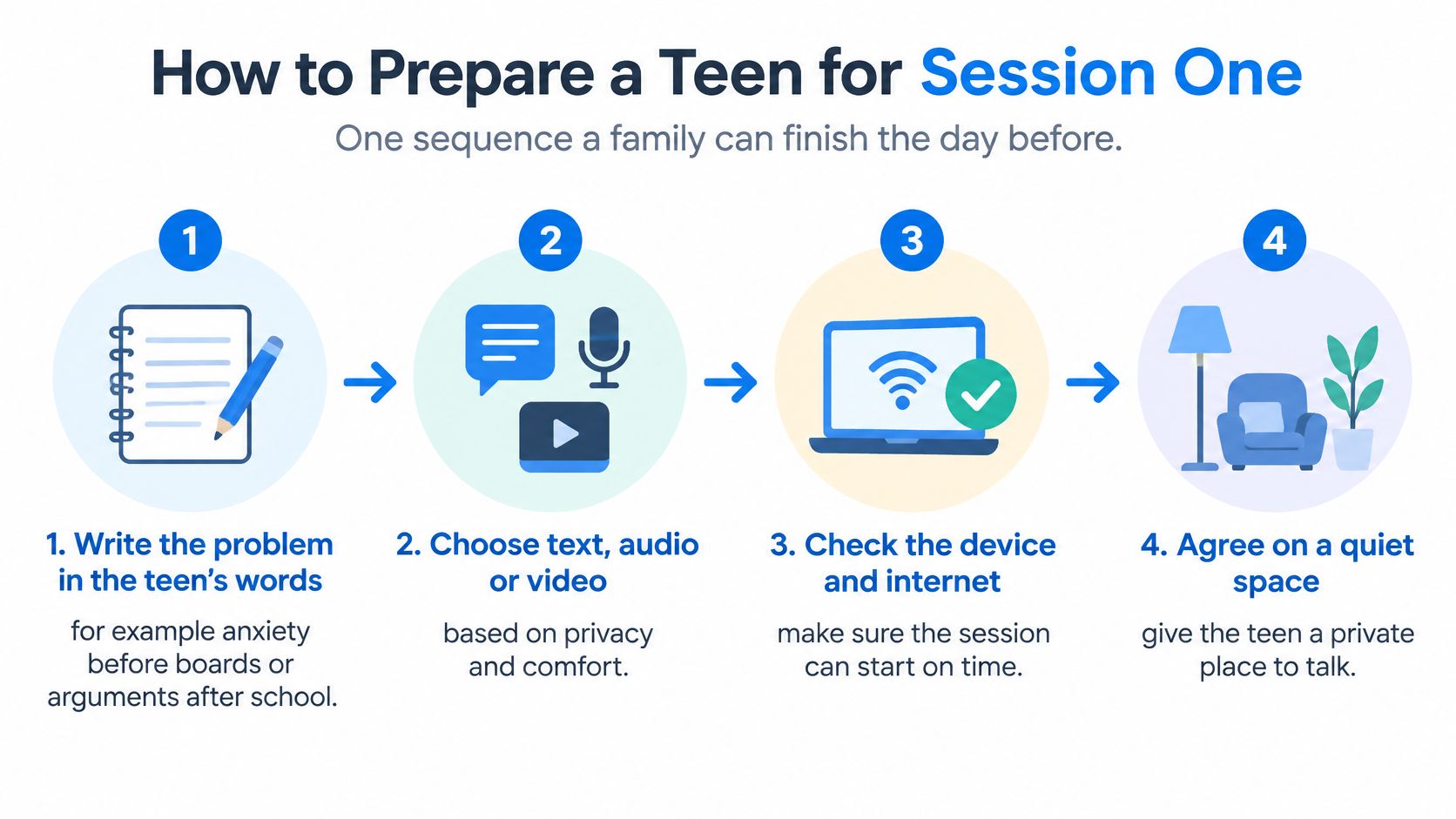
Prepare the words and the setting
Write the problem in the teen's words, such as anxiety before boards or arguments after school, rather than making the common mistake of replacing their account with a parent's interpretation.
Choose text, audio or video based on privacy, bandwidth and comfort, avoiding the mistake of assuming that a teen who uses video socially wants it for therapy.
Find a private corner and headphones, then check notification access on a shared phone, since a common slip is protecting the conversation while leaving bright message previews visible to everyone.
Complete identity checks with a parent or guardian when required, and clarify private speaking time rather than assuming adult verification means the adult must hear everything.
Set goals that combine relief and growth, such as less panic, a resilience skill and a kinder daily routine, instead of using a vague goal such as becoming happy.
Note sleep, medicines and any self-harm history for the clinician, avoiding the understandable but unsafe mistake of leaving out difficult information to make the appointment feel less serious.
Agree that the opening ten minutes can belong to the teen if the clinician considers that appropriate, rather than allowing a parental briefing to take over the whole conversation.
Save the agreed backup contact method and a local emergency contact, instead of waiting until a failed connection or safety concern to work out whom to call.
These are preparation choices, not a fixed clinical script. The therapist may need to change the order to complete consent, understand the concern or assess safety.
Send a short opening message
A brief message can lower the pressure of beginning. It should help the therapist listen, not require the teen to disclose everything in writing.
A possible first message: I'd like help with anxiety before exams and arguments after school. Audio feels easiest for me, and I'd like some private speaking time. I want to sleep more steadily, cope with panic and be less harsh with myself.
Add practical information about the device, preferred language and backup contact method. Keep sensitive details out of a shared email account if the therapist has offered a more suitable way to communicate.
Any forms completed beforehand are informational, not a diagnosis of anxiety or depression. It's also acceptable for a teen to say they don't understand a question or would rather discuss it during the appointment.
This week's choice: Save a short session brief together, then let the teen edit it. Their version may identify the most useful place to begin.
Why Some Teens Stop and What Keeps Them Going
In a pilot across 11 secondary schools in Goa, 1,575 students were screened, 92 self-referred, or 5.8%, 11 enrolled, and no intervention participant completed the remotely delivered, counsellor-supported programme. COVID-era restrictions, low acceptability, referral friction and limited school engagement likely contributed to its feasibility problems.
The lesson isn't that online counselling can't help. It's that making a service available doesn't mean a teenager will find it acceptable, enter it easily or keep attending.
When access breaks down
The following are fictional illustrations, not case records. They show how practical barriers can interrupt care even when a young person wants support.
Meera stops after her second session because a parent reads the chat on a shared device. A pre-agreed private window and discreet alerts might have reduced that barrier, but repairing trust would also require acknowledging what happened rather than asking her to return.
Arjun attends once from a town with weak internet and spends the appointment reconnecting. An agreed move to audio could make conversation possible; if his mood worsened, a local counsellor or in-person assessment would need to become part of the plan.
Neither situation is well described as a teen lacking motivation. Each calls for a different response from the adults arranging care.
Make attendance workable
A remote stepped-care feasibility study in low-income New Delhi schools referred 56 of 755 remotely sensitised students, or 7%; initial-stage completers averaged 4.6 sessions over 31.1 days, while later-stage completers attended 5.1 additional sessions over 54.4 days. Adolescents and counsellors expressed mixed views about remote counselling, underlining the need to monitor fit.
Care may unfold over weeks, with an initial problem-solving stage followed by more intensive work when needed. That isn't a universal timetable, so ask what the proposed course involves and when the clinician will review whether it's helping.
Useful fit checks aren't limited to symptom scores:
- Attendance: The teen could join without avoidable technical or household disruption.
- Ownership: They spoke in their own words, even if only briefly.
- Practice: They tried a skill or discussed why the task didn't fit.
- Willingness: They want to return, or can describe what would make returning easier.
A missed appointment should prompt curiosity before criticism. Ask whether the issue was timing, language, privacy, discomfort with the professional or uncertainty about what therapy involved.
More sessions don't automatically produce happiness or cure depression. If distress deepens, functioning worsens or safety becomes uncertain, online care shouldn't remain the only plan.
This week's choice: After an early appointment, ask what felt useful and what made it difficult. Change the arrangement, seek another professional or arrange in-person review according to the obstacle, rather than treating every dropout as the same problem.
Agree the First Step With Your Teen
Choose a path together this week: Tele-MANAS for a free, immediate, multilingual conversation; a booked online therapy appointment for ongoing difficulties when privacy is workable; or in-person care when safety or connectivity rules remote work out. The best starting point is one your teen can use.
Agreement doesn't require enthusiasm. A young person may be willing to try a single conversation while staying unsure about therapy itself, and that hesitation can be named openly rather than argued away.
Give adults a supporting role
Schools can help with a short orientation, a private room and a known route to help when a student feels unsafe. Their role stops short of therapy, and no student should have to retell their story to a chain of different staff. A teen who knows exactly which teacher to find after a difficult session is in a stronger position than one left to explain everything to whoever happens to be nearby.
At home, ask what the teen wants kept private and what support would make daily life easier. Help them practise an agreed coping skill without turning every evening into a progress review. If a skill keeps failing in daily life, tell the professional rather than abandoning it.
For learning pressures alongside care, parents can support your child's learning with MasteryMind. Keep educational support separate from mental-health treatment so that another study plan doesn't become the only response to emotional distress.
Keep the takeaways practical
- Start with the teen's words: Their priorities may differ from the behaviour adults first noticed.
- Protect privacy and safety together: Agree an emergency contact and a way to raise concerns.
- Look at everyday well-being: Notice sleep, school, relationships and whether the teen feels more able to participate in life.
Emotional awareness, compassion and resilience are worthwhile goals alongside relief from distress. They may shape how a young person handles later pressures, though counselling cannot promise a particular outcome or remove every difficulty ahead.
For help with the platform, contact support@detalks.com. This week's choice: Set aside a calm moment, agree the next action and let your teen help decide how it happens.
DeTalks offers a directory of psychologists, therapists and counsellors, along with science-backed assessments and curated self-help content. Visit DeTalks to browse professionals with your teen, then ask anyone you are considering about their experience with teenagers and how they arrange privacy, language and safety before booking.