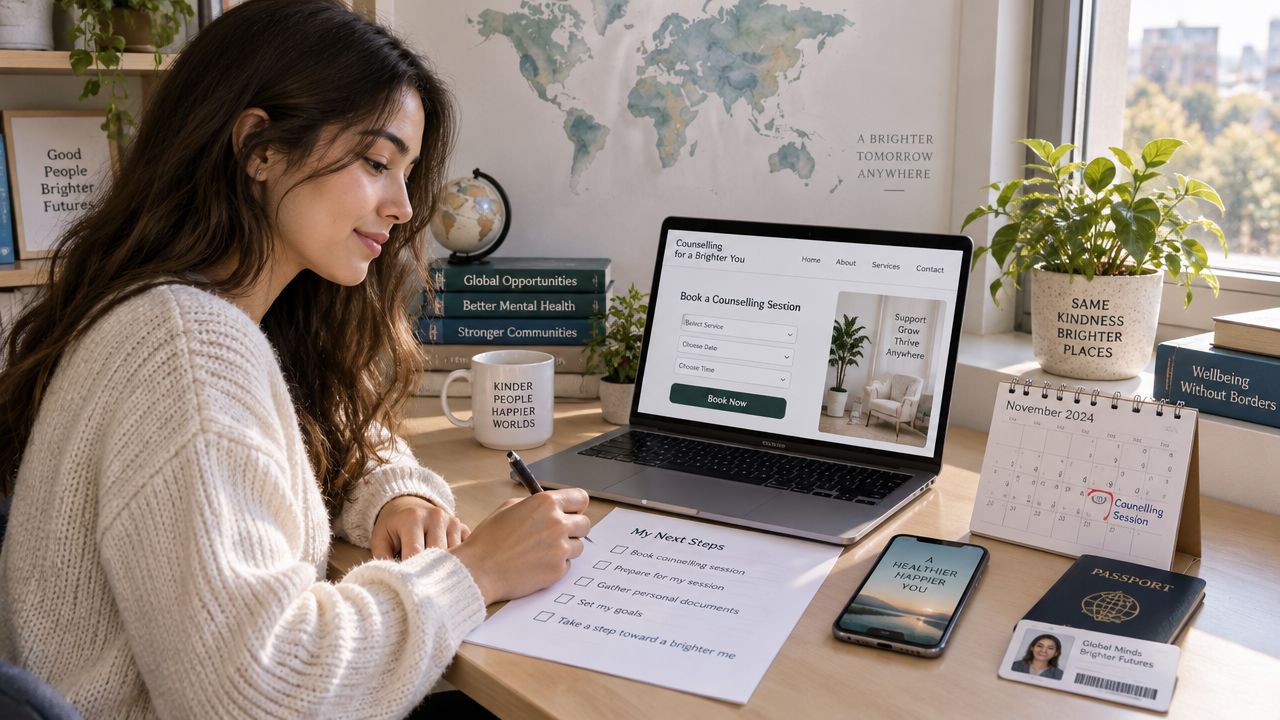
You may have been carrying workplace stress for months, sleeping poorly, feeling anxious before ordinary tasks, or wondering whether your low mood is depression. Perhaps you're not in crisis at all. You may want more resilience, self-understanding, compassion, or happiness, but you're unsure how to apply for counselling without making the process complicated.
That hesitation is common. Seeking therapy isn't a sign that you've failed to cope. It can be a practical step towards better well-being, whether you're dealing with burnout, relationship difficulties, exam pressure, or a desire for personal growth.
In India, the first door may be a public helpline, a district service, a private therapist, or an online platform. The right choice depends on your urgency, preferred language, location, budget, privacy needs, and whether you want one conversation or ongoing counselling. The process becomes easier when you treat it as a series of manageable decisions: identify what you need, compare access routes, choose a suitable professional and modality, complete basic consent and screening steps, then prepare for your first session.
A helpful starting point: You don't need to understand every therapy approach before asking for support.
Introduction to Applying for Counselling with Confidence
Consider a working professional who closes a laptop after another difficult day and realises that irritability, poor sleep, and constant worry have become a pattern. They search for counselling, open several pages, and then stop. Should they call a helpline, book a psychologist, complete an assessment, or speak to a general physician first?
That uncertainty can feel discouraging, especially when anxiety or burnout has already reduced your energy. Yet you don't need a perfect explanation of your feelings before you seek help. A simple description such as “I'm overwhelmed and I'm struggling to sleep” gives a counsellor a useful place to begin.
India's need for accessible mental health support is substantial. The National Mental Health Survey 2015–16 found that about 10.6% of Indian adults were living with a diagnosable mental health disorder, while 15% of adults were estimated to experience mental health issues requiring intervention. The survey also reported a 13.7% lifetime prevalence.
Counselling can support people facing anxiety, depression, workplace stress, grief, conflict, loneliness, and major life changes. It can also help with positive psychology goals, including resilience, self-esteem, compassion, mindfulness, purpose, and emotional balance. You don't have to wait until distress becomes severe to explore therapy.
What an assessment can and cannot tell you
A screening questionnaire can help you notice patterns in mood, stress, sleep, coping, or relationships. On platforms such as DeTalks, assessments are informational tools, not diagnostic replacements. They can help you decide whether self-help, counselling, coaching, or psychiatric care may be a sensible next conversation, but a qualified professional must interpret symptoms within your personal context.
The practical question isn't “Am I unwell enough?” It's “What kind of support would make the next step feel safer and more useful?” Once you answer that, applying for counselling becomes less like filling out an intimidating form and more like choosing an appropriate route.
Understanding Your Counselling Options and Where to Start
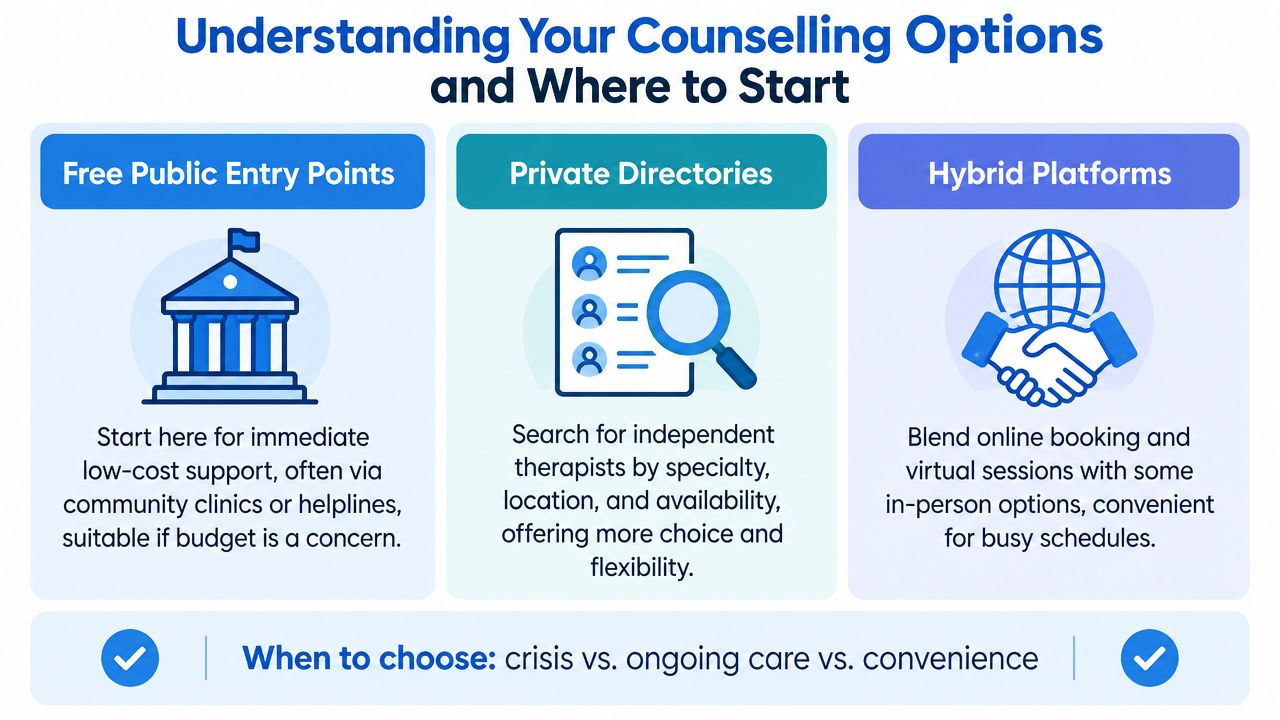
India has a mixed public and private access system. That matters because “apply for counselling” can mean calling a free helpline, asking a district service for help, searching a private directory, or booking a video session through a digital platform.
The public route is useful when cost, language, or immediate access is your main concern. Tele-MANAS, launched on 10 October 2022, provides free, 24×7 tele-mental health support through 14416 and 1-800-891-4416 in multiple languages. By 23 July 2024, 36 States and Union Territories had established 53 Tele-MANAS cells, and the programme had handled more than 11,76,000 calls, according to the Government of India's Tele-MANAS update.
Match the route to your situation
The National Mental Health Programme describes a broader public system that includes Tele-MANAS, district-level support through the District Mental Health Programme, and other government-listed facilities and helplines. A district service may suit someone seeking local, continuing support, particularly when in-person referral is important.
A private directory gives you more control over selection. You can compare professionals by concern, language, location, availability, and session format. A hybrid platform combines digital discovery and booking with virtual sessions and, where available, in-person possibilities. DeTalks is one such option, offering a directory of psychologists and therapists, confidential assessments, and session booking.
| Entry Point | Best For | Access Details | Next Step |
|---|---|---|---|
| Tele-MANAS | Immediate emotional support, first contact, or a concern about privacy and cost | Free, 24×7 access through 14416 or 1-800-891-4416, with multilingual support | Call and describe what you're experiencing |
| District Mental Health Programme | People who may need local public services or referral | Access varies by district and may connect you with community and specialist care | Ask a public health facility about local availability |
| Private directories | Choice, specialist matching, and ongoing therapy | Search by concern, language, location, fee, and modality | Shortlist professionals and review their profiles |
| Hybrid platforms | Convenient discovery, online booking, and flexible sessions | Browse professionals, complete relevant information, and choose an available appointment | Compare fit before confirming a session |
A well-organised therapy practice patient intake resource can also help explain the information many counselling services collect before an appointment. The route you choose should reduce friction, not add another source of stress.
How to Choose the Right Counselling Modality and Professional
Once you know where to begin, decide how you'd prefer to speak and what kind of professional may fit your concern. In-person counselling can feel grounding if you value a dedicated room and direct human presence. Video sessions may suit a busy professional, a parent, or someone living far from a specialist. Phone and chat formats can feel more approachable when speaking on camera feels uncomfortable.
Privacy deserves practical attention. Before booking an online session, choose a room where you can speak without interruption, use headphones if appropriate, and check that your internet connection is stable enough for the format. If your home isn't private, an audio session may be more workable than video.

Use concern and language as filters
Read profiles for experience with the issue you want to discuss. Useful search terms may include anxiety, depression, burnout, grief, relationships, trauma, exam stress, workplace stress, sleep, self-esteem, or family conflict. If your aim is personal growth, look for descriptions involving resilience, mindfulness, compassion, emotional intelligence, or purpose.
Language can affect comfort and clarity. A student in a tier-2 city may prefer a counsellor who can speak in a familiar regional language, while a professional may prioritise after-hours video sessions. Tele-MANAS has expanded access to 20 languages and operates through 53 cells across 36 States and Union Territories, as reported in government-linked coverage of the programme's expansion.
Before you book, ask yourself three questions:
- What do I want help with? Name the main concern, even if your explanation is incomplete.
- What format can I maintain? Choose a modality that works with your privacy, schedule, internet access, and comfort.
- What should I clarify? Ask about professional qualifications, confidentiality, fees, cancellation rules, language, and what happens if you need more specialised care.
You don't need to choose a therapist based only on a profile photograph or a polished description. Look for clear information, respectful communication, and a process that lets you ask questions before committing to ongoing sessions.
Preparing Documents Consent and Booking Your Session
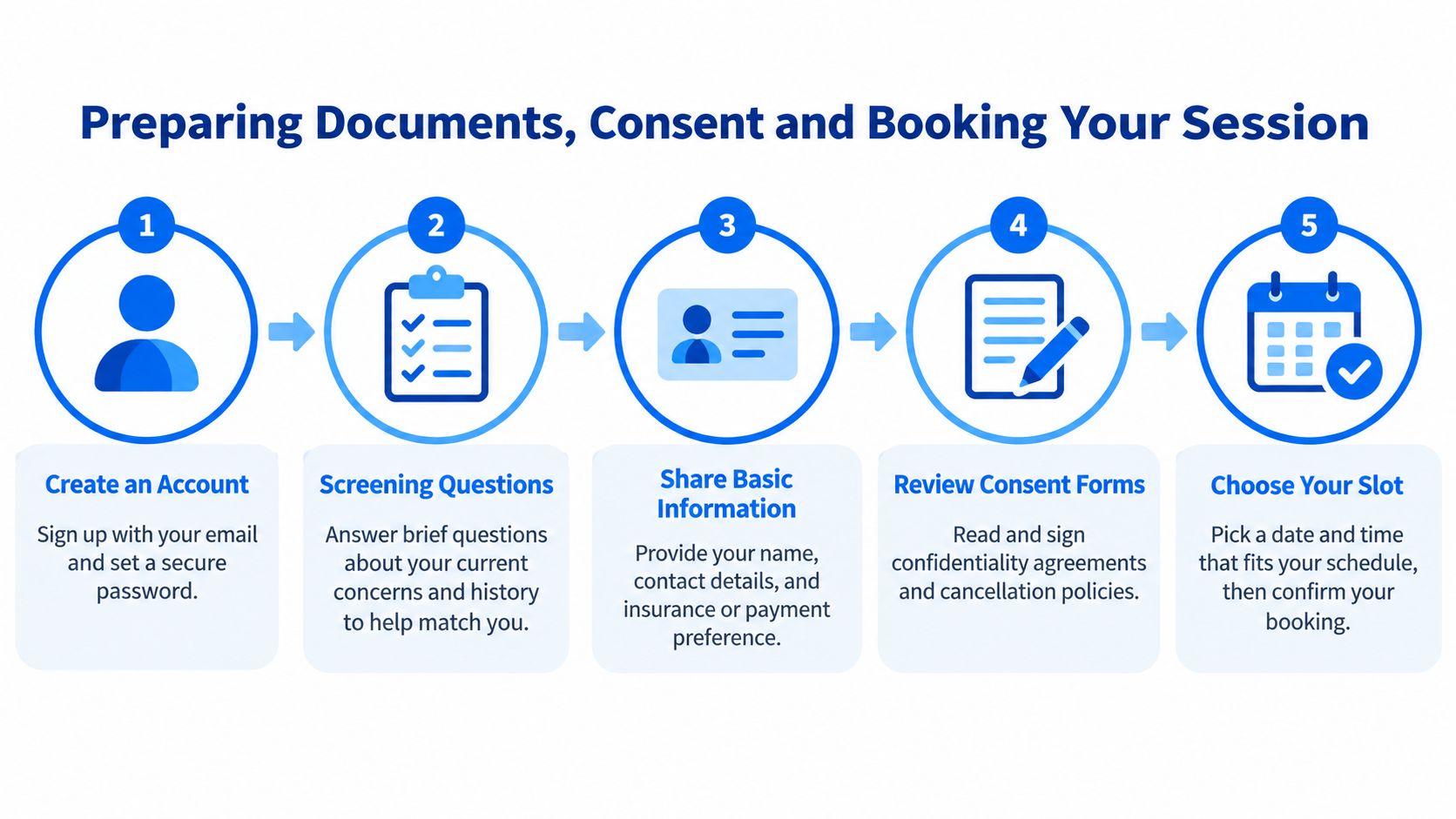
The application process is usually simpler than people expect. Most services begin with an account or contact form, a short description of your concern, screening questions, consent information, payment details where relevant, and a choice of appointment time.
Keep the practical details ready
You may need your name, contact details, preferred language, availability, and payment preference. Some services may request identification or information about previous care, but requirements differ, so don't assume you must prepare a large file of medical documents.
Screening questions may ask about mood, anxiety, sleep, stress, safety, relationships, or previous support. Answer as accurately as you can. These questions help with matching and triage, but they remain informational and not diagnostic. A screening result shouldn't be treated as a final label or a substitute for a professional assessment.
Cost and distance are real barriers. Indian research has identified stigma, low mental-health literacy, cost, travel distance, service unavailability, and fear of negative consequences as important reasons people delay help-seeking. One Indian survey found that 25% of respondents were either not inclined to seek help or faced practical constraints, with cost, travel distance, and service availability among the key logistical barriers, as reported by the Indian study on barriers to mental health care.
Read consent before confirming
Consent forms should explain confidentiality, its limits, cancellation arrangements, communication methods, and how your information is handled. For a child or young person, the service should explain who can provide consent and how privacy will work for the minor and their parent or guardian.
Look for short forms, transparent pricing, local-language onboarding, and clear high-risk triage. If a form asks about immediate danger, severe distress, or thoughts of self-harm, answer directly so the service can guide you towards urgent support. For operational teams designing these workflows, a patient intake coordinator can help explain how administrative information is gathered without confusing it with clinical diagnosis.
Before you click confirm, check the date, time zone, session length, fee, cancellation policy, and contact method. Save the appointment details somewhere accessible, then give yourself enough time to join without rushing.
What to Expect at Your First Counselling Session and Follow Ups
You might feel nervous before your first session, even if you chose counselling willingly. That doesn't mean you've made the wrong decision. A first meeting usually begins with introductions, an explanation of confidentiality, and a discussion of what brought you to support.

You may be asked about your current concerns, daily routine, relationships, sleep, work or study, and previous efforts to cope. You don't have to tell your whole life story in one appointment. Start with what feels most important today, and tell the counsellor if a question feels too quick or difficult.
The professional may help you identify goals. One person may want practical tools for workplace stress, another may want help understanding anxiety or depression, and someone else may want to build resilience, self-compassion, or healthier communication. Good counselling is collaborative, so you should have space to ask questions and discuss whether the approach feels suitable.
You're allowed to say, “I'm not sure how to explain this.” That sentence is already a useful beginning.
For an online session, test your device, use a private setting, and join a little early. Keep water nearby and write down one or two questions you want to remember. Afterward, note what felt useful, what felt uncomfortable, and whether you understood the suggested next step.
Follow-up sessions often focus on patterns that become clearer over time. You may review changes in mood, coping, relationships, sleep, or confidence, then practise strategies between appointments. Progress isn't always dramatic, and counselling isn't a promise of a cure. It can provide a structured relationship in which you understand yourself more clearly and make considered changes.
Assessments may be repeated as informational check-ins, but they don't diagnose you by themselves. If your needs change, discuss whether you should continue counselling, seek a different professional, involve a psychiatrist, or use another level of care.
For additional context on how mental health support can affect working life, the Deloitte mental health report found that more than 80% of Indian respondents in a survey of 3,995 employees across 12 industries reported at least one adverse mental health symptom. The same report recorded depression at 59%, emotional exhaustion or burnout at 55%, irritability or anger at 51%, sleep issues at 50%, and anxiety at 49%. These figures don't define any individual, but they show why workplace counselling can be a reasonable form of support rather than a last resort.
Supportive Takeaways for Your Well Being Journey
Knowing how to apply for counselling is less about completing a perfect application and more about choosing a safe, suitable entry point. If you need immediate public support, Tele-MANAS may be a practical first contact. If you want local referral, explore district services. If you need choice around language, specialisation, timing, or modality, a private directory or hybrid platform may be more suitable.
Counselling can hold difficult experiences such as anxiety, depression, grief, burnout, and conflict. It can also support strengths that are easy to overlook when life feels demanding, including resilience, compassion, gratitude, mindfulness, self-esteem, happiness, and purpose.
Take one small action today. Write down the main concern you want to discuss, identify the language and format that would feel comfortable, or save the relevant public helpline. You can also use an assessment as an informational check-in, while remembering that its result isn't a diagnosis.
The Aon India Mental Health Index report, based on an online survey of 1,500 people living in India, found that 60% felt more sensitive to stress than the previous year, while 43% often felt helpless and 43% felt unsettled and nervous. Such findings reinforce a useful principle: you don't need to wait until coping becomes impossible before asking for help.
Seeking support is a practical act of care, not a judgement on your strength.
If the first professional or format doesn't feel right, you can ask questions, request a different match, or pause and reconsider your options. Your well-being journey may include therapy, self-help, medical care, supportive relationships, or several of these together.
DeTalks lets you browse psychologists, therapists, and mental health professionals, explore confidential informational assessments, and book support for concerns such as anxiety, depression, burnout, relationships, and personal growth. Visit DeTalks to compare your options and take the next manageable step towards counselling that fits your needs.