Tag: therapy counselling

  • Online Assessment Tools Explained for Better Well Being

    Online Assessment Tools Explained for Better Well Being

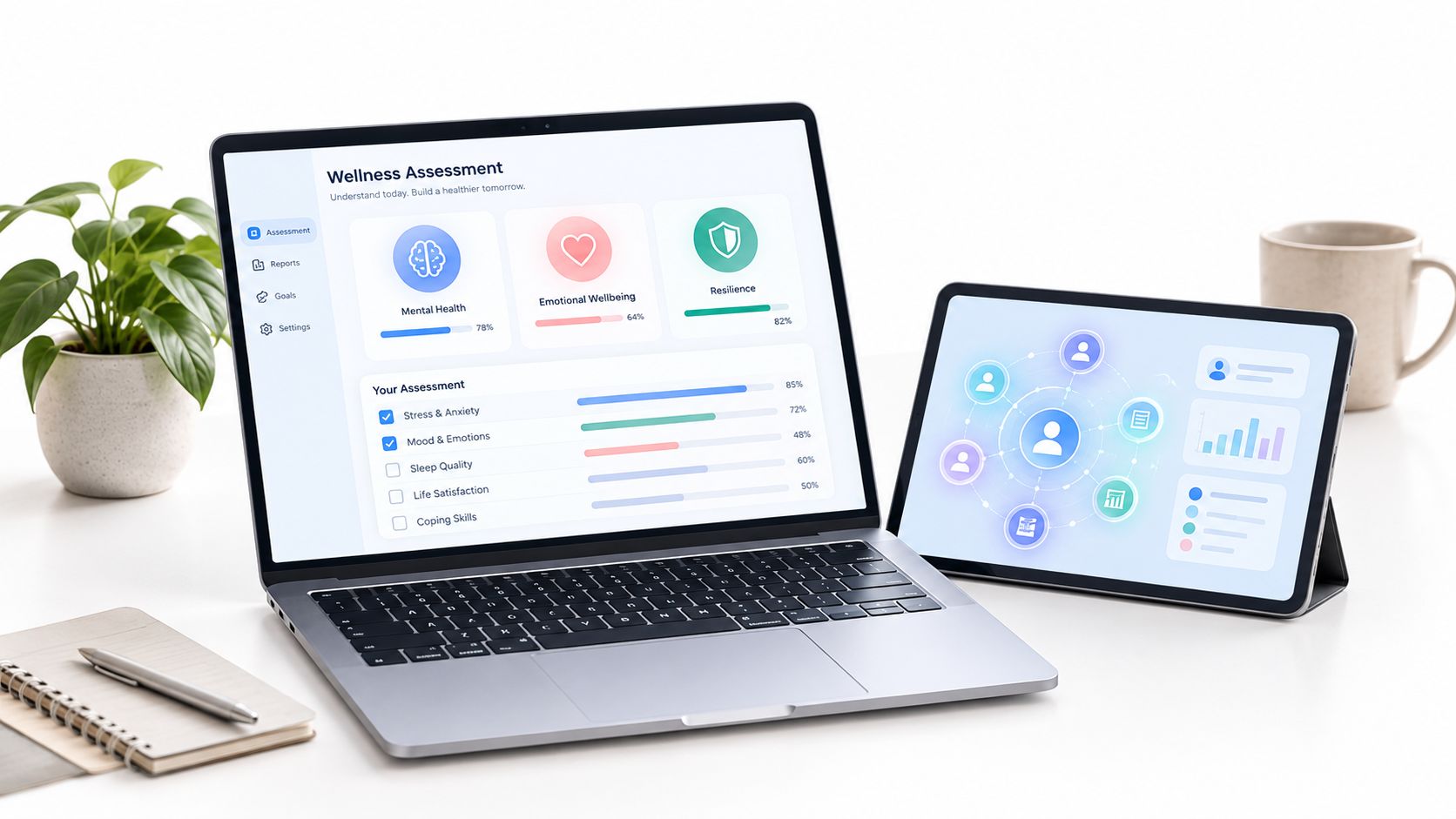
    You've had a demanding week. Your sleep feels lighter, small tasks require more effort, and conversations that once felt easy now leave you tense. You may not know whether you're experiencing ordinary pressure, workplace stress, anxiety, low mood, or the early signs of burnout. An online assessment tool can offer a calm place to organise those feelings instead of leaving you alone with uncertainty.

    These tools work like a helpful check-in. They ask focused questions about recent experiences, turn your answers into a structured snapshot, and suggest what kind of support may fit next. They don't provide a medical diagnosis, and a result shouldn't become a label or a judgement about your character.

    For people in India, this kind of early insight matters because access to specialist mental-health care isn't equal across every community. India's National Mental Health Survey 2 results, led by NIMHANS and covering adults aged 18+ and adolescents aged 13–17 across all States and Union Territories, reports mental-disorder prevalence across rural and urban areas. That national picture helps explain why accessible screening can support earlier identification and triage, particularly beyond specialist-heavy urban centres.

    A useful assessment also looks beyond distress. Resilience, compassion, happiness, mindfulness, and overall well-being can be explored alongside depression, anxiety, stress, and relationship difficulties. The aim isn't to find fault. It's to understand what's happening and identify a practical route towards self-help, counselling, therapy, coaching, or psychiatric care when appropriate.

    Introduction to Online Assessment Tools and Why They Matter Today

    Many people begin searching for an assessment after a quiet moment of concern. A student might notice that exam stress is affecting concentration. A working professional may feel constantly exhausted despite taking time off. A parent may wonder whether family conflict is creating more emotional strain than they can manage alone.

    An online assessment tool gives these experiences a structure. Instead of asking, “What's wrong with me?”, you can ask gentler questions: What am I feeling? How often is it happening? How much is it affecting daily life? What support could help?

    That change in language matters. Stress, anxiety, depression, burnout, grief, loneliness, and low motivation aren't signs of personal failure. They're experiences that deserve attention, just as positive qualities such as resilience and compassion deserve opportunities to grow.

    A starting point, not a verdict

    A screener is closer to a thermometer than a full medical examination. It can indicate that something needs a closer look, but it can't explain every cause or decide what treatment you need.

    For example, a high anxiety score might reflect workload, sleep problems, grief, a health concern, relationship strain, or several factors together. A low score also doesn't prove that everything is fine, especially if you're struggling in ways the questions didn't capture.

    Remember: An online assessment is informational. It can guide a conversation with a qualified professional, but it doesn't replace clinical evaluation.

    India's online public-service experience also offers a useful historical comparison. The NeSDA 2021 report describes an online system created to help the Department of Administrative Reforms and Public Grievances assess services. It reports 78% average compliance for Punjab's services portals, 62% for the Local Governance and Utility Services sector, 98% for Odisha's State Portal, and 86% for Uttar Pradesh's State Portal. These results show how online systems can apply common criteria, generate scores, and compare performance at scale.

    Mental-health assessments use a similar broad logic, but the subject is personal experience rather than public-service delivery. Good design still depends on clear questions, consistent scoring, responsible interpretation, and a pathway to meaningful action.

    What this guide can help you do

    You'll learn how these tools work, which type may suit your concern, how to judge scientific quality and cultural relevance, and what to check before sharing sensitive answers. You'll also see why a score is most useful when it connects to counselling, therapy, well-being practices, or professional referral, rather than ending on a results screen.

    How Online Assessment Tools Work in Simple Terms

    Think of an online mental-health assessment as a structured health check. A health check doesn't claim to explain your whole body from one measurement. It gathers selected information so you and a professional can decide whether further attention would be useful.

    The first step is deciding what you want to understand. A depression screener asks about mood, interest, energy, sleep, appetite, concentration, and related experiences. A resilience measure asks about how you respond to pressure, recover from setbacks, and access support. Different tools answer different questions.
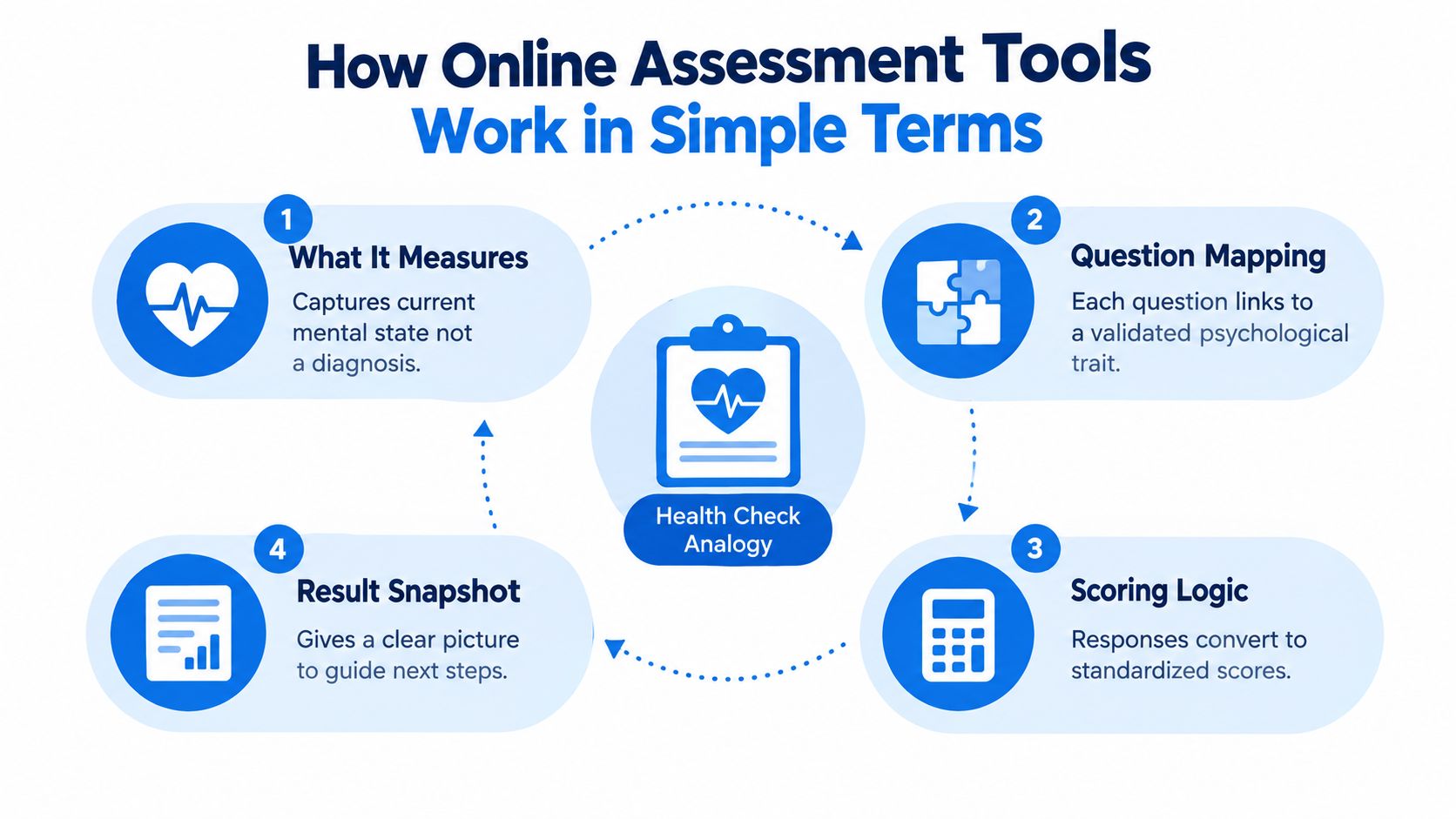
    A diagram illustrating the four-step process of how online mental health assessment tools function.

    Step one involves focused questions

    Most useful screeners refer to a defined period. For example, the India-based assessment guide from TheraSoft explains that PHQ-9 screens depression symptoms over the last 2 weeks, while GAD-7 screens anxiety symptoms over the last 2 weeks using 7 validated questions. It also describes K10 as a measure of general psychological distress.

    This time window helps you answer from a specific experience rather than from your entire life story. Try to respond based on what has generally been true during that period, not only on your best or worst day.

    Step two turns answers into a pattern

    Each response contributes to a score. The score doesn't measure your worth, intelligence, or ability to cope. It summarises the pattern represented by that particular tool.

    Some tools screen for possible symptoms. Others help track severity over time, explore personality tendencies, or identify strengths such as compassion and resilience. A progress check can be useful because you may not notice gradual changes in sleep, mood, or confidence without comparing your experiences across time.

    Step three requires thoughtful interpretation

    A results page may place your responses into a range, such as lower, moderate, or higher concern. Treat that range as a prompt for reflection, not a final answer.

    A score can be influenced by current circumstances, language, fatigue, privacy while completing the assessment, and how well the questions match your life. It can't observe your relationships, cultural context, physical health, or the meaning behind your answers.

    A result should open a useful conversation, not close one.

    If a result suggests concern, consider speaking with a counsellor, therapist, psychologist, or doctor. If the assessment includes a risk question and you indicate immediate danger, follow the platform's crisis guidance and contact local emergency or crisis services without waiting for a later interpretation.

    Types of Online Assessment Tools You Will Encounter

    The right tool depends on the question you're trying to answer. Someone facing workplace stress needs a different starting point from a student exploring resilience, and a person wondering about depression needs a different measure from a couple reflecting on communication.

    Symptom screeners

    Depression and anxiety screeners focus on recent symptoms and their effect on daily functioning. PHQ-9 is commonly used to screen depression symptoms over a recent time window, while GAD-7 focuses on anxiety symptoms. They can help a student recognise that exam stress has become persistent, or help a professional name patterns that feel like constant worry and exhaustion.

    These tools are particularly useful when you're unsure whether your experience deserves support. They don't determine a diagnosis, and they shouldn't be used to dismiss concerns when your score appears low.

    Tracking and broader distress

    A severity tracker can help you notice change. You might complete the same validated measure at suitable intervals and discuss the pattern with a professional. The purpose isn't to chase a perfect score. It's to see whether sleep, motivation, concentration, or emotional strain is shifting after counselling, therapy, lifestyle changes, or a change in circumstances.

    A broader distress tool, such as K10, may be useful when your feelings don't fit neatly into one category. It can provide a wider view of psychological strain, while a clinician helps explore what may be contributing to it.

    Personality and positive psychology

    Personality tools explore tendencies such as communication style, emotional responses, or preferences. They can support self-awareness, but they shouldn't be used to box you into a fixed identity.

    Positive-psychology assessments focus on resources as well as difficulties. Measures related to resilience, compassion, happiness, gratitude, mindfulness, emotional intelligence, self-esteem, and purpose can reveal areas to strengthen. A resilience score isn't a judgement about how strong you are. It can suggest where support, rest, connection, or skill-building may make daily life easier.

    For health concerns that overlap with emotional well-being, a broader resource such as this full assessment for perimenopause symptoms may help someone organise questions about changing physical and emotional experiences before speaking with a clinician.

    Tool Type What It Measures Typical Time Frame Best For
    Depression screener Mood, interest, energy, and related symptoms Recent defined period People concerned about low mood or loss of interest
    Anxiety screener Worry, tension, restlessness, and related symptoms Recent defined period Anxiety, exam stress, and workplace pressure
    Distress measure General psychological strain Recent defined period Experiences that don't fit one clear category
    Severity tracker Change in symptoms or functioning Repeated check-ins Monitoring progress with professional guidance
    Personality measure Patterns of preferences and responses Usually broader and less time-bound Self-awareness and communication
    Positive-psychology measure Resilience, compassion, happiness, or well-being Current strengths or recent experience Growth, prevention, and everyday well-being

    Are Online Assessments Scientifically Valid and Culturally Relevant

    A polished design doesn't make an assessment trustworthy. Scientific quality depends on whether the tool measures what it claims to measure, does so consistently, and works appropriately for the people using it.

    Reliability asks whether the questions work together consistently. If several questions explore a related experience, people's responses should form a coherent pattern. Validity asks whether the score has a meaningful relationship with the concern being assessed. Concurrent validity checks whether an online result aligns with an established measure or professional assessment.

    The language and setting matter too. A tool developed for another population may use assumptions that don't fit Indian family structures, work environments, access to care, or everyday expressions of distress. Translation alone isn't always enough. Researchers need to examine how local participants understand the questions and whether the scoring remains meaningful.
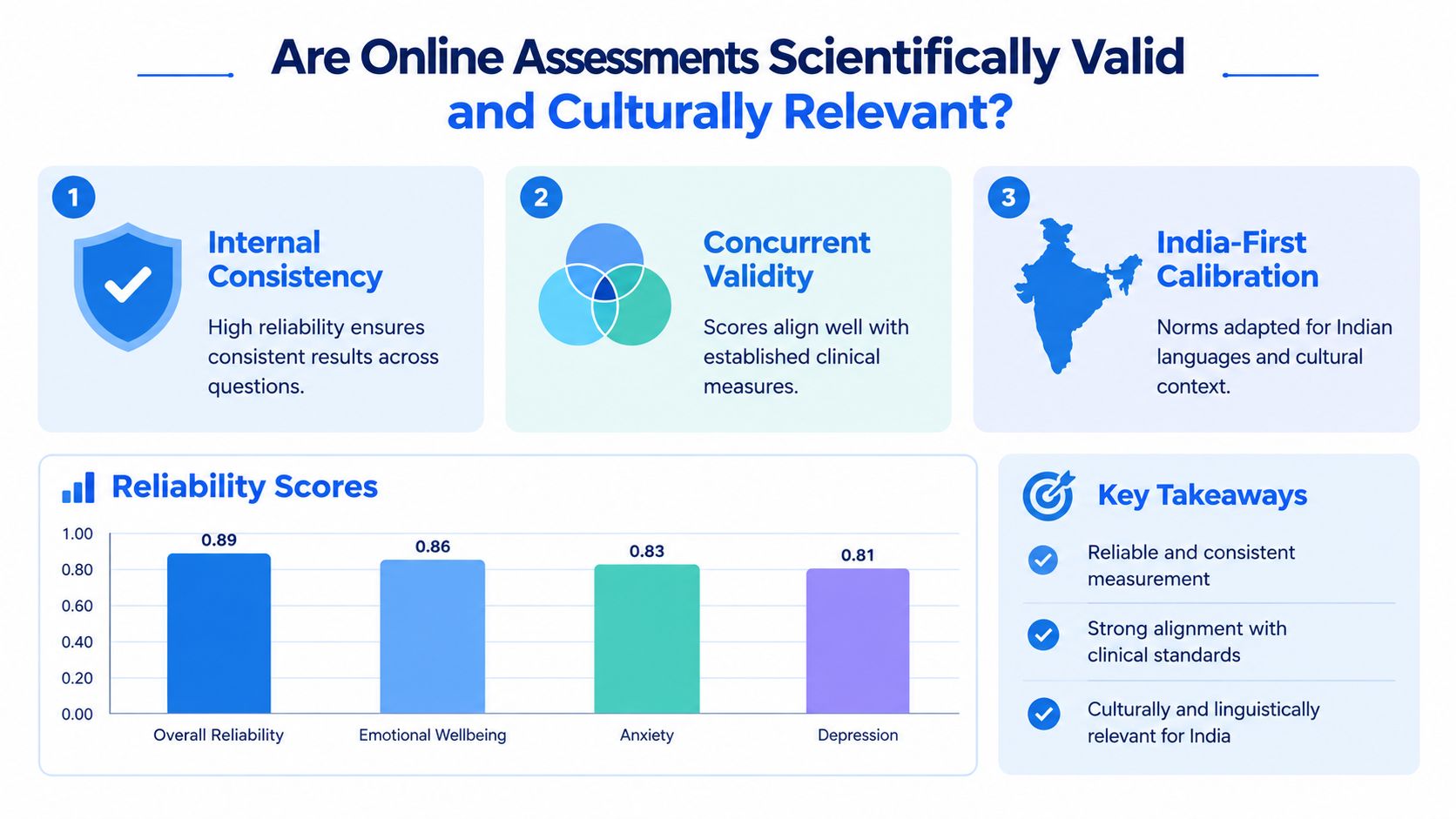
    An infographic titled Are Online Assessments Scientifically Valid and Culturally Relevant featuring reliability scores and key takeaways.

    What Indian validation can show

    An internet-use assessment developed for Indian participants reported Cronbach's alpha of 0.893 across 25 items, concurrent validity of 0.800, and a statistically significant correlation with the Internet Addiction Test at p<0.001 in the published Indian-context validation study. In plain language, the questions showed strong internal consistency and a meaningful relationship with an established comparator.

    The authors also noted that there had previously been no empirically validated tool in the Indian context for that purpose. That point matters beyond internet-use assessment. It shows why platforms should validate tools locally instead of merely placing an overseas questionnaire on a website.

    A co-designed screening app for Indian university students reported validity correlations of r=0.819, r=0.887, and r=0.972 when app scores were compared with clinical assessments in the Indian student screening research. The study also emphasised clinician-supported and student-centred implementation. Strong correlation helps, but safe referral and local usability remain essential.

    For readers who want a plain-language explanation of reliability and validity, this practical guide to psychometric metrics can make technical terms easier to understand.

    A trust checklist

    Look for the name of the instrument, its purpose, the population for which it was evaluated, and a clear explanation of scoring. A responsible platform should also say that results are informational and not diagnostic.

    Be cautious when a tool makes sweeping claims, hides its evidence, or presents a result as an identity. DeTalks brings validated assessments together with access to psychologists, therapists, and other mental-health professionals, allowing a screening result to sit within a wider support pathway rather than standing alone.

    Privacy Ethics and Safety Before You Share Your Answers

    Mental-health answers can reveal intimate details about mood, relationships, work, health, and safety. Before starting an online assessment, pause long enough to understand what happens to that information.

    A trustworthy platform should explain what it collects, why it collects it, how it stores it, and who can access it. If those details are difficult to find, unclear, or written in language you can't understand, you're entitled to delay sharing personal information.

    Five questions to ask first

    • Consent: Do you know what you're agreeing to, and can you choose not to continue?
    • Purpose: Is the information used to provide your requested assessment and support, or for another purpose?
    • Storage: Does the platform explain how answers are protected and how long they may be retained?
    • Access: Can you see who will receive the result, such as you alone, a clinician, an employer, or an institution?
    • Safety: Does the platform explain what happens if your answers suggest urgent risk?
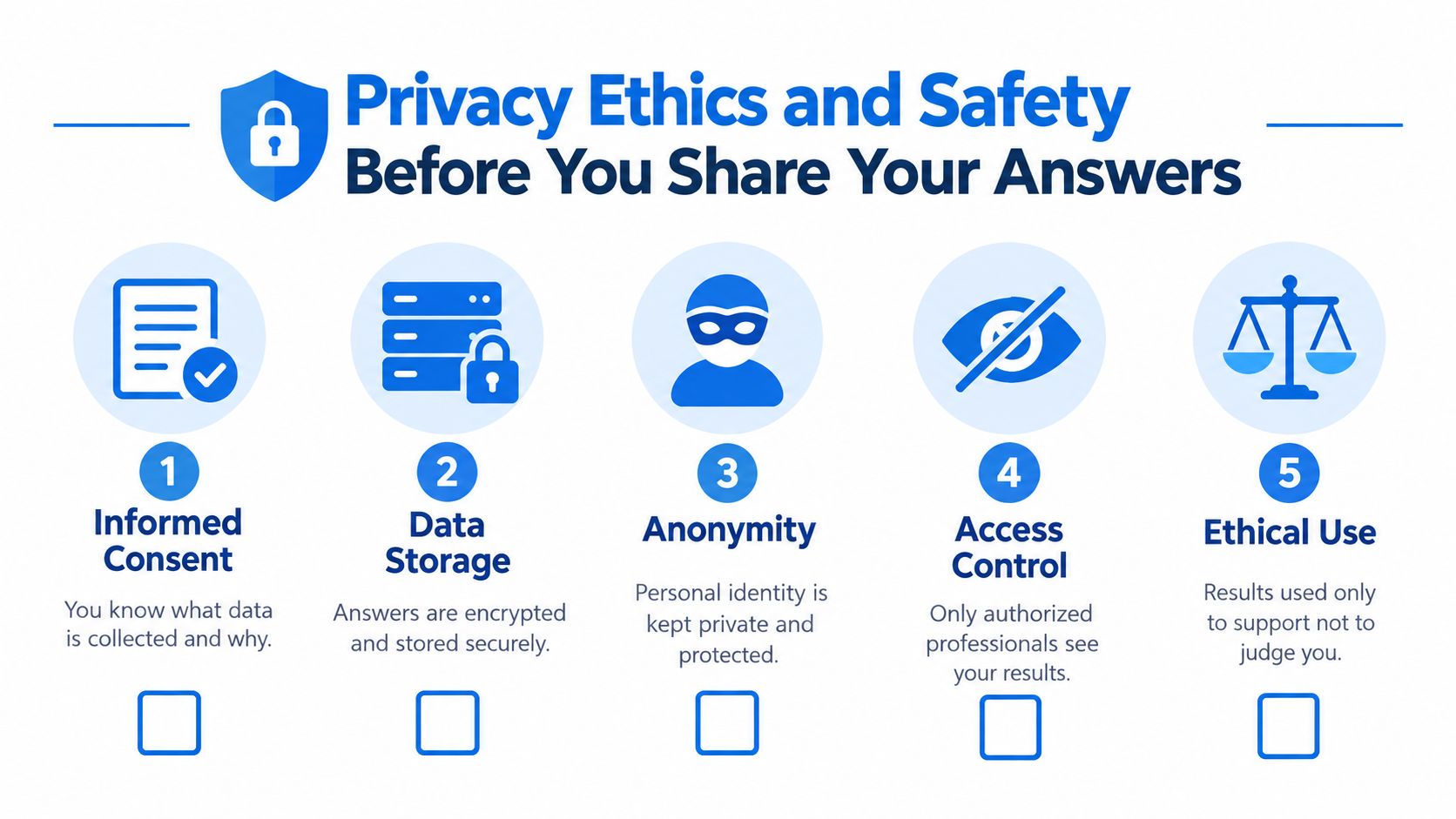
    An infographic titled Privacy Ethics and Safety listing five key principles for protecting data before sharing answers.

    Safety matters more than convenience

    An assessment should never be presented as a diagnosis, and a score shouldn't be used to judge whether you're a good employee, parent, partner, or student. Employers and institutions need especially careful consent and access boundaries because people may feel pressured to participate.

    Risk questions can feel direct, but they serve an important purpose when handled respectfully. If you're thinking about harming yourself, feel unable to stay safe, or face immediate danger, don't rely on an online score. Contact local emergency services, a crisis service, or a trusted person who can stay with you while you seek urgent help.

    A safe platform should provide clear next steps after a concerning result. That may include information about counselling, therapy, medical care, or crisis support. Screening without a route to care leaves the person with information but little help.

    The video below offers another accessible way to think about privacy, ethics, and responsible use.

    How to Choose Interpret and Act on Your Results Wisely

    Start with the situation, not the score. A student facing exam stress may choose an anxiety or general-distress screener, then discuss sleep, concentration, and study pressure with a counsellor. A professional experiencing workplace stress may combine a stress-focused check-in with reflection on workload, boundaries, rest, and burnout.

    A couple may use an assessment to identify communication patterns, but each person's score should support a respectful conversation rather than become evidence against the other. Parents dealing with family conflict can use a well-being or stress measure as a prompt to seek family counselling, especially when arguments, withdrawal, or worry are affecting daily routines.

    Read the result in context

    Check the tool's explanation of its ranges. Don't compare your score with a friend's, and don't treat a change as meaningful without considering sleep, illness, recent events, work demands, or the way you answered.

    Tracking can be useful when it's done consistently and discussed with a professional. One result may offer a snapshot. A pattern across time can provide richer information, but neither replaces a clinical conversation.

    A score can describe a pattern. Only a fuller conversation can explore its meaning.

    Turn insight into a next step

    Use the result to choose a proportionate response:

    • Lower concern: Consider self-help, mindfulness, gratitude, movement, rest, social connection, or resilience-building practices, while staying attentive to how you feel.
    • Persistent concern: Book counselling or therapy to explore causes, coping strategies, relationships, workplace stress, or recurring anxiety and depression symptoms.
    • Complex or worsening concern: Speak with a psychologist, psychiatrist, or doctor who can assess your wider mental and physical health.
    • Immediate safety concern: Seek urgent crisis or emergency support rather than waiting for an online follow-up.

    The connection between screening and referral is important in India. An implementation study reported that technology-enabled screening and referral increased use of primary-care services for mental-health problems from 3.3% to 81.2%, as described in the Indian implementation research. The same source reports 96% screening completion among logged-in users in an Indian college-based digital brief intervention. These figures support a practical lesson: an assessment becomes more useful when the platform makes the next step visible and reachable.

    DeTalks offers validated assessments alongside a directory of therapists, counsellors, psychologists, and other mental-health professionals. That arrangement can help users move from reflection towards a suitable conversation instead of interpreting a result in isolation.
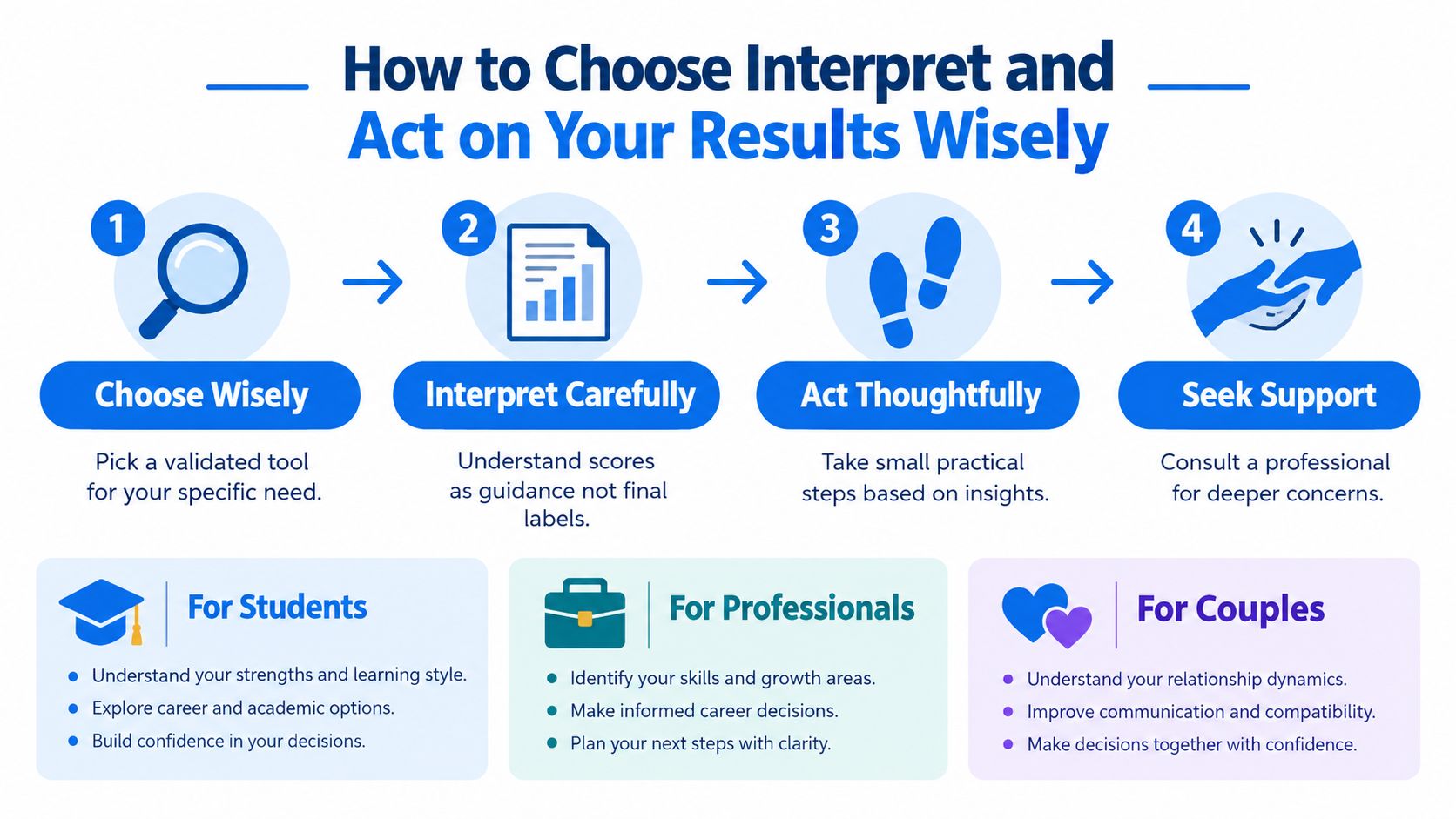
    An infographic showing four steps to effectively choose, interpret, and act upon professional online assessment results.

    Supportive Next Steps for Your Well Being Journey

    An online assessment can help you name an experience, notice a strength, or prepare for a conversation. It can't tell your whole story, predict your future, or replace therapy, counselling, medical advice, or a supportive relationship.

    Use results with curiosity. If anxiety, depression, burnout, grief, or workplace stress keeps affecting sleep, relationships, work, study, or daily functioning, reaching out is a sensible act of care. Seeking help doesn't mean you've failed. It can reflect resilience, self-awareness, and compassion towards yourself.

    Positive well-being deserves attention too. Small practices such as mindful breathing, gratitude, supportive connection, meaningful activity, and kinder self-talk can complement professional support. They won't erase every difficulty, but they can help you recognise what restores energy and strengthens your ability to cope.

    For readers who want to look beyond symptoms and consider everyday functioning, relationships, and satisfaction, this guide explains how to apply quality of life metrics with MicroTrack. Whatever tool you choose, check its evidence, protect your privacy, and treat the result as information rather than a verdict.

    If you're in India or elsewhere and feel unsure about what kind of support fits, you don't have to decide everything at once. Begin with one honest check-in, share your concerns with someone trustworthy, and seek professional guidance when the burden feels persistent, confusing, or unsafe.


    DeTalks offers confidential, scientifically validated assessments and access to psychologists, therapists, counsellors, and other mental-health professionals who can help you understand what comes next. Visit DeTalks to explore an assessment, find suitable support, and take a thoughtful first step towards better well-being.

  • Neuropsychiatrist vs Psychiatrist: Which Specialist Do You

    Neuropsychiatrist vs Psychiatrist: Which Specialist Do You

    You're sitting at home, trying to decide whether to book a psychiatrist or a neuropsychiatrist. You may be dealing with anxiety, low mood, poor sleep, or burnout. Or perhaps a parent has developed sudden memory problems, unusual behaviour, or emotional changes after a stroke. The specialist titles can make an already difficult moment feel more confusing.

    The practical answer is usually simpler than the names suggest. A psychiatrist treats mental health conditions broadly, while a neuropsychiatrist focuses on problems where brain function, neurological illness, cognition, behaviour, and emotions overlap. This guide is designed to help you find the fastest sensible entry point into care in India, without suggesting that any online information can replace a professional assessment.

    Understanding the Confusion Between Neuropsychiatrists and Psychiatrists

    A concerned woman sitting on a sofa and searching for information about neuropsychiatrist versus psychiatrist on her smartphone.

    Consider two people. One has felt anxious for months, avoids social situations, and struggles to concentrate at work. Another has become confused after a head injury and now shows memory problems, irritability, and sudden changes in personality. Both need medical attention, but their first specialist may differ.

    A psychiatrist is a medical doctor trained to assess, diagnose, and treat a wide range of mental health conditions. Their work can include anxiety, depression, bipolar disorder, obsessive-compulsive disorder, psychosis, sleep-related concerns, workplace stress, and emotional distress. Depending on the situation, care may involve medication, therapy, counselling, or coordination with other professionals.

    A neuropsychiatrist works at the boundary between psychiatry and neurology. Their focus is on mental, emotional, or behavioural symptoms that may be connected to the brain or nervous system, such as cognitive decline, epilepsy-related psychiatric symptoms, dementia, or behavioural change after a stroke or brain injury.

    Why the titles overlap

    The brain and mental health can't be separated neatly. Depression can affect concentration, neurological conditions can affect mood, and stress can influence sleep, memory, and daily functioning. That overlap means a psychiatrist may identify a possible neurological concern and refer someone onwards, while a neuropsychiatrist may work alongside a neurologist, psychologist, therapist, or rehabilitation team.

    The word “neuro” doesn't mean that a neuropsychiatrist replaces a psychiatrist. It signals a narrower area of expertise. For many people experiencing common anxiety or depression, access to a qualified psychiatrist and consistent follow-up may matter more than finding a doctor with a subspecialty title.

    Practical rule: Choose the specialist who can assess your main symptoms safely and promptly. You haven't failed if your first appointment leads to a referral.

    Online questionnaires can help you organise symptoms and decide what kind of support to explore. They're informational, not diagnostic, and they can't establish the cause of memory loss, mood change, seizures, or severe distress. A clinician still needs to take a history, understand medical factors, and decide whether further evaluation is needed.

    Training and Qualifications That Set Them Apart

    The clearest way to understand the difference is to look at the training pathway. In India, psychiatry is recognised as an M.D./DNB specialty within the National Medical Commission's postgraduate framework, while child and adolescent psychiatry is described as a further DM-level super-specialty built on postgraduate psychiatry training in the National Medical Commission framework.

    The psychiatrist pathway

    A psychiatrist generally begins with an MBBS degree. They then complete postgraduate specialist training in psychiatry through an M.D. or DNB pathway. This training prepares them to evaluate mental health conditions, consider physical and psychological contributors, prescribe medicines where appropriate, and plan ongoing care.

    That broad preparation makes psychiatry the foundational specialist route for concerns such as persistent anxiety, depression, severe stress, mood instability, obsessive thoughts, psychosis, and difficulties that interfere with everyday life. A psychiatrist may also work with therapists and counsellors, because medication is only one possible part of a person's care.

    The neuropsychiatric pathway

    Neuropsychiatry is a narrower field focused on the relationship between brain function and behaviour. In practice, a neuropsychiatrist usually builds on psychiatric or neurological training and develops additional expertise in conditions involving cognition, behaviour, emotions, and the nervous system.

    The exact route can vary by institution and clinician. Some specialists may have a psychiatry background with focused neuropsychiatric or behavioural-neurology experience, while others may work closely with neurology teams in academic or tertiary-care settings. A neuropsychiatrist's work may involve cognitive assessment, neurological history-taking, review of investigations, and coordination with specialists involved in seizure care, stroke recovery, dementia care, or brain-injury rehabilitation.

    A comparison chart outlining the educational training paths for a psychiatrist versus a neuropsychiatrist.

    The important point isn't to memorise every qualification. It's to understand the hierarchy: psychiatry is the broad specialist foundation, while neuropsychiatry represents focused expertise at the psychiatry-neurology interface. This is why neuropsychiatric services are more likely to be found in tertiary hospitals, specialist centres, and academic medical colleges.

    What this means for availability

    Training differences affect access. A person looking for help with anxiety or depression will usually have more realistic options by searching for a psychiatrist, rather than waiting for a neuropsychiatrist who may not practise nearby. If neurological features are present, a psychiatrist, neurologist, or general physician can help route the person to the appropriate service.

    The distinction should guide referral, not create a barrier. You don't need to identify the perfect label before asking for help.

    Comparing Scope of Practice and Conditions Treated

    Both specialists are medical doctors who can assess mental health symptoms and contribute to treatment. The difference lies mainly in the clinical question they're equipped to explore most. A psychiatrist asks how thoughts, feelings, behaviour, physical health, and life circumstances are interacting, while a neuropsychiatrist gives particular attention to whether brain or nervous-system changes are shaping those symptoms.

    Aspect Psychiatrist Neuropsychiatrist
    Main focus Broad mental health assessment and treatment Brain-behaviour conditions involving psychiatric and neurological features
    Common concerns Anxiety, depression, bipolar disorder, OCD, psychosis, stress, sleep difficulties, and emotional distress Cognitive decline, dementia-related behaviour, epilepsy-related psychiatric symptoms, post-stroke changes, and symptoms after brain injury
    Assessment Clinical interview, mental-state assessment, medical history, and psychological or functional review Psychiatric assessment combined with attention to cognition, neurological history, brain-related illness, and functional change
    Treatment Medication when appropriate, therapy, counselling referrals, lifestyle support, and coordinated care Psychiatric treatment alongside neurological review, cognitive support, rehabilitation planning, and collaboration with other specialists
    Typical referral pattern Often the first specialist for general mental health concerns Often considered when symptoms have a clear or suspected neurological connection

    Where a psychiatrist usually fits

    A psychiatrist is often the right first appointment for persistent anxiety, depression, workplace stress, burnout, panic symptoms, mood swings, intrusive thoughts, or emotional difficulties without a known neurological condition. They can also assess whether sleep, substance use, medication, hormonal factors, or physical illness may be contributing.

    Their care doesn't have to be limited to prescriptions. A psychiatrist may recommend therapy or counselling, discuss coping strategies, and monitor changes over time. For many people, continuity with one clinician provides more value than moving between specialists.

    Where a neuropsychiatrist adds depth

    A neuropsychiatrist becomes particularly relevant when mental health symptoms occur with memory loss, seizures, tremors, cognitive decline, dementia, movement symptoms, or behavioural change after a stroke or brain injury. The specialist can consider whether the emotional or behavioural presentation is connected to a neurological process.

    That doesn't mean every person with forgetfulness needs a neuropsychiatrist. Stress, depression, medication effects, sleep problems, and physical illness can also affect memory. The reason for referral is the pattern, timing, severity, and connection with neurological symptoms, not one isolated complaint.

    The most useful distinction is not “mind versus brain”. Mental health and brain health interact. The practical question is which clinician can investigate the pattern in front of you.

    Real-World Scenarios for Choosing the Right Specialist

    Definitions become more useful when they help you choose an appointment. The examples below aren't diagnoses. They show how symptoms and medical history can influence the first point of contact.

    Persistent anxiety and burnout

    You've felt tense, exhausted, and unable to switch off after work. You're sleeping poorly, worrying repeatedly, and finding it harder to focus, but there's no known seizure disorder, head injury, stroke, or progressive cognitive change.

    A psychiatrist is usually a sensible first choice. They can assess anxiety, depression, burnout, sleep, physical health, and workplace stress, then discuss therapy, counselling, medication, or a combination of supports. A psychologist or counsellor may also be appropriate, depending on the intensity and risk involved.

    Severe depression without neurological features

    Someone has persistent low mood, loss of interest, hopelessness, or difficulty functioning, but no clear neurological symptoms. A psychiatrist can assess the severity, review safety, and consider a treatment plan.

    If there are thoughts of self-harm or suicide, seek urgent local help rather than waiting for an online assessment or routine appointment. Immediate safety takes priority over choosing between specialist titles.

    Sudden memory problems

    A parent begins repeating questions, getting lost in familiar places, or struggling with everyday tasks. A neuropsychiatrist may be appropriate, especially if the changes are progressive or occur alongside behavioural, cognitive, movement, or neurological symptoms.

    A neurologist or general physician can also be a practical entry point where neuropsychiatry isn't available. The first clinician can assess the pattern and refer appropriately.

    Symptoms after a head injury or stroke

    Mood changes, irritability, confusion, impulsive behaviour, or personality changes after a brain injury or stroke point towards the psychiatry-neurology overlap. A neuropsychiatrist may be particularly useful, often working with neurology, rehabilitation, and therapy professionals.

    Epilepsy with emotional or behavioural symptoms

    A person with seizures develops anxiety, depression, unusual behaviour, or changes linked to seizure activity or treatment. A neuropsychiatrist can examine the psychiatric symptoms in their neurological context, while continued coordination with a neurologist remains important.

    A comparison chart explaining the differences between when to consult a psychiatrist versus a neuropsychiatrist for symptoms.

    When access matters more than the title

    A person with depression, anxiety, OCD, or bipolar disorder may not gain anything from delaying care while searching for a neuropsychiatrist. If a qualified psychiatrist is available sooner and can provide reliable follow-up, that may be the safer and more useful starting point.

    Referral is not a setback. It's a normal part of care when symptoms require another specialist's perspective.

    Navigating Mental Health Care in India's Specialist Shortage

    India's specialist shortage changes the practical meaning of neuropsychiatrist vs psychiatrist. The National Mental Health Survey reported 0.3 psychiatrists per lakh population nationwide, with state variation from 0.05 per lakh in Madhya Pradesh to 1.2 per lakh in Kerala, and an average national deficit of 77% against need, as documented in the government mental-health resource summary.

    These figures describe psychiatrists, the core scarce mental-health specialists. Neuropsychiatry is a narrower subspecialty layered on psychiatry or neurology training, so specialist availability can be even more limited outside major hospitals and academic centres. Someone in a smaller city may need to begin with a psychiatrist, neurologist, or general physician and use referral pathways rather than wait indefinitely for a specific title.

    An infographic detailing the severe shortage of mental health specialists across India with key statistics and data.

    Why continuity deserves attention

    The need is substantial. India's National Mental Health Survey found that 10.6% of adults had a current mental morbidity and 13.7% had a lifetime prevalence of any mental morbidity, according to the survey summary shared by WHO. The same evidence base reported an 80.4% treatment gap for common mental disorders, meaning many people who need care don't receive it, as described in The Lancet Regional Health Southeast Asia00160-9/fulltext).

    A practical plan therefore has two parts. Match the symptoms to the right level of expertise, but also choose care that you can continue. Telepsychiatry, digital mental-health services, task-sharing, and referral networks can help people outside metros reach guidance, follow-up, or specialist review.

    Telehealth doesn't remove the need for in-person evaluation when neurological signs, severe impairment, or immediate safety concerns are present. It can, however, help a psychiatrist assess the initial picture and decide whether neuropsychiatric or neurological referral is needed.

    Your Step-by-Step Decision Framework

    Use this framework to decide where to begin. It's a way to organise your next step, not a substitute for diagnosis.

    Step 1. Name the main problem

    Write down the symptoms that trouble you most. Are they mainly anxiety, depression, low motivation, intrusive thoughts, panic, workplace stress, burnout, sleep difficulty, or problems coping with daily life?

    If yes, start by looking for a psychiatrist, psychologist, therapist, or counsellor, depending on the intensity and type of support you need. A psychiatrist is especially important when symptoms are severe, persistent, worsening, or affecting safety and functioning.

    Step 2. Look for a brain or nervous-system connection

    Ask whether the symptoms began after a head injury, stroke, seizure, or diagnosed neurological illness. Also note new memory loss, confusion, tremors, movement changes, progressive cognitive difficulty, or marked personality change.

    A neuropsychiatrist may be the most suitable specialist when these features are prominent. If one isn't available, begin with a neurologist, psychiatrist, or general physician who can assess the situation and coordinate referral.

    Step 3. Record timing and change

    Write when the symptoms began, whether they appeared suddenly or gradually, and what has changed in work, relationships, self-care, memory, sleep, or behaviour. Bring a list of medicines and relevant medical records, especially after hospitalisation or injury.

    A family member can help describe changes the person may not notice. This is particularly useful when memory, judgement, or behaviour has shifted.

    Step 4. Use screening tools carefully

    A validated screening assessment can help you reflect on anxiety, depression, stress, resilience, or emotional well-being. It doesn't diagnose a condition and shouldn't be used to rule out neurological illness or delay urgent care.

    Use the result as a conversation starter with a qualified professional. A clinician will consider the score alongside your history, symptoms, physical health, and circumstances.

    Step 5. Choose available care rather than waiting for perfection

    If the ideal specialist isn't accessible, book the most appropriate qualified clinician you can reach. A psychiatrist can provide an initial assessment and refer you when the presentation crosses into neuropsychiatry.

    A useful decision test: If waiting for a specific title means receiving no care, start with an available professional who can assess risk and route you safely.

    Supportive Takeaways for Your Mental Health Journey

    The difference between a psychiatrist and a neuropsychiatrist is meaningful, but it shouldn't make you afraid of choosing incorrectly. A psychiatrist is often the broad first point of contact for anxiety, depression, stress, burnout, and other mental health concerns. A neuropsychiatrist is especially valuable when emotional or behavioural symptoms appear alongside cognitive or neurological changes.

    Your care may include more than medical treatment. Therapy and counselling can support emotional processing, coping, relationships, and behaviour change. Practices that build resilience, compassion, mindfulness, gratitude, self-esteem, emotional intelligence, and purpose can support well-being, although they shouldn't replace clinical care when symptoms are severe.

    Workplace stress deserves attention rather than dismissal. A review of Indian workplace studies found wide ranges for depression, anxiety, and workplace stress, with depression reported from 10% to 52.9%, anxiety from 7% to 57%, and workplace stress from 3.8% to 75.5% across the studies reviewed in this peer-reviewed article. These figures vary across settings and don't predict an individual's experience, but they reinforce that emotional strain at work can be a genuine health concern.

    Mental health care is a process of understanding patterns, finding suitable support, and building steadier ways to respond. You don't need to wait until everything feels manageable, and you don't need to solve the specialist question alone.

    If you're unsure whether counselling, therapy, coaching, or psychiatric care fits your situation, DeTalks offers a directory of psychologists, therapists, counsellors, and mental-health professionals, alongside confidential psychological assessments for informational guidance. Visit DeTalks to explore support options and take a practical first step towards greater clarity, resilience, and well-being.