Tag: therapy for depression

  • Major Depressive Disorder Single Episode ICD 10 Explained

    Major Depressive Disorder Single Episode ICD 10 Explained

    Some people search for major depressive disorder single episode icd 10 late at night, after weeks of feeling unlike themselves. Work feels heavier. Small decisions feel exhausting. Family members may notice withdrawal, irritability, tears, or a kind of emotional flatness that's hard to explain.

    If that's where you are, the search itself matters. It often means you're trying to make sense of something painful, and that's a thoughtful first step toward care, therapy, counselling, and better well-being.

    Understanding Your Feelings A Guide to First-Time Depression

    A first episode of depression often doesn't arrive with a clear signboard. It may begin as tiredness that doesn't lift, anxiety that sits in the body all day, or workplace stress that seems to spill into sleep, appetite, motivation, and relationships.

    In India, major depressive disorder affects approximately 45.7 million adults, and depressive disorders were identified as the leading mental health issue in the National Mental Health Survey, with many cases being first-time, single episodes, as noted in the NIMHANS survey summary. That means feeling this way is serious, but it also means you're not alone.

    What people often notice first

    For one person, the change may look like crying in the bathroom before logging into work. For another, it may look like snapping at loved ones, losing interest in food, or feeling numb during things that once brought happiness.

    A family member may say, “You've changed.” The person going through it may think, “I'm weak,” or “I should be able to handle this.” That interpretation is common, but it isn't fair.

    Understanding symptoms is not about putting someone in a box. It's about giving distress a name so support can become clearer.

    Depression can overlap with anxiety, burnout, low self-worth, irritability, and body-level stress. That overlap is one reason many people delay asking for help. They don't know whether what they're facing is stress, sadness, grief, exhaustion, or depression.

    A diagnosis is a map, not a verdict

    Clinical words can sound cold at first. Yet when used well, they help doctors, therapists, and counsellors understand severity, choose treatment, and document care accurately.

    If you're still unsure whether what you're seeing is depression, this resource on spotting early signs of mental illness can help you notice patterns that people often miss in the beginning.

    That said, self-checks and reading online are informational, not diagnostic. They can guide reflection, but they don't replace a professional assessment.

    What hope looks like at the start

    Hope doesn't always begin as confidence. Sometimes it begins as structure. Book one appointment. Write down your symptoms. Tell one trusted person what's been happening.

    You don't need to be certain before you seek support. You only need to recognise that something feels wrong and deserves care.

    Decoding the Clinical Code F32 for Depression

    F32 is the ICD-10 code family used for a single depressive episode. ICD-10 is a medical classification system that helps clinicians describe a condition in a standard way, so records, referrals, and treatment decisions are more consistent.

    When people see a code like F32, they often assume it's just paperwork. It isn't. The code tells a clinician whether this appears to be a first depressive episode and how severely it's affecting daily life.

    An infographic showing the ICD-10 breakdown for code F32 representing a single episode of major depressive disorder.

    What F32 actually covers

    The letters and numbers become easier when translated into lived experience.

    ICD-10 Code Severity Level Key Characteristics
    F32.0 Mild Symptoms are present, but the person may still be able to carry out many daily responsibilities, though with clear strain
    F32.1 Moderate Daily life is more noticeably disrupted. Work, study, relationships, and self-care often become harder to manage
    F32.2 Severe without psychotic symptoms Distress and impairment are intense. Functioning may drop sharply, and the person may struggle with basic routines
    F32.3 Severe with psychotic symptoms Severe depression is present along with psychotic symptoms, which needs urgent specialist assessment
    F32.4 In partial remission The full depressive episode has eased, but some symptoms still remain
    F32.5 In full remission Symptoms have cleared to a clinically significant degree for a sustained period

    One helpful clinical point is that F32.1 means moderate depression with marked social or occupational disruption, including findings such as a 50 to 70 percent reduction in work productivity in Indian population surveys, according to the ICD-10 F32.5 coding overview.

    How severity feels in real life

    A mild episode may look like someone pushing through the day while feeling joyless, slowed down, and emotionally worn out. They're functioning, but it costs a lot.

    A moderate episode often becomes visible to others. Deadlines slip. Conversations feel effortful. Showering, cooking, commuting, and replying to messages may start to feel overwhelming.

    A severe episode can shrink life dramatically. The person may withdraw almost completely, feel hopeless, or have trouble thinking clearly enough to do ordinary tasks.

    Practical rule: In depression coding, severity is not only about sadness. It's also about how much the symptoms interfere with work, study, sleep, relationships, and self-care.

    Why confusion is common

    People often compare themselves to stereotypes. They think depression must always mean constant crying or never leaving bed. In reality, many people with depression still go to work, smile in meetings, care for children, and look “fine” from the outside.

    Sometimes the question is whether the problem is depression, attention issues, or both. If that distinction feels relevant, the Sachs Center ADHD vs depression guide offers a useful plain-language comparison of how symptoms can overlap.

    Codes don't define your identity. They help clinicians describe what kind of support is likely to fit best.

    Single Episode Versus Recurrent Depression

    A single episode and recurrent depression can feel similar in the moment, but they don't mean the same thing clinically. The difference is about history.

    Imagine it as weather. A single episode is one intense storm. Recurrent depression is a pattern where storms return over time after a period of improvement.

    A pear-shaped clear gemstone casting a shadow beside ripples in a clear pool of water.

    What makes it a single episode

    If a clinician uses an F32 code, they're identifying the current depression as a first or standalone episode rather than part of a repeated pattern. That matters because it affects how progress is tracked and how future risk is discussed.

    For families, this point often brings mixed feelings. Relief, because it may be the first recognised episode. Fear, because they wonder whether it will come back.

    Why follow-up still matters

    Even when an episode is “single,” it still deserves serious attention. A person may improve with therapy, counselling, medication, lifestyle support, or a combination, but recovery also involves learning early warning signs, stress management, and resilience skills.

    Helpful areas to strengthen after a first episode include:

    • Routine protection: Stable sleep, meals, and daily structure can support emotional steadiness.
    • Stress awareness: Workplace stress, caregiving strain, and relationship conflict can all affect recovery.
    • Relapse planning: Noticing changes in energy, withdrawal, hopelessness, or irritability early can prompt faster help.
    • Compassionate support: Family members usually help more when they listen, reduce judgement, and avoid “just think positive” advice.

    A first episode deserves both treatment and reflection. The question isn't only “How do we stop this now?” It's also “What helps this person stay well?”

    What this means emotionally

    People often hear “single episode” and assume the problem was minor. That's not true. A single episode can still be severely painful and highly disruptive.

    The hopeful part is that the label also leaves room for prevention. With support, many people build stronger coping habits, more self-understanding, and better protection against future crises.

    The Spectrum of Severity and Path to Remission

    Depression isn't all-or-nothing. It moves across a spectrum, and people often shift along that spectrum over time. Someone may begin in a severe state, improve to partial remission, and later reach full remission.

    That movement matters because it gives shape to recovery. Healing doesn't have to be dramatic to be real.

    A serene sunrise over a misty, green landscape with morning dew on the grass under a tree

    Mild moderate and severe in everyday terms

    In mild depression, a person may still go through the motions but feel drained, joyless, and less connected to people they care about. The day happens, but it feels grey.

    In moderate depression, functioning drops more clearly. The person may struggle to focus, keep up with work, manage household tasks, or respond to everyday demands without feeling flooded.

    In severe depression, the emotional and physical burden can become overwhelming. Motivation may collapse, thoughts may turn very dark, and even basic acts such as bathing, eating, or leaving the bed may feel difficult.

    What remission means

    Clinicians also use remission codes when a depressive episode improves. F32.4 refers to partial remission, and F32.5 refers to full remission.

    According to the WHO ICD-10 depression remission guidance, full remission requires less than one symptom to persist for at least two months. That language can sound technical, but in plain terms it means the episode has eased in a clinically meaningful and sustained way.

    Recovery is not “all better” one morning. It's often a series of returns. Better sleep. A clearer mind. More appetite. A little interest in life again.

    What partial remission can look like

    Partial remission can be confusing because people often look improved from the outside. They may be back at work, talking more, or managing daily routines again.

    But internally, they might still feel fragile. Energy may still dip. Anxiety may still flare under pressure. Pleasure may return slowly rather than all at once.

    That's why treatment often continues after the worst period passes. Ongoing support helps people consolidate gains instead of stopping care too early.

    Where therapy and counselling fit

    Many people benefit from a combination of approaches. Therapy and counselling can help someone recognise unhelpful thinking patterns, process stress, rebuild structure, and practise resilience, self-compassion, and emotional regulation.

    The same WHO-linked guidance notes that CBT delivered via platforms such as DeTalks has been shown to significantly boost recovery outcomes compared to medication alone in the Indian context. That matters because recovery is rarely just about reducing sadness. It also involves restoring confidence, connection, and hope.

    How a Diagnosis Shapes Your Treatment Journey

    A diagnosis can feel intimidating at first, but in practice it helps care become more specific. Instead of vague distress, the clinician has a clearer framework for what to assess, what to monitor, and what kind of support may help.

    That can be especially important when depression appears alongside anxiety, burnout, sleep problems, family stress, or workplace stress. Without a clear starting point, treatment may become scattered.

    A person sits at a wooden desk by a window with a notebook and compass, gazing at a garden.

    What changes after an accurate diagnosis

    An accurate diagnosis helps a professional decide whether the next step should focus on therapy, counselling, medication review, psychiatric referral, safety planning, or a blended approach.

    It also improves communication. A psychologist, psychiatrist, physician, and family member can work from the same picture rather than guessing at different problems.

    In India, this practical side matters. Depression is often under-coded or miscoded as F32.9, meaning unspecified, especially in non-specialist settings, which can make proper care harder to access and may lower insurance reimbursements, according to the ICD-10 F32.4 coding note.

    Why the right code matters beyond paperwork

    People sometimes assume coding only matters to hospitals or insurers. But when a diagnosis is too vague, treatment can also stay vague.

    Here's where accurate documentation often helps:

    • Care planning: A clearer severity level helps match the intensity of support to the person's needs.
    • Referral decisions: Severe symptoms may call for faster psychiatric input or closer monitoring.
    • Workplace conversations: Some people need documentation to explain mental health treatment, leave, or temporary adjustments.
    • Insurance pathways: In some settings, specificity affects whether claims move smoothly or get delayed.

    Good documentation doesn't reduce a person to a file. It can open doors to the right care at the right time.

    Treatment is often layered

    A person with a first depressive episode may need several forms of support at once. One part may involve symptom relief. Another may focus on grief, relationship strain, self-esteem, or chronic stress that helped trigger the episode.

    If medication is being discussed and you want a plain-language overview of what to ask about, this XO Medical's guide for medication can help you prepare better questions about side effects and monitoring.

    A short explainer can also help make the broader treatment journey easier to understand:

    What families can do

    Families often want to help but don't know how. They may push too hard, minimise symptoms, or focus only on motivation.

    More useful support usually looks like this:

    1. Listen without correction. Try not to debate whether the person “should” feel this way.
    2. Help with practical steps. Offer to assist with appointments, meals, or daily tasks.
    3. Watch for risk. If someone sounds hopeless, withdrawn, or unsafe, seek urgent professional support.
    4. Support treatment consistency. Recovery usually improves when care is steady, not only crisis-driven.

    Finding Professional Support and Building Resilience

    Professional support can feel like a big step, especially when depression has already drained your energy. Even so, reaching out early often reduces confusion and helps you feel less alone with what's happening.

    That support might begin with a therapist, counsellor, psychologist, psychiatrist, or physician. The exact route matters less than starting an honest conversation about symptoms, stress, anxiety, sleep, functioning, and safety.

    What to ask in a first appointment

    You don't need perfect language. You can describe what has changed.

    Useful things to mention include:

    • How long it's been happening: Say when the low mood, anxiety, burnout, or loss of interest began.
    • What daily life looks like: Mention changes in sleep, appetite, work, study, relationships, or self-care.
    • What worries you most: Some people fear medication. Others fear judgement, job impact, or being a burden.
    • Any safety concerns: If there are thoughts of self-harm or suicide, say so clearly and immediately.

    Resilience is not forced positivity

    People sometimes hear “build resilience” and think it means pretending to be fine. It doesn't. Resilience is the ability to respond to pain with support, skill, and self-respect.

    It may include therapy homework, rest, boundaries, mindfulness, movement, gratitude practice, kinder self-talk, and reconnecting with people who feel safe. Positive psychology can help here, not by denying pain, but by slowly rebuilding meaning, compassion, and moments of genuine happiness.

    Healing often grows through small repeatable actions. One honest conversation. One appointment kept. One kinder response to yourself.

    A careful note on assessments

    Online mental health assessments can be useful for reflection, preparation, and deciding whether to seek help. They can help you notice patterns in depression, anxiety, resilience, stress, and overall well-being.

    But they are informational, not diagnostic. Only a qualified professional can diagnose major depressive disorder, determine whether it is a single episode, and assign an ICD-10 code.

    If you're supporting someone else, patience matters. Recovery may not move in a straight line. A difficult week doesn't erase progress, and a diagnosis doesn't erase a person's strengths.

    The next right step is often simple. Seek clarity. Accept support. Stay engaged with care long enough for it to work.


    If you're looking for a practical place to begin, DeTalks can help you explore therapy options, connect with qualified mental health professionals, and use confidential science-backed assessments to better understand what you're experiencing. These assessments are informational, not diagnostic, but they can help you take a calmer, more informed first step toward support, resilience, and well-being.

  • Understanding Moderate Depression (ICD-10: F32.1)

    Understanding Moderate Depression (ICD-10: F32.1)

    Hearing a clinical term like moderate depression ICD 10 can feel a bit formal, but it simply points to a specific code: F32.1. This code helps healthcare professionals understand the level of depression someone is experiencing. It describes a challenge that is more disruptive than mild depression but not yet considered severe, offering a clear starting point for a supportive plan.

    Demystifying the Moderate Depression ICD 10 Code

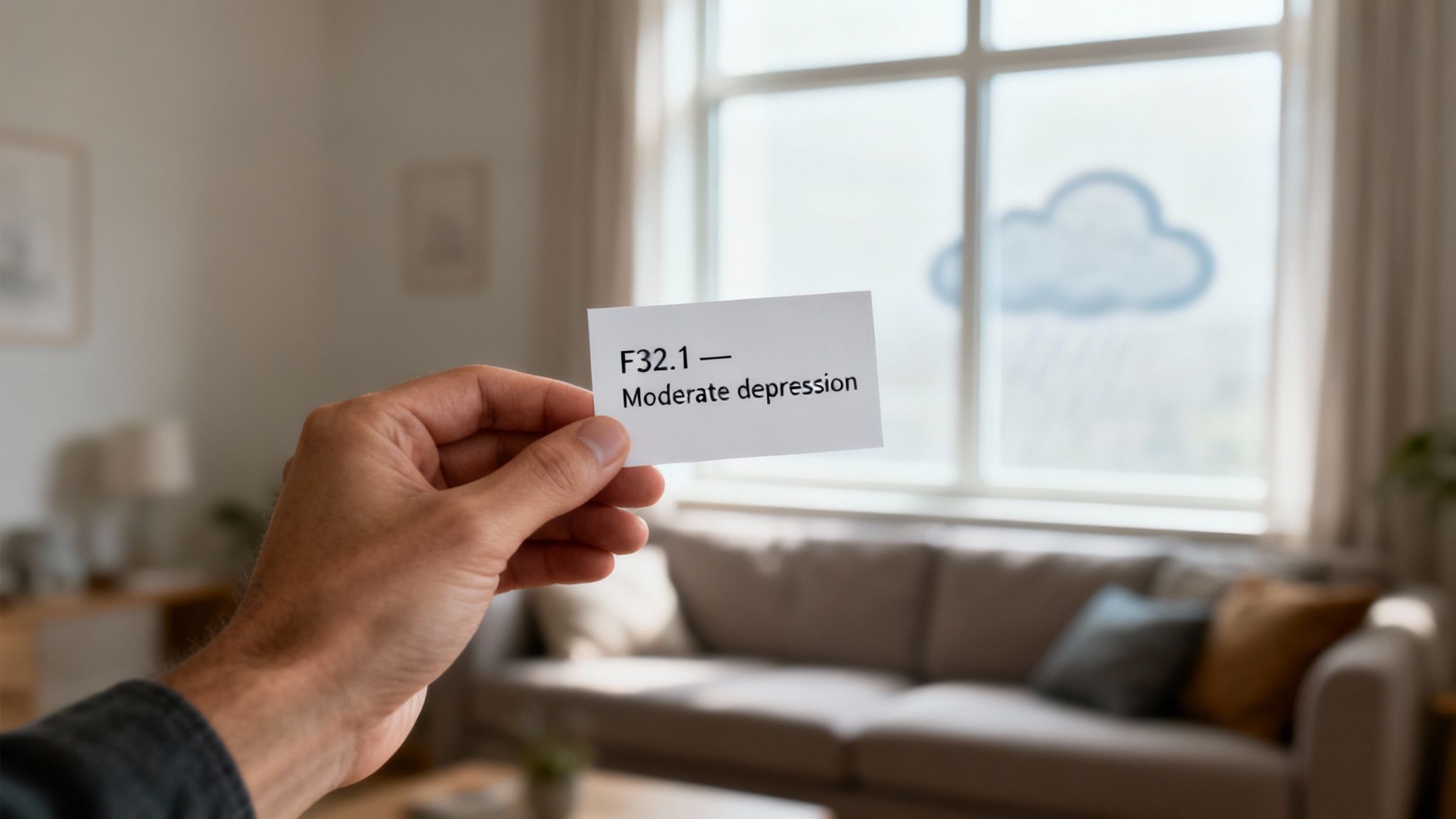
    Hand holding a card displaying 'F32.1 – Moderate depression' against a blurry background with a window showing a rain cloud.

    A phrase like "moderate depression ICD 10" might sound intimidating, but it's just a tool to bring clarity to your feelings. The International Classification of Diseases, 10th Revision (ICD-10) is a global system that helps doctors and therapists speak the same language about health conditions.

    Think of it like a weather report. Knowing a "moderate storm" is expected helps you prepare better than just hearing "it might rain." Similarly, the code F32.1 helps a professional understand the intensity of the challenges you're facing, including feelings of anxiety or stress.

    To give you a clearer picture, here’s a quick breakdown of how the ICD-10 system categorises single depressive episodes.

    A Simple Guide to Depression Levels in ICD-10

    Severity Level ICD-10 Code General Description
    Mild F32.0 Symptoms are present but often manageable. Daily activities can be done, though with some difficulty.
    Moderate F32.1 Symptoms are more pronounced and cause significant trouble with work, social life, or home duties.
    Severe F32.2 / F32.3 Symptoms can feel overwhelming, making it nearly impossible to continue with daily routines.

    This table helps show where F32.1 fits, creating a shared understanding between you and your care provider.

    A Tool for Understanding, Not a Label

    It is so important to remember that a diagnostic code is not a permanent label. It is a snapshot in time—an informational starting point that guides conversations about therapy and counselling. It describes what you are going through right now, not who you are.

    In India, conversations around mental health and well-being are growing. With millions of people experiencing depressive disorders, codes like F32.1 are vital for ensuring people get the right kind of support. This clarity is the first step toward building resilience and finding effective ways to feel better.

    An assessment offers a shared language between you and your healthcare provider. It transforms a vague feeling of being unwell into a recognised condition with established pathways for support.

    This structured approach allows professionals to tailor support for challenges like workplace stress and anxiety. Staying informed about latest ICD-10 coding updates helps them provide accurate care. By demystifying these terms, we can focus on what truly matters: your journey toward compassion, happiness, and lasting well-being.

    Recognising the Signs of a Moderate Depressive Episode

    A thoughtful young man sips a steaming hot drink at his desk beside a laptop.

    Understanding what a moderate depressive episode feels like is a meaningful step toward seeking support. It is more than a bad day; it’s a persistent cloud that can make every part of life feel heavier. Learning to see these signs, in yourself or a loved one, is an act of strength.

    While everyone's experience with depression is unique, there are common patterns that clinicians look for. These signs often affect your thoughts, feelings, and even your physical health. Gently taking stock of them can bring much-needed clarity.

    Core Emotional and Mental Signs

    At the heart of a depressive episode are two key experiences: a persistent low mood and a loss of interest in things you once enjoyed. This is a deep feeling of emptiness or hopelessness that lasts for weeks. It can feel like the colour has drained from your world, making it hard to find joy.

    For example, a young professional in Delhi who loves meeting friends might suddenly find the thought exhausting. This loss of interest is a significant sign that something more than everyday stress or anxiety is happening.

    Physical and Behavioural Changes

    Depression doesn’t just stay in your head; it often shows up in your body and actions. These physical shifts can be some of the most disruptive parts of a moderate depressive episode.

    Common physical signs include:

    • Sleep Disturbances: You might struggle with sleeplessness or find yourself sleeping far more than usual without feeling rested.
    • Appetite and Weight Changes: You could lose your appetite and weight, or you might turn to food for comfort, leading to weight gain.
    • Pervasive Fatigue: This is a deep exhaustion that sleep doesn't seem to fix, making even small tasks feel difficult.
    • Difficulty Concentrating: Trouble focusing at work or making decisions is very common and can add to workplace stress.

    Noticing these changes is not about finding fault. It's about compassionately acknowledging that your mind and body are signalling a need for support, a courageous first step toward building resilience.

    Research from India highlights how common these experiences are. One study using the moderate depression ICD 10 classification noted that many patients experienced physical symptoms that worsened their fatigue. You can learn more in this study on Indian patients with depression.

    Acknowledging these signs opens the door to seeking professional help. Through therapy or counselling, you can find the tools and support needed to navigate these challenges and move toward a greater sense of well-being.

    How Professionals Assess Moderate Depression

    An assessment might sound clinical, but it's really a compassionate conversation to understand what's going on. It's not about judging a bad day but about exploring a pattern of feelings you've had for at least two consecutive weeks. This timeframe helps distinguish a temporary reaction to stress from a more persistent challenge.

    A mental health professional, like a counsellor or therapist, will listen to your story in a safe space. They are trained to gently explore your experiences to understand your overall well-being. Please remember that any assessment is for informational purposes and is not a final diagnosis.

    A Collaborative Conversation

    Think of the assessment as a partnership, not an interrogation. A clinician’s goal is to get a full picture of your well-being, including workplace stress or personal struggles. This open dialogue is the foundation for creating a support plan that truly fits you.

    They will gently ask about your mood, energy levels, sleep, and how these are impacting your daily life. It is a completely confidential space for you to share honestly without fear of judgement.

    Differentiating Depression from Other Challenges

    A key part of a professional’s role is to distinguish moderate depression from other common experiences. Many challenges, like burnout or anxiety, can look similar on the surface. Getting this right is crucial for ensuring you receive the best support.

    Here’s how they might differentiate them:

    • Depression vs. Burnout: Burnout is almost always linked to your job and often improves with a break from that environment. Depression, however, tends to cast a shadow over all areas of life and doesn’t disappear with a holiday.
    • Depression vs. Anxiety: These two often appear together, but they are different. Anxiety is typically driven by intense worry about the future, while depression is rooted in a persistent low mood and loss of interest in the present.
    • Depression vs. Grief: Grief is a natural response to loss that comes in waves, with moments of happiness still possible. Depression is more like a constant, heavy blanket that makes it hard to feel anything positive.

    An accurate assessment isn't about putting you in a box. It's about unlocking the right door to effective therapy and counselling, creating a clear path toward building resilience and reclaiming your well-being.

    Ultimately, this careful process builds trust and ensures the support you receive is right for your journey. It is the first, most important step toward feeling heard, understood, and ready to move forward.

    Pathways to Managing Your Mental Well-being

    A serene counseling room with two light-colored armchairs, a wooden table, and a green plant.

    Recognising that you might be dealing with a moderate depressive episode is a huge first step. While the journey is personal, you don't have to walk it alone. There are effective approaches that offer support, hope, and practical tools for managing your mental health.

    Choosing to speak with a professional is a powerful act of self-care. It creates a safe space to explore your feelings and learn new ways to cope with pressures like workplace stress or anxiety.

    The Role of Psychotherapy and Counselling

    Psychotherapy, often called talk therapy or counselling, is a cornerstone of managing depression. It’s a collaborative partnership where you work with a trained therapist to understand your thoughts, feelings, and behaviours.

    A well-researched approach is Cognitive Behavioural Therapy (CBT). CBT helps you identify and challenge unhelpful thought patterns that can fuel depression. By reframing thoughts, you can build resilience and find more compassionate ways of relating to yourself.

    Other effective therapies include:

    • Interpersonal Therapy (IPT): This focuses on your relationships, helping you improve communication and build a stronger support network.
    • Mindfulness-Based Cognitive Therapy (MBCT): This blends CBT with mindfulness, teaching you to observe your thoughts without getting carried away by them.

    Therapy isn't about "fixing" something broken. It's about learning new skills and gaining fresh perspectives to navigate life’s challenges with greater ease and compassion.

    Considering Medication as Part of a Plan

    For some, medication prescribed by a psychiatrist can be a helpful part of a broader care plan. It isn't a quick fix, but a tool that can help lift symptoms, giving you the energy to engage fully in therapy and other positive changes.

    This is always a decision made carefully with a qualified doctor who can explain the potential benefits. The most effective strategy often involves a combination of therapy for skill-building and medication for symptom management.

    Building Resilience with Positive Psychology

    Beyond formal treatment, you can actively support your well-being by incorporating principles of positive psychology. These practices focus on building your strengths and fostering positive emotions like happiness and resilience.

    Learning strategies for cultivating self-compassion can be a powerful starting point. Simple habits like mindfulness, gratitude journaling, or gentle physical activity can create small but significant shifts in your daily experience. These practices are powerful additions to professional support, empowering you on your journey.

    Your Active Role in the Healing Journey

    Overhead shot of hands writing 'Self-care notes' in a journal, with a small plant and tea on a sunny table.

    While professional support from a therapist or counsellor is vital for managing moderate depression, the small steps you take each day build the foundation for your well-being. Self-care isn't another chore; it's about making gentle, kind choices for yourself.

    Your therapist helps plant the seeds of recovery, but you tend to the soil. Simple lifestyle adjustments can create an environment where the work you do in therapy can grow, giving you a sense of agency on your path to feeling better.

    Building Resilience with Small Daily Actions

    You don't need to change your entire life overnight. Real power lies in small, consistent habits that can ease the weight of workplace stress and anxiety.

    Consider these simple adjustments:

    • Gentle Physical Activity: A short walk, a few minutes of stretching, or dancing to a favourite song can release endorphins and lift your mood.
    • Balanced Nutrition: Eating regular, nourishing meals can help stabilise your energy and mood throughout the day.
    • Prioritising Sleep: A calming bedtime routine can signal to your body it’s time to wind down, promoting more restful sleep.

    Each of these small acts is a way of showing yourself compassion and care.

    Recovery is not a race to a finish line. It is a gradual process of building resilience, one small, compassionate step at a time, contributing to your overall well-being.

    The Importance of Your Support System

    Depression can make you feel isolated, but it is important to remember you don't have to carry this alone. Leaning on trusted friends, family, or a support group can be a lifeline.

    Sharing what you're going through with people who care can make the load feel lighter. Reaching out is an act of bravery that reinforces your connection to others and supports your journey toward happiness and health.

    Supportive Takeaways for Your Path Forward

    Navigating mental health can feel confusing, but understanding terms like moderate depression ICD 10 can bring clarity. This is not a label but a tool that helps you and your care provider map out a path toward well-being. Recognising the signs in yourself is a brave first step.

    This single moment of awareness can shift everything. It moves you from a place of confusion to a space where you can start making positive changes in your life.

    Embracing Your Unique Journey

    Healing is not a straight line; it is a personal journey with its own ups and downs. Some days will feel easier than others, and that is completely normal. The most important thing is to treat yourself with kindness and compassion through it all, which builds true resilience.

    Seeking support through therapy or counselling is one of the most powerful ways to care for yourself. It is a safe space to learn practical ways to cope with challenges like workplace stress or persistent anxiety.

    Remember, you do not have to walk this path alone. Reaching out for help is a sign of incredible strength and an investment in your well-being.

    Your journey forward is about taking small, manageable steps. Every positive choice—a nourishing meal, a five-minute walk, or booking a therapy session—is a step in the right direction. Be patient and kind with yourself as you move toward a brighter future.

    When you're ready, resources like DeTalks can connect you with qualified therapists. Finding a professional who understands your experience can guide you with empathy on your path to emotional well-being.

    Frequently Asked Questions

    It's normal to have questions as you learn more about mental health. Here are some common queries about moderate depression to help bring some clarity.

    Can I feel better from moderate depression without therapy?

    While self-care practices like exercise and mindfulness are helpful, moderate depression often involves patterns that are difficult to navigate alone. Professional counselling offers a supportive space to understand your feelings and build lasting coping skills for challenges like anxiety and depression.

    Is an ICD-10 code a permanent label?

    Not at all. A moderate depression ICD 10 code like F32.1 is an informational tool for your healthcare provider. It helps them create the best plan for you right now and is not a permanent part of your identity. As you heal, this information may change or no longer apply.

    Remember, a diagnostic code is a snapshot in time, not a life sentence. It is the starting point for a supportive conversation about your well-being and recovery.

    How can I tell if it’s moderate depression or burnout?

    This can be tricky, as they feel similar. The key difference is often scope: burnout is usually tied to workplace stress and tends to improve with a break. Depression is more pervasive, affecting all areas of your life, from work to relationships. A mental health professional can provide an assessment for clarity.

    What’s the first step to getting help in India?

    Taking that first step is simpler than you might think. You can speak to a trusted general practitioner for a referral or reach out directly to a qualified mental health professional for therapy. Online platforms are great resources for finding therapists who specialise in challenges like depression and anxiety.


    If you feel ready to take that next step, DeTalks is here to help. Our platform simplifies the process of finding and connecting with qualified therapists and counsellors across India. You can explore our directory and book a session that works for you today at https://detalks.com.

  • A Gentle Guide on How to Cope with Depression

    A Gentle Guide on How to Cope with Depression

    Coping with depression often begins with a single, brave moment: acknowledging your feelings without judgment. From that honest starting point, you can begin to build a life that supports your well-being, one small step at a time.

    Your First Step in Understanding Depression

    The fact that you are here reading this is a significant step. It takes incredible strength to seek support, and it is the very foundation of building resilience and finding your footing again.

    It is important to remember that depression is a real health condition, not a personal failing or a sign of weakness. It can affect anyone and can change how you feel, think, and handle daily activities.

    You Are Not Alone in This Journey

    One of the hardest parts of depression is the feeling of being completely alone, but this is a feeling, not a fact. Millions of people in India and across the globe understand the weight of challenges like workplace stress, anxiety, or burnout.

    In India, learning how to cope with depression is a quiet struggle for many. National surveys show that millions have faced depressive disorders, yet stigma often prevents them from seeking help. You can read more about the latest statistics on depression in India to understand the wider context.

    Think of this guide as a warm, supportive conversation offering gentle, practical ideas. We will focus on small, achievable actions you can take, starting today.

    Depression does not have to be a life sentence. Making a decision to get help is a courageous first step on the road to feeling better.

    Embracing Self-Compassion as a Starting Point

    If there is one tool that can change everything, it is self-compassion. When you are struggling, your inner critic can become very loud, so the key is to treat yourself with the kindness you would offer a friend.

    This isn’t about ignoring the pain but holding it with understanding. It is about recognizing that your struggle is a part of the shared human experience.

    Here are a few small ways to practice self-compassion right now:

    • Acknowledge the feeling: Simply name what you are feeling. Saying to yourself, "This is a moment of suffering," can reduce its power.
    • Just breathe: Take a few slow, deep breaths to ground yourself in the present moment and calm your nervous system.
    • Soften your inner voice: When you notice harsh self-talk, try replacing it with something gentler, like, "I am doing the best I can today."

    Finding your way back to a place of well-being is a journey, not a race. The following sections will offer more tools for your path, from immediate grounding techniques to finding professional support.

    Grounding Techniques for Overwhelming Moments

    When depression and anxiety feel overwhelming, it can seem impossible to face the future. In these moments, grounding techniques can gently pull you back to the present.

    Think of these as lifelines for when you feel adrift. They are simple, immediate actions that require very little energy, which is crucial when motivation is low.

    Using Your Senses to Find Stability

    Engaging your five senses is one of the most reliable ways to ground yourself. A well-known method is the 5-4-3-2-1 technique, which shifts your focus from inner turmoil to the world around you.

    Here’s how to put it into practice:

    • See 5 things: Look around and name five objects you can see, without judgment. A book, a pen, a light switch.
    • Feel 4 things: Bring awareness to four physical sensations. The texture of your clothes, the solid ground beneath your feet.
    • Hear 3 things: Listen carefully for three distinct sounds. The hum of a fan, distant traffic, your own breathing.
    • Smell 2 things: Try to identify two scents in the air, such as the smell of soap or a nearby cup of tea.
    • Taste 1 thing: Focus on one thing you can taste, like a sip of water or the natural taste in your mouth.

    This simple sensory scan can interrupt the cycle of difficult thoughts. It reminds your body that you are physically safe, even when your emotions feel turbulent.

    The Power of Breath in Calming the Mind

    Your breath is a powerful, built-in tool you always have with you. When we feel anxious, our breathing often becomes shallow, signaling stress to our brain.

    A simple technique is box breathing: breathe in for a count of four, hold for four, breathe out for four, and hold again for four. Repeating this cycle can lower your heart rate and quiet feelings of panic.

    When your thoughts are racing, your breath is the one thing you can always control. Focusing on a slow, steady rhythm is a direct way to soothe your body and, in turn, quiet your mind.

    For extra support, a guided meditation for stress relief and inner peace can be very helpful. Having a calm voice guide you through the process can make a real difference.

    Real-World Scenarios for Grounding

    Knowing when to use these techniques is as important as knowing how. If a wave of anxiety hits during a work meeting, you can discreetly press your feet into the floor or gently grip the arms of your chair.

    These small, unnoticed actions can be the anchor you need to get through the moment. They are essential tools for building resilience and taking care of your well-being in the real world.

    Building a Sustainable Self-Care Routine

    Lasting well-being is nurtured through small, consistent actions, especially on days you don't feel like it. Think of a self-care routine not as another demand but as a gentle way to support your mind and body.

    When you're in the middle of a depressive episode, start with impossibly small steps. The goal is to simply show up for yourself, not to achieve perfection.

    The Four Pillars of Gentle Self-Care

    It helps to think about self-care in four core areas. Just pick one tiny action from a single pillar to start making a positive change.

    • Gentle Movement: This isn’t about intense exercise. A simple ten-minute walk or a few gentle stretches can be surprisingly effective at lifting your mood.
    • Nourishing Your Body: When energy is low, focus on simple, nourishing choices. A piece of fruit or a glass of water gives your body fuel without pressure.
    • Meaningful Connection: Depression thrives on isolation. Sending a quick text to a friend or a five-minute call can be a powerful reminder that you are not alone.
    • Restful Stillness: Your mind needs a break from workplace stress and anxiety. Try five minutes of quiet breathing or listening to one calming song without distractions.

    This approach is not about "fixing" yourself but about gently caring for yourself. It helps build resilience over time by creating a reliable foundation.

    Rethinking Self-Care for Mental Well-being

    The idea of "self-care" is often presented as expensive or demanding, which can feel discouraging. It's time to reclaim it as something compassionate and genuinely supportive.

    This table contrasts some common myths with a more gentle, realistic approach.

    Common Myth A More Compassionate Approach
    "Self-care has to be a big, planned activity." "Self-care can be a two-minute action, like stepping outside for fresh air."
    "You must be productive and happy all the time." "Rest is a vital and productive part of self-care and well-being."
    "Self-care means pushing through the pain." "Self-care means listening to my body and giving it what it needs."
    "You have to do it perfectly every single day." "Consistency is more important than perfection. A small act on a bad day is powerful."

    Internalizing these shifts can help you build a routine that works for you. This frees you from guilt and replaces it with genuine self-compassion.

    Making Your Routine Stick When Motivation is Low

    The secret to consistency when motivation is low is to make your actions feel almost too easy to skip. If a twenty-minute walk feels impossible, aim for just two minutes.

    The goal isn’t to accomplish a big task but to create a tiny bit of positive momentum. A small success can make the next step feel a little easier.

    True self-care is not about adding another 'should' to your list. It's about subtracting pressure and adding moments of kindness, compassion, and gentle attention to your day.

    Another strategy is "habit stacking," where you link a new habit to an existing one. For example, you could practice two minutes of deep breathing right after you brush your teeth.

    Ultimately, a sustainable routine is a personal one. Learning how to cope with depression is a journey of patience, starting by meeting yourself where you are today.

    Navigating Your Inner World

    Depression can fill your mind with difficult thoughts and emotions. This section offers simple tools, free of jargon, to help you notice and work with what's happening inside.

    Noticing Unhelpful Thought Patterns

    Our brains form thinking habits, and during times of depression or anxiety, unhelpful patterns can emerge. These might include seeing things as all-or-nothing or jumping to negative conclusions.

    Instead of judging yourself for these thoughts, try to simply recognize them. A gentle acknowledgment like, "There's that all-or-nothing thinking again," can create helpful space.

    “Your thoughts are not facts. They’re just passing events in your mind.”

    Writing can be a powerful tool here. Explore ways to process feelings through writing for anxiety and depression to see your thoughts more clearly.

    Finding a More Balanced View

    Once you spot a pattern, you can invite a kinder dialogue with yourself. Ask, "Is there another way to look at this?" or imagine what you might say to a friend.

    For example, instead of thinking, "I failed that presentation," you might shift to, "I stumbled on a few points, but the rest went well." This approach, used in therapy, helps you find a more realistic middle ground.

    This skill is particularly important for young adults in India who face intense pressures. Studies on findings on youth mental health in India highlight the impact of competition and stress on their well-being.

    The Power of Gentle Action

    When motivation is low, small, manageable actions can create positive momentum. This idea is used in counselling for depression and focuses on choosing simple, kind activities.

    You could listen to one favorite song, water a plant, or stand outside for two minutes of fresh air. These micro-steps are not about a to-do list; they are gentle reminders of your capability.

    How and When to Seek Professional Support

    Deciding to seek professional help is not a sign of weakness but a powerful act of self-care. It shows you are ready to invest in your well-being and is a sign of true strength.

    Many people wonder if their feelings are "bad enough" for therapy. If your mood consistently affects your life, relationships, or work, that is more than enough reason to talk to someone.

    Recognising the Signs It’s Time to Talk

    Noticing the signs that you need more support is a huge first step. It can be the start of a journey that genuinely improves your quality of life.

    Here are a few common signs it might be time for professional guidance:

    • A Persistent Low Mood: You feel sad, empty, or hopeless most of the time.
    • Loss of Interest: The things you used to enjoy now feel like a major effort or bring no joy.
    • Changes in Sleep or Appetite: You are sleeping or eating much more or much less than usual.
    • Constant Fatigue: You feel completely drained, even after a full night's sleep.
    • Overwhelming Feelings: You are struggling with intense anxiety, irritability, or feelings of worthlessness.
    • Difficulty Functioning: It's hard to keep up with work, relationships, or daily tasks.

    If this sounds familiar, therapy offers a safe, confidential space to explore these feelings. It is a place to build new skills for coping with depression and improving your well-being.

    Who Can Help? Understanding Different Professionals

    The world of mental health can be confusing. In India, several types of professionals can help, each with different skills.

    A counsellor or therapist typically uses talk therapy to help you develop coping strategies for challenges like workplace stress or anxiety. They do not prescribe medication.

    A psychologist has advanced training and can provide therapy and conduct psychological assessments. They generally do not prescribe medication.

    A psychiatrist is a medical doctor who specializes in mental health. They can diagnose conditions, offer therapy, and are licensed to prescribe medication.

    Finding the right professional is all about finding the right fit for you. Don't be afraid to take your time until you find someone you genuinely feel comfortable and safe with.

    How to Find the Right Support in India

    Finding a therapist is much easier today than it used to be. Platforms like DeTalks simplify the process, allowing you to find qualified professionals across India.

    Context also matters. In India, gender can play a role in mental health, as women often face unique social pressures that impact their well-being. You can read more about these gender-specific mental health findings in India.

    This infographic breaks down a simple framework—Notice, Reframe, Act—that can help you manage difficult thoughts.

    It’s a great reminder that building mental resilience begins with noticing your thoughts, gently challenging them, and taking a small, positive step forward.

    Questions to Ask in Your First Session

    Think of your first appointment as a two-way conversation. It is your chance to see if the therapist is a good fit for you.

    You might want to ask questions like:

    • What’s your approach to therapy?
    • Do you have experience with what I'm going through?
    • What can I expect from our sessions?
    • How will we track progress?

    This first chat is about building a sense of trust and connection. Taking this step is a profound move toward healing and building a more resilient life.

    Common Questions About Coping With Depression

    Navigating mental health can bring up many questions. This section provides clear answers to common concerns about depression.

    How Do I Talk To My Family About My Depression

    Starting a conversation about your mental health can feel difficult. It can help to find a quiet moment with someone you trust.

    You could try saying, "I've been finding it hard to get through the day lately, and I'm worried it might be depression." Framing it as a health concern can help others understand.

    What Should I Expect From My First Therapy Session

    Your first therapy or counselling session is usually a gentle conversation. You will talk about what brought you there and what you are hoping to work on.

    It is not a test, but a chance for you and the therapist to get to know each other. There is no pressure to share everything at once.

    “The first session is a gentle introduction. It’s about building a foundation of trust where you can feel safe enough to be vulnerable. There's no pressure to share everything at once.”

    Finding a therapist you feel comfortable with is key. It is okay to explore different options until you find the right fit for you.

    How Can I Manage When I Have Zero Energy

    Depression can make everyday tasks feel exhausting. The key is to scale back your expectations and celebrate small wins.

    This approach helps you build small moments of accomplishment. A few low-energy ideas include listening to one song, stepping outside for two minutes, or sending a short text to a friend.

    Will I Have To Be On Medication Forever

    The question of lifelong medication is a common and valid concern. For many, medication can provide the stability needed to fully engage in therapy and build coping skills.

    Treatment plans are personalized and decided with your psychiatrist. As you build resilience, some people gradually reduce their dosage under professional guidance.

    What’s The Difference Between Sadness And Depression

    Sadness is a natural human emotion, often tied to a specific event. Depression, however, is a clinical condition that is persistent and interferes with daily life.

    Here’s a quick comparison:

    Sadness Depression
    Tied to a specific event Persistent feelings of emptiness
    Resolves in days or weeks Can persist for weeks, months, or longer
    Doesn’t derail daily routines Interferes with work, social life, and self-care

    When a low mood disrupts your life for an extended period, seeking support can make a significant difference.


    Remember, healing is a process, and every small step you take is a sign of your strength and resilience. Your journey toward well-being is unique, and being patient and compassionate with yourself is the most important part. You are not alone, and support is available to help you navigate this path.