Tag: therapy India

  • Bipolar 1 Disorder ICD 10 A Guide to Codes & Meaning

    Bipolar 1 Disorder ICD 10 A Guide to Codes & Meaning

    You open a report, discharge summary, or insurance paper and see something like F31.1 or F31.32. Your stomach drops. You may wonder if this code changes your future, your job, your relationships, or the way other people will see you.

    It helps to pause here. A clinical code is not your identity. It’s a shorthand that helps doctors, psychiatrists, therapists, and insurers describe what kind of support may be needed.

    If you or someone you love has been told they may have bipolar 1 disorder icd 10 coding on their records, confusion is common. So is anxiety. Many people feel overwhelmed by the mix of medical language, treatment decisions, family concerns, workplace stress, and practical questions about counselling, therapy, and day-to-day well-being.

    Your Guide to Understanding a Bipolar I Diagnosis

    A common situation looks like this. A person goes to hospital during a period of very high energy, little sleep, racing thoughts, or unusually risky choices. Later, when they read the paperwork, they find a code instead of a plain-English explanation.

    That can feel cold. It can also feel frightening, especially when the person is already coping with stress, depression, anxiety, family worries, or burnout from trying to hold life together.

    Why the code matters

    The code matters because it affects how clinicians describe symptoms, choose treatment, and communicate with each other. It may also affect insurance paperwork and the type of follow-up care someone is offered.

    But the code does not capture the whole person. It doesn’t describe your kindness, your strengths, your resilience, or your capacity for recovery and well-being.

    Practical rule: Read the code as a care tool, not a character judgement.

    Research suggests that the life prevalence of Bipolar I disorder in the general population ranges from 0.4 to 1.6%, and 1.7% of respondents in clinical registry research were identified with bipolar affective disorder according to clinical findings on bipolar affective disorder prevalence and classification. For many readers, that won’t remove the shock, but it can reduce the sense of being alone.

    What people usually want to know first

    Most families want answers to practical questions:

    • What does the code mean: Is it describing mania, depression, remission, or something mixed?
    • Does this affect treatment: Could it change medication, therapy, or follow-up plans?
    • Is improvement possible: Can someone work, study, parent, and build a meaningful life?
    • What help is available: Should you look into psychiatry, counselling, routine support, or a more intensive setting?

    Some people also want a broader overview of bipolar disorder treatments because treatment often involves more than one layer of care. That may include medication, psychological therapy, sleep and routine support, family education, and safety planning.

    A more human way to read a diagnosis

    When clinicians write a diagnosis, they’re trying to organise a pattern. They’re not trying to reduce a person to a label.

    That distinction matters. A diagnosis can open doors to therapy, counselling, workplace accommodations, family understanding, and better planning around stress, sleep, and emotional well-being.

    What is Bipolar I Disorder

    Bipolar I disorder is a mood condition marked by major shifts in energy, mood, activity, and thinking. These shifts are not the ordinary ups and downs typically encountered during a stressful week or a difficult month.

    For some people, the most visible part is mania. For others, it’s the crash that follows, including depression, exhaustion, hopelessness, or loss of interest in daily life.

    A young woman sitting by a bright window, gazing upward with a glowing rainbow prism light effect.

    The core feature clinicians look for

    A Bipolar I Disorder diagnosis requires at least one manic episode lasting a minimum of one week, or any duration if hospitalisation occurs, with three or more manic symptoms such as heightened mood or increased goal-directed activity. That distinction from Bipolar II is outlined in diagnostic criteria for bipolar disorder ICD-10 coding.

    In plain language, clinicians are looking for a period when someone’s mood and energy become distinctly heightened or unusually irritable, and their behaviour changes in a significant way.

    What mania can look like

    Mania doesn’t always look like happiness. Sometimes it looks like speed.

    A person may sleep very little and still feel full of energy. They may talk faster, start many projects, spend money impulsively, take risks, become more argumentative, or feel unusually powerful and certain.

    At first, this can be misunderstood as confidence, productivity, or relief after depression. But over time, it often disrupts work, studies, relationships, finances, and safety.

    What depression can look like

    The depressive side can feel heavy and disorienting. Someone may lose interest in things they usually care about, struggle to concentrate, feel slowed down, or carry deep sadness and fatigue.

    This can affect attendance at college or work, social connection, parenting, self-care, and hope. It can also make people question themselves harshly, especially if others only noticed the earlier high-energy phase.

    Bipolar I is not just about mood. It affects sleep, judgement, relationships, routine, and the ability to feel steady in your own mind.

    How it differs from Bipolar II

    Readers often get stuck here. The key difference is that Bipolar I includes mania, while Bipolar II involves hypomania, which is a less intense state of heightened mood.

    That difference matters in diagnosis, treatment planning, and safety decisions. It also helps explain why one person may need urgent psychiatric support while another may first come to care through therapy or counselling for depression and anxiety.

    A compassionate view

    People with Bipolar I are often dealing with more than symptoms alone. They may also be carrying shame, confusion, family tension, workplace stress, or burnout from trying to function while their mood is unstable.

    That’s why support should include both symptom care and strengths-based care. Resilience, routine, connection, compassion, and realistic hope all matter.

    Demystifying the ICD-10 Coding System

    ICD-10 is a medical classification system. Clinicians use it to describe diagnoses in a standard way so that records, referrals, and billing are more organised.

    A simple way to think about it is a library system. The code helps place a condition in the right section so different professionals can understand the same page of the story.

    What the code does

    An ICD-10 code can help with:

    • Clinical communication: A psychiatrist, therapist, and hospital team can refer to the same diagnostic category.
    • Documentation: Notes become more consistent across settings.
    • Insurance and administration: Claims and records often rely on formal coding language.
    • Care planning: The code can point to the current episode type, such as manic, depressed, mixed, or remission.

    What the code does not do

    A code does not tell someone’s whole history. It doesn’t measure values, intelligence, personality, or potential.

    It also doesn’t replace a full assessment. Good mental health care still depends on conversation, observation, history, family context, and the person’s daily functioning.

    Why people feel intimidated by codes

    Individuals weren’t taught how to read mental health documentation. So when they see letters and numbers, they assume the meaning is more ominous than it really is.

    That reaction is understandable. Medical shorthand can feel excluding.

    If a code increases your anxiety, ask your clinician to translate it into everyday language. That’s a reasonable request, not a difficult one.

    For families, this translation can reduce conflict. Instead of arguing over labels, everyone can focus on what support is needed right now, whether that means medication review, therapy, counselling, stress management, or changes to routine.

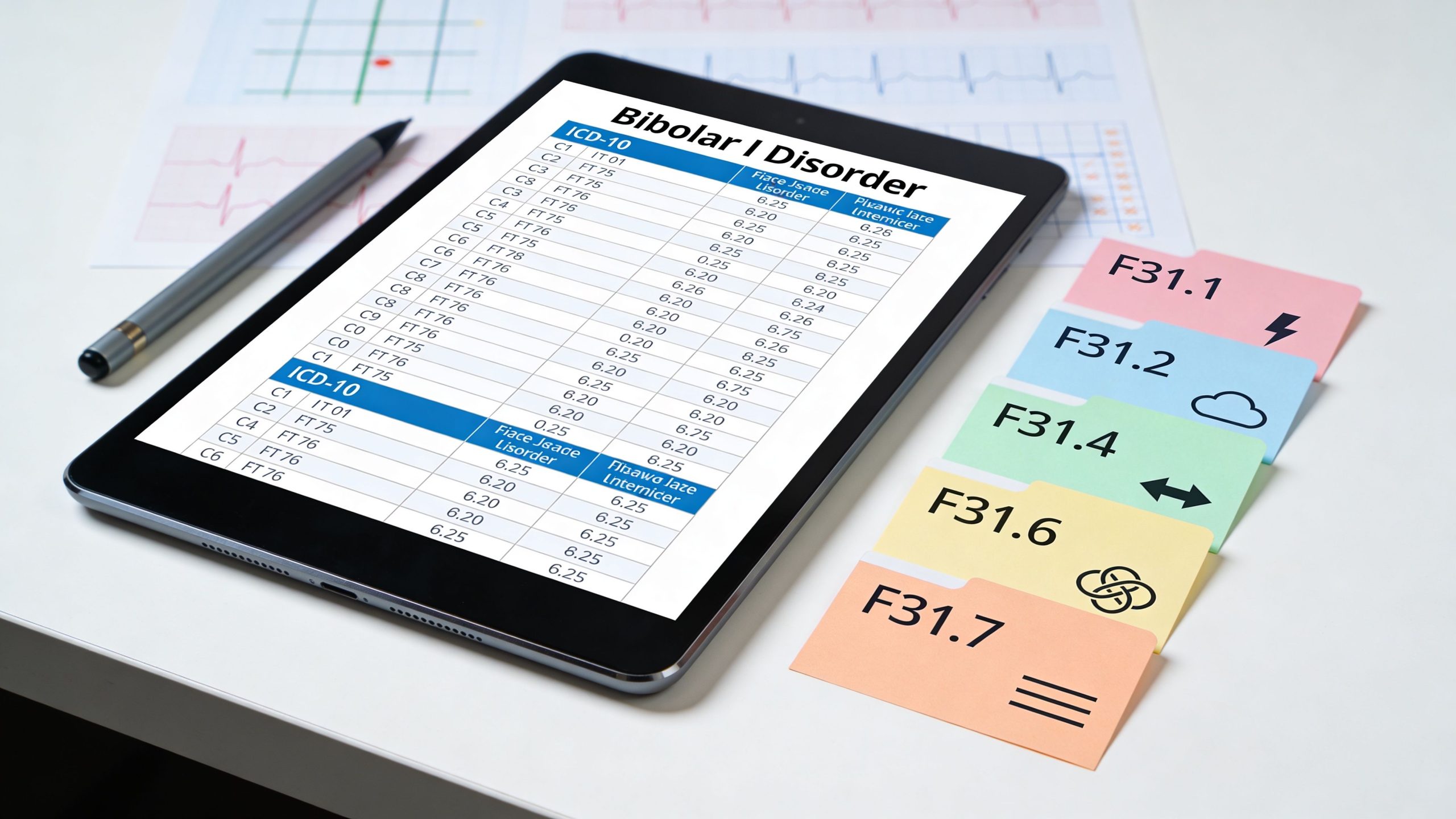
    Quick Reference for Bipolar I Disorder ICD-10 Codes

    When people search for bipolar 1 disorder icd 10, they usually want a quick answer first. The code family most often associated with bipolar affective presentations is F31.

    The pattern is easier to follow when you read it in two parts. F31 points to the broader bipolar category, and the number after it points to the current episode or state being documented.

    A diagram outlining ICD-10 medical codes for different stages and manifestations of Bipolar I Disorder.

    How to read the F31 family

    Some codes focus on a manic phase. Others focus on a depressive phase, a mixed phase, or remission.

    You don’t need to memorise them. You only need enough familiarity to ask informed questions and understand why a clinician chose one code over another.

    Bipolar I Disorder ICD-10 Codes F31

    Code Description
    F31.0 Bipolar disorder, current episode hypomanic
    F31.1 Bipolar disorder, current episode manic without psychotic symptoms
    F31.2 Bipolar disorder, current episode manic with psychotic symptoms
    F31.3 Bipolar disorder, current episode depressed
    F31.4 Bipolar disorder, current episode depressed, severe without psychotic symptoms
    F31.5 Bipolar disorder, current episode depressed, severe with psychotic symptoms
    F31.6 Bipolar disorder, current episode mixed
    F31.7 Bipolar disorder, currently in remission
    F31.8 Other bipolar disorder
    F31.9 Bipolar disorder, unspecified

    What this table can and can’t tell you

    This table is useful for orientation. It can help you understand what the code is pointing to right now.

    It is not enough for self-diagnosis. A person’s notes, symptom history, daily functioning, and clinical interview still matter more than the code alone.

    For concerned family members, one practical takeaway is this. If the code changes over time, that doesn’t always mean the earlier diagnosis was wrong. It may mean the current episode has changed and the record is being updated to match.

    A Detailed Breakdown of Current Episode Codes

    The most confusing part of bipolar coding is usually the phrase current episode. People often assume the diagnosis itself has changed, when the clinician is often documenting the person’s present state.

    That distinction matters because treatment decisions may differ during mania, depression, or mixed symptoms. The same person can move through different coded states over time.

    When the current episode is manic

    A code such as F31.1 points to a manic episode without psychotic features. In everyday terms, the person may be sleeping very little, talking rapidly, feeling unusually energised, making impulsive decisions, or becoming highly agitated.

    In this state, the main concern is often safety and judgement. The care plan may place more weight on psychiatric review, family monitoring, reducing overstimulation, and protecting sleep.

    When the current episode is depressed

    A depressive episode in bipolar disorder can look very similar to what people call depression in everyday conversation. The difference is that the depressive phase sits within a bipolar pattern rather than standing alone.

    That’s why accurate coding matters. A clinician isn’t just saying “this person is depressed.” They’re saying “this depression is happening in the context of Bipolar I.”

    A closer look at F31.32

    F31.32 is used for Bipolar I disorder, current episode depressed, moderate. According to clinical guidance on F31.32 moderate depressed bipolar episode coding, it requires a history of at least one manic episode, plus five or more depressive symptoms for at least two weeks, with impairment that falls between mild and severe.

    That wording can sound abstract, so it helps to make it concrete. A person might still be getting out of bed and attending some responsibilities, but with clear strain. They may show slowed thinking, reduced concentration, low motivation, sadness, or loss of pleasure that meaningfully affects work, family life, or studies.

    Clinical clue: “Moderate” doesn’t mean “not serious.” It means the person is impaired, but the presentation doesn’t fit the most severe end of the range.

    Why severity matters

    Severity language helps clinicians decide how much support is needed. Someone with a moderate depressive episode may need close follow-up, medication management, structured therapy, and support with routine, sleep, and stress.

    A person in a severe episode may need a more intensive response. That could include urgent psychiatric care or hospital-based support.

    When the current episode is mixed

    A mixed episode is especially hard for patients and families to recognise. The person may have features that look both energised and depressed at the same time, which can feel confusing, frightening, and emotionally exhausting.

    Families often say, “We can’t tell what’s happening.” That confusion makes sense. Mixed states don’t fit neat assumptions about either “high mood” or “low mood.”

    Questions worth asking your clinician

    If you see one of these current-episode codes, these questions can help:

    • What symptoms led to this code: Ask for examples from daily life.
    • What level of impairment are you seeing: Work, relationships, self-care, sleep, or safety?
    • Has the episode changed over time: If yes, what signs should the family watch for?
    • What support fits this stage: Therapy, counselling, medication review, routine changes, or emergency planning?

    These conversations often reduce fear. Clear language is part of good care.

    Coding for Remission Psychosis and Other Specifiers

    Some bipolar presentations are harder to capture in one tidy line. People often run into terms like remission, psychotic features, or mixed episodes, and the paperwork starts to feel even more distant from real life.

    These specifiers add detail. They don’t change the person’s humanity, and they shouldn’t increase stigma.

    What remission means

    A code such as F31.7 refers to bipolar disorder that is currently in remission. For many families, this can be one of the most hopeful parts of the coding system.

    Remission means the person isn’t currently meeting the full criteria for an active mood episode. It doesn’t mean they should stop all support. It means the focus may shift toward maintenance, relapse prevention, therapy, sleep stability, and long-term well-being.

    What psychotic features mean

    When clinicians document psychotic features, they’re referring to experiences such as delusions, hallucinations, or major disturbances in reality testing during a mood episode. This can happen in some manic or depressive states.

    This language can sound alarming, and many families fear it means the person is permanently changed. That isn’t what the code means. It describes what is happening during the episode and helps guide treatment intensity and safety planning.

    People deserve careful, non-judgemental care when symptoms include psychosis. Fear and shame make help-seeking harder.

    Why mixed and rapid changes cause confusion

    One of the known gaps in bipolar coding is that mixed episode coding such as F31.6x is often poorly understood by patients, and there is little guidance on how billing or treatment planning changes when someone cycles rapidly between manic and depressive states according to discussion of mixed bipolar coding and rapid shifts in clinical documentation.

    That gap matters in daily life. A person may feel that their mood state changes too quickly to match one stable code, while the record still has to choose something at a given point in time.

    Why your code may change

    A changing code can reflect real changes in the current presentation. It may also reflect a clinician gathering more information over time.

    For patients, this can feel unsettling. Some worry that changing codes mean uncertainty or inconsistency. Often, it means the clinician is documenting the episode more precisely as the picture becomes clearer.

    How to make this easier in practice

    If rapid mood shifts are part of the story, it helps to keep clear notes for appointments. These might include:

    • Sleep pattern changes: Reduced sleep often matters clinically.
    • Energy swings: Very high activation followed by collapse can be important.
    • Risky behaviour or impulsivity: Spending, driving, conflict, or abrupt decisions.
    • Depressive symptoms: Loss of interest, slowed thinking, hopelessness, or withdrawal.

    That record can help therapy and psychiatric follow-up feel more connected to lived experience. It also supports more accurate documentation.

    Understanding Comorbidities and Related Codes

    Bipolar I rarely exists in a vacuum. Many people also struggle with anxiety, poor sleep, relationship strain, substance use, trauma responses, or physical health stress.

    That doesn’t mean the diagnosis is “too complicated.” It means the care plan has to treat the whole person, not just one line in the chart.

    A human silhouette standing amidst swirling translucent circular rings with the text Bipolar I and Anxiety.

    Why more than one code may appear

    A psychiatrist or therapist may document bipolar disorder and also document another condition or concern. That can happen when a person has persistent anxiety, depressive symptoms outside the immediate episode picture, unhealthy coping patterns, or stress-related problems that need their own attention.

    This can improve care. Multiple codes can help explain why someone needs broader support, such as therapy for anxiety, counselling for family stress, or help reducing harmful coping behaviours.

    Common real-life combinations

    Some of the most common patterns include:

    • Anxiety alongside bipolar symptoms: A person may feel both mood instability and ongoing worry, tension, or panic.
    • Workplace stress and burnout: Job pressure can worsen sleep disruption, which can then affect mood stability.
    • Substance use as coping: Some people use alcohol or other substances to manage energy swings, anxiety, or depression.
    • Relationship strain: Partners and families may become distressed by confusion, conflict, or unpredictability.

    If you’re trying to understand how these overlapping issues are treated together, resources on co-occurring disorders can help frame why one person may need integrated support rather than isolated treatment.

    Why holistic care matters

    A narrow approach can miss what keeps the cycle going. If a clinician only looks at mood episodes but ignores chronic anxiety, grief, trauma, sleep loss, or workplace stress, the person may continue to struggle even with the correct bipolar code on file.

    Good care often includes several moving parts:

    • Psychiatric support for diagnosis review and medication planning
    • Therapy or counselling for coping skills, thought patterns, relationships, and resilience
    • Routine building around sleep, meals, activity, and social rhythm
    • Family education so loved ones know what changes to watch for

    A reassuring point

    Seeing more than one diagnosis on a record can feel heavy. But sometimes it’s a sign that the clinician is paying attention to the full picture.

    That can support better well-being, not worse. It can also make treatment feel more validating, because it reflects the fact that people don’t experience life in tidy diagnostic boxes.

    Navigating Healthcare in India with a Bipolar I Diagnosis

    It is a point where paperwork meets real life. In India, families often have to juggle clinical advice, insurance rules, hospital systems, and uneven access to mental health specialists.

    The challenge is that much online coding guidance is written for a very different healthcare environment. That can leave Indian patients and practitioners trying to translate foreign billing language into local realities.

    Why the Indian context feels confusing

    There is a recognised gap here. ICD-10 coding guidance is often primarily applicable to North American billing systems, with limited information for Indian practitioners and patients using local insurance schemes, cross-border telehealth, or resource-limited public health settings, as noted in discussion of ICD coding gaps for India-focused practice.

    That gap affects everyday questions. People want to know whether the code on their file matters for reimbursement, whether a private psychiatrist will write the same diagnosis as a public hospital, and what happens if one provider uses older terminology while another refers to newer classification systems.

    What patients and families can do

    If you’re navigating care in India, a few habits can make the process easier:

    • Ask for the diagnosis in plain language: Don’t leave with only a code.
    • Keep copies of records: Prescriptions, discharge notes, assessments, and follow-up plans matter.
    • Check insurance wording early: Ask what diagnosis language is accepted before assuming coverage.
    • Clarify telehealth documentation: This matters if your clinician is outside your home state or outside India.

    Public and private settings may differ

    Public systems may use shorter documentation and focus on urgent care needs. Private settings may provide more detailed reports, especially if families request them for work leave, academic accommodations, or insurance claims.

    Neither format automatically means the care is better or worse. But the difference can surprise patients who expect all mental health records to look the same.

    Bring a notebook or phone note to appointments. Write down the code, the plain-English explanation, the current episode, and the next-step plan.

    Why this matters for access to care

    A diagnosis code can shape how easily someone gets medicine, therapy referrals, or leave documentation. It can also affect whether a family understands the seriousness of symptoms, especially when the person looks “fine” during brief periods of stability.

    The best approach is practical, not perfectionistic. Ask questions, keep records, and seek clarification early. That can reduce delays and make treatment decisions feel less mysterious.

    How to Seek a Professional Assessment

    If this article sounds familiar, it may be time to speak with a qualified mental health professional. That could be a psychiatrist, clinical psychologist, therapist, or counsellor, depending on the symptoms and the urgency.

    Assessments are informational, not diagnostic unless they’re conducted as part of a formal professional evaluation. Online reading can help you recognise patterns, but it can’t replace clinical judgement.

    A professional in a suit extends their hand toward another person in a supportive therapy setting.

    When to reach out

    Consider professional help if you’ve noticed major changes in mood, sleep, energy, impulsivity, concentration, or functioning. The same applies if a loved one has become unusually activated, withdrawn, hopeless, or hard to recognise.

    Signs that deserve prompt attention include:

    • Marked sleep reduction with high energy
    • Unusual risk-taking or agitation
    • Periods of depression that affect work, study, or self-care
    • Confusion, frightening beliefs, or loss of touch with reality

    What a proper assessment usually includes

    A careful assessment often covers current symptoms, past mood episodes, sleep, family observations, medical history, substance use, and daily functioning. The clinician may also ask about work stress, anxiety, relationship conflict, and previous treatment.

    That depth matters because bipolar symptoms can overlap with other concerns. A good evaluation doesn’t rush.

    For readers who feel unsure where to begin, guidance on finding mental health support can be reassuring because it normalises the process of asking for help and choosing a provider who feels safe and competent.

    Questions to bring to your first appointment

    These can help the conversation feel less overwhelming:

    1. What diagnosis are you considering, and why?
    2. What symptoms suggest bipolar disorder rather than only depression or anxiety?
    3. Do I need therapy, psychiatry, or both?
    4. What signs mean I should seek urgent help?

    A short explainer can also help some families feel less alone:

    What support may look like afterwards

    Treatment may include medication, psychotherapy, counselling, family education, sleep support, and lifestyle work that protects resilience and well-being. Some people also benefit from tracking mood changes, stress triggers, and early warning signs.

    Asking for help is not weakness. It’s a practical step toward steadier care, clearer understanding, and more compassionate self-management.

    Frequently Asked Questions About Bipolar I

    Is Bipolar I the same as Bipolar II

    No. The key difference is the presence of mania in Bipolar I. Bipolar II involves hypomania, which is less intense than full mania.

    This difference affects diagnosis, safety planning, and treatment choices. It’s one reason a professional assessment matters.

    Can someone live a full life with Bipolar I

    Yes, many people build meaningful lives with work, study, relationships, and purpose while managing Bipolar I. The path usually involves ongoing support, self-awareness, and practical care around sleep, stress, therapy, and medication.

    A full life doesn’t mean a symptom-free life every day. It means learning how to protect well-being and respond early when warning signs appear.

    What if I disagree with the diagnosis

    Ask for a clear explanation of the clinician’s reasoning. You can also seek a second opinion, especially if the diagnosis was made in an emergency setting or during a short consultation.

    Bring records if you can. A fuller history often helps clarify things.

    Does a code mean I’ll always have the same symptoms

    No. Codes can change as the current episode changes. Someone may move from a manic or depressive state into remission, and the documentation may change to reflect that.

    That doesn’t mean the clinicians are guessing. It often means they’re updating the record to match the current picture.

    Should I tell my employer or college

    That depends on your needs, privacy preferences, and whether you require accommodations or leave documentation. If workplace stress or study pressure is affecting your well-being, it can help to discuss options with a clinician before deciding what to disclose.

    You don’t have to share every detail to ask for support.

    Can therapy help if medication is also needed

    Yes. Therapy and medication often play different roles. Medication may support mood stability, while therapy can help with coping skills, routine, relationships, anxiety, depression, resilience, and rebuilding confidence after difficult episodes.

    Both can matter. Neither replaces the other in every case.


    If you're looking for a trusted next step, DeTalks can help you connect with therapists, psychologists, and mental health professionals, while also offering confidential assessments for insight and guidance. These tools are designed to support understanding, not to replace diagnosis, and they can be a helpful first step toward therapy, counselling, resilience, and better overall well-being.

  • Respond vs React: Boost Emotional Intelligence

    Respond vs React: Boost Emotional Intelligence

    A message lands in your inbox at 9:12 am. Your manager says your work “missed the brief”. Before you’ve even finished reading, your chest tightens, your jaw sets, and your fingers start typing a defensive reply.

    That split second is where many difficult days begin. It also happens at home, in traffic, during exam season, in a family WhatsApp group, or when a partner says, “You never listen.”

    Most of us know the difference between a calm reply and a sharp comeback. The hard part is living it in real time, especially when stress is already high. In India, the distinction matters because stress and anxiety affect daily life at scale. One cited estimate notes that these concerns are prevalent among 82.7% of India’s population (ananiasfoundation.org).

    Respond vs react isn’t about becoming emotionless. It isn’t about being “nice” all the time, either. It’s about learning how to feel what you feel without letting the first surge of emotion make every decision for you.

    That matters for well-being, for relationships, and for work. It matters when you’re dealing with anxiety, low mood, burnout, or conflict that keeps repeating. It also matters for positive psychology goals like resilience, compassion, gratitude, and a steadier sense of happiness.

    Many articles stop at “just pause before speaking.” That advice can help, but it often falls short for people under chronic pressure. If you’re carrying workplace stress, family strain, or the wear and tear of always being switched on, reacting may not feel like a choice at all. It may feel automatic.

    The Crossroads of a Moment An Introduction

    You’ve had poor sleep. Your commute was draining. Then a colleague questions your idea in a meeting. You smile on the outside, but inside, your body is already preparing for danger.

    A contemplative businessman choosing between reacting impulsively or responding thoughtfully at a workplace decision crossroads.

    In one path, you cut them off, raise your voice, or send a cold follow-up message. In the other, you notice the rush, steady yourself, and say, “I want to understand your concern. Can you say more?” The situation may still be uncomfortable, but it doesn’t spiral in the same way.

    That is the crossroads of a moment. A reaction is fast, hot, and protective. A response is slower, steadier, and more connected to your values.

    What people often get wrong

    Many people think responding means suppressing anger, swallowing hurt, or tolerating disrespect. It doesn’t. You can respond firmly. You can set a boundary. You can disagree clearly.

    Responding is not silence. It’s choosing your next move with awareness.

    Another common confusion is this: if reacting happens quickly, does that mean you’ve failed? No. A reactive impulse is part of being human. The skill is noticing the impulse before it turns into words, tone, or action that you later regret.

    Why this matters in ordinary life

    The issue isn’t only major conflict. Small moments shape your day. A child spilling milk before school. A parent making a critical remark. A delayed payment. A message left on seen. Each one can pull you into an old pattern.

    When that happens often, your nervous system stays tired. Relationships become tense. Work feels heavier. Anxiety and depression can also feel harder to manage when your inner world is constantly in alarm mode.

    A gentler way to think about change

    You don’t need perfect emotional control. You need a little more space between feeling and action. That space is where resilience grows.

    Understanding the Neurological Difference

    Your brain doesn’t wait for a committee meeting when it senses threat. It acts quickly. That’s useful if you need to avoid real danger. It’s much less useful when the “threat” is feedback in a presentation or a partner’s irritated tone after a long day.

    A widely used way to understand respond vs react is this. Reacting involves instantaneous amygdala-driven responses, while responding engages the prefrontal cortex for thoughtful decision-making. The first can become impulsive. The second helps reduce emotional reactivity.

    The brain’s alarm system

    Think of the amygdala as a smoke detector. Its job is to notice possible danger and sound the alarm fast. It doesn’t stop to ask whether the smoke is from a house fire or burnt toast.

    That’s why a small comment can feel much bigger than it is. If your brain reads criticism, rejection, shame, or uncertainty as danger, your body may react before your thinking mind catches up.

    Common signs include:

    • Body changes like a racing heart, shallow breathing, heat in the face, or tight shoulders
    • Mind changes like all-or-nothing thinking, mind-reading, or the urge to defend yourself instantly
    • Behaviour changes like interrupting, snapping, withdrawing, over-explaining, or sending a message too quickly

    The brain’s regulation system

    The prefrontal cortex works more like a calm decision-maker. It helps you weigh context, consider consequences, and choose words that match your real intention.

    This is the part of you that can say, “I’m upset, but I don’t want to make this worse.” It can help you hold two truths at once. “I feel hurt” and “I still want to handle this well.”

    Why high stress makes this harder

    For many professionals, reacting isn’t just a bad habit. It can be the result of a body that has had too many stress signals for too long. Repeated pressure from deadlines, performance reviews, unstable schedules, caregiving, financial strain, or constant availability can make your threat system more sensitive.

    In that state, even neutral interactions may feel loaded. A short email can sound hostile. A delayed reply can feel rejecting. A simple question can feel like an accusation.

    When your nervous system feels unsafe, your mind often starts solving the wrong problem.

    That’s why “just calm down” usually doesn’t work. A stressed nervous system needs help at the physiological level, not only the intellectual level. You may understand emotional intelligence perfectly and still find yourself reacting. Knowledge alone doesn’t always override an activated body.

    Why this matters for resilience

    Resilience isn’t never getting triggered. It’s returning to centre more reliably. The more often you can recognise activation and support your body through it, the easier it becomes to respond with clarity.

    That’s also why therapy and counselling can help. They don’t teach “better behaviour”. They can help you understand your patterns, reduce shame, and build safer internal responses over time.

    A Detailed Comparison of Reacting vs Responding

    The easiest way to understand respond vs react is to place them side by side.

    Criterion Reacting Responding
    Timescale Immediate Paused, even if brief
    Neurological driver Threat alarm takes over Thinking brain joins in
    Emotional state Intense, flooded, urgent Aware, steadier, contained
    Cognitive process Automatic, defensive, narrow Deliberate, reflective, wider view
    Typical outcome Escalation, regret, misunderstanding Clarity, boundary-setting, problem-solving

    A comparison chart showing the differences between impulsive reacting and thoughtful, principle-driven responding in human behavior.

    Timescale and felt experience

    A reaction feels like it happens to you. It’s the urge to reply now, explain now, fix now, attack now, leave now. The speed itself can be a clue.

    A response usually includes a gap. Sometimes that gap is five seconds. Sometimes it’s an hour before you send the message. That pause doesn’t weaken your position. It often strengthens it.

    The pause is not passive. It is where choice returns.

    What drives each pattern

    Reacting is often fuelled by past pain meeting present stress. The current event may be small, but it touches something older. That’s why your response can feel bigger than the moment seems to justify.

    Responding is more grounded in the present. You’re still influenced by your history, of course, but you’re not fully run by it. You can ask, “What is happening right now?” instead of “What does this remind me of?”

    Attention narrows or opens

    In a reactive state, attention narrows. You focus on threat, blame, and self-protection. Nuance disappears.

    In a responsive state, attention opens up. You can notice tone, timing, context, and the other person’s perspective without abandoning your own.

    Outcomes in real relationships

    Reactive behaviour doesn’t stay private. It ripples into conversations, trust, and repair. One cited account notes that reactive behaviours contribute significantly to interpersonal conflicts among youth, linked to a 2021 NIMHANS report.

    That doesn’t mean one person causes every conflict. It means fast, unexamined emotional action can turn a manageable issue into a larger one.

    A simple self-check

    If you’re unsure which mode you’re in, ask:

    • Am I trying to understand, or just to win?
    • Is my body tense and urgent?
    • Will I be comfortable reading this message again tomorrow?
    • Am I speaking from my values, or from my wound?

    If the answer feels uncomfortable, that’s not failure. It’s information.

    Putting It into Practice in Daily Life

    The difference between reacting and responding becomes clearer in ordinary moments. Not dramatic movie scenes. Daily life.

    At work under pressure

    A teammate says in front of others, “This isn’t ready.”

    Reactive path:
    You jump in with, “Maybe if I had proper input from your side, it would be.” The room goes quiet. Later, both of you feel guarded.

    Responsive path:
    You feel the sting, take a breath, and say, “Let’s identify what’s missing so we can close it quickly.” You can still address tone later, but first you stabilise the moment. This is important because workplace stress is already common. One cited reference notes that it affects 38% of Indian professionals in a 2023 ASSOCHAM study on burnout, and reactive patterns can make that strain worse.

    In close relationships

    Your partner says, “You’re always on your phone.”

    Reactive path:
    “You also do the same thing. Why are you blaming me?” The original issue gets buried under counter-attack.

    Responsive path:
    “I can hear that you feel disconnected from me. I’m getting defensive, so let me slow down. What's been hard lately?” The issue stays the issue.

    The second reply isn’t perfect. It’s human. But it keeps the door open.

    In families with strong emotions

    A parent says, “In our time, we didn’t make a fuss about stress.”

    Reactive path:
    “You never understand anything.” The conversation shifts into old hurt and hierarchy.

    Responsive path:
    “I know your generation handled things differently. I’m trying to explain what it feels like for me now.” You’re still honest, but less likely to inflame the exchange.

    With children and teenagers

    A child refuses to get ready for school. A teen answers sharply after a long day.

    Reactive path:
    You raise your voice, lecture, or shame them. They either shut down or push back harder.

    Responsive path:
    You regulate yourself first. Then you say, “We’re both upset. Let’s get through the next ten minutes, then we’ll talk.” This models emotional regulation instead of demanding it.

    During digital communication

    Messages are especially tricky because tone is missing. Stress fills in the blanks.

    A short “Call me” from a boss can trigger panic. A delayed reply from a friend can trigger stories of rejection. Before reacting, consider whether the message contains the meaning your mind is assigning to it.

    A practical rule for daily life

    When emotion is high, reduce speed.

    That may mean:

    • Drafting, not sending an email straight away
    • Taking a short walk before a family discussion
    • Asking one clarifying question before defending yourself
    • Naming your state aloud with “I’m feeling activated, give me a moment”

    These small shifts don’t erase stress, anxiety, or burnout. But they lower the chance that stress will speak for you.

    Actionable Strategies to Shift from Reacting to Responding

    If reacting feels involuntary, start with tools that help your body settle first. Once your body feels safer, your thinking mind becomes easier to access.

    A woman writing in a notebook titled My Plan while thinking about a heart rate line.

    One helpful finding often cited in this area is that a 2022 study in the Indian Journal of Psychiatry found mindfulness-based interventions that taught response over reaction lowered anxiety scores by 45% in participants, as noted in the source referenced earlier.

    Start with the body

    Your body often reacts before language arrives. So begin there.

    1. The 3-breath pause
      Breathe in slowly. Exhale longer than you inhale. Do this three times. Don’t force calm. Just create a small interruption in the stress cycle.

    2. Feel your feet
      Press both feet into the floor. Notice the chair under you or the ground beneath your sandals or shoes. This sounds simple because it is. It can bring attention back to the present.

    3. Soften one muscle group
      Unclench your jaw. Drop your shoulders. Relax your hands. A body that loosens slightly often gives the mind a little more room.

    Use language that buys time

    You don’t need a perfect script. You need one sentence that prevents damage.

    Try phrases like:

    • “I want to respond well, and I need a minute.”
    • “I’m feeling overwhelmed. Can we pause and come back to this?”
    • “I hear your concern. I need a little time to process.”
    • “I don’t want to answer from frustration.”

    These lines work in homes, workplaces, and friendships. They are respectful without being submissive.

    Reframe the first story your mind tells

    Stress often creates instant interpretations. “They’re attacking me.” “I’m failing.” “Nobody respects me.” Those thoughts feel true in the moment, but they may be incomplete.

    Try this quick reframe:

    • First thought: “My manager thinks I’m useless.”
    • Alternative thought: “My manager may be unhappy with this task. That is not the same as my worth.”

    Another one:

    • First thought: “My partner ignored me on purpose.”
    • Alternative thought: “I feel ignored. I don’t yet know their intent.”

    This isn’t fake positivity. It’s balanced thinking.

    Your first interpretation is not always the most accurate one.

    Make your response values-based

    Ask one question before you speak. What kind of person do I want to be in this moment?

    Maybe your answer is calm, clear, self-respecting, compassionate, or boundaried. Let that guide your next sentence.

    If you’re exploring this topic from a gender and socialisation lens, this short piece on emotional intelligence for men offers a useful perspective on how many people are taught to hide vulnerability and react through anger instead.

    Practise after the moment, not only during it

    Most growth happens in reflection.

    Try a simple journal note with three lines:

    • What triggered me?
    • What did my body do?
    • What could I say next time?

    That’s enough. You don’t need pages.

    A short guided video can also help you practise slowing down when emotions spike:

    When “pause and respond” doesn’t work

    Sometimes the advice fails because the nervous system is too activated. This can happen in burnout, chronic anxiety, unresolved trauma, or long periods of relational stress.

    In those cases, try support that is more physiological:

    • Longer exhales to reduce arousal
    • Walking before talking when your body feels trapped
    • Cold water on hands or face to interrupt escalation
    • Co-regulation through sitting with a trusted person before addressing the issue
    • Therapy or counselling to understand recurring triggers and build emotional safety over time

    These supports don’t mean you’re weak. They mean you’re working with your biology instead of fighting it.

    When to Seek Support and How DeTalks Can Help

    Self-help tools can go a long way. But there are times when repeated reactivity points to a deeper pattern that deserves care, not self-criticism.

    Signs it may be time for more support

    Consider professional support if:

    • Conflict keeps repeating in the same form with your partner, family, friends, or colleagues
    • Your reactions feel disproportionate and leave you confused, ashamed, or emotionally exhausted
    • Anxiety, depression, burnout, or stress are making it hard to pause before acting
    • You shut down completely instead of exploding, and that pattern is harming closeness
    • Your body stays on edge even during ordinary conversations

    Seeking help can support relational well-being in a very practical way. One cited reference notes that entrenched reactive patterns fuel a significant number of marital discords in Indian Family Court data from 2022.

    A person receiving comforting physical support while viewing a therapy app on a tablet screen together.

    What support can look like

    Therapy and counselling can help you notice the roots of your pattern. Sometimes the trigger isn’t only today’s argument. It may connect to long-standing stress, earlier experiences of criticism, family dynamics, or a nervous system that has forgotten how to stand down.

    Support can also teach practical skills. Not abstract advice, but body-based grounding, communication repair, emotional naming, and ways to rebuild resilience with less shame.

    If you like learning in a structured way alongside therapy or self-reflection, Anxiety University can be a useful educational resource for understanding anxious patterns more clearly.

    A helpful note about assessments

    Assessments can offer insight into patterns like stress, anxiety, mood, relationship difficulties, or coping style. That can be useful if you’re trying to put words to what’s happening.

    They are informational, not diagnostic. A score or screening result isn’t the whole story. It’s a starting point for reflection, and sometimes for a conversation with a qualified mental health professional.

    You don’t need to wait until things are falling apart to get help. Support can also be part of growth, emotional intelligence, and a more compassionate way of living.


    If you want a supportive next step, DeTalks offers access to therapists, counsellors, and informational mental health assessments that can help you understand patterns around stress, anxiety, relationships, and emotional well-being. If you’re trying to move from reacting to responding, it can be a practical place to begin with more clarity and support.

  • Understanding the Signs of a Drained Mind: 8 Clues to Reclaim Your Well-being

    Understanding the Signs of a Drained Mind: 8 Clues to Reclaim Your Well-being

    In our fast-paced lives, it's common to feel drained, overwhelmed, or just 'off'. We might describe this as 'negative energy', a simple term for a complex mix of emotional, mental, and physical exhaustion. This feeling isn't a personal failing; it's a signal from our mind and body calling for attention and compassion.

    In contexts like India, where community and professional pressures are often intertwined, recognising these signs is the first step toward building resilience and restoring your well-being. This guide reframes 'bad vibes' into understandable psychological signs like stress, anxiety, and burnout. More importantly, it offers insights to help you build self-compassion, improve your mental health, and foster lasting happiness.

    Please remember, this article is for informational purposes to support self-reflection. The assessments mentioned are not diagnostic tools but can be a helpful starting point on your journey toward better well-being.

    1. Persistent Fatigue and Low Energy Levels

    One of the clearest signs of being emotionally drained is a deep, persistent sense of fatigue that sleep doesn't seem to fix. This isn't the normal tiredness after a long day; it's a chronic exhaustion that makes motivation and concentration feel difficult. This heavy feeling can impact everything from your work performance to your interest in daily activities.

    This type of fatigue is often more than just physical; it's a profound emotional and mental drain that can lead to brain fog. The constant exhaustion directly impacts your quality of life and productivity, making it a significant indicator that your emotional well-being needs attention.

    What You Can Do

    If this feeling resonates, taking small, intentional steps can help you understand and manage it. Addressing this sign is crucial for reclaiming your vitality and building resilience.

    • Track Your Energy: For one week, note when you feel most energised and when you feel drained. This can help identify triggers related to specific tasks, people, or even times of day.
    • Implement Grounding Techniques: When you feel overwhelmed, take five minutes for a grounding exercise like a short walk or focusing on your breath. These small actions can help reset your nervous system.
    • Distinguish the Fatigue: Ask yourself if your fatigue feels more physical or emotional. Recognising the source is the first step toward finding the right solution for your well-being.

    Professional Insight: Persistent fatigue can be linked to mental health challenges like depression, anxiety, or burnout. It's your body's way of signalling that its emotional resources are depleted, a common experience with workplace stress.

    If lifestyle adjustments don't bring relief, professional support can help. A therapist can assist you in exploring the root causes of your exhaustion through counselling. For initial insight, an informational burnout or depression screening on DeTalks may be useful, but please remember these assessments are not a diagnosis.

    2. Social Withdrawal and Isolation

    Another key sign of emotional strain is a growing tendency to withdraw from social connections. This isn't about enjoying quiet time alone; it's a consistent pattern of avoiding friends, family, and activities you once found fulfilling. This withdrawal often serves as a protective mechanism against feeling overwhelmed or drained by social interactions.

    A person sits alone on a couch, looking out a window at a blurry group of distant people.

    When you're feeling drained, the effort to be "on" for others can feel immense, leading to cancelled plans and dodged phone calls. This isolation can create a difficult cycle where loneliness deepens negative feelings, making it even harder to reconnect. It's a critical warning sign that your internal well-being needs support.

    What You Can Do

    Re-engaging socially can feel daunting, but starting small can help break the cycle of isolation. Building back your social well-being is a gradual process that requires self-compassion.

    • Set Realistic Goals: Aim for one small, achievable goal, like making one phone call to a friend per week. This avoids the pressure of a packed social calendar.
    • Start Small: Begin with interactions that feel less draining, such as a one-on-one coffee with a trusted friend. This is often more manageable than a large group gathering.
    • Share Your Feelings: If you feel comfortable, consider sharing your feelings with someone you trust. Letting them know you're finding things difficult can foster deeper connection and understanding.

    Professional Insight: Social withdrawal is a common symptom of mental health challenges like depression and anxiety. It's the mind's way of conserving energy, but it can worsen the underlying condition over time.

    If you find it increasingly difficult to break free from isolation, professional counselling can provide a safe space to explore the reasons why. A therapist can help you develop strategies to manage social anxiety and rebuild your support system. For a preliminary understanding, an informational loneliness assessment on DeTalks may offer insights, but it is not a diagnostic tool.

    3. Sleep Disturbances and Disrupted Patterns

    When your mind is burdened by stress or emotional turmoil, your sleep is often the first thing to suffer. This isn't just one restless night; it’s a consistent pattern of disrupted sleep that becomes a clear sign of being overwhelmed. You might struggle to fall asleep, wake up frequently, or sleep far more than usual.

    A young man lies awake in bed at night, unable to sleep, looking up at the ceiling.

    This disruption creates a draining cycle where poor sleep amplifies emotional reactivity, making it harder to cope with daily pressures. An executive battling insomnia due to workplace stress becomes less resilient and more prone to burnout. Similarly, a student with a reversed sleep pattern due to academic anxiety will find their concentration and well-being decline.

    What You Can Do

    Reclaiming your sleep is a powerful step toward restoring your emotional balance. Small, consistent changes can make a significant difference in breaking the cycle of exhaustion.

    • Establish a Sleep Routine: Try to go to bed and wake up around the same time daily, even on weekends. Consistency helps regulate your body's internal clock.
    • Create a Restful Environment: Make your bedroom cool, dark, and quiet. Limit screen time for at least an hour before bed, as the blue light can interfere with sleep.
    • Practise Relaxation Techniques: Before sleeping, try guided meditation or muscle relaxation to calm your mind and release tension. Learning more about methods for enhancing sleep quality can be a crucial step toward restoring balance.

    Professional Insight: Chronic sleep issues are frequently linked to mental health conditions like anxiety and depression. Your inability to rest is often a reflection of your mind's inability to switch off from persistent worry or distress.

    If improving your sleep habits doesn't resolve the issue, it may be a sign that deeper emotional factors need addressing. For an initial understanding, consider completing an informational sleep quality assessment on DeTalks. These tools are not a diagnosis but can provide valuable insights to discuss with a professional offering therapy.

    4. Loss of Interest and Joy (Anhedonia)

    A significant sign of emotional strain is when life starts to lose its colour, an experience known as anhedonia. This is the inability to feel pleasure from activities you once found enjoyable, from hobbies to socialising. It's more than passing boredom; it's a persistent emotional numbness that can make achievements feel empty.

    This loss of interest can be deeply unsettling, as it disconnects you from sources of joy and motivation. A passionate artist might stop painting, or a once-avid reader might find no joy in books. This emotional void is a serious indicator that professional mental health support could be beneficial.

    What You Can Do

    If you’re struggling to find joy, gently re-engaging with life can help. Addressing this emotional numbness is crucial for restoring your sense of purpose and happiness.

    • Practise Behavioural Activation: This therapeutic technique involves scheduling activities, even without motivation. Start small, like listening to one favourite song or taking a ten-minute walk.
    • Keep a Pleasure Log: Note any small moment that brings even a flicker of positive feeling, like the taste of your morning tea. This helps retrain your brain to notice pleasant experiences.
    • Start with Low-Pressure Activities: Choose simple, sensory-based activities like gardening or listening to calming music. The aim is gentle re-engagement, not high achievement.

    Professional Insight: Anhedonia is a core symptom of depression and can be linked to changes in the brain's reward system. It's a sign that your capacity for joy is diminished and often requires professional intervention.

    If this feeling of emptiness persists, it’s a strong indicator that you may need support. A mental health professional can help you explore the underlying causes through therapy. To gain a preliminary understanding, you could consider an informational depression screening on DeTalks, but please remember this is not a substitute for a professional diagnosis.

    5. Negative Self-Talk and Rumination Patterns

    A powerful internal sign of being emotionally drained is a persistent, critical inner voice. This goes beyond occasional self-doubt and becomes a pattern of negative self-talk where you get stuck replaying mistakes or worrying about the future. You might find yourself constantly expecting the worst from small issues, creating significant anxiety.

    This relentless inner critic can feel uncontrollable, damaging your self-esteem and emotional well-being. It is often a symptom of deeper struggles with anxiety, low self-esteem, or perfectionism. This pattern is an internal indicator that your mental state requires attention and compassion.

    What You Can Do

    Interrupting this cycle of negative thinking is essential for improving your mental health and resilience. Taking deliberate steps can help you challenge and reframe these thought patterns.

    • Practise the ‘Best Friend’ Test: When you notice your inner critic, ask yourself: "Would I speak to my best friend this way?" This simple question can highlight the unfairness of your self-talk.
    • Use Thought Records: Keep a journal to log negative thoughts, the situation, the emotion it caused, and then challenge it with a more balanced perspective. This is a core technique in Cognitive Behavioural Therapy (CBT).
    • Observe Without Judgement: Try a mindfulness technique where you notice your thoughts as passing events rather than truths. Labeling them—"I'm having the thought that…"—can create helpful distance.

    Professional Insight: Negative self-talk and rumination are key symptoms of conditions like anxiety and depression. These are learned cognitive habits that can be unlearned with the right therapeutic support.

    If you feel trapped in these cycles, professional counselling can provide effective strategies. A therapist can help you build healthier cognitive habits and improve your overall well-being. For preliminary insight, informational assessments for self-esteem or perfectionism on DeTalks may be helpful, but they do not replace a professional diagnosis.

    6. Physical Tension and Unexplained Aches

    Emotional stress often finds an outlet through the body, a significant sign of being overwhelmed. This can appear as chronic muscle tension, recurring headaches, digestive issues, or other unexplained aches and pains. This is the mind-body connection in action, where your body holds onto unresolved stress.

    These physical symptoms are real physiological responses to prolonged mental and emotional strain. For example, a student might notice migraines intensifying during exams, or an office worker may struggle with neck pain tied to workplace stress. These physical ailments are often a clear indicator that your emotional well-being needs attention.

    A person is massaging their neck and upper back, revealing red irritation marks on the skin.

    What You Can Do

    If you are experiencing unexplained physical discomfort, exploring its potential links to your emotional state is important. Addressing these signs can lead to both physical relief and improved mental well-being.

    • Keep a Symptom Diary: Track your physical symptoms alongside your daily emotional state and stress levels. This practice can reveal patterns connecting pain to particular triggers.
    • Practise Body Scan Meditation: Lie down comfortably and mentally scan your body, noticing areas of tension without judgement. This builds awareness of where you hold stress, which is the first step toward releasing it.
    • Try Progressive Muscle Relaxation: Tense and then release different muscle groups throughout your body. This technique directly addresses physical tension and provides immediate relief.

    Professional Insight: Somatic complaints are the body's way of communicating that your emotional resources are overtaxed. Conditions like stress, anxiety, and trauma often manifest physically when not processed emotionally.

    While it's important to rule out medical causes with a doctor, if symptoms persist without a clear origin, therapy can be valuable. A therapist can help you process the underlying emotional issues contributing to your physical pain. An initial informational assessment on DeTalks could offer insights, but it is not a diagnosis.

    7. Neglect of Self-Care and Personal Boundaries

    A key behavioural sign of being drained is when you start neglecting your fundamental needs and personal boundaries. This is a consistent pattern of deprioritising your own well-being, such as skipping meals, sacrificing sleep, or letting go of hobbies. This self-neglect often goes hand-in-hand with an inability to say ‘no’ to others.

    This erosion of self-care is a clear indicator of emotional depletion and diminished self-worth. When you’re overextended and unable to protect your time and energy, it creates a cycle of resentment and exhaustion. This is a classic sign that your well-being needs to be replenished.

    What You Can Do

    Reclaiming your well-being starts with small, deliberate actions to honour your needs. Addressing this neglect is vital for rebuilding your resilience and protecting your mental health.

    • Create a Non-Negotiable Schedule: Identify one or two self-care activities that are non-negotiable, like a 20-minute walk or a protected lunch break. Schedule them like important appointments.
    • Practise Saying ‘No’: Start with low-stakes situations using simple phrases like, "I can't commit to that right now." This builds the muscle for setting bigger boundaries later.
    • Identify Your Limiting Beliefs: Ask yourself what stops you from prioritising your needs. Recognising beliefs related to guilt or fear of disappointing others is the first step toward challenging them.

    Professional Insight: The chronic neglect of personal needs is a common symptom of burnout, anxiety, and low self-esteem. This pattern can deplete your emotional resources, making you more vulnerable to stress.

    If you find it impossible to set boundaries or prioritise self-care, professional counselling can offer powerful support. A therapist can help you develop assertiveness skills and address the root causes. For a first step, an informational self-esteem or boundary assessment on DeTalks can provide insights, but it is not a diagnosis.

    8. Unhealthy Coping Mechanisms and Avoidance

    A significant behavioural sign of emotional strain is an increased reliance on unhealthy coping mechanisms. This can include excessive drinking, endless screen time, compulsive shopping, or other escapist behaviours. These actions serve as a temporary distraction from emotional pain, stress, or anxiety.

    However, these avoidance strategies often compound the problem by creating new challenges like addiction or financial strain. A professional drinking to numb workplace stress is only masking the underlying issue. This reliance on unhealthy coping is a critical indicator that healthier strategies are needed.

    What You Can Do

    Recognising these patterns is the first step toward developing healthier ways to manage difficult emotions. Taking proactive steps can help you break the cycle of avoidance and build resilience.

    • Identify Your Triggers: Pay attention to what situations or feelings lead you to these coping behaviours. Understanding the trigger is key to finding a better response.
    • Build a Healthy Coping Toolkit: Actively replace unhealthy habits with constructive ones. This could include going for a run when anxious or calling a friend when lonely.
    • Practise Mindfulness: Instead of running from difficult feelings, try to sit with them using simple breathing exercises. This can help you acknowledge the emotion without letting it overwhelm you.

    Professional Insight: Turning to substances or avoidance behaviours is a common response to unaddressed anxiety, depression, or trauma. It's an attempt to self-soothe when healthier coping skills are not yet developed.

    If you are stuck in a cycle of unhealthy coping, seeking professional support is a sign of strength. A therapist can help you explore the underlying emotions driving these actions. For informational insight, an assessment on DeTalks may help you understand your patterns, but please remember it is not a diagnosis.

    8 Signs of Being Emotionally Drained — Comparison

    Indicator 🔄 Implementation Complexity ⚡ Resource Requirements 📊 Expected Outcomes 💡 Ideal Use Cases ⭐ Key Advantages
    Persistent Fatigue and Low Energy Levels Medium — diagnostic workup to rule out medical causes Medium — sleep/energy tracking, primary care, therapy Gradual energy restoration with lifestyle + therapy (weeks) Working professionals, students showing chronic exhaustion ⭐ Early warning sign; recognizable; prompts help-seeking
    Social Withdrawal and Isolation Medium — gradual behavioral reactivation and social skill support Low–Medium — therapy, group programs, social planning Improved mood and connection when re-engaged Grief, loneliness, social anxiety, progressive disengagement ⭐ Clear behavioral marker; reversible with reconnection
    Sleep Disturbances and Disrupted Circadian Rhythms Medium — behavioral interventions (CBT‑I) and possible medical review Medium — sleep tracking, therapy, possible medical tests Often rapid functional gains after sleep improvement Insomnia, reversed schedules, trauma-related nightmares ⭐ Highly measurable; responsive to targeted interventions
    Loss of Interest and Anhedonia High — often requires combined psychotherapy ± medication High — sustained therapy, psychiatric evaluation, behavioral activation Recovery possible but may require multi-modal treatment over months Persistent inability to feel pleasure; major depression ⭐ Strong clinical indicator; treatment-responsive when comprehensive
    Negative Self-Talk and Rumination Patterns Medium — cognitive restructuring and repeated practice Low–Medium — CBT, journaling, therapist guidance Relatively rapid mood gains with consistent CBT techniques Perfectionism, anxiety, low self-esteem, repetitive negative thoughts ⭐ Highly responsive to CBT; concrete tools for change
    Physical Tension and Somatic Complaints Medium — requires integrated medical and somatic assessment Medium — medical evaluation, somatic therapy, bodywork Physical symptom relief with combined mind‑body treatment Stress-related pain, trauma survivors, chronic tension ⭐ Visible symptoms motivate help; somatic therapies effective
    Neglect of Self-Care and Personal Boundaries Medium–High — behavioral restructuring and boundary skills training Low–Medium — coaching, therapy, habit supports Noticeable wellbeing gains when self-care is restored Caregivers, people-pleasers, burnout risk ⭐ Reversible through concrete actions; boosts overall resilience
    Substance Use, Avoidance Behaviors, Unhealthy Coping High — may require intensive, specialized treatment High — addiction programs, therapy, support groups Recovery possible but higher relapse risk; needs comprehensive care Escalating substance use, compulsive escape behaviors ⭐ Clear signal for urgent intervention; many evidence-based treatments

    Your Path Forward: Building Resilience One Step at a Time

    Recognising these signs in your life is a significant first step—an act of self-awareness and courage. Seeing these patterns isn't about finding flaws; it's about listening with compassion to what your mind and body are telling you. The goal is not a life without challenges, but one where you feel equipped to handle them.

    Challenges and moments of sadness are natural parts of the human experience in India and across the world. The objective is to cultivate resilience, developing the inner resources and support systems to navigate these feelings effectively. This prevents them from defining your daily existence and impacting your long-term well-being.

    Taking Actionable Steps Towards Well-being

    The true power lies in turning awareness into conscious action. Start by choosing one or two small, manageable practices to support your well-being. This could be a five-minute mindfulness break to manage workplace stress or dedicating one evening a week to an activity that brings you happiness.

    Exploring a mindful new hobby like embroidery can be a powerful way to ground yourself and shift away from negative thought patterns. The key is consistency, not perfection, on your journey toward better mental health.

    The Strength in Seeking Professional Support

    Remember, you don't have to walk this journey alone. Seeking support is a testament to your strength. While self-help strategies are valuable, professional therapy or counselling provides a safe space to explore the root causes of anxiety, depression, and other challenges.

    This journey toward emotional balance is a continuous process of learning and growing. By acknowledging these signs, you are reclaiming your power to build a more resilient and fulfilling life. Every small step you take is a supportive takeaway and a victory in itself.


    Ready to take the next step towards clarity and support? DeTalks offers confidential online assessments and connects you with qualified therapists across India to help you navigate life's challenges. Visit DeTalks to start your journey towards enhanced well-being today.