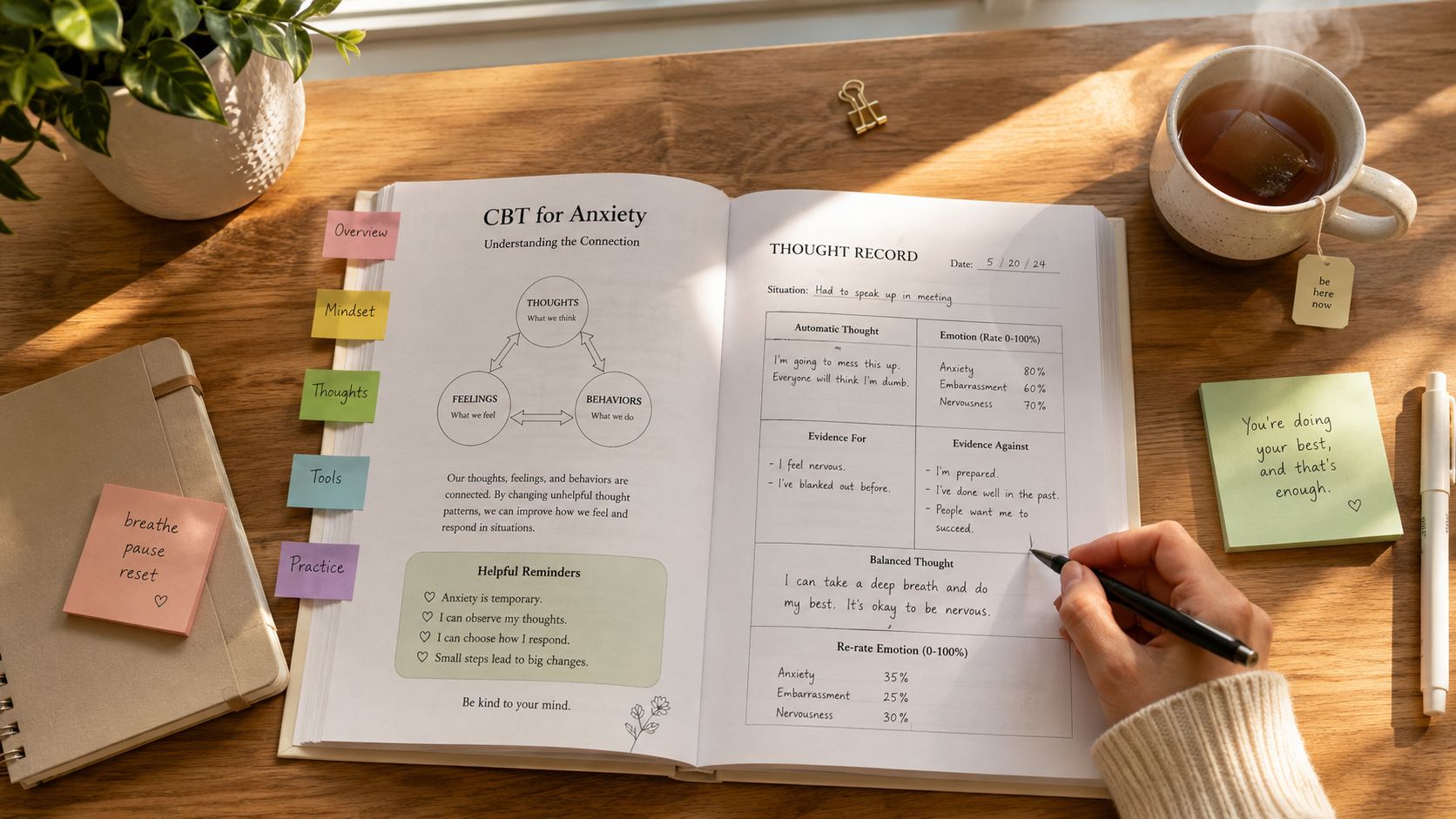
Feeling caught in a loop of worry can make even ordinary days feel heavy. A meeting, an exam, a family conversation, or a stretch of workplace stress can all keep anxiety running in the background. CBT for anxiety worksheets give that worry a place to go, turning vague tension into something you can observe, name, and work through with structure.
These tools are useful because they make therapy ideas more practical. They help with thought records, exposure steps, coping plans, and calming exercises, and they can support well-being, resilience, and steadier routines when life feels crowded.
They are not diagnostic tools. Any assessment or worksheet is informational, not a diagnosis, and deeper anxiety, depression, burnout, or panic often needs professional counselling or therapy support. If you're using self-help, think of it as a guided starting point, not a replacement for care.
For readers who want a broader digital context, a contextual tech CBT guide for parents of children with autism is available here.
1. Therapist Aid
Therapist Aid is one of the easiest places to start if you want CBT for anxiety worksheets that feel polished and practical. The library is broad, and the handouts are laid out in a way that makes them approachable for non-clinicians while still useful in counselling.

Its strength is range. You'll find materials for panic, social anxiety, worry, grounding, exposure basics, and thought-challenging, plus versions for adults and youth and some Spanish resources on the site.
Why clinicians keep recommending it
The worksheets are visually clear and usually step-by-step, which matters when someone is anxious and trying to think straight. That said, some of the more useful resources sit behind a paid plan, and a few tools are introductory enough that people with more complex anxiety may still need therapist guidance.
Practical rule: use Therapist Aid when you want a clean worksheet that helps someone start the work without getting lost in theory.
It fits well for people who want something straightforward to bring into counselling or use between sessions. For deeper patterns, especially when avoidance or panic is strong, it works best as part of professional therapy rather than as a standalone fix.
2. Psychology Tools
Psychology Tools feels more like a therapist's desk than a casual self-help site. The materials are built by clinical psychologists, and that shows in the treatment rationales, assignment style, and the way the worksheets connect to actual CBT methods.
The site works well for structured homework between sessions. That makes it a strong choice for people already in therapy or counselling who need worksheets that match a treatment plan instead of generic printouts.
Where it stands out
The anxiety resources cover psychoeducation, cognitive restructuring, and exposure, and some materials are available in more than one language. The trade-off is simple, though, the best content sits behind a subscription, and the site can feel dense the first time you use it.
- Best for homework between sessions: The format supports practice, review, and follow-through.
- Best for therapist-grade content: The explanations are detailed enough to guide careful use.
- Less ideal for casual browsing: New users may need a little time to find the right resource.
If someone is dealing with chronic workplace stress, repeated worry, or mixed anxiety and low mood, these worksheets can give therapy more structure. They're strongest when paired with guidance, because the content assumes some comfort with CBT language and follow-through.
3. Centre for Clinical Interventions, WA Health
CCI is one of the best free public resources for people who want a full CBT workbook rather than scattered handouts. The modules are specific, orderly, and built around common anxiety presentations like panic, social anxiety, health anxiety, and generalized worry.

The stepwise structure is the reason many practitioners value it. It moves from psychoeducation to cognitive and behavioural skills, then into exposure work, which is the right sequence for many anxiety problems.
A workbook for people who want real depth
CCI's biggest advantage is completeness. The downside is that the PDF layout is plain, so it doesn't feel as friendly as some commercial platforms, and people working alone may want support once the modules become more challenging.
For India-first use, CCI is a strong global benchmark because it gives clear sequencing. That matters when anxiety care is fragmented and people need a path, not just a download.
The best use case is someone who wants to understand the logic of CBT, then practice it in order. It's especially useful if you are trying to build resilience through repeated exercises, rather than hoping one worksheet will solve everything.
4. Get Self Help
Get Self Help is good when you need a fast, no-frills worksheet and don't want to spend ten minutes figuring out a platform. The pages are plain, but the tools are practical, and that suits people who want to start working right away.
Its catalogue includes thought records, worry-cycle tools, behavioral experiments, and coping statements. The materials feel classic, almost old-school CBT, which can be a strength when the goal is clarity.
Best used for quick practice
This site works especially well for people who need a one-page handout to use during the week. If someone is juggling exams, family pressure, or anxiety linked to routine workplace stress, the simple format can lower the barrier to starting.
Useful pattern: choose one tool, use it consistently for a week, then review what changed.
The limitation is that it doesn't go as deep as CCI or Psychology Tools, and the design looks dated. Still, that simplicity can be a plus when a person doesn't want a heavy workbook and just needs a printable task.
It also fits nicely in counselling because the therapist can assign one specific exercise without overwhelming the client. For many people, that is exactly what keeps CBT realistic.
5. Anxiety Canada, MAP and Downloads
Anxiety Canada is a strong free option when you want a guided path instead of random worksheets. The MAP, or My Anxiety Plan, gives structure, and the downloadable tools cover fear ladders, thinking traps, and exposure planning.

The age-appropriate content is useful for adults, youth, and parents. That makes it more flexible than a single workbook, especially when anxiety shows up differently across school, home, and work.
Strong for exposure work
The exposure planning pieces are a real advantage. Many people want help with the fear ladder part but don't know how to sequence steps, and this platform is built to make that process more concrete.
- Best for families and parents: The age-specific approach makes support easier to match.
- Best for step-by-step exposure: Fear ladders and plans reduce guesswork.
- Best for mobile use: The MindShift CBT app extends the same style of support.
The site note that content is not being updated after April 30, 2025 matters, but the materials remain accessible. For users who like structure and don't mind a little navigation, it still offers strong value for self-help and therapy homework.
6. PsychPoint
PsychPoint is a good choice when you want compact worksheets that get straight to the point. The anxiety section is easy to browse, and the PDFs are usually simple enough for quick use in a session or at home.
It's designed for therapists, but the language is reader-friendly. That makes it useful for people who want breathing tools, coping prompts, or worry logs without a lot of extra explanation.
Simple, practical, and easy to print
PsychPoint is best when the goal is action, not theory. A client can print a worksheet, complete it, and bring it back to therapy without spending half an hour learning a system.
The trade-off is depth. Compared with CCI or Psychology Tools, the explanations are lighter, so this is better for brief homework than for a full self-guided programme.
Pop-ups and ads can be a little distracting, but the core content is free and direct. For people managing burnout, rising worry, or early signs of anxiety, that quick format can be more realistic than a large workbook they may never finish.
7. Between Sessions
Between Sessions is a clinician-oriented library with a clear advantage, editable files. That matters when a therapist wants to tailor language, intensity, or examples to a specific client dealing with panic, avoidance, or persistent worry.

The anxiety collections are broad enough for teens and adults, and the editable format makes them especially useful for professional practice. That also means the site feels more commercial than some free public resources.
Best when customisation matters
If a client needs a worksheet rewritten in simpler language, or the therapist wants to swap examples to fit school, family, or job stress, this platform makes that possible. It's less appealing if you just want free downloads, because most of the library is paid.
A key strength is quality control. The materials feel designed for actual therapy work, not just for casual browsing.
For people receiving counselling, these worksheets can be a bridge between sessions. For people trying to self-manage more serious anxiety or depression, they're better used with a qualified professional than alone.
8. PositivePsychology.com Pro Store
PositivePsychology.com sits in a different lane from many worksheet libraries. The packs are polished, structured, and often blend CBT with positive psychology, so they can support not only anxiety management but also compassion, gratitude, and broader well-being work.
The layout is attractive, and the practitioner notes are useful when the worksheet is being used in therapy or coaching. That makes it a strong fit for professionals who want a ready-made pack that still feels thoughtful.
Good design, clear instructions, paid access
The biggest advantage is how usable the materials feel out of the box. The downside is cost, and the site is more coach- and practitioner-friendly than casual self-help users might expect.
This is a smart option if someone wants anxiety support while also building resilience, self-compassion, and happiness skills. That blend can be helpful when fear is tied to low confidence or long-term stress.
- Best for practitioners: The packs are presentation-ready and easy to adapt.
- Best for positive psychology blend: The content supports more than symptom reduction.
- Less ideal for budget seekers: It's a paid store rather than a free library.
Used well, it can support therapy goals around balanced thinking without making the work feel clinical or cold.
9. NHS Inform Anxiety Self Help Guide
NHS Inform is a strong public-health option for readers who want plain-English CBT support with clear safety guidance. It is not a huge worksheet library, but the workbook-style guide is trustworthy and easy to follow.

The exercises focus on thought challenging and behaviour change, which makes the guide especially approachable for first-time users. It also points people toward further help when self-help isn't enough, which is an important part of responsible care.
A good first workbook for cautious users
This is the kind of resource you hand to someone who wants a gentle entry point into CBT. It won't overwhelm them with too many choices, and it gives a sensible structure for starting.
The UK examples are not India-specific, so readers may need to translate the situations into their own life, whether that means exam pressure, family conflict, or office strain. The core CBT ideas still travel well.
For someone who values official guidance and wants reassurance that the material is clinically grounded, it's a strong option. It also works well alongside professional counselling, especially when anxiety is mixed with sleep trouble or low mood.
10. NIMHANS MindNotes
NIMHANS MindNotes stands out because it is India-developed and mobile-friendly. For many readers, that matters as much as the worksheet itself, because a resource is only useful if people can access it and keep using it.
The app-style modules cover managing worry, social anxiety, negative thoughts, and calming and soothing. It also includes a built-in workbook and a way to message professionals for clarification, which is especially helpful when a user gets stuck.
Why it matters for India
This is the most regionally relevant option in the list. India-specific mental health support often needs tools that fit local access patterns, digital habits, and the fact that many people are trying to cope without immediate in-person therapy.
That matters in light of the documented treatment gap in mental health care in India, and it makes MindNotes a practical bridge between self-help and professional support. It's less about pretty PDFs and more about usable, guided progression.
The main limitation is format. People who want printable worksheets may prefer other resources, but those who are comfortable with apps will find the structure helpful.
For resilience, regular practice, and gentle self-monitoring, it's a thoughtful option. It also fits well when someone wants support around anxiety while staying rooted in an Indian context.
Top 10 CBT Anxiety Worksheet Comparison
| Resource / Tool | Core Features ✨ | UX / Quality ★ | Price / Value 💰 | Target Audience 👥 | Standout / USP 🏆 |
|---|---|---|---|---|---|
| Therapist Aid | Printable, visually polished CBT anxiety worksheets (PDF, some Spanish) | ★★★★☆ clinician‑trusted, easy to use | Free tier + premium content 💰 | Therapists & self‑helpers | Widely used, highly polished handouts ✨ |
| Psychology Tools | Therapist‑grade CBT worksheets with treatment rationales + digital assignments | ★★★★★ strong clinical grounding | Subscription for best content 💰 | Clinicians & structured homework | Clinician‑grade materials & rationales 🏆 |
| CCI (WA Health) | Disorder‑specific stepwise CBT workbooks (printable PDFs) | ★★★★★ evidence‑based, thorough | Completely free 💰 | Self‑guided users & clinicians | Comprehensive, public‑health backed modules 🏆 |
| Get Self Help (Get.gg) | Large catalog of quick CBT worksheets & printable cards | ★★★★☆ plain but highly practical | Free 💰 | Quick self‑help & clinicians needing fast tools | Fast print‑and‑use one‑page tools |
| Anxiety Canada (MAP) | Structured MAP modules + age‑tailored worksheets & MindShift app | ★★★★☆ reputable nonprofit content | Free (content access; app free) 💰 | Adults, youth, parents | MAP structure + companion app ✨ |
| PsychPoint | One‑page anxiety tools (coping skills, logs) with printable PDFs | ★★★★ practical, concise formats | Free (ads possible) 💰 | Therapists & self‑helpers for homework | Easy browse; quick skill sheets |
| Between Sessions | Commercial library with editable worksheet files for teens/adults | ★★★★ clinician‑oriented, editable | Paid service; limited samples 💰 | Private clinicians & practices | Editable files for customization ✨ |
| PositivePsychology.com (Pro) | Themed digital packs, practitioner notes, licensing for client use | ★★★★★ high visual & instructional polish | Paid packs (~$29–$35 each) 💰 | Coaches & therapists | Polished, practitioner‑ready packs 🏆 |
| NHS Inform | Concise CBT self‑help guide + downloadable workbook, safety guidance | ★★★★☆ public‑health trustworthy | Free 💰 | First‑time CBT users; UK audience | NHS credibility & clear safety guidance 🏆 |
| NIMHANS MindNotes | Mobile web‑app with modular CBT exercises & progress tracking | ★★★★☆ mobile‑friendly, regionally relevant | Free 💰 | Indian users & self‑paced learners | App‑style modules from NIMHANS ✨🏆 |
Choosing and Using Your CBT Worksheets Effectively
Start small. If you're new to CBT, a psychoeducation worksheet from Therapist Aid or Anxiety Canada is a good first step because it helps you understand the logic before you ask yourself to challenge thoughts or face fears.
For specific problems like exam anxiety, social nerves, or workplace stress, a simple thought record from Get Self Help can be enough to begin. For more structured work, CCI is hard to beat because it gives you a clear order, from understanding the problem to practicing skills and exposure.
What matters most is consistency. The review evidence on internet-based CBT shows that uptake can vary widely, and adherence is tightly linked to better outcomes, so a short worksheet used regularly is more valuable than a perfect workbook left untouched. That is why therapist or coach prompts can make such a difference, especially when self-help is paired with counselling.
A useful pattern is to match the worksheet to the symptom. Use thought records for spiralling worry, exposure ladders for avoidance, calming logs for physical anxiety, and behavior plans when you're pulling away from life. If your anxiety is mixed with low mood, burnout, or patterns that feel too big to handle alone, professional therapy can help you sequence the work safely.
For Indian users, the biggest advantage is choice. You can use a global resource like CCI or NHS Inform, then move to a regionally relevant tool like NIMHANS MindNotes when you want something closer to home. That mix is often the most realistic way to build well-being, compassion, and resilience without getting stuck in generic self-help.
If the worksheet starts to feel overwhelming, stop and scale back. Good CBT is usually steady, not dramatic, and the goal is better coping, clearer thinking, and more room for everyday happiness.
If you want guided support alongside these CBT for anxiety worksheets, DeTalks can help you connect with qualified therapists and counsellors who understand anxiety, stress, burnout, and personal growth in the Indian context. Visit DeTalks to find professional support that fits your needs and to choose the right next step with confidence.