Tag: therapy techniques

  • The Power of Visualization: A Guide to Mental Well-being

    The Power of Visualization: A Guide to Mental Well-being

    Somewhere in India right now, a professional is staring at an unread email, a student is reopening the same chapter for the fourth time, and a parent is trying to stay patient after a long day. The body feels tight, the mind races ahead, and even simple decisions start to feel heavy.

    In moments like this, people often hear advice such as “think positive” or “manifest what you want.” That can sound comforting, but it can also feel vague, frustrating, or even unfair when you're already dealing with anxiety, low mood, or workplace stress.

    There is, however, a more grounded way to understand the power of visualization. Used carefully, visualization can become a practical mental skill that supports well-being, strengthens resilience, and sometimes works alongside therapy and counselling. It isn't magic, and it isn't a substitute for professional help. But for many people, it's a gentle way to create a little more calm, clarity, and self-compassion.

    Reclaiming Your Calm in a World of Stress

    Riya works in a private company in Bengaluru. Her day begins with commute traffic, continues with back-to-back calls, and ends with a tired mind that still won't switch off. At night, she replays mistakes, worries about tomorrow's targets, and tells herself she should be coping better.

    That experience isn't unusual. A 2023 ASSOCHAM study revealed that nearly 42.5% of employees in private sector organisations in India report experiencing stress-related issues, which points to a serious gap in workplace stress support and prevention, as noted in this discussion of stress among Indian employees.

    For some people, stress shows up as irritability. For others, it becomes headaches, poor sleep, self-doubt, or a sense of emotional numbness. Over time, that strain can affect resilience, relationships, concentration, and joy.

    What calm can look like

    Visualization starts with a simple idea. Your mind can practise safety, steadiness, and focused action before your day asks you to deliver them.

    It may be as basic as sitting for a few minutes and picturing a calmer version of the next hour. You imagine your breathing slowing, your shoulders softening, and yourself responding to a difficult message with clarity instead of panic.

    Practical rule: Visualization works best when you treat it as a skill, not a test. You're not trying to “do it perfectly”. You're giving your mind a more helpful path to follow.

    Many people pair mental practices with physical support. If stress leaves you feeling wired and depleted, you may also want to support calm with diet so your routines, meals, and rest work together rather than against each other.

    Why this matters in everyday life

    When life feels noisy, the nervous system often stops distinguishing between a real emergency and an ordinary challenge. A meeting, an exam, or a family conversation can begin to feel threatening.

    Visualization gives you a pause between trigger and reaction. In that pause, you may find a little more patience, a little more emotional balance, and a little more room for hope. That's not a cure for depression or severe anxiety, but it can be one meaningful part of self-help and emotional care.

    What Visualization Is and What It Is Not

    Some people hear the word visualization and think of wish-making. Others think it means staring at a vision board and waiting for life to change. That misunderstanding is common.

    Visualization is intentional mental rehearsal. You create a clear inner picture of an experience, action, or emotional state, and you engage with it on purpose. You aren't escaping reality. You're preparing your mind and body to meet reality differently.

    A diagram comparing visualization as intentional mental rehearsal versus passive daydreaming or magical wishful thinking.

    The architect blueprint way to understand it

    Think of an architect before construction begins. The building isn't there yet, but the plan is detailed, organised, and tied to action. The blueprint doesn't magically create the building. It guides the work.

    Visualization works in a similar way. You mentally rehearse what you want to do, how you want to feel, and what steady behaviour looks like under pressure.

    Here is the key difference:

    Approach What happens What it usually leads to
    Visualization You rehearse a specific situation with intention More focus, emotional preparation, clearer next steps
    Daydreaming Thoughts drift without direction Temporary escape, but not much structure
    Magical wishful thinking You hope the image alone will change reality Disappointment if action and support are missing

    What it includes

    Good visualization usually has a few ingredients.

    • A clear scene: You picture one situation, such as entering an interview room or settling yourself before sleep.
    • Sensory detail: You notice what you see, hear, and feel. The chair beneath you, the tone of your voice, the pace of your breathing.
    • Emotional direction: You don't only imagine success. You imagine steadiness, compassion, and recovery if something goes wrong.
    • Real action: You connect the inner rehearsal to an outer step, such as studying, attending counselling, or preparing your notes.

    This is why the popular “law of attraction” version only tells part of the story. Focusing on an outcome may feel motivating, but evidence-based visualization is more practical. It isn't “I picture it, so it must happen.” It's “I rehearse it, so I can respond with greater skill.”

    Why visuals help people understand hard things

    Visual thinking helps people make sense of complexity. In India, the Viz Chitra conference, the first national data visualization gathering, highlighted the commitment to using visual tools to retrieve key values from massive datasets and derive actionable insights for decision-making, as discussed in this Viz Chitra talk.

    That same human strength applies inwardly. When thoughts are messy or feelings are hard to name, an inner image can make the experience easier to understand. A calm room, a rooted tree, or a confident version of yourself can become a mental map when words feel too far away.

    Visualization isn't about pretending you have no fear. It's about giving fear less control over what you do next.

    The Science of Seeing With Your Mind

    The scientific appeal of visualization comes from a simple idea. The brain often responds to vivid mental rehearsal in ways that overlap with real experience.

    Researchers describe this with the term functional equivalence. In plain language, that means imagining an action can activate some of the same brain systems involved in doing that action. According to Dr. Srini Pillay's discussion of visualization and brain function, mental imagery stimulates motor cortex regions and prefrontal decision-making areas, and practice with high clarity, emotional intensity, and repetition over 10 weeks was linked with 17–22% improvement in real-world task performance.

    A man visualizing his goals represented by a glowing brain and a holographic version of himself.

    Why the brain responds so quickly to images

    Human beings are strongly visual. The brain can often take in an image faster than a paragraph of explanation, which helps explain why mental pictures can shape emotion so quickly.

    One source summarising the neuroscience of visual processing notes that 90% of all information transmitted to the brain is visual, that the brain can process an entire image in 13 milliseconds, and that this is nearly 60 times faster than reading text. The same source also reports that data visualization can cut meeting time by up to 24%, showing how visual clarity can speed understanding and decision-making in practical settings, according to this article on the power of data visualization.

    This doesn't mean every image in your mind is useful. Distressing images can intensify fear. But guided, intentional imagery can help the brain rehearse safety, confidence, and self-regulation.

    What this looks like in mental health care

    The most encouraging part is that visualization isn't limited to sports or productivity. It has begun to show clear relevance in clinical settings too.

    A pilot study by India's National Institute of Mental Health and Neurosciences in 2024 demonstrated that guided visualization therapy reduced anxiety scores by 34% in 120 patients with trauma disorders using 15-minute daily sessions. That matters because it places visualization in a real Indian mental health context, not just in pop psychology language.

    For readers who learn better through visual explainers, short educational content can also help make these ideas less intimidating. Some creators now create AI psychology videos easily to explain concepts like mental rehearsal, coping skills, and emotional regulation in a more accessible format.

    What people often get wrong

    A common misunderstanding is that visualization “tricks” the brain. A better way to say it is that rehearsal shapes familiarity.

    When the mind has already practised a hard moment, the body may react with slightly less alarm when that moment arrives. You're not eliminating stress. You're reducing surprise and building a steadier response.

    Here are three realistic effects people may notice:

    • Less anticipatory panic: A meeting or exam still matters, but it may feel less overwhelming.
    • More emotional organisation: Feelings become easier to notice without instantly acting on them.
    • Greater follow-through: Rehearsing a behaviour can make it easier to begin that behaviour in real life.

    If a visualisation leaves you feeling more distressed, stop and return to the present. A grounding exercise, a conversation with a trusted person, or professional support may be more helpful at that moment.

    Your Guide to Practical Visualization Exercises

    The most helpful visualizations are simple enough to repeat. You don't need incense, perfect silence, or a “special talent” for mental imagery. You need a few minutes, a bit of patience, and permission to keep it imperfect.

    Start by sitting or lying down in a position that doesn't strain your body. Let your breathing slow naturally. If images don't come easily, use words, sensations, or memories instead. That still counts.

    A six-step guide infographic titled Practical Visualization Exercises outlining techniques for mental focus and relaxation.

    Exercise one for a safe place

    Use this when anxiety feels high, your chest feels tight, or your thoughts won't slow down.

    1. Settle first. Place one hand on your chest or lap. Notice the support under your body.
    2. Choose a place. It may be a beach in Goa, a quiet room from childhood, a hillside, a temple courtyard, or a place you've never visited but can imagine.
    3. Add sensory detail. What colour is the sky. What sounds are nearby. Is the air warm, cool, dry, or humid.
    4. Add protection. Notice what makes this place safe. A locked door, soft light, trusted people nearby, or complete privacy.
    5. Create a cue. Pick one word for this place, such as “steady” or “home”.
    6. Return slowly. Open your eyes and look around the room. Bring the cue word with you.

    If you're someone who says, “I can't visualise clearly,” don't get stuck there. Focus on what the safe place feels like in your body. Relief, softness, warmth, space. Those signals matter.

    Exercise two for success rehearsal

    This one helps before a presentation, interview, exam, difficult conversation, or medical appointment. It supports confidence, but not by pretending nothing can go wrong.

    See yourself moving through the event one step at a time. You arrive. You sit down. You breathe once before speaking. If your mind goes blank, you pause, look at your notes, and continue.

    That middle part is important. Effective visualization doesn't only show the perfect ending. It also rehearses recovery.

    • Before an interview: Picture yourself greeting the panel, listening fully, and answering at a steady pace.
    • Before an exam: See yourself reading each question carefully, starting with what you know, and returning to harder questions without spiralling.
    • Before a meeting: Picture one calm sentence you want to say clearly.

    A useful check: End every success rehearsal with one real-world action. Revise the chapter. Print the document. Practise the opening line aloud.

    A short video can also help if you'd like a guided pace while learning the rhythm of this practice.

    Exercise three for self-compassion

    Many people can imagine achievement more easily than kindness. Yet compassion is often the missing piece when someone is dealing with burnout, self-criticism, or low mood.

    Bring to mind a version of yourself who is struggling. Perhaps it's you after a hard workday, after conflict at home, or during a period of depression symptoms. Now picture a compassionate presence beside that version of you. It could be an older wiser self, a mentor, a caring friend, or a gentle light.

    Then add a few phrases in your own words.

    • You are having a hard moment.
    • You don't have to carry it alone right now.
    • You can take one small step.
    • You still deserve care.

    This exercise can feel emotional. If tears come, that doesn't mean you're doing it wrong. It may mean your mind is finally meeting you with gentleness.

    Small habits that make the practice stick

    Visualization becomes more useful when it is woven into ordinary routines.

    When to practise A simple use
    Morning Rehearse one grounded behaviour for the day
    Before work or study Visualise starting with focus rather than avoidance
    After a stressful event Imagine your body releasing tension and returning to safety
    Before sleep Use the safe place exercise instead of replaying worries

    People often ask how long to practise. Keep it short enough that you will do it. Consistency matters more than intensity.

    Visualization in Action Across Life and Therapy

    Arjun is a university student in Pune. During exams, he knows the material, but his body doesn't cooperate. His hands get cold, his thoughts become scattered, and one difficult question can ruin the next half hour.

    He begins using visualization the night before each paper. He sees himself entering the hall, feeling nervous but steady enough to begin. He imagines reading the first page slowly and letting one hard question stay hard without turning it into a verdict on his future. The exam doesn't become easy, but he becomes less chaotic inside it.

    In the workplace

    Meera leads a team and dreads high-stakes presentations. Her fear isn't only about public speaking. It's also about being judged, forgetting a number, or seeing someone look unimpressed.

    Her counsellor encourages a more realistic rehearsal. Meera doesn't imagine a flawless talk. She imagines a pause, a sip of water, a quick glance at notes, and a return to her main point. That shift matters because confidence often grows from recovery, not perfection.

    In therapy rooms

    In therapy and counselling, visualization can support emotional processing when words feel too blunt or too fast. A therapist may guide someone to imagine a container for distressing thoughts, a safe place to return to, or a calmer future conversation with a family member.

    Used well, this can help people approach difficult feelings in smaller, safer steps. It can also strengthen compassion, grief processing, and the ability to notice internal states without immediate panic.

    Some people don't need a more detailed memory. They need a safer distance, more choice, and a way back to the present.

    In advanced clinical care

    At the more specialised end of mental health treatment, visualization is also connected to emerging neurotechnology. Advanced image reconstruction from brain signals, a neurotechnology enabling clinicians to visually decode traumatic memories, has shown 31% higher efficacy in treatment personalization for PTSD in Indian psychiatric trials compared to standard cognitive-behavioural therapy, according to this review of brain-signal image reconstruction and related clinical applications.

    For everyday readers, this doesn't mean a new device is the answer to every mental health struggle. It means visual processes are being taken seriously in clinical science. The gap between “self-help imagery” and professional mental health work is smaller than many people assume.

    Across everyday life

    Visualization can also support positive psychology, not just symptom relief. People use it to rehearse patience before a family discussion, gratitude before bed, or courage before asking for help.

    That matters because well-being isn't only the absence of distress. It also includes connection, meaning, compassion, and the ability to return to yourself after hard moments.

    Integrating Visualization Safely Into Your Well-being Routine

    The strongest approach is also the kindest one. Use visualization as a support, not as pressure.

    If a practice leaves you calmer, more focused, or more compassionate, keep it simple and repeatable. If it makes you feel trapped, flooded, detached, or more distressed, stop. A grounding exercise or professional conversation may be the better next step.

    An infographic titled Visualization: Benefits & Boundaries, comparing pros like mental rehearsal and cons like not therapy.

    When self-guided practice may help

    Visualization often fits well into a broader self-care routine when you're dealing with manageable stress, confidence dips, or emotional overload from everyday life.

    • For workplace stress: Rehearse a difficult call, presentation, or boundary-setting conversation.
    • For emotional balance: Use a safe-place exercise after conflict or overstimulation.
    • For resilience and happiness: Practise compassionate imagery, gratitude scenes, or a steady future self.

    Some people also like to shape their environment so it supports calm. Something as small as changing your screen background can become a visual cue for rest, and resources like the cozy aesthetic for your desktop can help create a gentler digital space.

    When you shouldn't rely on it alone

    Visualization is not therapy on its own. It shouldn't carry the full weight of severe anxiety, trauma reactions, persistent depression, panic, or overwhelming intrusive imagery.

    Be especially careful if:

    • Images become more disturbing: Some people find that closing their eyes increases distress rather than easing it.
    • You feel detached from reality or your body: In that case, grounding may be safer than imagery.
    • You're using it to avoid action: Rehearsal helps most when it leads to support, boundaries, rest, treatment, or problem-solving.
    • You have trauma symptoms: Guided imagery may need the structure of a trained therapist.

    A useful principle is this. If the practice helps you engage with life, it may be supportive. If it pulls you away from life, it may need adjustment.

    Why professional support still matters

    India has a large mental health need. The National Mental Health Survey 2016 found a weighted lifetime prevalence of any mental illness of 13.7% and a current prevalence of 10.6% across 12 states, as summarised in this report on mental stress and mental illness prevalence in India.

    At the same time, visualization hasn't yet been fully integrated into routine care. A 2025 national survey by the Indian Psychiatric Society found that only 12% of mental health professionals in India routinely incorporate visualization into treatment plans, highlighting a gap between self-help interest and clinical use, according to this discussion of visualization and clinical care gaps.

    That gap doesn't make the practice weak. It means people should approach it wisely. If you use self-assessments to reflect on stress, burnout, or mood, remember that assessments are informational, not diagnostic. They can point you towards support, but they can't replace a qualified mental health professional.

    Start small. Stay gentle. If you need more than a self-help tool can offer, reaching for therapy or counselling is a strength, not a failure.

    The power of visualization is real, but it's most helpful when it stays grounded. Use it to build steadiness, not to blame yourself for struggling. Use it to support action, not to escape reality. Use it as one caring part of a larger routine that may also include sleep, movement, relationships, reflection, and professional help.


    If you're looking for trusted support in India, DeTalks can help you find therapists, psychologists, and mental health professionals, explore science-backed assessments for insight, and take a thoughtful next step towards better well-being, resilience, counselling support, and emotional clarity.

  • Active Listening Skills: Improve Your Connections 2026

    Active Listening Skills: Improve Your Connections 2026

    You're likely reading this after a conversation that didn't go well. Maybe a manager cut you off in a meeting, a partner replied with advice when you wanted comfort, or a friend nodded along while clearly thinking about something else.

    That experience can leave you feeling small, tense, and oddly lonely. It can also make workplace stress, anxiety, and relationship strain feel heavier than they already are.

    The good news is that active listening skills can be learned. You don't need a perfect memory, a therapist's office, or a naturally calm mind to begin. You need a few simple habits, steady practice, and a kinder understanding of what listening is.

    More Than Just Hearing The Art of Listening

    Riya is on a video call with her colleague after a long day. Her internet lags, her phone keeps buzzing, and she is trying to explain why she has fallen behind on a project. Before she finishes, he starts offering fixes. The suggestions may be useful, but the moment still feels flat. What she needed first was space, attention, and a sense that someone had understood the pressure she was under.

    That moment is common in modern Indian life. It happens in offices, family WhatsApp calls, college group projects, and tele-therapy sessions. Many people are listening with half their attention because another tab is open, a notification has flashed, or their own stress is already running in the background.

    A professional woman having a productive conversation with a male colleague in a bright, modern office.

    Active listening means receiving more than words. You are noticing the message, the feeling under it, and the response the speaker may need right now. Sometimes they want help solving a problem. Sometimes they want reassurance. Sometimes they need a few extra seconds to find the right words.

    Listening changes conversations because it helps people feel safe enough to say what they mean. It also reduces confusion. People often remember only part of what they hear, especially when they are distracted, emotional, or mentally rehearsing a reply. That is why two people can leave the same conversation with different stories about what happened.

    This matters even more during stress. Anxiety narrows attention. Workplace pressure pushes the brain into problem-solving mode. In tele-therapy or online counselling, the challenge can be sharper because facial expressions are easier to miss, pauses can feel awkward, and technical glitches interrupt the natural flow. Good listening acts like a steady hand on a shaky camera. It helps the picture come into focus before anyone tries to interpret it.

    Why listening changes so much

    Listening is an active form of care. It helps people learn, connect, regulate emotion, and work through conflict with less friction.

    In practice, good listening often has a simple effect. The other person feels less alone and more clear about what they are saying. A manager gets better information. A partner feels less dismissed. A therapist or counsellor can understand your experience more accurately. Even in a short phone call, being heard can lower tension enough for a better conversation to happen.

    Practical rule: If the other person seems clearer, calmer, or more open after speaking with you, your listening probably helped.

    A small shift in mindset

    Many people assume active listening means staying quiet for a long time or agreeing with everything they hear. It means understanding first.

    A camera lens works the same way. If the focus is off, the whole scene looks distorted. Listening brings the image into focus before you respond, advise, reassure, or disagree.

    That shift sounds small, but it changes everything. Instead of rushing to fix, defend, or explain, you slow down enough to understand the person in front of you, or the person on the screen. For someone dealing with anxiety, grief, burnout, or everyday overwhelm, that pause can feel like relief.

    The Five Core Skills of Active Listening

    The easiest way to learn active listening skills is to break them into parts. You don't have to do everything perfectly at once. Most strong listeners are using a few dependable habits in a consistent way.

    A useful visual can make these habits easier to remember.

    A professional infographic illustrating the five core skills of active listening with icons and brief descriptions.

    Skill one and two paying attention and withholding judgment

    Paying attention is the base of everything else. If your mind is split between the speaker, your phone, and your to-do list, you won't hear the full message. In simple terms, this means facing the person, reducing distractions, and letting them finish.

    Withholding judgment comes next. This doesn't mean you must agree. It means you pause your internal verdict long enough to understand what the person is saying. It's like setting down a heavy bag before opening a door. Your assumptions can block the conversation before it even starts.

    People often miss this point. They think listening means waiting politely for their turn. Real listening means suspending that inner courtroom for a moment.

    Skill three and four reflecting and clarifying

    Reflecting means saying back the gist of what you heard in your own words. A simple line such as, “It sounds like you're upset because the plan changed at the last minute,” can do a lot. It helps the speaker feel seen, and it gives them a chance to correct you if needed.

    Clarifying means asking open questions that invite more than a yes or no answer. Good examples include, “What part of that felt hardest?” or “What would support look like right now?” These questions open doors instead of shutting them.

    Here's a quick teaching video that shows these habits in action.

    Skill five summarising and nonverbal cues

    The infographic names summarising, and it deserves its own place. Summarising is a brief recap of the key points near the end of a conversation. It's especially helpful in workplace discussions, counselling sessions, or emotionally loaded family conversations because it reduces confusion.

    Nonverbal cues also matter, even though people often forget them. Eye contact, an open posture, a calm tone, and small nods can show care without interrupting. In digital spaces, where body language is limited, your tone, pacing, and written responses do more of this work.

    Skill What It Is Why It Helps
    Paying attention Giving the speaker your focus It reduces missed details and shows respect
    Withholding judgment Pausing assumptions and quick opinions It creates safety and lowers defensiveness
    Reflecting Paraphrasing what you heard It checks understanding and helps the speaker feel heard
    Clarifying Asking open questions It brings out meaning, context, and emotion
    Summarising Recapping the main points It improves memory, alignment, and next steps

    Good listening often sounds simple. “So what I'm hearing is…” can prevent a surprising amount of confusion.

    The Transformative Benefits in Your Daily Life

    Your phone is buzzing. A manager is waiting for a reply. A parent is calling. Your own mind is already full. In moments like this, listening can feel like one more task. But good listening often lowers pressure instead of adding to it. It gives a conversation some breathing room.

    That matters in ordinary life. It matters in tele-therapy sessions where a screen can make connection feel thinner. And it matters when stress or anxiety makes your attention jumpy.

    In therapy and counselling

    In counselling, listening helps people feel safe enough to say what they have been holding in. That safety is not a small thing. It is often the ground that honest conversation stands on.

    This is especially relevant in tele-therapy. On a video call, you may miss small cues like posture shifts or changes in breathing. On audio-only calls, the listener has to rely even more on tone, pauses, pacing, and careful reflection. A calm summary such as “It sounds like this week felt heavy, and you were trying to cope on your own” can work like a handrail on a staircase. It gives the speaker support without taking over.

    If you are the client, active listening matters for you too. You may need to listen to your own reactions, notice when anxiety makes you shut down, and ask for clarification when something feels unclear. In many Indian homes and workplaces, people are taught to stay polite, keep moving, and not burden others. Therapy often asks for the opposite. Slow down. Name what is hard. Let someone stay with you in it.

    At work and in study life

    Listening changes the emotional climate of a workplace or classroom. When people feel heard, they often become less defensive and more willing to share concerns early, before small problems turn into bigger ones. As noted earlier, stronger listening at work is linked with better collaboration, fewer avoidable mistakes, and healthier team communication.

    Stress is common and often hidden. For instance, in India, approximately 15% of the working population suffers from workplace stress, and fewer than 10% of those affected seek professional therapy or counselling due to stigma and lack of access, according to https://agenciacomma.com/en/communication-training/active-listening/.

    For students, the picture can also be heavy. A 2023 NIMHANS study found that 37% of Indian university students reported clinically significant anxiety and 24% reported symptoms of depression, yet only 12% had accessed therapy or counselling, according to https://www.tandfonline.com/doi/full/10.1080/10904018.2013.813234.

    If you live with anxiety, listening can get harder under pressure. Your brain starts scanning for threat, rejection, or the next problem to solve. In a meeting, you may hear one critical phrase and miss the next five useful sentences. In an online class, you may look attentive while your mind is racing. This does not mean you are bad at listening. It means your nervous system is busy protecting you. A short pause, one steady breath, and a simple check-in question can help you return.

    In close relationships and recovery

    At home, listening often works like lowering the flame under a boiling pot. The problem may still be there, but the conversation becomes less likely to spill over.

    This is why active listening helps during conflict, caregiving, and recovery. A partner may not need a solution in the first minute. A teenager may be testing whether you will judge them before they tell the full story. A family member in recovery may hear advice as control unless it comes with patience and respect first.

    That is especially relevant in families healing from conflict, secrecy, or broken trust. If you're working through recovery at home, this guide on repairing family ties after substance abuse offers useful support for conversations that need patience, boundaries, and compassion.

    Listening will not fix every situation by itself. It does something quieter and often more useful first. It helps people feel steady enough to speak openly, hear each other clearly, and respond with more care.

    Your Four Week Plan to Become a Better Listener

    Improvement happens faster when practice is small and regular. You don't need long exercises. A few minutes a day can reshape how you show up in conversations.

    This plan works well for personal relationships, virtual meetings, therapy settings, and ordinary daily chats.

    A structured four-week plan infographic designed to help individuals improve their active listening skills through daily practices.

    Week one awareness and presence

    For one week, don't try to fix your listening yet. Just notice it.

    In one conversation each day, put your phone away and focus only on the speaker for one minute. Notice when your mind wanders. Notice when you feel the urge to interrupt, advise, or tell your own story.

    At the end of the conversation, ask yourself:

    • What distracted me most: My thoughts, my device, or the environment?
    • When did I stop listening: Was it after a trigger word, a complaint, or a pause?
    • What helped me return: Eye contact, a breath, or repeating the speaker's last point?

    This week builds awareness. You can't improve a habit you never catch in the moment.

    Week two nonverbal cues and emotional tone

    Now shift your attention to what isn't being said directly. Look for facial expression, posture, pace, and energy. In tele-therapy or video calls, this may mean noticing voice tone, pauses, and changes in typing speed or word choice.

    Try one small response a day that names emotion gently. Say, “You sound frustrated,” or “That seems exhausting.” Keep it soft. You're offering a mirror, not a verdict.

    When people are stressed, they often need emotional recognition before they can use practical advice.

    Week three paraphrasing and open questions

    This week, use one paraphrase in a daily conversation. Keep it short. “So you're saying the deadline wasn't the only issue. It was also the way the feedback was delivered.”

    Then add one open question:

    • For clarity: “What happened next?”
    • For emotion: “What part stayed with you?”
    • For support: “What would help right now?”

    A 2024 NIMHANS study revealed that active listening training for Indian corporate HR leaders reduces workplace conflict escalation by 41.2% over six months, with trained leaders showing a significant increase in their ability to accurately recall employee statements and de-escalate emotional situations, according to the NIMHANS workplace listening summary. Practice matters because it changes behaviour, not just intention.

    Week four full conversations and feedback

    This week, combine the skills. Be present. Reflect once. Ask one open question. Summarise before ending.

    Then ask someone you trust for simple feedback. You can say, “When we talk, do you feel rushed or heard?” or “Is there something I do that makes sharing harder?”

    If you want a simple weekly rhythm, try this:

    1. One personal conversation where you focus on emotion.
    2. One work or study conversation where you summarise clearly.
    3. One digital conversation where you slow your pace and check understanding in writing.

    The goal isn't perfection. It's becoming steadier, calmer, and more useful to the people who speak with you.

    Common Listening Barriers and How to Overcome Them

    Many people think poor listening only means interrupting. That's one problem, but not the whole picture. Some of the biggest barriers look helpful on the surface.

    A person may jump into advice because they care. Another may keep relating everything back to their own experience because they're trying to connect. Yet both habits can leave the speaker feeling unseen.

    A visual guide outlining four common listening barriers and actionable strategies to overcome them effectively.

    The barriers people often miss

    Some listening problems are easy to spot. Others are subtle.

    • Solution-solving too early: You start fixing before understanding the actual issue.
    • Autobiographical listening: You keep bringing the conversation back to your own similar story.
    • Anticipating your reply: You look attentive, but mentally you're already composing your response.
    • Emotional reactivity: A certain topic makes you defensive, anxious, or shut down.

    These habits are common under workplace stress, family tension, and fast digital communication. They become even harder when your own nervous system is overloaded.

    Listening when you're anxious, stressed, or neurodivergent

    This part matters. Standard advice on active listening often assumes a calm mind and stable attention. Many people don't start there.

    A 2024 Indian study by NIMHANS found that 78% of therapists in India reported that standard active listening scripts fail when applied to clients with high-anxiety or ADHD, leading to disengagement, according to the NIMHANS adaptive listening summary. That finding matters far beyond clinical work. It suggests we need more flexible ways of listening when attention, anxiety, or sensory overload are part of the picture.

    If your mind races, try these adaptations:

    • Use shorter listening goals: Focus on the next one minute, not the whole conversation.
    • Name your state when appropriate: “I want to listen well. Let me take a second to settle.”
    • Write one keyword: In digital or work settings, jotting down one key phrase can anchor your attention.
    • Ask for pacing: “Can you say that one part again?” is better than pretending you followed.

    Listening with a stressed brain still counts. The skill is not “never struggle”. The skill is “notice, regulate, return”.

    For tele-therapy and online meetings, slow down more than you think you need to. Because visual cues are weaker, brief check-ins help. A line like “I want to make sure I understood you correctly” can restore connection when screens make people feel distant.

    How to Know Your Listening Skills Are Improving

    Progress in listening is often quiet. You may not notice it in one dramatic moment. You notice it in how conversations start to feel less tense and more real.

    These prompts are for personal reflection only. They support awareness and well-being. They are informational, not diagnostic.

    Questions to ask yourself

    After an important conversation, pause and ask:

    • Did I learn something new: Not just facts, but feelings, values, or concerns?
    • Did I interrupt less: Or at least catch myself sooner?
    • Did I reflect before advising: Even once?
    • Did the other person seem more open: Did their shoulders relax, or did they keep talking with less hesitation?

    You can also notice your own body. If you felt less urgency to prove, fix, or defend, that's meaningful growth.

    Signs that others feel safer with you

    Sometimes the clearest signal comes from the other person's response.

    • They expand instead of shrinking: They add detail rather than shutting down.
    • They correct you comfortably: That means they trust the conversation enough to clarify.
    • They return to talk again: People usually come back to those who help them feel heard.

    If you use assessments or self-check tools to reflect on communication, keep them in the right place. They can support insight, but they aren't a diagnosis or a verdict on your character. They're a mirror that can help you practise with more intention.

    When to Seek Professional Support

    Active listening can improve daily life in powerful ways. It can soften conflict, reduce misunderstanding, and make relationships feel more secure. But it has limits.

    If anxiety, depression, burnout, trauma, panic, or long-standing relationship pain keep showing up, listening skills alone may not be enough. A trained therapist or counsellor can help you understand patterns, regulate intense emotions, and practise healthier ways of connecting.

    Signs it may be time to reach out

    Consider professional support if:

    • Conversations regularly end in shutdown or escalation
    • You feel emotionally flooded during ordinary discussions
    • Stress is affecting sleep, work, study, or relationships
    • You want to help someone you love, but don't know how to do it safely

    This is also important for families supporting young people. If a teenager seems persistently low, withdrawn, or hopeless, practical guidance can help you take the next step. This resource on treatment options for depressed teens may be useful for parents and caregivers who want a clearer sense of available support.

    India still faces major access gaps in mental health care. The World Health Organization's 2024 report on mental health in South Asia notes that India has a shortage of approximately 0.75 mental health professionals per 100,000 people, compared with a global recommended average of 3 per 100,000, as referenced in this discussion of coaching and active listening. That makes timely, accessible support especially important.

    Learning to listen to others is a form of care. Knowing when you need someone skilled to listen to you is also care. Both strengthen resilience, compassion, and the possibility of a steadier life.


    If you're looking for therapy, counselling, or science-backed self-reflection tools, DeTalks offers a practical place to begin. You can explore qualified mental health professionals, browse supportive resources, and use assessments that are informational, not diagnostic, to better understand your needs and next steps.

  • A Guide to Modern Techniques of Counselling

    A Guide to Modern Techniques of Counselling

    Welcome to the world of therapy—a space designed for growth, healing, and self-discovery. This guide is here to explain the core techniques of counselling in a simple, warm way. These are structured, proven methods that therapists use to help you navigate life's challenges, from everyday anxiety and workplace stress to building deeper happiness.

    Think of these techniques as a practical toolkit for building resilience and nurturing your mental well-being. This journey is about understanding yourself better and finding supportive ways to move forward.

    Your Journey into Counselling Techniques

    Deciding to start counselling is a brave and powerful step towards a healthier, more fulfilling life. It’s a partnership where a trained professional uses specific, thoughtful approaches to help you make sense of your thoughts, feelings, and behaviours. The entire process is designed to create a safe, supportive space for you to heal and grow.

    A person walks down a foggy park path at sunrise, holding a book, surrounded by trees.

    In this guide, we'll walk through everything from foundational skills like active listening to powerful, structured approaches like Cognitive Behavioural Therapy (CBT). Our aim is to give you a clear, empathetic overview, showing how different techniques are matched to different needs. Understanding these methods helps demystify what happens in a therapy session, making it feel much more approachable.

    The Evolution of Counselling in India

    The practice of counselling in India has grown immensely, blending global knowledge with local understanding. Early psychological labs, like the one at Calcutta University in 1915, laid the groundwork for modern mental health support.

    Today, the field has moved far beyond simple advice-giving, embracing evidence-based methods to address common challenges like anxiety and depression. This shift reflects a global move towards care that truly works, tailored to be relatable and effective for people across India and the world.

    Why Understanding These Techniques Matters

    When you know the basics of counselling techniques, you become an active partner in your own healing journey. Understanding the "why" behind your therapist's approach allows you to engage more deeply and build a stronger therapeutic relationship.

    This knowledge is helpful for managing issues like workplace stress and for cultivating positive qualities like resilience, compassion, and happiness. It’s about finding what works for you and gathering the tools to build a more balanced life.

    The most important thing to remember is that therapy is not a one-size-fits-all solution. The rich variety of techniques ensures that the support you receive can be tailored to your unique personality, background, and goals.

    For those considering a professional path in this field, grasping adult learning theory principles can make a world of difference in mastering these techniques. Ultimately, this journey is about finding what works for you and gathering the tools to build a more resilient, balanced life.

    The Power of Being Truly Heard

    Every meaningful counselling journey starts with something simple, yet incredibly profound: being truly heard. Active listening and empathy are the bedrock techniques of effective therapy. At its core, therapy provides a unique space where you can feel completely seen and understood, often for the very first time.

    When a counsellor truly tunes in, they are listening for the feelings beneath your words, which builds a powerful sense of trust. For anyone navigating the fog of depression or the constant buzz of anxiety, this simple act of being understood can be the first real step towards healing.

    What Active Listening Really Means

    Active listening is a structured way of hearing and responding that creates genuine understanding. It is one of the most vital techniques of counselling, involving more than just staying quiet while you talk. It's a fully engaged, dynamic process.

    Your therapist acts as an emotional mirror, reflecting back your thoughts and feelings without judgment. This helps you see your own emotions more clearly and feel validated for having them. This is especially important when you’re wrestling with overwhelming feelings from workplace stress or difficult relationships.

    Here’s what it looks like in practice during therapy:

    • Undivided Attention: Your therapist shows they are focused entirely on you with their body language and focus. It’s a non-verbal way of saying, "You matter."
    • Paraphrasing for Clarity: They might rephrase what you’ve said, like "It sounds like you're feeling completely overwhelmed." This isn't just repetition; it's a check to ensure they understand.
    • Reflecting Feelings: A good therapist listens for the emotion behind your words, saying something like, "That must feel incredibly frustrating."

    The Role of Empathy in Building Trust

    If active listening is the 'how', then empathy is the 'why'—it's the soul of the therapeutic connection. Empathy is the ability to genuinely step into your shoes and understand your experiences from your point of view.

    This authentic understanding forges the therapeutic alliance, the strong, trusting bond between you and your counsellor. Research shows that a strong alliance is one of the biggest predictors of a positive therapy outcome, no matter which techniques of counselling are used.

    A therapeutic relationship built on empathy creates a safe harbour. It’s a space where you can be vulnerable without fear of judgement, allowing for deeper exploration and growth toward better well-being.

    Empathy tells you that your feelings are valid, which is an incredibly powerful experience. When someone truly understands, the weight of carrying difficult emotions alone begins to lift. For anyone looking to foster this in other settings, exploring community circle questions to spark deeper connection can offer practical ideas.

    From Listening to Healing

    Active listening and empathy are powerful healing actions in themselves. This foundation is what allows all other therapeutic techniques to work effectively. It creates a stable ground from which you can start to build resilience and explore real change, transforming the counselling room into a space of safety.

    Ultimately, being truly heard is a fundamental human need. When that need is met within a professional, caring environment, it opens the door to self-compassion, new insights, and lasting positive change.

    How CBT Retrains Your Brain for Well-Being

    Of all the modern techniques of counselling, few are as widely practiced as Cognitive Behavioural Therapy, or CBT. The idea at its heart is simple and powerful: your thoughts, feelings, and actions are all connected. When you change one, the others follow.

    A man places sticky notes on a whiteboard labeled 'Negative' and 'Reframe'.

    This means that if you can learn to change unhelpful thought patterns, you can directly influence your emotional well-being and how you act. CBT is a hands-on, skill-building approach that gives you the tools to navigate life’s challenges long after your sessions are over.

    The CBT Triangle in Action

    Let’s make this real with an example of workplace stress. Imagine you have a big presentation coming up, and the thought, "I'm going to mess this up," pops into your head. That thought triggers a knot of anxiety in your stomach, which then leads you to avoid practicing.

    CBT works by showing you how to break this cycle at the source: the thought. A counsellor helps you spot these automatic patterns and gives you practical strategies to challenge that initial negative thought, building emotional control and resilience.

    "CBT is less about dwelling on the past and more about equipping you with practical skills for the present and future. It’s an active, collaborative form of therapy where you learn how to retrain your brain for healthier responses."

    Modern counselling in India has been profoundly shaped by these cognitive-behavioural techniques. Structured approaches like CBT have gained serious traction in both research and clinical practice. You can dig deeper into the growth of these methods in psychotherapy with Indian clients.

    Key CBT Tools for Your Everyday Life

    CBT is a collection of practical tools, and your therapist acts as a coach, guiding you through exercises to reshape how you think and act. While some assessments might be used to identify patterns, they are always informational tools, not rigid diagnostic labels.

    Here are a couple of the most common and powerful CBT techniques:

    • Cognitive Restructuring: This is the core skill of identifying, questioning, and changing unhelpful thoughts. You learn to catch "automatic negative thoughts" and examine the actual evidence for and against them.
    • Behavioural Activation: This technique is a game-changer for tackling depression and low motivation. It involves intentionally scheduling positive activities into your day to counteract the tendency to withdraw and help lift your mood.

    The table below summarises some key CBT techniques and where they are most helpful.

    Common CBT Techniques and Their Applications

    CBT Technique What It Does Commonly Used For
    Cognitive Restructuring Identifies and challenges negative or irrational thought patterns. Anxiety, depression, phobias, low self-esteem
    Behavioural Activation Schedules positive, rewarding activities to combat withdrawal. Depression, apathy, lack of motivation
    Exposure Therapy Gradually exposes a person to their fears in a safe setting. Phobias, panic disorder, obsessive-compulsive disorder (OCD)
    Journaling Tracks thoughts, feelings, and behaviours to identify patterns. General anxiety, stress management, self-awareness
    Problem-Solving Skills Breaks down overwhelming problems into manageable steps. Stress, anxiety, decision-making difficulties

    These techniques are the building blocks of CBT, helping you develop a more balanced and realistic perspective on life's challenges.

    Putting CBT into Practice

    So, what does this look like in the real world?

    Example 1: A Student with Exam Anxiety

    • Automatic Thought: "If I fail this exam, my future is ruined."
    • Cognitive Restructuring: A therapist would help the student challenge this by reframing it: "This exam is important, but my worth isn't defined by a grade."
    • Behavioural Activation: Instead of avoiding study out of fear, the student creates a structured study plan with small, achievable goals to build confidence.

    Example 2: A Professional Facing Workplace Burnout

    • Automatic Thought: "I can't cope with this workplace stress. I'm a complete failure."
    • Cognitive Restructuring: A counsellor helps them question this, reframing the thought to: "I'm feeling overwhelmed, which is normal. I need to find better strategies to manage my workload."
    • Behavioural Activation: The professional intentionally schedules restorative activities, like taking a proper lunch break or dedicating time to a hobby, to fight burnout.

    With practice, these CBT skills start to feel natural. You learn to pause, notice your thoughts without judgment, and choose a more helpful way forward, building lasting pathways to greater mental well-being.

    Fostering Growth with Person-Centred Therapy

    Person-centred therapy is built on a simple yet powerful idea: you already have the capacity to grow and find your own answers. The therapist is not an expert with all the solutions, but a genuine, supportive guide on your journey.

    This gentle form of therapy is all about helping you tap into your own inner resources. It creates a safe, non-judgemental space where you can freely explore your true feelings, build self-worth, and uncover the path that feels right for you. It's a journey of self-discovery, perfect for anyone looking to grow, boost their self-esteem, or find a clearer sense of purpose.

    The Three Core Conditions

    For person-centred therapy to work, the therapist cultivates a nurturing environment based on three core conditions. When a therapist embodies these qualities, they create the ideal soil for emotional growth and healing.

    These conditions are:

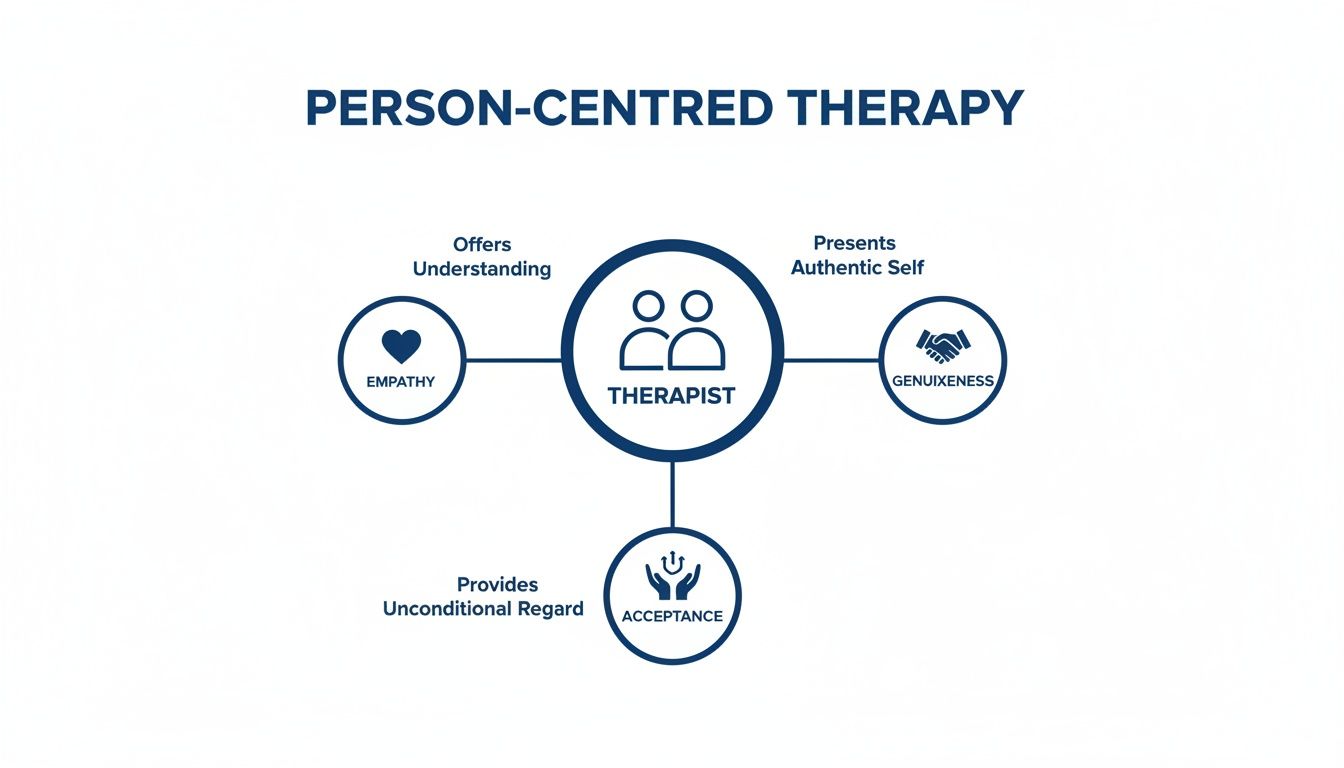
    • Unconditional Positive Regard: The therapist accepts you completely, without any "ifs" or "buts." You are valued for exactly who you are.
    • Empathy: The therapist works hard to understand your world from your point of view, helping you feel truly seen and understood.
    • Genuineness (or Congruence): Your counsellor is real with you, without a professional mask. This encourages you to be your true self, too.

    This approach is fantastic for improving your overall well-being by strengthening your relationship with yourself. It helps you move away from a harsh inner critic and towards a place of genuine self-acceptance and compassion.

    How Person-Centred Counselling Feels in Practice

    Unlike more structured therapies, a person-centred session feels more like a natural conversation. The session flows based on whatever you feel is most important to talk about that day. The focus is on your immediate experience—what you’re thinking and feeling in the here and now.

    Let's say you come to a session feeling overwhelmed by workplace stress. A person-centred therapist would first listen with deep empathy as you talk about feeling inadequate. They might reflect back with something like, "It sounds incredibly draining to feel like you have to be perfect all the time."

    Hearing your experience mirrored back without judgement is incredibly powerful. This process validates your feelings, helps you untangle them, and builds your resilience from the inside out.

    Who Benefits Most from This Approach

    While its core principles are a cornerstone of any good counselling relationship, this approach is brilliant for certain goals. It's an excellent choice if you're grappling with self-esteem, figuring out your identity, or feeling "stuck" in life.

    It's also a powerful way to work through mild to moderate anxiety and depression. By nurturing a strong sense of self-worth, it empowers you to manage your emotional world with more confidence. The skills you learn—like self-acceptance and trusting your inner voice—are tools you can carry with you for life.

    A Look at Other Powerful Counselling Methods

    The world of therapy is rich and varied, and different challenges call for different tools. Understanding the breadth of options can make the journey towards feeling better seem more hopeful. Specialised techniques offer unique pathways to healing, whether you're navigating family dynamics or processing a painful past.

    Exploring these different techniques of counselling reveals that support should be shaped to fit your life story and goals. It’s not about finding one "best" method, but about discovering the approach that resonates with you.

    Understanding Our Connections with Systemic and Family Therapy

    Sometimes, the problems we carry are tangled up in our relationships. Systemic and Family Therapy looks at us not in isolation, but within the context of our family and community. The core idea is that our struggles often emerge from the systems we're a part of.

    Instead of singling out one person as "the problem," this form of therapy explores the unspoken rules and communication habits within a group. It’s useful for resolving family conflicts or helping partners communicate better, aiming to forge healthier connections for everyone.

    The image below shows the core conditions of Person-Centred Therapy, which often provides a vital foundation for relationship-focused approaches.

    Diagram illustrating person-centred therapy, highlighting therapist conditions: empathy, genuineness, and acceptance.

    It’s a great visual reminder of how a therapist’s empathy, genuineness, and unconditional acceptance create the safe space needed to explore sensitive relationship issues.

    Finding Your Own Drive with Motivational Interviewing

    Have you ever felt completely stuck, knowing you need to make a change but lacking the motivation? That's where Motivational Interviewing (MI) comes in. It’s a collaborative counselling style designed to help you unearth and strengthen your own internal drive for change.

    A therapist using MI acts as a partner, helping you explore your own reasons for wanting something different. This technique works wonders for making lifestyle changes or breaking unhelpful habits. Because it’s built on respect for your autonomy, it empowers you to become the expert on your own life and build the resilience to follow through.

    Motivational Interviewing is based on a powerful idea: real, lasting change comes from within. A therapist's role is simply to help you find your own compelling reasons to grow, making the whole process feel more authentic and sustainable.

    In India, counsellors are brilliant at adapting Western models like these to better fit local culture. You can learn more about how Indian therapists adapt these models to provide care that’s both culturally sensitive and highly effective.

    Healing from Trauma with EMDR

    For anyone who has experienced trauma, certain memories can get "stuck," causing ongoing distress, anxiety, or other difficult symptoms. Eye Movement Desensitization and Reprocessing (EMDR) is a structured therapy developed to help people process these traumatic memories.

    During an EMDR session, the therapist guides you to focus on a memory while engaging in bilateral stimulation, like following their fingers with your eyes. This process helps the brain reboot its natural healing system, allowing you to reprocess the memory so it loses its disruptive emotional charge. EMDR is a well-researched technique for helping people find relief from the heavy weight of past trauma.

    Each of these methods shows that no matter what you're facing—from workplace stress to deep-seated trauma—there are effective techniques of counselling out there. The journey is about finding the right key to unlock your own path to healing and growth.

    Finding a Therapist Who's Right for You

    Taking that first step towards counselling is a huge win, and often the hardest part of the process. Now, let's talk about how to find a therapist and an approach that genuinely clicks with who you are. The secret isn't finding the "best" technique, but discovering what feels right for you.

    Remember, starting therapy is a proactive move towards building your well-being and resilience, not a quick fix. The connection you have with your therapist is one of the biggest factors in your progress, so it pays to find someone you trust.

    Starting Your Search with DeTalks

    Trying to find a qualified professional can feel overwhelming. Platforms like DeTalks make the process much clearer. You can easily browse profiles of verified therapists, read about their specialties, and get a sense of the techniques of counselling they use.

    As you look, see whose approach resonates with you. Maybe the practical nature of CBT appeals to you, or perhaps the gentle, self-exploratory space of Person-Centred therapy feels more fitting. Whatever it is, trust your gut.

    What to Look for in a Therapist

    When sifting through profiles, a few key things can help you narrow the field. A great therapeutic relationship is built on trust, respect, and feeling that someone truly understands you.

    Here are some practical points to keep in mind:

    • Specialisation: Does the therapist have experience with what you're dealing with, like workplace stress, anxiety, or relationship troubles?
    • Therapeutic Approach: Do they focus on a technique that interests you? Many therapists are integrative, but it’s helpful to know their main style.
    • Initial Consultation: Many therapists offer a short introductory call. This is your chance to ask questions and check the vibe. Do you feel comfortable opening up to them?

    It's completely okay to chat with a few different therapists before you decide. This is your journey, and finding a partner you connect with is the most important ingredient for success.

    Using Assessments to Point You in the Right Direction

    If you’re looking for more clarity on what you need, the scientifically validated psychological assessments on DeTalks can be a great resource. These tools can offer useful insights into your emotional patterns, personality, or specific challenges like depression.

    It’s crucial to remember that these are for information, not diagnosis. They act as a helpful starting point, giving you and a potential therapist some shared language for your first conversations. Your path to healing is your own, and finding the right support is a powerful first step.

    Frequently Asked Questions

    It’s completely normal to have questions when you’re thinking about starting counselling. Let's walk through some of the most common ones to help clear things up.

    How Do I Know Which Counselling Technique Is Right for Me?

    The good news is, you don’t have to have this figured out beforehand. A skilled therapist will get to know you first, often drawing from different techniques of counselling to create a plan that fits you perfectly.

    Those first few sessions are about conversation and connection. Your therapist will focus on understanding what you're going through, and together you will decide on the best way forward.

    Are Online Therapy Sessions as Effective as In-Person Ones?

    Yes, they absolutely can be. Research confirms that for common concerns like anxiety and depression, online therapy works just as well as face-to-face sessions. It offers a level of convenience that can make all the difference when you're juggling a busy life or dealing with workplace stress.

    What truly makes therapy work is the connection you have with your therapist. That sense of trust and rapport is the foundation for real progress, whether online or in an office.

    What Is the Difference Between Counselling and Therapy?

    You'll often hear these words used to mean the same thing, and that's generally okay. Both involve a trained professional helping you improve your mental health in a supportive way. Some might say counselling is for shorter-term problems, while therapy tackles deeper patterns, but in practice, the lines are blurry.

    The real goal for both is the same: to help you understand yourself better, learn new ways to cope, and build a more satisfying life. The most important thing isn't the label, but finding a qualified person you feel a genuine connection with.

    How Long Does Counselling Usually Take?

    There’s no one-size-fits-all answer, as everyone's journey is different. Some people get what they need in a few sessions, while for others, exploring deeper-rooted issues like chronic anxiety might mean longer-term support is more helpful.

    It’s something you and your therapist will figure out together. The focus is always on your progress and what you need to feel confident and supported, not on a rigid schedule.


    This guide is meant to offer supportive takeaways, not promises of a cure. The journey toward well-being is personal, and finding the right person to talk to is the most important step you can take. DeTalks makes that step easier by connecting you with verified therapists and providing informational assessments to help point you in the right direction. You can start exploring your options and find a professional who understands you at https://detalks.com.