
The house is quiet, but your thoughts aren't. You're scrolling on your phone after another tiring day, wondering whether the tightness, worry or heaviness you've been carrying is ordinary stress or something that deserves attention.
Searching for an anxiety stress depression test can be a way of asking for clarity before you're ready to speak to anyone. You don't need to know what's wrong before you deserve support.
Why You Might Be Searching for an Anxiety Stress Depression Test Tonight
Perhaps you've answered work messages through dinner and still feel behind. Perhaps exams are approaching, your family expects you to stay focused, and you can't explain why opening your books suddenly feels difficult.
Or there's no obvious crisis. You're meeting your responsibilities, laughing when someone makes a joke, and feeling strangely flat when you're alone.
These are examples, not diagnoses. A questionnaire can offer a structured pause when your experience feels too tangled to describe.
You don't have to prove you're struggling
In India, seeking mental-health support may involve concerns about family reactions, cost, privacy or being misunderstood. You might minimise your feelings because someone else appears to have more serious problems.
Yet the need for care is substantial. India's National Mental Health Survey, conducted in 2015–16, estimated that 10.56% of adults had a current diagnosable mental disorder, about 15% required active intervention, and the treatment gap ranged from 70% to 92%, depending on the condition, as summarised in the government's account of national mental-health needs.
You don't need a dramatic crisis, or permission from a questionnaire, to take your feelings seriously.
Screening is useful because it gives you somewhere to begin. It can help you notice whether worry, low mood or tension has become a pattern rather than an occasional difficult moment.
Comfort and clinical support can coexist
Some people begin with a trusted friend, prayer or reflective reading. If Islamic faith is part of your life, Ayah's collection on anxiety offers faith-based material for reflection, rather than a clinical assessment or replacement for care.
You don't have to choose between meaningful spiritual practices and professional support. The more useful question tonight may be: what would help me understand my experience clearly, without judging myself for having it?
What an Anxiety Stress Depression Test Actually Does
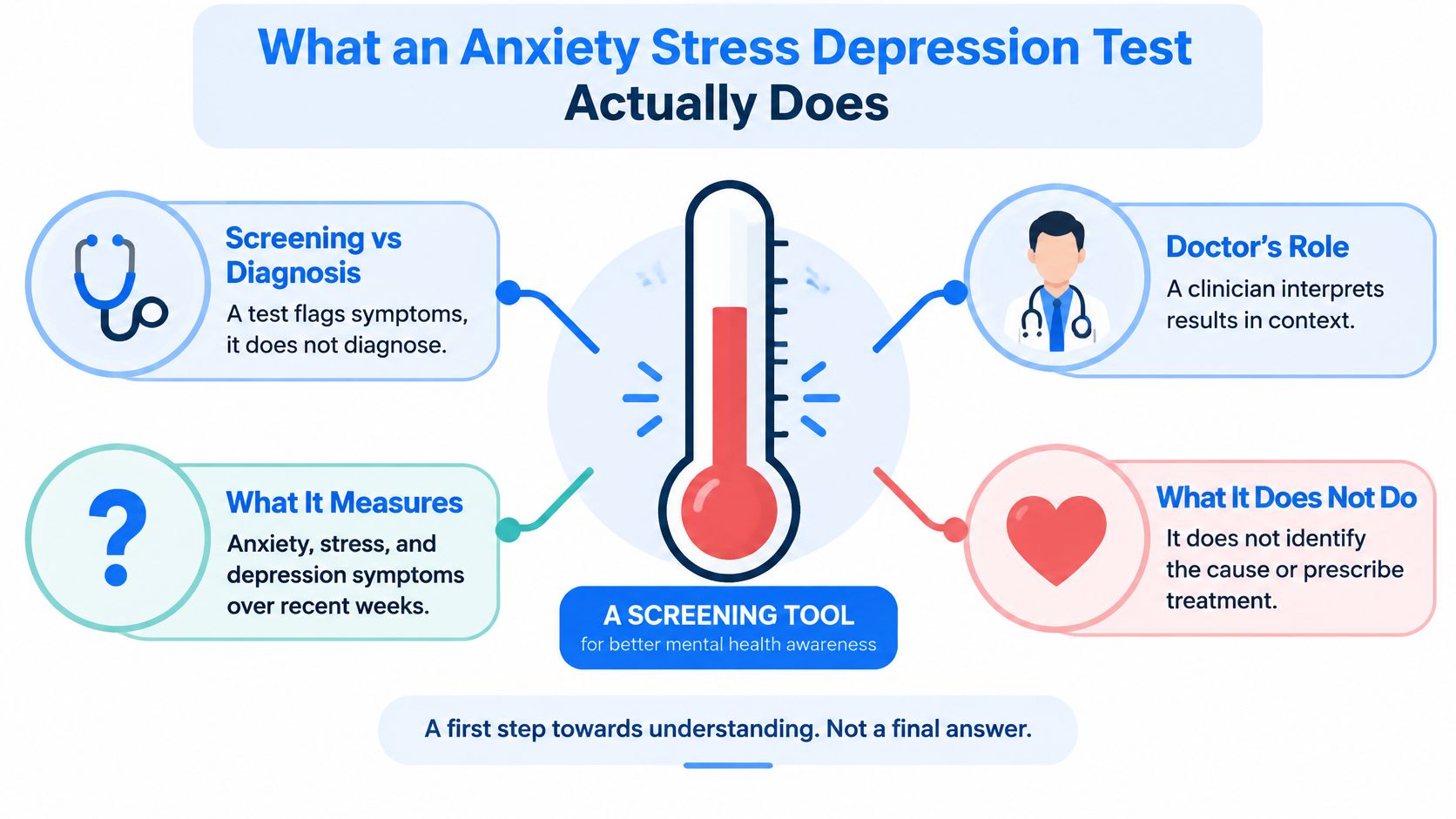
A thermometer can tell you that your temperature is raised. It can't explain the cause, identify an infection or decide what treatment you need.
A mental-health screening questionnaire works similarly. It identifies reported symptoms, not a diagnosis, and its results are informational.
The distinction is illustrated below.
What happens when you answer
Depending on the tool, you may answer questions about worry, loss of interest, low mood, tension, restlessness or sleep. You'll usually select how often or how strongly you've experienced something within the questionnaire's stated period.
There are no answers that make you a better or worse person. Follow the wording carefully and describe your experience, rather than what you think you should be feeling.
- Check the timeframe: Answer for the period specified, not your most difficult day ever.
- Check the purpose: A symptom questionnaire is different from a personality quiz.
- Check privacy first: Confidentiality depends on the service's practices, not on the questionnaire's name alone.
An anxiety symptom checker tool from Integrative Psychiatry of America is an example of a resource to approach with these checks in mind. Its output should support reflection and conversation, not self-diagnosis.
Why clinical assessment goes further
A clinician asks follow-up questions about duration, everyday functioning, health, medicines, substance use and safety. They can explore explanations that a fixed set of online questions cannot.
Population estimates also require careful interpretation. Indian literature discusses estimates including 3.6% for current anxiety disorders, 0.8% for current depressive disorders, 2.57% for weighted anxiety prevalence, and 5.25% for depressive-disorder prevalence across 12 states; these figures involve differing definitions or reference periods and shouldn't be treated as interchangeable, as discussed in the analysis of anxiety disorders using national survey data.
The same caution applies personally: a questionnaire result and a clinical conclusion answer different questions.
The Most Used Screening Tools for Anxiety Stress and Depression
PHQ-9, GAD-7 and DASS-21 are names you may encounter while looking for a screening tool. They overlap, but they aren't substitutes for one another.
Choose according to the concern you want to explore, the language you understand comfortably and the population the version was designed for. Completing several questionnaires doesn't automatically produce a more reliable answer.
Comparing Common Anxiety, Stress, and Depression Screening Tools
| Tool | What it screens | Number of items | Approximate time | Score output |
|---|---|---|---|---|
| PHQ-9 | Depression symptoms | 9 | Brief, allow unhurried time | A depression symptom total and severity band |
| GAD-7 | Anxiety symptoms, particularly generalised worry | 7 | Brief, depending on reading pace | An anxiety symptom total and severity band |
| DASS-21 | Depression, anxiety and stress symptoms | 21 | Longer than the shorter questionnaires | Separate depression, anxiety and stress scores |
PHQ-9 focuses on depression symptoms over the past two weeks, including mood, interest and other changes affecting daily life. It's used in primary care and research, but its total still needs clinical context.
GAD-7 offers a focused look at anxiety-related experiences such as persistent worry, difficulty relaxing and restlessness. It doesn't provide a complete assessment of every kind of anxiety difficulty.
DASS-21 is especially relevant when someone searches for an anxiety stress depression test because it considers these symptom areas together while keeping them separate. That matters when, for example, someone feels tense and overloaded without describing the same degree of low mood.
What Indian validation tells us
A Hindi DASS-21 validation study included 323 Hindi-speaking Indian adults and reported internal consistency of 0.835 for depression, 0.824 for stress and 0.916 for the total scale, supporting structured symptom screening in that setting, according to the Hindi DASS-21 validation paper.
Internal consistency means that questions intended to explore a symptom area work together reasonably well. It doesn't mean the questionnaire can independently establish a disorder.
- Choose relevance over popularity: A combined tool may suit broad concerns; a focused tool may suit a particular question.
- Allow enough time: Don't rush to meet an advertised completion time.
- Keep the separate results: Distinct symptom domains can help you explain your experience more clearly.
How to Read Your Score Without Overreacting or Ignoring It
Seeing a high result can feel unsettling, especially when the screen uses a word such as severe. A score describes your answers within that tool's framework, not your identity or your future.
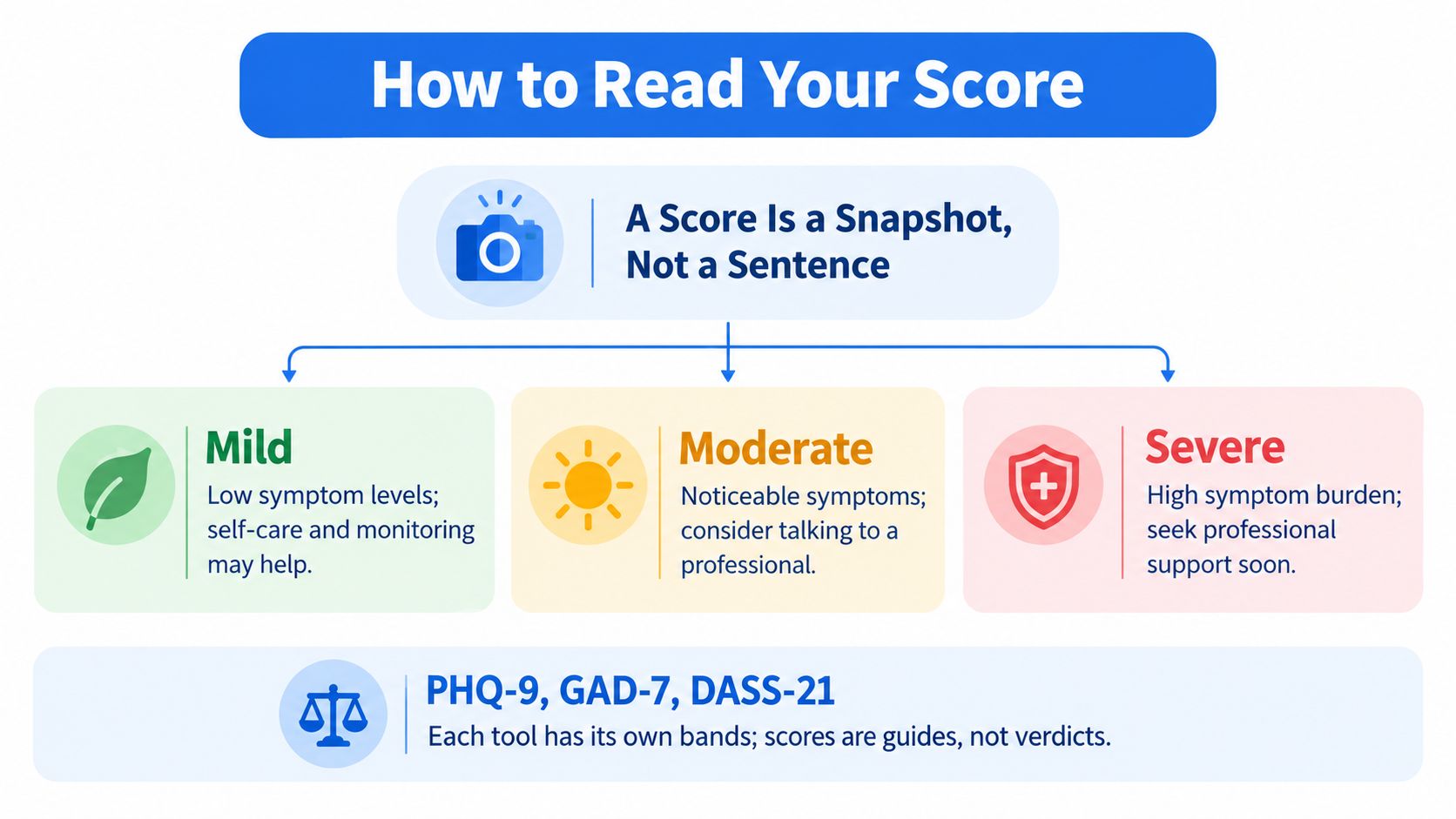
Severity bands summarise symptom burden. They aren't universal categories that mean exactly the same thing across PHQ-9, GAD-7 and DASS-21.
Use the visual as a broad orientation, not a substitute for the specific questionnaire's guidance.
Understand the band and then look beyond it
A mild band generally reflects a lower reported symptom burden. Moderate and severe bands indicate progressively greater reported difficulty, but the appropriate response also depends on your circumstances.
In an Indian breast-service screening study, a GAD-7 cutoff of 10 identified anxiety risk needing further evaluation with 89% sensitivity and 82% specificity, according to the BMJ Open screening study. Those findings apply to that study setting, not a universal rule that everyone above the cutoff has an anxiety disorder.
Practical rule: Read the score alongside how long symptoms have lasted, what they interrupt and whether you feel safe.
Ask yourself:
- Duration: Did this begin around a specific event, or has it continued well beyond it?
- Daily impact: Are sleep, studies, work, relationships or basic tasks becoming difficult?
- Hidden effort: Are you functioning only by exhausting yourself?
- Other influences: Could illness, medicines, alcohol, other substances or disrupted sleep need discussion?
Don't confuse different kinds of self-assessment
A high result can coexist with outward functioning. Equally, a low result shouldn't overrule distress you find difficult to capture in the questions.
Personality exploration belongs in a different category. If you choose to take the Similar Minds Enneagram test, presented through Acheloa Wellness, Inc., keep that activity separate from symptom screening and clinical decisions.
Neither a personality description nor a symptom total should become a label you feel obliged to live up to.
Why the Same Score Can Mean Different Things in India
An English-speaking student, a Hindi-speaking professional and a parent most comfortable in a regional language may understand the same question differently. Literal translation alone doesn't guarantee that the emotional meaning stays intact.
This illustration shows why a shared questionnaire doesn't imply a shared life context.

Language and life circumstances matter
Consider someone answering about difficulty relaxing while caring for an unwell parent. Compare that with someone facing workplace harassment or a student awaiting exam results: similar answers may require quite different conversations.
Age and gender also deserve attention rather than assumptions. Indian data indicate that stress-related disorders are nearly twice as common among females as males, discussed in the Indian research context for culturally relevant assessment; that population pattern cannot explain an individual's experience by itself.
- Language comfort: A familiar language may make it easier to recognise subtle differences between answers.
- Age suitability: Evidence from adults shouldn't automatically be extended to adolescents.
- Health context: Chronic illness and treatment demands may need separate exploration.
- Social expectations: Worries about appearing weak or disappointing family may affect disclosure.
Screening percentages aren't disorder prevalence
A 2025 Jaipur study of 382 young adults reported high depression symptoms in 48.57% and anxiety symptoms in 58.11%, but it used DASS-21 and recruited through WhatsApp and Gmail, as described in the Jaipur young-adult symptom study. These are symptom-screening findings from a particular sample, not clinically confirmed national disorder rates.
For an additional viewing resource alongside this discussion:
The central point isn't that questionnaires are useless. It's that good interpretation includes the person, rather than assuming a single online test works identically across every language, age group and setting.
What to Do After Your Result A Simple Next Step Pathway
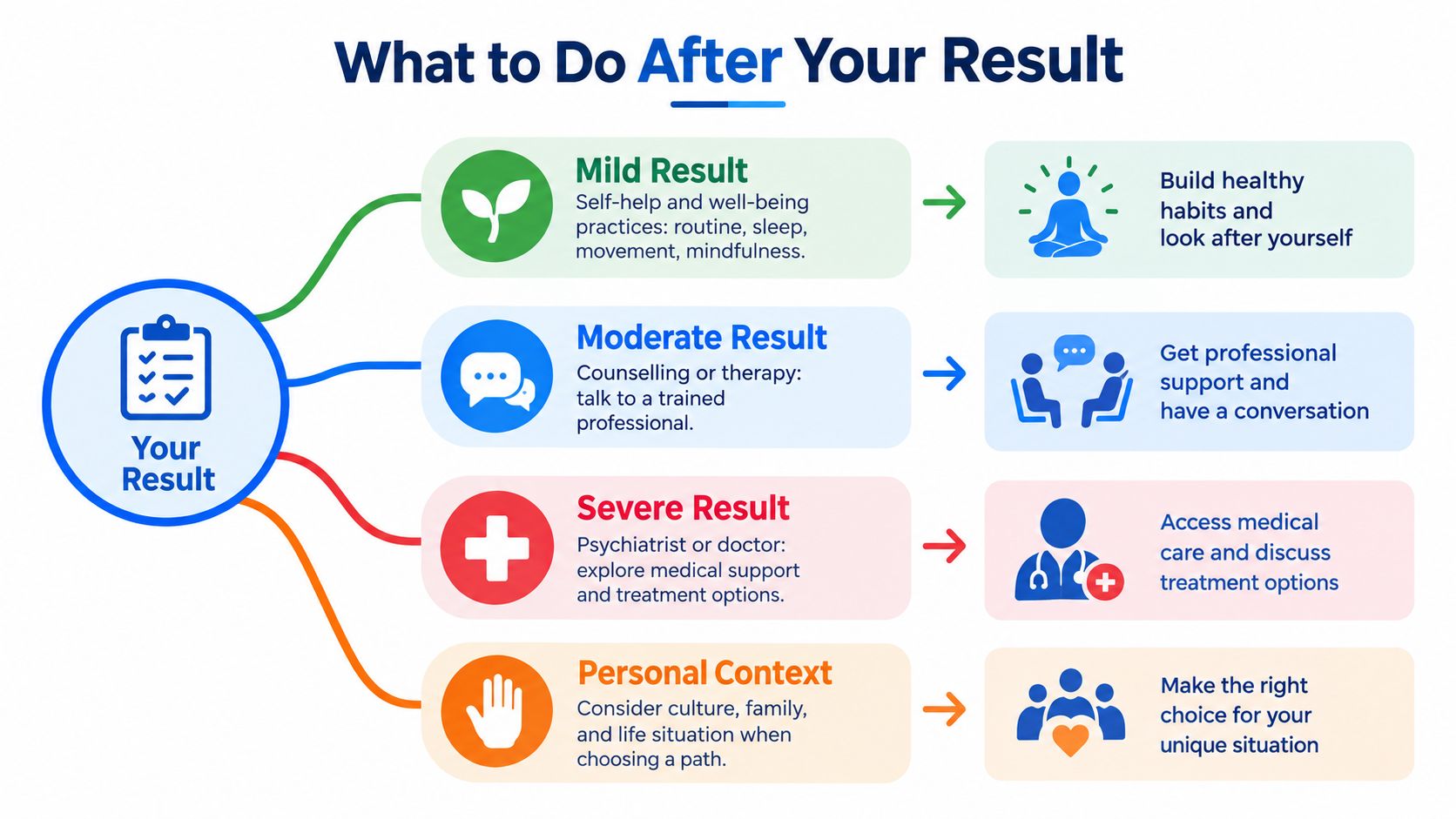
Start with what you need, not only the colour of your score band. These pathways are guides, and you can seek professional support even if your result appears low.
The flowchart offers a starting point; urgent safety needs take priority over every routine recommendation.
Match support to your current needs
For mild, manageable difficulties, consider protecting sleep, making room for movement and staying connected with someone you trust. Mindfulness or a grounding practice may be worth trying, without turning self-care into another demanding task.
When symptoms persist or interfere with life, counselling or therapy can help you explore patterns and practical changes. You don't need to wait until you can no longer cope.
- Severe or worsening difficulties: Arrange prompt assessment with a psychiatrist or another qualified medical professional, particularly when medical factors or treatment options need consideration.
- Self-harm or suicide concerns: Seek urgent professional help regardless of your total score. If you may act on these thoughts or can't stay safe, contact local emergency services or go to the nearest emergency department, ask a trusted person to stay with you, and move away from anything you could use to harm yourself.
Include the circumstances that need changing
Workplace stress isn't always something an employee can resolve through better coping. Excessive demands, harassment or inadequate recovery may require changes at work as well as personal support.
An Indian workplace review reported depression estimates of 10%–52.9%, anxiety of 7%–57% and workplace stress of 3.8%–75.5%, varying by occupation and measurement method, according to the review of mental health among Indian workers. These ranges aren't diagnostic thresholds or a prediction about any individual workplace.
Needing help doesn't mean you've failed at resilience. Sometimes resilience includes recognising what you shouldn't have to manage alone.
Before booking care, ask about fees, language, qualifications and appointment options. Family involvement can be helpful when it feels safe and wanted, but support should respect your circumstances and preferences.
Confidentiality, Limitations, and How Platforms Like DeTalks Handle Your Data
You may be comfortable answering a question but uncomfortable imagining who could read the answer. That concern deserves a clear response before you submit sensitive information.
Confidential isn't the same as anonymous. A service may protect information while still connecting it to an account, appointment record or contact details.
Ask what happens to your answers
Look for a readable privacy policy and a way to ask questions. Don't assume that a reassuring design or the word confidential explains every detail of data handling.
- Access: Who can see individual answers and scores?
- Purpose: Are results used for recommendations, research, advertising or anything else?
- Control: Can you request deletion, and what records must be retained?
- Disclosure: What consent arrangements and safety-related exceptions apply?
- Workplace boundaries: Will an employer receive individual results or only appropriately aggregated information?
The Asia Mental Health Index reported that 77% of workers in India had moderate-to-high mental-health risk and 60% felt more sensitive to stress than the previous year, according to the India workplace mental-health report. These are workplace survey findings, not diagnoses or permission for employers to access private answers.
Understand the limits of digital self-report
People may understate symptoms because they feel embarrassed, or answer differently depending on how they understand the wording. An automated result cannot independently examine medical causes or ask every clinically important follow-up question.
A platform's assessment library also doesn't establish its privacy safeguards. For the platform named above, as for any provider, check current policies directly rather than assuming specific storage practices, access controls or consent arrangements.
A useful service should explain the questionnaire's purpose, communicate its limits and make professional follow-up understandable. Scientifically supported screening and transparent data handling are separate requirements, and you deserve both.
Supportive Takeaways for Your Well-Being Journey
You began by looking for a name for what you're feeling. You may finish with something more useful than a label: a clearer description of your experience and a next step that fits your life.
India's National Mental Health Survey included 34,802 people across 12 states, estimating current depression at 2.7% and lifetime depression at 5.2%, according to the national survey summary. Keeping current and lifetime experiences separate matters, just as keeping screening and diagnosis separate matters.
Make room for care and growth
An anxiety stress depression test is informational, not diagnostic. Its value lies in helping you recognise concerns and decide whether to begin a conversation with a qualified professional.
Well-being needn't mean feeling happy all the time. You can make room for compassion, meaningful relationships, purpose and moments of happiness without denying distress.
- Notice patterns gently: Record what feels difficult and what seems to help, without repeatedly testing yourself for reassurance.
- Protect recovery: Consider where rest, regular meals and manageable boundaries could fit.
- Practise compassion: Speak to yourself as you would to someone you care about.
- Reach outward: Tell a trusted person what support would feel useful.
- Seek care when needed: Persistent, worsening or disruptive symptoms deserve attention.
Choose a manageable next step
You don't need to reorganise your whole life tonight. Saving your questions, speaking with someone safe or arranging an appointment can be enough for now.
There's no promise of an instant cure here. There is permission to take your experience seriously and pursue support at a pace that respects your needs, while responding promptly to safety concerns.
DeTalks offers confidential, science-backed screening assessments alongside a directory of qualified psychologists and therapists, helping you explore symptoms and possible support options. Visit DeTalks to learn about an assessment or browse counselling professionals, and bring your results and questions to a conversation about what you need next.