
Can a short questionnaire really tell you anything useful about your mind?
Mental health screening sounds simple enough: answer a few questions, receive a score. Yet the question rarely asked is this: if a questionnaire cannot tell you what is wrong, why does anyone bother with one?
The answer is that most of us are poor at noticing our own patterns. You put a low mood down to a bad week, tiredness down to a late night, and irritability down to a difficult manager. A screening tool asks the same questions in the same order every time, which makes those fuzzy weeks visible enough to talk about.
In India, that conversation matters far more than the score itself. Many adults live with a mental health condition, and most never reach any form of care, so the first signal often has to come from a simple questionnaire rather than a specialist. Language adds another wrinkle: a question written in English can carry a slightly different meaning in Hindi, Tamil or Bengali, and a number produced in one setting may not mean the same thing in another.
That is why the right way to read any score is as an opening line in a conversation, not the final word on your file.
What Mental Health Screening Means
Mental health screening is a brief set of standard questions that flags possible signs of anxiety, depression, stress or other concerns, so you can decide whether a closer look is worth it. It's the equivalent of a quick check at the clinic door: the nurse takes your temperature and blood pressure, then tells you to see the doctor. She hasn't named an illness.
Most screens take five to ten minutes. A teacher, an HR team, a primary-care nurse or a trained frontline health worker can hand one over, and you can also complete one yourself on a trusted well-being platform. What comes back is indicative, meaning it points somewhere rather than concludes something.
Screening, assessment and diagnosis compared
| Stage | Main purpose | Who usually does it | What it produces |
|---|---|---|---|
| Screening | Flags possible symptoms for a closer look | Trained staff, teachers, HR teams or a self-check tool | An indicative result, not a label |
| Clinical assessment | Explores symptoms, history, duration and impact | Psychologist, psychiatrist or clinician | A detailed understanding of needs |
| Diagnosis | Checks whether criteria for a disorder are met | Psychiatrist or qualified clinician | A formal diagnosis and treatment plan |
The three stages exist because they answer different questions. Screening asks "is anything here worth checking?". Assessment asks "what's going on, for how long, and how much is it affecting your life?". Diagnosis asks whether a specific set of criteria is met, and only a qualified clinician can answer that.
India's numbers explain why the first stage carries so much weight. The National Mental Health Survey 2015-2016, run by NIMHANS, interviewed 39,532 adults across 43 districts in 12 states and estimated that 13.7% had experienced a mental disorder at some point in their lives. Many of those people never walked into a specialist's clinic at all.
The Press Information Bureau summary of India's 2024 Economic Survey puts the treatment gap at 70% to 92% across different disorders. That gap doesn't close because people suddenly feel worse. It closes when someone notices early and gets pointed towards help.
A screening result is an opening line for a conversation with a qualified professional, not a verdict on who you are.
How a Screening Tool Works, Step by Step
The mechanics are simpler than many expect. Here's the sequence a well-run screening follows, and the reason each step exists.
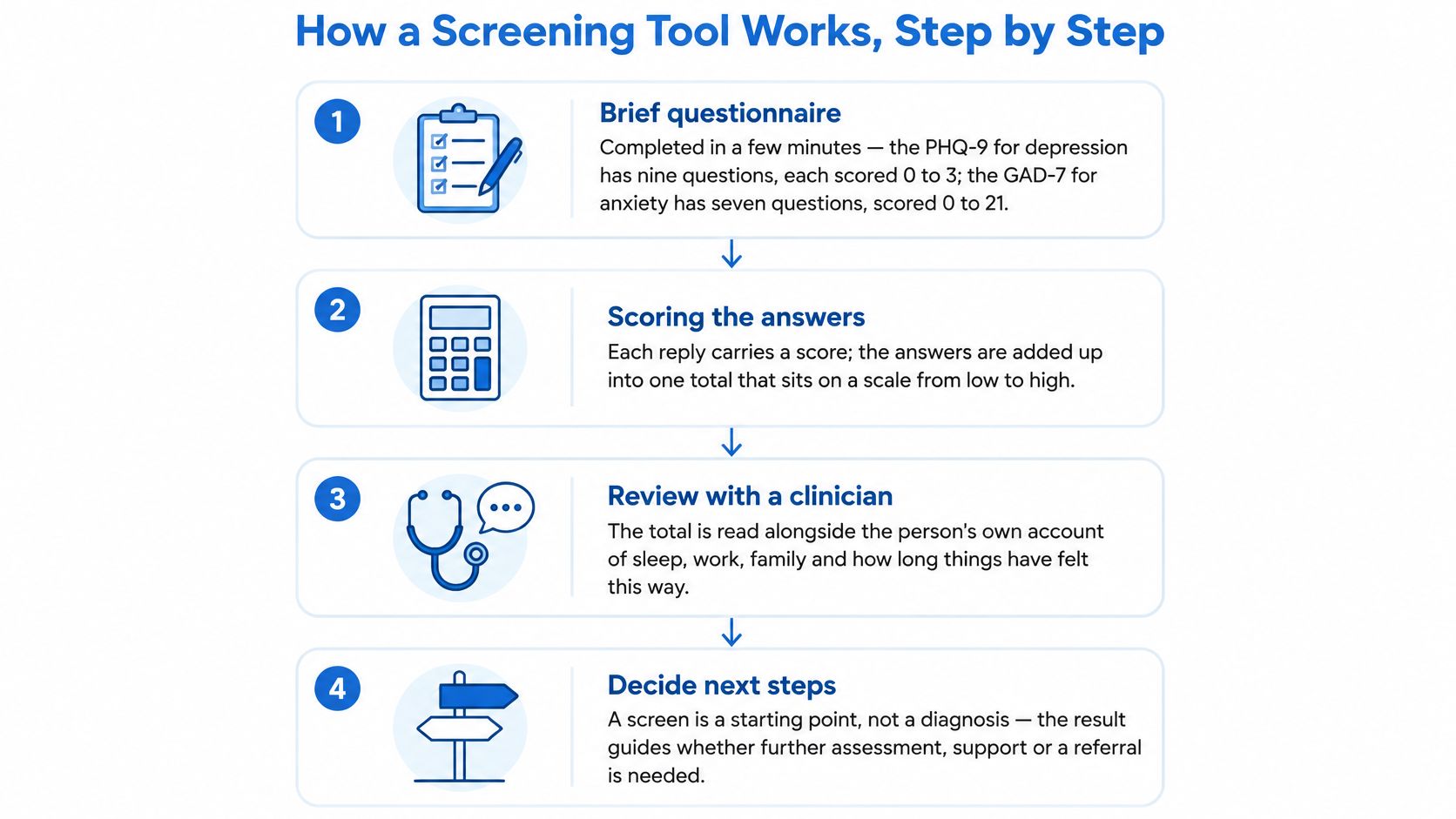
- Answer a brief questionnaire. A depression tool such as the PHQ-9 asks nine questions, each answered on a scale from 0 to 3, while an anxiety tool such as the GAD-7 asks seven. Fixed wording and fixed answer options are the whole point: they let your answers be compared with a standard, instead of with someone's guess.
- Add up the answers. Each reply carries a score, and the total lands somewhere on a scale from low to high. The common slip here is treating that arithmetic as the answer itself. A total is a summary of what you reported, nothing more.
- Review the total with a trained person. They ask how long things have felt this way, how much work or study has suffered, whether sleep, alcohol, medication or a physical illness could explain part of it, and whether you feel safe. Two people with identical totals often need completely different things.
- Follow the referral if you're flagged. A positive screen leads to a fuller clinical assessment, not an automatic label. Sometimes the right response is psychoeducation or counselling rather than treatment for a disorder.
- Act on any safety concern immediately. If you report thoughts of harming yourself, that answer overrides the total score. Contact a qualified professional or a crisis helpline the same day rather than waiting for the number to be interpreted.
- Repeat later to track change. A second completion after a few weeks shows direction of travel, which a single score can't. Repeating it daily just measures your mood on that morning.
India's tiered approach
The Ministry of Health operational guidance described in PLOS ONE sets out a two-level workflow: frontline workers identify people in the community using pictorial checklists or the validated Community Identification and Detection Tool (CIDT), then facility staff confirm with disorder-specific instruments such as the PHQ-9 for depression and AUDIT for alcohol use. The same guidance stresses that a positive result should trigger review of symptom duration, functional impairment, substance use, medical causes and suicide risk, not an automated diagnostic label.
Before your appointment, write down three things: the name of the tool, the date you completed it, and your total. That small note turns a vague "I've been feeling off" into something a clinician can work with in the first five minutes.
Reading Your Score and What the Bands Mean
| Total score | Typical meaning | Suggested next step |
|---|---|---|
| 0-4 | Minimal symptoms | Self-care, monitor and repeat if concerns return |
| 5-9 | Mild symptoms | Watch the pattern, repeat in a few weeks and seek support if it persists |
| 10-14 | Moderate symptoms | Clinical review with a qualified professional recommended |
| 15-19 | Moderately severe symptoms | Prompt professional assessment |
| 20-27 | Severe symptoms | Urgent professional assessment |
The PHQ-9 total runs from 0 to 27, and the bands describe how severe your reported symptoms look, not which disorder you have. A score of 10 or above is the usual trigger for further review, which is why that row shifts from self-monitoring to a professional conversation.
The two-week window
The PHQ-9 asks about the past two weeks. Your total is a snapshot of that fortnight, so it carries whatever was happening in it: a night-shift rotation, a family illness, exam results, a bereavement. Someone who completes it during a brutal work deadline and again a month later can get two very different totals without anything being "wrong" either time.
The safety item outranks the total
Item 9 asks about thoughts that you'd be better off dead or of hurting yourself. Any answer above zero needs a same-day check by a professional, even if your total sits in the minimal band. A low overall score never cancels out that single response, and no automated result page should let you scroll past it.
Practical rule: a mild score doesn't mean nothing is wrong, and a high score doesn't mean you have a diagnosis. Both mean the same thing, which is that a conversation is worth having.
What raises a score temporarily
Grief, poor sleep, a thyroid problem, anaemia, a demanding exam term and heavy workplace stress can all push a total up for a while. That's not the tool failing. It's the tool doing exactly what it was built to do, which is notice distress without deciding where it came from.
Three habits make your result far more useful. Compare it with your own earlier totals rather than with someone else's. Note in one line what was happening in your life that week. Bring both to a counsellor or doctor, because "14, and I'd just moved cities alone" tells a clinician much more than "14".
Record the total, the band and the date somewhere you'll find again. Then decide, calmly, whether you want to talk to someone.
Where Screening Falls Short and Common Misconceptions
The most common misunderstanding is that a screen tells you that you have depression or anxiety. It can't, and the numbers show why.

In an Indian primary-care comparison of five questionnaires for common mental disorders, positive predictive values at the optimal cut-offs ranged from only 51% to 77%. Depending on the population and the threshold, roughly one-quarter to nearly one-half of positive screens didn't match a confirmed disorder when checked against a diagnostic interview.
Think of a smoke alarm sensitive enough to catch burning toast. It will also go off while you're frying onions. Lower cut-offs catch more real cases and raise more false alarms; higher cut-offs do the reverse. Neither setting is "correct" in the abstract, which is why the person reading your score matters as much as the score.
"Screening is only for people in crisis"
Screening exists precisely for the stretch before a crisis, when symptoms are easy to explain away. Waiting until you can't function means skipping the stage where support is simplest.
"A free online quiz is the same as a diagnosis"
A validated instrument has a named version, a tested language, a published cut-off and a defined referral route. A ten-question entertainment quiz has none of those, and its result shouldn't influence any decision about your care.
"A low score means I'll always be fine"
False negatives are real. People describe distress in words the questionnaire doesn't use, under-report because of stigma, or don't think they need help. If your daily life is shrinking, act on that even with a low total.
A short trust checklist
- Indian validation data: ask whether the tool has been tested with the population you belong to, not only in English-speaking Western samples.
- Wording that fits you: age-appropriate language, and a translation you understand rather than one you're guessing at.
- Privacy safeguards: clarity on who sees your answers, where they're stored, and whether anyone else gets a report.
- A qualified professional to interpret it: a named route to a psychologist, psychiatrist or counsellor, especially if you flag self-harm.
We built DeTalks around that last point. Our founder, Abhay Singhal, has made it central to the platform that psychologists running their own practice stay compliant with laws and adhere to mental health practice guidelines.
Screening in Workplaces, Colleges and Families
Say a software company in Pune offers a confidential well-being check to any employee who reports workplace stress. A team lead who has been snapping at colleagues and sleeping badly completes it in eight minutes, gets a moderate band, and is offered a counselling session rather than a performance conversation.
In a college during exam season, a counsellor sits with a second-year student who says she can't get out of bed before noon. A short screen gives them something concrete to discuss, and the follow-up is a sleep plan plus two counselling appointments, not a label in her academic record.
At a district primary-care clinic, a patient keeps returning with fatigue and headaches. The doctor adds a questionnaire to the routine visit, and the conversation finally moves from painkillers to what's happening at home.
A parent notices her teenage son has stopped meeting friends. She completes a youth screen alongside the family doctor, who then talks to the boy directly, because a parent's answers and a teenager's answers often differ in useful ways.
Community screening reaches people who'd never book an appointment. A 2025 door-to-door study in Kerala published in BMC Psychiatry assessed 2,263 residents for depression, alcohol use and drug abuse by going house to house.
Who sees the result, and what happens next
- At work: the individual sees their own score; HR receives aggregate numbers only. A positive result opens a route to counselling or the employee assistance programme, never a note in a personnel file.
- At college: the counsellor holds the result and agrees next steps with the student. Academic staff aren't told the score.
- At a clinic: the result sits in the medical record and shapes the doctor's assessment, with referral if needed.
- At home: the parent and doctor review it together, and the young person is spoken to directly before any decision.
Two barriers shape all of this in India. Specialists are often far away, so the first check has to happen where people already are. And language matters enormously: with 121 officially recognised languages and 1,369 mother tongues documented in the review of internet interventions in the Indian context, a questionnaire written only in English will miss people who describe distress in entirely different words.
Every setting has the same job. Refer and support, don't label.
Screening for Strengths as Well as Strain
Well-being isn't just the absence of illness. You can have no diagnosable condition and still feel flat, directionless and disconnected, which is why strength-based tools deserve a place beside symptom checkers.

Resilience is your ability to steady yourself after a setback, and it's built through ordinary habits: a consistent sleep window, one friend you call, a walk after work. Compassion, towards yourself as much as others, shows up as talking to yourself the way you'd talk to a colleague having a hard week. Gratitude, purpose and emotional intelligence work similarly. Each one is a skill you can practise, not a fixed trait you either have or lack.
A strength-based reflection helps you see which protective habits you already have. Say a working professional scores low on emotional balance but has strong family support and a steady routine. Her sensible next step is boundaries at work and protecting her sleep, not rushing into clinical care.
The strain side is real too, and it deserves plain numbers. The Indian survey analysis indexed on Europe PMC found that common mental disorders affected about 5.1% of the population at the time of assessment, that nearly 60% of those affected reported disability of varying severity, and that the treatment gap for these disorders was 80.4%. Prevalence was higher among women, people aged 40 to 59, and residents of metropolitan areas.
Strengths tools and symptom tools are both informational. Neither one diagnoses anything, and a good score on resilience doesn't cancel out persistent low mood.
Use these reflections as conversation starters, repeated only when repeating helps. Booking a session with a therapist isn't a confession of weakness. It's self-awareness, and often the most compassionate thing you do all week.
When to Reach Out for Support and What Comes Next
Reach out to a qualified professional promptly if symptoms are severe, last more than a couple of weeks, interfere with work, study or relationships, or include any thoughts of self-harm. If there's any risk to your safety, contact emergency services or a crisis helpline such as Tele-MANAS, India's national tele-mental-health service, immediately rather than waiting for an appointment.
The scale of unmet need is why urgency matters. India's National Mental Health Survey materials hosted by the Ministry of Health and Family Welfare note that nearly 15% of Indian adults may need active intervention for one or more mental-health issues, and recommend that screening for common mental disorders, suicidal behaviour and substance use be tied to referral and continuity of care rather than stopping at a score.
Five steps after a flagged result
- Write it down. Note your score, the band, the date and what has changed since. Memory flattens detail that a clinician needs.
- See a general practitioner first. Thyroid problems, anaemia and medication effects can mimic depression, and ruling them out changes the plan.
- Ask for a clinical assessment. A psychologist, psychiatrist or counsellor explores history, duration and impact in a way no questionnaire can.
- Weigh the options together. Therapy or counselling, medical care, practical changes at work or home, and social support are all legitimate parts of a plan.
- Repeat screening only as advised. More frequent testing usually adds noise, not insight.
If workplace stress is the main driver, your employee assistance programme is the first stop, with your HR team as the route in if you don't know how to access it. Ask specifically whether sessions are confidential and how many you're entitled to.
When you're ready to find someone independently, DeTalks lists psychologists, therapists and counsellors alongside confidential self-help tools, so you can move from a result to a real conversation.
A screen is a starting point, not a verdict. Small, repeatable steps build resilience over months, not days. Asking for help is a strength, and you don't need to be at your worst to deserve support.
If a screening result has left you unsure what to do next, DeTalks gives you both halves of the answer in one place: science-backed assessments for anxiety, depression, stress, burnout and well-being that are informational rather than diagnostic, plus a directory of qualified psychologists, therapists and counsellors you can book with directly. Take your score, your date and your notes with you, and start a conversation instead of a self-diagnosis. Visit DeTalks to explore an assessment or find a professional who can help you read it properly.