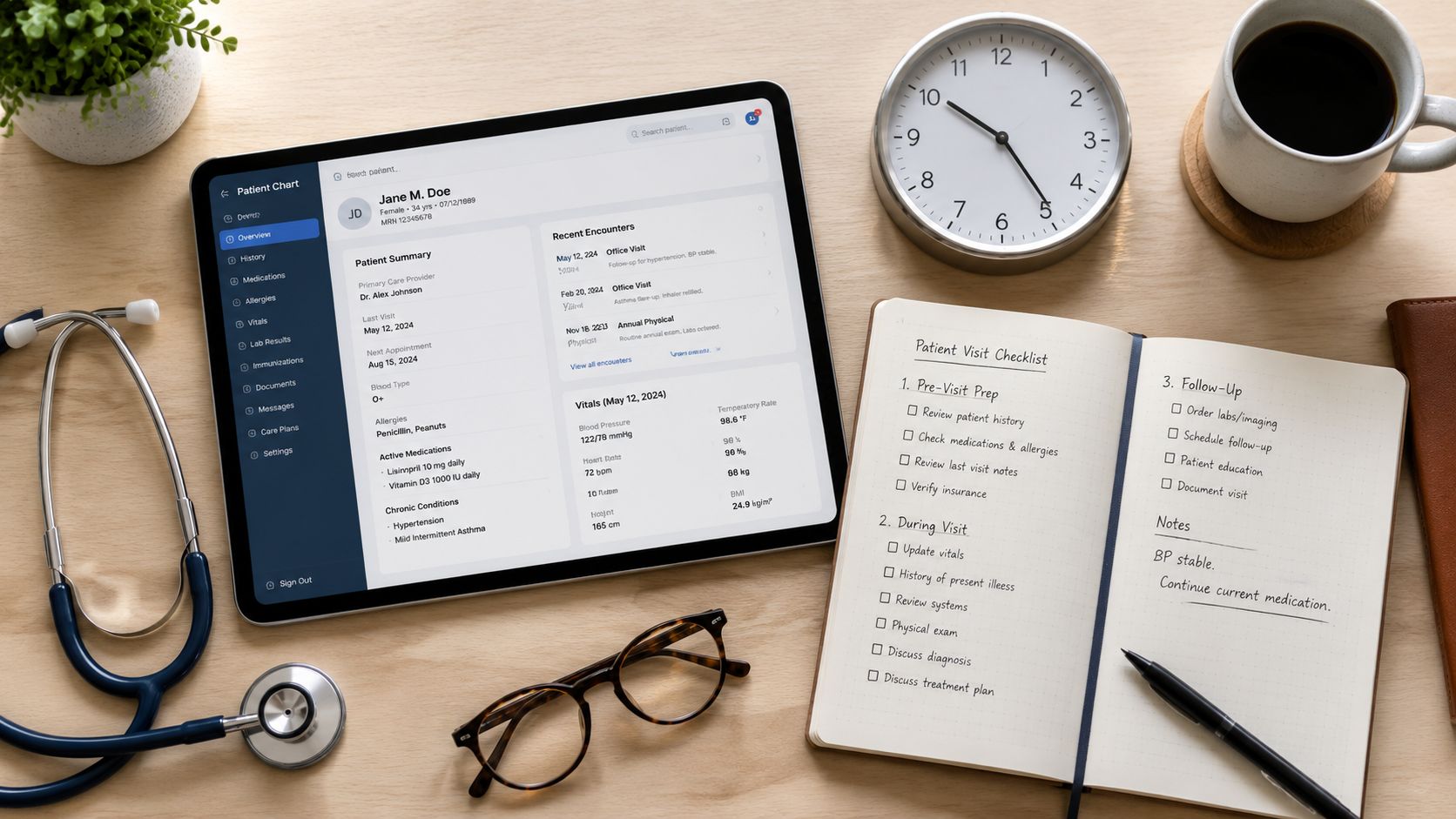
You've finished a first intake. The client came in with stress, anxiety, and trouble sleeping after workplace pressure built up over months. You documented the presenting concern, reviewed a short screening tool, discussed coping steps, and now you're staring at the claim form wondering whether this visit fits CPT 99202.
That moment is common for therapists, counsellors, and behavioural health teams, especially if you work from India with US-insured clients or support globally distributed telehealth workflows. The rules aren't impossible, but generic explainers often leave out the practical part: how to translate a real intake into a clean, defensible code choice.
This guide explains the 99202 CPT code description in plain language, with a strong focus on mental health, therapy intake, counselling-oriented visits, and telehealth documentation. It's educational only, not legal advice, and any assessment or screening tool mentioned here is informational, not diagnostic.
What Is CPT Code 99202
A therapist finishes an intake, documents a focused concern, offers brief guidance, and plans follow-up. The note feels substantial. The billing question is narrower. Does the visit meet the standard for CPT 99202?
CPT 99202 describes a new patient office or outpatient evaluation and management visit at the lowest level in that E/M family. For current office and outpatient coding, the visit is selected based on straightforward medical decision making or total time on the date of the encounter. For 99202, the time range is 15 to 29 minutes.

What that means in daily practice
For behavioral health clinicians, 99202 usually fits an initial visit with limited complexity. The patient is new to the practice, the problem addressed is minor or self-limited, the data reviewed is minimal, and the management plan carries low risk. In telehealth, the same coding logic applies. The note still needs to show what was addressed, what information was reviewed, and why the plan stayed simple.
This is the point many therapy teams miss. A long intake note does not support a higher E/M code by itself. Payers look for the level of work reflected in the decision making, or the total time if time is used for code selection. A detailed psychosocial history may be clinically useful, but it does not automatically change 99202 into 99203.
Practical rule: Choose 99202 only when the visit documentation supports straightforward E/M work or the total encounter time falls within the 15 to 29 minute range.
When 99202 tends to fit
In behavioral health, 99202 often fits visits such as:
- A new patient evaluation for mild situational anxiety with brief education and a basic follow-up plan
- A first telehealth visit for stress-related sleep difficulty where the clinician reviews limited information and recommends conservative next steps
- An intake with focused discussion of one concern, minimal record review, and no higher-risk treatment decisions
The trade-off is straightforward. If the session expands into multiple active problems, extensive record review, medication-related decisions, or a more involved assessment and management plan, 99202 may no longer be the right code. Therapists who are new to US insurance often undercode out of caution or overcode because the note feels thorough. The safer approach is to match the code to the actual decision making and document that reasoning clearly.
Decoding Medical Decision Making for 99202
The heart of the 99202 CPT code description is medical decision making, usually shortened to MDM. If you understand MDM well, coding becomes much less stressful.
For 99202, the expected level is straightforward MDM. In practical billing terms, that usually means a single minor or self-limited problem, minimal data, and low-risk management decisions.

The three pillars of straightforward MDM
Think of MDM as three questions.
| Pillar | What you ask | 99202 pattern |
|---|---|---|
| Problems | What issue did I actively address today? | Usually one minor or self-limited concern |
| Data | What information did I review or analyse? | Minimal review |
| Risk | How risky was the management plan? | Low-risk decisions |
You don't need every intake to look identical. You do need the note to show these three areas clearly enough that a payer can follow your reasoning.
Problems addressed
In therapy and counselling settings, the “problem” is where clinicians often overcomplicate things. A patient may describe anxiety, burnout, low mood, poor concentration, relationship strain, and workplace stress in one conversation. But your note should reflect what you assessed and managed that day.
If the visit focused on one early, limited concern, such as situational anxiety or stress related to work changes, 99202 may fit. If the encounter involved broader diagnostic uncertainty, multiple active concerns, or a more layered management decision, the visit may move beyond 99202.
A useful habit is to write the addressed problem in one plain sentence. That keeps your coding logic cleaner than listing every life difficulty the patient mentioned.
Data reviewed
In behavioural health, “data” doesn't only mean lab work. It can include brief screening tools, intake questionnaires, and outside records when they are reviewed and used.
Examples that may support minimal data in a straightforward visit include:
- A short screening result: Such as a brief mood or anxiety screen used to inform the conversation.
- A basic intake form: The patient's own history, reviewed and incorporated into the assessment.
- A limited outside note: If available and relevant.
What doesn't help is vague language such as “screening completed” with no indication of how it informed care. If you reviewed a tool, say so in plain terms and connect it to your assessment. Also remember that screening and assessment tools are informational, not diagnostic. They support clinical thinking, but they don't replace it.
Minimal data still counts, but only when the note shows what you reviewed and why it mattered.
Risk of management
Risk is about the management decision, not how emotionally painful the patient's experience feels. A person may be distressed by anxiety or depression, yet the visit can still involve straightforward management if your plan is limited to education, basic guidance, and routine follow-up recommendations.
A low-risk plan often includes supportive counselling, self-care advice, brief behavioural strategies, referral discussion, or monitoring. Once management becomes more involved, the code may need to rise.
Here's a simple mental check:
- One limited problem
- Minimal reviewed data
- Low-risk plan
If that's the encounter you documented, 99202 is often the right lane.
Choosing Between MDM and Time for Billing 99202
Some visits are easy to code by MDM. Others are easier to defend by time. Knowing which path to use can save rework later.
For 99202, the time window is 15 to 29 minutes on the date of the encounter. Billing guides also describe reimbursement as commonly landing around $75 to $83 in 2026 benchmarks, though payer rates vary, as noted in Sirius Solutions Global's 2026 billing guide.

When MDM is the better path
MDM is usually better when the note naturally shows a straightforward problem, minimal data, and a low-risk plan. This is common in brief behavioural health intakes where the clinical reasoning is clear and the visit length wasn't the main feature.
Use MDM when your documentation already answers these questions:
- What problem did I address?
- What data did I review?
- Why was the management decision low risk?
This method works well when time was not tracked closely but the clinical logic is easy to follow.
When time is the better path
Time can be the cleaner option when the encounter involved substantial counselling, education, or coordination, but the actual MDM stayed straightforward. That happens often in therapy-adjacent first visits.
A good example is an intake where you reviewed a short questionnaire, discussed stress, anxiety, resilience, and coping options, explained what therapy might look like, documented safety screening, and completed a basic plan. If the total work on that date reached the required range, time may be your strongest support.
Side-by-side comparison
| Billing path | Best for | What to document |
|---|---|---|
| MDM | Straightforward clinical logic is obvious | Problem addressed, data reviewed, management risk |
| Time | Counselling and coordination took a meaningful part of the visit | Total time on the date of service and the work performed |
What usually works and what doesn't
What works is choosing one method and documenting it cleanly. What doesn't work is mixing fragments of both in a way that leaves the reviewer guessing what supports the code.
If you bill by time, state the total time clearly and make the activities visible in the note.
For mental health teams, I generally recommend this approach: if the visit is a straightforward intake and your MDM language is disciplined, use MDM. If the visit was counselling-heavy and you tracked the day-of-service work carefully, use time.
Documenting 99202 Correctly to Avoid Denials
The most expensive 99202 mistakes usually aren't clinical. They're operational. A therapist gives a solid intake, then the claim fails because the patient wasn't new, or the note never clearly showed why the visit belonged at this level.
A practical gap in many coding guides is the new-patient threshold. An important question isn't “Was this their first visit with me?” It's “Are they new under the group and specialty rules?” TheraPlatform's discussion of CPT 99202 highlights that denials frequently occur in this area, especially after 99201 was deleted and 99202 became the entry-level new-patient office code.

Check new-patient status before the note is final
The patient must meet the 3-year rule. If they received professional services from the same physician, or another clinician of the same specialty in the same group, within that period, they may be established rather than new.
This catches many telehealth groups and multi-provider clinics. A person may be new to one therapist but not new to the organisation's same-specialty billing structure.
Keep the note lean but defensible
A 99202 note should be complete, but it shouldn't read like a dissertation. Payers want to see the logic, not every detail from the patient's life story.
Use a simple structure:
- Reason for visit: Why the patient presented today
- Relevant findings: Brief history, focused observations, and any screening used
- Assessment: What you concluded at this stage
- Plan: Education, counselling, referral, follow-up, or monitoring steps
- Code support: Either straightforward MDM or a clear total-time statement
If your clinic wants cleaner charting habits, structured training helps. Resources on EMR certification for healthcare professionals can be useful because many denial patterns come from workflow issues inside the record, not from the clinical encounter itself.
A short explainer can also help your team visualise the compliance basics before they build templates:
A practical denial-prevention checklist
- Verify status first: Confirm the patient is new before coding from the new-patient family.
- Name the addressed problem: Don't leave the payer inferring what was managed.
- Show your data review: If you reviewed a screening tool or intake form, say so.
- Match the plan to the level: Straightforward visits should show straightforward management.
- Use time carefully: If time supports the code, record total time clearly.
- Avoid note bloat: Extra pages don't protect a weak note.
A defensible 99202 note is usually concise, specific, and easy to audit.
Using 99202 for Therapy Intake and Telehealth Visits
This is a common sticking point for many behavioural health teams. A therapy intake often includes emotional history, psychosocial context, screening, and early planning. The visit may touch anxiety, depression, workplace stress, family strain, coping habits, and resilience factors in one sitting. Yet the coding level still depends on what you actively evaluated and how complex the management was.
Behave Health's overview of 99202 points out that behavioural-health and telehealth edge cases are often underexplained, especially when visits are mostly counselling, screening, or virtual intake.
Translating a therapy intake into 99202 logic
A straightforward intake can still support 99202 if the visit stayed limited in scope and management. The note should translate familiar therapy work into E/M language without changing the clinical reality.
For example, you might document:
- the patient's presenting concern
- a brief psychosocial summary relevant to today's issue
- review of an intake questionnaire or short screening
- an initial risk discussion
- a basic plan for counselling, monitoring, or referral
That doesn't mean every first therapy conversation belongs under 99202. If the visit involves broader complexity, layered risk management, or more substantial decision making, another code may fit better.
Where therapists often misstep
Many therapists are excellent at narrative documentation but weaker at coding language. They write rich notes about suffering, burnout, compassion fatigue, and hope, but leave out the exact elements that support the claim.
What usually hurts a 99202 claim in behavioural health:
- a note that lists many concerns without clarifying what was addressed
- screening mentioned without stating it was reviewed and used
- time recorded vaguely
- telehealth status documented incompletely
- management plan sounding more complex than the selected code
Remember that screening tools and assessments are informational, not diagnostic. In practice, they support a structured discussion about symptoms, functioning, well-being, and resilience. They don't, by themselves, define the billing level.
Telehealth details to watch
Telehealth doesn't change the need for correct code support. It adds another layer of payer-specific rules. Modifier use can vary, and some payers may require telehealth-specific indicators such as GT.
For teams serving India-based clinicians in cross-border systems, that means two habits matter. First, document the visit itself clearly. Second, verify payer instructions for telehealth modifiers, place-of-service expectations, and platform requirements before claims go out.
Virtual care can support 99202, but only when the note shows the same level of clarity you'd need for an in-person visit.
How 99202 Compares to 99203 and Established Visits
A common billing problem in behavioral health looks like this. A therapist completes an intake by video, reviews screening results, discusses safety, outlines next steps, and then reaches for 99202 because the visit felt simple. In many cases, the main question is not whether 99202 was "close enough." It is whether the service was genuinely straightforward, or whether the patient was even new in the first place.
99202 sits at two decision points that cause frequent errors. One is the line between 99202 and 99203. The other is the line between new patient and established patient coding. If either call is wrong, the claim is exposed.
99202 versus 99203
The practical difference is degree of work. 99202 supports a new patient visit with straightforward medical decision making, or the lower time range if you are coding by time. 99203 fits when the visit involves low MDM or more total time.
For therapists, the gap is easy to underestimate because behavioral health visits often sound complex in narrative form. A patient may report anxiety, insomnia, family stress, prior treatment, and work impairment in the same session. That does not automatically push the code to 99203. What matters is the amount and complexity of what was evaluated and managed on that date.
Use 99202 when the intake stays relatively focused. The problem is limited, the review is modest, and the plan is straightforward, such as brief assessment, discussion of findings, and referral or follow-up planning without more involved risk management.
Use 99203 when the visit requires more layered clinical judgment. In behavioral health, that can happen when the therapist evaluates multiple active problems, incorporates outside records or collateral information in a meaningful way, or documents a more involved management plan. Telehealth intakes can create this issue because the note often contains extra logistics and screening detail. Those details help only if they support the MDM or time billed.
| Code | Typical fit in practice |
|---|---|
| 99202 | New patient, straightforward MDM, focused intake, limited management decisions |
| 99203 | New patient, low MDM, broader assessment, more involved clinical planning |
99202 versus established visit codes
This comparison matters more than the jump from 99202 to 99203.
If the patient has already received professional services from a clinician of the same specialty in the same group within the relevant period, 99202 is off the table. The service belongs in the established patient office visit family. I see this missed often in group behavioral health practices, especially when scheduling systems do not show prior visits across locations or telehealth programs.
That mistake is expensive because the documentation can be perfectly written and the claim can still fail at the code-family level. Front desk staff, intake coordinators, and billers need the same definition of "new patient." Without that, therapists end up defending the wrong code after the visit is over.
A simple rule helps:
- Use 99202 only if the patient qualifies as new
- Make sure the note supports straightforward MDM, or the correct time range if billing by time
- If the clinical work is more involved, review 99203
- If the patient is established, choose from the established visit series instead of the 99202 to 99205 range
In behavioral health and telehealth, coding errors here usually come from status confusion, not from lack of clinical detail. The note may be strong. The code choice still has to match both the patient relationship and the level of work performed.
Frequently Asked Questions About CPT Code 99202
Can I bill 99202 if the visit was shorter than 15 minutes
Not by the time method. The time-based route for 99202 requires a total of 15 to 29 minutes on the date of the encounter. If you are not meeting that range, you can't justify 99202 using time alone.
If your documentation supports the code through straightforward MDM, review your payer rules and internal coding policy carefully. Don't assume a brief visit is automatically a 99202. The note still has to show medical necessity and the correct level of work.
Can I use telehealth modifiers with 99202
Sometimes, yes. Telehealth modifier requirements vary by payer, and some guidance notes that modifiers such as GT may be involved for virtual services. In many real-world workflows, you'll also see Modifier 95 used for synchronous telemedicine, depending on payer requirements.
The safe approach is simple:
- confirm the payer's current telehealth rule
- document that the visit was virtual
- use the required modifier and place-of-service logic for that payer
Don't copy one telehealth setup across every insurer. That's a common source of preventable denials.
What if the patient saw another clinician in my group
This is one of the biggest traps. If the patient previously received professional services from a clinician of the same specialty in the same group within the relevant period, they may count as established rather than new.
That's why “new to me” and “new to the practice” are not the same question. For therapy, counselling, and behavioural health groups, this gets especially tricky in shared systems and telehealth networks where patients move between clinicians.
Is 99202 a good fit for a counselling-heavy intake
It can be, but only when the underlying level remains straightforward. A long emotional conversation about anxiety, workplace stress, resilience, or low mood doesn't automatically push the service higher, and it doesn't automatically make 99202 right either.
If counselling dominated the visit, using the time pathway may be cleaner. Just document the total time and the work performed on the date of service.
Do assessments change the code level by themselves
No. Assessments and screening tools are helpful, but they are informational, not diagnostic. They support clinical reasoning. They don't replace it, and they don't independently determine the E/M level.
A short screen, used thoughtfully and documented clearly, can support the “data” part of the visit. The code still depends on the overall picture.
If you're helping clients work through anxiety, depression, workplace stress, burnout, or personal growth, DeTalks offers a practical way to find therapy, counselling, and mental health support across India in a safe, accessible format. It also provides informational assessments that can help people reflect on well-being, resilience, and next steps, while remembering that these tools guide insight and support, not diagnosis.
Leave a Reply