
It is nine in the evening on a Tuesday. Your manager sends a two-line message asking to talk tomorrow, and your stomach drops before you have finished reading it. By midnight, you have built a full case for why you are about to be told you are not good enough. The case feels like fact rather than fear.
Schema therapy is an integrative psychotherapy developed by Jeffrey Young. It works with deep, long-standing patterns of belief and emotion that form when core childhood needs for safety, care, freedom and self-worth go unmet. It extends cognitive therapy by looking beneath single thoughts to the patterns underneath them.
That gap between a short message and a long night is where this model does its work. A short message becomes a trigger because the mind reads it through an older pattern, much like reading a familiar road map after the streets have changed. In Indian family, student and workplace life, these patterns can show up as always proving yourself, avoiding conflict, or treating one disappointing result as a verdict on your worth.
Understanding what schema therapy claims, what it leaves to other kinds of care, and how it fits everyday settings helps you decide whether it deserves your time.
What Schema Therapy Means in Plain Words
The Tuesday message feels larger than it is because it lands on an old wound. A harmless request to talk about a project becomes evidence of being exposed, judged or found lacking. Schema therapy starts with that gap between what happened and what the person feels happened.
A schema works like an old map of a city that has since been rebuilt. It was drawn when the child had limited information and strong needs for safety, care, freedom and self-worth. Years later, the streets have changed, but the map still steers every turn. That is why the reaction often arrives before any conscious thought.
In plain words, schema therapy asks, "What old pattern is being activated now, and where did it learn to protect you?" It looks beneath a single worry, such as "I will fail", and toward the longer theme behind it, such as "I am not good enough unless I prove myself." In Indian settings, this can show up when a student fears disappointing family, when an employee reads a manager's brief message as criticism, or when someone feels guilty for wanting privacy or choice.
The model also names schema modes, the emotional states that take over moment to moment. There's a vulnerable part that feels small, a harsh inner critic that delivers the verdict, and a detached protector that changes the subject. You don't hold one fixed mode. You move between them, sometimes within an hour, much like weather shifting across the same city.
What a schema is not: it isn't a personality flaw, a label you can give yourself from a quiz, or a verdict on your parents. It's a pattern with a history, and patterns with a history can shift.
Standard cognitive behavioural therapy works mainly on the surface layer, the thought in front of you and the behaviour that follows it. Schema therapy keeps that work and adds childhood origins and the emotional modes beneath it, so a course usually runs longer than brief counselling. It also isn't a quick fix, a replacement for urgent medical care, or a reason to blame anyone for how you were raised.
The Building Blocks of Schemas, Modes and Coping Styles
Three ideas carry most of the model, and the plain answer to what is schema therapy sits inside them. Learn these and the technical words stop feeling technical.
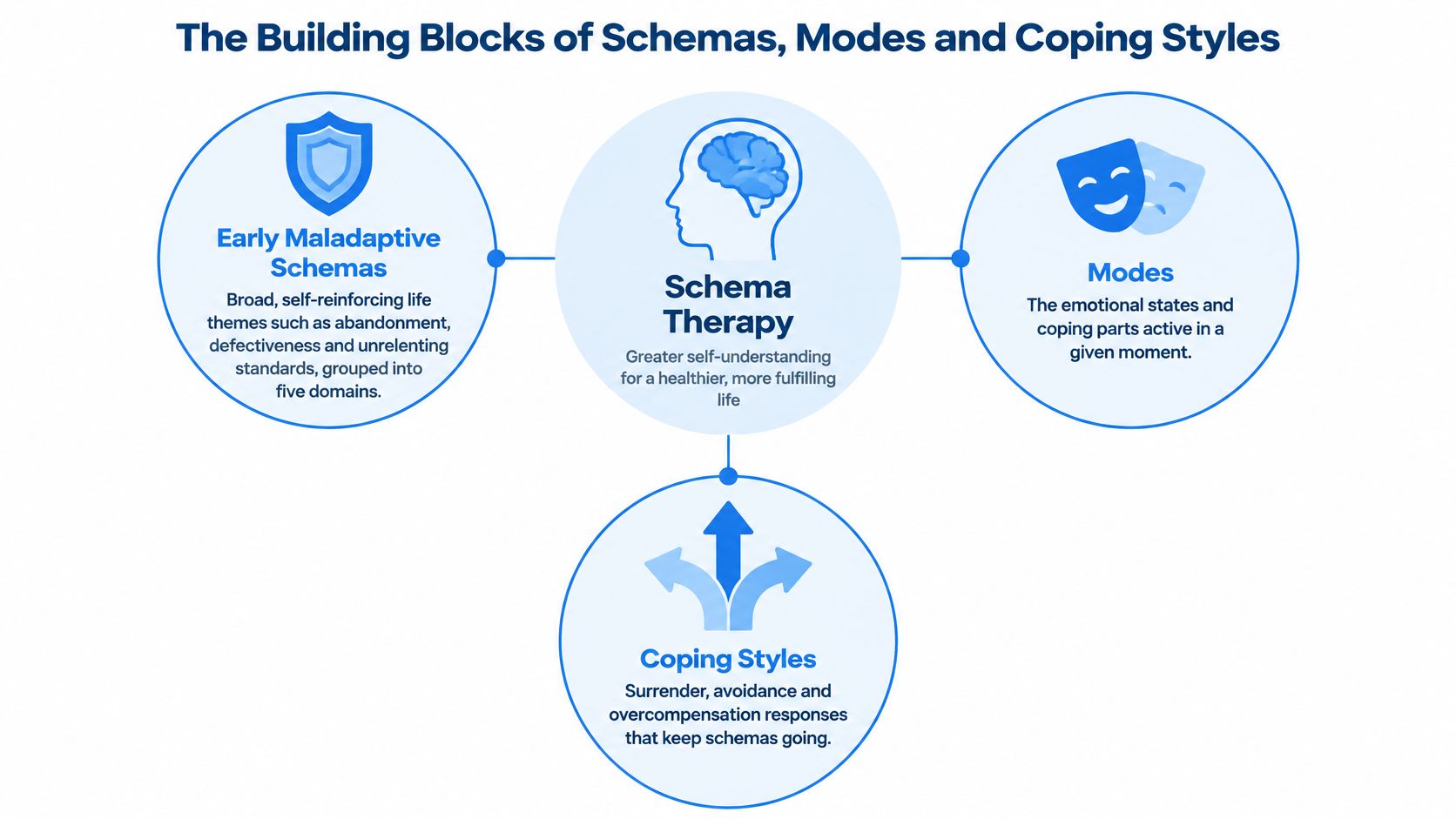
Think of a schema as the lens, a mode as the weather passing across it, and a coping style as what you do when the weather turns. The same person can be warm at noon and unreachable by evening without becoming a different person.
Schemas hold five kinds of life theme
An early maladaptive schema is a broad, self-reinforcing theme about yourself and other people. It filters what you notice, so evidence that confirms it feels obvious and evidence that contradicts it gets discounted. The eighteen named schemas sit inside five domains.
| Domain | Schemas in this domain | Typical inner belief |
|---|---|---|
| Disconnection and Rejection | Abandonment, Mistrust and Abuse, Emotional Deprivation, Defectiveness and Shame, Social Isolation | People will leave or hurt me, and I am not lovable |
| Impaired Autonomy and Performance | Dependence and Incompetence, Vulnerability to Harm or Illness, Enmeshment, Failure | I cannot cope alone, and something bad will happen |
| Impaired Limits | Entitlement and Grandiosity, Insufficient Self-Control | Rules do not apply to me, or I cannot tolerate frustration |
| Other-Directedness | Subjugation, Self-Sacrifice, Approval-Seeking | My needs matter less than other people's needs |
| Overvigilance and Inhibition | Negativity and Pessimism, Emotional Inhibition, Unrelenting Standards, Punitiveness | I must control every feeling and meet standards I can never reach |
Modes are the parts that take over in the moment
A mode is the state you're in right now. The vulnerable child feels lonely or ashamed. The angry child is furious that a need went unmet. The punitive parent inside delivers punishment, and the detached protector numbs everything so nothing lands. The healthy adult is the part that can care for you, hold a limit and choose well, and it's the part therapy deliberately strengthens.
Coping styles are what you do next
There are three habitual responses once a schema fires. Surrender accepts the pattern and repeats it, so you stay in the relationship that confirms it. Avoidance keeps you away from triggers, which is why someone who expects to be let down stops replying to friends for weeks. Overcompensation fights the pattern by doing the opposite, such as refusing all help to prove you're self-sufficient.
Put the three together and ordinary behaviour makes sense. A trigger lands, a mode takes over, a coping style follows, and the other person responds to the coping style rather than to the need underneath it. That's how one argument can run for years in different words.
What Happens Across a Typical Course of Sessions
Before starting, many clients want two answers: what will we do, and how long will it take. Therapists vary in emphasis, and a good one will explain their plan within the first session or two. The order below is common.
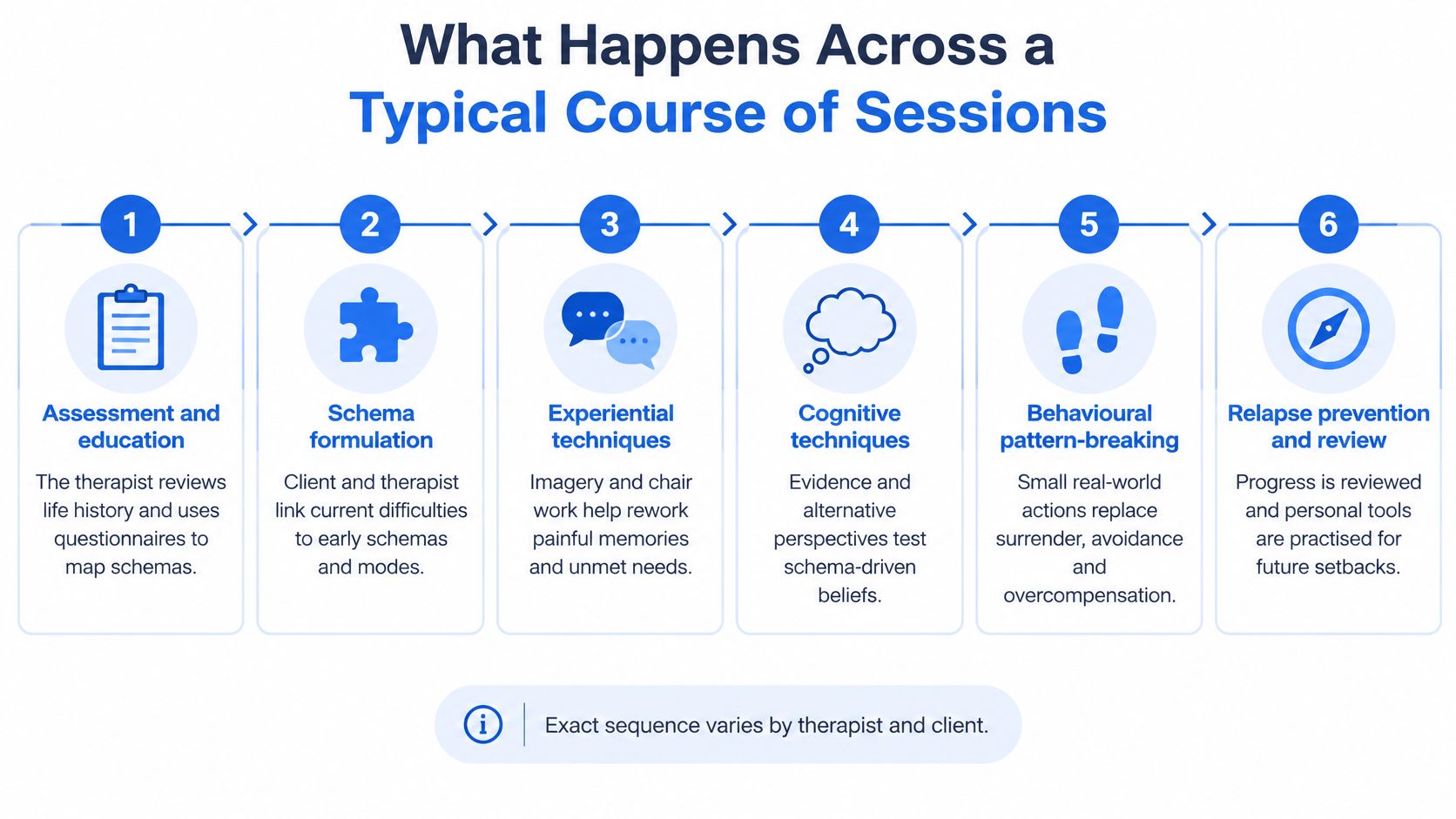
- Assessment and education. You go through your history, fill in questionnaires that map which schemas fit, and hear the model explained in ordinary words. Relief is common, quickly followed by feeling exposed.
- Pattern spotting. You learn to catch triggers and name the mode that showed up, usually with a simple diary. Expect self-consciousness, then surprise at how often the same mode appears.
- The relationship itself. The therapist offers steadiness, warmth and consistent limits, sometimes called limited reparenting. If care in your life has always come with conditions, this can feel strange before it feels good.
- Experiential work. Techniques such as imagery rescripting revisit a painful memory with an adult figure who offers protection, and chair dialogue lets two modes speak to each other. Discomfort here is normal rather than a sign of failure.
- Changing behaviour. You rehearse new responses between sessions, like asking a manager a clarifying question instead of accepting a criticism in silence.
- Consolidation and planning. You list your early warning signs and decide in advance what to do when an old mode returns.
Here's a short walkthrough of how the model looks in practice.
Length varies widely. Published trials have compared courses of 25 or 50 sessions, and a registered multicentre study compares up to 30 weekly individual sessions with treatment as usual for difficult-to-treat depression (2025 trial report in Psychological Medicine; clinical trial registry entry).
If a memory feels like too much: say so in the moment. A competent therapist will slow down, ground you and check whether to continue, and you can pause imagery work at any point.
Three Everyday Stories of Schemas at Work
Abstract descriptions only go so far. These three patterns turn up again and again in Indian homes, hostels and offices, and each one shows the same mechanism: an old need, a mode, a coping style.

Meera is 31 and works in software in Bengaluru. Any critical feedback lands as proof of inadequacy, so she overworks for a fortnight and then resigns before anyone can decide she isn't good enough. Her failure schema and her unrelenting standards drive the overcompensating mode. In therapy she practises separating a comment on a report from a verdict on her worth, and asking her manager two clarifying questions before she responds at all.
Arjun is 20, studying engineering, and freezes in exams while chasing marks to keep the approval coming. Praise in his family arrived only with results, which built approval-seeking and self-sacrifice patterns early. Imagery work with his younger self, a boy who believed love was a reward for a rank card, lets him study for goals he has chosen himself.
Priya and Vikram have been married eight years and fight about late replies to messages. Her abandonment schema meets his emotional inhibition. She pursues for reassurance; he withdraws further; both end up lonelier than before the conversation started. Naming the mode out loud in the moment, before either reacts, gives them a pause long enough to choose something different.
These three are composites built from familiar patterns, not clinical outcomes. Change is gradual, and not every story reaches full resolution. Notice one pattern that repeats in your week and ask what feeling sits underneath it, before you ask what to do about it.
Schema Therapy in an Indian Context
The question readers actually carry: how can a therapist explore these patterns without dismissing my duties toward my parents, my family, my community or my faith?
Schemas form inside a particular life. Family hierarchy, collectivist obligations, caste and class experience, religious identity, arranged-marriage expectations, migration and intergenerational stress all shape how a pattern develops and how it shows up. Reviews of the model call for cultural adjustments and more research on cross-cultural effectiveness, and the evidence base remains limited and mostly non-Indian.
There's a difference worth holding onto. A maladaptive schema is not the same as distress caused by ongoing discrimination, poverty, unsafe relationships or unrealistic social demands. Therapy that individualises structural problems can end up asking you to adjust to conditions that should change. Cultural responsiveness also never excuses harmful behaviour, and it doesn't treat Indian values as pathology.
The scale of unmet need makes clear explanation matter. India's National Mental Health Survey 2015-16 found that 10.6% of adults had a current mental-health condition (National Mental Health Survey prevalence report), with a 85.0% treatment gap for common mental disorders (national survey report on treatment gaps). Access is slowly widening: the National Tele Mental Health Programme has run a 24-hour service on 14416 since 10 October 2022, and its calls grew from 25,368 in 2022 to 1,424,379 in 2025 (Press Information Bureau release on the tele-mental health programme).
- Students carrying exam stress, comparison and parental expectation can use schema work to separate marks from worth.
- Professionals facing workplace stress, burnout or a punishing inner critic often find the unrelenting standards schema explains more than a time-management course does.
- Couples stuck in one repeated fight benefit from seeing two patterns collide rather than one person misbehaving.
- Parents in family conflict can examine what they inherited before passing it on.
Evidence Limits and Deciding If It Fits
The research picture is real but uneven. Most studies are small, several test parts of the model rather than the whole protocol, and results vary by diagnosis. The table collects the figures worth knowing.
| Study | Population | Key result or design |
|---|---|---|
| Systematic review of schema-therapy research | 12 intervention studies, 316 participants | 11 of 12 reported fewer early maladaptive schemas; all but one reported symptom improvement |
| Indian randomised trial of cognitive therapy with schema assessment | 84 adults with alcohol dependence, 45 intervention and 39 control (published trial report) | Greater change in 5 schemas and in perceived stress; no significant change in alcohol-use severity |
| 2025 Psychological Medicine randomised trial | 246 outpatients with depression and personality disorders | Randomised comparison of shorter and longer treatment courses |
| 2025 JMIR trial of a schema-informed digital intervention | 300 initially randomised, 201 to intervention and 99 to wait-list (JMIR trial report) | Tested a digital delivery format against a wait-list control |
| 2026 systematic review of schema and mode models | 7 studies, 580 participants in total (2026 systematic review) | Individual study samples ranged from 1 to 229 |
Read the rows carefully. The Indian trial tested cognitive therapy that included schema assessment, not a full standalone schema-therapy protocol, and the participants' alcohol-use severity did not improve significantly, while 33% of the intervention group missed the follow-up assessment. That's a useful result, not a cure claim.
Reviews of group schema therapy describe encouraging improvements in Cluster B and C personality-disorder symptoms, quality of life and functioning, while framing the work as a continuing research agenda rather than settled proof. Reviews in adolescents and young adults find the evidence base thin enough that quality concerns lower confidence in the conclusions. Meanwhile the need in India remains large, with a 73.6% treatment gap for severe mental disorders recorded by the National Mental Health Survey (Press Information Bureau release on the mental health survey).
Schema therapy is one evidence-informed option for chronic, recurring emotional and interpersonal patterns. It isn't automatically better than every alternative, and diagnosis, risk, therapist competence, treatment length and your own preference all change the answer.
- Check whether the pattern qualifies. Is it long-standing, recurring, and affecting work, relationships or sleep? A bad month isn't a schema.
- Treat any online assessment as informational. A screening result can suggest that support may help, but only a qualified professional can assess your needs or give a diagnosis.
- Seek urgent psychiatric assessment without delay for thoughts of self-harm, severe low mood, hallucinations or a sudden change in functioning. Therapy is not emergency care.
- Ask about training and measurement. Find out what schema training the therapist has, how they'll track progress, and tell them early if imagery or childhood work feels overwhelming.
- Compare before committing. Ask a qualified psychologist or counsellor how they'd formulate your pattern, how long they expect the work to take, and what change would look like.
If you want a plain standard for judging any therapy's claims before you book, this explanation of what evidence based therapy means is worth five minutes.
Resilience and self-compassion aren't reserved for people without struggles; they grow at any stage of life, often with steady support and a willingness to look at patterns clearly. Long-standing reactions soften with time and practice, not overnight. Reaching out for counselling is a strength, not a confession of failure.
DeTalks brings together a directory of psychologists, therapists and counsellors alongside confidential, science-backed assessments, so you can compare support rather than guess at it. If this guide has helped you name a pattern that keeps repeating, the next step is a conversation with a qualified professional who can work through it with you, and our assessments can give you a starting point for that discussion, as information rather than a diagnosis. Visit DeTalks to explore therapists, counselling options and self-help resources built for people in India and beyond.
Leave a Reply