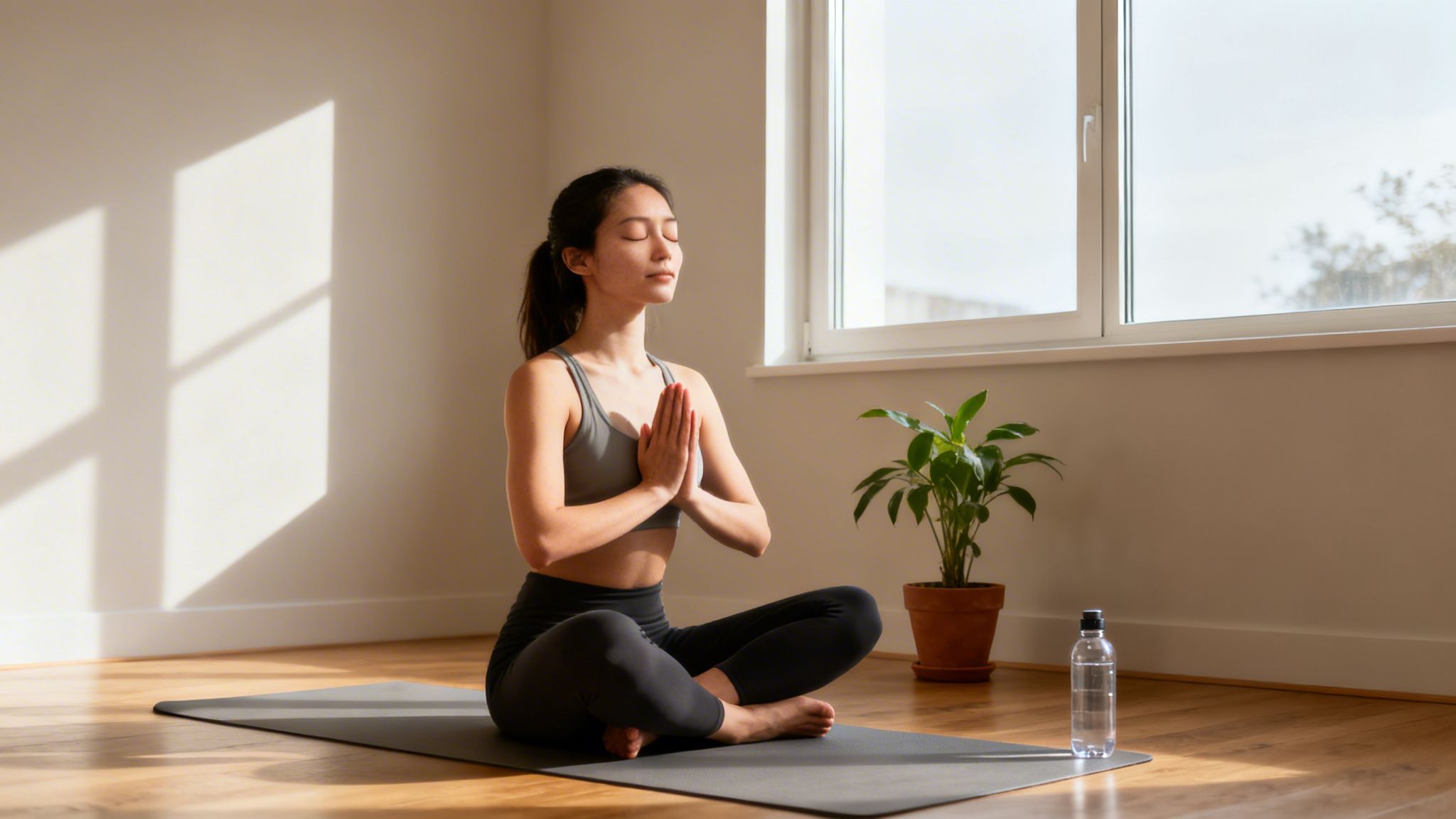
Yoga is an ancient Indian practice that weaves together physical postures, deliberate breathing, and mindfulness. It is designed to soothe the nervous system, lower stress hormones, and guide both mind and body into a state of deep relaxation. When you practise consistently, you're not just moving your body—you're building resilience and nurturing your overall well-being.
Finding Calm in a Chaotic World
Does it ever feel like you're being pulled in a million directions at once? You’re not alone. The constant hum of modern life, from demanding workplace stress in our bustling cities to the pressure of academic deadlines, can easily lead to burnout, anxiety, and a persistent feeling of being on edge.
It's no wonder so many of us are looking for real, sustainable ways to find balance. This is where the gentle, yet powerful, practice of yoga comes in. This guide is your starting point for using yoga for stress relief and anxiety, showing you how to create a lasting harmony between your mind and body.
A Practical Toolkit for Your Mind
Think of yoga less as a quest for the perfect pose and more as a personal toolkit for building emotional strength. It’s about taking small, manageable steps to handle daily stressors and reclaim your sense of peace.
Yoga gently nudges you to shift your focus inward, offering a sanctuary from external noise. By tuning into your breath and the sensations in your body, you can interrupt the cycle of anxious thoughts. This mindful awareness is key to managing feelings of anxiety and heading off burnout before it takes hold. The skills you learn on the mat—like focused breathing and body awareness—are tools you can use anytime to ground yourself.
Yoga teaches us to cure what need not be endured and endure what cannot be cured. It’s a profound practice of self-compassion and acceptance, essential for genuine well-being.
More Than Just Poses
While our focus here is on yoga, other therapeutic practices can be a wonderful part of your mental health journey. Many methods share a common purpose: to activate the body’s natural relaxation response. For example, learning how Swedish massage therapy helps reduce anxiety and stress shows another way to achieve physical and mental release.
Ultimately, whether it's through yoga, therapy, or other wellness practices, the journey is about discovering what works for you. It's a path toward understanding yourself better, building lasting resilience, and finding healthy ways to navigate life's challenges.
How Yoga Rewires Your Brain for Calmness
Have you ever stepped off your mat after a yoga session and felt a wave of peace wash over you? That feeling isn't just your imagination. It’s a real, tangible shift happening inside your brain.
Your yoga practice is a direct line of communication to your nervous system, coaxing it out of high alert and into deep calm. It’s a powerful transition from the "fight-or-flight" mode to the "rest-and-digest" response.
When we’re bogged down by workplace stress or caught in a loop of anxiety, our body is constantly braced for a threat. Yoga, through its blend of mindful movement and conscious breathing, sends a clear signal that it’s safe to stand down. This helps lower stress hormones like cortisol and brings a sense of ease to your entire system.
As this infographic shows, the pressures of modern life are a significant challenge for many.

These stressors are a daily reality for so many of us. This is why finding effective tools to build our resilience is vital for our long-term well-being.
The Science of Calm Brainwaves
Beyond just calming hormones, yoga physically changes your brain's electrical patterns. Our brains operate on different frequencies, or waves, each tied to a specific state of mind. Beta waves are linked to active thought and can go into overdrive when we feel anxious, while alpha and delta waves are hallmarks of relaxed focus and deep rest.
A comprehensive 2026 review, which included research from leading Indian institutions like AIIMS Delhi and NIMHANS Bengaluru, found that specific yoga practices produce remarkable changes. After just one session of practices like Sudarshan Kriya and Bhramari pranayama, participants showed:
- A 19.31% increase in deep relaxation (delta) waves.
- A 15.40% boost in calm, reflective (alpha) waves.
Another compelling Indian study revealed that six weeks of regular Hatha yoga led to a 42% drop in perceived stress and a 25% increase in activity in the prefrontal cortex—the part of our brain responsible for emotional regulation. You can discover the full research on yoga's neurological benefits to see the evidence for yourself.
This is the rewiring process that builds lasting resilience against not just anxiety, but also feelings of depression. It's a gradual strengthening of your mind's innate ability to find its centre.
Building Resilience One Breath at a Time
Every time you intentionally slow your breath or hold a pose with awareness, you’re strengthening the neural pathways that lead to calm. This is the foundation of emotional resilience.
Think of it like training a muscle. The more you practise activating your body’s relaxation response on the mat, the more readily you’ll be able to access it when faced with a stressful situation off the mat.
This consistency is what profoundly shifts your mental well-being. You move from being reactive to life's challenges to becoming more centred and proactive. Instead of getting swept away by a wave of anxiety, you develop the capacity to notice the feeling without letting it overwhelm you.
The goal isn't to eliminate stress entirely—that's impossible. The goal is to change our relationship with it, transforming it from a source of distress into an opportunity for growth and self-compassion.
This change in perspective is a cornerstone of positive psychology. It helps you cultivate not just a calmer mind, but also a deeper sense of happiness and purpose in your life.
The Role of Professional Guidance
While the evidence for yoga’s benefits is strong, it’s crucial to see it as a powerful self-care practice, not a substitute for professional mental health support. Any assessments you might find are purely informational; they aren't a diagnosis. Their purpose is to offer you insights to better understand what you’re experiencing.
If you’re navigating persistent anxiety or depression, combining a consistent yoga practice with therapy or counselling can create a powerful synergy. A therapist offers strategies tailored specifically to you, building a complete support system for your mental health.
Consider yoga and therapy as partners on your journey towards greater well-being. Each one strengthens the other, helping you build a more resilient and peaceful life.
Gentle Poses for Immediate Stress Relief

When stress or anxiety creeps in, a few simple movements can be a lifesaver. Gentle yoga poses, or asanas, help release physical tension, quiet a racing mind, and bring you back to the present moment. This isn't about achieving a perfect posture; it's about treating your body with compassion.
The magic of these poses lies in their simplicity and their almost immediate effect on your nervous system. By gently stretching and focusing on your breath, you send a clear signal to your body that it’s safe to relax. It’s a foundational practice for building resilience and nurturing your well-being.
Grounding With Child’s Pose (Balasana)
There’s a reason Child’s Pose is a go-to resting posture—it feels like a gentle, comforting hug for your entire being. It creates a sense of safety and encourages you to turn your focus inward, muffling the noise of the outside world.
Finding your way into this pose is easy. Start on your hands and knees, bring your big toes together, and sit your hips back towards your heels. From there, fold forward and let your forehead rest on the mat. You can stretch your arms out long in front of you or let them relax by your sides.
This pose offers a gentle stretch for the hips, thighs, and lower back—common areas where we store tension from workplace stress. As you settle in, focus on your breathing. Feel your back expand with every inhale and imagine tightness melting away with every exhale. It’s an incredibly grounding pose for moments of overwhelm.
Flowing Through Cat-Cow (Marjaryasana-Bitilasana)
Think of this as a moving meditation. The Cat-Cow flow connects your breath directly to the movement of your spine, a superhighway for your nervous system. It’s perfect for easing stiffness and cultivating a sense of calm fluidity.
Begin on all fours, with your wrists under your shoulders and your knees under your hips. On your inhale, let your belly drop as you lift your chest and gaze forward into Cow Pose. As you exhale, round your spine up and tuck your chin to your chest into Cat Pose.
Let your breath guide you as you flow between the two. This simple sequence warms up the spine and helps to synchronise your mind and body—a core benefit of yoga for stress relief and anxiety. You can find more specific yoga poses for reduced stress that can offer quick relief.
Remember, the goal isn't to force a deep stretch but to move with your breath. Let the rhythm calm your mind and release the physical knots tied by anxiety.
The Ultimate Restorative Pose: Legs-Up-The-Wall (Viparita Karani)
If there is one pose for pure, effortless restoration, this is it. Legs-Up-The-Wall is a passive, gentle inversion that requires almost no effort but delivers huge benefits. It’s incredibly effective for calming the mind, soothing tired legs, and easing symptoms of anxiety and even mild depression.
To set yourself up, sit on the floor with one hip right up against a wall. From there, swing your legs up the wall as you lie back onto the floor. Scoot your sitting bones as close to the wall as feels comfortable.
Rest here for 5 to 15 minutes. Let your arms relax by your sides, palms facing up, and just breathe. This position helps slow the heart rate and triggers the body's natural relaxation response. It's the perfect way to decompress after a long day.
Key Benefits of Gentle Poses:
- Release Physical Tension: Poses like Child’s Pose and Cat-Cow directly target tension in the back, neck, and shoulders.
- Soothe the Nervous System: Gentle inversions like Legs-Up-The-Wall activate the parasympathetic nervous system, shifting you into a state of "rest and digest."
- Improve Mindfulness: By focusing on physical sensations, you create a welcome distraction from the loop of anxious thoughts.
- Support Emotional Regulation: A consistent practice strengthens the mind-body connection, helping you build resilience against daily stressors.
These poses are small acts of self-care, offering a safe space to acknowledge feelings of anxiety without judgement. While powerful tools for support, they are not a substitute for professional therapy or counselling. They are allies on your journey toward greater mental well-being and happiness.
Using Your Breath to Tame Anxiety

When a wave of anxiety hits, your breath is your most powerful anchor. Unlike poses that need a mat, your breath is always with you. In yoga, we call this conscious breath regulation pranayama, and it's a cornerstone for managing stress and boosting mental well-being.
The connection between your breathing and your emotions is direct. When you get anxious, your breath becomes quick and shallow. By deliberately slowing and deepening your breath, you can flip that switch, telling your body it's safe to relax for an almost immediate sense of calm.
The Foundation: Three-Part Breath (Dirga Pranayama)
This is the perfect place to start with breathwork. It teaches you to use your full lung capacity—something we rarely do when dealing with constant workplace stress. This deep breathing is profoundly soothing for the nervous system.
You can do this lying down or sitting up straight. Place one hand on your belly and the other on your chest. As you breathe in slowly through your nose, first expand your belly, then feel your ribs widen, and finally let your chest rise.
As you breathe out, release the air in the opposite order: chest falls, ribs draw in, and belly contracts. This simple cycle grounds you firmly in your body, pulling your focus away from anxious thoughts. It’s a beautiful exercise in mindfulness and self-compassion.
Quieting the Noise with Bee Breath (Bhramari Pranayama)
Ever feel like your mind is buzzing with worries you can't shut off? Bhramari Pranayama, or Bee Breath, is a unique way to create internal quiet. The gentle humming sound vibrates through your skull, calming the brain and muffling the inner chatter that fuels anxiety.
Find a comfortable seat, close your eyes, and gently press your index fingers on the cartilage to close off your ears. Take a deep breath in. As you exhale, create a low, steady humming sound, like a bee, for the entire length of your breath.
The vibration is surprisingly soothing. It helps release tension in your jaw and forehead and can even help lower blood pressure. This is a brilliant practice before a big meeting or to unwind before bed.
Your breath is a bridge. It connects your mind to your body, your thoughts to your feelings, and your inner world to the present moment. By learning to cross this bridge with intention, you build lasting resilience.
Finding Balance with Alternate Nostril Breathing (Nadi Shodhana)
This classic pranayama technique is famous for balancing the left and right hemispheres of the brain, leading to greater mental clarity. It’s my go-to practice when feeling scattered or overwhelmed. It works wonders not just for anxiety, but also for the low moods that can accompany depression.
Here’s a simple way to practice it:
- Get Settled: Sit comfortably with a tall spine. Let your left hand rest on your left knee.
- Prepare Your Right Hand: On your right hand, fold your index and middle fingers down. You’ll use your thumb and ring finger.
- Start the Cycle: Gently close your right nostril with your thumb. Breathe out completely through your left nostril, then breathe in slowly through that same left side.
- Switch Over: Close your left nostril with your ring finger as you release your thumb from the right. Now, breathe out slowly through the right nostril, and then breathe back in through the right.
- Keep It Going: Close the right nostril again and exhale through the left. That’s one full round. Continue for 5-10 rounds, letting the rhythm soothe you.
This rhythmic pattern helps to harmonise your body’s energy and cultivate calm focus. While these breathing exercises are fantastic tools for self-support, they aren't a substitute for professional guidance. If persistent anxiety is impacting your life, seeking support through therapy or counselling is a sign of strength.
Creating a Sustainable Yoga Practice

The real benefits of yoga for stress relief and anxiety build up over time, through gentle, consistent practice. This is how yoga becomes a reliable tool for your mental well-being, helping you build the resilience to handle life’s challenges with more calm.
Getting started can feel difficult, especially when you’re already overwhelmed. The secret is to make it fit your life. Short, simple routines you can stick with are far more powerful than long sessions you never get around to doing.
Carving Out Your Calm Corner
Before you think about poses, find a space to practise. This doesn’t have to be a whole room—even a quiet corner will do. Clearing away clutter can signal to your brain that it’s time to switch off and focus inward.
Make it a place you want to be. You could add a soft cushion, a favourite blanket, or a small plant. The idea is to create an inviting nook that pulls you towards your mat, making it easier to build a positive habit.
Routines That Fit Your Real Life
We've put together a few sample routines based on the practices you've learned. Think of these as flexible templates to help you manage everything from workplace stress to nagging anxiety with a dose of self-compassion.
These three sample routines are designed to fit different schedules and give you a starting point for managing stress.
Yoga for Stress Relief Sample Routines
| Routine (Duration) | Focus | Sample Poses & Breathing | Best For |
|---|---|---|---|
| The 5-Minute Reset | Grounding and Recentring | 1 min Three-Part Breath, 2 mins Cat-Cow, 2 mins Child's Pose | A quick break at your desk or whenever tension starts to build. |
| The 15-Minute Morning Calm | Energising the Body & Calming the Mind | 5 mins Alternate Nostril Breathing, 5 mins gentle Cat-Cow flows, 5 mins Legs-Up-The-Wall | Starting your day with focus and intention instead of rushing. |
| The 30-Minute Evening Unwind | Deep Relaxation & Releasing Tension | 10 mins Cat-Cow & Child's Pose, 10 mins Legs-Up-The-Wall, 10 mins Savasana (with Bee Breath) | Letting go of the day to prepare your body and mind for restorative sleep. |
The routines in this table are simply suggestions. The most effective yoga practice is the one you actually show up for.
Don’t be afraid to mix and match. Listen to your body and choose what feels right for you on any given day. Cultivating a practice rooted in self-compassion is the ultimate goal.
How to Keep Showing Up
Motivation is rarely constant; it comes and goes, and that’s okay. Some days, just doing five minutes of deep breathing is a huge win. Other days, you might feel ready for a longer practice. The key isn't perfection; it's persistence.
Try to notice the small shifts. Do you feel a little calmer after you finish? Is your breathing a bit slower? Acknowledging these subtle changes can be incredibly motivating.
This journey is a supportive practice, not a cure for anxiety or depression. It works best alongside a complete mental health strategy, which may include professional support like therapy or counselling. If you feel you need more support, connecting with a professional can make all the difference.
When to Seek Professional Support
I believe in the power of yoga for stress relief and anxiety. It’s a fantastic way to connect with your body and cultivate inner calm. But it's also important to be honest about its role: yoga is a supportive practice, not a cure-all.
Think of it as a valuable part of your well-being toolkit, but not a replacement for professional mental healthcare. Knowing when to reach for a different tool is a true act of self-care and compassion.
Sometimes, no matter how dedicated we are, feelings of anxiety or depression can stick around. If you feel the challenges are becoming overwhelming, it might be time to speak with a professional. Taking that step is a sign of incredible strength.
How Yoga and Therapy Can Work Together
Yoga and therapy aren't an either-or choice; they work brilliantly together. While yoga helps you regulate your nervous system and stay grounded, a therapist offers a safe space to unpack your thoughts and learn structured coping strategies.
This two-pronged approach can make a huge difference. You're working on your mental health from the inside out and the outside in, building a much deeper resilience.
Research backs this up. A 2020 study looking at stress in urban India found that a consistent Kundalini yoga practice helped 54% of participants achieve remission from anxiety. When compared with a professional approach like Cognitive Behavioural Therapy (CBT), the remission rate was 71%. This shows that while yoga is powerful, expert guidance can provide a more direct path to feeling better. You can explore the complete study findings on yoga and anxiety here.
Signs It Might Be Time to Reach Out
It’s not always easy to know when "bad days" have turned into something more. Here are a few things to look out for that might signal it's time to get support for anxiety, depression, or even intense workplace stress:
- Feelings of sadness, worry, or emptiness have been present for several weeks and impact your day-to-day life.
- You've lost interest in hobbies or activities you used to love.
- You feel irritable, on edge, or find it hard to control your emotions.
- Your sleep has been seriously disrupted, or your appetite has changed significantly.
Reaching out for help is not a sign of weakness; it is an act of courage. It means you are taking ownership of your well-being and are ready to invest in your long-term happiness.
Making that first call can feel daunting, which is why platforms like DeTalks exist. We're here to help you find qualified and vetted psychologists across India. We also offer confidential, informational assessments that can give you a clearer picture of what you're experiencing. These aren't a diagnosis, but they can be an empowering first step on your journey.
Common Questions About Yoga for Mental Health
As you think about trying yoga for stress relief and anxiety, it’s normal to have questions. Stepping onto the mat for the first time can feel a little intimidating. Getting some answers can give you the confidence you need to begin.
One of the biggest hurdles people create for themselves is the flexibility myth. Let me be clear: you do not need to be able to touch your toes to do yoga. The real aim is to connect with your body through breath and movement, showing yourself some much-needed compassion.
How Often Should I Practise?
This is a question I get all the time. While a daily practice sounds ideal, it’s not always realistic. The best yoga routine is the one you’ll actually do.
My advice is to start small. Even 10-15 minutes, three times a week, can have a powerful effect on your mental well-being. Consistency is what truly builds resilience against workplace stress and daily anxiety, not the pressure to be perfect from day one.
Is Yoga a Replacement for Therapy?
This is a really important point. Yoga is an incredible tool for managing your mental health, but it’s not a substitute for professional support. It's best to think of it as a powerful partner working alongside treatments like counselling or therapy.
Yoga gives you a way to calm your nervous system in the heat of the moment. Therapy, on the other hand, helps you reframe the thought patterns that fuel anxiety and depression. When used together, they create a comprehensive approach to finding lasting happiness.
These practices are here to support you on your journey, not act as a cure. Any assessments you might find online are for informational purposes only and should never be considered a diagnosis.
If you feel that you need more structured support, DeTalks is here to help. We make it simple to connect with a qualified therapist or take a confidential assessment to better understand what you're going through. You can take the next step by visiting us at https://detalks.com.
Leave a Reply