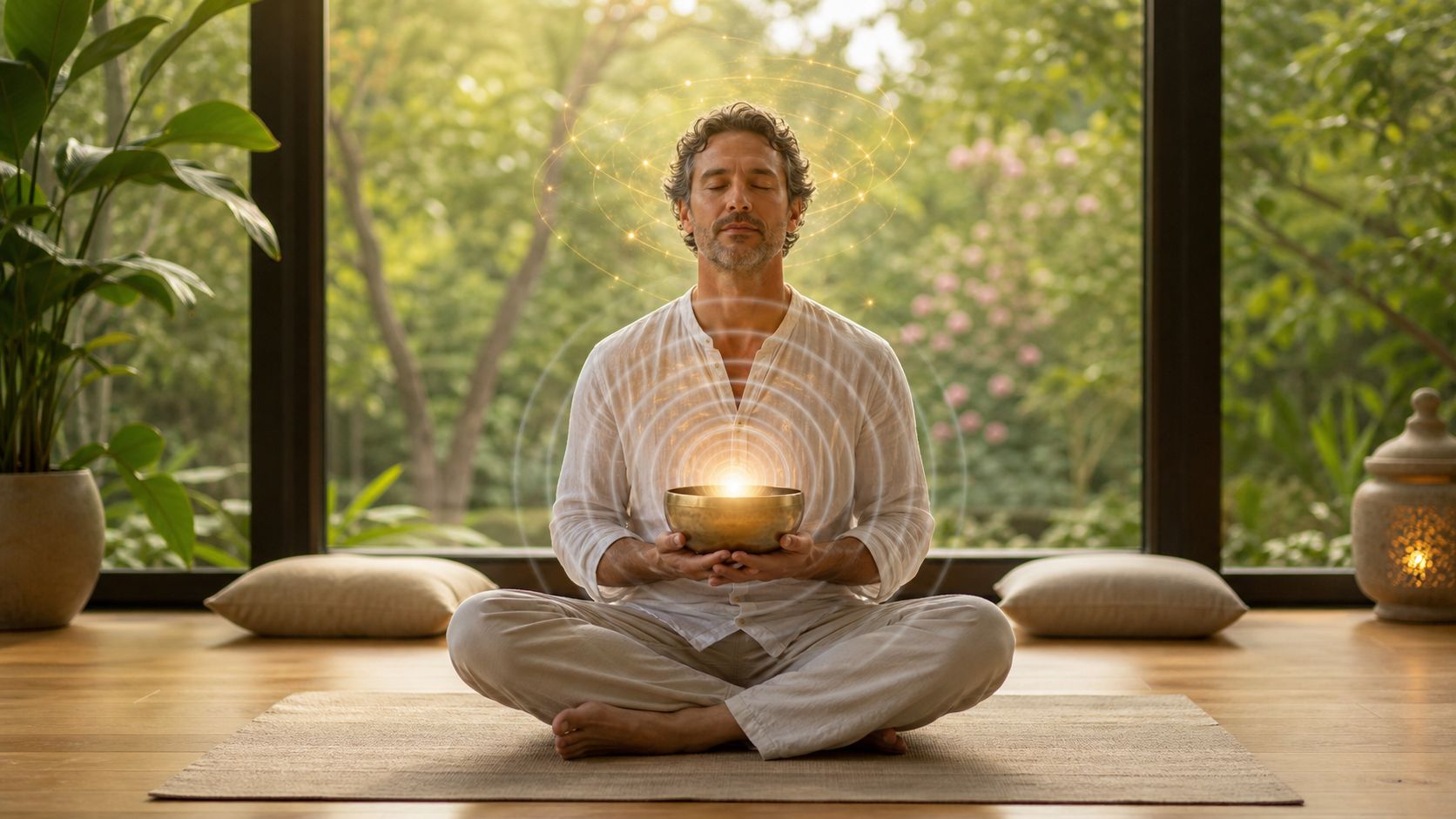
You sit down to meditate after a long day, close your eyes, and within seconds your mind starts running. Emails. Family worries. That awkward conversation. Tomorrow's deadlines. For many people, silence doesn't feel peaceful at first. It feels loud.
That's one reason sound in meditation can be so helpful. Instead of fighting your thoughts, you give your attention something gentle to return to. A hum, a chant, a singing bowl, rainfall, or even the steady rhythm of your own repeated mantra can act like a soft landing place for the mind.
Finding Stillness in a Noisy World
A lot of beginners assume meditation means sitting perfectly still in total silence with an empty mind. That idea stops many people before they even begin. In real life, most minds are busy, especially when stress, anxiety, burnout, or workplace stress have been building for a while.
Sound can make meditation feel more human and more approachable. Rather than treating every noise as a problem, you use one chosen sound as an anchor.

Why this feels familiar to many people
Meditation isn't a niche idea. It has long been used as a practical tool for everyday well-being. In the 2012 National Health Interview Survey, people reported starting meditation for general wellness (76.2%), improving energy (60%), memory or concentration (50%), anxiety (29.2%), stress (21.6%), and depression (17.8%). Among respondents using meditation for these purposes, 60% said it helped them significantly, according to meditation use data summarised here.
That matters in an India-first conversation because the reasons people turn to meditation are practical and familiar. They want steadiness, better focus, emotional balance, and relief from mental overload. Sound meditation sits naturally inside that wider picture.
Practical rule: If silent meditation makes you feel more frustrated than calm, that doesn't mean you're bad at meditation. It may simply mean you need a different anchor.
A simple example
Think of a student preparing for exams. They want better concentration but every study break turns into scrolling and worry. Or think of a working professional who carries workplace stress home and can't switch off at night. In both cases, a soft repeating sound can help the nervous system settle enough for attention to come back to the present moment.
Sometimes the setting matters too. If you're trying to create a restorative routine, environments that feel naturally quiet can support that intention. Travel and retreat planning often help people reset, which is why some readers may enjoy resources that discover serene Tulum locations as examples of spaces designed for stillness and reflection.
Meditation doesn't have to begin with silence. For many people, it begins with support.
What Is Sound Meditation
Sound meditation means using sound intentionally to focus attention. You're not just playing background audio while your mind wanders. You're listening on purpose, returning to the same sound each time attention drifts.
A helpful analogy is a guide rope. If your mind is walking through fog, sound gives your attention something steady to hold. You don't have to force calm. You come back to the rope.
It's different from passive listening
Relaxing music can feel pleasant, but sound meditation asks for a little more participation. You notice the rise and fall of a tone, the pause after a bell, the texture of chanting, or the repetition of a mantra.
That active noticing is the practice. The sound isn't there to entertain you. It's there to support awareness.
Here are a few forms sound meditation can take:
- External sound: Singing bowls, bells, gongs, guided audio, rain sounds, ocean waves, or soft musical tones.
- Internal sound: A silent mantra, a repeated sacred word, or the subtle sound of your own breath.
- Shared sound: Group chanting or guided sessions where many people hold attention together.
What beginners often get confused about
Some people ask whether this is the same as listening to music with their eyes closed. Not exactly. Music can be part of a calming routine, but meditation depends on the relationship you build with the sound.
A simple test helps. Ask yourself, “Am I following the sound with awareness, or am I getting lost in thought while the sound happens in the background?” If it's the second, that's okay. You can gently begin again.
Sound meditation works best when the sound becomes a place to return, not a way to escape.
What to focus on during practice
You don't need a perfect technique. Start with one of these points of attention:
The beginning of the sound
Notice the instant a chime starts.The middle of the sound
Stay with its vibration, pitch, or rhythm.The end of the sound
Listen until it fades fully.The silence after it
Many people find this surprisingly calming.
If you enjoy adding other sensory cues to a ritual, some people also pair meditation with scent. For a practical overview of how aroma can support a reflective atmosphere, you may find Aroma Warehouse on incense for meditation useful.
The main thing is simplicity. One sound. One moment of attention. One gentle return at a time.
The Science Behind Sound and Your Brain
When sound meditation helps you feel calmer, that isn't “just in your head” in the dismissive sense. Your brain and body respond to rhythm, tone, breathing, and repetition in measurable ways.
One educational review of sound-based practice describes a pathway in which slower tempo and lower-frequency sound promote alpha and theta brain-wave activity, while slower breathing and longer exhalations shift the autonomic balance toward parasympathetic activation. That combination is associated with lower heart rate, blood pressure, and cortisol response during meditation practice, as described in this science overview on music and meditation.

What that means in plain language
Your nervous system has different modes. When you're tense, overwhelmed, or on high alert, your body often leans into a stress response. Your thoughts speed up. Your muscles tighten. Sleep can become harder.
Sound meditation can encourage the opposite shift. Slower sounds often invite slower breathing. Slower breathing tells the body that it may be safe to settle. That's why some people notice their jaw unclench, their shoulders drop, or their mind stop racing quite so fast.
Think of it like pacing
If you walk beside someone who's rushing, you tend to speed up. If you walk beside someone calm and steady, your pace often changes without much effort. Sound can do something similar for attention and breathing.
This is one reason some people use sound meditation during periods of anxiety, depression, or burnout. It doesn't erase life problems. It can, however, create a small window in which the body feels less braced and the mind becomes easier to work with.
Where this fits with therapy and counselling
Sound meditation can support well-being, resilience, and emotional regulation. It can also sit alongside therapy or counselling as a daily self-help practice. For some people, it becomes part of a larger routine that includes sleep care, movement, journalling, social support, and professional mental health treatment.
A broader evidence base also matters here. The U.S. National Center for Complementary and Integrative Health summarises a 2018 analysis of 142 participant groups with more than 12,000 people diagnosed with anxiety or depression, finding mindfulness-based approaches better than no treatment and roughly as effective as established therapies such as cognitive behavioural therapy or antidepressant medications for reducing symptom severity. The same review notes that meditation can be anchored on a sound and reports that mindfulness meditation may help reduce insomnia and improve sleep quality, including a 2019 analysis of 18 studies with 1,654 total participants showing better sleep outcomes than education-based treatments, according to the NCCIH review on meditation and mindfulness.
A calming practice doesn't need to be dramatic to be meaningful. Sometimes the first sign it's helping is simply that you pause before reacting.
How to Practise with Different Types of Sound
There isn't one right way to practise. The best choice is usually the one you can return to consistently without feeling strained. If you're new to sound in meditation, it helps to sample a few approaches and notice how your body and attention respond.

A quick comparison
| Sound type | What it is | Best for |
|---|---|---|
| Singing bowls | Resonant metallic tones that rise and fade slowly | Relaxation and grounding |
| Nature sounds | Rain, waves, birds, wind, stream sounds | Gentle focus and sleep wind-down |
| Guided meditation with ambient sound | A spoken guide layered with soft audio | Beginners who want structure |
| Binaural beats | Slightly different tones in each ear, usually with headphones | Focused listening and experimenters |
| Chanting or mantra | Repeated vocal sound, spoken aloud or silently | Mental steadiness and devotional practice |
Singing bowls
Tibetan singing bowls are one of the best-known tools in this area. You may hear one sustained tone or a sequence of tones with pauses between them. The fading sound gives the mind a clear shape to follow.
A 2024 ACM study on Tibetan singing bowl meditation reported improvements in stress and anxiety, and the researchers analysed the effect through changes in physiological signal complexity, suggesting the practice may affect the body in measurable ways rather than functioning only as a subjective relaxation aid. You can read that work in the ACM paper on Tibetan singing bowl meditation.
To try it, sit comfortably, play one tone, and follow it until it disappears. Then notice three breaths before the next sound.
Nature sounds and guided audio
Nature recordings are often easier for beginners than highly layered music. Rainfall or ocean sounds don't demand much interpretation. They create a gentle auditory background that many people find less distracting than melody.
Guided sessions can also help if you struggle to stay with one point of focus. A calm voice may invite you back when your thoughts wander, which is useful during stressful periods or low-mood days.
Binaural beats
Binaural beats are usually heard through headphones, with a slightly different tone played in each ear. Some people enjoy them because the experience feels immersive and structured.
Keep your approach light. Start with a short session and notice whether you feel settled, restless, or overstimulated. If the sound feels irritating or you find yourself becoming more tense, switch to a simpler option.
Chanting and mantra
Chanting works differently because you become part of the sound. Instead of receiving a tone, you create one. That can feel grounding, especially if your mind is busy and your body needs a stronger point of focus.
In many traditions, chanting also carries meaning, memory, and community. Readers interested in the cultural side of repetitive devotional sound may enjoy this piece to Explore Theravada devotional practices.
This short video can help you get a feel for a sound-based practice style before you try one on your own.
A simple starter routine
Try this for one week:
- Choose one sound: Pick bowls, rain, a mantra, or a guided track.
- Keep it brief: Start with a short session that feels manageable.
- Sit in an easy posture: A chair is fine. Comfort helps attention.
- Return without judging: When the mind wanders, come back to the sound.
- Notice the after-effect: Check whether you feel steadier, sleepier, clearer, or emotional.
You're not trying to perform calm. You're learning how your system responds.
Navigating Challenges and Knowing When to Seek Help
A balanced conversation is essential. Sound meditation can be supportive, but not every sound-related experience in practice should be treated as spiritual or harmless.
Some traditions speak of inner sound, sometimes called Anahata Nada, as a subtle meditative experience. That idea can be meaningful for many people. But a similar report, “I hear sounds when I meditate”, can also overlap with conditions that need clinical attention, such as tinnitus or auditory experiences linked with anxiety.

Why caution matters
A 2024 Indian study by NIMHANS found that 18% of individuals reporting “meditation sounds” in urban India had untreated tinnitus, 7% showed early signs of auditory hallucinations linked to anxiety disorders, and 92% of meditation guides in India failed to recommend clinical screening, as described in this discussion referencing the issue of sounds heard in meditation.
That doesn't mean unusual experiences are always dangerous. It does mean they deserve careful attention instead of automatic spiritual interpretation.
Safety check: If a meditation experience leaves you frightened, confused, unable to function, or more distressed over time, pause the practice and speak with a qualified mental health professional.
Signs that suggest a pause is wise
Consider stepping back and seeking therapy, counselling, or medical advice if you notice any of the following:
- Persistent ringing or buzzing: Especially if it continues outside meditation and doesn't seem linked to a specific audio track.
- Voices or sounds with commands or strong emotional charge: This needs prompt professional support.
- Worsening anxiety or panic during practice: Meditation should be adjusted, not pushed through at any cost.
- Sleep disruption or increased agitation: Some people need a different method, a shorter duration, or more grounding support.
- Difficulty telling what is internal and what is external: That's an important reason to seek assessment.
Assessments can be helpful here, but they are informational, not diagnostic. They can point you towards the right kind of support, not replace a clinician's judgement.
A grounded way to think about spiritual experiences
You don't have to choose between respecting spiritual traditions and taking mental health seriously. Both can coexist. Curiosity is healthy. So is screening.
A good question to ask is, “Does this experience leave me more grounded, compassionate, and functional, or more distressed, confused, and cut off?” The answer won't diagnose anything on its own, but it can guide your next step.
If you live with anxiety, depression, trauma, PTSD, or heavy workplace stress, sound meditation may still be useful. It may need to be practised with gentler structure, shorter sessions, or support from a therapist or counsellor who understands both well-being practices and mental health symptoms.
Supportive Takeaways for Your Well-Being Journey
Sound meditation offers a practical doorway into mindfulness for people who find silence difficult. A repeating tone, a mantra, rain sounds, or a guided session can give the mind something steady to return to when life feels noisy inside and out.
That can support calm, focus, resilience, and a greater sense of emotional space. It may also help you build a kinder relationship with yourself, especially on days when anxiety, stress, burnout, or low mood make everything feel harder.
What to remember
- Start small: Short, simple practice is enough.
- Stay observant: Notice what helps and what doesn't.
- Keep expectations gentle: Meditation supports well-being. It isn't a test.
- Respect your limits: If a practice feels unsettling, pause and reassess.
- Reach for support when needed: Therapy and counselling can work alongside meditation, not against it.
You don't need to force a perfect experience. A core skill is learning to meet yourself openly.
Sound in meditation can be one useful tool in a wider journey towards balance, compassion, happiness, and steadier mental health. If it helps, keep going with care. If it doesn't, you haven't failed. You've learned something important about what your mind and body need.
If you'd like structured support for anxiety, depression, workplace stress, resilience, or personal growth, DeTalks can help you find therapists, counsellors, and mental health assessments that offer informed next steps. Assessments are informational, not diagnostic, and they can help you decide whether self-help, counselling, or clinical care may suit you best.
Leave a Reply