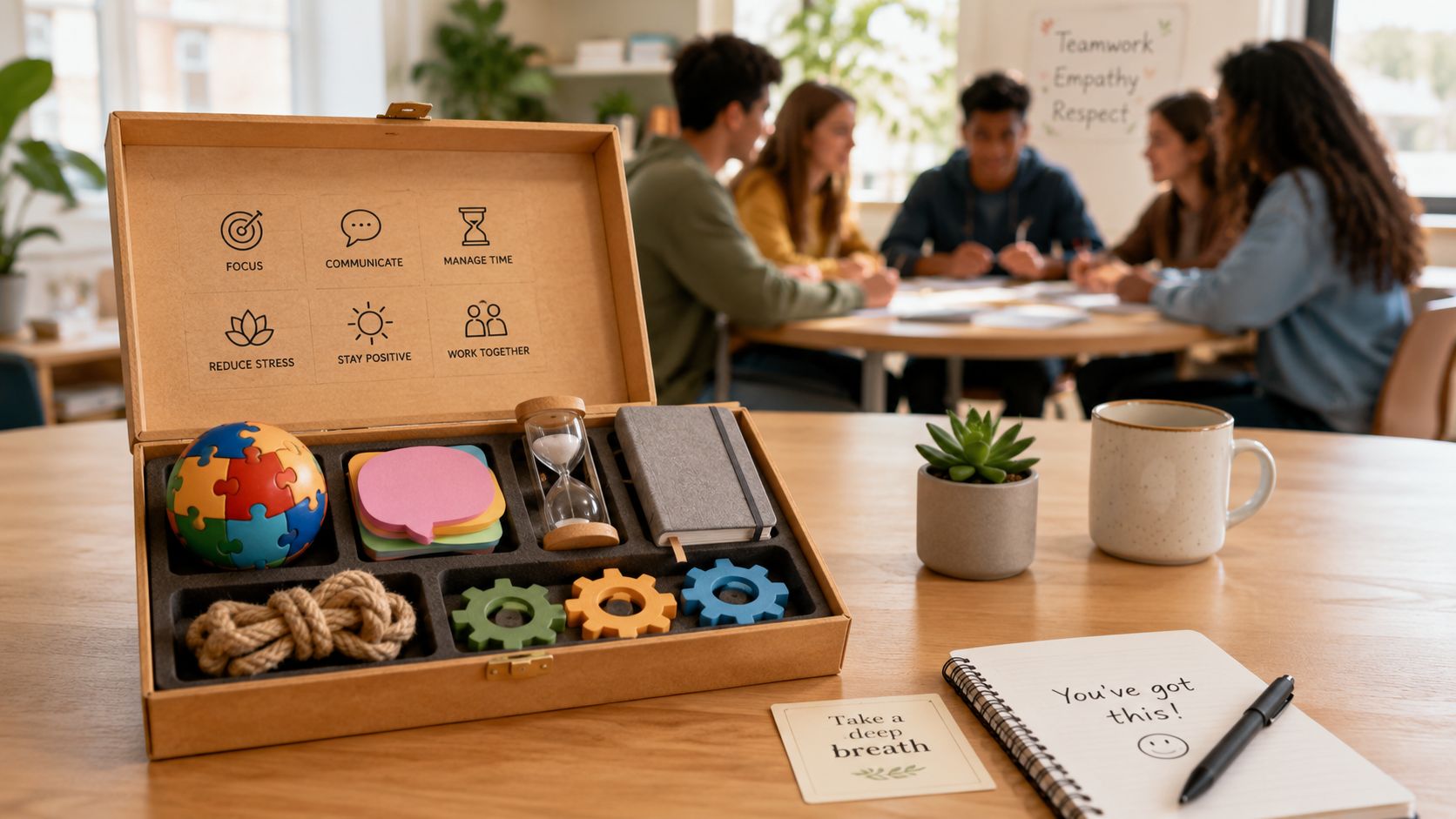
Juggling exams, social pressure, family expectations, and future worries can feel heavy, especially when students are trying to stay focused in a fast-changing world. Life skills activities for students give those pressures a practical outlet, because they turn vague stress into small, learnable habits that support well-being, resilience, and everyday confidence.
India's education system already points in this direction. NEP 2020 explicitly pushes schools toward critical thinking, creativity, communication, and problem-solving alongside academic learning, which makes life skills activities part of mainstream education rather than a side hobby (NEP 2020 policy milestone). Large-scale assessment data also shows why this matters. In ASER 2023, only 43.3% of rural children aged 14 to 16 could do basic division, while 86.8% could read at least a Class 2-level text in their regional language, and 90.9% of boys and 90.0% of girls in this group owned a smartphone (ASER 2023 findings). Students are already living in a digital world, so activities that strengthen judgment, communication, and self-management are no longer optional.
These activities also fit the emotional realities students face. School pressure, anxiety, depression, burnout, and workplace stress often begin with poor coping habits, weak boundaries, or a lack of tools for asking for help. At the same time, positive psychology matters too, because gratitude, compassion, and self-awareness help students notice what supports them, not just what overwhelms them.
Practical rule: keep every activity informational, not diagnostic. A school exercise can build insight, but it can't replace therapy, counselling, or a professional assessment when someone is struggling deeply.
1. Mindfulness and Breathing Exercises
A student who sits down for a test with a racing heart usually doesn't need a lecture. They need a body-based way to settle enough to think clearly, and that's where mindfulness and breathing exercises help. These practices train attention, which supports emotional regulation during exam stress, workplace stress, and general overwhelm.
A simple classroom version can begin with three minutes of box breathing, then move into a short body scan. Students notice where tension sits in the body, the jaw, shoulders, chest, or stomach, and then they return attention to the breath without judging themselves. That quiet repetition strengthens focus and gives students a tool they can use before class presentations, interviews, or difficult conversations.
Ready-to-use facilitator guide
Objective. Help students build present-moment awareness and calm their nervous system in a safe, non-competitive way. In Indian schools, this fits well with Yoga and Mindfulness practices already seen in curriculum settings, and it's equally useful in university counselling spaces or workplace wellness sessions.
How to run it. Ask students to sit comfortably, place both feet on the floor, and breathe in for four counts, hold for four, exhale for four, then hold for four. If that feels too structured, start with simple slow breathing and a brief body scan. Guided apps like Insight Timer or Headspace can support practice, and journaling after the exercise helps students notice what changed.
Adaptations.
- For anxious students: keep eyes open and offer a choice to focus on a point on the wall.
- For younger students: use a “balloon breath” or count on fingers.
- For busy classrooms: do one minute before a quiz or assembly.
A teacher doesn't need a perfect quiet room. A steady voice, a short routine, and repeated practice often matter more.
If intrusive thoughts come up, students should be told to return to the breath gently and without self-judgment. That matters because mindfulness is not about forcing calm, it's about noticing what's there and creating enough space to respond well.
The sleep hygiene tips from Ruidoso pros also fit here, because calmer evenings often start with calmer transitions during the day.

2. Emotional Intelligence and Self-Awareness Mapping
A student may know every deadline on the calendar and still have no language for what is happening inside. That gap matters. When feelings stay unnamed, they often show up as snapping at a classmate, avoiding homework, zoning out in class, or shutting down after a small setback. In school counselling, emotional intelligence begins with making those inner shifts visible so students can understand what they are feeling before the feeling starts directing the behavior.
A useful starting point is to map the five core emotions, joy, sadness, fear, anger, and surprise. Students can note when each emotion shows up, what their body does first, and how the feeling changes their words, study habits, or relationships. A tight chest before a presentation, a hot face during an argument, or a heavy mind after a poor test result can all become clues. Once students can see those patterns, emotional awareness becomes easier to use in counselling orientation weeks, conflict resolution programs, and peer-support settings.
Facilitator guide for safe reflection
Objective. Help students name emotions, connect them to triggers, and understand how feelings shape behavior. The aim is not to sort emotions into good or bad categories, but to notice them early enough to respond with care.
How to run it. Use an emotion wheel, color coding, or sticky notes on a chart. Ask students to write privately first, then share only what feels comfortable. A calm, private tone matters here, because emotional work should never feel like a public performance. If students seem unsure, start with body cues first, then move to the emotion name. That order often feels easier, like matching the smoke alarm before checking the kitchen.
Assessment tips.
- Look for pattern recognition: can the student identify a trigger?
- Check for coping awareness: does the student know what helps or harms?
- Notice relational links: can the student see how emotions affect communication?
Use these observations as a conversation guide, not as a label. A student who can say, “I get tense before group work and speak too quickly,” is already building self-awareness that can support better choices in class and at home.
When to pause and refer. If a student becomes visibly distressed, overwhelmed, or begins talking about self-harm, stop the activity and involve a qualified counsellor. Emotional mapping is for learning and reflection. It is not a substitute for therapy when risk signs are present.
CBSE's Class IX Life Skills Teachers' Manual places self-awareness and critical thinking inside teachable school competencies (CBSE life skills manual). That gives schools a solid base for treating emotional awareness as part of learning, while keeping therapy available for students who need a higher level of support.

3. Time Management and Priority Matrix Workshop
A student may sit down with a full notebook, a phone full of reminders, and still feel behind before the day begins. That is often a planning problem, not a character problem. A priority matrix helps students sort work by urgency and importance, so the day becomes easier to read and less draining to manage.
The deeper value is in the thinking, not just the schedule. Students begin to see that every task does not deserve equal attention, and that choice reduces the pressure to respond to everything at once. In schools and colleges where exams, family duties, and extracurricular demands overlap, that shift can lower burnout risk and make rest feel like part of a healthy routine rather than a reward for finishing everything.
Start with one real week.
Ask students to map where their time goes, not where they wish it went. Classes, homework, tuition, commuting, sports practice, chores, and phone use all belong on the page. Once the picture is visible, they can sort tasks into urgent, important, both, or neither, then break large tasks into smaller steps and place buffer time around them.
Facilitator note: if a student's timetable is already shaped by family responsibilities, a long commute, or part-time work, the plan should fit that reality, not a perfect routine on paper.
Objective. Help students choose priorities calmly and clearly. The result should be a workable plan for the week, not a neat chart that looks good for one day and then falls apart.
How to run it. Use a whiteboard, sticky notes, or plain paper. Students place tasks into the matrix, then mark one action they can do first, one task they can delay, and one habit they need to protect, such as sleep, meals, or a short break. Keep the discussion practical. If a student tries to put every task in the top box, that usually means they need help distinguishing what is urgent from what is merely noisy.
Adaptations.
- For board-exam students: focus on revision blocks, mock-test review, and time for correction.
- For university students: include assignment tracking, internship work, travel time, and sleep.
- For younger learners: use colored cards and simple examples from homework and chores.
Digital tools like Todoist, Google Calendar, and Notion can help if the student uses them. Paper works just as well when a notebook is easier to check and update. The method matters more than the app.
Assessment tips.
- Check sorting accuracy: can the student tell urgent from important?
- Look for realistic planning: does the schedule include travel, breaks, and revision?
- Notice self-management language: can the student explain why one task comes first?
When students review the plan each week, they start to understand a quiet but useful truth. Time management is not about doing everything. It is about choosing the right work often enough to stay steady, healthy, and ready for the next day.
4. Assertiveness and Boundary-Setting Training
A student who keeps saying yes to every request may look cooperative on the outside, while feeling drained on the inside. Over time, that pattern can strain family relationships, friendships, classroom participation, and part-time work. Assertiveness training gives students a steadier way to protect their time and energy without becoming rude or withdrawn.
The key idea is simple. Respect and refusal can exist together. A student can disagree without insulting, ask for space without vanishing, and set a limit without starting a fight.
Practice phrases and role-play
Begin with language that feels realistic in daily life. Phrases such as, “I understand your point, and my answer is no,” or, “I can help after class, but I need advance notice,” give students words they can readily remember under pressure. The goal is not to sound polished. The goal is to sound clear.
Role-play works best when the first examples are easy. A student might practise declining a borrowed note, asking a friend to stop interrupting, or telling a sibling that they need quiet time to study. Once that feels manageable, the activity can move to tougher moments, such as peer pressure, group conflict, or speaking to an impatient supervisor.
Facilitator guide.
Objective. Build respectful self-advocacy and boundary-setting. By the end, students should be able to name one boundary, say it aloud, and hold it calmly even if the other person is disappointed.
How to run it. Start with short, low-stakes role-plays. Then add situations that carry more emotional weight, such as repeated requests, unfair workload, or pressure from someone older or more senior. Keep the tone supportive, because many students hesitate not from weakness, but from fear of upsetting others.
Adaptations.
- For younger learners: use simple classroom situations, like sharing supplies, waiting for a turn, or saying no to teasing.
- For board-exam students: practise boundary language around extra tuition, family interruptions, and study time.
- For university students: include hostel sharing, group projects, travel plans, and part-time work.
- For adult learners: connect the exercise to parenting stress, couples' communication, and workplace expectations.
A helpful analogy is a door with a handle. A boundary is not a wall. It lets the right people in while still closing when something is not okay.
Assessment tips.
- Listen for “I” statements instead of blame-heavy language.
- Watch the tone and posture for steadiness, not dominance.
- Notice guilt language, because many students add so many apologies that the boundary disappears.
- Check follow-through, because saying no once is easier than repeating it kindly.
Healthy boundaries reduce resentment and confusion. They also make relationships more honest, because people know where the line is. In school and college settings, that can mean less peer pressure, fewer misunderstandings, and better focus. In counselling, students often practise this skill in a more personal and emotionally safe space when the boundary problem feels tied to family stress, friendship conflict, harassment, or a strong fear of displeasing others.
5. Gratitude Practice and Positive Psychology Journaling
Gratitude is not about pretending life is fine when it isn't. It is about training attention so the mind doesn't only scan for problems. Students who practice gratitude regularly often become more aware of support, small wins, and moments of comfort, which can help protect well-being during difficult periods.
This is especially valuable in exam seasons, when every day can feel like a measurement of worth. A gratitude journal gives the mind a second job, noticing what helped, what softened the day, and who showed care. That can support compassion, happiness, and steadier emotional balance.
Make it specific
Instead of writing, “I'm grateful for my family,” students can write, “I appreciated my mother's laugh at breakfast,” or “I was glad my friend shared notes before class.” Small details matter because the brain remembers concrete moments more clearly than vague statements. Even hot water, a clean notebook, or a quiet bus ride can be part of the practice.
How educators can guide it. Invite students to write three entries after class, morning assembly, or before bed. On difficult days, ask them to find just one thing that felt okay, because consistency matters more than mood. Gratitude also works well when paired with meditation, exercise, or counselling.
Gratitude should never be forced. If a student is in active distress, the right response is support and care, not pressure to “look on the bright side.”
In therapy, gratitude is often used as a complement to depression counselling, not as a replacement. That distinction matters. It keeps the exercise grounded, gentle, and realistic for students who are carrying more than they can say out loud.
6. Conflict Resolution and Empathetic Listening Workshop
Conflict becomes easier to manage when students learn to hear the need behind the complaint. A roommate who says “You're so messy” may be asking for respect, order, or peace. A classmate who shuts down may be protecting themselves from embarrassment or rejection. Empathetic listening helps students slow down long enough to understand what is really being said.
The Nonviolent Communication style used in many counselling and mediation settings is useful here because it gives students a structure for hard conversations. They practice observation, feeling, need, and request, instead of turning every disagreement into blame.
A script students can actually remember
Use this format, “When you [observation], I feel [emotion] because I need [underlying need]. Would you be willing to [specific request]?” That sentence gives students a clear path through tension without erasing their own feelings. It also keeps the problem specific, which lowers the chance of escalation.
Facilitator guide.
Objective. Help students listen, reflect, and negotiate without attacking or withdrawing. The skill is useful in family conflict, peer disputes, and workplace disagreements.
How to run it. Start with low-stakes examples, like shared study space, group project roles, or phone use in a room. Then ask students to switch roles so they can feel both sides of the conversation.
Assessment tips.
- Check whether the student can restate the other person's concern fairly.
- Notice whether they can separate the person from the problem.
- See whether their request is specific instead of vague or demanding.
University mediation programs, corporate team settings, and couples therapy all use some version of this approach because it protects dignity while still addressing the issue. Students usually need that balance, especially in environments where they feel unheard.
7. Stress Management and Progressive Muscle Relaxation
Stress often shows up in the body before it shows up in words. Tight shoulders, shallow breathing, clenched jaws, and a racing heart are common signs that the nervous system is working too hard. Progressive Muscle Relaxation, or PMR, helps students notice that tension and release it in a structured way.
This is a useful tool for exam anxiety, sports pressure, and the physical strain that can come with depression or chronic stress. Students learn to tense one muscle group for a few seconds, then relax it fully, so their body can feel the difference between holding and letting go.
Guided practice in a classroom or counselling room
Ask students to sit or lie down comfortably, then tense the hands, arms, shoulders, face, stomach, and legs one group at a time. Pair the release with a slow exhale. If leading the practice feels hard, audio guidance from YouTube or apps like Insight Timer can help.
Objective. Build body awareness and a repeatable method for calming physical stress. PMR works best when practiced regularly, not only during a crisis.
Adaptations.
- For sports teams: use it before competition or practice.
- For schools: keep sessions brief and consistent.
- For anxious students: invite them to skip any area that feels too sensitive.
Assessment tips.
- Ask what body signals showed up first.
- Notice whether the student can name the release they felt after relaxing.
- Check whether they know when to use PMR on their own.
Medical and hospital settings also use relaxation methods alongside treatment, which is a reminder that body-based coping is not “soft” or optional. It is practical support.
Calm isn't always a thought. Sometimes it starts with the shoulders dropping.
8. Decision-Making Framework and Values Clarification Exercise
Students often feel stuck because they are trying to make the “perfect” choice. They worry about careers, majors, money, family approval, and whether one decision will decide the whole future. A values clarification exercise reduces that pressure by helping them choose from what matters most, not from fear alone.
This works well in career counselling because it shifts the question from “What should I do?” to “What kind of life do I want to build?” Freedom, security, creativity, helping others, and stability are all valid values. Students need help naming them before they can use them.
A simple decision structure
Ask students to list their top values, then compare two or three choices against those values. They can use the regret test, “Looking back in five years, which choice would I regret not taking?” They should also write down trade-offs clearly, because every real decision includes something given up.
Facilitator guide.
Objective. Help students make choices with more clarity and less rumination. This is especially important for students facing family expectations, major selection, or career confusion.
How to run it. Give students one real decision, not a hypothetical one. If they can't choose a career yet, they can practice with smaller choices, such as clubs, projects, or internships.
Assessment tips.
- Look for value alignment.
- Check whether the student can tolerate uncertainty without freezing.
- See if they understand that a decision can be revised later.
Therapy can be helpful here when the fear behind decision-making is intense or linked to depression, anxiety, or family pressure. The exercise is still useful, but it should stay informational, not diagnostic.
Students often relax when they hear one honest truth. A choice can be meaningful without being permanent.
9. Self-Compassion and Inner Critic Awareness Training
The inner critic is the voice that says, “You always mess up,” or, “Everyone else is doing better.” It may sound like motivation, but it often fuels shame, anxiety, and low self-esteem. Self-compassion gives students a kinder inner response that supports resilience instead of punishment.
This matters for perfectionism, exam stress, burnout, and unhealthy coping patterns. Students who can speak to themselves with more kindness tend to recover faster after mistakes, which helps them keep learning instead of collapsing under self-blame.
Turning down the harsh voice
A simple practice is to name the inner critic. Some students call it “The Judge” or “The Perfectionist,” which creates a little distance between the voice and the self. Then they can use a self-compassion break, “This is hard right now. Everyone struggles. How can I be kind to myself?”
Facilitator guide.
Objective. Help students notice self-judgment and replace it with supportive self-talk. The goal is not false positivity, it's emotional steadiness.
How to run it. Ask students to recall a recent mistake, then write the harsh thought that showed up. Next, have them rewrite it the way they would speak to a friend.
Assessment tips.
- See if the student can identify their common triggers.
- Notice whether their self-talk becomes less absolute and less cruel.
- Ask what helps the inner critic quiet down.
This kind of training is useful in therapy for perfectionism and exam anxiety, and it also fits school mental health campaigns or corporate resilience programs. It creates room for growth without turning every setback into a verdict on worth.
Kindness to yourself is not self-indulgence. It is a stable base for learning, change, and repair.
10. Sleep Hygiene and Recovery Routine Building
Sleep problems often sit underneath bigger struggles. A student who sleeps badly is more likely to feel foggy, emotionally reactive, and less able to cope with stress. Good sleep hygiene is not a luxury, it is part of recovery, focus, and mental balance.
A strong routine starts before bedtime. Students do better when they keep fairly consistent sleep and wake times, dim lights before bed, and cut down screen use in the last part of the evening. A “worry dump” earlier in the day can also help, because racing thoughts often get louder when the room gets quiet.
Build a recovery routine that fits real life
Ask students to design a plan they can follow on busy school nights. That may include a cool, dark room, no caffeine late in the day, and a calm activity if they can't sleep after about 20 minutes. If they share a room or live in a noisy home, the plan should adapt to that reality instead of pretending it doesn't exist.
Objective. Help students protect sleep as part of well-being and stress recovery. The routine should support focus, mood regulation, and burnout prevention.
Assessment tips.
- Notice bedtime consistency.
- Ask whether the student has a realistic wind-down habit.
- Check whether screens, caffeine, or worry are interfering with sleep.
Medical schools, corporate wellness teams, and sleep clinics all treat sleep as a serious health issue, not a side topic. Students deserve the same seriousness.
The right message here is simple. Better sleep doesn't solve everything, but it gives students a stronger base for everything else.
10 Life Skills Activities Comparison
| Practice / Intervention | Implementation Complexity 🔄 | Resource Requirements ⚡ | Expected Outcomes ⭐ / 📊 | Ideal Use Cases 📊 | Key Advantages 💡 |
|---|---|---|---|---|---|
| Mindfulness and Breathing Exercises | Low, short, repeatable practice 🔄 | Minimal, no equipment; guided audio optional ⚡ | Immediate stress reduction; improved focus ⭐⭐⭐⭐ / 📊 reduced anxiety | Quick stress relief, pre-exam calm, daily resilience | Teachable anywhere; scalable for beginners 💡 |
| Emotional Intelligence & Self-Awareness Mapping | Medium, structured facilitation; safe space needed 🔄 | Moderate, emotion wheels, journals, facilitator ⚡ | Better self-regulation and empathy ⭐⭐⭐⭐ / 📊 improved relationships | Counselling, leadership training, conflict prevention | Builds emotional vocabulary and peer insight 💡 |
| Time Management & Priority Matrix Workshop | Medium, interactive planning & reflection 🔄 | Moderate, matrices, calendars, digital tools ⚡ | Reduced overwhelm; higher productivity ⭐⭐⭐⭐ / 📊 improved performance | Exam prep, workload planning, burnout prevention | Creates sustainable routines aligned with values 💡 |
| Assertiveness & Boundary-Setting Training | Medium–High, role-plays, cultural sensitivity 🔄 | Moderate, facilitators, realistic scenarios, practice time ⚡ | Increased confidence; fewer resentments ⭐⭐⭐⭐ / 📊 healthier relationships | Family dynamics, workplace harassment prevention, relationships | Practical scripts and role-play strengthen real-world use 💡 |
| Gratitude Practice & Positive Psychology Journaling | Low, simple daily habit 🔄 | Minimal, pen/paper or app; 5–10 minutes ⚡ | Increased well-being; reduced rumination ⭐⭐⭐⭐ / 📊 higher life satisfaction | Mood boosts, adjunct to therapy, group wellbeing routines | Low-cost, evidence-based habit that shifts attention 💡 |
| Conflict Resolution & Empathetic Listening Workshop | High, skilled facilitation; progressive practice 🔄 | Moderate–High, trained facilitators, time for role-play ⚡ | Lower conflict escalation; stronger empathy ⭐⭐⭐⭐ / 📊 improved outcomes in disputes | Mediation, team-building, relationship repair | Emphasizes needs-based solutions and lasting repair 💡 |
| Stress Management & Progressive Muscle Relaxation | Low–Medium, guided somatic practice 🔄 | Minimal, quiet space, 10–20 min, audio optional ⚡ | Rapid physical relaxation; reduced tension ⭐⭐⭐⭐ / 📊 fewer somatic symptoms | Pre-performance, exam anxiety, insomnia adjunct | Tangible body-based tool for immediate relief 💡 |
| Decision-Making Framework & Values Clarification | Medium, reflective exercises & tools 🔄 | Minimal–Moderate, worksheets, facilitator time ⚡ | Greater clarity; aligned choices ⭐⭐⭐⭐ / 📊 reduced decision paralysis | Career choices, value-conflict scenarios, counselling | Helps separate external pressure from personal values 💡 |
| Self-Compassion & Inner Critic Awareness | Medium, emotional work and modeling 🔄 | Minimal–Moderate, guided exercises, safe environment ⚡ | Reduced self-criticism; improved resilience ⭐⭐⭐⭐ / 📊 faster recovery from setbacks | Perfectionism, burnout prevention, exam stress | Reframes motivation away from shame toward sustainable change 💡 |
| Sleep Hygiene & Recovery Routine Building | Medium, behaviour change over weeks 🔄 | Minimal, education, habit-tracking tools ⚡ | Significant improvements in sleep and daytime function ⭐⭐⭐⭐⭐ / 📊 broad health benefits | Chronic poor sleep, exam season, shift workers | High-impact, low-cost prevention for mental and physical health 💡 |
Your Journey to Well-Being Starts Now
These life skills activities for students are more than classroom exercises. They are building blocks for a lifetime of resilience, compassion, emotional balance, and practical confidence. When students practice them regularly, even in small doses, they become better at handling workplace stress, relationship difficulties, exam pressure, and the ordinary setbacks that shape real life.
The biggest value of these activities is not perfection. It is awareness. A student who can breathe before reacting, name an emotion, set a boundary, or ask for help is already building a stronger future.
That said, these tools are not a substitute for professional mental health care. If anxiety, depression, burnout, sleep problems, or stress are staying with you and affecting daily life, support from a trained therapist or counsellor can make a real difference. Therapy is not a sign of weakness, it is a practical step toward safety, clarity, and healing.
Schools, colleges, parents, and student leaders can use these activities to create spaces where well-being is normal, not hidden. They also work best when adults stay alert to signs that a student may need more than a classroom activity, especially when distress is persistent or intense.
If you're a student, start with one practice that feels manageable this week. If you're an educator or parent, pick one activity, introduce it gently, and keep the conversation open. Small, steady support is often what helps students move from surviving to growing.
If you want support that goes beyond self-help, visit DeTalks to explore therapy, counselling, and science-backed assessments in one place. DeTalks helps students, parents, and working professionals find the right mental health support for stress, anxiety, depression, burnout, and life transitions.
Leave a Reply