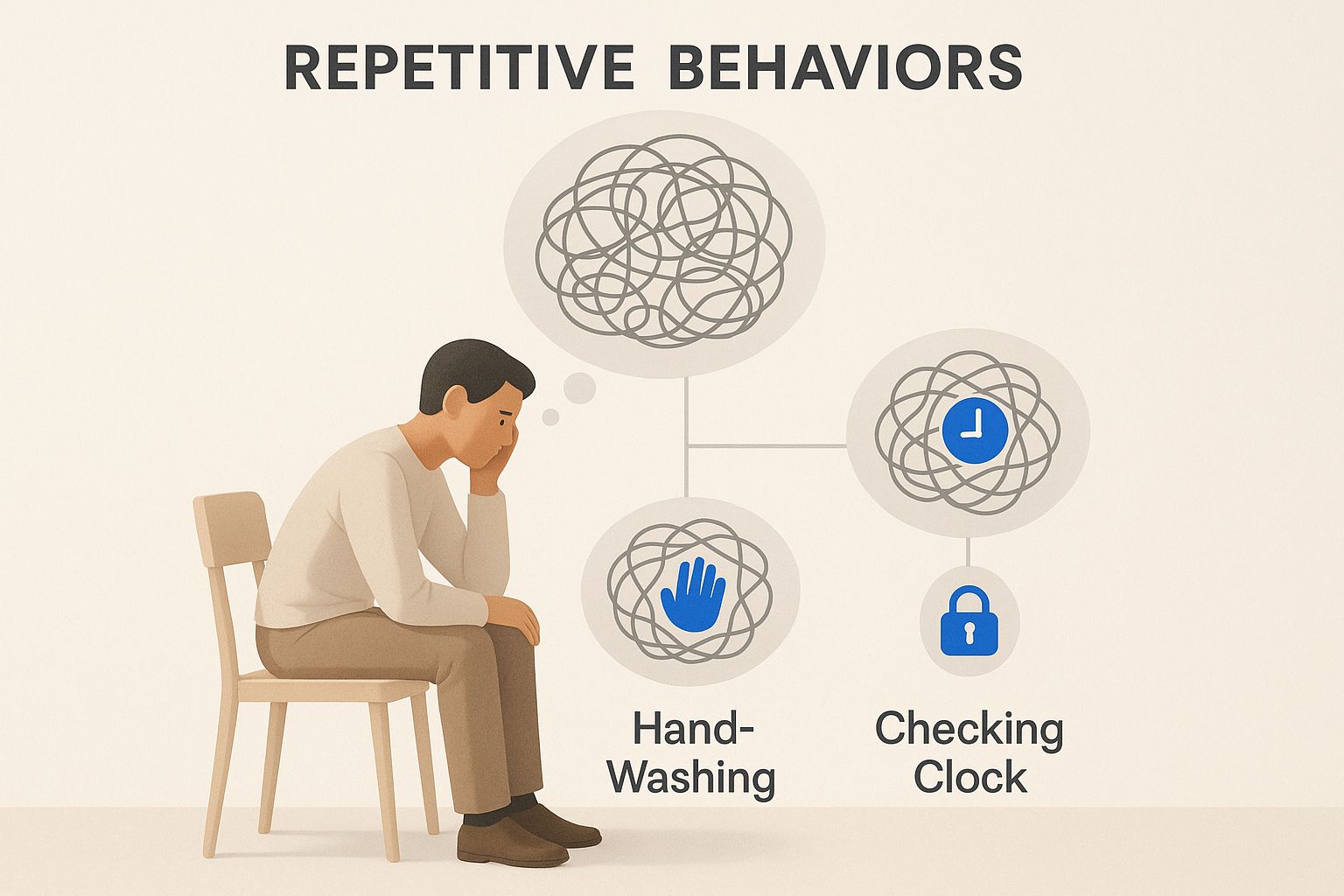
Tag: erp therapy

  • How to Overcome OCD Intrusive Thoughts: Practical Steps

    How to Overcome OCD Intrusive Thoughts: Practical Steps

    You're in a meeting, trying to listen, when a disturbing image suddenly appears in your mind. Perhaps you picture harming someone you love, doubt whether you locked the door, or wonder whether a thought reveals something terrible about you. You feel alarmed, then start checking, analysing, Googling, praying, or asking someone to reassure you.

    If this pattern feels familiar, you may be searching for how to overcome OCD intrusive thoughts without understanding why they feel so convincing. Recovery usually doesn't mean forcing thoughts to disappear. It means learning to respond differently, tolerate uncertainty, and return to the life you value.

    Understanding What OCD Intrusive Thoughts Really Are

    Intrusive thoughts are unwanted thoughts, images, or urges that arrive without invitation. They can involve harm, contamination, sexuality, religion, health, relationships, responsibility, or losing control. Their content often clashes with your values, which is why they feel so frightening.

    An intrusive thought isn't the same as an intention. Someone who has an unwanted image of pushing a person doesn't automatically want to push them. The distress often comes from the thought feeling completely unlike the person's wishes and character. A thought is a mental event, not proof of identity, morality, danger, or future behaviour.
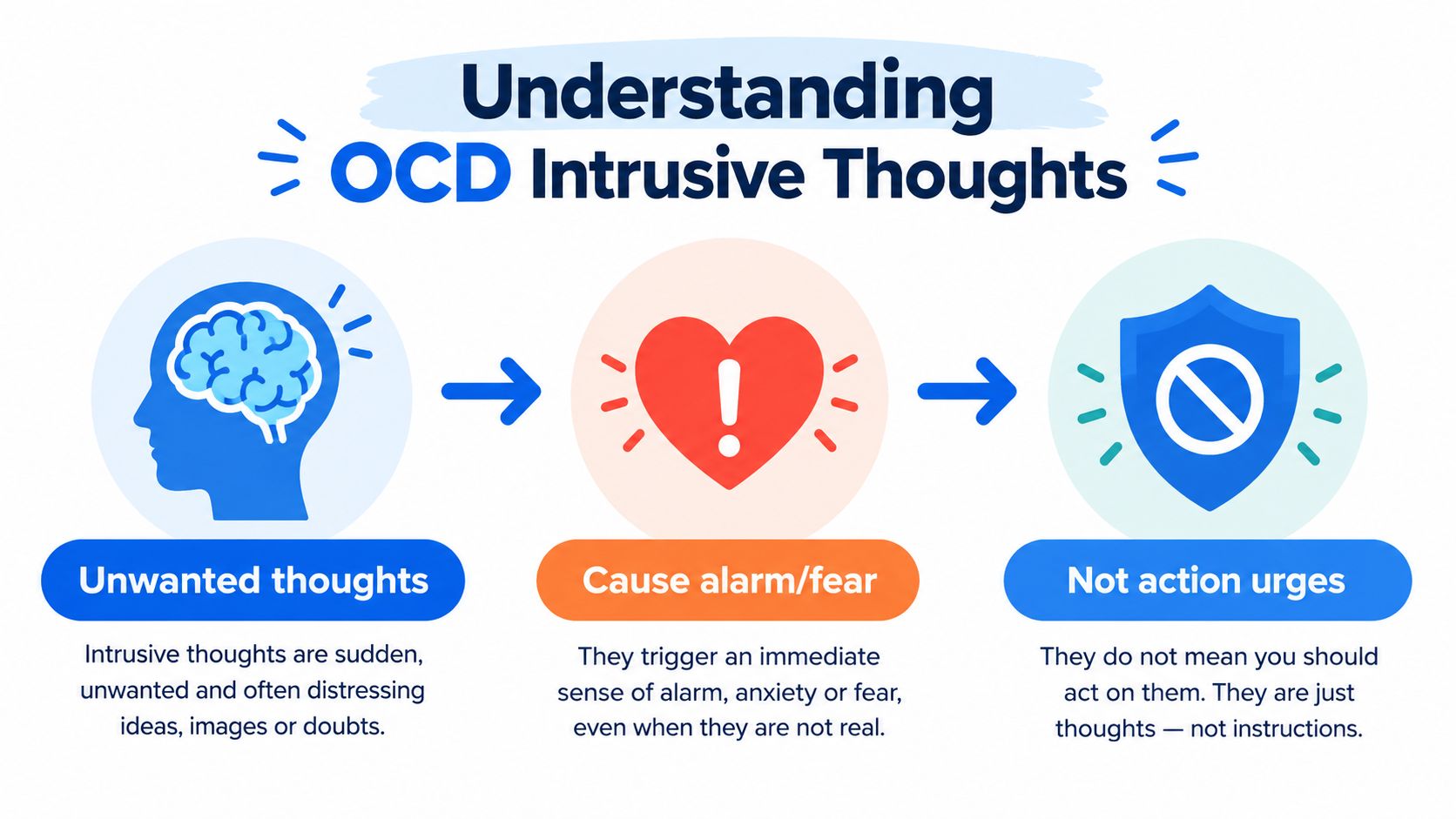
    A diagram explaining OCD intrusive thoughts through a three-step cycle involving unwanted thoughts, fear, and urges.

    Why the cycle becomes so powerful

    The difficulty usually lies less in the thought itself and more in what happens next:

    1. An unwanted thought appears.
    2. You interpret it as meaningful, dangerous, or morally important.
    3. Anxiety rises.
    4. You check, avoid, analyse, confess, pray, or seek reassurance.
    5. Relief arrives briefly.
    6. Your brain learns that the ritual must have prevented danger.

    That short-term relief strengthens the obsession-compulsion cycle. The next intrusive thought then feels more urgent, even though the ritual hasn't solved the underlying fear.

    This doesn't mean you're weak or choosing the cycle. OCD can make ordinary uncertainty feel impossible to tolerate. The more you demand complete certainty that you're safe, good, careful, or free from risk, the more your mind searches for another question.

    A useful distinction: The presence of a thought isn't the problem to solve. Your response to the thought is the part that can change.

    A qualified clinician can help distinguish OCD from other experiences, including anxiety, trauma-related symptoms, depression, or psychosis. If you're looking for background on adult care, this overview of OCD treatment for adults may help you understand the kinds of support available.

    Building an Exposure and Response Prevention Practice

    Exposure and Response Prevention, or ERP, is a first-line psychological treatment for OCD. It combines a gradual approach towards feared thoughts, situations, images, or uncertainty with a deliberate pause in the compulsion that normally follows.

    The purpose isn't to prove that nothing bad can ever happen. ERP helps you learn that anxiety can be present without requiring a ritual, and that you can act according to your values even when certainty is unavailable.

    A gradual way to practise

    Start by writing down common triggers and the responses that follow them. Include visible compulsions, such as washing or checking, as well as hidden ones, such as reviewing memories, counting, mentally replacing an image, or asking for reassurance.

    Then organise the triggers from easier to harder. A person worried about contamination might begin by touching a relatively low-anxiety object and waiting before washing. Later practices may involve touching a shared office surface, eating without repeated checking, or allowing uncertainty about cleanliness to remain.

    A typical exercise looks like this:

    • Identify the trigger: Notice the situation, thought, image, or uncertainty that activates fear.
    • Face it gradually: Approach a manageable item from your hierarchy rather than choosing the most frightening situation immediately.
    • Prevent the usual ritual: Don't wash, check, confess, Google, mentally cancel, or ask another person to settle the doubt.
    • Observe and repeat: Let anxiety be present, notice what happens over time, and practise again across different settings.

    An employee in Bengaluru might touch the meeting-room door, notice the urge to sanitise repeatedly, and return to the meeting without performing the usual ritual. The learning comes from allowing discomfort while continuing with the task, not from obtaining perfect reassurance about the door.
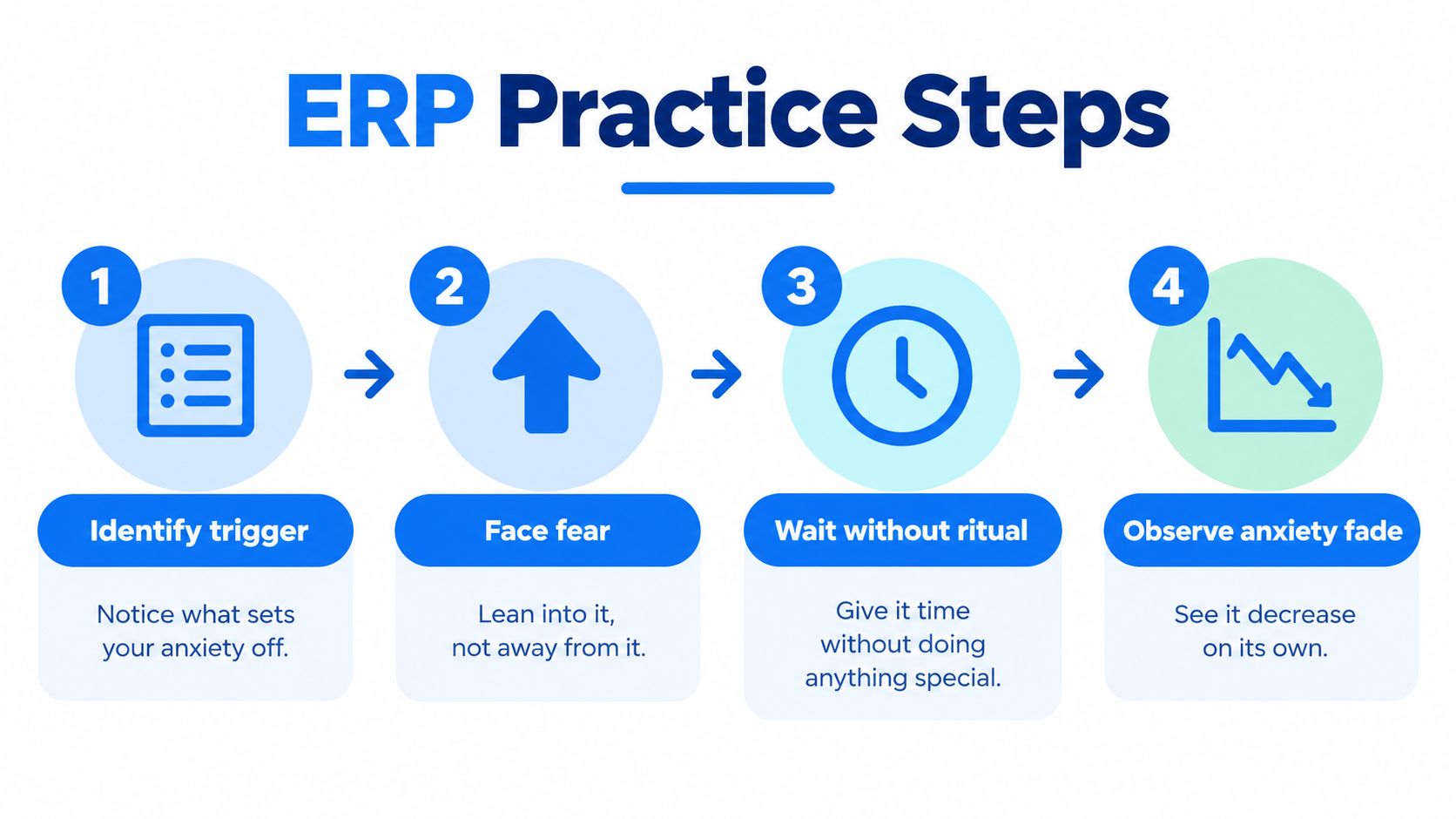
    A diagram outlining the four steps of ERP practice to help manage anxiety and obsessive thoughts.

    What can undermine ERP

    An exposure may look successful while a mental ritual continues underneath. You might touch the object but count to yourself, repeat a prayer to neutralise danger, imagine a protective scene, or check your feelings for certainty. These responses can keep the cycle active.

    Therapist-guided ERP is technically preferable, particularly when symptoms are severe, because a trained professional can adjust the hierarchy, identify subtle rituals, and prevent exercises from becoming flooding or unsafe. Indian guidance describes an adequate CBT course as approximately 10–12 sessions, including 8–10 ERP sessions, and recommends judging progress after a structured course rather than after one difficult exercise. The Indian Psychiatric Society guideline provides further clinical context, while practical resources for provisional psychologists can help trainees understand evidence-based practice.

    Using Mindfulness and Cognitive Defusion

    Mindfulness gives you a way to notice thoughts and body sensations without immediately obeying them. It isn't a demand to feel calm, think positively, or empty your mind. During ERP, mindfulness helps you remain present while anxiety and uncertainty move through you.

    Cognitive defusion adds a little distance between you and the thought. Instead of asking yourself, “Did I forget to lock the door, and what does that mean?”, you might say, “I'm having the thought that I forgot to lock the door.” The second wording doesn't prove the thought false. It identifies it as a thought rather than an instruction.

    A two-minute practice

    Sit comfortably or keep your feet on the floor. Notice one breath, then observe the next thought without chasing its story. You can use this script:

    1. Notice the thought or sensation.
    2. Label it as an intrusive thought, doubt, image, urge, or anxiety.
    3. Allow it to be present without arguing with it.
    4. Return attention to your breath, surroundings, or chosen task.

    When a disturbing image appears, you don't need to decide whether it means something about your character. You can acknowledge, “There's the image,” and continue making your tea, reading your email, or listening to the person in front of you.

    Mindfulness is not a hidden compulsion. If you repeat a phrase until you feel completely safe, use breathing to guarantee that nothing bad will happen, or meditate until the thought disappears, the practice may have become another attempt to obtain certainty.

    This short video can offer a guided introduction to mindful attention:

    Mindfulness won't remove every intrusive thought. Its value is that it helps you notice the thought without building a second struggle around it, then choose an action connected to work, relationships, learning, rest, or another personal value.

    Stopping Reassurance, Checking, and Mental Rituals

    Many people recognise physical compulsions but miss the rituals happening inside the mind. Asking a partner, “You're sure I didn't hurt anyone, are you?”, searching symptoms repeatedly, confessing every disturbing thought, reviewing a conversation, or replacing a “bad” thought with a “good” one can all function as reassurance rituals.

    These actions may feel responsible or thoughtful. The useful question is what they're trying to achieve. Ordinary reflection helps you make a decision or learn from an event. A mental compulsion keeps returning because it demands a feeling of absolute certainty that never lasts.
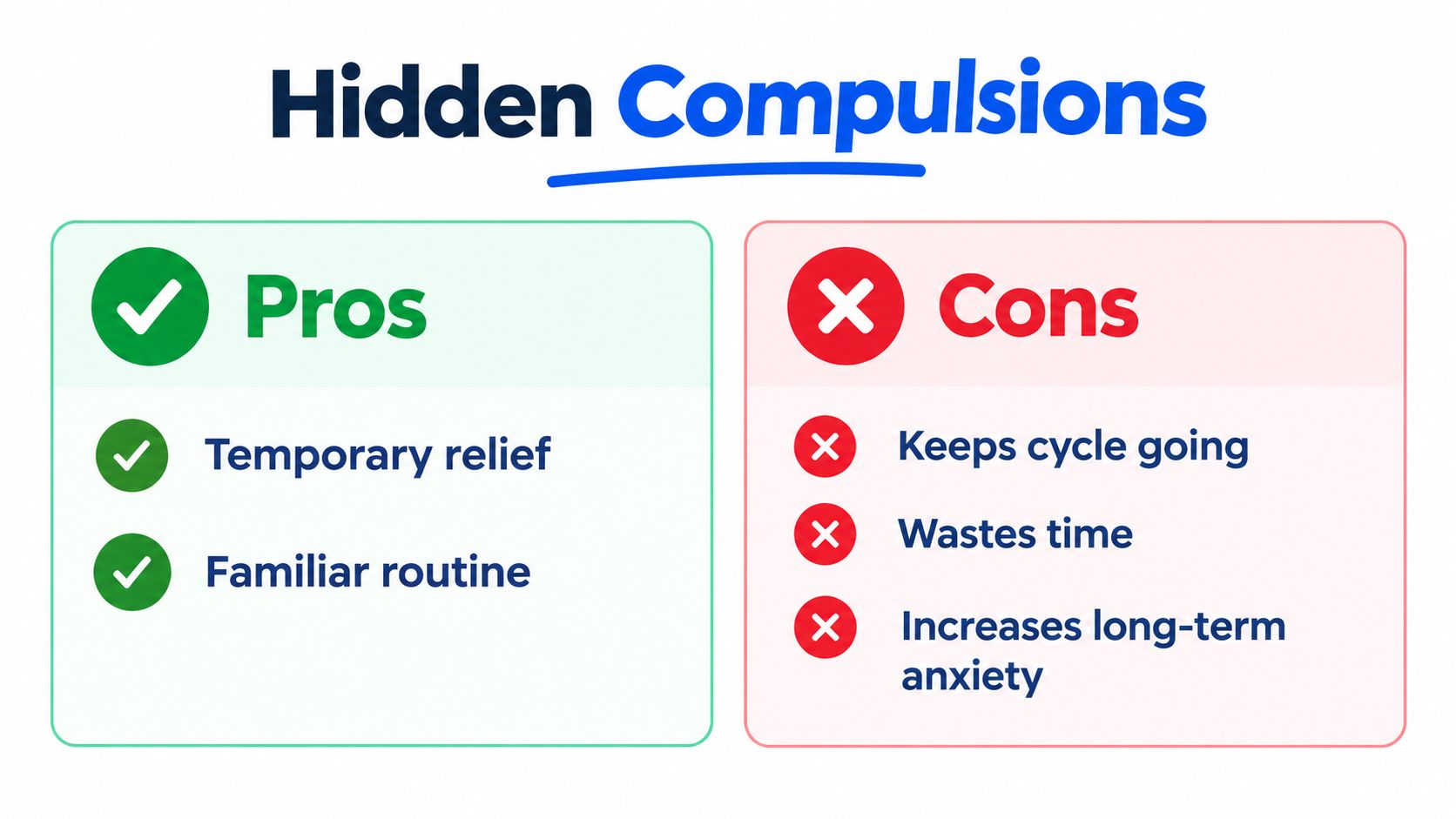
    A chart comparing the pros and cons of hidden compulsions in mental health, listing relief and cycles.

    How to spot the hidden loop

    Notice the sequence rather than debating the content. A doubt appears, anxiety rises, and you feel driven to obtain an answer. You check your memory, search online, ask someone, or mentally examine your feelings. Relief follows, but the doubt returns in a new form.

    Try replacing an automatic response with a planned pause:

    • Delay the ritual: Wait for ten minutes before asking for reassurance or checking. Use the time to continue an ordinary activity.
    • Choose one necessary check: If a practical check is genuinely needed, do it once according to a pre-decided rule rather than responding to every new doubt.
    • Redirect from analysis: Move your attention towards a concrete action, such as sending the email, walking to class, or preparing dinner.
    • Change family responses: A supportive person might say, “I hear that this feels frightening, and you can handle the uncertainty,” rather than repeatedly saying, “It's definitely fine.”

    The aim isn't to be harsh with yourself or refuse all reasonable support. It's to stop using other people, information searches, or mental review as tools for making anxiety disappear. Family members may need guidance because repeated reassurance can become accommodation, even when it comes from love.

    Knowing When Self-Help Is Enough and When to Seek Professional Help

    Self-help can be useful when symptoms are mild, you can continue daily responsibilities, and you're able to practise without the exercises becoming rituals. Professional support becomes more important when thoughts consume substantial time, cause marked distress, produce repeated compulsions or avoidance, or interfere with study, work, sleep, relationships, or self-care.

    Seek prompt clinical assessment if intrusive thoughts involve self-harm or harm to others, especially when there is intent, planning, or an inability to stay safe. A clinician should also assess symptoms that occur alongside depression, trauma, substance use, severe anxiety, or experiences that don't feel like unwanted thoughts.

    Self-help versus professional support at a glance

    Symptom Pattern Suggested Next Step
    Occasional intrusive thoughts that pass without major distress Notice them, avoid unnecessary rituals, and return to your activity.
    Repeated doubts, checking, reassurance, or avoidance Arrange an assessment with a qualified mental-health professional.
    Symptoms disrupting work, study, sleep, or relationships Consider structured CBT with ERP rather than relying on self-help alone.
    Severe impairment, risk concerns, or inability to resist compulsions Seek urgent professional assessment and coordinated care.

    India's National Mental Health Survey, conducted across 12 states, found that 10.6% of adults had a current diagnosable mental-health disorder, while treatment gaps across mental disorders ranged from 70% to 92%. Later Indian analysis reported an 85% gap for common mental disorders and an 80.4% treatment gap, reinforcing why confidential, accessible care matters. These findings come from the National Mental Health Survey report, and they describe population-level access, not your personal diagnosis.

    Good treatment starts with a structured assessment, clear goals, and a plan that matches your symptoms. Indian guidance commonly describes CBT and ERP delivery across 12–20 sessions over 3–4 months, although the right pace depends on your needs and access.

    Finding an ERP-experienced therapist may require asking about training, using tele-consultations, or looking for regional-language support. Directories and screening tools can help you find options, and a resource such as Vancouver Counselling Clinic can illustrate what to look for in an OCD-focused service. Assessments are informational, not diagnostic, and they can't replace a clinical interview or treatment plan.

    A Clear Overview of Medication for OCD

    Medication is one possible part of OCD care, not a personal failure and not an automatic requirement. Indian clinical guidance identifies selective serotonin reuptake inhibitors, or SSRIs, and CBT with ERP as first-line treatments.

    An SSRI must be prescribed and monitored by a qualified clinician. Your psychiatrist or prescriber may discuss benefits, side effects, interactions, other health conditions, and what to do if symptoms change. Don't start, stop, or alter the dose independently, even if you feel better or become worried about an early side effect.

    Why patience matters

    An adequate SSRI trial generally requires about 12 weeks at a maximum tolerable dose, because improvement may take time. The early period may involve adjustment, and you should tell your prescriber about any concerning or persistent effects rather than making changes alone.

    Medication may be considered when OCD symptoms are moderate or severe, when ERP access is limited, or when therapy alone hasn't provided enough improvement. For severe symptoms, Indian guidance supports combining CBT or ERP with medication under psychiatric supervision.

    For mild-to-moderate OCD, CBT with ERP may be used alone when trained care is available. The decision should account for symptom severity, functioning, preferences, medical history, affordability, language, location, and follow-up access.

    The practical aim isn't to erase every thought. It's to reduce compulsive responding, improve functioning, and make it easier to participate in therapy and everyday life. A psychiatrist can explain the available options without assuming that one route suits everyone.

    Staying Well, Preventing Relapse, and Supporting the People Around You

    Improvement doesn't mean you'll never have another intrusive thought. A more realistic measure is whether you can notice a thought, reduce the ritual, recover your attention, and continue with work, relationships, rest, or meaningful activities.

    Create a maintenance plan with your clinician. Continue agreed therapy or medication for the recommended period, practise ERP across different places and situations, and watch for early signs such as increased avoidance, repeated checking, rising reassurance-seeking, or withdrawing from valued activities.

    Indian literature reports relapse among CBT or ERP responders in the approximate range of 3%–12% and recommends continuing CBT and/or medication for several months after remission to consolidate gains. This doesn't mean relapse is inevitable. It means ongoing care can protect progress, just as follow-up supports many other long-term health conditions. The clinical discussion is available in this review of OCD treatment and relapse.

    Family support without feeding OCD

    Relatives often want to remove uncertainty for the person they love. Repeatedly answering the same question, participating in checking, helping avoid triggers, or changing household routines may bring immediate relief but can keep the cycle going.

    A calmer approach combines warmth with consistent boundaries:

    • Validate the emotion: “I can see that this feels frightening.”
    • Avoid proving certainty: “I won't keep checking this with you, but I'll stay beside you while the anxiety passes.”
    • Support valued action: Encourage the person to return to class, work, meals, sleep, or connection without demanding instant calm.
    • Reduce accommodation gradually: Make changes with clinical guidance, especially when family rituals have become extensive.

    Workplace stress, anxiety, burnout, depression, and mental fatigue can make intrusive thoughts harder to manage, but they don't mean every stressed person has OCD. An Indian workplace review reported that, among 1,764 urban white-collar employees assessed in 2022, 29% showed moderate-to-severe signs of depression, 55% showed moderate-to-severe anxiety, and 78% reported moderate-to-high stress. Those findings describe screening results, not diagnoses, and they show why counselling, rest, boundaries, resilience, compassion, and broader well-being deserve attention alongside OCD-specific treatment.

    Your supportive takeaway is simple: you don't need to eliminate every intrusive thought to build a meaningful life. Progress may look like checking less, asking for less reassurance, returning sooner to valued activities, and treating yourself with patience after a difficult day. Setbacks are information, not proof that treatment has failed, and asking for therapy or counselling is a sign of strength.


    DeTalks helps people in India explore psychologists, therapists, counsellors, confidential assessments, and online therapy or counselling options for concerns including OCD, anxiety, depression, burnout, and workplace stress. Visit DeTalks to find support that fits your needs and to take a practical next step towards greater resilience and well-being.

  • Find OCD Therapy Near Me: Expert Guidance for 2026

    Find OCD Therapy Near Me: Expert Guidance for 2026

    You might be reading this after another difficult hour. Maybe you checked the lock again, replayed a thought you didn't want, searched symptoms, closed the tab, and then typed OCD therapy near me anyway.

    That search can feel exposing. It can also be a strong act of self-respect. If you're in India, or anywhere else where specialist mental health care can feel hard to find, the challenge isn't a sign that your struggle is “too much”. It often means the system is hard to access.

    Acknowledging Your Search for Help

    A lot of people begin in the same place. They aren't looking for abstract information. They want relief, clarity, and someone who understands why ordinary reassurance hasn't solved the problem.

    You may be wondering whether your symptoms are “serious enough”, whether therapy will judge you, or whether a nearby counsellor will know how to help with OCD rather than offering general stress support. Those questions make sense.

    A distressed woman holding a smartphone and searching for local OCD therapy services online.

    Why this search feels harder than it should

    In India, access is still a major barrier. The National Mental Health Survey found that the treatment gap for mental disorders ranged from 70% to 92%, which shows that many people struggle to find care. Your search for help is a brave and important step, as noted in this summary of India's mental health treatment gap and OCD context.

    That matters because searching for OCD therapy near me isn't only about convenience. It's often about trying to find someone who recognises the difference between everyday anxiety and OCD's pattern of intrusive thoughts, doubt, checking, avoidance, reassurance-seeking, and rituals.

    You are not failing because you need specialist help. You're responding to a condition that often needs specialist treatment.

    Some people also carry extra pressure from work, studies, caregiving, or family expectations. OCD rarely sits neatly in one corner of life. It can increase anxiety, drain energy, add to workplace stress, and affect sleep, concentration, relationships, and confidence.

    A more hopeful way to approach the search

    It helps to think of this process as a series of smaller decisions, not one huge life-defining choice. You don't need to know everything today.

    Start with three gentle assumptions:

    • Specialist care matters: Not all therapy for anxiety or depression is the same as OCD treatment.
    • Fit matters too: A therapist can be qualified and still not be the right fit for your personality, language, schedule, or comfort level.
    • Progress can be gradual: Good therapy usually builds skills, resilience, and self-compassion over time rather than offering instant relief.

    If you've felt embarrassed about searching, try replacing that thought with something more accurate. You're trying to protect your well-being. You're looking for a structured way forward.

    That's not weakness. It's problem-solving under stress.

    Understanding Evidence-Based OCD Treatments

    When someone is looking for therapy or counselling for OCD, they often encounter a long list of terms. CBT, ERP, ACT, medication, intensive treatment. It can sound like every provider is offering something different, even when the descriptions are vague.

    The most important thing to know is simple. For OCD, Exposure and Response Prevention, usually called ERP, has the strongest foundational evidence and is recommended as a first-line treatment. A major meta-analysis found that approximately two-thirds of patients improved with ERP, according to this review discussing ERP as a first-line OCD treatment.

    An infographic titled Evidence-Based OCD Treatments illustrating ERP, CBT, and ACT therapy methods for OCD patients.

    What ERP actually means

    ERP sounds technical, but the idea is very practical.

    Exposure means gradually facing a trigger, thought, image, situation, or uncertainty that usually sparks obsessive fear. Response prevention means resisting the ritual, checking, reassurance, avoidance, or mental review that normally follows.

    A simple analogy is learning to enter a swimming pool slowly. You don't start by being thrown into deep water. You begin where it feels manageable, stay there long enough to learn that anxiety can rise and fall, and repeat the process with support.

    A therapist trained in ERP usually helps you create a graded hierarchy. That means you start with challenges that feel possible, then build upward.

    Practical rule: ERP isn't about forcing yourself to “stop thinking”. It's about changing how you respond when the thought shows up.

    How CBT and other approaches fit in

    ERP is often considered a specialised form within the broader family of cognitive behavioural therapy. In plain language, CBT helps you notice patterns between thoughts, feelings, and behaviours.

    For OCD, the behavioural part matters a lot. Insight alone often isn't enough. Many people already know their fear may be exaggerated, but they still feel driven to perform rituals because the anxiety feels urgent and convincing.

    You may also come across ACT, or Acceptance and Commitment Therapy. Some therapists use ACT-informed strategies to help people make room for discomfort without getting trapped in it. That can support resilience, compassion, and values-based action. The key question is whether the therapist can clearly explain how this approach supports OCD treatment rather than replacing structured OCD work without a reason.

    What medication can and can't do

    Some people use medication alongside therapy, often when anxiety, depression, sleep disruption, or daily impairment are making it hard to function. Medication discussions belong with a psychiatrist or another qualified prescriber.

    Medication can be helpful support, but it doesn't teach the behavioural skills that ERP targets. If you're comparing options, it's reasonable to ask whether the clinician recommends therapy alone, therapy plus medication, or a higher level of care because of symptom severity or safety concerns.

    A quick comparison can make the situation clearer:

    Approach What it focuses on Best question to ask
    ERP Facing triggers and reducing rituals “How do you structure exposures and response prevention?”
    CBT Thought and behaviour patterns “How do you adapt CBT specifically for OCD?”
    ACT-informed work Accepting discomfort and acting on values “How does this support, rather than avoid, OCD treatment goals?”
    Medication Reducing symptom burden “When would you suggest psychiatric input alongside therapy?”

    If a provider describes OCD treatment only as “talking through your feelings”, pause there. Feelings matter. But evidence-based OCD therapy usually includes a clear plan for behaviour change, practice between sessions, and measurable progress.

    Your Practical Search for OCD Therapy Near Me

    Searching well can save emotional energy. If you only type one broad phrase, search engines often show mixed results, including general anxiety counselling, wellness pages, and directories that don't tell you who specifically treats OCD.

    A person using a laptop to search for OCD and anxiety therapists on Google search results.

    Search like someone looking for a specialist

    Try adding the treatment type, symptom style, city, and format you need. For example:

    • Use treatment terms: “ERP therapist for OCD”, “OCD specialist counselling”, “CBT for OCD therapist”
    • Add your location: “ERP therapist in Bengaluru”, “OCD counselling in Delhi”, “intrusive thoughts therapist in Mumbai”
    • Include practical filters: “online OCD therapy India”, “Hindi speaking OCD therapist”, “after work therapy sessions OCD”

    If you're curious why certain phrases matter online, this plain-English guide on how local search intent drives business helps explain how search queries reflect what people intend to do. For you, that means specific search terms can lead to more useful results than a broad symptom search.

    Read profiles for signals, not slogans

    Many therapist listings sound warm and reassuring. That's nice, but it's not enough. You're looking for signs that the person treats OCD specifically.

    Pay attention to whether the profile mentions:

    • OCD by name: Not just anxiety, stress, burnout, or depression
    • ERP specifically: This is stronger than vague mentions of CBT alone
    • Assessment and goal setting: A structured process usually signals organised care
    • Homework or between-session practice: OCD therapy often continues outside the session
    • Telehealth options: Useful if the best-fit therapist isn't in your immediate area

    A nearby therapist is convenient. A therapist who understands OCD is often more important.

    Don't limit “near me” to geography

    For many people in India, specialist options are unevenly spread across cities. That's where virtual therapy can make a real difference. A clinician in another city may still be the better choice if they have clear OCD expertise, flexible timing, and a therapy style that fits your life.

    This matters if you juggle office hours, commuting, parenting, or university deadlines. Online sessions can reduce friction and make it easier to stay consistent, which supports well-being and resilience over time.

    A simple shortlist helps. Pick three providers and compare them on expertise, format, language, scheduling, and whether their description sounds specific or generic. You don't need the perfect match on the first click. You need a sensible next step.

    How to Choose the Right Therapist for You

    The first consultation isn't an exam you need to pass. It's a two-way conversation. The therapist is learning about your concerns, and you're deciding whether this person has the skill and style to support you well.

    That shift in mindset matters. When people feel anxious, they sometimes slip into “please tell me what to do” mode. But OCD treatment works best when the relationship is collaborative, clear, and grounded in trust.

    A checklist infographic titled Choosing Your Therapist with five key questions to ask for OCD treatment.

    Questions worth asking directly

    Because ERP can feel demanding, support and structure matter. Dropout is a known risk, with some reports showing rates around 19%, which is why it's wise to ask how the therapist helps clients stay engaged in treatment, as discussed in this OCD treatment guide from the International OCD Foundation.

    Here are useful questions that often reveal a lot:

    • “How much of your work involves OCD?”
      A specialist should answer clearly and comfortably.

    • “Do you use ERP, and how do you explain it to clients?”
      You want a practical answer, not only theory.

    • “What happens if I feel overwhelmed or want to avoid the exercises?”
      A good therapist won't shame you for fear. They should talk about pacing, support, and problem-solving.

    • “Do you give homework between sessions?”
      For OCD, between-session practice is often part of treatment.

    • “How do you track progress?”
      Good therapy is compassionate, but it's also organised.

    A strong therapist usually welcomes these questions. If they seem irritated, vague, or overly defensive, pay attention to that.

    Here's a helpful explainer if you want a quick visual before making calls:

    Green flags and red flags

    You don't need to like every detail of a therapist's style. But you do need enough confidence to begin.

    Green flags often include:

    • Specificity: They can describe how OCD therapy works in real life.
    • Collaboration: They ask about your goals, routines, work pressures, family context, and values.
    • Transparency: They explain session structure, fees, cancellation terms, and whether telehealth is suitable.
    • Respect: They don't mock, minimise, or act shocked by intrusive thoughts.

    Red flags deserve caution:

    • Guarantees of cure: Ethical professionals don't make promises like that.
    • Only reassurance-based care: If every session centres on calming you in the moment without addressing rituals, progress may stall.
    • No treatment plan: Warmth without direction can leave you stuck.
    • Overconfidence without explanation: “Don't worry, I handle everything” isn't a method.

    The right therapist doesn't just understand OCD. They help you understand what they're doing and why.

    Comfort matters, but not in the way people think

    Feeling understood matters. So does feeling challenged in a safe, respectful way.

    ERP isn't meant to be cosy all the time. If therapy gently stretches you while keeping you supported, that can be a very good sign. The aim isn't perfect comfort. It's building resilience, confidence, and a different relationship with anxiety.

    What to Expect in Your First Few Sessions

    Starting therapy can feel like showing up for something important without knowing the script. It helps to know that early sessions are usually slower and more collaborative than people fear.

    The first appointment often begins with questions about what's been happening, how long it's been affecting you, what situations trigger distress, and what you do to cope. If work, family conflict, burnout, sleep problems, anxiety, or depression are also part of the picture, those may come up too because they affect treatment planning.

    The first session is usually about mapping, not fixing

    Many therapists begin with an assessment process. That process is informational, not diagnostic. It helps the clinician understand patterns, severity, daily impact, strengths, risks, and whether OCD-focused therapy is the best next step.

    You might be asked about intrusive thoughts, checking, washing, ordering, repeating, mental reviewing, reassurance-seeking, or avoidance. These questions can feel personal, but they're meant to reduce confusion, not judge you.

    Early sessions should leave you feeling clearer about the plan, even if you don't feel better yet.

    How ERP usually begins

    If ERP is recommended, the therapist may help you build a list of feared situations or triggers from easier to harder. This is often called a hierarchy. You and the therapist then choose manageable starting points rather than jumping straight into the hardest challenge.

    For example, someone who repeatedly seeks reassurance might practise delaying that reassurance for a short period. Someone who avoids uncertainty might practise leaving a small question unanswered. The exact exercises depend on your symptoms and should be carefully customized.

    Evidence suggests that structured ERP leads to meaningful symptom reduction in about 60% to 80% of patients, which is why many clinicians see it as a hopeful and practical route when delivered well, according to this discussion of how effective exposure therapy can be for OCD.

    Progress often looks steadier than dramatic

    In the first few weeks, many people notice one of two things. Either they feel relief from finally having a framework, or they feel nervous because the work is becoming more active. Both reactions are normal.

    Good therapy doesn't ask you to become fearless. It helps you become less ruled by fear. Over time, that can improve daily functioning, relationships, workplace stress management, and your sense of well-being.

    Managing Costs and Taking Your Next Step

    Cost worries stop many people before they even send the first enquiry. That's understandable. Therapy is a health decision, but it's also a practical one.

    When you contact a provider, ask clearly about session fees, package options if any, payment timing, cancellation rules, and whether they offer reduced-fee slots. If you have employer-provided insurance or workplace wellness support, check whether mental health counselling, psychotherapy, or psychiatric consultations are included.

    Consider access, not just distance

    A common trap in the OCD therapy near me search is assuming the best option must be the closest office. In reality, telehealth has changed what access can look like. For many people, the best-fit specialist may not be physically nearby, and virtual care can make specialist support more realistic, as highlighted in this discussion of why best-fit OCD care may matter more than geography.

    If medication is part of your plan, it can also help to compare pharmacy costs carefully. For readers who are exploring prescriptions such as duloxetine for related symptoms under medical guidance, this guide on how to find lowest duloxetine price may be useful as a budgeting resource.

    Keep the next step small

    You don't need to solve your whole future today. A manageable next step could be:

    • Shortlist two or three therapists
    • Send one enquiry message
    • Book one consultation
    • Take an informational screening assessment
    • Write down your top questions before the first call

    If you use an assessment, remember the same rule. It's for insight, not diagnosis. It can help you describe your symptoms more clearly and decide what kind of support to seek.

    You're allowed to want relief from anxiety. You're allowed to care about happiness, resilience, compassion, and a calmer daily life. And you're allowed to ask for specialised help rather than trying to push through alone.


    If you'd like a low-pressure place to begin, DeTalks lets you explore therapists, counsellors, and confidential mental health assessments in one place. You can browse support options, learn more about your symptoms, and take a thoughtful next step towards better well-being.

  • Cognitive Behavioral Therapy for OCD: A Guide to Finding Relief

    Cognitive Behavioral Therapy for OCD: A Guide to Finding Relief

    Cognitive Behavioral Therapy, or CBT, is a practical, hands-on approach to therapy. It's designed to help you recognize and change the patterns of thinking and behavior that can keep you feeling stuck. Think of it as a training program for your mind, giving you real-world tools to manage difficult feelings and build long-term resilience.

    Your Path Forward Starts with Understanding

    Living with Obsessive-Compulsive Disorder (OCD) can feel like a constant internal struggle. The intrusive thoughts (obsessions) and the strong urge to perform certain actions (compulsions) can be exhausting and cause a great deal of anxiety. If this sounds familiar, please know you're not alone, and there is a proven path toward feeling better.

    This guide will walk you through Cognitive Behavioral Therapy (CBT), a structured and supportive type of counselling. Unlike therapies focused only on the past, CBT addresses the here-and-now. It helps you untangle the cycles of thoughts, feelings, and actions that fuel OCD.

    The Connection Between Thoughts and Actions

    At its heart, CBT is based on a simple but powerful idea: your thoughts, feelings, and actions are all connected. When you change one, the others often follow.

    For example, an obsessive thought like, "My hands are contaminated," can trigger a feeling of intense anxiety. This anxiety might then drive a compulsive action, such as repeated handwashing. CBT teaches you how to step into that cycle and gently break it.

    Cognitive Behavioral Therapy isn't about eliminating unwanted thoughts—it’s about changing how you relate to them. It shows you that you have a choice in how you respond, which is the first step toward managing OCD.

    Why CBT Is the Recommended Approach

    CBT's success is supported by years of research. A specific type, called Exposure and Response Prevention (ERP), is known as the most effective therapy for OCD. In India, where OCD affects a significant part of the population, this therapy offers a structured path forward. For more details, you can read about OCD's prevalence and treatment in India.

    What makes this type of therapy so helpful?

    • It’s skill-based: You learn practical techniques you can use for the rest of your life to support your well-being.
    • It’s a partnership: You and your therapist work as a team, setting goals at a pace that feels comfortable for you.
    • It builds independence: The goal is to equip you with the skills to become your own guide over time.

    This isn't just about managing specific symptoms. It is a journey toward building self-compassion and creating a life with more peace, especially when dealing with challenges like [workplace stress] or feelings of anxiety and depression.

    How Exposure and Response Prevention Works

    When we talk about Cognitive Behavioral Therapy for OCD, we often focus on a powerful technique called Exposure and Response Prevention (ERP). The name might sound clinical, but the idea is very practical. It’s about safely and gradually facing your fears until they no longer have the same power over you.

    Think of it like learning to swim with a supportive instructor. You start in shallow water and slowly build your confidence. ERP works the same way; it's a guided, step-by-step process tailored to you.

    This infographic captures the internal struggle of OCD, where thoughts and behaviors can feel like an impossible knot.

    Infographic about cognitive behavioral therapy for ocd

    ERP is a gentle method for untangling that knot, helping you regain a sense of control over your actions and reactions.

    The ‘Exposure’ Part: Facing the Fear

    The first part of the process is Exposure. This means you will gradually and safely confront the thoughts, places, or objects that trigger your anxiety. This is a carefully planned process that you and your therapist design together.

    For someone with a fear of contamination, an early exposure might be as simple as touching a doorknob at home for a few seconds. The goal is to start with a challenge that feels manageable and builds your confidence.

    This systematic process teaches your brain a new lesson: the things you fear may not be as dangerous as they feel. Over time, the triggers begin to lose their intensity.

    The ‘Response Prevention’ Part: Breaking the Habit

    This brings us to the second critical part: Response Prevention. After being exposed to a trigger, you learn to resist the urge to perform your usual compulsion or ritual. This is where you learn to sit with the discomfort until it naturally subsides.

    At first, the feeling of anxiety can be strong, and that's perfectly normal. Your therapist is there to support you through it. This discomfort always fades with time.

    By not giving in to the ritual, you are actively breaking the OCD cycle. You send a powerful message to your brain: "The difficult feeling passed on its own." This is where you start to find freedom.

    To make this clearer, this table breaks down the core components of Exposure and Response Prevention to clarify how this structured therapy helps you regain control.

    Understanding the Two Parts of ERP Therapy

    Component What It Means in Practice The Ultimate Goal
    Exposure Systematically facing triggers (thoughts, objects, situations) in a controlled way, starting with the least scary and moving up. To reduce the anxiety and fear associated with your triggers through a process called habituation.
    Response Prevention Actively choosing not to perform the compulsive behaviours or mental rituals that you normally use to reduce anxiety. To break the link between obsessions and compulsions, proving to your brain that the rituals are not necessary for safety.

    Together, Exposure and Response Prevention are a powerful team. This is a crucial step toward managing OCD and addressing related challenges like workplace stress, anxiety, and depression.

    What to Expect from Your Therapy Sessions

    Deciding to start counselling is a significant and hopeful step. To help you feel more prepared, let's walk through what cognitive behavioral therapy for OCD sessions typically look like.

    Think of the process as a partnership between you and your therapist. You are always in control of the pace, and the main goal is to create a safe space where you feel supported.

    Your First Session: The Initial Assessment

    The first few sessions are about getting to know each other. Your therapist is there to listen to your story and understand what you are going through in a judgement-free environment.

    You’ll likely talk about your specific challenges and what you hope to achieve through counselling. Any assessments used are simply informational tools to help create a personalized plan; they are not a formal diagnosis.

    The initial assessment is a two-way street. It is a chance for you to see if the therapist is a good fit and for them to understand how best to support you.

    This groundwork ensures your therapy is tailored to your unique needs, whether that's addressing OCD or related challenges like anxiety, depression, or stress.

    Creating Your Fear Hierarchy Together

    After your therapist understands your experiences, you'll work together to build a fear hierarchy. This is a list of the situations or thoughts that trigger your OCD, ranked from least stressful to most stressful.

    This list becomes your personal roadmap for therapy. You'll start with small, manageable challenges and only move up when you feel ready and confident. This step-by-step approach is designed to build your skills without feeling overwhelming.

    Practicing New Skills Beyond the Session

    A key part of CBT is applying what you learn in therapy to your everyday life. This is often called "homework," but it’s more like real-world practice to help new skills stick.

    These practice tasks are always designed with your therapist and are linked to your fear hierarchy. They are practical, achievable steps to keep your momentum going between sessions.

    What might this practice look like?

    • Behavioral Experiments: Gently testing a fear in a controlled way, like touching an object and waiting a few extra minutes before washing your hands.
    • Thought Records: Noting down a difficult thought and using cognitive skills to look at it from a different perspective.
    • Mindfulness Exercises: Practicing short, guided meditations to get better at sitting with uncomfortable feelings without reacting.

    This is the work that turns theory into a lived reality. It proves to you, one small victory at a time, that you have the strength to manage anxiety and reclaim your well-being.

    Navigating Challenges and Building Resilience

    The journey of managing OCD with cognitive behavioral therapy is not always a straight line. You will have days of great progress and moments that feel like a step back. This is a normal and expected part of the healing process.

    Facing your fears takes emotional energy, so feeling tired or experiencing therapy burnout is common. Life challenges, like [workplace stress], can also increase anxiety. Acknowledging that these bumps in the road are part of the path is an important first step.

    A person sitting peacefully on a rock, looking out over a calm body of water at sunrise, symbolizing resilience and self-compassion.

    Learning to Be Kind to Yourself

    One of the most powerful skills you will develop is self-compassion. OCD can often be accompanied by a harsh inner critic. Therapy teaches you to treat yourself with the same kindness you would offer a friend.

    This shift from self-criticism to self-kindness can lift a heavy emotional weight. It helps you recognize that you are doing your best with a genuinely difficult condition, which fosters both resilience and happiness.

    As you build this foundation, you may want to explore other strategies to master your anxiety. This can make the core therapy work feel more manageable.

    Forging True Resilience from Within

    Resilience is not about being unbreakable; it's the ability to bounce back from difficult experiences. CBT for OCD is excellent training for this. Every time you face a trigger without performing a compulsion, you are strengthening your resilience.

    You are proving to yourself that you can tolerate discomfort and that feelings of anxiety eventually pass. This process builds a deep sense of self-trust and confidence that extends far beyond managing OCD.

    Resilience is not a trait you either have or don’t. It is a set of skills and a mindset that anyone can learn and strengthen through practice.

    The Indian Context: Family, Culture, and Support

    In India, family and community are incredible sources of strength. However, cultural pressures to always appear "strong" can sometimes make it difficult to talk about mental health struggles.

    Good therapy respects these cultural nuances. It helps you combine professional techniques with the support systems you already have. It is about creating a personal toolkit for well-being that honors both modern therapy and your cultural roots.

    The road has its challenges, but it is also a path of incredible personal growth. By facing these difficulties with self-compassion, you are building a more resilient, calm, and fulfilling life.

    The Supportive Role of Your Therapist

    Your relationship with your therapist is one of the most important parts of the process. Think of them as a compassionate guide walking the path with you. Their first priority is to create a safe, confidential, and non-judgmental space where you feel heard.

    This partnership is often called the therapeutic alliance and is built on trust and respect. A good therapist knows that you are the expert on your own life. They bring their professional knowledge to help you find your inner strength.

    A compassionate therapist listening intently to a client in a warm and comfortable office setting.

    A Personalized and Flexible Approach

    There is no one-size-fits-all script for effective therapy. An experienced therapist will tailor your treatment plan to fit your specific needs, comfort level, and personal goals. They will listen to your concerns and adjust the pace, especially during ERP exercises.

    This flexibility is key. If you are dealing with burnout or high levels of stress, your therapist can shift the focus to building coping skills first. They ensure the process feels empowering, not exhausting.

    A therapist's job isn't to push you into situations you aren't ready for. It's to help you build the confidence to take the next step when you decide it's time.

    This tailored support is what makes professional counselling so effective. It addresses not just OCD but also related challenges like anxiety and depression, paving the way for greater well-being and resilience.

    Finding the Right Professional for You

    Finding a therapist you connect with is fundamental to your success. The right person will not only have the right qualifications but also a style that makes you feel comfortable and secure.

    When looking for a therapist, whether in India or elsewhere, keep these points in mind:

    • Qualifications: Look for professionals with specific training in CBT and ERP for OCD.
    • Experience: Feel free to ask about their experience working with people who have similar challenges.
    • Approach: During an initial chat, ask about their therapeutic style to see if it feels collaborative and empathetic.
    • Comfort Level: Most importantly, do you feel a sense of connection and trust?

    This relationship is the foundation for all your hard work. A strong therapeutic bond can make a significant difference in your journey.

    Empowering You to Become Your Own Guide

    Ultimately, a great therapist’s goal is to empower you with the tools to manage your thoughts and behaviors on your own. They teach you how to challenge unhelpful thinking, resist compulsions, and treat yourself with kindness.

    This process builds incredible self-reliance and resilience. You'll start using these skills automatically in your daily life. This is the true sign of successful therapy—feeling more capable and in control every day.

    Making Your Skills a Part of Your Life

    Finishing a course of cognitive behavioral therapy is a huge achievement. Now, the skills you’ve learned become tools for life. The more you use them, the stronger they become, supporting your well-being long after your sessions end.

    CBT teaches you to observe your thoughts without getting carried away and to choose how you respond. Weaving this into your daily routine is what turns your progress into lasting change.

    Weaving Your Skills into Everyday Moments

    The real power of this therapy appears in the small moments of your day. When a difficult thought or feeling of anxiety arises, you have a toolkit ready. The goal was never to eliminate anxiety, but to know what to do when it shows up.

    Here are a few ways to keep your CBT skills strong:

    • Practice Mindful Pauses: A few times a day, just notice what’s happening in your mind and body without judgment.
    • Embrace Mini-Exposures: Gently lean into small avoidance habits. See them as opportunities to practice your skills.
    • Take Self-Compassion Breaks: When you feel overwhelmed, treat yourself with kindness. Acknowledge that this is hard, without self-blame.

    Be Patient—This Is a Journey, Not a Race

    Progress is not always a straight line. Some days will feel easy, while others will be challenging. This is completely normal and expected.

    The goal isn’t perfection; it’s persistence. Every time you choose a compassionate response over self-criticism, you build resilience and reinforce your progress.

    Remembering this helps you handle tough days with more grace. It allows you to see setbacks not as failures, but as opportunities to learn and grow.

    This is a path of empowerment. Starting counselling for OCD is a sign of incredible strength and a commitment to your own well-being. Supportive takeaways from this journey include greater peace, freedom, and resilience, knowing you have the skills to care for yourself.

    Frequently Asked Questions

    It’s normal to have questions when considering therapy. Taking a thoughtful approach to your well-being is a great first step. Here are answers to some common questions about using cognitive behavioral therapy for OCD.

    This is helpful background information, but it is not a substitute for a conversation with a qualified professional.

    How Long Does Cognitive Behavioural Therapy for OCD Usually Take?

    There is no fixed timeline, as therapy is always personalized. A standard course of Exposure and Response Prevention (ERP) typically runs for about 12 to 20 weekly sessions. This rhythm helps you build momentum without feeling rushed.

    The real goal is to help you build the skills and confidence to manage OCD on your own. Your therapist will work with you to find a pace that feels right.

    The aim of therapy isn’t to keep you in counselling forever. It’s to empower you with the tools you need to eventually become your own therapist.

    Is ERP Therapy Scary or Overwhelming?

    It's understandable to feel nervous about ERP, as it involves facing your fears. However, a good therapist ensures the process is gradual, collaborative, and always supportive. You will never be pushed to do something you aren’t ready for.

    You and your therapist will create a "fear hierarchy," starting with small, manageable exposures. The idea is to gently show you that you can handle anxiety without compulsions. Your therapist acts as your coach every step of the way.

    Can I Do CBT for OCD on My Own?

    Self-help resources can be great for learning about general stress management. However, trying to do ERP for OCD on your own is not recommended. It is a precise process that requires careful planning to be safe and effective.

    A qualified therapist offers crucial support. They help you:

    • Design the right exposures: They create challenges that are effective but not overwhelming.
    • Navigate tough moments: A therapist provides in-the-moment coaching to help you manage anxiety.
    • Stay on track: They provide accountability and encouragement to help you keep going.

    For the safest and most effective path to managing OCD, working with a professional is the best approach. That partnership helps you build lasting skills for a calmer, more resilient life.


    Finding the right support is the most important first step. At DeTalks, we can connect you with experienced therapists who specialise in proven treatments like CBT for OCD. Feel free to explore our directory or take a confidential assessment to find the guidance you deserve. Your journey to well-being starts here: https://detalks.com.