
You're in a meeting, trying to listen, when a disturbing image suddenly appears in your mind. Perhaps you picture harming someone you love, doubt whether you locked the door, or wonder whether a thought reveals something terrible about you. You feel alarmed, then start checking, analysing, Googling, praying, or asking someone to reassure you.
If this pattern feels familiar, you may be searching for how to overcome OCD intrusive thoughts without understanding why they feel so convincing. Recovery usually doesn't mean forcing thoughts to disappear. It means learning to respond differently, tolerate uncertainty, and return to the life you value.
Understanding What OCD Intrusive Thoughts Really Are
Intrusive thoughts are unwanted thoughts, images, or urges that arrive without invitation. They can involve harm, contamination, sexuality, religion, health, relationships, responsibility, or losing control. Their content often clashes with your values, which is why they feel so frightening.
An intrusive thought isn't the same as an intention. Someone who has an unwanted image of pushing a person doesn't automatically want to push them. The distress often comes from the thought feeling completely unlike the person's wishes and character. A thought is a mental event, not proof of identity, morality, danger, or future behaviour.
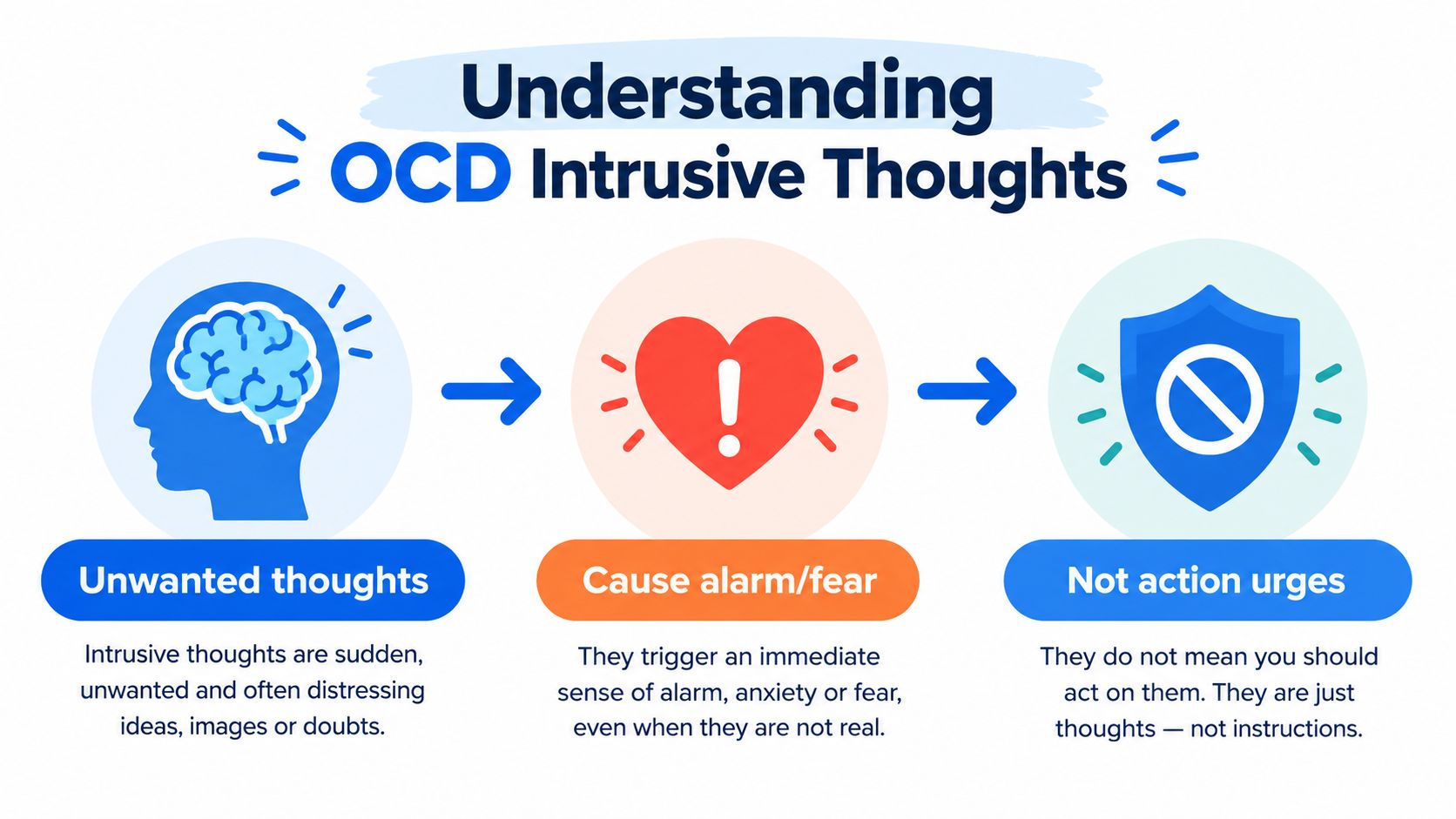
Why the cycle becomes so powerful
The difficulty usually lies less in the thought itself and more in what happens next:
- An unwanted thought appears.
- You interpret it as meaningful, dangerous, or morally important.
- Anxiety rises.
- You check, avoid, analyse, confess, pray, or seek reassurance.
- Relief arrives briefly.
- Your brain learns that the ritual must have prevented danger.
That short-term relief strengthens the obsession-compulsion cycle. The next intrusive thought then feels more urgent, even though the ritual hasn't solved the underlying fear.
This doesn't mean you're weak or choosing the cycle. OCD can make ordinary uncertainty feel impossible to tolerate. The more you demand complete certainty that you're safe, good, careful, or free from risk, the more your mind searches for another question.
A useful distinction: The presence of a thought isn't the problem to solve. Your response to the thought is the part that can change.
A qualified clinician can help distinguish OCD from other experiences, including anxiety, trauma-related symptoms, depression, or psychosis. If you're looking for background on adult care, this overview of OCD treatment for adults may help you understand the kinds of support available.
Building an Exposure and Response Prevention Practice
Exposure and Response Prevention, or ERP, is a first-line psychological treatment for OCD. It combines a gradual approach towards feared thoughts, situations, images, or uncertainty with a deliberate pause in the compulsion that normally follows.
The purpose isn't to prove that nothing bad can ever happen. ERP helps you learn that anxiety can be present without requiring a ritual, and that you can act according to your values even when certainty is unavailable.
A gradual way to practise
Start by writing down common triggers and the responses that follow them. Include visible compulsions, such as washing or checking, as well as hidden ones, such as reviewing memories, counting, mentally replacing an image, or asking for reassurance.
Then organise the triggers from easier to harder. A person worried about contamination might begin by touching a relatively low-anxiety object and waiting before washing. Later practices may involve touching a shared office surface, eating without repeated checking, or allowing uncertainty about cleanliness to remain.
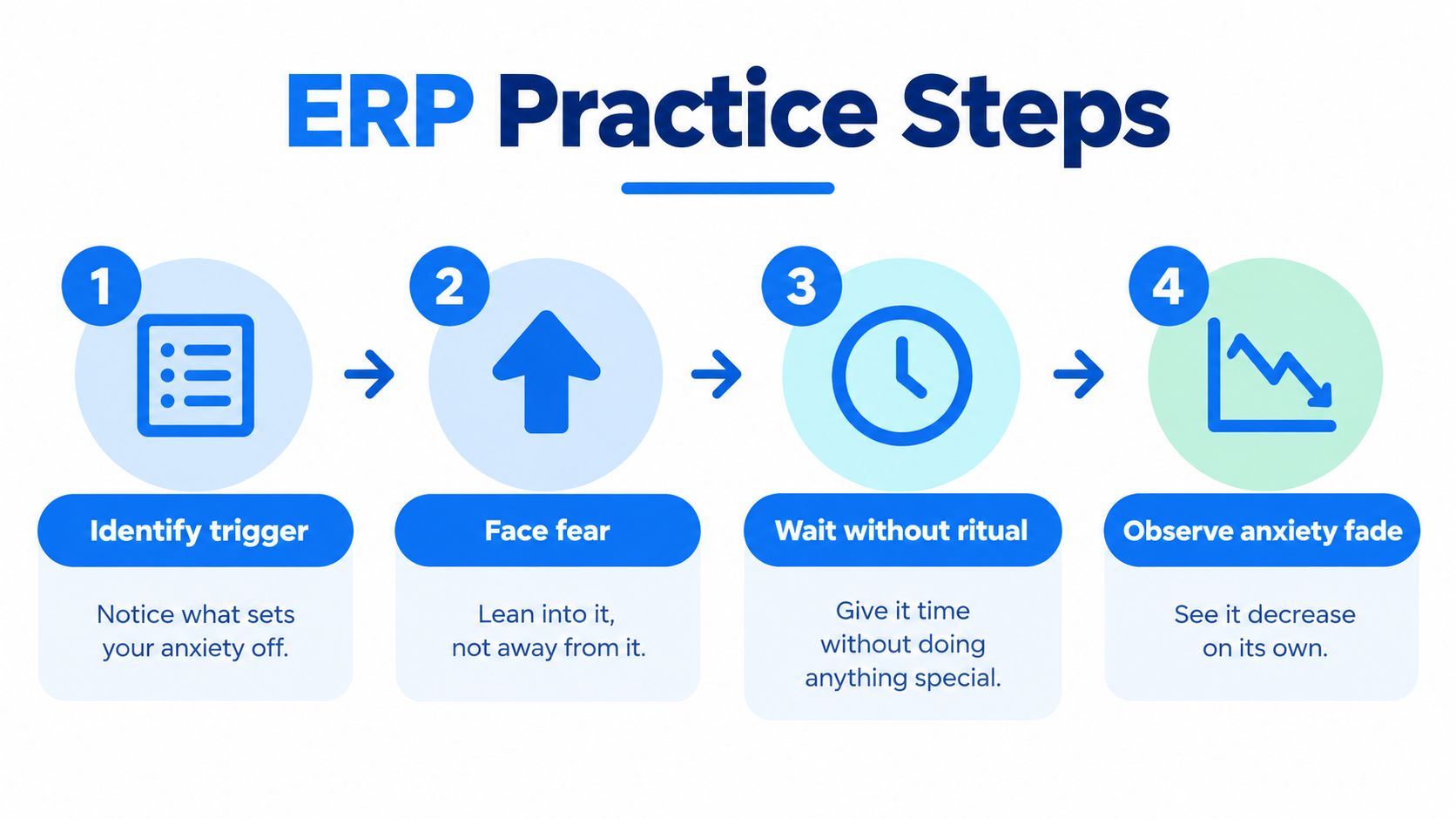
A typical exercise looks like this:
- Identify the trigger: Notice the situation, thought, image, or uncertainty that activates fear.
- Face it gradually: Approach a manageable item from your hierarchy rather than choosing the most frightening situation immediately.
- Prevent the usual ritual: Don't wash, check, confess, Google, mentally cancel, or ask another person to settle the doubt.
- Observe and repeat: Let anxiety be present, notice what happens over time, and practise again across different settings.
An employee in Bengaluru might touch the meeting-room door, notice the urge to sanitise repeatedly, and return to the meeting without performing the usual ritual. The learning comes from allowing discomfort while continuing with the task, not from obtaining perfect reassurance about the door.
What can undermine ERP
An exposure may look successful while a mental ritual continues underneath. You might touch the object but count to yourself, repeat a prayer to neutralise danger, imagine a protective scene, or check your feelings for certainty. These responses can keep the cycle active.
Therapist-guided ERP is technically preferable, particularly when symptoms are severe, because a trained professional can adjust the hierarchy, identify subtle rituals, and prevent exercises from becoming flooding or unsafe. Indian guidance describes an adequate CBT course as approximately 10–12 sessions, including 8–10 ERP sessions, and recommends judging progress after a structured course rather than after one difficult exercise. The Indian Psychiatric Society guideline provides further clinical context, while practical resources for provisional psychologists can help trainees understand evidence-based practice.
Using Mindfulness and Cognitive Defusion
Mindfulness gives you a way to notice thoughts and body sensations without immediately obeying them. It isn't a demand to feel calm, think positively, or empty your mind. During ERP, mindfulness helps you remain present while anxiety and uncertainty move through you.
Cognitive defusion adds a little distance between you and the thought. Instead of asking yourself, “Did I forget to lock the door, and what does that mean?”, you might say, “I'm having the thought that I forgot to lock the door.” The second wording doesn't prove the thought false. It identifies it as a thought rather than an instruction.
A two-minute practice
Sit comfortably or keep your feet on the floor. Notice one breath, then observe the next thought without chasing its story. You can use this script:
- Notice the thought or sensation.
- Label it as an intrusive thought, doubt, image, urge, or anxiety.
- Allow it to be present without arguing with it.
- Return attention to your breath, surroundings, or chosen task.
When a disturbing image appears, you don't need to decide whether it means something about your character. You can acknowledge, “There's the image,” and continue making your tea, reading your email, or listening to the person in front of you.
Mindfulness is not a hidden compulsion. If you repeat a phrase until you feel completely safe, use breathing to guarantee that nothing bad will happen, or meditate until the thought disappears, the practice may have become another attempt to obtain certainty.
This short video can offer a guided introduction to mindful attention:
Mindfulness won't remove every intrusive thought. Its value is that it helps you notice the thought without building a second struggle around it, then choose an action connected to work, relationships, learning, rest, or another personal value.
Stopping Reassurance, Checking, and Mental Rituals
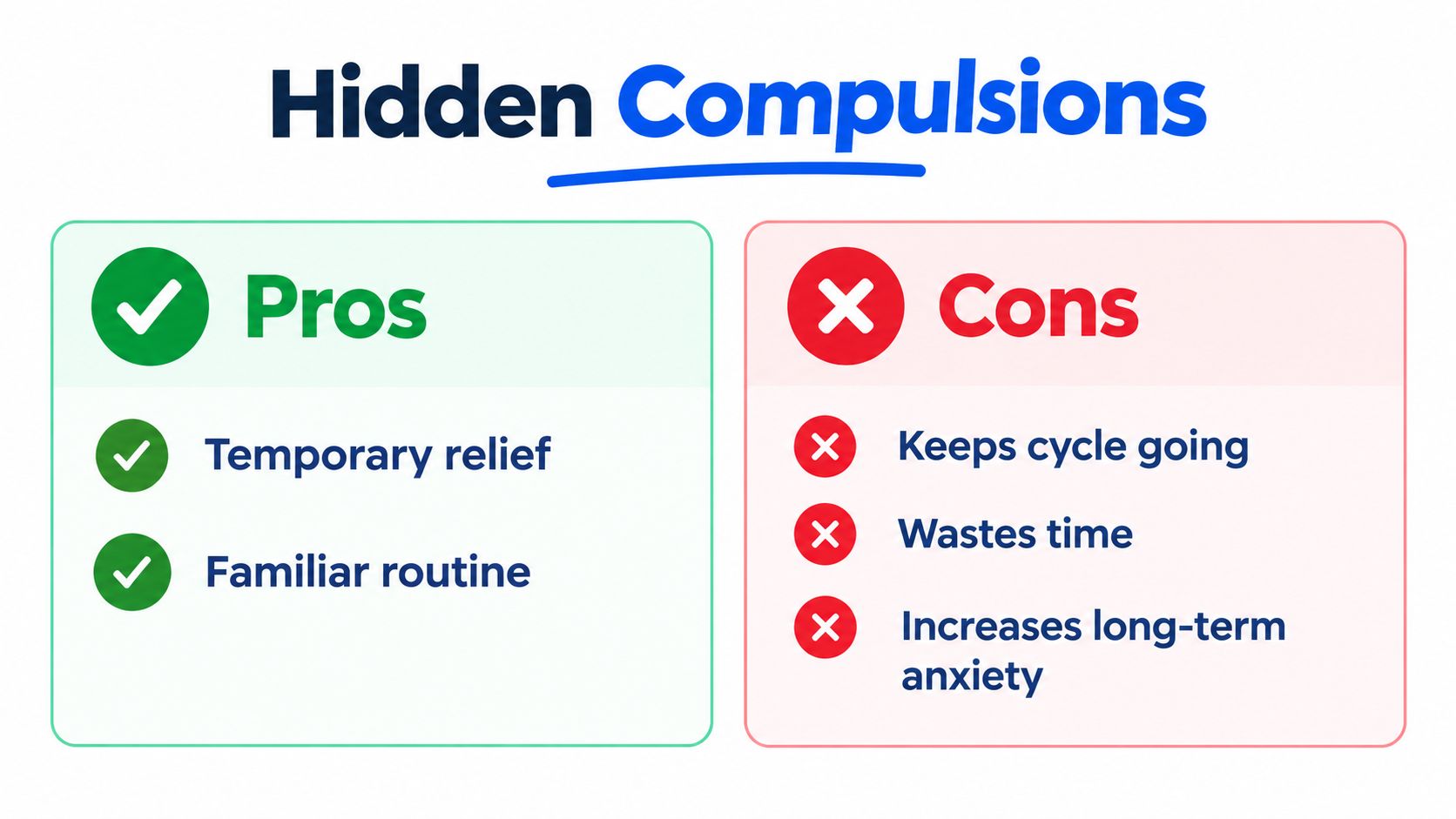
Many people recognise physical compulsions but miss the rituals happening inside the mind. Asking a partner, “You're sure I didn't hurt anyone, are you?”, searching symptoms repeatedly, confessing every disturbing thought, reviewing a conversation, or replacing a “bad” thought with a “good” one can all function as reassurance rituals.
These actions may feel responsible or thoughtful. The useful question is what they're trying to achieve. Ordinary reflection helps you make a decision or learn from an event. A mental compulsion keeps returning because it demands a feeling of absolute certainty that never lasts.
How to spot the hidden loop
Notice the sequence rather than debating the content. A doubt appears, anxiety rises, and you feel driven to obtain an answer. You check your memory, search online, ask someone, or mentally examine your feelings. Relief follows, but the doubt returns in a new form.
Try replacing an automatic response with a planned pause:
- Delay the ritual: Wait for ten minutes before asking for reassurance or checking. Use the time to continue an ordinary activity.
- Choose one necessary check: If a practical check is genuinely needed, do it once according to a pre-decided rule rather than responding to every new doubt.
- Redirect from analysis: Move your attention towards a concrete action, such as sending the email, walking to class, or preparing dinner.
- Change family responses: A supportive person might say, “I hear that this feels frightening, and you can handle the uncertainty,” rather than repeatedly saying, “It's definitely fine.”
The aim isn't to be harsh with yourself or refuse all reasonable support. It's to stop using other people, information searches, or mental review as tools for making anxiety disappear. Family members may need guidance because repeated reassurance can become accommodation, even when it comes from love.
Knowing When Self-Help Is Enough and When to Seek Professional Help
Self-help can be useful when symptoms are mild, you can continue daily responsibilities, and you're able to practise without the exercises becoming rituals. Professional support becomes more important when thoughts consume substantial time, cause marked distress, produce repeated compulsions or avoidance, or interfere with study, work, sleep, relationships, or self-care.
Seek prompt clinical assessment if intrusive thoughts involve self-harm or harm to others, especially when there is intent, planning, or an inability to stay safe. A clinician should also assess symptoms that occur alongside depression, trauma, substance use, severe anxiety, or experiences that don't feel like unwanted thoughts.
Self-help versus professional support at a glance
| Symptom Pattern | Suggested Next Step |
|---|---|
| Occasional intrusive thoughts that pass without major distress | Notice them, avoid unnecessary rituals, and return to your activity. |
| Repeated doubts, checking, reassurance, or avoidance | Arrange an assessment with a qualified mental-health professional. |
| Symptoms disrupting work, study, sleep, or relationships | Consider structured CBT with ERP rather than relying on self-help alone. |
| Severe impairment, risk concerns, or inability to resist compulsions | Seek urgent professional assessment and coordinated care. |
India's National Mental Health Survey, conducted across 12 states, found that 10.6% of adults had a current diagnosable mental-health disorder, while treatment gaps across mental disorders ranged from 70% to 92%. Later Indian analysis reported an 85% gap for common mental disorders and an 80.4% treatment gap, reinforcing why confidential, accessible care matters. These findings come from the National Mental Health Survey report, and they describe population-level access, not your personal diagnosis.
Good treatment starts with a structured assessment, clear goals, and a plan that matches your symptoms. Indian guidance commonly describes CBT and ERP delivery across 12–20 sessions over 3–4 months, although the right pace depends on your needs and access.
Finding an ERP-experienced therapist may require asking about training, using tele-consultations, or looking for regional-language support. Directories and screening tools can help you find options, and a resource such as Vancouver Counselling Clinic can illustrate what to look for in an OCD-focused service. Assessments are informational, not diagnostic, and they can't replace a clinical interview or treatment plan.
A Clear Overview of Medication for OCD
Medication is one possible part of OCD care, not a personal failure and not an automatic requirement. Indian clinical guidance identifies selective serotonin reuptake inhibitors, or SSRIs, and CBT with ERP as first-line treatments.
An SSRI must be prescribed and monitored by a qualified clinician. Your psychiatrist or prescriber may discuss benefits, side effects, interactions, other health conditions, and what to do if symptoms change. Don't start, stop, or alter the dose independently, even if you feel better or become worried about an early side effect.
Why patience matters
An adequate SSRI trial generally requires about 12 weeks at a maximum tolerable dose, because improvement may take time. The early period may involve adjustment, and you should tell your prescriber about any concerning or persistent effects rather than making changes alone.
Medication may be considered when OCD symptoms are moderate or severe, when ERP access is limited, or when therapy alone hasn't provided enough improvement. For severe symptoms, Indian guidance supports combining CBT or ERP with medication under psychiatric supervision.
For mild-to-moderate OCD, CBT with ERP may be used alone when trained care is available. The decision should account for symptom severity, functioning, preferences, medical history, affordability, language, location, and follow-up access.
The practical aim isn't to erase every thought. It's to reduce compulsive responding, improve functioning, and make it easier to participate in therapy and everyday life. A psychiatrist can explain the available options without assuming that one route suits everyone.
Staying Well, Preventing Relapse, and Supporting the People Around You
Improvement doesn't mean you'll never have another intrusive thought. A more realistic measure is whether you can notice a thought, reduce the ritual, recover your attention, and continue with work, relationships, rest, or meaningful activities.
Create a maintenance plan with your clinician. Continue agreed therapy or medication for the recommended period, practise ERP across different places and situations, and watch for early signs such as increased avoidance, repeated checking, rising reassurance-seeking, or withdrawing from valued activities.
Indian literature reports relapse among CBT or ERP responders in the approximate range of 3%–12% and recommends continuing CBT and/or medication for several months after remission to consolidate gains. This doesn't mean relapse is inevitable. It means ongoing care can protect progress, just as follow-up supports many other long-term health conditions. The clinical discussion is available in this review of OCD treatment and relapse.
Family support without feeding OCD
Relatives often want to remove uncertainty for the person they love. Repeatedly answering the same question, participating in checking, helping avoid triggers, or changing household routines may bring immediate relief but can keep the cycle going.
A calmer approach combines warmth with consistent boundaries:
- Validate the emotion: “I can see that this feels frightening.”
- Avoid proving certainty: “I won't keep checking this with you, but I'll stay beside you while the anxiety passes.”
- Support valued action: Encourage the person to return to class, work, meals, sleep, or connection without demanding instant calm.
- Reduce accommodation gradually: Make changes with clinical guidance, especially when family rituals have become extensive.
Workplace stress, anxiety, burnout, depression, and mental fatigue can make intrusive thoughts harder to manage, but they don't mean every stressed person has OCD. An Indian workplace review reported that, among 1,764 urban white-collar employees assessed in 2022, 29% showed moderate-to-severe signs of depression, 55% showed moderate-to-severe anxiety, and 78% reported moderate-to-high stress. Those findings describe screening results, not diagnoses, and they show why counselling, rest, boundaries, resilience, compassion, and broader well-being deserve attention alongside OCD-specific treatment.
Your supportive takeaway is simple: you don't need to eliminate every intrusive thought to build a meaningful life. Progress may look like checking less, asking for less reassurance, returning sooner to valued activities, and treating yourself with patience after a difficult day. Setbacks are information, not proof that treatment has failed, and asking for therapy or counselling is a sign of strength.
DeTalks helps people in India explore psychologists, therapists, counsellors, confidential assessments, and online therapy or counselling options for concerns including OCD, anxiety, depression, burnout, and workplace stress. Visit DeTalks to find support that fits your needs and to take a practical next step towards greater resilience and well-being.
Leave a Reply