Tag: intrusive thoughts

  • How to Overcome OCD Intrusive Thoughts: Practical Steps

    How to Overcome OCD Intrusive Thoughts: Practical Steps

    You're in a meeting, trying to listen, when a disturbing image suddenly appears in your mind. Perhaps you picture harming someone you love, doubt whether you locked the door, or wonder whether a thought reveals something terrible about you. You feel alarmed, then start checking, analysing, Googling, praying, or asking someone to reassure you.

    If this pattern feels familiar, you may be searching for how to overcome OCD intrusive thoughts without understanding why they feel so convincing. Recovery usually doesn't mean forcing thoughts to disappear. It means learning to respond differently, tolerate uncertainty, and return to the life you value.

    Understanding What OCD Intrusive Thoughts Really Are

    Intrusive thoughts are unwanted thoughts, images, or urges that arrive without invitation. They can involve harm, contamination, sexuality, religion, health, relationships, responsibility, or losing control. Their content often clashes with your values, which is why they feel so frightening.

    An intrusive thought isn't the same as an intention. Someone who has an unwanted image of pushing a person doesn't automatically want to push them. The distress often comes from the thought feeling completely unlike the person's wishes and character. A thought is a mental event, not proof of identity, morality, danger, or future behaviour.
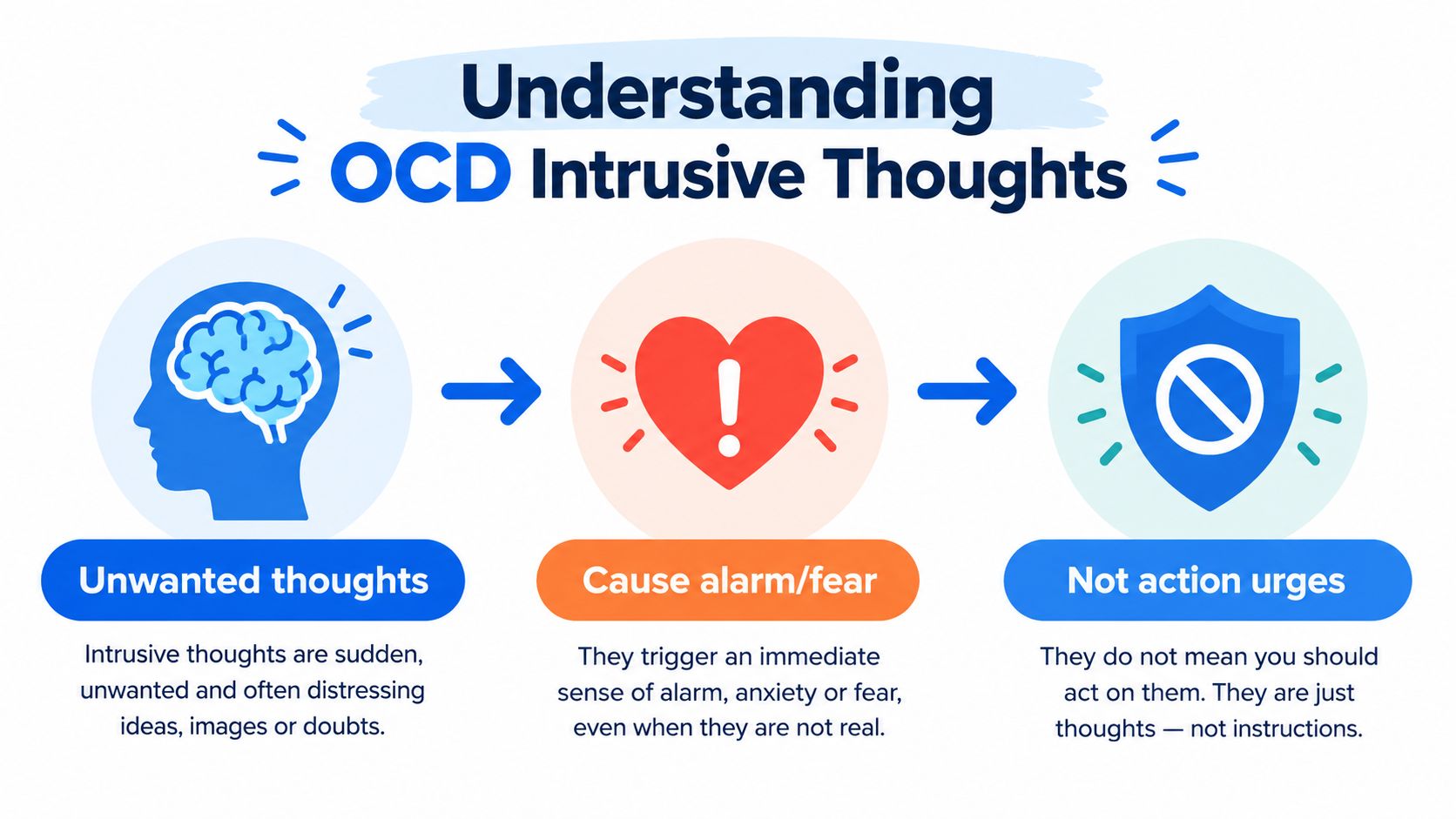
    A diagram explaining OCD intrusive thoughts through a three-step cycle involving unwanted thoughts, fear, and urges.

    Why the cycle becomes so powerful

    The difficulty usually lies less in the thought itself and more in what happens next:

    1. An unwanted thought appears.
    2. You interpret it as meaningful, dangerous, or morally important.
    3. Anxiety rises.
    4. You check, avoid, analyse, confess, pray, or seek reassurance.
    5. Relief arrives briefly.
    6. Your brain learns that the ritual must have prevented danger.

    That short-term relief strengthens the obsession-compulsion cycle. The next intrusive thought then feels more urgent, even though the ritual hasn't solved the underlying fear.

    This doesn't mean you're weak or choosing the cycle. OCD can make ordinary uncertainty feel impossible to tolerate. The more you demand complete certainty that you're safe, good, careful, or free from risk, the more your mind searches for another question.

    A useful distinction: The presence of a thought isn't the problem to solve. Your response to the thought is the part that can change.

    A qualified clinician can help distinguish OCD from other experiences, including anxiety, trauma-related symptoms, depression, or psychosis. If you're looking for background on adult care, this overview of OCD treatment for adults may help you understand the kinds of support available.

    Building an Exposure and Response Prevention Practice

    Exposure and Response Prevention, or ERP, is a first-line psychological treatment for OCD. It combines a gradual approach towards feared thoughts, situations, images, or uncertainty with a deliberate pause in the compulsion that normally follows.

    The purpose isn't to prove that nothing bad can ever happen. ERP helps you learn that anxiety can be present without requiring a ritual, and that you can act according to your values even when certainty is unavailable.

    A gradual way to practise

    Start by writing down common triggers and the responses that follow them. Include visible compulsions, such as washing or checking, as well as hidden ones, such as reviewing memories, counting, mentally replacing an image, or asking for reassurance.

    Then organise the triggers from easier to harder. A person worried about contamination might begin by touching a relatively low-anxiety object and waiting before washing. Later practices may involve touching a shared office surface, eating without repeated checking, or allowing uncertainty about cleanliness to remain.

    A typical exercise looks like this:

    • Identify the trigger: Notice the situation, thought, image, or uncertainty that activates fear.
    • Face it gradually: Approach a manageable item from your hierarchy rather than choosing the most frightening situation immediately.
    • Prevent the usual ritual: Don't wash, check, confess, Google, mentally cancel, or ask another person to settle the doubt.
    • Observe and repeat: Let anxiety be present, notice what happens over time, and practise again across different settings.

    An employee in Bengaluru might touch the meeting-room door, notice the urge to sanitise repeatedly, and return to the meeting without performing the usual ritual. The learning comes from allowing discomfort while continuing with the task, not from obtaining perfect reassurance about the door.
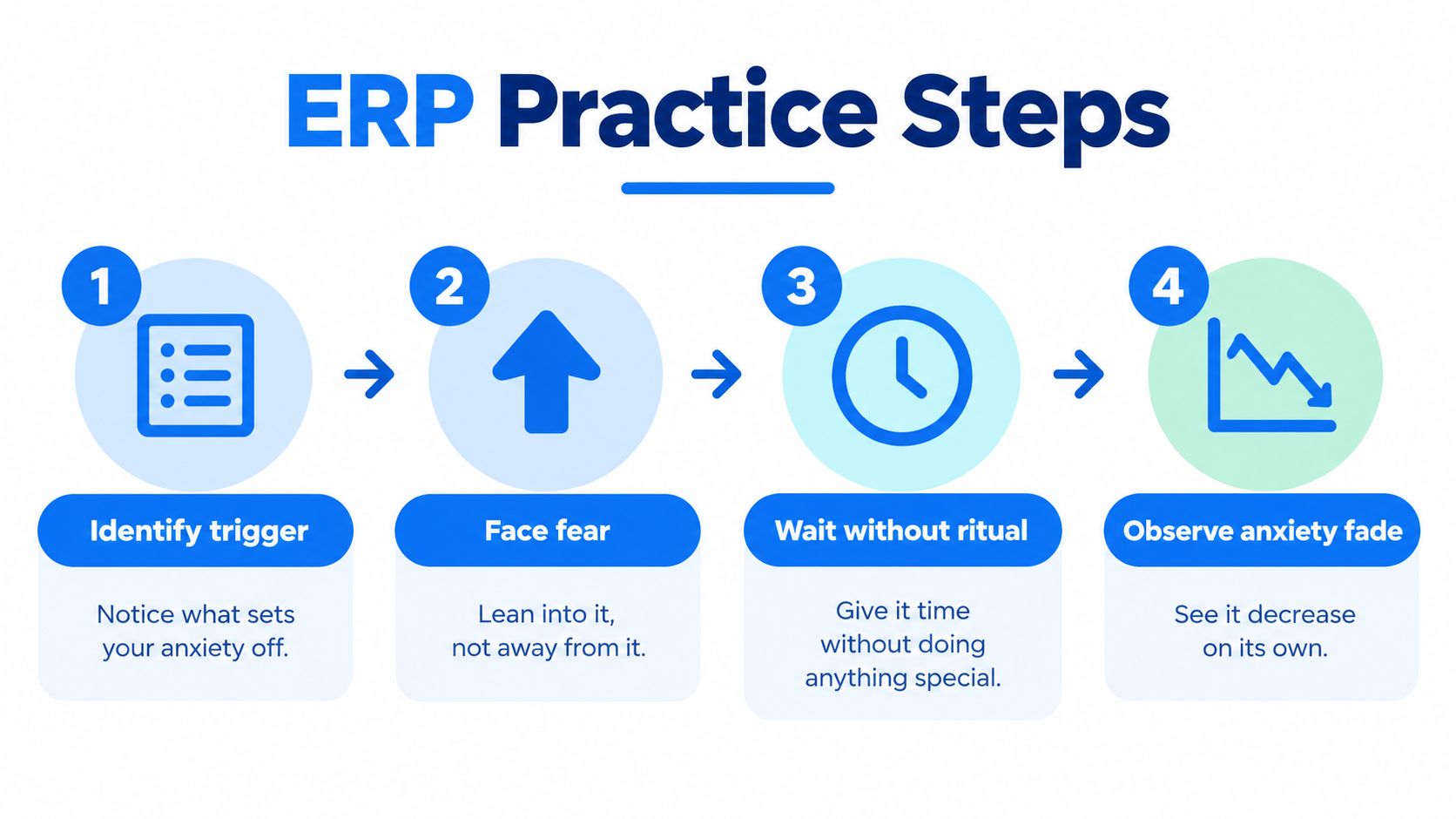
    A diagram outlining the four steps of ERP practice to help manage anxiety and obsessive thoughts.

    What can undermine ERP

    An exposure may look successful while a mental ritual continues underneath. You might touch the object but count to yourself, repeat a prayer to neutralise danger, imagine a protective scene, or check your feelings for certainty. These responses can keep the cycle active.

    Therapist-guided ERP is technically preferable, particularly when symptoms are severe, because a trained professional can adjust the hierarchy, identify subtle rituals, and prevent exercises from becoming flooding or unsafe. Indian guidance describes an adequate CBT course as approximately 10–12 sessions, including 8–10 ERP sessions, and recommends judging progress after a structured course rather than after one difficult exercise. The Indian Psychiatric Society guideline provides further clinical context, while practical resources for provisional psychologists can help trainees understand evidence-based practice.

    Using Mindfulness and Cognitive Defusion

    Mindfulness gives you a way to notice thoughts and body sensations without immediately obeying them. It isn't a demand to feel calm, think positively, or empty your mind. During ERP, mindfulness helps you remain present while anxiety and uncertainty move through you.

    Cognitive defusion adds a little distance between you and the thought. Instead of asking yourself, “Did I forget to lock the door, and what does that mean?”, you might say, “I'm having the thought that I forgot to lock the door.” The second wording doesn't prove the thought false. It identifies it as a thought rather than an instruction.

    A two-minute practice

    Sit comfortably or keep your feet on the floor. Notice one breath, then observe the next thought without chasing its story. You can use this script:

    1. Notice the thought or sensation.
    2. Label it as an intrusive thought, doubt, image, urge, or anxiety.
    3. Allow it to be present without arguing with it.
    4. Return attention to your breath, surroundings, or chosen task.

    When a disturbing image appears, you don't need to decide whether it means something about your character. You can acknowledge, “There's the image,” and continue making your tea, reading your email, or listening to the person in front of you.

    Mindfulness is not a hidden compulsion. If you repeat a phrase until you feel completely safe, use breathing to guarantee that nothing bad will happen, or meditate until the thought disappears, the practice may have become another attempt to obtain certainty.

    This short video can offer a guided introduction to mindful attention:

    Mindfulness won't remove every intrusive thought. Its value is that it helps you notice the thought without building a second struggle around it, then choose an action connected to work, relationships, learning, rest, or another personal value.

    Stopping Reassurance, Checking, and Mental Rituals

    Many people recognise physical compulsions but miss the rituals happening inside the mind. Asking a partner, “You're sure I didn't hurt anyone, are you?”, searching symptoms repeatedly, confessing every disturbing thought, reviewing a conversation, or replacing a “bad” thought with a “good” one can all function as reassurance rituals.

    These actions may feel responsible or thoughtful. The useful question is what they're trying to achieve. Ordinary reflection helps you make a decision or learn from an event. A mental compulsion keeps returning because it demands a feeling of absolute certainty that never lasts.
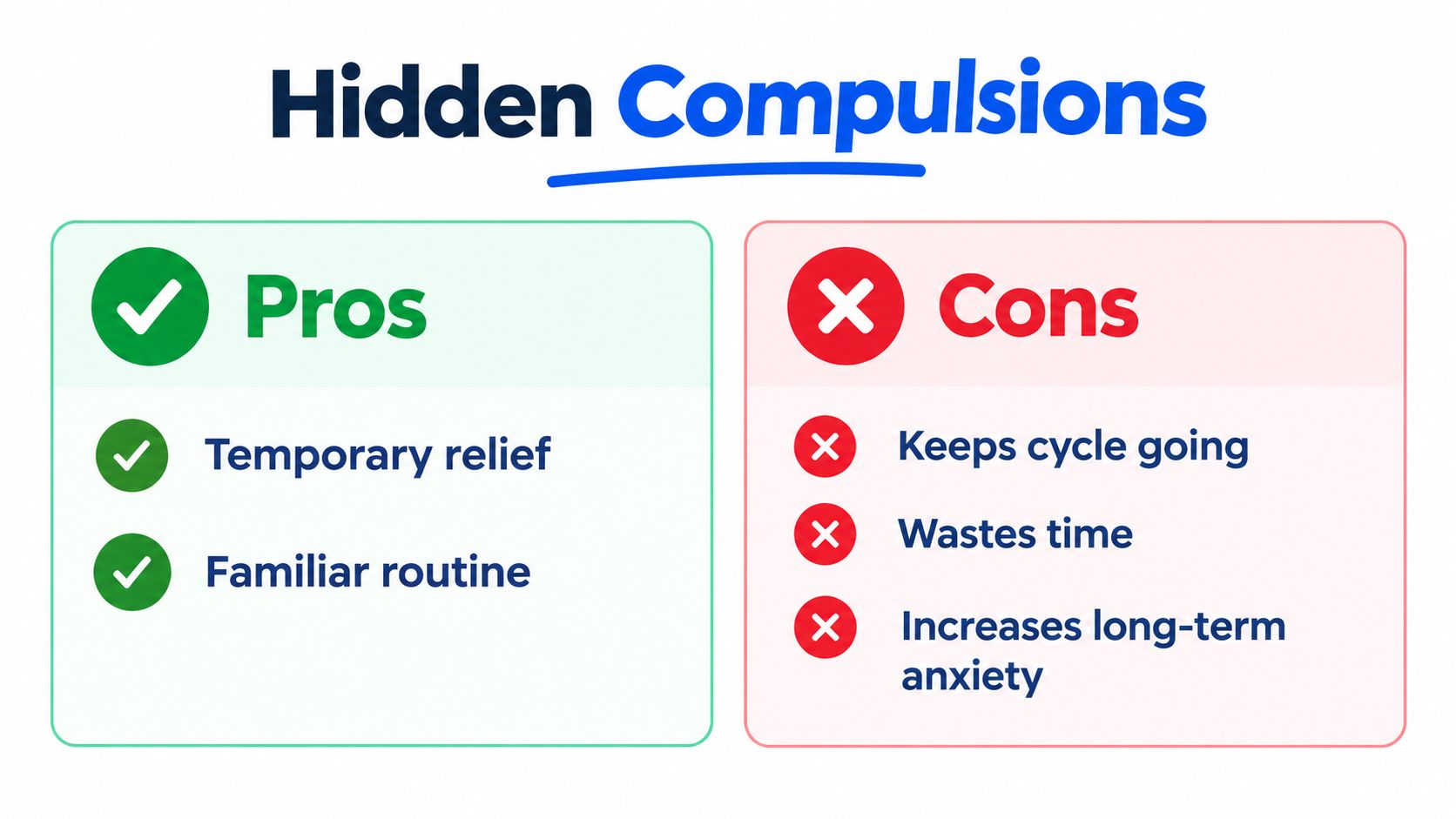
    A chart comparing the pros and cons of hidden compulsions in mental health, listing relief and cycles.

    How to spot the hidden loop

    Notice the sequence rather than debating the content. A doubt appears, anxiety rises, and you feel driven to obtain an answer. You check your memory, search online, ask someone, or mentally examine your feelings. Relief follows, but the doubt returns in a new form.

    Try replacing an automatic response with a planned pause:

    • Delay the ritual: Wait for ten minutes before asking for reassurance or checking. Use the time to continue an ordinary activity.
    • Choose one necessary check: If a practical check is genuinely needed, do it once according to a pre-decided rule rather than responding to every new doubt.
    • Redirect from analysis: Move your attention towards a concrete action, such as sending the email, walking to class, or preparing dinner.
    • Change family responses: A supportive person might say, “I hear that this feels frightening, and you can handle the uncertainty,” rather than repeatedly saying, “It's definitely fine.”

    The aim isn't to be harsh with yourself or refuse all reasonable support. It's to stop using other people, information searches, or mental review as tools for making anxiety disappear. Family members may need guidance because repeated reassurance can become accommodation, even when it comes from love.

    Knowing When Self-Help Is Enough and When to Seek Professional Help

    Self-help can be useful when symptoms are mild, you can continue daily responsibilities, and you're able to practise without the exercises becoming rituals. Professional support becomes more important when thoughts consume substantial time, cause marked distress, produce repeated compulsions or avoidance, or interfere with study, work, sleep, relationships, or self-care.

    Seek prompt clinical assessment if intrusive thoughts involve self-harm or harm to others, especially when there is intent, planning, or an inability to stay safe. A clinician should also assess symptoms that occur alongside depression, trauma, substance use, severe anxiety, or experiences that don't feel like unwanted thoughts.

    Self-help versus professional support at a glance

    Symptom Pattern Suggested Next Step
    Occasional intrusive thoughts that pass without major distress Notice them, avoid unnecessary rituals, and return to your activity.
    Repeated doubts, checking, reassurance, or avoidance Arrange an assessment with a qualified mental-health professional.
    Symptoms disrupting work, study, sleep, or relationships Consider structured CBT with ERP rather than relying on self-help alone.
    Severe impairment, risk concerns, or inability to resist compulsions Seek urgent professional assessment and coordinated care.

    India's National Mental Health Survey, conducted across 12 states, found that 10.6% of adults had a current diagnosable mental-health disorder, while treatment gaps across mental disorders ranged from 70% to 92%. Later Indian analysis reported an 85% gap for common mental disorders and an 80.4% treatment gap, reinforcing why confidential, accessible care matters. These findings come from the National Mental Health Survey report, and they describe population-level access, not your personal diagnosis.

    Good treatment starts with a structured assessment, clear goals, and a plan that matches your symptoms. Indian guidance commonly describes CBT and ERP delivery across 12–20 sessions over 3–4 months, although the right pace depends on your needs and access.

    Finding an ERP-experienced therapist may require asking about training, using tele-consultations, or looking for regional-language support. Directories and screening tools can help you find options, and a resource such as Vancouver Counselling Clinic can illustrate what to look for in an OCD-focused service. Assessments are informational, not diagnostic, and they can't replace a clinical interview or treatment plan.

    A Clear Overview of Medication for OCD

    Medication is one possible part of OCD care, not a personal failure and not an automatic requirement. Indian clinical guidance identifies selective serotonin reuptake inhibitors, or SSRIs, and CBT with ERP as first-line treatments.

    An SSRI must be prescribed and monitored by a qualified clinician. Your psychiatrist or prescriber may discuss benefits, side effects, interactions, other health conditions, and what to do if symptoms change. Don't start, stop, or alter the dose independently, even if you feel better or become worried about an early side effect.

    Why patience matters

    An adequate SSRI trial generally requires about 12 weeks at a maximum tolerable dose, because improvement may take time. The early period may involve adjustment, and you should tell your prescriber about any concerning or persistent effects rather than making changes alone.

    Medication may be considered when OCD symptoms are moderate or severe, when ERP access is limited, or when therapy alone hasn't provided enough improvement. For severe symptoms, Indian guidance supports combining CBT or ERP with medication under psychiatric supervision.

    For mild-to-moderate OCD, CBT with ERP may be used alone when trained care is available. The decision should account for symptom severity, functioning, preferences, medical history, affordability, language, location, and follow-up access.

    The practical aim isn't to erase every thought. It's to reduce compulsive responding, improve functioning, and make it easier to participate in therapy and everyday life. A psychiatrist can explain the available options without assuming that one route suits everyone.

    Staying Well, Preventing Relapse, and Supporting the People Around You

    Improvement doesn't mean you'll never have another intrusive thought. A more realistic measure is whether you can notice a thought, reduce the ritual, recover your attention, and continue with work, relationships, rest, or meaningful activities.

    Create a maintenance plan with your clinician. Continue agreed therapy or medication for the recommended period, practise ERP across different places and situations, and watch for early signs such as increased avoidance, repeated checking, rising reassurance-seeking, or withdrawing from valued activities.

    Indian literature reports relapse among CBT or ERP responders in the approximate range of 3%–12% and recommends continuing CBT and/or medication for several months after remission to consolidate gains. This doesn't mean relapse is inevitable. It means ongoing care can protect progress, just as follow-up supports many other long-term health conditions. The clinical discussion is available in this review of OCD treatment and relapse.

    Family support without feeding OCD

    Relatives often want to remove uncertainty for the person they love. Repeatedly answering the same question, participating in checking, helping avoid triggers, or changing household routines may bring immediate relief but can keep the cycle going.

    A calmer approach combines warmth with consistent boundaries:

    • Validate the emotion: “I can see that this feels frightening.”
    • Avoid proving certainty: “I won't keep checking this with you, but I'll stay beside you while the anxiety passes.”
    • Support valued action: Encourage the person to return to class, work, meals, sleep, or connection without demanding instant calm.
    • Reduce accommodation gradually: Make changes with clinical guidance, especially when family rituals have become extensive.

    Workplace stress, anxiety, burnout, depression, and mental fatigue can make intrusive thoughts harder to manage, but they don't mean every stressed person has OCD. An Indian workplace review reported that, among 1,764 urban white-collar employees assessed in 2022, 29% showed moderate-to-severe signs of depression, 55% showed moderate-to-severe anxiety, and 78% reported moderate-to-high stress. Those findings describe screening results, not diagnoses, and they show why counselling, rest, boundaries, resilience, compassion, and broader well-being deserve attention alongside OCD-specific treatment.

    Your supportive takeaway is simple: you don't need to eliminate every intrusive thought to build a meaningful life. Progress may look like checking less, asking for less reassurance, returning sooner to valued activities, and treating yourself with patience after a difficult day. Setbacks are information, not proof that treatment has failed, and asking for therapy or counselling is a sign of strength.


    DeTalks helps people in India explore psychologists, therapists, counsellors, confidential assessments, and online therapy or counselling options for concerns including OCD, anxiety, depression, burnout, and workplace stress. Visit DeTalks to find support that fits your needs and to take a practical next step towards greater resilience and well-being.


  • How to Stop Thinking About Something for Good

    How to Stop Thinking About Something for Good

    When you're trying to stop thinking about something, the fastest way isn't to fight the thought. Instead, try to acknowledge it without judgement and then deliberately shift your focus to something that requires your full attention—like a puzzle or a physical task. This gives your brain permission to let go, which can reduce the thought's power and bring a sense of mental calm.

    Why Your Brain Gets Stuck on Certain Thoughts

    A person sitting calmly, looking out a window, representing a moment of mental clarity and peace.

    It can be frustrating when your mind gets stuck on a thought and refuses to let go. You might find yourself replaying a conversation, a mistake, or a worry over and over. This is a common human experience, especially when we're dealing with stress.

    This guide offers practical strategies to help you reclaim your mental space. We'll explore why our brains sometimes get stuck—a process often called rumination—and see how it's linked to challenges like workplace stress, anxiety, and even burnout.

    Understanding the Thought Loop

    It's helpful to see this pattern not as a personal flaw, but as a mental habit that can be changed with practice. Learning how to stop thinking about something is a skill that builds resilience. It helps you treat yourself with more compassion when your mind feels like it's spinning.

    Often, these persistent thoughts are your brain’s attempt to solve a problem or protect you. When you're facing uncertainty, your mind can go into overdrive, replaying scenarios to find a solution or avoid future hurt.

    This experience is incredibly common. In India, where conversations around mental health are becoming more open, studies show many adults live with conditions like anxiety and depression, where rumination is a frequent challenge. For more insight, you can explore the full report on maternal mental health risk and resources.

    Shifting from Coping to Thriving

    Building good mental health isn’t about banishing all negative thoughts, but about changing your relationship with them. It’s about noticing when a thought is no longer productive and learning to gently guide your attention elsewhere. This shift can significantly improve your overall well-being.

    Acknowledging your thoughts without judgement is the first step toward reclaiming your mental peace. It’s about moving from being controlled by your thoughts to becoming an observer of them.

    This guide offers you practical strategies to find relief. By understanding the 'why' behind these thought loops, you can start using effective techniques to break the cycle and move from simply coping with stress to truly thriving.

    Getting to Grips with Those Sticky Thoughts

    Ever find your mind stuck on replaying a mistake from work or a comment from a friend? That feeling of a thought looping on repeat is something we all go through. It's a completely normal part of being human.

    These thought loops aren't a personal failing; they’re a mental habit built over time. The first step to breaking free is understanding why it happens. When you get the ‘why,’ you can approach the pattern with kindness instead of frustration.

    Past Regrets vs. Future Fears

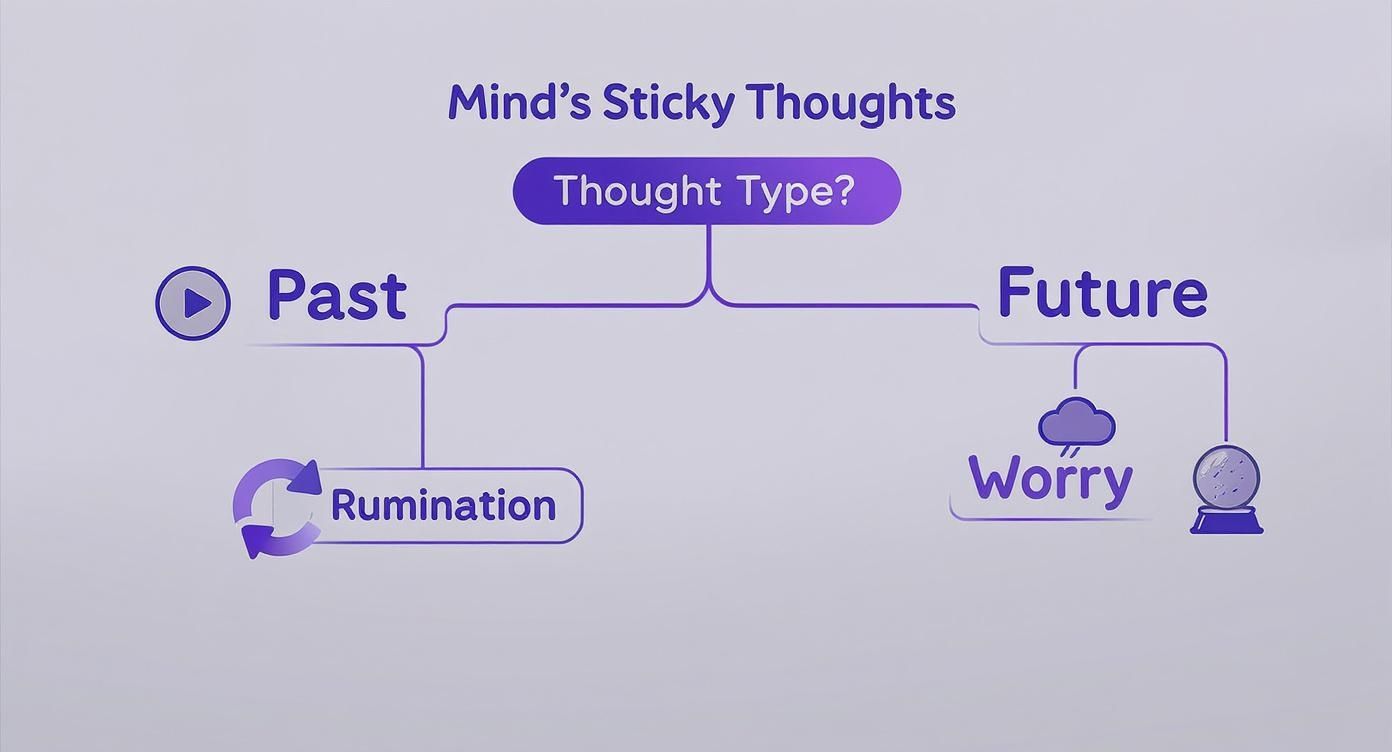
    These persistent thoughts usually fall into two categories: rumination or worry. They might feel the same—exhausting and stressful—but they are tied to different timelines.

    Rumination is all about the past. It's when your brain gets stuck replaying something that has already happened, like dissecting a tense conversation or cringing at an awkward moment. It’s like watching the same scene of a movie over and over, hoping for a different ending.

    Worry, on the other hand, is focused on the future. This is your brain spinning out "what if" scenarios and imagining things that could go wrong, like stressing about a deadline or a family gathering. It’s a cycle of negative forecasting about things that haven't even happened.

    In high-pressure situations, both of these can go into overdrive. The relentless pace of work can trigger rumination about your performance, while personal challenges can fuel a constant stream of worry.

    Why Your Brain Puts Certain Thoughts on Repeat

    So, what's really going on in our heads? At its core, this mental looping is often your brain's threat-detection system working a bit too hard to keep you safe. When something stressful happens, your brain flags it as a problem that needs solving.

    It replays the thought, trying to analyse it from every angle to prevent something similar from happening again. The trouble is, this system can get stuck, especially when trying to "solve" an emotional hurt. Instead of a solution, you just end up with more anxiety and a drained mental battery.

    Realising this is a game-changer. Your brain isn’t your enemy; it’s just trying to protect you. This shift in perspective can take you from self-criticism to curiosity, which is far more productive for making a change.

    This is far from a rare experience. One study of urban Indian populations found that many people often felt unable to stop dwelling on their personal worries. It highlights how deeply rumination is linked to common struggles like anxiety and depression. You can dive deeper into this topic and learn more about the research into behavioural health.

    Shifting from Habit to Healthy Coping

    Thinking of these thought patterns as a habit—not a fixed part of your personality—is incredibly freeing. It means that with the right strategies, you can build new, healthier mental pathways that support your well-being.

    Building resilience isn't about never having a negative thought again. It's about getting better at noticing when you’re stuck in a loop and knowing how to gently guide your attention back to the present. This is a core skill for managing daily stress and other mental health challenges.

    Acknowledging you’re caught in a loop, without judgement, is the starting point. Professional therapy and counselling often work on building this exact awareness, helping you change your relationship with your thoughts. Once you understand your own mind, you can start to loosen the grip those sticky thoughts have on you.

    Practical Ways to Break the Thought Cycle

    Knowing why your mind gets stuck is one thing; knowing what to do about it in the moment is another. These strategies are a mental toolkit of proven methods to pause a thought spiral and pull yourself back to the present.

    The goal isn't to find a single magic bullet. Some days, a quick breathing exercise will work, while on others, you might need something more hands-on. The key is to experiment and find what helps you find calm and clarity.

    Ground Yourself in the Here and Now

    When your mind is spinning with worries or regrets, the most powerful thing you can do is connect with the present moment. Grounding techniques pull your focus away from internal chaos and onto the physical world around you. They're simple, discreet, and can be done anywhere.

    One of the most reliable methods is the 5-4-3-2-1 technique. It engages your senses to reconnect with your environment.

    Just take a slow, deep breath, and then gently notice:

    • Five things you can see (a pen on your desk, the light on the wall).
    • Four things you can physically feel (the texture of your clothes, the ground beneath your feet).
    • Three things you can hear (the hum of a computer, birds outside, your own breathing).
    • Two things you can smell (the scent of coffee, the air from a window).
    • One thing you can taste (the lingering taste of mint or just the neutral taste in your mouth).

    This simple exercise forces your brain to shift gears from abstract worries to concrete, sensory details. It’s a fantastic circuit-breaker for anxiety and rumination, giving your mind a much-needed moment of peace.

    Rewrite the Story with Cognitive Reframing

    Persistent thoughts often come with a negative story we tell ourselves, like "I'm a failure." Cognitive reframing is the art of catching that story, questioning its truth, and choosing a more balanced or compassionate alternative. This isn't about toxic positivity; it's about finding a more realistic perspective.

    Let's say you made a mistake at work, and your mind is replaying it with the thought, "I mess everything up." To reframe it, you could challenge that thought:

    • Is it really true that I always mess things up?
    • What are some examples of when I've succeeded?
    • What can I learn from this specific mistake?

    A healthier reframe might sound like, "I made a mistake and it's frustrating, but this one event doesn't define my competence. Everyone makes mistakes, and I can learn from this." This small shift validates your feelings without letting the negative thought spiral, helping you build resilience, especially with workplace stress.

    Use Your Body to Interrupt the Pattern

    Sometimes, the quickest way to change your mind is to change what your body is doing. A "pattern interrupt" is a simple physical action that breaks your current mental state and forces your brain to reset. It's like a kill switch for an obsessive thought.

    If you find yourself stuck in a loop, try an immediate physical shift.

    • Get up and walk into a different room.
    • Splash some cold water on your face.
    • Put on an upbeat song and move for a minute or two.
    • Clench your fists tightly for ten seconds, then release.

    These actions create a sharp sensory jolt that yanks your brain out of its rut. The goal is to create a moment of pause so you can consciously choose what to focus on next.

    Give Your Brain a Different Job

    An idle mind is often a playground for intrusive thoughts. One of the best ways to stop thinking about something is to give your brain a task that's more compelling and demands its full attention.

    Passively watching TV often won't cut it, as there's still too much mental bandwidth for your mind to wander. You need something that actively engages your brain.

    Try one of these:

    • Tackle a Sudoku or a crossword puzzle.
    • Play a tricky strategy game on your phone.
    • Try learning something new, like a few chords on a guitar.
    • Listen to an engrossing podcast or audiobook.

    By absorbing your focus, these activities leave little room for the looping thought. The challenge for many is how to effectively break negative thought patterns that feel so automatic. Giving your brain a demanding new task is a practical way to redirect that mental energy.

    Whether your thoughts are stuck in the past (rumination) or fixated on the future (worry), this decision tree can help you visualise the mental habit.

    Infographic about how to stop thinking about something

    Simply recognising whether you're ruminating or worrying is a huge first step toward choosing the right strategy to get unstuck.

    Your mind is not your enemy. These techniques are compassionate tools to gently guide your attention back to a place of peace and control, boosting your overall well-being.

    Remember, finding what works for you is a process. If you're struggling, professional counselling can offer personalised strategies and support. This journey to manage your thoughts is a powerful step toward a happier, more resilient you.

    Using Scheduled Worry Time as a Proactive Strategy

    It might sound counterintuitive, but one of the best ways to deal with nagging worries is to stop fighting them all day. Instead, you can give them their own designated spot on your calendar. This technique is known as ‘thought postponement’ or, more simply, ‘worry scheduling’.

    The idea is straightforward: rather than letting anxious thoughts hijack your attention, you make a deal with your mind. You acknowledge the worry, jot it down, and promise to give it your undivided attention later, during a pre-planned, limited time slot.

    This simple shift puts you back in control and changes your relationship with worry from a constant battle to a structured appointment. It's a crucial step in learning how to stop thinking about something that just won't let go.

    How to Set Up Your Worry Time

    Creating a worry schedule is a practical skill that builds mental resilience. It validates your concerns without letting them run your life. Here’s a simple way to get started.

    First, pick a specific time and place for your daily 'worry appointment', aiming for a 15 to 20-minute window. It's best not to schedule it right before bed. The location should be somewhere you can think without being interrupted.

    Then, as you go about your day, notice when a worry pops into your head. Don't push it away. Just see it, write it down in a notebook, and mentally 'park' it, knowing you'll come back to it during your scheduled time.

    This act of writing and postponing is incredibly empowering. You’re sending a clear message to your brain: "I hear you, and I will give this my full attention—but on my terms." This can dramatically lower the background noise of anxiety.

    When your scheduled worry time arrives, sit down with your list and let yourself think about each item. You can analyse the problem, brainstorm solutions, or just feel whatever emotions come up. When your timer goes off, close the notebook and consciously move on to something pleasant.

    The Psychology Behind Postponing Worry

    This technique is effective because it addresses what keeps a thought loop going: a false sense of urgency and a feeling of being out of control. Worry scheduling challenges both of these things.

    By setting a specific time, you're teaching your brain that not every anxious thought is an emergency. This breaks the cycle of mental reactivity that contributes to workplace stress and burnout. You start to learn the difference between productive problem-solving and just spinning your wheels.

    You might also discover that many worries you wrote down in the morning lose their power by the evening. When you review your list, some of them might seem less important. It's a great way to see how many of our anxieties are fleeting.

    Making Your Worry Journal Effective

    Your 'Worry Journal' is the main tool for this practice. It doesn't need to be fancy—any notebook will do. To make it a supportive part of your well-being routine, you can give it some structure.

    • The Worry List: This is where you quickly jot down the thought during the day. A quick note is fine, like: "Worried about the upcoming project presentation."
    • The Worry Session: During your scheduled time, you can go deeper. Ask yourself questions like, "Realistically, what's the worst that could happen?" or "What's one small thing I could do about this?"
    • The Outcome: After your session, you might note down a potential next step or a decision to let it go. This helps create a sense of closure.

    This structured practice is a form of self-compassion, allowing you to listen to your feelings without getting lost in them. If you find your worries consistently feel overwhelming, seeking professional therapy or counselling can provide more targeted support for challenges like anxiety or depression.

    Building Long-Term Mental Resilience

    A person practising yoga on a mat outdoors, with a serene natural backdrop suggesting peace and long-term well-being.

    While in-the-moment tricks are crucial, learning how to stop thinking about something for good comes down to building mental resilience. This is about weaving small, sustainable habits into your life that support your day-to-day well-being.

    Think of it as strengthening your mental immune system. When you're resilient, unwanted thoughts may still appear, but they have less power to derail your day. This long-term view helps you shift from reacting to stress to proactively building a more balanced life.

    Over time, these habits can change your relationship with your mind, reducing the intensity of thought loops that often fuel anxiety or depression.

    Nourishing Your Body to Calm Your Mind

    It’s impossible to separate mental and physical health—they are two sides of the same coin. How your body feels directly affects your mind's ability to manage challenges like workplace stress. Looking after your physical self is a non-negotiable step toward lasting resilience.

    Simple, consistent actions can make a big difference:

    • Move Your Body Regularly: A brisk 30-minute walk or a gentle yoga session can do wonders. Physical activity releases endorphins—your body’s natural mood lifters—and helps burn off stress hormones.
    • Fuel Your Brain: A diet rich in omega-3s, vitamins, and minerals supports healthy brain function. On the other hand, too much processed food and sugar can sometimes contribute to mood swings and feelings of anxiety.
    • Prioritise Sleep: Sleep is your brain's nightly reset button. Aiming for 7-8 hours of quality rest can make a massive difference in your ability to regulate your thoughts and feelings.

    The Power of Connection and Purpose

    We are wired for connection. When we feel isolated, negative thought patterns can feel much bigger than they are. Building strong social ties and engaging in meaningful activities acts as a powerful buffer against worry.

    These things pull you out of your own head. Try scheduling a weekly coffee with a friend or joining a local group for a hobby you enjoy. Activities that demand your full attention, like gardening or learning an instrument, are brilliant for getting into a state of 'flow,' where your mind is simply too occupied to ruminate.

    Building resilience isn't a solo mission. It's about weaving a supportive net of healthy habits, meaningful connections, and self-compassion that can catch you when you stumble.

    Cultivating Self-Compassion and Gratitude

    Perhaps one of the most profound changes you can make is in your inner dialogue. We can be hard on ourselves for getting stuck on a thought. Learning to treat yourself with the same kindness you'd show a friend is the essence of self-compassion and a cornerstone of mental resilience.

    Another simple but powerful practice is gratitude. Each day, take a moment to notice three small things that went well or that you’re thankful for. This simple act starts to rewire your brain to scan for the good, providing a much-needed counterbalance to our natural tendency to focus on what's wrong.

    These shifts won't fix everything overnight, but they build a supportive pathway toward a more peaceful mind. And if these feelings ever seem too heavy to manage on your own, remember that seeking therapy or counselling is a sign of incredible strength.

    When It’s Time to Talk to Someone

    While these strategies are fantastic for managing your thoughts, it's also crucial to know when you might need extra support. You can fix a leaky tap yourself, but for a major plumbing issue, you call a professional. Taking that step for your mental health is a sign of strength.

    If you find that these thought loops are constantly disrupting your sleep, making it hard to focus, or straining your relationships, it might be time to reach out. It’s especially important if these thoughts leave you feeling hopeless or have taken the joy from activities you used to love.

    A Few Signs to Watch For

    How do you know when it’s time to call in a professional? Here are a few signs that your internal chatter might have become something more serious:

    • Your Day-to-Day is a Struggle: Simple tasks feel overwhelming, and you're finding it tough to keep up with your responsibilities.
    • The Emotional Toll is High: The thoughts are causing real emotional pain, constant anxiety, or symptoms of depression.
    • You're Pulling Away: You find yourself avoiding friends or social gatherings that you once enjoyed.

    Deciding to see a therapist or counsellor isn't giving up; it's gearing up. It shows you're ready to take charge of your mental well-being and build lasting resilience.

    What Does Professional Help Involve?

    Seeing a professional gives you a safe, confidential space to unpack what’s going on in your head. A good therapist will equip you with proven, personalised strategies. One of the most effective is Cognitive Behavioural Therapy (CBT), which is brilliant for challenging intrusive thoughts and developing healthier ways to cope.

    The need for this kind of support is significant. In India alone, it's estimated that many people are dealing with a mental health condition, but most never get the help they need. If you're interested in the numbers, you can discover more insights on mental health statistics.

    Please remember that while online assessments can be informative, they are not a substitute for a diagnosis from a qualified professional. Only they can provide a proper assessment and help you figure out the best path forward.

    Got Questions About Taming Your Thoughts? You're Not Alone.

    When you first start trying to manage your thoughts, it's normal for questions to come up. This is a personal journey, and figuring out what works for you takes patience.

    Let's explore some common questions to help you build healthier mental habits with more confidence. Remember, learning how to stop thinking about something is a skill that gets stronger with practice.

    How Long Until I See a Difference?

    This is the big question, and the honest answer is: it depends. Some techniques, like grounding exercises, can offer a sense of calm almost instantly. They're fantastic for in-the-moment relief from anxiety.

    Deeper skills like cognitive reframing are more like building muscle; they take several weeks of consistent effort to show results. Your well-being is a journey, and consistency is what builds lasting resilience.

    Is It a Bad Sign That I Can’t Just “Stop Thinking”?

    Not at all; this is one of the most common concerns we hear. It doesn't mean you're weak; it just means your brain is trying to do its job. Our minds are designed to solve problems, and sometimes they get stuck on a thought, especially if it's tied to a strong feeling.

    It only becomes an issue when it causes significant distress or disrupts your daily life. If you feel the thoughts are pulling you down into a low mood, professional counselling can be a game-changer, especially if they feel connected to depression.

    Do These Methods Work for Thoughts About a Specific Person?

    Yes, absolutely. These strategies are effective for any kind of repetitive thought, whether it’s about an event, a worry, or a person. The goal is always the same: to break the cycle of rumination, no matter the topic.

    When you’re stuck on thoughts about someone, scheduling worry time or getting lost in an activity you love can be especially helpful. The first step is to notice the thought, acknowledge it without judgement, and then gently guide your attention elsewhere.


    Ready to get a clearer picture of what’s going on in your mind? At DeTalks, we provide confidential assessments to help you understand your thought patterns. Please note these are for informational purposes only and are not diagnostic. We can also connect you with skilled therapists who can support you every step of the way. Take a look at your options and find the right path for you at https://detalks.com.