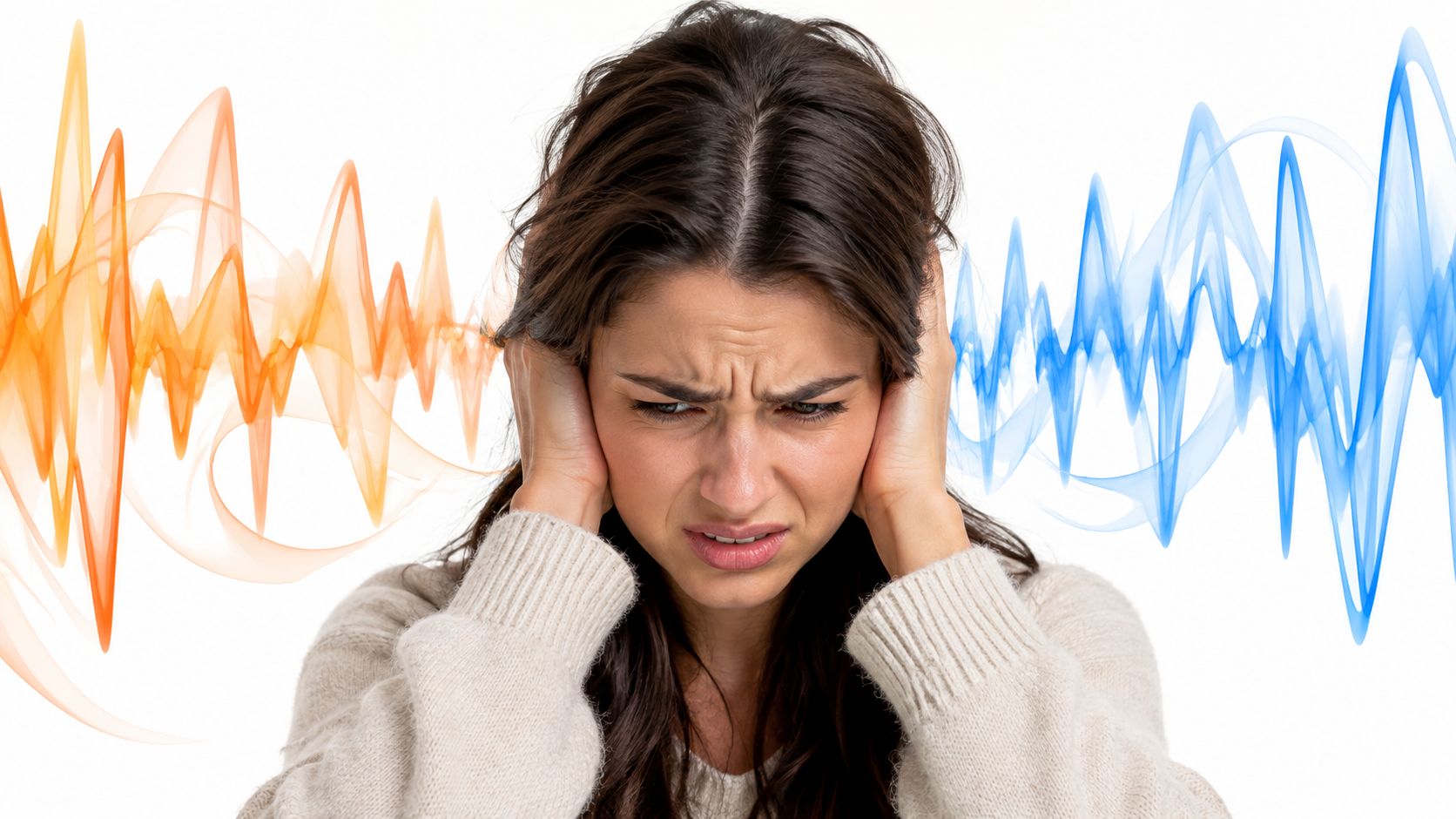
You're on a crowded Indian road when a horn cracks through the traffic. Your shoulders tighten, your heart races, and your first thought is not merely “that was loud”. You want to escape. Later, even an office alarm, a pressure cooker whistle, or music at a family gathering may leave you tense and watchful.
A phobia of loud noises can affect sleep, concentration, travel, work, education, and relationships. Your reaction isn't a character flaw, and you don't have to dismiss it as overreacting. Sound intolerance is real, but it doesn't always have one explanation. Fear, physical discomfort, anger, migraine-related sensitivity, tinnitus, anxiety, and exhaustion can create experiences that look similar from the outside.
Understanding Your Reaction to Loud Sounds
Riya works from a small office near a busy road. Most days, she can manage conversations and traffic, but a sudden horn makes her cover her ears and lose focus. She turns down invitations to festivals, chooses quieter routes, and worries that colleagues will think she's being difficult.
That pattern is common in people who experience sound as a threat rather than a neutral part of the environment. A loud noise may trigger a racing heart, muscle tension, dread, panic, irritability, headaches, or an urgent need to leave. Some people avoid cinemas, weddings, markets, public transport, fireworks, generators, construction sites, or crowded classrooms. Others stay present but spend the whole time scanning for the next sound.

The phrase noise phobia is often used as a broad label, but it can hide important differences. One person may fear the possibility of a sudden sound. Another may feel ordinary sounds as physically painful. Someone else may react with intense anger or disgust to a particular noise, even when it isn't loud.
Why the reaction can feel so powerful
Your nervous system responds to perceived danger before you've had time to reason through it. If you're already tired, stressed, grieving, or worried, a sudden sound may feel harder to recover from. Avoiding the sound can bring immediate relief, but constant avoidance may gradually shrink your world and make future situations seem more threatening.
Indian research offers a useful reminder that sound intolerance deserves attention. A 2024 study of 597 high-school students in Mysore District, Karnataka, found that 17.25% met the study's criteria for hyperacusis, with 103 students identified through the Modified Khalfa Hyperacusis Questionnaire. The finding applies to that adolescent sample, not to India as a whole, and it measured symptoms rather than a formal diagnosis of phonophobia. Still, it shows why a student who struggles with sound at school, during sleep, or in social settings shouldn't be dismissed. The study's findings are available through PubMed.
A useful starting point: Don't ask only, “Why am I afraid of noise?” Ask, “What exactly happens in my body, thoughts, emotions, and hearing when a sound occurs?”
Phonophobia, Hyperacusis, and Misophonia Explained
Three terms are often mixed together, although they describe different experiences. Phonophobia usually centres on fear, dread, or avoidance linked to sound. Hyperacusis involves reduced tolerance to ordinary sounds, which may feel excessively loud, uncomfortable, or painful. Misophonia involves a strong emotional or physiological reaction to particular trigger sounds, such as chewing, tapping, breathing, or repetitive clicking.
An analogy can help. With phonophobia, the alarm is mainly about anticipated danger. With hyperacusis, the volume dial may seem unusually high or the sound may hurt. With misophonia, the problem is often the identity and meaning of the sound, not its loudness. A person may feel intense anger or disgust when hearing a specific trigger, even while tolerating louder sounds elsewhere.
| Condition | Primary Trigger | Core Experience |
|---|---|---|
| Phonophobia | Loud or anticipated sounds | Fear, dread, panic, or avoidance |
| Hyperacusis | Ordinary sounds or environmental noise | Excessive loudness, discomfort, or pain |
| Misophonia | Specific sounds, such as chewing or tapping | Strong anger, disgust, distress, or physiological arousal |
These patterns can overlap. Sound intolerance may also occur alongside tinnitus, migraine, hearing-related conditions, trauma responses, or anxiety. A person might fear a sound because it causes pain, or feel anxious after repeated episodes of physical discomfort. That's why the same label shouldn't automatically lead to the same treatment.
Indian evidence reinforces the need for careful sorting. A survey of Indian ear, nose, and throat specialists and audiologists found that 56.6% said hyperacusis wasn't diagnosed in their clinics, while 73.4% reported that they didn't know its cause. Only 33.3% said they managed hyperacusis and tinnitus simultaneously. These figures describe professional awareness and clinical practice, not patient prevalence. The survey is available through the Indian clinician research publication.
Student research also illustrates why misophonia needs separate questions. In a survey of 172 Mysore University students, 48.27% reported misophonia symptoms and 23.28% reported clinically significant symptoms, while another Indian Journal of Otology study found clinically significant misophonia in 17.63% of university students. Among participants reporting hyperacusis in that study, 67.74% also reported misophonia. These university samples aren't national estimates and cannot establish an individual diagnosis. The research summary is available from NeuroScirn.
A hearing assessment may help clarify whether the main difficulty involves loudness, hearing, or sound tolerance. If you're unsure what to expect, this guide to what happens during auditory testing explains how evaluation can examine listening and auditory processing. A psychologist, therapist, audiologist, ENT specialist, or neurologist may be appropriate depending on your symptoms.
How Stress and Environment Amplify Sound Sensitivity
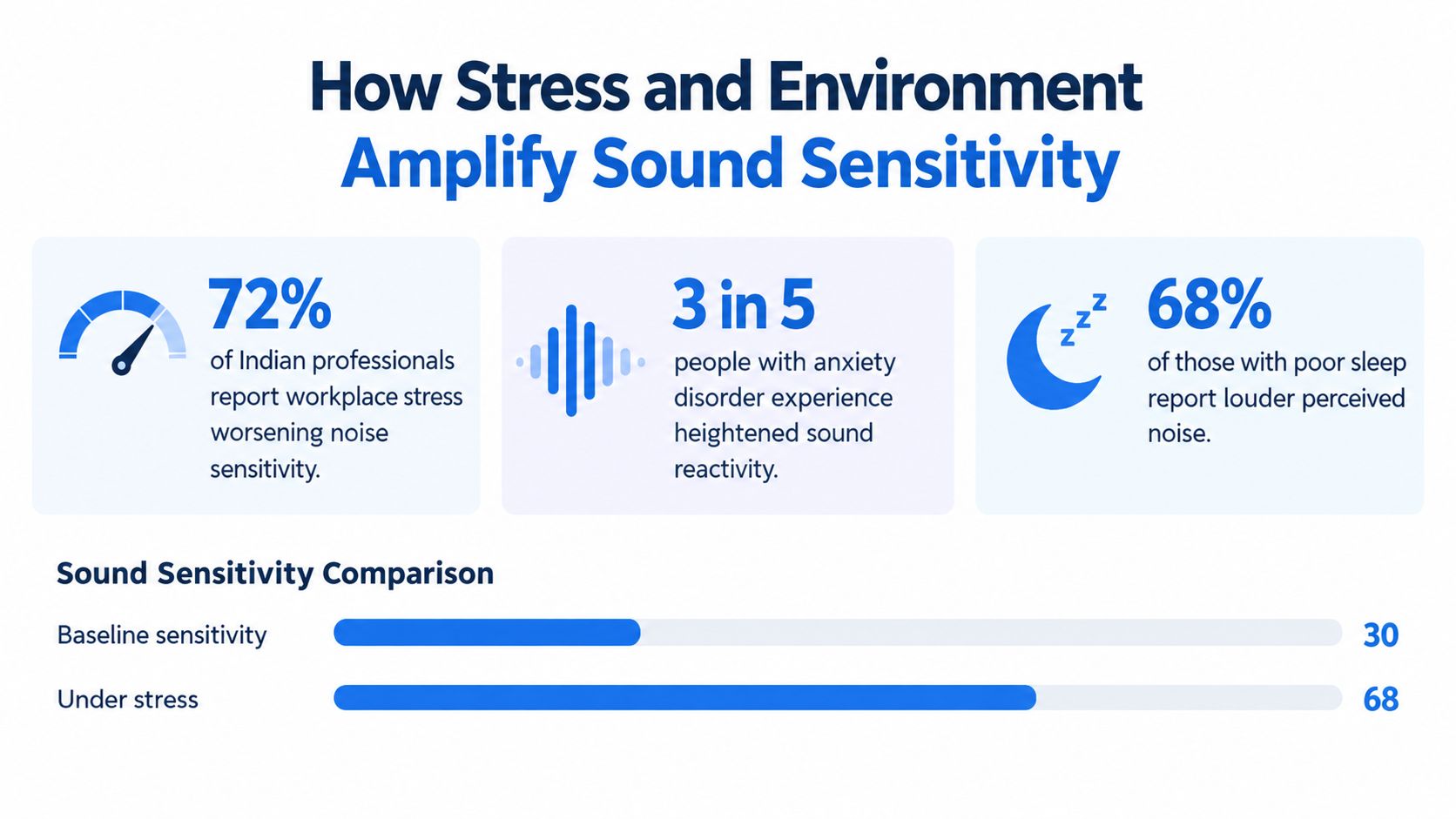
Sound sensitivity rarely appears in isolation. A demanding job, poor sleep, anxiety, depression, physical pain, or burnout can leave your nervous system with less capacity to absorb sudden stimulation. A horn that might have been manageable after restful sleep can feel unbearable after a tense day of deadlines and difficult conversations.
Workplace stress matters in India and elsewhere. A 2022 study of 1,764 urban white-collar employees found that 78% showed moderate-to-high stress, 55% showed moderate-to-severe anxiety, and 29% showed moderate-to-severe depression symptoms. These were screening results, not clinical diagnoses, and the findings don't prove that workplace stress causes phonophobia. They do show why sound-related distress may need to be considered alongside workload, sleep, anxiety, depression, and emotional exhaustion. Read the study through the National Library of Medicine.
The environment can be genuinely difficult
A busy Indian environment may include horns, construction, generators, amplified music, crowded buses, motorcycles, temple loudspeakers, festival fireworks, and packed workplaces. Telling someone to “just ignore it” overlooks the fact that some settings are objectively intense and offer little control.
Chennai research recorded average noise levels of 86 to 96 dB in sampled locations. In that research, 62% of participants reported high annoyance and 57% reported sleep disturbance, with noise sensitivity, annoyance, and sleep problems associated with poorer mental-health outcomes. These results don't mean every distressed person has a phobia, nor do they prove that noise alone caused mental-health difficulties. They support a balanced response that addresses both the environment and the individual. The Chennai findings are discussed by Nature India.
Your reaction isn't a moral failure. Stress can lower your tolerance, while persistent environmental noise can make rest and recovery harder.
This interaction can become circular. Noise disrupts sleep, poor sleep reduces emotional regulation, stress heightens vigilance, and heightened vigilance makes the next sound feel more alarming. Breaking that cycle may involve counselling, medical assessment, workplace adjustments, better rest, and practical noise reduction rather than relying on willpower alone.
Professional Treatments and the Role of Screening
Professional support becomes especially useful when sound-related fear or discomfort interferes with education, employment, sleep, travel, relationships, or basic daily activities. Start by describing the experience precisely: which sounds trigger it, whether the response is fear, pain, anger, or excessive loudness, when it began, and what happens afterwards.
A clinician may recommend different forms of care depending on the pattern.
- Therapy for fear and avoidance: Cognitive Behavioural Therapy can help you identify catastrophic predictions, understand bodily alarm signals, and practise more flexible responses.
- Carefully guided exposure: A therapist may create a gradual plan that begins with manageable sounds and builds slowly. Exposure shouldn't be abrupt, humiliating, or forced, and sounds that cause substantial physical pain shouldn't be treated as a challenge to endure without medical guidance.
- Hearing and medical evaluation: An audiologist or ENT specialist can review hearing changes, tinnitus, ear pain, dizziness, migraine symptoms, medication effects, and other relevant factors.
- Support for related conditions: Treatment may also address panic, trauma, anxiety, depression, insomnia, migraine, or workplace stress. Medication might be considered by an appropriately qualified doctor when an underlying mental-health or neurological condition calls for it.
Screening tools can help you organise your experience. They may highlight patterns of fear, avoidance, stress, resilience, or emotional symptoms that are worth discussing with a professional. However, an assessment is informational, not diagnostic. India's National Health Mission guidance describes validated screening tools as part of a healthcare process used to support confirmation of diagnosis, not as a replacement for clinical evaluation. Read the National Health Mission guidance on screening and diagnosis.
A qualified therapist, counsellor, psychologist, audiologist, ENT specialist, or doctor can interpret screening results in context. The right care plan should reflect your symptoms, health history, environment, priorities, and comfort with each step.
Practical Coping Strategies for Daily Well-being
You can't remove every loud sound from daily life, particularly in a busy city. The aim is to reduce unnecessary strain while preserving participation, confidence, and connection.
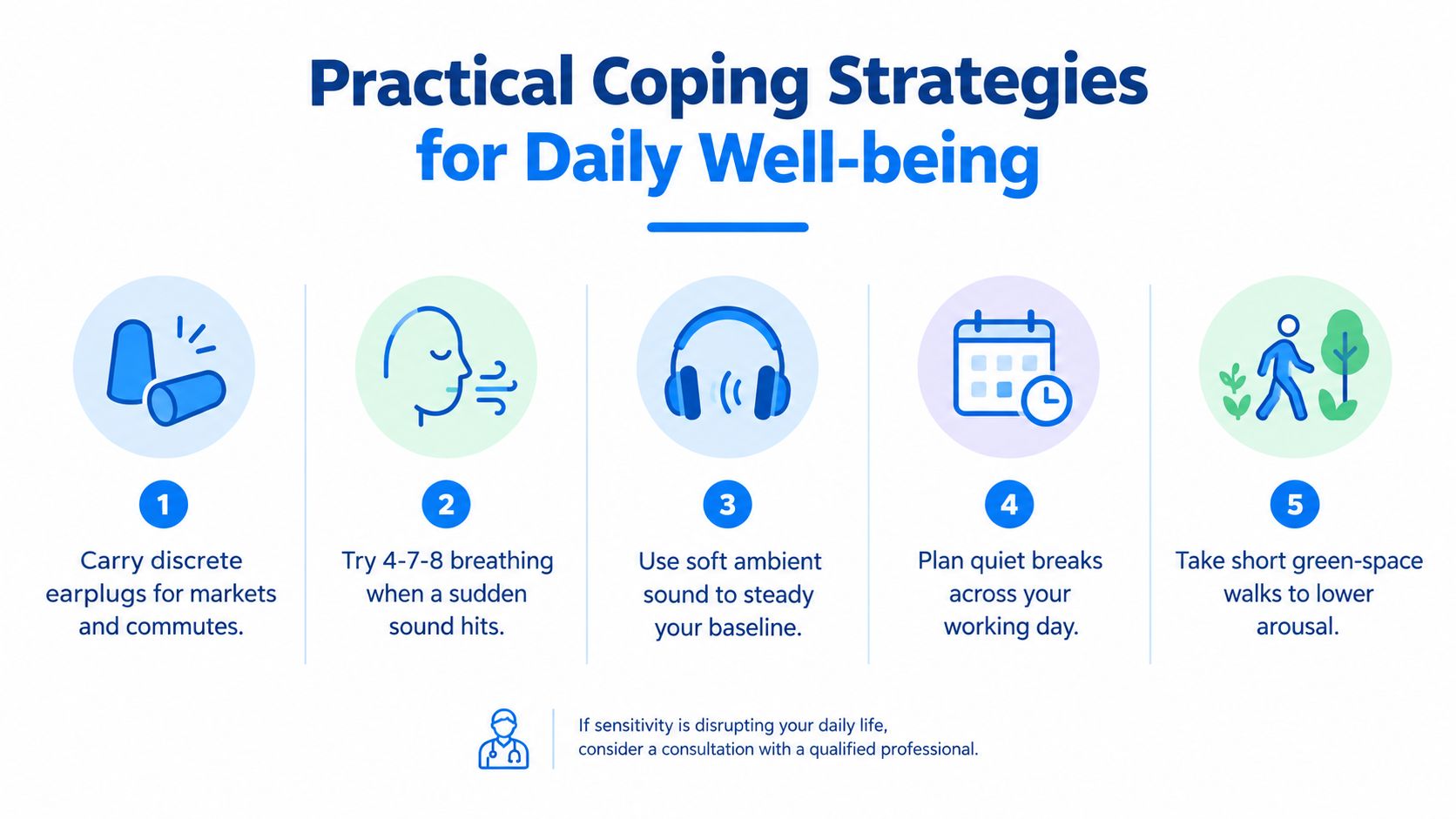
Start with environmental choices that cost little or nothing. You might travel outside the busiest period, sit farther from speakers, ask for a quieter desk, warn a colleague before an alarm test, or choose a less crowded area at a family event. At home, protect a quiet sleep zone by closing windows during peak noise, moving appliances away from the bedroom, and agreeing on lower-volume periods.
Temporary hearing protection has a place. Calibrated earplugs or appropriate hearing protection can be sensible around hazardous noise, loud commutes, fireworks, construction, or machinery. Continuous overprotection in ordinary safe environments may increase vigilance for some people, so discuss regular use with an audiologist or clinician, especially if sounds cause pain.
Build steadiness before the next trigger
When a sudden sound arrives, place both feet on the ground and name a few things you can see. Breathe out slowly, loosen your jaw, and remind yourself that a body alarm is not always evidence of immediate danger. Mindfulness isn't about pretending the sound feels pleasant. It helps you notice the reaction without adding a second layer of panic or self-criticism.
Plan recovery rather than judging yourself for needing it. A quiet break during the working day, a short walk in a green space, a nourishing meal, or a calming conversation can lower overall arousal. Positive psychology adds another important dimension: resilience grows through self-compassion, connection, meaning, gratitude, and small experiences of competence, not through forcing yourself to tolerate everything.
Use the following video as a gentle starting point for grounding and relaxation practice, while remembering that general exercises don't replace personalised therapy or medical care.
Research on environmental noise found that 62% of participants experienced high annoyance and 57% reported sleep disturbance, supporting the value of protected rest and realistic environmental adjustments for well-being. Review the environmental-noise findings.
Practical rule: Protect yourself from genuinely hazardous noise, but don't let protection become the only way you feel safe in ordinary life.
Finding the Right Support for Your Healing Journey
You deserve help when sound sensitivity is narrowing your life. Arrange a professional assessment if the problem persists, affects work or study, disrupts sleep, causes repeated panic, or leads you to avoid people and places that matter to you.
Some symptoms need prompt medical attention. Seek timely care for sudden hearing change, significant ear pain, severe tinnitus, fainting, severe dizziness, a new severe headache, facial weakness, confusion, or other new neurological symptoms. An inability to function safely at home, work, or college also deserves serious attention, particularly when anxiety or depression is present.
The first appointment doesn't need to solve everything. You can bring a short record of trigger sounds, physical sensations, emotions, avoidance, sleep, medication changes, migraine symptoms, and the situations you're trying to regain. This gives a therapist, counsellor, psychologist, audiologist, ENT specialist, or doctor a clearer picture than the phrase “I'm afraid of noise” alone.
Support should include your strengths as well as your difficulties. Indian workplace data found that 77% of workers had a moderate-to-high risk of experiencing mental-health issues, while 52% ended the workday feeling mentally or physically exhausted; 43% often felt helpless and 43% felt unsettled or nervous. These figures describe workplace experiences and risks, not your destiny. Read the India Mental Health Index report.
Therapy or counselling isn't a declaration that your mind is broken. It can be a collaborative way to understand your reactions, address anxiety or trauma, strengthen resilience, protect sleep, and reconnect with meaningful activities. Happiness doesn't require denying fear. It can include compassion for yourself, supportive relationships, purpose, and carefully chosen steps towards a fuller life.
DeTalks helps people across India connect with psychologists, therapists, and counsellors for concerns including phobias, anxiety, workplace stress, burnout, sleep problems, and personal growth. Explore confidential psychological assessments and professional support through DeTalks, and take a practical first step towards greater well-being and resilience.
Leave a Reply