
You're in a project meeting in Bengaluru, presenting a risk that could affect delivery. A senior colleague interrupts, dismisses the concern, and later sends a vague message implying that the delay is your fault. You want to respond, but you're also wondering whether speaking up will damage your reputation, appraisal, or relationship with someone who has more influence than you.
That uncertainty is central to how to handle difficult colleagues in India. The safest response isn't always a direct confrontation. It depends on the behaviour, the power difference, the impact on your work and well-being, and whether your organisation has a reliable way to protect you.
Understanding Workplace Friction and Its Real Impact
A colleague may be difficult because of a personality clash, unclear responsibilities, unreasonable workload, poor management, or pressure that the whole team is carrying. That context matters, but it doesn't make repeated disrespect acceptable. Your task isn't to diagnose the person. It's to understand what's happening well enough to choose a safe and useful response.

Consider a team member who regularly excludes you from important calls, a manager who changes priorities without acknowledging the change, or a peer who criticises your work in public but refuses to give clear feedback in private. Each incident can seem small. Together, they can create workplace stress, self-doubt, sleep disruption, and constant vigilance before meetings or messages.
The effect isn't imaginary. A report cited by Business Standard on burnout and workplace exhaustion in India found that 58% of Indians experienced burnout and workplace exhaustion, compared with a global average of 48%. That figure doesn't prove that a particular colleague caused your burnout, but it shows why repeated workplace pressure deserves serious attention rather than being dismissed as oversensitivity.
Notice the effect before you react
Ask yourself what has changed. Are you avoiding meetings, checking messages compulsively, losing concentration, or feeling anxious on Sunday evening? Are you becoming unusually withdrawn, irritable, or hopeless?
These signs don't establish a diagnosis, and an online assessment is informational, not diagnostic. They do indicate that the situation may be affecting your well-being and that coping alone may no longer be enough. Therapy, counselling, trusted personal support, or a workplace health service can help you think clearly while you decide what to do.
The first practical distinction is simple: stress is a signal, not a verdict. You can acknowledge the emotional cost without deciding immediately that the colleague is malicious or that you must leave your job.
Identifying the Behaviour Beyond the Label
Calling someone “toxic”, “rude”, or “impossible” may describe your experience, but labels rarely help a manager or HR team assess what happened. A stronger record describes observable conduct, such as repeated interruptions, public humiliation, unreasonable task pressure, intimidation, exclusion, offensive language, or misuse of authority.
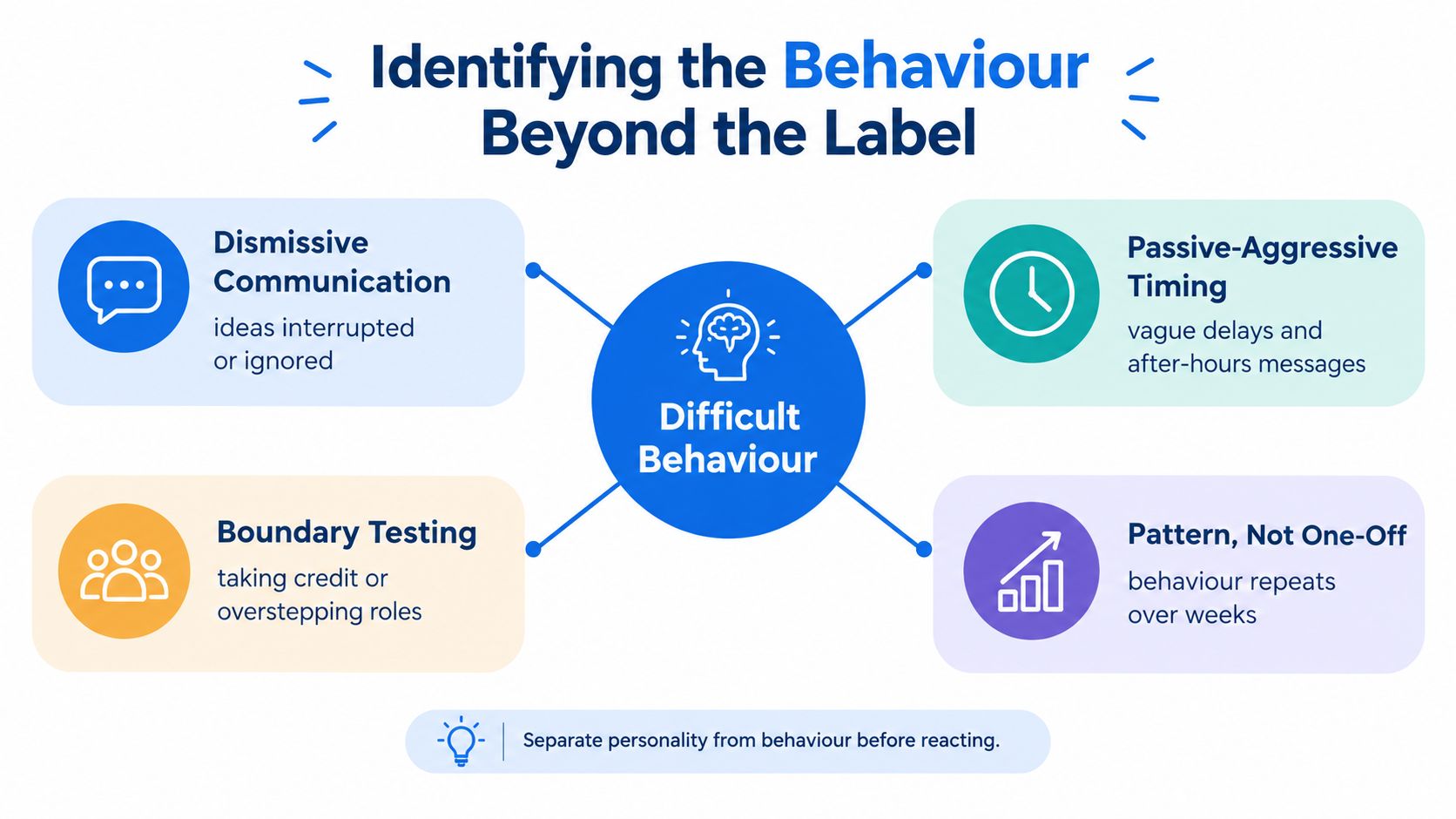
A foundational study of workplace bullying in India surveyed 1,036 employees across six cities in the IT-enabled services and business-process-outsourcing sector. It found that 44.3% had experienced bullying, while 19.7% reported moderate or severe levels. The study identified superiors as the predominant source and found task-focused behaviours particularly common in hierarchical workplace settings. The Indian workplace bullying study is significant, but its ITES-BPO focus means its prevalence shouldn't be applied to every Indian occupation.
That evidence supports a careful approach. Ordinary disagreement is not automatically bullying. A colleague who challenges your proposal once may be contributing to healthy debate. A colleague who repeatedly interrupts, humiliates, threatens, excludes, or imposes unreasonable demands creates a pattern that requires a different response.
Record facts, not interpretations
Use a private work log or secure personal record. Include:
- Date and setting: Note whether the incident occurred in a meeting, email, chat, call, or one-to-one conversation.
- Exact behaviour: Record the words or actions as accurately as you can.
- Witnesses: List people who were present or copied into the communication.
- Work impact: Describe the missed information, delay, confusion, reputational effect, or emotional response without exaggeration.
- Your reply: Keep a record of what you said and whether the behaviour continued.
This protects you from relying on memory when you're distressed. It also prevents a common mistake, building a case around assumptions about intent. “My manager hates me” is difficult to assess. “My manager interrupted my presentation repeatedly, rejected the risk without reviewing the evidence, and later assigned the same task with a conflicting deadline” gives others something concrete to examine.
Practical rule: Separate personality from behaviour before you decide how serious the problem is.
Look for repetition, power, and impact. A single awkward exchange may need clarification. A recurring pattern that affects safety, performance, or dignity may need managerial, HR, or formal support.
A Structured Approach to Managing Incivility
Direct communication can work when the behaviour is limited, the colleague has comparable power, and you don't expect retaliation. It works less well when the person is your reporting manager, controls access to opportunities, or has already responded aggressively to reasonable feedback.
A practical four-part method keeps the response focused.
Start with a reliable record
Write down the incident while the details are fresh. Keep work-related evidence in an appropriate place, such as emails, meeting notes, task records, or approved collaboration tools. Don't secretly distribute confidential material or forward sensitive documents to personal contacts without understanding company policy.
The purpose isn't to collect embarrassing material. It's to identify a pattern and explain its effect on the work. Research involving 1,133 Indian employees across banks, hotels, academic institutions, and IT firms found that demographic and workload factors significantly predicted experienced or instigated workplace incivility. The research on workplace incivility in India supports examining team norms, role design, working hours, and managerial practice rather than treating every conflict as a personality problem.
Use observation, impact, and request
Have a private, low-threat conversation when it's safe. Avoid “you're always rude” and describe one specific event instead:
“In yesterday's review, I was interrupted three times. It made it difficult to present the risk analysis. Can we use a no-interruption rule and park disagreements for the question period?”
This wording doesn't require you to prove motive. It tells the colleague what happened, why it matters, and what you need next. Then listen. Their explanation may reveal a genuine process issue, but context doesn't cancel the need for respectful behaviour.
Confirm the agreement
Send a calm written summary after the conversation. You might write, “Thanks for discussing the review process. We agreed that I'll present the risk analysis first, questions will come at the end, and urgent changes will be confirmed in writing.”
Written clarity reduces future disputes about what was agreed. Review the situation after one or two work cycles. If the conduct improves, acknowledge the change and maintain the agreed process. If it continues, your record will show that you tried a proportionate response.
For managers and HR leaders, clear standards matter as much as individual courage. Resources on practical behaviour policies for HR directors can help organisations define respectful conduct, reporting routes, investigation steps, and follow-up expectations.
When to Escalate and Seek Mediation
Self-resolution is usually faster and may preserve the working relationship. It can also be unsafe when the colleague is senior, influential, retaliatory, or connected to decisions about your pay, promotion, workload, or contract. In those circumstances, “just communicate better” places too much responsibility on the person with less power.
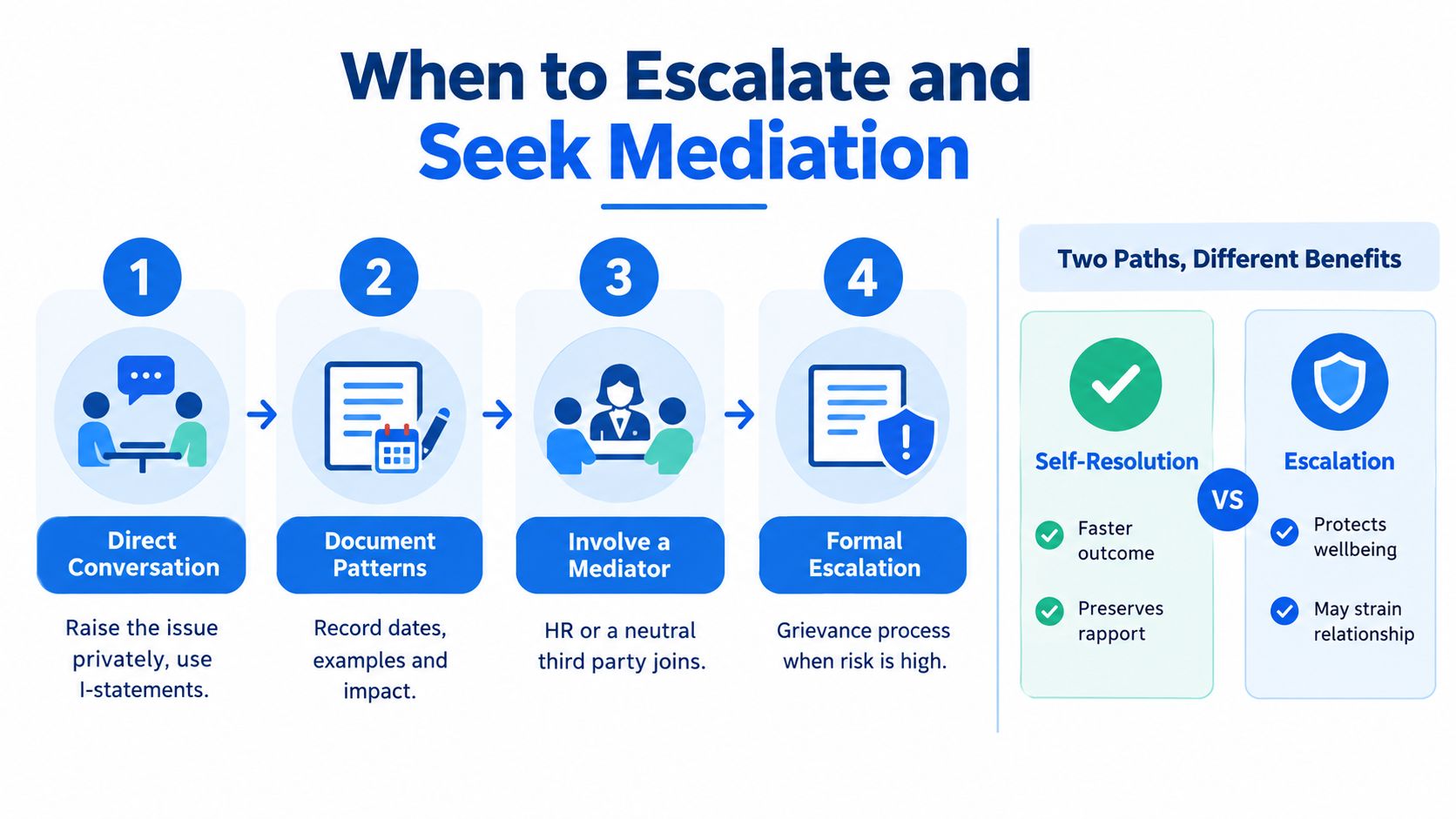
Use a graduated decision process:
- Direct conversation: Choose this for lower-risk friction, such as interruptions, unclear response times, or role confusion.
- Document patterns: Move here when the behaviour repeats, affects delivery, or the first conversation produces no change.
- Managerial or neutral support: Ask a trusted manager, HR representative, employee assistance contact, or neutral mediator to help structure the discussion.
- Formal escalation: Use the grievance process or other designated channel when the conduct involves threats, discrimination, sexual harassment, retaliation, or abuse of authority.
Mediation can help when both people can participate safely. A neutral person should separate fact-finding from advocacy, allow each person to give concrete examples without interruption, identify shared work goals, and record commitments with an owner, deadline, and review date. Agreements may cover meeting turn-taking, response-time expectations, escalation routes, and how disagreements will be recorded.
Mediation is not a substitute for safeguarding or investigation. Don't accept a forced “mutual resolution” where someone alleges sexual harassment, threats, coercion, or retaliation and may face further risk by sitting with the accused person.
Recognise India's formal protections
The Sexual Harassment of Women at Workplace Act, 2013 created a statutory framework requiring organisations with at least 10 employees to constitute an Internal Committee. Listed-company disclosures also provide a useful view of formal reporting. An analysis of 300 NSE-listed companies recorded registered complaints rising from 161 in FY2013–14 to 1,160 in FY2022–23, as reported in CEDA's analysis of a decade of the POSH Act.
The increase may reflect changing awareness, reporting practices, workforce size, and disclosure quality, not only more misconduct. The practical lesson is that serious conduct needs an institutional route. Preserve dates, messages, witnesses, and task records, consult your organisation's policy, and ask about confidentiality and protection from retaliation before choosing your next step.
Protecting Your Mental Health and Well-being
A difficult colleague can become a mental-health issue when you spend your evenings replaying conversations, lose sleep before work, or feel anxious whenever a notification appears. Persistent workplace stress can also affect concentration, mood, appetite, relationships, and your sense of happiness outside the office.

India's National Mental Health Survey, conducted in 2015–16 by NIMHANS, estimated that 10.6% of adults had a current diagnosable mental health disorder and 13.7% had experienced a mental disorder during their lifetime, with 15% requiring intervention, according to the Government of India's summary of the survey. These figures don't diagnose your response to a colleague. They do challenge the idea that anxiety, depression, or exhaustion should be treated as a personal weakness.
Use support before the crisis point
Begin with practical protection. Take breaks away from the screen, avoid checking non-urgent work messages during protected personal time where possible, speak to someone you trust, and keep important work communication factual. If the environment remains harmful, discuss workload, leave, role changes, or a safer reporting route with an appropriate professional.
Therapy or counselling can help you regulate anxiety, understand your reactions, prepare a boundary script, and decide whether the situation calls for escalation or a career change. A screening assessment may help you notice patterns, but it's informational, not diagnostic. A qualified mental-health professional must assess symptoms and recommend care.
Here's a short grounding reminder worth keeping visible:
Your well-being is part of the work problem, not an inconvenient side issue.
This video can provide an additional reflective resource, but it shouldn't replace professional assessment or immediate support when symptoms are severe.
Seek urgent help through local emergency or crisis services if you feel at immediate risk of harming yourself or someone else. You don't need to wait for a formal diagnosis before asking for help with workplace stress, burnout, anxiety, or depression.
Building Resilience Through Compassion and Support
Resilience isn't the ability to tolerate unlimited disrespect. It's the capacity to recover, think clearly, use support, and act in line with your values while protecting your boundaries.
Self-compassion helps you avoid two damaging conclusions: “I should have handled this perfectly” and “I must accept this because I'm not strong enough.” A 2024 study of 420 college and university students in Manipur examined compassion, and the wider evidence discussed alongside it connects self-compassion with resilience and life satisfaction. The study on compassion and positive psychological outcomes supports a useful workplace principle: treat yourself with dignity while still holding harmful conduct accountable.
Try a balanced response:
- Compassion for yourself: Name the emotional effect without criticising yourself for having it.
- Compassion without excuse: Consider possible pressure or confusion affecting the colleague, but don't use it to justify harassment or humiliation.
- Strengths-based action: Identify what you control, such as written clarification, meeting preparation, trusted support, or an escalation route.
- Connection: Stay in contact with people who remind you that your professional identity is larger than one difficult relationship.
Teams can strengthen these habits through structured conversations rather than vague wellness messages. For leaders planning a focused session, a best MEDIAL-backed agenda guide can help organise a team-building workshop around participation, shared expectations, and psychological safety.
Positive psychology also includes happiness, gratitude, meaning, and purpose, but these ideas shouldn't be used to pressure someone into positivity. You can practise mindfulness, recognise your strengths, and build supportive relationships while reporting conduct that crosses a line. Compassion and firmness are compatible.
Key Takeaways for Navigating Workplace Challenges
The most effective response to a difficult colleague balances empathy for yourself with clear boundaries. You don't have to decide whether someone is a bad person before you decide that a specific behaviour must stop.
Keep these principles close:
- Describe conduct: Replace labels with dates, words, actions, witnesses, and work impact.
- Check the pattern: A single disagreement may need clarification. Repeated aggression, humiliation, exclusion, threats, harassment, or unreasonable pressure may need formal support.
- Choose the safest channel: A private conversation can work when power is reasonably balanced. Use written clarification, a trusted senior, HR, mediation, or a grievance process when speaking directly could affect your safety or career.
- Set a specific request: Ask for a behaviour you can observe, such as no interruptions during presentations, written confirmation of changing deadlines, or a defined response-time norm.
- Follow up: Record agreements and watch whether the conduct changes. A conversation without follow-through rarely changes a pattern.
- Protect your health: Anxiety, sleep disruption, low mood, withdrawal, and exhaustion deserve attention. Therapy and counselling are valid forms of support, not evidence of failure.
- Use assessments carefully: An online screening tool can increase awareness and suggest next steps, but it's informational, not diagnostic.
- Keep compassion grounded: Self-compassion can support resilience and well-being, but it never requires you to tolerate harassment or retaliation.
You may not be able to change the colleague. You can still improve your clarity, protect your evidence, involve the right people, and choose a response that respects both your career and your mental health.
DeTalks helps people connect with psychologists, therapists, and counsellors for concerns including workplace stress, anxiety, burnout, professional pressure, and career confusion. If you want confidential guidance or an informational mental-health assessment while deciding your next step, visit DeTalks to explore available support.
Leave a Reply