
A parent watches their child lose focus halfway through homework, then struggle to join a group game. Elsewhere, an adult leaves a family wedding feeling restless, exhausted and overwhelmed by noise, conversation and unexpected changes. Both may wonder whether these experiences point to ADHD, autism, anxiety, or some combination.
The ADHD autism spectrum conversation is confusing because similar behaviours can have different causes. This guide explains the overlap in plain language, with an India-first perspective on screening, assessment, support and workplace well-being. It's educational information, not a diagnosis, and an online questionnaire can't replace a qualified clinical evaluation.
Why ADHD and Autism Can Feel Confusingly Similar
ADHD and autism are both neurodevelopmental conditions. This means their patterns begin during development and can influence attention, communication, behaviour, learning and relationships across life. They're distinct conditions, however, and ADHD isn't a form of autism or a position on the autism spectrum.
ADHD mainly involves ongoing differences in attention regulation, impulse control, activity level and executive functioning. A person may understand what needs to be done but struggle to start, organise, prioritise or complete it. Their attention may move quickly, particularly when a task feels repetitive or uninteresting.
Autism spectrum disorder, often called autism or ASD, involves persistent differences in social communication and interaction, alongside restricted or repetitive patterns of behaviour, interests or activities. Many autistic people also experience sensory input differently, although sensory features alone don't establish an autism diagnosis.
The outward behaviour can look similar. A child who doesn't respond to a teacher might be distracted by ADHD, absorbed in an interest, overwhelmed by classroom noise, anxious about the task or having difficulty processing spoken language. An adult who interrupts may be acting impulsively, struggling to read conversational timing, or urgently sharing a subject that matters greatly to them.
Why labels get missed
Indian children and adults may be described as lazy, careless, rude, shy or badly behaved when they're struggling with attention, social communication, sensory regulation or stress. In a busy classroom, a child who misses instructions can be punished rather than supported. In a workplace, an employee who needs written instructions may be judged as disengaged.
Family expectations, bilingual communication, joint-family dynamics and uneven access to specialists can also affect how concerns are understood. A person may learn to mask difficulties, copy social behaviour or work much longer than colleagues to complete ordinary tasks.
Practical rule: Look beyond what happened. Ask what made the task, conversation or environment difficult, and whether the same pattern appears across settings.
A careful assessment considers development over time, not one difficult afternoon. It also asks what helps, which strengths are present, and whether anxiety, depression, trauma, sleep problems or learning differences may be contributing.
How Common ADHD and Autism Are in India
Indian prevalence figures illustrate why one screening result shouldn't be treated as a national truth or a personal diagnosis. A 2019 systematic review of 14 Indian studies involving 20,143 children and adolescents found ADHD estimates ranging from 1.30% to 28.9%, with a pooled estimate of 7.1%, or approximately 71 children per 1,000 in the combined evidence base. The review reported 9.4% among males and 5.2% among females, while warning that studies used different instruments, thresholds and sampling methods. Read the Indian ADHD systematic review
These figures don't support a single definitive ADHD rate for India. Region, age, urban or rural setting, referral patterns and the difference between screening and diagnosis all influence the result. Lower identification can reflect limited access to child psychiatry, fewer trained assessors, stigma or different expectations about behaviour, rather than the absence of difficulties.
| Condition | Reported Range in Indian Studies | Key Reason for Variation |
|---|---|---|
| ADHD | 1.30% to 28.9% | Region, age group, diagnostic instrument and study setting |
| Autism | Estimates vary sharply by population surveillance and clinical samples | Sampling method, access to assessment and referral patterns |
Autism estimates need especially careful interpretation. A South Indian population study reported autism in 1 out of 6,616 people, approximately 0.02%, and in 1 out of 1,699 children, approximately 0.06%. Those population figures shouldn't be compared directly with clinic-based rates, because specialist clinics usually see people who have already been referred for concerns. See the Indian population and clinical autism findings
What a screening number can and can't tell you
A screening tool is designed to identify people who may benefit from further assessment. It doesn't establish whether ADHD or autism is present, explain the cause of a difficulty or predict the support a person needs.
Families looking for practical autism support may encounter resources about effective ABA therapy for autism. Any intervention should still be considered in relation to the individual's communication, sensory needs, preferences, safety, goals and broader clinical assessment.
Girls and women can be missed when attention problems, internal distress, perfectionism or intense effort are less visible than stereotypical hyperactivity. Adults may reach services through university pressure, workplace stress, relationship strain or exhaustion rather than a childhood referral. These patterns make a thoughtful, culturally responsive assessment more useful than reassurance based on a single percentage.
Core Features Side by Side
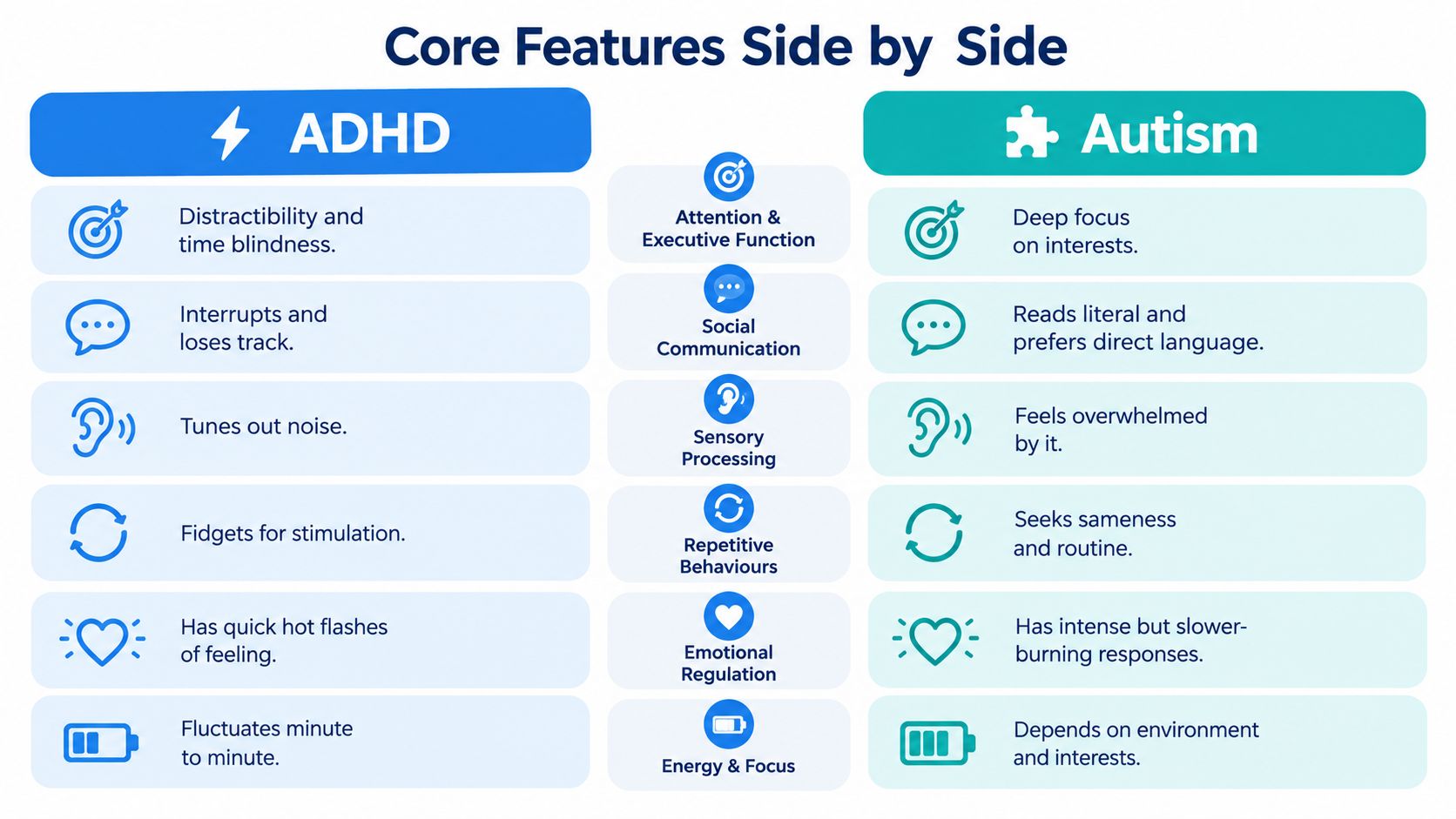
The most useful question is not just, “Does this behaviour appear on an ADHD or autism checklist?” It's why does it happen, when did it begin, and what changes it? The comparison below offers a starting point, not a diagnostic test.
| Area | ADHD may look like | Autism may look like |
|---|---|---|
| Attention and executive function | Attention shifts quickly, tasks are forgotten, time feels difficult to judge and organisation takes sustained effort | Attention may become deeply focused on interests, while transitions, planning or unclear tasks create difficulty |
| Social communication | Interrupting, losing the thread of conversation or speaking impulsively | Differences in social reciprocity, reading implied meaning, using non-verbal cues or adjusting communication to context |
| Sensory processing | Noise or movement may pull attention away, or stimulation may be sought through movement | Sounds, textures, lights, smells or crowded spaces may cause intense distress or lead to sensory seeking |
| Repetitive behaviour | Fidgeting or movement may help maintain alertness | Repetition, stimming, strong interests or predictable routines may support regulation and safety |
| Emotional regulation | Feelings may rise quickly, with frustration or excitement leading to rapid reactions | Responses may build around sensory overload, uncertainty, communication strain or an unexpected change |
| Energy and focus | Motivation and focus can fluctuate sharply from one task or moment to the next | Engagement often depends on interest, predictability, sensory environment and the demands of social interaction |
Differences that need context
A child with ADHD may want to join other children but miss social cues because attention shifts or impulses interrupt the interaction. An autistic child may want connection but find the unspoken rules of group play difficult to interpret. Some people experience both patterns.
Early social smiling, pretend play, shared enjoyment and flexible back-and-forth interaction can offer useful developmental information. So can sensory-driven distress, a strong need for sameness, repeated movements and highly focused interests. None of these observations should be used in isolation.
The same behaviour may have different explanations. A child staring away during class may be bored, distracted, overwhelmed by noise, anxious about failure or concentrating internally. A person who appears not to listen may be processing language slowly or trying to filter competing sensory input.
The behaviour is the clue, not the conclusion.
A clinician needs to understand the pattern across time and settings. A single missed instruction, intense interest, interruption or emotional reaction rarely decides whether someone has ADHD, autism, both or another condition.
Overlapping Symptoms and Differential Diagnosis
Screeners can be useful because they organise concerns and indicate whether further help may be appropriate. They can also mislead when a person or family treats a positive result as proof. The M-CHAT, for example, showed 86.7% sensitivity and 40.0% specificity in an Indian tertiary-hospital study of 50 children already diagnosed with ADHD. In that ADHD-enriched clinical group, a positive result could flag children for autism evaluation, but it couldn't confirm autism. Review the Indian M-CHAT and CARS findings
ADHD and autism can both involve executive-function difficulties, social misunderstandings, emotional dysregulation and sensory stress. A child's impulsivity may hide social-communication differences. Equally, an autistic child's intense distress during change may make it harder to notice attention or impulse-control difficulties.
What differential assessment examines
A qualified clinician builds a developmental and functional picture rather than scoring one questionnaire.
Developmental history: Parents, older relatives or records may describe early communication, play, friendships, attention, movement, routines and responses to change.
Multiple informants: Parent, teacher, partner, adult self-report and clinician observations can reveal how the person functions at home, school, work and in social environments.
Social communication: The assessment considers conversational reciprocity, non-verbal communication, interpretation of implied meaning and the ability to adjust interaction across contexts.
Restricted or repetitive patterns: The clinician explores sameness, intense interests, repeated movements, sensory regulation and distress during transitions.
Other explanations: Anxiety, depression, trauma, sleep difficulties, learning disorders, language differences and intellectual disability may create or intensify similar difficulties.
India-wide analysis has estimated crude prevalence at 0.4% for ADHD and 0.4% for ASD, while noting that ADHD prevalence varied 2.8-fold between Indian states. These variations reinforce the need for multi-informant assessment and developmental context, rather than treating a positive screen as a diagnosis. Read the India-wide burden analysis30475-4/fulltext)
| Symptom area | ADHD distinct | Autism distinct | Shared possibility |
|---|---|---|---|
| Inattention | Attention shifts, forgetfulness or impulsive task switching | Attention is pulled towards interests, sensory input or difficulty processing language | Both can miss instructions |
| Social difficulty | Interruptions, distraction or inconsistent self-monitoring | Persistent differences in social reciprocity and interpreting social communication | Both can struggle in groups |
| Sensory stress | Stimulation may be sought or attention may be captured by noise | Sensory input may feel unusually intense or regulating | Both may become overloaded |
| Routines | Repetition may feel boring and variety may support engagement | Predictability and sameness may provide security | Transitions can be difficult |
| Emotional reactions | Frustration or excitement may escalate quickly | Change, overload or communication strain may lead to intense responses | Anxiety can intensify either pattern |
Differential diagnosis is a clinical process, not a quiz outcome. When clinicians stop at the first plausible label, people may receive support that addresses the visible behaviour while missing the underlying need.
When ADHD and Autism Occur Together
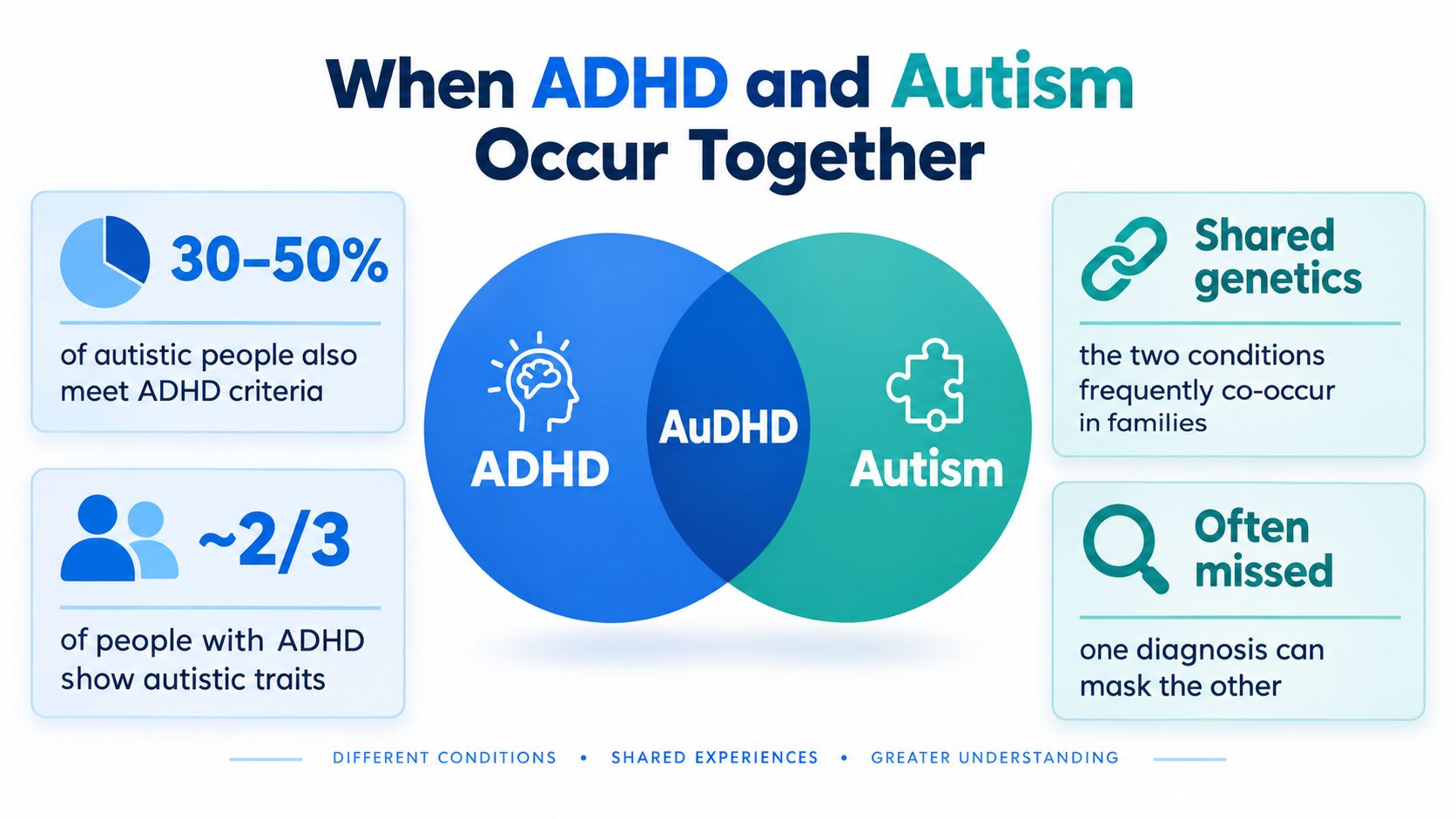
Some people meet criteria for both ADHD and autism. The informal term AuDHD is often used by adults and communities to describe this combined experience, but the important clinical point is simpler: the two profiles can coexist and should be assessed separately.
Co-occurrence can create tensions that are easy to misunderstand. A person may need structure and predictability while also struggling to maintain routines. They may seek stimulation yet become overwhelmed by noise. They may focus intensely on an interest but find everyday administration almost impossible to begin.
Why adults and women may be missed
Masking and compensation can hide support needs. A girl may copy classmates' social behaviour, rehearse conversations or appear organised while using exhausting amounts of effort. An adult may build elaborate systems to manage work, then experience burnout when sleep loss, family responsibilities or workplace change removes those supports.
A Delhi screening study of 1,665 people aged 18 to 25 found ADHD symptoms in 14%, suggesting that some young adults reach services through academic, work or relationship difficulties rather than childhood pathways. Screening symptoms still aren't diagnoses, and a young adult's assessment needs childhood history, current impairment and consideration of anxiety, depression, sleep and learning difficulties. Read the Indian young-adult and gender-focused discussion
A dual profile isn't a double failure. It can be a more accurate map of the person's needs, preferences and strengths.
A clinician may need school reports, family observations and examples from current work or relationships. The assessment should also ask what helps the person function, where masking occurs, and whether disclosure at university or work would be useful and safe.
Anxiety, burnout, sleep problems and emotional dysregulation may be the reasons someone seeks help first. They deserve direct attention, even when a neurodevelopmental assessment is also taking place. Better support often comes from addressing the whole person, not from choosing one label as the only explanation.
Evidence-Based Support That Helps
Support should target the difficulty a person is experiencing, not just the diagnostic name. A child may need help with transitions, an adult with task initiation, and another person with sensory regulation or social communication. The right combination can change over time.
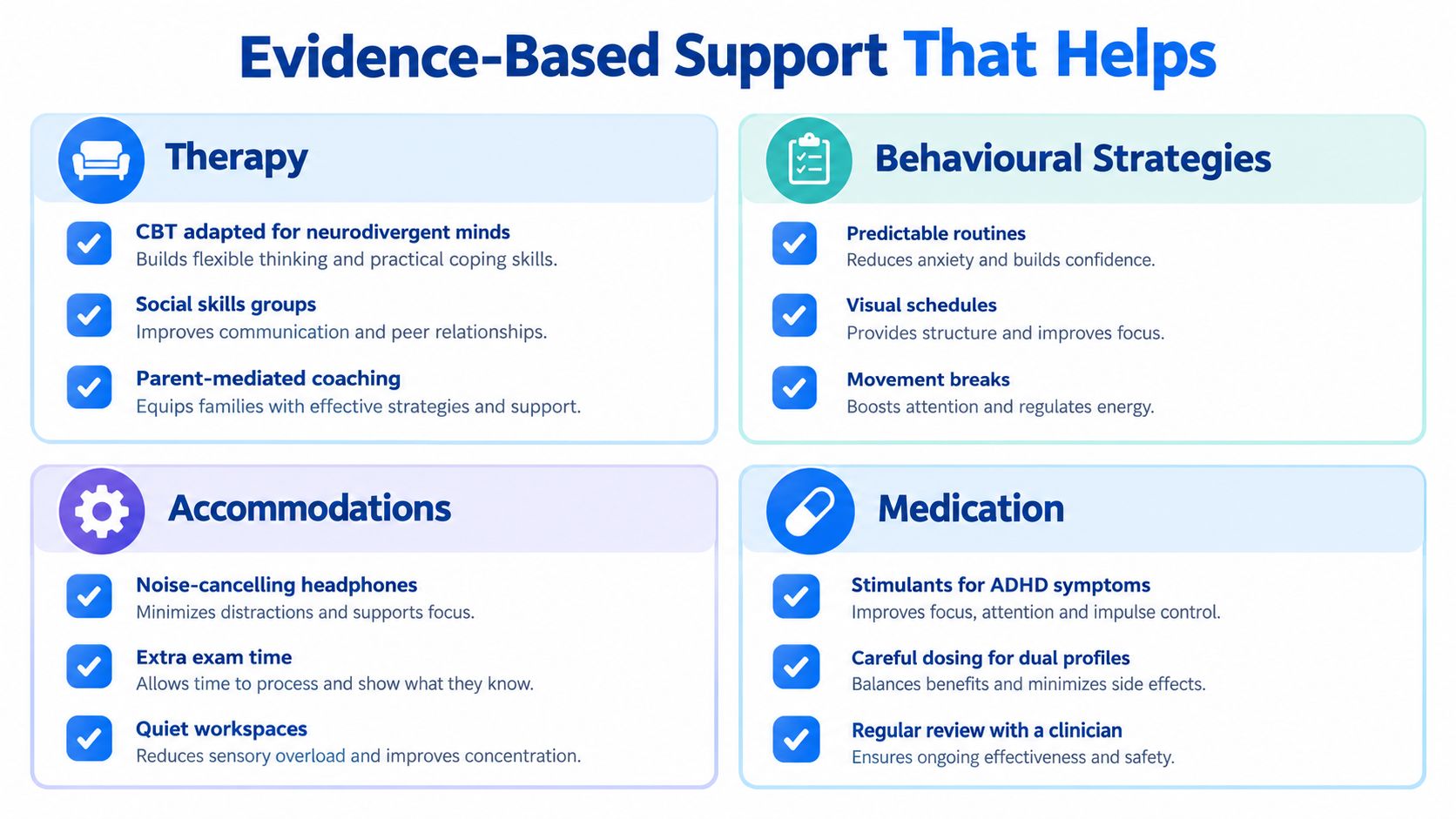
Therapy may help with emotional regulation, anxiety, self-understanding, communication and practical coping. Cognitive-behavioural approaches can be adapted to the person's attention, language and sensory profile. Parent-mediated coaching, social communication work and family counselling may help children and caregivers understand triggers without relying on punishment.
Occupational therapy can support sensory processing, daily-living tasks and environmental adjustments when those needs are part of the person's difficulties. Therapy should respect autonomy and avoid treating harmless differences, such as self-regulating movement, as problems that must be eliminated.
Practical changes at school and work
Small environmental changes can reduce unnecessary cognitive load.
- Predictable routines: Use written schedules, visual steps and advance notice of changes.
- Clear instructions: Break complex tasks into manageable actions and confirm what “finished” means.
- Movement options: Allow brief movement breaks or a position that supports attention without disrupting others.
- Sensory adjustments: Consider quiet workspaces, reduced visual clutter or noise-cancelling headphones.
- Assessment flexibility: Where appropriate, discuss extra exam time, rest breaks or alternative ways to demonstrate learning.
- Communication support: Written follow-up after meetings can help people who lose information during fast verbal discussions.
Medication is a clinical decision, not a shortcut. Stimulant and non-stimulant medicines may reduce core ADHD symptoms for some people, but they don't treat the core features of autism. A qualified psychiatrist should consider the full history, co-occurring conditions, side effects, goals and regular review, particularly when both profiles are present.
A strengths-based plan makes room for resilience, creativity, persistence, focused interests, compassion and problem-solving. Support isn't about promising a cure. It's about improving access, reducing avoidable stress and helping a person participate in life with greater well-being.
Finding the Right Help Through DeTalks
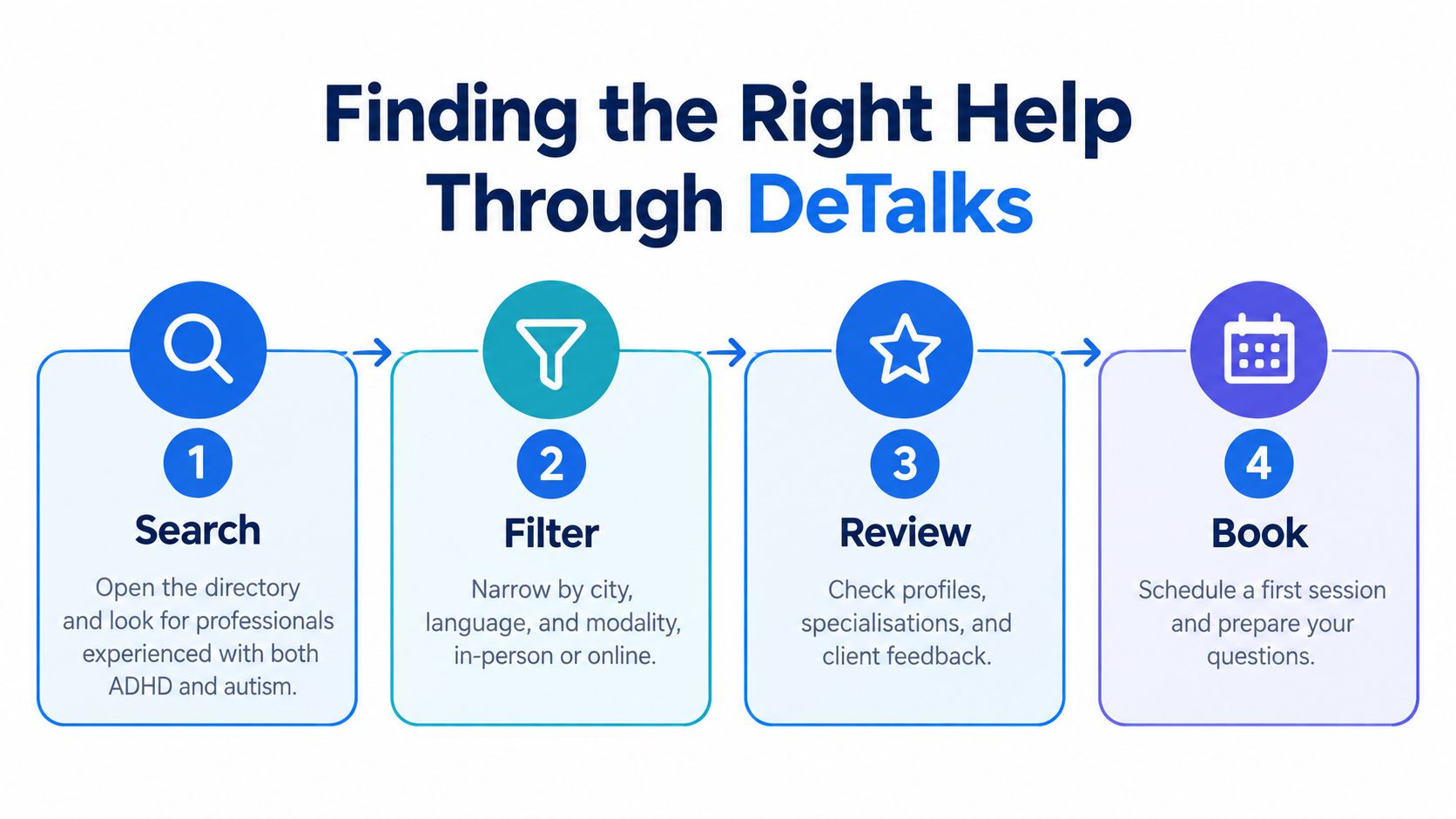
A useful directory should help families and adults find professionals who understand both ADHD and autism, rather than forcing them to choose one concern before speaking to anyone. Start by looking for experience with neurodevelopmental assessment, adult diagnosis, child development or co-occurring anxiety and depression.
Use practical filters that affect access:
- Location: Search by city when in-person care is important.
- Language: Consider the languages used at home, including bilingual family communication.
- Modality: Compare in-person and online sessions according to privacy, travel and sensory needs.
- Specialisation: Look for clinicians who assess attention, social communication, sensory processing and developmental history.
- Life stage: Adult assessment may require a different pathway from child assessment.
The platform's self-screenings are informational flags, not diagnoses. A flagged result should lead to questions, not a label. The next step may be booking a confirmatory evaluation, gathering childhood information and sharing observations from school, work or home.
Preparing for the first session
Bring specific examples rather than a general statement that something feels wrong. Note when the pattern appears, what makes it worse, what reduces it, and how it affects relationships, study, work, sleep and daily tasks.
Ask the professional:
- What information will you need about childhood development?
- Which people should complete questionnaires?
- How will you assess both ADHD and autism?
- How will anxiety, trauma, sleep and learning differences be considered?
- How long will the assessment take?
- Will you receive a written report and practical recommendations?
Indian families may also want to ask about bilingual development, joint-family observations, school expectations and sensory environments common in crowded cities. These details help a clinician distinguish a developmental pattern from a response to a particular environment.
Supportive Takeaways for Your Next Step
Confusion about ADHD and autism doesn't mean you're exaggerating or looking for a label. Similar behaviours can emerge from different needs, and a person can have both conditions alongside anxiety, depression, sleep difficulties or learning challenges.
Choose one pattern to observe this week. You might track when attention drops, what sensory input causes distress, or which instructions make tasks easier. Write down a few concrete examples, speak with a trusted family member and identify professionals who can assess the full picture.
Workplace stress deserves attention as well. A study of 1,764 urban Indian white-collar employees reported 29% moderate-to-severe depression, 55% moderate-to-severe anxiety and 78% moderate-to-high stress, although these figures don't measure ADHD or autism. Review the Indian workplace mental-health findings A separate Asia Mental Health Index reported 77% of workers in India had a moderate-to-high risk of mental-health issues, while 43% felt unsettled and nervous, compared with 36% across Asia overall. Read the India report
For social connection, people may also explore an autism dating site designed around neurodivergent connection. Whatever next step you choose, let compassion, resilience and practical support guide it. Understanding your profile won't solve every difficulty, but it can help you build environments, relationships and routines that fit you better.
DeTalks brings together informational assessments and access to psychologists, therapists and counsellors who can support ADHD, autism-related concerns, anxiety, depression, workplace stress and overall well-being. Visit DeTalks to explore relevant resources, find a suitable professional in India and take the next step towards a careful, person-centred evaluation.
Leave a Reply