
An online autism test for adults can help you notice patterns, but it cannot diagnose autism. India does not yet have a screening tool validated specifically for Indian adults. The closest Indian instrument has moderate positive predictive value, so a score is best treated as a prompt for discussion with a clinician, not a verdict about who you are.
At 11.40 at night, a 34-year-old marketing manager in Bengaluru searches “autism test for adults” for the third time this month. Her job title says senior. She rehearses how to begin conversations and spends much of Saturday in silence after a week in an open-plan office. From the outside, she seems to be coping. That gap can make her experience hard to understand.
Capable adults may reach their thirties or forties without a name for these patterns. Women, quiet high achievers and people who have learned to script social situations can be missed when childhood checklists are the main reference point. Understanding what a screening questionnaire can show, and what needs a clinician's assessment, makes the next steps clearer.
India's adult-specific screening options remain limited. The useful route is not a score: it is the path from a questionnaire to a clinician-led assessment, where your history and day-to-day experiences can be considered together.
Seeking answers is a way to treat yourself with care. Whatever a screening result suggests, therapy, counselling and a more understanding workplace may support your well-being. A first conversation with a qualified clinician can help you decide what to do next.
Screening Is a First Look and Diagnosis Is the Full Picture
An autism test for adults usually means a screening questionnaire. It's a structured set of questions about lifelong social communication, sensory sensitivities, focused interests and repetitive patterns. It gives shape to years of half-noticed experience. It doesn't decide anything.
The distinction worth holding on to is simple. A screen is a torchlight you shine on your own history. A diagnosis is a clinician reading the whole room.
Indian clinical literature treats adult screening as a triage step rather than an endpoint. A review of autism screening instruments used in Indian practice identifies the Autism Spectrum Quotient (AQ-50/AQ-S), the Ritvo Autism-Asperger Diagnostic Scale–Revised (RAADS-R) and RAADS-14 as the principal adult-oriented tools with at least moderate psychometric support. The same review is clear that child-focused instruments such as M-CHAT and CARS aren't appropriate substitutes for adult assessment.
| Tool | Format | What it explores | Notes for Indian adults |
|---|---|---|---|
| AQ-50 | 50-item self-report questionnaire | Social skill, attention switching, attention to detail, communication, imagination | Widely researched adult screen; not validated specifically for Indian adults; use as information only |
| RAADS-R | Long self-report questionnaire, usually taken online | Lifelong social communication, sensory experiences and restricted or repetitive patterns | Designed for adults; a helpful conversation starter with a clinician |
| RAADS-14 | 14-item short self-report | Core social communication and repetitive traits | Quick first pass; a raised score calls for professional follow-up, not self-diagnosis |
| IASQ | 10-item yes/no questionnaire | Broad autism traits, adapted from India's ISAA | Indian validation: 97% sensitivity, 81 to 92% specificity, 99% negative predictive value; positive results still need specialist confirmation |
| ISAA | 40-item clinician-rated scale across six domains | Autism severity after identification, using observation and informant interview | Government assessment framework; not a self-test and not an adult screening questionnaire |
What the Indian numbers actually mean
The IASQ is the one row with Indian validation behind it. In the 2022 study comparing it against CARS-2 and ISAA, sensitivity held at 97% and negative predictive value at 99% across both cutoffs, while specificity rose from 81% to 92% at the stricter one (IASQ validation study).
Read plainly, that makes it a strong rule-out tool and a weaker rule-in tool. A negative result meaningfully lowers the likelihood of autism in the population studied. A positive result still needs a specialist, because false positives creep in wherever anxiety, trauma or another developmental condition produces similar answers.
Screening answers "should I look further", not "what am I". Anyone who tells you otherwise, including a website with a slick score screen, is overselling.
Where screening stops and diagnosis begins
A score organises your observations. Only a clinician can integrate your developmental history, your current functioning, and the conditions that can mimic or hide autism, including ADHD, anxiety, depression, OCD, trauma and intellectual disability. That's also why the result of any online assessment is informational, not diagnostic.
The practical sequence is this. Take one reputable screen in private, write down the score, and note the specific examples behind your answers: the meetings you replay for hours, the noise that feels physical, the interests that swallowed whole weekends as a child. Then carry all of it to a qualified professional.
A low score doesn't close the question either. If daily life still feels harder than it looks from outside, that's worth discussing with someone trained to look past a questionnaire.
What a Full Adult Assessment in India Involves
A full assessment follows a clear path, from why you are seeking answers to what support may help. Knowing the stages can make the appointment feel less daunting.
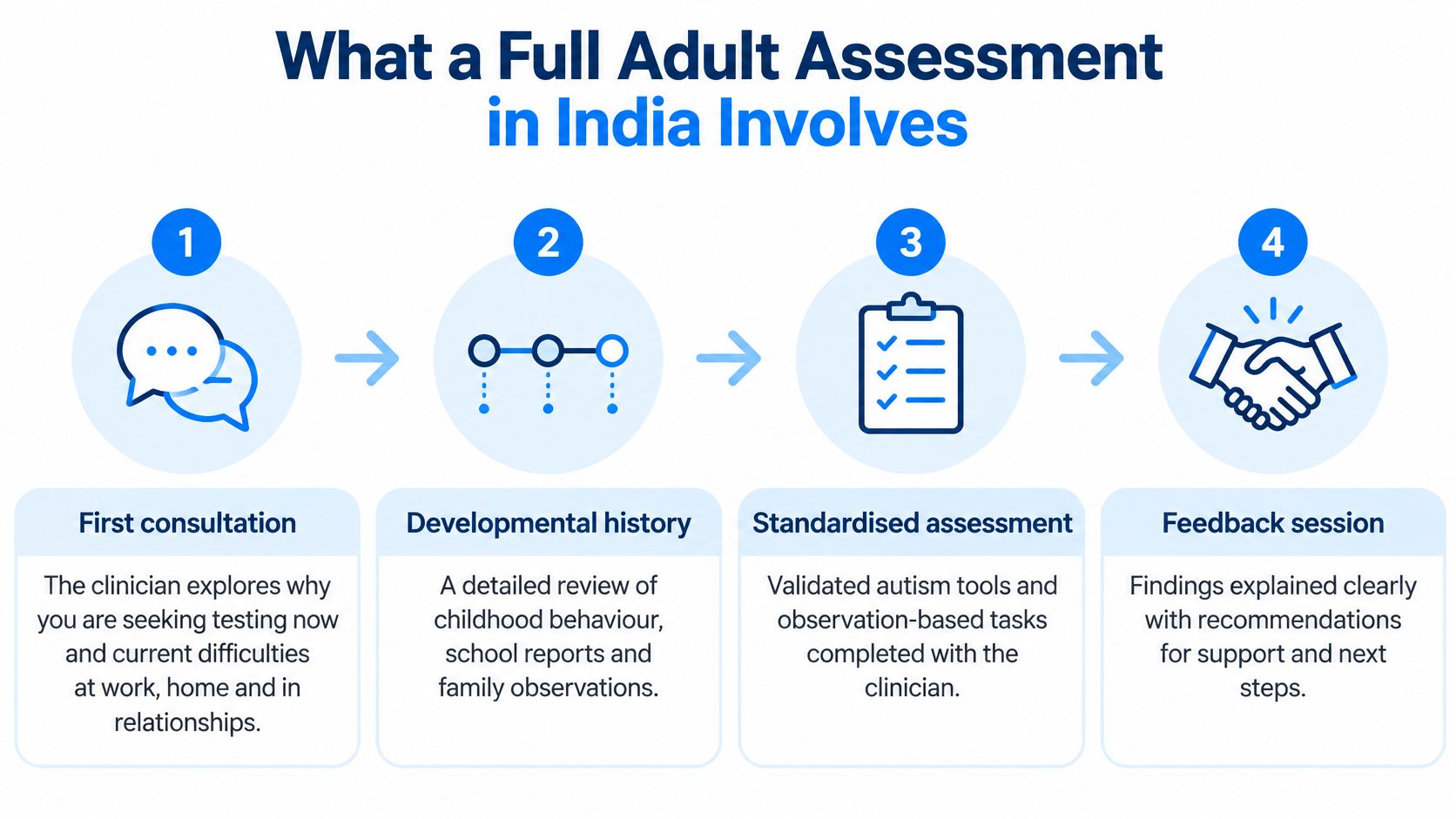
1. First consultation. The clinician asks what has led you to seek an assessment now. You may discuss work, family, friendships, sleep, and experiences such as anxiety, depression or burnout.
2. Developmental history. The clinician explores childhood milestones, school experiences and early patterns of communication or behaviour. If available, a parent, sibling or long-standing friend may add their perspective. Childhood history helps fill in what a questionnaire cannot show.
3. Standardised testing. The assessment may use formal tools alongside observation of how you communicate and respond during the appointment. Adult questionnaires such as the AQ or RAADS-R can add information, but they do not replace clinical assessment.
4. Differential diagnosis. The clinician considers whether other conditions could explain some of your experiences. ADHD, anxiety, depression, OCD, trauma and intellectual disability can resemble autism, and some may occur alongside it.
5. Functional impact review. The discussion turns to how communication, sensory needs and routines affect relationships, work and daily independence. Workplace stress or sensory overload can be examined in context rather than dismissed as a personality quirk.
6. Feedback session. The clinician explains the findings in plain language and discusses a support plan suited to your circumstances.
The ISAA and why it shapes an Indian assessment
Government guidance describes the Indian Scale for Assessment of Autism (ISAA) as a 40-item rating scale covering six domains. Each item is scored in one of five categories, and the assessment can take up to an hour. The process may include direct observation, an interview with a parent or other informant, and testing, as described in the Odisha government's autism assessment guidance.
A questionnaire can help you put experiences into words. The ISAA and wider clinical process allow a professional to consider those experiences alongside developmental history and everyday functioning. A score on its own cannot do that work.
Assessment is not the same as certification
Assessment, disability certification and decisions about support are related, but they are not the same step. The government framework is built for evaluation and disability certification. Keep certification separate from the initial question of whether an assessment could help.
A self-test can help start a conversation about support, therapy, counselling, anxiety, depression, burnout or overall well-being. It cannot issue a certificate. The useful path is from your observations and questionnaire answers to a clinician-led assessment, where the full picture can be considered.
Why Autism in Adults Often Goes Unrecognised
An adult can manage work, friendships and everyday conversations while still finding social situations draining or sensory input overwhelming. The familiar childhood image of autism, such as obvious isolation, visible rocking or difficulty holding a conversation, can make these adults harder to recognise. When their struggles remain private, they may go unrecognised for years.
Masking helps explain why. Some adults, especially women, learn to force eye contact, rehearse small talk, copy when others laugh and tolerate sensory discomfort because leaving the room does not feel acceptable. From the outside, they may seem socially capable. The effort can surface later as exhaustion, anxiety or burnout, without anyone connecting it to autism.
Having friends and a job does not rule out autism. A person may be carrying difficulties privately, much like keeping a heavy bag out of sight: others see the walk, not the effort it takes.
The gap in the Indian system
Indian reviews describe a shortage of tools developed and validated specifically to assess autism in adults. Existing instruments, including the ISAA, have mainly been designed for children or for rating severity after autism has been identified. Some available screening tools have reported upper age limits of 18 years, according to the review of adult autism assessment in India. This means an adult may find a questionnaire useful for reflecting on their experiences, while still needing a clinician to assess lifelong patterns.
Access can make that next step harder. Commonly used tools are available in fewer than five of India's 22 official languages, many assessments require specialist professionals, and India has fewer than 10,000 psychiatrists, concentrated mainly in large cities, according to national commentary on autism services in India. Adults in rural areas, those who speak less commonly served languages, and people with lower incomes may face greater difficulty finding support.
Being missed by the system is not evidence that you aren't autistic. It may mean the system has not been set up to recognise your needs.
A questionnaire score is a starting point, not a diagnosis. Clinicians consider patterns across a person's life alongside their effect on daily functioning. That fuller picture helps distinguish a useful clinical assessment from a hopeful guess.
When Coping on the Outside Still Warrants Testing
The outside view and the inside experience rarely match. Consider three people who'd all describe themselves as managing fine.

A software engineer in Pune taps his fingers in a fixed rhythm and paces when he's solving something hard. It steadies his focus. In meetings he holds both hands still, and by 7 pm he's depleted in a way his colleagues don't seem to be.
A teacher in Kolkata is warm and quick with her students all day. After any social gathering she needs two silent hours before she can speak to her own family. She's called it introversion for fifteen years.
A new parent in Delhi notices, while bouncing a crying baby at 3 am, that her own sensory limits have become impossible to ignore. Looking back, she sees the same pattern in her school reports: the child who was "fine but easily overwhelmed".
The pattern running through all three is worth naming. Repeated workplace misunderstandings, sensory overload, lifelong exhaustion and post-social burnout are legitimate reasons to seek a professional conversation, even when you have friends, a job and a family.
What the research on Indian workplaces shows
Workplace experience shapes mental health and day-to-day functioning together. In a qualitative study of 15 autistic adults employed in predominantly neurotypical Indian workplaces, participants described stimming as helping them manage intense emotions, gain mental clarity and improve productivity. Suppressing it was associated with worse mental health, lower productivity and increased stress, according to the Indian workplace study on stimming and employment.
That finding supports a compassionate, practical approach to workplace stress. Therapy, counselling, reasonable understanding and acceptance tend to support well-being and resilience better than forcing people to hide harmless self-regulation.
Naming your needs is itself a skill, and it builds self-compassion, better boundaries and resilience over time. You don't have to wait for a diagnosis to ask for a quieter desk, a written agenda before meetings, or fifteen minutes between back-to-back calls. Support can improve your well-being whether or not autism turns out to be the answer.
Connection matters too. Friendships, relationships and community are part of resilience, and for some adults the search for people who share their wiring extends into their personal life. For those who'd rather meet someone who understands the same sensory and social experiences, an autism dating site can take some of the performance out of dating.
How to Find Qualified Support in India
A high score raises a very practical question: where do you go, and what do you bring?
The answer is more than another questionnaire. Adult assessment may require developmental history, collateral information from family, evaluation of current functioning, and consideration of conditions that can resemble or conceal autism, including ADHD, anxiety, trauma, depression and obsessive-compulsive symptoms. Indian disability-assessment guidance also identifies limitations in applying the ISAA kit to older adolescents and adults, as noted in the 2025 Indian scoping review of autism screening tools. Screening, diagnosis, disability certification and support planning are four different things, and it helps to keep them in separate boxes.
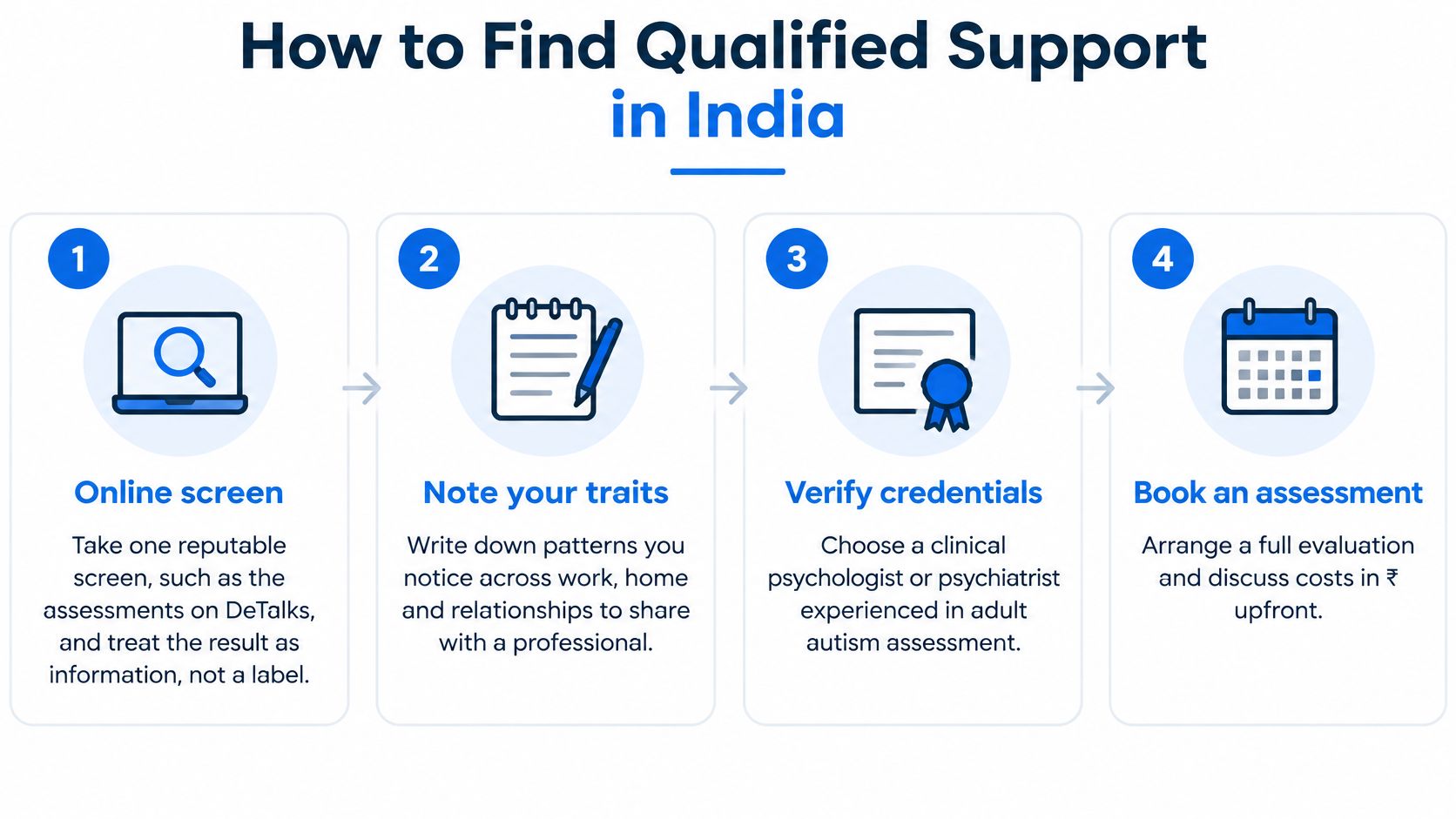
1. Take one reputable screen. Choose a science-backed assessment rather than a social media checklist, and treat the result as information, not a label.
2. Write down your lifelong examples. Childhood, school, work, relationships, sensory life. Specific memories carry more weight than adjectives, so note the incidents rather than the summary.
3. Look for a clinician with adult autism experience. The DeTalks directory of psychologists and therapists lets you read how a professional describes their approach before you book. Check for recognised clinical or psychiatric qualifications.
4. Prepare for the consultation. Bring your questionnaire score, any school reports or childhood memories, a family account if someone can give one, and a list of current difficulties including workplace stress, anxiety or low mood.
5. Ask direct questions. How many autistic adults have you assessed? How do you account for masking? Which tools do you use? How do you rule out ADHD, trauma or anxiety? What are the fees in rupees, and is tele-consultation available?
6. Work around scarcity. If specialists are scarce locally, ask about tele-assessment, request an assessment in your own language, and use counselling in the meantime for anxiety, depression or burnout. Waiting for a diagnostic appointment isn't a reason to wait for support.
| Professional | What they do | When to approach them |
|---|---|---|
| Clinical psychologist | Conducts detailed assessment using interviews, developmental history and standardised tools; distinguishes autism from anxiety, depression, ADHD or trauma | When a screen is positive or your questions persist |
| Psychiatrist | Provides medical evaluation, diagnosis and treatment for co-occurring anxiety, depression, sleep problems or burnout | When distress, mood symptoms or workplace stress feel overwhelming |
| Therapist or counsellor | Offers ongoing therapy for well-being, resilience, relationships and daily coping strategies | After assessment, or while you wait, whatever the outcome |
A well-chosen professional makes the whole process respectful, confidential and clear about what happens next. Ask about the fee and the number of sessions upfront, and walk away from anyone who promises a cure.
Your Next Step Toward Clarity and Support
Four things are worth carrying out of all this.
A score is a question, not an identity. An online result tells you which patterns to describe to a clinician. It doesn't tell you who you are, and it can't close the matter either way.
Understanding your needs helps regardless of the label. Sensory care, communication preferences, recovery time and workplace adjustments improve daily life whether or not autism turns out to be the frame.
Therapy and counselling have value while you wait. Anxiety, depression and burnout respond to support. You don't need a diagnosis to be allowed relief.
Resilience is built in company. Understanding workplaces, honest friendships and a community that doesn't require performance all make the difficult days more bearable.
The single most useful next step is small and specific: take one confidential screening assessment, write down your lifelong examples while the memories are fresh, and book a session with a qualified professional to talk them through. That's the whole pathway, and it's available now.
Seeking clarity is an act of self-respect. Support exists at every stage of it, with no promises of a cure, only steady companionship toward a steadier life.
DeTalks brings together a directory of psychologists, therapists and psychiatrists with a library of confidential, science-backed assessments, so you can move from a screening score to a real conversation with a qualified professional. If the late-night searching in this article sounds familiar, start with an assessment and one booked session instead of another open tab. Visit DeTalks to explore the assessments and find a clinician who understands adult autism.
Leave a Reply