Tag: mental well-being

  • Yoga for Stress Relief and Anxiety: Find Your Calm

    Yoga for Stress Relief and Anxiety: Find Your Calm

    Yoga is an ancient Indian practice that weaves together physical postures, deliberate breathing, and mindfulness. It is designed to soothe the nervous system, lower stress hormones, and guide both mind and body into a state of deep relaxation. When you practise consistently, you're not just moving your body—you're building resilience and nurturing your overall well-being.

    Finding Calm in a Chaotic World

    Does it ever feel like you're being pulled in a million directions at once? You’re not alone. The constant hum of modern life, from demanding workplace stress in our bustling cities to the pressure of academic deadlines, can easily lead to burnout, anxiety, and a persistent feeling of being on edge.

    It's no wonder so many of us are looking for real, sustainable ways to find balance. This is where the gentle, yet powerful, practice of yoga comes in. This guide is your starting point for using yoga for stress relief and anxiety, showing you how to create a lasting harmony between your mind and body.

    A Practical Toolkit for Your Mind

    Think of yoga less as a quest for the perfect pose and more as a personal toolkit for building emotional strength. It’s about taking small, manageable steps to handle daily stressors and reclaim your sense of peace.

    Yoga gently nudges you to shift your focus inward, offering a sanctuary from external noise. By tuning into your breath and the sensations in your body, you can interrupt the cycle of anxious thoughts. This mindful awareness is key to managing feelings of anxiety and heading off burnout before it takes hold. The skills you learn on the mat—like focused breathing and body awareness—are tools you can use anytime to ground yourself.

    Yoga teaches us to cure what need not be endured and endure what cannot be cured. It’s a profound practice of self-compassion and acceptance, essential for genuine well-being.

    More Than Just Poses

    While our focus here is on yoga, other therapeutic practices can be a wonderful part of your mental health journey. Many methods share a common purpose: to activate the body’s natural relaxation response. For example, learning how Swedish massage therapy helps reduce anxiety and stress shows another way to achieve physical and mental release.

    Ultimately, whether it's through yoga, therapy, or other wellness practices, the journey is about discovering what works for you. It's a path toward understanding yourself better, building lasting resilience, and finding healthy ways to navigate life's challenges.

    How Yoga Rewires Your Brain for Calmness

    Have you ever stepped off your mat after a yoga session and felt a wave of peace wash over you? That feeling isn't just your imagination. It’s a real, tangible shift happening inside your brain.

    Your yoga practice is a direct line of communication to your nervous system, coaxing it out of high alert and into deep calm. It’s a powerful transition from the "fight-or-flight" mode to the "rest-and-digest" response.

    When we’re bogged down by workplace stress or caught in a loop of anxiety, our body is constantly braced for a threat. Yoga, through its blend of mindful movement and conscious breathing, sends a clear signal that it’s safe to stand down. This helps lower stress hormones like cortisol and brings a sense of ease to your entire system.

    As this infographic shows, the pressures of modern life are a significant challenge for many.

    Infographic showing modern life stress factors: demanding jobs (75%), city life (60%), academic stress (50%).

    These stressors are a daily reality for so many of us. This is why finding effective tools to build our resilience is vital for our long-term well-being.

    The Science of Calm Brainwaves

    Beyond just calming hormones, yoga physically changes your brain's electrical patterns. Our brains operate on different frequencies, or waves, each tied to a specific state of mind. Beta waves are linked to active thought and can go into overdrive when we feel anxious, while alpha and delta waves are hallmarks of relaxed focus and deep rest.

    A comprehensive 2026 review, which included research from leading Indian institutions like AIIMS Delhi and NIMHANS Bengaluru, found that specific yoga practices produce remarkable changes. After just one session of practices like Sudarshan Kriya and Bhramari pranayama, participants showed:

    • A 19.31% increase in deep relaxation (delta) waves.
    • A 15.40% boost in calm, reflective (alpha) waves.

    Another compelling Indian study revealed that six weeks of regular Hatha yoga led to a 42% drop in perceived stress and a 25% increase in activity in the prefrontal cortex—the part of our brain responsible for emotional regulation. You can discover the full research on yoga's neurological benefits to see the evidence for yourself.

    This is the rewiring process that builds lasting resilience against not just anxiety, but also feelings of depression. It's a gradual strengthening of your mind's innate ability to find its centre.

    Building Resilience One Breath at a Time

    Every time you intentionally slow your breath or hold a pose with awareness, you’re strengthening the neural pathways that lead to calm. This is the foundation of emotional resilience.

    Think of it like training a muscle. The more you practise activating your body’s relaxation response on the mat, the more readily you’ll be able to access it when faced with a stressful situation off the mat.

    This consistency is what profoundly shifts your mental well-being. You move from being reactive to life's challenges to becoming more centred and proactive. Instead of getting swept away by a wave of anxiety, you develop the capacity to notice the feeling without letting it overwhelm you.

    The goal isn't to eliminate stress entirely—that's impossible. The goal is to change our relationship with it, transforming it from a source of distress into an opportunity for growth and self-compassion.

    This change in perspective is a cornerstone of positive psychology. It helps you cultivate not just a calmer mind, but also a deeper sense of happiness and purpose in your life.

    The Role of Professional Guidance

    While the evidence for yoga’s benefits is strong, it’s crucial to see it as a powerful self-care practice, not a substitute for professional mental health support. Any assessments you might find are purely informational; they aren't a diagnosis. Their purpose is to offer you insights to better understand what you’re experiencing.

    If you’re navigating persistent anxiety or depression, combining a consistent yoga practice with therapy or counselling can create a powerful synergy. A therapist offers strategies tailored specifically to you, building a complete support system for your mental health.

    Consider yoga and therapy as partners on your journey towards greater well-being. Each one strengthens the other, helping you build a more resilient and peaceful life.

    Gentle Poses for Immediate Stress Relief

    A woman in neutral activewear rests in Child's Pose on a yoga mat with a towel in a sunlit room.

    When stress or anxiety creeps in, a few simple movements can be a lifesaver. Gentle yoga poses, or asanas, help release physical tension, quiet a racing mind, and bring you back to the present moment. This isn't about achieving a perfect posture; it's about treating your body with compassion.

    The magic of these poses lies in their simplicity and their almost immediate effect on your nervous system. By gently stretching and focusing on your breath, you send a clear signal to your body that it’s safe to relax. It’s a foundational practice for building resilience and nurturing your well-being.

    Grounding With Child’s Pose (Balasana)

    There’s a reason Child’s Pose is a go-to resting posture—it feels like a gentle, comforting hug for your entire being. It creates a sense of safety and encourages you to turn your focus inward, muffling the noise of the outside world.

    Finding your way into this pose is easy. Start on your hands and knees, bring your big toes together, and sit your hips back towards your heels. From there, fold forward and let your forehead rest on the mat. You can stretch your arms out long in front of you or let them relax by your sides.

    This pose offers a gentle stretch for the hips, thighs, and lower back—common areas where we store tension from workplace stress. As you settle in, focus on your breathing. Feel your back expand with every inhale and imagine tightness melting away with every exhale. It’s an incredibly grounding pose for moments of overwhelm.

    Flowing Through Cat-Cow (Marjaryasana-Bitilasana)

    Think of this as a moving meditation. The Cat-Cow flow connects your breath directly to the movement of your spine, a superhighway for your nervous system. It’s perfect for easing stiffness and cultivating a sense of calm fluidity.

    Begin on all fours, with your wrists under your shoulders and your knees under your hips. On your inhale, let your belly drop as you lift your chest and gaze forward into Cow Pose. As you exhale, round your spine up and tuck your chin to your chest into Cat Pose.

    Let your breath guide you as you flow between the two. This simple sequence warms up the spine and helps to synchronise your mind and body—a core benefit of yoga for stress relief and anxiety. You can find more specific yoga poses for reduced stress that can offer quick relief.

    Remember, the goal isn't to force a deep stretch but to move with your breath. Let the rhythm calm your mind and release the physical knots tied by anxiety.

    The Ultimate Restorative Pose: Legs-Up-The-Wall (Viparita Karani)

    If there is one pose for pure, effortless restoration, this is it. Legs-Up-The-Wall is a passive, gentle inversion that requires almost no effort but delivers huge benefits. It’s incredibly effective for calming the mind, soothing tired legs, and easing symptoms of anxiety and even mild depression.

    To set yourself up, sit on the floor with one hip right up against a wall. From there, swing your legs up the wall as you lie back onto the floor. Scoot your sitting bones as close to the wall as feels comfortable.

    Rest here for 5 to 15 minutes. Let your arms relax by your sides, palms facing up, and just breathe. This position helps slow the heart rate and triggers the body's natural relaxation response. It's the perfect way to decompress after a long day.

    Key Benefits of Gentle Poses:

    • Release Physical Tension: Poses like Child’s Pose and Cat-Cow directly target tension in the back, neck, and shoulders.
    • Soothe the Nervous System: Gentle inversions like Legs-Up-The-Wall activate the parasympathetic nervous system, shifting you into a state of "rest and digest."
    • Improve Mindfulness: By focusing on physical sensations, you create a welcome distraction from the loop of anxious thoughts.
    • Support Emotional Regulation: A consistent practice strengthens the mind-body connection, helping you build resilience against daily stressors.

    These poses are small acts of self-care, offering a safe space to acknowledge feelings of anxiety without judgement. While powerful tools for support, they are not a substitute for professional therapy or counselling. They are allies on your journey toward greater mental well-being and happiness.

    Using Your Breath to Tame Anxiety

    A young Asian woman meditating in a comfortable yoga pose on a mat in a sunlit room.

    When a wave of anxiety hits, your breath is your most powerful anchor. Unlike poses that need a mat, your breath is always with you. In yoga, we call this conscious breath regulation pranayama, and it's a cornerstone for managing stress and boosting mental well-being.

    The connection between your breathing and your emotions is direct. When you get anxious, your breath becomes quick and shallow. By deliberately slowing and deepening your breath, you can flip that switch, telling your body it's safe to relax for an almost immediate sense of calm.

    The Foundation: Three-Part Breath (Dirga Pranayama)

    This is the perfect place to start with breathwork. It teaches you to use your full lung capacity—something we rarely do when dealing with constant workplace stress. This deep breathing is profoundly soothing for the nervous system.

    You can do this lying down or sitting up straight. Place one hand on your belly and the other on your chest. As you breathe in slowly through your nose, first expand your belly, then feel your ribs widen, and finally let your chest rise.

    As you breathe out, release the air in the opposite order: chest falls, ribs draw in, and belly contracts. This simple cycle grounds you firmly in your body, pulling your focus away from anxious thoughts. It’s a beautiful exercise in mindfulness and self-compassion.

    Quieting the Noise with Bee Breath (Bhramari Pranayama)

    Ever feel like your mind is buzzing with worries you can't shut off? Bhramari Pranayama, or Bee Breath, is a unique way to create internal quiet. The gentle humming sound vibrates through your skull, calming the brain and muffling the inner chatter that fuels anxiety.

    Find a comfortable seat, close your eyes, and gently press your index fingers on the cartilage to close off your ears. Take a deep breath in. As you exhale, create a low, steady humming sound, like a bee, for the entire length of your breath.

    The vibration is surprisingly soothing. It helps release tension in your jaw and forehead and can even help lower blood pressure. This is a brilliant practice before a big meeting or to unwind before bed.

    Your breath is a bridge. It connects your mind to your body, your thoughts to your feelings, and your inner world to the present moment. By learning to cross this bridge with intention, you build lasting resilience.

    Finding Balance with Alternate Nostril Breathing (Nadi Shodhana)

    This classic pranayama technique is famous for balancing the left and right hemispheres of the brain, leading to greater mental clarity. It’s my go-to practice when feeling scattered or overwhelmed. It works wonders not just for anxiety, but also for the low moods that can accompany depression.

    Here’s a simple way to practice it:

    • Get Settled: Sit comfortably with a tall spine. Let your left hand rest on your left knee.
    • Prepare Your Right Hand: On your right hand, fold your index and middle fingers down. You’ll use your thumb and ring finger.
    • Start the Cycle: Gently close your right nostril with your thumb. Breathe out completely through your left nostril, then breathe in slowly through that same left side.
    • Switch Over: Close your left nostril with your ring finger as you release your thumb from the right. Now, breathe out slowly through the right nostril, and then breathe back in through the right.
    • Keep It Going: Close the right nostril again and exhale through the left. That’s one full round. Continue for 5-10 rounds, letting the rhythm soothe you.

    This rhythmic pattern helps to harmonise your body’s energy and cultivate calm focus. While these breathing exercises are fantastic tools for self-support, they aren't a substitute for professional guidance. If persistent anxiety is impacting your life, seeking support through therapy or counselling is a sign of strength.

    Creating a Sustainable Yoga Practice

    A calming home yoga setup with mats, towels, a book, and tea by a sunlit window.

    The real benefits of yoga for stress relief and anxiety build up over time, through gentle, consistent practice. This is how yoga becomes a reliable tool for your mental well-being, helping you build the resilience to handle life’s challenges with more calm.

    Getting started can feel difficult, especially when you’re already overwhelmed. The secret is to make it fit your life. Short, simple routines you can stick with are far more powerful than long sessions you never get around to doing.

    Carving Out Your Calm Corner

    Before you think about poses, find a space to practise. This doesn’t have to be a whole room—even a quiet corner will do. Clearing away clutter can signal to your brain that it’s time to switch off and focus inward.

    Make it a place you want to be. You could add a soft cushion, a favourite blanket, or a small plant. The idea is to create an inviting nook that pulls you towards your mat, making it easier to build a positive habit.

    Routines That Fit Your Real Life

    We've put together a few sample routines based on the practices you've learned. Think of these as flexible templates to help you manage everything from workplace stress to nagging anxiety with a dose of self-compassion.

    These three sample routines are designed to fit different schedules and give you a starting point for managing stress.

    Yoga for Stress Relief Sample Routines

    Routine (Duration) Focus Sample Poses & Breathing Best For
    The 5-Minute Reset Grounding and Recentring 1 min Three-Part Breath, 2 mins Cat-Cow, 2 mins Child's Pose A quick break at your desk or whenever tension starts to build.
    The 15-Minute Morning Calm Energising the Body & Calming the Mind 5 mins Alternate Nostril Breathing, 5 mins gentle Cat-Cow flows, 5 mins Legs-Up-The-Wall Starting your day with focus and intention instead of rushing.
    The 30-Minute Evening Unwind Deep Relaxation & Releasing Tension 10 mins Cat-Cow & Child's Pose, 10 mins Legs-Up-The-Wall, 10 mins Savasana (with Bee Breath) Letting go of the day to prepare your body and mind for restorative sleep.

    The routines in this table are simply suggestions. The most effective yoga practice is the one you actually show up for.

    Don’t be afraid to mix and match. Listen to your body and choose what feels right for you on any given day. Cultivating a practice rooted in self-compassion is the ultimate goal.

    How to Keep Showing Up

    Motivation is rarely constant; it comes and goes, and that’s okay. Some days, just doing five minutes of deep breathing is a huge win. Other days, you might feel ready for a longer practice. The key isn't perfection; it's persistence.

    Try to notice the small shifts. Do you feel a little calmer after you finish? Is your breathing a bit slower? Acknowledging these subtle changes can be incredibly motivating.

    This journey is a supportive practice, not a cure for anxiety or depression. It works best alongside a complete mental health strategy, which may include professional support like therapy or counselling. If you feel you need more support, connecting with a professional can make all the difference.

    When to Seek Professional Support

    I believe in the power of yoga for stress relief and anxiety. It’s a fantastic way to connect with your body and cultivate inner calm. But it's also important to be honest about its role: yoga is a supportive practice, not a cure-all.

    Think of it as a valuable part of your well-being toolkit, but not a replacement for professional mental healthcare. Knowing when to reach for a different tool is a true act of self-care and compassion.

    Sometimes, no matter how dedicated we are, feelings of anxiety or depression can stick around. If you feel the challenges are becoming overwhelming, it might be time to speak with a professional. Taking that step is a sign of incredible strength.

    How Yoga and Therapy Can Work Together

    Yoga and therapy aren't an either-or choice; they work brilliantly together. While yoga helps you regulate your nervous system and stay grounded, a therapist offers a safe space to unpack your thoughts and learn structured coping strategies.

    This two-pronged approach can make a huge difference. You're working on your mental health from the inside out and the outside in, building a much deeper resilience.

    Research backs this up. A 2020 study looking at stress in urban India found that a consistent Kundalini yoga practice helped 54% of participants achieve remission from anxiety. When compared with a professional approach like Cognitive Behavioural Therapy (CBT), the remission rate was 71%. This shows that while yoga is powerful, expert guidance can provide a more direct path to feeling better. You can explore the complete study findings on yoga and anxiety here.

    Signs It Might Be Time to Reach Out

    It’s not always easy to know when "bad days" have turned into something more. Here are a few things to look out for that might signal it's time to get support for anxiety, depression, or even intense workplace stress:

    • Feelings of sadness, worry, or emptiness have been present for several weeks and impact your day-to-day life.
    • You've lost interest in hobbies or activities you used to love.
    • You feel irritable, on edge, or find it hard to control your emotions.
    • Your sleep has been seriously disrupted, or your appetite has changed significantly.

    Reaching out for help is not a sign of weakness; it is an act of courage. It means you are taking ownership of your well-being and are ready to invest in your long-term happiness.

    Making that first call can feel daunting, which is why platforms like DeTalks exist. We're here to help you find qualified and vetted psychologists across India. We also offer confidential, informational assessments that can give you a clearer picture of what you're experiencing. These aren't a diagnosis, but they can be an empowering first step on your journey.

    Common Questions About Yoga for Mental Health

    As you think about trying yoga for stress relief and anxiety, it’s normal to have questions. Stepping onto the mat for the first time can feel a little intimidating. Getting some answers can give you the confidence you need to begin.

    One of the biggest hurdles people create for themselves is the flexibility myth. Let me be clear: you do not need to be able to touch your toes to do yoga. The real aim is to connect with your body through breath and movement, showing yourself some much-needed compassion.

    How Often Should I Practise?

    This is a question I get all the time. While a daily practice sounds ideal, it’s not always realistic. The best yoga routine is the one you’ll actually do.

    My advice is to start small. Even 10-15 minutes, three times a week, can have a powerful effect on your mental well-being. Consistency is what truly builds resilience against workplace stress and daily anxiety, not the pressure to be perfect from day one.

    Is Yoga a Replacement for Therapy?

    This is a really important point. Yoga is an incredible tool for managing your mental health, but it’s not a substitute for professional support. It's best to think of it as a powerful partner working alongside treatments like counselling or therapy.

    Yoga gives you a way to calm your nervous system in the heat of the moment. Therapy, on the other hand, helps you reframe the thought patterns that fuel anxiety and depression. When used together, they create a comprehensive approach to finding lasting happiness.

    These practices are here to support you on your journey, not act as a cure. Any assessments you might find online are for informational purposes only and should never be considered a diagnosis.


    If you feel that you need more structured support, DeTalks is here to help. We make it simple to connect with a qualified therapist or take a confidential assessment to better understand what you're going through. You can take the next step by visiting us at https://detalks.com.

  • 12 Best Self Esteem Quizzes to Understand Yourself Better

    12 Best Self Esteem Quizzes to Understand Yourself Better

    Understanding your self-esteem is a key part of your overall well-being. It affects how you see yourself, your relationships, and how you manage challenges like stress and anxiety.

    Taking a moment for self-reflection can be a powerful first step toward self-awareness. That’s why we’ve gathered a list of the best online self esteem quizzes to help you check in with yourself.

    This guide will explore 12 carefully selected quizzes, from the respected Rosenberg Self-Esteem Scale to others focused on building resilience. For each quiz, we will share what it’s for, how long it takes, and what to keep in mind.

    It's important to clarify: these assessments are informational, not diagnostic. They offer helpful insights for personal growth but don't replace professional mental health support for issues like anxiety or depression. Other tools, like the Wheel of Life tool, can also offer a broader view of your well-being.

    1. Rosenberg Self-Esteem Scale (RSES) – Open Source Psychometrics Project

    For a quick, research-backed look at your overall self-worth, the Rosenberg Self-Esteem Scale (RSES) is a classic starting point. This version is a straightforward and respected self-esteem quiz that is free and takes only about two minutes to complete.

    An image showing the Rosenberg Self-Esteem Scale quiz interface on the Open Source Psychometrics Project website, with a question and multiple-choice answers.

    This scale is known for its directness and academic credibility. It gives you a single score reflecting your general feelings about yourself, helping you build a foundation for resilience and self-compassion.

    Key Details

    Feature Details
    Purpose To quickly measure global self-esteem using a widely recognised psychological tool.
    Time to Complete Approximately 2 minutes.
    Cost & Access Completely free; no registration required.
    Who It's Best For Anyone seeking a fast, scientifically grounded check-in on their overall sense of self-worth.
    Important Note The feedback is brief and not personalised. It’s an informational tool, not a diagnostic one for anxiety or depression.

    This quiz is ideal for a reliable benchmark. However, its main limitation is its lack of detailed advice; it's a starting point for reflection, not a treatment plan.

    Website: Rosenberg Self-Esteem Scale

    2. Psychology Today – Self‑Esteem Test

    The self-esteem screener from Psychology Today is an excellent, user-friendly choice for a quick check-in. It offers a 20-item questionnaire that feels approachable for anyone exploring their personal growth and well-being.

    A woman smiling while using a laptop, representing a positive experience with the Psychology Today Self‑Esteem Test.

    This test stands out by connecting you to a rich library of mental health articles. After your quiz, you can easily find articles on topics like resilience, anxiety, or the benefits of counselling.

    Key Details

    Feature Details
    Purpose To provide a general audience with an accessible, quick screener for self-esteem with links to further reading.
    Time to Complete Approximately 3-4 minutes.
    Cost & Access Free to take; no registration is needed to view the score and a brief report.
    Who It's Best For Individuals new to self-assessment or those looking for a simple quiz connected to a wider library of resources.
    Important Note This is an informational screener, not a formal diagnostic tool. The analysis is limited in depth.

    This test is ideal for a straightforward evaluation with easy access to more information. While the results lack deep, personalised advice, it’s a great starting point for reflection.

    Website: Psychology Today Self-Esteem Test

    3. PsychTests by Queendom – Self‑Esteem Test

    For a more detailed analysis, the Self-Esteem Test from PsychTests by Queendom is an excellent option. This in-depth questionnaire explores multiple sides of your self-esteem, giving you a richer picture of your self-perception.

    A screenshot of the PsychTests by Queendom Self-Esteem Test, showing a question with a scale for answers.

    What makes this one of the more insightful self esteem quizzes is its two-part results. You get a free "Snapshot" report, with an option to purchase a full, detailed report that includes personalised advice for happiness and well-being.

    Key Details

    Feature Details
    Purpose To provide a detailed, multi-faceted analysis of self-esteem with both free summary and paid in-depth reporting options.
    Time to Complete Approximately 15-20 minutes.
    Cost & Access Free for a snapshot report; a fee applies for the full, detailed analysis. Registration is optional but allows saving results.
    Who It's Best For Individuals wanting a comprehensive look at their self-esteem, complete with subscale scores and structured feedback.
    Important Note The most actionable insights are part of the paid report. The test is informational and is not a substitute for professional therapy.

    This test is ideal if you’re ready for more than just a score and want to understand the different parts of your self-worth. The main downside is that the most detailed results are behind a paywall.

    Website: PsychTests Self-Esteem Test

    4. Project Implicit – Self‑Esteem IAT (Implicit Association Test)

    For those curious about self-esteem beyond conscious thought, the Self-Esteem Implicit Association Test (IAT) offers a fascinating look. This test measures the automatic, subconscious connections you have between yourself and positive or negative ideas.

    An image showing the Project Implicit Self-Esteem IAT interface, with instructions for a sorting task.

    The IAT is different from standard self-esteem quizzes because it measures reaction times, revealing automatic mental links. This can be a powerful tool for self-reflection, showing how your gut-level feelings might differ from what you consciously believe.

    Key Details

    Feature Details
    Purpose To measure implicit (automatic, subconscious) self-esteem through a reaction-time-based task.
    Time to Complete Approximately 10 minutes.
    Cost & Access Completely free; guest access is available without registration.
    Who It's Best For Individuals interested in psychology and exploring the unconscious aspects of their self-concept.
    Important Note The results are for educational purposes only and are not a clinical diagnosis. It's best taken on a laptop or desktop.

    This test is ideal if you want to explore the psychological underpinnings of your self-worth. However, it's abstract and doesn't offer practical steps for managing challenges like low self-esteem or anxiety.

    Website: Project Implicit – Take a Test

    5. IDRlabs – Self-Esteem (Self-Concept) Test

    For a more detailed look into your self-concept, the IDRlabs Self-Esteem Test provides a slightly deeper dive than a simple screener. This quiz is based on a respected psychological tool and takes under five minutes to complete.

    This test stands out by offering a more nuanced view of how you see and value yourself. It delivers instant, visually organized results that break down your self-concept, providing a fuller picture than a single score.

    Key Details

    Feature Details
    Purpose To measure different aspects of self-concept based on a recognised psychological instrument.
    Time to Complete Approximately 3-5 minutes.
    Cost & Access Completely free; no registration needed.
    Who It's Best For Individuals curious about a multi-faceted view of their self-perception, beyond a single self-esteem score.
    Important Note The results are for informational purposes and are not a substitute for a professional diagnosis of anxiety or depression.

    This quiz is an excellent choice for a user-friendly experience with more granular insights. It’s a good starting point for self-reflection but lacks the personalised guidance for building resilience that professional counselling can offer.

    Website: IDRlabs Self-Esteem Test

    6. Psych Central – Self‑Esteem Test

    Psych Central offers a short, medically reviewed self-esteem quiz that is an excellent entry point for personal reflection. This 18-question test uses clear, accessible language to help you think about your feelings of self-worth and well-being.

    Psych Central – Self‑Esteem Test

    What makes this quiz stand out is its gentle and informative approach. The results are presented with readable explanations that encourage self-compassion and suggest seeking professional support, such as therapy, if needed.

    Key Details

    Feature Details
    Purpose To encourage self-reflection on self-esteem with medically reviewed content and guide users toward next steps.
    Time to Complete Approximately 3-4 minutes.
    Cost & Access Completely free; no registration required, though email sign-up for more resources may be offered.
    Who It's Best For Individuals looking for a simple, context-rich quiz that connects results to broader mental health information.
    Important Note This is not a formal diagnostic scale. Its primary value is educational and to encourage further self-exploration.

    This test is ideal if you appreciate a quiz that is part of a larger, credible mental health resource library. It’s a great starting point for initial insights combined with supportive, actionable guidance.

    Website: Psych Central – Self‑Esteem Test

    7. Nemours KidsHealth – “How’s Your Self‑Esteem?” (Teens)

    Designed for adolescents, this quiz from Nemours KidsHealth offers a safe space for teens to reflect on their self-perception. It uses relatable language to explore topics like self-talk, social comparison, and resilience in an age-appropriate way.

    Nemours KidsHealth – “How’s Your Self‑Esteem?” (Teens)

    This quiz is unique because it guides users to a library of articles on confidence, body image, and dealing with setbacks. This approach provides immediate, constructive content to help teens understand their feelings and build happiness.

    Key Details

    Feature Details
    Purpose To provide a teen-focused, educational tool for reflecting on self-esteem with links to supportive articles.
    Time to Complete Approximately 3 minutes.
    Cost & Access Completely free; no registration required. Printable materials are available for educators.
    Who It's Best For Teens, parents, and educators seeking a reliable, non-clinical starting point for discussions on self-worth.
    Important Note This is a reflective, educational quiz, not a psychological assessment. It does not provide a score or diagnosis.

    The main strength of this quiz is its trusted, educational framing. It doesn't produce a score but instead encourages self-reflection, making it a supportive learning tool rather than a measurement instrument.

    Website: Nemours KidsHealth Self-Esteem Quiz

    8. Mind Tools – Self‑Confidence Quick Quiz

    For professionals looking to connect self-worth to career performance, the Mind Tools Self-Confidence Quick Quiz offers a practical, workplace-focused view. It frames questions around professional assertiveness, decision-making, and goal achievement.

    Mind Tools – Self‑Confidence Quick Quiz

    This quiz stands out by focusing on actionable self-confidence in a work setting. After the quiz, users receive feedback and specific tips for managing workplace stress, building resilience, and improving job effectiveness.

    Key Details

    Feature Details
    Purpose To assess self-confidence in a professional context and provide actionable tips for career development.
    Time to Complete Approximately 5-7 minutes.
    Cost & Access The quiz can be purchased as a one-off downloadable product or accessed for free with a Mind Tools Club membership.
    Who It's Best For Working professionals, team leaders, and HR managers seeking a tool for personal or team development workshops.
    Important Note This is a skills-development tool, not a psychological assessment. It measures situational confidence, not clinical anxiety or depression.

    This resource is ideal for individuals who want to translate feelings of self-worth into professional gains. It’s a targeted career-coaching exercise rather than a general psychological check-in, helping address issues like burnout.

    Website: Mind Tools Self-Confidence Quick Quiz

    9. Manastha (India) – Self‑Esteem Assessment

    For individuals in India seeking a structured path from assessment to care, Manastha provides a valuable service. This India-based mental health platform offers a self-esteem assessment alongside others on topics like anxiety and workplace stress.

    An image of the Manastha self-esteem assessment landing page, showing a clean interface and an option to start the test.

    Manastha's key feature is its direct integration of self esteem quizzes with professional counselling services. After the assessment, you can book a session with an Indian psychologist, creating a smooth journey from insight to support.

    Key Details

    Feature Details
    Purpose To assess self-esteem and provide a direct pathway to professional counselling services within India.
    Time to Complete Approximately 8 minutes.
    Cost & Access This is a paid assessment; you must purchase it on their website to access the questions and report.
    Who It's Best For Users in India who want an assessment that is directly connected to regional therapy and counselling options.
    Important Note The assessment's underlying scale is not detailed publicly. Its main function is as a paid gateway to the platform’s services.

    This platform is a practical choice if your goal is not just to take a test but to find professional help in India. It is less of a free informational tool and more of an entry point into a paid mental well-being and therapy ecosystem.

    Website: Manastha Self‑Esteem Assessment

    10. Mind.Help (India) – Self‑Esteem Test

    Mind.Help, an India-based mental health platform, provides a free self-esteem quiz for a quick self-check. This tool combines a brief screening with relevant, localized educational content, making it useful for those in an India-first context.

    Mind.Help (India) – Self‑Esteem Test interface showing a question and response options.

    This platform stands out by putting the quiz within a broader context of mental well-being. After your score, the site guides you to articles on topics like building resilience and understanding low self-esteem.

    Key Details

    Feature Details
    Purpose To offer a quick self-esteem screening supported by contextual educational articles and next steps.
    Time to Complete Approximately 3-4 minutes.
    Cost & Access Completely free; no registration required.
    Who It's Best For Indian users or anyone seeking a fast self-assessment with immediate access to related mental health information.
    Important Note This is a screening tool, not a formal diagnostic instrument. The feedback is general and not a substitute for professional counselling.

    This test is excellent for accessibility and provides helpful guidance. It serves best as an initial step to increase self-awareness and explore topics like anxiety or workplace stress, pointing you toward further learning.

    Website: Mind.Help Self‑Esteem Test

    11. Attachment Project – Self‑Esteem Test (RSES‑based)

    For those looking to understand how self-worth connects with relationship patterns, the Attachment Project offers a valuable perspective. It uses the scientifically validated Rosenberg Self-Esteem Scale (RSES) but frames the results within attachment theory.

    A woman sitting thoughtfully by a window, symbolising self-reflection prompted by the Attachment Project's quiz.

    This test stands out by connecting your self-esteem score to your attachment style (e.g., secure, anxious). This approach bridges the gap between a general self-esteem quiz and a more personalized exploration of your well-being.

    Key Details

    Feature Details
    Purpose To measure self-esteem and connect the results to attachment theory for relational insights.
    Time to Complete Approximately 3-4 minutes.
    Cost & Access Free to take; email registration is required to receive the full, detailed report.
    Who It's Best For Individuals curious about how their relationship dynamics and attachment style affect their overall self-worth.
    Important Note The report is educational, not a clinical diagnosis. The site also markets related courses on attachment.

    This is one of the more insightful self esteem quizzes if your goal is to examine how relationships shape your feelings. The main trade-off is the email requirement for the full analysis, which includes marketing.

    Website: Attachment Project – Self-Esteem Test

    12. Coral Ehr – Rosenberg Self‑Esteem Scale (Free Online Assessment)

    For those who appreciate the credibility of the Rosenberg Scale but want more guidance, this version is an excellent choice. It provides the classic 10-item questionnaire in a clean, simple format that is free and requires no sign-up.

    An image of the Coral Ehr website showing the Rosenberg Self-Esteem Scale, with questions and a four-point answer scale.

    What sets this version apart is the immediate context provided with your score. Instead of just a number, you get a clear breakdown into low, average, and high self-esteem bands, with brief tips and potential next steps.

    Key Details

    Feature Details
    Purpose To measure global self-esteem using the RSES and provide clear scoring bands with interpretive context.
    Time to Complete Approximately 2 minutes.
    Cost & Access Completely free; no registration needed.
    Who It's Best For Individuals who want the reliability of the Rosenberg Scale plus extra guidance on understanding their results.
    Important Note The advice is general. While helpful for reflection, it is not a substitute for professional counselling or a diagnostic tool for anxiety or depression.

    This quiz is ideal if you're looking for a reliable benchmark with an added layer of interpretation. It's a helpful first step in understanding your overall sense of self-worth and exploring positive psychology concepts like compassion.

    Website: Coral Ehr – Rosenberg Self‑Esteem Scale

    Comparison of 12 Self‑Esteem Quizzes

    Test Core Features UX & Quality Price / Value Target Audience Unique Selling Point
    Rosenberg Self‑Esteem Scale (Open Psychometrics) ✨ Validated 10‑item RSES; instant score ★★★★ fast, ad‑light (~2 min) 💰 Free 👥 Researchers & quick self‑checkers 🏆 Classic RSES; minimal friction
    Psychology Today – Self‑Esteem Test ✨ 20 plain‑English items; on‑page scoring ★★★★ consumer‑friendly (~3 min) 💰 Free 👥 General public, therapy explorers ✨ Linked resources & guidance
    PsychTests by Queendom – Self‑Esteem ✨ In‑depth with subscales; snapshot + paid report ★★★★ detailed, longer 💰 Free snapshot / Paid full report 👥 Users wanting deep feedback 🏆 Premium graphs & tailored advice
    Project Implicit – Self‑Esteem IAT ✨ Reaction‑time implicit self‑evaluation ★★★ academic; best on desktop 💰 Free 👥 Researchers & introspective users ✨ Measures implicit attitudes
    IDRlabs – Self‑Concept Test ✨ Robson SCQ model; visual results ★★★★ user‑friendly, quick 💰 Free 👥 Casual users seeking nuance ✨ Visual, explanatory presentation
    Psych Central – Self‑Esteem Test ✨ 18 Q, medically reviewed, supportive framing ★★★★ mobile‑friendly, editorial oversight 💰 Free 👥 Readers seeking trusted quick check ✨ Clinically reviewed context
    Nemours KidsHealth – Teens ✨ Teen‑appropriate language; educator materials ★★★★ short, age‑appropriate 💰 Free 👥 Teens, parents, schools 🏆 Pediatric trusted source & resources
    Mind Tools – Self‑Confidence Quick Quiz ✨ Workplace focus; actionable tips ★★★ practical; business‑oriented 💰 Club member or one‑off purchase 👥 Professionals & HR ✨ Actionable workplace improvement tips
    Manastha (India) – Self‑Esteem Assessment ✨ 16 Q; automated report + booking option ★★★ region‑relevant (~8 min) 💰 Paid 👥 Indian users wanting integrated care ✨ Direct link to local therapists
    Mind.Help (India) – Self‑Esteem Test ✨ Fast screening with educational articles ★★★★ free, contextual content 💰 Free 👥 Indian users for quick self‑check ✨ Localized education & next steps
    Attachment Project – RSES‑based ✨ RSES framed by attachment theory; email report ★★★★ narrative report (email required) 💰 Free (email) 👥 People exploring relationship links ✨ Attachment‑focused interpretation
    Coral Ehr – Rosenberg RSES (Practitioner) ✨ RSES with scoring bands & reliability notes ★★★★ informative, no signup 💰 Free 👥 Practitioners & curious users ✨ Reliability notes + next‑step guidance

    From Insight to Action: Your Path Forward

    Taking a moment to explore your inner world with a self-esteem quiz is a courageous first step. These tools offer a valuable snapshot, providing a language for feelings that can be hard to put into words.

    However, the real journey begins now. A score from any of these self esteem quizzes is not a final judgment but a signpost, offering clues about your strengths and where you might need more support.

    Turning Awareness into Meaningful Change

    The insights you've gained are most powerful when they inspire action. The path forward is about building a more resilient, compassionate, and authentic relationship with yourself. Consider these supportive takeaways as you decide what to do with your results.

    If your score suggested low self-esteem, please know your worth is not defined by a number. This score is simply a sign that you may be carrying a heavy burden of self-criticism, which can be linked to challenges like anxiety or depression. This is an ideal time to consider professional support.

    The Role of Professional Support

    You do not have to walk this path alone. Persistent feelings of worthlessness that interfere with your daily life are important signals that it's time to reach out.

    A qualified therapist or counsellor provides a safe, non-judgmental space to explore your feelings. Therapy is a proactive tool for building mental fitness, helping you develop practical skills for lasting self-worth and resilience. Your journey toward stronger self-esteem is yours to define, and every step is a move in the right direction.


    If you've taken one of these self-esteem quizzes and feel ready to turn your insights into lasting change, professional support can be your next step. DeTalks offers confidential online counselling and scientifically-backed assessments to help you understand yourself better and connect with a qualified therapist in India. Explore your options and begin your journey towards greater well-being today at DeTalks.

  • A Guide to Online Counseling Services: Finding Support That Fits You

    A Guide to Online Counseling Services: Finding Support That Fits You

    Starting a conversation about your mental health is a brave and hopeful step. Online counseling services make this easier than ever by bringing confidential, professional support directly to you, using the technology you use every day.

    What Are Online Counseling Services and How Do They Work?

    Think of online counselling as therapy that fits into your life. It’s a private, secure space to talk with a qualified counsellor or therapist through video calls, phone calls, or even text-based chat, all from the comfort of your home.

    This modern approach to mental well-being removes many old barriers, making support more accessible. It’s designed to be a practical and achievable part of your routine, whether you live in a bustling Indian city or a quieter town.

    Infographic showing three online counseling modes: Video, Chat, and Phone, with their key features.

    The best part is you get to choose how you connect. This ensures the experience feels comfortable and right for you, helping you take that important first step toward feeling better.

    To help you decide, here’s a quick comparison of the different ways you can connect. This table can help you figure out which format might be the best fit for your specific needs and comfort level.

    Comparing Different Modes of Online Counselling

    Counseling Mode Best For Key Considerations
    Video Calls Those who prefer a face-to-face connection and can see non-verbal cues. Requires a stable internet connection and a private, quiet space.
    Phone Calls Individuals who feel more comfortable talking without being on camera. Good for privacy but misses the visual cues that can be important in therapy.
    Chat/Messaging People who express themselves better in writing or need more flexibility. Can be asynchronous (non-real-time) but may feel less personal than voice or video.

    Ultimately, there's no single "best" option—only what's best for you. Whether you prefer the personal connection of video, the simplicity of a phone call, or the reflective nature of chat, online counselling offers a path forward.

    A Space for Both Challenges and Growth

    It's a common myth that counselling is only for moments of crisis. While it is a vital support for navigating challenges like anxiety, depression, and workplace stress, it's also a powerful tool for personal growth and building a happier life.

    You can work with a therapist to build greater resilience, practice self-compassion, or find a deeper sense of direction. It's about developing skills to handle life's ups and downs with more confidence and calm.

    The Process Simplified

    Getting started is usually refreshingly simple. Most platforms have a clear process: you find a therapist who feels like a good match, book a time that works for you, and then connect for your session with ease.

    Some people start their journey with a private mental health assessment to better understand their feelings. These can offer valuable insights and direction for your path forward.

    It's important to clarify: an assessment is an informational tool to guide your journey, not a formal diagnosis. Think of it as a compass pointing you toward the right support, not a definitive label.

    Who Can Benefit From Online Counselling?

    Honestly? Anyone. It’s for the student in Mumbai juggling exam pressure, the IT professional in Bengaluru feeling burnout, or the parent in a small town who just needs someone to talk to without judgement.

    Online counselling services are designed to meet you exactly where you are. Taking that first step isn't a sign of weakness; it's a powerful move toward taking control of your well-being and feeling better.

    The Urgent Need for Digital Mental Health Support in India

    Young man on couch having a video call with a female counselor on his smartphone.

    Across India, more people are bravely opening up about their mental health and seeking support. This positive shift also highlights a major challenge: there isn't enough accessible support for everyone who needs it.

    People reach out for many reasons, from the pressure of exams to the quiet toll of workplace stress. These are not abstract problems; they are the real, everyday struggles we all can face at times.

    This rising need reveals what experts call the "treatment gap"—the space between how many people need help and how many can actually get it. This is often due to a shortage of professionals, the cost of traditional therapy, and the difficulty of travel.

    Bridging the Gap With Online Counselling

    This is exactly where online counseling services have become so essential. Using the technology in our pockets, these platforms connect you with a qualified professional, no matter where you are in India.

    The need is clear. Since October 2022, India’s Tele-MANAS helpline has received over 34 lakh calls for issues like low mood, anxiety, and daily stress. This shows how common these feelings are and why supportive platforms are a lifeline. You can see the data in this in-depth report on the rising demand for mental health support.

    Digital mental health support isn’t just a convenience; it’s a necessity. It promises that no matter who you are or where you live, you can find a safe space to talk and be heard.

    From Surviving to Thriving

    While many first seek counselling to cope with difficult times like depression or high stress, the journey is about much more. Online counselling provides practical tools to move from just surviving to truly thriving.

    This isn’t about chasing a vague idea of happiness. It’s about building concrete life skills, such as learning to practice self-compassion, building resilience, and discovering what brings you a sense of joy and purpose.

    This focus on positive psychology empowers you to not only manage hard times but also build a life rich with meaning. It's a compassionate and timely response, making professional guidance a realistic option for everyone working on their mental well-being.

    Common Issues Addressed Through Online Counselling

    Diverse individuals, young to elderly, engage with smartphones in varied home and outdoor environments.

    Many of us wonder, "Is what I'm going through serious enough for therapy?" The truth is, online counselling services are for anyone who wants to understand themselves better and feel more in control of their life.

    Whether you're struggling with a constant sense of unease or just feeling that something isn't right, reaching out is a valid first step. Counselling is a proactive tool for building a more balanced and resilient life.

    Navigating Life's Common Challenges

    Many people first turn to therapy when facing life's normal challenges. Online counselling offers a private, non-judgemental space to work through them with an expert, so you don't have to go through it alone.

    Some common reasons people seek support include:

    • Managing Anxiety and Stress: Learning practical tools to calm a racing mind and cope with the pressures of modern life.
    • Addressing Depression and Low Mood: Working through persistent sadness or a loss of interest in things you once loved. For more information, a guide to online psychiatry for depression can be a helpful resource.
    • Coping with Workplace Stress and Burnout: Developing strategies to manage professional demands and recover from emotional exhaustion.
    • Working Through Grief and Loss: Finding a safe space to process the pain of losing someone or something important to you.
    • Improving Relationships: Understanding communication breakdowns and building healthier connections with partners, family, and friends.

    Your reasons for seeking help are personal and valid. A good therapist will meet you where you are, with warmth and without judgement.

    Beyond Challenges: Cultivating Positive Well-Being

    While therapy is a great resource for tough times, it's just as powerful for personal growth. This side of counselling, often rooted in positive psychology, is less about fixing what's wrong and more about building on what's right.

    Therapy isn't only about what's going wrong; it's also about strengthening what's going right. It’s a space to build inner resources and intentionally create a life you love living.

    Think of it as moving from just getting by to actively thriving. It is a warm and supportive investment in your long-term emotional fitness.

    Building Your Inner Strengths

    Using online counselling for growth can equip you with essential life skills. You might work with a therapist to explore areas like:

    • Building Resilience: Developing the mental and emotional flexibility to bounce back from life's setbacks with grace.
    • Improving Self-Esteem: Learning to quiet your inner critic and build a more compassionate, supportive relationship with yourself.
    • Cultivating Compassion and Gratitude: Practicing kindness toward yourself and others, a practice proven to boost overall well-being.
    • Finding Purpose and Happiness: Aligning your life choices with your core values to create a more authentic and meaningful life.

    Whether you're facing a struggle like anxiety or you're ready to build a more joyful life, online counselling services can help. The goal is not a "cure," but supportive takeaways and tools to help you navigate your own path with greater strength.

    Finding the Right Therapist for You

    Of all the steps you'll take, this one matters most: finding the right person to talk to. The connection you have with your therapist is the foundation of your progress, creating a safe space where real change can begin.

    Think of it as finding a trusted partner for your journey. You need someone with the right skills and an approach that feels right for you. Taking time to find this fit is the most important step.

    Understanding Professional Qualifications

    When you browse online counselling services, you’ll see titles like "counsellor" and "psychologist." In the Indian context, it helps to know the general distinctions.

    • Counsellors often help with specific life challenges like workplace stress, relationship issues, or grief. Their focus is usually on providing practical guidance and building coping strategies.
    • Psychologists typically hold advanced degrees and have training in treating mental health conditions. They use established therapy methods to help with persistent issues like anxiety or depression.

    Ultimately, the professional's qualifications, experience, and your connection with them are what matter most. A good platform will make their credentials clear so you feel confident in your choice.

    Matching Specialisation to Your Needs

    Finding a therapist who specialises in what you need help with can make a huge difference. They will have a deeper understanding and a richer toolkit to support you effectively.

    For example, if you're feeling burnout, a therapist focused on workplace stress is a great choice. A little self-reflection here can guide you toward the right kind of professional support for your counselling journey.

    The therapeutic relationship is a partnership. Your comfort and trust are essential for growth. Give yourself permission to be selective and find someone you truly connect with.

    Questions to Ask a Potential Therapist

    Most online services allow a brief chat before you book a full session. This is your chance to see if their style aligns with your needs. Asking questions shows you are invested in your own well-being.

    Here are a few ideas to get you started:

    1. How do you typically approach helping someone with issues like mine?
    2. What does a typical session with you look like?
    3. How do you help people build skills like resilience?
    4. Could you tell me about your experience with [mention your concern, e.g., anxiety]?
    5. How will we track my progress toward my well-being goals?

    Pay attention to how the conversation makes you feel. Your gut feeling—and their answers—will tell you a lot about what therapy with them would be like. Finding the right fit is a journey, not a race.

    Understanding the Cost and Value of Online Therapy

    It’s completely normal to think about the financial side of getting help. It can be helpful to see online counselling services not as an expense, but as an investment in your long-term well-being—much like you would invest in your education or physical health.

    When we view therapy as an investment, it clicks. You're dedicating resources to build new skills, improve your daily life, and strengthen your emotional health for the future.

    Factors That Influence Session Costs

    The price of an online counselling session can vary. Understanding what influences the cost helps you find a good fit for your budget.

    • Therapist’s Experience and Qualifications: A professional with advanced degrees or years of specialised experience may have higher rates.
    • Session Length and Frequency: Sessions are typically priced by time (usually 45-60 minutes), and your total cost depends on how often you meet.
    • Type of Service: Individual therapy will have a different price than couples or family counselling.

    Knowing these factors helps you balance a therapist's expertise with what feels sustainable for you.

    Why Online Therapy Can Be More Affordable

    While there is a cost, the online format itself often makes professional support more accessible. You save time and money by cutting out the commute to a physical office, and the flexible scheduling means you may not have to take unpaid time off work.

    The India online mental health market is growing rapidly, expected to reach USD 451.73 million by 2033. This growth means more vetted experts and effective tools are becoming available. You can read more about this market expansion and its impact.

    Investing in therapy is an act of self-care that pays lifelong dividends. It's not about the cost of one session, but the immense value of building lasting resilience, clarity, and peace of mind.

    Beyond the Price Tag: The True Value

    The real value of online counselling is in the lasting positive changes it brings. It's an investment in learning how to navigate anxiety, cope with workplace stress, or build healthier relationships.

    The skills you build in therapy—like emotional regulation and personal resilience—become a permanent part of your life toolkit. They empower you to face whatever comes next with more confidence and calm. The goal is supportive guidance, not a promise of a cure.

    What to Expect in Your First Online Session

    Booking your first online counselling session is a huge step forward. It's completely normal to feel a mix of hope and nerves, but knowing what to expect can help you feel more confident.

    Your first meeting is not a test; it's simply a conversation. It's a chance for your therapist to gently get to know you and for you to see if you feel a good connection with them.

    There's no pressure to share everything at once. You are always in control, deciding what to talk about and when you feel ready. The main goal is just to start building a supportive connection.

    Setting Yourself Up for a Smooth First Session

    A little preparation can make a big difference, helping you focus on the conversation instead of distractions. Try these simple tips for your online counselling services session:

    • Find a Private Spot: Choose a quiet room where you won’t be disturbed to create a safe, confidential space.
    • Do a Quick Tech Check: Test your internet, camera, and microphone before your session. Headphones can improve privacy and sound.
    • Keep Water Handy: Having a glass of water nearby gives you a natural pause to collect your thoughts if you need a moment.
    • Jot Down a Few Notes: If you're worried you'll forget what you want to say, scribbling down a few key points can be a helpful reminder.

    This small amount of preparation helps ensure the focus stays right where it belongs: on you.

    What’s the Deal with Initial Assessments?

    Your therapist might ask you to fill out a questionnaire. It's easy to feel like you're being graded, but these are simply informational guides, not diagnostic tests or judgements.

    It's important to clarify: an assessment is an informational tool to guide your journey, not a formal diagnosis. It helps your therapist get a clearer picture of your current well-being so they can support you in a way that truly fits.

    For example, a form may ask about your sleep, work stress, or feelings of anxiety. Your answers provide a helpful snapshot and a solid starting point for you and your therapist. This practice is more common as online therapy has grown in India. Discover more insights about India's shift to online therapy.

    A Courageous Step Forward

    Your first session is about connection. Your therapist will likely ask open-ended questions about what brought you to counselling and what you're hoping for. This is also your chance to ask them questions.

    Remember, just showing up is a brave and powerful act of self-care. The journey won't be a quick fix, but it does offer a supportive path toward greater clarity, resilience, and overall well-being.

    Frequently Asked Questions About Online Counselling

    Laptop on a desk showing a woman on an online video call, with headphones and a mug.

    It’s completely normal to have questions before diving into something new. Taking that first step is a big deal, so let’s clear up some common queries about online therapy with warm, professional clarity.

    Is Online Counselling as Effective as In-Person Therapy?

    This is a very common question, and the answer is yes. For many common issues like anxiety, depression, and workplace stress, research shows that online counselling services are just as effective as meeting a therapist in person.

    Successful therapy depends less on the room you're in and more on the quality of the connection you build with your therapist.

    The real power of therapy comes from the relationship. A strong, trusting bond with your counsellor is what drives progress, whether you’re connecting through a screen or sitting across from each other.

    How Is My Privacy Protected During Online Sessions?

    This is an excellent and important question. Reputable online counselling platforms use robust, end-to-end encryption to ensure your conversations remain completely confidential and secure.

    Think of it this way: the technology protecting your session is similar to what banks use to secure financial information. It creates a private, digital room just for you and your therapist, keeping your personal information safe.

    What if I Don't Connect With My First Therapist?

    It happens, and it's perfectly okay. Finding a professional you click with is a personal journey, and it might take a try or two to find the right fit. This is no one's fault.

    You should never feel obligated to continue with a therapist who doesn't feel right for you. Most online platforms understand this and make it easy to switch to someone new. Your comfort is the top priority, as a trusting therapeutic relationship is essential for making real progress.


    Ready to take the next step on your well-being journey? DeTalks offers a secure platform to connect with vetted professionals and explore confidential assessments. Find the right support for you by visiting https://detalks.com.

  • Unlock Your Potential with Cognitive Behavioral Therapy Online

    Unlock Your Potential with Cognitive Behavioral Therapy Online

    Deciding to focus on your mental well-being is a courageous step, and it’s one worth feeling good about. This guide is here to walk you through cognitive behavioural therapy online—a practical, proven approach for navigating life's challenges. Think of it as a mental toolkit that helps you manage everything from stress and anxiety to building a more resilient and compassionate you.

    Starting Your Path to Well-Being With Online CBT

    Life can often feel demanding, and the constant pressure on our time and energy can be draining. This makes having strong mental health support more important than ever. Whether you're a professional in India navigating burnout, a student facing exams, or just someone aiming for a more balanced life, knowing your options is the first step toward well-being.

    A smiling young man works on a laptop at a bright desk with a plant and tea.

    Why Consider Online Therapy Now?

    The pressures of modern life can leave us feeling stretched thin, and it's completely normal to feel the weight of anxiety or low moods. It's vital to have effective tools to manage these feelings. Online therapy shines by removing many traditional barriers, making professional counselling accessible from your own space, on your own schedule.

    Platforms like DeTalks are designed to connect you with qualified therapists who specialise in CBT, making it simpler to find the right support. Whether you’re in a bustling Indian city or a quieter town, the aim is to provide a professional and welcoming space. Here, you can feel heard and begin building a path toward greater well-being.

    Online CBT isn’t just about managing problems. It’s a proactive way to build self-awareness and inner strength, helping you develop skills for long-term resilience and happiness.

    Building Skills for a Better Life

    At its core, online CBT is a partnership between you and your therapist. It's a structured approach that helps you see the link between your thoughts, feelings, and actions. Once you spot unhelpful patterns, you can learn to reframe them, leading to healthier responses to stress, anxiety, and other challenges.

    This form of counselling gives you tools to:

    • Manage workplace stress and avoid burnout with practical coping strategies.
    • Ease symptoms of anxiety and depression by breaking cycles of unhelpful thoughts.
    • Cultivate resilience so you can bounce back from setbacks with more confidence.
    • Nurture self-compassion and happiness by changing your inner dialogue.

    To enhance your journey, you can also explore complementary practices like mindfulness. Resources for guided meditation scripts can be a great way to center yourself between sessions. This guide will show how online CBT equips you with supportive takeaways for a more fulfilling life.

    Understanding How Cognitive Behavioural Therapy Works

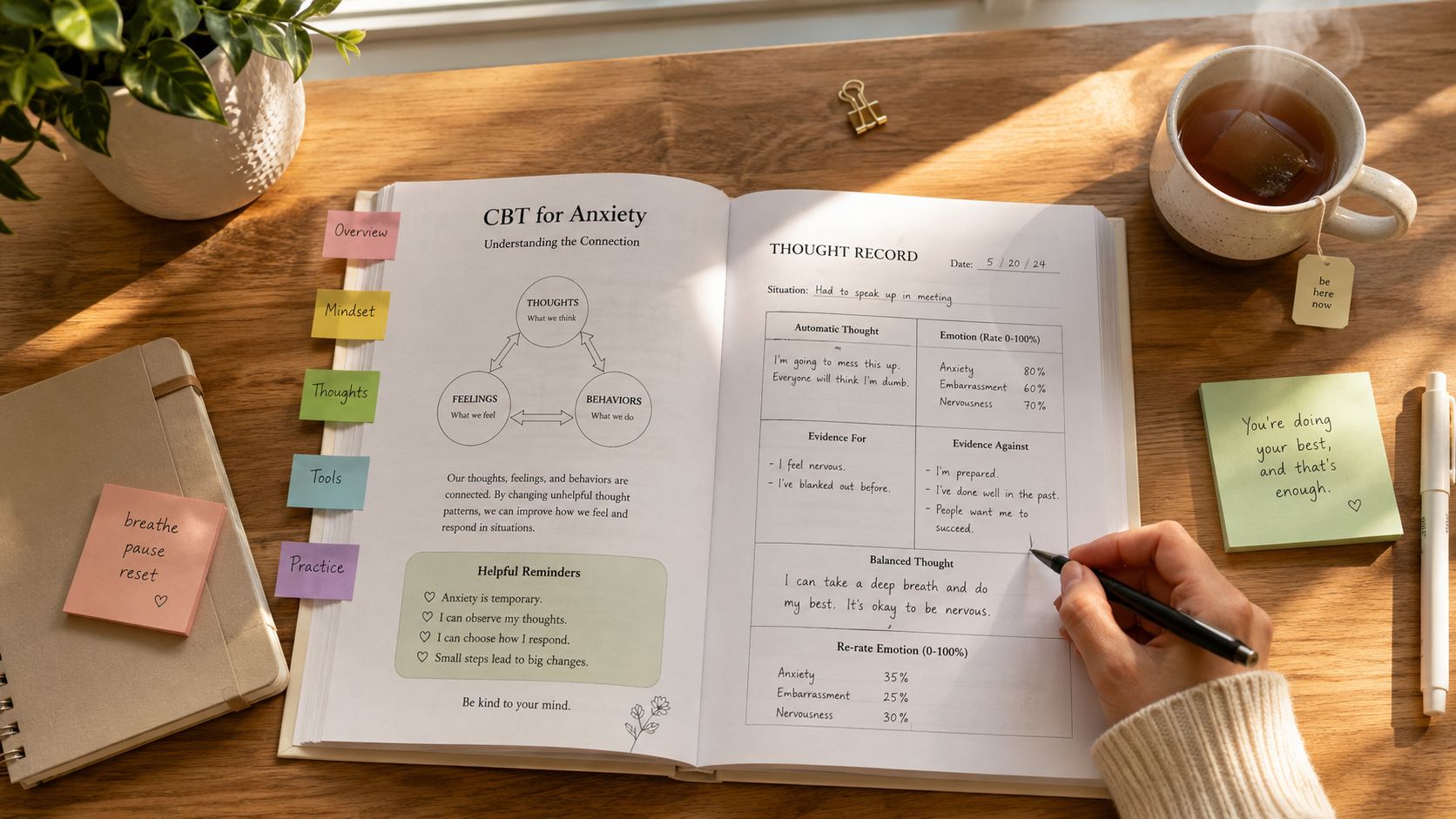
    Think of Cognitive Behavioural Therapy (CBT) as learning to become a curious observer of your own mind. It’s a practical approach that helps you map the connections between your thoughts (the 'cognitive' part), your emotions, and your actions (the 'behavioural' part). CBT is based on a powerful idea: it’s often not events themselves that cause distress, but the meaning we give them.

    This relationship is often shown as the ‘cognitive triangle,’ where thoughts, feelings, and behaviours constantly influence each other. An unhelpful thought can spark a difficult feeling, which then pushes you toward an action that reinforces the original thought. This can create a challenging cycle that feels hard to break.

    Let's take a common work scenario that many people in India and globally can relate to. Imagine you receive some unexpected feedback from your manager.

    • Thought: Your mind might jump to, "I'm a failure. I can't do anything right."
    • Feeling: That thought could trigger feelings of anxiety, shame, or deep sadness.
    • Behaviour: In response, you might avoid your manager or overwork yourself to compensate.

    This kind of spiral is incredibly common, especially in high-pressure environments that contribute to workplace stress. CBT gives you the tools to pause that cycle. By learning to question that first automatic thought, you gain the power to change how you feel and, ultimately, how you react.

    A Collaborative and Goal-Oriented Approach

    One of the most appreciated aspects of CBT is its focus on the present. While your past is important, sessions concentrate on tackling the challenges you're facing right now. It's a true partnership where you are the expert on your life, and the therapist is your guide, offering their knowledge of CBT techniques.

    Together, you'll set clear, achievable goals, whether it's feeling less anxious, managing stress, or building more resilience and self-compassion. The therapy is active and structured, designed to arm you with practical skills you can use immediately. This is why it has become such an effective form of counselling for challenges like anxiety and depression.

    CBT empowers you to become your own therapist. The skills you learn are designed for long-term use, providing a lasting toolkit for well-being and personal growth.

    Learning to Challenge Unhelpful Thinking

    A core part of the CBT process involves identifying what are sometimes called ‘cognitive distortions’ or unhelpful thinking styles. These are mental shortcuts our brains develop over time. They are very common, but they often paint a picture that is negatively skewed and not entirely accurate.

    Some examples include:

    • All-or-Nothing Thinking: Seeing things in extremes. If your performance wasn't perfect, you see it as a complete failure.
    • Catastrophising: Automatically jumping to the worst-possible conclusion. A bit of feedback means, "I'm definitely going to be fired."
    • Overgeneralisation: Taking one negative event and letting it define everything. "I made a mistake, so I must mess everything up."

    A good therapist helps you gently spot these patterns in your own thinking. The goal isn't to force "positive thinking," but to foster a more accurate and compassionate perspective. You'll learn to question these thoughts, look for evidence, and develop more balanced ways of seeing situations.

    This kind of support is more accessible than ever, thanks to telehealth. Across the globe, including India, people are embracing digital solutions for mental health. With 60% of people open to online therapy and 55.5% preferring digital options, there is a clear demand for support like online CBT. You can explore the latest teletherapy statistics to see the full picture.

    Comparing Online CBT and In-Person Therapy

    Deciding between online and in-person therapy is a personal choice, and there's no single right answer. Both online and in-person Cognitive Behavioural Therapy have unique advantages. The goal here is to help you understand the differences so you can make a choice that truly supports your mental well-being journey.

    Let's start with the most obvious benefit of cognitive behavioural therapy online: its accessibility. For a vast and diverse country like India, this is a game-changer. Suddenly, the right therapist can be in another city, but still available to you.

    This format also brings incredible convenience. If you're a busy professional or juggling family commitments, having a session without a commute makes it possible to fit vital self-care into a packed schedule. Many people also find that being in their own home creates a sense of comfort that makes it easier to open up.

    The Core Difference: How Does it Feel?

    While the proven techniques of CBT remain the same, the experience itself differs. In-person therapy is the traditional model where you're in the same room, making it easier to pick up on non-verbal cues. For some, this physical presence is key to building a strong connection.

    Online therapy builds this connection through a screen, which requires a stable internet connection and a private, quiet space. While the dynamic is different, it is a myth that the therapeutic bond is weaker. Countless people have built strong, trusting relationships with their therapists online.

    The most crucial factor for success in therapy—online or in-person—is the quality of the relationship you build with your therapist. A strong, trusting connection is the bedrock of progress, no matter the medium.

    The core principle of CBT—the interplay between our thoughts, feelings, and actions—is what you'll work on in either format.

    A concept map illustrating the core components of Cognitive Behavioral Therapy (CBT), showing how thoughts, actions, and feelings mutually influence each other in a continuous cycle.

    This therapy helps you see how changing one element—like an unhelpful thought—can create a positive ripple effect, improving how you feel and what you do.

    Online vs In-Person CBT: A Feature Comparison

    Feature Online CBT In-Person CBT
    Accessibility Excellent; access therapists from anywhere, overcoming geographical limits. Limited; requires you to be near the therapist’s office.
    Convenience High; no travel time, flexible scheduling fits into busy lives. Lower; requires commuting and scheduling around office hours.
    Comfort Can be higher, as you are in your own familiar and private space. Can be comforting for those who prefer a formal, neutral setting.
    Non-Verbal Cues Limited to what is visible on camera. Full range of body language and non-verbal cues are present.
    Technology Requires a stable internet connection and a private device (laptop, phone). No technology required beyond what the clinic uses for scheduling.
    Anonymity Can feel more private or anonymous, which some people prefer. Less anonymity due to physical presence in a clinic or waiting room.

    This table shows the "best" option depends on what you prioritise: convenience and accessibility, or the dynamic of a shared physical space.

    Is Online CBT as Effective? The Indian Context

    A common question is whether online therapy is as good as the "real thing." Research shows that for many challenges like anxiety and depression, online CBT is just as effective as face-to-face sessions. In India, the online format has shown unique advantages for managing issues like workplace stress and burnout.

    Post-pandemic, telehealth consultations for mental health in India soared by 500%, showing that online platforms are filling a critical need. You can find more data on how the global cognitive behavioural therapy market is evolving. The choice is yours, and both paths can lead to the same destination: building skills for better mental well-being and lasting resilience.

    Who Actually Benefits from Online CBT?

    It's a common myth that you need to be in crisis to start therapy. While online Cognitive Behavioural Therapy is very helpful for specific challenges, its true strength is its versatility. It's for anyone looking to build a more fulfilling life, whether that means tackling a problem or simply wanting to grow.

    Think of online CBT as a practical way forward if you're dealing with the constant buzz of anxiety, the heavy feeling of depression, or the relentless pressure of workplace stress. It can help you get unstuck and find your footing again.

    Support for Life’s Common Hurdles

    Life throws curveballs that can feel overwhelming, but online therapy makes getting support much easier. This is especially true if you're juggling a demanding schedule or live in an area with few local options.

    Online CBT is particularly effective for:

    • Working Professionals: If you're in a high-pressure career, you know how real burnout is. CBT offers tools to manage that stress, challenge perfectionism, and create a healthier work-life balance.
    • University Students: The academic world brings its own pressures, from exam nerves to social anxiety. A confidential online space can make a huge difference to your focus and well-being.
    • Anyone Navigating Relationship Issues: Difficulties with a partner, family, or friend can be draining. CBT helps you communicate more clearly, manage emotional reactions, and build stronger connections.

    Online CBT meets you where you are. It’s designed to fit into your life, not the other way around, providing support that feels both practical and deeply personal.

    A Powerful Tool for Personal Growth

    You don't need a specific issue to benefit from therapy. Many people use online CBT proactively to build a stronger, more resilient mindset and improve their overall quality of life. It’s less about fixing what’s broken and more about building what’s strong.

    This is where therapy shifts from just managing problems to actively cultivating well-being and happiness. Instead of only focusing on the negative, CBT can help you build skills for genuine, lasting fulfillment. You can work on building resilience, practicing self-compassion, and improving your emotional awareness.

    This need for accessible support has become clear. In India, the years after the pandemic saw a huge jump in people seeking cognitive behavioural therapy online, especially in areas with fewer mental health professionals. With its flexible scheduling, online CBT became a crucial resource for people managing job stress, anxiety, and relationship troubles. You can read the full research on teletherapy adoption in India to get a clearer picture of its impact.

    Whether you're looking for healing or growth, online CBT has something to offer. The journey begins with recognizing you want something to change and taking that first step. Most importantly, you don't have to do it alone—effective, accessible help is available.

    What to Expect in Your Online CBT Session

    So, you’ve decided to try online CBT. It’s natural to wonder what happens once you log in for your first session. A CBT appointment is a surprisingly straightforward and active process.

    Forget the image of passively lying on a couch; this is a collaborative effort. Your therapist brings expertise in CBT techniques, and you bring the most important part: your own life experience. It's a team approach aimed at improving your well-being.

    Person taking notes during an online therapy session with a therapist on a laptop screen.

    From the moment you connect, the goal is to create a space where you feel heard and understood. Your therapist is there to guide you, not judge you, using proven methods to help you move forward.

    The Structure of a Typical Session

    One of the great things about cognitive behavioural therapy online is its structure. While there's always flexibility for what you need, most sessions follow a clear path to ensure your time is used effectively. This helps you see real progress, whether you're tackling anxiety or workplace stress.

    Here’s a rough guide to how a typical online counselling session flows:

    • A Quick Catch-Up: Sessions usually start with a brief check-in on how your week has been. You'll also touch on any practices you tried since your last meeting.
    • Setting the Focus: Next, you and your therapist will decide together what to focus on for the session. This ensures the session is centered on what matters most to you right now.
    • Getting to Work: This is the heart of the session, where you'll explore a specific challenge, thought pattern, or situation. The goal is to gently untangle the connections between your thoughts, feelings, and actions.
    • Learning a New Tool: Your therapist will likely introduce a practical CBT skill that fits the problem. This is how you build a mental toolkit for lasting resilience.
    • Planning the Next Step: Before you sign off, you’ll recap the main points and agree on a small 'action plan' to try before the next session. This is key to applying what you learn in your daily life.

    This focused approach helps make cognitive behavioural therapy online feel empowering. You should leave each session with more clarity and a practical tool you can start using immediately.

    Common CBT Exercises Explained Simply

    A big part of CBT involves hands-on exercises that are simple yet effective tools. They help you notice the mental habits that might be holding you back. For instance, you might use a 'Thought Record' to jot down a situation, the automatic thought it triggered, and how it made you feel. Then, you work together to find a more balanced and helpful way of looking at it.

    Another common tool is the 'Behavioural Experiment,' where you act like a scientist investigating your own fears. If you're anxious about speaking in a meeting, you might design a small experiment to test your prediction that something awful will happen. It’s a way to challenge fears with real-world evidence, whether you're navigating depression or building self-compassion.

    CBT exercises are like a workout for your brain. They aren't about judging your thoughts but about observing them with curiosity and learning to respond in healthier, more helpful ways.

    It's important to clarify that any worksheets or assessments you use are informational tools to guide the conversation. They are not diagnostic. The aim of CBT is to equip you with supportive, life-long skills for navigating challenges with more confidence and calm.

    Finding the Right Online Therapist for You

    Choosing a therapist is perhaps the most important step in your journey. This isn't about finding the "best" therapist, but the right one for you. That personal connection is the bedrock of effective cognitive behavioural therapy online.

    When you look through profiles on a platform like DeTalks, take your time. A well-written profile offers a glimpse into a therapist's qualifications, expertise, and philosophy on counselling. Pay attention to whether their words feel warm, professional, and like someone you could talk to.

    What to Look For in a Therapist's Profile

    As you browse, notice the specialisations they list. If you're grappling with workplace stress or persistent anxiety, look for professionals who highlight these as their focus. This means they have experience and will understand the nuances of what you’re facing.

    Trust your gut on that initial sense of connection, as it is often a good predictor of a strong therapeutic fit. This trust is crucial for effective therapy. Keep an eye out for these specifics:

    • Qualifications and Credentials: Look for their degrees and professional licenses. This confirms they have the right training and are accountable to a professional board.
    • Areas of Specialisation: Do their skills align with your needs? Whether it's anxiety, depression, or building resilience, you want someone with relevant experience.
    • Therapeutic Approach: Their profile can give you clues about their style. Are they direct and structured, or do they lean towards a more exploratory, compassionate approach?

    Getting Deeper Insights with Assessments

    To give you a head start, platforms like DeTalks often provide psychological screening tools. These private questionnaires can offer a clearer picture of your current mental and emotional state. They can help you spot patterns in your own thinking, which is a fantastic starting point for therapy.

    It is very important to be clear on what these assessments are—and what they aren't.

    The screening tools available on DeTalks are informational, not diagnostic. Their purpose is to provide you with insights that can help you and your therapist better understand your needs and guide your sessions. They are not a substitute for a professional diagnosis from a qualified practitioner.

    Think of these tools as a compass, not a map; they help point you in the right direction. Sharing these results with your therapist can make your first session more productive by providing a snapshot of your current levels of anxiety or capacity for resilience. The goal is not a quick cure, but to find an ally who can equip you with practical tools to build a stronger, more balanced life.

    Common Questions About Online CBT

    Thinking about starting cognitive behavioural therapy online? It's completely normal to have questions. In fact, it’s a great sign that you're thoughtfully considering your path forward. Let's clear up some common uncertainties so you can feel confident and ready.

    Perhaps the biggest question is whether it works as well as in-person therapy. A mountain of research shows that for common challenges like anxiety and depression, online CBT is just as effective. The strength of the trusting, collaborative relationship you build with your counsellor is what truly matters.

    How Long Does Online CBT Usually Take?

    Another common question is about the timeline. CBT is a focused, goal-oriented approach, and a standard course of therapy usually falls between 12 to 20 sessions. Of course, this can be shorter or longer depending on your unique needs and goals.

    Your therapist will work with you to map out a plan that feels right. Whether you're tackling workplace stress or looking to build more resilience, the goal is to give you practical skills for long-term well-being, not to keep you in therapy forever.

    What Technology Do I Need for My Sessions?

    You don’t need a high-tech setup for cognitive behavioural therapy online. Keeping it simple means you can focus on what's important—your session.

    Here’s a quick checklist of the basics:

    • A Private, Quiet Space: This is essential. You need a confidential spot where you feel safe and comfortable enough to speak freely.
    • A Stable Internet Connection: A reliable connection is key to making sure your conversation flows naturally without frustrating interruptions.
    • A Device with a Camera and Microphone: Any modern laptop, tablet, or smartphone will do the job perfectly.

    It can also be helpful to understand how mental health therapy practices operate behind the scenes. This gives you insight into the professional standards that ensure a secure experience.

    Your privacy is paramount. Reputable online therapy platforms use secure, encrypted video software to safeguard your information, ensuring your sessions are a truly confidential space for you to heal and grow.

    This focus on security is a core part of professional online counselling. Our aim is to provide supportive takeaways, not promises of a quick fix. Your journey is about gaining skills for lasting well-being.


    Ready to find the right support for your journey? On DeTalks, you can browse a directory of qualified professionals who specialise in cognitive behavioural therapy. Explore our therapists and take the next step toward well-being today at https://detalks.com.

  • How to Beat Procrastination and Reclaim Your Time

    How to Beat Procrastination and Reclaim Your Time

    It’s a familiar feeling: you know what you need to do, but you just can’t seem to start. To break this cycle, it helps to see procrastination differently. It's often not about laziness; it’s an emotional reaction to a task.

    Realising your brain is trying to shield you from discomfort is the first step toward building healthier habits and improving your overall well-being.

    Why You Procrastinate and How to Start Changing It

    A person holding a handwritten checklist while sitting at a table in a sunlit room.

    Let's begin with a little self-compassion. If you're reading this, you’ve likely felt the weight of an unfinished to-do list and the frustration of feeling stuck. It’s a loop that can leave you feeling powerless.

    Here's the most important thing to understand: procrastination is often an emotional regulation issue, not a time-management one. When a task triggers difficult feelings like anxiety or self-doubt, your brain’s instinct is to find an escape.

    This cycle is common in high-pressure environments. In India, for instance, where academic and professional expectations are high, the urge to delay is often a response to overwhelming stress. Think of it as a signal that your emotional well-being needs attention, not a sign of failure.

    The True Roots of Delay

    To learn how to beat procrastination, we must look at the emotions driving the behaviour. Most of the time, avoidance comes from deep-seated feelings that are tough to confront.

    Some of the most common emotional triggers are:

    • Fear of Failure: The thought, "What if I'm not good enough?" can be paralysing. By not starting, you can’t possibly fail, which is often tied to perfectionism.
    • Anxiety and Overwhelm: When a project looks too big, it’s natural to feel overwhelmed. Your mind doesn’t know where to start, so it avoids the task entirely as a coping mechanism for that rising anxiety.
    • Lack of Connection to the Task: If a task feels boring or meaningless, mustering the motivation to start can feel impossible. Our brains are wired to prioritise things that feel rewarding.
    • Workplace Stress and Burnout: In a professional setting, constant pressure and a lack of autonomy can lead to emotional exhaustion. Procrastination can become a subconscious way to reclaim a little control.

    This link between difficult emotions and delay is well-documented. A study of Indian college students found that 43% reported procrastinating daily, with evaluation anxiety being the main culprit. You can discover more about these findings on procrastination and anxiety.

    Shifting from Blame to Understanding

    Recognising these underlying causes is a powerful first step. It lets you shift your internal dialogue from self-criticism ("Why am I so lazy?") to curious self-inquiry ("What am I feeling that makes this task so hard?").

    This shift helps identify the real problem. When you address the root cause, often emotional distress, you're better positioned to change the behaviour for good.

    This journey is about building resilience, not just becoming more productive. It involves developing emotional awareness and finding healthier ways to cope with the stress and anxiety that lead to avoidance. For some, this might mean seeking therapy or counselling to explore deeper patterns, especially if procrastination is tied to persistent feelings of depression or chronic anxiety.

    The goal isn't to become perfect. It’s to build a more compassionate and understanding relationship with yourself, paving the way for lasting change and improved well-being.

    The Hidden Costs of Delay on Your Mental Health

    We’ve all told ourselves, “I’ll get to it tomorrow.” But this constant delay does more than just affect deadlines; it takes a quiet but heavy toll on your mental and physical health. The longer you put something off, the more stress and anxiety build, ironically making you want to delay even more.

    This spiral is where the real trouble starts. The very act of avoidance becomes its own source of distress, snowballing into a more persistent sense of unease that can impact your overall well-being.

    Think of a young professional in a busy city like Mumbai, juggling a demanding job and family duties. Delaying a major project leads to late nights consumed by guilt and rising panic. This isn't just a productivity problem; it's a direct hit on her mental health and happiness.

    The Cycle of Stress and Avoidance

    Chronic procrastination is rarely just about laziness; it's deeply tangled with our emotions. Dodging a task gives you a quick hit of relief, but that feeling is short-lived. It's often replaced by a growing sense of dread and a harsh inner critic.

    This pattern can have serious consequences:

    • Elevated Stress and Anxiety: The nagging awareness of undone tasks creates a constant, low-grade hum of stress. This can fuel generalised anxiety and make it impossible to relax.
    • Feelings of Guilt and Low Self-Esteem: The story you tell yourself—that you’re undisciplined or incapable—is corrosive. This self-blame chips away at your confidence and can lead to feelings of worthlessness.
    • Burnout and Mental Exhaustion: Last-minute scrambles to finish work put immense strain on your mental reserves. This cycle of intense stress followed by avoidance is a fast track to workplace stress and burnout.

    This experience is far more common than you might think. In a world that prizes constant productivity, any delay can feel like a personal failure, trapping you in a cycle of shame.

    The Physical Toll of Putting Things Off

    The mental strain from putting things off often shows up in your body. The stress hormone, cortisol, can stay elevated, throwing your natural rhythm out of sync and triggering physical symptoms.

    One of the first things to go is your sleep. You might lie awake with a racing mind or sacrifice sleep to catch up. This creates a vicious cycle: poor sleep leaves you too tired to be productive, making procrastination more tempting the next day.

    This connection is clear in high-pressure academic settings. A study of Indian hostel students revealed a significant link between high levels of procrastination and poor sleep quality, making concentration and mood regulation even harder. You can explore more about these findings on procrastination and sleep here.

    Realising this connection is a game-changer. When you understand that your exhaustion and mental fog are tied to procrastination, you can tackle the root cause instead of just pushing through fatigue.

    When Delay Signals Something Deeper

    For many, procrastination is a manageable habit. But for some, it’s a persistent pattern that might point to an underlying mental health challenge. It's helpful to look at chronic procrastination with curiosity, not judgment.

    Conditions like anxiety and depression can make it feel almost impossible to start a task. The lack of energy and motivation that comes with depression can be mistaken for laziness, but it’s a genuine symptom. Similarly, the worry that accompanies anxiety can make small jobs feel huge.

    It's important to clarify that these are observations for informational purposes, not a diagnosis. If procrastination is severely impacting your life, it might be time to consider professional counselling. A therapist can help you explore these patterns safely and build the resilience you need.

    Practical Strategies to Get Moving Today

    Knowing why we procrastinate is one thing, but actually getting started is another. Let's move from understanding to action with these practical, proven methods. Experiment to find what clicks for you.

    The aim isn't to transform overnight. It's about making small, consistent shifts that build the confidence and resilience you need to break free from the cycle of delay.

    Make It Too Small to Fail

    Overwhelm is procrastination’s best friend. The 'Two-Minute Rule' sidesteps this by shrinking the task until it feels ridiculously easy to start.

    The concept is simple: whatever you're putting off, commit to doing it for just two minutes. Want to exercise? Just put on your workout clothes. Need to write a report? Just open a document and write one sentence. This tiny first step often builds enough momentum to keep going.

    This flowchart shows how that simple choice—to start or to delay—sets you on two very different emotional paths.

    A flowchart titled 'Procrastination's Pathways' illustrating choices and outcomes of delaying tasks.

    As you can see, the simple act of beginning can steer you away from the stress spiral and toward a feeling of accomplishment and happiness.

    Create Structure with Time Blocking

    Another great strategy is 'Time Blocking'. This is where you schedule specific blocks of time for your tasks directly into your calendar. It turns a vague intention like "study for the exam" into a concrete plan.

    For example, a student could block out 4:00 PM to 5:00 PM for "Review Chapter 3 Notes." This eliminates the mental drain of figuring out when to study, making it far more likely to happen.

    By assigning a task a specific home in your schedule, you tell your brain, "This is when it will get done." This simple act can quiet the anxiety that comes from an unstructured to-do list.

    Tackle the Hardest Thing First

    Coined by author Brian Tracy, the 'Eat the Frog' technique is about tackling your most dreaded task first thing in the morning. Your "frog" is the one critical task you're most likely to procrastinate on.

    Getting it out of the way delivers a rush of accomplishment and mental clarity. This is especially effective for managing workplace stress, as it stops one big project from casting a shadow over your entire day.

    Quick Guide to Procrastination Triggers and Fixes

    Common Trigger What It Feels Like A Strategy to Try Today
    Overwhelm "This project is huge. I don't even know where to begin." Use the Two-Minute Rule. Just open the file and write one sentence.
    Vagueness "I have so much to do today, I feel paralysed by choice." Try Time Blocking. Schedule your top priority into your calendar for a 45-minute slot.
    Dread or Fear "I'm dreading that difficult phone call. I'll do it later." Eat the Frog. Make that call the very first thing you do when you start your workday.

    Finding what works for you is a process of trial and error. For a deeper look, you can also explore these proven strategies to overcome procrastination.

    Remember, these methods work with your brain to reduce emotional friction. If chronic avoidance still affects your well-being, professional counselling can provide a supportive space to explore deeper issues like anxiety or depression.

    Rewiring Your Mindset for Lasting Change

    While practical strategies are great, lasting change comes from rewiring the thought patterns that make you want to avoid tasks. This means dealing with that harsh inner critic telling you your work will never be good enough.

    The real shift happens when you stop chasing a perfect outcome and start valuing progress. When you change your internal narrative, you build genuine resilience and break free from the self-doubt that keeps you stuck.

    Challenge Your Perfectionistic Thoughts

    Perfectionism is a sneaky culprit behind procrastination. It parades as high standards but often leads to paralysis. When the pressure to do something flawlessly is overwhelming, it feels safer to do nothing at all.

    Start actively pushing back against that critical inner voice. The next time you think, "If I can't do this perfectly, I shouldn't bother," pause and question it. Isn't a finished, imperfect draft better than a blank page?

    Here’s a simple exercise to challenge these thoughts:

    • Notice the thought: Catch the specific perfectionistic belief that's stopping you.
    • Question the evidence: Ask yourself, "Where's the proof?" What’s a more realistic outcome?
    • Create a new response: Come up with a more compassionate alternative, like, "My goal is to share my ideas, and feedback will help me improve."

    This isn't about giving up on quality work; it's about preventing high standards from sabotaging you. Research among Indian college students shows that perfectionism fuels self-doubt and avoidance. You can discover more about these findings on mental health and procrastination.

    Cultivate Self-Compassion After Setbacks

    Everyone has days when procrastination wins. The most important moment is what you do next. The old pattern is to spiral into guilt and self-blame, which only increases your anxiety.

    Self-compassion is the perfect antidote. It’s about treating yourself with the same kindness you’d offer a struggling friend. Instead of thinking, "I'm so lazy," try reframing it: "Today was tough. What's one small thing I can do to make it easier to try again tomorrow?"

    Acknowledging a setback without judgment is a powerful skill. It builds immense emotional resilience, stops the shame cycle, and is fundamental to your long-term well-being and happiness.

    This shift is critical because chronic procrastination often goes hand-in-hand with deeper issues like depression or persistent anxiety. If self-criticism is a constant battle, therapy or counselling can help you develop healthier self-talk.

    Focus on Strengths and a Growth Mindset

    Instead of obsessing over weaknesses, what if you focused on your strengths? Positive psychology reminds us to ask: What am I good at? Tapping into memories of success builds real confidence.

    Adopting a growth mindset is another game-changer. This is the belief that your skills can be developed through effort. When you truly internalise this, a difficult task is no longer a test of your inherent talent but an opportunity to grow.

    This simple reframing changes how you view challenges, turning threats into opportunities. This approach offers a sustainable path to managing procrastination by building a healthier, more compassionate relationship with yourself.

    When to Seek Professional Support

    While strategies can help, it's also crucial to recognise when procrastination is a sign of something deeper. Sometimes, constant delay is a symptom telling you the root of the problem lies beyond simple time management.

    If you’ve tried everything and still feel stuck, it might be time to get professional support. Recognising this isn’t a weakness—it’s an act of self-awareness. Please remember, this article is for informational guidance and is not a substitute for a professional diagnosis.

    Is It a Bad Habit or Something More?

    Everyone puts things off sometimes. But chronic procrastination is a relentless, paralysing cycle that can leave you feeling trapped. This isn't just about the stress of a deadline; it's about the significant emotional toll it takes.

    When procrastination leads to failing a course, putting your job in jeopardy, or feeding intense feelings of anxiety or depression, it’s a clear signal to look deeper.

    A Quick Self-Reflection

    This isn't a diagnostic test, but a chance to reflect. Please remember assessments are informational, not diagnostic. Ask yourself if any of these feel familiar:

    • Overwhelming Emotions: Does procrastinating leave you with a heavy blanket of guilt, shame, or hopelessness?
    • Serious Consequences: Has it led to major life disruptions like job loss, academic failure, or financial trouble?
    • Physical Symptoms: Do you experience signs of workplace stress and anxiety—like headaches or poor sleep—tied to your avoidance?
    • Pulling Away: Do you avoid people because you're ashamed of what you haven't done?
    • Feeling Stuck: Does it feel like no matter what you try, you're stuck in the same cycle?

    If you nodded to a few of these, procrastination might be a symptom of an underlying condition like an anxiety disorder, depression, or ADHD. A conversation with a therapist could bring much-needed clarity.

    How Professional Support Can Help

    Seeing a therapist or counsellor offers a safe, non-judgmental space to understand the why behind your procrastination. They can help you connect your behaviour and emotions, building lasting resilience along the way.

    One powerful tool is therapy that focuses on rewiring your thoughts. To explore this, you can explore cognitive behavioural therapy (CBT), which is very effective. Therapy helps you challenge the automatic negative thoughts that fuel your desire to avoid tasks.

    A professional will work with you to develop a personalised plan. The supportive takeaway is not a promise of a cure, but a path to arm you with coping strategies, foster compassion, and improve your mental health from the ground up.

    Building an Anti-Procrastination Lifestyle

    A bright desk with a habit tracker calendar, a plant, a water bottle, and a habit-tracking cloth.

    Overcoming procrastination isn’t about a magic bullet. It’s a process of building new habits and a lifestyle that works for you, not against you. This is about a kinder, strategic approach that supports your mental well-being.

    The goal isn't to become a productivity machine overnight. It's about building resilience and making steady progress, which is far more sustainable.

    Design a Supportive Environment

    Your environment has a massive say in whether you focus or falter. If your phone is buzzing and your desktop is cluttered, your brain is fighting a losing battle. Small, intentional tweaks to your space can make a world of difference.

    Try setting up a dedicated spot for work. When you sit down there, make it a rule: phone on silent, non-essential tabs closed. This simple routine signals to your brain that it’s time to concentrate.

    Real progress isn’t about more willpower. It’s about making focus the path of least resistance. When you build a low-distraction space, you’re making productivity the easy choice.

    Set Realistic Goals and Celebrate Small Wins

    Huge, vague goals like "finish the project" are a classic trigger for anxiety and avoidance. Break that mountain down into tiny pebbles. What's the smallest possible first step? Do that.

    And this part is crucial: celebrate your wins, no matter how small. Did you work for just 15 minutes on that task you’ve been dreading? Acknowledge it. This creates a positive feedback loop that rewires your brain to associate action with accomplishment and happiness.

    This is especially powerful if your procrastination is tangled with feelings of depression or helplessness. Each small win builds the momentum you need to keep going.

    If chronic procrastination still holds you back, professional counselling can be a powerful tool. A supportive process can help you build a more intentional life and find lasting well-being.

    Supportive Takeaways Instead of a Cure

    As you start to tackle procrastination, some questions are bound to pop up. Let’s walk through a few common ones with a supportive lens.

    Is Procrastination a Sign of a Mental Health Condition?

    Sometimes, it can be. While nearly everyone puts things off, chronic procrastination that seriously impacts your life can be a flag for issues like anxiety, depression, or ADHD.

    If procrastination causes you constant distress, it's a good idea to speak with a therapist. Professional counselling can help you uncover the root of the problem. Remember, any self-assessment is for informational purposes and not a replacement for a professional diagnosis.

    Can I Completely Stop My Procrastination?

    The goal isn't a "cure"—it's about building resilience and learning to manage procrastination effectively. It’s a human habit, so we're aiming for progress, not impossible perfection.

    You can get a handle on it by figuring out your emotional triggers and using practical strategies. By learning how to start and practising self-compassion, you’ll dramatically reduce its power over your well-being.

    Which Strategy Is the Best for Me?

    There's no single best strategy. The right one targets why you're procrastinating. If a project feels overwhelming and contributes to workplace stress, breaking it down into tiny pieces is a brilliant move.

    The most powerful strategy is the one you'll actually use. Experiment with different techniques to see what feels right for you and lowers the emotional barrier to getting started.


    At DeTalks, we believe understanding yourself is the first step toward building a more intentional life. If you're ready to explore your patterns and find personalised support, you can browse our directory of qualified therapists or try a confidential, science-backed assessment today at https://detalks.com.

  • 10 Powerful Affirmations for Motivation to Build Resilience

    10 Powerful Affirmations for Motivation to Build Resilience

    In the rush of modern life, our inner voice can often become critical. We face pressure from work, relationships, and personal goals, which can lead to workplace stress, anxiety, and even burnout. Intentionally shifting that inner conversation can become your greatest source of strength. This is the purpose of using affirmations for motivation—a conscious practice for building resilience and well-being.

    This guide provides practical affirmations rooted in positive psychology concepts like self-compassion. These statements are tools to help manage challenges like low energy or feelings linked to anxiety and depression. Integrating them into your daily routine can foster a mindset geared toward growth and happiness.

    We will explore ten powerful affirmations with simple steps to make them a part of your life. The focus is on building inner resources to face challenges with greater clarity and resilience. While these practices are helpful, they are for informational purposes. For persistent difficulties, seeking professional support through therapy or counselling is a sign of strength.

    1. I Am Capable of Overcoming My Challenges

    This foundational affirmation builds self-efficacy—the belief in your ability to succeed. It reinforces that you have the inner resources to manage and overcome difficulties. This approach fosters genuine psychological strength, especially when navigating workplace stress or significant life changes, shifting focus from the problem to your own capability.

    A lone person on a stone path gazing at a vibrant sunrise over rolling green hills.

    Why It Works

    Rooted in the psychological concept of self-efficacy, this statement strengthens your sense of personal agency. Believing in your capacity to handle challenges directly impacts your resilience and willingness to persevere. It is a realistic acknowledgement of both the struggle and your strength.

    How to Use This Affirmation

    • Customise for Your Situation: Tailor the affirmation to your specific challenge. For instance:

      • Anxiety: "I am capable of using my coping tools to manage these feelings of anxiety."
      • Team Leadership: "I am capable of guiding my team through this difficult project with clarity and support."
    • Anchor with Evidence: Actively pair this affirmation with small wins. When you successfully complete a tough task, pause and repeat, “See, I am capable of overcoming challenges.”

    • Prepare Proactively: Use this affirmation before a stressful event, like a major presentation or a difficult conversation. This pre-emptive practice builds a buffer of confidence.

    Supportive Takeaway: This affirmation is most effective when combined with action. Use it to build the courage to take the first small, concrete step towards addressing your problem.

    2. My Mental Health Journey Is Valid and Important

    This affirmation acts as a powerful counter to the shame that can accompany mental health challenges. It validates your experiences, whether you are dealing with depression, workplace stress, or anxiety. By declaring your journey as important, you give yourself permission to prioritise your well-being, a critical step for building authentic motivation and self-compassion.

    Why It Works

    This statement directly confronts internalised stigma, which can be a barrier to seeking help. It reinforces that caring for your mental health is a sign of strength, fostering a mindset of recovery and growth. This is a globally relevant concern, felt deeply in India where conversations around well-being are evolving.

    How to Use This Affirmation

    • Customise for Your Situation: Adapt the affirmation to your specific circumstances to make it more personal. For example:

      • Depression: "My experience with depression is real, and seeking therapy is a brave step towards healing."
      • Workplace Burnout: "The stress I feel from work is legitimate, and prioritising my mental health is necessary."
    • Combine with Education: Reinforce this belief by learning more about your experience. Understanding the science behind anxiety or burnout can strengthen your conviction that your journey is valid. For additional encouragement, you can also read inspiring quotes for your mental health journey.

    • Prepare for Support: Use this affirmation before a therapy session or a conversation with a loved one. Repeating it can reduce feelings of shame and help you enter the discussion with more openness.

    Supportive Takeaway: This affirmation is not just about feeling better; it's about granting yourself permission to act. Use it to build the courage to schedule a counselling appointment or set boundaries that protect your well-being.

    3. I Choose to Focus on What I Can Control

    This powerful affirmation shifts your mental energy from unproductive worry to productive action. It is a cornerstone of modern cognitive-behavioural therapy (CBT), designed to reduce anxiety by distinguishing between what is within your power and what is not. This approach is especially effective for managing workplace stress or feelings of being overwhelmed.

    Why It Works

    This affirmation is a practical tool for cognitive restructuring. It helps sever the link between an external event and your emotional response, creating a space for rational thought. Separating controllables from uncontrollables is a core technique in managing anxiety, as it redirects the brain’s focus to concrete steps.

    How to Use This Affirmation

    • Create a Control List: When facing a stressful situation, draw two columns: “What I Can Control” and “What I Cannot Control.”

      • Exam Stress: "I control my study schedule and effort; I cannot control the specific questions on the exam."
      • Burnout: "I control my work boundaries and self-care practices; I cannot control all organisational demands alone."
    • Use as an Anxiety Interrupter: When you feel a spike of anxiety, pause, breathe, and repeat, “I choose to focus on what I can control right now.” This simple act can ground you in the present moment.

    • Combine with Action Planning: After identifying what you can control, create a small, actionable plan. This moves you from a state of passive worry to active agency, which is essential for building motivation.

    Supportive Takeaway: This affirmation is a strategic tool for directing your energy with precision. It allows you to make a tangible impact where you have power and find peace where you do not.

    4. I Am Growing and Learning Through My Struggles

    This affirmation reframes difficulties not as dead ends, but as catalysts for meaningful personal development. It encourages you to see challenges as opportunities for growth, reflecting key concepts from resilience psychology. It supports the idea that hardship can lead to increased self-awareness, new skills, and greater compassion.

    Why It Works

    This affirmation is rooted in the psychological theory of post-traumatic growth. It helps you shift your perspective from feeling like a victim to feeling empowered. It recognises that while you cannot always control your circumstances, you can influence how you respond and what you learn from them.

    How to Use This Affirmation

    • Customise for Your Situation: Adapt the wording to your specific struggle to make it more impactful. For example:

      • Career Setback: "This setback is teaching me valuable skills and helping me discover my true professional priorities."
      • Relationship Ending: "I am developing greater self-awareness through this painful experience."
    • Journal Your Learnings: After a difficult day, use this affirmation as a journal prompt. Write down one specific thing you are learning from the struggle, which makes the growth tangible.

    • Pair with Self-Compassion: It is important to balance this affirmation with self-compassion. Acknowledge the pain first, then gently introduce the idea of growth.

    Supportive Takeaway: This affirmation is not about ignoring pain but about finding purpose within it. It works best when you consciously connect the struggle to a specific, positive outcome, such as a new skill or a stronger sense of self.

    5. I Deserve Rest, Care, and Compassion From Myself

    This affirmation acts as a direct counter to the modern pressures of burnout and perfectionism. It reframes self-compassion not as a luxury, but as a fundamental need. This mindset shift is crucial, as it gives you permission to pause and validates that your well-being is a core part of a meaningful life.

    Hands holding a steaming mug by a sunlit window, next to a cozy folded blanket.

    Why It Works

    Rooted in the extensive research on self-compassion, this statement offers kindness and support regardless of outcomes. It helps calm your nervous system and provides a powerful buffer against anxiety and feelings of depression. This is particularly relevant in high-pressure environments common in India and globally.

    How to Use This Affirmation

    • Customise for Your Situation: Adapt the phrase to directly address your specific source of pressure. For example:

      • Burnout: "I deserve rest without guilt, even when my to-do list is long."
      • Perfectionism: "I deserve kindness when I make a mistake, just as I would offer it to a friend."
    • Anchor with Action: Pair the words with a tangible act of self-care. As you make a cup of tea or take a five-minute break, repeat the affirmation to connect the belief to a restorative behaviour.

    • Practice Self-Compassionate Touch: As you say the words, place a hand over your heart or gently hold your arm. This physical gesture can promote feelings of safety and connection.

    Supportive Takeaway: True motivation is not sustainable without rest. This affirmation helps you realise that self-compassion is the fuel that prevents burnout and allows you to show up for your challenges with renewed energy.

    6. My Past Does Not Define My Future

    This affirmation helps you break free from the weight of past mistakes or limiting beliefs. It challenges the idea that your history dictates your destiny. It serves as a mental reset, opening up the possibility for genuine change and growth, making it an effective affirmation for motivation when you feel stuck.

    A lone figure walks away on a sun-drenched path in a park, leaving a bench behind.

    Why It Works

    This statement is grounded in the principle of neuroplasticity—the brain's ability to reorganise itself. It confirms that you can rewire your thought patterns. By consistently repeating this affirmation, you weaken neural pathways associated with past failures and strengthen new ones aligned with a more hopeful future.

    How to Use This Affirmation

    • Customise for Your Situation: Make the affirmation specific to the past event you are moving on from. For instance:

      • Career Setback: "My past career mistakes do not limit my ability to find meaningful work now."
      • Relationship Patterns: "My previous unhealthy relationships do not determine my capacity for a loving partnership."
    • Practise During Rumination: When you catch yourself replaying past failures, consciously interrupt the thought with this affirmation. Use it as a tool to redirect your focus from what was to what can be.

    • Pair with Professional Support: For deep-seated challenges, this affirmation is most effective when combined with professional counselling. Therapies like trauma-focused CBT can help you safely process the past while you use affirmations to build your future.

    Supportive Takeaway: Change comes from reinforcing new beliefs with new actions. Use this affirmation to build the courage to try a new hobby or set a healthy boundary, providing evidence that your future is indeed unwritten.

    7. I Am Learning to Accept Myself Fully, Including My Flaws

    This affirmation shifts the focus from relentless self-improvement to radical self-acceptance. It acknowledges that sustainable growth comes from accepting our flaws without judgment. This frees up the mental energy spent on shame, redirecting it toward meaningful action and fostering resilience.

    Why It Works

    Rooted in concepts from positive psychology and Acceptance and Commitment Therapy (ACT), this statement cultivates psychological flexibility. It means you stop battling the reality of who you are right now. This acceptance reduces internal conflict and creates a foundation of kindness from which change can arise.

    How to Use This Affirmation

    • Customise for Your Situation: Adapt the affirmation to target specific areas of self-judgment. For example:

      • Perfectionism: "I am learning to accept my mistakes as part of being human, not as failures."
      • Body Image: "I am learning to accept my body as it is in this moment, with kindness."
    • Practice Defusion: When harsh self-talk appears, notice it and repeat the affirmation. This creates distance from the critical thought, reminding you that a thought is just a thought, not an absolute truth.

    • Journal with Acceptance: Write about a flaw you struggle with and explore what it would feel like to simply accept it. This deepens your understanding and commitment to self-acceptance.

    Supportive Takeaway: Acceptance is the starting point for genuine change. By accepting your flaws, you remove the shame that often blocks you from addressing them in a healthy, constructive way.

    8. I Am Building Stronger Boundaries to Protect My Peace

    This affirmation reframes boundary-setting as a vital act of self-care and emotional protection. It addresses the root of many stressors like relationship conflicts and workplace burnout. By focusing on "building" boundaries, it promotes a gradual process that reinforces your right to psychological safety.

    Sunlit pathway between white walls leading to an open wooden gate and a potted plant.

    Why It Works

    Clear boundaries are the foundation of healthy relationships and mental well-being. This affirmation for motivation works by shifting your internal narrative from guilt to empowerment. It helps you realise that protecting your energy is necessary for preventing burnout and maintaining resilience.

    How to Use This Affirmation

    • Customise for Your Situation: Adapt the statement to your specific area of need. For instance:

      • Workplace Demands: "I am setting clear boundaries around my work hours to protect my well-being."
      • Friendships: "I am establishing boundaries that honour my energy and personal needs."
    • Start Small: Begin by setting lower-stakes boundaries first, like saying "no" to a small social request. Success in these moments builds the confidence needed for bigger challenges.

    • Prepare for Pushback: It is normal for others to react when you change relationship dynamics. Practise compassionate but firm responses beforehand, such as, "I understand this is different, but this is what I need for my health right now."

    Supportive Takeaway: True peace comes from having healthy boundaries. This affirmation gives you the courage to define your limits, which frees up mental and emotional energy for your goals.

    9. I Am Worthy of Love and Belonging Just as I Am

    This powerful affirmation targets the deep-seated belief that our worth is conditional. It challenges the idea that we must earn love through achievements or productivity. For those struggling with perfectionism or anxiety, this statement affirms that your value is intrinsic, providing a foundation for genuine self-acceptance.

    Why It Works

    Drawing from research on worthiness, this affirmation separates your identity from your output. It helps dismantle the inner critic that links self-worth to external validation, a major driver of workplace stress and depression. Asserting your inherent worth builds psychological resilience.

    How to Use This Affirmation

    • Customise for Your Situation: Adapt the phrase to directly counter your specific self-doubts. For example:

      • Perfectionism: "My worth is not determined by my productivity or my mistakes."
      • Burnout: "I am worthy of rest, regardless of what I have accomplished."
    • Anchor with Kindness: When you receive a compliment, resist downplaying it. Instead, pause, take it in, and silently repeat, "I am worthy of this kindness." This rewires your brain to accept positive regard.

    • Respond to Shame: Use this affirmation as an immediate response during moments of shame. When you feel you have fallen short, repeat it to yourself as a reminder that your worthiness remains intact.

    Supportive Takeaway: This affirmation is most impactful when paired with a conscious effort to notice where you tie your worth to achievement. Gently redirect your thoughts from "I must do this to be valued" to "I am valued, and from this place, I choose to act."

    10. I Am Taking Steps Toward the Life I Want to Create

    This action-oriented affirmation serves as a bridge between your present self and your future aspirations. It focuses on process rather than perfection, encouraging small, consistent actions. It centres your mind on the power of incremental progress, making it an effective affirmation for motivation when you feel stuck.

    Why It Works

    This affirmation is grounded in principles from positive psychology. It champions values-based living, where your actions are guided by what truly matters to you. This statement shifts your mindset from simply managing distress to actively building a meaningful and purposeful life.

    How to Use This Affirmation

    • Customise for Your Situation: Adapt the affirmation to specific areas where you want to see growth. For example:

      • Career Change: "I am taking steps toward work that aligns with my values of creativity and community."
      • Health: "I am taking steps toward the physical and mental health I desire by prioritising rest."
    • Identify Your Values First: Before using this affirmation, take time to clarify your core values. Knowing what matters most to you gives your actions a clear direction and purpose.

    • Track Your Small Steps: Keep a journal to note the small steps you take each week. Acknowledging that you scheduled a networking coffee or went for a walk reinforces the affirmation and maintains your sense of agency.

    Supportive Takeaway: This affirmation is most potent when your motivation is low. It reignites your sense of control by reminding you that even the smallest action is a deliberate step toward creating the life you want.

    Comparison of 10 Motivational Affirmations

    Affirmation 🔄 Implementation complexity 💡 Resource requirements / tips 📊 Expected outcomes ⭐ Key advantages (⚡ speed/efficiency) Ideal use cases
    I Am Capable of Overcoming My Challenges Moderate — requires consistent practice and reflection Pair with therapy, track past successes, combine with action steps Increased self-efficacy, resilience, reduced helplessness Science-backed, empowers agency; durable with repetition ⭐ Depression, anxiety, career setbacks, trauma recovery
    My Mental Health Journey Is Valid and Important Low-to-moderate — simple to state but may trigger strong feelings Place visibly, combine with psychoeducation and pre-session use Reduced shame, higher likelihood of seeking help and therapy adherence Normalizes help-seeking; lowers stigma; accessible ⭐⚡ First-time therapy users, stigma-affected populations, those delaying care
    I Choose to Focus on What I Can Control Low — easy to adopt but needs discernment to avoid avoidance Use CBT/CBT worksheets, two-column control lists, therapist review Reduced rumination and anxiety; clearer action plans Evidence-based for anxiety/OCD; quickly redirects cognition ⚡⭐ Anxiety, OCD, workplace stress, parenting challenges
    I Am Growing and Learning Through My Struggles Moderate — best after stabilization; timing matters Journal learnings, discuss with therapist, practice after crisis phase Increased meaning-making, resilience, sustained recovery Supports post-traumatic growth; fosters long-term adaptation ⭐ Grief, trauma recovery, burnout, mid-to-late therapy stages
    I Deserve Rest, Care, and Compassion From Myself Low-to-moderate — may feel uncomfortable initially Pair with concrete self-care actions, loving-kindness exercises Reduced burnout, improved adherence to self-care, lower anxiety Strong predictor of mental health; counters perfectionism ⭐ High-achievers, caregivers, burnout, perfectionism
    My Past Does Not Define My Future Moderate — effective with therapeutic processing and environmental change Combine with trauma therapies (EMDR/TF-CBT), identity work, 40+ days repetition Reduced shame, improved relapse prevention, identity flexibility Rooted in neuroplasticity; powerful for identity shifts ⭐ Trauma, addiction recovery, entrenched negative narratives
    I Am Learning to Accept Myself Fully, Including My Flaws Moderate — requires ongoing practice and ACT skills Use ACT exercises, self-compassion meditations, defusion techniques Greater psychological flexibility, reduced shame and perfectionism Builds sustainable self-acceptance; reduces resistance to therapy ⭐ Perfectionism, body image issues, neurodivergence, LGBTQ+ acceptance
    I Am Building Stronger Boundaries to Protect My Peace Moderate-to-high — behavioral change and interpersonal pushback expected Rehearse statements, start small, prepare for pushback, therapist coaching Clearer relationships, reduced stress, improved role modeling Directly reduces enmeshment and workplace stress; durable once enforced ⭐ Relationship conflict, workplace harassment, family enmeshment, codependency
    I Am Worthy of Love and Belonging Just as I Am Moderate — deep belief work often required Pair with attachment work, evidence-of-worth lists, practice receiving praise Reduced shame, improved relationships, lower anxiety and depression Foundational for many interventions; shifts core self-view ⭐ Depression, relationship insecurity, chronic shame, perfectionism
    I Am Taking Steps Toward the Life I Want to Create Moderate — needs values clarification and concrete planning Identify values, set small actions, track progress, review with therapist Increased purpose, motivation, reduced aimlessness, better goal attainment Action-focused; transitions from survival to thriving; scalable ⭐⚡ Career change, low motivation, recovery-to-growth transitions, values-driven goals

    Your Next Step: Integrating Affirmations into Your Well-being Journey

    You have now explored powerful affirmations designed to ignite your inner drive and support your well-being. From tackling workplace stress to overcoming low energy, these statements are tools for shifting your mindset. They help you build resilience and foster self-compassion.

    The real value of these affirmations for motivation is realised through consistent, intentional practice. Adopting them is about the cumulative effect of small, daily actions. By integrating these phrases into your routine, you are consciously choosing to focus on your strengths and capacity for growth.

    From Words to Action: Making Affirmations Work for You

    To make this practice your own, select one or two affirmations that resonate with your current circumstances. Perhaps "I am building stronger boundaries" speaks to your need to manage workplace stress. Or maybe "I deserve rest" addresses a tendency towards burnout.

    Consider these practical steps to anchor your practice:

    • Morning Ritual: Start your day by repeating your chosen affirmation aloud. This simple act sets a positive and purposeful tone.
    • Visual Reminders: Write your affirmations on sticky notes and place them where you will see them often, like on your laptop or desk.
    • Journaling Prompts: Use an affirmation as a prompt for a brief journaling session. For example, after stating, "I am taking steps toward the life I want to create," write down one small action you can take today.

    This process of repetition helps rewire your thought patterns, making empowering self-talk a more natural habit. You can find more powerful positive affirmations for mental health to integrate into your routine.

    The Bigger Picture: Affirmations and Professional Support

    While affirmations are a valuable self-help tool, they work best as part of a well-rounded approach to well-being. They support your mental state but are not a replacement for professional help. This is especially true for persistent challenges like deep-seated anxiety or depression.

    Think of affirmations as nutritious food for your mind, while therapy or counselling is like seeing a doctor to diagnose and treat a condition. If low motivation consistently holds you back, seeking guidance from a qualified professional is a sign of strength. Platforms like DeTalks can connect you with trained therapists who offer personalised strategies.

    Informational assessments on such platforms can be a helpful first step, but they are not a substitute for a formal diagnosis. Your journey toward greater well-being is uniquely yours. Honour it by equipping yourself with the right combination of tools and support.

  • Navigating Initiative vs Guilt for Lifelong Well-Being

    Navigating Initiative vs Guilt for Lifelong Well-Being

    The struggle between initiative and guilt is about how a child first learns to make their mark on the world. When a child is encouraged to ask "why" or dream up a new game, they develop initiative—an inner spark of purpose. But if these impulses are often met with criticism, a sense of guilt can form, leaving them afraid to try new things.

    Understanding the Initiative vs Guilt Stage

    A young child and smiling adult playing a grid game on a table in a bright playroom.

    This key phase is the third stage in Erik Erikson's model of development, usually happening between ages three and six. During this time, children shift from simply reacting to actively planning, inventing, and leading their own play. Their world expands in exciting ways.

    This is where initiative truly blossoms. When parents and caregivers meet this new energy with encouragement, they help build a foundation for confidence and resilience. This isn't about having no rules, but about creating a safe space for children to test ideas and learn without shame.

    On the other hand, guilt can form when a child's attempts to lead are met with impatience or too much control. They may start to believe their impulses are wrong, leading to hesitation and a fear of making mistakes. This balance profoundly affects a person's future well-being, influencing their approach to challenges like workplace stress and self-doubt.

    This isn't just a fleeting childhood phase. It’s the period that lays the groundwork for adult ambition, creativity, and emotional regulation. Successfully navigating it gives us a sense of purpose that helps us handle everything from workplace stress to personal self-doubt later on.

    The long-term consequences for mental health are significant. For instance, recent research from the Indian Council of Medical Research (ICMR) revealed that 12.4% of children under 13 exhibit behavioural disorders. The study drew a line from early difficulties in fostering initiative to a 28% higher risk of developing anxiety disorders by adolescence, showing just how crucial this period is. You can explore more about these mental health statistics and their impact.

    Thinking about initiative and guilt helps us connect the dots between our earliest experiences and our adult selves. Here's a straightforward look at the core conflict.

    Aspect Healthy Initiative Unresolved Guilt
    Child's Inner Voice "I have good ideas. I can do this." "I might mess this up. I shouldn't try."
    Observable Behaviour Eagerly explores and initiates activities. Hesitates, seeks constant approval.
    Long-Term Outcome Becomes a confident, purpose-driven adult. Can lead to anxiety and chronic self-doubt.

    Ultimately, this stage is a careful negotiation between a child’s blossoming independence and the guidance they receive. Recognising just how important that negotiation is becomes the first step toward building a healthier future for our children and ourselves.

    How Initiative and Guilt Show Up Across a Lifetime

    The push and pull between initiative and guilt doesn't fade after childhood. It sets the stage for how we approach challenges, relationships, and our own inner critic for life. Whether we step forward with confidence or hesitate in self-doubt often traces back to these early experiences.

    A child nurturing a healthy sense of initiative is a whirlwind of curiosity. They invent elaborate games, ask endless questions, and insist on "helping," even if it gets messy. They internalize a powerful message: my ideas matter, and trying is what counts.

    On the flip side, a child held back by guilt starts to withdraw. They might apologize for things that aren't their fault or avoid new activities, afraid of making a mistake. This can lay the groundwork for a long-term struggle with anxiety and a fragile sense of self-worth.

    From Childhood Play to Adult Confidence

    These early threads weave directly into our adult lives, especially at work and in relationships. An adult with a strong sense of initiative often takes charge, proposes solutions, and shows incredible resilience when things go wrong. That childhood encouragement becomes an inner voice of self-belief, which is a cornerstone of professional success and personal well-being.

    That echo of childhood encouragement becomes an inner voice that says, "I can figure this out." This fundamental self-belief is a cornerstone of professional success and personal well-being, acting as a powerful buffer against workplace stress and burnout.

    These developmental pressures can be magnified by cultural shifts. For instance, after India's economic liberalisation in the 1990s, parental expectations for children soared. A NIMHANS study revealed that preschoolers in urban, nuclear families were more than twice as likely to show guilt-driven behaviours like withdrawal compared to peers in rural areas. To get a broader perspective on how different environments affect psychological health, you can find more information through these rural mental health topics.

    Contrasting Life Paths: A Closer Look

    The long-term impact of this developmental stage is profound. An adult carrying unresolved guilt might constantly battle imposter syndrome, feel paralyzed by indecision, or live with a deep fear of criticism. Over time, these patterns can contribute to mental health challenges, including anxiety and depression.

    To make this clearer, let's look at how these two paths diverge. The following table contrasts behaviours in children and adults, showing how early outcomes shape everything from school performance to careers.

    Comparing Lifelong Behaviors Rooted in Initiative vs Guilt

    This table highlights contrasting behaviors in children and adults, showing how early developmental outcomes influence lifelong patterns in decision-making, social interaction, and professional life.

    Life Stage & Context Healthy Initiative Outcome Unresolved Guilt Outcome
    Childhood (Ages 3-6) Eagerly invents new games and asks lots of questions. Hesitates to join in play and often looks for approval from adults.
    School Years Confidently joins clubs and volunteers to lead group projects. Fears being called on in class and tends to avoid group activities.
    Adulthood (Career) Proposes new ideas at work and takes on challenges with self-assurance. Struggles with imposter syndrome and avoids making important decisions.
    Relationships Expresses needs clearly and navigates disagreements constructively. Over-apologises for small things and finds it hard to set healthy boundaries.

    Seeing these patterns laid out can be a powerful moment of recognition. With the right support, like counselling or therapy, it's absolutely possible to learn new skills and build a more confident, fulfilling life.

    Cultivating Initiative and Healing from Guilt

    To start healing from persistent guilt, it helps to understand its origins with compassion. Often, seeds are planted in childhood through strict parenting, intense academic pressure, or a lack of free play. These factors can teach a child that their natural drive to explore is somehow wrong.

    As a parent or caregiver, your role is to nurture that spark of initiative. Create an environment where curiosity is celebrated and mistakes are seen as learning moments. When you validate a child’s ideas, you send a powerful message: your thoughts have worth, and your efforts matter.

    This timeline shows how the balance between initiative and guilt evolves from childhood through to adulthood, ultimately shaping our sense of purpose.

    Diagram showing a timeline of initiative vs. guilt, with stages like exploration, criticism, and purpose.

    As you can see, early encouragement helps build a sense of purpose later in life, while constant criticism can lead to lasting feelings of inadequacy.

    Strategies for Parents to Foster Initiative

    Nurturing initiative is about giving freedom within clear, safe boundaries. This approach focuses on courageous effort rather than perfect results.

    • Offer Meaningful Choices: Instead of asking "What do you want to do?", try giving limited options like, "Would you like to wear the blue shirt or the red one?" This gives them a sense of control.
    • Praise the Process, Not Just the Result: Focus on their hard work and creativity. A comment like, "I love how carefully you built that tower," is far more effective for building resilience.
    • Create a "Yes" Environment: Whenever it's safe and practical, try saying "yes" to their creative ideas for play. This helps them trust their own instincts.

    Pathways to Healing for Adults

    If you're an adult struggling with deep-seated guilt, healing is about rebuilding self-esteem. It’s a journey of unlearning old patterns and replacing them with self-compassion. This process helps you challenge the inner critic that fuels feelings of inadequacy and workplace stress.

    The goal is not to erase the past but to change its power over your present. By understanding its origins, you can begin to separate childhood feelings from your adult reality.

    Walking this path alone can be difficult. Professional support through counselling or therapy offers a confidential space to explore these feelings without judgment. Resources that explain How Do You Stop Feeling Guilty can offer valuable starting points. Taking this step is a brave move toward reclaiming your agency and boosting your overall well-being.

    The Impact of Unresolved Guilt on Your Career and Well-Being

    A pensive man sits at a white desk, hands clasped, looking out a window in a bright office.

    Childhood experiences often show up in our adult lives, especially at work. When the initiative vs guilt stage isn’t navigated well, it can cast a long shadow over your career and personal well-being. This may feel like a constant, low hum of self-doubt in the office.

    This unresolved feeling can look like chronic workplace stress. You might second-guess every decision or feel frozen by the fear of making a mistake. A child discouraged from exploring can become an adult who dreads feedback, creating a painful cycle of anxiety and leading to professional burnout.

    The Professional and Personal Consequences

    This internal struggle can spill over into every corner of your life. Hesitation before speaking up in a meeting might mirror difficulty setting boundaries in personal relationships. This is how unresolved guilt can feed a deep-seated feeling of inadequacy, contributing to both anxiety and depression.

    The feeling isn't that you made a mistake, but that you are a mistake. This core belief can undermine your confidence, motivation, and overall happiness, making it difficult to pursue your goals with purpose.

    Think about it. You might talk yourself out of applying for a promotion you're qualified for, convinced you aren't good enough. Or you might take on too much work to prove your worth. Both patterns are exhausting and unsustainable, yet they are incredibly common.

    Understanding the Widespread Impact

    If this sounds familiar, you're not alone. Insights from India's National Mental Health Survey (NMHS) have linked unresolved conflicts from the initiative vs guilt stage to challenges in adulthood. Updated data from 2026 shows that 14.2% of urban youth aged 18-25 report feelings of inertia tied to guilt. You can learn more about these mental health findings and their effects.

    Realizing this connection is a powerful first step. Understanding that your struggles are a logical outcome of early experiences can help you seek support. This clarity lights a path toward building resilience and rediscovering your sense of agency through therapy and counselling.

    Finding Your Path to Healing Through Therapy

    Realizing that unresolved guilt is shaping your life is a huge first step. The next is finding a supportive way forward. Therapy and counselling provide a safe, confidential space where you can explore these deep-seated patterns without judgment.

    This isn't about being labeled or "fixed." Think of therapy as a partnership where you and a therapist work together. You'll develop practical skills for managing difficult emotions, challenging your inner critic, and nurturing a kinder relationship with yourself.

    Therapeutic Approaches That Can Help

    Several therapies are effective for issues stemming from the initiative vs guilt stage. Each offers a different lens to unpack old feelings and build new strengths, leading to lasting well-being. A skilled therapist can help you find the right approach.

    Here are a few common and effective methods:

    • Cognitive Behavioural Therapy (CBT): This practical approach helps identify and change unhelpful thought patterns that fuel guilt and anxiety. You learn to catch automatic negative thoughts and consciously reframe them into more balanced ones.
    • Person-Centred Counselling: This therapy is grounded in empathy and unconditional acceptance. It creates a warm, non-judgmental space for you to explore your feelings at your own pace and rebuild your self-esteem.
    • Family Therapy: Sometimes, these guilt-driven patterns are woven into family dynamics. Addressing them as a unit can be incredibly powerful for improving communication and fostering resilience together.

    What to Expect From Your Healing Journey

    Starting therapy can feel intimidating, but it is a courageous act of self-care. Your first few sessions will focus on building trust with your therapist as you share your story. This foundational work helps your therapist understand your unique challenges, whether they show up as workplace stress, low self-esteem, or feelings of depression.

    The aim of therapy isn't to erase painful memories, but to reduce their hold over your present. It's about building the skills to face life's challenges with more confidence and self-compassion.

    As you move forward, the focus will shift to developing concrete tools for managing your emotions and behaviors. You’ll learn to set healthy boundaries and treat yourself with the same kindness you offer others. Exploring options like private counselling services is an excellent next step.

    Ultimately, therapy is a journey back to yourself and your sense of agency. This shift opens the door to greater happiness and fulfillment. Platforms like DeTalks can connect you with qualified professionals who specialize in these issues, helping you find the right support.

    A Few Common Questions About Initiative and Guilt

    It's normal to have questions about the initiative vs guilt stage, whether you're a parent or an adult reflecting on your own journey. Getting curious about how these early experiences shape us is the first step toward better understanding and well-being.

    Here are some thoughtful answers to common questions.

    Is It Too Late to Deal with Guilt from My Childhood?

    No, it is genuinely never too late to begin a journey of healing. Many adults successfully work through lifelong patterns of guilt with support from therapy and counselling. An empathetic professional can help you build self-compassion and find new ways of relating to yourself.

    Approaches like Cognitive Behavioural Therapy (CBT) can be very helpful. A therapist can help you gently challenge negative thought patterns that took root in childhood, loosening their grip on your life today and building your resilience.

    The aim isn't to erase the past—it's to change the power it holds over your present. By understanding where these feelings came from, you can start to separate old childhood emotions from your adult reality.

    How Can I Encourage Initiative Without Being Too Lenient?

    Finding the balance between freedom and structure is key. You want to encourage your child's natural drive to explore within clear, safe boundaries. This balance helps a child feel capable and confident.

    Offer simple, meaningful choices like, "Would you like to draw or build with blocks?" Let them solve small problems on their own and praise their effort, not just the result. When a mistake happens, frame it as a learning moment to build true confidence.

    What's the Difference Between Healthy Guilt and Problematic Guilt?

    This is a crucial distinction for your mental health. Healthy guilt is a useful, temporary signal that our actions don't align with our values, nudging us to do better. Problematic guilt, however, is a persistent feeling of being fundamentally "bad" or not good enough.

    This heavier feeling often seems out of proportion and can lead to chronic anxiety or fear of trying new things. Therapy is an excellent place to learn how to tell the two apart and manage these feelings in a healthier way.

    How Can an Assessment Actually Help Me Understand This Better?

    Screening tools and psychological assessments can offer valuable, objective insights into your emotional patterns. They might highlight levels of self-esteem, resilience, or symptoms of anxiety, pointing to areas where unresolved guilt may still have an effect.

    It is important to remember that assessments are informational tools, not a diagnosis. Think of the results as a helpful starting point for a conversation with a therapist. They can provide a clearer picture of your inner world and guide you toward the most effective support for your overall well-being.


    Taking the first step to understand these patterns is a powerful act of self-care. If you feel you could use guidance on your journey, DeTalks offers a safe and trusted space to connect with qualified therapists. You can also explore scientifically validated assessments to support your personal growth. Find the right support for you at https://detalks.com.

  • How to Deal with Toxic Family Members and Reclaim Your Peace

    How to Deal with Toxic Family Members and Reclaim Your Peace

    Navigating relationships with family members who cause harm is a delicate process. It requires a blend of firm boundaries, clear communication, and prioritising your own well-being and resilience. Protecting your peace is not selfish; it is a necessary act of self-preservation.

    Recognising the Signs of a Toxic Family Dynamic

    It can be painful when family, who are meant to be a safe haven, become a source of stress. The first step in learning how to deal with toxic family members is to identify the specific behaviours causing harm. This is not about blame, but about gaining clarity for your mental health.

    In many Indian families, cultural norms of respect can make it hard to admit a dynamic is unhealthy. We might dismiss constant criticism as "their way of showing care" or excuse emotional manipulation. However, seeing the line between a normal disagreement and a toxic pattern is crucial for your happiness.

    Unpacking Toxic Behaviours

    A toxic behaviour is a consistent pattern of actions that leaves you feeling drained, anxious, or devalued. These behaviours create an environment of constant stress that goes beyond simple disagreements.

    Some of the most common signs include:

    • Constant Criticism: It feels like nothing you do is good enough. Your choices are perpetually judged or belittled.
    • Emotional Manipulation: This may appear as guilt-tripping ("After all I've done for you…") or being made responsible for their moods.
    • A Lack of Empathy: Your feelings are often dismissed or invalidated. When you express hurt, you might be told you're "too sensitive."
    • Controlling Behaviour: They try to control your decisions, friendships, or life path, either openly or through subtle guilt.

    Over time, these patterns can harm your self-esteem, leading to challenges like anxiety, depression, and even workplace stress as the strain spills over. These dynamics are complex, and data often points to intergenerational clashes as a source of conflict. You can find more information exploring family estrangement and its underlying causes.

    It’s one thing to hear about these behaviours, but it’s another to see how they stack up against normal, healthy conflict. This table breaks it down.

    Toxic Patterns vs Healthy Disagreements

    Behavior Healthy Disagreement Toxic Pattern
    Focus Aims to resolve a specific issue. Aims to control or blame a person.
    Communication Open, respectful, even when angry. Uses insults, sarcasm, or the silent treatment.
    Aftermath You feel heard and move towards a resolution. You feel drained, anxious, and devalued.
    Respect Boundaries are respected. Boundaries are consistently ignored or violated.
    Accountability People take responsibility for their part. Blame is shifted; apologies are rare or insincere.

    Please note: This table is for informational purposes only and is not a diagnostic tool.

    Seeing it laid out like this can be an eye-opener. Healthy disagreements are about solving a problem together, while toxic patterns are often about power and can leave you feeling worse.

    This diagram offers another way to visualise the key differences.

    A concept map showing healthy versus toxic relational dynamics and their characteristics.

    As you can see, healthy interactions are built on a foundation of respect and aim for resolution. Toxic ones, on the other hand, are often about control and create a cycle of negativity.

    Moving Past Guilt and Shame

    Recognising these signs in your own family almost always comes with feelings of guilt. You might think, "But they're my family," or "I shouldn't feel this way." These feelings are a completely normal and valid part of this difficult journey.

    Your feelings are valid. Recognising a challenging dynamic is not a betrayal; it is an act of self-compassion. You are not responsible for others' behaviour, but you are responsible for protecting your own peace.

    Accepting that your family dynamic is a source of anxiety or burnout does not make you a bad person. It makes you aware enough to take the next step. Professional counselling or therapy can offer a safe, non-judgmental space to process these heavy emotions and build a path forward.

    How to Set Boundaries That Actually Work

    A pensive young man sits at a kitchen table, as blurred family members argue behind him.

    When you're figuring out how to deal with toxic family members, most advice focuses on setting boundaries. Think of boundaries not as walls to shut people out, but as fences that protect your inner peace and well-being. They simply define what is acceptable to you.

    In many Indian families, the idea of setting personal limits can feel disrespectful. A crucial first step is to see boundaries as an act of self-respect. This is essential for building resilience and breaking free from cycles of anxiety and burnout.

    What a Boundary Actually Looks Like

    Boundaries are the personal rules—physical, emotional, or digital—that you set to protect yourself. Without them, you might feel constantly drained or resentful. Figuring out your limits requires honest self-reflection; pay attention to what leaves you feeling exhausted or uncomfortable.

    • Emotional Boundaries: These protect your feelings. An example is refusing to take the blame for a relative’s bad mood or walking away from gossip.
    • Physical Boundaries: This is about your personal space. It could be asking relatives to call before visiting or stating you're not comfortable with certain physical affection.
    • Time and Energy Boundaries: These guard your most precious resources. This might look like limiting phone calls to 15 minutes or deciding to stay at a family function for only two hours.

    Once you know your limits, the next step is communicating them. This is often where we get stuck, fearing an argument or a cold shoulder.

    Scripts for Communicating Your Limits Calmly

    Communicating a boundary is a skill that gets easier with practice. The most effective approach is firm but gentle. Using "I" statements allows you to express your needs without pointing fingers, which makes the other person less defensive.

    Here are a few scenarios and some scripts you can adapt:

    Scenario 1: Deflecting Intrusive Questions
    A relative asks invasive questions about your personal life at a family gathering.

    • What you can say: "I appreciate you asking, but I prefer to keep that private. How was your recent trip?"

    Scenario 2: Limiting Draining Phone Calls
    A family member calls to complain for long periods, leaving you drained.

    • What you can say: "It’s good to hear from you. I only have about 15 minutes to talk, but what’s on your mind?"

    Scenario 3: Saying No to Unreasonable Demands
    A sibling asks for last-minute favours that create chaos and workplace stress.

    • What you can say: "I understand this is important to you, but I can’t help on such short notice. I need to stick to my commitments."

    The goal of a boundary is not to control someone else's behaviour but to protect your own peace. The only people who get upset when you set boundaries are the ones who benefited from you having none.

    What to Do When Your Boundaries Are Tested

    Your boundaries will be tested, especially when you first start. People used to you having no limits may react with anger or try to guilt-trip you. This is the moment that matters most.

    If you back down, you teach them your boundaries are not firm. Stay consistent, even when it feels uncomfortable, to reinforce that you are serious about your well-being. If someone keeps pushing, you can calmly repeat your boundary and, if needed, remove yourself from the situation.

    This process can be tough and might bring up feelings of guilt or even depression. Professional therapy or counselling can be a game-changer, providing tools to build confidence and develop lasting resilience.

    Communicating Your Needs Without Starting a War

    A serene woman with closed eyes gently opens a door, with soft light and a flowing white fabric appearing in a hallway.

    Voicing your needs to a family member who causes harm can feel intimidating. After years of having your feelings dismissed, the thought of speaking up can be scary. But communication is a skill you can learn, and there are gentle ways to express yourself that don't have to lead to conflict.

    The key is to reframe the goal: it’s not about winning an argument, but about calmly stating your reality. This simple mental shift is a powerful first step in regaining a sense of control over your own life.

    Using I-Statements to Own Your Feelings

    One of the most powerful tools you have is the ‘I-statement’. Starting a sentence with “you” (e.g., “You always criticise me”) can sound like an attack, making the other person defensive. By using an ‘I-statement’, you center the conversation on your feelings, which no one can argue with.

    Instead of saying, “You make me feel guilty,” you could try, “I feel hurt when jokes are made about my career choices.” This shifts the focus from blame to your personal experience, opening the door for a real conversation. This approach is invaluable, and you can find more insights on how family dynamics impact mental health from Local News Matters.

    Disengaging With the Grey Rock Method

    Sometimes, the goal is not to be heard, but simply to get out of a draining interaction. This is where the ‘Grey Rock Method’ comes in handy. The idea is to make yourself as uninteresting as a plain grey rock so the other person gets bored and moves on.

    This tactic is useful for dealing with manipulative or drama-seeking relatives. It involves giving short, non-committal answers and keeping personal information to yourself.

    How to Practise the Grey Rock Method:

    • Keep answers short: Use one-word replies like “Okay,” “I see,” or “Uh-huh.”
    • Avoid direct eye contact: Look just past them or focus on something neutral.
    • Stick to boring topics: If you must make conversation, talk about the weather or traffic.

    The Grey Rock Method isn’t about being rude; it’s a strategic withdrawal. You are choosing not to provide the emotional fuel a person craves, protecting your own energy.

    This helps you stay calm and centered, reducing the anxiety and stress these encounters usually create.

    Know When to Walk Away

    Perhaps the most important communication skill is knowing when the conversation is going nowhere. If you have calmly stated your feelings and the other person continues to provoke you, it is perfectly okay to end the interaction. Your peace is more important than having the last word.

    Have a few simple exit lines ready so you don’t have to think on the spot. They don't need to be dramatic.

    Sample Exit Lines:

    • “I’m not comfortable with where this conversation is going, so I'm going to step away.”
    • “It’s clear we won’t agree on this. Let’s change the subject, or I’ll have to go.”
    • “I need a break from this conversation. I'm going to get some fresh air.”

    Walking away is not weakness; it is a profound act of strength and self-respect. If these conversations feel too overwhelming to handle alone, professional counselling or therapy can offer a safe space to practise these skills and build the confidence you need.

    Protecting Your Well-Being and Building Resilience

    Being around family members who cause harm is exhausting and takes a real toll on your health. Over time, that relentless stress can lead to chronic anxiety, feelings of hopelessness resembling depression, and burnout. This is about learning to protect your own peace and build the long-term resilience you need.

    This isn’t just about surviving tough family moments. It’s about creating a foundation of self-care and support that allows you to thrive, no matter what is happening around you.

    Practising Emotional First Aid After Draining Encounters

    It is normal to feel shaky or upset after a tough conversation. Your nervous system needs a moment to regulate, and giving yourself that space is a form of essential emotional first aid.

    Here are a few practical things you can try:

    • Take a Mindful Pause: Find a quiet spot and focus on your breath. This simple act anchors you in the present and can stop a spiral of stressful thoughts.
    • Move Your Body: Stress floods your body with cortisol. A quick walk, simple stretches, or even just shaking out your arms can help release that tension.
    • Connect with a Safe Person: Text or call a friend who understands. Sometimes, having someone validate your experience is incredibly powerful and reassuring.

    These small, immediate actions create a crucial buffer, helping you protect your energy before it gets completely drained.

    Journaling to Process Difficult Emotions

    A person writing in a notebook at a sunlit table with a cup of tea and a potted plant.

    After a difficult interaction, your thoughts can feel like a tangled mess. Journaling provides a private, judgment-free space to get everything out of your head, often bringing surprising clarity. You don't need a special notebook; just start writing whatever comes to mind.

    Journaling isn't about creating a perfect story. It's about giving your own feelings a voice and taking back the narrative. When you write it down, you are validating your own reality.

    If you are unsure where to begin, these prompts might help:

    • What specific moment from that interaction made me feel exhausted or anxious?
    • What boundary do I wish I had been able to set?
    • What is one kind, compassionate thing I can do for myself right now?

    Cultivating a Supportive Chosen Family

    One of the most painful parts of a challenging family dynamic is the loneliness it can cause. Building a "chosen family" of friends, mentors, and peers who respect and support you is a lifeline. This network offers the empathy and understanding you might be missing.

    Nurturing these healthy relationships is one of the most powerful things you can do to build resilience and counteract negativity. Building this network takes time, but every positive connection strengthens your overall well-being. If this process feels overwhelming, remember that counselling or therapy can be an invaluable source of support.

    Deciding When to Limit Contact or Walk Away

    You've tried communicating and setting boundaries, but the relationship continues to be a source of pain. The thought of stepping back from a family member can feel monumental, especially in cultures where family ties are highly regarded. This is not about punishing someone; it’s an act of profound self-preservation.

    It is you, finally deciding that your mental health and well-being are non-negotiable. Sometimes, creating distance is the only way to protect your peace when all other efforts have been exhausted.

    Signs It Might Be Time to Create Distance

    There is no magic formula for knowing when to pull back, as it is a deeply personal decision. However, certain red flags may indicate a relationship has become more destructive than supportive, often leading to chronic anxiety or depression.

    It might be time to create space if you notice a family member consistently:

    • Ignores your boundaries: They repeatedly steamroll over the limits you've calmly put in place.
    • Relies on harmful behaviours: This includes emotional manipulation, gaslighting, or constant criticism.
    • Refuses to be accountable: They never apologise and instead twist the situation or blame you.
    • Makes your life worse: You feel drained, on edge, sad, or unsafe after every interaction.

    When these patterns are present, you are caught in a cycle where healing is nearly impossible. Stepping away can provide the clear air you need to recover and build your resilience.

    Navigating Low-Contact and No-Contact

    Creating distance doesn't have to be an all-or-nothing event. You can decide how much space you need to feel safe.

    • Low-Contact: This is about reducing exposure. You could shift from weekly calls to a brief text once a month, or decline some family invitations.
    • No-Contact: In cases of severe and unrelenting harm, cutting off all communication might be the only healthy option. This is a tough road, but it can be a necessary step toward long-term healing.

    If you are contemplating this, you are not alone. There is growing awareness of the impact of family conflict on mental health and well-being, showing this is a widespread challenge.

    Choosing to limit contact is not a failure. It is a courageous decision to prioritise your mental health when a relationship consistently undermines it. This is an act of profound self-compassion.

    This path is often layered with complex emotions, and professional counselling can be a lifeline. A therapist can help you navigate guilt, process grief, and validate your decision. In cases involving an ex-partner, resources like those on co-parenting with an abusive ex spouse can provide crucial strategies.

    Frequently Asked Questions About Toxic Family

    It’s natural to have questions when you’re trying to make sense of a difficult family situation. These dynamics can be confusing and isolating. Let's walk through some of the most common concerns.

    What if They Get Angry When I Set a Boundary?

    Expect some pushback. When you set a new boundary, you are changing the unspoken rules of the relationship. A relative's anger or attempts to guilt-trip you are often a sign that the boundary was needed.

    The challenge is to stay calm and hold your ground. You don't need to get into a debate or justify your decision.

    You can say something like, “I understand this is upsetting, but this is what I need to do for myself, and it’s not up for discussion.” How you enforce the boundary matters more than their initial reaction.

    Am I a Bad Person for Considering No-Contact?

    Absolutely not. Protecting your mental and emotional health is a brave act of self-care. It's a decision that often comes after years of trying everything else.

    Going no-contact is a valid and sometimes essential step, especially when a relationship is harming your well-being and fuelling anxiety or depression. A professional counsellor can provide a safe space to process the heavy emotions that often come with this decision.

    How Do I Explain My Decision to Other Family Members?

    This can be tricky. You do not owe anyone a detailed explanation for a decision made to protect your health. It is helpful to have a simple, firm, and honest statement ready.

    • You could try saying: "My relationship with [Name] isn't healthy for me, so I’m taking space. I’d appreciate your support by respecting my decision."

    Resist the urge to gossip or defend your choice. Keep your response short, then change the subject.

    Can a Family Member Who Causes Harm Ever Really Change?

    People can change, but it requires a huge amount of self-awareness and hard work. Real change isn't just a few weeks of good behaviour; it means they take full accountability for their past actions and consistently behave differently over time. This often requires them to seek their own professional help, like individual therapy.

    While you can hold out hope, it is crucial not to put your own healing on hold waiting for it to happen. Focus on what you can control: your boundaries, your recovery, and your resilience.

    What if the Situation Involves Threats or Safety Concerns?

    Your safety always comes first. If a family member's behaviour ever makes you feel physically unsafe or escalates into threats, please take it seriously. This is no longer just a "toxic dynamic"—it is a dangerous situation.

    Create immediate physical distance. If you have serious concerns, learning how to seek a protective order can be a critical tool for your safety. Please do not hesitate to contact local authorities or organizations that specialize in domestic safety.


    Navigating family conflict is a personal and often painful process. Instead of promising a cure, the goal is to build your own resilience, protect your well-being, and find a path toward greater peace and happiness. You have the strength to manage these challenges and create a healthier life for yourself.

    If you’re finding it hard to set boundaries or need a safe space to be heard, professional support can make a significant difference. At DeTalks, we can connect you with qualified therapists who provide the guidance you need. Explore our network and find the right support for you at https://detalks.com.

  • How Do You Become Happy? A Guide to Finding Lasting Joy

    How Do You Become Happy? A Guide to Finding Lasting Joy

    Does it ever feel like lasting happiness is just around the corner, but never quite here? If you feel that way, you are not alone. The journey to understanding how do you become happy is not about reaching a final destination. It is a skill you can learn and improve over time with gentle practice.

    Think of happiness less as a treasure you stumble upon and more as a muscle you build with small, consistent actions every single day.

    Your Practical Path to Happiness Starts Here

    Juggling a demanding job, family life, and everything in between can leave you feeling drained. This is a common reality for many of us in India and across the globe. This constant pressure can easily lead to workplace stress, anxiety, or burnout, making genuine happiness feel out of reach.

    This guide offers a different perspective. Instead of chasing fleeting moments of joy, we will explore the science of positive psychology to build a foundation for sustainable well-being. The journey begins with a simple truth: you have more influence over your own happiness than you may think.

    Before we dive into specific strategies, let’s look at the core components of a happy and fulfilling life. These are the four pillars we'll be building on throughout this guide.

    The Four Pillars of Sustainable Happiness

    Pillar What It Means Simple Daily Practice
    Mindfulness & Presence Being fully aware of the present moment without judgement. Take 5 minutes to focus on your breath. Notice the sensation of air entering and leaving your body.
    Gratitude & Appreciation Actively noticing and being thankful for the good things in your life. At the end of the day, write down 3 things that went well and why.
    Social Connection Nurturing meaningful relationships with others. Send a thoughtful text to a friend you haven't spoken to in a while.
    Purpose & Values Aligning your daily actions with what you care about most deeply. Ask yourself: "Did something I do today reflect a value that is important to me?"

    These pillars are practical areas where small, daily efforts can create a powerful and positive shift in your well-being over time.

    Moving Beyond Temporary Fixes

    We often look for happiness in external things, like a promotion, a new gadget, or a holiday. While these can provide a temporary lift, true well-being is an inside job. It is about building the inner resources to handle life's ups and downs with a sense of calm and purpose.

    The key skills we will focus on developing are:

    • Building Resilience: This is your ability to bounce back when things get tough. It's not about avoiding problems, but about navigating them with strength.
    • Fostering Compassion: Cultivating genuine kindness for yourself and for others is a powerful contributor to overall happiness.
    • Practising Gratitude: Shifting your focus from what's missing to what you already have can fundamentally change your outlook.

    A significant part of this journey involves learning how to change negative thought patterns. When you start to build a more balanced perspective, you gain a powerful tool against the weight of anxiety and low moods.

    Happiness is not the absence of problems, but the ability to deal with them. It’s about building the resilience to face challenges while still finding moments of peace and connection in your daily life.

    This process is about progress, not perfection. There will be days when self-help strategies don’t feel like enough, and that's completely okay. Recognising when you might need professional support, like therapy or counselling, is a sign of self-awareness and strength.

    Understanding the Well-Being Gap in India

    Figuring out how to be happy can feel challenging, especially in a country as dynamic as India. We are surrounded by opportunity, but the pressure to succeed, meet family expectations, and find time for ourselves can be immense. This balancing act often leads to workplace stress and anxiety.

    If you feel this way, you are far from alone. These struggles are incredibly common, yet we often face them in silence. This creates a ‘well-being gap,’ where many people feel stuck, unable to see a clear path towards a happier, more fulfilling life.

    The Realities of Workplace Stress and Burnout

    Think of a young professional in a busy city, passionate about their work but exhausted by long hours and constant pressure. They might start to wonder if this is the price of a career, not realising they are experiencing burnout—a serious and widespread issue. Or consider a student overwhelmed by exam stress and the fear of not living up to family hopes, leading to anxiety.

    These stories show how the pressures of daily life can take a toll on our happiness. Acknowledging these struggles is the first step. Feeling overwhelmed by stress, anxiety, or burnout isn't a personal failure; it's a signal that your well-being needs attention.

    Acknowledging these struggles is the first step. Feeling overwhelmed by stress, anxiety, or burnout isn't a personal failure. It’s a signal that your well-being needs attention, and recognising that is a profound act of strength.

    The well-being gap is also fed by the stigma that can surround mental health conversations. Many people hesitate to consider therapy or counselling, which can prevent them from getting support that could make a difference.

    The Treatment Gap: A Major Hurdle to Happiness

    This hesitation to seek help is part of a larger challenge in India. The numbers are sobering: an estimated 80-85% of people with mental health conditions like depression or anxiety do not receive the care they need. They can remain caught in a cycle of unhappiness that professional support could help break.

    According to the Indian Psychiatric Society, this treatment gap is worsened by a shortage of professionals. You can read more about these findings on Express Healthcare. This is where we can reframe our approach to well-being.

    Infographic illustrating four pillars of happiness: connection, mindset, action, and resilience with percentages.

    As you can see, the pillars of connection, mindset, action, and resilience all work together to build sustainable well-being.

    Getting help through therapy or counselling can be incredibly powerful. It equips you with tools to manage anxiety, build resilience, and navigate depression. Platforms like DeTalks are designed to bridge this gap by connecting you with qualified professionals.

    Taking a confidential assessment can be a helpful first step. Please remember, this is an informational tool, not a diagnosis. It simply offers personal insight into your emotional state, helping you understand that it's okay to ask for help on your journey to becoming happy.

    Building Happiness Through Everyday Actions

    So, how do you actually become happy? The answer isn't about waiting for a grand, life-changing event. Lasting happiness is something you build, piece by piece, through small, intentional actions in your everyday life.

    This is a practical toolkit, drawing on science from positive psychology. These are simple habits designed to fit into a real life, whether you're dealing with workplace stress or just searching for more calm.

    A person writing in a gratitude journal with a hot drink and phone on a sunny wooden table.

    Embrace Mindfulness in Moments

    Mindfulness is the simple act of being fully present, right here, right now, without judgment. It’s a powerful way to quiet the noise of worries about the future or regrets from the past. You don’t need an hour of silent meditation to make it work.

    Try this tomorrow morning. As you sip your first cup of chai or coffee, focus completely on that experience for a minute. Feel the warmth of the mug, notice the aroma, and taste the flavour. This daily practice trains your brain to find pockets of peace, boosting your resilience to stress.

    Cultivate a Gratitude Mindset

    Our brains have a natural tendency to focus on negatives, a survival skill that is not always helpful for our daily well-being. Gratitude helps balance this by consciously looking for what’s going right.

    Here's a simple way to start:

    • Keep a Journal: Before sleep, write down three specific things that went well that day. Instead of a general "I'm grateful for my job," try, "I'm grateful my colleague helped with that difficult task."
    • Share It: Thanking someone directly not only makes their day but also strengthens your social bonds and amplifies the positive feeling for you both.

    This isn't about pretending challenges like anxiety or depression don't exist. It's about giving the good in your life the attention it also deserves, helping your mind see a more balanced picture.

    The Powerful Link Between Movement and Mood

    When you're feeling down, exercise might be the last thing on your mind, but its effect on your mood can be almost immediate. Physical activity releases endorphins, your body's natural mood-lifters, and reduces stress hormones.

    You don't need to run a marathon. A brisk 10-minute walk during your lunch break can clear your head and disrupt the cycle of workplace stress. The secret is finding something you enjoy so it becomes a sustainable part of your life.

    Happiness is not about being in a constant state of bliss. It is the ability to navigate life's challenges with resilience while actively creating moments of peace, connection, and joy through your everyday actions.

    Strengthen Your Social Connections

    We are wired for connection. Meaningful relationships are a cornerstone of a happy life, yet in our busy world, it's easy to let them fade. Nurturing your bonds is a direct investment in your emotional well-being.

    It doesn’t have to be a grand gesture. A quick message to a friend you're thinking of can mean the world. Scheduling a weekly call with a family member helps fight off loneliness and reminds you that you have a support system.

    These daily practices are the building blocks of a happier life. If you try these and still feel stuck, or if feelings of anxiety or low mood persist, remember that professional support through counselling or therapy can offer specific guidance.

    When the Journey to Happiness Hits a Rough Patch

    The road to a happier life isn't always smooth. Feeling anxious, stressed, or burnt out doesn't mean you've failed; it just means you're human. For many young people in India, this is a daily reality due to academic and career pressures.

    The most powerful first step is to acknowledge these feelings without judgment. Giving yourself a break for feeling this way is an act of compassion.

    Are You Just Stressed, or Is It Something More?

    It's common to dismiss constant exhaustion as "just stress." But sometimes, these feelings point to something more, like anxiety, burnout, or even depression. Learning to read these signs is the first step toward getting back on track.

    Pay attention to patterns of:

    • Persistent Irritability: Finding yourself easily annoyed with friends, family, or colleagues.
    • Emotional Exhaustion: Feeling completely drained, with nothing left to give.
    • Loss of Interest: When hobbies that used to bring you joy now feel like a chore.
    • Constant Worry: Your mind is always racing with "what ifs," and you can't seem to find the off-switch.

    These are not character flaws. They are signals from your mind and body that the weight you're carrying is too heavy. Listening is how you start to build genuine resilience.

    Practical Ways to Build Your Mental Strength

    Resilience is a skill you can build, like training a muscle. Cognitive and behavioural strategies can help you challenge difficult thought patterns and build emotional stamina. For example, if you think, "I'm going to mess up this presentation," pause and ask, "Is there a more balanced way to look at this?"

    Setting firm boundaries is also crucial to protect yourself from burnout. This could be as simple as not checking work emails after 7 PM or saying "no" to a social event when you need to recharge. Setting boundaries is a vital act of self-care.

    It's okay not to be okay. True strength isn't about never struggling; it's about having the courage to face your challenges and the wisdom to use the right tools to support your well-being.

    Data from the 2025 Global Mind Health report revealed that Indian youth (aged 18-34) rank a concerning 60th out of 84 countries in mental well-being. This suggests a happiness crisis, intensified by academic pressure, digital overload, and lifestyle shifts that impact our emotional control and resilience. You can find out more about these global mental health findings on YouTube.

    Getting a Clearer Picture to Move Forward

    Sometimes, you need more clarity on what you're feeling. A scientifically-backed assessment can be a fantastic tool. Platforms like DeTalks offer assessments that provide personal insights into areas like anxiety levels or motivation.

    It is important to remember that these assessments are informational, not diagnostic. They can give you a clearer picture of what's going on inside and serve as a starting point to decide what to do next, whether that’s exploring self-help resources or considering counselling or therapy.

    The journey toward happiness is about learning to navigate challenges with more awareness and skill. By spotting signs of struggle early and using practical strategies, you build a stronger foundation for lasting well-being.

    When and How to Seek Professional Support

    Sometimes, no matter how hard you try, the path to happiness feels blocked. You might be practising gratitude and connecting with friends but still find yourself feeling stuck or overwhelmed. This is not a failure; it is a signal that it might be time for expert support.

    Considering therapy or counselling can feel like a big step, but it is one of the most empowering things you can do for your long-term well-being. It’s a dedicated space to build skills and gain clarity with a professional guide.

    Knowing When It’s Time to Talk to Someone

    Deciding to get help is deeply personal, but some common signs suggest professional support could make a real difference. If you notice these patterns getting in the way of your daily life, it might be the right time to reach out.

    • A Persistent Low Mood: Feeling sad, empty, or hopeless most of the time.
    • Overwhelming Anxiety: Constant worry and fear making it tough to concentrate or relax.
    • Feeling Stuck or Lost: Wrestling with big questions about your career, relationships, or purpose.
    • Unhelpful Coping Habits: Relying on things like overeating or social withdrawal to get through the day.

    These are common human struggles, but you absolutely don’t have to go through them alone.

    What to Expect from Therapy

    The thought of a first therapy session can be intimidating, but it is a conversation in a safe, non-judgmental space. Your therapist will listen and work with you to understand your goals.

    Therapy isn't about "fixing" something that's broken. It's a collaborative process of discovery. It helps you understand your own thought patterns, build healthier emotional habits, and develop the resilience to face whatever life throws at you.

    For young adults in India, the situation can be especially tough. Data shows that while many under 35 experience issues like anxiety, a large percentage don't get the care they need due to stigma and a shortage of professionals. You can read more about the decline in youth mental health and its solutions at Jagruti Rehab.

    Thankfully, platforms like DeTalks are working to close this gap. They connect people with therapists to tackle everything from workplace stress and depression to low self-esteem, showing that getting help can make a world of difference.

    Finding the Right Support for You

    The connection with your therapist is crucial, so you need to feel comfortable and open. Platforms like DeTalks can help you find a professional who specialises in what you’re dealing with.

    It's also helpful to know the difference between therapy and coaching. While a therapist is trained to help with clinical issues like anxiety or depression, a mental health coach can be a great ally for building positive habits to improve your overall well-being. Asking for help is a sign of incredible strength and an investment in your own happiness and resilience.

    Your 30-Day Plan for a Happier You

    We’ve covered the ideas behind happiness, but true change happens through practice. So, how do you actually become happy? It isn’t about one grand gesture; it’s about small, consistent actions every day.

    This 30-day plan is a gentle invitation to build momentum. Each day offers one small, manageable action to build consistency and show that tiny steps lead to big shifts in your well-being.

    A hand writes on a desk calendar with a pen, next to a coffee cup and sticky notes.

    Week 1: Laying the Foundation

    The first week is about weaving simple, foundational habits into your day. These practices are quick and straightforward, designed to build confidence and start your journey on a positive note.

    • Day 1: Before bed, write down three specific things you’re grateful for.
    • Day 2: Step outside for a 10-minute walk without distractions. Focus on your surroundings.
    • Day 3: Send a quick, thoughtful text to a friend you haven't spoken to in a while.
    • Day 4: Practise 5 minutes of mindful breathing in a quiet spot.
    • Day 5: Perform one small act of kindness, like giving a genuine compliment.
    • Day 6: Spend 15 minutes decluttering one small space, like a messy drawer.
    • Day 7: Reflect on the past week. What was one moment that genuinely made you feel good?

    Week 2: Deepening Your Practice

    Week 2 invites you to go a little deeper, strengthening your connection with yourself and others. This is where you can start to gently challenge mental patterns that may be holding you back from a greater sense of well-being.

    For example, on Day 10, consciously challenge a negative thought about work by asking: "Is this thought 100% true?" This simple exercise is a powerful way to build resilience against everyday anxiety.

    • Day 8: Put on a favourite uplifting song and just listen without multitasking.
    • Day 9: Schedule 20 minutes of "guilt-free rest" doing something you genuinely enjoy.
    • Day 10: Identify one recurring negative thought and gently question its validity.
    • Day 11: Eat one meal mindfully, paying full attention to the tastes and smells.
    • Day 12: Write a letter of gratitude to someone who has made a difference in your life (you don't have to send it).
    • Day 13: Try a 10-minute guided meditation from a free online source.
    • Day 14: Plan something to look forward to, like a relaxing bath or watching a favourite movie.

    Week 3: Expanding Your Comfort Zone

    In the third week, the activities gently nudge you to step outside your comfort zone. These tasks are designed to cultivate self-compassion, curiosity, and a stronger sense of personal alignment.

    Day 20 encourages you to explore a self-assessment. Remember, these are informational tools, not diagnostic ones, designed to offer clarity and self-awareness. Visiting the DeTalks assessment page can provide insights to help you decide your next steps, whether that’s exploring counselling or focusing on a specific strategy.

    Week 4: Integrating and Sustaining

    The final week is about cementing your new habits. It revisits practices from previous weeks and encourages reflection on your progress, helping you finish the month feeling empowered.

    • Day 22: Revisit your gratitude list and add three new, specific things.
    • Day 23: Set one healthy boundary, like logging off from work on time to reduce workplace stress.
    • Day 24: Move your body for 20 minutes in a way that feels good to you.
    • Day 25: Unfollow social media accounts that make you feel inadequate or anxious.
    • Day 26: Make a list of your personal strengths and positive qualities.
    • Day 27: Connect with nature for 15 minutes, even if it's just watching the clouds from a window.
    • Day 28: Acknowledge a difficult feeling like anxiety without judgement, telling yourself, "It's okay to feel this way."
    • Day 29: Plan one small action for next month that aligns with your core values.
    • Day 30: Reflect on your 30-day journey. What have you learned? Acknowledge the effort you've put in.

    Happiness is not a final destination. It is the continuous, rewarding journey of taking small, consistent steps to build a life filled with meaning, connection, and resilience.

    This plan is a starting point. Feel free to adapt it. The magic is in the consistency of your effort. If feelings of depression or overwhelming anxiety persist, seeking professional therapy is a courageous step forward.

    Takeaways For Your Journey to Happiness

    The path to happiness is not about finding a cure, but about building skills for a more fulfilling life. It's a personal journey of progress, not perfection.

    Here are a few supportive takeaways to carry with you:

    • Small, Consistent Actions Matter Most: Lasting well-being is built through small daily habits like gratitude, mindfulness, and movement.
    • It's Okay Not to Be Okay: Facing challenges like stress, anxiety, or burnout is part of the human experience. Acknowledging these feelings is a sign of strength.
    • Resilience is a Skill You Can Build: You can learn to navigate life's difficulties with greater calm and strength through practice and self-compassion.
    • Professional Support is a Powerful Tool: Therapy and counselling are valuable resources for gaining clarity and developing coping strategies. Asking for help is an act of self-care.

    Your journey is uniquely yours. Be patient and kind to yourself as you take these steps toward building a life filled with more meaning, connection, and gentle joy. If you need guidance, our team at DeTalks is here to support you.

  • A Compassionate Guide to Anxiety and Related Disorders for 2026

    A Compassionate Guide to Anxiety and Related Disorders for 2026

    In our fast-paced lives, feeling overwhelmed by stress or worry is a common experience. Sometimes, these feelings grow into patterns that affect our work, relationships, and overall well-being. This guide reframes conditions historically called 'neurotic disorders' with a clearer, more compassionate understanding.

    Using simple and supportive language, this article provides a helpful neurotic disorders list, explaining these challenges in a way that is globally relatable but mindful of contexts like India. We will discuss how modern therapy and counselling can build resilience and improve your well-being. The term 'neurotic' is outdated clinically but helps group related conditions like anxiety, OCD, and stress for discussion.

    This article is an informational resource to build awareness, not a diagnostic tool. If you recognise these patterns, remember that understanding is the first step toward feeling better. Assessments on platforms like DeTalks are for informational purposes and can help you start a conversation with a qualified therapist on your journey to emotional balance.

    1. Generalized Anxiety Disorder (GAD)

    Generalized Anxiety Disorder (GAD) involves constant and excessive worry about everyday things, from workplace stress to family health. This isn't just normal anxiety; it's a persistent feeling of unease that can be mentally and physically exhausting. This ongoing state of high alert is a key reason GAD is on any neurotic disorders list.

    A man in a suit looks stressed, surrounded by glowing icons representing work-life balance.

    For example, a student might worry so much about exams and their future that they struggle to study, leading to burnout. A professional might feel paralyzed by "what-if" scenarios, impacting their decisions and team. These feelings of anxiety and depression often go hand-in-hand, making daily tasks feel overwhelming.

    Practical Steps for Managing GAD

    If you recognise these patterns, there are practical steps you can take to manage your symptoms. Building resilience against anxiety involves creating new habits and thought processes.

    • Practice structured worry time: Set aside a brief period (e.g., 15 minutes) each day to think about your worries. If anxious thoughts arise outside this time, gently postpone them until your scheduled slot.
    • Implement grounding techniques: During an anxiety spike, use the 5-4-3-2-1 method. Name five things you can see, four you can touch, three you can hear, two you can smell, and one you can taste to return your focus to the present.
    • Establish routines: A consistent sleep schedule and regular physical activity can significantly lower baseline anxiety by regulating your body's stress response.

    When to Seek Help: If persistent worry disrupts your work, relationships, or well-being, it is a sign to seek professional support. Counselling can offer effective strategies for managing GAD and improving your happiness.

    Cognitive Behavioural Therapy (CBT) is a highly effective, evidence-based treatment for GAD. Platforms like DeTalks can help you find therapists and offer screening tools to understand your symptoms. Remember, these assessments are for informational purposes, not a substitute for a professional diagnosis.

    2. Social Anxiety Disorder (SAD)

    Social Anxiety Disorder (SAD) is an intense and persistent fear of being judged by others in social situations. This goes far beyond shyness, making interactions feel daunting and leading people to avoid them altogether. This avoidance can impact work, education, and relationships, making SAD a critical entry on any neurotic disorders list.

    A young man with a sad, tearful expression stands amidst a bustling, blurred crowd in a city.

    A talented professional might turn down promotions that involve public speaking, limiting their career. A student may avoid social events despite wanting to make friends, leading to isolation. These aren't choices made from disinterest but are driven by an overwhelming fear of humiliation.

    Practical Steps for Managing SAD

    If these patterns feel familiar, there are practical ways to manage symptoms and build social confidence. Taking small, consistent steps can gradually reduce the power anxiety holds over your life.

    • Practice graduated exposure: Start with low-stress social situations, like a brief chat with a cashier. Gradually work your way up to more challenging scenarios, like speaking up in a small meeting.
    • Challenge negative thoughts: Identify anxious thoughts (e.g., "Everyone will think I'm awkward"). Gently question these thoughts and consider more realistic, compassionate outcomes.
    • Prepare talking points: For events that cause anxiety, preparing a few simple questions or topics can ease the pressure. This makes starting conversations feel more manageable.

    When to Seek Help: If fear of social situations prevents you from pursuing your goals or forming relationships, it's a clear signal to seek professional guidance. Therapy can provide powerful tools to build confidence.

    Cognitive Behavioural Therapy (CBT) and exposure therapy are effective treatments for SAD. Platforms like DeTalks can connect you with therapists and offer screening tools to understand your symptoms. These assessments are for informational insight, not a substitute for a professional diagnosis.

    3. Panic Disorder

    Panic Disorder involves unexpected and recurrent panic attacks—sudden episodes of intense fear with physical symptoms like a racing heart and shortness of breath. The fear of having another attack can cause someone to avoid places or situations, significantly restricting their daily life. This anticipatory anxiety makes it a critical part of any neurotic disorders list.

    For instance, after a panic attack in a crowded market, someone might start avoiding all public places. A professional who has an attack during a presentation may develop a fear of public speaking. This avoidance is driven by the intense fear of another attack, which can lead to isolation.

    Practical Steps for Managing Panic Disorder

    If you experience these sudden episodes of intense fear, practical strategies can help you regain a sense of control. Building resilience against panic involves both in-the-moment techniques and long-term adjustments.

    • Learn diaphragmatic breathing: Practice the 4-7-8 breathing technique: inhale for 4 seconds, hold for 7, and exhale slowly for 8. This simple exercise can help calm your nervous system during a moment of panic.
    • Create a comfort plan: Write down a simple plan for when you feel an attack coming on. Include grounding techniques, reassuring statements, and the number of a trusted friend or family member.
    • Make lifestyle adjustments: A regular sleep schedule, gentle physical exercise, and reducing caffeine can lower your baseline anxiety. These habits can make panic attacks less likely to occur.

    When to Seek Help: If the fear of panic attacks is causing you to avoid activities or is impacting your work and relationships, it's time to seek support. Counselling is highly effective for managing Panic Disorder.

    Cognitive Behavioural Therapy (CBT) is a very effective treatment for Panic Disorder. Platforms like DeTalks offer access to therapists and screening tools to track triggers and patterns. Remember, these assessments are for informational purposes only and do not replace a diagnosis from a qualified professional.

    4. Obsessive-Compulsive Disorder (OCD)

    Obsessive-Compulsive Disorder (OCD) involves a cycle of unwanted thoughts (obsessions) and repetitive behaviors (compulsions) performed to reduce the anxiety they cause. This is far more than being neat; it is a distressing condition that can involve themes like contamination or harm. The intense anxiety that fuels this cycle places OCD firmly on any neurotic disorders list.

    Hands carefully arranging multiple small white cups on a light wooden table in preparation.

    For instance, a new parent might have intrusive thoughts about their baby's safety, leading to constant checking rituals that disrupt sleep. A professional might be unable to work due to fears of making a mistake, checking their emails for hours. These compulsions are not choices but attempts to manage unbearable anxiety.

    Practical Steps for Managing OCD

    Managing OCD requires specific strategies that break the obsessive-compulsive cycle. Understanding and confronting the disorder with compassion is key to regaining control.

    • Understand the OCD cycle: Recognise the pattern: a trigger leads to an obsession, which causes anxiety. The anxiety then drives a compulsion, which provides temporary relief but reinforces the cycle.
    • Practice Exposure and Response Prevention (ERP): With professional guidance, this involves gradually facing triggers (exposure) while choosing not to perform the related compulsions (response prevention).
    • Avoid seeking reassurance: Asking others for confirmation (e.g., "Are you sure the stove is off?") can be a compulsion. While it offers temporary relief, it strengthens the idea that you cannot trust your own judgment.

    When to Seek Help: If obsessions and compulsions take up more than an hour a day or cause significant distress, it is important to seek professional support. Therapy for OCD is highly effective but requires specialised care.

    Exposure and Response Prevention (ERP) is the leading therapy for OCD. Platforms like DeTalks can connect you with specialised therapists and offer assessments to identify symptom themes. These informational tools are a helpful first step but are not a substitute for a formal diagnosis.

    5. Specific Phobia

    A Specific Phobia is an intense, irrational fear of a particular object or situation that leads to avoidance and distress. This goes far beyond a simple dislike; the anxiety is overwhelming and out of proportion to any actual danger. This condition can severely restrict a person's life, making it a key entry in any neurotic disorders list.

    For example, a talented manager might turn down international roles due to a fear of flying, limiting their career growth. Someone else might avoid necessary medical care because of a severe needle phobia. These are not choices made lightly but are driven by a powerful fear that feels uncontrollable.

    Practical Steps for Managing a Specific Phobia

    Confronting a phobia is challenging, but it is very manageable with the right approach. The goal is to gradually reduce the fear response through structured, safe methods.

    • Create a fear hierarchy: List situations related to your phobia, from least scary to most terrifying. This graded list provides a roadmap for gradually and safely facing the fear.
    • Practice relaxation techniques: Before and during exposure practice, use methods like deep breathing or mindfulness. This helps calm your body’s anxiety response, making the fear more manageable.
    • Challenge anxious thoughts: Gently question your fearful thoughts. Ask yourself: What is the realistic worst-case scenario? How likely is it to happen? This helps weaken the power of irrational beliefs.

    When to Seek Help: If a phobia is preventing you from living your life fully, affecting your career, health, or relationships, professional help is strongly recommended. Avoidance only strengthens the fear over time.

    Exposure therapy is a highly effective treatment for specific phobias, especially when guided by a trained therapist. Platforms like DeTalks can connect you with professionals who can help you build a safe, structured plan to face your fears and regain control of your well-being.

    6. Post-Traumatic Stress Disorder (PTSD)

    Post-Traumatic Stress Disorder (PTSD) can develop after experiencing a traumatic event, such as an accident, assault, or natural disaster. It involves intense, disturbing thoughts and feelings related to the experience that continue long after the event. People with PTSD may have flashbacks, nightmares, and severe anxiety, placing it on any neurotic disorders list.

    For instance, a survivor of a serious car accident might experience debilitating anxiety when driving or hearing loud noises. A healthcare worker who faced extreme workplace stress during a crisis may struggle with burnout and have trouble feeling safe. These experiences can strain relationships and make daily life feel like a constant struggle.

    Practical Steps for Managing PTSD

    If you recognise these experiences, taking gentle steps to establish safety and manage symptoms is crucial. Recovery involves compassionately processing trauma and rebuilding a sense of security.

    • Establish safety and stability first: Before addressing the trauma directly, focus on creating a stable routine and a strong support system. This foundation is essential for healing and building resilience.
    • Practice grounding techniques for flashbacks: When a flashback occurs, use the 5-4-3-2-1 sensory method. Name five things you can see, four you can touch, three you can hear, two you can smell, and one you can taste to reconnect with the present.
    • Prioritise foundational well-being: Consistent sleep, gentle movement, and social connections are fundamental to recovery. They help regulate your nervous system and build emotional strength.

    When to Seek Help: If intrusive memories, avoidance, and hypervigilance are disrupting your daily life, it is vital to seek professional support. Therapy provides a safe space for healing and recovery.

    Trauma-informed therapy is a highly effective approach for PTSD. You can find specialised therapists on platforms like DeTalks and use their PTSD assessments to better understand your symptoms. Remember, these informational tools are a starting point, not a substitute for a formal diagnosis.

    7. Health Anxiety Disorder (Illness Anxiety Disorder/Hypochondriasis)

    Health Anxiety Disorder is a persistent fear of having a serious, undiagnosed medical condition despite reassurance from doctors. People may interpret normal bodily sensations as signs of a severe illness, causing significant distress. This intense focus on health makes it an important entry on any neurotic disorders list.

    For example, a person might spend hours each day researching symptoms online, convinced a minor headache is a brain tumor. This can lead to either excessive health-related behaviors, like constant body-checking, or avoidance of doctors out of fear. This cycle of anxiety and reassurance-seeking can be exhausting.

    Practical Steps for Managing Health Anxiety

    If you are caught in a cycle of health-related worry, practical strategies can help you regain control and reduce anxiety. The goal is to build tolerance for uncertainty and shift focus to your overall well-being.

    • Break the reassurance-seeking cycle: Consciously limit how often you search for health information online or ask others for reassurance. Trust the medical process and stick to scheduled appointments.
    • Use thought records: When a health worry appears, write it down. Gently challenge the thought by considering more balanced, realistic explanations for your symptoms.
    • Practice acceptance: Learn to notice bodily sensations without immediately judging them as dangerous. Observe the feeling with curiosity and compassion, and let it pass without assigning a catastrophic meaning to it.

    When to Seek Help: If preoccupation with your health is damaging your relationships, affecting your work, or causing constant distress, professional support is crucial. Counselling is very effective for health anxiety.

    Cognitive Behavioural Therapy (CBT) helps challenge and reframe beliefs about health and illness. You can connect with therapists on platforms like DeTalks, where screening tools can offer initial insights. Remember, these assessments are for informational purposes, not a substitute for a professional diagnosis.

    8. Adjustment Disorder with Anxiety

    Adjustment Disorder with Anxiety occurs when someone develops significant emotional symptoms after a stressful life event. The anxiety and worry are a reaction to events like a job loss, breakup, or relocation. Unlike generalized anxiety, the distress is tied to a specific trigger, making this a key entry on any neurotic disorders list.

    A professional who was recently laid off might experience excessive worry and poor sleep far beyond typical workplace stress. A student who moved to a new city might feel significant anxiety and withdraw socially. These reactions show a struggle to adapt to major life changes and can impact overall happiness.

    Practical Steps for Managing Adjustment Disorder with Anxiety

    If you are navigating a difficult life transition, practical ways can help you manage the stress and build resilience. The focus is on accepting your emotional response and taking active steps to cope.

    • Implement problem-focused coping: Break down the stressor into manageable parts. If you've relocated, set small, achievable goals each week, like exploring a new area or joining a local group.
    • Practice emotion-focused coping: For things you cannot change, turn to mindfulness and self-compassion. Acknowledge your feelings without judgment through journaling or guided breathing exercises.
    • Maintain routines and social support: During times of change, familiar routines provide stability. Stick to regular sleep and meal schedules, and make an effort to connect with supportive friends and family.

    When to Seek Help: If your anxiety following a life event feels overwhelming for more than a few weeks, professional support can be beneficial. With guidance, therapy can help you regain your sense of well-being.

    Brief, supportive therapy can be very effective for adjustment disorders. A counsellor can provide coping tools and a safe space to process the transition. Platforms like DeTalks offer access to therapists and screening assessments to help you understand your emotional response, though these are informational, not diagnostic.

    Comparison of 8 Neurotic/Anxiety Disorders

    Condition 🔄 Implementation complexity ⚡ Resource requirements & speed 📊 Expected outcomes (⭐) 💡 Ideal use cases ⭐ Key advantages
    Generalized Anxiety Disorder (GAD) Moderate — long-term CBT + med management, individualized plan Moderate — regular therapy sessions, possible SSRI, ongoing monitoring Good — substantial symptom reduction with sustained treatment (⭐⭐⭐⭐) Persistent, broad worry across work, family, studies Evidence-based CBT and meds; scalable via online care
    Social Anxiety Disorder (SAD) Moderate–High — repeated exposure, social-skill training, relapse prevention High — frequent exposure practice, possible group therapy or meds Strong — marked functional gains with exposure/CBT (⭐⭐⭐⭐) Avoidance of evaluations, public speaking, networking High efficacy of exposure; online access lowers barriers
    Panic Disorder Moderate — CBT with interoceptive exposure and crisis planning Moderate — therapy, panic tracking tools, short-term meds as needed Excellent — 60–80% remission with proper treatment (⭐⭐⭐⭐) Recurrent unexpected panic attacks and agoraphobic avoidance Rapid symptom control; clear self-management strategies
    Obsessive-Compulsive Disorder (OCD) High — intensive ERP requiring specialized therapists and adherence High — specialized ERP, homework, often higher-dose SSRIs High — 60–80% improvement with ERP (⭐⭐⭐⭐) Time-consuming compulsions or distressing intrusive thoughts Clear, protocolized ERP treatment; strong online specialty options
    Specific Phobia Low–Moderate — focused, targeted exposure; usually brief course Low — time-limited sessions; VR can speed progress Very high — >90% success with exposure (⭐⭐⭐⭐⭐) Single-object/situation fears (flying, needles, heights) Fast, measurable results; short treatment duration
    Post-Traumatic Stress Disorder (PTSD) High — trauma-focused therapies with safety and stabilization phases High — prolonged PE/CPT/EMDR, clinician expertise, strong supports Moderate — 50–60% remission rates; gradual recovery (⭐⭐⭐) Trauma survivors with flashbacks, avoidance, hyperarousal Multiple evidence-based trauma protocols; peer support aids recovery
    Health Anxiety Disorder Moderate — CBT with reassurance-restructuring and behavior change Moderate — therapy, coordination with medical providers, possible SSRIs Good — reduced health-focused behaviors and healthcare use (⭐⭐⭐⭐) Excessive health worries, frequent checking or ER visits Targeted CBT reduces unnecessary medical utilization
    Adjustment Disorder with Anxiety Low — brief supportive therapy, problem-solving, psychoeducation Low — short-term sessions; quick access yields fast benefit Good — time-limited recovery typically within months (⭐⭐⭐⭐) Recent identifiable stressors (job loss, breakup, relocation) Rapid response; prevents escalation to chronic disorders

    Your Path Forward: From Awareness to Resilience

    Recognising your own experiences in this neurotic disorders list can be validating. It means what you're feeling is understood, and there are well-established paths toward feeling better. These challenges are not signs of weakness but human responses to a mix of life events, biology, and stress.

    The goal is not a quick 'cure' but building a life defined by resilience, self-compassion, and practical coping strategies. It is about learning to manage anxiety or intrusive thoughts, rather than being controlled by them. This process empowers you to reclaim your well-being and find stability even when facing workplace stress or personal hardship.

    Taking the First Step: Supportive Takeaways

    Knowledge is the first step, but gentle action is where change begins. Here are a few supportive takeaways to help you move forward:

    • Practise Self-Compassion: Acknowledge your struggle with kindness. Remember that millions in India and around the world face similar mental health challenges with anxiety and depression.
    • Start a Journal: Writing down your thoughts and feelings can bring clarity. It helps you notice patterns in your anxiety or mood, which can be a valuable tool to share with a professional.
    • Seek Professional Support: Lasting change often benefits from guidance. Modern therapy and counselling are powerful tools for growth, grounded in evidence-based psychology practices that can help you build a happier life.

    You Are Not Alone in This Journey

    The most powerful takeaway is that you do not have to navigate this path alone. Engaging with a therapist provides a confidential, supportive space to explore these challenges. Whether you are dealing with anxiety, burnout, or the strain of modern life, counselling can offer new perspectives and teach you skills that last a lifetime.

    This exploration of the neurotic disorders list is an invitation to understand yourself better and take the brave step of seeking support. Your mental health is a vital part of your overall well-being. Investing in it is an investment in a more peaceful, resilient, and fulfilling future.


    Ready to take that first step? DeTalks offers confidential assessments and connects you with qualified therapists who can support you on your journey. Explore your options and find the right professional for your needs at DeTalks.