Tag: mental well-being

  • Anger Issues Test: A Guide to Understanding Your Emotions

    Anger Issues Test: A Guide to Understanding Your Emotions

    An anger issues test is a self-assessment tool, a series of questions to help you reflect on your emotional responses. Think of it as a personal inventory, a way to explore how often you feel angry and how it impacts your well-being.

    This is an informational guide, not a diagnostic tool. Understanding your feelings is a key step toward building emotional resilience and finding balance.

    Understanding Anger and When It Becomes a Challenge

    Anger is a normal, healthy human emotion. It’s a signal that something needs your attention and can motivate us to solve problems or make positive changes.

    But when anger becomes frequent, intense, or leads to actions you regret, it can become a challenge. This is the point where a natural emotion can impact your mental health and relationships.

    From Healthy Emotion to Persistent Challenge

    In today's high-pressure world, it’s easy for anger to become a common response. Triggers like tight deadlines, family dynamics, and daily stress are everywhere, particularly in contexts like India where work and personal demands can be high.

    This constant pressure from workplace stress can lead to burnout, anxiety, and even symptoms of depression. When left unaddressed, persistent anger can strain relationships, leaving you feeling on edge.

    "Anger is an acid that can do more more harm to the vessel in which it is stored than to anything on which it is poured." – Mark Twain

    Why Self-Awareness Matters

    Taking an anger issues test is a private act of self-awareness, not a way to get a formal diagnosis. It offers a moment to pause and honestly reflect on your emotional habits without judgment.

    Getting to know your anger is the foundation for building emotional resilience. When you understand your triggers, you can develop healthier ways to manage tough emotions and cultivate positive qualities.

    This journey helps foster self-compassion and improves emotional regulation. Exploring this side of yourself is a sign of strength, leading to better well-being and stronger relationships.

    Across India, it's estimated that between 5% and 12% of adults struggle with anger that impacts daily life. You can learn more about the prevalence of anger regulation challenges in India to see how common this is. An assessment can be a great starting point for considering therapy or counselling.

    How an Anger Issues Test Can Help You

    Taking an anger issues test is like getting an emotional weather report. It's a private, pressure-free way to check in with yourself and spot patterns in your feelings over time.

    The goal isn’t to apply a label but to provide a starting point for self-discovery. By answering honest questions, you gain a clearer picture of your inner world and can better articulate your feelings.

    What an Anger Assessment Really Measures

    A good anger assessment is nuanced, looking at how you experience and express anger. The questions are designed to move you beyond "I'm angry" to a deeper understanding of your patterns.

    These assessments explore a few key areas to give you a full picture.

    Understanding the Dimensions of an Anger Assessment

    This table breaks down what an anger issues test measures, helping you understand the insights you can gain.

    Dimension Measured What It Tells You Example Reflection Question
    Frequency How often you feel angry or irritated—is it a rare storm or a daily drizzle? "Do I find myself feeling annoyed most days of the week?"
    Intensity The strength of your anger—is it a mild simmer or a full-blown boil? "When I get angry, does it feel like it completely takes over?"
    Duration How long the feeling sticks around—does it pass quickly or linger for hours? "After an argument, do I stay upset for the rest of the day?"
    Expression Style How you show your anger—do you bottle it up, lash out, or express it constructively? "Am I more likely to yell or to just go silent when I'm frustrated?"
    Consequences The impact your anger has on your life, work, and relationships. "Have my angry reactions caused problems with my partner or at work?"

    Looking at these dimensions helps you see the complete story. This specific insight is the first real step toward making a change for your well-being.

    Important Clarification: An online anger issues test is a powerful tool for self-reflection, not a clinical diagnosis. It's a great starting point, but it can't replace an evaluation from a qualified mental health professional.

    The Bridge from Insight to Action

    Gaining this clarity is empowering. Instead of feeling controlled by a confusing emotion, you can see anger as a signal pointing to unmet needs, workplace stress, anxiety, or depression.

    This knowledge is the foundation for building true emotional resilience. Once you understand your anger, you can pinpoint your triggers and develop healthier ways to cope.

    An anger issues test gives you information. What you choose to do with it is where the real journey toward positive change begins, whether through self-help or professional therapy or counselling.

    A Practical Self-Assessment to Reflect on Your Anger

    Taking a quiet moment to check in with yourself can help you understand your emotions. This self-assessment is an informational tool for private reflection, not a clinical diagnosis.

    It’s designed to help you gently explore your emotional patterns in a judgment-free space. This is not a substitute for a professional evaluation but a way to start a conversation with yourself about your well-being.

    Your Personal Anger Reflection Tool

    Read the following statements and consider how often you’ve felt this way over the past month. The key is honest, private reflection for your personal insight.

    Scoring Instructions:
    For each statement, pick the number that best fits your experience.

    • 1 = Never
    • 2 = Rarely
    • 3 = Sometimes
    • 4 = Often
    • 5 = Always

    The Questions

    1. I find myself getting irritated by small, everyday annoyances.
    2. When I feel angry, it feels intense and overwhelming.
    3. I hold onto angry feelings for a long time after an incident has passed.
    4. I have trouble controlling what I say or do when I feel provoked.
    5. My anger has caused tension or arguments in my relationships with family or friends.
    6. People have commented on my temper or told me I seem angry.
    7. I feel physical symptoms when I'm angry (e.g., heart racing, tense muscles, feeling hot).
    8. I tend to dwell on things that have made me angry, replaying them in my mind.
    9. After feeling angry, I often feel guilty or ashamed of my reaction.
    10. My temper has created problems for me at work or in my professional life, contributing to workplace stress.
    11. I feel resentful or bitter about how things are going in my life.
    12. I use sarcasm or cynical comments to express my frustration with others.

    Tallying Your Score

    Once you’ve answered all 12 questions, add up the numbers to get your total score. Remember, this number is a data point to help you see patterns more clearly.

    What Your Score Might Suggest

    Use this interpretation as a guide for reflection, not a definitive diagnosis. The goal is to build self-awareness, which is a cornerstone of emotional health and a defence against anxiety and depression.

    Low Range (12–24)

    A score in this range may suggest you experience anger in a manageable way. You likely have effective coping strategies and a good foundation for emotional resilience.

    Moderate Range (25–48)

    If your score is here, anger might be a more noticeable part of your life. This is a very common experience, and noticing it is a huge step toward finding new ways to manage your feelings.

    This could be a perfect time to explore proactive strategies like journaling. For inspiration, you could look into the best journals for mental health.
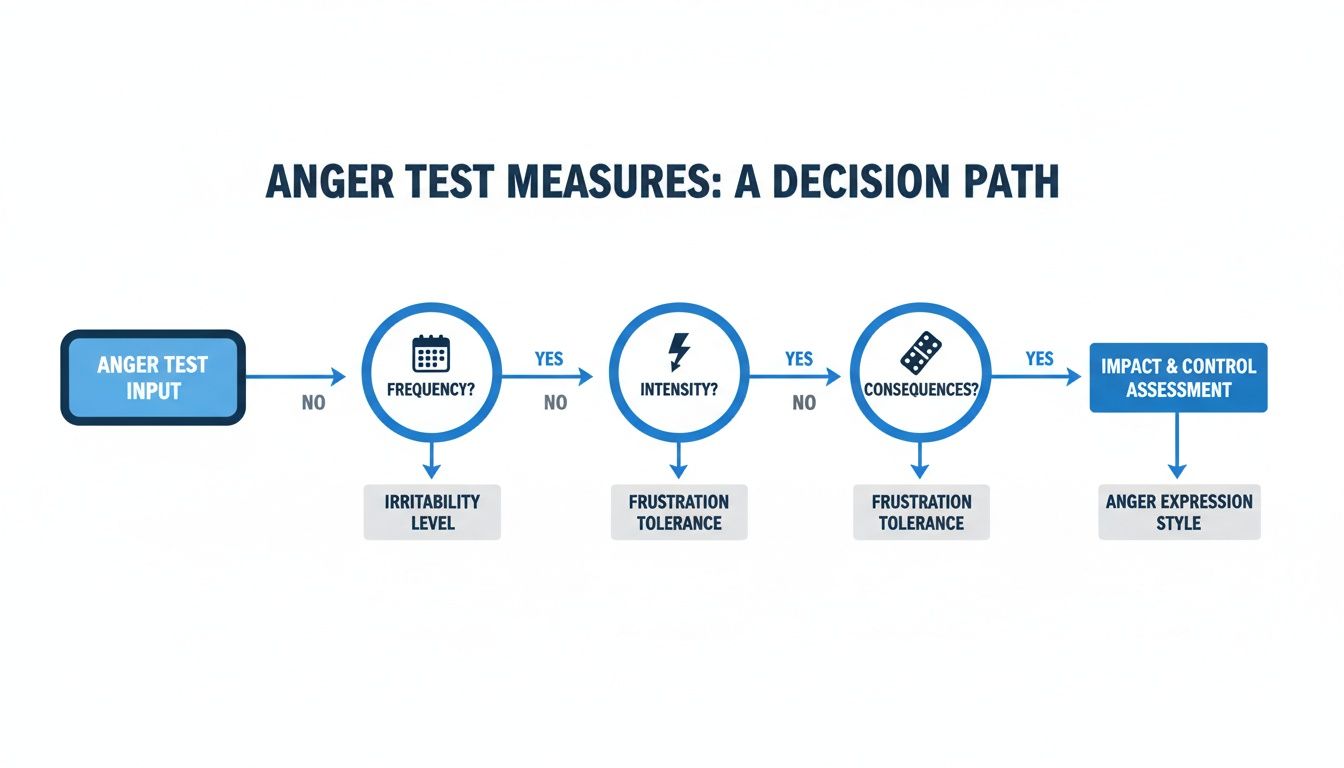
    A flowchart illustrating anger test measures, detailing a decision path based on frequency, intensity, and consequences.

    As you can see, a meaningful assessment considers how often, how strongly, and what kind of impact anger has on your life.

    High Range (49–60)

    A score in this range could mean that anger is causing significant distress. It’s important to know that feeling this way is not a personal failure, and reaching out for support is a sign of strength.

    This level of distress can lead to burnout. Exploring professional support through counselling or therapy can provide you with proven tools to find your balance.

    Supportive Takeaways

    No matter your score, this anger issues test is a tool for self-compassion and awareness.

    • Your score is a snapshot, not a permanent label. Emotions are fluid, and our ways of responding can change and grow.
    • Awareness is the first step toward growth. Simply reflecting on these questions helps build deeper emotional understanding.
    • Support is always available. If this reflection brought up difficult feelings, talking with a trusted person or a professional can help.

    Looking Beyond the Score to Find Your Triggers

    Your score is a useful starting point, but the real insight comes from understanding the why behind your feelings. Now is the time to become an 'emotional detective' and explore what sparks your anger.

    Anger rarely appears out of nowhere; it’s usually a reaction to something. Identifying your personal triggers can help you connect your feelings to challenges like workplace stress, burnout, or anxiety.

    Uncovering Your Personal Anger Patterns

    To find your triggers, ask gentle, curious questions when anger shows up. This self-reflection is a powerful step toward building emotional resilience.

    Start by asking yourself these focused questions with kindness and curiosity.

    • When do I feel most angry? Notice the time of day or week when these feelings are strongest.
    • Where am I when these feelings come up? Different environments can have a huge impact on our emotional state.
    • Who am I with? Anger can surface differently depending on whether we are with family, colleagues, or alone.
    • What was I thinking or doing right before I felt angry? Were you feeling criticized, ignored, or overwhelmed?

    Answering these questions helps patterns emerge. This awareness is the true foundation of change, helping you understand your personal challenges.

    The Indian Context: Family and Career Pressures

    In India, cultural nuances add unique layers to our emotional lives. The pressure to succeed professionally, coupled with family expectations, can create stress that makes us more susceptible to anger.

    This tension between traditional duties and modern ambitions can fuel frustration. Recognizing these cultural pressures is about understanding the full context of your emotional well-being.

    Anger is often a secondary emotion—a protective mask for more vulnerable feelings like hurt, fear, or disappointment. When you feel a surge of anger, gently ask yourself, "What other feeling might be underneath this?"

    This compassionate inquiry can reveal the root cause of your anger. This deeper understanding is essential for addressing the source, not just the symptom.

    From Triggers to Growth

    Once you identify your triggers, you can make conscious choices instead of having automatic reactions. This journey isn't about eliminating anger but understanding its message and building resilience.

    This self-awareness is a vital step toward greater happiness and a core part of effective counselling and therapy. By looking beyond the score, you learn that your anger is a signal, guiding you toward areas of your life that need more care and compassion.

    So, What's Next? Practical Steps for Your Emotional Well-being

    Peaceful Asian woman meditating in lotus pose on a yoga mat in a bright room.

    Reflecting on your emotions is an act of self-care. The insights from an anger issues test are a starting point, pointing you toward greater self-awareness and a calmer state of mind.

    These first steps are about building a personal toolkit for navigating tough feelings. You can nurture your inner resilience by treating yourself with compassion, one small action at a time.

    Self-Help Strategies You Can Start Today

    You have the power to influence your emotional state. Mindful practices can create calm and provide a healthy outlet for feelings before they become overwhelming.

    One powerful tool is your breath. Simple techniques, like the Indian practice of pranayama, can calm your nervous system. Exploring breathing exercises specifically for anger management can be incredibly helpful.

    Here are a few other gentle yet effective strategies:

    • Mindful Movement: Getting your body moving—through yoga, a walk, or dancing—can release physical tension and improve your mood.
    • Journaling: Writing down your thoughts without judgment offers a private, safe space to untangle feelings and understand what's beneath the surface.
    • Mindfulness Meditation: Even five minutes of quiet observation can help you build the mental muscle to pause and choose your response.

    When to Consider Professional Support

    Self-help is a great foundation, but sometimes we need more support. Reaching out for professional help through therapy or counselling is a sign of profound strength and an investment in your happiness.

    An anger management session is a confidential, supportive conversation. It's a space where you can explore your feelings and experiences without being judged.

    A good therapist acts as your guide, helping you understand the roots of your anger and develop personalized strategies. They can provide tools to cope with workplace stress and challenge unhelpful thoughts related to anxiety or depression.

    This journey is about learning to be kinder to yourself. A professional can offer evidence-based techniques and support to help you find balance.

    Finding the Right Path for You

    Where you live can play a role in your experience. In India, for example, people in urban areas may report higher stress, while rural communities might face a shortage of mental health specialists.

    Whether you start with self-help or seek professional guidance, the most important thing is to take that first gentle step. Every action toward understanding yourself builds a stronger foundation for a more peaceful life.

    Supportive Takeaways to Remember:

    • Start small. Pick one small thing, like a five-minute breathing exercise each morning, to build momentum.
    • Be patient with yourself. Learning new emotional habits takes time, and it's okay to have good days and tough days.
    • You are not alone. Many people navigate similar feelings, and support is available to help you move forward.

    Your Questions About Anger and Support, Answered

    Taking the first step to understand your anger can bring up questions. It's normal to feel curious or uncertain. This section provides clear, straightforward answers to common concerns.

    We want to clear up any confusion and help you feel more confident about the path that feels right for you. Seeking answers is a powerful act of self-care.

    Is It Normal to Feel Angry Every Day?

    Flashes of irritation are a normal part of life. However, feeling intense anger every day, especially if it disrupts your work or relationships, may be a sign of a deeper issue.

    If anger has become your primary emotion, it could be tied to workplace stress, unresolved issues, or anxiety. An anger issues test is a good starting point, but a counsellor can offer professional clarity and support for your well-being.

    Can an Online Anger Issues Test Actually Diagnose Me?

    No, an online test is an informational self-reflection tool, not a diagnostic instrument. It offers insights into your emotional patterns in a private, judgment-free way.

    A formal diagnosis can only come from a qualified professional, like a clinical psychologist or psychiatrist. However, these online tests are valuable for building self-awareness and can be a great way to start a conversation with a therapist.

    What’s the Difference Between Therapy and Counselling?

    These terms are often used interchangeably, but there's a subtle difference. Counselling usually focuses on specific, current problems and helps you build practical coping strategies over a shorter period.

    Therapy may dig deeper into the root causes of your emotional patterns, exploring past experiences. Both approaches are collaborative and aim to improve your emotional resilience. The most important thing is finding a professional you trust.

    The best choice depends on your needs and goals. Both offer a safe space to work toward a healthier, more balanced emotional life.

    How Do I Know if I Need Anger Management?

    Looking into anger management is a proactive choice for your well-being. It might be useful if you feel your temper is controlling you, hurting your relationships, or causing guilt.

    Anger management, often part of therapy or counselling, gives you practical tools to spot triggers and respond in healthier ways. It's about building skills to shift from automatic reactions to thoughtful responses.

    How Can I Find a Therapist for Anger Issues in India?

    Finding the right therapist is about finding a good fit. Look for professionals who specialize in anger management or emotional regulation on reputable online platforms.

    Don't be shy about asking questions in an initial chat to see if you connect. The goal is to find someone you feel safe with. Reaching out is a sign of strength, and the right therapist can be an incredible ally.


    Taking the time to understand your anger is a meaningful step toward a more peaceful and fulfilling life. If you feel ready to explore professional support, DeTalks provides a safe and trusted space to connect with verified therapists and counsellors across India. Browse our directory to find a professional who can guide you with compassion and expertise. Find the right support for you on DeTalks.


  • A Practical Guide on How to Self Love Daily

    A Practical Guide on How to Self Love Daily

    Learning how to self love isn't a single decision but a gentle, daily practice. It means choosing to treat yourself with kindness, making peace with your imperfections, and consistently prioritising your own well-being. At its heart, it’s about building resilience and compassion from the inside out, so your sense of worth comes from within.

    What Self-Love Actually Means and Why It Matters

    Self-love is often mistaken for bubble baths and spa days, but it goes much deeper. It is the foundational respect you have for yourself that shapes your thoughts, feelings, and actions every day.

    It’s about shifting away from a harsh inner critic and learning to speak to yourself with the warmth you would offer a friend. In a culture like India, where community needs often come first, prioritising yourself can feel unfamiliar. But it's not selfish; it's essential for building the emotional strength needed to navigate life.

    The Connection to Your Well-Being

    A lack of self-love can make you more vulnerable to life's challenges. It can turn a simple mistake into a source of spiralling anxiety or transform workplace stress into burnout. A consistently critical inner voice can erode your confidence, leaving you susceptible to sadness and even depression.

    Conversely, cultivating self-love helps build an internal support system. It equips you with the tools to manage stress, bounce back from setbacks, and maintain a healthier perspective. For a deeper look, understanding what self-compassion is offers a practical framework for your mental wellness.

    A Look at Self-Love in India

    Globally, India's Self-Love Index score is 52, just one point below the global average of 53, according to a report from The Body Shop and Ipsos. This suggests many in India are on this journey, but there is still room for growth in nurturing our inner well-being.

    To understand this better, let's explore the key components of a self-love practice.

    Core Pillars of Self-Love

    Pillar What It Means in Practice
    Self-Compassion Treating yourself with kindness when you fail or feel inadequate, instead of self-criticism.
    Boundaries Saying "no" to things that drain your energy and protecting your mental and emotional space.
    Self-Acceptance Embracing all parts of yourself—the good, the bad, and the messy—without judgement.
    Prioritising Needs Recognising and honouring your own needs for rest, nourishment, and joy.
    Mindfulness Staying present with your thoughts and feelings without getting carried away by them.

    Each pillar works with the others to create a strong, supportive relationship with yourself.

    Self-love is not a final destination but a continuous practice. It's about choosing to show up for yourself with kindness, especially on the days when it feels the most difficult. This commitment is a powerful step toward lasting well-being.

    Committing to this journey can genuinely improve your life. Here are some of the benefits:

    • Improved Resilience: You can handle life's ups and downs with greater emotional balance.
    • Healthier Relationships: Valuing yourself helps you nurture respectful and supportive connections with others.
    • Reduced Anxiety and Stress: A kind inner voice is a powerful tool for soothing anxiety and managing daily stress.
    • Greater Happiness: Accepting yourself fully creates space for a more authentic and lasting sense of joy.

    This guide provides practical, actionable steps for your journey. While therapy is a valuable resource, the small habits you build daily are the true cornerstones of a healthy relationship with yourself.

    Understanding the Barriers to Loving Yourself

    Have you ever wondered why being kind to yourself can feel so difficult? The journey to self-love starts not with forcing positive thoughts, but with gently understanding what stands in the way.

    Often, the biggest roadblocks are internal, like old thought patterns and painful memories. Others come from external pressures and expectations. The goal isn't to judge these barriers, but to see them clearly, as awareness is the first step toward compassion.

    The Harsh Inner Critic

    We all have that nagging inner voice that is quick to point out mistakes and dismiss successes. This inner critic often echoes critical messages we heard from others long ago.

    It's the voice that whispers you’re not smart enough after an error at work or not attractive enough when you see your reflection. Living with this constant commentary is exhausting, fuelling feelings of anxiety and inadequacy that can lead to burnout. Learning how to self love means learning to see this voice as a misguided attempt to protect you.

    The Weight of Societal and Family Expectations

    In India, cultural and family pressure to follow specific life paths is strong. We are often measured by external benchmarks like academic success, career choices, or marriage. When our lives don't match that blueprint, it's easy to see it as a personal failure.

    This can take a heavy toll, especially on young people, contributing to rising rates of depression and other emotional challenges. You can read more about the findings on adolescent mental health in India to understand this issue better.

    Self-love involves gently separating your self-worth from the expectations of others. It’s about learning to define success and happiness on your own terms.

    Lingering Effects of Past Experiences

    Our pasts shape us in ways we don't always realise. Painful events can create limiting beliefs that run in the background of our minds, such as "I am not worthy of love."

    These old wounds can become major barriers, causing us to self-sabotage or avoid taking chances. Acknowledging this pain is a courageous act of self-love. For many, a safe space like therapy or counselling is key to processing these experiences and writing a kinder story for themselves.

    Common Roadblocks to Watch For

    Identifying specific patterns can be incredibly helpful. Here are a few common ones you might recognise:

    • Perfectionism: The belief that you must be flawless to be worthy of love, which creates an intense fear of making mistakes.
    • Comparison: Constantly measuring your life, body, or career against others, especially on social media.
    • Unresolved Guilt or Shame: Holding on to past mistakes and letting them define who you are today.
    • Neglecting Your Needs: A habit of putting everyone else first, which often leads to feeling drained and resentful.

    Remember, identifying these patterns isn't about finding more flaws. It's about gathering information to know which areas of your life need more gentleness and attention. This is the foundation for building lasting resilience and well-being.

    Cultivating Daily Self-Compassion Practices

    Young Asian man meditating peacefully at a desk in a bright room, practicing self-love.

    The real work of self-love begins with actively practising kindness toward yourself. This isn't about grand gestures but about the small, consistent choices you make every day to build a more supportive inner voice.

    Self-compassion means responding to your own mistakes and imperfections with the kindness you’d offer a friend. Building this skill creates an internal source of strength, helping you navigate everything from workplace stress to personal setbacks with greater resilience.

    From Self-Criticism to Self-Kindness

    The first step is simply to notice how you talk to yourself. When you make a mistake, do you immediately call yourself "lazy" or an "idiot"? Awareness is the crucial starting point for change.

    Once you catch that critical voice, gently reframe the thought. Instead of, "I can’t believe I said that," try, "That wasn’t my most articulate moment, but everyone has off-days." This shift removes the harsh judgment that fuels anxiety.

    Mindful Self-Compassion in Action

    Mindfulness is a powerful tool for paying attention to the present moment without judgment. When paired with compassion, it helps you acknowledge difficult feelings without letting them take over your day.

    Here’s a simple two-minute breathing exercise you can do anywhere:

    • Settle into your chair with your feet flat on the floor. Gently close your eyes or lower your gaze.
    • Take three slow, deep breaths, in through your nose and out through your mouth.
    • Place a hand over your heart or on your lap, feeling its warmth and gentle pressure.
    • Acknowledge whatever you're feeling by silently saying, "This is a moment of stress."
    • Offer yourself a phrase of kindness, like, "May I be kind to myself," or, "It’s okay."
    • Take one last deep breath and slowly bring your awareness back to the room.

    Practices like this help build new neural pathways for self-compassion, improving your overall well-being.

    Rewriting Your Inner Story with Journaling

    Journaling is another effective way to challenge negative self-talk in a private, judgment-free space. The simple act of writing can bring clarity to overwhelming emotions, like anxiety or feelings linked to depression.

    Don't worry about writing perfectly; just five minutes a day is a great start. If you feel stuck, try one of these prompts:

    • What’s one thing I did today that I can feel proud of, no matter how small?
    • If my best friend were going through this, what kind words would I offer them?
    • What is one of my needs that I’ve been ignoring? How can I honour it this week?
    • Write a letter of forgiveness to yourself for a past mistake you've been holding onto.

    Your inner world is like a garden. Journaling helps you pull out the weeds of self-criticism and plant the seeds of self-compassion. With consistent care, a kinder, more resilient version of you will begin to grow.

    Using Affirmations That Actually Feel Genuine

    Positive affirmations can feel inauthentic if you're struggling with deep-seated inadequacy. The secret is to craft affirmations that feel believable to you right now.

    Instead of making a huge leap, try using "bridge" statements. These acknowledge where you are while gently pointing you toward where you want to go.

    Instead of This (If It Feels Fake) Try This More Believable Affirmation
    "I love my body completely." "I am learning to appreciate my body for what it can do."
    "I am a confident person." "I am open to building more confidence in myself."
    "I am completely free from anxiety." "I am capable of handling my anxiety with kindness."

    These gentler statements make the practice feel more honest and effective. They are a practical step in learning how to self love without feeling like you are pretending. Remember, this journey is about progress, not perfection.

    If negative beliefs feel deeply entrenched, these practices may not be enough on their own. When workplace stress, anxiety, or low self-worth feel too heavy to carry alone, seeking professional counselling or therapy is a courageous act of self-care.

    How to Set Boundaries for Better Well-Being

    Setting boundaries is one of the most practical ways to show yourself love. It isn't about building walls but about defining your personal space to protect your energy and mental health.

    Many of us, especially in India where community ties are central, struggle with saying "no." However, constantly prioritising others' needs can lead to resentment, anxiety, and burnout. Setting a boundary is an act of self-respect that strengthens relationships in the long run.

    Understanding Different Types of Boundaries

    Boundaries appear in nearly every area of our lives, and getting good at setting healthy boundaries is key to protecting your energy. The first step is to notice where you need them most.

    Here are the main types:

    • Emotional Boundaries: These protect your feelings, allowing you to empathise without absorbing others' stress.
    • Physical Boundaries: This relates to your personal space, privacy, and comfort with physical touch.
    • Digital Boundaries: This involves managing your online life, such as not checking work emails after hours or limiting social media.

    Weak boundaries are a fast track to workplace stress and exhaustion. Every boundary you set sends a powerful message: "My well-being matters."

    Practical Phrases for Setting Boundaries Politely

    Saying the words out loud is often the hardest part because we fear conflict. The key is to be clear, kind, and firm without needing to over-explain or apologise.

    Here are a few real-life examples:

    Scenario 1: At Work
    Your boss assigns another project when you're already overwhelmed.

    • Try: "Thank you for trusting me with this. My plate is full right now, and I couldn't give this the focus it deserves. Can we discuss priorities?"

    Scenario 2: With Family
    A relative gives unsolicited advice that is starting to wear on you.

    • Try: "I appreciate that you care so much. For this, though, I need to figure it out for myself. I'd rather we talk about something else."

    Scenario 3: With Friends
    A friend calls to vent for hours, leaving you drained.

    • Try: "I can tell this is weighing heavily on you. I only have about 15 minutes before I have to go, but you have my full attention until then."

    A boundary isn't a rejection of someone else. It's an acceptance of yourself and your own limits. This is foundational for building resilience and preventing the kind of burnout that can lead to feelings of depression.

    Navigating the Aftermath of Setting a Boundary

    When you first start setting boundaries, some people may not like it, especially if they are used to you always saying "yes." This is a normal reaction, but it doesn't mean you've done anything wrong.

    Hold your ground with compassion and calmly repeat your boundary if needed. Over time, the people who respect you will adjust. You are teaching others how to treat you, which is a cornerstone of self-love and long-term happiness.

    If setting boundaries consistently fills you with extreme anxiety, or if people repeatedly violate them, it might be worth exploring this in therapy. A counsellor can provide tools and a safe space to build this vital skill.

    Knowing When to Seek Professional Support

    The journey toward self-love is deeply personal, often built through daily practices. But sometimes, these tools may not feel like enough, and that's perfectly okay.

    Reaching out for professional support isn’t a sign of failure. In fact, it’s one of the most courageous acts of self-care you can take.

    Recognising you need help is a profound expression of self-love. It means you value your well-being enough to seek guidance when challenges like persistent workplace stress or sadness feel too heavy. A therapist or counsellor offers a safe, confidential space to explore these feelings without judgment. This assessment is for informational purposes and not a clinical diagnosis.

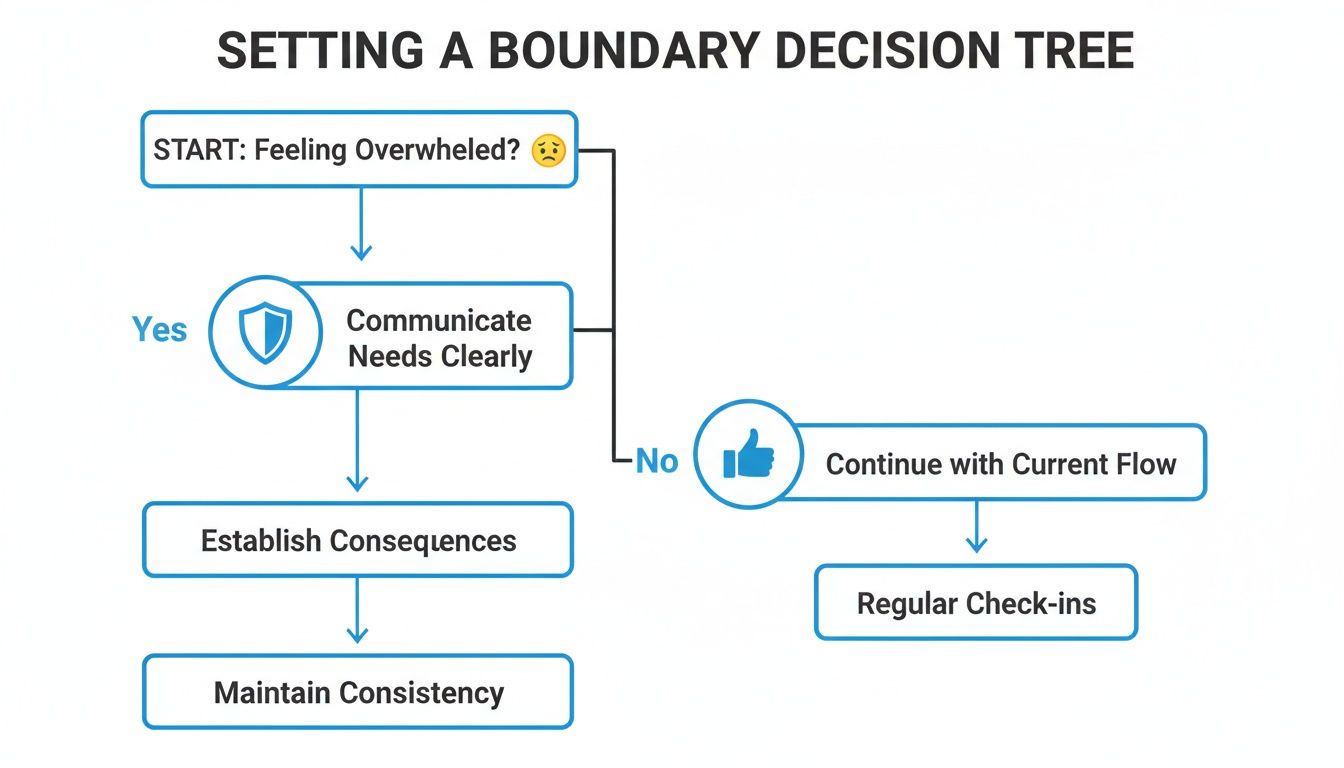
    This decision tree can help you map out how to communicate your needs when you're feeling overwhelmed—a crucial skill for protecting your mental health.

    A decision tree illustrating how to set boundaries when feeling overwhelmed, offering two paths based on needs communication.

    As the visual guide shows, simply acknowledging that you're overwhelmed is the first step toward taking action to support yourself.

    Signs It Might Be Time for Counselling

    How do you know when it’s time to seek support? If certain patterns persist, professional help could make a real difference. Here are a few common indicators to look for:

    • Persistent Low Mood: Feeling sad, empty, or hopeless most days for more than a couple of weeks, which can sometimes be a sign of depression.
    • Overwhelming Anxiety: Worry and fear are interfering with your work, relationships, or daily routine.
    • Difficulty Coping: Feeling consistently overwhelmed by life and struggling to manage stress.
    • Relationship Strain: Your personal struggles are creating conflict or distance in your relationships.

    What to Expect from Therapy

    The idea of therapy can feel intimidating, especially with the misconceptions that still exist in India. A therapy session is simply a dedicated time for you to talk through your thoughts and feelings with a trained professional.

    A good therapist listens with empathy, helps you spot unhelpful patterns, and gives you practical strategies to build resilience. It's a collaborative process aimed at empowering you to navigate life with greater self-awareness and compassion.

    Seeking therapy is not about "fixing" something that is broken. It's about investing in your own well-being, learning new skills for living, and building a stronger, more compassionate relationship with yourself.

    The Proven Impact of Professional Guidance

    This kind of structured support has a real, measurable impact. For example, research on targeted programmes in India has shown how effective they can be.

    One study in Gujarat found that after an assertiveness training programme, adolescents' average self-esteem scores jumped from 11.33 to 21.16. This highlights the power of guided intervention. You can learn more about these encouraging research findings and see the data for yourself.

    This shows that working with a professional can provide the tools needed to build a stronger sense of self-worth and genuine happiness. Whether you’re navigating anxiety, depression, or simply want to learn how to self love on a deeper level, counselling is an invaluable resource.

    Got Questions About Self-Love? Let's Talk.

    When you first start exploring how to love yourself, it's normal for questions to arise. This path is personal and can feel complex at times. Here are some honest answers to common questions we hear.

    Isn't Focusing on Myself a Bit… Selfish?

    This is a common concern, especially in cultures that prioritise family and community. But the answer is a firm no.

    Genuine self-love isn’t about shutting others out; it’s about ensuring your own cup is full so you have something left to give. When you're running on empty, it's impossible to be the patient, present, and resilient person you want to be for others. Looking after your well-being isn't selfish—it's the foundation that allows you to be a supportive partner, parent, or friend.

    How Long Until I "Get" This Self-Love Thing?

    Self-love is more of a lifelong practice than a destination. There’s no final exam to pass.

    That said, you can start feeling small but powerful shifts quickly. After a few weeks of consistent effort, you might notice you’re catching your inner critic faster or that it’s easier to challenge a negative thought. Deeper work, like building solid boundaries or healing old wounds, naturally takes more time, so be patient with yourself through the process.

    The goal here is consistency, not perfection. Every tiny step forward counts. Each moment of self-kindness is a win on your journey toward accepting and loving yourself more fully.

    These Positive Affirmations Just Feel Fake. Am I Doing It Wrong?

    This is a completely valid feeling. When your self-worth has taken a hit, repeating "I am worthy" can feel like a lie. The trick is to start with statements that feel more believable right now.

    Instead of making a big leap, use "bridge statements" that honour where you are while gently nudging you in a kinder direction.

    • Instead of "I am worthy," try: "I am willing to believe I could be worthy."
    • Instead of "I love myself," try: "I am learning to be kinder to myself."
    • Instead of "I am a confident person," try: "I am taking small steps to build my confidence."

    This softer approach makes the practice feel more genuine and less like a chore.

    Can I Really Practice Self-Love When I'm Dealing with Depression or Anxiety?

    Yes, absolutely. In fact, self-compassion practices can be a powerful support when navigating challenges like anxiety or depression. Being kind to yourself in a tough moment can help soothe your nervous system and interrupt the cycle of self-blame.

    However, it’s crucial to remember that these practices are a support system, not a substitute for professional help. If you're struggling, please reach out for professional support through therapy or counselling. A good therapist can give you personalised tools and a safe space to heal.


    At DeTalks, we know that taking that first step can feel daunting. Our platform is designed to make it easier, connecting you with qualified therapists and offering scientifically validated assessments to help you understand what you need. These assessments are for informational purposes only and are not a substitute for a clinical diagnosis. Find the right support for your journey today at DeTalks.

  • What Causes Low Self Esteem and How to Build Your Confidence

    What Causes Low Self Esteem and How to Build Your Confidence

    Low self-esteem isn't a character flaw or something you're born with. It's often a lens that becomes smudged over time, shaped by early life experiences, social pressures, and our own inner thoughts.

    If this feels familiar, please know you are not alone on this journey. Understanding where these feelings come from is the first gentle step towards healing and self-acceptance.

    Unpacking the Roots of Low Self-Esteem

    Getting to the heart of what causes low self-esteem is the first step toward rebuilding it. It’s rarely a single event but a slow build-up of past experiences, our interactions with the world, and the stories we tell ourselves.

    Everyone’s journey is different because this is such a personal mix of factors. For some, the seeds were planted by a critical parent, while for others, they grew from intense workplace stress or social media pressure. Pinpointing these origins helps build self-compassion.

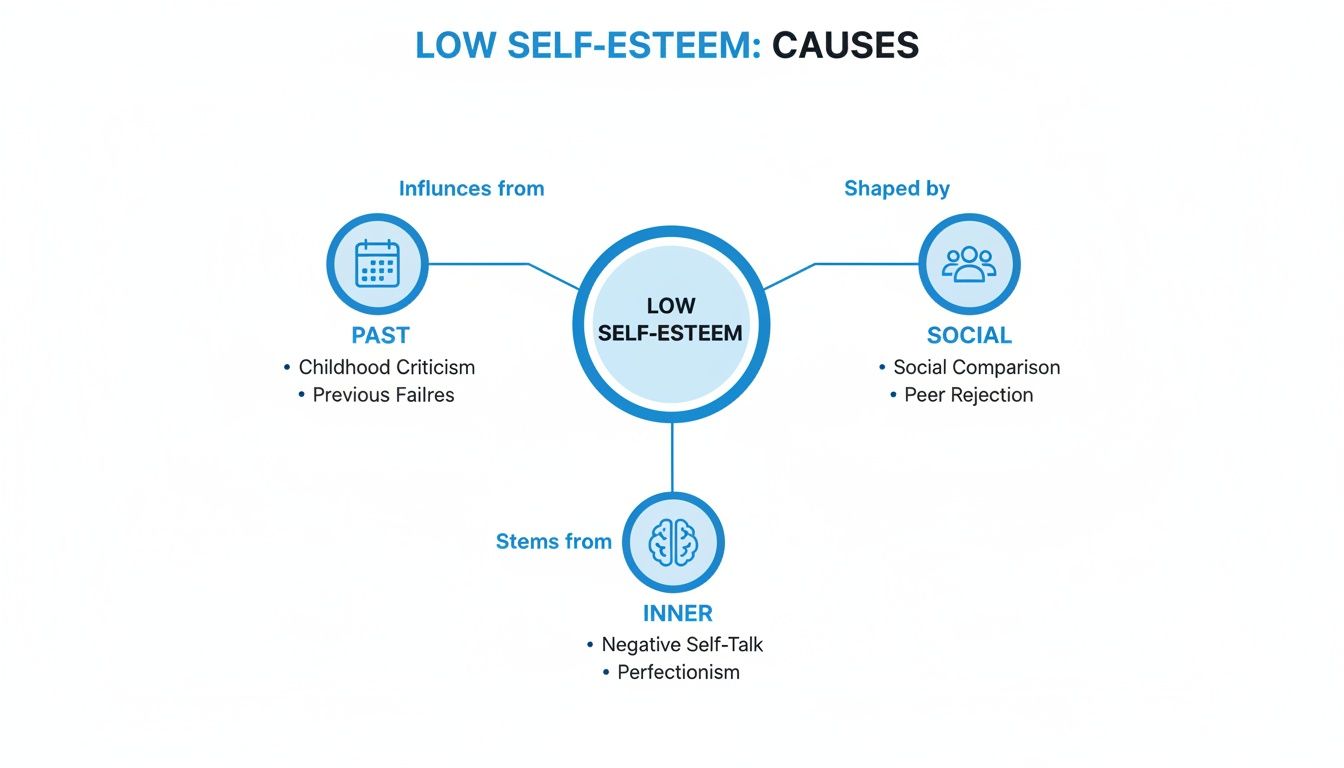
    This diagram helps to visualise how these different areas—our past, our social world, and our inner life—all connect.

    A diagram illustrating the causes of low self-esteem, categorized into past, social, and inner factors.

    As you can see, our view of ourselves doesn't form in a vacuum. It’s a dynamic interplay between historical, external, and internal forces.

    Primary Factors That Shape Your Self-Esteem

    To help make sense of it all, let's briefly look at the primary factors that influence our self-worth. The table below summarises the main cause categories we'll be exploring in more detail throughout this guide.

    Cause Category Brief Description Common Examples
    Early Life Experiences Foundational events and relationships from childhood that shape our core beliefs about ourselves. Unsupportive parenting, bullying, academic struggles, difficult childhood friendships.
    Life's Challenges & Trauma Significant negative events that can shatter our sense of safety and competence. Abuse, neglect, major illness or injury, loss of a loved one, significant failure.
    Relationships The quality of our connections with others and how they impact our sense of value and belonging. Toxic relationships, social isolation, break-ups, lack of a support system.
    Cognitive Patterns Ingrained habits of thinking that distort reality and reinforce negative self-perceptions. All-or-nothing thinking, catastrophising, harsh self-criticism (the "inner critic").
    Mental Health Conditions Conditions like anxiety and depression that are deeply intertwined with, and often fuel, low self-esteem. Generalised anxiety disorder, social anxiety, major depressive disorder.
    Social & Cultural Factors Broader societal messages and pressures that dictate standards for success, beauty, and worth. Media portrayals, unrealistic beauty standards, workplace competition, discrimination.
    Biological Factors Our inherent temperament and genetic predispositions that can make us more vulnerable to low self-esteem. A naturally sensitive temperament, genetic links to mood disorders.

    Understanding these areas can help you connect the dots in your own life. This awareness is the first step toward making meaningful changes for your well-being.

    It’s vital to remember that exploring these causes is about gaining understanding, not assigning blame. The aim is to achieve clarity so you can start treating yourself with more kindness and compassion.

    While self-help is powerful, professional support can offer a safe space to work through these issues. Remember, any self-esteem assessments are for informational purposes to guide your journey; they are not a clinical diagnosis. This knowledge is your foundation for building resilience and a more authentic sense of happiness.

    How Your Earliest Years Shape Who You Are Today

    Think of childhood as the foundation of a house. A foundation laid with care and support creates a strong structure, but one marked by criticism or neglect can lead to cracks in your self-worth later in life.

    From the start, we look to our caregivers to understand our place in the world. Their reactions—their smiles, words, and attention—are the first mirrors we see. Encouragement teaches us we are capable and valuable.

    On the other hand, a childhood filled with harsh words or unrealistic expectations can form a negative self-image. These early messages often become a nagging inner critic that stays with us for decades.

    Your Family and First Relationships

    The family home is our first school, where we learn powerful lessons about our value. The way our parents treated us sent signals about whether we were "good enough," shaping feelings of anxiety later on.

    A child with critical parents might grow up fearing failure and feeling they always fall short. Similarly, a child who feels ignored can internalise the belief that they don’t matter, damaging their core sense of worth.

    A crucial takeaway is that a child's inner voice often records their parents' voices. Awareness of this pattern, often with professional support through therapy or counselling, allows it to be changed. The goal is not blame, but understanding.

    Navigating School and Friendships

    Outside the home, the classroom and playground become the next test of our self-worth. This is where we start measuring ourselves against others, and a few tough experiences can leave a lasting impact.

    Consider these common situations:

    • Academic Pressure: In a culture like India's, where academic success is highly valued, not performing well can feel like a deep personal failure. This can lead to intense workplace stress later in life.
    • Bullying and Social Rejection: Being excluded or made fun of by peers is incredibly painful. These experiences can sow the seeds of social anxiety and make it hard to trust people.
    • The Comparison Trap: Constant comparison to a "smarter" sibling or a "more popular" classmate can breed resentment. This makes a child doubt their own unique talents and feel inadequate.

    These early social tests can be a huge factor in developing low self-esteem and may contribute to challenges like anxiety and depression. Understanding these origins is the first step toward rewriting your story and improving your well-being.

    The Weight of Social Pressure and Modern Expectations

    While our early years lay the foundation, adult life introduces new challenges that can chip away at our self-worth. It's easy to measure our value by external achievements, making our self-esteem fragile and dependent on others' opinions.

    Child's hands holding a vibrant green seedling in soil, symbolizing growth and family future.

    It often feels like we are on a treadmill, always chasing the next promotion or lifestyle goal. Tying our identity to these external goals can make any setback feel like a personal failure, stirring up feelings of inadequacy and anxiety.

    The High Stakes of Academic and Career Pressure

    In many cultures, including India, the pressure to be a top performer at school and work is immense. This focus on exam scores and prestigious jobs creates a constant fear of not being good enough, leading to significant workplace stress.

    This pressure is a major source of distress for young people, fuelling low self-esteem. In fact, a recent report on the mental health of Gen Z found that a significant number of young people are struggling, much of it stemming from this relentless chase for success.

    When your value is tied to your performance, you believe you are only as good as your last success. This mindset makes it difficult to build lasting resilience because any setback feels like a direct hit to your identity.

    This environment leaves little room for discovering who you are outside a narrow definition of success. Support through therapy or counselling is vital for helping people find their worth beyond these external benchmarks and improve their overall well-being.

    Comparison Culture and the Social Media Effect

    Social media is another powerful force shaping how we see ourselves. These platforms can ironically leave us feeling more alone and inadequate as we scroll through curated "highlight reels" of others' lives.

    This endless stream of idealised images sets unrealistic standards for happiness and success. It's easy to fall into the comparison trap, where our own life, with its normal ups and downs, seems disappointing.

    This constant social scoreboard can trigger a cascade of negative feelings:

    • Feelings of Inadequacy: Your own achievements can suddenly feel insignificant next to the polished perfection you see online.
    • Increased Anxiety and FOMO: The "Fear of Missing Out" becomes a constant worry that everyone else is having more rewarding experiences than you are.
    • Distorted Self-Image: Unrealistic beauty filters and lifestyle portrayals can do a number on your body image and overall sense of self-worth.

    This digital comparison game is a direct line to low self-esteem and is often linked to rising rates of anxiety and depression. The need for online validation can replace the steady work of building genuine, internal self-worth.

    How Your Inner Critic Shapes Your Reality

    It’s not just past events or outside pressures that determine how we see ourselves. One of the most powerful forces is the constant chatter inside our own heads, often called the "inner critic."

    Imagine your mind has a radio station that’s always on. Is it playing a supportive soundtrack or a loop of harsh self-criticism? This internal monologue is a major driver of what causes low self esteem.

    From a rooftop, a young man views the city skyline and illuminated buildings at twilight.

    This is the part of you that whispers doubts, replays mistakes, and constantly compares you to others. Over time, this negative thinking can start to feel automatic and true, chipping away at your confidence and feeding feelings of inadequacy.

    The Downward Spiral of Negative Thinking

    Our brains are naturally wired to notice negative experiences more than positive ones. When this tendency goes into overdrive, it creates thought patterns that warp our reality and keep our self-esteem low.

    This creates a tough cycle: a negative thought sparks a negative feeling, which influences your behaviour. This can seem to confirm the original thought, reinforcing the loop and impacting your overall well-being.

    The link between thoughts and feelings is fundamental to our mental state. Persistent negative self-talk is deeply connected to ongoing challenges like anxiety and depression. Understanding this connection is the first step toward taking back control.

    Common Thought Patterns That Damage Self-Esteem

    These mental traps are common ways of thinking that many of us fall into. Here are a few to watch out for:

    • All-or-Nothing Thinking: You see everything in black and white. If you aren't perfect, you see yourself as a total failure.
    • Jumping to Conclusions: You assume the worst without any real evidence, like mind-reading ("I know they think I'm incompetent").
    • Emotional Reasoning: You take your feelings as facts. For instance, "I feel like a loser, so I must be one."
    • Magnification and Minimisation: You blow your mistakes out of proportion while brushing off your strengths and achievements.

    These thought patterns contribute to everything from workplace stress to social isolation. In India, this inner critic is often amplified by digital life, with one study on the impact of social media on Indian youth highlighting how online pressures can worsen stress and anxiety.

    Remember, these thoughts are not facts. With awareness and practice, often with help from therapy or counselling, you can learn to challenge your inner critic, build mental resilience, and practice self-compassion.

    Practical Strategies to Build Resilience and Self-Compassion

    Knowing what causes low self-esteem is one thing; building confidence is a journey of small, consistent actions. The real work is in cultivating your inner strength and learning to treat yourself with kindness.

    A person sits at a dressing table, gazing at their reflection in a sunlit room.

    Think of resilience as a muscle that gets stronger with use; it helps you bounce back from setbacks faster. Self-compassion is the gentle inner voice that gives you permission to struggle, a perfect antidote to the harsh inner critic.

    Starting with Small, Achievable Steps

    Trying to change your self-perception all at once can be overwhelming. Starting small creates a positive feedback loop where small wins build momentum and reinforce a healthier self-image.

    Here are a few simple yet powerful techniques:

    • Journal to Challenge Your Inner Critic: Spend a few minutes each day writing down your thoughts. When a negative belief appears, challenge it with evidence that proves it wrong.
    • Set Tiny, Attainable Goals: Break large objectives into bite-sized pieces, like going for a 10-minute walk. Each completed task builds your confidence.
    • Rediscover Joyful Activities: Re-engage with a hobby that makes you feel competent and happy. This shifts your focus from perceived flaws to moments of enjoyment.

    These actions are the building blocks for a stronger sense of self. They help focus on your achievements and genuine moments of happiness.

    Cultivating a Supportive Environment

    Your surroundings and the people you connect with have a massive impact on your mental well-being. It is important to be intentional about who and what you allow into your daily life.

    Setting healthy boundaries is a powerful act of self-respect. Learning to say "no" to things that drain your energy is critical for managing workplace stress and protecting your emotional resources.

    Your digital world needs boundaries, too. Curating your social media feed by unfollowing accounts that trigger comparison or anxiety can significantly improve your mood.

    Learning to overcome challenges is crucial for self-worth. For more detailed guidance, you can explore how to build mental resilience and thrive through adversity. Building these skills is a key part of the journey.

    Knowing When and How to Find Professional Support

    Self-help strategies are valuable, but sometimes the journey requires a guide. Reaching out for professional help through therapy or counselling is a courageous act of self-care and a powerful step towards lasting change.

    A therapist or counsellor offers a safe, confidential space to explore the roots of your low self-esteem without judgment. They can help you connect past experiences to present feelings and build personalised strategies for emotional resilience.

    What to Expect From Therapy

    Taking the first step can feel daunting, so knowing what to expect can ease any anxiety. Your first session is usually a conversation to share your story and goals, and to see if you and the therapist are a good fit.

    Therapy is a collaborative process, not a quick fix. You and your therapist work together to help you gain a deeper understanding of yourself and develop tools for your well-being.

    Remember, any assessments you might encounter are for informational purposes only. They are designed to offer insights and guide your journey, not to provide a clinical diagnosis or label.

    Finding the Right Support in India

    Finding the right mental health professional is crucial. Platforms like DeTalks make this easier by offering a directory of qualified professionals across India.

    When you start your search, keep these things in mind:

    • Check Credentials: Ensure they are a qualified psychologist or counsellor with relevant experience in areas like anxiety, depression, or self-esteem.
    • Understand Their Approach: Different therapists use different methods. A brief chat can help you see if their style feels right for you.
    • Trust Your Gut: The connection with your therapist is key. It’s okay to speak with a few professionals before finding one who feels right.

    Building self-esteem is a gradual process. Professional support can provide the tools and encouragement you need to navigate challenges like workplace stress or past trauma, helping you on your journey to a happier, more authentic you.

    Your Self-Esteem Questions, Answered

    It's normal to have questions as you explore your relationship with yourself. Here are some common ones, answered with clarity and support.

    Can Low Self-Esteem Be a Symptom of a Mental Health Condition?

    Yes, low self-esteem and conditions like anxiety or depression often have a two-way relationship. Each can make the other worse.

    For instance, a persistent feeling of worthlessness is a key aspect of depression. That's why building a healthier sense of self is a central part of effective therapy.

    Is It Possible to Completely Overcome Low Self-Esteem?

    It's more helpful to see it as an ongoing practice of self-kindness and resilience, much like maintaining physical fitness. It requires consistent, gentle effort.

    The goal is not to silence self-doubt forever but to manage it when it appears. With practice and often with professional counselling, you can learn to treat yourself with compassion.

    Remember, healing isn't a straight line. You will have good days and tough days. The real win is in continuing to show up for yourself, patiently and kindly, through it all.

    How Does Workplace Stress Affect Self-Esteem?

    Workplace stress can be very damaging to self-esteem, especially in high-pressure or unsupportive jobs. Constant demands and a fear of failure can lead to self-doubt.

    When your value gets tangled up in your job, any stumble can feel like a personal failing. Learning to separate your identity from your career is vital for protecting your well-being.

    Are Self-Esteem Assessments Accurate?

    Self-esteem quizzes can be handy starting points to notice patterns in your thinking. They can offer a way to begin a conversation with a therapist.

    However, it's important to remember they are a snapshot in time, not a diagnosis. Treat the results as a guide for curiosity, not a final verdict.


    Taking steps to understand and nurture your self-esteem is a sign of true strength. If you’re looking for a professional to support you on this path, DeTalks is a safe place to find qualified therapists and scientifically-backed assessments to guide your journey. Find the right person to talk to at https://detalks.com.

  • How to Manage Panic Attacks: A Guide to Finding Calm

    How to Manage Panic Attacks: A Guide to Finding Calm

    A panic attack is a sudden, intense wave of fear that triggers very real physical reactions, even when there's no actual danger. Understanding what's happening and learning simple techniques can help you feel more in control. This isn't a sign of weakness; it's your body's alert system getting a false alarm, and you can learn to manage it with practice and self-compassion.

    What a Panic Attack Actually Feels Like

    If you've had a panic attack, you know it can feel like you're losing control, having a heart attack, or that something terrible is about to happen. Simply understanding the experience is a powerful first step. It is a sudden surge of overwhelming fear or discomfort that reaches a peak within minutes.

    What’s happening is your body's "fight or flight" response—its natural alarm system—is activated by mistake. It's meant to protect you from real threats, but during a panic attack, this system gets triggered for no clear reason. Your body is flooded with adrenaline, preparing you for a danger that isn't there, which causes frightening physical and emotional feelings.

    The Physical Side of Panic

    The physical feelings of a panic attack can be terrifying, and many people mistake them for a serious medical emergency. This can increase the sense of fear and urgency. Learning to recognise these feelings as symptoms of panic can help reduce their power over you.

    Here are some common physical sensations you might experience:

    • A Racing Heart: It might feel like your heart is pounding, fluttering, or skipping beats.
    • Shortness of Breath: A frightening feeling that you can't get enough air or are suffocating is very common.
    • Dizziness or Light-headedness: You might feel unsteady, wobbly, or like you're about to faint.
    • Sweating or Chills: Your body temperature can feel out of control, causing you to sweat or shiver.
    • Numbness or Tingling: Many people feel a "pins and needles" sensation, often in their hands, feet, or face.

    The Emotional and Mental Storm

    Alongside the physical chaos, a panic attack brings intense emotional and mental feelings. It is more than just worry; it's an overwhelming sense of doom or a fear that you are losing control completely. This experience can be incredibly isolating.

    Many people also feel a sense of detachment, as if they are watching themselves from outside their body (depersonalisation) or that the world isn't real (derealisation). Acknowledging that these are symptoms of anxiety—not signs of immediate danger—is a key step toward feeling grounded again.

    "A panic attack is your body's alarm system going off at the wrong time. Learning to recognise the false alarm is the first step in learning how to switch it off."

    This experience is more common than you might think, especially with rising challenges like workplace stress and burnout. In India, the conversation around mental health is growing, helping more people seek support for anxiety and depression. Studies on mental health trends in India00135-1/fulltext) show a notable increase in these challenges, making open dialogue more important than ever.

    Grounding Yourself When Panic Strikes

    When a panic attack hits, your mind can feel like it's spiralling. The most helpful thing you can do is bring yourself back to the present moment. This is called grounding, and it's a powerful way to anchor yourself and interrupt the cycle of fear.

    Grounding isn’t about ignoring the panic; it’s about shifting your focus from the frightening feelings inside to the real world around you. By engaging your senses—sight, touch, and sound—you send a message to your nervous system that you are safe. This simple act is your first step toward regaining a sense of control and building resilience.

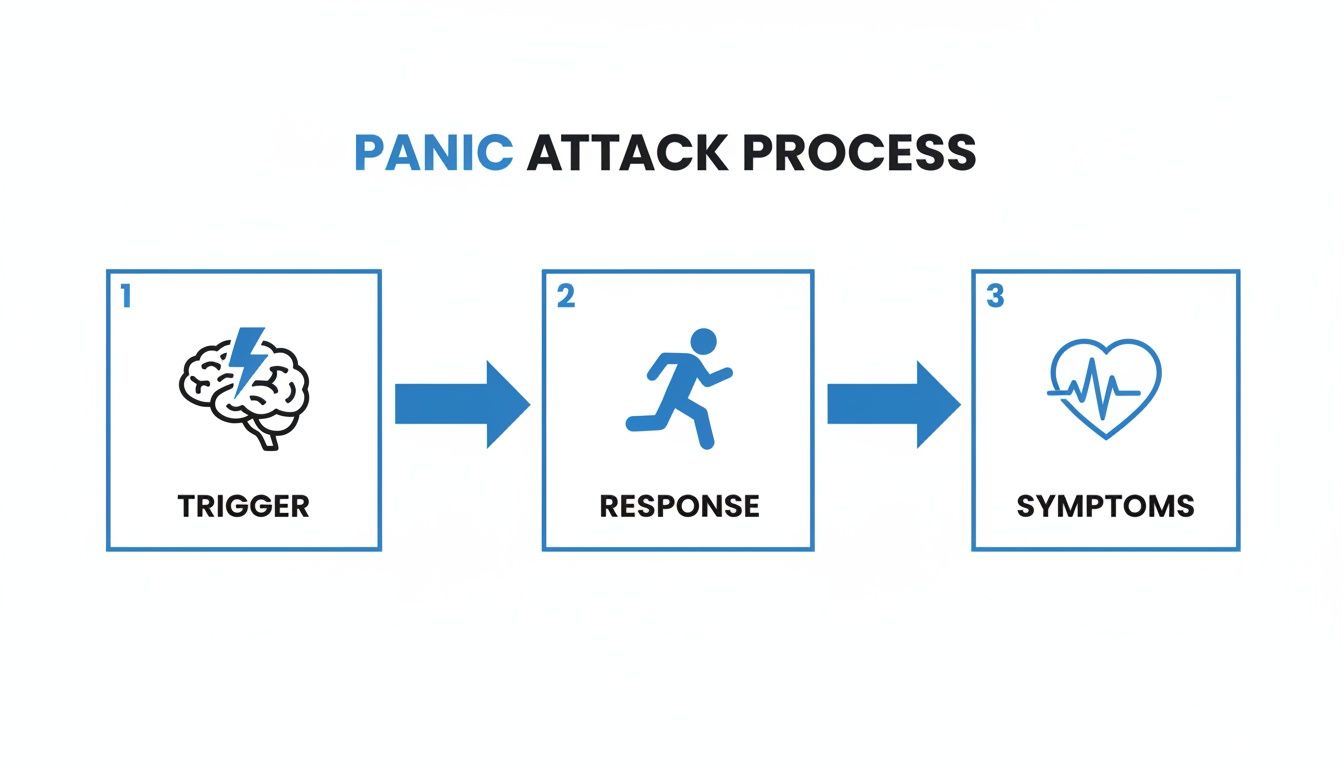
    Flowchart illustrating the panic attack process: trigger, response, and symptoms with corresponding icons.

    Understanding this process helps you see that these intense feelings are part of a predictable sequence—one you can absolutely learn to navigate with the right techniques.

    Reconnecting with Your Senses

    One of the most reliable grounding techniques is the 5-4-3-2-1 method. It's simple, private, and can be done anywhere, whether you're on a crowded train in Delhi or in a high-pressure meeting. The goal is to observe your surroundings instead of getting lost in anxious thoughts.

    Here’s how it works:

    • Look for 5 things you can see. Glance around and name five objects. Notice their colour, shape, or texture. "I see a blue pen. I see the wooden desk. I see a green plant."
    • Acknowledge 4 things you can feel. Bring your attention to physical sensations. Notice the feeling of your feet on the floor, the texture of your shirt, or a cool surface under your hand.
    • Listen for 3 things you can hear. Tune into the sounds around you. It could be the hum of traffic, the ticking of a clock, or your own breathing.
    • Notice 2 things you can smell. Try to identify scents in your environment, like coffee, soap, or fresh air from a window.
    • Identify 1 thing you can taste. Focus on one taste. You could take a sip of water or simply notice the current taste in your mouth.

    This exercise pulls your brain out of its "what if" spiral and back into reality. It breaks the momentum of panic, giving you a crucial window to breathe and re-centre.

    Grounding Techniques for Immediate Relief

    Technique How It Helps You Simple Steps to Follow
    The 5-4-3-2-1 Method Engages all five senses to interrupt anxious thought loops and anchor you in the present moment. Systematically identify 5 things you see, 4 you can feel, 3 you can hear, 2 you can smell, and 1 you can taste.
    Temperature Shock A sudden change in temperature can jolt your nervous system, redirecting your focus instantly. Splash cold water on your face, or hold an ice cube in your hand for a few seconds.
    Firm Pressure Deep, steady pressure provides reassuring physical feedback and helps you feel more contained and secure. Press your feet firmly into the floor. Push your palms together. You can also try wrapping yourself in a heavy blanket.
    Object Focus Concentrating on a single object provides a simple, external anchor for your wandering mind. Pick up a nearby object (like keys or a pen). Notice its weight, texture, temperature, and colours in detail.

    Experiment with these to find what feels most helpful for you. Having a few go-to techniques ready helps you respond calmly when panic arises.

    The Power of Controlled Breathing

    During a panic attack, breathing often becomes fast and shallow, which can increase dizziness and anxiety. Slow, deep breathing is a powerful tool for calming your body’s stress response. You can practise this simple exercise to find your balance.

    Place one hand on your stomach and, if you feel comfortable, close your eyes. Inhale slowly through your nose for a count of four, feeling your belly expand. Hold the breath for a moment, then exhale slowly through your mouth for a count of six.

    By making your exhale longer than your inhale, you activate your body's natural relaxation response. This is a direct signal to your nervous system to slow down and find calm.

    Repeat this for a few minutes. Focusing on your breath stabilises oxygen levels and gives your mind a single, calming task to hold onto. Practising these techniques regularly helps build emotional resilience, making it easier to turn to them when you need them most. For more personalised strategies, seeking therapy or counselling can provide valuable support.

    Building Your Daily Resilience to Anxiety

    Managing panic attacks isn't just about what you do in the moment. The most lasting change comes from building a daily foundation of calm and well-being. Think of it as preventative care for your mind—small, consistent habits that strengthen your emotional resilience and compassion.

    The first step is to gently understand what makes you feel vulnerable. This isn't about avoiding life's challenges but about spotting patterns. This awareness allows you to make mindful choices that support your mental health.

    Person writing a checklist in a notebook on a bedside table with a steaming coffee mug and plant.

    Identifying Your Personal Triggers

    Triggers are the specific situations, thoughts, or feelings that tend to come before a panic attack. Pinpointing them gives you the power of awareness. They often fall into a few common areas.

    For some, it might be a looming work deadline or a crowded market. For others, it could be a physical feeling like a racing heart after exercise or the effects of too much caffeine. This self-awareness helps you prepare and respond with kindness.

    Think of yourself as a detective of your own experiences. A simple journal is a great tool. When you feel anxious, note what was happening—where you were, who you were with, and what you were thinking. You're not looking for blame, just clues to support your well-being.

    This awareness can be a game-changer. For example, if you notice poor sleep leaves you on edge, prioritising rest becomes a clear, compassionate action for your mental health.

    Lifestyle Choices and Your Mental Well-being

    Your daily habits and mental state are deeply connected. Small changes to your routine can lower your baseline anxiety, creating a helpful buffer against panic. Let’s look at a few areas where simple adjustments can make a positive difference for your well-being.

    Nourishment and Hydration
    What you eat and drink has a direct link to your mood and anxiety.

    • Mindful caffeine and sugar intake: Both can activate your nervous system and mimic anxiety symptoms like a racing heart.
    • Stay hydrated: Dehydration can cause dizziness and fatigue, which an anxious mind might misinterpret as a sign of panic.
    • Eat regular meals: Consistent meals prevent blood sugar crashes that can lead to irritability and increased anxiety.

    The Power of Sleep
    A good night's rest is one of the most effective tools for managing anxiety. Aiming for a solid 7-9 hours helps your brain regulate hormones that control stress and mood. A calming bedtime routine, like reading or listening to quiet music, signals to your body that it's time to unwind.

    Navigating Workplace Stress and Burnout

    For many, especially in busy cities across India and globally, the workplace can be a source of significant pressure. Deadlines, high expectations, and long hours can contribute to chronic anxiety and burnout. Managing workplace stress is essential for your long-term well-being and happiness.

    One practical step is setting clear boundaries. This could be not checking work emails after a certain hour or taking a full lunch break away from your desk. These small acts of self-preservation create pockets of calm and prevent stress from becoming overwhelming.

    Another helpful strategy is to integrate moments of mindfulness into your day. Take two minutes between meetings to focus on your breath or do a quick stretch. These micro-breaks can reset your nervous system and help you navigate the day with greater ease. If workplace stress feels unmanageable, professional counselling can offer tailored strategies.

    Supportive Takeaway: Building resilience is a journey, not a destination. The goal is to weave small, compassionate choices into your daily life. Every healthy meal, mindful breath, and protected boundary is a step toward a stronger, calmer you. This is about consistent, kind practice, not perfection.

    When to Consider Professional Support

    Deciding to seek professional help is a positive and courageous step. It's an act of self-care and a commitment to your long-term well-being. It means you're ready to get the right tools and support to manage overwhelming experiences like panic attacks.

    In India, this can be a significant decision, as the conversation around mental health is still evolving. Cultural views can sometimes create barriers, and research on mental health barriers in India shows that many don't get the care they need due to stigma or lack of awareness. By reaching out for therapy or counselling, you are helping to change that narrative and build personal resilience.

    Understanding Your Options for Support

    There are different ways to get support, and it’s helpful to know your options. The right path is the one that makes you feel comfortable and understood.

    Here are the most common avenues for professional help:

    • Psychotherapy (Talk Therapy): A professional can help you work through mental health challenges in a supportive space. Cognitive Behavioural Therapy (CBT) is particularly effective for panic attacks, as it helps you identify and reframe the thought patterns that trigger panic.
    • Counselling: This is often focused on specific life challenges, like workplace stress or major transitions. A counsellor provides a safe space to develop practical coping skills.
    • Psychiatry: Psychiatrists are medical doctors who specialise in mental health. They can provide a formal assessment, offer therapy, and prescribe medication if it is a useful part of your treatment plan.

    It's important to remember that online self-assessments are for informational purposes only. They can be a good starting point for self-reflection but are not a substitute for a professional diagnosis.

    How to Find the Right Professional

    Finding a therapist you connect with is key to a positive experience. You need to feel safe and trusted, so the relationship matters. Today, you have more options than ever, from in-person meetings to flexible online sessions.

    When searching, look for professionals who list anxiety, stress, or panic as their areas of expertise. Reading reviews or asking a trusted doctor for a recommendation can be helpful. Don't be discouraged if the first person you speak with isn't the right fit; finding the right connection can sometimes take a few tries.

    For many, panic attacks are linked to a broader experience with anxiety. Exploring professional anxiety therapy can offer a comprehensive plan to address the root of the issue and build lasting coping skills.

    Supportive Takeaway: Reaching out is a sign of strength. It means you value your well-being enough to invest in it. Professional support provides a safe, non-judgmental space to understand your experiences, learn powerful strategies, and build a more resilient and peaceful life.

    Seeking help is a partnership. You are teaming up with someone who has the expertise to offer new perspectives and proven techniques. This collaboration can empower you to move beyond just surviving anxiety and depression and toward a future with more happiness and self-awareness.

    Creating a Long-Term Plan for Well-Being

    Managing a panic attack in the moment is one part of the journey. The other is building a life that feels more stable and secure over the long term. This is about shifting from reacting to fear to intentionally cultivating calm and happiness.

    This process involves nurturing a deeper sense of security within yourself. You'll learn who you can rely on and create a clear, actionable plan for moments of high anxiety. It’s a gentle, ongoing practice of self-compassion and resilience, where progress, not perfection, is the goal.

    A minimalist workspace with a notebook, pen, smartphone, wireless earbuds, a plant, and a water bottle on a white desk.

    Building Your Personal Well-Being Toolkit

    Your well-being toolkit is your personal collection of strategies that you know work for you. It's unique because what brings calm to one person may not work for another. Think of it as your go-to resource for maintaining emotional balance.

    To get started, include a mix of proactive habits and in-the-moment comforts.

    • Mindfulness and Movement: Incorporate small, consistent practices like a five-minute morning meditation or a short walk after lunch. Regular physical activity is a wonderful way to manage stress hormones.
    • Creative Outlets: Find activities that help you process emotions, such as journaling, painting, or listening to a specific playlist. These can provide a healthy release for pent-up tension.
    • Calming Routines: Establish predictable routines, especially around bedtime. Consistency signals safety and relaxation to your nervous system.

    For these habits to become second nature, it's helpful to understand effective habit formation strategies. This knowledge can help you integrate these supportive practices into your daily life.

    Communicating Your Needs to Your Support Network

    You don't have to go through this alone. A supportive network of friends, family, or a partner can be a great source of strength. However, they can only help if they understand what you need, as panic attacks can be confusing for those who haven't experienced them.

    Opening up takes courage but can greatly improve your relationships. Instead of just saying you feel anxious, try being specific and constructive.

    You could say, "When I start to feel overwhelmed, having a quiet space and a gentle reminder that I'm safe helps me most. Phrases like 'just calm down' aren't helpful, because my body isn't listening at that moment."

    This clear communication turns loved ones into true allies. It gives them practical ways to support you, which reduces their own feelings of helplessness and strengthens your connection.

    Creating a Personal Safety Plan

    A personal safety plan is a simple, written guide you create for yourself to use during moments of intense anxiety or panic. It's a roadmap that removes the guesswork when fear makes it hard to think clearly. Just knowing you have this plan can provide a powerful sense of security.

    Keep it somewhere easily accessible, like the notes app on your phone or a card in your wallet. Here’s what it could include:

    1. Early Warning Signs: List 2-3 personal signs that anxiety is building (e.g., "Tightness in my chest," "Racing thoughts").
    2. Immediate Coping Strategies: Write down your most effective grounding techniques (e.g., "Do the 5-4-3-2-1 exercise," "Listen to my calming playlist").
    3. Supportive Contacts: List the names and numbers of 1-2 people you can call who can offer calm support.
    4. Reassuring Reminders: Write a kind message to your future self, like "This feeling is temporary and will pass. I am safe."

    Challenges with anxiety and depression are widespread, and proactive well-being strategies are essential for navigating them. These plans are a compassionate way to care for yourself.

    Supportive Takeaway: The journey of managing panic attacks is about building a life that feels safe, supportive, and fulfilling. Your well-being plan will evolve as you grow. The goal isn't to erase anxiety, but to build the confidence and resilience to live beautifully alongside it.

    Got Questions About Panic Attacks? You're Not Alone.

    It's completely normal to have questions when you're trying to understand panic attacks. Finding clear, straightforward answers is a huge step toward feeling more in control. Let's address some of the most common concerns.

    Feeling uncertain is part of the process when dealing with something so overwhelming. The more you know, the more tools you have to build your resilience. Knowledge empowers you to make the best decisions for your mental health and happiness.

    Can I Stop Panic Attacks From Ever Happening Again?

    While the goal might feel like "curing" panic attacks forever, a more helpful aim is learning to manage them so they no longer control your life. Through consistent practice of coping skills, lifestyle adjustments, and often with therapy, most people find they can significantly reduce the frequency and intensity of attacks.

    The focus shifts from eliminating fear to building the confidence to handle it. The ultimate goal is to build resilience so you can live a full, meaningful life without the constant worry of when the next one might happen.

    How Do I Explain This to My Family or My Boss?

    Explaining what a panic attack feels like can be difficult, especially since mental health can be a sensitive topic. It's often best to keep it simple and direct. You don't have to share every detail unless you feel comfortable doing so.

    You could try saying something like: "I sometimes experience a strong physical reaction to stress called a panic attack. When it happens, what I need most is a quiet space and some patience while it passes." By focusing on what you need, you give people a practical way to help and show compassion.

    Do I Need Both Medication and Therapy?

    Not necessarily, as the best treatment plan is always personalised. For many, counselling—especially Cognitive Behavioural Therapy (CBT)—is very effective on its own. It provides practical tools to change your response to anxiety.

    For others, especially when attacks are frequent or severe, a combination of therapy and medication may be the most helpful path. The best way to know is to consult with a mental health professional. They can provide a thorough assessment (as self-assessments are informational, not diagnostic) and help you decide on a plan that supports your long-term well-being.

    What's the Difference Between a Panic Attack and an Anxiety Attack?

    People often use these terms to mean the same thing, but in a clinical sense, they are different. A panic attack is a sudden, intense wave of fear that peaks within minutes and brings on strong physical symptoms like a pounding heart or dizziness. It often feels like it comes out of nowhere.

    An "anxiety attack," which is not a formal clinical term, usually describes anxiety that builds more slowly. It is often tied to a specific worry, like an upcoming deadline. While it's very unpleasant, it is typically less intense than the sudden, overwhelming feeling of a panic attack.


    At DeTalks, we believe that finding the right professional support is a critical step towards healing and growth. Our platform connects you with qualified therapists and provides science-backed assessments to help you understand your mental health and build a more resilient life. Begin your journey toward clarity and well-being at https://detalks.com.

  • How to Increase Self Motivation and Reignite Your Drive

    How to Increase Self Motivation and Reignite Your Drive

    Figuring out how to increase self-motivation is not about forcing yourself to feel better. It’s about taking a gentle, honest look at why your drive may have faded. This journey begins with understanding the roots of your feelings without judgment.

    Why Your Motivation Fades and How to Recognise It

    It's completely normal for your inner drive to dip sometimes. Life is full of challenges that can drain our energy and enthusiasm. Before you can rebuild that fire, it helps to understand what might be dampening it.

    This process is an act of self-compassion, not self-blame. It’s about taking a moment to listen to what your mind and body are telling you. Often, a lack of motivation is a signal that something deeper needs your attention.

    Common Roots of Low Motivation

    A persistent feeling of being drained is rarely just "laziness." It's usually a sign of bigger challenges affecting your overall well-being. Sometimes the cause is clear, but often it builds slowly from different sources.

    Here are a few common reasons your motivation might be low:

    • Workplace Stress and Burnout: Constant pressure or long hours can lead to emotional and physical exhaustion. When this happens, it's hard to feel motivated about anything, both at work and at home.
    • Underlying Anxiety: If you are constantly worried, your mind uses a lot of energy just to manage those feelings. This leaves very little mental space for pursuing goals or being proactive.
    • Feelings of Depression: A persistent low mood can make even small tasks feel overwhelming. This is a real challenge that can significantly sap your drive and is not a matter of choice.

    Spotting these triggers is a key first step toward regaining your energy. This simple flow can help you visualise the path from feeling stuck to taking meaningful action.

    This visual reminds us that building motivation is a process. It begins with recognising your feelings, moves to identifying the cause, and finally leads to real, tangible action.

    To help you with the recognition phase, here are some common motivation blockers and what they might look like in your daily life.

    | Common Motivation Blockers and Their Signs |
    | :— | :— |
    | Motivation Blocker | Common Signs to Look For |
    | Burnout | Feeling cynical about your job, chronic fatigue, a sense of ineffectiveness. |
    | Lack of Clarity | Feeling overwhelmed, procrastinating on tasks, unsure where to start. |
    | Fear of Failure | Avoiding new challenges, perfectionism, self-sabotaging behaviour. |
    | Depression | Persistent sadness, loss of interest in hobbies, changes in sleep or appetite. |
    | Physical Exhaustion | Poor sleep, bad diet, or lack of exercise leading to low energy levels. |

    Please remember, this table is informational and not a diagnostic tool. It can simply be a starting point for understanding what might be happening under the surface.

    Building Self-Awareness

    The goal here is to gently figure out if this is just a tough day or a more persistent pattern. Ask yourself: have you been feeling this way for a few days, or has it stretched into weeks or months? Acknowledging the duration can bring a lot of clarity.

    Remember, this self-reflection is purely for your own information and awareness. It is not a diagnostic tool but an empowering first step to better understand your emotional landscape and improve your well-being.

    Taking time for this self-assessment helps you pinpoint your personal triggers. You might notice your motivation drops after a stressful project or during certain family events. These small insights are incredibly valuable for building resilience.

    If you find that these feelings are sticking around and affecting your life, seeking professional support through therapy or counselling can be a courageous and helpful step. It offers a safe space to explore what’s really going on.

    Setting Goals That Actually Inspire Action

    Do you ever feel like you're spinning your wheels with a vague desire to "do better" but no clear map? This feeling is one of the quickest ways to lose motivation. A wish isn't a plan; the key is to turn big ambitions into clear, actionable steps that feel exciting, not exhausting.

    This is where setting goals becomes a powerful tool for your well-being. It’s not about adding pressure, but about creating a personal roadmap that gives you direction and purpose. When you know where you're going and why, your goals start to pull you forward.

    A thoughtful young man with a pen and notebook, looking out a window, questioning 'Why?'.

    Making Your Goals SMART

    A brilliant way to create clarity is by setting SMART goals. This simple framework helps make your objectives clear, grounded, and genuinely achievable. It helps you avoid the trap of vague goals that often lead to procrastination.

    Here’s the breakdown:

    • Specific: What, exactly, do you want to achieve? Instead of "get fit," aim to "join a yoga class and go twice a week."
    • Measurable: How will you track your progress? For "learn a new skill," a measurable goal is to "complete three online modules and build a small project."
    • Achievable: Is this goal realistic for you right now? Setting a goal you can reach builds confidence and happiness.
    • Relevant: Does this goal truly matter to you? When it aligns with your personal values, your motivation to see it through will be much higher.
    • Time-bound: When will you complete this? A deadline creates a healthy sense of urgency and prevents the goal from being pushed to "someday."

    Think of it this way: "Upskill for a better job" is a nice idea. A SMART goal transforms it into a plan: "I will complete a certified digital marketing course online (Specific, Achievable) by finishing one module per week (Measurable, Time-bound) so I can qualify for a promotion in the next six months (Relevant)." Suddenly, you know exactly what to do first.

    Breaking Down Big Ambitions

    Even a perfect SMART goal can feel overwhelming if it's large. The trick is to break it down into the smallest possible chunks. This simple strategy helps manage the feeling of being overwhelmed, a common trigger for workplace stress and anxiety.

    If your goal is to write a book, the first step isn't "write chapter one." It could be "open a document and write one paragraph." These small wins create momentum and give you a sense of accomplishment, fuelling your motivation for the next step.

    This is especially helpful for career goals. For many young professionals in India, skill development is a major motivator. The India Skills Report 2025 highlights a significant rise in graduate employability, showing that building tangible skills boosts career prospects and drive.

    With so many students actively seeking practical experience, the link between action and motivation is clear. You can learn more about these trends shaping career motivation in India. By setting small, skill-focused goals, you build your competence and confidence, which is the foundation of long-term drive and the resilience needed in any career.

    Practical Techniques to Rewire Your Mindset

    Your thoughts shape your reality. When you feel stuck, figuring out how to increase self-motivation often starts with changing the inner voice in your head. With a few simple techniques, you can build a mindset that is more positive, resilient, and ready for action.

    This isn’t about pretending challenges don’t exist; it's about learning to view them from a more empowering perspective. Shifting your outlook can break a cycle of self-doubt and free up the mental energy needed to move forward. These strategies give you a real sense of control over your goals and life.

    Overhead shot of a person writing SMART goals in a notebook with coffee and a timer.

    Practice Cognitive Reframing

    Have you ever found yourself spiralling after a setback? Cognitive reframing is the skill of changing how you look at a situation to find the opportunity within the obstacle. It's a game-changer for managing difficult emotions that come with workplace stress or personal disappointments.

    So, instead of thinking, "I failed that interview, I’m not good enough," you could reframe it to: "That was excellent practice. Now I know what to prepare for next time." This small mental shift moves you from defeat to a mode of learning and growth, keeping your motivation intact.

    Use Implementation Intentions

    A goal without a plan is just a wish. Implementation intentions create a bridge between wanting to do something and actually doing it. The technique involves creating a specific "if-then" plan that decides your actions in advance.

    The formula is simple: "If situation X happens, then I will perform action Y."

    • For exercise: If my alarm goes off at 7 a.m., then I will immediately put on my workout clothes.
    • For work boundaries: If a colleague asks for help when I'm on a deadline, then I will say, "I can help you with that after I finish this task at 3 p.m."

    This pre-planning automates your response and removes the need for in-the-moment decision-making. It helps you stay on track even when your motivation is low.

    This strategy is effective because it cuts out the "should I or shouldn't I" debate that can lead to procrastination and anxiety. With a plan in place, you simply follow the script.

    Design a Personal Rewards System

    Celebrating your progress is essential for staying motivated, no matter how small the win. A personal rewards system reinforces positive behaviour and makes the journey towards your goals more enjoyable.

    Choose rewards that you find meaningful and that match the achievement. Finishing a difficult report could earn you an hour to read a book you love. Hitting your workout goals for a week might be rewarded with your favourite takeaway.

    This system trains your brain to connect effort with positive feelings, creating a sustainable cycle of motivation and boosting your overall sense of well-being. Alongside rewiring your mindset, you can explore other ways to improve your mental wellbeing through practical lifestyle changes.

    Creating an Environment That Fuels Your Drive

    Your motivation is constantly shaped by your surroundings. Your physical space, the people you talk to, and your work culture all play a part in either firing you up or draining your energy. Taking control of your environment is a powerful way to keep your ambition alive.

    Think of your surroundings as the soil for your goals. If the soil is supportive, motivation grows strong. This means creating a space that reduces distractions and fills your view with positive cues and reminders of what you're working toward.

    The Power of a Supportive Workplace

    For most of us, work is where we spend a huge portion of our time. A positive workplace culture is essential for staying motivated. When you feel you belong and are trusted to do your work, your engagement naturally increases.

    Recent data from India highlights this point. While workplace engagement has seen a dip, employees with more control over where they work show much higher engagement. This is a clear signal that empowerment is directly linked to motivation.

    Flexibility and trust are not just perks; they are fundamental for preventing the kind of workplace stress that leads to burnout. A company culture that trusts its people builds the resilience we all need to stay driven.

    Building Your Accountability System

    Trying to achieve big goals alone is incredibly difficult. An accountability system can provide the structure and support needed to stick with it, especially on days when your internal drive is low.

    This system can look different for everyone. Here are a few ideas:

    • Find a Mentor or Coach: This is someone who has been where you want to go and can offer guidance and perspective.
    • Get an Accountability Partner: Team up with a friend or colleague for regular check-ins. Knowing someone will ask about your progress can be a powerful push.
    • Consider Professional Therapy: A therapist offers a safe space to work through deeper roadblocks like anxiety or depression and develop helpful coping strategies.

    Accountability is about creating a compassionate support structure for yourself. It’s a reminder that you’re not in this alone and that your efforts matter.

    To keep that fire lit long-term, you have to build an environment that supports your overall well-being. This includes fundamental habits like improving sleep quality naturally. When your mind and body are rested, every challenge feels more manageable.

    When It’s Time to Call in Professional Support for Your Well-Being

    The journey to boost your self-motivation is a personal one. Sometimes, the bravest and most effective step is admitting you don't have to figure it all out alone. Reaching out for support is a powerful act of self-awareness and strength.

    The idea of professional support may seem intimidating, but it just means adding an expert to your corner. A therapist or counsellor can help when feelings of low motivation, anxiety, or sadness become constant and get in the way of your life.

    A bright workspace with a laptop displaying a calendar, a potted plant, and a 'Start Small' framed note.

    Is It Just a Slump or Something More?

    We all have off days or even off weeks. That's perfectly normal. The key is to recognise when a temporary dip in motivation might be hinting at a deeper issue.

    Consider these signs as signals that it might be time to get a professional perspective:

    • Duration: The feeling of being unmotivated has been dragging on for several weeks or more.
    • Impact: It’s affecting your work, straining your relationships, or making self-care feel impossible.
    • Other Feelings: Your lack of motivation is paired with persistent sadness, irritability, or overwhelming anxiety.
    • Loss of Interest: You've stopped caring about hobbies and activities that used to bring you happiness.

    What Actually Happens in Therapy or Counselling?

    Taking the first step into therapy or counselling can feel daunting. In India, thankfully, the conversation around mental health is opening up, and support is more accessible. At its core, a session is a confidential chat with a trained professional focused on your well-being.

    Your first session is usually about telling your story in a safe, non-judgmental space. The therapist will listen to understand your challenges and work with you to create a practical plan for building resilience.

    This kind of collaborative guidance is becoming more common. The personal development market in India, which includes coaching and self-motivation training, is growing rapidly. This shows how much people value structured support. You can read more about this growing trend toward self-improvement.

    Using Assessments for Insight, Not Diagnosis

    If you're trying to make sense of your feelings, informational assessments can be a great starting point. Platforms like DeTalks offer scientifically validated tools that provide a snapshot of things like depression, workplace stress, or anxiety levels.

    It’s crucial to remember that these are for your information only—they are not a diagnosis. Think of them as a compass that can point you in the right direction. Armed with this insight, you can have a more focused conversation with a mental health professional.

    Common Questions About Finding Your Motivation Again

    It's completely normal for questions to pop up when you're working on how to increase self-motivation. You might wonder how long it will take or what to do when you hit a wall. Let's tackle some of the most common questions.

    How Long Does It Take to Feel Motivated Again?

    There’s no one-size-fits-all answer, as the journey is deeply personal. Some people feel small sparks of motivation within a couple of weeks of trying new habits. For others, especially if the root cause is burnout or ongoing workplace stress, it can take more time.

    The key is to focus on consistency, not speed. Celebrate the small wins, as they build the momentum you need for bigger steps. Think of it as a long-term investment in your well-being and personal happiness.

    Can I Boost Motivation While Dealing with Anxiety?

    Yes, absolutely, but it requires a great deal of self-compassion. Challenges like anxiety and depression can drain your energy, making simple tasks feel difficult. The strategies in this guide can be helpful, especially when paired with professional support from a therapist.

    Start with the smallest, most manageable step you can think of. On some days, just getting through the day is a massive win, and that is more than okay. Professional counselling can provide a structured, safe space to work through these complex feelings.

    It can be disheartening when you put in the effort but don't see immediate results. This is not a sign of failure. It often means the root issue may benefit from a different approach, which is a perfect time to bring a professional onto your team.

    What if I Try These Techniques and Still Feel Stuck?

    Feeling stuck after trying new strategies is frustrating, but it’s not a personal failing. It’s a common experience that usually means the underlying cause needs a different approach.

    This is a good time to consider outside support. A counsellor can help you explore things you might not be aware of, like lingering stress or old thought patterns. You’ve already done the hard work of trying on your own; getting professional guidance is just the next smart, logical step.

    How Can I Stay Motivated in a Stressful Work Environment?

    A high-pressure job can drain motivation quickly. While you might not be able to change the company culture, you can work on what’s within your control to build resilience.

    Start by setting firm boundaries to protect yourself from burnout. Try to focus on the parts of your job that you find meaningful. Finally, don't underestimate the power of leaning on a few trusted colleagues for support and connection.


    Navigating your mental health is a journey, and you don’t have to do it alone. DeTalks offers a safe space to find the right therapist or explore scientifically-backed assessments to better understand what you're feeling. Take the next step toward clarity and resilience by visiting the DeTalks website.

  • A Guide to Online Treatment for Depression in India

    A Guide to Online Treatment for Depression in India

    Recognising you might need support is a brave and important step. If you're exploring your options, this guide offers a clear, gentle path through online treatment for depression. Think of it as a helpful map for finding your way to feeling better, with a special focus on the context in India.

    A New Path to Mental Well-Being in India

    Taking the first step toward mental wellness can feel big, but you are not alone on this journey. In India, conversations about mental health are becoming more open, creating new ways to find professional, confidential help. Online therapy offers a private and flexible way to get support from your own comfortable space.

    This guide is designed to be a supportive companion on your path. We will explore how online treatment for depression can provide you with tools to manage difficult emotions and build a stronger, more resilient you.

    Navigating Life's Modern Pressures

    Modern life can be demanding, whether you're in a bustling city or a quiet town. Juggling a career, family, and personal goals can leave anyone feeling overwhelmed and stretched thin.

    This constant pressure can show up in different ways, making everyday tasks feel like a challenge. Recognising these signs is the first step toward feeling more in control of your well-being.

    • Workplace Stress: Feeling overwhelmed by deadlines or a tough work environment can lead to burnout.
    • Anxiety: This can feel like a persistent worry or restlessness that makes it hard to focus.
    • Depression: This often shows up as a heavy sadness, loss of interest in things you once enjoyed, or feeling tired all the time.

    Online counselling provides a safe, non-judgemental space to work through these feelings. A therapist can help you understand the roots of these challenges and develop practical strategies to manage them.

    Building a Foundation of Well-Being

    Support isn't just about managing tough times; it's about building a life that feels good and meaningful. This is where positive psychology can help by focusing on our strengths, like resilience and compassion.

    "Therapy is not about becoming a new person. It’s about becoming more of who you truly are, with tools to navigate life’s ups and downs more effectively."

    It’s a shift from just getting by to truly thriving. Online therapy can be a wonderful guide in this process, helping you lay a solid foundation for your overall well-being and happiness.

    • Resilience: This is your ability to bounce back from challenges and adapt to change.
    • Compassion: Learning to be kinder to yourself can quiet your inner critic and improve your relationships.
    • Happiness: It's about discovering what brings you joy and purpose to build a more fulfilling life.

    Please remember, the information here is for guidance and understanding. It is not a substitute for a formal evaluation by a qualified healthcare professional.

    Understanding Online Depression Treatment

    Online therapy is much like a traditional therapy session, but it happens in a secure, private digital space. Instead of travelling to an office, you receive professional support for challenges like depression and anxiety from wherever you feel most comfortable.

    Online treatment for depression offers a variety of care options, from live video calls to structured self-paced programs. This flexibility is making professional mental health support more approachable and accessible for many people.

    Bridging a Critical Gap in Mental Health Care

    In India, accessing quality mental health care can be difficult due to distance, schedules, or stigma. Online platforms are helping to close this gap by connecting people with the support they need, wherever they are.

    The need for this is clear. India has just 0.75 psychiatrists for every 100,000 people, which is far below the recommended number. This makes finding in-person help a challenge for many, positioning online therapy not just as a convenience but as a vital solution. You can read more about India's mental health landscape and how technology is helping.

    This improved access means expert care for depression or workplace stress is now within reach for many more people.

    More Than Just Managing Symptoms

    Good online counselling does more than help with the symptoms of depression or anxiety. It aims to build a strong foundation for your long-term mental well-being by giving you practical skills and a deeper understanding of yourself.

    This often involves a blend of proven therapeutic methods and principles from positive psychology. The goal is to equip you with the tools you need to face future challenges with greater strength and confidence.

    At its core, therapy is about building resilience—that inner capacity to navigate life's inevitable ups and downs without getting swept away. It's about strengthening your own resources so you can face challenges from a place of calm and control.

    How It Fosters Growth and Resilience

    Online treatment provides a supportive space to work on personal growth. Your therapist acts as a guide, helping you identify unhelpful thought patterns that may contribute to feelings of sadness, stress, or burnout.

    Together, you can build healthier ways of coping. This process might involve:

    • Building Self-Compassion: Learning to be as kind to yourself as you would be to a friend.
    • Developing Emotional Regulation: Gaining skills to better understand and manage your emotions so they feel less overwhelming.
    • Finding Purpose and Happiness: Exploring what gives your life meaning to create a more fulfilling future.

    While tools like online assessments can offer useful insights into your emotional state, they are informational, not diagnostic. They serve as a starting point for a meaningful conversation with a qualified professional.

    Exploring Different Types of Online Therapy

    When you look into online treatment for depression, you'll find several options. The best approach is the one that fits your personality, schedule, and comfort level.

    Think of it as a menu of services, each offering a unique way to get support. Let’s look at the most common formats to help you understand how they work.

    Live Video and Audio Sessions (Teletherapy)

    This is what most people picture when they think of online counselling. You schedule live appointments with a therapist and meet through a secure video or audio call for a real-time conversation.

    This format is great if you value direct interaction and want to build a strong connection with your therapist. It provides dedicated time to work through feelings related to depression, anxiety, or workplace stress.

    Internet-Delivered CBT Programmes

    Internet-delivered Cognitive Behavioural Therapy (iCBT) is a structured, educational approach. You work through online modules that teach you the core skills of CBT, a powerful method for managing depression.

    A therapist often guides you, checking in with messages or short calls to offer support. This blend of self-paced learning and professional guidance is ideal if you prefer a clear curriculum. You can also explore best Cognitive Behavioural Therapy (CBT) apps that use a similar model.

    This flowchart can help you think about whether the flexibility of online care is a good fit for you.

    Flowchart asking if online therapy is right, showcasing flexibility with time, mental health, and location.

    As you can see, factors like a busy schedule or the comfort of home can make online therapy an excellent choice for your mental well-being.

    Medication Management (Telepsychiatry)

    For many, an effective path for managing depression includes both therapy and medication. Telepsychiatry makes this process seamless online by connecting you with a qualified psychiatrist through video consultations.

    It's important to know that only medical doctors, like psychiatrists, can prescribe medication. Therapists provide talk therapy but cannot write prescriptions, making telepsychiatry a vital part of online care.

    This service is a game-changer if you need medication but find it hard to get an in-person appointment. It brings expert medical care into your home, ensuring your treatment plan is complete and well-managed.

    Comparing Online Therapy Formats

    How do you choose the right format? It depends on what you're looking for in terms of interaction, structure, and support. The table below outlines the key differences to help you decide.

    Therapy Type Best For Level of Interaction Typical Structure
    Live Teletherapy Those who want a strong, direct connection with a therapist and real-time conversation. High Weekly or bi-weekly scheduled sessions (video or audio).
    Internet-Delivered CBT Individuals who prefer a structured, educational approach and self-paced learning. Low to Medium Sequential modules with exercises, often with periodic therapist check-ins.
    Guided Self-Help Apps People looking for introductory tools to build resilience and manage mild symptoms. Low Daily check-ins, guided meditations, mood tracking, and educational articles.
    Telepsychiatry Those needing a medical evaluation for medication to complement their therapy. High (Medical Focus) Initial consultation followed by regular follow-up appointments for management.

    Ultimately, the best online treatment for depression is the one that feels right for you. Whether you prefer direct interaction or self-paced learning, there is an online path that can help you build resilience.

    Online vs. In-Person Therapy: Which Is Right for You?

    When considering therapy, you might wonder whether to choose an online or in-person setting. Research shows that for many people, especially those with mild to moderate depression, online support can be just as effective.

    There is no single "better" option. The right choice depends on your lifestyle, comfort with technology, and personal preferences for your therapy journey.

    Convenience and Access: Therapy on Your Terms

    The biggest advantage of online therapy is its convenience. It eliminates travel time, which is a huge benefit whether you live in a busy city or a remote area.

    This means you can connect with a professional from a place where you feel completely comfortable, like your own home. Feeling safe can make it easier to open up and discuss what’s on your mind.

    The Client-Therapist Connection

    The bond you build with your therapist is a key part of successful therapy. Many people wonder if this connection can be as strong through a screen, and experience shows that it absolutely can.

    A strong therapeutic relationship is built on trust, empathy, and feeling truly heard. These human qualities come through a screen just as powerfully as they do in person.

    While in-person sessions offer the benefit of seeing body language, a skilled online therapist is trained to listen closely to build a deep connection. The chemistry between you and your therapist matters most, not the medium you use.

    Weighing Up the Cost and Effectiveness

    Effectiveness and cost are important considerations. Studies have shown that online Cognitive Behavioural Therapy (CBT) is as effective as face-to-face therapy for managing depression and anxiety.

    In India, the demand for mental health support has grown, with a 40% jump in people seeking help since the pandemic. Online therapy is often 20–30% less expensive than traditional sessions, making care more accessible. You can learn more about the rise of online therapy packages in India and their effectiveness.

    This blend of effectiveness and affordability makes online treatment for depression a powerful and practical choice for improving your well-being.

    How to Choose the Right Online Therapist for You

    Finding the right person to talk to is the most important step in your therapy journey. The connection you build with your therapist is the foundation for growth, so it's worth choosing thoughtfully.

    This guide will walk you through what qualifications to look for and the best questions to ask. Making an informed choice helps you start your online treatment for depression feeling confident.

    Checking Qualifications and Specialisations

    First, ensure you're speaking with a qualified professional. In India, look for credentials like a Master's degree in Psychology (M.A./M.Sc.), an M.Phil in Clinical Psychology, or a PhD in Psychology.

    Also, consider their areas of expertise. A therapist specializing in depression, anxiety, or workplace stress will have a deeper understanding of your challenges. Platforms like DeTalks make this easy by listing each therapist's credentials and specialities.

    Questions to Ask in Your First Consultation

    Most online services offer an initial consultation, which is a great chance to see if you connect. Think of it as a conversation to see if the therapist feels like a good fit for you.

    Having a few questions ready can help you make the most of this chat. It's about understanding their approach and seeing if it aligns with your needs.

    Here are a few ideas:

    • What's your approach to helping with challenges like depression?
    • How do you help clients build skills for resilience and self-compassion?
    • What does a typical therapy session with you look like?
    • How will we work together and track progress toward my goals?

    Pay attention to how the conversation feels. The best therapist for you is someone you feel you can be open and honest with.

    Understanding Costs and Payment in India

    The cost of online counselling in India is generally more affordable than in-person sessions. Most services charge per session, and some offer discounted packages for booking multiple sessions.

    Before you commit, get a clear understanding of the payment process and cancellation policy. Feeling clear about the financial side removes a potential source of stress, allowing you to focus on your well-being.

    Choosing a therapist is a personal decision, so take your time. Finding someone who feels like a true partner for your journey can make all the difference.

    Final Thoughts on Your Path Forward

    Exploring therapy is a courageous act of self-care and an investment in your well-being. This journey is not about finding a quick fix but about discovering new ways to cope and uncovering your inner resilience.

    Online treatment for depression offers a safe space to process your experiences and practical tools for the road ahead. It’s about building resilience to handle life's challenges and learning to show yourself compassion along the way.

    How to Make Online Therapy Work for You

    A little preparation can make a big difference in your online counselling sessions. Creating a focused and secure space helps you open up and engage fully with your therapist.

    Here are a few tips to get the most out of every session:

    • Find a private space: Choose a quiet spot where you won't be disturbed to help you focus.
    • Be open and honest: The more you share, the better your therapist can support you.
    • Apply what you learn: The real progress happens when you practice new skills in your daily life.

    The effort you put in is a direct investment in your long-term well-being.

    It's a Marathon, Not a Sprint

    Therapy is a partnership where you are the expert on your life, and your therapist is a guide. They have the tools to help you navigate challenges like anxiety, workplace stress, or depression.

    I often tell my clients to think of therapy like tending to a garden. It takes patience, consistent care, and the right environment to thrive. Some days will be bright and sunny, while others might bring rain. But every single day of tending to it helps something beautiful grow.

    Progress isn't always a straight line, so celebrate small wins and be kind to yourself on tough days. Exploring strategies to reduce brain fog can also be a helpful addition to your toolkit. Remember that online assessments are informational starting points, not diagnoses. Help is more accessible than ever, and you can take the next step whenever you're ready.

    Your Questions About Online Depression Treatment, Answered

    It's natural to have questions when starting something new, especially regarding your mental health. We've gathered answers to some common questions about online treatment for depression to help you feel more comfortable.

    Getting your questions answered is an important part of feeling ready. This can help you make a choice that feels right for you on your journey toward building greater resilience.

    Is My Information Kept Confidential in Online Therapy?

    Yes, absolutely. Reputable online therapy platforms in India follow the same strict confidentiality rules as in-person therapists. They use secure, encrypted technology to ensure your conversations remain private.

    It's always a good idea to review a platform's privacy policy before signing up. This will help you feel secure and focus on your well-being.

    What if I Don’t Click with My First Online Therapist?

    This can happen, and it's perfectly okay. The connection with your therapist is vital for successful therapy, and it might take time to find the right match.

    Most online services make it easy to switch to a new therapist if the first one doesn't feel right. Finding someone who understands you is a key step in feeling supported with challenges like anxiety or depression.

    "Finding the right therapist is like finding the right key for a lock. It's not about the key being 'bad' if it doesn't fit the first time—it's about finding the one that turns smoothly."

    Can I Get Medication Through Online Treatment?

    Yes, through a service called telepsychiatry. While counsellors provide talk therapy, only a psychiatrist, who is a medical doctor, can prescribe and manage medication.

    Many platforms now offer access to online psychiatrists for evaluation and prescription management. This allows you to receive both therapy and medical treatment conveniently, supporting your overall well-being.

    What Technology Do I Need for Online Therapy?

    You likely already have what you need: a smartphone, tablet, or computer with a camera and a stable internet connection.

    Just as important is your environment. Finding a quiet, private space where you can speak openly is essential for making the most of your counselling sessions.


    Taking steps towards better mental health is a personal and brave decision. If you feel ready to connect with a professional who can guide you, DeTalks provides a safe, trusted space with qualified therapists and science-backed assessments. Begin your journey to resilience and well-being today at https://detalks.com.

  • Feeling Lost in Life? A Guide to Finding Your Way

    Feeling Lost in Life? A Guide to Finding Your Way

    It’s a deeply human experience to feel adrift, like you’re trying to navigate life without a map. This isn't a sign of failure; it's a quiet signal to pause, breathe, and reconnect with yourself. In a world that never stops moving, feeling lost in life is rarely a final destination—it's often a necessary stop on the journey of personal growth.

    Why It's Perfectly Normal to Feel Lost

    Feeling lost connects us all at some point. It can seem like you’re walking through a dense fog where the usual landmarks have vanished, and you can’t see the path ahead. It’s important to remember this isn't a personal flaw, but a natural reaction to the complexity and constant changes of life.

    Here in India, the pressure to follow a set path can be immense, especially for students and young professionals. When your own dreams don’t fit the traditional script of career, marriage, and settling down, confusion can set in. This gap between societal expectations and your inner voice is a common reason for feeling lost.

    A Powerful Signal for Growth and Change

    Instead of seeing this feeling as a crisis, consider it a powerful message from your inner self. It’s your mind’s way of saying, "Hey, something isn't working anymore. It's time for a change." This period of uncertainty, though uncomfortable, is often the soil from which new passions, self-awareness, and a stronger sense of purpose can grow.

    This feeling often surfaces during big life transitions, such as:

    • Graduating and entering the professional world.
    • Questioning your career path after several years.
    • Navigating the end of a significant relationship.
    • Adapting to new family roles and responsibilities.

    These moments can shake our sense of identity. They force us to pause and reflect on what's truly important, making that temporary feeling of being directionless almost unavoidable.

    Turning the Journey Inward

    The key is to approach this phase with curiosity, not criticism. It's your chance to ask important questions: What truly brings me joy? What are my core values? What kind of life do I genuinely want to build? Finding the answers takes time, patience, and self-compassion.

    Feeling lost doesn't mean you are broken; it means you are in the process of becoming. It's an invitation to rediscover your internal compass and chart a course that is authentically yours.

    This isn't about a quick fix; it’s about building resilience. By exploring these feelings without judgement, you can understand their source—whether it's workplace stress, underlying anxiety, or a genuine need for a new direction. This compassionate approach can turn confusion into a profound journey of self-discovery.

    Understanding Why You Might Be Feeling Lost

    Feeling lost often begins as a quiet sense that something is off, growing until it becomes a mental fog. It's usually not one single problem, but a mix of internal and external pressures. The first step to finding your way is understanding what’s causing these feelings.

    This feeling often has deep roots in workplace stress. When the daily grind drains your energy and leaves you disconnected from any sense of purpose, it’s natural to question everything. This can lead to burnout, a state of emotional and physical exhaustion that makes seeing a clear path forward feel impossible.

    Societal expectations, particularly within the Indian context, add another layer of pressure. When the unspoken script for life clashes with your authentic desires, it creates a painful conflict. This inner struggle is a significant reason so many of us end up feeling lost in life.

    The Signs: How Feeling Lost Shows Up

    The signs you're feeling lost can appear in your thoughts, emotions, and daily habits. You might notice a persistent low mood, a lack of excitement for things you once loved, or a general sense of just going through the motions. It can feel like you’re an actor in your own life, reading lines without any real connection.

    Behaviourally, this often looks like chronic indecisiveness, where even small choices feel overwhelming. You might find yourself procrastinating more or withdrawing from friends and family. This isn't a weakness; it's your mind signalling that it's overwhelmed and unsure which way to turn.

    This feeling, while difficult, can also be a powerful signal for personal growth.

    Infographic showing a person feeling lost, connected to solutions, achievements, and personal growth symbols.

    As this image suggests, we can reframe this experience. Instead of a dead end, think of it as a pause—a chance to reflect, recalibrate, and find a path that feels more true to you.

    Connecting the Dots to Your Overall Well-being

    It is vital to listen to these feelings, as they are valid signals from your mind and body. Persistent confusion and a lack of drive are often tied to deeper issues affecting your mental well-being. If left unaddressed, they can sometimes contribute to conditions like anxiety or depression.

    Feeling lost isn’t a clinical diagnosis; it's a human experience. Think of it as an invitation to explore what’s really going on and build greater self-awareness and resilience.

    Broader societal changes in India, like rapid urbanization, also contribute to this collective feeling. A report highlighted that 74% of Indians experienced stress and 88% reported symptoms of anxiety, with many mentioning feeling disconnected. You can learn more about these alarming mental health statistics in India and their impact.

    To help you connect the dots, let's break down the common signs.

    Recognizing the Signs You Might Be Feeling Lost

    Pinpointing what’s wrong can be hard. This table outlines common signs across different areas of life to help you identify what you may be experiencing. It is important to remember that this is for informational purposes and is not a diagnostic tool.

    Category Common Signs and Symptoms
    Emotional A persistent sense of emptiness, feeling numb, or a lack of joy even in good moments.
    Behavioural Chronic indecisiveness, avoiding social situations, procrastinating on important tasks, and a general loss of motivation.
    Cognitive Constant confusion about your future, trouble concentrating, and a nagging inner critic that fuels negative self-talk.
    Physical Unexplained fatigue, changes in your sleep patterns or appetite, and persistent aches and pains often linked to stress.

    If this sounds familiar, please know you're not alone. This is a common human experience. The journey out starts with being kind to yourself and exploring these feelings without judgement. Reaching out for support, whether through professional counselling or talking to a friend, can provide the anchor you need to navigate this time.

    Simple First Steps to Regain Your Footing

    When you're feeling lost, the idea of making a big decision can be overwhelming. The secret isn't to solve everything at once but to take small, manageable steps that create a little calm. These actions are about giving yourself a moment to breathe and reconnect with the present.

    Think of it as clearing a tiny patch in a thick fog—just enough to see your own two feet on the ground again. It’s about creating a stable base from which you can begin to explore your path forward.

    An open notebook with a shopping list and a pen next to a steaming cup of tea on a sunlit wooden table.

    Ground Yourself in the Present Moment

    Feeling lost often means your mind is stuck worrying about the future or replaying the past. Grounding techniques bring your attention back to the here and now, which can instantly reduce anxiety. One of the simplest ways to do this is through mindful breathing.

    Try this quick, three-minute exercise:

    1. Find a quiet spot where you can sit comfortably.
    2. Gently close your eyes and bring your focus to your breath, noticing the air moving in and out.
    3. Count your breaths. Try breathing in for four counts, holding for four, and slowly breathing out for six. Repeat this for a few minutes.

    This simple action breaks the cycle of stressful thoughts and gives your nervous system a chance to reset. It’s a powerful tool for building emotional resilience, one breath at a time.

    Untangle Your Thoughts Through Action

    Sometimes the easiest way to change your mental state is to change your physical one. Focusing on simple, concrete activities can help loosen the knot of difficult feelings. You can explore various therapeutic activities for mental well-being that offer a gentle boost.

    Here are a few practical ideas to try today:

    • Journal for five minutes: Write down your thoughts without judgement. Getting them onto paper can bring surprising relief and clarity.
    • Take a short walk: A 10-15 minute walk, especially in nature, can do wonders for clearing your head. Notice the sights and sounds around you.
    • Connect with a friend: Send a message to someone you trust. Simply sharing that you’re having a tough time can make you feel less alone.

    Remember, the goal of these first steps isn't to find a magic cure. It's about creating space and showing yourself some compassion. Each small action builds momentum.

    These practices are your immediate toolkit for managing overwhelming feelings. They build a stable foundation from which you can later explore deeper questions about your life's direction.

    How to Reconnect with Your Inner Compass

    Once you have some breathing room, you can begin the deeper work of reconnecting with yourself. This isn't about a quick fix; it's about carefully building a new path forward that feels authentic. It’s a journey to rediscover what truly matters, away from the noise of external expectations.

    Finding your way again is a process of self-discovery that starts by turning your attention inward. The goal is to build long-term resilience and a stronger sense of direction. Let's explore practical ways to identify your values, set meaningful goals, and practice self-compassion.

    Silhouette of a person holding a glowing compass against a beautiful sunset sky, standing on a hilltop.

    Rediscover Your Core Values

    Think of your core values as your personal compass; they are the beliefs that guide your choices. When you feel lost, it’s often because your daily life has drifted away from what you truly believe in. Getting clear on what’s most important to you is a huge step toward finding your way back.

    Think back to moments when you felt genuinely happy and alive. What were you doing? Who were you with? The answers often point to your values, whether that's creativity, community, security, or adventure.

    To get started, ask yourself:

    • What topics do I enjoy reading or thinking about for fun?
    • What qualities do I admire in other people?
    • If there were no limits, what impact would I want to have on the world?

    Jot down whatever comes to mind without judgement. This is a personal exploration to help you find what gives your life meaning.

    Set Small, Meaningful Goals

    Once you have a better sense of your values, you can set small, manageable goals that align with them. Aim for progress, not perfection. Small wins build momentum and confidence, which is a powerful way to counter feeling stuck.

    For instance, if "community" is a core value, a small goal could be calling a friend once a week. If "creativity" drives you, your goal might be spending 20 minutes sketching each day. These tiny actions anchor your values in the real world, creating a renewed sense of purpose.

    Feeling lost can feel permanent, but it’s almost always a temporary state of disconnection. By aligning your daily actions with your core values, you begin to chart a new course, one small, intentional step at a time.

    This gradual process helps you rebuild trust in yourself. It proves that you have the power to shape a life that feels authentic and contributes to your happiness.

    Cultivate Self-Compassion and Connection

    The journey back to yourself requires kindness. Self-compassion means treating yourself with the same care you’d offer a friend. It's about accepting that it’s okay to feel lost and that you don't need all the answers right now, which is key to cultivating self-compassion for emotional well-being.

    Building a support network is just as crucial. Sharing your feelings with trusted friends, family, or a professional through therapy or counselling can bring incredible relief. Connection reminds us that we aren't alone and helps us build the resilience needed to navigate tough times.

    When to Consider Professional Guidance

    While self-help strategies are powerful, sometimes the fog is too thick to navigate on your own. Reaching out for professional support isn’t a sign of weakness; it’s a courageous step toward reclaiming your well-being. A therapist can act as a guide for your inner world, helping you find a safe path forward.

    Taking this step is especially important if these feelings persist and interfere with your daily life. If feeling lost has been a constant companion for weeks or months, professional guidance can offer needed structure and support. The goal of therapy is not just to get by, but to build lasting resilience and a greater sense of happiness.

    Signs It Might Be Time to Talk to Someone

    Recognizing when you need more support is a sign of self-awareness. While everyone’s journey is different, a few common signals suggest that professional help could be beneficial. Consider professional counselling if you find yourself nodding along to several of these points.

    Consider reaching out if you're experiencing:

    • Persistent Hopelessness: A constant feeling that things will never get better.
    • Significant Life Disruption: Your ability to work, study, or maintain relationships is suffering.
    • Overwhelming Emotions: You feel swamped by sadness, anxiety, or anger that you can't manage.
    • Social Withdrawal: You consistently avoid friends, family, and activities you once enjoyed.
    • Changes in Physical Health: Unexplained tiredness, sleep issues, or appetite changes have become your new normal.

    Please remember, this list is for informational purposes to help you reflect on your experience. It is not a diagnostic tool.

    Understanding Therapy and Counselling

    Therapy and counselling both provide a safe, confidential space to explore your feelings with a trained professional. Knowing the difference can help you find the right fit. Counselling is often shorter-term and focused on specific issues, like managing workplace stress.

    Therapy can be a longer-term process that goes deeper. It helps you understand recurring patterns of thought and behaviour that may be at the root of feelings like depression or chronic anxiety. Both approaches are designed to empower you with coping skills and greater self-awareness.

    Seeking professional help is an investment in your long-term happiness and well-being. It provides a dedicated space to untangle complex feelings and develop healthier ways of navigating life's challenges.

    A professional can help you build coping skills and find a clearer path forward when you are feeling lost in life.

    What to Expect in Your First Session

    The idea of a first therapy session can feel intimidating, but it’s usually a gentle process. The main goal is for you and the therapist to get to know each other and see if you’re a good match. It is a conversation, not an interrogation.

    The therapist will likely ask what brought you in and what you hope to achieve. This is also your chance to ask them questions about their approach and experience. Finding the right therapist is about connection, which is key to a supportive therapeutic relationship.

    Your Questions About Feeling Lost, Answered

    When you're feeling adrift, it's natural to have questions. Trying to make sense of this unsettling time is a huge first step. Let's walk through some common concerns to help normalize what you're going through and offer practical perspective.

    Feeling lost isn't a sign of failure; it's a very human experience. Asking these questions is how you start to find your way back to a path with purpose and a greater sense of happiness.

    How Long Does This Feeling Last?

    There's no set timeline, as the experience is personal. For some, it might be a short phase that passes in a few weeks. For others, it can linger for months, especially if it’s tied to deeper issues like burnout or intense workplace stress.

    The duration depends on the cause and how you approach it. Engaging in self-reflection, leaning on your support system, and making small, meaningful changes can help shorten this period. The goal isn't to rush through it, but to use this time to build resilience and clarity.

    It’s important to remember that this feeling isn't permanent, even when it feels like it is. It is a season of life, and like all seasons, it will eventually pass. Patience and self-kindness are your best allies.

    Is Feeling Lost the Same as Depression?

    This is a crucial distinction to make. While feeling lost and depression can look similar—both may involve low moods or a lack of motivation—they are not the same. Feeling lost is often a reaction to your circumstances, an existential response to life changes or a lack of purpose.

    Depression, on the other hand, is a persistent mental health condition defined by a consistent low mood and loss of interest that interferes with daily life. It often requires professional help, like therapy, to manage effectively. If your feelings are constant and overwhelming, it is vital to speak with a professional. Please remember, this information is for educational purposes and is not a substitute for a professional diagnosis.

    Could My Job Be the Real Reason I Feel So Lost?

    Yes, absolutely. Our careers take up a huge part of our lives and are often tied to our identity. It's very common for work to be the source of feeling lost, especially with prolonged workplace stress, a lack of meaning, or a toxic environment.

    This feeling can be stronger if you chose your career based on external expectations rather than your own passions. If you suspect your job is the issue, ask yourself if it aligns with your values and offers a sense of accomplishment. Answering honestly can provide the clarity needed to decide if a career change is the key to finding your direction again.

    What Role Does Self-Compassion Play in All This?

    Self-compassion is one of the most powerful tools you can use when feeling lost in life. It simply means treating yourself with the same kindness you'd give a friend. Instead of being critical, self-compassion allows you to accept your feelings without judgement.

    This practice is the foundation for building resilience. By being kinder to yourself, you create a safe mental space to explore your feelings, which is essential for self-discovery. It helps quiet the harsh inner critic that fuels anxiety, making it easier to hear what you truly need and want.

    How Do I Know if I Actually Need Therapy?

    Deciding to seek therapy or counselling is a personal choice. If this feeling of being lost won't go away, harms your work or relationships, or comes with overwhelming anxiety, it might be time to reach out.

    A good therapist provides a safe, structured space to unpack these feelings. They can offer practical tools and guide you as you reconnect with your values. If you've tried to work through it on your own but still feel stuck, a professional can provide the support needed to find a clear path forward.


    At DeTalks, we understand that finding your way starts with the right support. Our platform connects you with qualified therapists and provides science-backed assessments to help you understand your unique needs. These assessments are informational and not diagnostic. Take the first step toward clarity and resilience today. Explore support options on DeTalks.

  • Self Confidence Affirmations: A Guide to Building Inner Strength

    Self Confidence Affirmations: A Guide to Building Inner Strength

    In a world that constantly tests our resolve, finding a stable sense of self-worth can be a significant challenge. The pressures of modern life, from workplace stress and anxiety to the quiet struggle with burnout, can wear away at our self-belief. This is where the practice of self confidence affirmations can serve as a supportive tool for building mental resilience and well-being.

    This is not about reciting empty phrases; it is a technique rooted in positive psychology designed to gently reshape our thought patterns. These simple, positive statements, when practised consistently, can help counter negative self-talk and reinforce a healthier, more compassionate inner dialogue. The principles of self-esteem are often established early, and for deeper insights, you might explore a comprehensive parent's guide to building confidence.

    Throughout this guide, we will provide a list of affirmations tailored for various situations. These informational tools are for your personal growth and are not a substitute for a professional diagnosis or therapy. They are a step towards understanding yourself better and cultivating lasting self-assurance.

    1. I Am Capable of Achieving My Goals

    This foundational affirmation targets your belief in your own ability to succeed. It is one of the most powerful self confidence affirmations because it shifts your internal narrative from doubt to a statement of capability. This simple phrase reinforces your personal power and reminds you that you possess the skills and resilience to overcome challenges.

    By consistently repeating this, you can begin to rewire thought patterns associated with self-doubt and fear of failure, often linked to anxiety or workplace stress. Instead of seeing a goal as an insurmountable mountain, you start to perceive it as a series of manageable steps. This mindset is crucial for personal growth and building lasting well-being.

    A person stands at the base of a long, illuminated staircase, looking towards a bright opening.

    How to Implement This Affirmation

    To make this practice effective, integrate it into your routine with intention. The goal is to move beyond simple repetition and truly connect with the message.

    • Morning Mirror Work: Start your day by looking at yourself in the mirror and repeating, "I am capable of achieving my goals," five to ten times. Making eye contact with yourself helps to strengthen the connection and make the statement feel more personal.
    • Pair with Visualisation: Close your eyes and vividly imagine yourself successfully completing a specific goal. Picture the details: what you are doing, how you feel, and the positive outcome. This mental rehearsal prepares your mind for success.
    • Link to Action: Immediately after stating the affirmation, take one small, concrete step towards your goal. If your goal is to find a new job, you might update one section of your resume. This action provides immediate proof of your capability, reinforcing the affirmation.

    This approach is especially beneficial for anyone facing a demanding project or feeling overwhelmed by a significant life objective, as it helps build momentum and resilience.

    2. I Deserve Success and Happiness

    This powerful affirmation tackles the core issue of self-worth, challenging beliefs that you are not good enough. It helps counteract feelings of unworthiness that can hinder personal and professional growth. This statement asserts that you are inherently deserving of positive outcomes, independent of external validation or past experiences.

    By internalising that you deserve good things, you give yourself permission to pursue opportunities and be kind to yourself when you face setbacks. This is one of the most transformative self confidence affirmations because it addresses a root cause of self-doubt. It is particularly helpful for those in India and around the world overcoming limiting cultural beliefs or rebuilding their sense of self-worth.

    How to Implement This Affirmation

    To truly absorb this belief, you must practise it with intention, especially during moments when you feel least deserving. The goal is to make worthiness your default state of mind.

    • Practise in Moments of Doubt: When you face a rejection or a setback, pause and repeat, "I deserve success and happiness," to yourself. This acts as an immediate counter-narrative to negative self-talk, helping to build resilience.
    • Write and Place Visibly: Write the affirmation on sticky notes and place them where you will see them often, such as your bathroom mirror or laptop. This constant, passive reinforcement helps the message seep into your subconscious.
    • Combine with Self-Care: Link the affirmation to a tangible act of self-care. After saying it, treat yourself to something you enjoy, like a cup of tea or a short walk. This action reinforces the message that you are worthy of care and kindness.

    This approach is especially beneficial for anyone struggling with feelings of guilt or low self-esteem, providing a gentle but firm reminder of their intrinsic value.

    3. My Potential Is Limitless

    This affirmation is rooted in the principles of a growth mindset, challenging self-imposed limitations on our abilities. Instead of viewing your skills as static, this phrase encourages you to see them as dynamic qualities that can be developed through dedication and resilience. It is one of the most transformative self confidence affirmations for fostering continuous personal and professional development.

    By internalising the belief that your potential is limitless, you shift from a mindset of scarcity to one of possibility. This perspective is crucial for anyone facing significant life transitions, as it promotes adaptability and reduces the fear of stepping into the unknown. It re-frames challenges not as threats, but as opportunities to expand your capabilities and well-being.

    How to Implement This Affirmation

    To truly embrace a limitless mindset, integrate this affirmation into moments of planning and reflection. The aim is to dismantle mental barriers before they can take hold.

    • During Goal Setting: When planning your future, repeat, "My potential is limitless." Use it as a prompt to brainstorm ideas without initial judgment, allowing yourself to explore ambitious goals you might have otherwise dismissed.
    • Reflect on Past Successes: Keep a list of achievements where you surpassed your own expectations. When feelings of doubt arise, review this list while stating the affirmation. This provides concrete evidence that your previous perceptions of your limits were incorrect.
    • Combine with Skill Development: Connect the affirmation directly to action. After saying it, dedicate 15-20 minutes to learning a new skill that supports one of your goals. This practice turns the abstract concept of "limitless potential" into a tangible process of growth.

    This affirmation is particularly effective for those navigating workplace stress, choosing a career path, or exploring new ventures, as it encourages innovation and personal growth.

    4. I Choose to Focus on My Strengths

    This affirmation shifts your mental focus from perceived weaknesses to your inherent capabilities. It is grounded in positive psychology, which suggests that building on your strengths is an effective path to confidence. By consciously choosing to acknowledge your strengths, you build a foundation of self-worth based on tangible evidence of your competence.

    Consistently using this phrase helps counter the effects of negative self-talk, which often arise from workplace stress or social anxiety. You cultivate an appreciation for your unique talents instead of dwelling on shortcomings. This redirection of energy fosters resilience and a more optimistic outlook, empowering you to see challenges as opportunities to apply your best qualities.

    Close-up of cupped hands holding a vibrant yellow sunflower against a clean white background with shadows.

    How to Implement This Affirmation

    To truly integrate this mindset, you must move from simply saying the words to actively applying the concept. The goal is to make strength-based thinking your default response.

    • Create a Strength Inventory: Take a few moments to list five of your personal strengths. Then, next to each one, write down one specific way you can use that strength this week. For example, if "creativity" is a strength, you might use it to propose a new solution in a team meeting.
    • Reframe Challenges: When you encounter a difficult situation, pause and ask yourself, "What strength can I apply here?" This question transforms your perspective from one of helplessness to one of resourcefulness, directly boosting your confidence.
    • Seek Strength-Focused Feedback: Ask a trusted friend or manager for feedback specifically about what they perceive as your greatest strengths. Hearing this from others can validate your own perceptions and even reveal positive traits you had not recognised in yourself.

    5. I Am Worthy of Respect and Admiration

    This affirmation tackles the core of social confidence and self-respect. It challenges the belief that our worth is conditional, dependent on others' approval or our achievements. This statement establishes that your value is inherent and unconditional, which is crucial for combating social anxiety and setting healthy boundaries.

    By internalising this statement, you shift from seeking external validation to cultivating it from within. This is a vital mindset for professionals who struggle to advocate for themselves or anyone recovering from difficult relationships. It reminds you that you deserve to be treated with dignity, not because of what you do, but because of who you are.

    How to Implement This Affirmation

    To make this affirmation a part of your belief system, integrate it with tangible actions that reinforce its truth. The goal is to build evidence that supports your inherent worth.

    • Document Your Value: Keep a dedicated journal or note. Each day, write down one quality you possess or one action you took that makes you worthy of respect. When self-doubt arises, review this list as concrete evidence.
    • Practise with Eye Contact: Stand in front of a mirror, look directly into your eyes, and repeat, "I am worthy of respect and admiration," ten times. Maintaining eye contact strengthens the neural connection to the statement, making it feel more impactful.
    • Set a Boundary: After affirming your worth, identify one small boundary you can set during the day. This could be saying "no" to a request that drains you or clearly stating your needs in a conversation. This action directly applies the affirmation.

    This practice is particularly beneficial for professionals advocating for fair compensation or anyone working to rebuild their self-esteem after a difficult experience.

    6. I Learn and Grow From Every Experience

    This affirmation transforms your relationship with setbacks. It encourages a growth mindset, where challenges are seen as essential opportunities for development and learning. This perspective is a cornerstone of resilience, allowing you to navigate life's difficulties without letting them diminish your self-worth.

    By repeating "I learn and grow from every experience," you train your mind to look for the lesson in every situation, especially when things don't go as planned. This shift is crucial for managing workplace stress, academic pressure, or personal disappointments. It helps you bounce back quicker, armed with new insights, making it one of the most constructive self confidence affirmations for building long-term inner strength.

    A vibrant green sprout with two leaves emerging from the spine of an open book.

    How to Implement This Affirmation

    To fully integrate this mindset, actively engage with your experiences, turning reflection into a consistent habit. The aim is to make learning from outcomes an automatic response.

    • Post-Setback Reflection: Immediately after a challenging event, take a moment to breathe. Ask yourself, "What is one specific lesson I can take from this?" and state, "I learn and grow from every experience." This interrupts the cycle of self-criticism.
    • Keep a 'Lessons Learnt' Journal: Dedicate a notebook to documenting challenges and the wisdom gained from them. To truly embody this affirmation, consider exploring effective learning strategies to maximise your personal development.
    • Share Your Learnings: Discussing what you've learnt with a trusted friend, mentor, or professional through counselling can reinforce the lesson. Vocalising your growth helps to integrate it more deeply into your self-concept.

    This approach is valuable for anyone navigating the natural ups and downs of personal relationships or professional life.

    7. I Trust Myself to Make Good Decisions

    This affirmation is designed to build decisional confidence and strengthen your reliance on your own intuition. It counters the anxiety of decision paralysis and second-guessing, which can contribute to workplace stress. By stating this, you reinforce the belief that you possess sound judgment to navigate life's choices.

    Consistently practising this affirmation helps quiet the inner critic that fuels self-doubt, fostering a sense of inner peace. It assures you that even if an outcome isn't perfect, you have the resilience to handle it. This mindset is vital for anyone needing to trust their gut instinct to improve their well-being.

    How to Implement This Affirmation

    To make this one of your most effective self confidence affirmations, integrate it into moments of choice and reflection. The key is to build a body of evidence that supports the statement.

    • Evidence-Based Repetition: Before making a decision, pause and repeat, "I trust myself to make good decisions." Immediately afterwards, recall three past decisions you made that turned out well. This grounds the affirmation in your personal history.
    • Pre-Decision Ritual: When faced with a significant choice, find a quiet space. Close your eyes, take a few deep breaths, and say the affirmation aloud. This small ritual helps to centre your thoughts and disconnect from external pressures.
    • Decision Journaling: Keep a journal where you note down important decisions and the reasons behind them. Periodically review the outcomes. This practice helps you recognise patterns in your successful decision-making and build long-term resilience.

    8. I Am Strong Enough to Handle Whatever Comes My Way

    This powerful affirmation builds psychological resilience and emotional fortitude. It shifts your focus from fearing the unknown to trusting your inherent capacity to cope with adversity. It counters feelings of helplessness and anticipatory anxiety by establishing a belief in your inner resources.

    By repeating this phrase, you cultivate a sense of inner stability. Instead of being overwhelmed by potential negative outcomes, you ground yourself in your own strength. This is one of the most effective self confidence affirmations because it reinforces your ability to endure and adapt, which is vital for managing challenges like workplace stress or depression.

    How to Implement This Affirmation

    To make this affirmation a practical tool for building resilience, integrate it into moments when you feel most vulnerable. The key is to connect the words to a felt sense of strength and calm.

    • In-the-Moment Grounding: When you feel a surge of anxiety, pause and repeat, "I am strong enough to handle whatever comes my way," slowly to yourself. Pair this with deep breathing to regulate your nervous system and reduce the physiological symptoms of stress.
    • Recall Past Triumphs: Close your eyes and bring to mind a past situation where you successfully navigated a difficult challenge. As you hold that memory, repeat the affirmation. This practice links the statement to tangible proof of your resilience.
    • Journaling for Reinforcement: At the end of the day, write down one thing you handled well, no matter how small. Follow it by writing the affirmation. This helps you actively recognise your strength in daily life.

    This approach is particularly beneficial for those experiencing significant life stressors, as it helps build the emotional endurance needed to persevere.

    9. I Embrace My Unique Qualities and Differences

    This affirmation addresses the core of authentic self-confidence: self-acceptance. It directly counters the pressure to conform and the anxiety that arises from social comparison. By declaring that you embrace what makes you different, you reframe your unique traits as valuable assets that define your identity.

    Consistently practising this affirmation helps dismantle the belief that you must fit a certain mould to be accepted or successful. It nurtures a sense of belonging to yourself first, which is especially crucial in a diverse country like India. This statement reinforces that your distinct perspective is a source of strength and innovation.

    How to Implement This Affirmation

    To make this one of the most effective self confidence affirmations, integrate it with conscious reflection and action. The goal is to celebrate, not just tolerate, your individuality.

    • Create a Uniqueness List: Dedicate a page in your journal to list at least five qualities or experiences that make you unique. Reframe any negative self-judgement associated with it into a positive one. For example, "overly sensitive" becomes "highly empathetic."
    • Acknowledge Your Value: At the end of each day, recall one instance where your unique perspective brought value to a situation. Maybe your different way of thinking helped solve a problem at work or your background allowed you to connect with someone.
    • Curate Your Environment: Repeat, "I embrace my unique qualities and differences," when you feel the pressure of comparison. Build relationships that celebrate authenticity and make you feel valued for who you are.

    This approach is invaluable for anyone who feels like an outsider, helping to cultivate resilience by grounding your confidence in your authentic self.

    10. I Am Continuously Improving and Evolving

    This affirmation fosters a growth mindset, framing self-confidence as a dynamic journey, not a static destination. It shifts the focus from an unrealistic demand for perfection to an appreciation for progress. This is one of the most sustainable self confidence affirmations for building long-term resilience and well-being.

    Adopting this belief helps you view mistakes as valuable learning opportunities essential for growth. This mindset is powerful for managing workplace stress or navigating personal development. It encourages self-compassion and patience, creating a healthier internal environment for happiness and confidence to flourish.

    How to Implement This Affirmation

    To truly integrate this affirmation, connect it to tangible evidence of your personal evolution. The goal is to create a feedback loop where the affirmation is supported by real-world proof of your progress.

    • Journal Your Growth: At the end of each week, write down one specific area where you have improved. It could be a new skill, a healthier habit, or a mindset you have shifted. Seeing your progress documented makes the affirmation feel more authentic.
    • Celebrate Small Wins: After repeating, "I am continuously improving and evolving," consciously acknowledge a recent small victory. For instance, if you spoke up in a meeting when you normally would have stayed silent, recognise that as a significant step.
    • Create a 'Progress Map': Visually track your journey. When you review your progress, it provides concrete proof of your evolution, which is incredibly effective for combating feelings of stagnation or self-doubt.

    This approach is invaluable for professionals building expertise, students navigating a challenging curriculum, or anyone committed to lifelong learning and personal development.

    Comparison of 10 Self-Confidence Affirmations

    Affirmation 🔄 Implementation Complexity ⚡ Resource Requirements ⭐📊 Expected Outcomes 💡 Ideal Use Cases ⭐ Key Advantages
    I Am Capable of Achieving My Goals Low 🔄 — easy to adopt; needs follow-through Medium ⚡ — daily repetition + concrete actions Increased self-efficacy ⭐⭐⭐; higher goal attainment 📊 Athletes, job seekers, students Boosts agency; counters imposter syndrome
    I Deserve Success and Happiness Low–Medium 🔄 — may require inner work Medium ⚡ — journaling, self-care; possible therapy Improved self-worth ⭐⭐; reduced anxiety accepting opportunities 📊 Trauma recovery, leaders, those with scarcity mindset Builds self-esteem; reduces scarcity thinking
    My Potential Is Limitless Medium 🔄 — mindset shift; needs balance Medium ⚡ — exploratory activities + planning Greater creativity & adaptability ⭐⭐⭐; risk of overreach 📊 Entrepreneurs, career changers, creatives Encourages growth mindset; stimulates innovation
    I Choose to Focus on My Strengths Low 🔄 — actionable reframing Low ⚡ — strengths assessment, feedback Increased engagement & resilience ⭐⭐; better role fit 📊 Managers, strengths-based development users Practical; reduces perfectionism; boosts motivation
    I Am Worthy of Respect and Admiration Medium 🔄 — requires boundary practice Medium ⚡ — practice, social feedback Improved social confidence ⭐⭐; stronger boundaries 📊 Leaving toxic relationships, negotiators, speakers Enhances assertiveness; reduces people-pleasing
    I Learn and Grow From Every Experience Low–Medium 🔄 — needs reflection habit Low ⚡ — journaling, review time Greater resilience & accelerated learning ⭐⭐⭐; reduced fear of failure 📊 Entrepreneurs, athletes, students Reframes failure; accelerates development
    I Trust Myself to Make Good Decisions Medium 🔄 — evidence-building + tools Medium ⚡ — decision logs, frameworks Reduced paralysis; improved autonomy ⭐⭐; faster decisions 📊 Leaders, career pivots, high-stakes roles Strengthens decisional confidence; supports autonomy
    I Am Strong Enough to Handle Whatever Comes My Way Medium 🔄 — realistic appraisal required Medium ⚡ — mindfulness, support activation Lower anticipatory anxiety ⭐⭐; better stress response 📊 People in crisis, high-stress professions Increases coping efficacy; builds emotional resilience
    I Embrace My Unique Qualities and Differences Medium 🔄 — ongoing social practice Low–Medium ⚡ — reflection, supportive community Greater authenticity & belonging ⭐⭐⭐; less comparison 📊 LGBTQ+, neurodivergent people, creatives Enhances authenticity; attracts aligned relationships
    I Am Continuously Improving and Evolving Low–Medium 🔄 — habit formation needed Medium ⚡ — tracking systems, accountability Sustainable progress & reduced perfectionism ⭐⭐⭐; steady gains 📊 Long-term skill builders, professionals, athletes Promotes steady growth; increases self-compassion

    Your Path Forward: Integrating Confidence Into Daily Life

    We have explored a collection of self confidence affirmations designed to anchor you in moments of anxiety and self-doubt. You now have a toolkit filled with affirmations for your professional and personal life. More importantly, you understand that these are not just words; they are instruments for reshaping your inner dialogue and building psychological resilience.

    The true power of these affirmations lies not in occasional use but in consistent and mindful integration into your daily life. Remember the practical strategies we discussed, such as timing, repetition, and journaling. Each method offers a pathway to embed these positive statements within your subconscious, transforming them from hopeful wishes into core beliefs.

    Supportive Takeaways for Your Journey

    To truly harness the benefits of this practice, let's highlight the most critical insights from our exploration. These are supportive takeaways, not promises of a cure, to help you on your path.

    • Consistency Over Intensity: A few minutes dedicated to your chosen affirmations each day will yield greater results than a long session once a month. Build it into your routine to create a sustainable habit for long-term well-being.
    • Believability is Crucial: Start with affirmations that feel authentic to you. If "I am a phenomenal success" feels like a stretch, begin with "I am capable of learning and growing." Your mind is more likely to accept statements that feel achievable.
    • Action is the Anchor: Affirmations are the fuel, but action is the engine. Pair your affirmations with small, manageable steps. If you affirm "I am confident in social situations," challenge yourself to make eye contact and smile at a cashier.
    • Self-Compassion is Key: Building self-confidence is not a linear path. On days when self-doubt feels louder, treat yourself with kindness. Acknowledge the feeling without judgment and gently return to your practice.

    From Words to Well-being

    Mastering self confidence affirmations is about fundamentally altering your relationship with yourself. It is a conscious choice to become your own greatest supporter rather than your harshest critic. This internal shift has profound ripple effects, influencing your ability to handle workplace stress and the quality of your personal relationships.

    When you consistently cultivate a supportive inner voice, you equip yourself to navigate challenges with greater calm and clarity. You begin to see setbacks as opportunities for growth. This enhanced resilience is a cornerstone of mental well-being, helping you manage feelings of anxiety and depression while fostering a more optimistic outlook.


    Ready to deepen your journey towards lasting self-confidence? While self confidence affirmations are powerful tools, combining them with professional guidance like therapy or counselling can accelerate your growth. Professional support can help you explore the root of self-doubt and build resilient self-esteem in a safe, confidential space.

  • Uncover the Real Reasons for Procrastination and How to Move Forward

    Uncover the Real Reasons for Procrastination and How to Move Forward

    Procrastination is not a sign of laziness. It's an emotional response our brain uses to avoid uncomfortable feelings tied to a task, like anxiety, self-doubt, or boredom. This isn't a character flaw; it’s a deeply human way of coping with challenging emotions.

    Understanding this helps us shift from self-blame to self-compassion. When you know the real reasons for procrastination, you can find kinder, more effective ways to move forward.

    Why Procrastination Is More Than Just a Bad Habit

    Have you ever scrolled through your phone when a deadline is near, feeling a growing sense of dread? This common experience shows that procrastination is less about managing time and more about managing emotions. It's a way we protect ourselves from feelings of stress and anxiety.

    Our brains are wired to seek immediate comfort. Faced with a difficult task, we often choose a distraction to get a quick sense of relief, even if it leads to more stress later. In the high-pressure academic and professional settings in India and globally, this can affect our well-being and lead to burnout.

    This mind map shows how procrastination is often linked to our emotional state.

    As you can see, putting things off is often a direct response to internal challenges, not just a lack of effort. Recognising this pattern in our own lives is the first step toward building resilience.

    Common Procrastination Triggers and Their Emotional Roots

    Task Trigger Common Underlying Emotion Immediate Relief Sought
    Writing a complex report Fear of failure or criticism Distraction (e.g., watching videos)
    Making a difficult phone call Social anxiety or dread Avoidance (e.g., cleaning the house)
    Studying for an exam Feeling overwhelmed or inadequate Numbing (e.g., scrolling social media)
    Starting a new creative project Self-doubt ("Am I good enough?") "Productive" procrastination (e.g., organising files)

    Recognising these connections is a key step. The goal isn't to eliminate the feeling but to learn how to act with self-compassion even when it’s present.

    Shifting from Self-Blame to Self-Compassion

    Once you understand the emotional roots of procrastination, you can change your approach. The next time you delay a task, gently ask, "What feeling am I trying to avoid right now?" This shift opens the door to kinder and more effective solutions.

    Procrastination can also be linked to executive dysfunction, which affects the brain's ability to plan, organise, and start tasks. Learning about executive dysfunction help and practical strategies can offer a new way to understand these challenges.

    Procrastination is an emotion regulation challenge, not a time management problem. By addressing the underlying feelings with kindness, we can begin to break the cycle and improve our well-being.

    Ultimately, this journey is about creating a supportive inner environment. A compassionate mindset helps you acknowledge your feelings without letting them take over, which is key to breaking free from the procrastination loop.

    Exploring the Emotional Roots of Delay

    Often, the real reasons we procrastinate are not on our to-do lists but deep within us. Delay is a way we protect ourselves from feelings that seem too uncomfortable to face. Understanding these emotional drivers is the first step toward a healthier relationship with our tasks and ourselves.

    At its heart, procrastination is often tied to anxiety. This isn't just a vague worry but a specific fear of being judged negatively. For example, a student in India might put off a major project not because they can't do the work, but because the thought of their professor's critique feels overwhelming.

    Young man sitting at a desk, looking intently at his glowing smartphone with a notebook nearby.

    This kind of avoidance is common in high-pressure settings. Research shows that evaluation anxiety is a major reason for procrastination among college students in India and around the world. One study found that 35.7% of students delayed weekly reading assignments, often due to a fear of being assessed poorly. You can read the full research about academic procrastination here.

    The Perfectionism Paralysis

    Perfectionism is another powerful trigger for delay. It traps us in an all-or-nothing mindset where the pressure to be flawless is so great that we avoid starting at all. The internal thought is often, "If I can't do it perfectly, I won't do it."

    This isn't about high standards; it's about setting impossibly high ones that lead to inaction. This cycle fuels workplace stress and gets in the way of both well-being and personal growth.

    The Weight of Low Self-Esteem

    How we see ourselves plays a huge role in our motivation. When we struggle with low self-esteem, we often believe we are not capable of succeeding. This internal story can be shaped by past experiences, making us hesitant to take on new challenges.

    Each new task can feel like another opportunity to fail, creating a difficult cycle. Breaking this pattern requires more than time management; it demands building self-compassion and resilience. This is where therapy and counselling can be very helpful, offering a safe space to challenge these beliefs and cultivate a more supportive inner voice.

    Please clarify: assessments mentioned in this article are for informational purposes only. They are tools for self-reflection and not a substitute for a professional diagnosis.

    These emotional reasons for procrastination are not signs of weakness. They are deeply human responses to perceived threats. Acknowledging these feelings without judgment is the most compassionate and effective first step toward regaining control and improving your overall well-being.

    How Your Thoughts and Surroundings Can Trap You in Procrastination

    Sometimes, the reasons for procrastination are hiding in plain sight—in our thoughts and our environment. The stories we tell ourselves about a task or our own abilities can either help us get started or stop us completely.

    This is more than just a lack of willpower; it's often about how we think. Many of us are not good at guessing how long a task will take. This is known as the planning fallacy, and it's a common setup for procrastination.

    The Problem of "Decision Paralysis"

    Have you ever felt so overwhelmed by choices that you did nothing at all? That's decision paralysis. It happens when a task is too vague or the options are too numerous, making it feel easier to avoid making a choice.

    A student in India choosing a project topic might feel lost in hundreds of options, making it impossible to start. This isn't laziness; it's a common reaction to feeling overloaded that can trigger stress and anxiety.

    Facing these mental hurdles is completely normal. Recognising these patterns is the first real step toward finding supportive strategies to overcome them and improve your well-being.

    When Your Environment Is the Enemy

    Our physical space matters a great deal. It’s hard to focus when your environment is working against you. Trying to work in a chaotic room or study in a noisy space is an invitation to procrastinate.

    Lacking the right tools for a job can also be a real barrier. These practical issues are not just excuses; they can make getting started feel like an enormous effort.

    Poor time management is a common thread, especially in high-pressure situations. An Indian study found that 95% of medical undergraduates cited poor time management as the top reason they procrastinated. You can discover more insights from this study on academic procrastination. This cycle of stress can impact mental health, sometimes contributing to anxiety and depression if not addressed.

    The Link Between Procrastination and Mental Health

    Putting things off occasionally is normal. But when procrastination becomes a constant, draining pattern, it might be a sign of a deeper mental health challenge. The internal struggle can make getting started feel impossible.

    Understanding this connection is a compassionate first step toward getting support. Chronic procrastination often co-exists with conditions like ADHD, anxiety, and depression. This is for awareness, not self-diagnosis, but exploring these links can be helpful.

    Stressed male student studying at a desk with a laptop and papers in a dorm room.

    The Role of ADHD and Executive Function

    For someone with ADHD, procrastination is often a result of executive dysfunction. Executive functions are your brain's management system for planning, organising, and starting tasks. When this system faces challenges, it's a neurological hurdle, not a lack of effort.

    This can show up in a few key ways:

    • Trouble Starting: The task seems so big or vague that the first step feels overwhelming.
    • Difficulty Sustaining Focus: Distractions can easily pull you off track.
    • Time Blindness: Gauging how long something will take can be difficult, leading to last-minute rushes.

    The Cycle of Anxiety and Avoidance

    Anxiety and procrastination can create a difficult cycle. When a task makes you anxious, your brain's instinct is to avoid it. This brings a moment of relief, reinforcing procrastination as a coping strategy.

    However, that relief is temporary. The task remains, which increases anxiety and workplace stress. Breaking this pattern often means addressing the root cause of the anxiety, sometimes with the help of professional counselling.

    Always clarify: any assessments you may find are informational tools for insight, not a clinical diagnosis. For an accurate understanding of your mental health, please consult a qualified professional.

    Depression and the Loss of Motivation

    Depression can make even simple actions feel incredibly difficult. Its core symptoms—fatigue, loss of interest, and feelings of hopelessness—directly impact motivation. In this context, procrastination isn't a choice; it's a symptom.

    The self-criticism that often accompanies it can worsen feelings of worthlessness and fuel the cycle of depression. Rebuilding your strength takes self-compassion, patience, and often professional therapy. Building resilience starts with acknowledging that the struggle is real and that you deserve support on your journey to well-being.

    Building Resilience with Compassionate Strategies

    https://www.youtube.com/embed/VBifDZwPiI4

    Knowing why you procrastinate is a breakthrough. The next step is learning to respond to yourself with compassion instead of criticism. This shift helps you move from harsh self-discipline into the world of positive psychology and builds lasting resilience.

    Building resilience is about creating a kinder inner dialogue. Instead of asking, "What's wrong with me?" you can start asking, "What do I need right now?" This small change in perspective can make a big difference in breaking the cycle of avoidance and building positive momentum toward happiness.

    Start with Small, Actionable Steps

    Feeling overwhelmed is a major trigger for procrastination. Breaking tasks down into very small pieces can lower the barrier to starting. This helps rebuild trust in your ability to follow through.

    Here are a couple of simple yet powerful techniques:

    • The Two-Minute Rule: Commit to working on something for just two minutes. This tiny push is often all you need to overcome the initial hurdle and keep going.
    • Task Chunking: Break a large project into small, specific mini-tasks. Instead of "write report," your list becomes "open document" and "write one paragraph." This makes the project feel less intimidating.

    Remember to celebrate these small wins. Every task you complete is proof of your progress. This is how you build the resilience and confidence needed to take on bigger challenges. For more great ideas, check out these 10 practical ways to stop procrastination.

    Prioritise Compassion and Well-Being

    Lasting change comes from treating yourself with kindness. Self-compassion is about acknowledging that challenges are difficult without adding self-judgment. It’s a powerful antidote to the shame that fuels procrastination and can worsen feelings of anxiety or depression.

    By treating ourselves with compassion, we create the psychological safety needed to face difficult tasks. It is not an excuse for inaction but the foundation for sustainable action and improved well-being.

    This kind approach should extend to all parts of your life, including rest. "Bedtime procrastination"—delaying sleep for leisure activities despite being tired—is a growing issue, especially for students.

    One study found that about 20% of Indian university students regularly did this, often due to academic pressure and late-night digital use. Improving your sleep by setting a consistent bedtime is a crucial act of self-care. These are supportive takeaways, not promises of a cure, to help you move forward in a healthier way.

    When to Seek Professional Support

    A smiling woman checks off a task on a paper checklist, next to a cup with a '2-minute rule' note.

    While self-help strategies can be very effective, sometimes procrastination is a sign of a deeper issue that needs professional support. Reaching out for help is a sign of strength and an investment in your long-term well-being. It shows you are ready to take charge when the struggle feels too difficult to manage alone.

    Signs It Might Be Time for Therapy

    How do you know when it's time to seek support? If procrastination consistently disrupts your work, relationships, or mental health, it may be time to consider professional therapy or counselling.

    Look out for these recurring patterns:

    • Chronic Overwhelm: You constantly feel swamped by your to-do list, which increases workplace stress and makes it hard to start anything.
    • Significant Impact on Life: Procrastination is causing real problems, such as missed deadlines at work or friction in your relationships.
    • Co-occurring Symptoms: Procrastination appears alongside persistent sadness, worry, or hopelessness, which could be linked to underlying anxiety or depression.

    Therapy and counselling offer a safe, non-judgmental space to explore the real reasons you procrastinate. A professional can help you understand your challenges and build coping skills that work for you.

    A therapist acts as a guide, helping you see the connections between your feelings and actions. They can provide practical tools to manage difficult emotions, reframe unhelpful thoughts, and develop strategies that build genuine resilience. The goal is a deeper understanding of yourself and a more balanced, compassionate approach to life.

    Frequently Asked Questions About Procrastination

    You might still have some questions, and that's perfectly normal. Let's walk through some common ones to provide more clarity on the reasons for procrastination.

    Is Procrastination a Sign of Laziness?

    No, it’s a common misconception. Procrastination is not about being lazy; it's an emotional coping mechanism. Our brain tries to avoid feelings like stress, boredom, or fear of failure.

    Understanding this allows you to stop self-criticism and approach the problem with more kindness. This shift is the first step toward real change and improved well-being.

    Can Procrastination Be Linked to Anxiety or Depression?

    Yes, there is a strong connection. If you are dealing with anxiety, the fear of not doing something perfectly can be paralysing. With depression, symptoms like low energy and hopelessness can make even small tasks feel overwhelming.

    If you suspect your procrastination is tied to these deeper feelings, seeking professional counselling can be a supportive step. A therapist can help you untangle these overlapping challenges.

    What Is the First Step I Can Take to Stop Procrastinating?

    The best place to start is with a small, kind action. Try the 'two-minute rule': commit to doing a task for only two minutes. This simple trick lowers the mental barrier and often helps you continue for longer.

    The goal isn't to solve the problem all at once. It's about breaking the initial paralysis with one tiny, achievable step. That small win builds momentum and resilience, helping you chip away at the core reasons for procrastination.

    This small action interrupts the cycle of avoidance that fuels workplace stress and personal anxiety. It creates space for something new to happen. These supportive takeaways are practical steps, not promises of a cure, to help you on your journey.


    Ready to understand your own patterns and start building a more resilient you? Explore our confidential, science-backed assessments or connect with a qualified therapist on DeTalks. Find the support you need to move forward with confidence and happiness at https://detalks.com.

  • Self Love Positive Affirmations: Boost Confidence and Well-being

    Self Love Positive Affirmations: Boost Confidence and Well-being

    In a world that constantly demands more from us, turning inward with kindness can feel revolutionary. The practice of using self love positive affirmations offers more than feel-good phrases; they are tools for gently rewiring our inner dialogue, especially when navigating challenges like workplace stress, anxiety, or burnout.

    Rooted in positive psychology, these simple statements help cultivate resilience and challenge negative self-talk. To harness their power, it's helpful to understand the power of setting intentions, as this focuses your energy and makes each affirmation more meaningful. This practice can transform a simple sentence into a catalyst for positive change.

    This guide offers affirmations for different parts of life, from body positivity to setting healthy boundaries. With an India-first context that remains globally relatable, this list is a supportive resource on your journey toward greater well-being.

    1. I Am Enough

    Of all the self love positive affirmations you can practice, "I am enough" is perhaps the most foundational. This simple statement confronts feelings of inadequacy that can fuel anxiety and stress. It acts as an antidote to the internal critic that says you need to achieve more to be worthy of love and respect.

    This affirmation reinforces that your value is inherent and not tied to your productivity, appearance, or others' validation. Embracing this concept is effective for challenging perfectionism, a common struggle for many professionals and students.

    Why This Affirmation Works

    Pioneered by figures like Louise Hay and popularised in research by Brené Brown, "I am enough" works by helping to form new thought patterns. Consistent repetition can interrupt long-standing negative self-talk, replacing it with a more compassionate internal dialogue and building resilience.

    Practical Ways to Use "I Am Enough"

    To integrate this affirmation into your life, try these specific techniques:

    • Morning Mirror Work: Start your day by looking at yourself in the mirror and saying "I am enough" out loud three to five times. This can feel awkward at first but becomes a powerful ritual for self-acceptance.
    • Situational Anchor: Before a stressful event like an interview, take a moment to breathe deeply and silently repeat the phrase. This can help calm your nervous system and centre your thoughts.
    • Visual Reminders: Write "I am enough" on sticky notes and place them where you will see them often, such as on your laptop or bathroom mirror. These visual cues serve as gentle nudges throughout the day.
    • Thought-Stopping Technique: When you notice negative self-talk, mentally interrupt it by firmly thinking or saying, "Stop. I am enough." This actively counters the cycle of self-criticism.

    2. I Choose to Prioritize My Mental Health and Well-being

    This powerful affirmation shifts self-care from a luxury to a deliberate choice. It frames mental wellness as an active decision you make daily, countering societal pressure to be constantly productive at the expense of your peace. This helps address common sources of burnout and workplace stress.

    This statement is about giving yourself permission to put your psychological needs first. It validates the importance of rest, setting boundaries, and seeking support, which is crucial for managing academic pressure, family life, or demanding careers. It transforms self-care from a vague concept into a tangible, prioritised action.

    Why This Affirmation Works

    This affirmation is rooted in the psychological principle of agency. Using the words "I choose," you reinforce your sense of control over your life, a key factor in building resilience and combating feelings of helplessness often associated with anxiety and depression. It empowers you to be an active participant in your own well-being.

    Practical Ways to Use This Affirmation

    To integrate this choice into your daily routine, try these actionable techniques:

    • Boundary-Setting Anchor: Before declining a request, silently repeat, "I choose to prioritize my mental health." This reinforces your decision and can help reduce feelings of guilt.
    • Action-Oriented Pairing: After stating the affirmation, take one small, concrete self-care action. This could be scheduling a counselling appointment, taking a five-minute walk, or closing your work laptop on time.
    • Calendar Reminders: Schedule "mental health time" in your calendar and use this affirmation as the event title. This treats your well-being with the same importance as a professional meeting.
    • Daily Wellness Log: To truly embrace mental well-being, explore an ultimate daily self-care checklist and track your activities. This provides tangible evidence that you are honouring your choice.

    3. I Forgive Myself for Past Mistakes and Learn From Them

    This powerful affirmation tackles the heavy burden of past regrets, a significant barrier to self-love. It combines self-forgiveness with a growth mindset, reframing mistakes as learning opportunities rather than sources of shame. This perspective is crucial for releasing self-blame that can contribute to feelings of anxiety.

    By embracing this affirmation, you acknowledge that making errors is a natural part of life's journey. It moves you from being stuck in the past to a position of forward momentum, empowered by the lessons you have learned. It is a cornerstone practice for building emotional resilience.

    Why This Affirmation Works

    Drawing from research on self-compassion and shame resilience, this affirmation works by challenging the brain's tendency to ruminate on failures. Repetition can help soothe the parts of the brain associated with threat and self-criticism, fostering a kinder internal environment. It directly counters the punitive inner voice, replacing it with a compassionate and constructive one.

    Practical Ways to Use "I Forgive Myself for Past Mistakes and Learn From Them"

    To integrate this affirmation into your well-being routine, try these specific techniques:

    • Reflective Journaling: When a past mistake comes to mind, write it down. Then, write out the affirmation and follow it with one specific lesson you have learned from the experience.
    • Compassionate Letter: Write a letter to yourself about a specific mistake as if you were writing to a friend. Offer the same kindness and forgiveness you would extend to them, concluding with this affirmation.
    • Linked with Amends: If your mistake impacted others, use this affirmation as an internal step before making amends. Forgiving yourself can provide the strength needed to repair relationships authentically.
    • Mindful Repetition: During a quiet moment, bring a past mistake to mind gently. As feelings of regret arise, breathe deeply and repeat, "I forgive myself for past mistakes and learn from them," until the emotional charge lessens.

    4. My Body Is Worthy of Love and Respect

    This powerful affirmation is a direct antidote to societal pressures and internalised body shame. It works to heal your relationship with your physical self, shifting the focus from external appearance to inherent worthiness. It is a crucial tool for those navigating body image concerns.

    This practice is not about forcing yourself to love how your body looks, but about honouring it as your vessel through life. It re-establishes that your body deserves care and kindness, regardless of its size, shape, or ability. This can be particularly healing for individuals adapting to physical changes from illness or post-partum.

    Why This Affirmation Works

    Championed by the Body Positive Movement, this affirmation helps neutralise the critical inner voice. By consistently repeating that your body is worthy of respect, you challenge deep-seated negative beliefs often linked to anxiety and low self-worth. This practice encourages a sense of being present and connected to your body.

    Practical Ways to Use "My Body Is Worthy of Love and Respect"

    Integrate this affirmation into your daily routines to build a more compassionate relationship with your body:

    • Body Care Rituals: As you shower, apply lotion, or get dressed, repeat the affirmation. Connect the words to the act of caring for your body, reinforcing that it is deserving of this attention.
    • Gentle Movement Practice: Pair this phrase with gentle, mindful movement like yoga or stretching. As you move, focus on what your body can do and silently affirm its worthiness, building trust and appreciation.
    • Mirror Work with Compassion: Stand in front of a mirror and say the affirmation out loud. Try to look at yourself with neutral or compassionate eyes, acknowledging your body without judgement.
    • An Act of Body Kindness: After repeating the affirmation, follow it with one small act of kindness for your body. This could be drinking a glass of water, stretching your back, or simply taking a few deep, nourishing breaths.

    5. I Deserve Success, Happiness, and Abundance

    This powerful affirmation directly confronts deep-seated beliefs that we are unworthy of good things. It challenges the scarcity mindset and the narrative that we must earn joy through struggle. It works to dismantle feelings of guilt associated with achievement and opens the space to welcome prosperity.

    This statement is a crucial tool for anyone held back by limiting beliefs. It reinforces the idea that your worth is not conditional on suffering, granting you permission to pursue and receive positive outcomes, whether that's a promotion, creative fulfilment, or personal peace.

    Why This Affirmation Works

    This affirmation operates on the principle of abundance consciousness. Repeating "I deserve success, happiness, and abundance" helps to rewire the brain's response to opportunity, reducing the anxiety and stress often tied to striving for goals. It shifts your internal state from one of lack to one of deservingness, a cornerstone of self-worth.

    Practical Ways to Use "I Deserve Success, Happiness, and Abundance"

    To embed this belief into your daily life, try these specific techniques:

    • Goal-Setting Ritual: Incorporate this affirmation into your goal-setting or vision-boarding sessions. Say it aloud as you write down your aspirations to align your desires with your beliefs.
    • Action-Oriented Pairing: After repeating the affirmation, immediately take one small, concrete step toward a goal. This links the belief of deservingness with tangible action, creating momentum.
    • Gratitude Combination: Before reciting this affirmation, list three things you are already grateful for. This grounds the desire for more in an appreciation for what you currently have.
    • Belief Exploration: When you say the phrase, notice any resistance that arises. Use a journal to explore where these feelings of unworthiness might originate, helping you to consciously release them.

    6. I Am Growing and Evolving Every Day

    This statement embraces the journey of personal development. "I am growing and evolving every day" reframes your life as a dynamic process of improvement rather than a static state. It counters the pressure to be perfect and instead fosters a growth mindset, resilience, and adaptability.

    This affirmation is a powerful tool for navigating change, whether you are facing a steep learning curve or noticing gradual shifts in your well-being. It acknowledges that setbacks are part of the process and instils hope, which is vital for managing feelings of stagnation that can contribute to anxiety or low moods.

    Why This Affirmation Works

    Rooted in research on growth mindset, this affirmation works by shifting your focus from outcomes to progress. Repeating it helps build new neural pathways that value effort and learning over innate talent. This mental shift cultivates resilience, making it easier to bounce back from challenges.

    Practical Ways to Use "I Am Growing and Evolving Every Day"

    To integrate this affirmation into your daily routine, try these actionable techniques:

    • Growth Journaling: At the end of each week, write down one or two concrete examples of how you have grown. This could be a new skill you practiced or a new perspective you gained.
    • Setback Reframe: When you face a disappointment, take a moment to breathe and repeat, "This is a part of my journey. I am growing and evolving every day." This helps to neutralise negative self-talk.
    • Combine with Learning Goals: Pair this affirmation with a specific learning objective, such as mastering a new software. Use it as a mantra to reinforce your commitment to development.
    • Celebrate Small Wins: Actively acknowledge and celebrate minor improvements, not just major milestones. Recognise small steps as evidence of your evolution.

    7. I Attract Positive People and Experiences Into My Life

    This powerful affirmation shifts your focus from what you lack to what you can attract. It is built on the belief that by cultivating an internal state of positivity, you become a magnet for people and opportunities that mirror that same energy.

    This statement empowers you to be a deliberate creator of your social and experiential world. It encourages you to actively set the standard for the quality of relationships and circumstances you welcome. This is particularly transformative for individuals healing from difficult relationships or professionals building supportive networks.

    Why This Affirmation Works

    This affirmation operates on the "like attracts like" principle. By repeatedly affirming your ability to attract positivity, you begin to subconsciously filter your perceptions and actions. You become more attuned to positive cues and more likely to engage in behaviours that lead to favourable outcomes.

    Practical Ways to Use "I Attract Positive People and Experiences Into My Life"

    To integrate this affirmation and see tangible results, try these specific techniques:

    • Pre-Socialisation Ritual: Before entering a new social setting, take a few quiet moments. Close your eyes, breathe deeply, and repeat this affirmation to set a positive intention for your interactions.
    • Journaling Prompt: Use this affirmation as a journaling prompt. Write down the specific qualities you want to attract in people (e.g., kindness, integrity) and the types of experiences you desire.
    • Gratitude Pairing: Each evening, identify one positive person or experience from your day. Acknowledge it by saying, "I am grateful for [person/experience], and I continue to attract positive people and experiences into my life."
    • Action-Oriented Mindset: Pair the affirmation with proactive steps. If you want to attract supportive friends, join a club or group that aligns with your interests.

    8. I Am Capable of Overcoming Challenges and Obstacles

    This empowering affirmation builds resilience and self-efficacy. It directly counters feelings of being overwhelmed by reframing difficulties as surmountable hurdles. This affirmation fosters a proactive, problem-solving mindset and encourages perseverance.

    It reinforces the belief in your own internal resources, strength, and adaptability. This is crucial for anyone navigating personal or professional setbacks, from students facing exams to professionals managing workplace stress. It shifts the focus from the size of the problem to the strength of the individual facing it.

    Why This Affirmation Works

    Rooted in the psychological concept of self-efficacy, this affirmation strengthens your belief in your ability to succeed. When you repeatedly affirm your capability, you begin to internalise this belief, which influences your actions. It encourages a growth mindset, where challenges are seen as opportunities to learn and develop.

    Practical Ways to Use "I Am Capable of Overcoming Challenges and Obstacles"

    To integrate this powerful affirmation into your daily well-being routine, try these specific techniques:

    • Recall and Recite: When facing a new obstacle, recall three past challenges you successfully navigated. Then, say the affirmation out loud, connecting it to your proven track record of resilience.
    • Action-Oriented Pairing: Combine the affirmation with concrete action planning. Say, "I am capable of overcoming this," and immediately break down the first small, manageable step you can take.
    • Pre-Challenge Ritual: Before entering a potentially stressful situation, like a difficult meeting, repeat this phrase to yourself. It acts as a mental warm-up, priming your mind for courage.
    • Journaling Prompt: Use this affirmation as a journaling prompt. Write it at the top of a page and then list your strengths, skills, and past successes that support this statement.

    9. I Celebrate My Unique Qualities and Gifts

    In a world that often pressures us to conform, this is one of the most liberating self love positive affirmations. This powerful statement encourages authentic self-expression and appreciation of your individual differences. It acts as a counter-narrative to comparison and the feeling that you must fit a specific mould.

    This affirmation validates that your personal strengths, talents, and unique perspectives are valuable contributions. Embracing this helps dismantle the fear of judgement and fosters the courage to be seen for who you truly are. It is particularly impactful for creatives and professionals bringing new ideas to the table.

    Why This Affirmation Works

    This affirmation works by shifting your focus from perceived flaws to inherent strengths. It aligns with principles of positive psychology, which emphasise that using your unique character strengths is a key pathway to greater well-being and resilience. By celebrating what makes you different, you reinforce a sense of self-worth rooted in authenticity.

    Practical Ways to Use "I Celebrate My Unique Qualities and Gifts"

    To integrate this affirmation and foster genuine self-appreciation, try these specific actions:

    • Create a 'Qualities' List: Dedicate a journal page to list everything that makes you unique. Include personality traits, skills, passions, and even quirks. Read this list when you need a confidence boost.
    • Pre-Expression Ritual: Before sharing creative work or speaking up in a meeting, silently repeat this affirmation. It serves as a reminder to show up as your authentic self.
    • Notice and Reframe: When you catch yourself suppressing a unique quality to fit in, pause and reframe the thought by affirming, "My perspective is a gift I can share."
    • Creative Expression: Engage in hobbies that allow your uniqueness to shine, whether through art, writing, or your personal style. Use these activities as a form of active celebration.

    10. I Love and Accept Myself Completely, Flaws and All

    This comprehensive affirmation champions radical acceptance. It goes beyond simple positivity to acknowledge that true self-worth is not based on being perfect. This statement directly addresses the internal critic that fixates on mistakes and perceived shortcomings, creating space for genuine self-compassion.

    Embracing this affirmation fosters psychological safety, allowing you to be vulnerable and authentic without fear of self-judgment. It is particularly healing for individuals working through deep-seated shame or navigating the complexities of anxiety and depression where self-criticism is often heightened.

    Why This Affirmation Works

    Rooted in research on self-compassion, this affirmation works by actively rewiring your response to your own perceived flaws. Instead of spiralling into negative self-talk, you consciously choose a path of love and acceptance. This practice builds resilience by teaching your brain that imperfections are a normal, acceptable part of being human.

    Practical Ways to Use "I Love and Accept Myself Completely, Flaws and All"

    To integrate this affirmation into your daily well-being routine, try these specific techniques:

    • Targeted Mirror Work: Stand before a mirror and identify a feature you often criticise. Look at it, take a breath, and say aloud, "Even with this, I love and accept myself completely."
    • Self-Compassion Pairing: Combine this affirmation with a self-compassion meditation. Bring to mind a recent mistake or a quality you dislike, and repeat the phrase gently to yourself.
    • Responsive Action: When you catch yourself in a moment of harsh self-judgment, pause. Place a hand on your heart, breathe deeply, and silently affirm, "I love and accept myself completely, flaws and all."
    • Compassionate Journaling: Write a letter to yourself from the perspective of a loving friend. Acknowledge your struggles and perceived flaws with kindness and end the letter with this powerful statement of unconditional acceptance.

    10 Self-Love Affirmations Comparison

    Affirmation 🔄 Implementation Complexity ⚡ Resource Requirements 📊 Expected Outcomes 💡 Ideal Use Cases ⭐ Key Advantages
    I Am Enough Low — simple repetition Minimal — daily practice Strong boost to baseline self-worth; reduces perfectionism Imposter syndrome, pre-performance, morning routines Immediate emotional shift; broad applicability ⭐
    I Choose to Prioritize My Mental Health and Well-being Medium — requires behavior change Moderate — time, boundaries, possible therapy Increased self-care, clearer boundaries, reduced guilt Caregivers, high-stress periods, starting therapy Enables boundary-setting and sustained self-care ⭐
    I Forgive Myself for Past Mistakes and Learn From Them Medium — reflective + reparative work Moderate — journaling, reflection, amends when needed Less shame and rumination; greater resilience and learning After failures, recovery programs, therapeutic reflection Breaks shame cycles and supports growth ⭐
    My Body Is Worthy of Love and Respect Medium — integrates belief with actions Moderate — body-care routines, movement, mindset shifts Improved body image; reduced appearance anxiety Eating-disorder recovery, post-partum, chronic illness adaptation Supports embodiment and healthier self-care ⭐
    I Deserve Success, Happiness, and Abundance Medium — mindset + action alignment Moderate — goal-setting, opportunity-seeking Increased openness to opportunities; less self-sabotage Entrepreneurship, career advancement, breaking scarcity beliefs Shifts to empowered, opportunity-focused mindset ⭐
    I Am Growing and Evolving Every Day Low–Medium — ongoing practice Minimal — tracking, learning goals, journaling Stronger growth mindset; reduced fear of failure Learning new skills, career transitions, therapy progress Encourages persistence and continuous improvement ⭐
    I Attract Positive People and Experiences Into My Life Medium — selective + proactive social effort Moderate — networking, boundary work Higher-quality relationships; more aligned opportunities Ending toxic relationships, networking, raising standards Promotes boundary-setting and expectancy for positivity ⭐
    I Am Capable of Overcoming Challenges and Obstacles Low–Medium — cognitive reframing + planning Minimal–Moderate — recall wins, action planning, support Increased self-efficacy, persistence, better problem-solving Exams, health crises, recovery, workplace challenges Boosts resilience and actionable confidence ⭐
    I Celebrate My Unique Qualities and Gifts Low — awareness and expression practice Minimal — reflection, creative outlets Greater authenticity; reduced comparison and envy Creatives, authenticity work, expressing identity Strengthens confidence in individuality and creativity ⭐
    I Love and Accept Myself Completely, Flaws and All High — deep, sustained integration work Significant — therapy, mirror work, consistent practices Foundational self-compassion; reduced depression/anxiety; resilience Healing shame, perfectionism recovery, long-term therapy Deep, wide-ranging psychological benefits; foundational practice ⭐

    Your Path Forward: Supportive Takeaways

    Using self love positive affirmations is a conscious choice to replace critical inner voices with messages of compassion, acceptance, and resilience. From embracing your worth with "I am enough" to honouring your physical self with "My body is worthy of love and respect," these affirmations are seeds of transformation.

    The true power of these statements lies not in occasional use but in consistent, mindful practice. By integrating them into your daily life, you can actively prioritise your well-being.

    Affirmations are Informational, Not Diagnostic

    While affirmations are a powerful tool for building self-esteem and resilience, they are one component of a holistic mental health strategy. They are meant to support, not replace, other forms of care, especially when dealing with deep-seated challenges related to anxiety, depression, or workplace stress. These tools are for informational and self-help purposes only and are not a substitute for professional diagnosis or treatment.

    It is normal to struggle with these statements, especially when navigating complex trauma or persistent low moods. If affirmations feel jarring or bring up difficult emotions, it may signal that deeper emotional wounds need a safe and supportive space to heal. This is where professional counselling and therapy become invaluable.

    A qualified therapist can help you explore the root causes of negative self-talk and provide evidence-based strategies to process difficult emotions. Therapy offers a confidential, non-judgemental environment to build a truly resilient sense of self. Think of affirmations as supportive scaffolding, while therapy helps strengthen the foundation.

    Weaving Affirmations into Your Life

    Mastering self-love is an ongoing practice, not a destination. It requires patience, compassion, and a commitment to your own growth. Consider these steps:

    1. Choose Your Focus: Select one or two affirmations from this article that resonate most with your current challenges or goals.
    2. Create a Ritual: Tie your affirmation practice to an existing habit, like your morning tea or commute. This makes it easier to stay consistent.
    3. Acknowledge Resistance: When your inner critic argues with an affirmation, don't fight it. Acknowledge the thought and gently return to your chosen phrase.

    The journey toward self-love is the most important one you will ever take. By integrating self love positive affirmations with self-awareness and, when needed, professional support from therapy or counselling, you are making a powerful declaration: you are worthy of your own care and compassion.


    Ready to deepen your journey of self-love with professional guidance? DeTalks connects you with qualified therapists who can help you navigate challenges like anxiety and depression, creating a safe space to complement your affirmation practice. Start your path to holistic well-being by visiting DeTalks today.