Tag: mental well-being

  • How to Deal with Social Anxiety: A Practical Guide

    How to Deal with Social Anxiety: A Practical Guide

    Living with social anxiety isn’t about becoming a different person overnight. It's a gentle journey of understanding yourself, learning to stay grounded, and slowly building your confidence over time. This is about nurturing your resilience and well-being with small, manageable steps.

    Understanding What Social Anxiety Really Feels Like

    A person sitting alone on a bench, looking thoughtful and slightly withdrawn, with a blurred background of a park.

    If you’re reading this, you probably know the feeling—that knot in your stomach, racing thoughts, or a wave of worry in social situations. The first thing to know is that what you’re experiencing is very real, and you are not alone in this.

    It's easy to dismiss it as shyness, but there's a difference. Shyness is often a temporary feeling in new situations, while social anxiety is a more persistent fear of being judged or embarrassed. This fear can be strong enough to make you avoid social events you might otherwise enjoy.

    Shyness vs. Social Anxiety: A Clear Distinction

    This simple comparison can help clarify the difference between occasional shyness and the patterns of social anxiety. Understanding where you are on this spectrum is a helpful first step.

    Characteristic Shyness Social Anxiety
    Intensity Mild to moderate discomfort. Intense, often overwhelming fear.
    Duration Usually temporary; fades as you warm up. Can start weeks before an event and linger long after.
    Impact Doesn't typically interfere with life goals. Often leads to avoidance of school, work, or relationships.
    Physical Symptoms Minimal; maybe some blushing. Significant; racing heart, sweating, shaking, nausea.
    Core Fear Fear of awkwardness or saying the wrong thing. Deep-seated fear of negative judgment and humiliation.

    Recognising these patterns is an important step toward understanding what you’re navigating and finding the right support.

    The Modern Pressures We Face

    Our always-on, connected world can amplify these feelings. The pressure to present a perfect image online while managing real-life social circles can lead to a draining cycle of anxiety and avoidance. This creates significant stress for many.

    This is particularly true in India, where a unique mix of traditional expectations and modern ambitions creates a high-pressure environment. From large family weddings to high-stakes work presentations, triggers for social unease are common. The resulting burnout is a growing concern.

    Research shows a rise in anxiety disorders across India, driven by socio-economic and cultural shifts. A global study highlighted that countries like India bear a large burden of these challenges. To learn more, you can explore the full research on this topic00412-2/fulltext) and see the data for yourself.

    What Does It Physically and Mentally Feel Like?

    Social anxiety is more than a feeling; it’s a full-body experience. When a trigger appears, your body’s "fight or flight" response can activate, even without any real danger. This can be an incredibly draining experience.

    You might notice physical and mental signs like a racing heart, sweating, or a whirlwind of "what if" thoughts. A powerful urge to escape can make it hard to focus on anything else. This response can contribute to feelings of depression over time.

    Acknowledging these feelings with compassion is the first step toward building resilience. It’s about recognising this as a manageable challenge, not a personal failing.

    Understanding what is happening can demystify the experience. This guide is here to walk you through that process with practical, gentle steps, helping you find more comfort and confidence.

    Pinpointing Your Personal Anxiety Triggers

    The first step in managing anxiety is not to fight it, but to understand it. Think of yourself as a gentle detective in your own life, looking for clues that show what sets off those feelings of unease. This process is about gaining clarity and compassion for yourself.

    Once you see the patterns, you are no longer in the dark. You have a map to start navigating your way forward with more awareness.

    Common Scenarios That Fuel Anxiety

    While everyone's experience is unique, social anxiety often appears in a few common situations. You might recognise yourself in these scenarios, whether it’s a large family gathering in India or the pressure of a presentation at work.

    • Performance Situations: This is a big one, including giving a speech or being put on the spot in a meeting. The underlying fear is often about being judged for how you come across.
    • Large Gatherings: A crowded party or a busy office social can feel overwhelming. It’s easy to feel like every move you make is being watched.
    • One-on-One Interactions: Sometimes, the most intense anxiety happens in smaller settings, like a chat with a boss. The pressure to be interesting can feel immense.
    • Anticipatory Anxiety: The dread often begins long before an event. You might worry for days or weeks, rehearsing all the ways things could go wrong.

    If this sounds familiar, you are far from alone. One study of nearly 7,000 young people found that 36% had symptoms of social anxiety disorder. Many feel this way for years before seeking help, which shows why open conversations are so important. You can read the full research about these findings to learn more.

    A Gentle Journaling Prompt for Self-Discovery

    To get a clearer picture of your triggers, try this simple journaling exercise. Think of this as an informational tool for awareness, not a test.

    Find a quiet moment and recall a recent social situation where you felt anxious. Use these questions to guide your thoughts without judging yourself.

    1. What was the situation? (e.g., A team lunch, a video call, a family function.)
    2. Who was there? (e.g., Colleagues, strangers, relatives, my manager.)
    3. What specific thoughts ran through my mind? (e.g., "I'm going to say something silly," "They think I'm awkward.")
    4. How did my body feel? (e.g., Heart pounding, sweaty palms, a knot in my stomach.)
    5. What did I do? (e.g., Stayed quiet, left early, looked at my phone.)

    Doing this helps you connect the dots and see patterns. This awareness is where your power lies and is the foundation for any effective therapy or counselling journey.

    By understanding what fuels your anxiety, you turn a vague feeling of dread into a specific challenge you can begin to address. This knowledge allows you to prepare for situations, be kinder to yourself, and take real steps toward feeling better.

    Practical Techniques to Calm Anxiety in the Moment

    When a wave of social anxiety hits, it can feel like your thoughts are spiralling. In those moments, you need simple, effective tools that work right away. You have the power to gently guide your nervous system back to a place of calm.

    These techniques are designed to be discreet and easy to use anywhere. They work by interrupting the anxiety cycle, pulling your focus away from racing thoughts and back to the present moment. This helps ease the physical symptoms of anxiety.

    First, it helps to understand what sets these feelings off. This decision tree shows a common thought process when facing a social event, pinpointing where anxiety might begin.
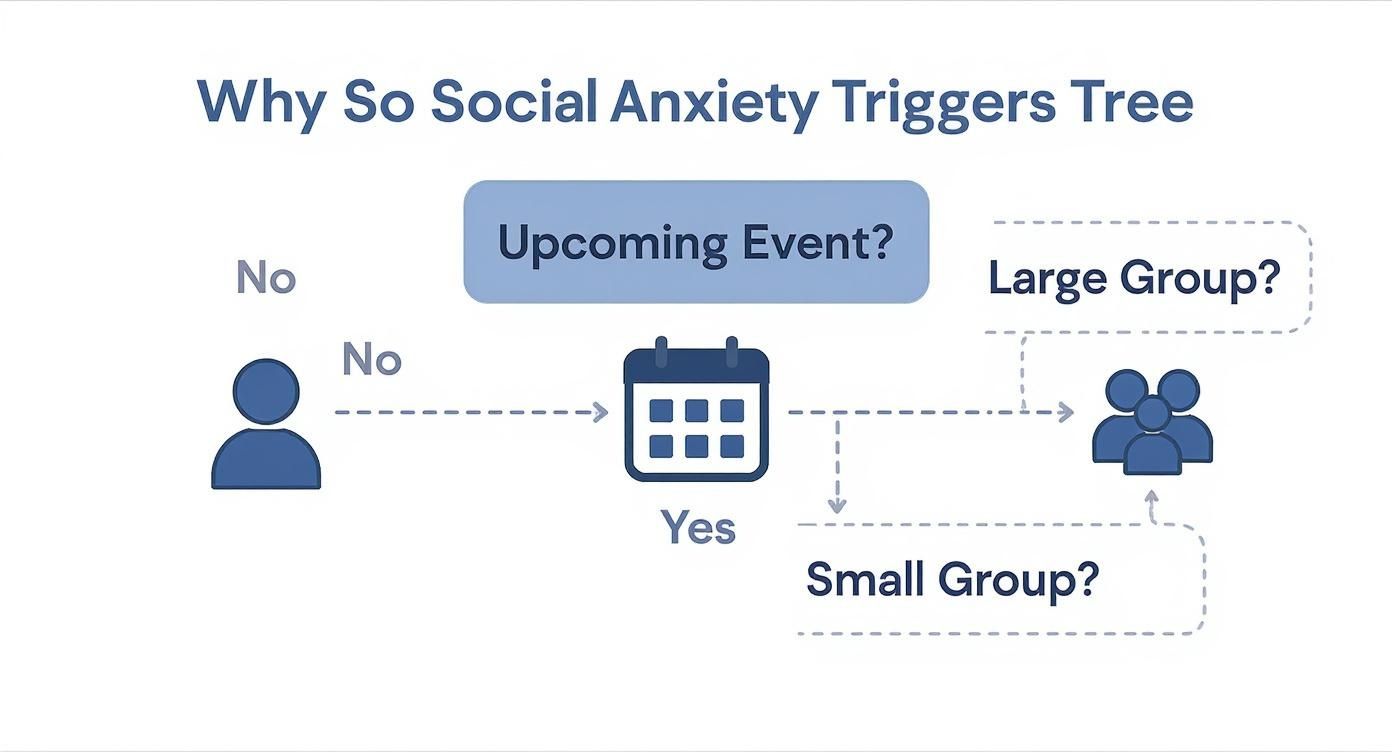
    Infographic showing a decision tree for social anxiety triggers, starting with 'Upcoming Event?' and branching into large vs. small groups.

    Sometimes the anxiety starts with just the thought of an event. Realising this pattern is a huge first step toward preparing yourself with calming strategies ahead of time.

    Ground Yourself with the 5-4-3-2-1 Method

    When anxiety pulls you into a whirlwind of worry, grounding techniques are your anchor. The 5-4-3-2-1 method is a sensory exercise that helps your brain focus on your immediate surroundings instead of internal fears. It's simple and can be done anywhere without anyone noticing.

    Here's how it works:

    • Look for 5 things you can see. Silently name five objects around you, like a pen, a pattern on the floor, or a leaf outside.
    • Notice 4 things you can feel. Tune into physical sensations, such as the texture of your clothes or the feeling of your feet on the ground.
    • Listen for 3 things you can hear. Pay attention to three distinct sounds, like the hum of a computer or distant traffic.
    • Identify 2 things you can smell. This may be subtle, but try to notice scents like coffee or the faint smell of rain.
    • Acknowledge 1 thing you can taste. Focus on one taste, such as a lingering flavour from a drink or just the neutral taste in your mouth.

    This exercise is a quiet, personal reset button you can press anytime you feel overwhelmed. It's a great tool for your mental well-being.

    Control Your Breath to Calm Your Body

    Your breath is one of the most powerful tools you have for managing anxiety. When you feel anxious, your breathing often becomes fast and shallow, which can worsen physical symptoms. By consciously slowing your breath, you can activate your body's natural relaxation response.

    A simple yet effective technique is box breathing. Picture a square and follow its sides with your breath.

    • Breathe in slowly for a count of four.
    • Hold your breath for a count of four.
    • Breathe out slowly for a count of four.
    • Hold your breath again for a count of four.

    Repeat this cycle a few times to help regulate your heart rate and bring a sense of stability. For those exploring other avenues of support, learning about the top supplements for stress and anxiety can also be a helpful resource.

    Quick Anxiety-Relief Techniques at a Glance

    This table summarises a few simple tricks you can use whenever you need them. Practice them in calm moments to build confidence in using them during times of stress.

    Technique How It Helps When to Use It
    5-4-3-2-1 Grounding Re-focuses your mind on your senses, pulling you out of anxious thoughts. When your thoughts are racing or you feel detached.
    Box Breathing Slows your heart rate and signals your nervous system to calm down. Before an event or when you feel physical symptoms.
    Progressive Muscle Relaxation Releases physical tension you may be holding onto. Discreetly tense and release your toes or fists.
    Mindful Observation Narrows your focus to a single object, giving your mind a break. When you feel overwhelmed in a crowded room.

    These are not magic cures, but they are powerful tools for navigating difficult moments. Having a few trusted strategies ready can help you face social situations with a greater sense of control and resilience.

    Building Lasting Confidence and Resilience

    A person gently tending to a small, thriving plant, symbolising growth and nurturing personal resilience.

    While in-the-moment techniques are helpful, building lasting confidence is key. This is where we move from managing anxiety to building genuine resilience. The goal is to learn to navigate social situations so that fear no longer controls your choices.

    This process involves gently and intentionally expanding your comfort zone. It's about taking small, manageable steps that prove to you, one interaction at a time, that you can handle this. This approach fosters happiness and a sense of accomplishment.

    Gently Expand Your Comfort Zone

    Think of this process as a series of low-stakes social experiments. The goal is to dip your toes into social situations where the pressure is minimal. This is a core part of professional therapy and counselling because it helps rewire the brain’s fear response.

    Start with things that feel just a little challenging, not overwhelming. Here are a few practical ideas:

    • Chat with the cashier: A simple "How's your day going?" is a structured interaction with a natural end.
    • Find a hobby-based group: Join a book club or a local class where the shared activity is the focus, taking pressure off conversation.
    • Give someone a compliment: Offer a genuine compliment to a colleague or someone in a shop. It's a positive, low-pressure interaction.

    Each time you do one of these things, you gather evidence that social interactions can be pleasant. This slow accumulation of positive experiences builds real confidence.

    Challenge and Reframe Your Thoughts

    Social anxiety is often fuelled by a relentless inner critic. Thoughts like "Everyone thinks I'm boring" can feel like truths, but they are often just assumptions. Learning to question them is a huge step toward better well-being.

    This practice is sometimes called cognitive reframing. It’s about becoming a curious detective of your own thoughts. When a negative thought appears, pause and ask yourself:

    • Where is the evidence for this thought? Is it based on facts or just a feeling?
    • What is a kinder way to see this? Instead of "I'm so awkward," try, "It's normal to feel nervous in new situations."
    • What would I tell a friend who was thinking this? We are often more compassionate with others than with ourselves.

    This is not about forced positivity. It's about introducing a more balanced and realistic viewpoint to counter the mind's tendency to focus on the negative.

    Mastering this internal dialogue is crucial for managing not just social anxiety, but also related challenges like workplace stress and feelings of depression. You’re building emotional resilience from the inside out.

    Embrace Progress Over Perfection

    One of the sneakiest traps of social anxiety is perfectionism. The fear of making one small mistake can be paralysing. Shifting your focus from perfection to progress is the way out.

    Celebrate the small wins, like staying at a party for 10 minutes longer than you planned. Acknowledge these moments to reinforce your courage and give you the motivation to keep going. This is about self-compassion and treating yourself with kindness.

    Setbacks will happen, and they are part of any meaningful journey. See them as learning opportunities, not failures. By taking these small, consistent steps, you are actively creating a more confident and fulfilling life.

    Knowing When and How to Get Professional Support

    Taking steps to manage social anxiety on your own shows real strength. But sometimes, even our best efforts aren't enough, and that’s completely okay. Reaching out for professional support is a smart, courageous move toward caring for your well-being.

    Making that decision can feel difficult, especially as conversations around mental health are still evolving in many cultures, including in India. Professional counselling provides a safe, confidential space to explore your feelings without judgment.

    Is It Time to Talk to a Professional?

    If social anxiety is consistently getting in the way of the life you want, it might be time to seek help. Therapy is about equipping you with tools and support to handle challenges more effectively. Consider reaching out if you notice your anxiety is affecting your life in these ways:

    • Affecting Your Work or Studies: Are you avoiding presentations or struggling to speak in meetings due to intense workplace stress?
    • Straining Your Relationships: Are you pulling away from friends and family, leading to feelings of isolation and depression?
    • Limiting Your Life: Are you saying "no" to things you want to do, like a friend's wedding or a trip you've been dreaming of?
    • Leading to Unhealthy Coping Habits: A professional can guide you toward healthier strategies if you are relying on avoidance or other unhelpful patterns.

    Think of these as signs pointing you toward extra support. Exploring resources on things like effective PTSD treatments can also show the wide range of support available for various mental health challenges.

    What Is Therapy Actually Like?

    The thought of starting therapy can be nerve-wracking if you don’t know what to expect. Your first appointment is really just a conversation to see if you and the therapist are a good fit. You can talk about what's been going on, and the therapist will listen and explain how they can help.

    Remember, you are in control. It's okay to ask about their experience, the methods they use, and what a typical session looks like.

    One of the most effective methods for social anxiety is Cognitive Behavioural Therapy (CBT). This practical approach helps you learn to spot, challenge, and change the negative thought patterns fuelling your anxiety. It gives you real-world skills to build your resilience.

    What to Expect from Getting Support

    Therapy is a partnership focused on your growth and happiness. It helps you build on your strengths, encourages self-compassion, and supports you as you work toward a life that feels authentic.

    Platforms like DeTalks can help you begin this process. They offer confidential assessments that can give you a better handle on your emotional state. It's important to remember these tools are informational, not diagnostic, but they can be a great first step toward a conversation with a professional.

    Ultimately, seeking support is an investment in your own well-being. It’s about giving yourself the chance to live a fuller, more connected life.

    Wrapping Up: Your Journey Forward

    Living with social anxiety is a journey, not a race. The goal is not a "perfect" social life, but to build your resilience and find more moments of ease and connection. Every small effort you make is a real win for your well-being.

    Understanding your anxiety is a huge first step. When you acknowledge your feelings without judgment, you are swapping fear for awareness. This self-compassion is the foundation for lasting change.

    It's the small, consistent actions that add up. Whether it's taking deep breaths before a meeting or gently questioning a negative thought, each act builds your confidence. These are the steps that help you loosen the grip of workplace stress and social fears.

    Your Path to Greater Well-Being

    Forget the idea of a quick cure; this is an ongoing process of growth. Embrace progress over perfection and celebrate the small victories—they matter more than you think.

    Here are a few supportive takeaways:

    • Be Kind to Yourself: Treat yourself with the same compassion you would offer a friend.
    • Progress Isn't a Straight Line: You will have good days and tough days. Both are part of the process.
    • Your Feelings Are Valid, Not Facts: Acknowledge your anxiety, but remember it is something you experience, not who you are.

    It is always okay to ask for help. Reaching out for therapy or counselling is a sign of incredible strength and a practical step toward more happiness and balance.

    This process is about equipping yourself with the right tools and insights to handle what comes your way. You have what it takes to build a life that feels more connected, authentic, and joyful.

    Frequently Asked Questions

    When you're figuring out how to handle social anxiety, many questions can come up. Here are answers to some of the most common ones.

    Can Social Anxiety Be Completely Cured?

    It is more helpful to think of social anxiety as highly manageable rather than something to "cure." Through consistent use of coping strategies, gentle exposure to feared situations, and professional support like therapy, you can significantly reduce its impact on your life. The goal is to build lasting resilience and feel good, even if you still get nervous sometimes.

    Should I Tell My Friends or Boss About My Social Anxiety?

    This is a personal decision, and there is no single right answer. Opening up to people you trust can build a strong support network and may lead to small adjustments that reduce workplace stress. However, you are never obligated to share. If you do decide to talk about it, being specific about what would be helpful can make the conversation more productive.

    Is Medication the Only Way to Treat Severe Social Anxiety?

    No, medication is just one of many tools. It often works best when combined with other approaches. Cognitive Behavioural Therapy (CBT), a key part of professional counselling, is a powerful, science-backed method for addressing the root causes of anxiety and depression. A good mental health professional will discuss all options with you to create a plan that feels right.


    Ready to feel more in control? DeTalks provides a confidential space with science-backed assessments to help you understand what's going on. You can also connect with qualified therapists who get it. Start your journey by exploring your options at https://detalks.com.


  • How to Respect Yourself: A Guide to Building Lasting Confidence

    How to Respect Yourself: A Guide to Building Lasting Confidence

    Learning how to respect yourself means honouring your own needs, values, and boundaries. It isn't built on grand gestures but through small, consistent actions that form the foundation of genuine well-being. This quiet inner confidence helps you handle everything from workplace stress to personal challenges with greater resilience.

    Understanding What Self-Respect Truly Means

    A person sitting peacefully on a rock, looking out over a misty valley at sunrise, symbolizing self-reflection and well-being.

    Self-respect has nothing to do with arrogance; it is a core part of your mental health. It shapes how you see the world and provides a deep, internal validation that anchors you, regardless of external praise or criticism. This inner strength helps you navigate life's inevitable challenges, from daily frustrations to significant hurdles like anxiety and depression.

    When self-respect is low, you might constantly seek others' approval, struggle to say "no," or fall into a cycle of harsh self-criticism. These patterns can lead to burnout and reduce your happiness. Building self-respect involves unlearning these habits and cultivating a kinder, more compassionate inner voice.

    The Connection Between Respect and Resilience

    Resilience is the ability to bounce back from adversity, and it is built on a foundation of self-respect. When you value yourself, you are more likely to protect your well-being during stressful times. This could mean taking a needed break when you feel overwhelmed by workplace stress or seeking counselling to work through difficult emotions.

    This connection is supported by research. A study highlighted that individuals with lower self-respect were more likely to report symptoms of depression. This shows the protective role that feeling valued and assertive plays in our emotional balance.

    Core Pillars of Self-Respect

    To build this inner strength, it's helpful to understand its key components. Exploring topics like How to Be a Confident Man can offer insights, as genuine self-esteem is built from the inside out. Let's look at the areas that create a strong sense of self.

    Core Pillars of Self-Respect

    A quick look at the fundamental components of self-respect we'll explore in this guide.

    Pillar What It Means for You
    Setting Boundaries Protecting your time, energy, and emotional well-being without guilt.
    Self-Compassion Treating yourself with the same kindness you'd offer a good friend.
    Personal Growth Actively investing in your skills, health, and what makes you happy.
    Supportive Environment Surrounding yourself with people who uplift and validate you for who you are.

    Fostering self-respect is an ongoing commitment to honouring yourself. It is a journey that empowers you to build a more authentic, balanced, and fulfilling life.

    Setting Healthy Boundaries to Honour Yourself

    A person's hands gently pushing away a tangled mess of strings, symbolizing the creation of clear personal space and boundaries.

    Learning how to respect yourself often comes down to setting healthy boundaries. Think of a boundary not as a wall, but as a way to protect your time, energy, and peace of mind. In doing so, you teach others how you expect to be treated.

    This can feel difficult at first, especially in cultures where saying 'no' might be seen as unhelpful. However, consistently failing to set limits can lead to workplace stress and personal burnout, which can harm your mental health over time.

    What Healthy Boundaries Look Like in Daily Life

    Boundaries are often small, quiet choices you make every day to prioritise your needs. It's about recognising these moments and acting on them.

    For instance, a healthy boundary could be:

    • Politely declining an extra project when your schedule is already full.
    • Telling a friend, "I'd love to support you, but I don't have the emotional capacity for a heavy conversation right now."
    • Stepping away from negative office gossip.
    • Leaving work on time to protect your personal life.

    These are not aggressive actions. They are calm, clear statements about what you need to stay balanced and well.

    "When you speak to yourself with the utmost respect, I promise you that your life…will quickly improve. The energy of the words you use permeates your experiences and influences your self-worth and behaviour."

    This gets to the heart of it—boundaries start internally. They begin with respecting your own needs enough to communicate them.

    How to Communicate Your Needs with Confidence

    The fear of setting a boundary is often about how the other person will react. The key is to be firm yet kind, focusing on your needs rather than their behaviour. This simple shift can ease tension and lead to a more understanding conversation.

    Try this simple, three-part framework:

    1. State the situation factually: Start with a neutral observation. "I've noticed I'm taking on projects that are pushing my deadlines back."
    2. Explain how it affects you: Use "I" statements to share your feelings. "I feel overwhelmed and stressed when my workload gets this high."
    3. Clearly define what you need: Be direct about the necessary change. "From now on, I need to complete my current tasks before I can consider taking on anything new."

    Using this structure turns a potentially difficult exchange into a constructive one. It’s a skill that builds resilience and helps you feel less anxious.

    If setting boundaries consistently feels challenging, exploring it through counselling can provide personalised tools and support. Remember, this is a practice that becomes more natural with time.

    Choosing Self-Compassion Over Self-Criticism

    A person sitting in a comfortable chair by a window, journaling in a notebook with a warm cup of tea beside them, illustrating a moment of quiet self-compassion.

    Many of us have a persistent inner critic that focuses on every mistake and dismisses accomplishments. Over time, this can lead to feelings of inadequacy, anxiety, and even depression. A key part of learning how to respect yourself is to consciously replace that critical voice with a kinder, more supportive one.

    This is the essence of self-compassion. It's about treating yourself with the same warmth you would offer a friend during a hard time. It means accepting that being human involves imperfection, and that is okay.

    Understanding Your Inner Dialogue

    The first step is to simply listen to how you talk to yourself. When you make a mistake, is your reaction harsh or forgiving? This internal voice has a significant impact on your overall well-being.

    A study in India noted that while many people have stable self-esteem, a significant portion struggles with low levels. This suggests many are dealing with a harsh inner critic, making the path to self-respect challenging. You can explore the findings on self-esteem fluctuations and mental health for more context.

    Practical Ways to Cultivate Self-Compassion

    Shifting from self-criticism to self-compassion is a gradual practice. It requires patience and a commitment to building new, supportive mental habits.

    Here are a few ways to get started:

    • Reframe Your Thoughts: When you catch yourself in a negative spiral, pause and challenge the thought. Instead of, "I failed that presentation," try, "That was tough, but I did my best and I know how to improve."
    • Practise Mindful Self-Kindness: When you feel overwhelmed, place a hand over your heart and breathe. Offer yourself gentle words like, "This is a difficult moment. I will be kind to myself."
    • Journal Your Feelings: Writing without judgment can be a powerful release. It helps you process difficult emotions and gain a clearer, more compassionate perspective.

    By practising radical self-respect, you lighten your energy field and emotional state. You then can give much-deserved unconditional love to your body-confidence journey… and yourself.

    Choosing self-compassion is a profound act of self-respect. It strengthens your mental health, giving you the resilience to handle workplace stress with more grace. If your inner critic feels too overwhelming, seeking therapy or counselling can offer a supportive space to learn these skills.

    Investing in Your Personal Growth and Well-being

    A person watering a small plant that is growing in a pot on their windowsill, signifying nurturing personal growth.

    Actively investing in yourself is one of the most powerful ways to build self-respect. This means intentionally nurturing your mind, body, and spirit. It is a quiet affirmation to yourself that you are worthy of your own time and care.

    You don't need to make grand changes; lasting growth often comes from small, consistent daily actions. It's about carving out moments in your life for things that truly fulfil you. For example, finding just 20 minutes a day for a hobby or taking a short walk at lunchtime can significantly improve your well-being.

    Nurturing Your Mind and Emotional Health

    Prioritising your mental health is a fundamental part of respecting yourself. This involves being honest about your feelings and taking deliberate steps to support your well-being.

    Here are a few practical places to start:

    • Mindfulness and Meditation: A few minutes of mindfulness each day can help manage anxiety and stress. Many apps offer guided sessions for beginners.
    • Journaling for Clarity: Writing down your thoughts can help you untangle them. Journaling provides a private space to explore emotions and gain perspective.
    • Learning Something New: Engaging your brain by learning a new skill builds confidence and fosters a growth-oriented mindset.

    This commitment to personal growth often benefits your professional life. Learning how to build confidence at work can make you feel more empowered and valued in your career.

    Seeking Professional Support is an Act of Strength

    Sometimes, we need guidance on our growth journey. Reaching out for therapy or counselling is a courageous move toward becoming healthier. Recognising you need support and seeking it is a profound act of self-respect. A therapist provides a safe space to work through challenges like workplace stress, anxiety, or depression.

    While online assessments can offer initial insights, they are for informational purposes only and are not a substitute for a professional diagnosis. They can be a starting point for self-awareness, not the final word. Every step you take to invest in your growth sends a powerful message: you are valuable and worthy of care.

    Shape an Environment That Feeds Your Self-Worth

    Self-respect doesn't grow in isolation; it thrives or withers based on your environment. The people you surround yourself with and the spaces you inhabit can either nurture your confidence or subtly damage it. Take an honest look at your relationships and surroundings to see what supports your well-being.

    A significant part of learning how to respect yourself is making deliberate choices about who gets your time and energy. Move towards people who energise and validate you, and create distance from those who leave you feeling drained or insecure.

    Choose Your Company Wisely

    Intentionally spend time with friends, family, and colleagues who listen and celebrate your successes. It also means creating healthy distance from those who are persistently critical or dismissive. This isn't about cutting people off, but about managing your exposure to negativity.

    This could mean:

    • Making more time for a supportive friend.
    • Politely limiting time with a critical relative.
    • Collaborating with positive, team-oriented colleagues.

    These small changes can reduce background anxiety and create mental space for self-worth to grow. You are simply protecting your peace.

    An environment of respect and validation isn't a luxury; it’s a fundamental need for building lasting resilience and happiness. When you surround yourself with positivity, you give yourself the best possible chance to thrive.

    Interestingly, a supportive environment can be found in unexpected places. Research in East Midnapore, India, found that rural students reported slightly higher self-esteem than their urban peers. This suggests strong community ties can be incredibly powerful. You can explore how social factors influence self-worth in this research if you're curious.

    Craft a Physical Space That Respects You

    Your physical surroundings are as important as your social ones. A cluttered, chaotic space can reflect and amplify feelings of workplace stress or being overwhelmed. Creating a calm, organised space that feels like you is a powerful act of self-care.

    You don't need a major overhaul. Start small by clearing your desk, adding a plant to your room, or hanging art you love. When your external world feels orderly, it sends a strong message to your inner world that you are in control and you matter.

    If your environment is a source of distress, talking to a professional can help. Therapy or counselling offers a safe space to develop strategies for building a life that truly supports you. Please remember, any information here is for guidance and not a substitute for a professional diagnosis.

    The Road Ahead: Making Self-Respect a Daily Practice

    Building self-respect is a continuous practice, much like tending a garden. It requires consistent, conscious choices every day to honour who you are and what you need. This journey is deeply personal, and every small step is a genuine victory.

    The tools we've discussed—setting boundaries, practising self-compassion, and investing in your growth—are your allies. These are not just ideas; they are skills that build real emotional resilience.

    It is also vital to consider your surroundings. Chronic workplace stress or draining relationships can erode your self-worth. Protecting your peace is a fundamental part of learning how to respect yourself.

    Your journey to self-respect is a process of commitment, not perfection. Be patient with yourself, embrace the learning curve, and know that you are deeply worthy of your own respect, every single day.

    If you find yourself wrestling with anxiety or the heavy weight of depression, reaching out for help is a sign of strength. Professional support through therapy or counselling is an investment in your relationship with the most important person in your life: you. These are supportive takeaways, not promises of a cure.

    Got Questions? Let's Talk About Self-Respect

    As you begin this journey, some common questions may arise. These answers are meant to offer clarity and support along the way.

    Isn't Self-Respect Just the Same as Self-Esteem?

    That's a great question. While they sound similar, there's a key difference. Self-esteem is often tied to your performance and achievements; it can fluctuate with successes and failures.

    Self-respect is steadier. It is an underlying sense of honour for who you are, your values, and your needs, regardless of external circumstances. This stable foundation is what truly supports your long-term well-being.

    Is It Even Possible to Build Self-Respect in a Toxic or Difficult Situation?

    Yes, it absolutely is. In fact, challenging environments are often where self-respect becomes your most powerful tool for managing workplace stress and preventing burnout. The key is to focus on what you can control.

    You can start small by setting one manageable boundary, practising a moment of self-compassion, or giving yourself credit for navigating a tough day. These internal shifts build incredible resilience over time.

    Building self-respect in a tough situation isn’t about changing everything at once. It’s about reclaiming your power, one small, consistent act of self-care and boundary-setting at a time.

    So, How Long Does This Whole Self-Respect Thing Take?

    There is no finish line. Building self-respect is not a project to complete but a lifelong practice. It is a conscious choice you make every day.

    Instead of focusing on a timeline, focus on the daily process. You will notice gradual shifts as you consistently apply these ideas. Celebrating small wins reinforces your foundation of self-worth and can be a powerful way to manage feelings of anxiety or depression.

  • How to Improve Self Awareness: A Practical Guide

    How to Improve Self Awareness: A Practical Guide

    Becoming more self-aware isn’t a complicated process. It's about paying closer attention to your feelings, thoughts, and actions without judgment. This journey begins with small habits, like pausing to notice why you're reacting a certain way, building a foundation for your overall well-being.

    Your Starting Point for Greater Self Awareness

    A person sitting on a dock and looking out at a calm lake, reflecting on their thoughts.

    Starting the journey to greater self-awareness is one of the kindest things you can do for your mental health. It’s not about finding flaws, but about building an honest and compassionate relationship with yourself. This practice is the cornerstone for building real resilience, giving you the clarity to navigate life’s challenges.

    This guide explores what self-awareness looks like in the real world. By observing your thoughts and feelings, you can better manage common challenges like workplace stress and anxiety.

    Understanding the Core of Self Awareness

    At its heart, self-awareness is the ability to see yourself clearly and gently. It’s about tuning into your internal world—your emotions, thoughts, and physical sensations—as they happen. The key is to simply acknowledge them without labelling them as "good" or "bad."

    This is important because it helps you understand why you react the way you do. For instance, noticing your shoulders tense up when a certain colleague speaks is a clue. It’s the first step to unpacking and addressing the stress you might be feeling.

    Self-awareness isn’t about discovering a new, improved version of yourself. It’s about showing up for the person you already are, with kindness and curiosity.

    This practice helps you feel more in control of your emotional health. By knowing your internal landscape, you can make choices that feel right for you, helping you learn how to find your authentic self and highest good.

    Why This Journey Matters Now

    In the fast pace of modern life, especially in demanding jobs common across India and globally, it's easy to lose touch with ourselves. This pressure can lead to burnout, anxiety, and even feelings of depression. Self-awareness acts as an anchor to keep you grounded.

    Building this skill can enrich many areas of your life:

    • Better Emotional Regulation: You learn to manage your emotions instead of letting them manage you.
    • Improved Relationships: Understanding your own needs helps you communicate them clearly and empathise with others.
    • Increased Resilience: You can bounce back from setbacks more easily because you know your strengths and coping strategies.

    This journey empowers you to shape your life proactively. It's the starting point for greater well-being, often supported by tools like mindfulness, journaling, and sometimes, the guidance of professional counselling or therapy.

    Mastering the Art of Mindful Observation

    A person sitting in a lotus position on a mat, practicing mindfulness in a calm, sunlit room.

    Mindfulness is a practical tool for building self-awareness. It's about creating a small pause between an event and your reaction to it. This simple habit is key to managing daily pressures and building emotional resilience.

    When you pay attention to the present moment without judging it, you start to see your internal patterns clearly. This is especially helpful for tackling workplace stress and staying centred. If you're new to the concept, a beginner's guide to mindfulness can offer helpful techniques.

    Starting With Small Moments of Stillness

    You don’t need an hour of silent meditation to begin. Start with a single 'Mindful Minute' at your desk or while waiting for your chai. Just close your eyes and bring your full attention to your breath, noticing the air coming in and going out.

    Imagine you're about to enter a stressful meeting. Taking sixty seconds to focus on your breath can make the difference between walking in flustered and entering with a calm, clear head.

    These small, consistent practices add up. A 2022 survey found that people who practised mindfulness for just 15 minutes a day reported a 27% improvement in recognising and managing their emotions. Furthermore, 62% noticed better clarity in their decision-making, alongside a 22% reduction in workplace stress.

    Simple Mindfulness Exercises to Start Today

    A quick guide to integrating mindfulness into your daily routine with simple, effective practices.

    Exercise How to Practice When to Use It
    Mindful Breathing Close your eyes and focus on the sensation of your breath. Notice the rise and fall of your chest. Do this for 1 minute. Before a stressful meeting, when you wake up, or to refocus at work.
    Body Scan Mentally scan your body from your toes to your head, noticing any tension or sensation without judging it. Before bed to relax, or during a break to release physical stress.
    Mindful Listening Pick a sound in your environment (like a fan or birds) and listen to it intently, without labelling it as "good" or "bad". When you feel distracted or overwhelmed by noise.
    Mindful Eating Eat a meal or a snack slowly, paying full attention to the taste, texture, and smell of the food. During lunch or a coffee break to ground yourself in the present.

    These aren't complicated rituals but simple, powerful check-ins with yourself that you can fit into any schedule.

    Observing Without Judgement

    One of the most important parts of mindfulness is observing your thoughts without a harsh inner critic. When a thought like, "I'm going to mess this up," appears, simply acknowledge it: "A thought about failure." Note it and let it pass.

    This skill is invaluable for navigating personal challenges, such as family expectations. Noticing your emotional reaction before you act gives you the power to choose a better response. This can reduce feelings that contribute to anxiety or depression.

    The goal of mindfulness is not to empty your mind of thoughts but to become more aware of them. It's about changing your relationship with your thoughts, so they no longer control you.

    Weaving these brief moments of observation into your day helps build stronger emotional regulation and a deeper sense of well-being. If you uncover complex patterns, professional counselling or therapy can offer a safe space to explore them.

    Using a Journal to Decode Your Inner World

    A person writing in a journal with a cup of tea nearby, in a cozy, well-lit setting.

    Journaling is more than a diary; it's a private conversation with yourself. This simple practice brings clarity to a cluttered mind, helping you see recurring patterns in your moods and actions. It’s a dedicated space to process everything from daily frustrations to bigger life questions.

    The act of writing can be a safe container for difficult feelings tied to anxiety, workplace stress, or burnout. When thoughts spin in your head, they can feel overwhelming; writing them down offers perspective. This is a cornerstone practice for building emotional resilience and well-being.

    Going Beyond the Blank Page

    Staring at an empty page can feel intimidating, but structured prompts can help. They guide your reflection to uncover new insights. Remember, the goal isn't perfect writing but honest curiosity about your inner world.

    Here are a few prompts to get you started:

    • What situation today brought up a strong emotion? What was underneath that feeling?
    • When did I feel most energised today? What was I doing?
    • What’s one thing I’m avoiding, and what fear is holding me back?

    Using focused questions turns your journal into a tool for self-discovery, which is essential if you want to learn how to improve self awareness.

    Making Journaling a Consistent Habit

    Consistency is more important than length. Just five minutes of focused writing each day can lead to significant shifts in self-understanding. Research shows this works; one study found that students who journaled daily had a 40% higher retention of self-awareness skills. You can discover more about these findings from NIMHANS.

    Your journal isn't there to judge you. It’s a mirror that reflects your inner world, helping you see yourself more clearly and with greater compassion.

    To make the habit stick, try linking it to an existing routine, like sipping your morning coffee. Over time, this small ritual becomes a reliable anchor in your day. While journaling is a powerful tool, it's not a substitute for professional help if you're experiencing significant challenges like depression, where therapy or counselling can provide supportive guidance.

    Discovering Your Blind Spots Through Feedback

    Two people having a constructive, positive conversation over coffee in a bright, airy cafe.

    While looking inward is key, we all have blind spots—habits that are clear to others but invisible to us. Seeing yourself through the eyes of people you trust is a game-changer for personal growth.

    Asking for feedback can feel vulnerable, but approaching it with curiosity can highlight behaviours causing workplace stress or friction in relationships. The goal isn’t to invite criticism but to have an honest conversation that helps you understand yourself better.

    How to Ask for Meaningful Feedback

    Being specific and gentle is the best approach. A vague question like, "What do you think of me?" can make others uncomfortable. Instead, frame your request around a specific situation or behaviour.

    Here are a few ways to start the conversation:

    • "I'm trying to be a better listener. In our recent chats, have you ever felt I wasn't fully present?"
    • "I'm working on managing stress. Have you noticed me overreacting to things at work lately?"
    • "I want to be a more supportive teammate. Is there anything I could do differently to help our projects run smoother?"

    Think of this as gathering information to improve your well-being and strengthen your connections with others.

    Receiving Feedback with Grace

    When someone shares their perspective, your only job is to listen. Resist the urge to get defensive or explain yourself. Remember, their feedback is their perception, and that is valuable information on your journey of how to improve self awareness.

    Thank them for their honesty, even if what they say is hard to hear. Take time to reflect on it afterward. The goal isn't to blindly accept everything but to use these insights to build greater resilience and emotional intelligence.

    Learning to gracefully accept feedback is a superpower. It offers a perspective that self-reflection alone can never provide.

    Understanding your impact on others is vital for healthy relationships. If feedback consistently triggers difficult emotions tied to anxiety or depression, exploring those feelings in counselling or therapy can turn tough moments into opportunities for growth.

    Look to Assessments and Professional Guidance for a Fresh Perspective

    Self-guided practices are fantastic, but an outside view can be a real eye-opener. Structured tools, like personality or emotional intelligence assessments, can offer a helpful mirror, reflecting parts of yourself you might not have noticed.

    It's important to remember these assessments are informational, not diagnostic. They don't define you. However, seeing your traits laid out in a clear framework can help you connect the dots between how you think, feel, and act.

    Finding Clarity with Structured Tools

    In India, such tools are gaining traction in the corporate world. A 2023 report from the Confederation of Indian Industry found that 68% of organisations use formal self-awareness tools for employee development. The results are promising: 82% of employees reported better relationships with colleagues, and 76% noted a positive impact on their leadership skills.

    These frameworks can help you understand:

    • Your communication style: Do you prefer direct conversations or a more collaborative approach?
    • Your stress responses: What are your typical triggers and how do you react under pressure?
    • Your decision-making process: Do you rely more on logic, gut feelings, or emotions?
    • Your core motivations: What truly drives and energises you in life?

    This structured insight is particularly useful for tackling workplace stress. It can highlight why certain situations feel draining while others feel engaging.

    The Role of Professional Guidance

    You don’t have to do this work alone. Seeking professional guidance through therapy or counselling can be a profound step in your self-discovery journey. A trained professional offers a confidential, non-judgmental space to explore patterns that may be fuelling challenges like anxiety or feelings of depression.

    Therapy isn’t about "fixing" something that’s broken. It’s about having a skilled, compassionate guide to help you read your own internal map with greater clarity.

    A good therapist helps you connect the dots in ways that are hard to see on your own. This partnership can accelerate your growth, helping you build lasting resilience and a stronger sense of well-being. If your self-exploration brings up difficult feelings, reaching out for support is a proactive step toward a more balanced, fulfilling life.

    Making Self-Awareness a Part of Your Everyday Life

    Think of this as a practice, not a race. The aim isn't to reach a perfect state of ‘self-awareness’ but to weave it into your daily life. This consistent, gentle effort is what truly improves your long-term well-being.

    Being patient and kind to yourself is key. Every small step you take toward understanding yourself better is a win. It’s about building small habits that support your mental health over time.

    Weaving These Practices Into Your Routine

    We've covered several powerful tools, from mindfulness and journaling to asking for feedback. Blending these into your daily life can help you navigate workplace stress, anxiety, or burnout more effectively. These are practical skills that empower you to move through life with more clarity and resilience.

    Think of this not as a task to check off a list, but as an ongoing conversation with yourself. Each day offers a new opportunity to listen to your inner world with a little more kindness.

    Remember, if looking inward brings up tough emotions, that's completely normal. Seeking professional therapy or counselling is a sign of strength and provides invaluable support.

    Your Questions About Self-Awareness, Answered

    As you explore self-awareness, it’s natural for questions to arise. Here are answers to some common uncertainties.

    How Long Until I Start Seeing a Difference?

    Building self-awareness is an ongoing practice, much like learning a skill. However, you don't have to wait long to see changes. Committing to a small, consistent practice—like journaling for 5-10 minutes a day—can lead to a noticeable shift in how you manage your emotions within a few weeks.

    Is This Something I Can Do on My Own?

    Absolutely. You can make huge strides using tools like journaling, mindfulness, or asking a trusted friend for feedback. However, we all have blind spots. That's where therapy can be incredibly valuable, offering a safe space to uncover deeper patterns, especially if you're dealing with persistent anxiety or depression.

    Isn't Self-Awareness Just Being Self-Conscious?

    These two are very different. Self-awareness is about looking inward with curiosity and without judgment to gain clarity. Self-consciousness is worrying about how you appear to others, often rooted in a fear of being scrutinised.

    Self-awareness is freeing because it is rooted in compassionate curiosity. Self-consciousness, on the other hand, can feel limiting because it is rooted in fear of external judgment.

    Learning to be more self-aware builds true resilience by helping you create a more honest and solid relationship with yourself.


    This journey is one of compassion and curiosity, and you don’t have to walk it alone. The goal is not a cure, but to gain supportive takeaways that empower you to navigate life’s ups and downs with greater awareness and self-compassion. At DeTalks, we connect you with qualified therapists and evidence-based tools to support your growth in self-understanding and mental well-being. To explore our resources and find the right professional for you, head over to DeTalks.com.

  • How to Stop Obsessing Over Someone and Reclaim Your Peace

    How to Stop Obsessing Over Someone and Reclaim Your Peace

    Feeling like you can't stop thinking about someone is a very human experience, and you are not alone in this. The path forward begins with understanding why it's happening, then taking gentle steps to create distance and refocus on your own well-being. This journey is about noticing your thoughts, identifying what might be missing in your life, and shifting your attention back to your personal growth.

    Understanding Why You Can't Stop Thinking About Them

    A person sitting alone on a windowsill, looking out thoughtfully, representing introspection and loneliness.

    It's common for our minds to become preoccupied with thoughts of another person. These intense feelings often come from a place of vulnerability. Understanding their origin is the first step toward finding balance and peace.

    Often, fixating on someone is a sign of deeper, unmet needs. It might be loneliness, the pain of a breakup, or a dip in self-esteem. These feelings can create an emotional gap that our minds try to fill with an idealised version of someone, which is a natural way we try to cope.

    Getting Trapped in a Thought Loop

    Have you ever felt like your thoughts are stuck on a repeating loop? This pattern, known as rumination, involves replaying conversations, memories, and "what-if" scenarios without reaching any conclusion. This mental cycle can fuel anxiety and create significant stress, making it difficult to focus on other areas of your life, like work.

    In the Indian context, societal and family pressures around relationships can add another layer of complexity. Expectations to meet certain milestones can intensify these obsessive thought patterns, making them harder to break.

    The link between obsessive thinking and mental health is well-documented. For instance, research on obsessive thoughts in India found that such symptoms can be more pronounced in urban settings, highlighting how our environment impacts our well-being.

    What Fuels the Fixation?

    Obsessive thinking often stems from a few common psychological triggers. Identifying these within yourself can help you approach your feelings with more compassion and less judgment.

    • Filling an Emotional Void: When you feel lonely or disconnected, fixating on someone can provide a temporary sense of connection.
    • Low Self-Esteem: We might put others on a pedestal when we feel we are lacking something ourselves, seeking their approval as a substitute for self-worth.
    • Past Wounds: Unresolved pain from previous relationships can lead us to subconsciously seek a "do-over," obsessing over a new person to try and fix what went wrong before.

    It's important to remember these thought patterns are not a reflection of your worth. They are signals from your mind, pointing to areas of your life that need kindness, attention, and healing. Acknowledging this is a powerful step toward regaining control.

    Practical Ways to Reframe Obsessive Thoughts

    A person calmly meditating, surrounded by gentle light, symbolising mental clarity and peace.

    Breaking free from an obsessive thought cycle is about taking small, deliberate steps. These techniques help interrupt the loop and reclaim your mental space. The goal is not to force the person out of your mind, but to gently redirect your focus and challenge the narrative you have built.

    One effective method is thought-stopping. When you notice yourself spiralling, consciously interrupt the thought. You can picture a stop sign or say "stop" to yourself, then immediately shift to a positive distraction, like calling a friend or listening to a song. This simple act helps weaken the neural pathways that fuel the obsession over time.

    Challenging Your Inner Story

    Another powerful approach is cognitive reframing, which involves questioning the story you tell yourself. Obsessive thoughts often create an unrealistic, idealised image of a person. By consciously challenging this image, you can bring yourself back to a more grounded reality.

    For example, instead of thinking, “My life would be perfect with them,” a reframe would be, “I admire certain things about them, but I know one person cannot solve all my problems or guarantee my happiness.” Practices like mindfulness can help you observe these thoughts without getting carried away. You can explore mindfulness exercises for anxiety to get started.

    Remember, reframing isn’t about denying your feelings but about introducing a dose of reality. This act can reduce the thought's emotional power and help you build resilience.

    A Practical Guide to Shifting Your Thoughts

    It's important to recognise that obsessive thinking can be connected to challenges like anxiety and depression, making it harder to break the cycle alone. Having a few planned responses can be very helpful when your mind starts to spiral. The table below offers a simple guide for replacing common obsessive thoughts with healthier alternatives.

    Challenging Obsessive Thoughts with Balanced Alternatives

    This guide helps you identify a common obsessive thought and consciously replace it with a more realistic perspective, which can help reduce the anxiety it creates.

    Common Obsessive Thought A Balanced, Realistic Alternative
    "I need to know what they're doing right now." "Their activities don't affect my well-being. I can focus on my own tasks and find peace in my day."
    "They are the only one who can make me happy." "My happiness comes from within. I am responsible for my own joy and fulfilment."
    "If I just try harder, they will see how perfect I am." "I am worthy of connection just as I am. I don't need to change myself to earn someone's affection."
    "Replaying our last conversation will give me clarity." "Going over it again and again causes more anxiety. I will let go and focus on the present moment."

    Using these reframing techniques consistently is like building a muscle. It requires patience and self-compassion, but with practice, you can regain control and find peace of mind.

    Grounding Exercises for Immediate Calm

    A person sitting in a calm, mindful pose with a serene natural background, representing grounding and presence.

    When your mind is caught in a spiral of obsessive thoughts, grounding exercises can offer immediate relief. These tools pull your attention out of the mental chaos and anchor you in the present moment. They are simple, discreet, and can be done anywhere to manage sudden waves of stress.

    The goal isn't to fight your thoughts, which can often make them stronger. Instead, these techniques create distance, giving you needed breathing room. This shift in focus helps calm your nervous system and puts you back in control.

    The 5-4-3-2-1 Sensory Method

    Reconnecting with your immediate surroundings is a practical way to halt a rumination spiral. The 5-4-3-2-1 technique directs your brain to the tangible world, away from the repeating loop of "what-ifs."

    Take a moment wherever you are and try this:

    • See 5 Things: Look around and name five objects, noticing details like the colour, shape, or texture.
    • Touch 4 Things: Shift your focus to physical sensations, like the feeling of your clothes or the surface of a table.
    • Hear 3 Things: Tune into the sounds around you, such as distant traffic, the hum of a fan, or your own breathing.
    • Smell 2 Things: Notice any scents in the air, whether it’s coffee, soap, or the smell of rain.
    • Taste 1 Thing: Finally, focus on what you can taste, like the lingering flavour of your last meal or drink.

    This exercise acts as a circuit-breaker, interrupting the obsessive pattern and demonstrating your ability to redirect your focus.

    A key part of improving your well-being is acknowledging thoughts without letting them define you. Grounding exercises are a first line of defence, helping you create a peaceful mental space.

    Mindful Breathing for Inner Stillness

    Mindful breathing is another powerful tool. When we experience stress, our breathing often becomes shallow, which can worsen anxiety. Deliberately slowing your breath sends a calming signal to your brain.

    Find a comfortable position and gently close your eyes if you wish. Place a hand on your stomach, and simply notice your breath. Then, slowly inhale through your nose for a count of four, and exhale slowly through your mouth for a count of six.

    Repeating this cycle for just a few minutes can have a significant calming effect. It cuts through mental chatter and helps you find a moment of peace, empowering you to regulate your emotions.

    Reclaiming Your Life with New Habits

    While shifting your mindset is crucial, taking tangible action is where you truly regain your freedom. These new habits are empowering choices that help you reconnect with yourself outside of this fixation. A great place to start is by managing your digital world, as constant social media access can fuel obsessive thoughts.

    Creating Healthy Digital Boundaries

    Setting digital boundaries is about giving your mind the space it needs to heal. You don't need a dramatic gesture; small, consistent steps are often more effective. A good first move is to mute their accounts, which stops their updates from appearing in your feed without the finality of blocking.

    Another practical technique is scheduling "worry time." Allot a specific, short period—perhaps 15 minutes each evening—to allow these thoughts. When the time is up, deliberately switch to a different, pre-planned activity. This trains your brain that these thoughts don't get to dominate your entire day.

    Taking control of your digital space and schedule sends a powerful message that your peace of mind comes first. This is about creating a calm, supportive environment for yourself.

    Reconnecting with Your World

    Obsessive thoughts can make your world feel very small, pushing out people and activities you once enjoyed. The antidote is to consciously rebuild those connections and rediscover your interests. Think about what you loved to do before this fixation began and put those activities back on your calendar.

    • Reconnect with friends: Reach out to a friend for a simple coffee or walk. The goal is to be present with someone who cares about you.
    • Explore new interests: Trying something new can create fresh neural pathways and build confidence. Consider a new class, hobby, or volunteer opportunity to invest your energy in positive experiences.

    Integrating meaningful self-care practices into your daily routine is also vital. Every step you take to reinvest in yourself, your friendships, and your passions helps loosen the obsession's grip.

    Building Resilience Through Self-Compassion

    A person gently holding their own hands in a gesture of self-comfort and compassion.

    Lasting healing often begins when you nurture your relationship with yourself. Obsessing over someone else can signal an unmet need for internal validation. Practising self-compassion helps you meet those needs and build a foundation of strength that doesn't depend on others.

    This journey is an opportunity to transform a painful experience into genuine personal growth and build lasting emotional resilience. Treating yourself with the same kindness you would offer a friend can soothe the inner turmoil that fuels the obsession.

    Cultivating a Kinder Inner Dialogue

    Your inner voice can be your harshest critic, especially when you're stuck in obsessive thoughts. The goal is to shift that internal conversation from judgment to compassion. This is crucial for managing the intense anxiety and stress that come with rumination.

    Journaling can be a powerful tool for this. It offers a safe space to untangle your thoughts and feelings without fear of judgment.

    Try these prompts to get started:

    • What might this obsession be telling me about what I truly need right now?
    • If my best friend were going through this, what supportive advice would I offer?
    • What are three things I appreciate about myself today?

    Please remember, any self-reflection or assessments are for informational purposes only and are not a substitute for a professional diagnosis. They are tools to guide your understanding on your path to well-being.

    Anchoring Yourself in Your Values

    When you're fixated on someone, it's easy to lose sight of who you are. Reconnecting with your core values provides a powerful anchor and a sense of purpose that is entirely your own. This internal compass helps guide your decisions and builds self-esteem from within.

    Take a moment to reflect on what is most important to you—perhaps it's creativity, honesty, or community. Once you have a clearer picture, start making small, intentional choices that align with those values. Every action reinforces your identity and proves you can create a fulfilling life on your own terms, which is a vital step in breaking free.

    When Professional Support Is the Next Best Step

    While self-help strategies are valuable, seeking professional guidance is a sign of strength. If obsessive thoughts are consistently disrupting your daily life, extra support can make a significant difference. Choosing therapy or counselling is a proactive step toward reclaiming your well-being.

    A trained professional offers a safe, non-judgmental space to explore these thought patterns. They can provide structured, personalised strategies to help you move forward.

    Knowing When It's Time for Help

    Consider how these obsessions are impacting your life. If you're constantly feeling overwhelmed by anxiety or a persistent sadness, those are important signals.

    It might be time to talk to someone if you notice:

    • Constant emotional distress: Your mood depends heavily on the other person's actions or perceived feelings.
    • A dip in daily functioning: You struggle to focus at work, neglect responsibilities, or withdraw from friends and hobbies.
    • Physical side effects: You experience sleep problems, appetite changes, or persistent fatigue from emotional burnout or workplace stress.

    It's important to clarify: any assessment checklist is for informational purposes, not for diagnosis. It can, however, be a useful guidepost to help you understand when professional support for your mental well-being may be beneficial.

    What Support Looks Like in India

    Seeking therapy is becoming more widely accepted across India, with many professionals offering sessions both in-person and online. A therapist can help you build emotional resilience and develop healthier coping mechanisms.

    In some cases, obsessive thoughts can be linked to conditions like depression or anxiety. We know from findings on mental health treatment accessibility in India that while effective therapies exist, access can sometimes be a challenge. A professional can provide clarity and equip you with the tools to break the cycle and move toward a more balanced state of mind.

    Supportive Takeaways and Next Steps

    As you move forward, it's natural to have questions. This journey is not about finding a quick cure, but about building lasting skills for your emotional well-being. Here are a few final thoughts to support you.

    How Long Does This Take?

    There is no set timeline for healing, as everyone's journey is unique. The duration depends on the depth of your feelings and how consistently you can apply new coping strategies. Instead of focusing on the calendar, celebrate small victories, like successfully redirecting a thought or enjoying an afternoon without rumination.

    Is It Normal to Feel Worse Before It Gets Better?

    Yes, this is a common part of the process. When you begin to consciously change long-held thought patterns, it can initially increase feelings of anxiety or sadness. This discomfort is often a sign that you are doing the difficult but necessary work of creating healthier neural pathways. Be gentle with yourself, and if the feelings become overwhelming, consider reaching out for professional counselling.

    What if I Have a Setback?

    Setbacks are a normal part of any learning process, not a sign of failure. If you find yourself slipping into old habits, approach the moment with compassion, not criticism. Gently guide yourself back to the tools you've learned, whether it's a mindfulness exercise or reaching out to a supportive friend. Each time you steer yourself back on course, you strengthen your resilience.


    If you feel that professional guidance could support you on this journey, help is available. DeTalks is a resource for finding qualified therapists and counsellors across India who specialise in managing challenges like obsessive thoughts, anxiety, and depression. You can find the right support for your well-being at https://detalks.com.

  • How to Calm Your Mind from Overthinking

    How to Calm Your Mind from Overthinking

    If you've ever found yourself replaying a conversation in your mind or getting lost in "what-if" scenarios, you're not alone. Understanding how to calm your mind from overthinking isn't about fighting your thoughts; it's about gently guiding them. This is a very human response to stress and uncertainty, and learning to manage it is the first step toward finding peace.

    Why We Get Stuck in Overthinking Loops

    A person sitting calmly on a windowsill, looking out over a city at dusk, representing a moment of quiet reflection.

    Thinking deeply is normal, but overthinking is when your thoughts spin in circles without finding a solution. It’s not a personal failing; it's often the brain's attempt to protect you from future unknowns or potential pain.

    This cycle can be common in high-pressure environments, like in cases of workplace stress, where the need to be constantly available fuels endless analysis. This isn't productive problem-solving; it’s a direct path to burnout and can harm your overall well-being.

    The Impact on Your Well-being

    When your mind gets caught in a loop, it can take a real toll on your mental and emotional health. This constant mental activity often triggers anxiety and can contribute to feelings of depression, keeping your nervous system on high alert.

    This experience is common. In India, a recent study revealed that 81% of people spend over three hours a day overthinking. For many, it's a constant habit tied to daily choices and major life events, showing how deeply this pattern can affect us. You can discover more insights from the India Overthinking Report to understand the full scope.

    Moving from Awareness to Action

    Recognising that overthinking is a common response is a powerful first step. It allows you to approach these thoughts with compassion rather than self-criticism. This awareness isn't about labeling yourself, but about preparing to make a positive change.

    Please remember, this guide provides informational tools to support your journey toward a calmer mind. It is not a substitute for a professional diagnosis from a qualified healthcare provider.

    Acknowledging these thought loops as they happen allows you to try practical strategies to build mental resilience. The goal is to shift your relationship with your thoughts—to observe them without being controlled by them. That is where the path to a quieter mind begins.

    Ground Yourself with Practical Mindfulness Techniques

    A person practicing a calming breathing exercise by a window, with soft light filtering in, creating a serene and focused atmosphere.

    When your thoughts are spiralling, bringing yourself back to the present moment can be incredibly powerful. This is the core of mindfulness. It isn't about forcing your mind to be empty, but about giving it a gentle anchor.

    These simple techniques can be used anywhere, whether at your desk or on a crowded train. The idea is to shift your focus from the storm inside your head to the world around you, helping to calm your body’s stress response.

    Use the 5-4-3-2-1 Grounding Method

    This technique is a discreet way to stop a thought spiral by engaging your five senses. It pulls your mind out of past regrets or future worries and plants it firmly in the here and now.

    You can try it right now. Silently, go through this checklist:

    • See 5 things: Look around and name five objects without judgement. Notice their colour, shape, and texture.
    • Feel 4 things: Bring attention to physical sensations, like the feeling of your chair or the fabric of your clothes.
    • Hear 3 things: Listen for background sounds you might have been tuning out, such as traffic or your own breathing.
    • Smell 2 things: Focus on what you can smell in the air. Even noticing the absence of a scent is helpful.
    • Taste 1 thing: Acknowledge what you can taste, whether it’s a lingering flavour or just the natural taste in your mouth.

    This sensory scan is a wonderful first step in learning how to calm your mind from overthinking. It short-circuits internal chatter and reminds you that you are more than your thoughts.

    Practise Simple Box Breathing

    Box breathing is another great tool for calming your nervous system. It works by regulating your breath, which sends a direct signal to your brain that you are safe. This helps turn off the fight-or-flight response that overthinking often triggers.

    By intentionally slowing your breathing, you can create a sense of calm and mental space, easing feelings of stress and anxiety.

    It's beautifully simple. Picture a square and follow these steps, with each side lasting for a count of four:

    1. Breathe in slowly through your nose for four seconds.
    2. Hold your breath gently for four seconds.
    3. Breathe out slowly through your mouth for four seconds.
    4. Hold your breath at the end for four seconds.

    Repeat this cycle for a minute or two until you feel more settled. The steady, rhythmic nature of this practice gives your racing mind something positive to focus on.

    Simple Techniques to Interrupt Overthinking

    Technique How It Works When to Use It
    5-4-3-2-1 Grounding Engages all five senses to pull your focus out of your head and into the present physical environment. When you feel detached or are caught in a loop of "what-if" scenarios and past regrets. Excellent for public spaces.
    Box Breathing Regulates your breathing pattern to calm the body's physiological stress response (fight-or-flight). When you feel the physical symptoms of anxiety—a racing heart, shallow breathing, or tension. Great before a stressful event.

    These are immediate, practical actions you can take the next time you feel overwhelmed. Integrating these small practices into your day builds mental resilience and gives you back a sense of control.

    Change Your Relationship with Your Thoughts

    A person looking at their own reflection in a puddle, symbolizing self-reflection and changing one's perspective on their thoughts.

    While grounding techniques are helpful in the moment, a long-term strategy involves changing how you relate to your thoughts. It’s about learning to see them as mental events, like clouds passing in the sky—temporary and not always true.

    Many of these strategies come from approaches used in therapy and counselling. The goal is not to suppress your thoughts, which often makes them stronger, but to get curious and gently loosen their hold on you. This builds lasting mental resilience and promotes happiness.

    Question Your Automatic Thoughts

    Our brains often jump to conclusions, especially when we feel pressure from workplace stress or general anxiety. For example, a short email from your boss might trigger a spiral of worry that you've done something wrong.

    Instead of accepting that first negative thought, pause and question it.

    Ask yourself these questions:

    • Is there another way to look at this? Perhaps your manager was just busy. It might not be about you at all.
    • What's the actual evidence for my fear? Often, you'll find there’s no real proof for the worst-case scenario.
    • What would I tell a friend in this situation? Applying the same compassion to yourself can change your perspective.

    This is not about ignoring problems but about creating space to consider more balanced possibilities. Practicing this can help rewire your brain to be less reactive, which is a big step toward greater well-being.

    Schedule a Time to Worry

    This may sound unusual, but setting aside a specific time to worry can be very effective. By scheduling a "worry window," you contain the thoughts instead of letting them take over your entire day.

    Dedicate a short period, like 15 minutes each evening, to your worries. If a concern pops up earlier, you can gently tell yourself, "I'll think about that at 6 PM," and redirect your focus.

    This works because it stops worries from constantly interrupting you. When you do sit down for your worry session, you may find that many of those thoughts now seem less urgent or important.

    Learning how to calm your mind from overthinking is a skill built over time. If these patterns feel too difficult to manage alone, seeking support through counselling can make a significant difference, especially if you are facing challenges like anxiety or depression.

    Build a Lifestyle That Supports a Calm Mind

    A person incorporating healthy lifestyle changes, such as enjoying a quiet cup of tea and a nutritious meal, creating a peaceful and supportive home environment.

    While in-the-moment techniques are useful, a lifestyle that supports calm is key to long-term well-being. Your daily habits can either fuel overthinking or build a strong foundation for peace.

    This isn’t about a complete overhaul. Small, intentional choices can create a powerful buffer against workplace stress, anxiety, and burnout.

    Set Healthy Digital Boundaries

    We are surrounded by a constant flow of information that can easily put our minds into overdrive. Setting digital boundaries helps you reclaim your mental space.

    Try these simple habits:

    • Schedule 'no-phone' times, like the first hour of your day or during meals, to give your brain a break.
    • Curate your digital world. Unfollow accounts that make you feel anxious or drained and focus on content that inspires you.
    • Silence non-essential notifications. Constant alerts can keep your nervous system on high alert, so turn them off.

    Connect Your Body and Mind

    Your physical and mental health are deeply connected. When you take care of your body, your mind is better equipped to handle stress. It's also worth understanding the intricate link between your gut and brain health, as your diet can directly impact your mood.

    Simple activities, like a short walk, can help clear your head and improve your sleep. The goal is not perfection but gentle, consistent care for your whole self.

    Remember, consistency is more important than intensity. A gentle 20-minute walk each day is more beneficial for long-term well-being than an intense workout once a week.

    Finally, protect your sleep. A tired brain is more likely to fall into patterns of rumination that can contribute to feelings of anxiety or depression. A simple, relaxing bedtime routine can signal to your body that it’s time to wind down.

    Know When to Seek Professional Support

    While self-help strategies are valuable, sometimes overthinking can be too much to handle alone. Recognising you need extra support is a sign of strength and self-awareness, an important step toward improving your mental well-being.

    If racing thoughts are disrupting your sleep, work, or relationships, it may be time to speak with someone. Persistent feelings of hopelessness or an inability to switch off your worries are also signs that professional help could be beneficial.

    When overthinking feels like your default state, it could be related to an underlying condition like anxiety or depression. Reaching out for help through therapy or counselling provides a safe space to explore these patterns.

    What to Expect from Therapy

    Starting therapy can feel like a big step, but it is a collaborative process. A therapist can act as a guide, helping you understand the roots of your overthinking and providing you with personalised tools to build resilience.

    In India, accessing mental healthcare can be challenging. The country faces a significant mental health burden of 2443 DALYs per 100,000 population, with only 0.75 psychiatrists per 100,000 people. You can read the full report on India's mental health imperatives for more context.

    Despite these gaps, support is becoming more accessible through online platforms and helplines. The goal of therapy isn't to eliminate all worries, but to help you build a healthier relationship with your thoughts so they no longer control your life.

    Taking the First Step

    Acknowledging that you might need help is the most important move. If overthinking is affecting your quality of life, exploring comprehensive mental health assessment services could offer helpful insights. It's important to remember these assessments are informational, not diagnostic.

    Here are a few signs that professional guidance could be helpful:

    • Constant Fatigue: Feeling mentally and emotionally exhausted most of the time.
    • Avoiding Situations: Dodging activities you once enjoyed due to anxiety.
    • Physical Symptoms: Regular headaches, stomach issues, or muscle tension without a clear medical cause.
    • Impact on Relationships: Your worrying is causing strain with loved ones.

    The journey to a calmer mind is about building a supportive toolkit for the long haul. A professional can provide the structure and expertise to guide you with compassion.

    Your mental health is just as important as your physical health. Seeking professional support is a powerful investment in your happiness and resilience.

    Your Questions, Answered

    It's natural to have questions as you learn to manage overthinking. Here are answers to some common concerns to help you feel more confident on your journey.

    How Can I Stop My Brain from Racing at Night?

    The quiet of nighttime can often amplify our thoughts. Creating a gentle buffer between your day and bedtime can help. A simple wind-down routine, like reading a book or listening to calm music, signals to your brain that it's time to rest.

    A helpful tip is to keep a notepad by your bed. If a worry pops into your head, write it down. This simple act tells your brain that the thought is captured and can be addressed tomorrow, allowing you to let it go for now.

    What's the Difference Between Overthinking and Anxiety?

    This is a great question. Overthinking is a pattern of thought—the repetitive, unproductive loop. Anxiety is a broader emotional and physical response that often includes physical symptoms like a racing heart or a feeling of dread.

    While they are not the same, they are closely linked. Chronic overthinking can intensify anxiety, and feeling anxious can make you more prone to overthinking. If you feel overwhelmed by either, speaking with a professional through counselling can help clarify what you're experiencing.

    Remember, this information is for educational purposes and is not a substitute for a professional diagnosis. A therapist can provide a clear assessment based on your unique situation.

    How Can I Help a Friend Who's Stuck in Overthinking?

    It's hard to watch someone you care about struggle. Instead of telling them to "just stop worrying," which can feel dismissive, try simply listening with compassion.

    Validating their feelings with a phrase like, "That sounds really stressful," can make a world of difference. You can also gently guide them to the present moment by suggesting a shared activity, like a walk or watching a movie. Sometimes, a supportive presence is the most helpful gift you can offer, promoting their own resilience.

    Are There Good Mental Health Resources in India?

    Yes, access to mental health support in India is improving. The Tele MANAS helpline, launched in 2022, is a wonderful initiative that has provided over 1.81 million mental health consultations. It's free, available 24/7, and offers support in multiple Indian languages.

    Services like these make it easier for people to get the initial support they need in a confidential way. You can learn more about Tele MANAS and its impact on mental health care to see the progress being made.


    At DeTalks, we believe everyone deserves the right support for their mental well-being. Our platform is designed to connect you with qualified therapists and provide science-backed tools to help you understand your thoughts and build a more resilient, peaceful mind. Take the first step toward clarity and find the support you need at https://detalks.com.

  • A Practical Guide on How to Not Take Things Personally

    A Practical Guide on How to Not Take Things Personally

    Learning how to not take things personally is about building emotional resilience to protect your well-being. It begins with a powerful shift in perspective: other people's actions are often about them, not you. Their behaviour reflects their own world, not a judgment on your worth.

    Why We Take Things Personally

    A person sitting alone, looking thoughtful and slightly sad.

    Feeling hurt by a thoughtless comment or harsh feedback is a universal human experience. It isn't a sign of weakness but is connected to our basic need for belonging and acceptance. This instinct has been with us for generations, making social acceptance feel crucial for survival.

    When we sense criticism or rejection, our brain can interpret it as a threat, triggering an emotional response like hurt or shame. Learning to manage this reaction is a vital step toward improving your mental well-being and building lasting happiness.

    Common Triggers in Daily Life

    Emotional triggers can appear anywhere, in both our personal and professional lives. In India, balancing family expectations with workplace pressures can make us more sensitive to comments. Recognising these triggers is the first step toward changing how you respond.

    You may have felt this in situations like these:

    • Workplace Stress: A brief email from your manager, a colleague’s direct feedback, or feeling excluded from a meeting can feel like a personal critique of your skills.
    • Personal Relationships: A casual remark from a friend or a sarcastic comment from a family member can be easily misinterpreted as a reflection of your own shortcomings.
    • Social Interactions: Feeling ignored in a conversation or receiving a backhanded compliment can make you question how others see you.

    It's Normal to Feel This Way

    Taking things personally is a common human habit, not a character flaw. It simply means you care about your relationships and your role in the world. It’s a sign of your connection to others.

    The goal isn’t to stop caring, but to stop defining your self-worth by others' actions and words. This distinction is key to building emotional resilience.

    Understanding why certain moments affect you so deeply allows you to see them differently. Instead of viewing it as a personal failure, you can see it as an opportunity to strengthen your emotional core. This shift helps reduce feelings of anxiety and chronic stress, promoting greater peace of mind.

    Build a Foundation of Self-Awareness

    A person journaling in a calm, sunlit room, focusing on self-reflection.

    To stop taking things personally, you first need to understand your inner world. Building strong self-awareness helps you navigate your emotional responses without judgment. It allows you to see your reactions as valuable information.

    When someone's words trigger a strong feeling, it often points to a deeper insecurity, a past hurt, or a core belief about yourself. The first step is to simply notice these moments with curiosity and compassion.

    Recognise Your Unique Triggers

    We all have specific situations or words that set off a strong emotional response. Identifying your personal triggers is a powerful step toward managing them. This knowledge helps you protect your well-being.

    Your triggers might include:

    • Receiving unsolicited advice, making you feel your competence is questioned.
    • Feeling excluded from a conversation, which can bring up fears of rejection.
    • Getting feedback on an area you already feel insecure about.

    By understanding what affects you, you can prepare for it and respond with intention. You shift from being reactive to being in control of your emotional state.

    This self-awareness is the foundation of emotional intelligence. While 95% of people believe they are self-aware, research suggests only 10–15% truly are. In Indian professional settings, this gap can contribute to workplace stress and team friction.

    Use Journaling to Uncover Patterns

    Journaling provides a private space to be honest with yourself and understand the connection between events and your reactions. Just a few focused sentences can lead to a breakthrough. This process is for gathering information, not for self-criticism.

    Try this simple exercise the next time you feel hurt:

    1. Describe the situation: What actually happened? Stick to the facts.
    2. Identify the feeling: Name the primary emotion you felt. Was it embarrassment, anger, or sadness?
    3. Explore the story: Ask yourself, "What story did I tell myself about this situation?"

    For example, if a colleague offers blunt feedback, the story might be, "They think I'm failing at my job." This practice helps you see that the pain often comes from the narrative you create, not the event itself.

    Getting to know yourself this way is fundamental. For a structured approach to defining your values, you can learn how to create a personal mission statement. This clarity makes you less dependent on external opinions.

    Practical Ways to Reframe Your Thoughts

    A person looking out a window, calmly reframing their thoughts.

    Once you can spot your triggers, the next step is to actively change the stories you tell yourself. This is how you shift from being reactive to proactive, taking control of your emotional well-being. This is the core of learning how to not take things personally.

    Start by gently questioning your immediate thoughts. When a negative thought arises—"My boss thinks my work is terrible"—pause and ask, "Is there another way to look at this?" This simple question opens the door to a more balanced perspective.

    Question the Narrative You Create

    Our minds are natural storytellers, but these stories are often shaped by our fears and insecurities. Learning to question them is a key skill for building genuine resilience. The goal is to separate facts from the emotional narrative you've attached to them.

    Imagine your boss sends a direct email with feedback on your report.

    • The Initial Story (Personalised): "She hates my work. I'm going to get a bad review." This thinking can lead to a spiral of anxiety and workplace stress.
    • The Reframed Thought (Objective): "My boss suggested improvements to make the report stronger."

    This simple shift removes the personal sting without dismissing the feedback. It’s an act of self-compassion that is essential for protecting your mental health. The table below offers more examples of this helpful mindset shift.

    Mindset Shift From Personal to Objective

    Personalized Thought (Taking it Personally) Objective Reframe (Detached Perspective)
    "My friend hasn't replied to my message. They must be angry with me." "My friend is probably busy or overwhelmed. I'll check in later if I don't hear back."
    "My partner seems quiet tonight. I must have done something wrong." "My partner seems tired. I wonder if they had a tough day at work."
    "I wasn't invited to that meeting. They don't value my input." "That meeting's agenda might not have been relevant to my role. I can ask for a summary if needed."
    "That person gave me a funny look. They must not like me." "That person might be lost in their own thoughts or having a bad day. It has nothing to do with me."

    Consider Alternative Explanations

    Another helpful tool is to consider other reasons for someone's behaviour that have nothing to do with you. You are rarely the main character in someone else's day. Their actions are driven by their own pressures, moods, and challenges.

    If a friend cancels plans, instead of assuming they don't value your friendship, consider other possibilities:

    • They might be dealing with a family issue or feel overwhelmed with work.
    • They could be struggling with their own anxiety or depression and need time alone.
    • They might simply be exhausted and need to rest and recharge.

    This shift isn't about making excuses for others. It's about freeing yourself from the unnecessary emotional weight of assuming you are the cause of their behaviour.

    This skill is closely linked to emotional intelligence (EI). A 2023 study found that emotional intelligence in India has declined since 2016, making relationship management more challenging. You can explore more from this new research on India’s emotional intelligence.

    If reframing thoughts feels difficult, professional counselling or therapy can offer personalised strategies in a supportive space. This guidance can help you build mental strength and navigate challenges with greater ease.

    How to Strengthen Your Emotional Resilience

    A strong, resilient tree standing alone in a field, symbolizing emotional strength.

    Building true emotional resilience is an ongoing practice, much like physical exercise. It strengthens your inner core, making you less vulnerable to external opinions and protecting your overall well-being. One of the most effective habits for this is self-compassion.

    Self-compassion means treating yourself with the same kindness you would offer a good friend. You acknowledge your hurt without letting it define you, which is a powerful way to foster happiness.

    Cultivate Self-Compassion

    When you take something personally, your inner critic often becomes loud, adding shame to the initial hurt. Self-compassion is the perfect antidote. It quiets that harsh inner voice, which is vital for managing feelings that could lead to anxiety or even depression.

    Here are a few ways to practice self-compassion:

    • Mindful Self-Kindness: In a difficult moment, pause and tell yourself, "This is hard right now." Acknowledging the pain without judgment can reduce its power.
    • Common Humanity: Remind yourself that feeling hurt and making mistakes is a normal part of being human. You are not alone in your struggles.
    • Supportive Touch: Place a hand over your heart. This simple physical act can create a sense of calm and safety.

    This practice is not about making excuses but about giving yourself the grace to be imperfect. It is a cornerstone of learning how to not take things personally.

    Set and Maintain Personal Boundaries

    Think of personal boundaries as the immune system for your emotional health. They are clear lines that show others what is and isn't acceptable in how they treat you. Without them, you are more vulnerable to negativity and workplace stress.

    Setting boundaries is an act of self-respect, not aggression. It can be as simple as saying, "I can't discuss this right now, but I am available later," or "I appreciate your concern, but this isn't something I want to talk about."

    Boundaries are not walls to keep people out. They are guidelines that teach people how to treat you with respect, preserving your energy and peace.

    This skill is essential in emotionally demanding roles. For instance, many core community manager responsibilities require navigating complex social dynamics where resilience is key.

    Anchor Yourself in Your Values

    When your sense of self is rooted in your core values—like integrity, kindness, or creativity—other people's opinions lose their power. Your self-worth comes from within, based on living a life that feels authentic to you. This internal validation is your strongest shield.

    This inner stability is closely tied to emotional intelligence, a significant factor in professional success and personal happiness in India. However, research indicates that only about 36% of people globally are emotionally intelligent. Recognising its importance, around 75% of Fortune 500 companies in India are now investing in EI training.

    If building this emotional core feels challenging, support is available. Professional counselling or therapy offers a safe space to explore your values, build self-compassion, and learn to set healthy boundaries.

    Wrapping Up: Your Path Forward

    Learning how to not take things personally is a journey, not a destination. It's a continuous practice of self-discovery and compassion. Think of this guide as a toolkit to help you find more peace in your daily interactions.

    The real work begins with consistent, compassionate practices. Acknowledge your feelings without judgment, and build the self-awareness needed to understand your triggers. These are supportive takeaways, not promises of a cure.

    Making Resilience a Habit

    Lasting change comes from applying these strategies until they become your natural response. It’s about consciously reframing thoughts and nurturing your emotional resilience through self-compassion and healthy boundaries. This practice helps build long-term happiness.

    Be patient with yourself throughout this process. Celebrate small victories, like pausing before reacting to a thoughtless comment. That moment is a huge win and a step toward greater peace.

    This is a practice of self-compassion that leads to lasting well-being. It’s about shifting your self-worth so it is anchored within you, not in the opinions of others.

    Knowing When to Ask for Help

    Sometimes, feelings of hurt, anxiety, or even depression can feel too overwhelming to manage alone. Recognizing when you need more support is a sign of strength. These assessments are informational, not diagnostic, but can point you toward getting the help you need.

    If you feel stuck despite your best efforts, consider reaching out for professional support. Counselling or therapy is a powerful, proactive step for your mental health. A therapist can offer a safe space and personalised tools to help you build a stronger foundation for emotional well-being.

    Got Questions? Let's Talk Through Them

    As you begin this practice, you will likely encounter challenges. This is a normal part of the process. Here are some common questions and thoughts on how to navigate them.

    How Can I Tell Valid Criticism From an Unfair Comment?

    Distinguishing between the two is a game-changer. Constructive feedback focuses on a specific action or work, not on you as a person. For example, "This report needs more data in section three" is actionable and helpful.

    An unfair comment often feels personal and vague, causing workplace stress. The key is to pause before reacting and ask, "Is there a small piece of truth here I can use?" Learning to find the useful part and discard the rest is a powerful skill for building resilience.

    What If the Person Who Hurt Me Is a Close Family Member?

    This is difficult because these relationships are so important. Remember that their behaviour often reflects their own stress, habits, or history, not your value. Their words may trigger anxiety, but the intent may not have been malicious.

    Boundaries are essential here. You could say, "I know you mean well, but the way you said that was hurtful. Can we talk about it differently?" If family dynamics feel stuck, family counselling can provide a neutral space to improve communication and collective well-being.

    How Long Does It Take to Stop Taking Things So Personally?

    This is an ongoing practice, not a race with a finish line. Some days you will feel stronger than others, and that is perfectly okay. Progress is what matters, not perfection.

    The real win is progress, not perfection. Celebrate the small victories, like when you catch yourself before reacting, or when you successfully reframe a negative thought.

    Be kind to yourself through it all. If you feel overwhelmed or struggle with persistent feelings of depression, therapy can make a significant difference. A professional can provide personalised tools to help you move forward with more confidence.


    Finding the right professional support is a crucial step in strengthening your mental health and well-being. DeTalks offers a trusted platform to connect with qualified therapists and access scientifically validated assessments, making it easier to find the guidance you need. Start your journey toward resilience today.

  • How to Control My Thoughts for Mental Clarity

    How to Control My Thoughts for Mental Clarity

    Learning how to control my thoughts isn't about forcing your mind into silence. It's a gentler process of listening to your inner dialogue and guiding the conversation with kindness, which builds resilience and improves your overall well-being.

    This skill helps you understand that you are not your thoughts; you are the one who observes them. This small shift in perspective is the first step toward managing stress, anxiety, and the pressures of daily life with greater calm.

    Understanding Your Inner Dialogue

    Before you can guide your thoughts, you have to get to know them. Our minds are constantly active, and much of this inner chatter happens automatically, influenced by our past experiences and core beliefs.

    These automatic thoughts can be triggered by everyday challenges, from workplace stress to personal anxiety. Learning to notice them without judgment is a key step toward improving your mental well-being and building emotional strength.

    The Nature of Automatic Thoughts

    Imagine you have a major presentation at work in Mumbai. A thought like, "I'm going to mess this up," might suddenly appear. This isn't a conscious choice but an automatic reaction, perhaps rooted in past fears.

    Recognising that these thoughts are just mental events—not facts—is incredibly freeing. The goal isn't to stop thinking, but to change your relationship with your thoughts, observing them with curiosity instead of fear.

    The Broader Context of Mental Well-being

    Managing our thoughts is especially important in a place like India, where the pressures of work and family life can feel intense. This environment can often fuel feelings of anxiety, self-doubt, and burnout.

    When challenges like depression or anxiety are present, managing your thoughts can feel even harder. Exploring mental health issues in India shows just how common these experiences are.

    This is why developing thought-management skills is so vital. It helps you build a foundation of self-awareness and compassion, allowing you to navigate life's challenges with greater ease and happiness.

    This process isn't about fighting with your mind. It's about treating yourself with kindness and curiosity, creating a safe internal space where you can build resilience and find greater peace.

    This gentle approach allows you to become an explorer of your thoughts rather than a prisoner to them. Understanding where they come from is the first step toward guiding them to a more balanced and supportive place.

    How to Observe Your Thoughts Without Judgment

    The first skill in managing your mind is to simply watch your thoughts without getting caught up in them. This creates a small but powerful space between you and your thoughts, which is key for building resilience.

    When you can see a thought as just a mental event, it loses its power to trigger an immediate emotional reaction. This helps you handle everything from workplace stress to feelings of anxiety with more calm and clarity.

    Create Space with Mindful Breathing

    A simple way to step back from a racing mind is to focus on your breath. This isn't about stopping your thoughts, but gently shifting your attention to the physical sensation of breathing.

    When you feel overwhelmed, find a quiet spot and bring your awareness to the air moving in and out of your body. If your mind wanders, just notice it and gently guide your focus back to your breath.

    Label Your Thoughts Gently

    Once you have a little distance, you can start to gently label what your mind is doing. This isn't about deep analysis; it’s simply a way of categorising your thoughts, like "planning" or "worrying."

    For example, if the thought "They'll think I'm an idiot" appears, you can label it as a "judging thought" or a "fear thought." This act of naming helps you see it as a mental habit rather than a fact.

    By simply naming what your mind is doing, you shift from being in the thought to being an observer of the thought. This simple change in perspective is a powerful tool for improving your well-being.

    Start a Thought Journal

    A thought journal is a private space to notice your recurring thought patterns. This simple practice can help you identify triggers for anxiety or low moods without pressure to fix anything.

    You can use a notebook or a notes app with a simple structure:

    • The Situation: What was happening? (e.g., "My boss sent a one-word email: 'Urgent'.")
    • The Thought: What did your mind say? (e.g., "I've messed something up badly.")
    • The Feeling: What emotion came up? (e.g., Panic, dread.)

    Remember, these informational self-assessments are for your awareness and are not a substitute for a professional diagnosis. If the patterns you notice feel overwhelming, seeking professional counselling can provide supportive guidance.

    Gently Questioning Unhelpful Thinking Patterns

    Once you're comfortable observing your thoughts, you can begin to question them with gentle curiosity. This isn't about self-criticism, but about checking if your thoughts are as true as they feel in the moment.

    This practice builds mental flexibility, a key skill for improving your well-being and strengthening your resilience against workplace stress and other life challenges.

    Identify Common Thought Traps

    Our brains sometimes take mental shortcuts that aren't very helpful, often called "thought traps." Learning to recognise them is the first step toward loosening their hold on your mood and actions.

    Here are a few common ones:

    • Black-and-White Thinking: Seeing things as all-or-nothing. For example, a small mistake makes you think, "I'm a complete failure," instead of, "I made an error I can correct."
    • Catastrophising: Assuming the worst-case scenario will happen. A friend not replying to a text immediately leads to, "They must be angry with me."
    • Mind Reading: Believing you know what others are thinking without evidence. You might assume, "My boss thinks I'm incompetent," after a brief interaction.

    These patterns can feel particularly strong when dealing with anxiety or depression. In a high-pressure environment like India, these thoughts can feel very real and powerful.

    Becoming aware of these patterns is not about self-criticism. It’s about understanding your mind's habits so you can respond with more wisdom and self-compassion.

    Ask Compassionate Questions

    After you notice an unhelpful thought, you can explore it with a few simple questions. Approach this with kindness, as if you were helping a friend.

    Try asking yourself:

    • What's the evidence for this thought? And what's the evidence against it?
    • Is there a more balanced or realistic way of looking at this situation?
    • What would I say to a friend who was having this exact thought?

    Practising this helps build mental strength. You can explore critical thinking exercises to develop these skills further. This self-exploration is for your benefit and is not a clinical diagnosis; if you feel overwhelmed, professional counselling can offer personalised support.

    Reframing Thoughts for a Kinder Inner Voice

    After you've learned to notice and question your thoughts, the next step is to cultivate a kinder inner voice. Reframing is the skill of shifting a harsh thought into one that is more balanced, compassionate, and constructive.

    This isn't about ignoring problems but about finding a more helpful perspective. This small shift can have a big impact on your well-being and build the resilience you need to navigate workplace stress and personal challenges.

    Turning Criticism into Compassion

    The first step is to catch a self-critical thought and consciously replace it with something more supportive. Think of it as swapping an inner critic for a compassionate coach.

    Here’s an example:

    • Harsh Inner Critic: "I completely failed that job interview. I'm so useless."
    • Supportive Coach: "That interview was challenging. It was a good learning experience for next time."

    Another example might be:

    • Harsh Inner Critic: "I can't believe I made that mistake. Everyone must think I'm incompetent."
    • Supportive Coach: "I made a mistake, which is human. I can fix it and learn from it."

    With practice, you begin to strengthen neural pathways linked to self-compassion and problem-solving. This is how you can guide your thoughts in a way that truly supports your well-being.

    Reframing doesn't change the facts of a situation, but it fundamentally changes the story you tell yourself about it. This shift in narrative is where your power lies.

    Cultivating a More Positive Focus

    You can also build a more positive mindset through simple, daily habits from positive psychology. These practices train your brain to notice what's good and what's working in your life.

    Two helpful habits include:

    1. Practising Gratitude: Each day, take a moment to identify three specific things you're grateful for. This could be a warm cup of chai, a kind word, or a moment of peace.
    2. Acknowledging Small Wins: Celebrate your small accomplishments instead of waiting for a huge success. Finishing a difficult task or handling a stressful conversation with grace are both wins worth noting.

    Reframing your thoughts effectively is supported by strong cognitive skills. It can be helpful to improve your executive function, as these abilities are key to regulating thoughts and actions.

    These practices are valuable tools for building a stronger mindset, but they are not a cure for conditions like anxiety or depression. They are supportive habits for your mental well-being, helping you build a foundation of inner strength.

    When to Seek Professional Support

    While self-help strategies are powerful, sometimes our thoughts are too heavy to manage alone. Reaching out for professional support through therapy or counselling is a proactive and courageous step toward lasting well-being.

    A therapist provides a safe, confidential space to explore your thoughts without judgment. They offer expert guidance and personalised strategies that can help you build resilience and navigate challenges more effectively.

    Signs It Might Be Time to Reach Out

    Knowing when you need extra support is a sign of self-awareness. It may be time to seek professional help if your thoughts are consistently interfering with your daily life.

    Consider reaching out if you notice these signs:

    • Persistent Distress: Your thoughts regularly cause significant emotional pain, anxiety, or sadness that doesn't go away.
    • Interference with Daily Life: Your thinking patterns make it difficult to focus at work, maintain relationships, or care for yourself.
    • Feeling Overwhelmed: You feel like you're losing the battle with your thoughts, and your coping strategies aren't enough to manage workplace stress or other pressures.
    • Lack of Joy: You've lost interest in activities you once enjoyed, which can sometimes be a sign of depression.

    Seeking therapy isn't an admission of weakness; it's an investment in your mental fitness. It’s dedicated time to build the resilience and skills you need to face life’s challenges with more clarity and kindness towards yourself.

    Normalising the Conversation in India

    In India, there can be a gap between needing and receiving mental health support due to social stigma and other barriers. This can make the journey of managing your thoughts feel isolating. You can learn more about India’s mental health challenges.

    Choosing to seek counselling is a meaningful decision for your own well-being and helps normalise the conversation for others. Therapy is a supportive partnership that can empower you to build a healthier inner world.

    A Few Common Questions

    It's natural to have questions as you begin to explore how to manage your thoughts. Here are some straightforward answers to common concerns.

    How Long Will This Take to Work?

    The timeline is different for everyone. Some people feel relief right away just by becoming more aware of their thoughts, while for others, it takes a few weeks of consistent practice.

    Be patient and compassionate with yourself. Focus on small, steady progress rather than expecting an overnight transformation, as each small win helps build resilience.

    What if I Feel Totally Overwhelmed by My Thoughts?

    When your thoughts feel like a storm, don't try to fight them. Instead, focus on grounding yourself in the present moment with simple, calming techniques.

    You can try these grounding exercises:

    • Tune into your senses: Name five things you can see, four you can feel, three you can hear, two you can smell, and one you can taste.
    • Get moving: A short walk or a few gentle stretches can help release the built-up energy that comes with anxiety.
    • Just breathe: Place a hand on your stomach and take a few slow, deep breaths to help calm your nervous system.

    When you feel overwhelmed, the goal isn't to silence your thoughts. It's to gently shift your focus and anchor yourself until the storm calms down. This is a skill that’s fundamental to long-term well-being.

    If you often feel overwhelmed, professional counselling can offer more targeted support to help you manage these intense moments.

    Is This Normal Worry, or Is It Something More?

    It can be difficult to distinguish between everyday worry and a condition like an anxiety disorder. The key differences are often in the intensity, frequency, and impact on your daily life.

    If your worries feel constant, uncontrollable, and interfere with your work, relationships, or happiness, it might be more than just stress. Conditions like anxiety or depression often involve persistent, distressing thought patterns.

    The techniques in this guide can support your well-being, but they are not a replacement for a professional assessment. If you have concerns, speaking with a therapist is the best way to get clarity and find the right path forward.


    At DeTalks, we help you find qualified mental health professionals who can offer personalised guidance for your unique journey. Take a look at our directory to connect with a therapist who can help you build a healthier, more balanced inner world. You can find the right support for you today.

  • How to Overcome Inferiority Complex and Build Confidence

    How to Overcome Inferiority Complex and Build Confidence

    Feeling like you’re not quite good enough is a deeply human experience. When these feelings are constant, learning how to overcome an inferiority complex starts with seeing these thoughts for what they are—just thoughts, not facts. Your journey begins by spotting this pattern and taking small, kind steps toward building genuine self-worth and resilience.

    Understanding What an Inferiority Complex Is

    Have you ever felt a knot in your stomach before speaking in a meeting, convinced your idea isn't good enough? Or perhaps you've scrolled through social media, feeling your own life seems dull in comparison. These moments can be signs of a deeper pattern: an inferiority complex.

    While not a formal diagnosis, the term describes a persistent, gnawing feeling of inadequacy. It’s the inner voice that whispers you’re less capable or worthy than others, shaping your decisions, relationships, and overall well-being.

    It's helpful to see this not as a personal failing, but as a learned pattern of thinking rooted in past experiences. Childhood criticism, social comparisons, or difficult times can create a mental filter that distorts how we see ourselves.

    The Impact on Daily Life

    Living with these feelings is exhausting and can create significant workplace stress. It might stop you from seeking a promotion or taking credit for your hard work, leading to burnout.

    These feelings often spill into personal life, fueling social anxiety and making it hard to form genuine connections. If left unaddressed, these persistent thoughts can sometimes contribute to more serious mental health challenges like depression.

    The infographic below breaks down the core elements of an inferiority complex, from what it is to its most common signs.

    Infographic about how to overcome inferiority complex

    This visual guide unpacks a complex feeling into a mix of thoughts and behaviours. Simply recognising these signs in yourself is a powerful and compassionate first step toward change.

    A Relatable Challenge in India

    In India, intense pressure to succeed in academics and careers can create fertile ground for these feelings. A study on Indian college students found a direct link between feelings of inferiority and lower academic performance. You can read more about these findings about student challenges.

    This shows that an inferiority complex is less about your actual abilities and more about your perception of them. Understanding this is key to improving your mental well-being.

    The goal isn't to become perfect or banish self-doubt forever. It's about building resilience and self-compassion so you can manage these feelings without letting them run your life.

    How to Challenge Your Inner Critic

    We all have an inner voice that whispers doubts and criticisms. The first step in overcoming an inferiority complex is learning to gently challenge this internal narrative. You can learn to turn down its volume and reframe the self-talk that fuels feelings of inadequacy.

    A person sitting calmly and meditating while thoughts swirl around them

    The techniques for doing this are simple and borrowed from well-established therapeutic approaches. With small, consistent efforts, you can build the mental resilience needed to quiet that critic and improve your overall well-being.

    First, Just Notice the Critical Thought

    Your first task is to catch your inner critic in the act, especially during moments of workplace stress or social anxiety. These thoughts often appear automatically, saying things like, "I’m going to fail this presentation," or, "Everyone here is smarter than me."

    The key is to notice these thoughts without judging yourself for having them. This simple act of mindful awareness creates a small but vital space between the thought and your emotional reaction. Once you can spot these thoughts, you are ready to question them.

    Now, Question and Reframe Your Thoughts

    Once you've noticed a critical thought, it's time to examine it. Ask yourself: is this thought 100% true? Is there a kinder, more realistic way to see this situation? This isn't about forced positivity, but about finding a more balanced perspective.

    For example, if your inner critic says, "I messed up that entire project," you can challenge it:

    • Is that completely true? "No, most of the project went well. I made one mistake and I can learn from it."
    • What’s a more helpful way to look at this? "Mistakes happen to everyone. This is a chance to improve for next time."
    • What would I tell a friend? "I'd tell a friend that one error doesn't define their competence."

    This reframing process helps break the cycle of automatic negative thinking that often drives anxiety and can contribute to depression.

    By consistently examining your inner critic, you reduce its power. You start to see that critical thoughts are often distorted interpretations, not objective facts.

    This shift in perspective is a cornerstone of building genuine self-worth.

    Try Keeping a Thought Journal

    To make this process more concrete, try keeping a thought journal. When you feel a strong negative emotion, pause and write down the situation, the automatic thought, and the feeling that followed. Then, consciously write a more balanced, alternative thought.

    An entry might look like this:

    • Situation: My manager gave me constructive feedback on my report.
    • Automatic Thought: "I'm terrible at my job. I can't do anything right."
    • Emotion: Shame, anxiety.
    • Alternative Thought: "My manager is helping me grow. This feedback is about the work, not about me as a person."

    This practice trains your brain to challenge these patterns more naturally over time. It's a practical tool to help you learn how to overcome an inferiority complex in the moments it matters most. Remember, this is about building new mental habits. If feelings feel too overwhelming, professional therapy or counselling can offer structured support. Assessments here are for informational purposes and not a substitute for a professional diagnosis.

    Building a Foundation of Self-Compassion

    Challenging your inner critic is important, but a gentler, more effective approach is to actively cultivate self-compassion. This means treating yourself with the same kindness and understanding you would offer a good friend. It is a shift from self-judgment to self-support that builds lasting resilience and improves well-being.

    A person gently holding a small, glowing plant, symbolising self-care and growth.

    This change is fundamental to managing the pressures that can lead to workplace stress and anxiety. It helps you build a more supportive inner world, which is crucial for happiness.

    Embrace Kindness Through Self-Compassion Breaks

    When feelings of inadequacy arise, a self-compassion break can ground you in kindness. This brief, mindful pause is a simple yet powerful exercise you can do anywhere.

    It is built on three core actions:

    1. Acknowledge Your Pain: Say to yourself, "This is a difficult moment." This validates your experience without judgment.
    2. Recognise Common Humanity: Remind yourself, "Feeling this way is part of being human. I am not alone in this." This connects you to a shared experience.
    3. Offer Yourself Kindness: Gently place a hand over your heart and say, "May I be kind to myself." The physical touch can be very calming.

    These breaks can interrupt the downward spiral of negative self-talk. They are a practical way to soothe difficult emotions and prevent them from escalating into deeper feelings of anxiety or depression.

    Celebrate Your Small Victories

    When you're figuring out how to overcome an inferiority complex, focusing only on big goals can be overwhelming. Instead, shift your focus to celebrating small wins along the way. Every small act of courage—like speaking up in a meeting or reframing a negative thought—is a victory.

    Acknowledging these small wins builds positive momentum and provides tangible proof of your progress. Each success, no matter how minor, reinforces your capability and helps build genuine self-belief.

    Celebrating small wins builds a ladder to your larger goals, one sturdy rung at a time. This approach makes the journey feel more manageable and rewarding.

    Cultivate Authenticity in a World of Comparison

    In a world of curated online lives, it’s easy to fall into the comparison trap, a major source of workplace stress and unhappiness. The antidote is not to be better than others, but to be more authentically yourself.

    Authenticity means aligning your actions with your core values and embracing your unique strengths. It's about understanding what truly matters to you, separate from external expectations.

    Reflect on these questions to connect with your authentic self:

    • What activities make you feel genuinely energised?
    • When do you feel most like yourself, without any pretence?
    • What values (like honesty, creativity, or kindness) are most important to you?

    Living authentically reduces the need for external validation because your sense of worth comes from within. It’s a powerful step toward building true resilience and a deeper sense of well-being. Keep in mind that all assessments mentioned are for informational purposes only and are not a substitute for a professional diagnosis.

    How Your Lifestyle Can Lift You Up

    Our mental and physical health are deeply connected. The small choices you make every day—what you eat, how you move, and how well you rest—form the foundation of your mental resilience. Gentle, sustainable shifts in your lifestyle can be a powerful way to support yourself as you work to overcome feelings of inferiority.

    A person practicing yoga at sunrise, representing mindful movement and a healthy start to the day.

    This is not about a complete life overhaul or adding more pressure. It’s about making small, manageable changes that can genuinely reduce feelings of anxiety and protect against burnout.

    Mindful Movement for a Calmer Mind

    When you feel down, exercise might be the last thing on your mind. But mindful movement is about connecting with your body gently, which can be very effective for easing workplace stress. A brisk walk, simple stretches, or a few yoga poses can release feel-good chemicals in your brain.

    These small actions help regulate your mood and build a stronger mind-body connection. The goal is to find joy in moving, which is a huge step for building self-compassion and boosting your overall well-being.

    The Restorative Power of Sleep

    Good sleep is essential for mental health. When you are tired, negative emotions can feel more intense, making you more vulnerable to anxiety and depression. A well-rested mind is better equipped to challenge the inner critic and handle stress.

    Creating a simple pre-sleep routine can make a big difference.

    • Limit Screen Time: Put devices away at least an hour before bed.
    • Create a Calm Environment: A dark, quiet, and cool room promotes better sleep.
    • Practice Relaxation: A few minutes of deep breathing or reading can help calm your mind.

    Consistent, restful sleep is one of the most powerful tools for building emotional resilience.

    Nourishing Your Body to Support Your Brain

    The food you eat directly impacts your mood and brain function. A balanced diet rich in whole foods provides the stable energy and nutrients your brain needs to thrive.

    You don't need a "perfect" diet to feel the benefits. Simply adding more fruits, vegetables, and lean proteins can help regulate your mood and lessen symptoms of anxiety, making a big impact on your well-being.

    In the Indian context, basic needs like education can significantly shape self-worth, as research shows a link between illiteracy and feelings of inferiority. You can learn more about how education shapes self-perception and its impact. These lifestyle changes create a supportive environment for your mind and body to thrive, but remember that this information is for guidance, not diagnosis.

    When to Seek Professional Support

    Reaching out for professional help is an act of strength and self-care. While self-help tools and lifestyle changes are powerful, sometimes the weight of inadequacy is too heavy to carry alone. Recognising when you need support is a huge step toward lasting mental well-being.

    If feelings of inferiority consistently interfere with your daily life, work, or relationships, it may be time to talk to someone. When these feelings contribute to persistent anxiety, cycles of depression, or overwhelming workplace stress, professional guidance offers structured support.

    Recognising the Signs It’s Time for Support

    It can be hard to tell the difference between a bad day and a deeper issue. Gently ask yourself if any of the following feel familiar, as they may indicate that professional support could be helpful.

    • Feelings Are Overwhelming: You feel stuck in a loop of negative self-talk you can't break.
    • Daily Functioning Is Affected: Your work performance is suffering, or you are avoiding social situations.
    • Coping Mechanisms Are Unhealthy: You are relying on unhealthy habits to manage your feelings.
    • You Feel Persistently Hopeless: A sense of hopelessness has become a constant companion.

    These are not personal failings; they are signals that you are carrying a heavy load. A professional can help you unpack it in a safe, non-judgmental space.

    What to Expect from Therapy and Counselling

    The idea of therapy or counselling can feel intimidating, but the process is designed to be supportive. In a first session, a therapist aims to understand your experiences and goals. It is a collaborative space where you can share your story at your own pace.

    The goal of therapy isn’t to "fix" you, because you are not broken. It is to provide you with personalised tools and new perspectives, empowering you to build the resilience needed to thrive.

    In India, societal pressures can add another layer to these feelings. You can learn more about how this mindset can be addressed by fostering greater self-assurance. A culturally aware therapist can be invaluable in helping you explore these nuances.

    Finding the Right Professional for You

    Finding the right person is key to a successful therapeutic journey. It's important to work with someone you feel comfortable with, such as one of these Clinical and Counseling Psychologists. Look for qualified professionals with experience in self-esteem, anxiety, and cognitive-behavioural techniques.

    Don't hesitate to have a brief initial chat with a potential therapist to see if their approach feels right. Think of it as an investment in your long-term happiness and well-being. Remember, the self-assessments and guidance in this article are informational and not a substitute for a professional diagnosis.

    A Gentle Path Forward on Your Journey

    The journey to move past an inferiority complex is a personal one, built on small, courageous steps. It is not a race to a flawless state of confidence, but rather a process of valuing progress over perfection. Every time you question a negative thought or offer yourself kindness, you are strengthening your foundation for mental well-being.

    This path is about weaving these strategies into your daily life. It’s about questioning your inner critic, celebrating small wins, and nourishing your mind and body. Every effort, no matter how small, adds to your growing resilience.

    Embracing the Gradual Process

    Healing is rarely a straight line; you will have days when old feelings creep back in, and that's okay. These moments are not setbacks but opportunities to practice your new skills, like self-compassion or managing workplace stress.

    Think of it like tending a garden. You plant seeds with new techniques, water them with consistent effort, and remain patient. This steady, consistent care helps your self-worth flourish over time. You might also find this external guide to building confidence to be a helpful companion.

    Your Continued Growth

    This process is proof that you can change your inner narrative. You have the power to shift from self-criticism to self-acceptance. If the journey feels too heavy to walk alone, remember that seeking professional support through therapy or counselling is a sign of incredible strength.

    The most important takeaway is this: you are worthy of kindness, respect, and acceptance—especially from yourself. Every small step on this path is a victory for your long-term happiness and a testament to your strength.

    Your Questions, Answered

    As you work through these feelings, questions will naturally arise. Here are answers to some common ones, but remember, this is for informational purposes; it's always best to speak with a professional for personal advice.

    Is an Inferiority Complex Just Low Self-Esteem?

    That's a great question. While they are related, there is a subtle but important difference. Low self-esteem is a general feeling of not being good enough, whereas an inferiority complex is a more intense conviction that you are fundamentally behind everyone else.

    It involves constant comparison and always finding yourself lacking. Working on your self-esteem is an excellent starting point for addressing feelings of inferiority.

    Can I Really Get Over This on My Own?

    For many, the answer is yes. Self-help strategies like practicing self-compassion, reframing negative thoughts, and making positive lifestyle changes build resilience. These practical tools can genuinely help you manage feelings of anxiety and workplace stress.

    However, if these feelings are deeply ingrained, professional therapy or counselling can be highly effective. A good therapist provides a safe space and tailored strategies for lasting change.

    How Long Until I Start to Feel Better?

    There is no magic timeline, as everyone's journey is different. Some people notice small shifts within a few weeks, while for others, it may be a more gradual process. It’s all about unlearning old habits and building new, healthier ones.

    Be patient and compassionate with yourself. Celebrate the small victories along the way—each one is a meaningful step toward breaking free from self-doubt and building a healthier relationship with yourself.

    Your progress is not a race. It is a commitment to your own well-being, and every step is a powerful move in the right direction.


    Ready to take the next step in your mental health journey? At DeTalks, we connect you with qualified therapists and provide science-backed assessments to guide you toward greater clarity and resilience. Find the right support for you today.

  • How to Stop Overthinking Everything

    How to Stop Overthinking Everything

    The first step to stop overthinking is to notice when you're doing it. Catch yourself in the thought loop, and gently guide your focus back to the present moment. This simple act of awareness is powerful—it breaks the cycle and creates a space for calm and clarity.

    Breaking the Cycle of Repetitive Thoughts

    It's easy to get stuck replaying a conversation or worrying about a future decision. If you've ever laid awake at night dissecting a comment from a colleague, you know how overwhelming this can feel. This isn't a personal flaw; it's a common human experience that can impact your well-being.

    A person sitting calmly with their eyes closed, representing a quiet mind.

    Understanding why our minds get stuck is the first step toward regaining control. These repetitive thoughts often stem from our brain's attempt to protect us from uncertainty. However, they can create significant challenges for our mental health and contribute to burnout.

    Recognising Your Thought Patterns

    Overthinking often appears in specific situations. You might experience intense workplace stress, replaying a presentation in your head and criticising every detail. Social situations can also be a trigger, leading to anxiety as you over-analyse conversations with friends or strangers.

    These thought loops are mentally exhausting and are linked to broader mental health challenges. Constant worrying can fuel anxiety, while replaying negative events can deepen feelings of sadness and depression. This creates a difficult cycle where overthinking worsens the very feelings that cause it.

    "Understanding your unique overthinking triggers is like finding a map to your own mind. It shows you where thought spirals begin, giving you the power to choose a different path toward calm and improved well-being."

    The Broader Context of Mental Well-Being

    In India, the challenge of overthinking exists within a wider context of mental health awareness. While conversations around well-being are growing, many people still face barriers to support. The stigma surrounding mental health can make it difficult for individuals to seek help for issues like anxiety or depression.

    You can find more details on the state of mental health support in India on Business Standard. Realising that overthinking is a common response to stress can be incredibly empowering. It shifts the focus from self-blame to finding practical ways to build resilience and cultivate a healthier inner world.

    Actionable Techniques to Calm Your Mind Now

    When your mind is racing, you need something that works in the moment. The good news is that you don't need special equipment or a lot of time to break the cycle. You can pull yourself out of the spin wherever you are.

    Think of these techniques as your mental first-aid kit. They are simple but powerful tools for managing everything from a sudden spike of workplace stress to the nagging worries that keep you up at night. These strategies can help you build compassion for yourself and find happiness in the present moment.

    A person practicing a calming grounding technique in a natural setting.

    Let's move from understanding why you overthink to the practical how of stopping it.

    Ground Yourself in the Present Moment

    One of the quickest ways to quiet a racing mind is to bring your attention back to the here and now. The 5-4-3-2-1 grounding technique is excellent for this because it shifts your brain's focus to your immediate surroundings. It works by engaging all your senses to anchor you firmly in the present.

    Here’s how you can do it. Wherever you are, take a quiet moment to:

    • Notice 5 things you can see: Look around you. Name five objects in the room—your laptop, a plant, the colour of a mug.
    • Notice 4 things you can feel: Bring your focus to physical sensations. It could be the chair beneath you or your feet on the floor.
    • Notice 3 things you can hear: Listen carefully. Can you hear the hum of a computer, birds outside, or your own breathing?
    • Notice 2 things you can smell: Try to identify two distinct scents, like the aroma of coffee or soap.
    • Notice 1 thing you can taste: Focus on one taste. Can you still taste something you ate, or just the neutral taste in your mouth?

    This simple exercise redirects your brain from abstract worries to concrete information, which can instantly reduce feelings of anxiety.

    Schedule Time to Worry

    It might sound counterintuitive to schedule time for worrying. However, giving your anxious thoughts a specific, contained appointment can be incredibly freeing. Instead of letting them interrupt your day, you put them in their place.

    Choose a 15-20 minute slot in your day, but avoid scheduling it right before bed. When a concern appears outside of this time, write it down and promise yourself to address it during your scheduled slot. You may find that by the time your "worry appointment" arrives, the issue seems smaller or has resolved itself.

    By containing your worries to a specific timeframe, you regain control over your mental energy. This practice teaches your brain that there is a time and place for problem-solving, allowing you to focus on the present for the rest of the day.

    This technique is about managing your thoughts, not suppressing them. It’s a powerful way to build mental resilience and improve your overall well-being. You can find more ideas in this list of therapeutic activities for mental health.

    Whether you use these methods alone or alongside counselling, they're practical steps toward greater peace. Please remember, this advice is informational and is not a substitute for a professional diagnosis.


    To give you a clearer picture, here’s a quick guide to some immediate techniques you can try.

    Quick-Relief Techniques for Overthinking

    This table breaks down a few in-the-moment strategies to help you manage overthinking, explaining what each involves and when it might be most helpful.

    Technique What It Involves Best For
    5-4-3-2-1 Grounding Using your five senses (sight, touch, hearing, smell, taste) to connect with your immediate surroundings. When you feel overwhelmed by a sudden rush of anxiety or your thoughts are racing uncontrollably.
    Scheduled Worry Time Designating a specific, short period each day (e.g., 15 minutes) to actively think about your worries. When you find yourself distracted by recurring anxious thoughts throughout the day and need to regain focus.
    Deep Belly Breathing Taking slow, deep breaths that engage your diaphragm, inhaling through the nose and exhaling slowly through the mouth. When you're feeling physically tense and need to calm your body's stress response quickly.

    Having a few of these tools ready means you're better prepared to handle moments when your thoughts spiral, giving you a sense of control and immediate relief.

    Building Long-Term Mental Resilience

    While quick techniques can help in the moment, learning how to stop overthinking everything for good is about building lasting mental strength. It's about changing your relationship with your thoughts, not fighting them. Think of it as cultivating a compassionate inner guide to navigate uncertainty.

    A person watering a small plant, symbolising the cultivation of mental resilience and growth.

    This kind of shift is a practice that requires conscious effort to build healthier mental habits. By focusing on reframing your thoughts and practising self-compassion, you can lay a solid foundation for long-term well-being and emotional balance.

    Learning to Reframe Your Thoughts

    Overthinking thrives on negative thought loops. Cognitive reframing is a technique for identifying these automatic thoughts, questioning their truth, and choosing a more balanced perspective. It's like stepping back to see the whole picture instead of focusing on one negative detail.

    For example, the thought, "I'm going to fail this important presentation," is a common trigger for workplace stress. To reframe it, you could shift to something more constructive: "I've prepared for this presentation and I'll do my best. Whatever happens, it's a chance to learn and grow."

    This isn't about forced positivity. It’s about finding a viewpoint that is more realistic and genuinely helpful. When you consistently challenge your harshest assumptions, you slowly strip them of their power and build resilience against self-doubt and anxiety.

    The Power of Self-Compassion

    Self-criticism often fuels the cycle of overthinking. Practising self-compassion means treating yourself with the same kindness you would offer a friend. It's about accepting that making mistakes and feeling uncertain are part of being human.

    Instead of criticising yourself for a mistake, try acknowledging the feeling without judgment. You could say to yourself, "This is a tough moment, and it’s okay to feel this way." This simple act can reduce the internal pressure that drives repetitive, anxious thoughts, leading to greater happiness.

    To build long-term resilience, it's also important to address underlying issues like chronic stress. You can find helpful strategies for reducing chronic stress and improving your overall well-being.

    Cultivating a Healthier Inner Dialogue

    Developing mental resilience is an ongoing journey supported by good systems. In India, there's a growing recognition of mental health's importance. This positive shift is reflected in the growth of awareness and accessible digital support platforms that foster connection and compassion.

    These practices are about creating a healthier internal dialogue that supports your long-term well-being. Whether you work on these techniques alone or with the guidance of therapy or counselling, you’re taking a powerful step toward a quieter mind. Please remember, these assessments are for informational purposes, not a diagnosis.

    Simple Lifestyle Shifts for a Quieter Mind

    Addressing overthinking is connected to how you care for your body. Your daily habits—what you eat, how much you move, and your sleep quality—are the foundation of your mental well-being. Making small, consistent shifts in these areas can have a big impact on taming anxiety and building resilience.

    A person practicing yoga peacefully in a sunlit room, embodying a quiet and centred mind.

    The goal isn't a complete life overhaul, which can be overwhelming. Instead, focus on weaving in simple, sustainable changes that support a calmer state of mind and contribute to your happiness.

    Fuel Your Brain and Body

    There's a strong connection between your diet and your mental state. A diet rich in whole foods—like fresh fruits, vegetables, and whole grains—provides your brain with essential nutrients. This can help stabilise your mood and cut through the mental fog associated with workplace stress.

    You can start with simple changes:

    • Stay Hydrated: Even mild dehydration can affect your mood and focus. Keep a water bottle with you during the day.
    • Eat Mindfully: Try to eat without distractions like your phone or TV. Focusing on your food is a powerful way to ground yourself.
    • Watch Caffeine and Sugar: Too much of either can increase feelings of jitteriness, which can fuel overthinking.

    These aren't strict rules but gentle guidelines for nourishing your brain for better clarity.

    The Power of Movement and Rest

    Physical activity is one of the most effective ways to break a mental loop. Movement releases endorphins and burns off stress hormones. A brisk walk, gentle yoga, or a few minutes of stretching can work wonders to clear your head.

    Equally important is good-quality sleep. Sleep deprivation makes you more susceptible to negative thought spirals. A tired brain struggles to regulate emotions, making it harder to escape an overthinking cycle.

    A simple but game-changing habit is to create a calming pre-sleep routine. This signals to your brain that it's time to switch off. Maybe it's reading a book, listening to soft music, or just doing ten minutes of deep breathing before turning out the lights.

    Finding Pockets of Stillness

    Living in a bustling city can make finding quiet feel difficult. The key is to intentionally create small moments of stillness, even amidst chaos. This could be as simple as wearing headphones with calming music during your commute or having a no-phone zone at home.

    These lifestyle adjustments work together to build a strong foundation for your mental resilience. While they are not a substitute for professional counselling or therapy, they provide practical, everyday tools to support a happier, less anxious life. Remember, this information is for educational purposes, not a diagnosis.

    Knowing When to Seek Professional Support

    While self-help strategies are powerful, sometimes they aren't enough, and that's perfectly okay.

    Reaching out for professional help is not a sign of weakness; it's a courageous step toward reclaiming your mental well-being. It shows a commitment to your own health and happiness.

    So, how do you know when it’s time? If overthinking consistently interferes with your daily life—affecting your sleep, work, or relationships—it might be time to talk to someone. If these looping thoughts are tied to overwhelming feelings of sadness or anxiety, professional guidance can make a significant difference.

    What Therapy and Counselling Actually Look Like

    The idea of therapy can feel intimidating. However, a counselling session is simply a safe, confidential space to explore your thoughts and feelings without judgment. A trained professional can help you identify the root causes of your overthinking and provide personalised strategies.

    They offer structured approaches to help you manage challenges like workplace stress, anxiety, and depression. Think of a therapist as a guide who helps you understand your own mind better. They empower you with tools and perspectives you might not find on your own.

    Seeking support is an act of profound self-compassion. It's about giving yourself the dedicated time and expert guidance you deserve to foster a healthier relationship with your thoughts and build a more peaceful inner world.

    The Bigger Picture in India

    The need for accessible mental health support in India is more urgent than ever. The economic impact is significant, with mental health challenges projected to cost the Indian economy over $1 trillion between 2012 and 2030 in lost productivity. You can explore the full research on the economic burden of mental illness to understand the scale of this issue.

    This highlights how vital mental healthcare is for the nation’s overall well-being. By seeking help, you are not only supporting yourself but also contributing to a positive cultural shift that normalises these important conversations.

    Remember, online information and self-assessment tools are guides, not diagnoses. If you feel stuck, reaching out to a qualified professional is a powerful and proactive step toward a more resilient and happy life.

    Got Questions About Overthinking? We’ve Got Answers

    It's completely normal to have questions when you're trying to manage overthinking. Let's walk through some of the most common ones.

    Is Overthinking a Mental Illness?

    This is a common question. On its own, overthinking isn't a formal mental health diagnosis. It's better understood as a thought pattern that can be draining and stressful.

    However, it often accompanies conditions like anxiety and depression. While everyone gets stuck in their thoughts sometimes, it becomes a problem when it disrupts your daily life, relationships, and overall well-being.

    If your thoughts feel unmanageable and cause you distress, speaking with a professional can help. A good counsellor can help you explore where these thought patterns come from. Please remember, this assessment is informational and not a substitute for a professional diagnosis.

    How Can I Help a Friend Who Overthinks?

    It's difficult to watch a friend struggle with overthinking. The most helpful thing you can do is listen without judgment. Avoid well-meaning but unhelpful phrases like "just stop worrying." To your friend, the thoughts feel very real, and such comments can feel dismissive.

    Instead, gently guide them back to the present moment. Ask them what they can see or hear right now. Suggest a simple, distracting activity like taking a walk or making tea together. If they seem open to it, gently encouraging them to seek professional therapy can be a powerful act of friendship.

    "One of the kindest things you can do is validate their feelings. A simple, 'Wow, that sounds incredibly tough,' shows you're in their corner. It’s far more powerful than trying to offer a quick fix."

    Can Medication Help with Overthinking?

    Medication can be part of the solution, especially if overthinking is linked to an anxiety disorder or depression. Some medications help balance brain chemistry, which can reduce the intensity of racing thoughts. This can make it easier to apply the techniques learned in therapy.

    However, medication is rarely a complete solution on its own and often works best when combined with therapy. This is a conversation to have with a doctor or psychiatrist, who can assess your situation and determine if it's the right option for you.

    Learning how to stop overthinking everything is a journey of building self-awareness and mental resilience. Whether you start with small lifestyle changes, self-help strategies, or professional support, every step you take is a supportive takeaway on the path to a quieter mind and a more peaceful life.


    At DeTalks, we're passionate about connecting you with the right support for your mental well-being. Our platform offers access to qualified therapists and science-backed tools to help you understand your inner world and build the resilience to thrive. Take the first step toward a clearer, calmer mind with DeTalks.

  • How to Overcome Self-Doubt: Practical Steps to Confidence

    How to Overcome Self-Doubt: Practical Steps to Confidence

    Overcoming self-doubt is a journey, not an overnight fix. It starts with seeing this feeling for what it is: a common human experience, not a personal flaw. You can learn how to overcome self-doubt by understanding its roots, gently challenging negative thoughts, and building resilience with self-compassion.

    This path is about learning to manage these feelings with kindness, not pretending they don't exist. It's a quiet, steady process of building a stronger, more supportive relationship with yourself.

    Understanding What Self-Doubt Really Is

    Before you can work with self-doubt, it helps to understand it. It’s not a character weakness but a near-universal feeling that often appears in high-pressure situations, like the modern workplace. It’s that quiet voice that questions your abilities before a big meeting or makes you feel like an imposter, even when you’re successful.

    This feeling can be subtle, causing you to hold back ideas or downplay your achievements. The irony is that self-doubt often comes from caring deeply about your work and wanting to do well, which can lead to stress and anxiety if left unaddressed.

    The Common Ground of Uncertainty

    Imagine starting a new job in a busy city like Mumbai or Bengaluru, facing high expectations from family and society. This kind of pressure can easily lead to feelings of inadequacy and contribute to workplace stress. Realising you're not alone in this is a crucial step toward building genuine mental well-being.

    Approaching this challenge with curiosity instead of self-criticism creates space for real growth. It allows you to explore these feelings without judgment, which is the foundation of building resilience and happiness.

    This infographic lays out a clear comparison between the mindsets of self-doubt and confidence.

    As you can see, self-doubt tends to fixate on perceived flaws and the potential for failure, while a confident mindset focuses on strengths and opportunities to learn and grow.

    To help you get a clearer picture of where you stand, here’s a breakdown of common thought patterns and behaviours. Please remember, this table is for informational purposes only and is not a diagnostic tool.

    Common Signs of Self-Doubt vs Self-Confidence

    Characteristic Sign of Self-Doubt Sign of Self-Confidence
    Focus On weaknesses and potential failures. On strengths and past successes.
    Decision-Making Indecisive, second-guessing choices. Decisive, trusts their own judgment.
    Feedback Takes constructive criticism personally. Views feedback as a growth opportunity.
    Goals Avoids challenges due to fear of failure. Sets ambitious goals and pursues them.

    Social Interaction Compares self negatively to others. Celebrates the success of others.

    Self-Talk Harsh, critical inner dialogue. Encouraging and compassionate self-talk.

    Seeing these side-by-side can be a real eye-opener, helping you pinpoint exactly where that inner critic is getting the upper hand.

    A Deeper Look at the Indian Context

    In India, conversations about mental well-being are becoming more open and urgent, especially for young people. The pressures of modern life can be intense, contributing to challenges like anxiety and depression. Acknowledging this reality is vital for fostering supportive communities.

    It's important to build robust support systems that make professional help like therapy and counselling more accessible. You can read more about these mental health statistics in India30475-4/fulltext).

    Acknowledging self-doubt is not admitting defeat; it's the beginning of a conversation with yourself. It's an opportunity to understand what truly matters to you and where you want to grow. This mindset shifts the focus from fear to resilience.

    When you see self-doubt as a protective but often misguided internal alarm, you can start to disarm it. This understanding creates a supportive foundation to manage workplace stress and cultivate lasting confidence.

    Identifying the Real Roots of Your Self-Doubt

    Self-doubt is often an echo from past experiences, amplified by current pressures. Understanding where it comes from isn't about dwelling on the past but about spotting the triggers that keep those feelings alive today. This awareness is the first step toward regaining control.

    Many of these triggers are external, tied to societal and cultural expectations. In India, for example, immense pressure to achieve specific career and life milestones can create a perfect environment for self-doubt to grow, making you feel like you're falling behind.

    A person looking thoughtfully out a window, reflecting on their journey.

    This feeling is magnified by daily life. Persistent workplace stress, a critical manager, or even scrolling through social media can reinforce the thought that you’re not good enough, chipping away at your resilience and overall well-being.

    Common Triggers for Self-Doubt

    Pinpointing your triggers is key to moving past them. Most tend to fall into a few familiar categories:

    • Lingering Criticisms: A harsh comment from a parent, teacher, or boss can stick with you, becoming the voice of your inner critic.
    • The Comparison Trap: Constantly measuring your journey against someone else's highlight reel can diminish your own accomplishments.
    • High-Stakes Environments: Intense competition at work or university can lead to feelings of inadequacy and even burnout.
    • Facing the Unknown: Starting a new job or a big project can bring deep-seated fears of failure to the surface.

    A huge part of this journey is learning how to start overcoming limiting beliefs and rewriting your narrative so you can truly empower yourself.

    How Societal Pressures Affect Our Well-being

    It's important to consider the bigger picture, especially in places where discussing mental health is still gaining acceptance. In India, the stigma around mental health challenges can be a significant hurdle, making it difficult for people to seek help for self-doubt, anxiety, or depression.

    This silence can lead to social exclusion, worsening feelings of inadequacy and preventing people from getting the support they need. This journey toward better well-being is something many people around the world can relate to.

    Takeaway: Your self-doubt is not a personal failure. It’s almost always a reaction to outside pressures and things you’ve been through. By gently exploring these roots in a safe space—maybe with a counsellor or therapist—you can start to untangle your true self-worth from all that external noise.

    Practical Ways to Challenge Those Negative Thoughts

    Once you understand where your self-doubt comes from, you can start to challenge it. This isn't about ignoring negative thoughts but questioning them with gentle curiosity. It's like building a mental toolkit to navigate anxiety and feel better about yourself, one thought at a time.

    This involves practical techniques, many used in professional counselling, that help create distance from that critical inner voice. Like any skill, it gets stronger with practice, paving the way for lasting confidence.

    Play Detective with Your Fears

    Negative thoughts often feel like facts, but they are usually just anxious assumptions. The next time your mind says, "I'm going to completely bomb this presentation," treat it as a theory to investigate, not the truth.

    Ask yourself a few simple questions:

    • What's the evidence for this thought? Maybe you feel nervous or are unsure about one slide.
    • What's the evidence against it? You've given successful presentations before. You know the material well.
    • What’s a more realistic, balanced view here? "I'm nervous about this presentation, but I've prepared well and have succeeded before. I can handle this."

    This simple act of questioning can stop an anxiety spiral and bring you back to reality. It shifts your focus from a feared catastrophe to your actual abilities, building resilience.

    Change the Story You're Telling Yourself

    The way you frame a situation greatly impacts how you feel. Reframing is choosing a more helpful or kind perspective, a powerful tool for managing workplace stress or performance anxiety.

    For instance, if you get some tough feedback on a project, your first thought might be, "I'm just not good at my job." This is a dead-end thought that only fuels more self-doubt and can lead to burnout.

    Now, let's try reframing it.

    "This feedback isn't a verdict on my entire career. It's a chance to learn something new and get even better on the next project."

    This subtle shift turns criticism from a personal attack into a practical lesson for growth. It acknowledges the challenge while focusing on progress, which is the essence of building resilience and happiness.

    Keep a "Success Jar"

    Our brains often hold onto failures and forget successes due to a negativity bias. To counter this, create a tangible record of your wins with a 'success jar' or a simple digital folder. This is a foundational piece in applying proven strategies to build self-confidence.

    Whenever you do something you're proud of, big or small, write it down and put it in the jar.

    • Received a kind email from a client.
    • Finished a task you'd been avoiding.
    • Helped a teammate with a problem.
    • Shared your idea in a meeting.

    When self-doubt creeps in, pull out a few notes. These reminders provide concrete proof of your competence, helping you build a more accurate and positive self-image and improve your overall well-being.

    Building Resilience Through Self-Compassion

    Think about how you speak to a friend who is struggling. It's likely with kindness and support. Yet, when self-doubt arises after a setback, our inner critic can be harsh, creating stress and anxiety.

    The most effective way to quiet that voice is not to fight it but to practice self-compassion. This isn't about making excuses; it's about offering yourself the same understanding you would give a friend, which is foundational for long-term well-being and preventing burnout.

    A person sitting calmly with a gentle, compassionate expression, one hand over their heart.

    From Self-Criticism to Self-Kindness

    Practicing self-compassion helps you shift from harsh judgment to supportive encouragement. This is a game-changer when navigating workplace stress or feelings of inadequacy. Over time, this builds genuine resilience, helping you bounce back from challenges without them damaging your self-worth.

    Imagine a project you led didn't meet its goals. The self-critical voice might say, "I failed. I knew I wasn't cut out for this." A self-compassionate response sounds different: "This is disappointing, and it's okay to feel that way. What can I learn from this for next time?"

    This small change stops the negative cycle that fuels anxiety and can contribute to depression. It acknowledges the difficulty but pivots toward growth, which is a core component of positive psychology.

    Self-compassion is the practice of treating yourself with the same care and support you'd offer a good friend. It acknowledges that imperfection is a shared human experience, fostering resilience instead of self-criticism.

    A Quick Self-Compassion Break

    You can do this simple exercise anywhere to ground yourself when you feel overwhelmed. It has three simple parts and is an informational technique, not a diagnostic tool.

    • Acknowledge the Pain: Say to yourself, "This is a moment of difficulty," or "This hurts."
    • Recognise Shared Humanity: Remind yourself, "Struggles are a part of life," or "Other people feel this way, too."
    • Offer Kindness to Yourself: Gently place a hand over your heart and say, "May I be kind to myself," or "May I give myself the compassion I need."

    Self-Criticism vs Self-Compassion In Practice

    Rewiring your internal script takes consistent effort. This table shows how this shift looks in day-to-day situations, offering compassionate alternatives to self-critical thoughts.

    Situation Self-Critical Response Self-Compassionate Alternative
    Making a mistake at work "I'm so stupid. I can't do anything right." "Everyone makes mistakes. This is an opportunity to learn."
    Receiving negative feedback "They think I'm a failure. I'll never be good enough." "This feedback is hard to hear, but it will help me improve."
    Feeling overwhelmed "I should be able to handle all of this. I'm weak." "It's understandable to feel overwhelmed right now. It's okay to ask for help."

    If you find this shift difficult, professional counselling can offer a guided and supportive space to develop this skill. Choosing self-compassion gives you the emotional resources to navigate life's challenges with more grace and is the foundation of lasting confidence.

    Knowing When and How to Seek Support

    Working to overcome self-doubt is admirable, but you don't have to do it alone. Sometimes, a persistent inner critic is connected to deeper challenges like burnout, anxiety, or depression. Recognizing you might need support is a sign of strength and self-awareness.

    Sometimes, the first step is talking to someone you trust, like a friend, family member, or mentor. Hearing an outside perspective can cut through the noise in your head and make a world of difference.

    A supportive hand resting on a person's shoulder, conveying comfort and empathy.

    If that doubt constantly affects your work, relationships, or happiness, professional help can be invaluable. Therapy and counselling provide a confidential, judgment-free space to explore these feelings with a trained professional who can offer personalized tools.

    What to Expect from Professional Support

    The idea of therapy can feel intimidating, but it’s really just a conversation. A therapist is there to listen, understand your experience, and work with you to create a plan. Any assessments used are informational tools to guide the process, not to label you.

    Think of it as a supportive partnership. In your sessions, you will likely discuss your goals, pinpoint triggers, and learn new coping skills to build lasting confidence and resilience.

    Seeking help isn't about finding a "cure." It's about developing the self-awareness and resilience to manage that inner critic so it no longer runs the show.

    Finding the Right Support in India

    Thankfully, the conversation around mental health in India is becoming more open. Initiatives like the National Tele Mental Health Programme (Tele MANAS) are making a huge impact by offering free, accessible mental health support. This positive shift is mirrored in many countries worldwide, making it easier to get help without judgment.

    You can learn more about these government mental health initiatives and the resources available. Taking the first step, whether by talking to a friend or finding a professional counsellor, is a powerful act of self-compassion and an investment in your well-being.

    A Few Common Questions About Self-Doubt

    As you build a more compassionate relationship with yourself, it's normal to have questions. Here are supportive answers to some common queries to help you move forward with more confidence.

    How Can I Tell the Difference Between Self-Doubt and Humility?

    This is an important question. The key difference is the feeling behind it. Humility comes from a place of quiet, realistic self-awareness, where you know your strengths but also recognize you have room to grow.

    Self-doubt, however, often stems from insecurity and anxiety. It makes you undervalue your abilities and dismiss your achievements as luck. Humility encourages growth, while self-doubt keeps you feeling stuck.

    Can Counselling Really Help with Workplace Self-Doubt?

    Yes, absolutely. Professional counselling offers a safe space to explore the triggers behind your workplace stress and self-doubt. A therapist can help you identify the root causes and provide personalized strategies to cope.

    The goal of therapy isn't a quick fix but to build genuine skills for resilience and self-awareness that support your career and overall well-being. Speaking with an objective professional can offer invaluable clarity.

    A quick note: The insights from any assessment or therapy session are for informational purposes, not a diagnosis. Think of them as tools to empower your journey of self-discovery, helping you understand your patterns so you can build a more fulfilling life.

    What Is One Small Action I Can Take When Self-Doubt Feels Overwhelming?

    When anxious thoughts feel overwhelming, grounding yourself in the present moment is a powerful tool. This simple mindfulness exercise acts as a circuit breaker for your brain.

    Try this right now: name three things you can see, acknowledge three sounds you can hear, and move three parts of your body. This quick practice pulls your focus from internal chaos to your external environment, creating enough space to calm your nervous system.

    Is It Possible to Eliminate Self-Doubt Completely?

    It's more realistic and healthier to aim for managing self-doubt rather than eliminating it entirely. A small amount of self-doubt can be useful—it keeps us humble and encourages preparation. The goal is to prevent it from becoming a paralyzing force that holds you back.

    With practice and self-compassion, you can learn to turn down the volume. You can reach a point where you notice the feeling, acknowledge it without judgment, and then move forward with confidence. This journey is not about winning a battle but about managing a relationship with yourself with kindness and growing strength.


    Ready to understand yourself a little better? At DeTalks, we can connect you with qualified therapists and provide you with science-backed tools to support your mental health journey. Explore our resources and find the right support for you today.