Tag: mental well-being

  • How to Overcome Insecurity and Build Lasting Confidence

    How to Overcome Insecurity and Build Lasting Confidence

    Overcoming insecurity isn't about quick fixes. It’s about gently understanding its roots, learning to challenge negative thoughts, and being kinder to yourself in the process.

    This guide will help you identify personal triggers and reframe your inner critic. By taking small, consistent steps, you can build genuine, lasting confidence for improved well-being.

    Understanding Where Insecurity Comes From

    A person sitting on a window sill, looking thoughtfully outside, representing self-reflection and understanding insecurity.

    Before building confidence, it helps to understand what you're facing. Insecurity is a normal human feeling, not a personal flaw, and it often comes from past experiences or social pressures.

    These feelings of self-doubt can be traced to specific sources. Pinpointing your triggers helps you see insecurity not as a permanent trait, but as a thought pattern you can change.

    Common Roots of Self-Doubt

    Insecurity often grows from past experiences. Understanding its origins is the first step toward building a stronger sense of self and improving your overall well-being.

    • Past Experiences: Criticism during childhood or setbacks in your career can leave a lasting mark of self-doubt. These events may cause you to question your worth and abilities long after they've passed.
    • Social Comparisons: Constantly measuring yourself against others, especially on social media, can make you feel like you're not good enough. This is a common source of modern anxiety and stress.
    • Cultural Expectations: In places like India, societal pressure to meet certain career or family milestones can be intense. Falling short of these standards can significantly impact your self-worth.

    If this feels familiar, you are not alone. Research suggests many people in India experience social anxiety. The good news is that approaches like therapy are highly effective in reducing anxiety and boosting self-esteem. You can learn more in the Indian Journal of Psychiatry.

    It's crucial to remember that these feelings don't define who you are. They are learned responses, and just as you learned them, you can unlearn them with conscious effort and self-compassion.

    To help you connect the dots, let's look at common triggers and how they might show up in your life.

    Common Insecurity Triggers and Their Impact

    Source of Insecurity Common Thought Pattern Potential Impact on Well-being
    Social Media Comparison "Everyone else is so successful/happy/attractive. What am I doing wrong?" Increased anxiety, feelings of loneliness, and distorted self-perception.
    Workplace Feedback "My boss pointed out one mistake; I must be terrible at my job." Fear of taking risks, avoiding new projects, and chronic workplace stress.
    Family Expectations "I haven't achieved what my parents expected of me by this age." Feelings of guilt, shame, or being a disappointment, leading to low self-worth.
    Past Rejection "I was rejected before, so it will definitely happen again. I shouldn't even try." Avoidance of new relationships or opportunities, leading to social isolation.
    Body Image Concerns "I hate how I look. I need to change myself before I can be confident." Low self-esteem, social withdrawal, and preoccupation with appearance.

    Recognising your patterns in a table like this is a powerful step. It makes the feeling more tangible and something you can begin to work with.

    The Impact on Your Daily Life

    Insecurity can seep into your actions and create real challenges. It might show up as stress at work, making you hesitant to speak up in meetings or ask for a promotion.

    This cycle of doubt can also lead to more persistent issues like anxiety and sometimes depression. The good news is that building resilience begins with recognising how these feelings affect you personally, which is a huge step toward regaining control and finding happiness.

    Rewire Your Thinking to Silence Your Inner Critic

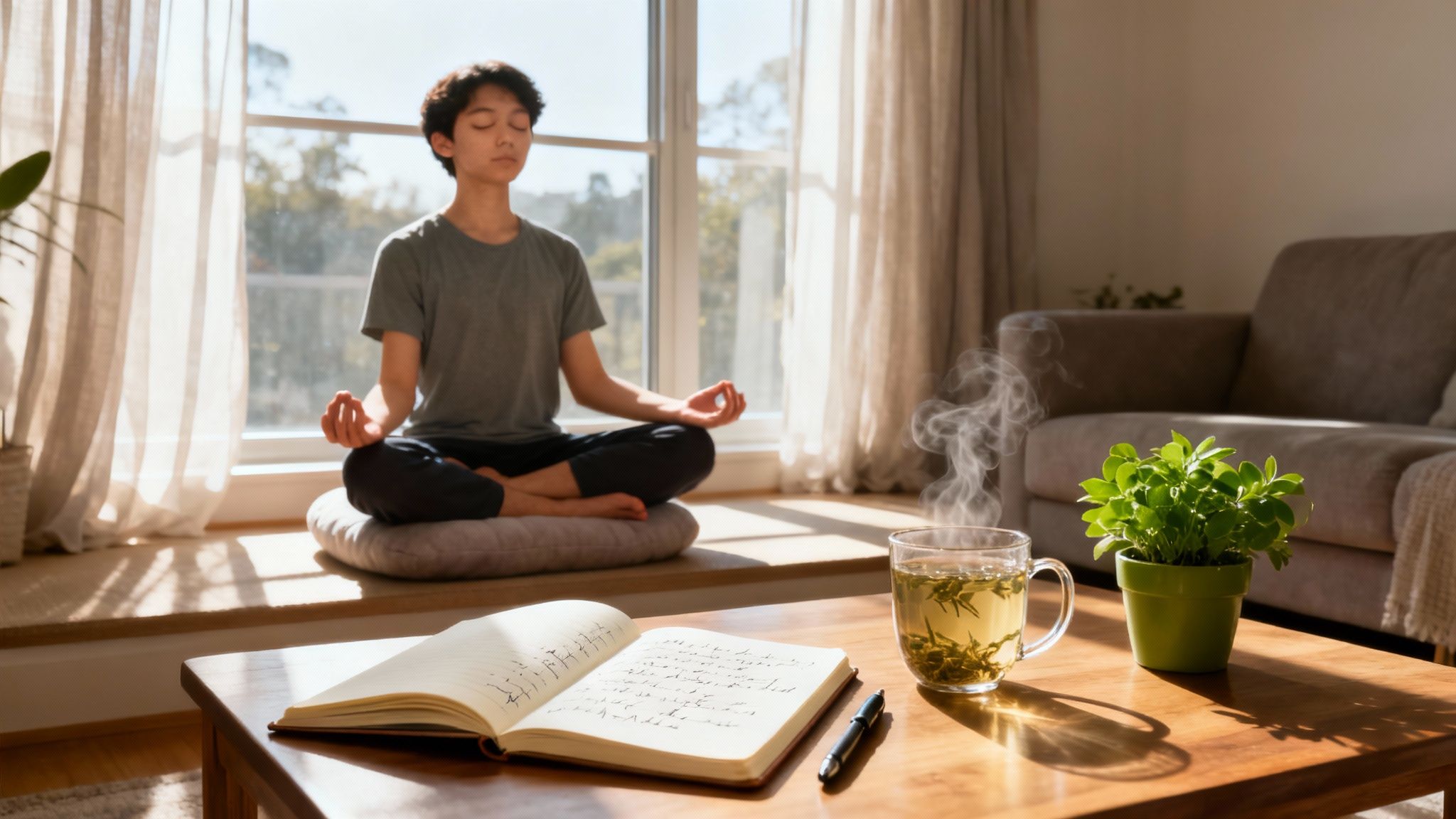
    A person calmly practising mindfulness, symbolizing the process of rewiring negative thoughts.

    We all have an inner critic—that voice that points out our flaws and tells us we're not good enough. This voice fuels insecurity by turning small mistakes into huge problems.

    Learning how to overcome insecurity means learning how to respond to this voice. Using tools from therapy like Cognitive Behavioural Therapy (CBT), you can build a kinder internal dialogue and quiet the noise of self-doubt.

    Identify Your Automatic Negative Thoughts

    First, you have to spot the critic in action. These automatic negative thoughts (ANTs) are harsh, knee-jerk judgments that often feel like the absolute truth.

    For example, a small mistake at work might trigger the thought, "I'm a complete failure." This all-or-nothing thinking can create relentless workplace stress and damage your confidence.

    Try to catch these thoughts as they happen by noting them down. When you feel insecure, pause and write down what just went through your mind.

    • The Situation: What happened right before the thought? (e.g., "My manager gave me feedback.")
    • The Emotion: How did it make you feel? (e.g., "Anxious, embarrassed.")
    • The Automatic Thought: What did your inner critic say? (e.g., "I can't do anything right.")

    This simple act of observation is a core practice in counselling. It creates space between you and the thought, helping you see it more clearly instead of being overwhelmed by it.

    Challenge and Reframe Your Inner Critic

    Once you can identify these thoughts, you can start to question them. Your inner critic relies on assumptions, not facts, so you can build mental resilience by challenging its claims.

    You don't need to argue with yourself. Just gently question the negative thought with a few logical questions to see if it holds up.

    Takeaway: Your feelings are always valid, but they are not always facts. A key skill in managing anxiety is learning to separate your emotional reaction from the objective reality of a situation.

    Here’s how you can dismantle common negative thoughts and find a more balanced perspective:

    Automatic Negative Thought The Challenge (Ask Yourself) A Balanced Reframe
    "Everyone in the meeting thought my idea was stupid." "Did anyone actually say that? What evidence do I have?" "My idea wasn't chosen, but I spoke up and contributed. That's a win."
    "I'll never be as successful as my friends." "Is success a competition? What does 'success' mean to me?" "My friends are on their own paths, and I'm on mine. I can celebrate their wins and focus on my own progress."
    "I'm so awkward in social situations." "Have I had positive social interactions before? What went well?" "Sometimes I feel nervous, but I'm capable of connecting with people. Each interaction is a chance to practise."

    This process isn't about ignoring weaknesses but seeing yourself as a whole person capable of growth. Regular practice can foster a more compassionate inner voice, which can ease feelings linked to depression and improve your daily well-being.

    Build Lasting Confidence with Self-Compassion

    A person practising a gentle, compassionate yoga pose indoors, with soft light creating a calm atmosphere.

    One of the kindest ways to quiet insecurity is to treat yourself as you would a dear friend. This is the heart of self-compassion, a powerful tool for building confidence from within. It helps reduce the stress and anxiety that fuel insecurity.

    Instead of fighting self-doubt, self-compassion invites you to meet it with warmth and understanding. Accepting that you are human and that mistakes are part of life builds profound emotional resilience and a stronger sense of self-worth.

    Start with Mindful Acceptance

    The first step is to notice your feelings without judgment. When insecurity arises, pause and acknowledge what's happening by saying to yourself, "This is a moment of pain," or "I'm feeling insecure right now."

    This mindful act creates space between you and your emotions, preventing a negative spiral. It is a foundational skill taught in therapy to help manage difficult feelings and improve your overall well-being.

    Remember, acknowledging your feelings isn't the same as giving in to your insecurities. It’s about creating the space to feel, without letting those feelings define who you are.

    Practical Self-Compassion Exercises

    Bringing self-compassion into your daily life can be simple. Here are a few practices to try when you're feeling low:

    • Comforting Touch: Place a hand over your heart or give yourself a gentle hug. This physical act can release oxytocin, a hormone that promotes feelings of safety and helps calm your nervous system.
    • Kind Self-Talk: Ask yourself, "What would I say to a friend going through this?" Then, turn that supportive and understanding language inward.
    • Journaling Prompts: Write about a recent setback. Describe what happened without judgment, then write a compassionate letter to yourself, offering gentle words of encouragement.

    Practising self-compassion often includes learning to set healthy boundaries. It can be challenging, but asserting your needs is a vital part of building self-respect and confidence.

    Fortunately, support is widely available. Mental health resources and mindfulness exercises can be powerful allies on your journey to overcoming insecurity.

    Find Strength in Your Relationships and Community

    Insecurity often thrives in isolation, making you feel completely alone. One of the most powerful ways to counteract this is through genuine human connection. A strong support system can buffer against the anxiety that self-doubt creates.

    Authentic relationships with trusted friends, family, or colleagues can reflect your true value back to you. When you share your vulnerabilities, you often find empathy and acceptance, which directly counters your inner critic and fosters a sense of belonging.

    Cultivate Your Support System

    Nurturing your relationships is an active choice. Invest your time and energy in people who make you feel seen, heard, and valued for who you are.

    Even one or two deep connections can make a huge difference. Reach out to the people you feel most comfortable with through a call, a coffee, or an honest conversation.

    Supportive relationships don’t just make us feel good; they actively build our resilience. Knowing you have people in your corner during tough times can make any challenge feel less overwhelming and reduce feelings of loneliness or depression.

    Research confirms this. Data shows that individuals with strong family and community ties report significantly lower levels of personal insecurity. Institutions like the Joint Research Centre track these indicators of social well-being.

    Set Healthy Boundaries

    While positive relationships are vital, it's just as important to manage those that drain you. Setting boundaries is an act of self-respect and a key part of learning how to overcome insecurity.

    This may mean limiting time with critical people or learning to say "no" to requests that cause workplace stress. It's about protecting your energy and well-being.

    Here are a few ways to start building healthier boundaries:

    • Identify Your Limits: Notice what makes you feel uncomfortable, resentful, or drained. This awareness is your starting point.
    • Communicate Clearly and Kindly: You can state your needs calmly. A simple phrase like, "I appreciate the offer, but I can't take that on right now," is effective.
    • Start Small: If setting boundaries is new to you, practice in low-stakes situations to build your confidence.

    The goal is a social environment that supports your growth and happiness. If relationship dynamics feel complex, professional counselling or therapy can offer a safe space to practice these skills.

    Turn Self-Doubt into Action with Small Wins

    Lasting confidence is built through action, not just positive thinking. Turning insights into small, tangible steps proves to yourself that you are capable.

    This isn't about grand leaps but about creating a series of small, meaningful wins. Each step builds momentum, chipping away at feelings of inadequacy and creating a sustainable engine for your self-esteem and well-being.

    Set Goals That Truly Matter

    For your actions to feel rewarding, they must be meaningful to you. Chasing external validation often magnifies anxiety, especially if it's not aligned with your true desires.

    Take a moment to look inward and ask what gives you a sense of purpose and happiness. When your goals align with your core values, your progress will feel authentic and satisfying, providing a powerful antidote to workplace stress and insecurity.

    Consider setting a small goal in one of these areas:

    • Personal Growth: Learn a new skill, like coding or public speaking.
    • Health and Well-being: Commit to a short daily walk or a five-minute meditation practice.
    • Relationships: Reconnect with an old friend or have a meaningful conversation with a loved one.
    • Creativity: Work on a passion project you've set aside.

    Pick one small, specific goal that genuinely excites you. This will kick-start a positive feedback loop where each success builds your resilience and courage for the next step.

    Focus on Progress, Not Perfection

    Perfectionism is insecurity's best friend, setting an impossible standard that keeps you stuck. To break free, you must learn to celebrate the process and your progress, no matter how small.

    The goal isn't to get it perfect; the goal is to get it done. Every small action you take is a vote for the person you want to become, reinforcing your capability and strengthening your self-belief.

    For example, if your goal is to speak up more in meetings, a win is simply sharing one idea, even if your voice shakes. This shift reframes success as effort and participation, which can ease performance-related anxiety and feelings of depression.

    Track Your Wins to Build Momentum

    Our brains tend to focus on failures while overlooking successes. Actively counter this by keeping a record of your accomplishments.

    At the end of each day or week, jot down three things you did that moved you closer to your goals. This simple habit creates tangible proof of your progress, which you can look back on when your inner critic reappears.

    If you struggle to maintain momentum, remember that professional counselling or therapy can provide structured support. A therapist can offer accountability to help you stay on track and build on your wins.

    Your Path Forward and When to Seek Professional Support

    Overcoming insecurity is a personal journey, not a race. It’s about slowly building a more compassionate and resilient relationship with yourself by weaving these practices into your daily life.

    Lasting change comes from small, consistent habits that reinforce your sense of worth. Remember, this path is about progress, not perfection.

    You will have days when self-doubt is loud and others when you feel confident. The goal isn't to silence doubt forever but to build a foundation that helps you manage it with kindness, improving your overall well-being.

    Knowing When You Need More Support

    Self-help strategies are powerful, but sometimes insecurity is too heavy to carry alone. Reaching out for professional help is a courageous step toward healing and investing in your happiness.

    It might be time to consider professional counselling or therapy if you notice:

    • Your feelings of insecurity are constant and disrupting your daily life, work, or relationships.
    • You’re struggling with overwhelming anxiety or symptoms of depression.
    • The strategies you've tried on your own aren't making a difference.
    • You suspect deep-rooted past issues are still affecting your self-worth.

    A therapist provides a safe, non-judgmental space to explore the roots of your insecurity. They offer personalised guidance and proven techniques to help you build healthier coping skills.

    What to Expect from Therapy

    Starting therapy can feel intimidating, especially where mental health conversations are still evolving, such as in India. A qualified therapist will work collaboratively with you.

    Together, you'll identify your unique triggers and develop tailored strategies to build your emotional resilience. Therapy can help you make sense of complex feelings and manage challenges like workplace stress or difficult relationships.

    Supportive Takeaway: Your journey is your own. The aim isn't to eliminate insecurity forever but to reduce its power over you, allowing you to live a more authentic and fulfilling life. Be patient and compassionate with yourself every step of the way.

    The tools mentioned here are for informational purposes to help you build self-awareness; they are not a substitute for a professional diagnosis. Whether you continue this journey on your own or with professional support, know that you are capable of building a more confident and peaceful inner world.


    If you're ready to take that next step, DeTalks is here to help. Our platform connects you with qualified therapists and provides scientifically validated assessments to guide your journey towards greater self-understanding and well-being. Explore our resources and find the right support for you.

  • How to Stop Worrying And Calm Your Mind

    How to Stop Worrying And Calm Your Mind

    Learning how to stop worrying isn't about flipping a switch. You won’t suddenly feel no anxiety at all. Instead, it's about gently untangling anxious thoughts and finding healthier ways to respond.

    Think of it as building mental muscle. This skill improves your resilience and well-being for the long haul.

    Understanding Why You Worry and How to Move Forward

    Worry is a natural response. But when it becomes a constant chatter in your head, it can feel exhausting. Pressures from work, family, and social expectations can keep us stuck in stress and anxiety.

    The first step is to reframe how you see worry. It’s not a flaw or a weakness. It’s a signal your brain is waving to tell you something needs attention.

    Here in India, the weight of career ambitions and family expectations often fuels this endless loop of anxious thoughts. This can affect your sleep, your relationships, and your ability to enjoy simple moments.

    A person sitting calmly on a windowsill, looking out at a peaceful city view, representing a moment of quiet reflection.

    The Roots of Worry in Daily Life

    Chronic worry often springs from uncertainty or feeling out of control. Everyone’s triggers look a bit different:

    • Workplace Stress: Deadlines, performance pressure, or fears about job security can fuel anxiety.
    • Personal Responsibilities: Managing family needs, finances, and health can leave little room for rest.
    • Societal Pressures: Messages about success and perfection can turn small stumbles into big catastrophes.

    A 2021 report showed India had 2.6 million diagnosed cases of anxiety disorders among those aged 10–24—the highest figure globally for that age group. You can discover more insights about these findings on youth mental health directly from the report.

    Worrying does not take away tomorrow's troubles; it takes away today's peace.

    This quote reminds us that worry drains our peace. Building emotional resilience starts here.

    Self-compassion is a powerful tool. Instead of judging yourself for worrying, get curious. Ask what your thoughts are trying to tell you. This simple shift supports your mental well-being.

    Talking with a trusted friend or keeping a journal can help you notice patterns. And if you ever feel stuck, seeking professional counselling or therapy is a proactive, caring step—not a sign of failure.

    Practical Ways to Break the Worry Cycle

    When you’re caught in an anxious loop, you need tools that work right now. Pushing worries away often gives them more power. The goal is to interrupt the cycle with simple, practical techniques.

    A close-up of a person's hands gently holding a small, delicate plant, symbolizing care and grounding.

    Create a 'Worry Window'

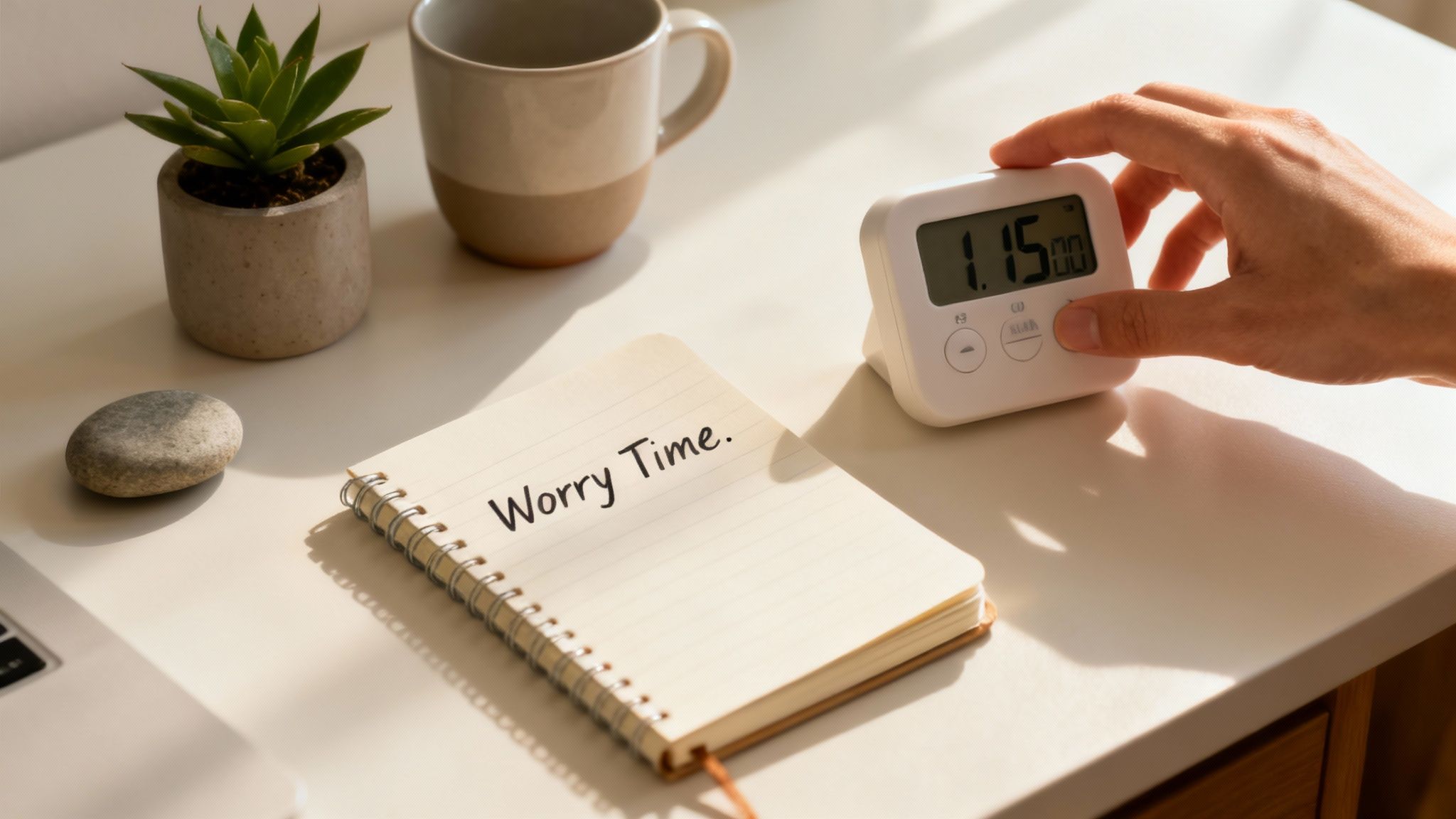
    A “worry window” helps you control when you face concerns. Choose a 15-minute slot each day—say 6 PM—to sit with your worries.

    When a worry pops up outside that window, acknowledge it and remind yourself, “I’ll deal with this at 6 PM.” This simple act frees your mind for other tasks.

    Ground Yourself in the Here and Now

    Grounding exercises pull you back to the present. One favourite is the 3-3-3 Rule. It works for workplace stress or any spike of anxiety.

    1. Notice 3 things you can see around you.
    2. Listen for 3 sounds you can hear.
    3. Move 3 parts of your body, like wiggling toes or shrugging shoulders.

    This sensory focus breaks the chain of “what if” thoughts. You can also try other grounding techniques for anxiety to anchor yourself in the present.

    Remember, these tools help you manage worry—they're not a magic cure for anxiety or depression.

    Gently question anxious thoughts using cognitive reframing. Ask, “What evidence supports this fear? Is there a more realistic outcome?” This practice builds resilience and reduces the power of catastrophic thinking.

    Worry-Breaking Techniques at a Glance

    Technique What It Does Best Used When
    Worry Window Contains worrying to a specific, limited time slot each day. Worries creep in and disrupt your focus all day long.
    3-3-3 Rule Uses your senses to pull you into the present moment. You feel a sudden spike of anxiety or spiralling thoughts.
    Cognitive Reframing Gently questions and challenges the logic behind an anxious thought. You’re stuck on a persistent “what if” scenario that feels catastrophic.

    Keeping a few of these tools handy can make all the difference when worry starts to take over.

    Building Long-Term Resilience Against Stress

    A person practicing yoga on a mat in a brightly lit room, signifying the connection between physical and mental well-being.

    Quick fixes can help in the moment, but lasting resilience grows through small, steady habits. Think of resilience as a muscle that needs daily exercise.

    Cultivating Mindfulness And Presence

    Mindfulness means noticing what’s happening right now, without rushing to judge or solve. Even a five-minute pause can shift how you handle the day.

    • Mindful Breathing: Focus on each inhale and exhale. When thoughts wander, gently return to your breath.
    • Body Scan Meditation: Lie down and notice sensations from toes to head, without trying to change anything.

    Regular practice can loosen anxiety’s grip over time and support your overall well-being and happiness.

    Resilience is not about avoiding stress but learning to recover from it with compassion and practice.

    The Powerful Link Between Body And Mind

    Physical routines directly impact emotional resilience. Small changes can make a big difference:

    • Nutrition: Include foods rich in Omega-3s, magnesium, and B vitamins—like oily fish, nuts, and whole grains.
    • Sleep: Aim for 7–9 hours of rest each night. A consistent bedtime calms your stress response.
    • Movement: A simple 20-minute walk or gentle stretching lowers cortisol without a full gym workout.

    Journaling For Clarity And Self-Compassion

    Journaling creates space to untangle thoughts. A quick evening “brain dump” for five to ten minutes can lighten your mental load.

    Writing without judgement transforms worries into something you can work with. If you need more guidance, professional counselling can offer personalised support, but a journal remains a powerful first step.

    Navigating Workplace Stress and Preventing Burnout

    For many, the workplace fuels chronic worry. Deadlines, high expectations, and always-on cultures can spark both anxiety and burnout. Learning to stop worrying at work means taking back control of your time and energy.

    It starts with healthy boundaries. Politely decline extra tasks when your plate is full. Truly log off at the end of your workday—protecting your personal time is essential for long-term well-being.

    A person at their desk taking a mindful break, looking away from their screen and stretching, with a calm and focused expression.

    Smart Strategies for Managing Your Workload

    Feeling swamped by your to-do list is a classic worry trigger. Productivity methods can restore order and calm.

    The Pomodoro Technique is one to try. Work in 25-minute sprints, then take a five-minute break. This rhythm helps you stay focused without mental fatigue.

    Mindful breaks are just as important. Stand up, stretch, walk to the window, or close your eyes and breathe. These tiny resets interrupt the stress cycle and bring you back with a clearer mind.

    If you want more guidance on workplace wellbeing, check out effective workplace stress management strategies.

    Your career can be a source of fulfilment, not chronic worry. Small, consistent actions build resilience and support your mental health.

    These practices are acts of self-compassion that protect you from deeper issues like depression. And if stress ever feels too much, professional counselling or therapy offers targeted strategies to thrive without sacrificing your peace.

    When and How to Seek Professional Support

    Sometimes self-help tools need a partner in professional support. That’s perfectly okay. Recognising you might need more help is a sign of strength, not weakness.

    Assessments offered by therapists or online platforms are informational, not diagnostic. They can guide you toward useful strategies, but only a qualified professional can provide a formal diagnosis.

    Knowing When Worry Is Something More

    Everyday worry ties to specific concerns like a looming deadline or exam. It’s temporary.

    Anxiety often feels persistent and hard to pin down. You might carry unease even when there’s no clear reason. Physical symptoms like a racing heart can appear.

    Depression involves long-lasting low mood, loss of interest in activities, and a sense of hopelessness that disrupts daily life.

    If your worry is running the show—ruining sleep, work, or relationships—it may be time to talk to a professional. Remember, these pointers are for awareness, not a substitute for diagnosis.

    Finding the Right Support for You

    The connection with your therapist matters. Finding someone you click with makes all the difference.

    Access to mental healthcare in India is growing, with more in-person and online options. Platforms like DeTalks help you find qualified professionals who fit your budget and preferences.

    Consider what you need—specialisation, approach to counselling, or online versus in-person sessions. Many therapists offer a short initial chat to see if it’s a good fit before you commit.

    Therapy isn’t about being “fixed.” It’s about being heard, understood, and guided as you learn healthier ways to manage thoughts and life’s challenges, including workplace stress.

    Got Questions About Managing Worry? Let's Talk.

    It’s normal to have questions when you start using these tools. Learning how worry works is part of feeling confident you can manage anxious thoughts.

    Is It Realistic to Think I Can Stop Worrying Forever?

    Worry is a basic human emotion that helps us spot problems. The goal isn’t to silence it completely—that’s not possible. It’s to manage it so it doesn’t run your life.

    With consistent practice, you can dial down worry’s volume and frequency. It becomes an alert, not a tidal wave.

    How Can I Tell if My Worrying Is Just ‘Normal’ or Something More Serious?

    Everyday worry is tied to specific events. But if you feel unstoppable worry, constant unease, or physical symptoms like a racing heart, it could point to an anxiety disorder.

    Guides like this are for information and insight, not a diagnosis. If worry spirals out of control, professional counselling or therapy can give you clarity and a structured plan.

    I’m Already in Therapy. Can I Still Use These Techniques?

    Absolutely. These strategies complement professional therapy. Journaling, grounding exercises, and boundary-setting reinforce the progress you make with your counsellor.

    Share any new techniques with your therapist to ensure they fit your treatment plan. Together you can weave these tools into your daily routine for the best results.


    Ready to take that next step? At DeTalks, we help you find qualified therapists and provide science-backed assessments to support your journey towards better mental well-being. Find the right support for you on DeTalks

    Supportive Takeaways

    • You are not alone—worry is a shared human experience.
    • Small, consistent actions build lasting resilience.
    • These techniques are tools, not quick fixes or cures.
    • Assessments are informational, not diagnostic.
    • Kindness and compassion toward yourself fuel well-being.
  • How to Practice Self-Compassion: A Guide to Greater Well-Being

    How to Practice Self-Compassion: A Guide to Greater Well-Being

    Think about how you treat a good friend having a rough time. You would likely offer kind words, understanding, and support. Self-compassion is simply turning that same warmth and kindness inward, especially when you need it most.

    It's about accepting that being human means being imperfect. This gentle shift in mindset is one of the most powerful things you can do for your emotional resilience and overall well-being.

    What Self-Compassion Really Means

    When we face a setback, our first reaction is often to listen to that harsh inner critic. It's the voice that tells us we aren't good enough or that we're the only one who makes mistakes, which can lead to feelings of isolation, anxiety, or even depression.

    Learning how to practice self-compassion offers a healthier, more supportive way to handle life's challenges. Whether dealing with workplace stress or academic pressure, it’s not about letting yourself off the hook but about building a strong foundation for lasting mental health.

    The Three Pillars of Self-Compassion

    To truly understand self-compassion, it helps to see its three core parts. Think of them as working together to create a stable support system for your mind.

    • Self-Kindness: This is the simple act of being gentle with yourself when you're struggling, instead of being critical.
    • Common Humanity: This is the powerful realisation that you are not alone. Imperfection and challenges are universal parts of the human experience that connect us all.
    • Mindful Awareness: This means acknowledging your difficult thoughts and feelings without judgment, so they don't overwhelm you.

    A Powerful Tool for Well-Being

    Cultivating self-compassion has a real, measurable impact on your mental health. It acts as a buffer against the harsh effects of stress and self-criticism, helping you navigate challenges with more emotional stability.

    For example, a study of university students in Asia revealed that those with higher self-compassion had significantly lower rates of anxiety, depression, and insomnia. The compassionate group, making up 54.1% of students, showed far better mental health and resilience. You can learn more about the study on student mental health for more details.

    Remember, self-compassion doesn't make challenges disappear. It gives you an inner resource to face them with strength and kindness, which is fundamental to building lasting well-being and can be supported through practices like therapy and counselling.


    How to Deal With Your Inner Critic

    Before building self-compassion, we must first get to know our inner critic. Think of it as that harsh monologue playing on a loop inside our heads, often echoing the demanding expectations we absorb from the world around us. In India, this pressure to succeed can be intense, whether on a university campus or in the workplace.

    This internal voice fuels self-doubt, kicking off cycles of anxiety and stress. The first step in learning how to practice self compassion is simply to notice this voice when it appears, without judging yourself for having it.

    Tuning In to Your Inner Critic’s Voice

    Learning to recognise your inner critic is a mindfulness exercise. It’s about becoming an observer of your thoughts, especially when you’re feeling stressed or disappointed.

    Pay attention to its language. Does it use absolute words like "always" or "never"? These are classic signs of the inner critic.

    For instance, after receiving feedback at work, the critic might say, "You always mess things up!" This kind of thinking only adds to anxiety and harms your well-being.

    The skill is learning to separate that critical voice from your own balanced perspective. Think of it not as an enemy to defeat, but as a thought pattern you can gently redirect with patience and awareness.

    Figuring Out What Sets It Off

    That critical voice is usually triggered by specific situations that make us feel vulnerable. By identifying your personal triggers, you can anticipate its arrival and manage its impact.

    Common triggers include:

    • Workplace Stress: A looming deadline or comparing your career to a colleague's can activate the inner critic.
    • Social Anxiety: Feeling like you don't fit in can be a prime time for self-judgment.
    • Perceived Failure: Not hitting a personal or professional goal can give your inner critic ammunition.

    Once you notice when this voice gets loudest, you can see it for what it is: a reaction, not a fact. This creates the space to choose a kinder response. If these triggers bring up persistent feelings of depression or intense anxiety, professional counselling can offer tailored strategies to build resilience.

    Practical Ways to Cultivate Self-Kindness

    Knowing about self-kindness is one thing; putting it into practice is where change happens. It's about weaving small, intentional moments of gentleness into your everyday life. The goal is to build a reliable toolkit of simple practices to help you respond with warmth.

    These techniques are like anchors, designed to be used anywhere to shift from harsh judgment to supportive care. Over time, these small acts build your emotional resilience and improve your overall well-being.

    This visual guide offers a straightforward, three-step approach to practising self-kindness when you're struggling.

    By mindfully pausing, using a calming touch, and speaking to yourself gently, you can create a buffer against both stress and your inner critic.

    Take a Self-Compassionate Break

    A simple and effective exercise is the Self-Compassionate Break. It's a short, structured pause that helps you acknowledge your feelings without letting them take over.

    The next time you feel a wave of anxiety or self-criticism, try this. First, acknowledge the pain by saying to yourself, "This is a moment of suffering."

    Next, connect with common humanity by reminding yourself, "Suffering is a part of life." This step counters the isolating feeling that you're alone in your struggles.

    Finally, offer yourself kindness. You can place a hand over your heart, feel the gentle warmth, and say something comforting to yourself.

    It doesn't have to be poetic. Something as simple as, "May I be kind to myself," works perfectly. The intention to offer comfort instead of criticism is what matters most.

    Use a Supportive Touch

    Never underestimate the power of physical touch to soothe your nervous system. A simple, supportive physical gesture can send a direct message to your brain that you're safe, calming your body's stress response.

    This doesn't need to be complicated. Here are a few simple gestures you can use anytime:

    • Hand on Heart: Gently place one or both hands over your heart and breathe.
    • A Gentle Hug: Cradle one arm with the other or wrap your arms around yourself.
    • Cupping Your Face: Gently place your hands on your cheeks.

    This practice is kindness made physical. It’s a tangible way to calm feelings of depression or anxiety and ground you in the present. You can extend this kindness to other routines, like exploring a food journaling app focused on memories, not macros to foster a healthier relationship with food.

    Connecting with Our Shared Human Experience

    One of the heaviest burdens is feeling alone in our struggles. This sense of isolation can turn a tough situation into an unbearable one, making us believe we're uniquely flawed. The idea of ‘common humanity’ reminds us that imperfection and pain aren't personal failures—they're universal human experiences.

    In many cultures, including in India, there is immense pressure to appear strong. Admitting we're having a hard time can feel like a weakness, reinforcing the isolating belief that everyone else has it figured out. This mindset can fuel shame, which is often at the heart of anxiety and depression.

    Seeing Yourself in Others’ Stories

    Learning how to practice self compassion begins when you shift your perspective from "Why me?" to "Just like me."

    Every setback is not a unique mark against you. Instead, see it as a thread connecting you to the vast, imperfect fabric of humanity.

    This shift doesn't dismiss your pain; it validates it as a real and understandable human feeling. Embracing this shared experience disarms shame and fosters a comforting sense of belonging, which is crucial for our emotional well-being.

    True connection arises from understanding that our vulnerabilities are what we have in common. Acknowledging your struggles as part of the human condition is a profound act of kindness to yourself.

    A Protective Factor for Everyone

    This sense of common humanity acts as a buffer against mental health challenges for everyone. Research on self-compassion's role in diversity and inclusion shows it helps people from all backgrounds.

    For instance, studies with sexual and gender-minority youth found that self-compassion significantly reduced rates of stress, anxiety, and depression, whether they had experienced bullying or not. You can discover more insights on these findings to see how this practice builds universal resilience.

    Journal Prompts to Foster Connection

    Writing can be a fantastic way to solidify this feeling of shared humanity. Try exploring these ideas in a journal to reframe your struggles as part of a collective journey.

    • Think about a recent mistake. What gentle, understanding words would a kind friend say?
    • Describe a time you felt you failed. Consider how many others might be feeling the same way right now.
    • What is one imperfection you're critical of? Write a short, compassionate note to yourself, acknowledging it as part of being human.

    These reflections are about making connections, not excuses. If feelings of loneliness or self-criticism feel too heavy, seeking professional counselling or therapy can provide a safe space to explore them with expert guidance.

    Using Mindful Awareness in Daily Life

    Think of mindfulness as the quiet foundation for self-compassion. It's about learning to hold your experiences—good, bad, and uncomfortable—with balanced, non-judgmental awareness.

    This is key to navigating feelings of anxiety or depression without getting swept away. When you can observe your thoughts and emotions with gentle curiosity, you create space to respond with kindness.

    Weaving Mindfulness into Your Routine

    You don’t need a special retreat to start. The most powerful way to practice mindful awareness is to weave small moments of it into your existing life. This makes it an accessible tool for managing workplace stress and improving your well-being.

    Here are a few simple ways to get started:

    • The One-Minute Breathing Break: Right at your desk, pause. For 60 seconds, bring all your attention to the sensation of your breath.
    • A Mindful Walk: On your next break, take a short walk and tune into your senses. Notice your feet on the pavement, the sounds around you, and the air on your skin.

    Mindfulness isn’t about fixing your feelings; it's about holding them with gentle awareness. This creates the space to choose a compassionate response over a critical one, boosting your resilience.

    How Awareness Builds Resilience

    Every time you practice mindful awareness, you train your brain to step back from overwhelming emotions.

    When a jolt of anxiety hits before a meeting, mindfulness helps you see it as "a feeling of anxiety" passing through, rather than becoming "an anxious person." This subtle shift is incredibly powerful.

    It allows you to see that thoughts and feelings are temporary visitors. This understanding is the foundation for learning how to practice self compassion, as it stops you from over-identifying with your struggles.

    Research shows self-compassion often deepens with age and experience. Broader studies involving over 20,000 people show men tend to be less self-critical, while women often cultivate a more supportive inner voice. You can discover more about these demographic insights for more context. If difficult thoughts persist, therapy or counselling offers a safe space to build these skills.

    Your Path Forward with Self-Compassion

    https://www.youtube.com/embed/4HTKzQm67mw

    Learning to be kinder to yourself is a gentle, ongoing journey, not a race to a finish line. The real work happens in tough moments when you choose to offer yourself kindness instead of criticism.

    Progress isn't a straight line, and that's okay. Being patient with yourself through the ups and downs is perhaps the most compassionate thing you can do.

    Remember the core ideas we've explored. These are your anchors for navigating workplace stress or personal struggles:

    • Be kind to yourself: Treat yourself as you would a good friend.
    • Recognise our shared humanity: You're not alone in your imperfections.
    • Hold your feelings with mindfulness: Acknowledge your pain without being overwhelmed.

    Your commitment is to the practice, not perfection. Every time you choose a gentle response over a harsh one, you strengthen your resilience and nurture your well-being.

    Sometimes, the kindest act is realising you need more support. If feelings of anxiety or depression feel too heavy, seeking professional therapy or counselling is a powerful step forward. This is your journey, and every step, no matter how small, is a victory.

    Common Questions About Self-Compassion

    As you start exploring self-compassion, it's normal for questions to come up. Let's walk through some of the most common ones to clarify what it means to be kind to yourself.

    Isn't This Just Being Selfish or Making Excuses?

    This is a common misconception, but the truth is the opposite. Self-compassion is about giving yourself the support needed to build genuine resilience, not letting yourself off the hook.

    People who practice self-compassion are often more motivated to learn from mistakes because they aren't paralysed by shame. It strengthens your ability to grow rather than getting stuck in self-blame.

    How Long Until I Actually Feel the Benefits?

    Everyone’s journey is different. Some people feel relief almost immediately, while for others, it's a gradual process of unlearning old habits.

    The goal is consistency, not perfection. Every small, intentional moment of self-kindness adds up, building a stronger emotional foundation over time, especially when navigating workplace stress.

    The most important thing is to be patient with yourself. Each small step you take toward self-kindness reinforces your inner strength and fosters lasting resilience.

    Can I Still Practise This if I'm Dealing with Severe Anxiety or Depression?

    Yes, self-compassion can be a powerful tool when managing symptoms of anxiety or depression. It helps you relate to difficult feelings with more care and less judgment.

    However, it's important to see self-compassion as a supportive practice, not a replacement for professional care. Please remember, these assessments are for informational purposes, not for diagnosis. If you are struggling, please seek guidance from a qualified therapist, as professional counselling offers structured support for healing.


    At DeTalks, we believe that finding the right support is a vital act of self-care. If you're ready to explore your mental well-being with a qualified professional, our platform connects you with trusted therapists across India. Find the right therapist for you and start your journey with DeTalks.

  • Top Mindfulness Techniques for Stress Relief in 2025

    Top Mindfulness Techniques for Stress Relief in 2025

    In today's fast-paced world, feeling stressed, anxious, or overwhelmed is a common experience. The demands of our personal and professional lives can sometimes lead to workplace stress and burnout, impacting our overall well-being. This article explores practical mindfulness techniques for stress to help you find calm and build a strong foundation for emotional balance.

    Mindfulness is the simple practice of paying attention to the present moment on purpose and without judgment. It's a skill that builds resilience, enhances self-compassion, and can foster a greater sense of happiness. By connecting with the here and now, you can learn to navigate difficult feelings linked to anxiety and depression with more ease. For a broader approach to mental calm, you might find value in this gentle guide to calming your mind and finding inner peace.

    This guide offers eight proven methods to support your mental wellness journey, explained in warm, clear language. Rooted in an India-first context with global relevance, these informational techniques are tools for well-being, not diagnostic assessments or a replacement for professional therapy or counselling. Let’s explore how you can cultivate a more balanced and mindful life.

    1. The Anchor of Now: Mindful Breathing (Breath Awareness Meditation)

    Mindful breathing is the foundation of many mindfulness techniques for stress. It involves focusing your attention on the natural rhythm of your breath. This simple act anchors you in the present moment, guiding your focus away from anxious thoughts.

    This practice helps activate the body's relaxation response, which can lower stress hormones and slow your heart rate. Popularised in the West, its power lies in its simplicity and accessibility for managing stress and promoting well-being.

    Why It's a Powerful Tool for Stress

    This technique is especially helpful for managing immediate stress. When you feel overwhelmed by workplace stress or a sudden wave of anxiety, focusing on your breath offers an instant point of concentration. The Indian Army incorporates similar tactical breathing to enhance focus, while the NHS in the UK often suggests it for managing anxiety.

    How to Practise Mindful Breathing

    Getting started is simple and requires no special equipment. Here are some tips to integrate this into your routine:

    • Start Small: Begin with just two to three minutes a day. Consistency is more important than duration when building a new habit.
    • Use a Tangible Anchor: Place one hand on your belly to feel the rise and fall with each breath, giving your mind a concrete sensation to focus on.
    • Practise the 4-7-8 Technique: A calming method popularised by Dr. Andrew Weil involves inhaling for 4 counts, holding for 7, and exhaling for 8.
    • Don't Judge Your Thoughts: Your mind will wander; that's natural. When it does, gently guide your attention back to your breath without criticism.
    • Use Guided Resources: Apps like Calm or Insight Timer offer guided breathing meditations that can help structure your practice, which is especially useful for beginners.

    2. Body Scan Meditation

    Body Scan Meditation is a practice that cultivates a deep connection between your mind and body. It involves guiding your attention through different parts of your body, noticing sensations like warmth or tension without judgment. This is one of the most effective mindfulness techniques for stress for those who carry tension physically.

    Body Scan Meditation

    Popularised as part of Mindfulness-Based Stress Reduction (MBSR), the practice helps you tune into your body's signals. By simply noticing physical sensations, you can consciously release accumulated stress from challenges like workplace stress and improve your well-being.

    Why It's a Powerful Tool for Stress

    This method is potent for managing chronic stress and physical discomfort that often come with anxiety and burnout. It trains the mind to observe sensations objectively rather than reacting to them. Major corporations like Apple and Nike include body scan sessions in their wellness programs to enhance employee resilience and well-being.

    How to Practise Body Scan Meditation

    Lying down comfortably is ideal for this practice, making it a perfect pre-sleep routine. Here are some actionable tips:

    • Use Guided Recordings: When starting, guided meditations are invaluable. Apps like Headspace or Insight Timer have excellent guided body scans.
    • Practise Before Bed: Performing a body scan in bed can significantly improve sleep quality by calming your nervous system and body.
    • Notice Without Judging: The goal is to notice sensations, not change them. Acknowledge tightness, pain, or ease with gentle curiosity.
    • Pace Yourself: Spend about 30-60 seconds on each major body part, such as your feet or abdomen, before moving to the next.
    • Return Gently: Your mind will naturally wander. When you notice this, gently guide your focus back to the part of your body you were attending to.
    • Stay Warm: As you relax, your body temperature might drop slightly. Keep a light blanket nearby to stay comfortable.

    3. Mindful Walking

    Mindful walking transforms the everyday act of moving into a powerful meditation. It involves bringing your full, non-judgmental awareness to the physical sensations of walking. This mindfulness technique for stress shifts your focus from the destination to the journey itself.

    Mindful Walking

    This practice grounds you in the present moment through movement, making it a great alternative for those who find seated meditation difficult. It connects the mind and body, helping to soothe anxiety by engaging your senses directly with the here and now.

    Why It's a Powerful Tool for Stress

    This technique is valuable for managing workplace stress and integrating calm into a busy schedule. A short mindful walk can physically and mentally reset your state, reducing feelings of being overwhelmed. The Japanese practice of Shinrin-yoku (forest bathing) combines mindful walking with nature to lower cortisol, while companies like Salesforce encourage it to boost employee well-being and resilience.

    How to Practise Mindful Walking

    You can practice mindful walking anywhere, from an office corridor to a quiet park. Here are some tips to get started:

    • Start with Short Sessions: Begin with just five minutes of mindful walking. As you become more comfortable, you can extend the duration.
    • Focus on Each Movement: Pay close attention to the sensation of lifting one foot, moving it through the air, and placing it back down.
    • Coordinate Breath with Steps: Try synchronizing your breath with your steps, such as inhaling for three steps and then exhaling for the next three.
    • Walk Barefoot: If you are in a safe, natural space like a grassy lawn, try walking barefoot to enhance the sensory feedback from the ground.
    • Use it as a Transition: Take a mindful walk when moving between tasks. This can act as a mental palate cleanser, helping you refocus.
    • Choose a Quiet Path: When possible, find a route with minimal distractions to deepen your practice and sense of well-being.

    4. Loving-Kindness Meditation (Metta)

    Loving-kindness meditation, or 'Metta', is a practice focused on cultivating unconditional compassion and goodwill. It involves silently repeating phrases that extend warmth and well-wishes first to yourself, and then to others. This can transform your relationship with stress born from conflict or self-criticism, fostering resilience.

    This technique shifts your mental state from judgment to acceptance and connection. By generating feelings of warmth, you actively counter the brain's negativity bias, reducing the emotional charge of stressful situations and promoting happiness.

    Why It's a Powerful Tool for Stress

    This mindfulness technique for stress is uniquely effective for managing emotional and interpersonal challenges. When facing workplace conflict or harsh self-judgment, Metta offers a way to soften your heart and approach the situation with greater empathy. Healthcare organizations are now using compassion meditation to help professionals prevent burnout and manage emotional tolls.

    How to Practise Loving-Kindness Meditation

    You can begin this heartfelt practice with just a few minutes a day. Here are some actionable tips:

    • Start With Yourself: Always begin by directing kind phrases toward yourself. Repeat phrases like, "May I be safe. May I be happy. May I be healthy. May I live with ease."
    • Personalise Your Phrases: If the traditional phrases don’t resonate, change them. You might prefer, "I wish myself peace," or "May I feel strong today."
    • Visualise the Recipient: When extending wishes to others, picture them in your mind. This makes the practice more vivid and heartfelt.
    • Combine with a Gesture: Place a hand over your heart as you offer kindness to yourself. This physical touch can deepen the feeling of self-compassion.
    • Be Patient with 'Difficult People': Only extend Metta to those you have friction with after you are comfortable directing it towards yourself and loved ones. It is a gradual process.

    5. The RAIN Technique: Navigating Emotional Storms

    The RAIN technique is a structured mindfulness practice to help you work through difficult emotions rather than suppressing them. Developed by mindfulness teachers, it provides a clear, four-step process. This method transforms your relationship with stress, creating a crucial pause between a trigger and your reaction.

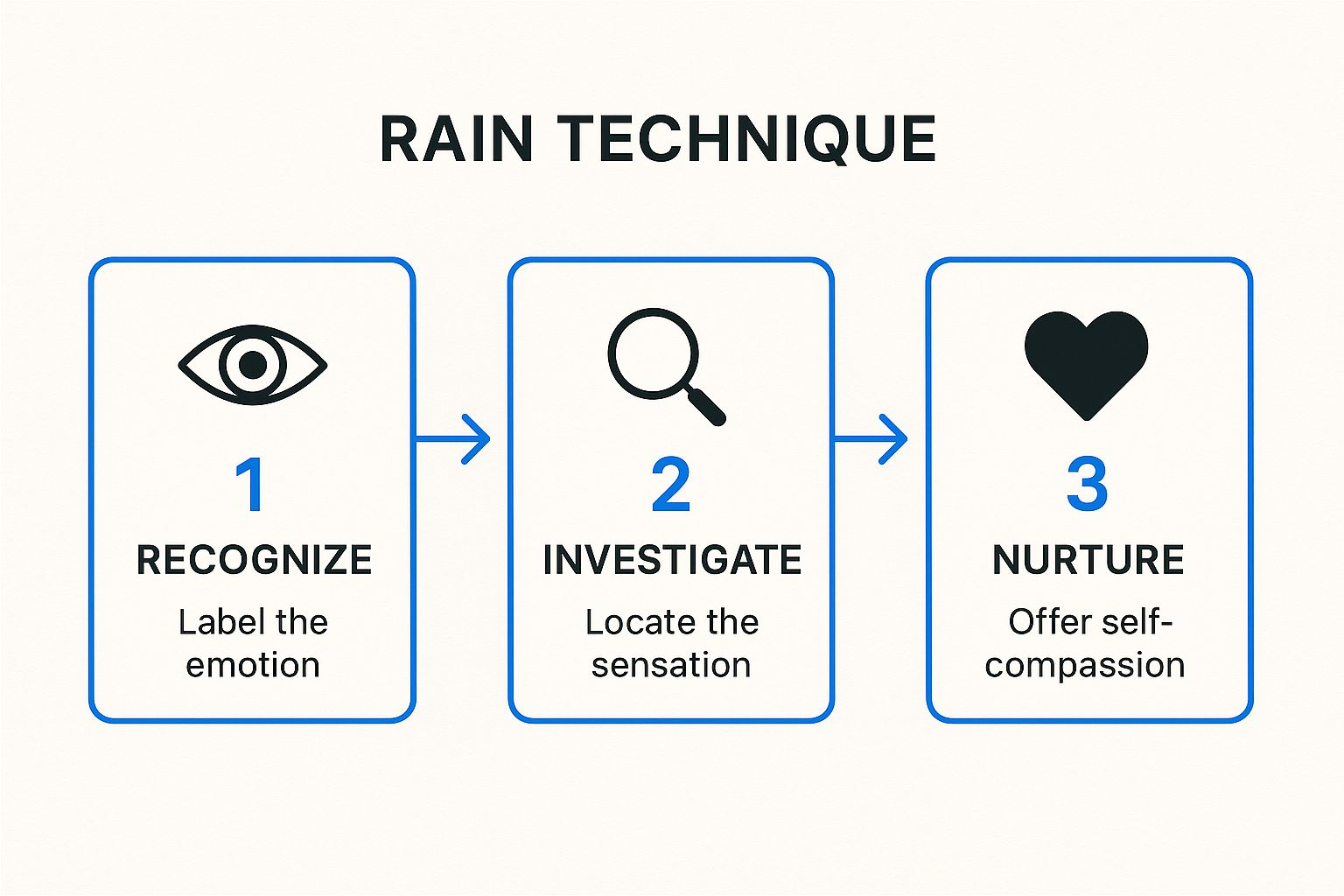
    The infographic below illustrates the core steps of the RAIN process, offering a visual guide to this powerful technique.

    Infographic showing key data about RAIN Technique

    This simple flow provides a structured pathway to process difficult emotional experiences. By moving through these stages, you build resilience and self-compassion.

    Why It's a Powerful Tool for Stress

    RAIN is exceptionally effective for processing intense emotions that accompany workplace stress or anxiety. It is widely used in therapy and counselling; for instance, addiction recovery programs in India employ it to manage cravings. It provides a practical framework for emotional regulation and well-being.

    How to Practise the RAIN Technique

    You can apply this four-step process anytime you feel a strong emotion rising. Here are some tips to integrate RAIN into your life:

    • Recognise What’s Happening: Pause and mentally name the feeling. For example, say to yourself, "This is anxiety," or "Anger is here."
    • Allow the Experience to Be There: Gently give the feeling permission to exist without trying to fix it. You might whisper internally, "It's okay to feel this."
    • Investigate with Kindness: Turn your attention inward with curiosity. Ask yourself, "Where do I feel this in my body?" or "What does this emotion need right now?"
    • Nurture with Self-Compassion: Offer yourself a gesture of kindness, like placing a hand on your heart or offering kind words. This step provides comfort and care.
    • Start with Minor Irritations: Practice RAIN with small stressors, like being stuck in traffic, before applying it to more intense situations to build the skill.

    6. Mindful Observation (Open Awareness)

    Mindful observation, or open awareness, is a practice that trains your attention on a single object in your environment. Whether it's a flower or a cup of tea, the goal is to observe it with full sensory awareness, free from judgment. This technique interrupts the cycle of stress-generating thoughts by anchoring your mind in the tangible world.

    The practice shifts your focus from internal mental chatter, which often fuels anxiety, to external sensory input. Popularised through the famous "raisin exercise," it shows that even a mundane object can be a gateway to presence and peace.

    Why It's a Powerful Tool for Stress

    This technique is effective for breaking free from repetitive negative thinking. When you're caught in a loop of worry about workplace stress, mindful observation provides an escape route. Nature-based therapy programs in India often use mindful observation to help individuals manage symptoms of anxiety and depression, grounding them in the natural environment.

    How to Practise Mindful Observation

    Integrating this practice requires only a willingness to see the world with fresh eyes. Here are some actionable tips:

    • Start with a 'Beginner's Mind': Choose an object, perhaps the cup of chai you have every morning, and pretend you are seeing it for the very first time.
    • Keep a 'Mindfulness Object': Place a small object like a smooth stone on your desk. When stress rises, take a two-minute break to simply observe it.
    • Engage All Senses: The "raisin exercise" is a classic example. Look at it, feel it, smell it, and finally, taste it slowly, observing the flavor.
    • Use the 5-4-3-2-1 Technique: Ground yourself by naming: 5 things you can see, 4 things you can feel, 3 things you can hear, 2 things you can smell, and 1 thing you can taste.
    • Don't Strive, Just Notice: The goal is simply to observe. When your mind wanders, gently guide it back to the object of your attention.

    7. Penning Down Peace: Mindful Journaling

    Mindful journaling is a powerful mindfulness technique for stress that combines writing with present-moment awareness. It involves writing about your thoughts, emotions, and physical sensations as they arise, observing them without judgment. This practice helps make overwhelming feelings feel more manageable.

    Translating thoughts and feelings into words creates a healthy distance, allowing you to see them more objectively. This method builds self-awareness, a key component of emotional resilience and well-being.

    Why It's a Powerful Tool for Stress

    This technique is effective for untangling complex emotions tied to workplace stress, anxiety, or burnout. It’s a private and accessible way to engage in self-counselling and identify recurring thought patterns. Corporate wellness programs, like those at LinkedIn, offer journaling sessions to help employees manage job stress and improve well-being.

    How to Practise Mindful Journaling

    You don’t need to be a writer to benefit; you just need a pen and paper or a digital app. Here are some tips to begin:

    • Start with Five Minutes: Begin with a short, achievable goal of five minutes a day. Consistency is more crucial than duration.
    • Use Mindful Prompts: Kickstart your session with prompts like, "Right now, I am feeling…" or "I notice in my body…" to anchor your writing in the present.
    • Observe, Don't Solve: Write about a source of stress without pressure to find a solution. The goal is to simply observe your thoughts and feelings.
    • Incorporate Gratitude: End each session by noting three specific things you are grateful for. This shifts your focus towards positivity and builds resilience.
    • Try Morning Pages: This involves writing stream-of-consciousness thoughts upon waking to clear your mind for the day.
    • Use Digital Tools: If you prefer typing, apps like Day One or Journey offer secure platforms to support your mindful journaling practice.

    8. Mindful Sensory Grounding (5-4-3-2-1 Technique)

    Mindful sensory grounding is a powerful mindfulness technique for stress that pulls your awareness out of overwhelming thoughts. It uses your five senses to connect to the present moment, as seen in the popular 5-4-3-2-1 method. This practice involves systematically identifying things you can see, touch, hear, smell, and taste.

    The technique works by redirecting your brain's focus from anxiety-fuelling thoughts to neutral, real-world sensory information. This shift interrupts the body's stress response, calming the nervous system and providing immediate relief.

    Why It's a Powerful Tool for Stress

    This technique is effective for managing sudden spikes in anxiety or panic. When your mind is racing with workplace stress or worry, sensory grounding acts as an emergency brake. Professionals in therapy and counselling use grounding as a core component for helping people navigate intense emotions and feel safe in the here and now.

    How to Practise Mindful Sensory Grounding

    The 5-4-3-2-1 method is easy to remember and can be done anywhere. Here are actionable tips to integrate this into your well-being toolkit:

    • Practise When Calm: Rehearse the technique when you are relaxed. This makes it easier to use automatically during a high-stress moment.
    • Be Specific: Instead of just noticing "a chair," describe it to yourself: "I see a brown wooden chair with a smooth surface." Specificity deepens the grounding effect.
    • Speak Aloud: If you are in a private space, say what you observe out loud. Hearing your own voice can provide an extra layer of grounding.
    • Adapt for the Senses: For taste, you can notice the current taste in your mouth or have a mint or sip of water. For touch, focus on textures like the fabric of your clothes.
    • Create a 'Grounding Kit': Keep a small bag with items that have strong sensory properties, such as a textured stone or a small bottle of essential oil.

    Mindfulness Techniques: 8-Item Comparison

    Technique Implementation Complexity 🔄 Resource Requirements ⚡ Expected Outcomes 📊 Ideal Use Cases 💡 Key Advantages ⭐
    Mindful Breathing Low – simple focus on breath, easy to learn Minimal – no equipment needed, 5–20 mins Immediate stress reduction, parasympathetic activation Acute stress, quick calming Accessible anywhere, scientifically proven, no cost
    Body Scan Meditation Moderate – systematic, 10–45 mins Quiet space, guided audio recommended Reduces chronic pain, improves body awareness Insomnia, chronic stress, physical tension Effective for physical stress, increases emotional regulation
    Mindful Walking Low to moderate – slow walking, 5–30 mins Safe walking space, outdoors preferred Combines stress relief with physical activity Restless individuals, integrating mindfulness into daily routine Combines exercise and mindfulness, grounding benefits
    Loving-Kindness Meditation (Metta) Moderate – structured phrases, 10–30 mins Minimal – quiet space, no equipment Increases positive emotions, reduces social anxiety Interpersonal stress, self-criticism, isolation Enhances empathy, social connection, self-compassion
    RAIN Technique Moderate – 4-step cognitive-emotional process Minimal, 5–20 mins Enhances emotional intelligence, prevents reactivity Acute emotional overwhelm, trauma processing Structured, practical for intense emotions
    Mindful Observation (Open Awareness) Low to moderate – focus on external object, 5–15 mins Suitable object, quiet or public space Reduces rumination, improves concentration Those triggered by internal focus, daily routine Easily integrated, subtle public practice
    Mindful Journaling Moderate – writing with mindful awareness, 10–20 mins Writing materials or digital app Processes stress, identifies thought patterns People who express via writing, emotional processing Tangible record of stress, combines writing & mindfulness
    Mindful Sensory Grounding (5-4-3-2-1) Very Low – simple sensory engagement, 2–5 mins None, portable, can be discreet Immediate grounding, reduces panic and acute anxiety Panic attacks, acute stress, anxiety Fast, easy, discreet, suitable for all ages

    Your Path Forward: Integrating Mindfulness into Your Life

    You have just explored a powerful toolkit of mindfulness techniques for stress, each offering a unique pathway to the present moment. These strategies are invitations to reshape your relationship with your mind and emotions. From Mindful Breathing to the compassionate practice of Loving-Kindness Meditation, they provide practical ways to build resilience and find calm.

    The journey through these techniques reveals a central truth: you do not have to be swept away by stress, anxiety, or worry. Instead of fighting difficult thoughts, you can learn to observe them with gentle curiosity. This shift in perspective is the heart of mindfulness and is key to greater well-being.

    Key Takeaways: Making Mindfulness Your Own

    As you integrate these practices into your life, remember the goal is not perfection but presence. The true value lies in discovering which techniques resonate with you and committing to a gentle, consistent practice.

    • Start Small and Be Patient: You don’t need to meditate for an hour. Begin with five minutes of Mindful Breathing or a short Mindful Walk. Each time you gently guide your attention back from a wandering thought, you are strengthening your resilience.
    • Adapt to Your Needs: These are flexible tools. On a day filled with workplace stress, the 5-4-3-2-1 technique might be your anchor. When dealing with difficult emotions, the RAIN technique can offer insight and self-compassion.
    • Mindfulness is Not a Cure, but a Skill: Mindfulness won't eliminate stress, but it builds your capacity to navigate it without being overwhelmed. It cultivates emotional regulation, enhances well-being, and provides a buffer against burnout, anxiety, and depression.

    Building a Foundation for Lasting Well-being

    By weaving these mindfulness techniques for stress into your life, you invest in your long-term mental health and happiness. This practice fosters a deeper connection with yourself and the world around you. You learn to savour positive moments more fully and approach challenges with greater clarity and self-compassion.

    This journey is a powerful step towards personal growth and building resilience against life's challenges. Remember, each breath and each moment of awareness is a victory. You are cultivating a sanctuary within yourself—a place of calm you can always return to.


    If you're looking for personalised support to navigate stress, anxiety, or other life challenges, professional guidance can make all the difference. DeTalks connects you with qualified therapists and counsellors across India who can help you integrate these mindfulness practices into a structured plan for your mental well-being. Explore your path to a healthier mind by visiting DeTalks today.

  • 8 Powerful Self Esteem Building Activities to Try in 2025

    8 Powerful Self Esteem Building Activities to Try in 2025

    Building self-esteem is a rewarding investment in your personal well-being. In a world often filled with challenges like workplace stress and anxiety, a strong sense of self-worth is vital for resilience and confidence. This journey is about small, consistent actions that reshape how you see yourself.

    This guide offers practical and effective self esteem building activities for your daily routine. Rooted in positive psychology, these exercises help manage stress, foster compassion, and improve your overall happiness. Whether you're a student in India or a professional elsewhere, these tips are globally relatable.

    Consider this list a supportive toolkit for self-discovery, not a diagnostic tool for conditions like depression. Each activity is a step toward understanding your strengths and building a healthier relationship with yourself. The goal is to empower you with strategies to cultivate a stronger sense of self, one step at a time.

    1. Positive Affirmations Practice

    Positive affirmations are simple statements used to challenge and overcome unhelpful self-talk. This practice involves repeating positive phrases about yourself to reinforce a sense of self-worth and confidence. It is a foundational step among self esteem building activities as it directly addresses your inner dialogue.

    This method works by helping your brain form new, more positive thought patterns. Consistent repetition of these statements can strengthen these pathways, making positive thoughts more automatic and weakening negative beliefs that may contribute to anxiety or low moods.

    How to Implement Positive Affirmations

    Getting started is simple, but consistency is key to seeing real benefits for your well-being.

    • Create Your Statements: Write affirmations that are personal and believable to you. For example, instead of a general phrase, try, "I am capable of handling today's challenges."
    • Practise Mirror Work: Stand in front of a mirror and repeat your affirmations aloud while making eye contact with yourself. This technique can be powerful for building self-compassion.
    • Integrate into Daily Routines: Add affirmations into your existing habits. You can write them in a journal, repeat them during your commute, or say them while getting ready in the morning.

    Why This Practice Is Effective

    Affirmations help disrupt the cycle of negative thinking that often accompanies workplace stress. By consciously focusing on empowering thoughts, you actively build resilience and a more positive mindset to face challenges. This practice is a proactive tool for managing your mental well-being and can complement professional support like therapy or counselling.

    2. Gratitude Journaling

    Gratitude journaling is the simple habit of writing down things you are thankful for. This powerful exercise shifts your focus from what's missing to the good things already in your life, improving self-worth. It is a key self esteem building activity that helps cultivate a positive mindset, which is crucial for managing workplace stress and anxiety.

    Grounded in positive psychology, this practice trains your brain to notice and appreciate positive experiences. This counters the natural tendency to dwell on negative events. Over time, this conscious effort can foster greater resilience and a more optimistic outlook.

    Gratitude Journaling

    How to Implement Gratitude Journaling

    This practice only requires a few minutes each day, but consistency is vital for your emotional well-being.

    • Be Specific and Personal: Instead of writing "I'm grateful for my friend," try, "I'm grateful my friend sent a supportive message today." Specificity makes the feeling more real.
    • Focus on People and Experiences: While it's okay to be thankful for things, reflecting on relationships or small moments of happiness often has a deeper impact on your self-worth.
    • Integrate into a Routine: Make journaling a regular part of your day, like writing down three things you're grateful for each morning or before bed.

    Why This Practice Is Effective

    Gratitude journaling helps interrupt the cycle of negative self-talk that can contribute to low moods. By focusing on what you have, you build a foundation of appreciation for yourself and your life. This simple practice provides a tangible tool for navigating challenges and serves as a powerful complement to professional support like therapy for mental well-being.

    3. Strengths Identification and Application

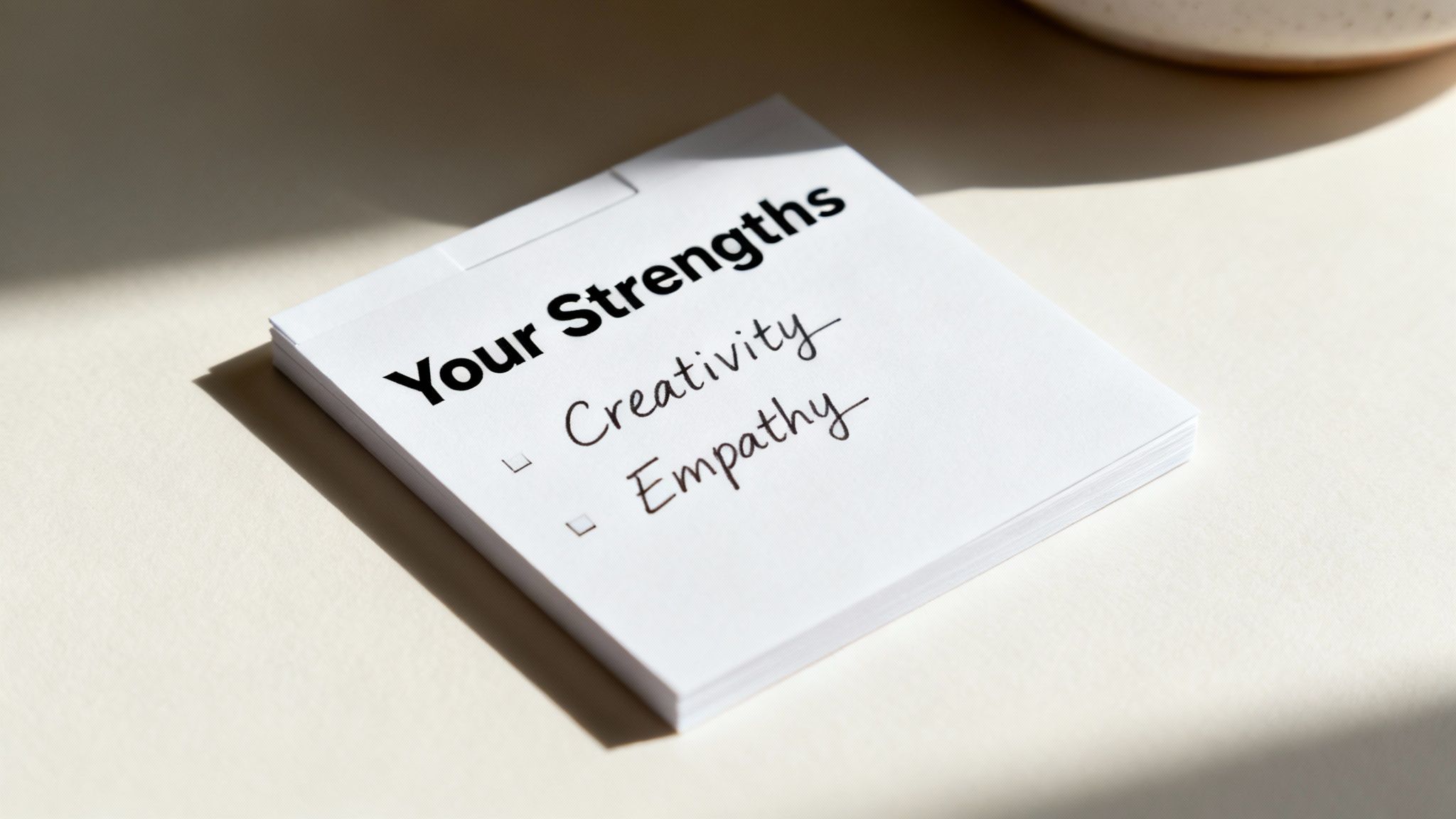
    Identifying your strengths means discovering and using your personal talents and positive qualities. This practice involves reflecting on your abilities and applying them in daily life to build confidence. It is one of the most empowering self esteem building activities because it shifts focus from fixing weaknesses to leveraging what you already do well.

    This method is rooted in positive psychology, which suggests that using your character strengths leads to greater happiness and resilience. By concentrating on your natural capabilities, you create a positive feedback loop that reinforces your self-worth. This can help you better manage feelings of anxiety or self-doubt.

    Strengths Identification and Application

    How to Implement Strengths Identification

    Discovering your strengths is a journey of self-exploration. These tools are for informational purposes and are not diagnostic.

    • Take Validated Assessments: Use free tools like the VIA Character Strengths Survey to get a structured overview of your top qualities.
    • Seek Feedback: Ask trusted friends, family, or colleagues what positive qualities they see in you. Their perspective can offer valuable insights.
    • Create a Strengths Portfolio: Write down specific examples of when you used your top strengths successfully. This creates real evidence of your capabilities.
    • Apply Strengths to Goals: Each week, aim to use one of your signature strengths in a new way, such as at work or in a personal project.

    Why This Practice Is Effective

    This practice builds genuine, evidence-based confidence by helping you value and amplify the best parts of who you already are. For professionals, this can be a powerful tool against workplace stress and burnout. Recognizing how your strengths contribute to your team can reconnect you with a sense of purpose and competence, enhancing your overall well-being and resilience.

    4. Achievement and Success Documentation

    Documenting your achievements is the practice of recording and reviewing your personal accomplishments, both big and small. This creates tangible evidence of your competence and progress, which can help counter negative self-perception. It is one of the most concrete self esteem building activities because it provides a factual record of your capabilities.

    This method helps build a personal collection of successes you can look at during moments of doubt or high workplace stress. Instead of relying on memory, which often highlights setbacks, this log offers clear proof of your skills and resilience. It helps ground your self-worth in real-world evidence, which is helpful for managing performance-related anxiety.

    Achievement and Success Documentation

    How to Implement Achievement and Success Documentation

    Creating your success log is straightforward, and maintaining it can become a rewarding part of your routine.

    • Start with the Past: Begin by listing accomplishments from the last year to build some initial momentum and fill your log.
    • Capture Small Wins: Include daily victories, not just major milestones. This could be anything from solving a tricky problem to receiving positive feedback.
    • Organise Your Evidence: Use a digital tool or a physical notebook to save positive emails, photos of completed projects, or notes from others.
    • Reflect on the Process: When you document a win, briefly note the challenges you overcame to achieve it and what you learned along the way.

    Why This Practice Is Effective

    This practice shifts your focus from perceived shortcomings to proven strengths. For professionals, it's a practical tool for career growth, but its main benefit is psychological. When you feel discouraged, reviewing your log offers an immediate, factual confidence boost, helping you build resilience and a healthier perspective on your journey.

    5. Skill Development and Mastery Challenges

    Skill development is the process of learning and improving a specific ability through practice. This activity builds self-esteem by providing clear proof of your growth, showing that effort leads to real improvement. It is one of the most effective self esteem building activities because it shifts your focus to the empowering process of acquiring new talents.

    This method creates a cycle of positive reinforcement. As you practice and achieve small wins, your brain feels a sense of reward, which boosts motivation and belief in your abilities. This experience of earned success directly counters feelings of helplessness and boosts resilience against workplace stress.

    How to Implement Skill Development

    The key is to choose a skill you are genuinely interested in and approach it with a structured plan.

    • Choose a Meaningful Skill: Select something you’re curious about, whether it's learning a new language, starting a new fitness routine, or picking up a creative hobby.
    • Set Micro-Goals: Break the skill into small, manageable steps. Instead of "learn to draw," start with "practise basic shapes for 15 minutes daily." Exploring essential drawing practice exercises to master new skills can be a great starting point.
    • Track Your Progress Visually: Keep a journal or photo log of your journey. Seeing how far you've come provides powerful motivation and a concrete record of your achievements.
    • Find a Community: Join a group or online class to share the experience with others. Accountability and shared learning can make the process more enjoyable.

    Why This Practice Is Effective

    Mastering a skill builds self-efficacy—the belief in your ability to succeed. When you prove to yourself that you can learn and grow, this confidence can spread to other areas of your life, from managing anxiety to tackling professional challenges. It provides a healthy outlet for your energy and equips you with a stronger sense of purpose, complementing professional support like therapy or counselling when needed.

    6. Compassionate Self-Talk and Self-Compassion Exercises

    Compassionate self-talk means treating yourself with the same kindness and understanding you would offer a good friend. It involves shifting your inner voice from harsh criticism to a gentler tone, especially during difficult times. This approach is a cornerstone of self esteem building activities as it directly addresses the inner critic that can fuel feelings of anxiety.

    This method is built on self-kindness, recognizing that struggles are a shared human experience, and being mindful of your feelings. By engaging with our challenges in this way, we can build profound inner resilience. This is crucial for navigating workplace stress and personal setbacks with greater compassion.

    How to Implement Self-Compassion Exercises

    Integrating self-compassion into your life is a skill that strengthens with consistent practice.

    • Practise the Self-Compassion Break: In a difficult moment, pause and acknowledge the feeling by saying, "This is a moment of suffering." Remind yourself, "Suffering is a part of life," and then offer yourself kindness, saying, "May I be kind to myself."
    • Reframe Your Inner Dialogue: When you notice self-critical thoughts, ask, "What would I say to a friend in this situation?" Then, direct that same compassionate response to yourself.
    • Write a Compassionate Letter: Write a letter to yourself from the perspective of a loving friend, addressing something you tend to judge yourself for. Read it when you need support.

    Why This Practice Is Effective

    Self-compassion offers a supportive alternative to self-criticism, which can worsen feelings of depression and low self-worth. Instead of punishing yourself for mistakes, you learn to see them as opportunities for growth. This practice provides a stable source of internal comfort, equipping you with the emotional resilience to navigate life's challenges.

    7. Boundary Setting and Assertiveness Practice

    Setting boundaries is the practice of clearly communicating your personal limits and needs. This skill involves learning to say 'no' without guilt and is a fundamental self esteem building activity because it demonstrates self-respect. By honoring your needs, you teach yourself and others that your well-being matters.

    This method works by reinforcing your sense of personal control and worth. When you set healthy boundaries, you protect your emotional and mental space. This practice helps create healthier, more balanced relationships where your voice is heard and valued.

    How to Implement Boundary Setting

    Building assertiveness is a skill that strengthens with consistent practice. Start small to build confidence.

    • Practise Low-Stakes Scenarios: Begin by setting small boundaries, like declining a social invitation without needing an elaborate excuse.
    • Use Clear Language: Adopt simple, firm phrases. A statement like, "That doesn't work for me," is often more effective than a long justification.
    • Establish Digital Boundaries: Protect your personal time by turning off work notifications after hours. This reinforces that your time for rest is important.

    Why This Practice Is Effective

    Setting boundaries protects your energy and helps prevent burnout. It is one of the most effective strategies to avoid burnout at work, which directly supports a healthier sense of self. By asserting your limits, you affirm your self-worth and reduce the resentment that can build when your needs are consistently ignored.

    8. Social Connection and Acts of Kindness

    Engaging in meaningful social interactions and performing acts of kindness are powerful self esteem building activities. This approach shifts focus from internal self-criticism to external contribution. It reinforces your value to others and fosters a sense of purpose and belonging.

    This practice is rooted in the benefits of helping others. When we are kind, our brains release feel-good chemicals that boost our mood. This also strengthens social bonds, which helps counter feelings of isolation that can contribute to low self-esteem and anxiety.

    How to Implement Social Connection and Kindness

    Integrating kindness into your life can be simple and doesn't require grand gestures. The key is intention.

    • Start with Micro-Kindnesses: Begin with small, everyday actions like offering a genuine compliment or holding a door open for someone.
    • Join a Structured Programme: For a more organized approach, consider volunteering with a local community group. This provides structure and connection.
    • Practise Intentional Connection: When interacting with others, be fully present by putting your phone away and listening actively. Stronger connections are built on genuine attention.

    Why This Practice Is Effective

    Kindness helps change our perspective by allowing us to step outside our own cycle of negative thoughts. This practice demonstrates our capability and impact, providing tangible evidence that we matter. It is a proactive strategy for improving mental well-being, fostering resilience, and building a compassionate view of both others and ourselves.

    Self-Esteem Activities Comparison Guide

    Item Implementation Complexity 🔄 Resource Requirements ⚡ Expected Outcomes 📊 Ideal Use Cases 💡 Key Advantages ⭐
    Positive Affirmations Practice Low – Beginner-friendly Minimal – time daily 5-15 mins Improved self-worth, reduced stress, rewired self-talk Daily mental health, stress reduction, confidence Free, portable, scientifically activates brain reward centers
    Gratitude Journaling Low – Beginner-friendly Minimal – 5-10 minutes daily Increased positivity, better sleep, reduced depression Emotional well-being, social-emotional learning Supported by 40+ studies, improves relationships
    Strengths Identification and Application Medium – Intermediate Moderate – initial 1-2 hr assessment + ongoing practice Increased engagement, performance, authenticity Career development, personal growth Validated tools, asset-focus, backed by positive psychology
    Achievement and Success Documentation Low – Beginner-friendly Minimal – 5-10 mins weekly + review Enhanced motivation, counters imposter syndrome Career, interviews, overcoming self-doubt Concrete evidence of competence, motivates during challenges
    Skill Development and Mastery Challenges Medium to High – varies by skill Time-intensive – 15-60 mins daily Tangible competence growth, mastery, new opportunities Learning new skills, hobbies, career shifts Builds resilience, measurable progress, growth mindset
    Compassionate Self-Talk and Exercises Medium – Intermediate Minimal – 5-15 mins daily + ongoing Reduced anxiety, increased resilience, better motivation Mental health, handling failure, emotional regulation Strong research backing, enhances emotional resilience
    Boundary Setting and Assertiveness Medium to High – Intermediate to Advanced Ongoing practice Healthier relationships, reduced burnout, increased agency Personal and professional relationships Empowers self-respect, reduces resentment and anxiety
    Social Connection and Acts of Kindness Low to Medium – Beginner to Intermediate Variable – 5 mins to hours Enhanced belonging, increased happiness, reduced loneliness Community involvement, social anxiety reduction Builds social support, releases mood-boosting hormones

    Your Journey Forward: Embracing Progress, Not Perfection

    The journey to building healthier self-esteem is about consistent and compassionate engagement with yourself. The self esteem building activities in this article are powerful tools for your ongoing well-being toolkit. They are daily practices that, over time, can reshape your inner dialogue and perception of self-worth.

    Think of these exercises as a conversation with yourself. Documenting achievements reminds you of your capabilities, while gratitude shifts your focus to what is abundant. Each activity is a unique way to nurture the most important relationship you will ever have: the one with yourself.

    Integrating These Practices into Your Life

    Lasting change comes from consistency, not intensity. Trying to do everything at once can feel overwhelming, especially when dealing with workplace stress or anxiety. Instead, choose one or two practices that resonate with you most right now.

    • Start Small: Dedicate just five minutes each day to your chosen activity. For example, write down three things you are grateful for or repeat a single positive affirmation.
    • Track Your Progress: Notice the small shifts in how you feel or act. Acknowledging these small victories builds momentum and keeps you motivated.
    • Be Patient and Forgiving: Some days will be harder than others, and you may forget your practice. This is a normal part of the process, so simply return to it the next day without judgment.

    The Supportive Role of Professional Guidance

    While these strategies are effective for building resilience, it's important to recognize when professional support can offer deeper guidance. If low self-esteem is persistently linked to feelings of anxiety, depression, or is impacting your daily life, seeking therapy or counselling is a courageous step.

    A qualified professional provides a safe space to explore the root causes of your feelings and develop personalized coping strategies. Therapy is not a last resort but a proactive investment in your mental health and well-being. Every step you take to honor your mental health is a testament to your strength.


    Ready to take the next step in your self-esteem journey with professional guidance? DeTalks offers accessible, confidential online counselling with qualified therapists who can support you in building confidence and resilience. Explore personalised therapy plans and start your journey towards a healthier relationship with yourself today at DeTalks.

  • 8 Essential Work Life Balance Tips to Thrive in 2025

    8 Essential Work Life Balance Tips to Thrive in 2025

    In today’s demanding professional world, the line between our work and personal lives can easily blur. This often leads to increased workplace stress and anxiety, making us feel overwhelmed and pushing us towards burnout. This isn't just about managing time; it's about nurturing your well-being with compassion and building resilience.

    Achieving a harmonious balance is not a luxury but a necessity for a fulfilling and healthy life. It allows us to be present for our families, pursue passions, and protect our mental health from professional pressures. This journey is supported by practices like mindfulness, and sometimes, seeking professional therapy or counselling can provide valuable tools.

    This article offers practical, empathetic work life balance tips, framed with an India-first context while remaining globally relatable. We will explore eight actionable strategies to help you navigate these challenges. These insights will help you build a more sustainable and joyful way of living, fostering greater well-being and resilience against challenges like anxiety and depression.

    1. Set Clear Boundaries Between Work and Personal Time

    In today's 'always-on' work culture, the lines between our professional and personal lives can easily fade. This often leads to increased workplace stress and burnout. One of the most effective work-life balance tips is to consciously create and maintain firm boundaries to protect your personal time, space, and mental energy.

    Setting boundaries is not about working less; it’s about working smarter and protecting your well-being. It involves defining specific work hours and sticking to them, which helps prevent the chronic stress that comes from feeling perpetually on-call. This protected personal time is vital for nurturing relationships and maintaining your overall mental health.

    Why Boundaries are Essential for Well-being

    Without clear divisions, work can seep into every part of your life, depleting your energy and contributing to feeling overwhelmed. This is a common path to burnout, a state of emotional, physical, and mental exhaustion. Renowned researcher Brené Brown notes that clear boundaries are a prerequisite for compassion and connection, both with others and ourselves.

    Companies are also recognising the benefits of this approach. For example, Microsoft Japan's experiment with a four-day work week saw a 40% increase in productivity. This shows that when employees have protected time to rest, their focus and efficiency during work hours improve dramatically.

    How to Implement Strong Boundaries

    Building this separation requires intentional, consistent effort. Here are some actionable steps to reclaim your personal time and build resilience against workplace stress:

    • Create a Shutdown Ritual: At the end of your workday, perform a series of actions that signal to your brain that work is over. This could be closing your laptop, tidying your desk, and saying "work is done for today" out loud.
    • Use Separate Digital Spaces: If possible, use separate devices or user profiles for work and personal life. This creates a powerful psychological barrier, reducing the temptation to check work emails on your personal phone late at night.
    • Communicate Your Availability: Proactively inform your team about your working hours and when you will be unavailable. Use your calendar to block off personal time and set up an email auto-responder to manage expectations after hours.
    • Physically Leave Your Workspace: If you work from home, make a point to physically exit your designated workspace. This physical separation reinforces the mental one, helping you to truly disconnect and recharge.

    By setting these boundaries, you take a crucial step towards a healthier, more sustainable relationship with your work.

    2. Practice Time Blocking and Prioritisation

    Managing your time intentionally is one of the most powerful work life balance tips for reducing workplace stress. Instead of reacting to an endless stream of demands, time blocking helps you proactively divide your day into dedicated blocks for specific tasks. This ensures your most important activities, both professional and personal, receive the focus they deserve.

    This strategy is about making conscious decisions about how you spend your energy. By scheduling everything, from deep work projects to family dinner, you create a clear, structured plan. This intentionality helps protect your personal time from work-related creep, fostering greater well-being and resilience.

    Why Intentional Scheduling is Crucial

    Without a deliberate plan, it's easy to feel busy but unproductive, a common trigger for anxiety and burnout. Time blocking minimises the mental load of deciding what to do next, freeing up your mind for focused, high-quality work. This is a key principle highlighted by author Cal Newport.

    This structured approach extends to your personal well-being. By blocking time for rest and relationships, you treat them with the same importance as a business meeting. This commitment is fundamental to building a more sustainable and fulfilling routine.

    How to Implement Time Blocking and Prioritisation

    Integrating this method into your life requires a shift from a reactive to a proactive mindset. Here are actionable steps to get started:

    • Block Your Non-Negotiables First: Before scheduling any work, block out time for sleep, meals, exercise, and family commitments. This ensures your well-being essentials are protected.
    • Prioritise with a Framework: Use a system like the Eisenhower Matrix to categorise tasks. Schedule blocks for "important, not urgent" tasks first, as these are often tied to long-term goals and personal growth.
    • Colour-Code Your Calendar: Assign different colours to various types of activities (e.g., blue for deep work, green for personal time). This provides a quick visual overview of how your time is allocated, helping you see imbalances.
    • Schedule Buffer and Planning Time: Include 15-minute buffers between major blocks to decompress or handle unexpected issues. Also, dedicate a block at the start of each week to plan your schedule.

    By mastering your schedule, you master your life. This practice is a foundational skill for managing workplace stress and improving focus.

    3. Embrace the Power of Saying 'No'

    One of the most transformative, yet challenging, work life balance tips is learning to say 'no'. In a culture that often praises being busy, we can feel pressured to accept every request. However, every 'yes' to a new commitment is an implicit 'no' to something else, whether it’s time with family or essential rest.

    Embracing the power of saying 'no' is about strategic refusal, not negativity. It involves consciously protecting your time and energy for tasks that align with your highest priorities. This skill is fundamental in preventing overcommitment, which is a direct path to workplace stress, resentment, and burnout.

    Why Saying 'No' is Essential for Well-being

    Constantly saying 'yes' depletes your most valuable resources: time and energy. This can lead to a state of chronic overwhelm and anxiety. Learning to decline non-essential requests is a powerful act of self-respect and a critical component of building resilience.

    This principle is championed by many successful leaders. Warren Buffett famously said, "The difference between successful people and really successful people is that really successful people say no to almost everything." Saying 'no' allows you to channel your energy where it creates the most impact and satisfaction.

    How to Implement the Power of 'No'

    Learning to say 'no' gracefully is a skill that can be developed with practice. Here are some actionable steps to reclaim your focus and protect your well-being:

    • Apply the 'Hell Yeah or No' Test: Before committing, ask yourself if the opportunity genuinely excites you. If your gut reaction isn't a resounding "hell yeah!", then it should probably be a 'no'.
    • Offer a Clear but Kind Refusal: You don't need to over-explain or make elaborate excuses. A simple, "Thank you for thinking of me, but I'm not available at this time," is often sufficient and respectful.
    • Propose an Alternative: If you want to help but lack the capacity for the original request, suggest a different solution. For example, "I can't lead that project, but I can offer some feedback on the proposal next week."
    • Create a 'Stop-Doing' List: Alongside your to-do list, create a list of commitments you will consciously stop doing. This helps you actively remove low-impact activities from your schedule, freeing up space for what truly matters.

    By mastering the art of saying 'no', you are not rejecting others; you are saying 'yes' to your own well-being.

    4. Prioritize Physical Health and Regular Exercise

    Your physical well-being is the foundation upon which a healthy work-life balance is built. Prioritising regular exercise, proper nutrition, and adequate sleep is a fundamental necessity. It directly influences your energy levels, mental clarity, and resilience against workplace stress.

    Physical activity is a powerful tool for managing stress, as it reduces cortisol levels and releases mood-boosting endorphins. It also serves as a natural transition, helping you mentally disconnect from professional duties. This is a key component of our work life balance tips for protecting your overall well-being.

    Why Physical Health is a Non-Negotiable

    Neglecting your physical health while pursuing professional goals is a common path to burnout, anxiety, and exhaustion. As fitness expert Dr. John Ratey explains, exercise fundamentally rewires the brain for better focus, mood, and resilience. This is why many high-performers, like Richard Branson, make it a priority.

    Companies like Google and Asana invest in on-site fitness facilities because they understand this connection. A healthy, energised team is more innovative, engaged, and capable of navigating challenges. They are better equipped to handle pressure without succumbing to chronic stress.

    How to Integrate Fitness into Your Routine

    Integrating physical activity into a busy schedule requires intention and planning. Here are some actionable steps to make your physical health a consistent priority:

    • Schedule It Like a Meeting: Block out time for exercise in your calendar. Treating it with the same importance as a business appointment makes you far more likely to stick with it.
    • Find Activities You Enjoy: Consistency is easier when you genuinely like what you are doing. Explore different options like dancing, trekking, team sports, or yoga until you find something that doesn't feel like a chore.
    • Embrace the 'Two-Day Rule': To build a lasting habit, commit to never skipping your planned physical activity for more than two consecutive days. This prevents small breaks from turning into long-term lapses.
    • Optimise Your Work Environment: Small changes during your workday can have a significant impact. Consider exploring the various standing desk benefits for health and well-being to support your physical wellness.

    Weaving physical health into your daily life is an investment in the energy and focus needed to excel in all areas of life.

    5. Implement Digital Detox and Technology Boundaries

    In our hyper-connected world, the digital link to work can feel unbreakable, fueling workplace stress. One of the most powerful work-life balance tips is to implement a digital detox. This means consciously stepping away from screens to reclaim your mental space from constant notifications and information overload.

    A digital detox is not about abandoning technology, but about controlling it so it doesn't control you. Setting deliberate boundaries around your device usage creates pockets of time free from digital distractions. This allows your brain to rest, which is essential for managing anxiety and strengthening your overall well-being.

    Why Digital Boundaries are Essential for Well-being

    Constant connectivity keeps our minds in a state of high alert, contributing to burnout and feelings of depression. The pressure to be always available blurs the lines between work and home. As Cal Newport, author of 'Digital Minimalism', argues, a thoughtful approach to technology is crucial for a meaningful life.

    This idea is gaining global recognition, with countries like France establishing a "right to disconnect" for employees after hours. This shows a growing understanding that mental downtime is necessary for productivity and health. When you protect your offline time, you build resilience against chronic workplace stress.

    How to Implement Strong Digital Boundaries

    Creating a healthier relationship with technology requires intentional habits. Here are actionable steps to reduce digital noise and reclaim your personal time:

    • Schedule "No-Tech" Time: Designate specific periods, like during meals or the first hour of your day, as completely screen-free. This simple rule helps you reconnect with yourself and your loved ones.
    • Curate Your Notifications: Turn off all non-essential notifications on your phone and computer. This one change can drastically reduce distractions and the constant sense of urgency.
    • Establish Email-Checking Windows: Instead of reacting to every incoming email, set specific times to check your inbox (e.g., 10 am and 3 pm). This puts you in control of your schedule.
    • Create a Tech-Free Bedroom: Charge your devices outside the bedroom to protect your sleep. Using a traditional alarm clock can help break the habit of scrolling before bed, improving sleep quality and reducing anxiety.

    Implementing these digital boundaries is a proactive step toward a more balanced life, giving your mind the space it needs to thrive.

    6. Cultivate Mindfulness and Mental Health Practices

    Achieving a healthy work-life balance is about managing your mental state as much as your time. Cultivating mindfulness means intentionally paying attention to the present moment without judgement. This practice helps you be fully present where you are, rather than being at home while your mind is still at the office.

    These mental health practices are not about eliminating stress but about building resilience to it. They train your brain to stop ruminating on work-related anxieties during your personal time. This focused attention reduces feelings of being overwhelmed and enhances your ability to manage workplace stress.

    Why Mindfulness is Essential for Well-being

    Without a conscious effort to manage your thoughts, work stress can easily spill over into your personal life. This is a primary contributor to burnout, a state of mental and physical exhaustion. To learn more, it's helpful to understand the psychological impact of burnout and chronic stress.

    Companies are increasingly recognising the power of these practices. Aetna's mindfulness programme resulted in a reported $3,000 annual productivity gain per employee. This shows that supporting mental health directly translates to a more focused, productive, and resilient workforce.

    How to Implement Mindfulness Practices

    Integrating mindfulness into your routine requires small, consistent efforts. Here are some actionable steps to foster better mental health and improve your work-life balance:

    • Start with Short Meditations: Use apps like Headspace or Calm to begin with just five minutes of guided meditation each day. This simple habit can train your focus and calm your nervous system.
    • Practise Mindful Transitions: Create a ritual to mentally switch off from work. This could be a short walk, listening to a specific song, or practising a few minutes of deep breathing before you engage with your family.
    • Use the 'STOP' Technique: When feeling overwhelmed, remember to Stop, Take a breath, Observe your thoughts and feelings without judgement, and then Proceed with intention.
    • Schedule Mental Health Check-ins: Just as you would a physical health appointment, block out time for activities that support your mental well-being, like journaling or speaking with a therapist or counsellor.

    By incorporating these practices, you actively build a buffer against workplace stress and protect your mental and emotional resources.

    7. Delegate, Automate, and Eliminate Tasks

    Many people struggle with work-life balance because they try to manage everything themselves. A powerful strategy is to systematically review your responsibilities to see what can be delegated, automated, or eliminated entirely. This frees up precious time and mental energy for high-impact work and personal priorities.

    This approach involves applying principles like the Pareto Principle (the 80/20 rule). By identifying and focusing on the critical 20% of tasks that yield 80% of results, you can reclaim significant portions of your day. This is about strategically investing your energy where it yields the greatest return, a key component of effective work life balance tips.

    Why This Strategy is a Game-Changer

    Trying to do everything leads to a constant state of being overwhelmed, which is a direct path to workplace stress and burnout. Delegating, automating, and eliminating tasks allows you to focus on your core strengths. It's a mindset shift from being busy to being effective.

    Author and entrepreneur Tim Ferriss popularised this concept in "The 4-Hour Workweek." He demonstrated that by letting go of non-essential tasks, you not only improve productivity but also create space for personal well-being and a healthier, more sustainable career.

    How to Implement This Approach

    Reclaiming your time requires a conscious effort to re-evaluate your to-do list. Here are actionable steps to start delegating, automating, and eliminating:

    • Conduct a Time Audit: For one week, track all your activities. This will reveal where your time is actually going and highlight repetitive, low-impact tasks that are prime candidates for change.
    • Apply the 'Only I Can Do This' Test: Review your task list and ask if someone else could do the task to an 80% standard. If the answer is yes, delegate it. This applies at work and at home.
    • Embrace Automation Tools: Use technology to handle repetitive work. Set up email filters, use scheduling software like Calendly, or explore tools like Zapier to connect apps and automate workflows.
    • Ask: 'What if I Just Didn't Do This?': Challenge the necessity of every task on your list. Use the Eisenhower Matrix to identify tasks that are neither urgent nor important and consider eliminating them completely.

    By strategically reducing your workload, you take control of your time and energy, which is fundamental to managing workplace stress.

    8. Schedule and Protect Personal Time and Relationships

    In the push for professional achievement, our personal lives can become an afterthought. A powerful strategy is to treat your personal time with the same importance as your work. This means proactively scheduling it into your calendar so it doesn't get pushed aside.

    Date nights, family dinners, hobbies, and even solo relaxation time should not be left to chance. This approach, championed by time management experts like Laura Vanderkam, ensures your life isn't just about what's left over after work. It creates a balanced structure where personal fulfilment is a scheduled priority, preventing workplace stress from taking over.

    Why Scheduling Personal Time is Crucial

    What doesn't get scheduled often doesn't happen, especially in demanding careers. When you calendar these events, you create a commitment to yourself and your loved ones. This practice is essential for nurturing relationships, reducing feelings of anxiety, and building resilience against burnout.

    This is a practice adopted by many successful individuals. For example, Barack Obama made it a non-negotiable priority to have dinner with his family almost every evening. This shows that protecting personal time is not a sign of a lack of ambition but a key component of sustainable success and well-being.

    The infographic below highlights key metrics for actively protecting your personal time.

    As the data suggests, consciously scheduling a few dedicated personal events each week can transform your approach to work-life balance.

    How to Prioritise Your Personal Life

    Integrating this practice requires a shift from passive hope to active planning. Here are actionable steps to start protecting your time:

    • Use a Unified Calendar: Put personal appointments and family events directly into your work calendar. This makes them visible and treats them as immovable commitments.
    • Implement Relationship Rituals: Adopt a simple rule like the '2-2-2 rule': a date night every two weeks, a weekend away every two months, and a week-long vacation every two years. Scheduling these strengthens connections.
    • Time-Block for Yourself: Schedule a recurring weekly activity dedicated to your own renewal. This could be reading at a café, visiting a museum, or simply going for a long walk without your phone.
    • Be Proactive with Planning: At the start of each month, schedule your key personal priorities first, before your calendar fills up with work demands. This aligns with Stephen Covey's "Big Rocks" principle.

    Work-Life Balance Tips Comparison Matrix

    Strategy Implementation Complexity 🔄 Resource Requirements ⚡ Expected Outcomes 📊 Ideal Use Cases 💡 Key Advantages ⭐
    Set Clear Boundaries Between Work and Personal Time Moderate to Difficult Low to Moderate (time, consistency) Reduced burnout, improved focus, better relationships For those needing mental health protection and clear separation Prevents work bleed; improves life satisfaction
    Practice Time Blocking and Prioritization Moderate (planning & maintenance) Moderate (planning time, tools) Increased productivity, reduced decision fatigue Highly structured schedules; managing multiple priorities Enhances focus; clear time allocation
    Embrace the Power of Saying 'No' Moderate (skill development) Low (time & communication skills) Prevents overcommitment, reduced stress Overloaded individuals needing to protect priorities Protects energy; improves quality of commitments
    Prioritize Physical Health and Regular Exercise Moderate (habit formation) Moderate to High (time, possible costs) Increased energy, reduced stress, better health Anyone seeking improved well-being and productivity Boosts mood and resilience; enhances sleep
    Implement Digital Detox and Technology Boundaries Moderate (habit & discipline) Low to Moderate (apps, time) Reduced stress and anxiety; improved presence Those overwhelmed by technology; improving focus Restores mental clarity; reclaims personal time
    Cultivate Mindfulness and Mental Health Practices Moderate to High (consistent practice) Low to Moderate (time, possible costs) Reduced stress, better emotional regulation Individuals seeking stress resilience and mental clarity Enhances self-awareness; reduces burnout risk
    Delegate, Automate, and Eliminate Tasks Moderate to High (setup & trust building) Moderate to High (tools, outsourcing costs) Frees up time; reduces mental load People with heavy workloads needing efficiency Increases focus on high-value activities
    Schedule and Protect Personal Time and Relationships Moderate (discipline & negotiation) Low to Moderate (time, calendar management) Improved relationships; balanced life Busy professionals prioritizing personal life Strengthens connections; prevents personal life neglect

    Your Journey to a More Balanced Life Starts Today

    Navigating the demands of modern professional life can feel like a constant juggling act. We've explored practical work life balance tips to help you regain control, from setting boundaries and saying 'no' to time blocking and digital detoxing. Each strategy offers a tool for your personal well-being toolkit.

    Remember, the goal is not a flawless, static equilibrium but a flexible system that honours both your professional ambitions and personal needs. It's about consciously choosing where to invest your energy. By prioritising your physical and mental health and scheduling time for joy, you build a foundation of resilience against workplace stress.

    The Path Forward: Integration, Not Perfection

    The key takeaway is to approach this as an ongoing practice. The tips shared are not one-time fixes but habits to be cultivated. Start small by choosing one or two strategies that resonate most with you and focus on integrating them into your routine. Perhaps you begin by blocking out 30 minutes for a walk or turning off work notifications after 7 PM.

    Celebrate your progress, however small it may seem. This journey requires patience and self-compassion. There will be days when the balance feels off, and that's okay. The objective is not to eliminate stress entirely but to build the capacity to manage it effectively, preventing it from escalating into chronic anxiety or burnout.

    A Commitment to Your Well-being

    Ultimately, mastering these approaches is an investment in your long-term happiness and health. A balanced life fuels creativity, strengthens relationships, and prevents the emotional exhaustion that can lead to more serious issues like depression. It empowers you to show up as your best self in all areas of your life.

    If the weight of stress feels overwhelming, remember that seeking support is a sign of strength. Professional therapy or counselling can provide a safe space and expert guidance to help you navigate these complexities. Taking control of your work-life harmony is a significant act of self-care, and your journey towards a more intentional and fulfilling life can begin today.


    Ready to take the next step towards a more balanced and resilient life? The expert therapists at DeTalks are here to provide personalised support for managing workplace stress, anxiety, and burnout. Explore our resources and connect with a professional at DeTalks to start building a healthier, more harmonious future.

  • A Practical Guide to Emotional Intelligence Training

    A Practical Guide to Emotional Intelligence Training

    Do you ever wish you could handle difficult situations with more calm and less stress? That's where emotional intelligence training comes in. It’s a way to better understand your own feelings and the feelings of others, helping you navigate life more effectively. This training can help manage workplace stress and build healthier, more supportive relationships.

    Understanding Emotional Intelligence Training

    Emotional intelligence isn’t a fixed trait you either have or don’t—it's a skill you can develop. This training helps you learn the unspoken language of human connection. It gives you the tools to respond thoughtfully in tense moments instead of reacting on impulse.

    This isn’t about ignoring your feelings or becoming robotic. It's about understanding the important messages your emotions send. That feeling of anxiety before a big presentation is normal; training helps you work with it, not let it overwhelm you.

    From Reacting to Responding

    A core goal is to create a small pause between a trigger and your reaction. In that brief moment, you can make a conscious, effective choice. This skill is fundamental for your well-being and for maintaining strong professional relationships.

    Emotional intelligence is critical in building and maintaining relationships and influencing others—key skills that help people throughout their career and wherever they sit in an organisational structure.

    This shift from reacting to responding has a direct, positive impact on your mental health. When you manage emotional triggers, you can reduce the chronic stress that often leads to burnout or feelings of depression. It's a proactive way to build genuine mental resilience.

    Building Resilience and Compassion

    Emotional intelligence is also linked to positive psychology, focusing on strengths like resilience, empathy, and compassion. In the Indian workplace, where team harmony is highly valued, these skills are essential. They help foster happiness and cohesive teamwork.

    This kind of training helps you build:

    • Self-Awareness: Understanding your own emotional patterns and what triggers you.
    • Empathy: Seeing things from a colleague's perspective, which turns conflict into collaboration.
    • Social Skills: Communicating clearly, handling disagreements, and building supportive relationships.

    These are not "soft skills"—they are core strengths for great leadership and teamwork. Modern training methods, like those described in what is interactive video for corporate training, make learning engaging.

    Working with a professional through counselling or therapy can offer structured support on this journey. It's important to remember that any assessments are informational, not diagnostic. They are simply tools to guide your growth toward lasting well-being.

    The Five Pillars of Emotional Intelligence

    To understand emotional intelligence, it helps to break it down into five core parts. These pillars are a roadmap, guiding you from understanding yourself to interacting effectively with others. They are all connected, working together to boost your overall well-being.

    Building these pillars is a personal journey of growth and self-discovery. Sometimes, that journey is easier with guidance. Professional support, such as counselling or therapy, can provide a safe space to explore these areas without judgment.

    The Five Pillars of Emotional Intelligence Explained

    To bring these ideas to life, let’s look at what each pillar means in a daily work setting. The table below breaks down each component with a real-world example. It's important to clarify that assessments used to measure these are informational, not diagnostic tools.

    Pillar What It Means for You A Real-World Workplace Example
    Self-Awareness Knowing your emotional landscape—what triggers you, what energizes you, and how your feelings affect your thoughts and behavior. It is the foundation for everything else. A manager notices they get irritable when a deadline is near. Being self-aware, they can manage that reaction instead of snapping at their team, preventing workplace stress.
    Self-Regulation The ability to manage your emotional responses. It's that crucial pause between feeling an impulse and acting on it, especially under pressure, which builds resilience. During a heated meeting, you feel frustrated. Instead of interrupting, you take a breath and listen, formulating a calm, constructive response to reduce conflict.
    Motivation An internal drive and passion for what you do that pushes you to persevere through setbacks with optimism. This helps manage feelings of anxiety about challenges. A project hits an unexpected snag. Your internal motivation drives you to see it as a challenge to solve, keeping your own and the team's spirits up.
    Empathy The skill of tuning into how others are feeling and trying to understand their perspective. This fosters compassion and helps prevent feelings of isolation or depression in others. A colleague seems withdrawn. Instead of assuming they're unengaged, you check in with them privately, listen to their struggles, and offer your support.
    Social Skills Using your understanding of your own emotions and others' to build strong relationships, communicate clearly, resolve conflicts, and inspire people. This is key to overall happiness at work. You need to give a team member difficult feedback. Using your social skills, you deliver the message constructively and with compassion, helping them grow without feeling attacked.

    These pillars are practical tools that can change how you navigate your professional life. They help you build relationships, lead with compassion, and foster a healthier work environment.

    Pillar 1: Self-Awareness

    The journey begins by looking inward with curiosity. Self-awareness is the ability to recognize your emotions as they arise and understand your typical reactions. It’s about knowing what makes you tick—what causes stress, what brings you joy, and how those feelings guide you.

    As the foundation of emotional intelligence, it’s essential to delve into self-awareness to build the other skills. It's the starting point for genuine personal and professional growth.

    This infographic gives a great visual of how these core skills stack up.

    Infographic about emotional intelligence training

    Just as the diagram shows, you can’t build a strong house on a weak foundation. Self-awareness is that foundation.

    Pillar 2: Self-Regulation

    Once you know what you're feeling, the next step is learning how to manage it. Self-regulation is your ability to control impulses instead of letting them control you. This art of the pause is crucial for avoiding burnout from constant workplace stress.

    Someone with strong self-regulation can navigate a tense conversation without losing their cool. This skill is vital for preventing small disagreements from becoming major conflicts and is a cornerstone of personal resilience.

    Pillar 3: Motivation

    Motivation in EI goes deeper than external rewards. It’s about your inner drive—a genuine passion for your work and an optimistic commitment to your goals. This internal fire is what fuels resilience and helps you push through challenges.

    True motivation is about finding personal meaning in what you do. It’s the 'why' that keeps you focused and hopeful, even when faced with difficulties or the mental weight of anxiety.

    This pillar is tied to a positive outlook. A motivated person sees opportunities where others see roadblocks. That mindset doesn’t just boost your performance; it can inspire and uplift those around you.

    Pillar 4: Empathy

    Empathy is the ability to understand and share what someone else is feeling. It means putting yourself in their position to see the world from their perspective. In any team, this is the secret ingredient for building trust, compassion, and connection.

    In the workplace, empathy is an action. It looks like:

    • Truly listening: Not just waiting to talk, but hearing what a colleague is really saying.
    • Validating feelings: Acknowledging a teammate's frustration after a project fails.
    • Offering help: Noticing when someone is struggling and quietly offering support.

    Empathy doesn't mean you must agree with everyone; it means you try to understand where they're coming from. It's the heart of effective teamwork and helps combat feelings of isolation that can contribute to depression.

    Pillar 5: Social Skills

    The final pillar, social skills, is where you put everything into practice. It's about using your awareness of your own emotions and others' to build strong relationships. This includes clear communication, conflict resolution, and inspiring people positively.

    A person with strong social skills can deliver tough feedback constructively and lead a team with compassion. They are naturals at building rapport and navigating tricky social dynamics. These are the skills that turn a good professional into a great leader.

    Why Emotional Skills Matter in the Workplace

    A diverse team of professionals engaged in a thoughtful discussion in a bright, modern meeting room.

    In today's world, technical abilities might get you a job, but emotional skills help you succeed. These aren’t just "nice-to-have" traits; they are essential tools for navigating human interaction at work. Without them, even the most talented individuals can struggle to collaborate, lead, or handle pressure.

    Think about common workplace frustrations like misunderstandings, communication breakdowns, or ineffective leadership. Often, a lack of emotional awareness is the root cause. This is why emotional intelligence training is crucial for building teams that are effective, supportive, and resilient.

    Bridging the Gap Between Pressure and Performance

    The modern workplace, especially within India's demanding corporate culture, can be a high-pressure environment. This constant drive can lead to chronic workplace stress and other challenges if left unmanaged. Developing emotional intelligence gives you powerful tools to handle pressure before it handles you.

    When you recognize your emotional triggers—like that feeling of anxiety before a big deadline—you can address them proactively. This conscious approach helps prevent burnout and supports a healthier work life. It’s about shifting from merely surviving your workday to actively shaping your professional well-being.

    Across Indian organizations, emotional intelligence is increasingly seen as essential for success, especially in leadership. You can read more about the role of EI in leadership on economictimes.com. Employees who develop their emotional intelligence not only perform better but also create a more positive environment for everyone.

    Cultivating a Culture of Well-being

    Beyond managing stress, emotional skills are the foundation of a positive workplace. When empathy and clear communication are the norm, they create psychological safety. This environment allows open dialogue, creative problem-solving, and true collaboration to flourish.

    Emotional intelligence is not about suppressing feelings. It’s about understanding them, learning from them, and using that awareness to make conscious choices that support your well-being and strengthen your relationships.

    A supportive atmosphere directly impacts job satisfaction and overall happiness. People who feel understood, heard, and valued are more engaged, motivated, and loyal. Investing in these skills is a direct investment in the human core of an organization.

    From Soft Skill to Strategic Advantage

    It’s time we recognize emotional intelligence as a core competency for professional excellence. It directly influences everything from decision-making and team dynamics to leadership. A few practical advantages include:

    • Improved Decision-Making: Understanding how emotions affect judgment helps you make clearer, more rational choices under pressure.
    • Stronger Collaboration: Empathy allows you to genuinely understand colleagues' perspectives, leading to smoother teamwork and innovation.
    • Enhanced Resilience: The ability to regulate your emotions helps you bounce back from setbacks, turning challenges into learning opportunities.

    Emotional intelligence training is a path to greater well-being. It offers strategies for navigating challenges like anxiety while building positive traits like compassion and resilience. A guided journey, perhaps with therapy or counselling, can provide a structured framework for this growth, using assessments as informational tools, not labels.

    The Real-World Rewards of Higher Emotional Intelligence

    Investing in your emotional intelligence isn’t about changing who you are. It’s about sharpening your awareness and giving you tools to navigate life’s ups and downs with more grace. The impact is profound, touching everything from how you handle pressure to the strength of your relationships.

    Think of it as a fundamental life upgrade. The same abilities that help you in a tricky work conversation also strengthen your connection with loved ones. It’s a journey toward a more resilient, understanding, and fulfilling life.

    Finding Calm and Building Resilience in a Hectic World

    In our fast-paced world, stress can feel constant. Emotional intelligence training provides a practical toolkit for managing that pressure before it leads to burnout. By tuning into your self-awareness, you can spot your stress triggers and respond thoughtfully.

    This ability to self-regulate is what builds true resilience. It's the inner strength that helps you bounce back from setbacks, viewing challenges as opportunities for growth instead of sources of anxiety. You learn to navigate emotional waves instead of being knocked over by them.

    “Emotional intelligence is critical in building and maintaining relationships and influencing others—key skills that help people throughout their career and wherever they sit in an organisational structure.”

    This proactive stance on mental health is empowering. It creates a buffer against chronic workplace stress, which, if unchecked, can contribute to feelings of depression. Building these skills is a direct investment in your long-term well-being.

    Boosting Your Career and Becoming a Better Leader

    In any workplace, emotional intelligence separates good colleagues from great ones. It transforms how you communicate, collaborate, and lead. A genuine sense of empathy, for example, helps you create a more supportive and creative atmosphere.

    For anyone in a leadership role, these skills are essential. A leader with strong emotional intelligence can:

    • Give constructive feedback that feels helpful, not hurtful.
    • Navigate conflict by understanding the emotions involved and guiding the conversation to a solution.
    • Inspire a team by connecting with them as people, building trust and loyalty.

    These are core competencies for success. Research consistently shows that people with higher emotional intelligence report greater job satisfaction and perform better. They are simply better equipped for the complex human dynamics of any workplace.

    Deepening Personal Connections and Overall Happiness

    The positive effects of emotional intelligence extend far beyond your work life. These skills are the foundation of deeper, more meaningful connections with family and friends. When you understand and manage your feelings, you can express yourself more clearly and listen with genuine empathy.

    This creates a solid foundation of trust and respect in your relationships. You become better at working through disagreements, offering real support, and sharing openly. This kind of emotional connection is a powerful ingredient for lasting happiness.

    Remember, this is a process. Getting support from a professional through counselling or therapy can offer a safe space to practice these skills. Any assessments you encounter are informational tools to light the way, not labels; they simply show you where you are so you can move forward with supportive takeaways.

    Practical Ways to Start Your EI Training Journey

    A person sitting in a calm, well-lit space, journaling in a notebook.

    Starting your emotional intelligence training journey doesn’t require a huge overnight change. It begins with small, consistent steps toward understanding yourself and others a little better. It's about weaving simple habits into your daily life, focusing on progress, not perfection.

    These gentle techniques build your skills gradually, helping you navigate life with more grace. Whether managing workplace stress or forging stronger connections, every small effort adds up to a greater sense of well-being and happiness.

    Cultivate Self-Awareness Through Reflection

    The first step is always to look inward with a curious and open mind. A powerful way to do this is through mindful journaling. Just set aside a few minutes each day to write down your thoughts and feelings without judgment.

    Ask yourself gentle questions like, What emotions did I feel today? What situations sparked them? This simple practice helps you recognize your emotional patterns, which is the foundation for managing them. It’s a quiet conversation with yourself that builds clarity and self-compassion.

    This self-awareness is vital in our professional lives. In India, there's a growing appreciation for emotional intelligence, yet recent data shows a dip in overall EI scores. This highlights an opportunity for training that strengthens emotional awareness, starting with personal reflection. You can read more about India's emotional intelligence trends on 6seconds.org.

    Practice the Power of the Pause

    Self-regulation is about creating space between a feeling and your reaction. One effective way to build this skill is by practicing ‘the pause’. When you feel a strong emotion like anger or anxiety, consciously stop before you speak or act.

    Just take a single, deep breath. That tiny action gives your logical brain a moment to catch up with your emotional brain, allowing for a more thoughtful response. It’s a simple technique that can prevent misunderstandings and build your resilience one breath at a time.

    Emotional intelligence is not about suppressing feelings. It’s about understanding them, learning from them, and using that awareness to make conscious choices that support your well-being and strengthen your relationships.

    Strengthen Empathy with Active Listening

    Empathy is the heart of human connection, and it is a skill you can develop. A great place to start is by practicing active listening. This means giving the other person your full, undivided attention.

    Here are a few things to try:

    • Listen to Understand: Focus on what the other person is really saying with their words, tone, and body language.
    • Ask Open-Ended Questions: Encourage them to share more with questions like, "How did that make you feel?"
    • Summarise and Reflect: Gently paraphrase what you heard. Saying, "It sounds like you felt really overwhelmed," shows you were listening and validates their experience.

    Seek Professional Guidance and Support

    While self-help practices are valuable, a structured path can make a big difference. Professional support through therapy or counselling provides a safe, non-judgmental space to explore your emotions with an expert guide. A professional can offer personalized strategies to navigate challenges like anxiety or feelings of depression.

    It's important to remember that any assessments used are informational tools. They are designed to offer insights to guide your journey, not to apply a rigid diagnostic label. The goal is to equip you with supportive takeaways and lasting skills for a more balanced life.

    How DeTalks Can Support Your Growth Journey

    Starting a journey of self-improvement is easier with the right support. At DeTalks, we offer a safe, understanding, and professional space for your emotional intelligence training. Our approach helps you navigate real-world challenges like workplace stress while nurturing positive skills like compassion and resilience.

    Our counselling and therapy services are tailored to you. We work to understand your personal journey, helping you develop practical strategies for managing emotions. Our guidance combines globally recognized practices with a deep cultural understanding, keeping your well-being as our top priority.

    It’s also important to clarify that any assessments we use are informational tools. They are meant to guide your progress by offering insight, not to serve as a diagnostic label for conditions like anxiety or depression. Our goal is to support your growth toward happiness.

    Our goal is to be your partner in this process, offering practical tools and insights to enhance your well-being in a non-judgemental way. We are here to support your growth, helping you build the skills for a more balanced and fulfilling life.

    A Few Common Questions

    It's natural to have questions when exploring something new like emotional intelligence. Let's walk through some common ones to give you a clearer picture.

    How Can This Training Actually Help with Everyday Stress and Anxiety?

    Think of emotional intelligence training as learning to recognize the early signs of stress or anxiety. By becoming more self-aware, you notice that tight feeling in your chest or racing thoughts sooner. This allows you to respond calmly before you feel overwhelmed.

    The training also teaches self-regulation—the skill of pausing before you react. This helps you respond with a clear head instead of impulse. Building this kind of resilience is key to handling challenges at work and home with greater calm.

    Is Emotional Intelligence Training the Same as Therapy?

    That's a great question, and while they both support well-being, they are different. EI training focuses on developing specific emotional and social skills that can benefit anyone. It's like learning a practical life skill.

    Therapy, or counselling, is a clinical approach aimed at addressing deeper mental health challenges such as chronic anxiety, depression, or trauma. The two can work together powerfully. The skills from EI training can strengthen your progress in therapy, and insights from therapy can deepen your emotional intelligence.

    A quick note: Any assessments you might take in emotional intelligence training are there to give you insights for your growth. They are informational tools, not diagnostic ones for mental health conditions.

    Can This Training Genuinely Make a Difference in My Career?

    Absolutely. Success at work is often about how well you work with people. Honing your emotional intelligence helps you manage workplace stress more effectively, communicate clearly, and navigate conflicts constructively.

    This is especially vital in demanding fields. For example, a review of studies on nurses in India found that emotional intelligence programs significantly boosted their professionalism and personal health. You can read the full review about EI training in healthcare on pubmed.ncbi.nlm.nih.gov.

    What if I’m Not a Very “Emotional” Person?

    Everyone has emotions, even if they don't show them openly. The goal of emotional intelligence isn’t to make you more emotional; it's to make you more skillful at understanding the emotions you and others experience.

    This training can be very helpful if you find emotions confusing. It provides a practical framework for understanding what feelings are and how they shape thoughts and actions. This awareness leads to better decision-making and stronger relationships.

    How Long Until I Start Seeing Results?

    Building emotional intelligence is a journey, not a race. However, you can see small but meaningful changes quickly when you start practicing consistently. The secret is to aim for progress, not perfection.

    Within a few weeks, you might notice yourself taking a deep breath before replying in a tense meeting. These small victories are the building blocks for lasting improvements to your overall well-being and happiness.


    Taking this step is a powerful move toward a more fulfilling and balanced life. When you’re ready for professional, supportive guidance, DeTalks is here to connect you with the right therapist or counsellor for your journey. See how our platform can help you grow by visiting https://detalks.com.

  • Mindfulness Based Stress Reduction: A Practical Guide

    Mindfulness Based Stress Reduction: A Practical Guide

    Mindfulness Based Stress Reduction (MBSR) is a structured eight-week programme that combines mindfulness meditation, gentle yoga, and a deep awareness of your own body. It is a practical, evidence-based approach designed to help people better manage challenges like stress, anxiety, and even chronic pain.

    The core idea is simple yet powerful: training your attention to live in the present moment. This helps you avoid getting lost in worries about the future or regrets about the past.

    A Practical Path to Resilience and Well-Being

    In the whirlwind of modern life, especially in bustling Indian cities, it is easy to feel overwhelmed. The relentless demands of work, family, and daily tasks can lead to chronic workplace stress, anxiety, and burnout, making you feel stuck.

    If this sounds familiar, please know you are not alone in this experience. Many people are seeking ways to navigate these pressures with more calm and clarity, and MBSR offers a grounded path to build the inner resources you need.

    A person meditating peacefully outdoors, symbolising the calm found through mindfulness.

    Learning to Surf the Waves of Life

    Imagine your thoughts and feelings are like waves in the ocean; some are small and gentle, while others feel huge and overwhelming. Trying to fight them or stop them from coming is an exhausting and impossible task.

    MBSR does not teach you to stop the waves, but rather how to surf them. It gives you the skills to find your balance and navigate life's unpredictable currents with greater ease.

    This guide will walk you through what MBSR is, how the programme is structured, and the tools it provides to improve your well-being. We will explore the science behind it and the benefits it offers for anyone seeking a more balanced way of living. This is a journey of building positive strengths, such as:

    • Resilience: The ability to bounce back more quickly from setbacks.
    • Compassion: Fostering a kinder, more understanding attitude toward yourself and others.
    • Happiness: Cultivating a genuine and lasting sense of peace and contentment.

    Mindfulness is the awareness that arises from paying attention, on purpose, in the present moment, non-judgementally. It’s about being fully where you are, rather than where you are not.

    The table below offers a quick look at the fundamental practices that make up the MBSR programme.

    MBSR Core Components At a Glance

    Component What It Involves
    Body Scan Meditation Lying down and bringing focused, non-judgemental attention to different parts of the body, one by one.
    Mindful Movement Gentle yoga and stretching practices to explore the body's movements and limitations with curiosity.
    Sitting Meditation Focusing on the breath, sounds, or bodily sensations to anchor attention in the present moment.
    Informal Mindfulness Integrating awareness into everyday activities like eating, walking, or washing dishes.
    Group Dialogue & Inquiry Sharing experiences and insights in a supportive group setting, guided by a trained facilitator.

    Each of these elements works together, creating a comprehensive toolkit for managing stress and enhancing your quality of life.

    A Supportive Approach to Mental Health

    It is important to understand that MBSR is a powerful educational tool for personal development, not a replacement for professional therapy or counselling. Any assessments or insights you gain are informational, not diagnostic.

    For challenges like clinical anxiety or depression, combining MBSR with support from a qualified therapist can create a robust plan for your well-being. This approach empowers you to take an active, informed role in your own mental health journey.

    This is about more than just managing stress; it's about building a life filled with greater awareness and inner peace. The following sections will give you a clear roadmap to understanding this transformative practice.

    The Story Behind MBSR: Science Meets Ancient Wisdom

    To understand Mindfulness-Based Stress Reduction (MBSR), it helps to look at its roots. This is not a wellness trend, but a carefully structured programme born from a blend of ancient contemplative practices and modern science. It began in a hospital with a clear, secular goal.

    The programme started in 1979 with Dr. Jon Kabat-Zinn at the University of Massachusetts Medical School. He worked with patients experiencing chronic pain and severe stress who found little relief from conventional medicine. He adapted mindfulness traditions, removing religious aspects to create an accessible approach that could be studied in a healthcare setting.

    This scientific foundation is what makes MBSR so distinct. It is not about adopting a spiritual belief system, but about learning a practical skill to train your mind and improve your well-being.

    So, What Exactly Is Mindfulness?

    Let's clarify the term 'mindfulness,' as it is often used loosely. At its core, it is the simple, basic human ability to be fully present and aware of where we are and what we are doing. It helps us avoid being overly reactive or overwhelmed by what is happening around us.

    Think about the last time you had a cup of tea. Did you truly taste it, or was your mind already racing through your to-do list? That is living on autopilot. A mindful approach is to simply experience the tea—noticing the warmth, the steam, the flavour—and switch from 'doing' mode to 'being' mode for a few moments.

    When you practise this, you train your attention. You learn to step back from the constant mental chatter that fuels stress and anxiety, which is a gentle but effective way to reconnect with yourself.

    A Practical Toolkit for Today’s World

    The need for tools like this has never been greater, particularly in high-pressure environments. In the Indian private sector, for instance, intense competition and long work hours have made workplace stress a significant issue. Researchers have studied how MBSR can offer support, and one Indian study on an 8-week online MBSR course showed a positive impact on stress, anxiety, and the well-being of working professionals. You can read the full research on MBSR's impact in India to learn more.

    This shows how these principles are more relevant than ever for building mental and emotional resilience. MBSR is not a magic wand but a form of mental training.

    Ultimately, MBSR provides a framework to nurture our own ability to be healthier and happier. It does not pretend life's challenges don't exist, but it offers tools to navigate everything from workplace pressure to personal struggles with more clarity. It's a supportive approach that can be a great companion to professional therapy or counselling.

    Inside the 8-Week MBSR Programme

    Starting a Mindfulness-Based Stress Reduction (MBSR) programme can feel like a big commitment. The eight-week structure is a gradual process, where each week intentionally builds on the last, helping you develop skills to manage stress and improve your well-being.

    This journey is a guided exploration of how your mind and body work. Each session introduces new practices in a manageable way, making it easier to weave mindfulness into your everyday life.

    This infographic gives you a great visual overview of the core elements you’ll encounter, from foundational meditation to mindful movement, showing how each piece fits together.

    Infographic about mindfulness based stress reduction

    As you can see, the programme flows logically, starting with basic awareness and progressing towards skills like mindful communication and self-compassion.

    The Weekly Rhythm

    A typical MBSR session runs for about two and a half hours and follows a consistent rhythm. This structure is designed to create a sense of safety, allowing you to relax and focus on your inner experience.

    Most sessions will include a blend of these core components:

    • Guided Meditation: Your facilitator will lead the group through practices like the body scan or sitting meditation with gentle instructions.
    • Mindful Movement: This involves simple, gentle yoga accessible to all fitness levels, helping you reconnect with your body and release physical tension.
    • Group Discussion: This is a chance to share experiences from your home practice in a confidential and non-judgemental space.
    • Weekly Themes: Each week has a specific focus, creating a clear path for learning and personal growth.

    This combination of individual practice and shared reflection helps normalise the struggles of dealing with workplace stress and anxiety. It builds a real sense of connection and mutual support.

    A Week-by-Week Journey

    The eight-week path is designed to build your mindfulness skills step-by-step. While programmes may vary slightly, the core themes follow a time-tested progression from basic awareness to deeper emotional intelligence.

    The real practice is not what you do for 45 minutes a day, but how you bring that awareness into the other 23 hours and 15 minutes. It’s about weaving mindfulness into the fabric of your life.

    Here is a breakdown of the typical weekly themes:

    1. Week 1: Moving Off Autopilot: This week focuses on recognising how often we run on autopilot and beginning to consciously step into the present moment.
    2. Week 2: Perceiving the World Differently: The focus shifts to how our perceptions shape our reality, learning to observe thoughts and feelings without getting entangled in them.
    3. Week 3: Being Present and Finding Pleasure: This week introduces mindful movement and the practice of finding joy in simple moments, a powerful tool against burnout.
    4. Week 4: Understanding Stress Reactivity: You will explore your personal "stress signature"—how stress shows up in your body and mind—to learn how to respond with awareness.
    5. Week 5: Responding to Stress with Mindfulness: This session builds on the last, applying mindfulness techniques in challenging situations to build resilience.
    6. Week 6: Mindful Communication: The focus broadens to relationships, practising listening and speaking with more presence and compassion.
    7. Week 7: Taking Care of Yourself: This week is dedicated to self-compassion, exploring how to use mindfulness to cultivate a kinder inner voice.
    8. Week 8: Living a Mindful Life: The final session ties everything together, helping you create a sustainable plan to carry your practice forward.

    Remember, MBSR is a skills-based educational programme, not a substitute for therapy or counselling. The insights you gain are informational, not diagnostic, providing a solid foundation for building resilience.

    A Closer Look at the Core Practices of MBSR

    The Mindfulness-Based Stress Reduction (MBSR) programme is built on simple, practical exercises designed to train your attention. By engaging with these core practices, you learn to observe your thoughts and feelings without getting carried away by them. This is how you build a solid base for greater calm and resilience.

    Think of these techniques as ways to exercise your "mindfulness muscle," strengthening your ability to navigate stress. The goal is to make these practices feel like moments of self-care you can turn to whenever you need them.

    The Body Scan Meditation

    One of the first practices you will learn is the Body Scan. This involves lying down and systematically moving your attention through your body, part by part. You are not trying to change anything, just noticing sensations as they are—warmth, tingling, pressure, or even nothing at all.

    The Body Scan is a wonderful way to bring your mind and body back into conversation. It gently brings you back home to your body, helping you notice and release stored tension.

    Sitting Meditation with Breath Awareness

    Sitting Meditation is often what people associate with mindfulness. The primary focus is your breath, using its natural rhythm as an anchor to the present moment. You simply pay attention to the feeling of air flowing in and out of your body.

    Your mind will wander—that is completely normal. The instruction is not to stop it, but to gently guide your attention back to your breath whenever you notice it has strayed. To get a feel for this, you can explore some basic guidance on how to practice mindfulness.

    This gentle act of returning is the "rep" that strengthens your attention. Each time you guide your focus back to the breath, you're building your capacity for focus, calm, and emotional balance.

    This skill translates directly into daily life. Taking a few moments to center yourself with your breath before a big meeting or a difficult conversation can significantly reduce anxiety.

    Mindful Movement

    MBSR also includes Mindful Movement, often through gentle yoga or simple stretches. This is not a fitness class; the emphasis is on paying close attention to the sensations in your body as you move. You learn to honour your body's limits with kindness and curiosity.

    This practice is brilliant for dissolving the physical tension that builds up from work stress and daily worries. By moving with awareness, you foster a deeper connection between your physical and emotional states.

    Keeping the Practice Alive

    While these practices offer incredible benefits, making them a consistent habit can be a challenge. Research shows that things like group support and a set routine are crucial for long-term success. This is especially true in India, where unique cultural stressors can make it hard to stay consistent. To learn more, you can read the full research about the challenges and facilitators of sustained mindfulness practice.

    Together, these foundational practices help you cultivate a more present and resilient way of living. They are not about escaping life, but about learning to show up for it more fully.

    The Proven Benefits of MBSR for Mind and Body

    When you commit to a Mindfulness-Based Stress Reduction (MBSR) programme, you are building inner resources with real, science-backed benefits. It is like developing a 'mental muscle'—the more you practise, the stronger your mind becomes at handling life's challenges.

    This mental strengthening is especially helpful for navigating tough emotions. Consistent mindfulness practice has been shown to reduce symptoms of anxiety and depression, giving you a way to manage overwhelming internal static.

    A serene image of a person sitting by a calm lake at sunrise, reflecting the mental clarity gained from MBSR.

    Cultivating Emotional Resilience

    One of the most profound outcomes of MBSR is improved emotional regulation. Instead of reacting automatically, you gain the ability to pause, breathe, and choose your response. This skill is a game-changer for managing workplace stress and preventing burnout.

    This newfound emotional balance is the foundation of genuine resilience. Life will always have its ups and downs, but MBSR gives you the tools to bounce back more quickly and build a deep well of inner stability.

    "Mindfulness gives you time. Time gives you choices. Choices, skillfully made, lead to freedom." – Bhante Henepola Gunaratana

    The programme also helps positive psychological traits like compassion flourish, both for yourself and for others. This can lead to a deeper, more sustainable sense of happiness that is not dependent on external circumstances.

    Physical Well-being and Holistic Health

    The benefits of MBSR extend to the body as well. Chronic stress can harm our physical health, and mindfulness is a direct antidote. Many people report improved sleep, finding it easier to quiet a racing mind and get restorative rest.

    MBSR has also proven to be a valuable tool for managing chronic pain. By changing your relationship with physical sensations, you can lessen their intensity and the emotional distress that often accompanies them. It is also wise to explore other coping strategies for anxiety and depression to build a broader toolkit for your well-being.

    It is crucial to see MBSR as an educational programme for personal growth, not a replacement for clinical treatment. Any insights are informational, not diagnostic. For deeper challenges, MBSR can be a wonderful partner to professional therapy or counselling, creating a powerful path toward lasting wellness.

    Weaving MBSR into the Fabric of Your Life

    Starting a mindfulness practice is an act of kindness toward yourself. Now that you understand MBSR, you might wonder how to begin. The secret is to start with gentle curiosity, knowing this journey is about showing up for yourself consistently, not achieving perfection.

    Some days, your practice will feel effortless, while other days it will feel like a struggle. Both experiences are normal and valuable. The point is not to force your mind into silence, but to get to know its habits with a compassionate eye.

    So, What's the Next Step?

    If the structured, eight-week journey appeals to you, finding a qualified MBSR teacher is the best approach. A certified instructor provides the expert guidance and supportive group dynamic that makes the programme so effective.

    For many, MBSR becomes one piece of a larger well-being puzzle. It complements other forms of professional support beautifully.

    • Working with a Therapist: While MBSR provides tools for the present moment, therapy or counselling offers a space to explore the roots of personal history and patterns. Combining the two can be a solid foundation for working through challenges like anxiety or depression.
    • Diving into Resources: Keep your curiosity alive with books, guided meditation apps, and talks from seasoned mindfulness teachers.
    • Finding Your People: Connecting with a local or online meditation group can offer a real sense of shared experience and encouragement.

    Remember, this is your journey. There's no single "right" way to do it. The only path that matters is the one that resonates with you.

    Supportive Takeaways to Carry with You

    Bringing mindfulness based stress reduction into your life is not about adding another task to your schedule. It is a fundamental shift in how you relate to your mind and the world, creating space for more compassion and clarity, especially when navigating workplace stress.

    Think of any assessments as helpful signposts, not definitive labels; they are informational tools to guide you. Be kind to yourself as you move forward. Every moment you consciously choose to be present is a step towards building a more mindful, resilient, and fulfilling life.

    Your Questions About MBSR, Answered

    Thinking about starting a Mindfulness-Based Stress Reduction programme? It’s completely normal to have a few questions. Feeling clear from the start can make all the difference, so we’ve put together some common queries to provide that clarity.

    Do I Need Any Meditation Experience to Join?

    Not at all. The MBSR programme is designed for absolute beginners and assumes you are starting from scratch.

    Each week, you will be gently guided through the core practices in a supportive space where everyone is new. It is a welcoming starting point for anyone interested in learning.

    Is MBSR the Same as Therapy or Counselling?

    That is an important distinction. While MBSR is wonderful for mental well-being, it is not therapy or counselling. MBSR is an educational programme that teaches you practical skills to manage stress using your own awareness.

    It works brilliantly alongside professional therapy. A counsellor can help you explore your personal history, while MBSR gives you tools to handle present-moment challenges like workplace stress and anxiety.

    How Much Time Do I Need for Home Practice?

    To get the most out of the programme, you will be encouraged to practice for about 45 minutes a day, six days a week. This consistent effort is what builds your mental 'muscle' for resilience.

    That might sound like a lot, but the programme helps you weave these practices into your life. You will receive guided recordings and also learn informal practices to bring more awareness to everyday activities.

    Remember, any assessments you might do are purely for your own information, not for diagnosis. They're simply tools to help you understand yourself better, pointing you toward the right kind of support for your well-being.

    Is MBSR a Religious Practice?

    No, it is completely secular. While mindfulness has roots in contemplative traditions, MBSR was developed in a modern medical center. It is a science-based approach that taps into our universal human ability to be aware.

    The practices are taught in a way that is accessible to people from all backgrounds, regardless of their beliefs. The focus is always on your direct experience and how these skills can help you navigate life with more ease.


    At DeTalks, we're passionate about making sure everyone has access to tools that support their mental and emotional health. If you feel that professional guidance could complement your mindfulness journey, or if you want to explore challenges like anxiety and depression more deeply, our network of qualified therapists is ready to help. Take the next step and explore support options at DeTalks to find a more balanced life.

  • What Is Positive Psychology? A Guide to Happiness & Resilience

    What Is Positive Psychology? A Guide to Happiness & Resilience

    Positive psychology is the scientific study of what helps us flourish. It explores what makes life feel meaningful and fulfilling, focusing on our strengths rather than just our challenges.

    Instead of only looking at what's wrong, this field helps us understand what's right. It offers tools to build lasting resilience, compassion, and happiness in our everyday lives.

    Understanding Psychology Beyond Fixing Problems

    A person sitting peacefully outdoors, symbolizing mental well-being and flourishing.

    When we hear "psychology," we often think of treating conditions like anxiety, depression, or stress. For a long time, its main goal was to help people move from a state of suffering back to a stable baseline, which is incredibly important work.

    But what happens after you reach that baseline? Positive psychology offers a complementary view by asking a different, empowering question: "What is right with you?"

    This simple shift helps us move from fixing problems to actively nurturing our inner strengths. It provides a path toward genuine well-being.

    Think of it like this: A gardener doesn't just pull weeds. To grow a vibrant garden, they must also nourish the soil, provide sunlight, and water the plants. Positive psychology is the "nourishing" side of mental health.

    This isn't about ignoring life's hardships or forcing a smile. It is about equipping you with science-backed tools to build your inner resources, so you can face challenges with greater strength.

    To understand this better, let's look at how the two approaches compare.

    Positive Psychology vs Traditional Psychology At a Glance

    This table shows how positive psychology and traditional clinical psychology focus on different, yet equally important, parts of our mental health journey.

    Focus Area Traditional Psychology Positive Psychology
    Primary Goal To heal distress and treat mental illness; moving from negative to neutral. To cultivate well-being and flourishing; moving from neutral to positive.
    Core Question "What is wrong with you?" or "How do we fix the problem?" "What is right with you?" or "How do we build on your strengths?"
    Focus of Study Disorders, trauma, dysfunction, and human suffering. Happiness, strengths, resilience, optimism, and positive relationships.
    Outcome Alleviating symptoms, restoring normal functioning. Increasing life satisfaction, engagement, and a sense of meaning.

    As you can see, both are essential for a complete picture of mental wellness. They work together to support your overall health.

    Key Focus Areas of Positive Psychology

    So, what does positive psychology actually concentrate on? It zeroes in on a few core areas that help create a balanced and meaningful life.

    • Building resilience: This is about learning how to bounce back from adversity and grow from challenges.
    • Cultivating positive emotions: This involves mindfully fostering feelings like gratitude, joy, and hope in your daily life.
    • Identifying and using character strengths: We all have unique strengths, and using them helps boost our confidence and engagement.
    • Fostering strong relationships: This explores how to build and maintain the supportive connections crucial for our well-being.

    The tools and assessments in positive psychology are designed to be informational guides on your journey. It's important to remember they are not for diagnosing conditions, but for offering insights into building a more flourishing life.

    The Core Pillars of a Flourishing Life

    To understand positive psychology in practice, it helps to see it as a structure built on three core pillars. These pillars work together to support a life of genuine well-being, helping us move from just getting by to truly flourishing.

    The first pillar is Positive Emotions. This goes beyond fleeting happiness to include intentionally cultivating feelings like joy, gratitude, hope, and compassion. These emotions enrich our lives, broaden our perspective during challenges, and build our resilience over time.

    Next is the second pillar: Positive Individual Traits. This focuses on our inner character—the strengths and virtues we can all develop, like kindness, courage, and perseverance. These are like muscles that get stronger with use, helping you navigate workplace stress and personal struggles with more confidence.

    This infographic neatly shows how these three foundational pillars—Positive Emotions, Positive Traits, and Positive Institutions—all link up to support a flourishing life.

    Infographic about what is positive psychology, showing three pillars labeled "Positive Emotions," "Positive Traits," and "Positive Institutions."

    As you can see, our personal growth is deeply connected to the environments we live and work in.

    The Power of Positive Connections

    This brings us to the third pillar: Positive Institutions. We don't build well-being in a vacuum. Supportive families, fair workplaces, and strong communities are essential for us to thrive and feel a sense of belonging.

    A key part of living a flourishing life involves getting clear on your core values and purpose. You can gain clarity and direction by learning how to write a personal mission statement.

    Nurturing all three pillars helps create a balanced foundation for a meaningful life. This framework complements, rather than replaces, professional therapy or counselling for challenges like anxiety or burnout.

    Why Well-being Is Gaining Global Attention

    There has been a major shift in how we talk about mental health. For years, the focus was mostly on fixing problems. Now, the conversation is expanding to include how we can actively build and nurture our well-being.

    This is a global movement. From corporate wellness programs in India to community initiatives worldwide, people are asking how to move from just surviving to truly thriving. This is why understanding what is positive psychology is so important for handling challenges like workplace stress.

    From West to East and Beyond

    While the term "positive psychology" was coined in the West, its core ideas—like building resilience and fostering compassion—are universal. Cultures around the world, including in India, are adapting these principles to fit their unique contexts.

    The field has grown globally, especially in regions with strong South Asian cultural ties. For example, a review of studies in the Arab world showed a dramatic spike in interest after 2011. You can read the full research about these regional trends.

    This surge shows that the desire to flourish is a fundamental human aspiration, shared across borders.

    By focusing on well-being, we aren't dismissing the seriousness of conditions like anxiety or depression. We are adding a vital layer to mental health care—one focused on prevention, strength, and proactive growth.

    Traditional therapy and counselling are essential for healing, while positive psychology provides tools for building strength. The two approaches work together to create a more complete and supportive picture of mental health.

    Practical Ways to Apply Positive Psychology Daily

    Knowing the theory is a great start, but real change comes from putting these ideas into practice. This is about weaving small, consistent actions into your day that build mental strength over time.

    Turning these concepts into simple habits can help you manage anxiety and cope with workplace stress. These exercises are tools for self-discovery that support, not replace, professional therapy or counselling.

    Cultivating Gratitude and Mindfulness

    One of the simplest practices is gratitude journaling. Each day, take a few minutes to write down three things you are thankful for. This small act trains your brain to focus on what you have, which is an idea you can learn more about in the profound impact of gratitude.

    Mindfulness is another powerful tool that brings you into the present moment, calming anxious thoughts.

    • Mindful Breathing: When you feel overwhelmed, stop and take a few slow, deep breaths. This can be done anywhere.
    • Sensory Check-in: Pause and name five things you can see, four you can touch, and three you can hear. This simple trick grounds you in the here and now.

    Identifying and Using Your Strengths

    Another key part of positive psychology is discovering your unique character strengths and finding ways to use them. When you lean into what you're naturally good at, you feel more authentic, engaged, and confident.

    Positive psychology often takes a holistic approach, which fits well with many cultural perspectives, including those across India. Any assessments you find are for informational purposes, not for diagnosis.

    Research shows these methods work. A major review found that interventions based on these principles boosted resilience and happiness while reducing symptoms of anxiety and depression. By bringing these small practices into your life, you build a stronger foundation for your mental well-being.

    Let's Clear Up Some Common Myths About Positive Psychology

    As positive psychology has become more popular, a few misunderstandings have emerged. It’s important to clarify these so you can see how this field genuinely supports our overall well-being.

    The biggest myth is that positive psychology is about being happy all the time. This is untrue. Forcing a smile, often called "toxic positivity," is the opposite of what this science is about. The goal is not to ignore difficult feelings like sadness or anger, but to build the inner resources to navigate them.

    It’s Not a Replacement for Therapy

    Another common mix-up is thinking positive psychology can replace traditional therapy or counselling. It cannot. Instead, think of it as a powerful ally that works alongside these vital services.

    While therapy is often essential for healing from distress like anxiety or depression, positive psychology offers tools to proactively build your strengths. The two approaches are complementary and can be used together for a holistic approach to mental health.

    We see this balance in research worldwide. For instance, studies in Asia show that both a strengths-based focus and a focus on deficits are needed for a complete picture of mental health. You can discover more insights about these research trends if you're curious.

    Positive psychology fully acknowledges human suffering. Its aim is to help you build the coping skills, emotional balance, and resilience needed to navigate life's inevitable hardships, not pretend they don't exist.

    By clearing up these myths, we see positive psychology for what it is: a science-backed partner on your journey. It offers practical tools to manage challenges like workplace stress and build a more meaningful life.

    Your Path Forward to Greater Well-being

    Your journey toward well-being is deeply personal, and understanding positive psychology can be a supportive first step. It's not about chasing constant happiness, but about gathering tools to build a more authentic and resilient life.

    Focusing on your strengths and nurturing meaningful connections creates a solid foundation for your well-being. Remember that progress comes from small, consistent steps, not a complete life overhaul overnight.

    The goal is to build a life that feels good on the inside, not just one that looks good on the outside. This means embracing all your emotions while actively nurturing the resources that help you thrive.

    Reaching out for professional support through therapy or counselling is a sign of strength. It is especially helpful when navigating challenges like anxiety, depression, or workplace stress.

    Ultimately, this path is about discovering what works for you. Whether through your own exploration or with professional guidance, you have the power to build a life filled with purpose, connection, and genuine well-being. Every step you take is a move toward a more resilient you.

    Got Questions? We've Got Answers

    Let's answer a few common questions about positive psychology and how it might fit into your life.

    Is Positive Psychology Just Another Name for Therapy?

    Not at all. Think of it as a partner to traditional therapy, not a replacement. While therapy is often essential for healing and managing mental health conditions, positive psychology focuses on building your strengths for a more fulfilling life.

    How Can This Actually Help Me with Stress at Work?

    Positive psychology is very practical for real-world challenges like workplace stress. Instead of just coping with burnout, it helps you proactively build resilience.

    You can start by identifying your unique strengths and using them more at your job. Practising short mindfulness exercises or fostering better relationships with colleagues are also proven strategies to buffer against stress.

    So, Do I Have to Be Happy All the Time?

    Absolutely not. Positive psychology acknowledges that sadness, anger, and anxiety are normal parts of being human. It is not about forcing a smile or ignoring difficulties.

    The goal is to build a foundation of positive emotions, relationships, and meaning. This foundation doesn't prevent life's storms, but it helps you weather them with greater strength. Remember, any assessments you take are for your own insight and are not diagnostic.


    Ready to explore how you can build a more fulfilling life? At DeTalks, we connect you with qualified therapists and provide science-backed tools to support your unique journey.

    Take a look at our resources and find the support that's right for you at https://detalks.com.

  • How to Deal with Insecurities and Reclaim Your Confidence

    How to Deal with Insecurities and Reclaim Your Confidence

    Tackling insecurity is not about fighting a war against yourself. It's a gentle process of understanding your feelings without judgment and learning what they are trying to tell you. It begins with self-awareness, questioning negative thoughts, and treating yourself with more compassion.

    Where Do Your Insecurities Actually Come From?

    A person sitting on the floor, looking thoughtfully out a window, representing introspection.

    Before you can work through an insecurity, it helps to understand its origins. These feelings don't appear from nowhere; they are complex responses to our life experiences, not a sign of failure. Insecurity can be a messenger, pointing toward an old wound or an unmet need that deserves attention.

    For many of us, these feelings are rooted in childhood, tangled in societal expectations, or stem from a single painful moment we have carried with us. Understanding this can help you see the insecurity as separate from your true self.

    Digging Into the Common Roots of Insecurity

    Pinpointing the source is a kind first step toward healing. When you know where a feeling comes from, it loses some of its power over you.

    Here are a few common sources:

    • Past Experiences: A critical comment from a parent, harsh feedback from a teacher, or bullying can plant seeds of self-doubt that grow into a persistent inner critic.
    • Societal Pressures: In India and globally, we are often shown unrealistic images of success, beauty, and happiness, which can lead to constant comparison and self-criticism.
    • Major Life Events: Losing a job, a painful breakup, or not meeting a personal goal can trigger a powerful wave of inadequacy that is hard to shake.

    Many insecurities form during our teenage years. For a deeper look into this stage, it can be helpful to explore resources on understanding and coping with teenage emotions.

    Common Insecurity Triggers and Mindful Responses

    Common Trigger Initial Feeling A Mindful First Step
    Seeing others' success on social media "I'm so far behind." Pause and remind yourself: "This is a curated highlight, not the whole story."
    Receiving constructive criticism at work "I'm not good enough." Take a breath. Separate the feedback from your self-worth. "This is about my work, not me as a person."
    A friend cancels plans last minute "They don't really like me." Gently challenge the assumption. "There could be a hundred reasons for this. It's not personal."
    Trying on clothes in a changing room "I hate how I look." Shift focus to a part of your body you appreciate or how the fabric feels. Offer yourself one kind thought.

    Becoming aware of your triggers is the first step. It helps you catch the thought before it spirals, giving you a chance to respond with more care.

    How Insecurity Spills Over Into Stress and Anxiety

    When insecurities are left unaddressed, they can affect your daily life. The constant need to prove yourself can lead to workplace stress and burnout as you try to hide what you perceive as flaws. This internal struggle can contribute to general anxiety.

    Over time, this can even feed into feelings of hopelessness associated with depression. Learning to trace your insecurity to its source is a proactive step in protecting your overall well-being and building resilience.

    Supportive Takeaway: Your feelings of insecurity are not a flaw. They are a shared human experience, often rooted in past events and external pressures. The first step to healing is simply noticing them with curiosity instead of criticism.

    Reaching out for professional support through therapy or counselling can make a real difference. It offers a safe, non-judgmental space to explore these origins and build a healthier relationship with yourself.

    Recognising How Insecurity Shows Up in Daily Life

    Insecurity can be subtle, quietly weaving into our thoughts and actions. It often disguises itself as perfectionism, procrastination, or the need to please everyone. Learning to spot these patterns is the first step toward reclaiming your well-being.

    Have you ever held back an idea in a meeting, worried it wasn't good enough? Or felt a knot in your stomach at a party, convinced everyone was judging you? These are common ways insecurity can steer our choices and limit our potential.

    The Common Disguises of Insecurity

    Identifying these behaviours helps create space between who you are and the insecure voice in your head. This is not about self-blame but about cultivating gentle awareness so you can choose a different response.

    Here are a few common masks insecurity wears:

    • Perfectionism: This is the crippling belief that anything less than flawless is a failure. You might spend hours on a simple task, terrified of what someone might think.
    • Constant Apologising: Saying "sorry" for things that are not your fault can stem from a feeling that you are an inconvenience or a burden to others.
    • Procrastination: We often delay tasks not out of laziness, but out of fear that we won't do them perfectly. Procrastination becomes a way to protect ourselves from potential failure.
    • People-Pleasing: This is the strong need for everyone's approval. You might say "yes" to things you don't want to do just to avoid disappointing someone.

    The infographic below shows how a trigger can lead to these behaviours and how awareness can interrupt the cycle.

    Infographic showing a three-step process: A trigger like comparison leads to behaviours like perfectionism, which can be interrupted by awareness and reframing.

    Simply recognising the behaviour creates a crucial pause. In that pause, you have the power to respond thoughtfully instead of reacting out of fear.

    The Link Between Insecurity and Mental Health

    These daily challenges are deeply connected to our overall mental health. In the United States, which often reflects global trends, 23.1% of adults experienced a mental illness in 2022, with anxiety and depression being the most common. Insecurities often fuel these conditions, creating a cycle that can feel difficult to break.

    You can find more details in these important mental health statistics.

    Supportive Takeaway: Noticing how insecurity shows up in your life isn't an invitation for self-criticism. Think of it as an act of self-compassion. It's what empowers you to finally make choices that align with your true self, not your fears.

    This is where professional support can be a game-changer. Therapy or counselling provides a safe, non-judgmental space to unpack these patterns and build the resilience you need for lasting well-being and happiness. Please remember, any informational assessments here are for guidance, not diagnosis.

    Actionable Ways to Challenge Your Inner Critic

    A person journaling in a notebook, looking calm and focused.

    The nagging voice of insecurity can feel like the truth, but it's often a playlist of old, unhelpful stories. The key to turning down the volume is not forced positivity but gentle curiosity and questioning those automatic negative thoughts. This creates breathing room, giving you the power to choose a more balanced perspective.

    This is a gentle skill that helps you build genuine mental resilience. With practice, you can learn to respond to your inner critic with more compassion and wisdom.

    Questioning Your Automatic Thoughts

    Our brains use mental shortcuts that can become negative when we are stressed. These flawed thinking patterns, known as cognitive distortions, include jumping to conclusions or seeing things in black-and-white. Asking a few simple questions can help dismantle them.

    If you think, "I completely failed that presentation," pause and ask yourself:

    • Is this thought 100% true? Were there any parts that went well?
    • What’s a kinder way to look at this? Perhaps, "I was nervous and stumbled, but I also shared valuable information."
    • What would I say to a friend in this situation? Try offering yourself the same grace and encouragement.

    This practice is about finding a more complete and less punishing story. It can slowly rewire your default thinking and improve your overall well-being.

    Using a Journal to Spot Patterns

    Getting swirling, critical thoughts onto paper can be incredibly powerful. They become words you can observe objectively instead of an overwhelming feeling.

    Here are a few prompts to get you started:

    1. When did I feel most insecure today? Note the situation, your thoughts, and how it felt in your body.
    2. What is my inner critic’s go-to line? Identify recurring phrases like "You're not smart enough."
    3. Find one piece of evidence that proves that thought wrong. Did a friend send a kind message? Write it down.

    Over time, your journal reveals your thought patterns. You will see connections between triggers like workplace stress and your insecurities, which is the first step toward managing anxiety or depression.

    Supportive Takeaway: Learning to challenge your inner critic is a skill that gets stronger with practice. Every time you question a negative thought, you're building a healthier, more compassionate relationship with yourself. These small acts add up to real change.

    If these thoughts feel too big to handle alone, therapy or counselling can provide a safe, structured space to work through them. Remember that self-assessments are for informational purposes and are not a substitute for a professional diagnosis.

    Building a Foundation of Self-Compassion and Resilience

    A person watering a small plant, symbolising the nurturing of self-compassion and resilience.

    Managing insecurities is about changing the relationship you have with yourself to be kinder and more understanding. This is built on two powerful concepts: self-compassion and resilience. Self-compassion means treating yourself with the same care you would offer a friend.

    It involves accepting that mistakes and setbacks are part of being human, not personal failures. This mindset is the foundation for genuine emotional well-being.

    Cultivating Everyday Self-Compassion

    Self-compassion is built through small, consistent acts of kindness toward yourself, especially when you feel anxious or inadequate. Start by noticing your self-talk. When you make a mistake, do you immediately criticize yourself?

    Try to pause and approach the thought with gentle curiosity. For instance, replace "That was so stupid" with "That didn't go as planned. What can I learn?" This shift can soften the impact of workplace stress and daily pressures, helping to prevent feelings from spiralling into anxiety or depression.

    Supportive Takeaway: Treating yourself with compassion isn't selfish. It’s a crucial practice for building the inner strength needed to handle life's challenges with more grace and achieve greater happiness.

    Practical Steps to Build Resilience

    Resilience is the ability to bounce back from difficult experiences without letting them diminish your self-worth. It is like an emotional muscle that grows stronger with use.

    Here are ways to strengthen your resilience:

    • Celebrate Small Wins: Acknowledge your accomplishments, no matter how small. These victories create momentum and remind you of your capabilities.
    • Set Healthy Boundaries: Learning to say "no" to protect your energy is an act of self-respect. It reinforces that your needs matter.
    • View Vulnerability as a Strength: Opening up to a trusted friend or seeking counselling is a courageous step toward connection and emotional honesty.

    This is especially vital in situations like new motherhood, where support can be limited. Research on maternal mental health risks on PolicyCenterMMH.org shows a need for accessible ways for mothers to build resilience. Ultimately, these practices help you create a safe inner space where it is okay to be imperfect and grow.

    Knowing When and How to Seek Professional Support

    Asking for help is a powerful act of self-care and a sign of strength. If insecurities consistently affect your happiness, relationships, or daily life, it might be time to consider professional support like therapy or counselling. This is not admitting defeat; it is adding an expert to your team.

    A therapist provides a safe, confidential space to explore the roots of your insecurities without judgment. They can help you build personalised strategies for your mental well-being.

    What to Expect in Therapy

    The first therapy session is usually a conversation. Your therapist will ask what brought you in and what you hope to achieve. This is also your chance to see if you feel comfortable with them, as a strong therapeutic relationship is built on trust.

    Therapy is a collaborative journey to build lasting resilience against challenges like workplace stress, anxiety, and depression. The goal is to empower you to understand your patterns and make healthier choices.

    Supportive Takeaway: Seeking professional help is a proactive choice for your well-being. It’s like hiring a personal trainer for your mind—someone to guide, support, and challenge you to become the strongest version of yourself.

    Finding the Right Professional for You

    Finding a therapist who is a good fit is crucial. Look for licensed professionals with experience in the issues you are facing. In a diverse country like India, it can be helpful to find someone who understands your cultural background.

    Don't hesitate to have initial chats with a few therapists before deciding. Platforms like DeTalks can connect you with qualified professionals across India, making the first step less intimidating.

    Accessible care leads to better outcomes, as shown in The State of Mental Health in America 2025 report from mhanational.org. Reducing stigma and improving access are proven ways to help people manage their insecurities. Finally, please remember any self-assessments are informational and not a substitute for a professional diagnosis.

    Common Questions About Overcoming Insecurity

    As you build self-confidence, it is normal for questions to arise. Here are answers to some common ones to support you on your journey.

    Can Insecurities Ever Be Completely Cured?

    It is more helpful to think of managing insecurities rather than "curing" them. Everyone feels insecure at times; it is part of being human. The goal is to reduce their power over your life so they no longer prevent you from pursuing your goals and finding happiness.

    With consistent self-compassion and practice in challenging negative thoughts, you learn to handle these feelings when they appear. They may show up less often and with less intensity, improving your overall well-being.

    How Can I Support Someone Dealing With Insecurity?

    The best thing you can do is listen without judgment. Offer a safe space for them to share their feelings, and validate their experience by saying something like, "That sounds really difficult." Resist the urge to give advice or say, "Just be more confident."

    Instead, gently remind them of their strengths and past accomplishments. If their insecurities are significantly impacting their life, you can encourage them to consider professional support through therapy or counselling.

    Supportive Takeaway: True progress isn't about erasing insecurity, but about learning to live alongside it more peacefully. Every small step you take towards self-awareness and self-compassion builds a stronger, more resilient you.

    Is There a Difference Between Low Self-Esteem and Insecurity?

    Yes, though they are closely related. Low self-esteem is a more general, persistent feeling of not being "good enough." Insecurity is often more specific to a situation, like feeling insecure about public speaking due to workplace stress.

    However, persistent insecurities can erode your overall self-esteem over time. Working on specific insecurities can, in turn, boost your self-esteem and help reduce feelings of anxiety and depression.

    How Long Does It Take to See Progress?

    Everyone's journey is different, and progress is rarely a straight line. Some people notice small shifts in their thinking within a few weeks, while deeper insecurities may take months or years of dedicated work, often with a therapist.

    Focus on consistent effort rather than a deadline. Celebrate small wins and be patient and kind with yourself throughout the process. Please note that any assessments mentioned are for informational purposes only and are not a substitute for a professional diagnosis.


    At DeTalks, we believe everyone deserves to find the right support for their mental well-being. Whether you're ready to explore therapy for deep-seated insecurities, want the clarity of a psychological assessment, or simply want to build resilience for a happier life, our platform connects you with trusted professionals across India. Take the next step on your journey by exploring support options at DeTalks.