Tag: well-being

  • Habit Formation Psychology: Your Guide to Lasting Change

    Habit Formation Psychology: Your Guide to Lasting Change

    You may be trying to start something simple right now. A short morning walk before the city gets noisy. Ten minutes of yoga between school runs and office calls. A small pause before checking your phone at night.

    And yet, even when the intention is sincere, the habit doesn't always stick. That doesn't mean you're lazy, weak, or lacking discipline. It usually means your mind is doing what minds do. It follows patterns, protects energy, and repeats what feels familiar.

    That's why habit formation psychology matters. It helps you understand why some behaviours become almost automatic, while others stay frustratingly hard. When you see the pattern clearly, change stops feeling like a moral test and starts feeling like a practical skill.

    Good habits can support well-being, resilience, happiness, and self-compassion. Unhelpful habits can also develop subtly during anxiety, workplace stress, burnout, or depression. Both deserve understanding, not shame.

    Why Willpower Is Not Enough for Lasting Change

    A common scene in many Indian homes looks like this. You decide that tomorrow will be different. You'll wake up early, stretch, drink water, maybe do yoga before work. Then the alarm rings after a late night, messages have already started, someone needs breakfast, and your plan disappears before the day has properly begun.

    A common response at that point is self-blame. They say, “I just need more willpower.” But that explanation is too harsh and too simple.

    A woman performing yoga on a mat while balancing work commitments at her home office setup.

    Your brain likes efficiency

    Your brain is built to save effort where it can. Once it learns a repeated pattern, it tries to run that pattern with less conscious thought. That's useful when the habit helps you, like locking the door before leaving home. It's much less helpful when the habit is doom-scrolling at midnight or skipping lunch during a stressful workday.

    Foundational research shows that 43% of our everyday actions are performed habitually while we are thinking about something else entirely, according to research highlighted by the University of South Carolina. Nearly half the day can run on autopilot.

    When a behaviour keeps happening, it's often because the pattern is well learned, not because your character is flawed.

    Many people feel relief because if habits are automatic, then lasting change isn't only about trying harder. It's about changing the pattern your brain keeps repeating.

    Why motivation fades so fast

    Motivation is real, but it's unreliable. It rises when you watch an inspiring video, speak to a friend, or promise yourself a fresh start on Monday. It drops when you're tired, worried, overloaded, or emotionally stretched.

    That's why habit formation psychology asks a different question. Not “How do I stay motivated forever?” but “How do I make the healthy action easier to repeat when life feels ordinary, messy, or stressful?”

    A more useful way to think about habit change is this:

    • Willpower is temporary: It can help you begin, but it rarely carries the full load for weeks.
    • Habits are systems: They depend on cues, routines, and repeated context.
    • Compassion matters: Shame usually makes change harder, especially when anxiety or burnout is already present.

    Lasting change is learnable

    You don't need a perfect personality to build better habits. You need a structure that matches real life.

    That matters in an Indian context, where many people juggle family roles, long commutes, academic pressure, caregiving, and workplace stress all at once. A habit that looks easy on paper may feel hard in a crowded, demanding day.

    The good news is that habits can be designed with more kindness and more realism. Therapy and counselling often help people do exactly that. Not by forcing discipline, but by understanding what keeps the old loop in place and what would make the new one easier to repeat.

    The Science Behind How Habits Work

    Most habits look complicated from the outside. On the inside, they usually follow a simple pattern. Your brain notices a signal, performs a behaviour, and learns from what happens next.

    A familiar Indian example is afternoon chai. Around the same time each day, your energy dips, your mind gets foggy, and almost without thinking you start wanting tea, a snack, or a quick break. That pattern feels personal, but it's also predictable.

    The basic loop

    The classic model has three core parts.

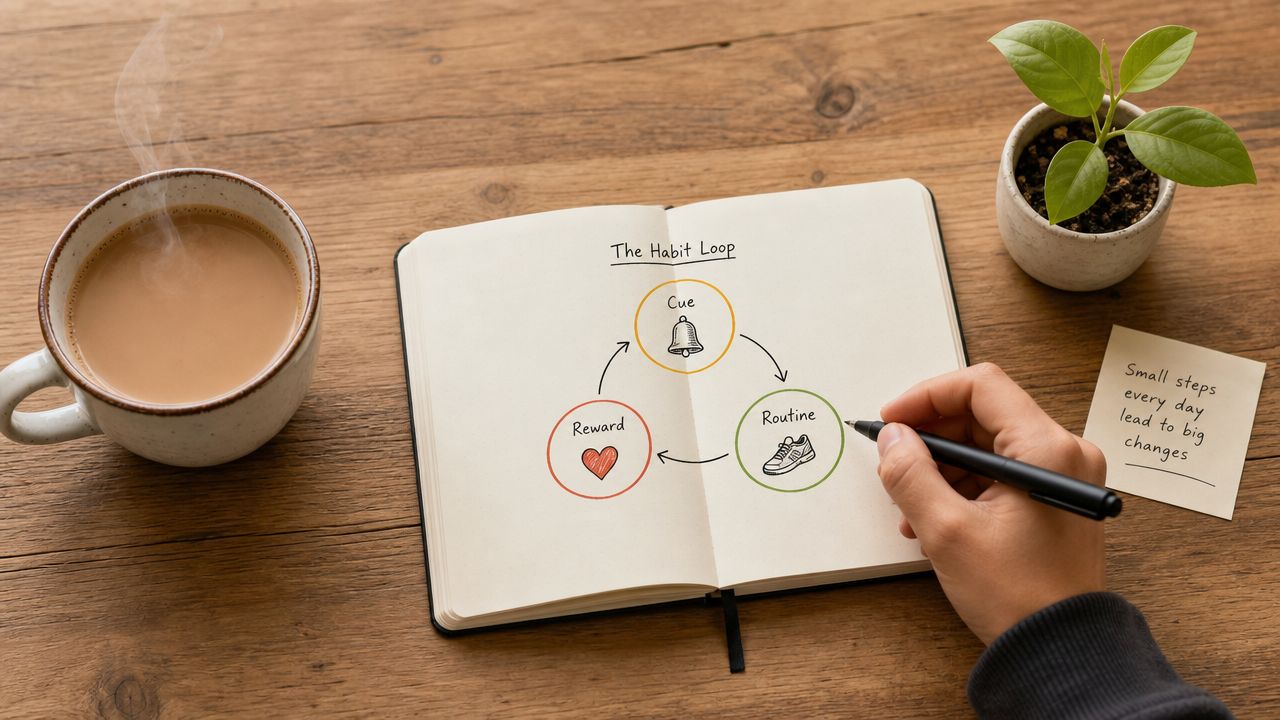
    Cue > Routine > Reward

    The cue is the trigger. It could be a time of day, a place, a feeling, another person, or an action that comes just before. In the chai example, the cue may be the post-lunch slump, seeing colleagues head to the pantry, or noticing tiredness.

    The routine is the behaviour itself. You make tea, open a snack packet, check social media, or step outside for air.

    The reward is what makes the brain remember the loop. The reward might be comfort, energy, relief, connection, or just a pleasant break from mental effort.

    Why craving matters too

    Many people find it easier to understand habits if they include one more piece between cue and routine. That piece is craving. The cue doesn't force the behaviour on its own. It creates a desire for a certain feeling or outcome.

    A diagram illustrating the four stages of the habit loop: Cue, Craving, Routine, and Reward.

    So the fuller version looks like this:

    • Cue: “It's 4 pm and I feel mentally dull.”
    • Craving: “I want comfort or a lift in energy.”
    • Routine: “I make chai and grab something crunchy.”
    • Reward: “I feel better for a while, so my brain stores the pattern.”

    That's why habits often repeat even when they clash with our long-term goals. The brain isn't asking, “Is this ideal for my future?” It's asking, “Did this bring relief last time?”

    Good and bad habits use the same psychology

    This part is important. There isn't a separate brain system for “healthy habits” and “unhealthy habits”. The same learning process can support bedtime reading, daily prayer, journalling, movement, meditation, or hydration. It can also support stress eating, procrastination, or checking messages every few minutes.

    A short comparison makes this easier to see:

    Habit type Cue Routine Reward
    Helpful After brushing teeth Drink a glass of water Feel refreshed and organised
    Unhelpful Feeling tense after work Scroll on phone for an hour Escape and emotional numbness
    Helpful Returning from work Change into walking shoes Feel lighter and settled
    Unhelpful Late-night worry Watch one more reel Temporary distraction

    The key question to ask

    When a habit isn't serving you, try asking: What is this behaviour doing for me right now? That question is kinder and more useful than “Why am I like this?”

    Practical rule: Don't fight a habit only at the level of action. Look for the cue and the reward first.

    If someone snacks during anxiety, the snack may be giving comfort. If someone avoids studying, the avoidance may be giving short-term relief from pressure. If someone stays glued to work messages late into the night, the habit may be protecting them from guilt or fear.

    Once you understand the loop, you can start changing one part at a time. That's where habit formation psychology becomes practical rather than abstract.

    How Long Does It Really Take to Build a Habit

    Many people carry a discouraging belief: if a habit hasn't become easy within a few weeks, they must be doing it wrong. That belief often comes from the old “21-day” idea, which sounds neat but sets people up for disappointment.

    Real behaviour change is slower and more human than that. It depends on the kind of habit, the person's routine, stress level, and how consistently the action happens in the same setting.

    A more realistic timeline

    India-specific research challenges the “21-day” myth. In a meta-analysis available on PubMed Central, habit automaticity was achieved in a median of 62 days. The same research found that consistency of performing the action in the same context was the key predictor of success, not a person's level of self-control or willpower.

    That finding changes the whole conversation. The question isn't “How can I be tougher?” It's “How can I make repetition easier in one reliable context?”

    Why your timeline may not look like someone else's

    A two-minute breathing practice after dinner may settle in faster than a full workout plan at dawn. A self-chosen habit may feel more natural than one copied from social media. A morning routine may work better for one person, while another person can only manage consistency late in the evening.

    Here's a simpler way to think about progress:

    • Small habits often stabilise sooner: They ask less of your energy and schedule.
    • Complex habits need more setup: Exercise, meal prep, or sleep routines often involve several moving parts.
    • Stress slows the process: During anxiety, burnout, or family strain, repetition becomes harder.

    Missing a day doesn't erase the learning. It means you return to the pattern at the next realistic opportunity.

    What helps more than perfection

    People often quit because they think one break means they've failed. That's rarely true. Habits usually grow through repetition over time, not flawless daily performance.

    A useful mindset is to treat habit building like learning a route through a city. Each repeat makes the road more familiar. If you miss one turn, the road still exists.

    This is one reason therapy or counselling can be so supportive. A therapist can help you set a habit that matches your actual life, not an idealised version of it. That creates more resilience, less guilt, and a much better chance of long-term well-being.

    Why Good Intentions Fail and What to Do

    People usually don't fail at habits because they don't care enough. They fail because life places real obstacles in the way. Stress changes attention. Anxiety narrows focus. Burnout drains follow-through.

    That's especially relevant in India, where many working adults are carrying pressure from multiple directions at once. Professional demands, family expectations, financial worries, and digital overload can all crowd out even the healthiest intentions.

    Stress changes what feels possible

    A 2022 Deloitte study found that 80% of the Indian workforce reported facing mental health challenges, primarily driven by stress, as discussed in this ScienceDirect-linked analysis. When stress stays high, habit formation becomes harder because the mind is already spending energy on coping.

    In practical terms, this means a stressed person may know exactly what would help. Sleep on time. Eat regularly. Move the body. Pause before reacting. But knowing isn't the same as having the capacity to do it consistently.

    That gap often creates self-criticism. “If I understand it, why can't I just do it?” The answer is that strain interferes with planning, remembering, and initiating action.

    Anxiety and burnout create invisible friction

    Anxiety often pushes the mind toward urgent relief. Burnout often makes even simple tasks feel heavy. Depression can flatten motivation and reduce the sense that any action will help. Under these conditions, generic advice like “just be disciplined” can feel almost insulting.

    A more realistic response is to lower friction and increase support. If you want a gentler way to explore mindset for mental wellness, it can help to look at how your inner beliefs about growth, effort, and setbacks shape the way you approach change.

    Consider how intentions fail in everyday life:

    • After-work exhaustion: You planned a walk, but your body is depleted and your brain wants only relief.
    • Constant interruptions: A habit needs a stable cue, but your day keeps changing.
    • Emotional overload: The habit competes with worry, resentment, or low mood.

    Good intentions often fail when the environment and emotional state keep rewarding the old behaviour.

    When standard habit advice doesn't fit

    Some people follow all the common advice and still struggle. This is often true for neurodivergent individuals, especially those living with ADHD or executive dysfunction.

    A Frontiers article notes a key gap in India-focused habit advice for ADHD, including that 7.5% of Indian adults have ADHD, and that standard self-control-based advice often misses what they need, according to this Frontiers in Psychology article. For these individuals, the issue may not be intention at all. It may be cue detection, task initiation, memory load, or inconsistent energy.

    That's why habit support needs flexibility. Some people do well with visual prompts, body doubling, therapist-guided cue restructuring, or external accountability. Others need to treat anxiety, depression, trauma, or sleep problems first, because the habit difficulty is only the visible surface of a deeper struggle.

    Smart Strategies for Building Habits That Stick

    Once you stop expecting willpower to do everything, habit change becomes much more practical. You start building around real behaviour. What you see. What you reach for. What happens right before the action. What makes the action feel worth repeating.

    The strategies below work because they reduce friction. They also support well-being by making healthy actions easier to start when life is full.

    A visual guide titled Mastering Habits displaying three practical strategies: make it obvious, make it easy, and make it rewarding.

    Design the environment first

    Environment design means shaping your surroundings so the helpful choice is visible and simple. If you want to drink more water, keep a bottle on your work desk, not inside a cupboard. If you want to stretch in the morning, place the yoga mat where you'll see it before you see your phone.

    This matters even more when you're dealing with workplace stress or mental fatigue. Under pressure, people usually take the easiest available path. If the easy path supports well-being, your habit has a better chance.

    Try these examples:

    • For movement: Keep walking shoes near the door you use most.
    • For sleep: Charge your phone away from the bed.
    • For calm: Leave a journal, prayer book, or breathing prompt in the spot where you usually sit at night.

    For the 7.5% of Indian adults with ADHD, standard habit advice often fails because it relies on self-control. Research highlighted in the earlier Frontiers source points toward consistency, clinician-guided cue restructuring, and environment design that works with neurodivergent brains rather than against them.

    Stack a new habit onto an old one

    Habit stacking is simple. You attach the new behaviour to something you already do reliably.

    If you already make tea every morning, add one deep breath before the first sip. If you already lock the front door before leaving, add a posture check or a short mental intention for the day. If you already sit down after dinner, use that moment for two minutes of gratitude or planning tomorrow's lunch.

    A useful formula is:

    After I do this familiar action, I'll do this tiny new action.

    Examples for daily life:

    • After brushing my teeth, I'll fill my water bottle.
    • After opening my laptop, I'll take one slow breath before checking messages.
    • After dinner, I'll walk for five minutes.

    This works well for students too. If you're trying to connect habit psychology to study routines, this guide with expert advice on student studying can offer practical ideas for building steadier academic habits without relying on last-minute pressure.

    A short video can make these ideas easier to picture in real life.

    Use implementation intentions

    An implementation intention is a plan that tells your brain exactly when and where the habit will happen. Instead of saying, “I'll meditate more,” you decide, “If I finish lunch, I'll sit in my chair and breathe for two minutes.”

    This removes uncertainty. You don't have to negotiate with yourself every day.

    A few examples:

    Situation If-then plan
    Commute stress If I get home feeling irritated, then I'll wash my face and sit quietly for two minutes before talking about work
    Phone overuse If I enter the bedroom at night, then I'll place my phone on the table across the room
    Skipping meals If it becomes 1 pm, then I'll eat the simple lunch I packed, even if work is busy

    Make the reward immediate

    Many healthy habits have delayed rewards. Walking helps mental health over time, but the benefit may not feel dramatic on day one. Your brain learns faster when the action has a small immediate reward too.

    That reward doesn't need to be expensive or elaborate. It can be a tick on a tracker, a favourite song after the walk, a cup of chai after finishing a study block, or the simple sentence “I kept my word to myself today.”

    • For resilience: Notice completion, not just outcome.
    • For happiness: Pair effort with something pleasant but simple.
    • For compassion: Speak to yourself in a way that supports repetition, not fear.

    These strategies aren't a cure for anxiety, depression, or burnout. But they often make self-help more realistic, and they give therapy or counselling a stronger foundation to build on.

    Knowing When to Seek Professional Support

    Sometimes a habit problem isn't only a habit problem. It may be connected to grief, trauma, anxiety, depression, chronic stress, relationship pain, or ADHD. In those cases, changing the routine alone may not be enough because the deeper issue keeps feeding the loop.

    That isn't failure. It's useful information.

    Signs that extra support may help

    If you keep returning to habits that harm your sleep, mood, work, or relationships, it may be time to look beyond self-help. The same applies if you feel stuck in cycles of avoidance, panic, irritability, numbness, or exhaustion.

    According to India's National Mental Health Survey, 10.6% of the population is living with a current mental illness, as reported in the National Mental Health Survey summary. Struggling is common, and seeking support through counselling or therapy is a normal, healthy step toward better well-being.

    A woman holding a tablet showing a mental health support interface with therapy and support service options.

    What therapy can do that habit tips can't

    A therapist can help you identify the emotional function of a habit. Maybe late-night scrolling protects you from loneliness. Maybe overworking protects you from guilt. Maybe a shutdown response appears whenever stress reminds you of earlier experiences.

    Therapy and counselling can also help you build resilience in a more personalised way. That may include emotional regulation, self-compassion, nervous system awareness, grief processing, communication skills, or practical routines that fit your actual capacity.

    Assessments can be helpful here too, but they need to be understood correctly. Assessments are informational, not diagnostic. They can give you clearer language for your experience and help you decide what kind of support may fit best, but they don't replace a qualified mental health professional's evaluation.

    Seeking support doesn't mean you couldn't handle life. It often means you're finally handling it with honesty.

    A steady way to move forward

    You don't need to wait until things become unbearable. Support can be useful when you're functioning on the outside but struggling on the inside. It can also be part of growth, not only crisis.

    Habit formation psychology offers a powerful lens. It shows that change happens through repeated patterns, kind structure, and realistic expectations. When that isn't enough on its own, professional support can help you understand the roots of the pattern and build a healthier one with care.


    If you'd like support that goes beyond generic advice, DeTalks can help you connect with therapists, psychologists, and mental health professionals across India. You can also explore science-backed assessments that are informational, not diagnostic, and use those insights to choose the next step for your well-being, resilience, counselling, or therapy journey.

  • Learning Disabilities Psychologist: A Guide to Support

    Learning Disabilities Psychologist: A Guide to Support

    You may be reading this after another difficult school day. Your child worked hard, still came home upset, and now you're wondering whether the problem is reading, attention, confidence, anxiety, or something no one has explained clearly yet.

    Or maybe you're an adult who has carried the same question for years. You've managed work, training, reports, deadlines, and workplace stress by pushing harder than everyone else, but learning still feels more tiring than it should.

    That's often the hardest part. Not just the struggle itself, but the confusion around who to see first and what a “learning disabilities psychologist” does.

    In India, that confusion is common. Families may hear about clinical psychologists, educational psychologists, neuropsychologists, occupational therapists, speech-language therapists, therapy, counselling, and school referrals, all at once. Without a clear map, it's easy to feel stuck.

    A thoughtful assessment can bring clarity, but it helps to start with the right expectation. Assessments are informational, not diagnostic by themselves. They gather evidence, describe patterns, and help a qualified professional decide what may be going on and what support makes sense next.

    Understanding the Role of a Learning Disabilities Psychologist

    A learning disabilities psychologist helps answer a question that often sits underneath months or years of worry. Why does this child, teen, or adult seem capable in many ways, yet keep struggling with certain kinds of learning?

    Their job is not only to measure marks or spot weakness. It is to study how a person takes in information, understands it, stores it, and shows what they know. A useful comparison is a mechanic checking the whole system of a car, not just noticing that it is moving slowly. Two students may both score poorly in maths, for example, but one may have a language-based difficulty, while the other may be dealing with attention problems, anxiety, or gaps in teaching. The support plan will differ for each one.

    That distinction often matters even more in India, where families are commonly told several different things at once. One person suggests a clinical psychologist. Another mentions a neuropsychologist. A school recommends an educational assessment. Without a clear explanation, these titles can sound interchangeable when they are not.

    More than testing

    A learning disabilities psychologist usually focuses on the link between thinking skills, academic skills, and day-to-day functioning in school, college, or training. They look at reading, writing, spelling, maths, memory, attention, language demands, and the emotional impact of repeated struggle.

    The process is usually broader than a single test. A psychoeducational evaluation may include cognitive testing, academic achievement measures, behavioural questionnaires, developmental history, and careful clinical interpretation. A broad assessment is helpful because learning difficulties are identified through patterns over time, not one bad exam, one teacher comment, or one afternoon of poor concentration.

    This specialist is often the right starting point when the main question is academic. Why is reading not improving despite practice? Why does written work lag far behind spoken understanding? Why does a bright student keep falling apart during tests?

    Psychologist, neuropsychologist, or educational psychologist?

    Many families get stuck at this point, so it helps to sort the roles clearly.

    A learning disabilities psychologist, often working through a psychoeducational framework, is usually the best fit when the concern centres on school skills such as reading, writing, spelling, maths, and exam performance.

    A neuropsychologist is often more relevant when there is a history of brain injury, seizures, major medical or neurological illness, developmental complexity, or a question about how brain-based functioning is affecting memory, attention, and reasoning more broadly.

    An educational psychologist may be involved when the focus is strongly tied to school learning, classroom support, teaching strategies, and recommendations for educational planning. In India, titles and training pathways can vary by setting, so the better question is often not “What is the label?” but “Does this professional assess learning difficulties in a structured way, and can they explain what type of support should come next?”

    That one question can save families time, money, and a lot of confusion.

    Understanding the person, not just the score

    A skilled psychologist does not stop at whether a score falls above or below a cut-off. They ask what daily life looks like for the learner.

    A child who avoids reading may be protecting themselves from repeated failure. A teenager who shuts down during written exams may understand the chapter well but struggle to organise language quickly enough on paper. An adult who keeps putting off certification courses may have spent years believing they are careless or lazy, when the underlying issue lies in processing speed, working memory, or written expression.

    Scores help, but context gives them meaning.

    That is why a good evaluation also pays attention to effort, frustration, coping habits, confidence, and the gap between potential and performance. It helps separate questions that can look similar from the outside. Is this a specific learning disorder, ADHD, anxiety, a language issue, uneven schooling, or a mix of factors?

    Why this step often brings relief

    Families often feel lighter after meeting the right specialist because the struggle starts to make sense. Blame softens. The child is no longer seen as stubborn. The adult is no longer left wondering why ordinary learning tasks feel unusually draining.

    Clarity does not solve everything at once. It does give you a map.

    And a map changes what happens next. It can guide decisions about school accommodations, remedial teaching, counselling, assistive technology, exam support, or referral to another professional when the picture suggests something beyond a learning disability alone.

    Recognizing Signs That May Warrant Support

    Many families wait because they hope the problem will pass on its own. Sometimes children do catch up with time and teaching. Sometimes, though, the same pattern keeps returning across months, subjects, and settings.

    The useful question isn't “Does this definitely mean a disorder?”
    It's “Does this pattern suggest we should talk to a professional?”

    An infographic titled Recognizing Signs That May Warrant Support, categorized by age groups for early childhood intervention.

    In younger children

    A preschooler may seem bright, curious, and talkative, yet still have unusual difficulty recognising letters, remembering sound patterns, or following simple spoken instructions. Another child may avoid colouring, struggle to hold a crayon, or become upset during tasks that need fine motor control.

    These signs don't automatically point to a learning disability. They do suggest that the child may benefit from closer observation and perhaps support from a psychologist, speech-language therapist, or occupational therapist depending on the pattern.

    In school-age children

    This is often when concerns become more visible. A child may read slowly, guess words instead of decoding them, mix up similar-looking letters, or understand ideas well when spoken aloud but struggle when reading independently.

    Maths can show up differently. A student may know answers verbally but get lost when writing steps, lining up numbers, or recalling basic facts. In writing, you may see very short sentences, messy spacing, or a big gap between what the child can say and what they can put on paper.

    A useful clue is persistence. Everyone has off days. Repeated difficulty despite effort, teaching, and practice deserves attention.

    In teenagers

    Secondary school brings heavier demands on planning, note-making, time management, and written expression. A teen may spend long hours studying but still produce weak results because reading is slow, writing is exhausting, or organising information feels overwhelming.

    Some teenagers stop trying in obvious ways. Others keep trying and become intensely anxious.

    Common emotional signs include:

    • Avoidance of schoolwork: putting off reading, written tasks, or revision until the last minute
    • Frustration or anger: emotional outbursts around homework that seem larger than the task itself
    • Loss of confidence: saying “I'm stupid” or “I can't do anything right”
    • Stress symptoms: headaches, stomach aches, restlessness, or exam anxiety
    • Low mood: sadness, withdrawal, or signs that begin to overlap with anxiety or depression

    In adults

    Learning difficulties don't disappear just because school ends. Adults may notice them when they face professional exams, workplace training, report writing, spreadsheets, email organisation, or new systems at work.

    A capable employee may still struggle to process written instructions quickly, keep track of multiple steps, or write clearly under time pressure. Over time, that can contribute to workplace stress, burnout, shame, and quiet avoidance.

    What these signs mean

    They are signals, not proof. They tell you that the learner may need a closer look.

    That closer look should be compassionate. Many people with learning difficulties have spent years hearing that they are careless, lazy, too emotional, or not trying hard enough. Often, they've been trying very hard for a very long time.

    Navigating the World of Specialists

    One of the biggest barriers isn't willingness to get help. It's not knowing which professional fits the concern.

    In India, this matters even more because there isn't always one standard entry point into support. School referrals, private clinics, paediatricians, counsellors, and family advice may all point in different directions.

    The need is large. The Unified District Information System for Education Plus reported 3.24 million children with special needs enrolled in 2023-24, which highlights how important it is for families to understand the support system and choose the right specialist early, as noted in Every Special Child's discussion of school psychologists and support pathways.

    A chart listing different professionals who support individuals with learning disabilities and their primary roles.

    A quick comparison

    Professional Best suited for
    Learning disabilities psychologist Understanding why reading, writing, or maths difficulties persist and how cognition, behaviour, and emotions affect learning
    Clinical psychologist Emotional distress, anxiety, depression, behaviour concerns, and mental health treatment, sometimes alongside learning concerns
    Educational psychologist School-based learning patterns, classroom strategies, and educational planning
    Neuropsychologist More complex cognitive questions, neurological conditions, brain injury, or cases where multiple areas of functioning need closer mapping
    Speech-language therapist Language comprehension, expression, phonological skills, and communication-related barriers
    Occupational therapist Fine motor concerns, handwriting, sensory-motor issues, and functional classroom skills
    Paediatrician or psychiatrist Medical review, developmental questions, medication discussions where relevant, and broader diagnostic coordination

    When a learning disabilities psychologist is the right first call

    This is often the right fit when the main question is academic. Your child is bright but reading doesn't come easily. Writing is much weaker than spoken language. Maths facts don't stick. The same struggle continues despite effort and teaching.

    The psychologist can look at the whole pattern and help separate learning difficulty from other possibilities such as anxiety, inconsistent instruction, attention problems, or low confidence.

    When you may need a different first step

    Sometimes the presenting concern isn't primarily academic.

    If a child has strong emotional meltdowns, severe school refusal, panic, or depression, a clinical psychologist may be the first priority. If there's a history of head injury, seizures, or a more complex neurological picture, a neuropsychologist may be more appropriate.

    If speech sounds, language understanding, or expressive language seem delayed or unusual, a speech-language therapist may need to be involved early. If handwriting, grip, posture, or sensory issues are central, an occupational therapist may help more than a psychology referral alone.

    The best first professional is the one whose training matches the main problem you can see, not the broadest title.

    A simple decision guide for families

    You don't need to get this perfect on the first try. Start with the clearest question.

    • Reading, writing, or maths are the main concern: start with a learning disabilities psychologist or educational psychologist
    • Attention, emotional outbursts, anxiety, or depression are front and centre: consider a clinical psychologist
    • Language seems to be the bottleneck: consult a speech-language therapist
    • Handwriting, coordination, or sensory-motor issues stand out: consult an occupational therapist
    • There's a neurological history or a more complex picture: ask about neuropsychological evaluation

    Why “get assessed” isn't enough

    Families often hear generic advice that doesn't reduce confusion. A decision tree is the solution, not a vague instruction.

    That matters because support for learning disabilities is rarely one-professional work. Even when a psychologist leads the assessment, the best outcomes usually come from matching the learner's profile with the right mix of school support, therapy, targeted teaching, and family understanding.

    What to Expect During a Psychoeducational Assessment

    A parent in Bengaluru may walk into an assessment expecting one intimidating exam. An adult in Mumbai may worry that one poor performance will decide everything. In reality, a psychoeducational assessment works more like putting together a clear map. The psychologist studies how the person learns, where work gets stuck, and what strengths can be used to make learning easier.

    A flowchart detailing the five-step process of a psychoeducational assessment performed by a psychologist.

    The first meeting

    The process usually begins with a detailed history. The psychologist asks what teachers and family members have noticed, when the concern first became clear, what support has already been tried, and how the learner manages in daily life.

    For children, this often includes early development, language history, school progress, medical background, and emotional well-being. For teenagers and adults, the discussion may focus more on study patterns, exam struggles, workplace demands, long-standing frustrations, and the coping methods they have built over time.

    This conversation matters because test scores make more sense when they are placed beside real life. A reading score alone cannot show whether the person avoids homework, takes hours to finish written work, or understands lessons well but cannot express answers on paper.

    The testing sessions

    Testing is usually spread across one or more sessions. The tasks may feel a bit tiring, especially for someone who already struggles with attention, reading, writing, or processing speed, but they are designed to observe patterns, not to catch anyone out.

    A psychoeducational assessment may include:

    • Cognitive tasks: reasoning, memory, verbal skills, visual-spatial skills, and processing speed
    • Academic tasks: reading accuracy, reading comprehension, spelling, written expression, and maths
    • Attention and behaviour tools: questionnaires or rating scales completed by parents, teachers, or the individual
    • Record review: school notebooks, report cards, previous evaluations, and samples of classwork

    In India, families are often unsure whether the professional is only checking for a learning disability or also ruling out other explanations. A good assessor explains that these tasks help separate different possibilities. For example, poor marks can come from a reading disorder, weak language foundations, ADHD, uneven teaching history, anxiety, or a mix of these. The assessment is built to sort that out carefully.

    Why the process has several parts

    One score cannot capture how a person learns.

    A child may reason well during conversation but struggle badly with spelling. Another may understand maths concepts yet fail timed worksheets because processing speed is slow. A college student may read accurately but need to reread the same paragraph several times because working memory or attention is getting in the way.

    That is why psychologists use multiple types of information. It works like checking eyesight with more than one lens before deciding on the prescription. The aim is not just to name a problem. The aim is to identify the pattern behind the problem.

    This is also the stage where families in India often see why choosing the right specialist mattered. An educational or learning-focused psychologist is usually asking, "How does this person learn?" A neuropsychologist may go further if there is a neurological history, seizures, head injury, or a more complex brain-based picture. The assessment process can overlap, but the main question guides the tools chosen and the final interpretation.

    Assessments are meant to explain difficulties clearly, not judge effort or character.

    The feedback meeting

    After testing, the psychologist prepares a written report and reviews it with the family or adult client. This meeting should translate technical findings into plain language.

    You should come away understanding:

    1. What the person does well
    2. Which skills are significantly weaker
    3. Whether the pattern fits a specific learning disorder or suggests another explanation
    4. What support is recommended at school, college, work, or home
    5. Whether another specialist should be involved

    In the Indian context, many families also need practical guidance on documentation. They may want to know whether the report can support exam accommodations, school-based help, or referrals for remedial education. Ask directly. A useful report should not leave you guessing about the next step.

    A note families often need

    This process can bring relief, grief, confusion, or all three at once. Some parents worry about labels. Some adults feel angry that nobody noticed the problem earlier. Some children feel tired and want to know whether they did "badly."

    Reassurance helps here. The assessment is a clinical evaluation, not a verdict on intelligence or effort. Its real value is direction. Once the pattern is clear, families can choose support that fits, whether that means school accommodations, skill-based teaching, therapy, or community-based help such as The Grow Project support services.

    From Assessment to Actionable Support and Resilience

    The report is not the finish line. It is the beginning of a more precise support plan.

    The profound value of a learning disabilities psychologist is evident. Their best reports don't just name the difficulty. They connect the learner's pattern to practical teaching methods, accommodations, and emotional support.

    What support often looks like

    Different profiles need different responses. A child with reading impairment may need structured literacy. A learner with dyscalculia may need multisensory maths instruction. Someone with writing difficulties may benefit from typing, text-to-speech, or reduced handwriting load.

    These supports matter because there is no single medication approved specifically for learning disorders. Progress usually comes from targeted instruction and accommodations, not a one-size-fits-all fix.

    Why the support plan is often interdisciplinary

    This surprises many families. They expect the psychologist to handle everything.

    In reality, good support is often coordinated across roles. The psychologist may help interpret the profile, the teacher may adapt classroom expectations, a special educator may provide remediation, an occupational therapist may work on handwriting or sensory-motor issues, and a speech-language therapist may help if language processing is part of the picture.

    Effective support is therefore interdisciplinary, and the psychologist's most valuable contribution is often a differential profile with actionable recommendations rather than generic counselling. Earlier identification is linked with better outcomes and fewer secondary emotional effects such as low self-esteem or anxiety, as explained in Psychology Today's guidance on learning disabilities support.

    The emotional side deserves equal attention

    Learning struggles rarely stay confined to academics. They often affect identity.

    A child who keeps failing despite effort may become anxious before school. A teen may stop volunteering answers because they fear embarrassment. An adult may overwork to hide difficulty, then crash into burnout, workplace stress, or depression when the pressure becomes too much.

    That's where therapy and counselling can help. Not because therapy removes the learning difference, but because it helps the person manage shame, frustration, perfectionism, avoidance, and the emotional exhaustion that can build around repeated struggle.

    Support works best when it helps both performance and well-being. A plan that improves marks but harms confidence isn't good enough.

    Building resilience, not just compliance

    Families sometimes worry that accommodations will make a learner dependent. In practice, the opposite is often true.

    When support fits the actual difficulty, people spend less energy pretending and more energy learning. That creates room for resilience, self-advocacy, compassion, and even happiness. A learner who understands their profile can say, “This is how I learn best,” instead of “Something is wrong with me.”

    For families looking beyond school and wanting broader care pathways, some find it useful to review services that support children and adults across development, daily functioning, and care planning, such as The Grow Project support services.

    What progress often feels like

    Progress may look quiet at first. Less homework panic. Fewer tears. Better pacing. More willingness to attempt hard tasks. A teacher noticing that the child participates more. An adult writing reports with less dread.

    Those are not small changes. They are the foundation of durable well-being.

    How to Find the Right Psychologist for You

    Once you've decided to seek help, the next challenge is choosing well. Credentials matter, but so do clarity, communication, and fit.

    A strong psychologist should help you feel informed, not intimidated.

    A woman reviewing a document titled Questions to Ask a Learning Disabilities Psychologist while at her desk.

    Questions worth asking

    Before booking, ask direct questions. You don't need to sound expert.

    • What age groups do you assess most often? A psychologist who mostly works with young children may not be the best fit for an adult workplace-related concern.
    • What does your assessment include? You want to hear that the process is broad and thoughtful, not based on a single tool.
    • Do you also look at emotional factors like anxiety or low mood? Learning concerns often overlap with well-being.
    • What kind of written report do you provide? The report should be practical enough for schools, colleges, workplaces, or family planning.
    • How do you explain results? Families need plain language, not only technical terms.
    • Do you coordinate with other professionals if needed? This matters when speech, occupational, or mental health support may also be useful.

    Practical ways to start in India

    Many families begin through a school referral, a paediatrician, or a mental health professional already involved in the child's care. Adults may start through workplace well-being referrals, a therapist, or their own online search.

    If you have insurance or employer benefits, it helps to ask early whether any part of the process is covered. Policies vary, and the answer often depends on whether the service is framed as educational, psychological, or developmental support.

    Signs of a good fit

    A good provider is careful without being alarmist. They don't rush to labels, and they don't dismiss concerns because a learner is coping “well enough” on the surface.

    Look for someone who can hold both challenge and hope. The right clinician should understand school pressure, exam anxiety, family stress, adult workplace stress, and the emotional impact of repeated struggle.

    A short explainer can also help you know what to listen for when evaluating a provider's approach.

    Red flags to notice

    Some warning signs are easy to miss.

    Green flag Red flag
    Explains the process clearly Promises instant certainty
    Looks at strengths and difficulties Focuses only on deficits
    Gives actionable recommendations Gives vague advice like “work harder”
    Welcomes questions Becomes defensive when asked for clarification
    Considers mental health and well-being Treats emotional distress as irrelevant

    Why the first conversation matters

    You're not only choosing a service. You're choosing a guide for a confusing stretch of the journey.

    That means it's reasonable to ask questions, pause, compare, and trust your instincts. If the process leaves you feeling more confused, judged, or rushed, it may not be the right fit.

    Your Journey Forward with Understanding and Support

    Learning difficulties can affect school, work, confidence, relationships, and emotional health. They can also be misunderstood for years.

    But confusion isn't the end of the story. When the right professional helps make sense of the pattern, families and individuals often move from blame and stress toward understanding, therapy, counselling, and practical support that strengthens resilience and well-being.

    No single assessment can define a person's future. What it can do is offer language, direction, and a more compassionate plan.

    If anxiety has become part of this journey for you or your family member, supportive resources like these anxiety self-help guides can be a gentle companion alongside professional care.

    With the right support, people don't become different people. They become better understood, better supported, and more able to use their strengths with less fear and more self-compassion.


    If you're ready to take the next step, DeTalks can help you find psychologists, therapists, and mental health professionals across India, explore trusted assessments, and connect with support for learning concerns, anxiety, depression, burnout, and overall emotional well-being.

  • Uncovering the Real Pursuit of Happiness Meaning

    Uncovering the Real Pursuit of Happiness Meaning

    Some days, the pressure to be happy feels like a second job. You wake up, check your phone, see smiling photos, career updates, travel reels, fitness wins, and suddenly your own life feels late, messy, or not enough.

    If you're tired of chasing a feeling you can't seem to hold onto, you're not failing. You're asking a wise question. What is the pursuit of happiness meaning if success, productivity, and looking fine on the outside still leave people feeling anxious, empty, or burnt out?

    The Constant Pressure to Be Happy

    A lot of people are carrying two lives at once. One is the visible life where they answer emails, attend meetings, smile in family groups, and post an occasional cheerful photo. The other is the private life where they feel drained, worried, lonely, or unsure why their achievements don't feel as satisfying as they expected.

    A young man sitting on a city bench looking at a social media feed on his smartphone.

    This tension is especially visible among young people trying to build a future in uncertain times. One reported trend says youth unemployment reached 17.8%, alongside a 35% rise in anxiety among college students, and 52% linked low motivation to a lack of meaningful career paths, not merely a lack of effort, according to the cited reported discussion of purpose and youth anxiety. Even without turning that into a universal story, many readers will recognise the feeling. You keep moving, but you don't always know what you're moving towards.

    When happiness becomes a performance

    The problem isn't that people want happiness. The problem is that many of us have been taught to perform it. We start to believe a happy life should look polished, energetic, socially active, and constantly improving.

    That belief can increase workplace stress, self-criticism, and exhaustion. If your body is asking for rest but your mind says, "I should be more grateful, more productive, more positive," then happiness starts to feel like pressure instead of well-being.

    You don't need to feel good all the time to be living a good life.

    Sometimes the kindest first step is practical, not philosophical. If your days feel overloaded, these strategies to avoid burnout can help you protect energy, set limits, and create space to think more clearly.

    The deeper question underneath

    When people search for the pursuit of happiness meaning, they usually aren't asking for a clever quote. They're asking something more personal. How do I live in a way that feels worth it, especially when life includes stress, uncertainty, anxiety, and disappointment?

    That question takes us beyond mood. It takes us into meaning, values, relationships, and resilience. Happiness, in its deeper sense, isn't about pretending pain doesn't exist. It's about building a life that can hold both joy and difficulty without losing direction.

    What Our Ancestors Meant by a Happy Life

    The phrase "pursuit of happiness" often sounds modern, almost like a lifestyle goal. But historically, the idea was much deeper than buying comfort or collecting pleasant experiences. Earlier thinkers were usually talking about how to live well, not just how to feel good.

    In classical Greek thought, a central idea was eudaimonia. This is often translated as flourishing. It points to a life shaped by character, purpose, and wise action. In simple terms, it asks, "Are you becoming the kind of person you want to be?"

    Happiness as a way of living

    This older view treats happiness less like a reward and more like a practice. You don't stumble into it by accident. You build it through choices, habits, relationships, and responsibility.

    A useful way to understand this is to compare two experiences:

    Everyday experience What it gives you
    Buying something you've wanted for weeks Excitement and relief for a while
    Caring for a parent, child, friend, or community project A deeper sense of meaning, even when it's tiring

    Both matter. But they don't nourish us in the same way. One soothes a moment. The other shapes a life.

    Indian ideas of a fulfilling life

    In India, many people will recognise a similar distinction through ideas like Dharma and purposeful duty. Different traditions describe this in different language, but the thread is familiar. A meaningful life isn't only about comfort. It's also about responsibility, integrity, contribution, and inner balance.

    Modern life often separates achievement from meaning. You can be busy without direction. You can be praised without feeling peaceful. You can be surrounded by people and still feel alone.

    Practical rule: If a goal improves your image but weakens your inner life, it may not be taking you towards real happiness.

    Why this older view still helps now

    Ancient ideas don't solve today's stress by themselves. They won't remove deadlines, family conflict, exam stress, or career confusion. But they do correct a major misunderstanding.

    They remind us that a happy life was never meant to mean a life free from struggle. It meant a life with coherence. A life where your actions, values, and relationships fit together well enough that you can respect the way you're living.

    That is why the pursuit of happiness meaning still matters. It shifts the question from "How do I stay in a good mood?" to "How do I build a life I can stand inside with honesty?"

    The Psychological Difference Between Pleasure and Purpose

    Psychology gives us a very useful lens for understanding happiness. It often separates well-being into two broad forms. One is hedonic well-being, which focuses on pleasure, comfort, and positive feelings. The other is eudaimonic well-being, which focuses on meaning, growth, and living in alignment with your values.

    Both are part of being human. The trouble begins when we expect pleasure to do the whole job.

    An infographic comparing hedonic well-being based on pleasure and eudaimonic well-being based on meaning and purpose.

    A simple analogy

    Think about dessert and cooking. Eating a wonderful dessert can make you happy in the moment. That's pleasure. Learning to cook well, feeding people you love, and growing in confidence over time can create a deeper satisfaction. That's purpose.

    Neither one is wrong. But they work differently.

    Type of well-being Main focus Usual feeling How long it tends to last Link to resilience
    Hedonic Enjoyment, relief, comfort Pleasant and immediate Often brief Can soothe stress, but may not guide you through setbacks
    Eudaimonic Meaning, growth, contribution Fulfilling and grounding Often more enduring Helps people recover and keep going when life is hard

    Why meaning matters so much

    In the Indian context, positive psychology research has connected happiness strongly with meaning. One cited summary says meaning accounts for 40% of subjective well-being variance among urban professionals, and low meaning scores were linked with 2.5x higher depression rates, while meaning-focused interventions improved resilience by 28%, according to the cited overview of the pursuit of happiness in psychology.

    This doesn't mean pleasure has no place. Rest matters. Fun matters. A nice meal, music, laughter, and comfort all support well-being. But if your life has pleasure without direction, you may still feel emotionally underfed. That is why many people benefit from reflecting on hidden needs, including exploring emotional hunger, especially when they keep reaching for comfort but still feel empty.

    A helpful framework for real life

    Positive psychology often uses the PERMA model to describe flourishing:

    • Positive emotion helps you enjoy life in the moment.
    • Engagement happens when you're absorbed in something meaningful.
    • Relationships give care, belonging, and support.
    • Meaning connects your life to something larger than immediate comfort.
    • Accomplishment supports confidence and a sense of progress.

    If you're confused about the pursuit of happiness meaning, start here. A good life usually includes some pleasure, but it becomes steadier when purpose is present too.

    If pleasure is the spark, purpose is the firewood.

    That is also why assessments about strengths, values, emotional patterns, or resilience can be useful. They can offer information and reflection points. But they are informational, not diagnostic. They don't define you. They help you notice where your life may need more care, structure, or meaning.

    Common Happiness Myths That Increase Anxiety

    Many people don't suffer because they want happiness. They suffer because they've been handed faulty rules about how happiness is supposed to work.

    A split screen comparing a minimalist empty room with a person reading and drinking tea in a cozy kitchen.

    One reason this confusion matters so much in India is that public well-being doesn't always rise with economic change. The World Happiness Report 2023 ranked India 126th out of 137 countries, and the cited summary links this to lower social support and lower freedom to make life choices, showing that growth and well-being don't automatically move together, according to the cited discussion of happiness and freedom.

    Myth one, happiness is a destination

    People often say things like, "I'll be happy when I get the promotion," or "Once my life settles down, then I'll feel okay." This sounds reasonable, but it can trap you in permanent postponement.

    A destination mindset increases anxiety because life keeps changing. One goal is replaced by another. You arrive somewhere you worked hard to reach, then feel guilty that the feeling didn't last.

    Myth two, happiness means feeling positive all the time

    This myth can be especially harsh on people dealing with depression, grief, fatigue, or chronic stress. If you believe sadness, anger, or fear are signs of failure, you'll start fighting your own inner life.

    That often creates a second layer of suffering. First you feel bad. Then you judge yourself for feeling bad.

    A healthy mind isn't a mind that never hurts. It's a mind that can respond to pain without panic or shame.

    Myth three, success automatically creates well-being

    Achievement can improve comfort and opportunity. But it can't replace belonging, purpose, or emotional safety. Many high-functioning people are still lonely, exhausted, or disconnected from themselves.

    For some readers, gentle mental habits help interrupt that pressure. Short reflective practices, including powerful affirmations to rewire thoughts, can support a kinder inner voice when self-criticism starts to take over.

    A brief video can help make this shift feel more concrete.

    Myth four, you have to do it alone

    This myth is common in competitive settings. Students, professionals, and parents often think they should manage everything privately. But isolation can worsen workplace stress, low mood, and burnout.

    Humans regulate emotion in connection with others. Sometimes happiness grows less from chasing a feeling and more from allowing support, honesty, and shared burden into your life.

    Evidence-Based Practices for Cultivating Well-Being

    A meaningful life doesn't appear all at once. People build it in small, repeatable ways. These practices aren't quick fixes, and they aren't tests you need to pass. Think of them as skills that strengthen your capacity for steadier happiness.

    Start with attention, not perfection

    Many people try to improve their life by becoming stricter with themselves. They add more routines, more goals, more pressure. Usually, a better starting point is attention. Notice what lifts you, what drains you, and what leaves you emotionally numb.

    A simple check-in can help:

    • Morning question ask, "What matters most today?"
    • Midday pause ask, "What is my body telling me right now?"
    • Evening reflection ask, "What gave me energy, and what took it away?"

    This kind of awareness supports resilience because it helps you respond earlier, before stress turns into shutdown.

    Practise gratitude in a grounded way

    Gratitude is often misunderstood as forced positivity. Real gratitude doesn't deny difficulty. It widens your attention so hardship is not the only thing in view.

    Try a short journal with prompts like these:

    1. Name one person who made your day easier.
    2. Notice one ordinary comfort such as tea, shade, music, or a quiet moment.
    3. Record one effort you made, even if the day felt imperfect.

    This works best when it's specific. "My colleague waited for me before starting the meeting" lands with more impact than "I'm grateful for everything."

    Small acts of noticing can stabilise a mind that has learned to scan only for threat.

    Build meaning through service and strengths

    Purpose often grows where your values meet action. That might mean mentoring a junior colleague, helping a sibling with studies, volunteering locally, or doing your paid work with more intention and care.

    Ask yourself:

    Reflection question Why it helps
    What kind of problems do I care about? It points towards values
    When do I lose track of time in a good way? It reveals natural engagement
    Who benefits when I'm at my best? It connects personal growth with contribution

    This is also where counselling can help. A good counsellor can help you sort through career confusion, burnout, identity questions, and the gap between the life you're living and the life that feels meaningful.

    Strengthen self-compassion

    People often think self-compassion will make them passive. In practice, it usually makes them more steady. When you stop wasting energy on self-attack, you have more capacity to repair, learn, and try again.

    You can use a simple three-step response after a hard moment:

    • Acknowledge reality by naming what hurts.
    • Normalise struggle by reminding yourself that difficulty is part of being human.
    • Offer support by asking, "What would help me take the next kind step?"

    This matters for anxiety, perfectionism, and workplace stress because harsh self-talk often keeps the nervous system activated long after the stressful event has ended.

    Protect relationships and flow

    Some of the strongest pillars of well-being are ordinary. One is connection. The other is absorption.

    Connection grows when you message a friend, share a meal without rushing, or tell the truth about how you're doing. Flow grows when you're fully engaged in something that uses your skills just enough to stretch you. It might be writing, coding, gardening, music, teaching, designing, or solving a difficult problem.

    Neither needs to be dramatic. Both need consistency.

    If you use self-reflection tools or online assessments to understand your emotional patterns, use them wisely. They can help you explore strengths, stress responses, or resilience. But they are informational, not diagnostic. They are best used as conversation starters, not final answers.

    When to Seek Support on Your Journey

    There is a difference between having a hard week and feeling persistently unlike yourself. Many can sense it, even if they don't have the words yet. Something starts to feel heavier, flatter, or harder to manage.

    A woman sits looking sad while another person places a comforting hand on her glowing shoulder.

    In India, the 2023 National Mental Health Survey reported that 13.8% of adults had current mental disorders, involving over 150 million people, with depressive and anxiety disorders among the most common, according to the cited summary of the National Mental Health Survey findings. That matters because many struggles are invisible from the outside. A person can look functional and still be experiencing significant suffering.

    Signs that deserve attention

    You don't need to wait for a crisis to seek help. Support can be useful if you notice patterns such as:

    • Changes in sleep where you're sleeping far more, far less, or waking tense.
    • Loss of interest in things that used to feel enjoyable or meaningful.
    • Persistent hopelessness or the sense that nothing will improve.
    • Constant overwhelm where small tasks feel unusually difficult.
    • Withdrawal from friends, work, study, or family life.

    These signs don't automatically tell you what diagnosis, if any, is present. But they do suggest your mind and body may need more support than self-help alone can provide.

    Therapy and counselling can play different roles

    Therapy often helps people explore deeper emotional patterns, painful experiences, or repeating struggles in relationships, mood, and self-worth. Counselling can be especially helpful for current-life stressors such as exam pressure, grief, workplace conflict, family strain, or decision-making.

    Both can support coping, self-understanding, and emotional regulation. Neither can guarantee constant happiness. That's not the goal. The goal is to help you live with more clarity, flexibility, and self-respect.

    Seeking support doesn't mean you're weak. It means you're no longer asking yourself to carry everything alone.

    If you're unsure whether to reach out, that uncertainty itself can be worth discussing with a professional.

    Frequently Asked Questions About the Pursuit of Happiness

    Is pursuing happiness selfish

    Not when happiness is understood as meaning, balance, and healthy functioning. A person who is grounded, emotionally aware, and supported is often better able to care for family, contribute at work, and show up with patience in relationships.

    The selfish version is not happiness. It's using other people or ignoring responsibilities in the name of comfort. Real well-being usually makes people more compassionate, not less.

    Can therapy or counselling guarantee happiness

    No. Therapy and counselling don't guarantee a permanent emotional state, because no honest form of support can promise that. What they can do is help you understand your patterns, build coping tools, process pain, and make choices that support long-term well-being.

    That often changes how you relate to sadness, fear, anger, and stress. The goal isn't nonstop positivity. It's a more workable, meaningful life.

    How do I balance happiness with responsibility

    A helpful shift is to stop thinking of happiness and responsibility as opposites. Often, meaning grows inside responsibility when that responsibility is chosen consciously and held with boundaries.

    You might ask:

    • Which duties matter to me
    • Which duties come from fear, guilt, or image
    • Where do I need rest, support, or clearer limits

    This kind of reflection protects you from burnout while helping you stay connected to what matters.

    What if I don't know what gives my life meaning

    That's more common than people admit. Meaning usually doesn't arrive as a dramatic revelation. It grows through attention, experimentation, and honest reflection.

    Try noticing what gives you a quiet sense of rightness. Not excitement alone. Not approval alone. The moments that feel steady, alive, and true.

    Embracing Your Unique Path to a Meaningful Life

    The deepest pursuit of happiness meaning isn't about chasing a permanent mood. It's about creating a life with enough purpose, care, honesty, and connection that joy has somewhere real to land.

    That life will still include hard days. You may still face anxiety, stress, conflict, self-doubt, or periods of low energy. A meaningful life doesn't remove pain. It gives pain a context, and gives you ways to move through it without losing yourself.

    Try making the journey smaller and kinder. Notice one thing that matters. Strengthen one relationship. Change one harsh sentence in your inner dialogue. Rest before you collapse. Ask for help before things become unbearable.

    You don't need to become a different person to live well. You need a steadier relationship with the person you already are.

    And if you're still figuring it out, that's not a failure. That's part of being human.


    If you'd like support in understanding your emotions, finding the right therapist, or exploring science-backed mental health assessments, DeTalks offers a trusted place to begin. You can explore therapy and counselling options, learn more about your well-being, and take thoughtful next steps at your own pace.

  • Yoga Poses Chakras: Guide to Energy Balance

    Yoga Poses Chakras: Guide to Energy Balance

    You wake up tired, check your phone, and feel your chest tighten before the day has properly begun. By lunch, your jaw is clenched, your breath is shallow, and your attention is jumping between tasks. By evening, the body is still upright, but the inner spark feels low. Many people describe that state as stress. In yoga therapy, I often hear a different phrase too: out of balance.

    The chakra system gives language to that experience. Rather than treating chakras as fixed objects or a belief test, it helps to use them as a practical map of human experience. You might notice a lack of grounding, difficulty feeling pleasure, trouble asserting yourself, guardedness in relationships, a blocked voice, mental fog, or a sense of disconnection. Traditional chakra teachings developed over time within Indian spiritual traditions, and the seven-chakra model familiar today took shape in later Tantric sources, as outlined in Hareesh Wallis’s historical overview of chakra traditions.

    Used this way, chakra-based yoga becomes more than a list of poses. It becomes a method for emotional regulation. A grounding shape may help during workplace stress. A steady backbend may support someone who feels shut down after conflict. A seated posture and simple breath awareness can sometimes soften the mental spin that comes with anxiety or early burnout. The trade-off is that symbolism should not replace discernment. A pose can support the nervous system, but it cannot by itself resolve trauma, depression, or chronic relational pain.

    Yoga also remains closely connected to everyday well-being in India, and many practitioners turn to it for far more than flexibility. People use it to settle the mind, build resilience, and restore a felt connection between body and emotion.

    The poses in this guide are paired with the chakras they are most often associated with, along with the emotional themes they may help regulate, the common mistakes that make them less useful, and the moments when extra support is wise. If your distress feels persistent, intense, or hard to manage alone, yoga can sit alongside professional care. Therapy can help address the underlying patterns with more safety and depth, including support through platforms such as DeTalks.

    1. Child's Pose (Balasana) for Muladhara

    Child’s Pose looks simple, but it’s one of the most useful grounding postures in a chakra-based practice. When someone feels scattered, overstimulated, or emotionally unsafe, this pose often helps bring attention back to the lower body and the breath. That’s why it’s commonly linked with Muladhara, the root chakra, which is associated with steadiness, support, and belonging.

    A woman performing a yoga child's pose with a glowing chakra symbol overlaid on her lower back.

    A working professional dealing with workplace stress might use Balasana for a few breaths before opening a laptop. A university student might come into it before an exam when the mind won’t slow down. In therapy, some trauma-informed practitioners also use it carefully as a grounding option, though not everyone finds folded shapes comforting, so choice matters.

    How it helps and where people force it

    The biggest mistake is treating Child’s Pose as passive collapse. It works better when you let the front body soften while keeping some awareness in the hips, belly, and breath. If the knees or ankles complain, the nervous system won’t settle, so props aren’t optional. They’re smart.

    A cushion under the chest, a folded blanket behind the knees, or widened knees can make the pose feel safer and more spacious. If your forehead doesn’t comfortably reach the mat, place it on a block or pillow. The point is regulation, not endurance.

    Practical rule: If a grounding pose makes you feel trapped, numb, or more agitated, come out early and choose a more upright shape.

    Try staying for 5 to 10 slow breaths at first. Over time, many people can rest here for 1 to 3 minutes, especially when they focus on belly breathing and a soft exhale. A simple phrase such as “I am safe and steady” can help if it feels natural, but don’t force affirmations that your body doesn’t believe yet.

    Best use for mental health support

    Balasana is useful when stress has pushed you into overdrive. It can support emotional regulation between counselling sessions, during burnout recovery, or after difficult conversations. It won’t solve chronic anxiety on its own, but it can create enough space for you to respond rather than react.

    2. Cat-Cow Flow (Marjaryasana-Bitilasana) for Svadhisthana

    You close the laptop after hours of meetings, and your mind is still racing while your body feels oddly numb. That is a good moment for Cat-Cow. This simple spinal wave can restore a sense of movement and feeling without asking much from an already tired system, which is why it is often linked with Svadhisthana, the sacral chakra.

    Svadhisthana is traditionally associated with emotion, pleasure, creativity, and connection. In practice, I often see its imbalance show up less as dramatic emotion and more as disconnection. A person under workplace stress may feel stiff through the pelvis, guarded in the belly, and cut off from any clear sense of what they feel. Cat-Cow gives the body a safe pattern of expansion and release. For many people, that is the first step back toward emotional regulation.

    The value of this pose is not intensity. It is rhythm.

    Come onto hands and knees with the wrists under the shoulders and the knees under the hips. As you inhale, let the chest broaden and the sitting bones tip back for Cow. As you exhale, press the floor away, round the spine, and gently draw the lower belly inward for Cat. Keep the throat soft. Let the movement travel through the whole spine instead of forcing the neck or lower back to do all the work.

    This flow can help during creative fatigue, low mood, or the flat, depleted feeling that often follows burnout. It also suits people who find still poses too exposing at first. Repetition creates predictability, and predictability can help an anxious nervous system settle.

    A few adjustments make a big difference:

    • Keep the movement modest: Small, steady rounds usually regulate better than large, dramatic ones.
    • Pad the knees if needed: A folded blanket can reduce irritation and make it easier to stay with the breath.
    • Let the pelvis participate: Svadhisthana is closely tied to the hips and lower abdomen, so include that area in your awareness.
    • Slow the exhale: Many people rush through Cat and miss the release that comes from a complete breath out.

    The common mistake is chasing range. An exaggerated Cow can dump into the lower back and tighten the neck, which tends to make stress feel sharper, not softer. A better approach is to move at about seventy percent of your maximum range and stay attentive to the quality of the breath. If the breath becomes strained, the pose has stopped serving its purpose.

    Sacral chakra work can bring up tender material. Themes like shame, desire, grief, and relationship stress often live close to this area of the body. If emotion rises, pause in a neutral tabletop or sit back and rest. You do not need to force a release. Gentle movement supports resilience best when it stays tolerable.

    For people dealing with anxiety, chronic stress, or burnout, Cat-Cow works well as a short regulation practice between therapy sessions or at the end of the workday. If you notice that movement consistently stirs up panic, dissociation, or painful memories, yoga may need to be paired with professional mental health support through a service such as DeTalks. The goal is not to handle everything on your own. The goal is to build steadier contact with your body, one breath and one movement at a time.

    3. Warrior I (Virabhadrasana I) for Manipura

    You open your laptop at 8 a.m., and by noon your body already reflects the day. The chest has collapsed, the jaw is tight, and every decision feels heavier than it should. Warrior I gives that stress pattern a clear physical countershape, which is one reason it is often associated with Manipura, the solar plexus chakra, linked with will, confidence, and purposeful action.

    I use this pose often with people who feel worn down by workplace pressure, self-doubt, or the flat, depleted state that can follow burnout. Warrior I does not manufacture confidence. It lets you practise the posture of commitment while staying aware of your limits, and that matters. Real confidence is not bravado. It is the ability to stay organised under pressure.

    The setup deserves care. Step the feet onto two steady tracks, bend the front knee, and ground through the outer edge of the back foot. Let the pelvis turn forward as much as your hips allow without twisting the knee or gripping the low back. Raise the arms only to the height that keeps the breath smooth and the neck soft.

    A few details change the pose completely:

    • Press down before you lift up. Stable feet usually create a steadier mind.
    • Draw the lower belly in gently so the trunk feels supported, not braced.
    • Keep the front ribs from thrusting forward. That is where many students lose both breath and balance.
    • Soften the face. Effort in Warrior I should feel focused, not harsh.

    The trade-off becomes clear. If you chase a dramatic shape, the pose can feed the same strain pattern you are trying to interrupt. If you shorten the stance a little and keep the breath full, Warrior I becomes a training ground for tolerating challenge without tipping into overwhelm. That is especially useful for people whose stress response shows up as irritability, overworking, or a constant need to prove themselves.

    I have seen this land well for a manager before a hard conversation, a student facing performance anxiety, and someone in therapy rebuilding a sense of agency after emotional exhaustion. For some practitioners, adding a calming visual cue nearby, such as a healing Rose Quartz gemstone tree, supports the reflective side of the practice, though the pose itself should remain the main tool.

    Hold for 3 to 5 breaths on each side at first. Come out while you still feel steady. If the pose leaves you more agitated, ashamed, or pushed into a survival state, that is useful information, not failure. Yoga can support emotional regulation, but if effort, assertiveness, or body-based practices consistently trigger panic, shutdown, or traumatic memories, it may be time to pair your practice with professional support through a service such as DeTalks.

    4. Heart-Opening Cobra Pose (Bhujangasana) for Anahata

    Grief often shows up physically before it becomes words. The chest tightens, the shoulders round in, and breathing turns shallow. Cobra Pose can help create space across the front body, which is why many practitioners connect it with Anahata, the heart chakra, linked with compassion, affection, and emotional openness.

    This is one of the most misunderstood poses in beginner classes. It isn’t about how high you lift. It’s about how fully you open.

    A smaller backbend usually works better

    Lie on your belly, place your hands under or slightly forward of the shoulders, and lengthen the legs behind you. Then lift the chest a little, using the back muscles first and the hands second. If the elbows flare wide or the lower back jams, you’ve gone too far.

    This offers substantial support for someone moving through loneliness, heartbreak, or emotional numbness. A person recovering from divorce may find that a few gentle Cobras help soften protective tension. A couple doing relationship counselling might even practise simple chest-opening shapes separately, then reflect on what openness feels like in the body before trying to communicate it in words.

    A therapist’s reminder: Heart-opening work should feel vulnerable but not exposed. There’s a difference.

    Hold for 15 to 30 seconds, then lower and repeat. If you want to add a reflective element, place one hand over the heart afterwards and notice what’s there. You don’t need to manufacture gratitude or forgiveness.

    Where this pose fits in emotional care

    Bhujangasana can complement therapy, especially when someone is working on self-compassion, grief, or reconnection after isolation. It doesn’t replace emotional processing. It supports it by making room for breath and sensation.

    Some people also like to pair heart practices with visual reminders of softness and care, such as a healing Rose Quartz gemstone tree. That kind of ritual isn’t required, but for some practitioners it helps create a calmer atmosphere for inner work.

    A final caution. If you’re in acute emotional distress, a deep heart opener can feel too intense. In that case, choose a lower lift, reduce the hold, or try a supported restorative pose instead.

    5. Shoulder Stand (Sarvangasana) for Vishuddha

    You rehearse what you need to say before a hard meeting, then your throat tightens the moment the conversation starts. That mind-body pattern is one reason Vishuddha, the throat chakra, still resonates with many practitioners. In yoga therapy, this area often connects with expression, listening, truth-telling, and the stress response that can shut all of that down.

    Shoulder Stand is one traditional pose for this chakra. It can feel steadying and clear. It can also feel like too much. For people dealing with workplace stress, anxiety, or burnout, a full inversion may sharpen focus on one day and increase pressure on another. The body decides whether the pose is supportive.

    Use discernment with this pose

    Sarvangasana asks a lot from the neck, shoulders, breath, and nervous system. If your breathing gets tight, your jaw grips, or you feel compressed in the throat, stop and choose a different option. A pose linked with communication should not leave you bracing.

    I rarely treat Shoulder Stand as the starting point for throat-chakra work. A shy manager preparing to speak more directly with colleagues may get better results from a supported Bridge or Legs-Up-the-Wall, then a few minutes of simple humming or extended exhales. Someone in couples therapy may also connect with the symbolism of the throat chakra, but the physical practice needs to feel stable enough that insight can land.

    Start with Legs-Up-the-Wall before attempting a full inversion. If you have learned Shoulder Stand from a qualified teacher, place folded blankets under the shoulders to reduce strain on the neck. Keep the back of the neck quiet, and never turn your head while in the pose.

    To explore the shape visually, this guided demo can be useful:

    Supported options often work better

    A lot of chakra content treats Shoulder Stand as a requirement. It is not. Supported Bridge, Viparita Karani, or even a seated practice with slow breath and relaxed throat muscles can serve the same emotional theme with less risk.

    Some yoga-based programs for stress relief have used gentler poses, including Bridge, to support emotional balance across several chakra themes. That lines up with what many clinicians and yoga therapists see in practice. Dramatic shapes are not what help people regulate. Consistent, tolerable practice does.

    If you do choose Shoulder Stand, hold it briefly and come out slowly. Notice the after-effect. A useful throat-chakra practice leaves you feeling more settled, more honest, and a little more able to say what needs to be said. If speaking up still feels impossible, or anxiety is affecting work, sleep, or relationships, yoga can support the process, and therapy through a service like DeTalks may offer the added structure and care you need.

    6. Lotus or Half-Lotus (Padmasana or Ardha Padmasana) for Ajna and Sahasrara

    You close the laptop after a day of back-to-back meetings, sit down to meditate, and find that your mind is still answering emails. In such instances, Lotus, Half-Lotus, or a well-supported simple seat can help. These shapes are traditionally associated with Ajna and Sahasrara because they encourage steady attention, quiet observation, and a wider sense of perspective.

    The pose matters less than the quality of your seat.

    Full Lotus asks for significant hip mobility and stable knees. Many dedicated practitioners are better served by Half-Lotus, Sukhasana, or sitting on a cushion against a wall. I tell students this often in therapeutic settings: if the body is bracing, insight gets replaced by endurance.

    Steady posture supports clear seeing

    Ajna work is less about mysticism than discernment. Under stress, discernment often slips first. Burnout can look like irritability, numbness, indecision, or the sense that every task is urgent. A stable seated posture gives you a few minutes to notice those patterns before they run the day.

    Sahasrara practices can also be misunderstood. They do not require chasing transcendence or forcing yourself into stillness. In practice, this chakra theme often shows up as meaning, connection, and the ability to step out of constant mental noise. For someone dealing with workplace stress or anxiety, that may look very ordinary. A slower breath. A softer jaw. Enough space to notice, "I am overloaded," instead of pushing through again.

    Start with setup.

    Raise the hips on a folded blanket or firm cushion so the knees can descend without strain. Rest the hands on the thighs. Let the spine lift naturally rather than stiffening into a performance of good posture. If Half-Lotus causes pulling in the knee, come out right away and choose an easier seat.

    A few practical guidelines help:

    • Prioritize the knees over the shape: Sensation in the outer hips can be workable. Sharpness or torque in the knee is a clear no.
    • Keep the sit short at first: Three to five quiet minutes often helps more than a long, agitated effort.
    • Use the breath as the anchor: When attention scatters, return to the exhale instead of trying to stop thoughts.
    • Treat props as part of the practice: Support usually improves focus.

    This kind of seated work fits well with journalling, counselling, or therapy because it builds self-observation. You begin to catch the difference between tiredness and depletion, between passing stress and a pattern that is affecting sleep, relationships, or work. Yoga can support that awareness. It does not replace mental health care when symptoms are persistent or intense. If anxiety, hopelessness, or burnout keeps repeating, therapy through a service like DeTalks can give you more structure than solo practice can provide.

    If sitting hurts, your attention returns to pain. Modify first, meditate second.

    7. Forward Fold (Uttanasana) as a bridge for release

    You close the laptop after a long day, but your body still acts like the meeting is happening. The jaw stays tight. The breath sits high in the chest. Forward Fold gives that stress somewhere to go.

    Uttanasana works across the chakra system rather than fitting neatly into one center. The feet root into the ground, the spine lengthens, the head drops below the heart, and the nervous system often reads that as permission to soften. I use it as a transition pose for people who feel mentally crowded, physically tense, and too depleted for anything complex.

    Start with the knees bent more than you think you need. Let the belly and ribs rest on the thighs so the low back does not grip. Release the neck. If the floor feels far away, place hands on blocks, a chair seat, or even your shins. The pose should feel containing, not forced.

    The release in this shape comes from support.

    Students under academic pressure often use it between study blocks. Office workers do well with it after commuting or before dinner, when the mind is still cycling through unfinished tasks. For clients already doing therapy for anxiety or burnout, it can serve as a short regulation practice between sessions, especially when they need a physical cue to slow down.

    A few details change the whole experience. Keep weight balanced between heels and the balls of the feet. Let the elbows soften and the tongue relax away from the roof of the mouth. If holding opposite elbows helps the back body loosen, stay there. If that creates more effort, keep the hands supported.

    Trying to straighten the legs at all costs usually turns this pose into a hamstring test. That misses the point. In therapeutic practice, a smaller fold with an easier breath does more for emotional regulation than a deeper shape held with strain.

    This is also a useful checkpoint. If a brief fold helps you settle, it may be enough to interrupt a stress cycle during the workday. If folding inward makes you feel trapped, agitated, or more emotionally flooded, choose a more upright position and get support. Yoga can steady the system, but repeated anxiety, panic, shutdown, or burnout often needs more structure than self-practice provides. In those cases, working with a therapist through a service like DeTalks can help you sort out what is situational stress and what has become a larger mental health pattern.

    Come out slowly, with bent knees, and rise on an inhale. If dizziness appears, pause halfway or place hands on the thighs before standing fully.

    7-Pose Chakra Comparison

    Pose Complexity 🔄 Resources & Modifications 💡 Expected outcomes ⭐📊 Ideal use cases Key advantages ⚡
    Child's Pose (Balasana) – Root Chakra Low, simple alignment, low risk Props: cushion/block; avoid if knee/hip pain Grounding, reduced anxiety, parasympathetic activation ⭐📊 Trauma grounding, anxiety, quick calming breaks Very accessible; safe long holds; gentle on spine ⚡
    Cat‑Cow Flow (Marjaryasana‑Bitilasana) – Sacral Chakra Low, rhythmic movement, mindful pacing 🔄 Padded mat; wrist support if needed; keep neck neutral Emotional release, creative flow, spinal mobility ⭐📊 Creative blocks, low motivation, gentle trauma recovery Easy to adapt tempo; promotes fluidity and breath sync ⚡
    Warrior I (Virabhadrasana I) – Solar Plexus Chakra Moderate, requires strength, balance 🔄 Space for lunge; modify back heel or reduce depth Increased confidence, willpower, core strength ⭐📊 Low self‑esteem, motivation rebuilding, pre‑performance ritual Builds stamina and mental focus; empowering stance ⚡
    Heart‑Opening Cobra (Bhujangasana) – Heart Chakra Low‑Moderate, backbend with alignment focus 🔄 Blanket under pelvis; "baby cobra" option; protect low back Emotional opening, self‑compassion, chest release ⭐📊 Grief processing, loneliness, relationship healing Direct heart‑center activation; scalable intensity ⚡
    Shoulder Stand (Sarvangasana) – Throat Chakra High, advanced inversion, technical 🔄 Use wall or bolsters; professional guidance; avoid neck issues Enhanced self‑expression, mental clarity, thyroid stimulation ⭐📊 Communication anxiety, reclaiming voice, assertiveness work Potent for voice/clarity; strong circulatory effects ⚡
    Lotus / Half‑Lotus (Padmasana/Ardha) – Third Eye & Crown Moderate‑High, requires hip flexibility, sustained stillness 🔄 Meditation cushion/zafu; use Half‑Lotus or cross‑legged first Deep meditation, intuition, spiritual clarity ⭐📊 Life‑purpose exploration, contemplative practice, meaning‑making Ideal for prolonged meditation; fosters inner clarity ⚡
    Forward Fold (Uttanasana) – A Bridge for Release Low, simple bend, watch blood pressure 🔄 Bend knees if tight; hold 30s–2min; avoid prolonged if hypertensive Mental release, reduced racing thoughts, posterior stretch ⭐📊 Exam/study stress, anxiety relief, evening unwind Fast calming effect; accessible with modifications ⚡

    Your Integrated Path to Lasting Well-being

    You finish a long workday with your jaw tight, breath shallow, and mind still replaying meetings. On a day like that, chakra-based yoga works best as a check-in, not a performance. A grounding pose may help when stress has scattered your attention. A heart opener may help when burnout has left you flat. Seated stillness may help when anxiety keeps your thoughts spinning.

    That is the value of this practice. It gives you a way to notice what your nervous system is asking for, then respond with something concrete. Over time, these poses can strengthen body awareness, emotional regulation, and resilience. For many people, that makes yoga more than exercise. It becomes a steady mental health support you can return to after conflict, overwork, grief, or restless sleep.

    In India, this connection carries particular weight because yoga already sits inside daily life for many households, studios, and communities. As noted earlier, broad participation shows that many people turn to yoga for well-being, not only physical fitness. I see the same pattern in practice. People often begin with stiffness or fatigue and stay because the poses help them feel more settled, more present, and less reactive.

    Still, honest guidance matters. Yoga can calm the stress response, improve breath control, and bring buried feelings closer to the surface. It can also show you where you brace, avoid, overpush, or shut down. But it does not replace skilled mental health care when you are dealing with trauma, panic, persistent depression, severe burnout, or relationship patterns that keep repeating.

    That point matters in places where mental health stigma still keeps people quiet. Analysts and clinicians at NIMHANS, drawing on the National Mental Health Survey 2015 to 2016, have discussed how stigma affects help-seeking for anxiety and depression in India, as referenced in this discussion of yoga for chakras and mental health gaps. Seeking counselling or therapy does not weaken a spiritual practice. It supports it.

    Self-assessments can be useful here if you treat them as a starting point. They can help you identify whether you are facing workplace stress, low mood, anxiety, emotional exhaustion, or strain in relationships. They cannot diagnose you. A qualified therapist helps make sense of the pattern, especially when symptoms are affecting sleep, work, appetite, concentration, or your sense of safety.

    If rituals help you stay consistent, restorative settings can support that commitment. Some people find renewed focus through experiences such as yoga retreats. The trade-off is that a retreat can reset you, but it cannot maintain your practice for you once daily pressure returns. What helps most is repetition you can sustain at home. Breathe. Modify. Rest when needed. Repeat what works.

    A lasting path usually blends several forms of care. Use yoga to reconnect with your body and regulate your state. Use reflection to name what you feel. Use therapy or counselling when the emotional load is too heavy or too persistent to carry alone.

    If you want support beyond self-practice, DeTalks can help you take the next step. You can explore confidential, science-backed assessments for insight into stress, anxiety, depression, resilience, and emotional well-being, or connect with a qualified therapist for therapy and counselling that fits your needs.

  • How to Discover Your Strengths and Unlock Your Potential

    How to Discover Your Strengths and Unlock Your Potential

    Feeling a bit lost or unsure of what you're truly good at? It’s a common feeling, and you are not alone. Learning how to discover your strengths is a key step toward building genuine confidence and a stronger sense of well-being. This guide will walk you through this journey of self-discovery, which involves looking inward, gathering feedback, and using helpful tools.

    Why Discovering Your Strengths Matters

    It's easy to feel like you're not quite hitting your stride in life, which can lead to stress and feeling undervalued. Identifying your core strengths provides a solid foundation for a more satisfying career and a more resilient mind. This process is essential for your personal and professional well-being.

    In India, this feeling is widespread. A 2022 study revealed that 62% of urban professionals felt stuck because they hadn't identified their strengths. This uncertainty is a major contributor to workplace stress and burnout. You can read more about these findings on professional well-being.

    This simple flowchart lays out the three-part journey we're about to take.

    As you can see, finding your strengths is about balancing your own reflections with feedback from others and some structured guidance.

    To give you a clearer picture of the road ahead, this table breaks down the core methods we'll be exploring in this guide.

    Four Pillars of Strength Discovery

    A quick overview of the core methods we will explore in this guide to help you identify your personal strengths.

    Method What It Helps You Uncover Best For
    Self-Reflection Your intrinsic motivations, passions, and moments of natural flow. Gaining initial insights and understanding your personal "why."
    Feedback (360°) How others perceive your talents and contributions, revealing blind spots. Getting an objective, external view of your impact on others.
    Validated Assessments A structured, objective language to define and categorise your strengths. People who prefer data-driven, evidence-based methods.
    Real-World Testing How your potential strengths hold up in practical, everyday situations. Turning theoretical strengths into proven, actionable skills.

    Each of these pillars offers a unique lens through which to see yourself, and using them together provides the most complete and accurate picture.

    From Surviving to Thriving

    Knowing what you’re good at is more than a career move; it’s a shift in perspective. Instead of focusing on fixing weaknesses, you can amplify what already makes you feel capable and alive. This positive psychology approach is key to building lasting well-being and happiness.

    When you lead with your strengths, navigating challenges becomes easier. This builds resilience, equipping you to better handle stress, anxiety, and even feelings of depression. It is a compassionate and empowering way to approach personal growth.

    The goal isn't to become someone new; it's about fully embracing and leveraging who you already are. This shift from self-criticism to self-awareness is where true growth begins.

    This journey is a process of developing a deeper, more compassionate understanding of yourself. Whether you find clarity through quiet reflection, professional therapy, or structured counselling, you are building a life that feels authentic to you.

    Looking Inward Through Self-Reflection

    The journey to discover your strengths begins with turning your focus inward. Self-reflection is a quiet, powerful practice of reconnecting with your experiences to find what truly energizes you. It’s about being honest with yourself and moving beyond what you think you should be good at to what comes naturally.

    Think of this process as an act of gentle curiosity, not judgment. You're creating a safe space to explore your own history for clues that point toward your innate talents. These are often the abilities you might have taken for granted or dismissed as unimportant.

    Gentle Prompts for Deeper Insight

    Find a quiet moment for yourself with a journal or just your thoughts. The only goal is to be present and honest as you consider these questions.

    • When do you feel most energised? Think about activities that leave you feeling refreshed, not drained, like organising a family event or helping a friend.
    • What activities make you lose track of time? Being "in the zone" is a massive clue that you're using a natural strength.
    • What compliments do you tend to dismiss? We often brush off praise for things that feel easy to us, but these are frequently our most powerful talents.
    • What did you love doing as a child? Early interests in building things, telling stories, or organising games can reveal a lot about your core strengths.

    Just as films can give us a new lens on our internal lives, dedicating time to understanding self through popular media and other creative avenues can be a huge help. It connects your personal feelings to broader human experiences, making self-discovery feel much more relatable and less isolated.

    Identifying Patterns in Your Experiences

    After reflecting, look for patterns in your answers. A single instance might be a fluke, but recurring themes are signposts pointing toward your core strengths. Think about past successes, both big and small, beyond just official achievements.

    Consider that time you skilfully handled a difficult conversation or taught yourself a new skill for fun. What personal abilities did you use? These insights help you turn reflection into a practical tool for building resilience and improving your well-being.

    Think of your past experiences as a collection of data about yourself. Your mission is to become a gentle detective, looking for the common threads that tie your most positive and effective moments together. This helps build the foundation for your well-being.

    As you recall these moments, ask yourself what skills you were using. Was it your patience? Your creativity? Your knack for analysing things logically? Or maybe your ability to connect with people? This step is what turns simple reflection into a practical tool for building resilience.

    From Self-Reflection to Self-Compassion

    This process isn't always easy and can sometimes stir up difficult feelings related to workplace stress or personal challenges. If tough emotions surface, it is important to treat yourself with the same kindness you would offer a friend. Self-compassion is a key part of this journey.

    Self-reflection is a skill that strengthens with practice, fostering a better relationship with yourself and boosting your mental well-being. Understanding what makes you feel capable helps you better manage feelings of anxiety or self-doubt.

    If this inward journey feels overwhelming, that's completely okay. It might be a sign that seeking support through therapy or counselling could be a helpful next step. A professional can provide a guided, supportive space to explore these questions and turn your insights into lasting personal growth.

    Gaining Perspective by Seeking Feedback

    Self-reflection is a great starting point, but we all have blind spots. Sometimes, our greatest strengths are invisible to us because they feel so natural. This is why getting an outside perspective is an essential part of discovering what you’re good at.

    Asking others for their honest insights isn’t about fishing for compliments; it’s about gathering information. When you ask trusted friends, family, or colleagues for their thoughts, you build a more complete picture of your impact. This can highlight talents you never even realized you had.

    How to Ask for Meaningful Feedback

    Asking for feedback can feel awkward, but framing the request correctly makes all the difference. Be specific and explain that you’re on a personal growth journey. This helps the other person feel comfortable sharing something constructive.

    Choose people who see you in different settings—a trusted manager, a close friend, or a family member. Let them know you’re working to understand your strengths to improve your well-being and that you value their perspective. Use simple, open-ended questions to guide the conversation.

    • "Can you think of a time when you saw me at my absolute best?"
    • "What kinds of problems do you think I'm naturally wired to solve?"
    • "From where you stand, what's the unique thing I bring to our team (or our friendship)?"
    • "Was there ever a time I helped you with something that really stuck with you?"

    These questions encourage concrete examples rather than vague praise, giving you valuable information to work with.

    Receiving Feedback with an Open Mind

    How you listen is just as important as how you ask. Your only job is to listen with curiosity, not to defend or explain yourself. Think of it as gathering data to build a richer self-portrait; every piece of information is useful.

    It's normal to feel vulnerable during this process, especially if you're navigating anxiety or workplace stress. Take a breath and remind yourself that this is an act of self-care designed to build your resilience. Treat the feedback as a gift meant to help you grow.

    Your primary job is to listen and say, "Thank you for sharing that with me." Avoid the urge to immediately react or analyse. Simply collect the insights and allow yourself time to process them later.

    After speaking with a few people, review your notes and look for recurring themes. Did different people mention your calming presence or your ability to simplify complex ideas? These patterns are powerful clues pointing directly to your core strengths.

    Turning Insights into Self-Awareness

    Hearing a consistent message from people you trust can be a powerful antidote to the self-doubt that fuels stress. This isn't about ego; it’s about gaining clarity and practising self-compassion. Owning your strengths with confidence becomes much easier when they are validated by others.

    This exercise can be an empowering part of your growth. However, if hearing feedback brings up difficult emotions, professional support can make a difference. Engaging in therapy or counselling offers a safe environment to process these perceptions and integrate them in a healthy way.

    Using Assessments for Deeper Insight

    Self-reflection and feedback are powerful, but sometimes a structured approach can provide even more clarity. Formal assessments offer a clear, established vocabulary to describe your talents. They can turn a vague feeling of being good at something into a concrete concept you can use.

    Think of these tools as a map of your inner landscape. They won’t tell you where to go, but they will highlight your natural terrain, making it easier to navigate your personal and professional life. They provide valuable information, but they are not diagnostic tools.

    Choosing the Right Kind of Assessment

    The goal is to find assessments designed for growth, not for putting you in a box. Look for "strengths-based" tools that focus on what’s right with you. These assessments are built on principles of positive psychology.

    When exploring platforms like DeTalks, look for assessments that explore areas like:

    • Character Strengths: Positive personality traits like creativity, honesty, or leadership.
    • Emotional Intelligence (EQ): How well you understand and manage your emotions and those of others.
    • Workplace Styles: How you naturally solve problems, work in a team, and communicate.

    An assessment gives you a snapshot—a starting point for a much deeper conversation about your well-being.

    Interpreting Your Results with Compassion

    Approach your results with an open and curious mind. These are not grades or judgments; they are simply signposts pointing toward your natural talents. They provide information to help you understand yourself better.

    An assessment result is a starting point, not a final word. Use it as a conversation starter with yourself or a trusted professional to explore how these themes show up in your life.

    Sometimes, your results will confirm what you’ve always suspected, boosting your confidence. Other times, they might reveal hidden strengths. Both outcomes are valuable for building genuine self-awareness and resilience.

    A Tool for Growth, Not a Label for Life

    It is important to remember that these assessments are informational tools to support your mental health journey. In India, where pressure to succeed is high, unrecognized strengths can contribute to low self-esteem, anxiety, and burnout, especially among young professionals.

    Understanding your strengths is a crucial part of your mental well-being. It acts as a powerful buffer against workplace stress, anxiety, and the kind of persistent low mood that can lead to depression. It empowers you to build a more fulfilling life.

    If you feel confused or overwhelmed by your results, that's okay. Discussing your report in therapy or counselling provides a safe space to make sense of it all. A therapist can help you connect the report to your real-life experiences and create an actionable plan for growth.

    Putting Your Strengths into Action Daily

    The real magic happens when you start weaving your newfound knowledge into your daily life. This is where self-awareness becomes a tool for confident, intentional action. It's about making small choices that play to your natural talents, creating a more energized and fulfilling reality.

    You don’t need to overhaul your life overnight. Start with small, conscious shifts in your daily routines at work and at home. When you deliberately use your strengths, you create a positive feedback loop that builds momentum and boosts your well-being.

    Weaving Strengths into Your Work Life

    Your job is a powerful place to apply your strengths. Much of workplace stress comes from feeling like you don't fit in. Actively using your strengths can shift feelings of dread into genuine engagement and purpose.

    For example, if your top strength is 'Creativity', volunteer to brainstorm on a tough project. If you're a natural at 'Organisation', offer to streamline a messy workflow. These small actions make your day more enjoyable and your contributions more valuable.

    This is especially relevant in the Indian context, where professional stress is a significant issue. Aligning your work with your strengths can combat career confusion and motivational slumps. Once you know what you’re good at, the next step is figuring out how to talk about it, especially when you are listing strengths on your resume.

    Enhancing Personal Well-being and Relationships

    Leaning into your strengths is an incredible strategy for building resilience, managing anxiety, and strengthening personal relationships. When you operate from a place of natural talent, you have more emotional energy to handle life’s challenges. Think about how your abilities can enrich your life outside of work.

    • Is your strength 'Curiosity'? Set aside time to learn something new each week to feel a sense of growth and fight boredom.
    • Do you lead with 'Kindness'? Make a point to do one small, kind thing each day for a friend or neighbor to boost your own happiness.
    • Are you a born 'Leader'? Take the lead on organising a family holiday or a get-together with friends.

    These small, intentional acts reinforce who you are and help you build a life that feels authentic and joyful.

    By consciously choosing activities that play to your strengths, you are not just having fun—you are actively building your mental and emotional fortitude. This is the essence of moving from surviving to thriving.

    This practice acts as a buffer against stress and self-doubt. When you consistently see your strengths making a positive difference, it’s much easier to cope with those moments when you feel overwhelmed or inadequate. It’s a practical path to greater self-compassion and mental clarity.

    Below are a few more practical examples of how to connect your strengths to everyday challenges.

    Applying Your Strengths in Daily Life

    Identified Strength Challenge Area (e.g., Workplace Stress) Actionable Strategy
    Empathy Conflict with a colleague Proactively listen to their perspective before responding. Try to understand their "why" to find common ground.
    Discipline Feeling overwhelmed with tasks Dedicate the first 30 minutes of the day to creating a structured to-do list and prioritising the top three items.
    Adaptability Unexpected change in plans Instead of resisting, focus on finding the new opportunity within the change. Brainstorm three positive outcomes.
    Strategic Thinking Personal finance anxiety Schedule a weekly "money meeting" to review your budget, track progress towards goals, and plan future expenses.

    As you can see, applying strengths isn't about grand gestures but about small, consistent actions that align with your natural abilities.

    Setting Goals Aligned with Your Strengths

    Finally, set long-term goals that honor your core strengths. Frame them around what you're naturally wired to do well. This simple shift makes the process more enjoyable and dramatically increases your chances of success.

    For instance, if you want to advance in your career and 'Empathy' is a strength, aim for a mentoring role. If your goal is to get healthier and your strength is 'Discipline', a structured workout plan will feel natural. This alignment helps you avoid burnout and find more happiness in your pursuits.

    If you struggle to make this connection, working with a professional through counselling or therapy can offer the clarity you need. They can help you chart a path forward that feels authentic and empowering.

    Sometimes, this journey of self-discovery can feel overwhelming. Recognizing that you could use outside help is a sign of strength, not weakness. If digging into your past stirs up anxiety or you feel trapped by burnout, it might be time to talk to a professional.

    Making Sense of Your Inner World

    A good therapist helps you see what's getting in your way. We all have blind spots shaped by past experiences that can obscure our potential. Counselling offers a safe, structured space to unpack these challenges with compassion.

    A therapist acts as a guide, helping you connect life experiences to your natural talents. They bring an objective perspective and proven techniques to build resilience and improve your well-being. This is incredibly helpful if you are dealing with workplace stress or symptoms of depression.

    Remember, self-help tools and assessments give you information, but they can't provide a diagnosis. Only a qualified mental health professional can offer a clear understanding of your situation and guide you to the right kind of support.

    Finding the Right Support for You

    Taking the step to find a therapist is significant, and finding the right fit is important. Platforms like DeTalks can connect you with licensed professionals across India who specialize in various areas of mental health and personal development.

    The goal is not a quick fix, but building a stronger, more compassionate relationship with yourself. Professional guidance provides tools to see your strengths and use them with confidence. Your path is your own, and asking for support is a brave and supportive step forward.

    Frequently Asked Questions

    It's natural to have questions as you start exploring your personal strengths. Think of this as a friendly chat where we tackle some of the most common ones that pop up on this journey.

    Are Strengths Assessments Actually Accurate?

    This is a great question. Think of strength assessments as a really useful starting point. If you use a reputable one grounded in positive psychology, it can give you a clear language to talk about your natural talents. For many people, seeing their inherent abilities laid out like that is a huge confidence boost.

    It's important to remember that these results are informational, not diagnostic. They are a snapshot in time—a fantastic tool to spark deeper thought and conversation, whether with yourself, a mentor, or through therapy or counselling.

    Do My Strengths Change as I Get Older?

    Yes, they definitely can and do. While your core personality might stay relatively consistent, how you express your strengths will absolutely evolve. Life experience, new skills, and a deeper understanding of yourself all play a huge part.

    For instance, a young person's "leadership" strength might show in organizing university projects. Later in life, that same strength may appear as mentoring junior colleagues. Your strengths are dynamic and grow with you.

    What if I Can Only See My Weaknesses?

    First off, know that you are not alone in feeling this way. It's incredibly common, especially when you're navigating things like workplace stress, anxiety, or burnout. Our brains have a built-in negativity bias, meaning we're naturally wired to spot the problems before the positives.

    The trick is to start small. Ask a trusted friend what they see as your best qualities. At the end of each day, try to identify one small thing that went well because of something you did. If this feeling persists, talking to a professional could be a supportive next step.

    Remember, this process isn't about pretending weaknesses don't exist. It's about consciously choosing to nurture your strengths to build resilience and boost your overall well-being. It’s an act of kindness to yourself.

    How Does Knowing My Strengths Help My Mental Health?

    Understanding and using your strengths is a game-changer for mental health. When you lean into activities that feel natural and energising, it boosts your sense of competence, happiness, and meaning.

    This acts as a powerful buffer against things like anxiety and depression. By focusing on what fills your cup, you're actively building a solid foundation of self-esteem and emotional resilience. This makes it so much easier to handle the inevitable curveballs life throws your way and is a key part of creating a life filled with more purpose and joy.


    At DeTalks, we're passionate about helping people unlock their unique potential. Whether you need clarity from an assessment or guidance from an experienced therapist, we're here to support you in building a more resilient and fulfilling life. Explore our resources and find the right professional for you.

  • How To Deal With Peer Pressure And Build Lasting Resilience

    How To Deal With Peer Pressure And Build Lasting Resilience

    When you feel the pull to go with the crowd, it’s easy to lose your calm. Here are four simple steps to help you pause and choose what feels right. Use these tools to protect your well-being and strengthen your resilience.

    Peer Pressure Tactics

    • Assertive Phrases
      Speak with calm confidence: “I’d rather sit this one out.”
    • Pause To Reflect
      Give yourself a moment. A few seconds can curb an impulse.
    • Lean On Allies
      A quick text to a trusted friend reminds you you’re not alone.
    • Core Values Check
      Ask, “Does this match what I believe?” and let your values guide you.

    Summary Of Key Strategies

    Strategy Description
    Assertive Phrases Use a firm “I prefer not to” statement
    Pause To Reflect Take a brief moment before agreeing
    Lean On Allies Reach out to friends who respect your choice
    Core Values Check Align decisions with what matters most to you

    These small moves ease stress and build ongoing resilience without big confrontations.

    “Try one tactic each day to see how it reduces anxiety and boosts confidence.”

    Warning Signs And Next Steps

    Sometimes a pause isn’t enough. Watch out for:

    • Persistent stress or anxiety that affects sleep
    • Feeling burnt out or regularly withdrawing from friends
    • Lingering low mood or signs of depression

    If these patterns last more than a few weeks, it’s wise to talk to a professional. Therapy or counselling offers a safe space to process underlying stress and build stronger coping skills. Online assessments can highlight pressure points, but they’re informational, not diagnostic.

    Ready to dive deeper?

    • Visit DeTalks to connect with experts in resilience and well-being
    • Explore self-help guides focused on anxiety reduction and positive psychology

    Recognise Different Types Of Peer Pressure

    Peer Pressure Examples

    Peer pressure can come in many forms, from a group nod to skip lunch in a Mumbai classroom to viral trends on social media. These pressures can increase stress, trigger anxiety or lead to burnout if left unchecked.

    • Direct Invitations where friends explicitly urge risky behaviour
    • Silent Expectations like unspoken rules at work or school
    • Digital Pressures viral challenges that normalise unhealthy habits

    Spotting these early lets you set boundaries and protect your well-being.

    Spotting Pressure In Social Settings

    A NIMHANS study found 75% of urban adolescents face pressure to smoke or drink, and role-playing exercises improved resistance by 40%. Learn more about these findings on NIMHANS research

    In a Delhi café, classmates might push rounds of drinks, sparking FOMO and anxiety. Recognising that pang is the first step to pausing and choosing differently.

    Noticing pressure helps you protect your mental health and build resilience.

    Recognising Pressure In Work Teams

    When a team meeting praises constant overtime, it can feel like an unspoken rule. A marketing analyst may stay late to avoid judgement and risk burnout.

    A friendly chat with a counsellor can help you reinforce healthy boundaries. Early awareness of workplace stress stops anxiety from spiralling and supports long-term well-being.

    Develop Assertive Boundaries And Refusal Skills

    Assertive Refusal Example

    Setting boundaries doesn’t require conflict. Simple lines can protect your peace and guide peers toward respect.

    • I Prefer Not To makes your choice clear without blame.
    • Maybe We Can Try Something Else steers the group to a different option.
    • I’m Focusing On My Well-Being highlights self-care and discourages pushiness.

    Understanding Nonverbal Strength

    Your posture and tone support your words. A relaxed stance and steady eye contact show you mean what you say. In a Delhi high school, practising nonverbal cues helped a student refuse a risky dare with more confidence and resilience.

    Practise both words and body language so your refusal feels natural.

    Scripts For Different Contexts

    Situation Response Benefit
    Classroom peer pressure “I’d rather sit this one out.” Preserves friendship
    Team Asking Extra Hours “I can’t stay late today.” Protects work-life balance
    Social Media Challenge “Count me out this time.” Reduces anxiety and burnout

    In rural India, 62% of adolescents reported pressure to engage in early relationships. Clear refusal scripts boosted their success rate by 42%, according to the WHO report.

    Practice these lines in low-stakes moments. If persistent stress or anxiety persists, consider reaching out for therapy or counselling. Remember, assessments guide you—they don’t diagnose you.

    Practice With Feedback

    Role-play with a friend or counsellor to refine your delivery. Record yourself to notice small habits—perhaps you look away too quickly or your tone changes.

    • Label what you feel before responding
    • Ask for honest feedback in a safe setting
    • Use mirror exercises to match words and gestures

    This feedback loop turns hesitation into instinct and builds lasting resilience.

    Use Cognitive Reframing And Emotional Regulation

    Shifting your mindset can ease pressure and boost happiness. By spotting unhelpful thoughts and swapping them for balanced views, you build self-compassion and calm.

    Recognise And Shift Unhelpful Thoughts

    Notice when “I can’t handle this” pops up. Instead, tell yourself, “I’m learning to manage stress.” Swap “Everyone else agrees” for “My choice matters too.” These small shifts nurture resilience and support your well-being.

    Mindful Breathing And Journaling

    A brief breathing exercise can calm anxiety quickly. Inhale through your nose for four counts, pause for two, then exhale for six. After you feel steadier, write for five minutes on prompts like, “What am I really worrying about?”

    A study by ASER Centre and Pratham found 68% of students faced exam-related pressure, and resilience training cut its impact by 30%. Read more on Firewall Times.

    Real-World Scenarios For Emotional Balance

    In a Mumbai corridor, a teen reframed “I’m not good enough” to “I’m growing every day.” That small change eased social-media anxiety and brightened her mood.

    In a London agency, teams take five-minute breathing breaks after meetings. These pauses curb workplace stress and prevent burnout.

    “Reframing is like adjusting a lens: the picture changes, but it’s still yours.”

    Build Lasting Resilience Habits

    Daily Resilience Habits

    Small, daily choices build resilience over time. By weaving simple rituals into your routine, you’ll notice stress easing and happiness growing.

    • Gratitude Journal: Write three things you’re grateful for each night.
    • Morning Reflection: Spend five minutes listing goals and checking in on emotions.
    • Peer Mentorship: Schedule a 15-minute chat weekly with a supportive friend.
    • Digital Detox: Step away from screens for 30 minutes each day.

    These habits ease anxiety, boost resilience and protect against workplace stress.

    Seek Support And Professional Guidance

    If stress, anxiety or low mood last for more than a few weeks, consider professional help. Early support can prevent burnout and strengthen your coping skills.

    • School Counsellor offers confidential guidance for students facing peer-related pressures.
    • Helplines provide 24/7 chat or phone support during urgent moments.
    • Therapy allows in-depth work on anxiety, depression and ongoing stress with an expert.
    • Peer Support Groups connect you with others facing similar challenges.
    • Mental Health Apps help you track mood, journal and practise breathing exercises.

    Online screenings can point out pressure hotspots, but remember, they’re informational, not diagnostic.

    Recognise Warning Signs

    Look for changes in sleep, appetite or focus. If you avoid friends or lose interest in hobbies, it’s time to pause and reflect. Reach out early to protect your resilience and well-being.

    Comparison Of Support Resources

    Resource Description When To Use
    School Counsellor Confidential support from trained counsellors in schools Peer-related anxiety or stress at school
    Helpline 24/7 phone or chat support for urgent moments Panic attacks or crisis situations
    Therapy Structured sessions with psychologists or therapists Ongoing anxiety, depression or workplace stress
    Peer Support Group Group meetings to share experiences and coping strategies Feeling isolated and seeking community
    Mental Health App Tools for mood tracking, breathing exercises and journaling Daily self-monitoring and quick check-ins

    Prepare For Your First Session

    Jot down your main worries, goals and any past experiences with mental health support. Ask about approaches to anxiety, depression or stress, session fees and confidentiality standards. A clear plan helps you get the most from therapy or counselling.

    Choose The Right Option

    Consider cost, location and your comfort level. Online directories like DeTalks let you filter by specialism—youth, trauma or workplace stress—and read genuine reviews. Verify credentials and cancellation policies before booking.

    Reaching out for help takes courage. Connecting with a counsellor or peer group strengthens your capacity to handle peer pressure and daily challenges. You deserve support on this journey.

    FAQ About Dealing With Peer Pressure

    How To Start A Boundary Conversation With Friends

    Begin with a warm opener like, “I value our friendship and need to share something on my mind.” Identify the behaviour that bothers you without blaming. Suggest an alternative and invite their support.

    Handling Clashes With Group Norms

    When expectations clash with your values, take a moment to reflect. In a Mumbai office, you might say, “I’m sharper when I switch off by 7 pm—can we discuss tomorrow?” A friendly refusal in a Delhi group chat could be, “I’ll cheer you on instead of filming myself.”

    Respecting your values builds compassion and resilience.

    When To Seek Professional Guidance

    If stress, anxiety or burnout linger beyond a few weeks, consider talking to a therapist. Whether it’s workplace stress or persistent low mood, professional support can help you rebuild balance. Online assessments flag patterns but aren’t diagnostic.

    Maintaining Resilience Over Time

    Resilience grows with consistent practice. Schedule weekly check-ins with someone you trust to celebrate wins and address setbacks. Short rituals—like noting three gratitudes or mindful breaths—strengthen your well-being over time.

    Small daily habits can transform your long-term happiness and resilience.


    Ready to explore support options? Visit DeTalks to connect with qualified therapists and counsellors: https://detalks.com

  • How can I overcome shyness: Practical steps to confident living

    How can I overcome shyness: Practical steps to confident living

    If you've ever found yourself wondering, “how can I overcome shyness?” know that it's a shared human experience, not a permanent trait. The path to confidence involves learning new skills and gently challenging your fears, much like strengthening a muscle you haven't used in a while.

    This journey begins when you see shyness not as a flaw, but as an opportunity for building self-awareness and resilience. Your well-being is a priority, and this is a positive step forward.

    Understanding The Roots Of Shyness

    A pensive young man sits on a bench, looking out a window, with a faint child's image nearby.

    That shy feeling is common, yet it can feel incredibly isolating. It often appears physically—a racing heart before a presentation or sweaty palms before meeting someone new. This reaction isn't a lack of desire to connect; it's a deep-seated fear of social judgment.

    Understanding this is the first step toward managing it. Shyness isn't who you are; it's a pattern of feelings that surface in certain situations, which means you can learn to influence it.

    Shyness Is Not A Character Flaw

    It's easy to confuse shyness with other traits, but clarifying the definitions can bring a sense of relief. Many mistake it for introversion or social anxiety, but they are quite different. Knowing the distinction provides a clearer path forward.

    • Shyness: This is the fear of being judged negatively in social settings. You might want to join a conversation but hesitate due to worry about what others will think.
    • Introversion: This is about energy. Introverts recharge through solitude, and social interaction can be draining for them, even if they aren't afraid of it.
    • Social Anxiety: This is a more intense and persistent fear of social situations that can interfere with daily life, sometimes leading to avoidance of work, school, or events.

    It’s possible to be a shy extrovert who loves being around people but feels anxious about it. Understanding where you fit helps you tailor your approach to building confidence that feels authentic to you.

    How Shyness Can Impact Your Life

    When unaddressed, shyness can create significant roadblocks in your personal and professional life. The constant worry about others' opinions can become a source of workplace stress, holding you back from career growth. You might avoid speaking in meetings or networking events.

    This internal conflict can affect personal relationships, making it harder to form friendships or be vulnerable with a partner. Over time, this avoidance can lead to feelings of loneliness and, in some cases, contribute to symptoms of depression.

    Shyness is not about being anti-social; it’s about a strong desire to connect that gets blocked by fear. The goal is to learn how to act despite this feeling, building your resilience and happiness one step at a time.

    Reframing Your Perspective For Growth

    The journey past shyness starts with self-compassion. Instead of viewing it as a weakness, see it as a signal from your brain trying to protect you from a perceived social threat. This shift from self-criticism to gentle curiosity is powerful.

    Professional support, like therapy or counselling, offers a safe space to explore these feelings without judgment. A therapist can help you understand the roots of your shyness and develop personalized strategies to build your social skills and self-esteem. The process is about removing barriers so you can express your true self with confidence.

    Your Toolkit for Managing Anxious Moments

    When that wave of shyness hits, it can feel overwhelming. Your heart pounds and your mind goes blank. In these moments, you need practical, in-the-moment tools to ground yourself.

    Think of these techniques as a first-aid kit for anxiety. They help you ride the wave instead of letting it pull you under. These small, powerful actions can help you regain control and build real resilience.

    Ground Yourself with Mindful Breathing

    One of the quickest ways to calm your nervous system is through your breath. When we experience stress, our breathing becomes shallow, signaling danger to our brain. Deliberately slowing it down sends a message of safety.

    A powerful technique from Indian tradition is pranayama, or yogic breathing, which you can use anywhere.

    • Box Breathing: This is simple and discreet. Inhale slowly for four counts, hold for four, exhale for four, and hold again for four. Repeat this cycle a few times.
    • 4-7-8 Breathing: Inhale through your nose for four seconds, hold your breath for seven, and exhale through your mouth for eight. The long exhale is key to triggering your body's relaxation response.

    Just a minute of these exercises can interrupt the anxiety spiral. This gives you a moment of clarity to decide what to do next, rather than reacting from fear.

    Challenge Your Inner Critic with Cognitive Reframing

    Shyness is often fueled by an inner critic whispering worst-case scenarios. "Everyone thinks I'm awkward," or "If I say something stupid, they’ll judge me forever." Cognitive reframing is the practice of catching and gently challenging that voice.

    This isn’t about forced positivity, but about finding a more balanced and realistic perspective. The goal is to question the automatic negative thought and replace it with something kinder and more accurate.

    For example, when a critical thought appears, you can challenge it:

    • Instead of: "Everyone is watching me and waiting for me to mess up."
    • Try: "Most people are focused on their own conversations and worries, not me."

    The power of this technique is in realizing that your thoughts are not facts. They are just mental events. With practice, you can choose not to buy into them, which can significantly dial down the intensity of your anxiety and stress.

    This is a core principle in many forms of therapy. In India, where social anxiety is a real issue, evidence-based approaches like Cognitive Behavioural Therapy (CBT) are effective. Explore more on these findings about mental health trends in India.

    Small Steps for Immediate Relief

    When you feel intense shyness, even a small action can break the spell. The idea is to shift your focus from your internal storm to the world around you. These are manageable steps to find your footing.

    Next time you feel overwhelmed, try one of these:

    1. Focus on Your Senses: Name five things you can see, four you can feel, three you can hear, two you can smell, and one you can taste. This 5-4-3-2-1 technique pulls your attention out of your anxious thoughts.
    2. Take a Small Action: Get a glass of water or step outside for fresh air. A simple change of scenery can disrupt the anxiety loop.
    3. Offer a Compliment: Find something you genuinely appreciate about someone and tell them. This shifts your focus outward, takes the spotlight off you, and can open up a conversation naturally.

    These tools are your first line of defense. They are supportive, actionable ways to build your resilience and sense of well-being, one moment at a time.

    Building Lasting Confidence, One Small Step at a Time

    Real, lasting confidence is built quietly from many small, consistent wins. A powerful technique from cognitive behavioural therapy is the exposure hierarchy.

    Think of it as a personalized roadmap, turning the big goal of "overcoming shyness" into a series of manageable steps. It's about celebrating every bit of progress, which in turn builds genuine, resilient self-belief.

    Create Your Personal Confidence Ladder

    Imagine climbing a ladder—you wouldn’t leap straight to the top. Your confidence ladder works the same way. List social situations that trigger your anxiety and rank them from least to most scary.

    This journey is completely personal. The goal is to be honest with yourself and create a ladder that respects your own pace, ensuring each step is a gentle push, not a terrifying shove.

    When you're about to take a new step, anxiety can spike. This simple framework can help you manage it.

    A flowchart illustrates a 3-step process for managing anxiety: Breathe, Reframe, and Act.

    As the visual shows, the flow is straightforward: first, calm your body with your breath. Then, challenge the anxious thoughts. Finally, take that small, planned action.

    Designing Your Hierarchy: A Practical Example

    Let's say your goal is to speak up in your weekly team meeting, which feels like a 10/10 on your fear scale. Instead of jumping straight to that, we break it down into smaller pieces.

    Here is what a sample hierarchy might look like, starting from the easiest step.

    Your Personalised Exposure Hierarchy A Sample Plan

    Use this sample table to create your own step-by-step plan. Start with the easiest task (Fear Rating 1) and slowly work your way up as you build confidence.

    Social Goal Fear Rating (1-10) Action Step
    Make eye contact with a colleague in the hallway. 2 Smile and give a small nod.
    Start a one-on-one chat with a trusted coworker. 3 Ask them a simple, work-related question.
    Contribute to a small group meeting (3-4 people). 5 Share a brief, positive comment about someone else's idea.
    Ask a question in the large weekly team meeting. 7 Ask for clarification on a point that was made.
    Share an original idea in the large team meeting. 10 Proactively state one of your own ideas during the discussion.

    The key is to stick with each step until the anxiety lessens before moving to the next. This gradual process retrains your brain, teaching it through experience that these situations aren't threats.

    This gentle, step-by-step approach is at the heart of building sustainable well-being. It’s about cultivating courage through repeated, manageable experiences of success, fostering happiness and compassion for yourself.

    This method is globally effective. In India, for instance, where social anxiety is prevalent among students, psychologists recommend gradual social immersion, like joining a club, to build resilience. Similar gradual exposure techniques have proven successful in reducing reported shyness.

    Putting Your Plan into Action

    Once your ladder is mapped out, start climbing with the first rung. Maybe it's asking a shopkeeper for the time. Afterward, take a moment to notice how you feel; that sense of accomplishment is powerful fuel.

    Remember, this is not a race. If a step feels too big, break it down further. For practical tips, you can explore how to build confidence in your speaking.

    This journey is about self-compassion, not perfection. You will have good days and more challenging ones. The goal is to build momentum and prove to yourself that you are more capable than your shyness suggests, managing not just shyness but all kinds of stress and anxiety in life.

    Mastering Everyday Conversations

    Knowing what to say can feel like the biggest hurdle when you're working through shyness. Any social situation can cause stress and anxiety. But conversation is a skill you build, not a talent you’re born with.

    With the right tools, you can turn nerve-wracking moments into opportunities to connect. This section offers practical ways to navigate chats with more confidence.

    Smiling couple enjoying coffee and conversation at a cafe table with sunny window.

    Simple Conversation Starters That Actually Work

    The hardest part is just starting. The fear of saying the wrong thing can be paralyzing. The good news is that a few reliable openers can make all the difference, and they are usually observant and open-ended.

    Forget trying to be clever. Just try one of these context-based icebreakers.

    • At a work event: "This is a great turnout. Which team are you with?"
    • At a party: "This food is amazing! Have you tried the biryani?" or a simple, "How do you know the hosts?"
    • In a casual queue: "That looks like a great book. Is it any good?"

    These questions are low-pressure. They give the other person an easy way to respond and shift the focus off you, easing that initial anxiety.

    The Art of Listening and Asking Better Questions

    Once the ice is broken, the secret to keeping a conversation flowing isn't having clever things to say; it’s becoming a better listener. When you truly listen, you take the pressure off yourself and make the other person feel heard.

    Active listening involves small nods or affirmations like, "I see." Paired with open-ended questions—those that can’t be answered with a simple 'yes' or 'no'—you create a natural dialogue.

    True connection comes from curiosity, not performance. When you shift your focus to genuinely understanding the other person, your own self-consciousness begins to fade.

    For example, if someone mentions a trip, a closed question like "Did you have a good time?" can stop the flow.

    Try an open-ended one instead:

    • "That sounds amazing! What was the most memorable part of your trip?"
    • "Oh, brilliant. What made you choose that destination?"
    • "How did you find the local culture there?"

    These kinds of questions invite stories, not just facts. They turn small talk into a real, meaningful exchange.

    How to Gracefully End a Conversation

    Knowing how to end a conversation without feeling awkward is just as crucial as starting one. It gives you a sense of control and reduces the fear of getting "trapped."

    You don't need a complicated excuse. A simple, polite closing line is all it takes.

    • "It was really great chatting with you. I need to go catch up with a colleague, but hopefully we can talk again soon."
    • "Well, I should let you get back to your friends. Thanks for the lovely conversation!"
    • "I have to head off, but it was a pleasure meeting you. Enjoy the rest of the event."

    Practicing these skills builds social resilience. Every small interaction reinforces that you can handle these situations. For some, a safe way to practice is by engaging in acting classes.

    Mastering conversations is about learning strategies that allow your true self to emerge, helping you build connections without the weight of social anxiety. If these feelings are persistent, remember that therapy or counselling can offer fantastic, personalized support.

    Knowing When to Seek Professional Support

    While self-help strategies are effective, it's important to know when to seek professional support. Reaching out to a professional isn't a sign of weakness; it's a brave, proactive step toward prioritizing your well-being.

    Think of it as adding an expert navigator to your team, someone who knows the terrain and can help you find the best path forward. A therapist or counsellor can provide a safe, non-judgmental space to unpack what’s going on.

    Is it Time to Talk to Someone?

    How do you know when you've crossed from manageable shyness to something needing more support? The line between shyness and more persistent social anxiety can be fuzzy.

    Here are a few signs it might be time to consider professional help:

    • You're constantly avoiding things. You say "no" to social events or important meetings at work because of fear.
    • The physical symptoms are intense. Social situations regularly trigger a racing heart, dizziness, or shortness of breath.
    • Your relationships are suffering. Shyness makes it tough to build the connections you crave, leading to feelings of isolation.
    • It's holding you back at work. Your career has stalled because you can't speak up, network, or take on leadership roles, leading to significant workplace stress.

    If any of this sounds familiar, please know you don't have to figure it out alone.

    What Therapy is Actually Like

    The thought of therapy can be daunting. A therapy session is simply a confidential conversation focused on you. It’s a safe space to explore your feelings and build a path toward better well-being.

    A good therapist or counsellor is a trained, impartial guide. They listen with empathy and help you see the connections between your thoughts, feelings, and actions. Together, you'll build practical strategies to boost your social resilience and self-worth.

    Seeking support isn't about "fixing" a part of you that's broken. It's about learning skillful ways to manage your thoughts and emotions so shyness no longer controls your life. It is an act of profound self-compassion.

    This is backed by evidence. For instance, a 2023 study found that many secondary school students in India struggled with moderate shyness, and professional counselling made a significant impact.

    Other research shows that the right support can help individuals move toward more social career paths, boosting their long-term earnings. For a deeper dive, you can explore the full research about shyness among students.

    Taking That First Step

    Deciding to get help is a powerful choice and an investment in your own happiness and resilience. It can help you manage feelings tied to anxiety or even depression. The goal is to become a more confident, authentic version of yourself.

    Platforms like DeTalks can make that first step less intimidating by connecting you with qualified professionals. You can explore their science-backed psychological assessments for insight, but please remember these are informational tools, not a formal diagnosis. This journey is about building a happier, more connected life.

    Got Questions About Shyness? Let's Talk.

    As you start this journey, questions will naturally arise. Here are some common ones with straightforward answers to provide more clarity.

    Can I Ever Stop Being Shy for Good?

    The goal isn't to completely erase shyness from your personality. Even the most outgoing person feels shy now and then. It’s a normal human feeling.

    The real win is reaching a point where shyness no longer controls your actions. It's about feeling that fear but having the tools and resilience to act anyway. You’re learning to turn down the volume on that nervous voice, not eliminate it entirely.

    Realistically, How Long Will This Take?

    There's no magic timeline, as everyone's starting point is different. You can start seeing small, encouraging changes quickly. Within a few weeks of consistent practice, you might notice that asking for help doesn’t trigger the same level of anxiety.

    Bigger challenges will naturally take more time. The key is to focus on consistency, not speed. Be kind to yourself and celebrate every small victory along the way, fostering your own well-being.

    Remember, every time you face a situation that scares you, you are doing something incredible. You are rewiring your brain and building a more confident, resilient foundation for the person you are becoming.

    Wait, Isn't Being Shy the Same as Being an Introvert?

    This is a common point of confusion. These terms describe two different experiences.

    Here’s a simple way to think about it:

    • Introversion is about energy. Introverts recharge with solitude and may find social events draining, even if they enjoy them.
    • Shyness is about a fear of being judged. A shy person (who could be an introvert or an extrovert) avoids social situations due to anxiety over what others might think.

    An introvert might pass on a party because they prefer a quiet night in. A shy person might want to go but stays home because the fear of saying something awkward is too overwhelming.

    My Family Just Says "Get Over It." How Do I Explain What's Really Going On?

    Hearing "just get over it" can feel invalidating, even if meant well. It overlooks that shyness can trigger a real physical fear response.

    Instead of saying "I'm shy," try describing the experience. You could say, "When I walk into a room full of people, my mind goes blank and I feel a lot of pressure, which makes it hard for me to talk to anyone." This frames it as a specific challenge, not a flaw.

    It can also help to let them know you’re actively working on it. Mentioning that you’re practicing specific strategies shows you are taking proactive steps toward personal growth, which often earns more empathy and support.

    Ultimately, this journey is for you. Whether you use self-help strategies or seek professional counselling, what matters most is your commitment to building a life where fear doesn't hold you back.


    At DeTalks, we're committed to connecting people with the right support for their mental well-being. Our platform helps you find qualified therapists and provides science-backed tools to understand yourself better. Start building a more resilient, fulfilling life by finding the right professional for you at https://detalks.com.

  • How to Deal with Exam Anxiety

    How to Deal with Exam Anxiety

    Tackling exam anxiety isn't about finding a single magic solution. It's about combining smart preparation, a healthier mindset, and some practical, in-the-moment calming tricks. The best way to get ahead of it is to start building your resilience long before you see the exam paper.

    This guide will help you create a plan that works for you. You'll learn to challenge nagging negative thoughts and make your well-being a top priority.

    Why Exam Nerves Can Feel So Overwhelming

    Feeling nervous before a big exam is completely normal. In fact, a little bit of that stress can sharpen your focus and push you to prepare properly. But sometimes, that gentle flutter of nerves can grow into something much bigger and more disruptive.

    When pre-test jitters escalate into persistent worry, physical unease, and a loop of negative thoughts, you might be dealing with exam anxiety. This is a specific type of performance anxiety where the pressure feels immense. In today's competitive world, it's a very common experience for students everywhere.

    Recognising the Signs of Exam Anxiety

    The first step to managing exam anxiety is learning to recognise what it looks and feels like. The signs can show up differently for everyone. Usually, it's a mix of physical sensations, racing thoughts, and even changes in how you act.

    These are your body's natural reactions to what it sees as a major threat. Being able to spot these signs without judgment is key for building resilience and finding what helps you stay grounded.

    Symptom Category Common Examples
    Physical Racing heart, sweaty palms, headaches, upset stomach, shallow breathing, muscle tension.
    Cognitive Mind going blank, trouble concentrating, negative self-talk ("I'm going to fail"), racing thoughts.
    Emotional Feeling irritable or on edge, a looming sense of dread, overwhelming frustration, a sudden drop in confidence.
    Behavioural Procrastinating or avoiding studying, trouble sleeping, fidgeting, changes in eating habits.

    Please remember, this table is for informational purposes only and is not a diagnostic tool. Seeing these symptoms can simply help you realise that you're having a legitimate response to stress.

    The Indian Context: A Shared Challenge

    In India, the pressure to perform well in exams is woven into our academic culture. Fierce competition for university spots and top careers creates an environment where the stakes feel sky-high. This naturally increases feelings of stress and anxiety, making it a shared societal challenge.

    This pressure has a real impact on student well-being, with data showing a significant emotional toll. You can discover more insights about these student mental health statistics for a deeper understanding of this complex issue.

    Acknowledging this context helps us remember that these feelings are not a personal failing. They are a valid response to a demanding system, which is the first step toward self-compassion.

    Realising you aren’t alone can be a powerful antidote to the isolation that anxiety often brings. It opens the door to asking for support, whether that means seeking professional counselling or talking with friends. This helps reframe anxiety as a signal that you need more tools and support to protect your well-being.

    Building Your Pre-Exam Resilience Plan

    Organized desk with open planner, laptop, water glass, and fruit bowl in sunlight

    The best way to handle exam anxiety starts long before the test day. It begins by building a strong foundation of resilience that prepares your mind and body for the pressure.

    Think of it like training for a marathon; you wouldn't just show up and hope for the best. Building a solid pre-exam routine creates sustainable habits that boost your confidence and your general well-being.

    Craft a Study Schedule That Works for You

    One of the biggest triggers for exam anxiety is feeling overwhelmed by a mountain of material. A good study plan breaks that mountain into manageable chunks. The secret is to build a schedule that’s realistic for you.

    Schedule your most challenging subjects for when you're sharpest. A great plan isn't just about what you study; it’s about making the process feel achievable.

    Here are a few tips to make your schedule effective:

    • Break it down: Instead of "Study Physics," try "Revise Chapter 3 and solve 10 practice problems." This turns a huge task into a clear goal.
    • Schedule your breaks: Your brain needs downtime. Pencil in short breaks every hour and longer ones for meals to avoid burnout.
    • Be flexible: Life happens. Build some buffer time into your week so an unexpected event won’t derail your entire plan.

    The Power of Lifestyle Habits

    You can’t pour from an empty cup. Simple things like what you eat, how much you sleep, and how often you move have a huge impact on your ability to manage stress. When your body is cared for, your mind is better equipped to handle pressure.

    Consistent sleep is non-negotiable, as it helps with memory and mood, making you less vulnerable to anxiety and even depression. Likewise, a balanced diet provides the steady fuel your brain needs for concentration.

    These aren't just extras; they are the pillars of your resilience plan. Prioritising sleep and nutrition is a powerful act of self-compassion during a stressful time.

    Challenging the Negative Inner Voice

    A huge part of exam anxiety is the stories we tell ourselves, like "You're going to fail." That inner critic can feel incredibly convincing. Learning to challenge these automatic negative thoughts is a game-changing skill for life, especially for managing future workplace stress.

    Start by noticing these thoughts without judgment. When one pops up, ask yourself: Is this thought 100% true? You could reframe "I'm going to fail" to "I've prepared for this, and I'll do my best."

    This technique, called cognitive reframing, is a cornerstone of professional therapy and counselling for anxiety. It puts you back in the driver's seat of your mind, helping you build calm, confidence, and personal happiness.

    Calm Your Mind with In-the-Moment Techniques

    Asian student in school uniform sitting on park bench practicing meditation and breathing exercises

    When your heart races just before an exam, you need practical, fast-acting tools. These techniques are like a mental first-aid kit. The goal isn't to erase anxiety but to get the physical symptoms under control so you can think clearly again.

    Learning to ground yourself pulls you out of a panic spiral. It lets the prepared, rational part of your brain take over.

    The Power of Your Breath

    One of the quickest ways to dial down a spike in anxiety is to focus on your breathing. When we get stressed, our breathing becomes shallow and rapid. By intentionally slowing it down, you send a powerful message of safety to your body.

    A simple and discreet technique is box breathing. You can do it anywhere without anyone noticing.

    Here’s how you do it:

    • Breathe in slowly for a count of four.
    • Gently hold your breath for a count of four.
    • Breathe out slowly for a count of four.
    • Hold again for a count of four.

    Repeat this cycle a few times. This tiny action can make a huge difference in slowing a racing heart and is a core skill for building real-time resilience.

    Ground Yourself with the 5-4-3-2-1 Method

    When anxiety makes your thoughts chaotic, grounding techniques are your anchor. They pull your focus into the physical world. The 5-4-3-2-1 method engages your senses, forcing your brain to concentrate on the here-and-now.

    Pause and silently identify:

    • Five things you can see (a poster, your pen, a crack on the floor).
    • Four things you can feel (your chair, the texture of your clothes).
    • Three things you can hear (distant footsteps, your own breathing).
    • Two things you can smell (the scent of a book, your cup of tea).
    • One thing you can taste (a mint, or just the taste of your own mouth).

    This exercise instantly interrupts the panic cycle. It’s an incredibly practical way to manage that overwhelming feeling.

    Small Comforts for Big Moments

    Sometimes, the simplest sensory comforts can make a real difference. A small, comforting routine can signal to your brain that it’s time to calm down. For example, sipping on a warm, non-caffeinated drink can be incredibly soothing.

    If you're looking for ideas, you could explore various teas that relax body and mind. These little acts of self-care are crucial parts of your well-being toolkit.

    Staying Focused Inside the Exam Room

    Asian student concentrating on exam paper while writing answers in bright classroom setting

    You can prepare for weeks, but panic can still hit you in the exam hall. The ticking clock and rustling papers can be peak moments for exam anxiety. What you do in these critical hours is just as important as your revision.

    The goal is to shift your brain from fear to focus. With a few smart tactics, you can keep your cool and show what you know.

    Your First Five Minutes Matter

    How you start the exam sets the tone. Don't dive into the first question immediately. Take a moment to ground yourself as a strategic move for your well-being and final mark.

    Before you write your name, take three slow, deep breaths to calm your nervous system. Next, quickly scan the whole paper to get a feel for the layout and identify the questions you feel good about.

    Build Momentum Strategically

    We've all experienced "going blank" on the first question, which can trigger a spiral of self-doubt. You can sidestep this trap with a smarter approach.

    Instead of tackling questions in order, find the ones you know you can answer easily. This builds a powerful sense of confidence and quiets that anxious voice. This makes it much easier to face tougher questions with a clear head.

    Think of each easy question as a small victory. This approach transforms the exam from a single obstacle into a series of manageable steps.

    Regain Control with Discreet Grounding

    If panic bubbles up halfway through, you need a quiet way to get back in control. A simple grounding exercise is perfect for this.

    Here’s a quick technique you can do at your desk:

    • Press your feet firmly into the floor and feel the solid ground.
    • Grip your pen tightly for a few seconds, then relax your hand.
    • Focus on your breathing for a moment, just observing the air move in and out.

    These tiny physical acts pull your attention back to the present, short-circuiting the panic cycle. Learning this now will also help you handle future workplace stress with more resilience.

    The Power of Positive Self-Talk

    The conversation in your head during an exam can make or break your performance. Negative thoughts like "I can't do this" fuel anxiety and feelings of depression.

    If you hit a wall, don't panic. Tell yourself, "Okay, I'll circle back to this one," and remind yourself of the work you put in: "I am prepared." This is about giving yourself the same encouragement you'd give a friend.

    To sharpen your performance, you can explore strategies to improve focus while studying. Building a distraction-proof environment is a huge part of dealing with exam anxiety.

    Handling the Aftermath: Post-Exam Stress and Self-Criticism

    The exam might be over, but the anxiety often isn't. The time spent waiting for results can be just as nerve-wracking. It’s easy to get caught in a loop of replaying every answer and second-guessing every choice.

    Learning to manage this post-exam period is a huge part of building lasting resilience. This skill will serve you well beyond academia, especially when dealing with workplace stress.

    Sidestep the "Exam Post-Mortem"

    You know the scene after an exam when everyone dissects every question. While it feels necessary to join in, these conversations often do more harm than good. Hearing someone took a different approach can send you into a spiral of self-doubt over something you can no longer control.

    Politely walk away from these discussions. Your energy is better spent relaxing and recharging. Acknowledge that you did your best in that moment and let it be.

    You cannot control the outcome now, but you can control how you treat yourself while you wait. Choose kindness over criticism as a powerful act of self-care.

    Give Yourself a Bit of Grace

    Our default response to a potential mistake is often to beat ourselves up. But would you ever talk to a friend that way? Treating yourself with the same kindness is a much healthier way to process the experience.

    Self-compassion isn't about making excuses; it's about acknowledging that you tried your best and that exams are difficult. This simple shift can stop anxiety from spiralling into something more serious, like depression.

    Here are a few ways to show yourself compassion:

    • Name the feeling: Simply telling yourself, "It's normal to feel anxious waiting for results," can take away much of its power.
    • Focus on effort, not outcome: Give yourself credit for the hours you put in, regardless of the final mark.
    • Plan a reward: Give yourself something to look forward to, like a movie night or a day out with friends. This shifts your focus from worry to positive anticipation.

    Reframe the Exam: It's a Tool, Not a Verdict

    It’s easy to see an exam as the final word on your intelligence. A more powerful perspective is to view it as a snapshot of your understanding at one point in time. It's just data that provides feedback on your strengths and areas for improvement.

    This mindset is key to building academic and professional resilience. Even a disappointing result becomes a learning opportunity, not a failure. If the stress ever feels like too much, remember that talking to a professional through counselling or therapy is a sign of strength.

    Knowing When to Reach Out for Support

    While self-help strategies are powerful, sometimes they aren't enough. Deciding to reach out for professional support is not a sign of weakness. It's a brave, proactive step toward protecting your mental well-being.

    The real skill is recognising when anxiety has tipped over from manageable jitters into something more persistent. You don't have to carry that burden alone.

    Signs It Might Be Time to Talk to Someone

    It can be tough to draw a line between normal stress and something needing more support. A good rule of thumb is this: if exam anxiety is negatively affecting your life outside of studying, it might be time to chat with a professional.

    Think of these signs as gentle prompts to check in with how you're really feeling.

    Consider reaching out if you notice:

    • A persistent low mood: You've felt down, hopeless, or irritable most of the time, and the feeling doesn't lift after the exam.
    • Significant changes in your habits: Your sleep patterns or appetite have dramatically shifted.
    • Social withdrawal: You find yourself pulling away from friends, family, and activities you used to enjoy.
    • Physical symptoms that won't quit: You're dealing with constant headaches or stomach problems not tied to a physical illness.

    These signals can indicate that stress is deepening into something more serious, perhaps touching on depression or a more generalised anxiety.

    Please note: The assessments and tools you may find online are great for self-reflection and gaining insight. However, they are informational and are not a substitute for a professional diagnosis from a qualified expert.

    Demystifying Therapy and Counselling

    The thought of starting therapy or counselling can feel daunting. Modern therapy is usually a warm, collaborative conversation in a safe, confidential space. You can unpack what’s on your mind with someone trained to listen and guide you.

    A therapist can help you uncover the root causes of your fears and negative thought patterns. They can also help you create personalised coping strategies and build lasting resilience to handle future academic and workplace stress.

    Academic pressure in India is immense, with studies showing that many students report high levels of test anxiety. For example, some research indicates high rates of depression, anxiety, and stress among students preparing for competitive exams. You can discover more insights about these exam anxiety statistics.

    This data shows how common these feelings are. Seeking help is a logical, healthy response and a powerful investment in your long-term happiness and success.

    Final Takeaways

    When you're in the thick of exam season, it's natural for questions and worries to pop up. Here are some supportive takeaways to keep in mind.

    Is It Normal to Feel Anxious Before an Exam?

    Yes, it’s completely normal to feel pressure before an exam. A little stress can sharpen your focus. The challenge arises when normal jitters become overwhelming anxiety that interferes with your preparation or performance.

    The goal isn't to eliminate stress but to learn to manage it. This is how you build resilience, working with your body's alert system instead of letting it take over.

    Can My Diet and Sleep Really Affect My Exam Anxiety?

    Absolutely. Your physical and mental health are directly linked. Skimping on sleep can make anxiety feel worse, while a diet high in sugar and caffeine can amplify nervousness.

    Aiming for 7-9 hours of quality sleep and eating balanced meals gives your mind and body a stable foundation to handle stress. These are fundamental pillars for good mental well-being.

    Remember, these daily choices are powerful acts of self-compassion. Caring for your body is one of the most practical ways to prepare your mind for academic challenges.

    What if These Techniques Don’t Work for Me?

    It’s completely okay if some strategies don’t click for you. Managing anxiety is a personal process with no one-size-fits-all solution. The goal is to experiment and discover the tools that fit your unique needs.

    If you’ve tried these techniques and still feel overwhelmed, reaching out for support through therapy or counselling is a sign of strength. It’s a proactive step toward taking control of your well-being, not a failure.


    Ready to take the next step in understanding and managing your mental well-being? DeTalks offers confidential, science-backed assessments and can connect you with qualified therapists who are ready to help. Explore your options and find the right support for you.

  • How to Find Purpose in Life: Your Practical Guide

    How to Find Purpose in Life: Your Practical Guide

    Finding your purpose isn't about a single, grand revelation. It's a gentle process of looking inward to understand what truly matters to you—your values, passions, and strengths—and weaving them into your daily life.

    This is an ongoing journey, a continuous conversation between who you are and what you do. It’s about building a life that feels authentic and meaningful to you.

    Starting Your Search for Meaning

    If you've ever asked yourself, "what is my purpose?", you are not alone. This question often comes up during times of change, or when challenges like workplace stress and anxiety begin to feel overwhelming.

    Feeling a bit lost is often the first step toward meaningful personal growth. It's a sign that you are ready to connect with yourself on a deeper level.

    Understanding the Search for Purpose

    Searching for meaning doesn't mean something is wrong; it's a natural part of human growth. The pressures of modern life can lead to burnout or a sense of disconnection, and this guide is here to help you reconnect with your inner voice.

    We will explore ideas from positive psychology, focusing on building skills like resilience and self-compassion to help navigate life's challenges. It's important to clarify that these exercises are for self-discovery and are not a substitute for professional diagnosis or treatment of conditions like anxiety or depression.

    "Purpose is not something you discover, but something you build. It is created in the small moments of choice, in the commitments you keep, and in the connections you nurture every day."

    An India-First Perspective on a Global Journey

    While the search for purpose is a universal human experience, our cultural context shapes this journey. In India, a strong sense of purpose is deeply linked to overall well-being and is often nurtured through community and family bonds.

    The Voluntās Foundation's Global Meaningfulness Index recently ranked India 4th globally, highlighting how purpose and belonging contribute to a meaningful life. You can discover more about how Indians find purpose in the full report.

    This guide uses an India-first context while offering insights that are globally relatable. The goal is to provide supportive takeaways that bring more clarity and well-being into your life.

    What Are Your Core Values, Really?

    Your core values are like a personal compass, guiding your decisions and behaviours. Understanding them is the first step toward building a life that feels truly yours.

    When your daily actions don't align with your deepest beliefs, it can create a sense of unease. This disconnect is a common source of workplace stress and anxiety, making it vital to identify what truly matters for your well-being.

    A Practical Way to Uncover What Matters

    The best way to identify your values is through honest self-reflection. This isn't a test; it's about listening to the wisdom of your own experiences.

    Grab a journal or open a document and explore these prompts without judgment:

    • Think of a time you felt genuinely happy. What was happening? Who was with you? Pinpoint what made that moment special—was it connection, challenge, or freedom?
    • Recall a time you were deeply proud of yourself. What did you do, and what principle did that action reflect? Perhaps it was integrity, courage, or creativity.
    • Now, consider a time you felt angry or frustrated. What injustice or broken rule triggered that feeling? Anger often points directly to a core value that has been challenged.

    This exercise is designed to connect you with what you genuinely value, not what you think you should value.

    Connecting with your fundamental beliefs gives you a solid foundation for making decisions that align with your true self. This alignment is essential for building resilience and improving your overall mental health.

    Turning Your Reflections Into a Clear Guide

    After reflecting, look for recurring themes in your writing. Words like "community," "freedom," "creativity," "security," or "kindness" may appear often.

    Try to create a list of your top five core values to bring focus and clarity to your decisions. This makes it easier to say "no" to things that drain you and "yes" to what energizes you.

    This clarity is a key step in learning how to find purpose in life. If you feel persistently stuck or are navigating challenges like depression, professional therapy or counselling can provide a supportive space to explore these ideas further.

    Connecting Passions to Your Strengths

    Purpose often emerges where your passions and natural talents meet. This is about exploring with curiosity, not pressure, to see where your energy flows most freely.

    Think about activities that make you lose track of time—these are powerful clues to your passions. Leaning into them is an effective way to manage workplace stress and prevent burnout.

    Identifying What You Genuinely Love

    A passion is something that energizes you, something you would do even without external reward. To uncover yours, reflect on these questions:

    • What topics could you discuss or read about for hours? No subject is too big or small, from sustainable farming to cinematic history.
    • If you had a free afternoon with no obligations, what would you choose to do? Let your mind wander past your to-do list.
    • What brought you joy as a child? Our earliest interests often hold a pure reflection of our authentic selves.

    This is about reconnecting with parts of yourself that feel most alive. This self-awareness is a cornerstone of strong mental well-being.

    Purpose isn’t a destination you arrive at. It's the meaning you create in your actions, day by day, by connecting with who you truly are.

    Recognising Your Natural Talents

    Your strengths are the things you do with natural ease, perhaps so easily that you don't even see them as special skills. What do others consistently ask for your help with?

    Using your talents provides a sense of competence and accomplishment, which can counter feelings of helplessness that may accompany anxiety or depression. This reinforces a positive sense of self and builds incredible resilience.

    This self-assessment is informational, not diagnostic. If feelings of inadequacy are persistent, professional counselling or therapy can offer a supportive space to explore them with compassion.

    Mapping Your Personal Purpose Drivers

    This self-reflection tool can help you see where your passions, strengths, and contributions overlap.

    My Passions (What I Love) My Strengths (What I'm Good At) My Contribution (How I Can Help Others)
    Example: Cooking traditional family recipes Example: Organising events and bringing people together Example: Hosting small potluck dinners to foster community
    Example: Mentoring junior colleagues at work Example: Explaining complex ideas in a simple, patient way Example: Volunteering to tutor students in my area of expertise
    Example: Spending time in nature and gardening Example: Planning long-term projects and staying consistent Example: Starting a small community garden in my neighbourhood

    Jot down the first things that come to mind. Seeing these areas together can spark powerful insights and offer a clearer direction.

    Turning Purpose into Actionable Goals

    Purpose comes to life through action. This is where your inner values meet the real world, turning ideas into tangible steps that shape your days.

    The key is to avoid feeling overwhelmed by breaking down your purpose into small, achievable goals. This approach creates momentum without adding pressure.

    From Vague Ideas to Concrete Steps

    Let's make this practical. If a core value is "community connection," an actionable goal moves beyond the idea and becomes a specific, doable task.

    For example, this value could become one of these goals:

    • Mentoring: Spend one hour every two weeks mentoring a junior colleague.
    • Volunteering: Commit to two hours a month with a local charity.
    • Neighbourhood Initiative: Organise a small seasonal get-together for neighbours.

    These small, consistent actions are the building blocks of a purposeful life. They provide a sense of accomplishment and reinforce your values, which is key for building resilience and improving your well-being.

    The journey toward a purpose-driven life is built on small, consistent actions, not grand gestures. Progress, no matter how small, is more important than perfection.

    Setting Goals That Nurture Your Purpose

    This practical mindset is growing in India, with many seeing life goals as a path to purpose. A recent study found that 71% of Indians view providing financial security for family as a primary life goal, reflecting a collective desire for more fulfilling lives.

    If your purpose involves your career, a guide to career promotion may be a helpful resource. The most important thing is to ensure your goals are truly your own.

    If goal-setting brings up feelings of anxiety or depression, remember that professional counselling offers a supportive space to navigate these challenges. The aim is to create a sustainable and meaningful path forward.

    How to Navigate Setbacks with Resilience

    The journey of exploring how to find purpose in life is rarely a straight line. You will encounter setbacks and moments of self-doubt along the way.

    These challenges are not signs of failure; they are part of the discovery process. Building resilience is the key to navigating these moments.

    Resilience is the inner strength that helps you bounce back, learn, and keep moving forward. It's like a muscle that you can strengthen with practice and self-compassion.

    Practising Self-Compassion in Tough Times

    When things don't go as planned, our first reaction is often self-criticism. Practicing self-compassion—treating yourself with the kindness you would offer a friend—is a healthier way to build resilience.

    This practice can reduce feelings of anxiety and prevent negative thought cycles. It begins by acknowledging your feelings without judgment.

    Here are a few ways to practice self-compassion:

    • Mindful Pauses: When you feel overwhelmed, stop and take a few deep breaths. Notice your feelings without needing to "fix" them.
    • Positive Self-Talk: Gently reframe harsh inner criticism. Instead of "I failed," try, "This was a learning experience."
    • Supportive Journaling: Write about your struggles as if you were talking to a friend, then write a kind, understanding response back to yourself.

    Seeking Support and Gaining Perspective

    Remember, you don't have to navigate this journey alone; reaching out is a sign of strength. Professional therapy or counselling provides a safe space to discuss challenges like workplace stress, anxiety, or depression.

    A therapist can offer tools to reframe negative thoughts and develop healthier coping strategies. These services are here to provide support and encourage growth.

    The ability to navigate setbacks is a crucial part of living a purposeful life. It teaches us that our purpose isn't defined by uninterrupted success, but by our capacity to grow through challenges with grace and self-kindness.

    Research in India supports this idea, showing a strong link between purpose and life satisfaction in older adults. Their well-being was tied to factors like health and living situation, showing how purpose evolves and strengthens as we age. You can learn more in the World Happiness Report.

    Building resilience is an ongoing practice. Each challenge navigated with compassion makes you stronger for the next, keeping you connected to your unique journey.

    Still Have Questions About Finding Your Purpose?

    It is completely normal for questions to arise as you explore what gives your life meaning. This is a sign that you are engaging deeply with the process.

    Let's address some common questions that come up on this path. Think of these as supportive guideposts for your personal journey.

    "What If I Don't Have One Big Passion?"

    Many of us believe purpose must be a single, grand passion, but this is rarely the case. Purpose is often found in the small, consistent ways we live our values.

    Your purpose might be expressed through being a reliable friend, a patient parent, or a supportive colleague. A collection of small, meaningful actions can boost your well-being and build powerful resilience.

    Purpose isn’t something you just find, fully formed. It’s something you build, piece by piece. You create it in the small choices you make, the promises you keep, and the relationships you nurture day in and day out.

    "Is It Okay for My Purpose to Change?"

    Yes, it is not only okay for your purpose to change, but it is expected. The priorities and insights you have at 20 will be different from those you have at 40 or 60.

    Major life events naturally shift what you find meaningful, which is a sign of healthy growth. Embracing this evolution allows you to ensure your life reflects who you are now.

    "What Should I Do If I Feel Stuck or Overwhelmed?"

    Feeling stuck is a normal part of this journey. When deep reflection stirs up difficult feelings like anxiety, it's important to pause and simplify.

    • Pick one small thing. Focus on one small action you can take today that aligns with your values.
    • Talk it out. Sharing your thoughts with someone you trust can offer a fresh perspective and reduce feelings of isolation.
    • Reach out for support. If feeling stuck persists and is linked to challenges like depression or severe workplace stress, consider professional help. Therapy or counselling is a proactive step toward getting the support you deserve.

    These assessments are informational, not diagnostic. A safe, dedicated space can help you untangle your thoughts and find clarity on your path.


    At DeTalks, we believe that everyone should have access to the right mental health support. Our platform can connect you with qualified therapists and provides scientifically-backed assessments to help you understand yourself better. It’s all about building a more resilient, meaningful life. Start your journey with DeTalks today.

  • 12 Best Mental Health Assessment Tools for 2025: A Guide

    12 Best Mental Health Assessment Tools for 2025: A Guide

    Understanding our inner world is the first step toward a more balanced and fulfilling life. Mental health assessment tools are supportive resources that offer insights into our emotional landscape, from challenges like workplace stress and anxiety to our capacity for resilience, compassion, and happiness.

    This guide explores a range of valuable assessment tools, with a special focus on options available in India while keeping a global perspective. We'll cover what each tool does and who it's for, helping you find the right fit. It’s also helpful to remember that taking care of our well-being includes rest; understanding mental health days off work can be a part of this journey.

    It's important to remember that these assessments are for informational purposes. They are designed to build self-awareness and open up helpful conversations, not to replace a formal diagnosis from a qualified therapy or counselling professional.

    1. DeTalks for Therapists | All‑in‑One Practice Management Solution

    DeTalks for Therapists is a leading all-in-one practice management solution designed for mental health professionals in India. It combines scheduling, billing, and client management with a powerful suite of mental health assessment tools, creating a seamless ecosystem. This allows therapists to focus more on providing quality care and less on administrative tasks.

    The platform’s strength is its direct integration with PsyPack Assessments, which embeds scientifically validated screening tools into the clinical workflow. Professionals can administer and review assessments for challenges like anxiety and depression within the same system they use for daily practice. This supports an informed approach to therapy and counselling from the very first session.

    DeTalks for Therapists | All‑in‑One Practice Management Solution

    Why It Excels as an Assessment Platform

    DeTalks acts as a supportive clinical partner, enhancing the therapeutic journey for both therapist and client. The built-in assessments help practitioners gain objective insights into a client's experiences with issues like workplace stress or anxiety. This helps in creating personalised care plans and tracking progress in well-being over time.

    For group practices, the system offers a central hub for managing multiple clinicians and their clients, ensuring organised and consistent care. The secure client portal also empowers individuals to actively participate in their mental health journey. This unified environment makes DeTalks an excellent choice for any practice aiming to enhance its services.

    • Best for: Individual therapists and group practices in India seeking an integrated system that combines practice management with robust, evidence-based assessment capabilities.
    • Key Features: Integrated PsyPack assessments, secure client-therapist communication, intuitive scheduling, and a dedicated client portal.
    • Pricing: Customised pricing plans are available upon request.
    • Pros: A complete all-in-one solution that saves time; provides deep clinical insights through validated assessments; enhances client engagement.
    • Cons: Primarily serves the Indian market currently; may involve a learning curve for those new to comprehensive digital platforms.

    Website: https://detalks.com/for-therapists/

    2. Pearson Clinical Assessment India (Q-global)

    For mental health professionals in India, Pearson Clinical is a key resource for world-renowned mental health assessment tools. It offers India-adapted versions of well-known assessments like the MMPI and Beck Depression Inventory (BDI). The platform focuses on providing tools that are culturally and linguistically relevant for Indian populations.

    Pearson Clinical Assessment India (Q-global)

    Its Q-global web platform allows practitioners to administer, score, and generate reports online. This simplifies the assessment process for understanding conditions like anxiety and depression. The platform offers a mix of digital and paper formats to suit different clinical needs.

    Access and Practical Considerations

    Access to these professional tools is restricted to qualified professionals who must verify their credentials before purchasing. Pricing is in Indian Rupees, with local support available. This platform is ideal for clinics, hospitals, and educational institutions needing validated and standardised assessment instruments for therapy and counselling.

    3. PARiConnect (PAR, Inc.)

    PARiConnect from PAR, Inc. is a reliable digital platform offering a wide range of clinical mental health assessment tools. It is widely used in clinical and research settings for its extensive catalog covering challenges like anxiety, depression, and other emotional patterns. The platform's strength is its digital efficiency, helping professionals administer, score, and report on assessments online.

    PARiConnect (PAR, Inc.)

    The platform is known for its high uptime, ensuring these critical tools are almost always available. PAR continually updates its library, giving practitioners access to the latest instruments in psychological assessment. This commitment to technology and content makes it a dependable choice for modern mental health practice, supporting overall well-being.

    Access and Practical Considerations

    Access to PARiConnect's instruments is limited to qualified professionals who must register and meet specific criteria. While based in the US, its digital-first nature makes it accessible globally. The platform is ideal for professionals who need a broad, continuously updated, and highly reliable digital assessment solution for their therapy practice.

    4. MHS Online Assessment Center+ (Multi-Health Systems)

    The MHS Online Assessment Center+ (MAC+) is a powerful resource for professionals seeking a streamlined digital platform. It provides access to a wide range of MHS clinical measures covering anxiety, behaviour, and emotional patterns. The platform is efficient, offering pay-per-use digital forms and automated reminders that simplify the assessment process.

    MHS Online Assessment Center+ (Multi-Health Systems)

    A key feature is its support for remote and tele-assessment, which is crucial in today's world. This flexibility makes mental health assessment tools more accessible to clients, regardless of their location. The pay-per-use model is cost-effective, and MHS provides excellent training resources, supporting professional growth.

    Access and Practical Considerations

    Similar to other professional-grade platforms, access to the MAC+ requires professional credential verification. Users must create an account and prove their qualifications. The platform is an attractive option for educational institutions and clinicians in training, helping build skills in areas like counselling and well-being.

    5. WPS Publishing – Online Evaluation System (OES)

    WPS Publishing is a respected source for clinical assessments, especially for understanding autism and behavior. Its Online Evaluation System (OES) provides a powerful digital platform for administering, scoring, and generating reports. The system focuses on providing efficient and cost-effective tools for professionals.

    A key benefit of the OES is its pricing model, where users only pay for completed forms, which is helpful for smaller practices. The platform also offers strong support for tele-assessment, making it an excellent resource for remote counselling. Its progress monitoring reports are valuable for tracking a client's journey over time.

    Access and Practical Considerations

    Access to WPS tools requires user qualification verification to ensure assessments are used ethically. While the content is primarily oriented towards US markets, its high-quality mental health assessment tools are widely used internationally. It's ideal for practitioners who need a flexible, digital-first solution to support their clients' well-being.

    6. ePROVIDE by Mapi Research Trust (PROQOLID/COA licensing)

    For researchers and organisations conducting formal studies, ePROVIDE by Mapi Research Trust is a critical resource. It is a central hub for legally accessing and licensing validated mental health assessment tools. It simplifies the complex process of getting official permissions for copyrighted scales used in research and practice.

    The platform's strength is its large database of Clinician-Reported Outcome Assessments (COAs). It offers licensing and translation services for hundreds of instruments, which is invaluable for multicountry studies. This ensures that the correct and validated version of an assessment for conditions like anxiety or depression is being used.

    Access and Practical Considerations

    Accessing the full databases often requires a subscription or payment. The platform is not for casual users but for professionals who need to ensure their use of a specific tool is fully authorized. It is essential for clinical trials, academic research, and healthcare organisations integrating validated mental health assessment tools into their systems.

    7. HealthMeasures (PROMIS, NIH Toolbox, Neuro-QoL)

    HealthMeasures is a vital resource for anyone seeking robust, publicly available information on patient-reported outcomes. Backed by the U.S. National Institutes of Health (NIH), it provides free access to powerful tools like PROMIS. These tools cover areas like depression, anxiety, and sleep, helping to build a picture of overall well-being.

    HealthMeasures (PROMIS, NIH Toolbox, Neuro-QoL)

    The platform offers different formats, including short forms and Computerized Adaptive Tests (CATs), which provide precise and efficient measurement. This flexibility allows for integration into electronic health records or research studies. HealthMeasures also provides extensive support, making it a powerful tool for tracking well-being and resilience.

    Access and Practical Considerations

    The primary tools, such as PROMIS measures, are free to use. Users can download paper forms or access APIs for digital integration without charge. The platform is ideal for large-scale research projects and practitioners who need scientifically rigorous and cost-effective mental health assessment tools.

    8. APA PsycTests (American Psychological Association)

    For researchers and academics, APA PsycTests is an unparalleled database for discovering a vast range of mental health assessment tools. It is not a platform for taking tests but a comprehensive library of measures, scales, and surveys. Its value lies in providing detailed records for thousands of instruments, which is essential for academic work.

    APA PsycTests (American Psychological Association)

    The platform is a great resource for finding tools to understand experiences like workplace stress, anxiety, and depression. It offers direct downloads for many non-commercial tests and provides clear guidance on how to obtain commercial ones. It empowers professionals to find the most appropriate tools for their specific needs, from large studies to developing therapy programs.

    Access and Practical Considerations

    Access to PsycTests is typically provided through an institutional subscription, common in university and research libraries. It is an ideal resource for academic institutions rather than individual practitioners. It helps professionals and researchers find validated tools to support evidence-based practice and build resilience.

    9. American Psychiatric Association – DSM-5/DSM-5-TR Online Assessment Measures

    The American Psychiatric Association (APA) offers its official DSM-5 and DSM-5-TR Online Assessment Measures completely free of charge. These tools are designed to help practitioners systematically screen for and monitor symptoms across a range of mental health domains. They are a vital and accessible resource for clinicians worldwide.

    American Psychiatric Association – DSM-5/DSM-5-TR Online Assessment Measures

    The collection includes measures for initial broad screening and more specific tools for deeper investigation into areas like depression or anxiety. Available in adult and youth versions, these are some of the most widely used mental health assessment tools globally. They support a measurement-based care approach in therapy, establishing a baseline and tracking progress.

    Access and Practical Considerations

    Access is simple: the measures are available as free, downloadable PDFs directly from the APA website. There are no qualification checks or fees, making them incredibly accessible. It's important to remember these are informational tools; positive screens require a thorough clinical follow-up with a counselling professional.

    10. PHQ/GAD Official Screeners (Pfizer – PHQscreeners)

    Pfizer’s PHQscreeners website is an essential, no-fee resource for clinicians and public health professionals. It provides official versions of the globally recognized Patient Health Questionnaire (PHQ-9) for depression and the Generalised Anxiety Disorder (GAD-7) scale. It offers these gold-standard mental health assessment tools directly from the developers.

    The platform is designed for quick access to printable PDF screeners. These instruments are helpful for initial screening in various settings to identify individuals who may need further evaluation for anxiety or depression. The availability of multiple validated translations makes it invaluable for diverse communities in India and globally.

    Access and Practical Considerations

    Access to all screeners is completely free and unrestricted. However, these are informational tools, not diagnostic ones. It is crucial for practitioners to have supportive protocols in place. This resource is ideal for any setting needing rapid, validated, and copyright-clear screening measures to support well-being.

    11. Prasad Psycho (India)

    Prasad Psycho is a key Indian publisher and distributor of psychological tests. Their digiConnect platform facilitates online administration of many of their assessments. They are a vital resource for Indian practitioners using both international and locally developed mental health assessment tools.

    The organization focuses on professional development, regularly conducting training workshops. By partnering with test authors, Prasad Psycho ensures a relevant catalog for evaluating challenges like workplace stress and anxiety. Their local presence provides dependable support for clinics, researchers, and educational institutions across India.

    Access and Practical Considerations

    Similar to other professional distributors, access requires qualification verification. Pricing is in Indian Rupees, and one of the main benefits is the local, India-based customer support. This platform is ideal for Indian professionals seeking a mix of established tools, local support, and resources for counselling.

    12. National Psychological Corporation (NPC), Agra (India)

    The National Psychological Corporation (NPC) is a major Indian publisher and distributor of mental health assessment tools. It offers a vast catalog of standardized tests, many developed or adapted for Indian populations. This focus on local relevance makes it an essential resource for culturally sensitive assessments of challenges like anxiety and depression.

    National Psychological Corporation (NPC), Agra (India)

    NPC acts as a comprehensive hub, not only publishing its own instruments but also reselling for major international publishers. This provides a single point of access to a wide array of tools. Their services are particularly valuable for academic institutions and clinics engaged in local research, supporting the growth of India-centric psychological knowledge.

    Access and Practical Considerations

    Accessing NPC’s catalog requires professional qualification. Procurement is often traditional, involving phone or email orders, as the website serves as a catalog. The organization's long-standing reputation ensures reliability, making it an indispensable partner for practitioners needing India-normed psychological tests for their therapy or research work.

    Mental Health Assessment Tools: Feature Comparison of Top 12

    Product Core Features & Integration User Experience & Quality ★ Value Proposition 💰 Target Audience 👥 Unique Selling Points ✨
    🏆 DeTalks for Therapists All-in-one scheduling, secure client portal, PsyPack Assessments ★★★★☆ Streamlined clinical workflow Competitive, time-saving practice management Therapists & group practices in India Integrated evidence-based assessments
    Pearson Clinical Assessment India (Q-global) India-adapted digital & paper assessments, local support ★★★☆☆ Localized tools & training Mid-range, India-specific pricing Clinicians requiring Indian norms Local reseller network & training
    PARiConnect (PAR, Inc.) 80+ tests, online admin, batch & inventory ★★★★☆ Highly reliable platform Variable, broad test portfolio Clinics, researchers worldwide Large, updated test library
    MHS Online Assessment Center+ (MAC+) Pay-per-use digital forms, remote admin ★★★☆☆ Efficient workflow Pay-as-you-go, academic discounts Professionals using MHS tools Tele-assessment & training supports
    WPS Publishing – Online Evaluation System Autism/behavior focus, pay-per-completed form ★★★☆☆ Cost-effective, user tutorials Pay-per-completion, reduces waste Autism/behavior specialists Focused portfolio with video tutorials
    ePROVIDE by Mapi Research Trust Licensing & translations, 8,400+ instruments ★★★★☆ Authoritative metadata Subscription/licenses required Researchers & clinicians needing licenses One-stop official instrument licensing
    HealthMeasures (PROMIS, NIH Toolbox) Free PROMIS tools, adaptive testing ★★★★☆ NIH-backed, multilingual Free tools, some consulting costs Clinicians & researchers globally Free validated multi-language PROMs
    APA PsycTests Indexed test database, research-focused ★★★☆☆ Extensive, scholarly Institutional subscription required Researchers & educators Historic & comprehensive test archive
    American Psychiatric Assoc. DSM-5 Tools Free DSM-5 Cross-Cutting symptom measures ★★★★☆ Clinician-trusted Free official tools Clinicians using DSM-5 No-cost validated screening tools
    PHQ/GAD Official Screeners (Pfizer) Free PHQ-9, GAD-7 screeners with guides ★★★★☆ Widely used, evidence-based Free Primary care, public health Official, globally recognized tools
    Prasad Psycho (India) DigiConnect platform, India-centric tools & training ★★★☆☆ Local digitization & workshops India-focused pricing Indian clinicians & institutions Local test publishing & training
    National Psychological Corp. (NPC), India 1000+ India-normed tests, publishing & reselling ★★★☆☆ Established authority Moderate, local manufacturing Indian clinical & educational use Strong Indian adaptations & support

    Your Path Forward: Using Insights for Growth

    Exploring mental health assessment tools is an empowering first step toward greater self-awareness and well-being. Throughout this guide, we have looked at a variety of platforms, from comprehensive clinical systems to accessible screeners. We've also highlighted India-specific resources like Prasad Psycho and NPC to provide a relevant perspective.

    The purpose of these assessments is not to give a diagnosis but to offer a language for your inner experiences. They can help you recognize patterns related to anxiety, depression, or workplace stress. This clarity can be a powerful starting point for communicating your needs to a loved one or a mental health professional.

    Choosing the Right Tool for Your Journey

    Selecting the right tool depends on your personal goals and circumstances. A few key questions can guide you:

    • For Individuals: Are you looking for a simple check-in on your emotional state? Freely available screeners can be a great place to start. They can help you decide if seeking professional counselling or therapy could be a supportive next step.
    • For HR Leaders and Organisations: Is your goal to support employee well-being and address workplace stress? A platform offering insights into burnout and organisational health would be more suitable.
    • For Clinicians and Counsellors: Do you need reliable, validated instruments for client evaluation? Professional platforms like MHS Online, WPS, or DeTalks for Therapists are designed specifically for clinical practice.

    The true value of any mental health assessment tool is in how the information is used. The insights are not labels but starting points for a deeper conversation. They can guide you toward resources that help build resilience, enhance compassion, and foster a more fulfilling life.

    Taking the Next Meaningful Step

    Your mental health journey is a personal and ongoing process of growth. Taking the initiative to understand yourself better through these tools is an act of self-care. It acknowledges that your well-being matters and that support is available to help you navigate life's challenges.

    Whether the results encourage you to explore self-help strategies, talk about your mental health, or seek formal therapy, you are moving in a positive direction. This journey is yours, and you don't have to walk it alone. Every step contributes to building a stronger, more resilient you.


    Ready to connect with a professional who can help you interpret these insights and guide your next steps? DeTalks offers a secure and supportive platform to find qualified therapists and counsellors across India who can help you transform self-discovery into lasting growth. Visit DeTalks to begin your journey with a trusted expert today.