You may be trying to start something simple right now. A short morning walk before the city gets noisy. Ten minutes of yoga between school runs and office calls. A small pause before checking your phone at night.
And yet, even when the intention is sincere, the habit doesn't always stick. That doesn't mean you're lazy, weak, or lacking discipline. It usually means your mind is doing what minds do. It follows patterns, protects energy, and repeats what feels familiar.
That's why habit formation psychology matters. It helps you understand why some behaviours become almost automatic, while others stay frustratingly hard. When you see the pattern clearly, change stops feeling like a moral test and starts feeling like a practical skill.
Good habits can support well-being, resilience, happiness, and self-compassion. Unhelpful habits can also develop subtly during anxiety, workplace stress, burnout, or depression. Both deserve understanding, not shame.
Why Willpower Is Not Enough for Lasting Change
A common scene in many Indian homes looks like this. You decide that tomorrow will be different. You'll wake up early, stretch, drink water, maybe do yoga before work. Then the alarm rings after a late night, messages have already started, someone needs breakfast, and your plan disappears before the day has properly begun.
A common response at that point is self-blame. They say, “I just need more willpower.” But that explanation is too harsh and too simple.

Your brain likes efficiency
Your brain is built to save effort where it can. Once it learns a repeated pattern, it tries to run that pattern with less conscious thought. That's useful when the habit helps you, like locking the door before leaving home. It's much less helpful when the habit is doom-scrolling at midnight or skipping lunch during a stressful workday.
Foundational research shows that 43% of our everyday actions are performed habitually while we are thinking about something else entirely, according to research highlighted by the University of South Carolina. Nearly half the day can run on autopilot.
When a behaviour keeps happening, it's often because the pattern is well learned, not because your character is flawed.
Many people feel relief because if habits are automatic, then lasting change isn't only about trying harder. It's about changing the pattern your brain keeps repeating.
Why motivation fades so fast
Motivation is real, but it's unreliable. It rises when you watch an inspiring video, speak to a friend, or promise yourself a fresh start on Monday. It drops when you're tired, worried, overloaded, or emotionally stretched.
That's why habit formation psychology asks a different question. Not “How do I stay motivated forever?” but “How do I make the healthy action easier to repeat when life feels ordinary, messy, or stressful?”
A more useful way to think about habit change is this:
- Willpower is temporary: It can help you begin, but it rarely carries the full load for weeks.
- Habits are systems: They depend on cues, routines, and repeated context.
- Compassion matters: Shame usually makes change harder, especially when anxiety or burnout is already present.
Lasting change is learnable
You don't need a perfect personality to build better habits. You need a structure that matches real life.
That matters in an Indian context, where many people juggle family roles, long commutes, academic pressure, caregiving, and workplace stress all at once. A habit that looks easy on paper may feel hard in a crowded, demanding day.
The good news is that habits can be designed with more kindness and more realism. Therapy and counselling often help people do exactly that. Not by forcing discipline, but by understanding what keeps the old loop in place and what would make the new one easier to repeat.
The Science Behind How Habits Work
Most habits look complicated from the outside. On the inside, they usually follow a simple pattern. Your brain notices a signal, performs a behaviour, and learns from what happens next.
A familiar Indian example is afternoon chai. Around the same time each day, your energy dips, your mind gets foggy, and almost without thinking you start wanting tea, a snack, or a quick break. That pattern feels personal, but it's also predictable.
The basic loop
The classic model has three core parts.
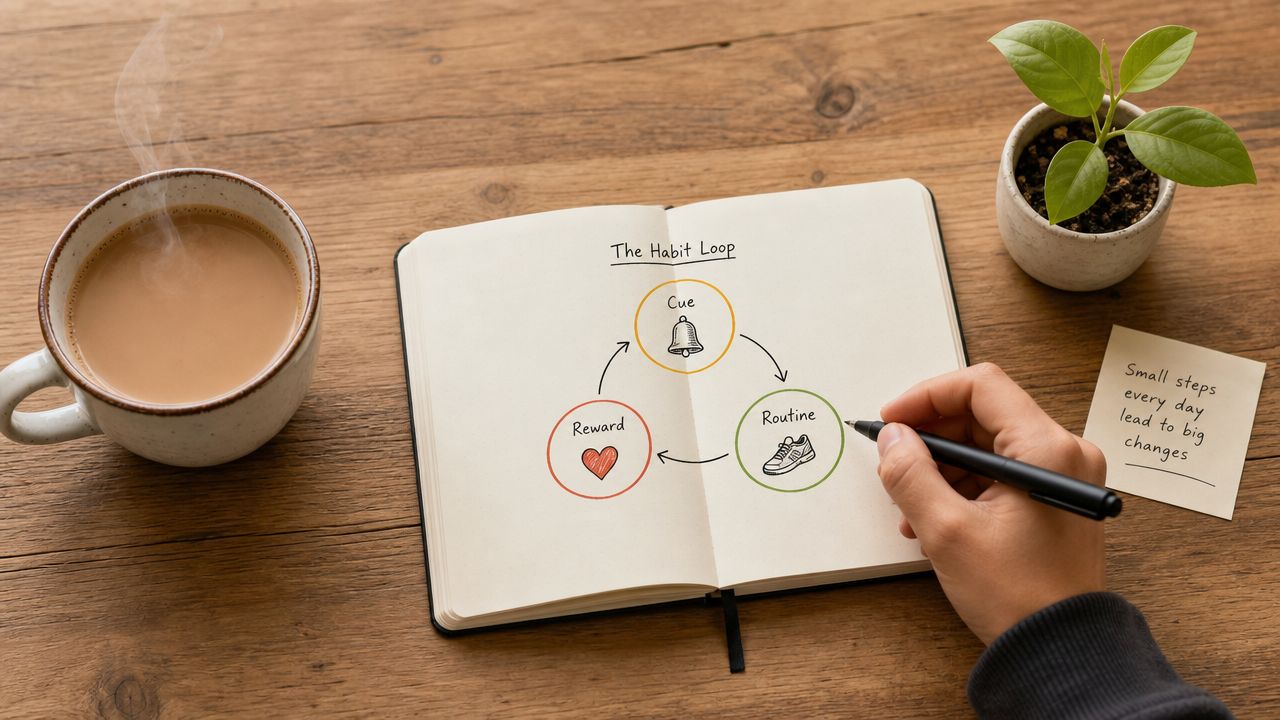
Cue > Routine > Reward
The cue is the trigger. It could be a time of day, a place, a feeling, another person, or an action that comes just before. In the chai example, the cue may be the post-lunch slump, seeing colleagues head to the pantry, or noticing tiredness.
The routine is the behaviour itself. You make tea, open a snack packet, check social media, or step outside for air.
The reward is what makes the brain remember the loop. The reward might be comfort, energy, relief, connection, or just a pleasant break from mental effort.
Why craving matters too
Many people find it easier to understand habits if they include one more piece between cue and routine. That piece is craving. The cue doesn't force the behaviour on its own. It creates a desire for a certain feeling or outcome.

So the fuller version looks like this:
- Cue: “It's 4 pm and I feel mentally dull.”
- Craving: “I want comfort or a lift in energy.”
- Routine: “I make chai and grab something crunchy.”
- Reward: “I feel better for a while, so my brain stores the pattern.”
That's why habits often repeat even when they clash with our long-term goals. The brain isn't asking, “Is this ideal for my future?” It's asking, “Did this bring relief last time?”
Good and bad habits use the same psychology
This part is important. There isn't a separate brain system for “healthy habits” and “unhealthy habits”. The same learning process can support bedtime reading, daily prayer, journalling, movement, meditation, or hydration. It can also support stress eating, procrastination, or checking messages every few minutes.
A short comparison makes this easier to see:
| Habit type | Cue | Routine | Reward |
|---|---|---|---|
| Helpful | After brushing teeth | Drink a glass of water | Feel refreshed and organised |
| Unhelpful | Feeling tense after work | Scroll on phone for an hour | Escape and emotional numbness |
| Helpful | Returning from work | Change into walking shoes | Feel lighter and settled |
| Unhelpful | Late-night worry | Watch one more reel | Temporary distraction |
The key question to ask
When a habit isn't serving you, try asking: What is this behaviour doing for me right now? That question is kinder and more useful than “Why am I like this?”
Practical rule: Don't fight a habit only at the level of action. Look for the cue and the reward first.
If someone snacks during anxiety, the snack may be giving comfort. If someone avoids studying, the avoidance may be giving short-term relief from pressure. If someone stays glued to work messages late into the night, the habit may be protecting them from guilt or fear.
Once you understand the loop, you can start changing one part at a time. That's where habit formation psychology becomes practical rather than abstract.
How Long Does It Really Take to Build a Habit
Many people carry a discouraging belief: if a habit hasn't become easy within a few weeks, they must be doing it wrong. That belief often comes from the old “21-day” idea, which sounds neat but sets people up for disappointment.
Real behaviour change is slower and more human than that. It depends on the kind of habit, the person's routine, stress level, and how consistently the action happens in the same setting.
A more realistic timeline
India-specific research challenges the “21-day” myth. In a meta-analysis available on PubMed Central, habit automaticity was achieved in a median of 62 days. The same research found that consistency of performing the action in the same context was the key predictor of success, not a person's level of self-control or willpower.
That finding changes the whole conversation. The question isn't “How can I be tougher?” It's “How can I make repetition easier in one reliable context?”
Why your timeline may not look like someone else's
A two-minute breathing practice after dinner may settle in faster than a full workout plan at dawn. A self-chosen habit may feel more natural than one copied from social media. A morning routine may work better for one person, while another person can only manage consistency late in the evening.
Here's a simpler way to think about progress:
- Small habits often stabilise sooner: They ask less of your energy and schedule.
- Complex habits need more setup: Exercise, meal prep, or sleep routines often involve several moving parts.
- Stress slows the process: During anxiety, burnout, or family strain, repetition becomes harder.
Missing a day doesn't erase the learning. It means you return to the pattern at the next realistic opportunity.
What helps more than perfection
People often quit because they think one break means they've failed. That's rarely true. Habits usually grow through repetition over time, not flawless daily performance.
A useful mindset is to treat habit building like learning a route through a city. Each repeat makes the road more familiar. If you miss one turn, the road still exists.
This is one reason therapy or counselling can be so supportive. A therapist can help you set a habit that matches your actual life, not an idealised version of it. That creates more resilience, less guilt, and a much better chance of long-term well-being.
Why Good Intentions Fail and What to Do
People usually don't fail at habits because they don't care enough. They fail because life places real obstacles in the way. Stress changes attention. Anxiety narrows focus. Burnout drains follow-through.
That's especially relevant in India, where many working adults are carrying pressure from multiple directions at once. Professional demands, family expectations, financial worries, and digital overload can all crowd out even the healthiest intentions.
Stress changes what feels possible
A 2022 Deloitte study found that 80% of the Indian workforce reported facing mental health challenges, primarily driven by stress, as discussed in this ScienceDirect-linked analysis. When stress stays high, habit formation becomes harder because the mind is already spending energy on coping.
In practical terms, this means a stressed person may know exactly what would help. Sleep on time. Eat regularly. Move the body. Pause before reacting. But knowing isn't the same as having the capacity to do it consistently.
That gap often creates self-criticism. “If I understand it, why can't I just do it?” The answer is that strain interferes with planning, remembering, and initiating action.
Anxiety and burnout create invisible friction
Anxiety often pushes the mind toward urgent relief. Burnout often makes even simple tasks feel heavy. Depression can flatten motivation and reduce the sense that any action will help. Under these conditions, generic advice like “just be disciplined” can feel almost insulting.
A more realistic response is to lower friction and increase support. If you want a gentler way to explore mindset for mental wellness, it can help to look at how your inner beliefs about growth, effort, and setbacks shape the way you approach change.
Consider how intentions fail in everyday life:
- After-work exhaustion: You planned a walk, but your body is depleted and your brain wants only relief.
- Constant interruptions: A habit needs a stable cue, but your day keeps changing.
- Emotional overload: The habit competes with worry, resentment, or low mood.
Good intentions often fail when the environment and emotional state keep rewarding the old behaviour.
When standard habit advice doesn't fit
Some people follow all the common advice and still struggle. This is often true for neurodivergent individuals, especially those living with ADHD or executive dysfunction.
A Frontiers article notes a key gap in India-focused habit advice for ADHD, including that 7.5% of Indian adults have ADHD, and that standard self-control-based advice often misses what they need, according to this Frontiers in Psychology article. For these individuals, the issue may not be intention at all. It may be cue detection, task initiation, memory load, or inconsistent energy.
That's why habit support needs flexibility. Some people do well with visual prompts, body doubling, therapist-guided cue restructuring, or external accountability. Others need to treat anxiety, depression, trauma, or sleep problems first, because the habit difficulty is only the visible surface of a deeper struggle.
Smart Strategies for Building Habits That Stick
Once you stop expecting willpower to do everything, habit change becomes much more practical. You start building around real behaviour. What you see. What you reach for. What happens right before the action. What makes the action feel worth repeating.
The strategies below work because they reduce friction. They also support well-being by making healthy actions easier to start when life is full.

Design the environment first
Environment design means shaping your surroundings so the helpful choice is visible and simple. If you want to drink more water, keep a bottle on your work desk, not inside a cupboard. If you want to stretch in the morning, place the yoga mat where you'll see it before you see your phone.
This matters even more when you're dealing with workplace stress or mental fatigue. Under pressure, people usually take the easiest available path. If the easy path supports well-being, your habit has a better chance.
Try these examples:
- For movement: Keep walking shoes near the door you use most.
- For sleep: Charge your phone away from the bed.
- For calm: Leave a journal, prayer book, or breathing prompt in the spot where you usually sit at night.
For the 7.5% of Indian adults with ADHD, standard habit advice often fails because it relies on self-control. Research highlighted in the earlier Frontiers source points toward consistency, clinician-guided cue restructuring, and environment design that works with neurodivergent brains rather than against them.
Stack a new habit onto an old one
Habit stacking is simple. You attach the new behaviour to something you already do reliably.
If you already make tea every morning, add one deep breath before the first sip. If you already lock the front door before leaving, add a posture check or a short mental intention for the day. If you already sit down after dinner, use that moment for two minutes of gratitude or planning tomorrow's lunch.
A useful formula is:
After I do this familiar action, I'll do this tiny new action.
Examples for daily life:
- After brushing my teeth, I'll fill my water bottle.
- After opening my laptop, I'll take one slow breath before checking messages.
- After dinner, I'll walk for five minutes.
This works well for students too. If you're trying to connect habit psychology to study routines, this guide with expert advice on student studying can offer practical ideas for building steadier academic habits without relying on last-minute pressure.
A short video can make these ideas easier to picture in real life.
Use implementation intentions
An implementation intention is a plan that tells your brain exactly when and where the habit will happen. Instead of saying, “I'll meditate more,” you decide, “If I finish lunch, I'll sit in my chair and breathe for two minutes.”
This removes uncertainty. You don't have to negotiate with yourself every day.
A few examples:
| Situation | If-then plan |
|---|---|
| Commute stress | If I get home feeling irritated, then I'll wash my face and sit quietly for two minutes before talking about work |
| Phone overuse | If I enter the bedroom at night, then I'll place my phone on the table across the room |
| Skipping meals | If it becomes 1 pm, then I'll eat the simple lunch I packed, even if work is busy |
Make the reward immediate
Many healthy habits have delayed rewards. Walking helps mental health over time, but the benefit may not feel dramatic on day one. Your brain learns faster when the action has a small immediate reward too.
That reward doesn't need to be expensive or elaborate. It can be a tick on a tracker, a favourite song after the walk, a cup of chai after finishing a study block, or the simple sentence “I kept my word to myself today.”
- For resilience: Notice completion, not just outcome.
- For happiness: Pair effort with something pleasant but simple.
- For compassion: Speak to yourself in a way that supports repetition, not fear.
These strategies aren't a cure for anxiety, depression, or burnout. But they often make self-help more realistic, and they give therapy or counselling a stronger foundation to build on.
Knowing When to Seek Professional Support
Sometimes a habit problem isn't only a habit problem. It may be connected to grief, trauma, anxiety, depression, chronic stress, relationship pain, or ADHD. In those cases, changing the routine alone may not be enough because the deeper issue keeps feeding the loop.
That isn't failure. It's useful information.
Signs that extra support may help
If you keep returning to habits that harm your sleep, mood, work, or relationships, it may be time to look beyond self-help. The same applies if you feel stuck in cycles of avoidance, panic, irritability, numbness, or exhaustion.
According to India's National Mental Health Survey, 10.6% of the population is living with a current mental illness, as reported in the National Mental Health Survey summary. Struggling is common, and seeking support through counselling or therapy is a normal, healthy step toward better well-being.

What therapy can do that habit tips can't
A therapist can help you identify the emotional function of a habit. Maybe late-night scrolling protects you from loneliness. Maybe overworking protects you from guilt. Maybe a shutdown response appears whenever stress reminds you of earlier experiences.
Therapy and counselling can also help you build resilience in a more personalised way. That may include emotional regulation, self-compassion, nervous system awareness, grief processing, communication skills, or practical routines that fit your actual capacity.
Assessments can be helpful here too, but they need to be understood correctly. Assessments are informational, not diagnostic. They can give you clearer language for your experience and help you decide what kind of support may fit best, but they don't replace a qualified mental health professional's evaluation.
Seeking support doesn't mean you couldn't handle life. It often means you're finally handling it with honesty.
A steady way to move forward
You don't need to wait until things become unbearable. Support can be useful when you're functioning on the outside but struggling on the inside. It can also be part of growth, not only crisis.
Habit formation psychology offers a powerful lens. It shows that change happens through repeated patterns, kind structure, and realistic expectations. When that isn't enough on its own, professional support can help you understand the roots of the pattern and build a healthier one with care.
If you'd like support that goes beyond generic advice, DeTalks can help you connect with therapists, psychologists, and mental health professionals across India. You can also explore science-backed assessments that are informational, not diagnostic, and use those insights to choose the next step for your well-being, resilience, counselling, or therapy journey.
Leave a Reply