
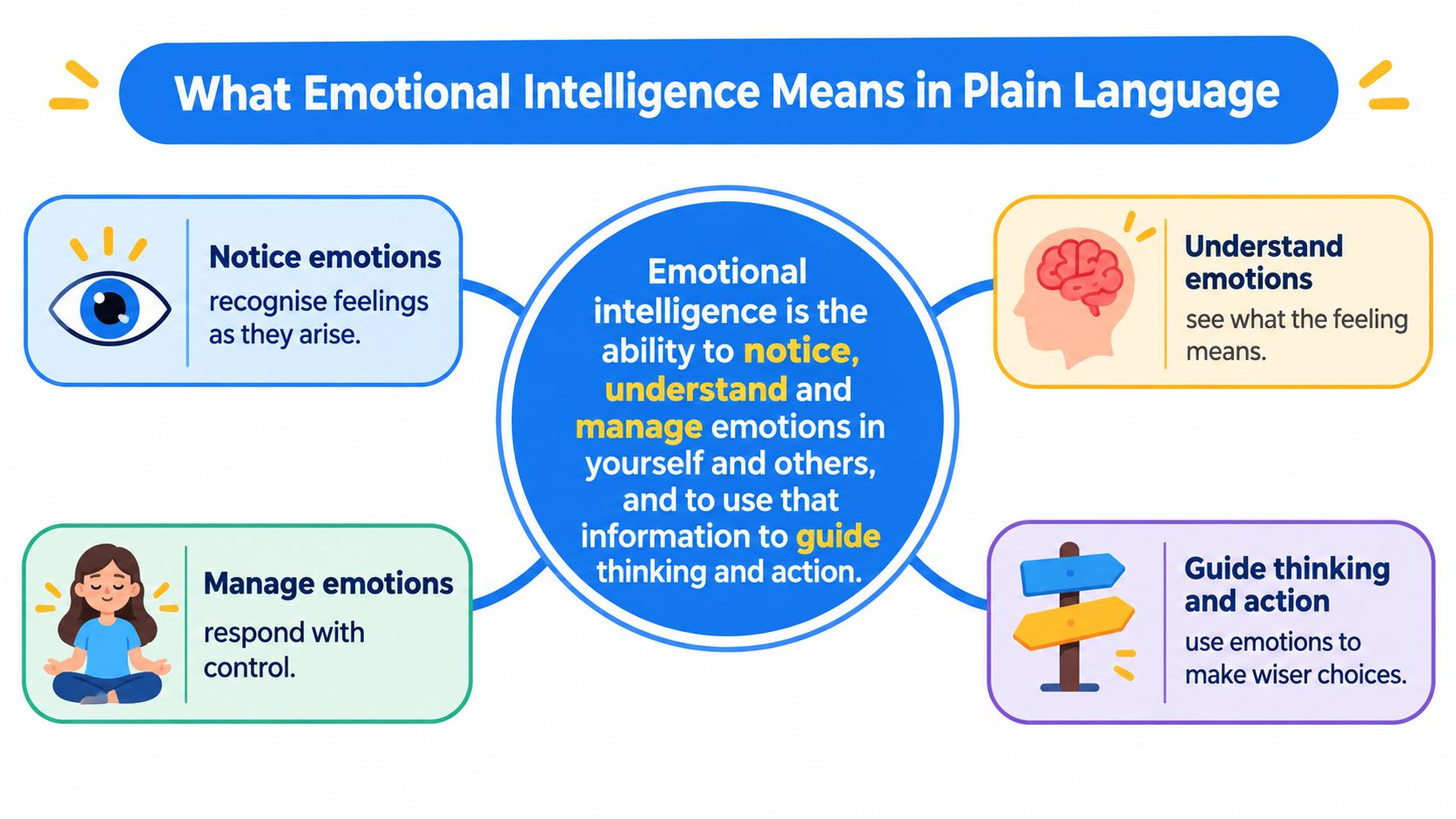
Emotional intelligence is the ability to notice, understand and manage emotions in yourself and others, and to use that information to guide thinking and action. You might need it today, in a tense meeting, before an exam, or after a short message from someone you care about.
A strong reaction can arrive before you've had time to think. You read the words, feel hurt or irritated, and reply in seconds. Later, you wish you'd paused, asked what was meant, or said what you needed more clearly.
That pause isn't about hiding feelings. It's about understanding what is emotional intelligence in everyday terms, then practising small skills that give you more choice. Those skills can support well-being, resilience and calmer communication, while still leaving room for therapy or counselling when you need more support.
What Emotional Intelligence Means in Plain Language
Emotional intelligence is the ability to notice, understand and manage emotions in yourself and others, and to use that information to guide thinking and action. In simple words, you read a feeling, name what it may mean, and choose a response instead of being pushed by the first reaction.
Think of emotions like a weather forecast. A forecast doesn't stop the rain, but reading it early helps you carry an umbrella, change plans, or wait until the weather settles. Emotional intelligence works in a similar way with anger, anxiety, joy, shame or disappointment.
What It Is Not
It doesn't mean being cheerful all the time, agreeing with everyone, or speaking softly in every situation. A person can set a firm boundary, feel strong anger, or cry during a difficult conversation and still respond with awareness and care.
It's closer to information processing than to having a pleasing personality. You notice a signal, check whether you've understood it correctly, and decide what to do next. That process can be learned and strengthened through reflection, feedback and practice.
Where the Idea Came From
Robert Thorndike's 1937 work on "social intelligence" was an early influence. The term gained a research definition when Peter Salovey and John D. Mayer published their peer-reviewed framework in 1990, and the Salovey and Mayer framework described accurately appraising and expressing emotions, regulating emotions in oneself and others, and using feelings to guide thinking, planning and goal achievement.
Daniel Goleman's 1995 book later brought the idea to a much wider audience. The earlier research definition is still useful because it keeps the focus on specific abilities. It doesn't reduce a person to being naturally "good with people" or not.
For schools, workplaces, counselling and assessment in India, that distinction matters. A student, parent or professional can work on noticing triggers, naming feelings or repairing conflict. Each skill can improve at a different pace, and none of them is a final judgement of character.
Emotional intelligence is a set of skills you can practise, not a fixed grade you were born with.
Mayer-Salovey and Goleman Models Compared
| Feature | Mayer-Salovey ability model | Goleman mixed model |
|---|---|---|
| Core idea | Emotion-related abilities that can be scored like skills | Emotional and social competencies that can be learned through practice |
| Origin | Peer-reviewed framework published in 1990 | Popularised by Daniel Goleman's 1995 book |
| Structure | Four linked abilities, perceiving, using, understanding and managing emotion | Five domains, explained in the next section |
| How it is measured | Ability tests with right and wrong answers | Self-report and multi-rater feedback |
| Typical use | Research, education and formal assessment | Leadership development, team coaching and personal growth |
| Main limitation | Ability scores are hard to interpret without context | Self-ratings can reflect self-image more than actual behaviour |
How to Read the Difference
The Mayer-Salovey ability model asks what you can do when you're given an emotional problem. You might identify the feeling in a face, predict how emotions could change, or choose a helpful way to manage a situation. Your answers are scored against agreed responses.
The Goleman mixed model takes a broader view of everyday competence. It includes habits and social behaviours that develop through experience, feedback and coaching. A manager might use it to work on listening, handling disagreement, or supporting a team during pressure.
These approaches don't always produce the same picture. Someone may rate themselves as calm and empathic, yet struggle to identify mixed emotions in a test. Another person may solve test items well but become defensive when a real colleague criticises their work.
Which Model Fits Which Decision
- Use the ability framing for accuracy. It suits research, education and formal screening where you need a consistent way to compare specific emotional reasoning skills.
- Use the mixed framing for development. It suits manager coaching, team learning and personal goals because it points to behaviours you can practise and review.
- Use either result carefully. Treat it as a conversation starter, then compare it with real behaviour, feedback and the setting you're in.
Say a college wants to understand whether students can recognise emotions and reason about them. An ability approach gives a clearer structure for that question. Say a workplace wants fewer heated escalations, and the mixed approach may be more practical because it connects awareness with daily conduct.
Neither model can tell you whether someone is kind, trustworthy or mentally healthy. A high score doesn't make a person good, and a lower score doesn't make them bad. The useful question is narrower and kinder, which emotional skill needs attention, and what support would help it grow?
Five Skills That Make Up Emotional Intelligence
Self-awareness is naming "I feel anxious and tired" before you snap at a colleague. Self-regulation is pausing for a few breaths and choosing your reply. The remaining skills help you keep going after setbacks, understand other people, and repair relationships when something goes wrong.
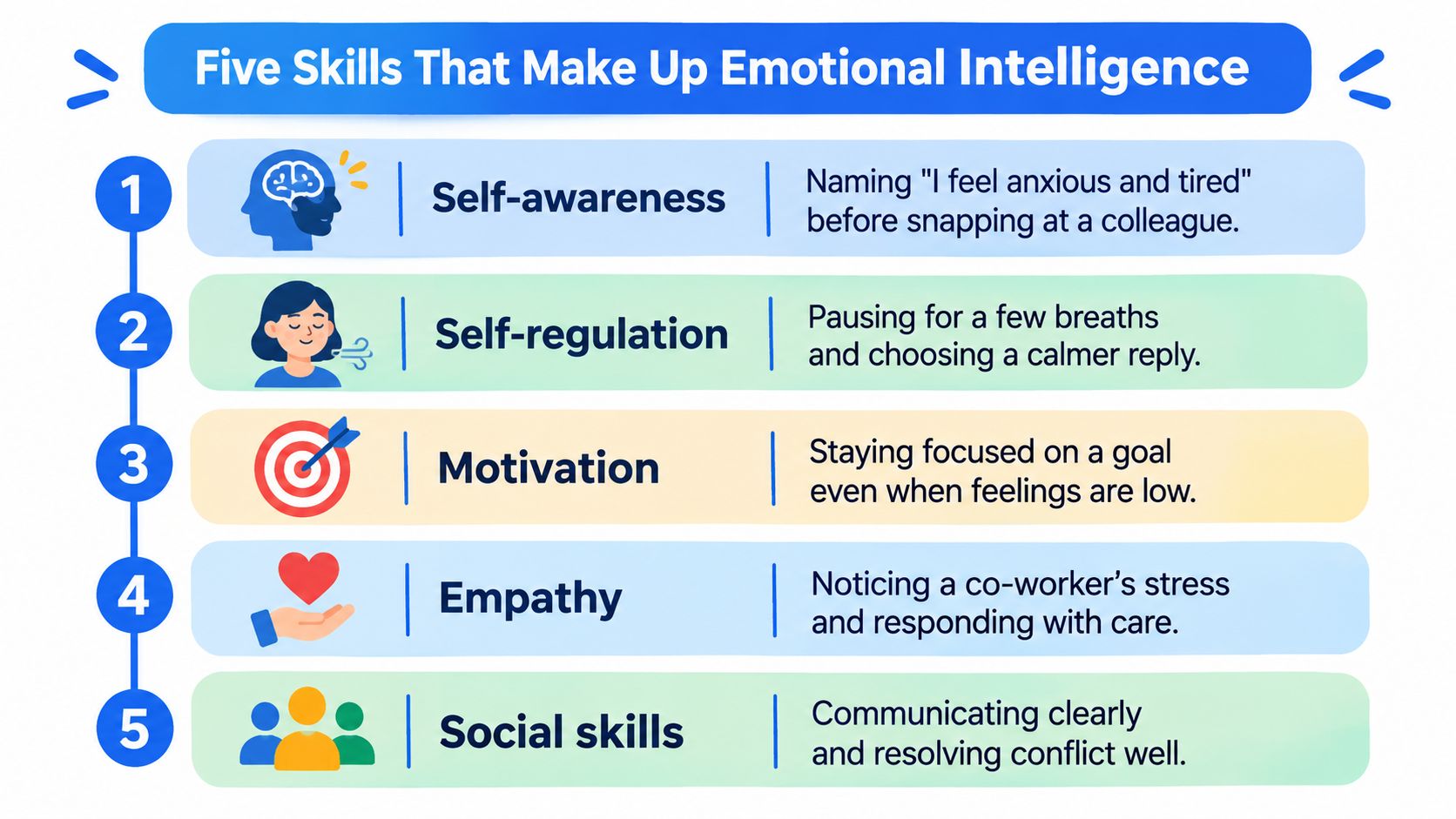
A validation study described in the ECPS Journal examined 608 Indian secondary-school teachers and identified Self-Perception, Self-Regulation, Self-Drive, Empathy and Social Motive, reporting Cronbach's alpha of 0.95 and 80.18% of total variance explained. The names differ slightly from popular lists, but the practical chain is familiar.
How the Skills Connect
Self-perception helps you detect a feeling early. Self-regulation gives you some control over the response, and empathy helps you interpret another person's experience more accurately. Social motivation then turns that understanding into cooperation, repair or a clear request.
Say a student notices exam panic rising during revision. She names the fear, takes a short break, and slows her breathing. She then asks a friend to test her on one topic, so awareness becomes action instead of hours of worried rereading.
| Skill | Everyday moment | Sign it needs work | Practice to try |
|---|---|---|---|
| Self-awareness | Naming "I feel anxious and tired" before snapping at a colleague | Surprised by your own outbursts | Label each feeling in one or two words |
| Self-regulation | Pausing for a few breaths before replying | Replies sent in the heat of the moment | Wait before sending and reread your reply once |
| Motivation | Continuing after a rejected application and asking what to change | Giving up after one setback | Write one change to try after each setback |
| Empathy | Considering another person's view before judging them careless | Assuming bad intent quickly | Ask what the other person may be facing |
| Social skills | Repairing a friendship after a sharp message | Repeated conflicts with the same people | Repair within a day with a clear apology or request |
Empathy becomes visible in small listening choices, such as letting someone finish, reflecting their main concern and checking that you've understood. If you'd like concrete examples, these behaviors of an empathic listener show how attention and response work together in conversation.
Culture Changes How Skills Look
A quiet answer may show respect, restraint or care for family harmony. It doesn't automatically mean weak awareness. Direct speech also isn't automatically poor regulation, especially where clear and open discussion is normal.
Judge the pattern, not one style of expression. Can the person notice distress, communicate needs, respect others and repair harm in ways that fit their setting? Your weakest skill is usually the best starting point because improving it often makes the rest of the chain easier.
Where Emotional Intelligence Shows Up in Daily Life
The collage below shows emotional skills across health, relationships, work, study and parenting.

| Setting | Everyday sign of strong EI | What it helps with |
|---|---|---|
| Mental health | Noticing anxiety early and naming it | Earlier self-care and less rumination |
| Relationships | Repairing an argument within a day | Fewer repeated conflicts and more trust |
| Work | Staying composed during an escalation | Lower workplace stress and stronger team trust |
| Academics | Recognising exam panic and asking for help | Steadier study routines and lower test anxiety |
| Parenting | Staying calm during a child's tantrum | Stronger parent-child communication |
Two Everyday Moments
A team lead feels frustration rising before a review meeting. She names it privately, separates the missed deadline from the people in the room, and opens with the facts she needs. The team can solve the problem without spending the meeting defending itself.
A college student notices test anxiety while it's still manageable. He books counselling, makes a smaller study plan, and tells a friend what's happening. Early action doesn't remove pressure, but it gives him more options before panic affects sleep and revision.
The video below offers another plain-language view of these everyday choices.
Benefits Without Guarantees
Emotional skills can support resilience, compassion, gratitude and self-esteem. They can also help you respond to workplace stress, conflict and disappointment with more flexibility. For client-facing roles, this guide to managing tough clients without burning out gives practical context for protecting your energy while staying professional.
Still, strong skills don't make anyone immune to depression, anxiety, trauma or burnout. A 2025 study of 200 young adults from Mizoram and Manipur reported moderate-to-high EI and moderate-to-high positive beliefs about mental illness, yet found no significant relationship between EI and those beliefs.
That finding is a useful reminder. Emotional ability doesn't automatically remove stigma, guarantee happiness, or replace therapy. Suppression can also look like calm from the outside, even when a person is struggling inside.
A helpful reframe: Strong emotional intelligence should make it easier to ask for support, not make support seem unnecessary.
How Emotional Intelligence Is Measured and What Scores Mean
| Tool | Format | What it covers | Best use |
|---|---|---|---|
| Mayer-Salovey-Caruso Emotional Intelligence Test (MSCEIT) | Ability test with scored answers | Four branches, perceiving, using, understanding and managing emotion | Research and formal assessment |
| Emotional Quotient Inventory 2.0 (EQ-i 2.0) | Self-report questionnaire | Emotional and social skills with subscales | Coaching and personal development |
| Schutte Self-Report Emotional Intelligence Test (SSEIT) | Short self-report scale | Overall EI across a few broad areas | Quick reflection and classroom discussion |
| Trait Emotional Intelligence Questionnaire (TEIQue) | Self-report questionnaire | Global trait EI and its facets | Personality and academic research |
| DeTalks informational assessments | Online self-assessment | Emotional well-being, personality traits and resilience factors | Self-reflection before booking counselling or therapy |
Two Families of Tools
Ability tests present emotional problems and score your answers. They try to measure what you can do, such as identify a feeling or judge how it may change. They're useful when consistency matters, but they can't capture every family, language or workplace situation.
Self-report questionnaires ask how you see your own skills. They're often easier to use for reflection and coaching, though mood, confidence and self-image can shape the answers. Honest disagreement between your rating and another person's feedback is information, not failure.
What to Check in a Report
Look for the instrument name, its subscales, reliability information and stated limits. In an Indian medical-education sample reported in PMC, researchers administered an EI scale to 480 undergraduate medical students and reported Cronbach's alpha of 0.68, indicating moderate internal consistency, with a statistically significant correlation with the Social Awareness domain of an established Emotional Intelligence Test.
- Look for patterns. Compare subscales instead of focusing only on one total score.
- Check recent behaviour. Ask whether the result matches what happened during recent conflict, pressure or disappointment.
- Bring questions to a professional. A counsellor can help you interpret the result in context and choose a practical next step.
Scores can shift with language, culture, mood on the day and self-report bias. One result is a snapshot, not a permanent measure of ability. Assessments are informational, not diagnostic, and diagnosis requires evaluation by a trained clinician.
Used well, a score starts reflection. It may highlight noticing triggers, pausing before reacting, or reading another person's distress. It shouldn't label you, rank your worth, or decide whether you deserve support.
Practical Strategies to Build Your Emotional Skills
Start with one repeated situation, not your whole personality. Choose a moment that happens often, such as receiving critical feedback, joining a family discussion, or opening messages when you're tired. Small practice in a familiar setting is easier to notice and repeat.
A Six-Step Routine for Tense Moments
- Label the feeling. Name it in one or two words, such as "frustrated", "hurt" or "embarrassed". A precise label gives your mind something specific to work with instead of a general sense of upset.
- Pause for 90 seconds. Breathe out slowly, relax your shoulders and let the first surge in your body settle. You're not suppressing the feeling, and you're creating a short gap before you act.
- Reappraise the situation. Ask what else the message could mean and what the other person may be facing. A short reply might signal anger, hurry, distraction or a poor network connection.
- Choose a response that serves your goal. If you want clarity, ask a calm question. If you need a change, make a specific request instead of using sarcasm or blame.
- Repair within a day. If the conversation became tense, acknowledge your part and reopen the discussion. A simple repair can sound like, "I spoke sharply earlier. Can we restart?"
- Track the episode. Write the trigger, feeling, response and outcome in four short lines. Patterns become easier to see after several entries, especially around sleep, workload or particular relationships.
A Four-Week Focus
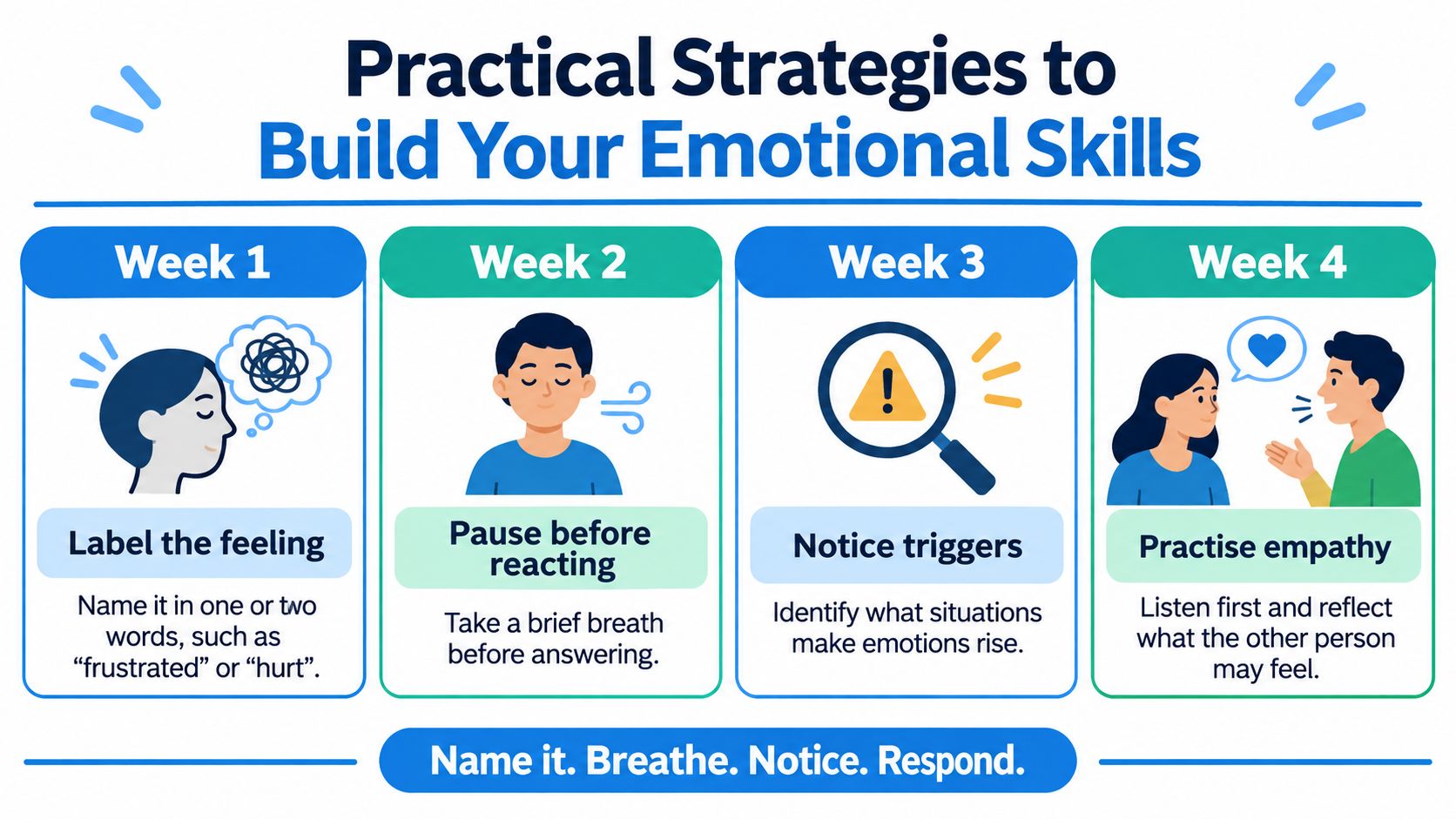
- Week 1, label feelings. Pause twice a day and name what you feel without judging it.
- Week 2, pause before reacting. Practise the breathing pause before replies that usually feel urgent.
- Week 3, notice triggers. Record the places, times, people and physical states linked with stronger reactions.
- Week 4, practise empathy. Listen first, reflect what the other person may feel, and check whether you've understood.
Daily habits also affect regulation. Regular sleep, movement, gratitude practice and mindfulness can make emotions easier to notice and manage. They support mood and resilience, but they don't need to be perfect to be useful.
Ask a trusted person for specific feedback, such as whether you interrupt when anxious or withdraw after conflict. Feedback helps you see the gap between intention and impact. If strong reactions, low mood or workplace stress persist despite practice, counselling or therapy is a sensible next step rather than a sign that you haven't tried hard enough.
Name it. Breathe. Notice. Respond.
When to Reach Out for Support and Your Next Step
India's National Mental Health Survey, reported by the Ministry of Health and Family Welfare, found that about 10.6% of adults were living with a mental health disorder, while the overall treatment gap was approximately 70% to 92% across conditions. Many people who could benefit from care never reach it.
That gap is a reason to act early and without shame. Emotional skills can support well-being, but they aren't a substitute for care when symptoms persist or daily life becomes hard to manage.
Signs Professional Support Can Help
- Persistent low mood or anxiety. Distress lasting more than two weeks deserves professional attention.
- Changes in daily functioning. Panic attacks, major sleep or appetite changes, or withdrawing from work and family are important signals.
- Burnout or harmful coping. Daily tasks may feel unmanageable, or you may rely on alcohol or substances to get through the day.
- Thoughts of harming yourself. Seek urgent help immediately and tell a trusted person.
For urgent distress in India, you can call Tele-MANAS on 14416, a free national helpline. If you may act on thoughts of harming yourself, contact emergency services or go to the nearest hospital. You don't need to wait until things feel severe enough.
Online assessments can help you reflect and decide what kind of support to explore. They're informational, not diagnostic, and they don't promise a cure. A qualified therapist or counsellor can listen to your full context, assess your needs and plan care with you.
Carry these takeaways with you. Emotional intelligence is learnable, asking for help is also a skill, and progress usually comes through small repeated steps. Be patient with the process, and let support be part of it.
If you'd like to understand your emotional patterns and find the right professional support, visit DeTalks to explore informational assessments and connect with qualified therapists and counsellors across India. You can take one small step today, whether that's reflecting on a skill you'd like to build or booking a first session to talk things through.
Leave a Reply