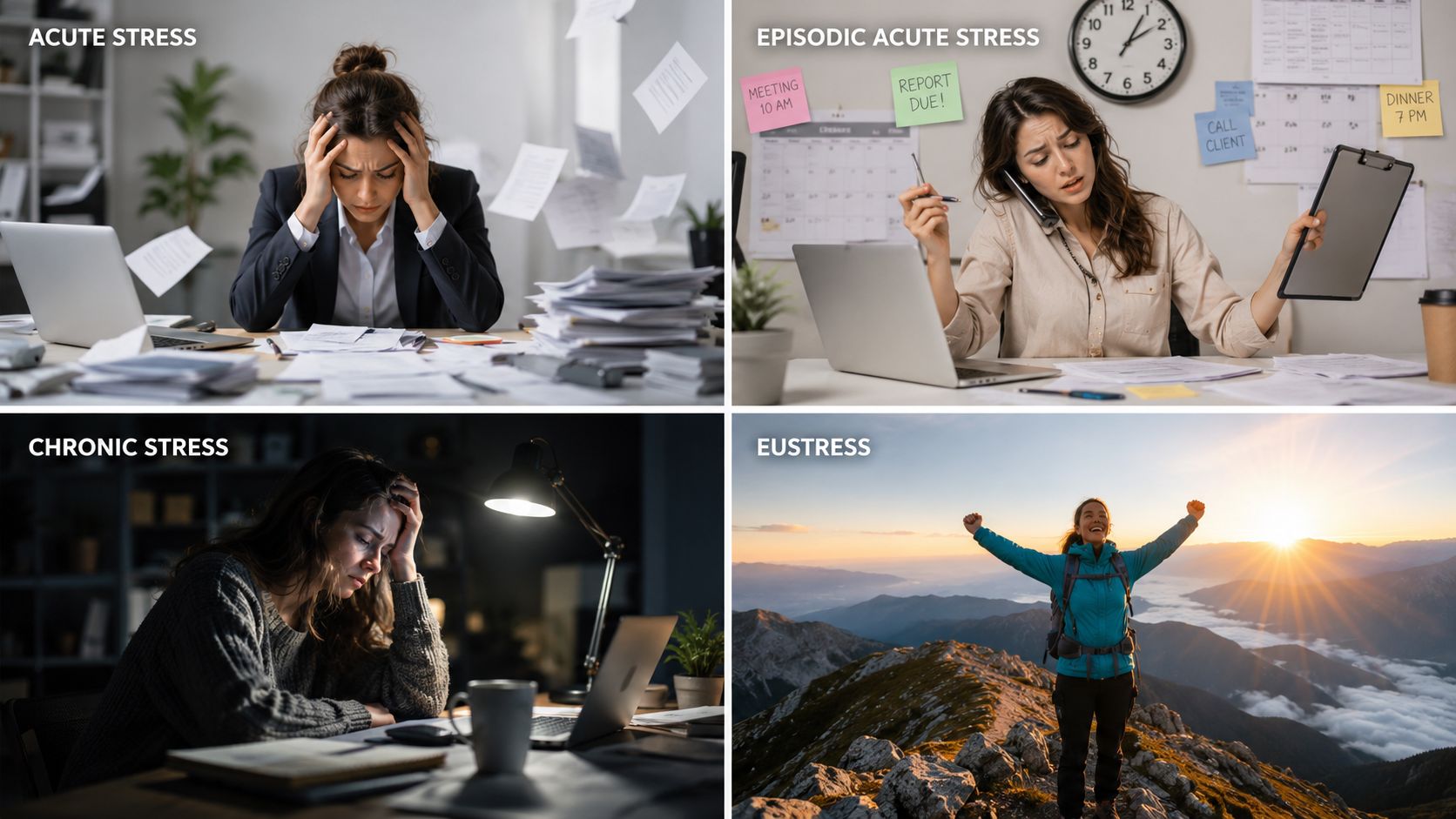
28% of employees in India experienced stress “a lot” on the previous day in Gallup's 2026 country profile, but the four useful patterns covered here are acute, chronic, workplace, and emotional stress. These categories help you understand duration, context, and emotional impact, but stress can overlap, and no category by itself is a diagnosis.
You may be reading this after a night spent revising for an exam, answering late work messages, caring for family, or worrying about money. A demanding deadline can create acute stress, while months of pressure can become chronic. Workplace stress may sit alongside family conflict, anxiety, burnout, loneliness, or grief.
That distinction matters because the right next step depends on the pattern. A short grounding exercise may help during an immediate crisis, while ongoing strain may call for boundaries, practical support, therapy, or counselling. DeTalks assessments and screening tools can offer information for self-understanding, but they're informational, not diagnostic, and they don't replace professional evaluation.
For additional practical ideas, you can also read this stress relief guide from VitzAi.
1. Acute Stress
Acute stress arrives quickly. It's the body and mind responding to a specific challenge that feels urgent, such as an exam, a difficult conversation, an accident, or an important presentation.
A student revising for JEE, NEET, or UPSC the night before an exam may notice a racing heart, tense muscles, restless thoughts, or difficulty concentrating. A software engineer in Bengaluru rushing to finish a critical project before a client presentation may experience the same pattern, even though the trigger is professional rather than academic.
Acute stress can also follow an unexpected school call about a child's accident, a sudden GST audit notice for a small business owner, or a first salary negotiation. A homemaker coordinating care during an elderly relative's health emergency may feel alert, frightened, and mentally overloaded within minutes.
Recognising a short-lived response
The key question is whether the pressure has a clear beginning and a likely end. Once the exam, presentation, call, meeting, or emergency resolves, the body may gradually settle.
Try naming the experience without judging yourself. Saying, “This is acute stress, and this moment will pass,” can create a little distance from the fear. The statement isn't a promise that everything will be easy. It's a reminder to focus on the immediate situation rather than every possible outcome.
When you feel overwhelmed, use the 5-4-3-2-1 grounding technique:
- Five things you see: Look around and name them slowly.
- Four things you feel: Notice your feet on the floor or your hands touching a surface.
- Three things you hear: Include quiet or ordinary sounds.
- Two things you smell: Identify them, or notice the absence of a strong smell.
- One thing you taste: Sip water or notice the taste in your mouth.
Helping your system recover
Practise your preferred coping method before a crisis. Slow breathing, grounding, calling someone you trust, or using a brief positive affirmation is easier when the technique already feels familiar.
Set a timer for a short period and work only through the next step. Afterward, reflect on what helped and acknowledge how you handled the situation. Avoid relying on excess alcohol, binge eating, or other harmful coping methods, since temporary relief can make recovery harder.
If these episodes are becoming more frequent, affecting sleep or relationships, or making daily responsibilities difficult, consider a check-in with a counsellor. Support can help you understand whether repeated “acute” episodes are part of a longer pattern.
2. Chronic Stress
Chronic stress is pressure that continues without a clear endpoint. Instead of rising around one event and then easing, it can keep a person mentally prepared for the next problem, leaving less energy for rest, relationships, and ordinary enjoyment.
Consider a woman working full-time while managing household responsibilities and caring for ageing parents in a joint family. A factory worker in Mumbai may face job insecurity, long hours, and inadequate wages, while a student preparing for several competitive exams may also carry family financial pressure.
Other examples include a shop owner dealing with uncertain daily income, rising rent, and tax concerns; a new mother adjusting after childbirth with limited support; or a corporate employee facing constant performance pressure, unrealistic deadlines, and workplace politics. A person living in a flood-prone area may face repeated monsoon displacement, while a migrant worker may experience low pay, difficult conditions, separation from family, and social isolation.
Find the pattern before solving everything
A simple stress journal can show when pressure is strongest and what gives you even slight relief. Write down the situation, your physical and emotional response, what you did next, and whether that response helped in the short term or the longer term.
You don't have to solve every problem at once. Separate what you can influence, such as asking for help, reviewing expenses, setting a boundary, or seeking advice, from what you can't control. Put your energy into the first group and make room to grieve or accept the second.
Practical rule: A small action that restores control is useful, even when it doesn't remove the larger problem.
Break a difficult situation into manageable parts. One conversation, one appointment, one application, or one planned rest period can be a meaningful step. Recovery is usually gradual, so notice small wins such as better sleep, a supportive conversation, or one lower-stress day.
Support is part of resilience
Support groups, whether in person or online, can reduce isolation. Review your support network and consider adding a trusted friend, family member, therapist, counsellor, doctor, or professional who understands your circumstances.
Therapy can be appropriate even when you feel your situation “isn't bad enough.” Prevention, self-understanding, and personal growth are valid reasons to seek help. A therapist may also help you think through changes involving a job, relationship, or living situation.
If chronic stress involves discrimination, violence, coercion, or another unsafe situation, prioritise safety and connect with appropriate advocacy or local support resources. You don't have to manage an unsafe environment through resilience alone.
For people who struggle with planning, a simple routine may help. This guide to planning your day with ADHD offers ideas that can also support clearer task breakdown and realistic expectations.

3. Workplace Stress
Workplace stress comes from job demands, work relationships, the work environment, career uncertainty, or the way responsibility and control are distributed. It can follow an obvious event, such as a deadline, or build through constant availability, unclear expectations, low trust, and repeated pressure.
An IT professional in Hyderabad may manage changing projects, tight deadlines, and constant pressure to upskill. A bank employee may worry about sales targets and performance reviews, while a teacher may juggle large classes, limited resources, administrative duties, and students' emotional needs.
A nurse working in an understaffed hospital can face long shifts and the emotional demands of patient care. A startup founder in Delhi may carry investor pressure, uncertain income, and an identity closely tied to the company. A woman in corporate India may also encounter subtle gender discrimination, unequal responsibilities, or pressure related to motherhood.
Name the workplace stressor precisely
“Work is stressful” is difficult to act on. “I'm anxious about Thursday's presentation,” “my manager changes priorities without notice,” or “I'm expected to answer messages late at night” gives you a clearer starting point.
India-focused workplace reporting found that 42% of respondents identified constant availability demands as their biggest workplace stressor, ahead of unrealistic deadlines at 21%. The same report found 52% said feeling trusted and empowered improved well-being most, while 36% identified fair workload distribution as the key marker of a healthy workplace culture. These findings are reported by The Economic Times workplace coverage.
That context matters. Stress type alone doesn't explain the experience. Workload, control, trust, and fairness may matter just as much.
Build a practical response
Track when stress peaks, whether it's linked to a certain project, person, meeting, or time of day. Then separate controllable actions, such as clarifying priorities, communicating capacity, and setting boundaries, from factors such as organisational politics that may be outside your influence.
A small workplace stress first-aid kit might include a breathing exercise, a supportive colleague's contact, a short grounding method, and a realistic affirmation. If your organisation offers an Employee Assistance Program, ask how confidentiality works and what services are available.
You can practise saying no to non-essential requests, request a career counselling session, and review workplace rights and internal policies. If your role remains incompatible with your well-being, explore alternatives thoughtfully rather than making an impulsive decision during a crisis.
A quiet pause can help you reset before a difficult task.

A supportive ally outside the reporting chain can also help you think clearly. Workplace support may involve a manager, HR team, trusted colleague, union, professional association, therapist, or counsellor.
4. Emotional Stress
Emotional stress grows from experiences that affect your sense of belonging, safety, identity, or connection. Loss, rejection, shame, grief, family expectations, relationship conflict, and social pressure can all contribute.
A young person may face family rejection after sharing a sexual orientation or career choice that differs from expectations. A daughter may feel guilt while balancing elder care and career ambitions. A divorced woman may deal with stigma, loneliness, and co-parenting pressure in a conservative community.
A father working long hours may feel guilty about emotional distance from his children. Someone in an unhappy arranged marriage may feel trapped and unsupported, while an adult child may grieve an emotionally unavailable or abusive parent while facing pressure to forgive. Mental-health stigma can add another layer of shame, especially when a person worries that seeking therapy will be judged.
Make room for the feeling
Emotional stress doesn't require you to justify every feeling before you acknowledge it. You can write, draw, make music, pray, speak with someone safe, or sit with what has happened. These activities don't erase pain, but they can give the experience a shape that feels easier to understand.
During grief or conflict, protect basic routines. Eat when you can, maintain sleep habits, attend to hygiene, and keep essential appointments. Reaching out may feel difficult when you want to withdraw, so send a simple message to one trusted person instead of waiting until you feel ready to explain everything.
“You can care about your family and still need boundaries.”
Small rituals can support transitions. You might write a private letter, keep a memory box, mark a meaningful date, or create a quiet routine after a major change. Compassion toward yourself is not weakness. It can support resilience while you make decisions about relationships, family expectations, and your future.
Know when stress needs more support
Emotional stress may overlap with anxiety, depression, burnout, or loneliness. Gallup's 2026 India country profile reports 36% of employees reported sadness and 28% reported loneliness, alongside the stress measure, which shows why emotional experiences shouldn't be treated as one identical condition. You can review the India country profile from Gallup for that country-level context.
Seek therapy or counselling if distress persists, functioning changes, relationships deteriorate, or you feel unable to stay safe. DeTalks assessments can help you reflect on symptoms and possible support needs, but they're informational, not diagnostic.
A gentle routine can include rest, connection, and activities that give you meaning. This resource on stress and sleep habits for focus may help you consider how sleep and daily rhythm fit into your well-being plan.
5. Truncated Content Note
Stress doesn't always stay inside one category. A sudden deadline can become repeated workplace stress, workplace stress can contribute to chronic exhaustion, and a family conflict can create emotional stress that affects concentration at work.
That overlap is why duration, context, and impact matter more than finding a perfect label. Acute stress usually has a specific trigger, chronic stress continues over time, workplace stress is linked to job conditions, and emotional stress is tied to feelings, relationships, loss, identity, or social pressure.
India's workplace data shows why a broad view is important. A 2022 urban white-collar sample of 1,764 employees found 78% showed moderate-to-high stress, while a Deloitte India survey of 3,995 respondents across 12 industries found workplace stressors were the top source of distress at 47%, ahead of financial stress at 46% and family relationships at 39%. These findings are summarised in an Indian workplace mental-health review on PubMed Central.
The practical lesson is to screen for the source rather than assume every problem is workplace stress. A triage conversation can ask whether pressure comes mainly from work, finances, relationships, health, grief, or several areas at once.
Young adults and women may also experience stress differently. A 2024 Indian employee survey reported high stress among 72.2% of women respondents and 53.64% of men, and identified workers aged 21 to 30 as the most stressed group. The same report said three out of five employees in major sectors experienced high or extreme stress, according to The New Indian Express.
These figures don't diagnose anyone. They show why compassionate, context-sensitive support matters.
5-Point Stress Types Comparison
| Stress Type | Implementation complexity 🔄 | Resource requirements ⚡ | Expected outcomes 📊 | Ideal use cases 💡 | Key advantages ⭐ |
|---|---|---|---|---|---|
| Acute Stress | Low, short-term, situation-specific interventions | Low–Moderate, breathing, brief self-care, short therapy | Rapid recovery likely if managed; reversible; can boost performance | Time-limited events (exams, interviews, emergencies, deadlines) | Sharpens focus, motivates action, builds quick coping skills |
| Chronic Stress | High, multifactorial, long-term management needed | High, ongoing therapy, lifestyle changes, social/systemic support | Slow, gradual improvement with sustained effort; reduces long-term health risks | Persistent circumstances (caregiving, debt, job insecurity, chronic illness) | Prompts meaningful life changes and deep resilience when addressed |
| Workplace Stress | Moderate, mix of acute and chronic; may need organizational change | Moderate, individual therapy + HR/organizational interventions (EAP, policy) | Better job performance and reduced burnout when addressed; may lead to role change | Job demands, role ambiguity, conflict, harassment, workload issues | Improves productivity, work-life balance, and career clarity |
| Emotional Stress | Moderate, requires emotional processing and relational work | Moderate, individual therapy, social support, creative/self-care practices | Gradual emotional regulation, relational repair, improved well‑being | Grief, breakups, family conflict, shame, rejection | Facilitates healing, self‑compassion, and stronger relationships |
| Truncated Content Note | Unknown, incomplete source content | Unknown, insufficient information available | Not applicable, cannot determine outcomes from fragment | Use when requesting reconstruction or additional sources | Indicates missing data; prompts completion or clarification |
Choose Support That Matches Your Stress Pattern
Start with four questions. When did it begin? What triggers it? Where does it show up? How is it affecting your emotions, body, relationships, work, or studies?
A short reaction to an exam or emergency may call for grounding, clear next steps, and connection. Pressure that continues for months may require practical changes, stronger boundaries, social support, and therapy. Workplace stress may need a conversation about workload, autonomy, policies, or career direction. Emotional stress may need space for grief, identity, relationship repair, compassion, and safe expression.
Don't use a screening result as a diagnosis. India's National Mental Health Survey of 2015–16 reported a weighted prevalence of depressive disorders of 2.7% for current experience and 5.3% for lifetime experience, while phobic anxiety disorder was 1.9% for current experience. The National Mental Health Survey report helps show why professional interpretation matters.
A broader India context comes from ICMR's GBD India mental-disorders paper. It estimated that 197.3 million Indians, or 14.3% of the population, were living with various mental disorders in 2017, including 45.7 million people with depression and 44.9 million with anxiety disorders. Those figures, reported in the ICMR paper, aren't a way to label your experience. They reinforce the value of timely, respectful care.
Take one small step today:
- Name the stressor: Write one sentence describing what is happening.
- Choose a coping action: Try grounding, a walk, a conversation, or a protected rest period.
- Protect connection: Tell one trusted person what support would help.
- Consider professional care: Explore therapy or counselling when distress persists or functioning changes.
- Respond with compassion: Treat yourself as a person facing pressure, not as a problem to fix.
Burnout, anxiety, depression, and chronic stress can overlap, so don't wait for a perfect label before seeking help. If safety becomes a concern, contact local emergency services or an appropriate crisis-support resource immediately.
DeTalks offers access to psychologists, therapists, counsellors, online therapy, and informational assessments for concerns including stress, anxiety, depression, burnout, workplace pressure, relationships, and personal well-being. The platform also includes support focused on resilience, compassion, mindfulness, self-esteem, gratitude, and meaningful growth.
Visit DeTalks to explore qualified mental-health professionals and confidential informational assessments that can help you understand your stress pattern. Choose a small, practical next step toward therapy, counselling, resilience, or stronger everyday well-being.
Leave a Reply