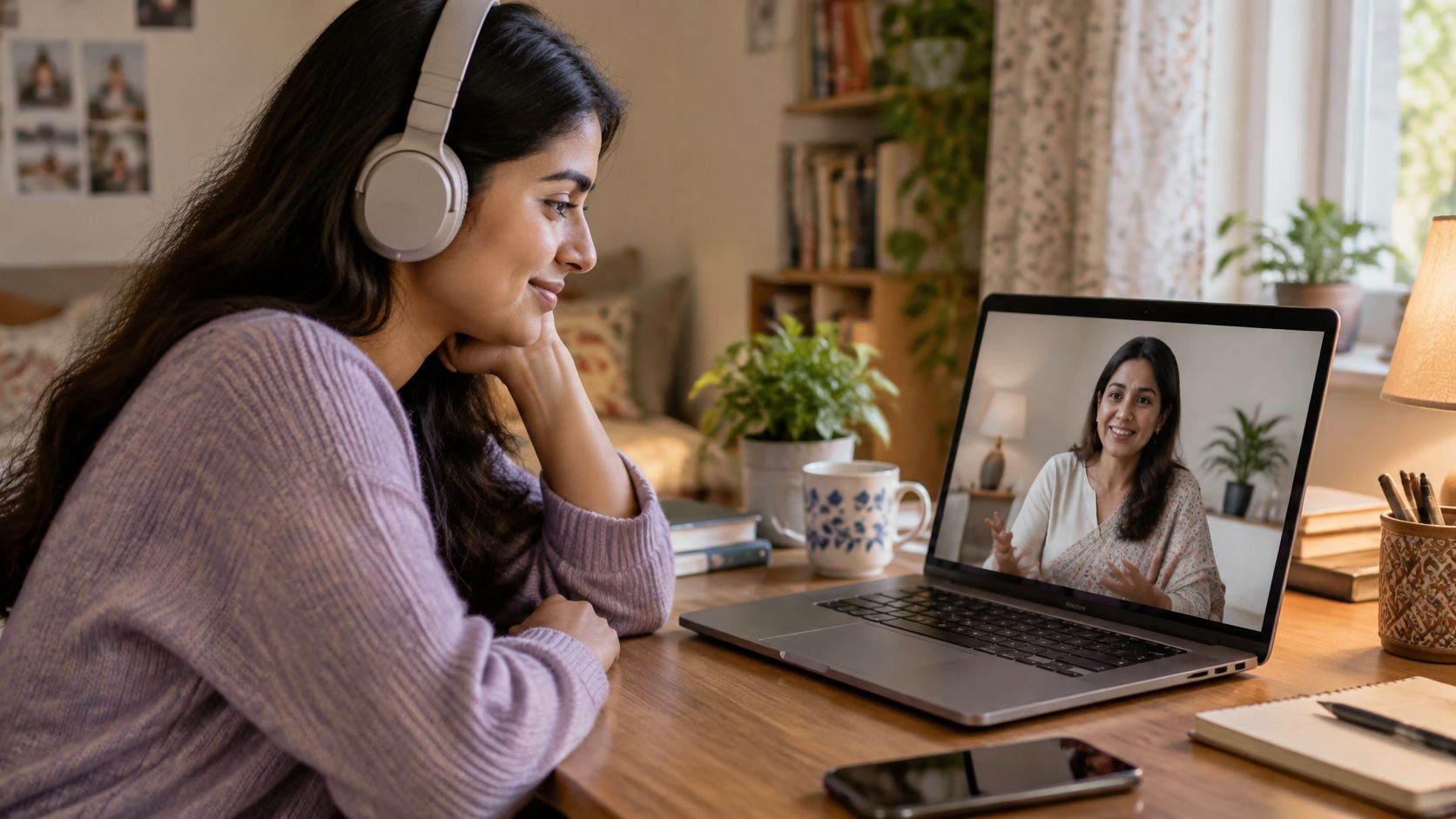
Online counselling is structured support with a qualified professional by phone, video, or secure chat, not a diagnosis and not emergency care. It's a planned conversation with a focus, a next step, and a clear route to stronger help if you need it.
That distinction matters in India, where many people live far from a clinic, juggle work or study, or worry about being seen in a waiting room. A remote session can lower those barriers, but it doesn't replace every other kind of care. The useful question isn't only what online counselling is, it's which format fits, what level of help fits, and how you can speak safely from where you are.
What Online Counselling Is in Plain Words
Say you're a working professional in Pune who has felt tense for weeks. You don't want casual advice from a stranger online, and you can't easily travel across the city in office hours. You book a video session with a qualified counsellor, agree on a focus, and leave with one clear step to try before you meet again.
That's the core of online counselling. Think of it as a private room moved onto a connection you already have, a phone, a laptop, or a secure chat window. The work inside that room stays professional, even though the room itself has moved.
Why Remote Care Matters in India
Distance, cost, stigma, and uneven clinic access keep many people away from in-person care. The National Mental Health Survey of India, 2015–16 estimated that 10.6% of Indian adults were living with a diagnosable mental disorder, and its disorder-specific findings showed that the treatment gap ranged from 70% to 92%, including approximately 85.0% for common mental disorders.
A treatment gap means many people who could benefit from care don't receive appropriate treatment. Online counselling can't close that gap on its own, but it can make a first conversation and follow-up easier for students, parents, couples, and people in underserved places.
What You Can Bring to a Session
People use counselling and therapy for workplace stress, anxiety, depression, burnout, and relationship strain. They also use it to build resilience, compassion, emotional awareness, and a steadier sense of happiness. Both parts belong in good care, easing what's hard and strengthening what helps you cope.
One point needs to stay clear from the start. An online assessment is informational, not diagnostic. It can highlight patterns, but a diagnosis needs a qualified professional who looks at your symptoms, context, duration, and risk.
Online counselling is a way of reaching care, not a label for what you're going through.
So you really have three decisions to make. You need a format you can use in private, a level of care that matches your situation, and a safe first step you can take this week.
Phone Video and Chat Compared
A first session can happen over a voice call, a video screen, or a chat window, and each format changes what the conversation can do. Here is the comparison at a glance.
| Format | Best suited for | Practical needs | Limit |
|---|---|---|---|
| Phone or audio | First talks, low bandwidth, camera discomfort | A working phone line and a quieter moment | Body language is harder to read |
| Video | Ongoing therapy, couples or family work | Stable internet and a private room | Weak networks drop the session |
| Secure chat or messaging | Booking, brief check-ins, people who prefer writing | Literacy and patience for delayed replies | Not enough for crisis or complex risk |
| Helpline first contact (Tele-MANAS 14416 or 1-800-891-4416) | Emotional support, triage, and referral in English, Hindi, and ten regional languages | Any phone, including a basic handset | Not a full course of psychotherapy |
Phone or Audio
A phone session is often the simplest place to start. You don't need strong internet, you don't have to look at a camera, and you can often speak more freely when you're not watching yourself on screen. For a first conversation about workplace stress or poor sleep, audio can be enough.
The trade-off is real. Your counsellor can't see your facial expressions or body language, and you can't see theirs. That makes it wise to say feelings out loud, in words, rather than hoping they'll be picked up.
Video
Video is the closest match to sitting in a clinic room. Faces help when you're doing couples or family work, when trust is still building, or when a counsellor needs to notice how you respond as you speak. It also helps many people stay focused, because the session feels like a real appointment.
Video asks more from your surroundings. You need a stable connection and a room where you won't be interrupted. If the picture keeps freezing, the conversation loses its thread and both of you spend energy on the technology instead.
Secure Chat or Messaging
Writing suits some people better than speaking, at least at first. Secure chat works well for booking, brief check-ins between sessions, and sharing a thought you've had time to shape. Good chat support anywhere depends on honest expectations about reply times, a point that even live chat advice for RV travelers, from a completely different field, makes clearly.
Chat has a hard limit you shouldn't test. A delayed reply is not crisis care, and short messages can't carry complex risk well. If you feel unsafe, you need a live voice and local help, not a thread.
The Public Helpline as a First Contact
India's public system shows how wide the phone door can open. The Government of India launched the National Tele-Mental Health Programme through Tele-MANAS on 10 October 2022, and the Press Information Bureau release on Tele-MANAS records that by 19 March 2025, 36 States and Union Territories had established 53 Tele-MANAS cells. Since launch, the helpline has handled a large and growing volume of calls through 14416 and 1-800-891-4416.
A helpline is a first contact, not a full course of therapy. It can offer support, sort out what kind of help you need, and refer you onwards.
Practical rule: Choose the format you can finish in private, and switch to audio if video keeps dropping.
Counselling Therapy or Urgent Care
A booked online session is the right level of help only when your situation is stable, manageable, and safe right now. Severity decides the door you walk through, and a useful way to picture this is a ladder: each rung handles a different level of need, and the honest skill is knowing which rung to start on and when to climb.
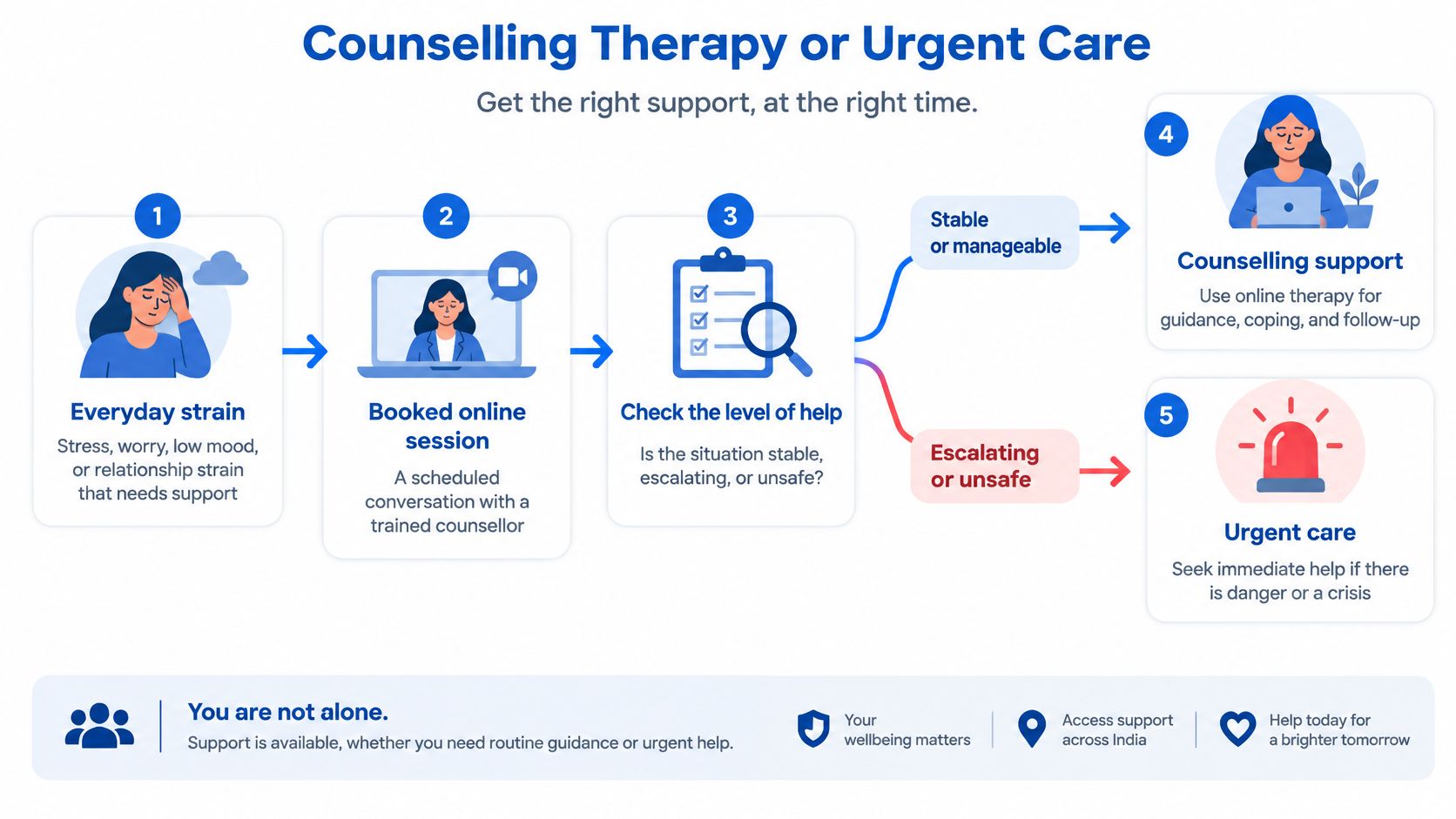
| Situation | Usually start with | Step up when |
|---|---|---|
| Stress, burnout, exam pressure, or relationship strain | Online counselling or therapy | Distress lasts, worsens, or disrupts work, study, or sleep |
| Persistent anxiety or low mood | Counselling plus informational screening | A clinician must judge duration, risk, and whether psychiatry fits |
| Possible need for medication or a complex diagnosis | Psychiatrist by video or in person | Counselling alone cannot cover the medical picture |
| Immediate danger, suicidal thoughts, or violence | Local emergency services or a crisis helpline | A booked session or chat reply cannot wait |
| Wish to build resilience, compassion, or happiness | Self-help, coaching, or counselling | Symptoms are severe, persistent, or disruptive |
Four Levels in Plain Words
Counselling means structured emotional support and problem-solving for a concern you're facing now. Therapy, or psychotherapy, usually runs longer and works on patterns, such as repeated anxiety, low mood linked to depression, or the same relationship conflict returning again and again.
Psychiatric care adds a medical assessment. A psychiatrist can consider diagnosis, physical health, and medication or e-prescription with follow-up when that's appropriate. Crisis support is different again, because it's for immediate danger and can't wait for an appointment.
The distinction matters most at the two ends. A student worn down by exam season and a person hearing voices may both "need someone to talk to," yet they belong on different rungs, and starting on the wrong one wastes time they may not have.
Stepped Care in Practice
Tele-MANAS gives a public picture of this ladder. Launched on 10 October 2022 and reachable on the toll-free number 14416, the service shows how callers move between levels: the Press Information Bureau update on Tele-MANAS referrals records 19,135 callers referred to mental-health professionals and 1,319 referred to District Mental Health Programme services.
Those referrals are the ladder working as intended. A phone conversation can be a first link, then a handoff to the right professional. It isn't presented as a guaranteed cure, and it shouldn't be.
When Online Counselling Alone Is Not Enough
Suicidal thoughts, psychosis, severe substance dependence, violence at home, or any immediate danger need urgent, local help. A remote session runs on appointments, and danger doesn't. Please use local emergency services or go to the nearest hospital in those moments.
Screening tools fit at the lower, informational end of this ladder. They can point to patterns worth discussing, but a qualified clinician still has to judge symptoms, context, duration, risk, and treatment. Skills for resilience and well-being can sit alongside care, yet they don't replace assessment when distress is severe, persistent, or disruptive.
Evidence That Remote Support Can Help
A careful claim comes first. Online counselling can be feasible and helpful when trained clinicians, reliable technology, and clear steps for follow-up and referral are in place. The screen alone does none of that work.
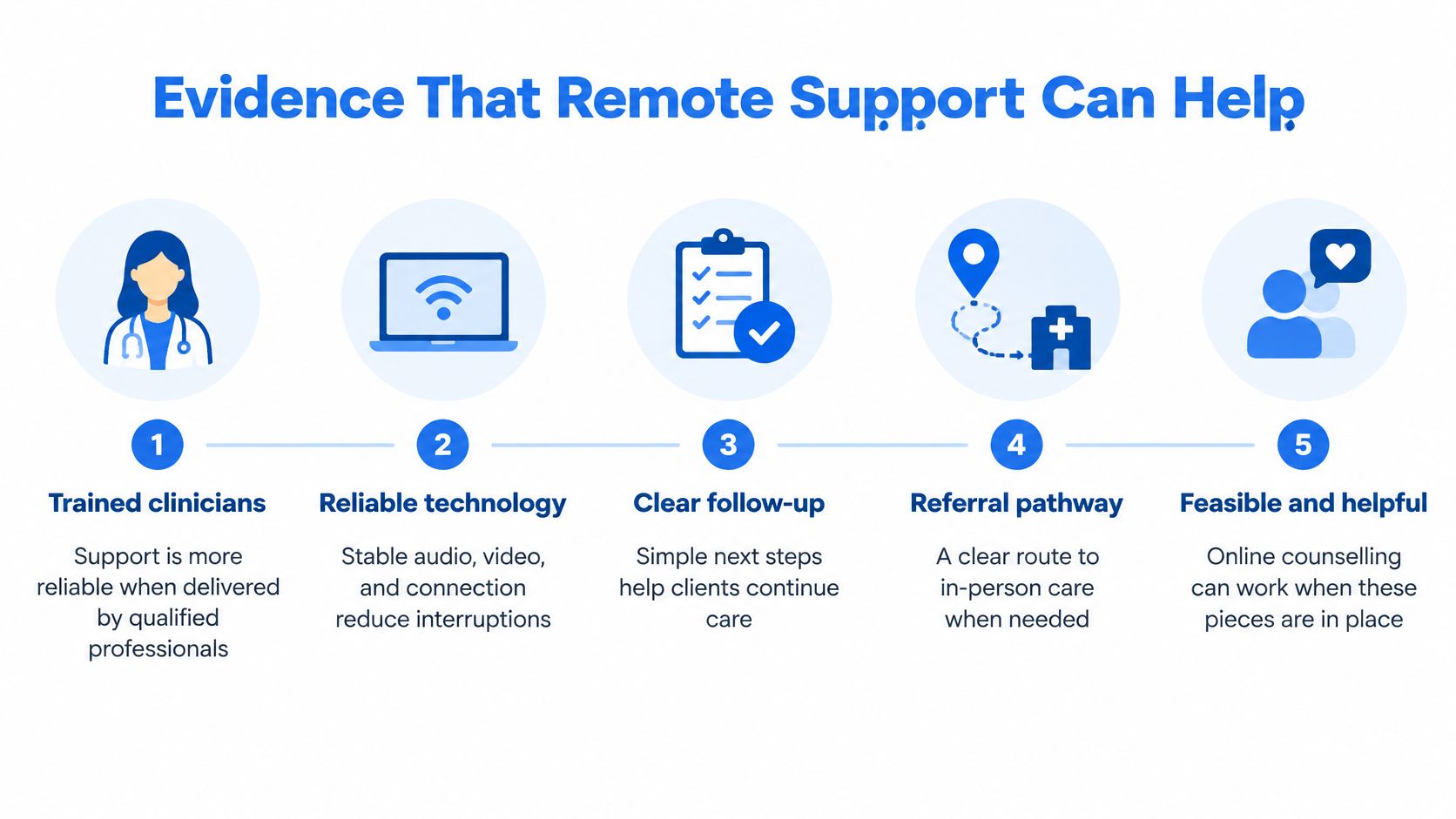
| Study | Who took part | What was tested | What it found |
|---|---|---|---|
| COVIDAV | People using the programme and clinicians delivering remote sessions | Whether virtual psychiatry and counselling could be used in routine care | Better access and greater comfort were reported, mainly among younger users |
| Goa feasibility study | 161 adults with mental-health or alcohol-use concerns | Video consultations with a psychiatrist, trained counsellors, or both | Significant drops in distress and disability scores; high satisfaction |
What the Indian Studies Show
The COVIDAV row is best read as direction rather than measurement. An Indian programme used remote psychiatry and counselling in routine care, and clinicians reported gains in access and comfort, concentrated among younger users. It supports feasibility; it does not by itself show who benefited, how much, or for how long.
The Goa work is more specific. The Cambridge Global Mental Health feasibility study from Goa provided video tele-consultations to 161 adults with mental-health or alcohol-use disorders, and participants showed significant post-treatment reductions in GHQ-12 psychological-distress scores and WHODAS 2.0 disability scores, alongside high satisfaction with the service and technology.
How to Read Those Results
A good remote service works like a referral chain with a screen at the front: contact becomes easier, screening becomes quicker, and follow-up has somewhere to go. Less travel can help people show up and stay in touch. Specialist oversight then turns that contact into care that can be acted on.
Session design is the shared lesson across remote care, though one field cannot prove another. Guidance on setting up engaging online ABA sessions makes the same practical point outside counselling: structure and continuity decide whether a video call becomes a planned session or remains a loose conversation.
These studies don't prove that every chat eases depression or anxiety. They also don't replace in-person care for high-risk situations. They show what's possible when the service is organised well.
- Audio backup: You can keep talking if video fails.
- Language match: You explain feelings in the words you think in.
- Same professional: Trust and memory build across sessions.
- Repeated check-ins: Progress is tracked, not guessed from one quiz.
- Clear handoff: You know where to go if your needs grow.
Results depend on fit, safety, and follow-through. They don't come from the screen itself.
Privacy When Home Is Not Private
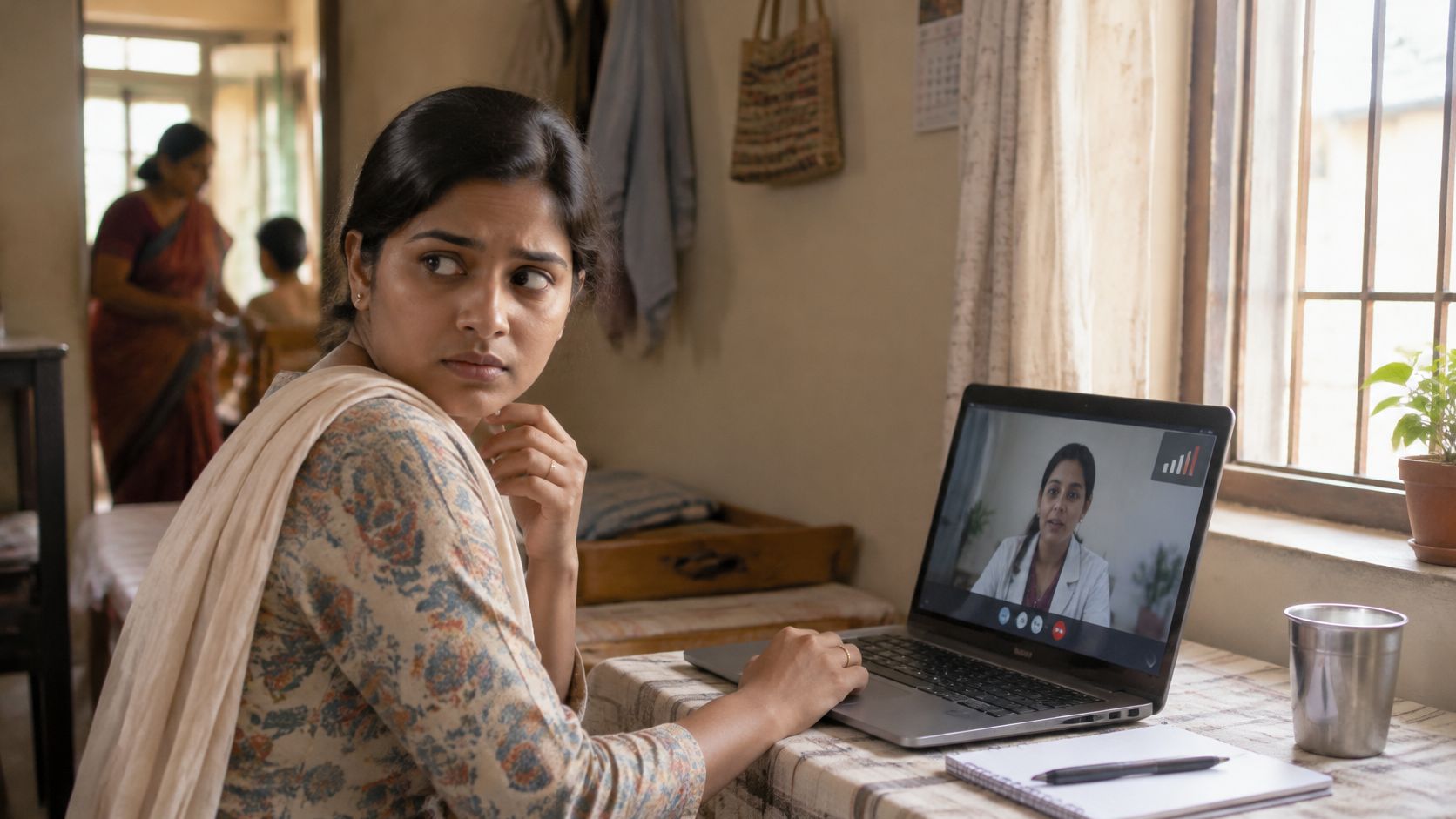
Convenience solves the distance problem. It does not solve the overhearing problem. A student in a hostel shares a room. A woman in a joint family has a corridor outside her door. A parent in a two-room flat can be heard through a wall. For them, privacy is the whole question, and a session only works when it is safe to speak.
The image below captures a feeling many people recognise: wanting help while also checking who might overhear.
Barriers That Technology Alone Cannot Fix
A review of tele-mental health barriers in India identifies poor rural connectivity, limited digital literacy among older adults, data-leak risks, and confidentiality problems when sessions take place in shared homes. Any one of these can decide whether someone dares to speak openly about abuse, family conflict, suicidal thoughts, or workplace problems.
Wider technology helps, but it does not create privacy inside a room. Tele-MANAS has expanded its language and accessibility options over time, yet availability still has to meet a real household. A service that exists on paper only helps the person who can answer it safely.
Six Practical Moves Before You Book
Privacy in a shared home works like adjusting a lamp: you change where you sit, what others can see, and what they can hear. Six moves cover most situations.
- Prefer audio if a camera feels exposing. You can sit where a screen will not be seen.
- Use headphones. The counsellor's voice stays in your ears, not in the room.
- Pick a safer time and place. Book when the house is emptier, or use a parked car or quiet stairwell you consider safe.
- Use text only to fix the appointment. Keep anything sensitive out of a shared phone that others may open.
- Agree a backup plan. Decide on a phone callback if the call drops mid-session.
- Warn the professional at the start. Say someone might walk in, and agree a code word that means pause or change topic.
The short video below is a useful pause to think through your own setup before a first session.
If Privacy Cannot Be Guaranteed
Skip the deep video session when you cannot speak freely. Care works in steps, and the right step this week may be a smaller, safer one. Use a helpline from a safer spot, ask for audio only, or request an in-person referral where a clinic room gives you the privacy home cannot. A fuller session can wait for a safer room.
That choice is good judgement. Forcing an unsafe conversation serves no one.
Confidentiality is a shared plan between you and your professional. Platform settings matter, but your time, place, headphones, and code word matter just as much.
Everyday Concerns People Bring Online
A college student in Indore loses sleep before exams. Her mind races at night, and she wants a plan for study, rest, and worry, not a label. In a first session she might say, "I can't switch off, and I'm scared I'll blank in the paper."
A working professional in Bengaluru feels workplace stress turning into burnout. He still meets every deadline, so he tells himself it can't be serious, yet Sundays feel heavy and small tasks irritate him. His first line could be, "I'm functioning, but I feel flat and tired all the time."
Relationships, Family, and Growth
A couple living in different cities argues over calls late at night. Travel makes clinic visits rare, so they try one video hour together with a counsellor who can slow the conversation down. One of them opens with, "We keep hurting each other over small things, and we don't know how to stop."
A parent carries grief and family conflict while caring for children and an ageing mother. Alongside the strain, she wants more patience and compassion at home. Families in that stage often need support for older relatives too, and Velma's guide to senior emotional support speaks to that side of care. Her first sentence might be, "I'm holding everyone together, and I have nothing left for myself."
- The hard part: Anxiety, low mood, loneliness, or sleep trouble needs care and attention.
- The growth part: Resilience, gratitude, emotional awareness, and purpose can be built in the same work.
A Bad Week Is Not Automatically an Illness
Stress after a hard week doesn't automatically mean a diagnosable illness. An informational questionnaire can only point to patterns, and it's informational, not diagnostic. Please don't use a score to label yourself or someone you love.
The picture changes when sadness, panic, or hopelessness stays for weeks. If it blocks study, work, sleep, or care of children, a qualified professional should assess you properly, and psychiatry or local care may be needed. No honest counsellor will promise that one session restores happiness, but a good first session can leave you clearer about your next step.
How to Choose Support and Get Started
You don't need a perfect plan to begin. You need a short, honest start you can follow.
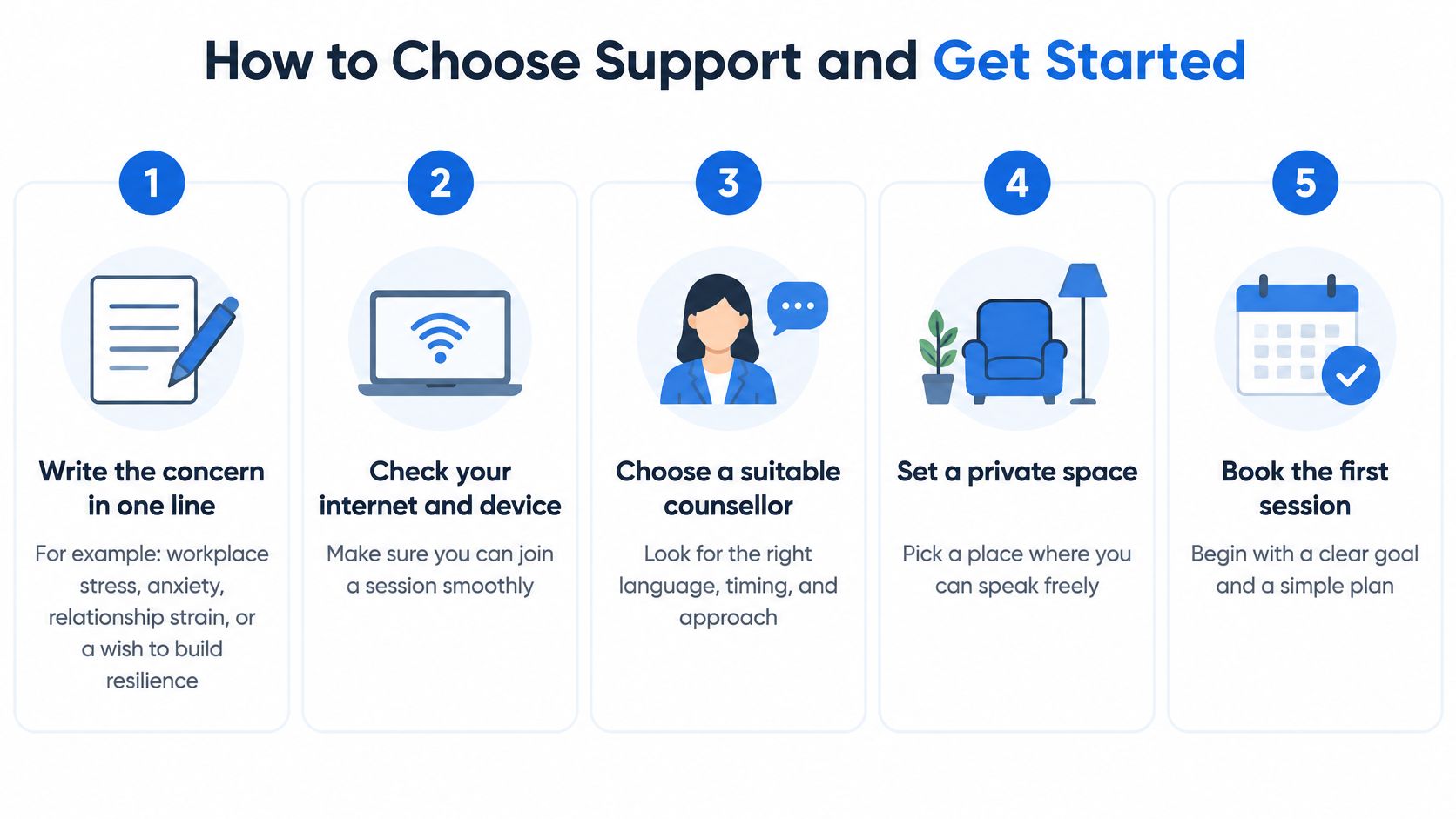
Six Steps to a Safe First Session
- Write the concern in one line. For example, workplace stress, anxiety, relationship strain, or a wish to build resilience. A single sentence keeps the first conversation focused when nerves make words hard to find.
- Check the professional is qualified. The platform should explain each practitioner's credentials, how consent works, and what happens if risk appears during counselling.
- Match language and format to real life. If a shared home makes video calls awkward, ask whether an audio-only session is possible, and pick a language you can be fully honest in.
- Treat any assessment as a guide, not a label. Ask how results will be used to shape your sessions before you answer a single question.
- Book one first session. Agree in advance what would mean stepping up to psychiatry, face-to-face care, or emergency help, so nobody has to improvise if things get harder.
- Change if the fit feels wrong. It's reasonable to try another professional, and you don't need to apologise for that.
Before you book, ask about fees, session length, and privacy rules. A good provider explains that confidentiality has limits when someone may be in serious danger. Clear answers at this stage protect your well-being later.
Using DeTalks to Take Those Steps
DeTalks is one India-based way to do this in practice. You can browse psychologists, therapists, and counsellors, book a session, and use science-backed screening only as a guide toward self-help, counselling, coaching, or psychiatric care. For support questions, the team can be reached at support@detalks.com.
DeTalks.com is owned and operated by XequalsZERO Private Limited, with its registered office at 289, Model Gram, Ludhiana, PB 141002, IN. Knowing who stands behind a platform is part of choosing care you can trust.
Take these supportive points with you. Help can begin remotely, in your own language and format. Privacy deserves a plan, growth and relief can be worked on together, and urgent danger still needs local emergency care.
If you're ready to take a first, steady step, DeTalks helps you browse qualified psychologists, therapists, and counsellors across India, book sessions with them, and use confidential, science-backed assessments as informational guides toward the right level of support. Visit today, write your concern in one line, and book a first session that fits your language, your privacy, and your pace.
Leave a Reply