
You may be holding your phone after a difficult conversation, staring at an unfinished email, or trying to work through another night of broken sleep. The problem may look ordinary from the outside, yet inside, your thoughts are racing, your body feels unsafe, and the coping methods that usually help no longer seem to work.
Crisis intervention services exist for this point of urgency. They offer focused support to help a person regain safety and steadiness, whether the crisis involves self-harm risk, panic, burnout, grief, conflict, substance use, or another overwhelming change. A crisis doesn't mean you've failed. It often means your mind and body need more support than they can provide alone.
When a Hard Moment Turns Into a Crisis
A project manager in Bengaluru has spent three nights sleeping only in short bursts. During a routine work call, her chest tightens, her hands become cold, and she can't follow a conversation she's led many times before. She tells herself to breathe, drink water, and push through, but the panic keeps returning.
In Lucknow, a young mother has been crying since an argument with her partner. She can't settle her thoughts, care for herself properly, or respond to her child with her usual patience. She isn't sure whether she needs therapy, a doctor, a hospital, or a quiet night.
These situations can become crises when distress starts to overwhelm ordinary functioning and the person can't regain balance with familiar support. The warning signs may include racing thoughts, intense fear, uncontrollable crying, sleeplessness, impulsive behaviour, or a frightening sense of losing control.
A crisis is a signal of overload, not a character judgement.
Crisis intervention services provide a calm, organised response during that period. A trained counsellor may listen, assess immediate safety, reduce the intensity of the moment, involve a trusted person, and connect the individual with therapy, psychiatric care, or emergency medical support when needed.
Crisis support also extends beyond suicide risk. Someone experiencing severe workplace stress, a panic episode, relationship breakdown, grief, withdrawal, or addiction-related distress may need urgent help even when they don't want to harm themselves. For people looking for specialised information about substance-related emergencies, 24/7 addiction crisis care can offer another relevant point of reference.
India has been building a national response to this need. The Government of India launched Tele-MANAS on 10 October 2022, and by 31 July 2025, 36 States and Union Territories had established 53 Tele-MANAS cells offering support in 20 languages. Official reporting said the programme had handled more than 24 lakh calls since its launch. Government reporting on Tele-MANAS
What Crisis Intervention Services Actually Are
Crisis intervention is short, focused support for acute emotional, behavioural, or psychiatric distress. It concentrates on what needs attention now, usually over hours or a few days, so the person can move towards safety and basic routine functioning.
Think of it as a triage nurse rather than a surgeon. The triage nurse identifies the immediate danger, provides first support, and directs the patient to the right level of care. Crisis intervention does something similar for emotional distress.
Four immediate aims
Safety comes first. The practitioner checks whether the person may harm themselves or someone else, whether they can remain safe, and whether urgent medical care is necessary.
Stabilisation follows. This may involve grounding, slow breathing, reducing stimulation, listening without judgement, addressing immediate practical needs, and helping the person move away from a dangerous environment.
Connection prevents isolation. A crisis worker may help contact a family member, trusted friend, therapist, psychiatrist, hospital, community service, or follow-up team. The purpose isn't to leave the person with advice and no next step.
Brief problem-solving makes the next few hours manageable. The worker and the person may identify where they can stay, who can accompany them, what substances or objects should be moved away, and which appointment or referral should happen next.
Crisis intervention isn't the same as long-term therapy. Therapy may explore patterns, relationships, trauma, anxiety, depression, or workplace stress across a longer period. Crisis care focuses on restoring enough stability for that deeper work to become possible.
It also isn't a substitute for emergency medical care. An overdose, serious self-harm injury, severe intoxication, active psychosis, or another condition requiring hospital treatment needs an emergency department or psychiatric unit. A crisis service can help direct the person there, but it can't replace medical stabilisation.
Support may be voluntary, requested by a family member, or recommended by a clinician. If a person is working alone or travelling between locations, practical safety tools such as the 3rd-i 24/7 app for lone workers may complement, but not replace, professional mental health support.
Types of Crisis Intervention Services and How They Differ
Different doors suit different situations. A person who feels overwhelmed but physically safe may start with a helpline, while someone facing immediate danger needs emergency care without delay.
A practical comparison
| Service Format | How You Access It | Best For | Typical Response Time | Key Limitation |
|---|---|---|---|---|
| Helplines and text-based support | Call a crisis line or use an available messaging service | Someone who is distressed, alone, or unable to travel | Immediate or as soon as the service answers | The worker can't physically assess the environment or provide medical treatment |
| Mobile crisis teams | Request an in-person response where available | Someone who can't or won't travel safely to a facility | Depends on local availability and urgency | Coverage, staffing, and language access vary by location |
| Emergency psychiatric care | Visit the casualty department, psychiatric unit, or nearest hospital; call emergency services when danger is immediate | Active psychosis, severe self-harm risk, intoxication, suicide attempts, or medical danger | Urgent triage on arrival | The setting can feel busy, and ongoing therapy may still need separate arrangement |
| Brief psychotherapy or critical incident support | Arrange a short, focused session after a destabilising event | Acute grief, panic, workplace incidents, relationship shock, or other urgent distress without immediate physical danger | Often arranged promptly through a provider | It isn't designed to manage medical emergencies or replace ongoing treatment |
In India, Tele-MANAS provides free, 24/7 tele-counselling through 14416 or 1800-89-14416. The system has expanded to 53 cells across 36 States and Union Territories, creating a route from first-contact counselling to more specialised care when necessary. Official Tele-MANAS information
Cost can influence the decision. Government helplines may offer free access, while hospital charges, private therapy fees, transport, and medication costs vary by provider and location. Ask about fees before a planned appointment, but don't delay emergency care because you're uncertain about cost.
A helpline is a good starting point when you need to speak to someone now and can remain physically safe. A mobile response is more suitable when the person is too disorganised, frightened, isolated, or unwilling to travel. A hospital is the right door when there is injury, overdose, severe confusion, an attempt to die, or an inability to stay safe.
Signs That Tell You It Is Time to Reach Out
A person may finish a demanding workday, manage family responsibilities, and still reach a point where panic, burnout, or relationship conflict makes ordinary decisions feel impossible. The need for help is not limited to suicidal thoughts. Urgent emotional distress can also follow exam pressure, postpartum changes, gig-economy uncertainty, long working hours, or urban loneliness.
Stress is common in India, yet a common experience can still become too heavy to manage alone. Workplace findings support a compassionate, non-diagnostic response. A 2022 survey of 1,500 Indian workers found that 77% had a moderate to high risk of mental health issues, 43% felt unsettled and nervous, and 60% felt more sensitive to stress than the previous year. India workplace survey
An urban study of 1,764 white-collar employees reported 78% with moderate-to-high stress, 55% with moderate-to-severe anxiety, and nearly 29% with moderate-to-severe depression. Yet 99% also reported moderate-to-high psychological well-being. Distress and resilience can exist in the same person. Urban India workplace study
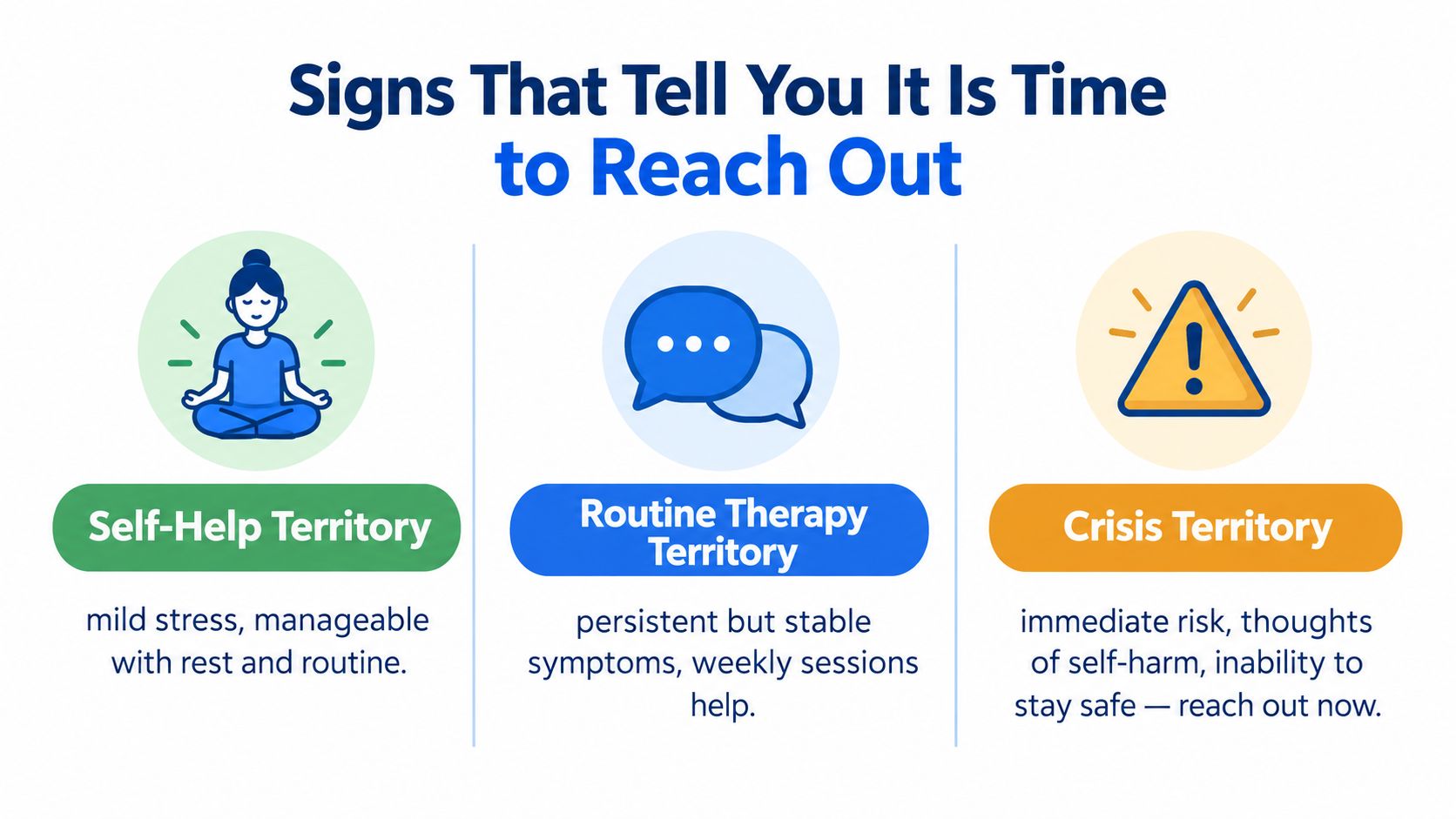
Use the following levels as a decision aid, not as diagnoses:
- Self-help territory: You are strained, but still eating, sleeping somewhat, staying safe, and handling basic tasks. Rest, connection, movement, breathing exercises, and supportive routines may be enough for now.
- Routine therapy territory: Persistent anxiety, low mood, burnout, conflict, or sleep problems deserve planned counselling or therapy, especially when daily life remains mostly stable.
- Crisis territory: Panic keeps returning, work or home responsibilities are slipping, substance use is increasing, or a triggering event leaves you feeling out of control. Contact a crisis service promptly.
- Emergency territory: Stop reading and act. A plan or urge to harm yourself, recent self-harm, danger from another person, or inability to stay safe calls for emergency help now.
Young people may need closer support when academic pressure, isolation, identity concerns, or family conflict intensify. Discussion of unprecedented teen girl struggles can help parents and educators respond calmly, without dismissal or shame.
Immediate Steps You Can Take Right Now
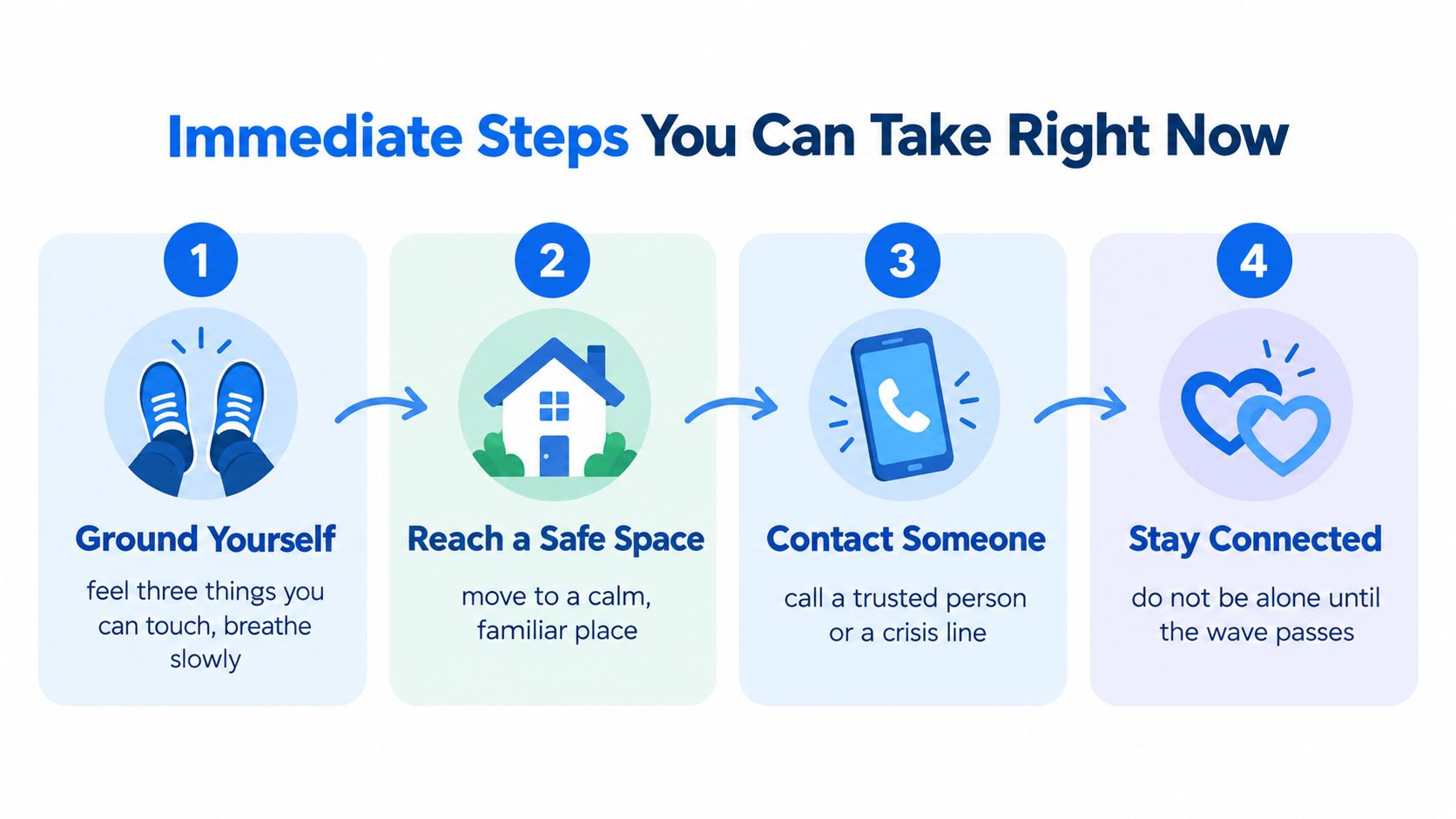
Start by reducing danger and making the next few minutes simpler. Move to a place with other people if being alone feels unsafe, sit with both feet on the floor, and name a few things you can see, hear, or touch.
Slow your breathing without forcing it. Sip water, loosen tight clothing, move away from alcohol or other substances, and put distance between yourself and anything you could use to hurt yourself.
Choose the next level of support
If you have suicidal thoughts, self-harm urges, a recent attempt, serious injury, overdose, or immediate danger, go straight to the nearest hospital emergency department or call 112. Ask someone to accompany you, and don't drive if you're confused, intoxicated, or physically unwell.
If you're overwhelmed but not in immediate danger, call Tele-MANAS on 14416 or 1800-89-14416. You can also contact iCall on 9152987821 or the Vandrevala Foundation on 1860-2662-345. If one service doesn't answer promptly, try another available route.
Tell one trusted person exactly what you need. You might say, “I'm not feeling safe alone. Please stay with me,” or, “I need help reaching a counsellor.” Clear words make it easier for another person to respond usefully.
Prepare for an emergency visit if you can do so safely. Keep identification, relevant medical information, prescribed medication details, and emergency contacts ready. Don't postpone urgent care while searching for perfect paperwork.
If the person is a child, older adult, or someone with limited mobility, involve a responsible family member or caregiver. The aim isn't to solve the whole problem during one conversation. It's to create enough safety for the next decision.
This short video offers another grounding and crisis-support prompt:
What to Expect When You Reach Out for Help
The first call often feels harder than the conversation itself. You don't need a perfect explanation, a diagnosis, or a carefully organised history. Start with what is happening now, such as, “I haven't slept,” “I'm panicking,” “I might hurt myself,” or, “I can't stay alone.”
During a Tele-MANAS call, a counsellor may ask about immediate safety, listen to the situation, help reduce emotional intensity, and decide whether telephonic support is enough. If the concern requires more care, the counsellor can guide the person towards a mental health professional, hospital, or other appropriate service.
The programme's scale shows that these calls involve more than general reassurance. Government reporting found that, among 16.5 lakh fully assessed calls, 19,955 people sought help for suicidal distress, 5,890 cases were classified as acute emergencies involving imminent suicide risk, and 7,700 calls were escalated to trained mental health professionals for advanced counselling and crisis intervention. Tele-MANAS call-triage reporting
A hospital visit usually begins with triage. Staff may check physical safety, injuries, intoxication, confusion, medication needs, and suicide risk before deciding whether the person needs observation, psychiatric treatment, referral, or discharge with a safety plan.
You can ask what will happen next, who will be informed, and whether a family member can remain involved. Services aim to be respectful and confidential, but confidentiality has limits when there is an immediate risk of serious harm or a legal or safeguarding duty to act.
Language matters. Tele-MANAS is available in 20 languages, and local services may offer additional language support, although availability can differ. If speaking in English feels difficult, ask whether you can use a preferred Indian language.
Crisis intervention isn't designed to replace long-term therapy, medication management, or ongoing support for anxiety, depression, trauma, or burnout. It provides a bridge from an acute wave of distress towards a safer and more sustainable plan.
Follow-Up Care, Safety Planning, and Finding the Right Support
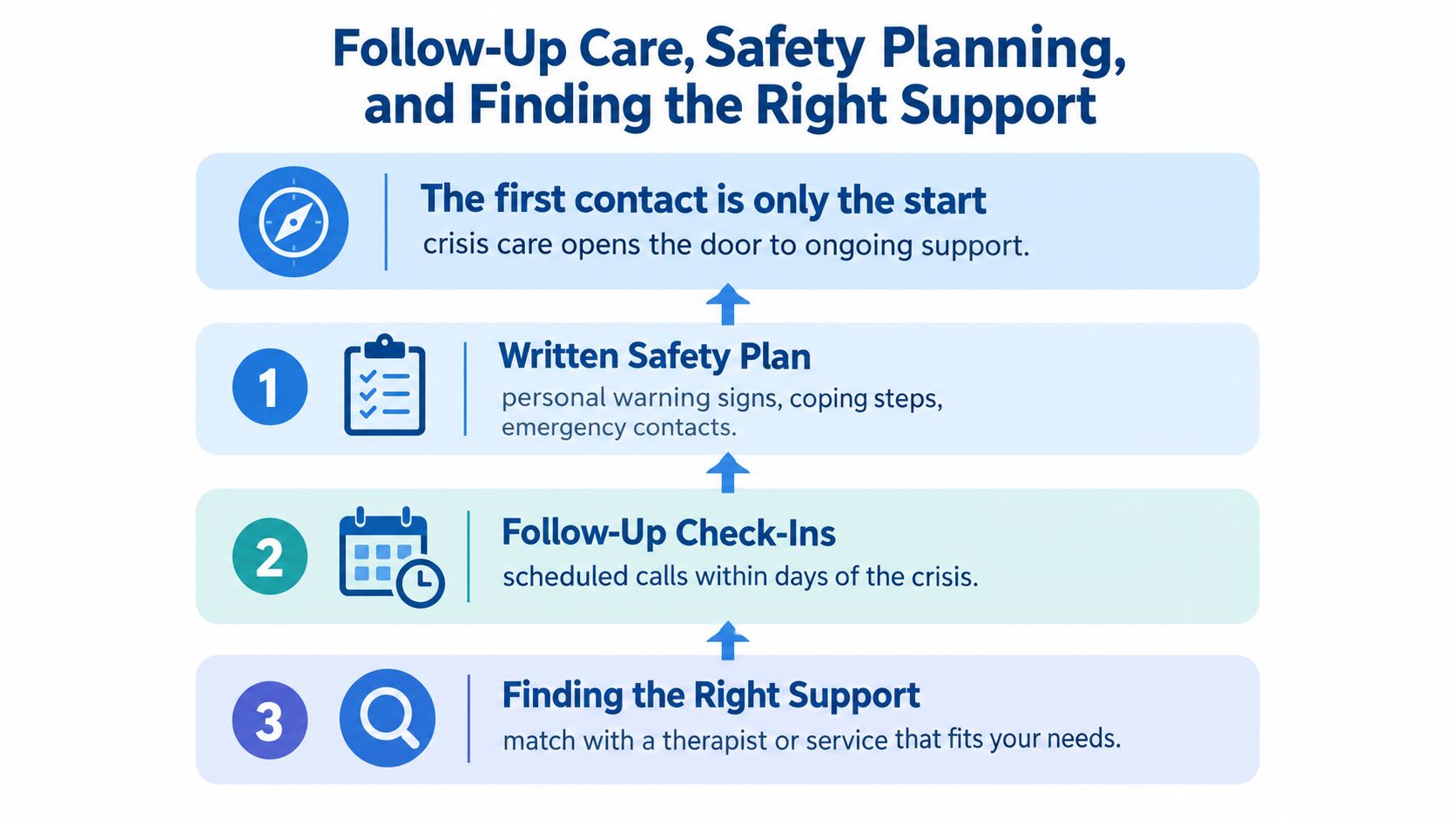
After a panic episode, workplace breakdown, relationship crisis, or other urgent emotional strain, a person may feel calmer after a call or hospital visit and still need support. Crisis intervention steadies the immediate moment. Follow-up helps prevent the same distress from becoming unmanageable again.
Build a written safety plan
A safety plan works like a map for times when clear thinking is difficult. Keep it practical and easy to find. It can include:
- Personal warning signs: thoughts, body sensations, situations, or behaviours that suggest a crisis is developing.
- Coping actions: grounding, leaving a stressful setting, contacting someone supportive, or following a calming routine.
- Support contacts: trusted people, counsellors, helplines, doctors, and the nearest emergency department.
- Safer surroundings: reducing access to harmful items, avoiding intoxicants, and staying with someone dependable.
- Emergency decisions: clear instructions for when to call 112 or go to hospital.
The right response depends on the situation. Someone with recurring panic may need a therapy appointment and help reducing immediate demands. A person facing burnout may need rest, workplace support, and medical review. After a relationship breakdown, trusted company and a clear plan for the next night may matter more than a long list of resources. Reach out promptly when distress disrupts sleep, safety, basic functioning, or the ability to manage ordinary responsibilities, even without suicidal thoughts.
Arrange follow-up before the person is left to manage alone. This may involve a scheduled call, therapy appointment, psychiatric review, family support, or a community group. A warm referral, where the next provider receives relevant information and the person knows how to make contact, is easier to act on than a list of names.
India's treatment gap remains substantial, as noted in Government mental health information. Asking for help early can make the next step more manageable, particularly when local services, language access, cost, or family expectations affect the choice of care.
Respectful care includes informed consent, clear explanations, and discussion of who may be contacted. Confidentiality generally protects private information, while urgent safety concerns, child protection duties, or a valid legal requirement may create limited exceptions. Ask the provider to explain these boundaries in plain language.
When ongoing support feels appropriate, a directory such as DeTalks can help you find a psychologist, therapist, or counsellor. Its assessments are informational, not diagnostic.
Crisis intervention helps you get through an intense moment. Ongoing therapy, counselling, psychiatric care, trusted relationships, rest, and positive psychology practices can support recovery afterwards. You do not need to wait for another crisis or have a diagnosis to deserve care.
Leave a Reply