
About 15% of Indian adults need mental health intervention, which is approximately one in six people. Stress management counselling is a practical, accessible form of support, not a last resort reserved for people in crisis.
You may be reading this after another day of answering messages between meetings, travelling through Bengaluru traffic, preparing for an exam in Pune, or managing responsibilities at home after a long shift. Your body feels tired, your mind keeps replaying unfinished tasks, and “just relax” no longer feels like useful advice.
Stress can look quiet from the outside. It may appear as poor sleep, irritability, headaches, constant worry, emotional numbness, or the feeling that one more request will push you past your limit. Counselling gives you a private space to understand what's happening and practise responses that fit your actual life.
What Stress Management Counselling Actually Looks Like
At 8:45 in the morning, Meera opens her laptop in Hyderabad and sees a full inbox. Her manager wants a revised presentation, her parents are asking about a family decision, and she has an important call later in the evening. She completes every task, but spends the day with tense shoulders, shallow breathing, and the fear that she's falling behind.
By night, Meera scrolls through her phone instead of sleeping. She tells herself that everyone is busy and that she should be able to cope. A weekend of rest helps briefly, but the same pattern returns on Monday.

Stress management counselling is a structured partnership between you and a trained mental health professional. You talk through your stressors, notice how your thoughts, body, emotions, and actions interact, and develop coping strategies that can be used during a difficult workday or family conversation.
The first session may include questions about sleep, mood, relationships, work, physical sensations, and the situations that trigger distress. You and the counsellor can then agree on a manageable focus, such as setting boundaries, responding to anxious thoughts, improving communication, or recovering from burnout.
Counselling is not a judgement
Many people delay therapy because they believe counselling means they're seriously unwell or unable to manage life. In reality, people seek support for many reasons, including workplace stress, exam pressure, relationship conflict, grief, low motivation, and a desire to improve their well-being.
Assessments used before or during counselling can help you reflect on symptoms and patterns, but they're informational, not diagnostic. A qualified professional considers your wider circumstances before discussing treatment or further care.
A useful starting point: You don't need to wait until stress becomes unbearable. Seeking support early can help you understand a pattern before it starts controlling your choices.
Why Stress Support Matters in India Today
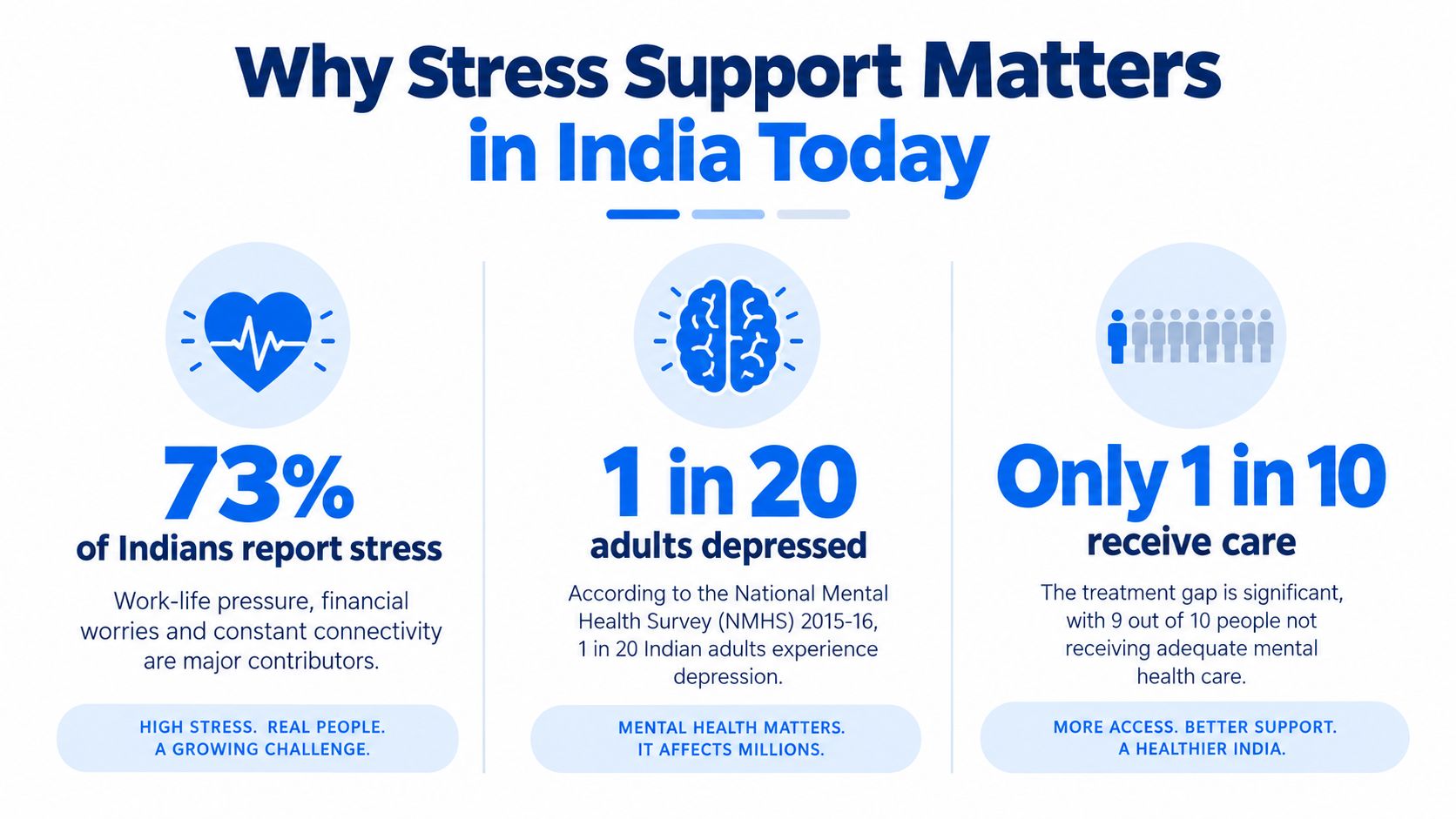
India's mental health needs are documented at a national level. The National Mental Health Survey findings from 2015–16 sampled 34,802 individuals across 12 states and found a weighted lifetime prevalence of any mental morbidity of 13.67%, alongside a current prevalence of 10.56%.
The survey reported that neurotic and stress-related disorders accounted for 3.70% of mental morbidity in India. Later government summaries stated that about 15% of India's adult population needs mental health intervention, which places stress counselling within a broader, documented need for care rather than treating it as a minor lifestyle concern.
The same government summary of the survey reports that about 10.6% of Indian adults, or roughly 11 in every 100 adults, were living with a diagnosable mental health disorder. It also records lifetime prevalence of 13.7%, with higher prevalence in urban areas at 13.5%, compared with 6.9% in rural areas.
The workplace picture
Work can be a major source of pressure, especially when long hours, unclear expectations, financial concerns, and family responsibilities overlap. An Indian Journal of Psychiatry review cited an urban white-collar study in which 78% of employees showed moderate-to-high stress. The same review noted moderate-to-severe anxiety in 55% of employees and moderate-to-severe depressive signs in 29%.
Those findings matter because generic advice may not address the cause. If workload and workplace relationships are driving distress, counselling may need to include prioritisation, boundary setting, communication with a manager, and practical changes to the working environment. Resources such as Benely employee wellness support can also help organisations think about workplace stress as a shared well-being issue, not only an individual problem.
India's wider mental health burden includes anxiety and depression as well. An ICMR release on mental disorders in India reported 45.7 million people with depression and 44.9 million with anxiety disorders. These figures don't mean that every stressed person has a disorder, but they do show why careful support and early conversations matter.
Evidence-Based Techniques You Will Encounter
A counselling session isn't just a place to describe everything that went wrong. It can be a practical learning space where you identify a pattern, test a different response, and decide what to practise between sessions.
Cognitive Behavioural Therapy
Cognitive Behavioural Therapy, or CBT, helps you notice the connection between thoughts, feelings, physical reactions, and behaviour. It doesn't ask you to pretend that difficult situations are easy. Instead, it helps you examine whether a thought is accurate, useful, or more extreme than the available evidence supports.
A software professional might think, “If I make one mistake in this presentation, my career is over.” A CBT conversation may explore the evidence, identify the fear beneath the thought, and develop a more balanced response, such as, “This presentation matters, but one mistake can be corrected and doesn't define my entire ability.”
You may also practise a small behavioural change, such as asking for clarification instead of guessing what a manager expects. The aim is to reduce automatic reactions and increase choice.
Mindfulness
Mindfulness means paying attention to the present moment with less judgement. A counsellor may guide you to notice your breathing, the sensations in your feet, or the thoughts passing through your mind without immediately acting on each one.
For a student facing exam pressure, this can create a pause between “I'm going to fail” and an impulsive decision to avoid studying altogether. Mindfulness doesn't remove the syllabus or the uncertainty. It can help the student return attention to the next realistic task.
Relaxation training
Relaxation training addresses the body's side of stress. Depending on your needs, it may include slower breathing, guided imagery, or progressive muscle relaxation, where you gently tense and release muscle groups to recognise physical tension.
A person who carries stress in their jaw and shoulders may learn to notice those sensations before they become painful. The practice works best when it becomes familiar during ordinary moments, rather than being attempted for the first time during a crisis.
For organisations assessing job-related pressure, a resource such as stress lavoro correlato Spark can provide context for thinking about stress connected to work. Your counsellor can then help translate that understanding into personal coping, communication, and boundary-setting choices.
Understanding Different Levels of Care and Support
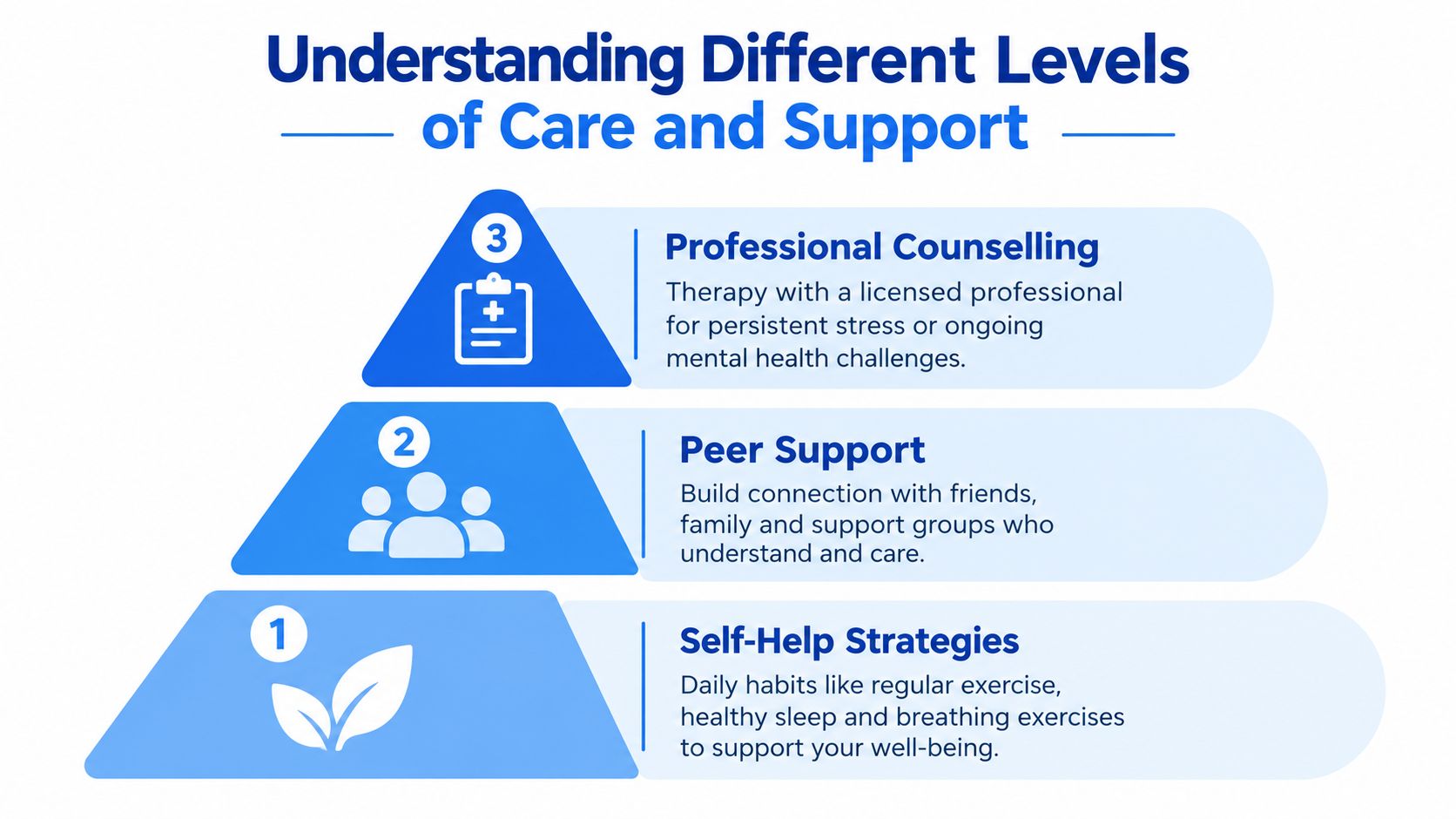
Not every difficult week requires formal therapy, but persistent distress deserves attention. The useful question isn't whether you're “sick enough” to seek help. Ask instead whether your current coping methods are working and whether stress is interfering with sleep, concentration, relationships, work, study, or enjoyment.
Choosing the right level
Self-help strategies can suit short-term stress that improves when you restore basic routines. You might track triggers, take regular breaks, practise breathing, reduce avoidable commitments, or speak with someone you trust.
Peer support adds connection. A friend, colleague, student group, community organisation, or support group can reduce isolation and help you see that you aren't the only person facing pressure. If you're unsure how to find a suitable group or take part safely, guidance on how to join a mental health support can help you begin.
Professional counselling becomes especially relevant when stress persists, keeps returning, or leads to withdrawal, panic, hopelessness, severe sleep disruption, or difficulty functioning. Anxiety and depression can overlap with stress, so a counsellor can help you understand whether you need focused therapy, a referral, or additional support.
Public support in India
India has expanded structured public mental health services. In a 2024 government update, the District Mental Health Programme had been sanctioned for implementation in 767 districts, with objectives including workplace stress management, life skills training, and counselling in schools and colleges.
The same update said that, as of 23 July 2024, 36 States and Union Territories had established 53 Tele-MANAS cells. Tele-MANAS offers a possible first point of contact when local services are difficult to find, while the national helpline launched for psychosocial support during the pandemic was 080-4611 0007.
If someone may harm themselves or is in immediate danger, contact emergency services or go to the nearest hospital. A helpline can provide support and direction, but urgent safety concerns require immediate human assistance.
How Counselling Builds Resilience and Well-Being
Counselling isn't only about reducing distress. It can also help you develop resilience, which means responding to difficulty with greater flexibility, self-awareness, and support rather than expecting yourself to remain unaffected.

A counsellor might help you distinguish between responsibility and over-responsibility. A new manager in Chennai may care very much about a team but still need to delegate. A parent may love their family and also need rest. A university student may value achievement without treating every result as a judgement on their worth.
From coping to capacity
Therapy can strengthen emotional intelligence by helping you identify feelings before they turn into sharp words or avoidance. You may learn to say, “I'm overwhelmed and need time to respond,” instead of sending an angry message or agreeing to another commitment you can't manage.
Compassion is part of this work. Many people speak to themselves in ways they wouldn't speak to a friend, calling themselves weak for feeling anxious or guilty for needing help. A compassionate approach recognises pain without removing accountability. It asks what support, skill, or boundary would make the next step possible.
Positive psychology adds another dimension. Counselling may explore gratitude, meaningful relationships, values, confidence, happiness, and purpose alongside symptoms. These aren't substitutes for treatment when someone is experiencing depression or severe anxiety. They can, however, help a person build a life that contains connection and meaning, not only fewer problems.
A useful session often ends with a small experiment. You might practise a boundary with a colleague, schedule a conversation with a partner, notice three moments of ease during the day, or return to an activity that used to give you energy. Progress is usually built through repeated, realistic actions.
This video offers another accessible way to reflect on emotional support and personal well-being:
Workplace well-being improves when organisations also examine workload, psychological safety, manager behaviour, and access to support. Individual resilience shouldn't become an excuse to leave harmful conditions unchanged.
Finding the Right Counsellor on DeTalks
The first counsellor you contact doesn't have to be the final choice. A good fit usually develops through comfort, trust, clear communication, and a shared understanding of what you want from counselling.
Start with a focused search
Write down the concern in ordinary language. You might be looking for help with burnout, exam stress, anxiety, family conflict, workplace harassment, grief, relationship difficulties, or low motivation. You don't need a perfect label before booking. Your description gives the professional a useful starting point.
Use a therapist directory such as DeTalks to review professional profiles and identify counsellors whose experience matches your concern. Look for information about their qualifications, approach, language preferences, online availability, and the kinds of people they support.
Use the first conversation well
Before the session, note what has changed, what you've already tried, and what you hope will feel different. You can ask how the counsellor usually works with stress, whether they use CBT or mindfulness-based methods, how privacy is handled, and what happens if your needs require another kind of care.
DeTalks also provides psychological assessments and screening tools. Remember that an assessment is informational, not diagnostic. It can help you organise your concerns and consider possible next steps, but it shouldn't be used to label yourself or replace a professional evaluation.
Trust can take time, yet discomfort that remains unexplained matters. If the counsellor dismisses your concerns, pressures you, or doesn't communicate clearly, you can ask questions, request a different approach, or seek another professional. Finding a suitable match is part of responsible care, not a sign that counselling has failed.
Your Next Steps Toward Better Mental Health
Start by observing your current pattern without criticising yourself. Notice when stress rises, what happens in your body, which thoughts appear, how you respond, and whether sleep, work, study, or relationships are being affected.
You don't need to solve everything before asking for support. One useful action might be telling a trusted person that you're struggling. Another might be writing down the situations that repeatedly trigger anxiety or burnout, then using that note to guide a counselling conversation.
Make the first step manageable
Choose one action that feels possible today:
- Name the concern: Write “workplace stress”, “exam anxiety”, “family conflict”, or another clear description.
- Check your support: Decide whether self-help, peer connection, or professional counselling best matches the persistence and impact of what you're experiencing.
- Prepare questions: Ask a prospective counsellor about their approach, experience, confidentiality, and next steps.
- Protect a small pause: Give yourself a brief period without work messages, academic tasks, or pressure to perform.
- Seek urgent help: If you feel unsafe or think you may harm yourself, contact emergency services, go to a hospital, or reach out to a crisis support service immediately.
Progress won't always feel dramatic. You may notice a thought sooner, recover more quickly from a difficult conversation, or ask for help before reaching exhaustion. Those changes matter because resilience grows through practice, support, and self-compassion.
Stress management counselling can support symptom relief, but it can also support happiness, emotional balance, healthier relationships, and a stronger sense of purpose. You don't have to wait for a perfect time, a perfect explanation, or a promise of a quick cure. You only need a safe next step.
DeTalks helps you explore stress, anxiety, burnout, resilience, and related well-being concerns through counsellor discovery, online therapy access, and scientifically validated assessments. Visit DeTalks to review support options and take a practical first step toward understanding what you're experiencing.
Leave a Reply