
Low self-esteem isn't a character flaw or something you're born with. It's often a lens that becomes smudged over time, shaped by early life experiences, social pressures, and our own inner thoughts.
If this feels familiar, please know you are not alone on this journey. Understanding where these feelings come from is the first gentle step towards healing and self-acceptance.
Unpacking the Roots of Low Self-Esteem
Getting to the heart of what causes low self-esteem is the first step toward rebuilding it. It’s rarely a single event but a slow build-up of past experiences, our interactions with the world, and the stories we tell ourselves.
Everyone’s journey is different because this is such a personal mix of factors. For some, the seeds were planted by a critical parent, while for others, they grew from intense workplace stress or social media pressure. Pinpointing these origins helps build self-compassion.
This diagram helps to visualise how these different areas—our past, our social world, and our inner life—all connect.
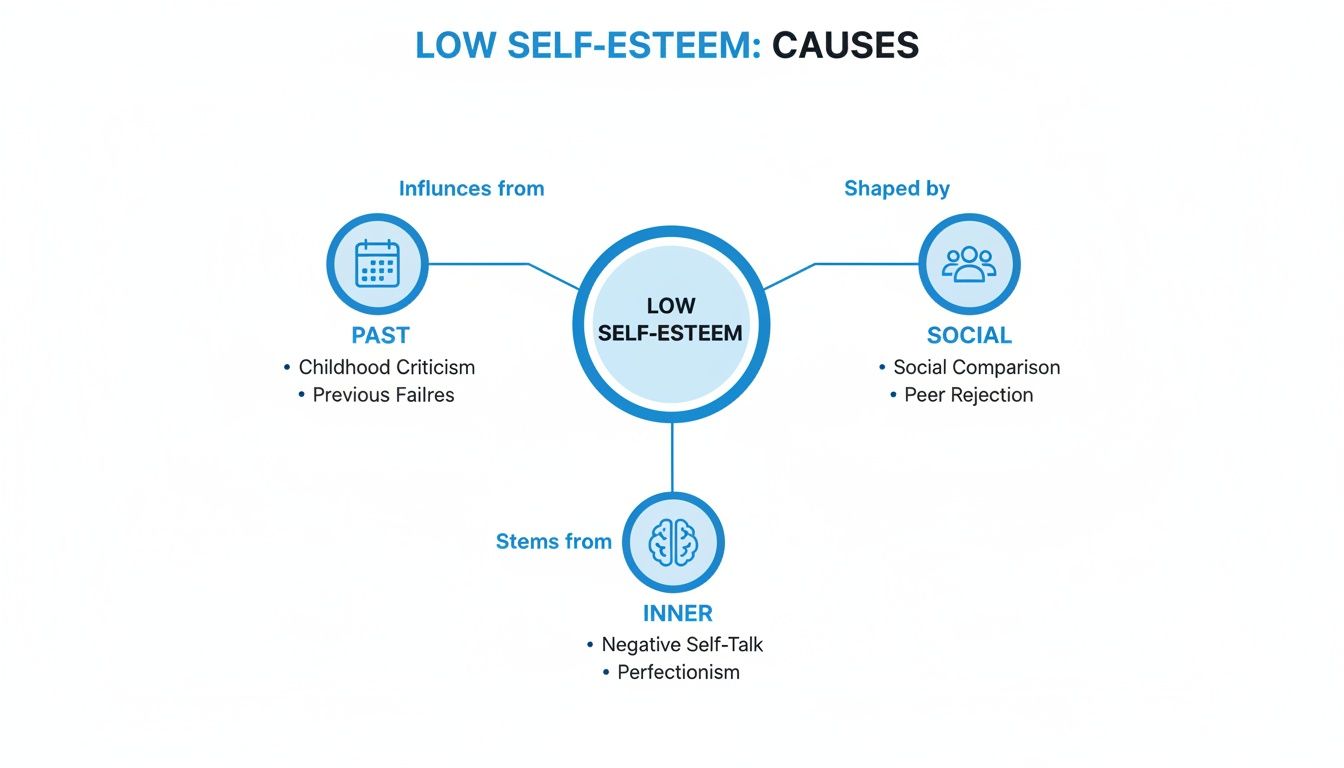
As you can see, our view of ourselves doesn't form in a vacuum. It’s a dynamic interplay between historical, external, and internal forces.
Primary Factors That Shape Your Self-Esteem
To help make sense of it all, let's briefly look at the primary factors that influence our self-worth. The table below summarises the main cause categories we'll be exploring in more detail throughout this guide.
| Cause Category | Brief Description | Common Examples |
|---|---|---|
| Early Life Experiences | Foundational events and relationships from childhood that shape our core beliefs about ourselves. | Unsupportive parenting, bullying, academic struggles, difficult childhood friendships. |
| Life's Challenges & Trauma | Significant negative events that can shatter our sense of safety and competence. | Abuse, neglect, major illness or injury, loss of a loved one, significant failure. |
| Relationships | The quality of our connections with others and how they impact our sense of value and belonging. | Toxic relationships, social isolation, break-ups, lack of a support system. |
| Cognitive Patterns | Ingrained habits of thinking that distort reality and reinforce negative self-perceptions. | All-or-nothing thinking, catastrophising, harsh self-criticism (the "inner critic"). |
| Mental Health Conditions | Conditions like anxiety and depression that are deeply intertwined with, and often fuel, low self-esteem. | Generalised anxiety disorder, social anxiety, major depressive disorder. |
| Social & Cultural Factors | Broader societal messages and pressures that dictate standards for success, beauty, and worth. | Media portrayals, unrealistic beauty standards, workplace competition, discrimination. |
| Biological Factors | Our inherent temperament and genetic predispositions that can make us more vulnerable to low self-esteem. | A naturally sensitive temperament, genetic links to mood disorders. |
Understanding these areas can help you connect the dots in your own life. This awareness is the first step toward making meaningful changes for your well-being.
It’s vital to remember that exploring these causes is about gaining understanding, not assigning blame. The aim is to achieve clarity so you can start treating yourself with more kindness and compassion.
While self-help is powerful, professional support can offer a safe space to work through these issues. Remember, any self-esteem assessments are for informational purposes to guide your journey; they are not a clinical diagnosis. This knowledge is your foundation for building resilience and a more authentic sense of happiness.
How Your Earliest Years Shape Who You Are Today
Think of childhood as the foundation of a house. A foundation laid with care and support creates a strong structure, but one marked by criticism or neglect can lead to cracks in your self-worth later in life.
From the start, we look to our caregivers to understand our place in the world. Their reactions—their smiles, words, and attention—are the first mirrors we see. Encouragement teaches us we are capable and valuable.
On the other hand, a childhood filled with harsh words or unrealistic expectations can form a negative self-image. These early messages often become a nagging inner critic that stays with us for decades.
Your Family and First Relationships
The family home is our first school, where we learn powerful lessons about our value. The way our parents treated us sent signals about whether we were "good enough," shaping feelings of anxiety later on.
A child with critical parents might grow up fearing failure and feeling they always fall short. Similarly, a child who feels ignored can internalise the belief that they don’t matter, damaging their core sense of worth.
A crucial takeaway is that a child's inner voice often records their parents' voices. Awareness of this pattern, often with professional support through therapy or counselling, allows it to be changed. The goal is not blame, but understanding.
Navigating School and Friendships
Outside the home, the classroom and playground become the next test of our self-worth. This is where we start measuring ourselves against others, and a few tough experiences can leave a lasting impact.
Consider these common situations:
- Academic Pressure: In a culture like India's, where academic success is highly valued, not performing well can feel like a deep personal failure. This can lead to intense workplace stress later in life.
- Bullying and Social Rejection: Being excluded or made fun of by peers is incredibly painful. These experiences can sow the seeds of social anxiety and make it hard to trust people.
- The Comparison Trap: Constant comparison to a "smarter" sibling or a "more popular" classmate can breed resentment. This makes a child doubt their own unique talents and feel inadequate.
These early social tests can be a huge factor in developing low self-esteem and may contribute to challenges like anxiety and depression. Understanding these origins is the first step toward rewriting your story and improving your well-being.
The Weight of Social Pressure and Modern Expectations
While our early years lay the foundation, adult life introduces new challenges that can chip away at our self-worth. It's easy to measure our value by external achievements, making our self-esteem fragile and dependent on others' opinions.

It often feels like we are on a treadmill, always chasing the next promotion or lifestyle goal. Tying our identity to these external goals can make any setback feel like a personal failure, stirring up feelings of inadequacy and anxiety.
The High Stakes of Academic and Career Pressure
In many cultures, including India, the pressure to be a top performer at school and work is immense. This focus on exam scores and prestigious jobs creates a constant fear of not being good enough, leading to significant workplace stress.
This pressure is a major source of distress for young people, fuelling low self-esteem. In fact, a recent report on the mental health of Gen Z found that a significant number of young people are struggling, much of it stemming from this relentless chase for success.
When your value is tied to your performance, you believe you are only as good as your last success. This mindset makes it difficult to build lasting resilience because any setback feels like a direct hit to your identity.
This environment leaves little room for discovering who you are outside a narrow definition of success. Support through therapy or counselling is vital for helping people find their worth beyond these external benchmarks and improve their overall well-being.
Comparison Culture and the Social Media Effect
Social media is another powerful force shaping how we see ourselves. These platforms can ironically leave us feeling more alone and inadequate as we scroll through curated "highlight reels" of others' lives.
This endless stream of idealised images sets unrealistic standards for happiness and success. It's easy to fall into the comparison trap, where our own life, with its normal ups and downs, seems disappointing.
This constant social scoreboard can trigger a cascade of negative feelings:
- Feelings of Inadequacy: Your own achievements can suddenly feel insignificant next to the polished perfection you see online.
- Increased Anxiety and FOMO: The "Fear of Missing Out" becomes a constant worry that everyone else is having more rewarding experiences than you are.
- Distorted Self-Image: Unrealistic beauty filters and lifestyle portrayals can do a number on your body image and overall sense of self-worth.
This digital comparison game is a direct line to low self-esteem and is often linked to rising rates of anxiety and depression. The need for online validation can replace the steady work of building genuine, internal self-worth.
How Your Inner Critic Shapes Your Reality
It’s not just past events or outside pressures that determine how we see ourselves. One of the most powerful forces is the constant chatter inside our own heads, often called the "inner critic."
Imagine your mind has a radio station that’s always on. Is it playing a supportive soundtrack or a loop of harsh self-criticism? This internal monologue is a major driver of what causes low self esteem.

This is the part of you that whispers doubts, replays mistakes, and constantly compares you to others. Over time, this negative thinking can start to feel automatic and true, chipping away at your confidence and feeding feelings of inadequacy.
The Downward Spiral of Negative Thinking
Our brains are naturally wired to notice negative experiences more than positive ones. When this tendency goes into overdrive, it creates thought patterns that warp our reality and keep our self-esteem low.
This creates a tough cycle: a negative thought sparks a negative feeling, which influences your behaviour. This can seem to confirm the original thought, reinforcing the loop and impacting your overall well-being.
The link between thoughts and feelings is fundamental to our mental state. Persistent negative self-talk is deeply connected to ongoing challenges like anxiety and depression. Understanding this connection is the first step toward taking back control.
Common Thought Patterns That Damage Self-Esteem
These mental traps are common ways of thinking that many of us fall into. Here are a few to watch out for:
- All-or-Nothing Thinking: You see everything in black and white. If you aren't perfect, you see yourself as a total failure.
- Jumping to Conclusions: You assume the worst without any real evidence, like mind-reading ("I know they think I'm incompetent").
- Emotional Reasoning: You take your feelings as facts. For instance, "I feel like a loser, so I must be one."
- Magnification and Minimisation: You blow your mistakes out of proportion while brushing off your strengths and achievements.
These thought patterns contribute to everything from workplace stress to social isolation. In India, this inner critic is often amplified by digital life, with one study on the impact of social media on Indian youth highlighting how online pressures can worsen stress and anxiety.
Remember, these thoughts are not facts. With awareness and practice, often with help from therapy or counselling, you can learn to challenge your inner critic, build mental resilience, and practice self-compassion.
Practical Strategies to Build Resilience and Self-Compassion
Knowing what causes low self-esteem is one thing; building confidence is a journey of small, consistent actions. The real work is in cultivating your inner strength and learning to treat yourself with kindness.

Think of resilience as a muscle that gets stronger with use; it helps you bounce back from setbacks faster. Self-compassion is the gentle inner voice that gives you permission to struggle, a perfect antidote to the harsh inner critic.
Starting with Small, Achievable Steps
Trying to change your self-perception all at once can be overwhelming. Starting small creates a positive feedback loop where small wins build momentum and reinforce a healthier self-image.
Here are a few simple yet powerful techniques:
- Journal to Challenge Your Inner Critic: Spend a few minutes each day writing down your thoughts. When a negative belief appears, challenge it with evidence that proves it wrong.
- Set Tiny, Attainable Goals: Break large objectives into bite-sized pieces, like going for a 10-minute walk. Each completed task builds your confidence.
- Rediscover Joyful Activities: Re-engage with a hobby that makes you feel competent and happy. This shifts your focus from perceived flaws to moments of enjoyment.
These actions are the building blocks for a stronger sense of self. They help focus on your achievements and genuine moments of happiness.
Cultivating a Supportive Environment
Your surroundings and the people you connect with have a massive impact on your mental well-being. It is important to be intentional about who and what you allow into your daily life.
Setting healthy boundaries is a powerful act of self-respect. Learning to say "no" to things that drain your energy is critical for managing workplace stress and protecting your emotional resources.
Your digital world needs boundaries, too. Curating your social media feed by unfollowing accounts that trigger comparison or anxiety can significantly improve your mood.
Learning to overcome challenges is crucial for self-worth. For more detailed guidance, you can explore how to build mental resilience and thrive through adversity. Building these skills is a key part of the journey.
Knowing When and How to Find Professional Support
Self-help strategies are valuable, but sometimes the journey requires a guide. Reaching out for professional help through therapy or counselling is a courageous act of self-care and a powerful step towards lasting change.
A therapist or counsellor offers a safe, confidential space to explore the roots of your low self-esteem without judgment. They can help you connect past experiences to present feelings and build personalised strategies for emotional resilience.
What to Expect From Therapy
Taking the first step can feel daunting, so knowing what to expect can ease any anxiety. Your first session is usually a conversation to share your story and goals, and to see if you and the therapist are a good fit.
Therapy is a collaborative process, not a quick fix. You and your therapist work together to help you gain a deeper understanding of yourself and develop tools for your well-being.
Remember, any assessments you might encounter are for informational purposes only. They are designed to offer insights and guide your journey, not to provide a clinical diagnosis or label.
Finding the Right Support in India
Finding the right mental health professional is crucial. Platforms like DeTalks make this easier by offering a directory of qualified professionals across India.
When you start your search, keep these things in mind:
- Check Credentials: Ensure they are a qualified psychologist or counsellor with relevant experience in areas like anxiety, depression, or self-esteem.
- Understand Their Approach: Different therapists use different methods. A brief chat can help you see if their style feels right for you.
- Trust Your Gut: The connection with your therapist is key. It’s okay to speak with a few professionals before finding one who feels right.
Building self-esteem is a gradual process. Professional support can provide the tools and encouragement you need to navigate challenges like workplace stress or past trauma, helping you on your journey to a happier, more authentic you.
Your Self-Esteem Questions, Answered
It's normal to have questions as you explore your relationship with yourself. Here are some common ones, answered with clarity and support.
Can Low Self-Esteem Be a Symptom of a Mental Health Condition?
Yes, low self-esteem and conditions like anxiety or depression often have a two-way relationship. Each can make the other worse.
For instance, a persistent feeling of worthlessness is a key aspect of depression. That's why building a healthier sense of self is a central part of effective therapy.
Is It Possible to Completely Overcome Low Self-Esteem?
It's more helpful to see it as an ongoing practice of self-kindness and resilience, much like maintaining physical fitness. It requires consistent, gentle effort.
The goal is not to silence self-doubt forever but to manage it when it appears. With practice and often with professional counselling, you can learn to treat yourself with compassion.
Remember, healing isn't a straight line. You will have good days and tough days. The real win is in continuing to show up for yourself, patiently and kindly, through it all.
How Does Workplace Stress Affect Self-Esteem?
Workplace stress can be very damaging to self-esteem, especially in high-pressure or unsupportive jobs. Constant demands and a fear of failure can lead to self-doubt.
When your value gets tangled up in your job, any stumble can feel like a personal failing. Learning to separate your identity from your career is vital for protecting your well-being.
Are Self-Esteem Assessments Accurate?
Self-esteem quizzes can be handy starting points to notice patterns in your thinking. They can offer a way to begin a conversation with a therapist.
However, it's important to remember they are a snapshot in time, not a diagnosis. Treat the results as a guide for curiosity, not a final verdict.
Taking steps to understand and nurture your self-esteem is a sign of true strength. If you’re looking for a professional to support you on this path, DeTalks is a safe place to find qualified therapists and scientifically-backed assessments to guide your journey. Find the right person to talk to at https://detalks.com.
Leave a Reply