
You've put your phone down, but you're still replaying the conversation. Did you say something hurtful in the family WhatsApp group, or are you imagining a sentence that never appeared? You open the chat again, hoping this check will finally settle it.
When a Memory Doubt Will Not Let Go
Perhaps the messages look ordinary, yet you don't feel reassured. You start examining what you meant, how someone replied, and whether you've forgotten something important. Soon, you're trying to remember not just the conversation, but exactly how you felt during it.
That uncertainty can feel frightening and lonely. You might worry that discussing it will make someone judge you, especially when the fear involves harming another person or acting against your values.
When remembering becomes an urgent task
False memory OCD describes an OCD presentation involving intrusive doubts about whether something happened, whether you remember it accurately, or whether you caused harm. The term describes a pattern of distress, not a finding that a particular memory is false.
In this pattern, the pressure to reach complete certainty can become more disruptive than the original unclear detail. The person isn't curious about yesterday's conversation. They feel they must settle it before they can study, sleep, or enjoy time with others.
A starting point: You don't have to prove what happened before you deserve support for the distress you're experiencing.
Indian research recognises OCD, but it doesn't establish false-memory fears as a separately counted Indian diagnosis. A review of Indian OCD research reports an earlier lifetime OCD prevalence estimate of 0.6%, compared with approximately 2%–3% in European and North American studies, while noting limitations in comparing research across settings.
Those figures concern OCD overall, not false memory OCD. Differences in sampling, diagnostic methods, awareness, and disclosure mean they shouldn't be used to decide whether an individual's experience is serious enough for care.
A label isn't a verdict
Finding a familiar description online can bring relief. It can also create another question: if the description fits, does that prove you have OCD, or prove the feared event didn't happen? Neither conclusion follows from recognising yourself in an article.
A more useful starting point is what's happening in your life:
- Attention: Are you repeatedly pulled away from study, work, or conversations?
- Behaviour: Are you reviewing, questioning, checking, or avoiding things to feel certain?
- Distress: Are anxiety and shame making it difficult to ask for help?
These observations give a clinician something concrete to assess without requiring you to present a perfectly reconstructed account. You can begin with the difficulty itself: you're spending time trying to solve a doubt, and you're struggling to stop.
How False Memory OCD Differs from Ordinary Slips
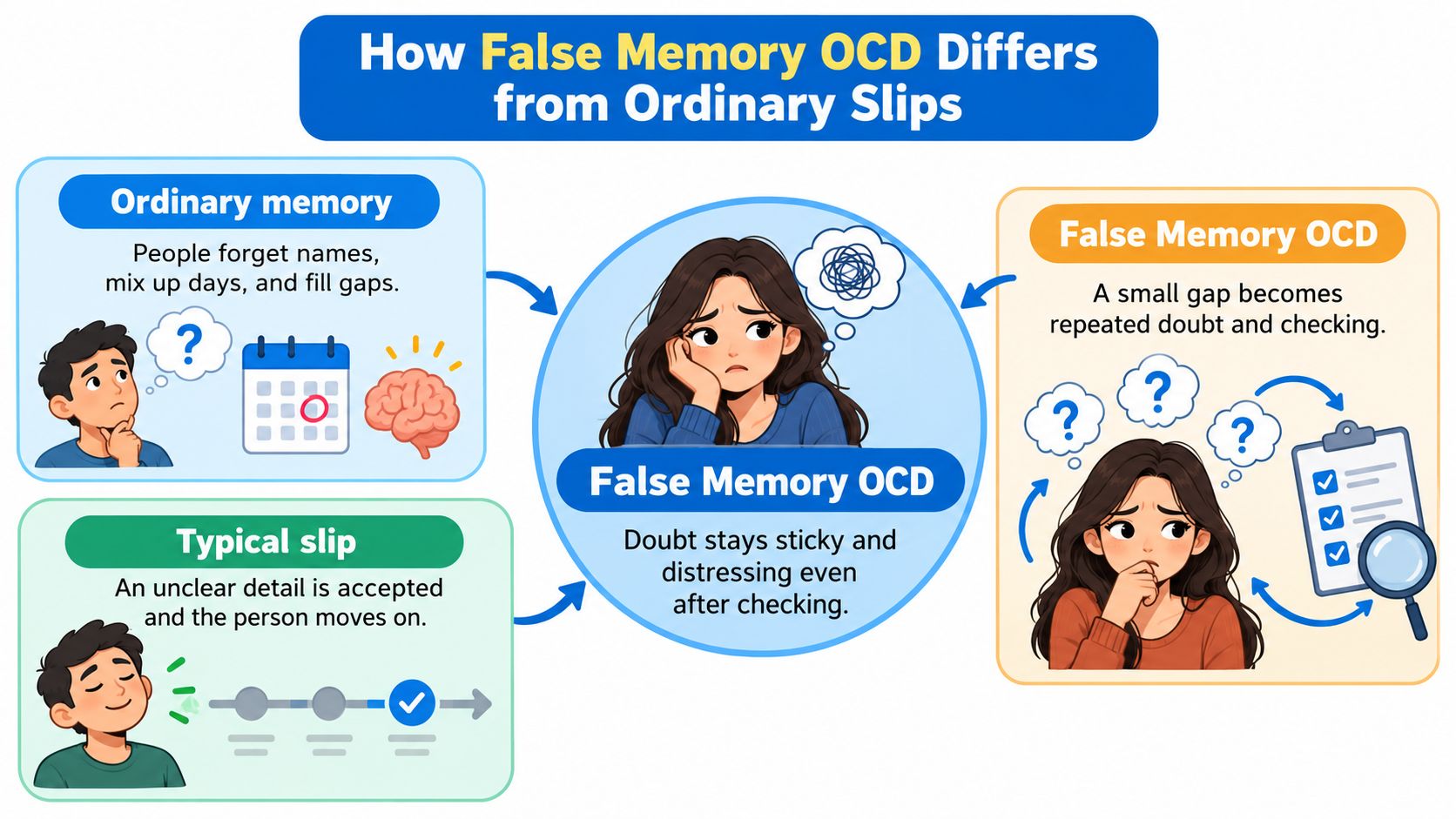
Forgetting a name or mixing up which day a conversation happened isn't, by itself, a sign of OCD. The important distinction is how you respond to the uncertainty, rather than whether your memory contains gaps.
With an ordinary slip, you might check something for a practical reason and then continue your day. In an obsessive doubt pattern, an unclear image, bodily sensation, or what-if impression becomes a demand for certainty that never feels fully satisfied.
The comparison below highlights that difference without offering a diagnostic test.
An alarm isn't an investigation
Think of a sensitive smoke alarm. Its loudness tells you that it has been triggered, but it doesn't identify the source of every smell. Similarly, intense guilt, familiarity, or a vivid mental image doesn't, by itself, establish what happened.
This isn't a reason to dismiss feelings. It's a reason not to ask feelings to do the work of factual evidence. An OCD-informed assessment considers the broader pattern, including repeated checking, reassurance-seeking, avoidance, distress, time spent, and interference with daily life.
The following contrasts can help you describe your experience:
- An ordinary uncertainty: You can leave a detail unresolved without repeatedly returning to it.
- A potentially obsessive pattern: You keep seeking an answer, but each answer produces another qualification or doubt.
- A different clinical concern: You're experiencing memory changes, trauma-related difficulties, or a concrete safety issue that needs its own assessment.
Don't turn the distinction into another test
Trauma memories, neurological memory problems, and concerns about actual events can't be sorted out reliably through an online checklist. An article cannot determine whether an event occurred, and a symptom label shouldn't be used to dismiss a disclosure or explain away new memory difficulties.
You also don't need to repeatedly classify every thought as either ordinary or obsessive. That sorting exercise can become another way of chasing certainty.
Instead, give a qualified professional a broad account of what happens and how it affects you. The aim is an appropriate assessment, not a rule you must apply perfectly whenever a troubling thought appears.
Why the Checking Cycle Keeps Doubt Alive
The confusing part is that checking can help briefly. You reread the message, ask your sister what she remembers, or reconstruct the evening, and your anxiety eases. That relief makes the next check feel reasonable.
But the relief doesn't necessarily last. Another possibility appears: perhaps you missed a message, asked the question badly, or remembered the wrong moment. The broad clinical description of intrusive doubt and repetitive responses emphasises why support needs to address the pattern rather than one feared thought in isolation.
What happens between doubt and relief
The sequence below shows how an understandable attempt to feel safe can become repetitive.
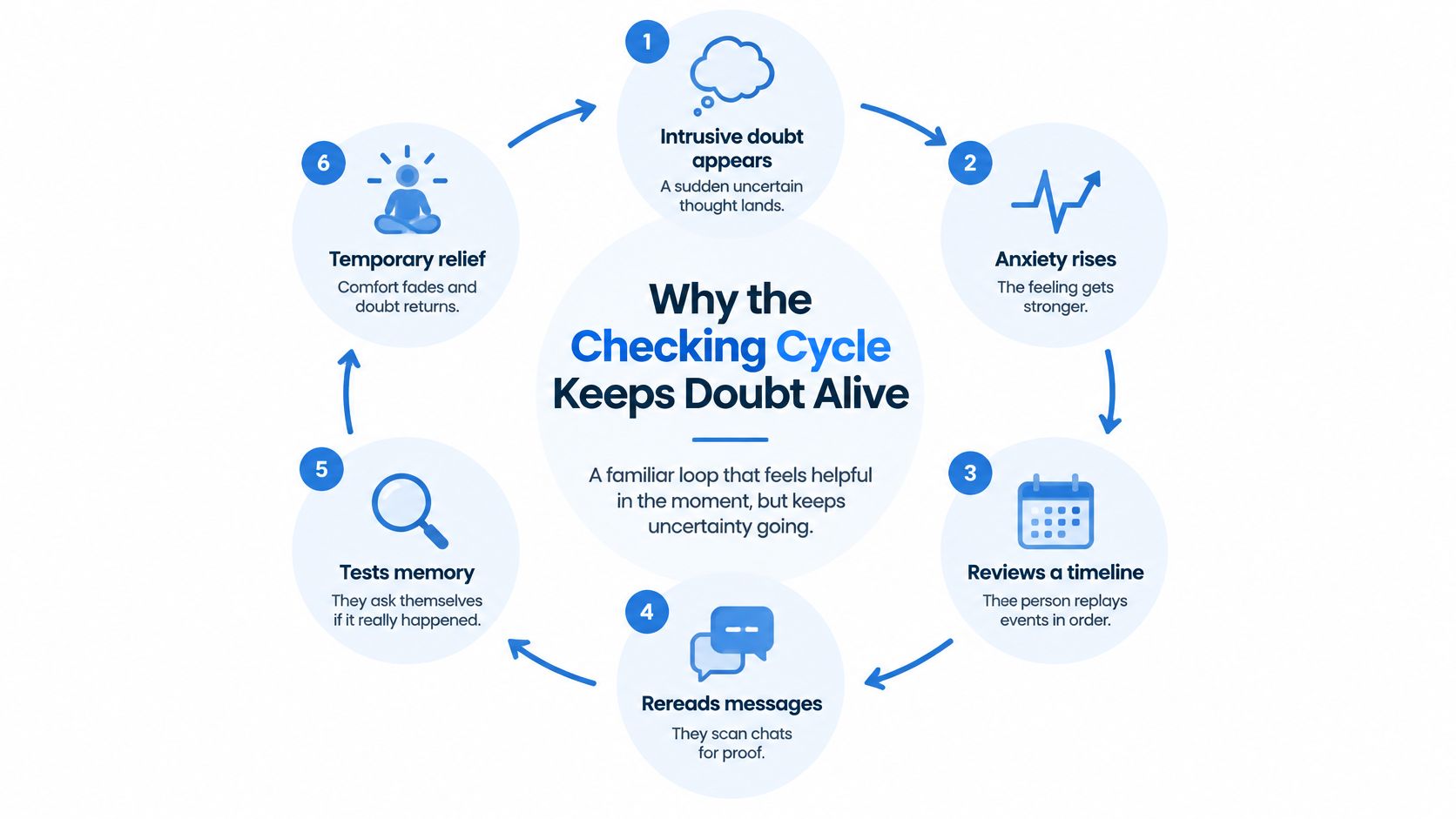
The checking may be visible, such as searching chats or asking questions. It may also happen internally: replaying a scene, testing whether you feel guilty enough, or comparing today's image with yesterday's recollection.
When a person repeatedly responds this way, they can strengthen the expectation that uncertainty must be removed before life can continue. The original fragment receives more attention, and the urge to investigate it becomes harder to leave alone.
Relief after checking is a change in anxiety, not proof about the past.
Why the response matters
The clinical target is therefore the interpretation of the doubt and the checking response, rather than an endless reconstruction of events. This doesn't mean ignoring genuine evidence or refusing sensible responsibility. It means recognising when the investigation has become repetitive and no answer remains sufficient.
Tiredness, anxiety, and stress can make it harder to tolerate unresolved questions. They don't, on their own, explain every intrusive fear or establish an OCD diagnosis.
A compassionate approach makes room for difficulty without self-attack:
- Resilience: Practise continuing a meaningful activity while some uncertainty remains, rather than measuring success by whether you feel completely calm.
- Compassion: Notice that you're struggling instead of treating the struggle as a moral failure.
- Support: Discuss hidden mental reviewing as well as visible checking with a clinician.
These aren't instructions to force yourself through overwhelming distress. They're ways of understanding why professional help may focus on changing your response, rather than supplying a more convincing reassurance.
Real Situations Where the Pattern Shows Up
The following are illustrative situations, not case histories or diagnostic examples. Their shared feature is the amount of attention spent trying to settle an uncertain social moment.
This image brings together some familiar settings for reassurance-seeking.

In college and at home
A student leaves a canteen conversation wondering whether a joke sounded insulting. They ask a friend, then ask again with slightly different wording. By evening, they've postponed an assignment because they're still replaying everyone's expressions.
After a disagreement, a partner repeatedly rereads old chats to work out whether they were dishonest. Their partner answers patiently at first, but the repeated questioning begins to replace ordinary conversation and time together.
In an Indian household, a parent, sibling, or spouse may become the person asked to confirm each detail. Their involvement can be caring and valuable, while repeated certainty-giving can unintentionally become part of the checking pattern.
After a demanding workday
A professional finishes a difficult shift and worries that they sent an offensive message. They check the work group, revisit the sent folder, and mentally rehearse possible consequences instead of resting. The next morning, they avoid a colleague because facing them feels too uncomfortable.
Broader workplace distress belongs in the conversation too. A review of Indian workplace mental-health research describes a survey of 1,764 urban white-collar employees in which 29% showed moderate-to-severe depression symptoms, 55% showed moderate-to-severe anxiety symptoms, and 78% reported moderate-to-high stress.
Those are survey findings, not diagnostic rates, and they don't measure false-memory symptoms. They do provide context for discussing workplace stress, emotional exhaustion, poor sleep, and reduced room for coping alongside the memory doubt.
For another way to engage with the topic, the video below offers an additional viewing option.
A different moment is possible without an instant change in feelings. The student notices the urge to message their friend again, postpones the check, and returns to an assignment while still uncomfortable.
- What matters: They've made room for a valued task, not proved that their memory is accurate.
- What deserves attention: Lost time, avoidance, relationship strain, burnout, anxiety, and depression all belong in a support conversation.
A Practical Way to Decide on Support
You don't need to investigate the memory indefinitely before contacting someone. A brief account of the doubt, your response, and its effect on daily life is more useful than a detailed case for or against the feared event.
Notice the pattern without keeping a dossier
Name the concern in plain words, then notice what you do next. Estimate the disruption broadly rather than timing every thought or recording every detail.
When Memory Doubt Needs Support
| What you notice | More like an ordinary slip | More reason to seek support |
|---|---|---|
| Response to uncertainty | You can leave the detail unresolved | You repeatedly review, check, or ask |
| Effect of an answer | A practical answer is sufficient | Relief fades and another doubt follows |
| Daily activities | You continue with usual tasks | Study, work, sleep, or relationships suffer |
| Avoidance and shame | You can discuss the concern when needed | You withdraw or delay help because of fear |
This comparison is a conversation aid, not a scoring tool. Questionnaires and online assessments are informational, not diagnostic; a qualified professional evaluates symptoms, duration, distress, and daily impact.
Make access part of the plan
Difficulty finding care isn't a personal failure. A Government of India mental-health overview reports that approximately 70%–92% of people with mental disorders don't receive proper treatment, and describes psychiatrist availability of about 0.75 per 100,000 people, compared with a WHO benchmark of at least 3 per 100,000.
Those figures concern mental-health services broadly, not false memory OCD specifically. Practically, you may need to ask about availability, fees, language, privacy, and OCD experience before finding a suitable appointment.
For parents considering how to participate in a child's care, Children Psych's resource on family coaching for childhood OCD offers a relevant topic to discuss with the treating professional. Family support should be adapted to the child rather than becoming repeated interrogation about what happened.
Safety exception: Abuse disclosures, genuine safeguarding concerns, new neurological symptoms, or immediate danger need appropriate professional assessment. They must not be waved away as OCD.
If distress or interference keeps recurring, that's enough reason to seek an OCD-informed conversation. You don't have to reach a final conclusion about the feared memory first.
Choosing Therapy and Care That Can Fit
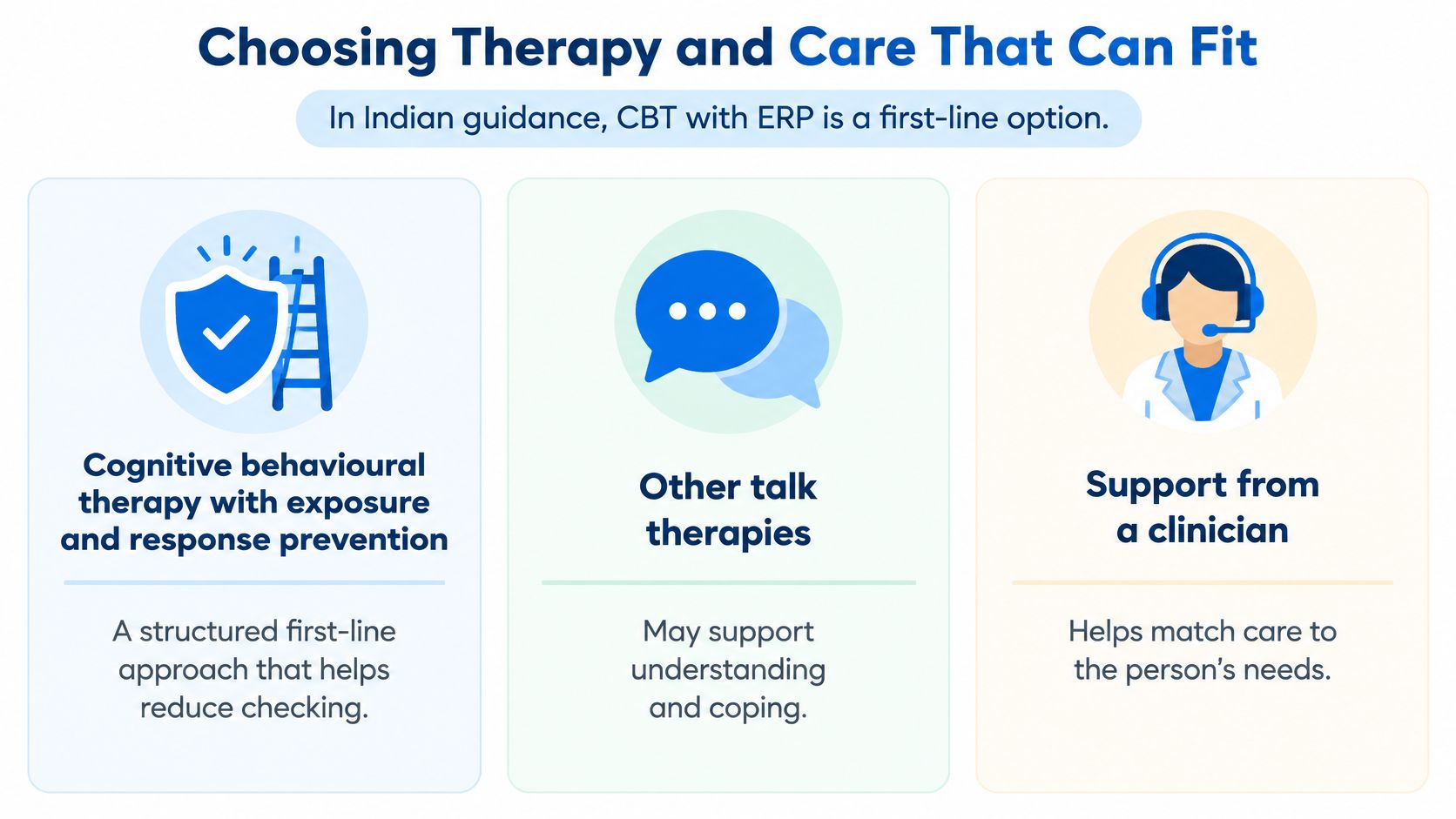
Cognitive behavioural therapy with exposure and response prevention, usually called CBT with ERP, is a first-line OCD intervention in Indian clinical practice guidelines. For mild-to-moderate OCD, it may be used alone when trained care is available; more severe presentations often need medication alongside therapy.
In everyday terms, ERP involves practising contact with uncertainty while reducing checking, reassurance-seeking, or other neutralising responses. A clinician helps plan this work, rather than asking you to overwhelm yourself or disregard genuine risks.
The options below place structured OCD treatment alongside broader support.
Match the setting to your needs
In-person appointments may suit someone who lacks privacy at home. Video sessions may make specialist care more reachable, but shared rooms, unstable internet, and difficulty speaking freely can affect participation.
Family agreements can help clarify how relatives will offer warmth without repeatedly answering the same certainty-seeking question. Medication decisions and reviews belong with an appropriate prescribing clinician, especially when symptoms remain severe or other conditions complicate treatment.
An Indian pilot study of videoconferencing ERP included 97 people with OCD, reporting 11% refusal, 19% dropout, and treatment failure in 29% of treatment-resistant cases. Its 20 completers reportedly showed an 85% reduction in Yale-Brown scores, with gains maintained for more than two years, but this pilot doesn't establish that remote care is universally equivalent to specialist in-person treatment.
Ask about expertise and practical arrangements
General counselling may offer emotional support, while OCD-focused work needs attention to hidden compulsions such as mental reviewing. Ask how the clinician would address reassurance without making sessions another investigation of the past.
Useful appointment questions include:
- Experience: How do you treat mental reviewing and memory-related doubt?
- Privacy and language: Can sessions happen in a language I'm comfortable with, and what can we do if I'm overheard?
- Continuity: What happens if the connection drops or I struggle between appointments?
- Level of care: When would medication review or more intensive specialist support be appropriate?
One directory option is DeTalks, where people can find psychologists, therapists, and counsellors and book sessions. It also provides science-backed informational assessments and self-help material on resilience and well-being, but screening doesn't diagnose OCD or replace an individual assessment.
Supportive Next Steps for Well-Being
You may still feel uncertain after reading about false memory OCD. That doesn't mean you've failed to understand it, and you don't need to keep rereading until every doubt disappears.
The useful takeaway is a different stance towards the difficulty: take your distress seriously without treating every strong feeling as a verdict. Support can make room for both clinical needs and the ordinary parts of life you miss.
Choose an action rather than a certainty test
Name a valued action for the next hour. You might eat with your family, return to a manageable piece of work, or sit with a friend without asking them to analyse the memory.
Let the action be worthwhile in its own right. Don't repeat it until you feel safe, use it to test your character, or judge it by whether the thought disappears.
- Protect the basics: Include sleep, manageable boundaries around workplace stress, and room for rest in your care conversation.
- Allow enjoyment: Happiness doesn't need to wait until every difficult thought has been resolved.
- Speak kindly: Compassion can mean acknowledging that today is difficult without demanding immediate progress.
Reading can also be a gentle leisure activity rather than another search for answers. Soulknit's selection of comforting stories of companionship offers an option when you'd like a break from symptom-focused material, not a substitute for care.
Bring the impact into the appointment
When you contact a therapist or counsellor, describe the checking and its consequences, not only the feared event. Mention missed sleep, delayed tasks, repeated questions, avoidance, and any accompanying depression or anxiety.
Screening remains informational, and no article can diagnose you or promise a cure. Urgent danger, safeguarding concerns, abuse disclosures, or neurological changes need direct professional help rather than self-management alone.
Resilience is a direction, not a test you must pass today. Taking a practical step towards support can count even while you're unsure.
DeTalks offers a directory of mental-health professionals, session booking, and informational assessments to help you explore support for intrusive doubts and repeated checking. Visit DeTalks to browse qualified therapists or counsellors, and ask about experience with OCD and ERP before booking.
Leave a Reply