
Being in a relationship with a person who has narcissistic traits can be a confusing and draining experience. It often leaves you questioning your reality and self-worth. This dynamic can create an imbalance where their needs consistently overshadow yours, pulling you into a cycle of highs and lows.
What a Relationship with a Narcissist Can Feel Like

If you constantly feel on edge or exhausted by your partnership, please know those feelings are valid. Being with a partner with narcissistic traits can feel like being a passenger in a car where the driver keeps changing the destination without telling you. It can leave you feeling disoriented and powerless.
At its core, this kind of relationship often involves a significant power imbalance where your partner's need for admiration sets the rules. This dynamic can lead to serious emotional distress, contributing to anxiety, chronic stress, and eventually, burnout.
The Emotional Rollercoaster
Many of these relationships start with an intense and exciting "idealisation" phase, where they shower you with affection. You might feel like you've found your soulmate. This initial connection can feel incredibly strong and validating.
Then, the dynamic can shift, and the person who once praised you may begin to criticise or devalue you. This sudden change is jarring and can leave you scrambling to regain their approval. It's a difficult cycle that can impact your mental health.
"The end of a relationship with a narcissistic partner is unlike any other breakup. It involves shattering an entire reality. Yet, in that shattering, there is a profound opportunity for healing and rediscovering yourself."
This cycle of idealisation and devaluation is a common pattern in a narcissist in relationships. It is an emotional rollercoaster designed to keep you seeking their approval, often at a great cost to your own well-being.
Building Resilience and Finding Clarity
Understanding these patterns is a crucial first step toward reclaiming your sense of self. It's not about diagnosing your partner but about recognising how the dynamic is affecting you. This awareness is where you can begin to build resilience and practice self-compassion.
What you are experiencing is real, and your feelings are normal reactions to a challenging situation. Acknowledging this truth is your first move toward healing, often with the support of professional counselling or therapy.
Recognising the Red Flags of a Narcissistic Partner
Identifying the specific behaviours of a narcissistic partner can be difficult. You might have a nagging feeling that something is wrong but struggle to pinpoint it. Let's break down some common red flags to help you connect the dots.
These patterns often start in a way that feels wonderful, which makes them hard to spot. Over time, however, these behaviours can reveal a cycle designed to control rather than connect. Recognising them is the first step toward protecting your emotional health.
The Dazzling Start: Love Bombing
At the beginning, you may be swept off your feet by an overwhelming display of affection known as love bombing. You are placed on a pedestal and celebrated as the perfect partner. This intense idealisation is meant to forge a powerful bond very quickly.
You might receive extravagant gifts or hear declarations of love much sooner than feels natural. While it can seem like a fairy tale, this phase often lays the groundwork for future manipulation. It’s the "too good to be true" stage that can make it so painful to leave later.
The Mind Game: Gaslighting
After the initial high, you may notice a disturbing shift where your reality is questioned. Gaslighting is a manipulation tactic that can make you doubt your own perceptions, memories, and sanity. It is a slow erosion of your self-confidence.
For example, your partner might deny saying something you clearly remember, using phrases like, "You're just being too sensitive." Over time, this constant invalidation can lead to significant anxiety and a sense that you can no longer trust your own judgment.
This tactic is particularly damaging because it isolates you from your own intuition. When you can no longer trust what you know to be true, you may become more dependent on the person causing the confusion.
Understanding what a healthy emotional connection looks like can highlight the lack of emotional availability common in these dynamics. Learning how to be more emotionally available can offer a helpful contrast.
The Slow Erosion: Devaluation and Criticism
Once the love-bombing phase has you emotionally invested, a pattern of devaluation often begins. The same person who once adored you may now find fault in everything you do. It can start subtly with backhanded compliments or small jabs disguised as jokes.
This often escalates to overt criticism about your appearance, intelligence, or choices. A partner might praise you in public but dismiss your feelings or tear down your achievements in private. This behaviour can chip away at your self-esteem, leading to feelings of anxiety and depression.
The Three-Phase Cycle
The dynamic with a narcissist in relationships often follows a predictable cycle. Understanding these stages can help you see the bigger picture and realise the shifts in behaviour are part of a pattern, not a reflection of your worth.
The Narcissistic Relationship Cycle Explained
This table breaks down the three main phases of a relationship with a person with narcissistic traits to help identify recurring patterns.
| Phase | Their Behaviour (What You See) | Your Feeling (How It Impacts You) |
|---|---|---|
| Idealisation | Intense praise, over-the-top affection, and constant attention. They present themselves as your perfect match. | Euphoric, seen, and deeply loved. You feel an incredibly strong, almost magical connection. |
| Devaluation | Non-stop criticism, dismissal of your feelings, and gaslighting. The praise vanishes, replaced by fault-finding. | Confused, anxious, and inadequate. You're always on edge, trying to win back their approval. |
| Discard | Abruptly ending things, often with shocking cruelty and blame. They might just disappear without a word. | Shocked, heartbroken, and worthless. You are left feeling completely abandoned and disposable. |
This cycle rarely ends with the discard and can repeat, reinforcing an unhealthy attachment. Understanding this cycle is a crucial step toward finding support to build your resilience and protect your well-being.
The Toll on Your Mental and Emotional Well-Being
Being in a relationship with a narcissistic partner can slowly erode your sense of self. It takes a profound toll on your mental health, leaving an emotional weight that feels heavy to carry alone. Recognising this impact is a compassionate first step toward healing.
The constant cycle of being put on a pedestal only to be torn down can create chronic unease. This emotional rollercoaster often leads to persistent anxiety, as your nervous system remains on high alert. It is an exhausting way to live.
This destructive pattern is often visualised as a cycle of love bombing, devaluing, and discarding.
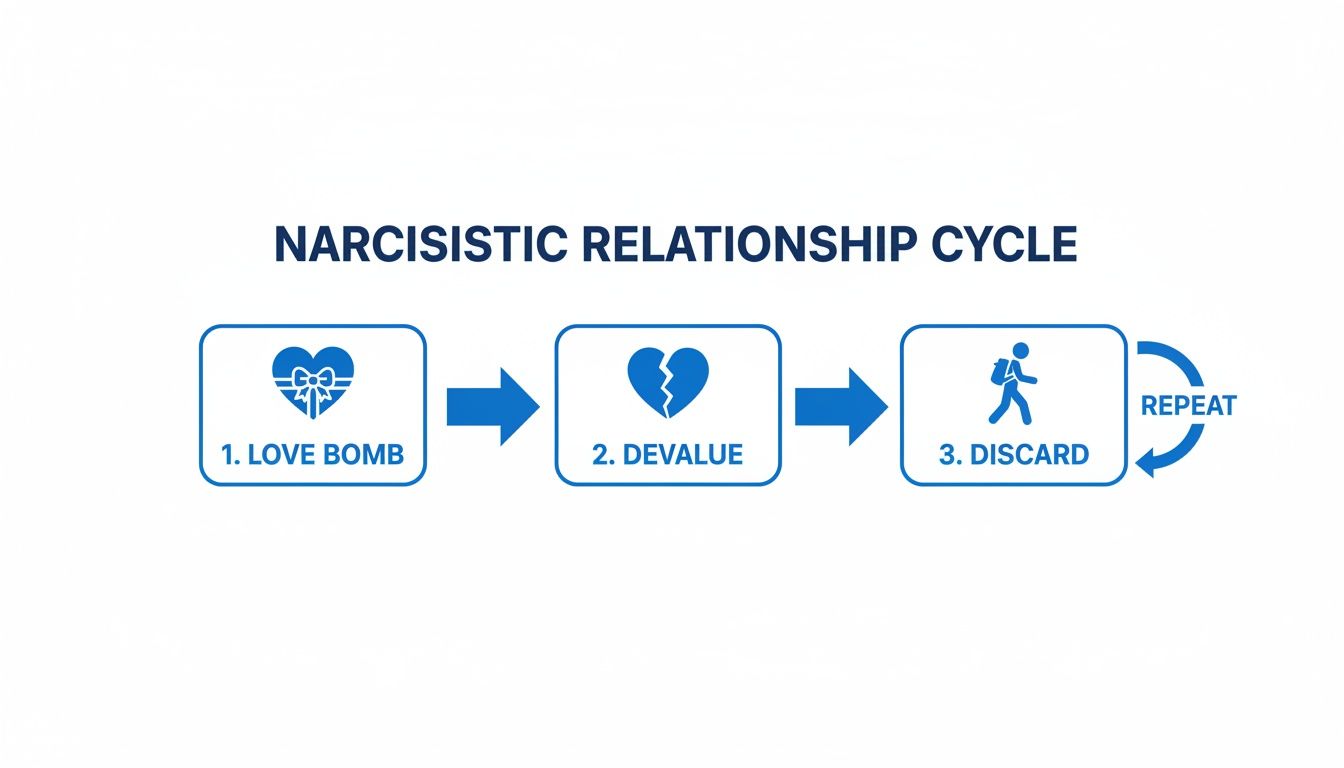
Seeing this laid out can help you realise that these behavioural shifts are part of a predictable pattern—they are not a reflection of your worth.
From Anxiety to Burnout
Over time, living in this heightened state of stress can lead to something deeper than just worry. Many people experience symptoms of depression, like a persistent low mood and a loss of interest in things they once loved. Your world can start to feel smaller.
This prolonged emotional strain can eventually lead to complete burnout, a state of emotional, physical, and mental exhaustion. It might feel like you have nothing left to give—not to your partner, your work, or even yourself.
In a relationship with a narcissist, your emotional needs may be consistently dismissed. This invalidation can chip away at your self-esteem and make you question your own perceptions of reality.
This erosion of confidence is a significant blow to your overall well-being. It can even spill over into your professional life, increasing workplace stress and feeding a sense of inadequacy.
Understanding the Impact as Trauma
It can be helpful to view the effects of such a relationship through the lens of trauma. This is not about assigning a diagnosis but acknowledging that prolonged emotional distress is a genuinely traumatic experience. Your body and mind are having a normal reaction to an abnormal situation.
Complex trauma can develop from the repeated emotional harm common in these relationships. Recognising these responses as trauma-related can be incredibly validating. It helps shift your perspective from, "What's wrong with me?" to, "What happened to me?" which is a powerful step toward self-compassion.
Cultivating Resilience and Happiness
Despite the immense challenges, remember your capacity for healing and resilience. Resilience is about integrating your experiences and growing stronger because of them. You can learn to rebuild your self-worth and find happiness again.
This journey starts with small, intentional acts of self-care. It involves reconnecting with hobbies, friends, and activities that bring you joy. Every step you take to prioritise your own well-being is an act of reclaiming your life.
Understanding Narcissistic Traits Versus NPD
It's helpful to distinguish between someone showing narcissistic traits and someone who has Narcissistic Personality Disorder (NPD). The difference is like feeling sad versus experiencing clinical depression. This distinction helps in navigating the situation with clarity and empathy.
Most of us can be selfish or crave attention at times, especially under stress, but these moments don't define a personality disorder. Human behaviour exists on a spectrum. This helps us avoid labels while still acknowledging the pain that a narcissist in relationships can cause.
The Spectrum of Narcissism
Think of narcissism as a continuum, with healthy self-esteem at one end and NPD at the other. NPD is a mental health condition defined by a pervasive pattern of grandiosity, a need for admiration, and a lack of empathy. Most people fall somewhere in the middle, occasionally showing traits like self-absorption.
For example, a colleague under intense workplace stress might become unusually self-centred for a short period. While their behaviour might be hurtful, it is different from the destructive patterns of NPD that affect all aspects of a person's life.
Disclaimer: It is important to remember that only a qualified mental health professional can make a formal diagnosis. This guide is informational and intended to empower you, not to serve as a diagnostic tool.
Why the Distinction Matters for Your Healing
Understanding this distinction is not about excusing hurtful behaviour but about protecting your mental health from anxiety and burnout. When you understand what you are dealing with, you can set realistic expectations. This clarity helps you focus on what you can control: your responses, boundaries, and path to resilience.
This knowledge is the first step toward getting the right kind of help. Whether you are dealing with someone with strong narcissistic traits or someone who may have NPD, professional counselling can provide you with valuable tools. A therapist can help you develop coping mechanisms and rebuild your self-worth.
Practical Strategies for Setting Boundaries and Coping

Moving from understanding to action is a major step in reclaiming your life. Setting boundaries with a narcissist in relationships can feel intimidating but is essential for your well-being. The key is to start with small, manageable steps.
These strategies are not about changing your partner but about changing how you interact with them. By creating emotional distance and setting clear limits, you can shield yourself from the constant impact of their behaviour. This process helps you manage the anxiety and stress these dynamics often create.
Establishing Clear and Firm Boundaries
The first step in setting a boundary is defining your limit and communicating it calmly and firmly. Using "I" statements helps you express your needs without starting a conflict. This approach focuses on what you will do, which is within your control.
For instance, instead of saying, "You can't yell at me," try framing it as, "I am not willing to continue this conversation if you're yelling." Sticking to your boundary is crucial. Each time you enforce it, you reinforce its importance to both them and yourself.
The Grey Rock Method
When dealing with manipulation, the "Grey Rock Method" can be an effective technique. The goal is to become as uninteresting as a plain grey rock. This means keeping conversations short, factual, and emotionally neutral.
A person with narcissistic traits often thrives on emotional reactions. By not providing that reaction, you become a less satisfying target. The Grey Rock Method is a powerful tool for disengaging and reducing the daily stress of the interactions.
"Your healing cannot and should not be rushed. The depth of your pain reflects what you endured. Honour that by giving yourself permission to take all the time you need."
This approach protects your inner peace by allowing you to opt out of their emotional chaos. It is a quiet act of resilience that conserves your energy for your own healing.
Rebuilding Your Support System and Self-Worth
Relationships with narcissistic partners can be isolating, which makes reconnecting with your support system vital. Reach out to trusted friends and family who see and value you. Rebuilding these connections is a powerful reminder of who you are outside the relationship.
At the same time, consciously invest in things that bring you joy. This could be joining a class, reviving a hobby, or spending time in nature. These activities are concrete steps toward rebuilding the self-esteem that may have been eroded.
Creating a Safety Plan
If you ever feel emotionally or physically unsafe, creating a safety plan is the top priority. This is a practical and empowering step to ensure you are protected. A therapist or a domestic violence support service can be invaluable in this process.
A safety plan might include identifying a safe person to call or a safe place to go. It could also involve keeping a small bag with essentials in a secure location. Taking these steps can help you regain a sense of control in a chaotic environment.
How to Find the Right Professional Support
Choosing to seek professional help is a profound act of self-care and strength. If you are constantly on edge, battling anxiety, or feel you’ve lost yourself, it may be time to talk to someone. These feelings are valid signals that you need support.
In India, conversations around mental health are becoming more open, making it easier to seek help. Choosing therapy or counselling is a courageous move toward healing. It offers a safe space to process your experiences and develop tools for lasting resilience.
When Is It Time to Seek Help?
Knowing when to reach out is a personal decision, but some common signs include persistent self-doubt or a feeling of sadness you can't shake. If stress from your relationship is affecting other areas of your life, such as your work or friendships, that is another key indicator. Professional guidance may be helpful if you feel alone, anxious, or have lost touch with your own needs.
Finding a therapist is not about admitting defeat; it’s about investing in your well-being and future happiness. A good counsellor can act as a guide, helping you find your way back to yourself.
Finding a Therapist Who Understands
When dealing with a narcissist in relationships, finding the right therapist is key. It is important to find someone experienced in narcissistic abuse, complex trauma, and difficult relationship dynamics. Not all therapists have this specialised training, so feel empowered to be selective.
As you search, look for professionals who list these areas as specialities. Platforms like DeTalks can simplify this process by allowing you to filter therapists by their expertise. This helps ensure you connect with someone who understands the nuances of what you are facing.
Disclaimer: Online psychological assessments are informational, not diagnostic. A formal diagnosis can only be provided by a qualified mental health professional, but these tools can offer valuable insights for your first therapy session.
Questions to Ask a Potential Counsellor
Before committing to sessions, it is a good idea to have an initial chat with a potential therapist. This is your chance to see if their approach feels right for you. You deserve to feel heard, respected, and comfortable.
Here are a few questions you could ask:
- What is your experience working with clients who have been in relationships with narcissistic individuals?
- Which therapeutic approaches do you use for issues like complex trauma, anxiety, and rebuilding self-esteem?
- How do you create a safe and non-judgmental space for your clients?
- Can you explain how you help someone learn to set boundaries and build resilience?
Healing is a journey, not a race, focused on rediscovering your strength and practicing self-compassion. The right professional support can provide a roadmap, guiding you toward a healthier, more peaceful life.
Frequently Asked Questions
When you are dealing with the effects of a narcissistic relationship, it is normal to have many questions. It's common for the same doubts and fears to surface repeatedly. Let’s walk through some of them to help you find more clarity.
Can a Narcissist Change for Someone They Love?
In theory, anyone can change, but for someone with deep-seated narcissistic patterns, it is a very difficult and rare process. Real, lasting change requires significant self-awareness and a strong commitment to long-term therapy. The desire for change must come from within them, not from external pressure.
Am I to Blame for What Happened?
No, you are not to blame. After experiencing gaslighting, it is natural to feel guilt or wonder if you could have done something differently. However, the manipulation and control tactics used by a narcissist are about their needs, not your worth or actions.
Your reactions were normal for someone in a confusing and challenging situation. Feeling hurt, trying to fix things, or getting angry does not make you the problem. Practicing self-compassion is an important first step in healing.
How Do I Heal After Leaving a Narcissistic Relationship?
Healing is a gradual journey of returning to yourself and rebuilding your emotional well-being. The path often includes giving yourself permission to grieve, reconnecting with your support system, and creating emotional safety through boundaries. Working with a professional counsellor can help you process the experience and build resilience.
This process is about rediscovering who you are and learning to trust yourself again. It is about moving toward a future where you can experience genuine happiness and peace.
If you are struggling and need someone to talk to, DeTalks can connect you with therapists who understand narcissistic abuse. Start your healing journey by visiting https://detalks.com today.
Leave a Reply