
You may be answering emails late into the evening, waking with a tight chest, or losing interest in things that once made you happy. Perhaps you've searched for an online psychiatry consultation because travelling to a clinic feels difficult, privacy matters, or you're unsure whether your symptoms are “serious enough” to deserve professional support.
You don't need to wait until life becomes unmanageable. Online care can offer a structured way to discuss anxiety, depression, workplace stress, burnout, sleep changes, or persistent low mood with a qualified professional. It can also become part of a longer plan for therapy, counselling, medication review, resilience, and overall well-being.
Understanding Your Mental Health Needs
Consider a person who keeps saying, “I'm just tired.” Their workload has increased, sleep feels broken, and small decisions now feel overwhelming. They may still be attending meetings and caring for family, but inside they're struggling with anxiety and a growing sense of disconnection.
That experience deserves attention even if the person is still functioning. Mental health concerns often appear gradually, and early support can help someone understand patterns before distress begins to control work, relationships, or daily routines.

Understanding support without self-diagnosis
An online psychiatry consultation is a medical appointment with a psychiatrist through a digital platform. The clinician listens to your concerns, asks about your symptoms and history, considers safety, and discusses appropriate care. Depending on the assessment, that care may include therapy, counselling, lifestyle support, medication, or referral for in-person evaluation.
Online assessments and screening tools serve a different purpose. They can help you notice patterns in mood, anxiety, stress, sleep, personality, or resilience, but they're informational, not diagnostic. A score can suggest that a conversation with a professional may be useful. It can't establish a diagnosis or determine medication by itself.
A useful rule: Use an assessment to prepare for care, not to label yourself.
Mental health care also involves more than reducing symptoms. Positive psychology asks how people build compassion, purpose, emotional balance, happiness, and resilience alongside treatment for distress. Someone may seek help for depression while also wanting to rebuild confidence, reconnect with friends, or regain pleasure in ordinary activities.
For readers in India, online care can be a practical first step when specialist access, travel, work schedules, or stigma create barriers. It's also globally relatable. People everywhere need support that fits real lives, while still meeting professional and safety standards.
How Telepsychiatry Works in India
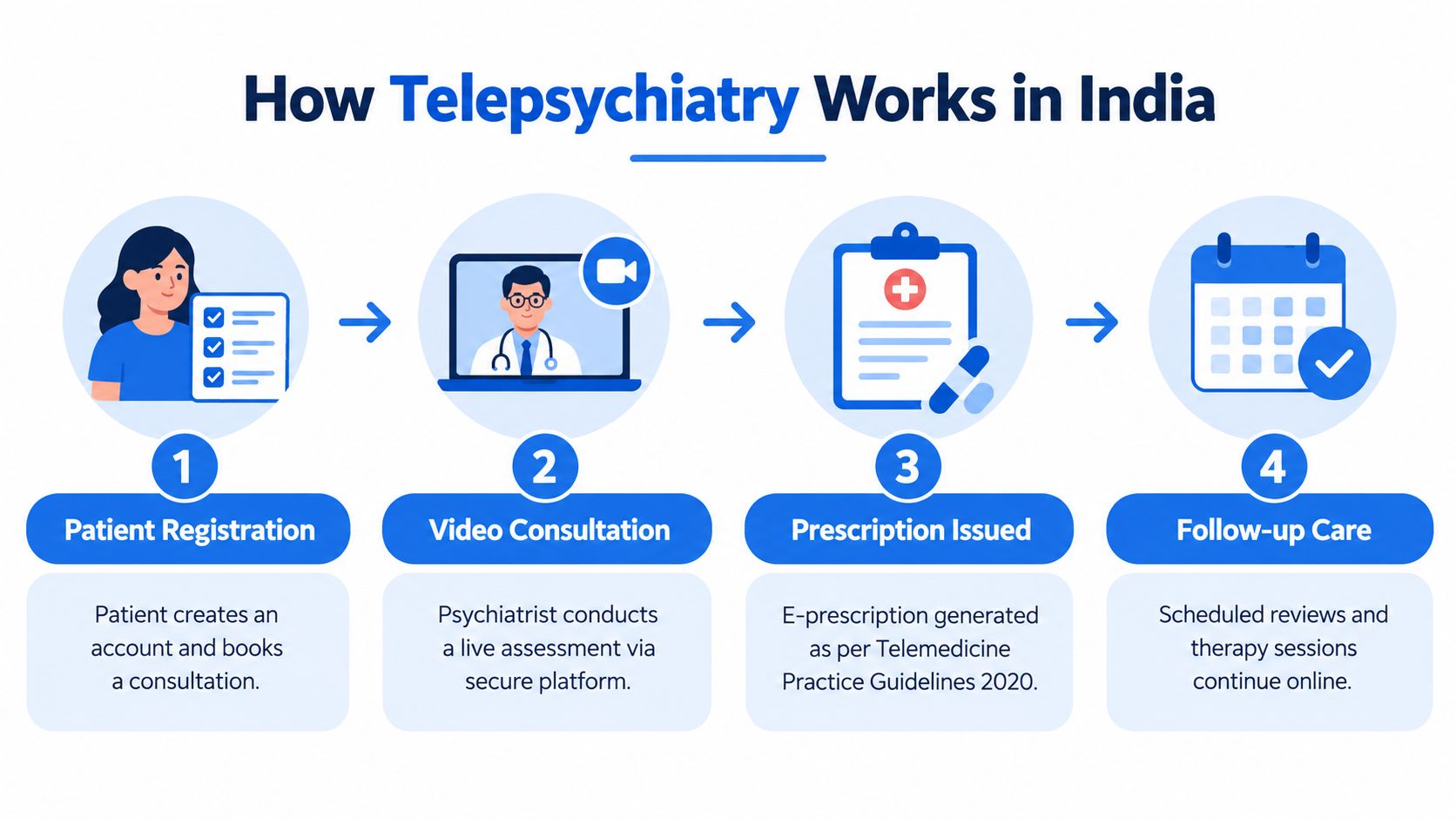
India formally made telemedicine consultations legally permissible on 25 March 2020, when the Ministry of Health and Family Welfare issued the Telemedicine Practice Guidelines. Those rules created the regulatory basis for online psychiatry consultation across the country. The framework was expanded in 2020 through the Indian Psychiatric Society, the Telemedicine Society of India, and NIMHANS, which released the Telepsychiatry Operational Guidelines-2020. The Indian Journal of Psychiatry explains India's telemedicine framework.
The process usually begins with registration, identity and consent procedures, and a booked appointment. A psychiatrist then speaks with you through an approved digital channel, gathers relevant medical and personal information, discusses safety, and decides whether remote care is suitable.
What the medicine categories mean
The operational guidelines created a prescribing structure with four medicine categories, known as Lists O, A, B, and C. The category affects whether and how a medicine may be prescribed through telemedicine. Patients don't need to memorise these lists, but they should understand that an online psychiatrist can't prescribe every medicine in every situation.
For first-time prescribing of List A medicines, the guidelines require a live video consultation. This requirement allows the psychiatrist to assess the patient directly before making a decision. A prescription, when clinically appropriate, must follow the applicable rules and include the required professional details.
Follow-up care has more flexibility. Under defined conditions, follow-up consultations may take place through audio, text, or video. Tele-follow-up means the patient is seeing the same clinician for the same condition within six months of a previous in-person visit, an important provision because it recognises ongoing psychiatric care rather than limiting telepsychiatry to emergencies.
What to expect from the appointment
Your psychiatrist may ask about mood, anxiety, sleep, concentration, appetite, relationships, work, past treatment, physical health, medicines, alcohol or substance use, and thoughts about safety. You can also ask how the proposed treatment works, what side effects to watch for, how follow-up will happen, and when an in-person review might be needed.
A stable internet connection and a private space support better communication. If you're learning how remote healthcare platforms work more broadly, TOOLii's guide to remote care offers useful context about digital consultation design and patient access.
Choosing Between Helplines and Private Care
Not every mental health need calls for the same doorway. A helpline can provide immediate listening, counselling, triage, and direction. A private online psychiatry platform may be more appropriate when you need a detailed assessment, a consistent clinician, medication management, or a planned course of therapy and follow-up.
India's Tele-MANAS programme was launched on 10 October 2022 as the national tele-mental-health service. It provides free, 24/7 access through 14416 and 1800-89-14416, with counselling, video consultations with specialists, e-prescriptions, follow-up services, and linkage to in-person care. The Directorate General of Health Services describes Tele-MANAS services and access.
| Feature | National Helplines, e.g. Tele-MANAS | Private Online Psychiatry Platforms |
|---|---|---|
| Main purpose | Immediate support, counselling, triage, and escalation | Structured assessment, treatment planning, and continuity |
| Cost | Free through the national service | Fees vary by practitioner or platform |
| Clinician continuity | May depend on service pathways and availability | You can usually seek an ongoing relationship with a chosen clinician |
| Suitable for | Acute distress, uncertainty about where to start, and referral guidance | Chronic anxiety, depression, medication review, therapy, and planned follow-up |
| Care pathway | Can connect callers with specialists or local services | Can coordinate online reviews and recommend in-person care when needed |
Choosing the right starting point
Call a helpline when you feel overwhelmed, need someone to speak with promptly, or aren't sure what kind of help is suitable. It can be especially useful when you need triage rather than a long-term treatment decision.
Book an online psychiatry consultation when symptoms have persisted, repeatedly interfere with daily life, or require monitoring. Ongoing depression, recurring anxiety, burnout, medication questions, and changes in sleep or functioning usually benefit from a planned relationship with a mental health professional.
If you may act on thoughts of self-harm, feel unable to stay safe, or face an immediate medical emergency, prioritise emergency services and nearby trusted people. An article, screening tool, or routine appointment isn't a substitute for urgent help.
Real World Benefits and Clinical Limits
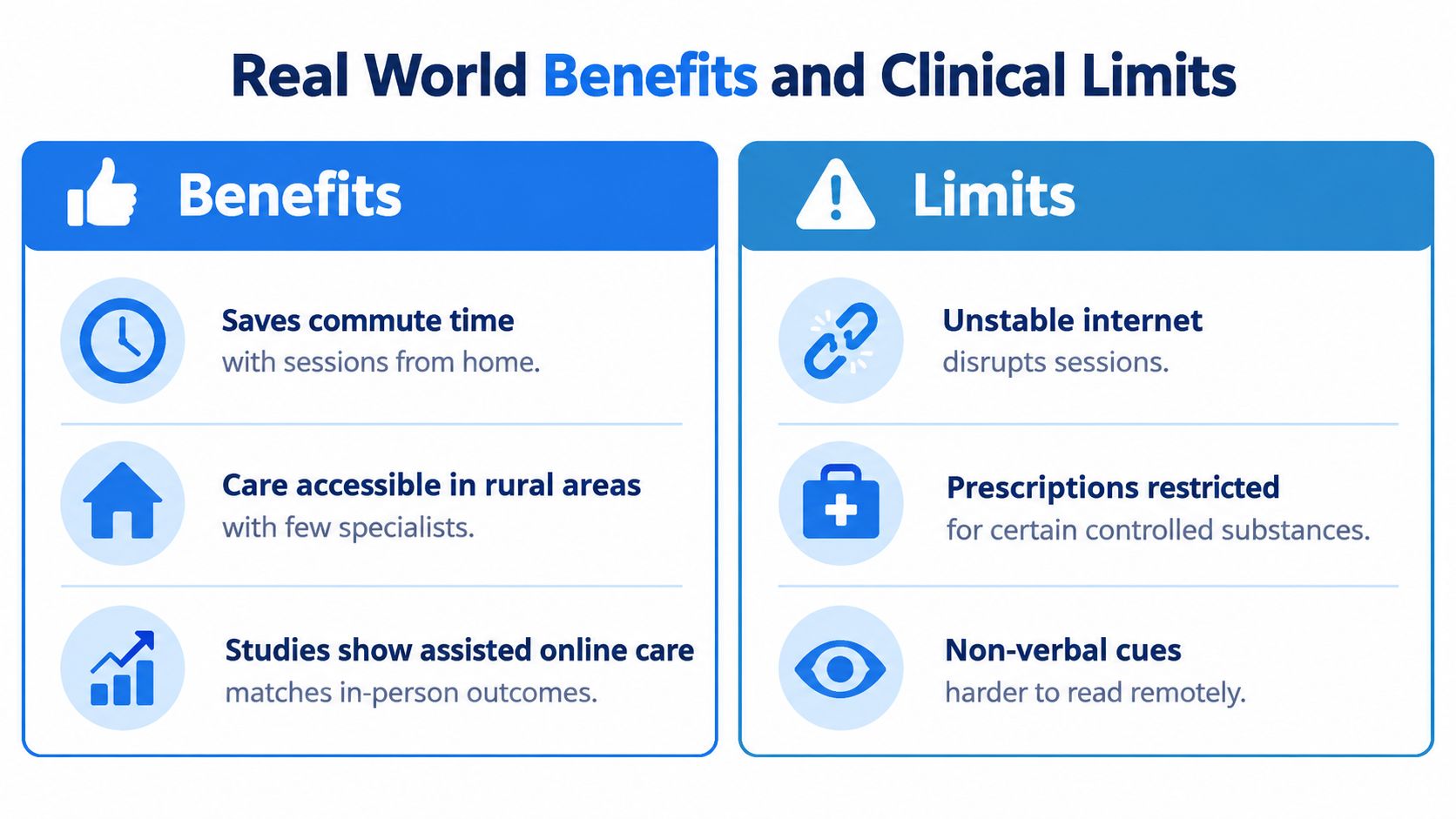
Remote care can produce clinical improvement, not just convenience. In a feasibility study from Goa, patients receiving assisted tele-consultations had statistically significant reductions in GHQ-12 and WHODAS 2.0 scores from baseline to follow-up, indicating lower psychological distress and disability. The Goa feasibility study examines assisted telepsychiatry in primary healthcare.
A separate India-based routine-care study reported that 81% of participants had a planned discharge, while psychological distress and disability also fell significantly during follow-up. In that study, 58 of 126 patients received psychiatrist-only tele-consultation, showing how remote psychiatric support can operate through both assisted and more direct models. The wider lesson is that remote care works best when the service matches the person's circumstances.
Where online care helps
A video appointment can remove travel demands and make it easier to fit care around work, study, parenting, or physical limitations. It may also connect people in rural areas with specialists who aren't available nearby.
Assisted telepsychiatry adds another layer of support. A local health worker or care coordinator can help with technology, medication routines, symptom observation, and follow-up. That local connection can be valuable when someone has limited digital confidence or needs help translating a treatment plan into daily habits.
Where it needs care
Some people communicate more comfortably in person. A 2022 survey of practising psychiatrists found that 67.06% still felt in-person consultation was better, even though telepsychiatry use had become widespread. The same survey reported smartphone use by 76.47% of respondents, audio consultations by 57.65%, and electronic prescription use by 73.4%. The Indian Journal of Psychiatry reports these findings on telepsychiatry practice in India.
Poor connectivity, lack of privacy, limited access to devices, and difficulty reading non-verbal cues can reduce the quality of a session. Older adults and people in rural areas may need practical assistance. A psychiatrist may also recommend in-person assessment when symptoms, medication risks, physical health concerns, or safety issues require it.
Making Telepsychiatry Stick Long Term
Booking the first appointment is only the beginning. Convenience may help someone start treatment, but it doesn't automatically create the trust, routine, privacy, and continuity needed for chronic conditions.
A 2025 mixed-methods study of 165 telepsychiatry patients in north India found a 56.4% dropout rate after physical outpatient departments reopened. Participants described brief sessions, changing doctors, privacy problems at home or work, technology barriers affecting older or rural users, and higher local pharmacy costs as reasons for leaving care. The study on telepsychiatry dropout in north India is available through PubMed.
Build continuity into the plan
Ask whether you can continue with the same psychiatrist for the same condition. Familiarity helps the clinician understand changes over time, while you won't need to retell your entire history at every appointment.
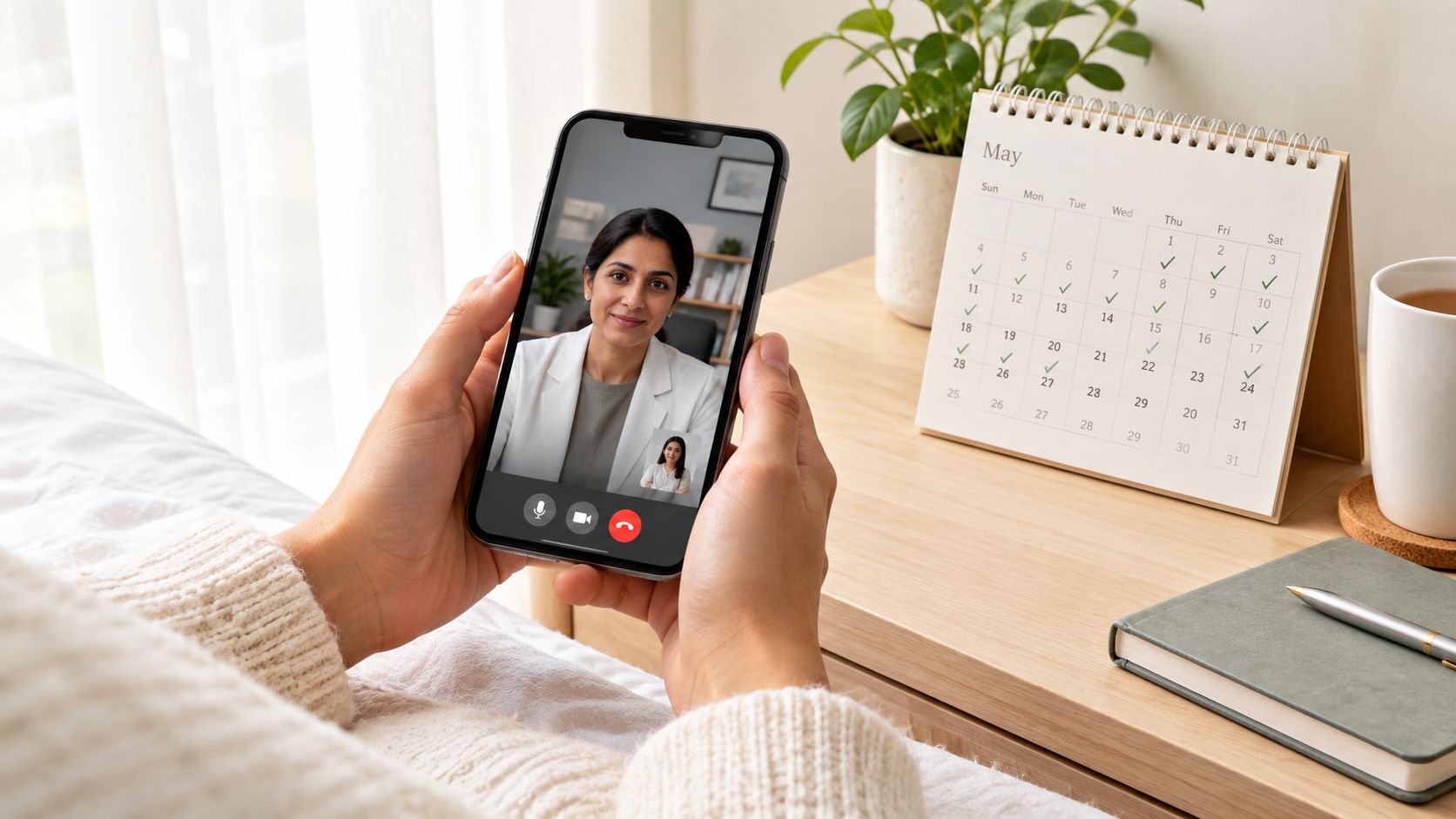
Discuss the follow-up rhythm before ending the first session. Put reviews in your calendar, clarify how prescriptions will be renewed, and ask what to do if you experience side effects, worsening symptoms, or a technology problem.
Practical rule: A treatment plan should include the next point of contact, not just the first appointment.
Privacy deserves equal attention. A bedroom may not be private if family members enter without warning, and a workplace may not be suitable if colleagues can overhear. Use headphones where appropriate, tell others that you need uninterrupted time, and consider a trusted local setting if home privacy isn't possible.
Here's a short video reminder of how to approach a remote consultation as a real healthcare appointment:
Make adherence realistic
If sessions feel too brief, tell the clinician what remains unresolved. If changing doctors has disrupted care, explain that continuity matters to you. If medicine costs or pharmacy access create problems, raise them directly so the clinician can consider safe, practical alternatives.
Track useful observations between appointments, such as sleep, mood, anxiety, energy, side effects, and important stressors. You don't need a perfect journal. A few honest notes can help both of you decide whether the plan is working and what needs adjustment.
Preparing for Your First Online Session
Preparation can reduce the nervousness that comes with speaking about personal experiences. You don't need to tell your story perfectly. You only need enough information for the psychiatrist to understand what has changed and how it affects your life.
Start with the practical details
Use a device with a charged battery, test the camera and microphone, and check that your connection is reliable. Keep a backup option, such as a phone connection, if your main device fails.
Choose a quiet, private place with enough light for the clinician to see you clearly. If you share your home, arrange a time when interruptions are less likely. Headphones may improve privacy, but use them only if they're comfortable and safe.
Prepare your health information
Write down when your main concerns began and whether they appear constantly or in patterns. Note changes in sleep, appetite, energy, concentration, work performance, relationships, and enjoyment.
Keep a list of current medicines, supplements, allergies, previous treatments, and relevant physical health conditions. Include anything you're unsure about. The psychiatrist can decide what matters clinically.
Prepare your questions
Bring questions about treatment options, therapy, counselling, medication, side effects, costs, privacy, follow-up, and referral. You can also ask whether an online psychiatry consultation remains suitable for your needs or whether an in-person assessment would offer greater safety.
During the appointment, answer as candidly as you can, including information about alcohol, substances, or thoughts of self-harm. These questions aren't moral judgements. They help the clinician make safer decisions.
Assessments you complete before or after the session can provide useful context, but they remain informational and not diagnostic. The psychiatrist's clinical assessment, your history, and ongoing observation guide care.
Building a Resilient and Meaningful Life
Online psychiatry is one part of mental health care, not a promise of instant recovery. It can help you access medical assessment, discuss medication when appropriate, connect with therapy or counselling, and create a follow-up plan that fits your life.
The larger aim is not only to reduce anxiety or depression. It's also to strengthen resilience, practise self-compassion, restore meaningful relationships, and make room for happiness and purpose. Positive psychology doesn't ask you to ignore pain. It helps you identify strengths and values that can support you while you address pain.
India's need for accessible care is substantial. The Global Burden of Disease estimates for 2017 recorded 197.3 million people living with mental disorders, including 45.7 million with depressive disorders and 44.9 million with anxiety disorders. Depression accounted for 33.8% of mental-disorder DALYs, while anxiety accounted for 19.0%. The ICMR report presents India's mental-disorder burden estimates.
The National Mental Health Survey estimated that 10.6% of adults had a diagnosable mental health disorder, with a treatment gap of about 84.5%. The discussion of India's mental-health treatment gap is available in Frontiers in Digital Health. These figures make access important, but access alone isn't enough. Care must also be understandable, safe, private, affordable, and continuous.
Supportive takeaway: Asking for help isn't a failure of resilience. It's one way resilience grows.
You can begin with a helpline, a therapist, a counsellor, a psychiatrist, or an assessment that helps you organise your concerns. You can also combine online and in-person care when that provides better continuity. Move at a pace that respects your safety, and seek urgent assistance immediately if you may harm yourself or cannot remain safe.
DeTalks helps people explore confidential psychological assessments, connect with psychologists and therapists for online counselling, and receive psychiatric referral when appropriate. Visit DeTalks to find support for anxiety, depression, workplace stress, relationships, resilience, and broader well-being.
Leave a Reply