
Why does a low national trauma figure leave survivors wondering if their pain counts? Trauma therapy is structured psychological care for lasting trauma symptoms, and Indian estimates show why one size cannot fit everyone. Current PTSD in the general population is low, while rates after natural disasters run much higher.
A national average is a rainfall map: it describes the region, not your street. In India, exposure varies by flood zone, conflict, road accidents, domestic abuse, and workplace harm. A low national estimate can make personal suffering feel statistically unlikely. It isn't. Many people steady themselves through support, time, and resilience. Others stay on high alert, avoid ordinary places, or feel numb long after the danger has passed. Therapy and counselling exist for that second group, and for anxiety, depression, and workplace stress beside trauma. LGBTQ+ survivors also need a therapist who won't treat identity as the problem. A screening result can point you toward help. It does not diagnose you.
What Trauma Therapy Means in Plain Language
Trauma therapy is structured psychological care for people affected by a traumatic event or by trauma symptoms that keep going long after it. Its three core goals are to process traumatic memories, reduce avoidance and hyperarousal, and restore safety plus daily functioning.
Picture a smoke alarm that keeps ringing after the kitchen is clear. The alarm once protected you. It has not learned that the room is safe. Therapy does not erase the memory. It helps that alarm settle so you can cook, sleep, and leave the house without treating every trace of smoke as a new fire.
Not every hard season produces trauma symptoms. Grief, exam pressure, and a bruising month at work can hurt without becoming trauma. Plenty of people recover through friends, rest, and their own resilience. When reactions stay stuck, counselling becomes more than a kind conversation.
India's 2015–16 National Mental Health Survey, summarised by the Press Information Bureau, found that about 10.6% of adults were living with a diagnosable mental disorder, with a lifetime figure of 13.7%, roughly 14 in every 100 people. The same survey reported that 70%–92% of people with mental disorders did not receive proper treatment, because of limited awareness, stigma, and shortages of trained professionals. That is why therapy matters for anxiety, depression, workplace stress, and wider well-being, not only for trauma.
How it differs from general counselling
General counselling can steady mood, relationships, and daily stress. Trauma therapy targets trauma-linked symptoms in particular, such as intrusive memories and a body that will not stand down. Supportive counselling often sits beside that work rather than replacing it.
If your reactions still run the day long after the event, ask whether they feel stuck, not whether you are "strong enough." A screening tool offers information. It is not a diagnosis.
The Symptoms Trauma Therapy Is Built to Ease
Trauma symptoms are the mind and body trying to protect you. That is why they feel so stubborn. They are not a character flaw, and they are not proof that you are broken.
Five clusters show up again and again. Intrusive memories arrive as flashbacks, nightmares, or images you did not invite. Avoidance means skipping the bus, the relative, or the conversation that brushes the event. Hyperarousal is the jumpiness, the poor sleep, the short temper. Negative beliefs and mood can sound like shame, guilt, or numbness, including the thought "I am broken." Dissociation is the foggy, detached, or unreal feeling that makes the room seem far away.
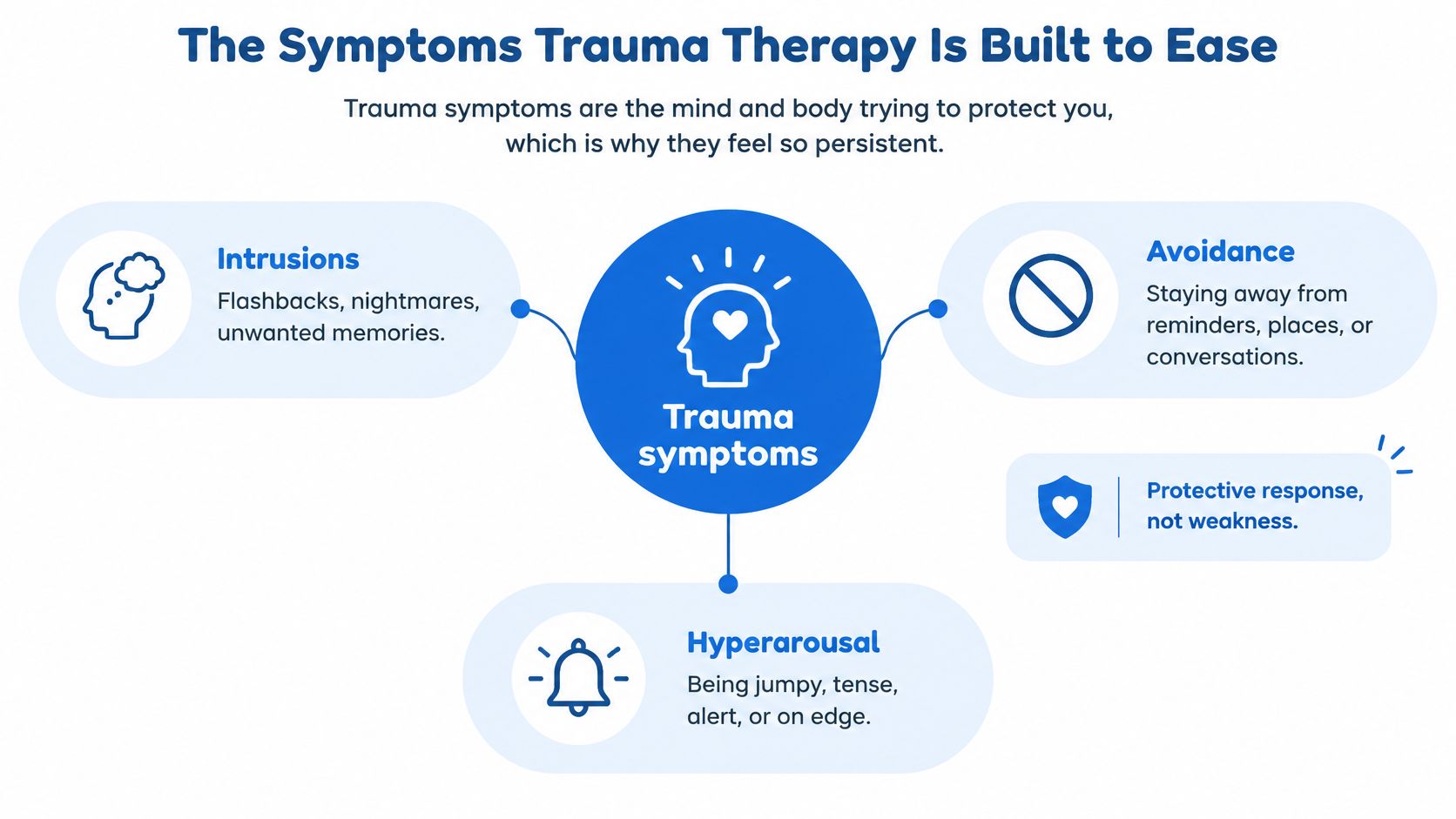
A commuter may refuse a familiar bus route after a road accident. A nurse may lie awake after a violent shift, even in a quiet flat. These are protective habits that overstayed.
| Symptom cluster | What it can look like | What trauma therapy targets |
|---|---|---|
| Intrusive memories | Flashbacks, nightmares, distressing images | Processing the memory so it loses its grip |
| Avoidance | Skipping places, people or thoughts linked to the event | Gradual, safe re-engagement with avoided situations |
| Hyperarousal | Constant alertness, startle responses, poor sleep | Calming the body's threat response with skills and practice |
| Negative beliefs and mood | Shame, guilt, numbness, "I am broken" thinking | Testing and reframing self-blame using evidence |
| Dissociation | Feeling detached, foggy or unreal | Grounding and stabilisation before any trauma processing |
These patterns overlap with depression, anxiety, and burnout. A clinician should screen for all of them rather than assume one cause. When symptoms keep disrupting work, relationships, or sleep for several weeks or more, that is a reason to seek a professional assessment. The patterns here are for information only. They are not a diagnosis.
If numbness and shame have lasted for years rather than weeks, a counseling perspective on complex trauma from Katy Teen & Family Counseling can help you tell a single overwhelming event from harm that stacked up over time.
Main Types of Trauma Therapy and How They Differ
No single method suits everyone. The better fit depends on the type of trauma, your symptoms, your safety, and what you are willing to try.
| Approach | Core idea | Often suited for |
|---|---|---|
| EMDR | Bilateral stimulation while recalling the memory | Single-incident trauma and PTSD symptoms |
| Trauma-focused CBT | Identifying and reframing trauma-linked thoughts, with gradual exposure | Adults and children with PTSD, shame and guilt |
| Prolonged exposure | Repeated, safe revisiting of memories and avoided situations | Persistent avoidance after assault or accident |
| Narrative exposure therapy | Building a life-story timeline that includes multiple events | Repeated or multiple traumas, including low-resource settings |
| Somatic therapies | Tracking body sensations and releasing stored activation | Hyperarousal, numbness and body-based distress |
EMDR and trauma-focused CBT
EMDR (eye movement desensitisation and reprocessing) pairs recall of a memory with bilateral stimulation, such as guided eye movements or tapping. The aim is to take the sting out of the memory so it sits in the past. It is often considered when there is a clearer incident and classic PTSD symptoms.
Trauma-focused CBT helps you spot beliefs such as "it was my fault" and test them against what really happened. Gradual exposure is part of the work, always inside a plan you understand. A child version brings parents in, so the young person is not doing the hard part alone. Shame and guilt are common reasons clinicians reach for this approach with adults as well as children.
Exposure, narrative work, and the body
Prolonged exposure asks you to revisit the memory, and the situations you have been dodging, in a safe and repeated way. Avoidance shrinks when the body learns that the reminder is not the event. It is often used when avoidance after an assault or accident has taken over the week.
Narrative exposure therapy lays events on a life-story timeline, including moments of strength, not only harm. It suits people with several or repeated traumas, and it has been used in low-resource settings where long specialist courses are hard to arrange.
Somatic therapies track sensations such as a tight chest, numb hands, or a held breath, and help that activation settle. They are often combined with another method rather than used as the whole plan, especially when distress lives mainly in the body.
A longer course is not a sign of failure. Reference ranges in treatment descriptions are often a few weeks to a few months, and your clinician sets the real length after assessment, based on symptoms, safety, and progress.
EMDR, trauma-focused CBT, and prolonged exposure carry the strongest research support for PTSD in many treatment guidelines. Somatic approaches have a smaller evidence base and tend to work best alongside those methods. A clinician chooses by looking at symptoms, current risk, your preferences, and the therapist's training. You can ask why one method was picked, and you can say if the pace feels wrong.
Who Benefits and When Trauma Therapy Helps Most
Who benefits from trauma therapy? The honest answer is broader than many assume, and it depends far less on how tough you are than on what happened and what has remained unresolved since.
A 2024 cross-sectional study in the Indian Journal of Psychological Medicine screened 600 flood victims in Kerala and found that 298 of them, or 49.7%, screened positive for post-traumatic stress disorder three months after the disaster, as the study abstract on PubMed reports. People with ordinarily strong coping skills were in that group. Resilience tends to mean a faster recovery, not an exemption from needing one.
Set that beside the national picture. An analysis of India's National Mental Health Survey, readable in the full PMC article, interviewed 34,802 people and identified 64 with current PTSD, an estimated 0.2% of the general population. A national average behaves like average rainfall for a whole country: it says almost nothing about the district sitting under a cloudburst. Both figures are true at once because general surveys include many people who have never faced severe trauma, which pulls the number down. Survivors of disasters and of violence carry far heavier rates.
Who often needs this kind of care
- Disaster survivors: Floods, cyclones, and fires can leave sleep, startle, and grief tangled together.
- People harmed by others: Violence, abuse, and road accidents often bring shame as well as fear.
- Medical trauma survivors: A frightening procedure or a life-threatening illness can leave the body braced for the next alarm.
- First responders and healthcare workers: Repeated exposure at work can sit under a calm professional face.
- Employees facing harassment: Workplace stress may ease with counselling, coaching, and clearer boundaries. Flashbacks and avoidance need trauma-focused care, not only a workload tweak.
Screening numbers tell you how common a problem is. They do not tell you whether your own sleep, concentration, or relationships have reached the point where help would change the outcome. That judgement belongs inside an assessment.
Identity, safety, and growth
For LGBTQ+ people in India, discrimination, family rejection, concealment, and previous harm in clinics can shape the trauma itself. A 2026 narrative review of India's LGBTQ+ community, published by Springer, links stigma, homophobia, microaggressions, and re-traumatisation in healthcare with complex PTSD, and notes that community and government responses remain limited. Identity-affirming, consent-based care means you control what you disclose, and you are not pushed toward family members who may be unsafe.
Distress and growth can exist together. Therapy can strengthen compassion, emotional intelligence, and resilience without pretending the harm was useful. If symptoms outlast the first few weeks, or they block daily life, that is reason enough to seek help.
How Assessment and Treatment Pathways Unfold
Care works better as a sequence than as a single brave conversation. Each stage answers a different question, and skipping ahead can leave someone flooded.
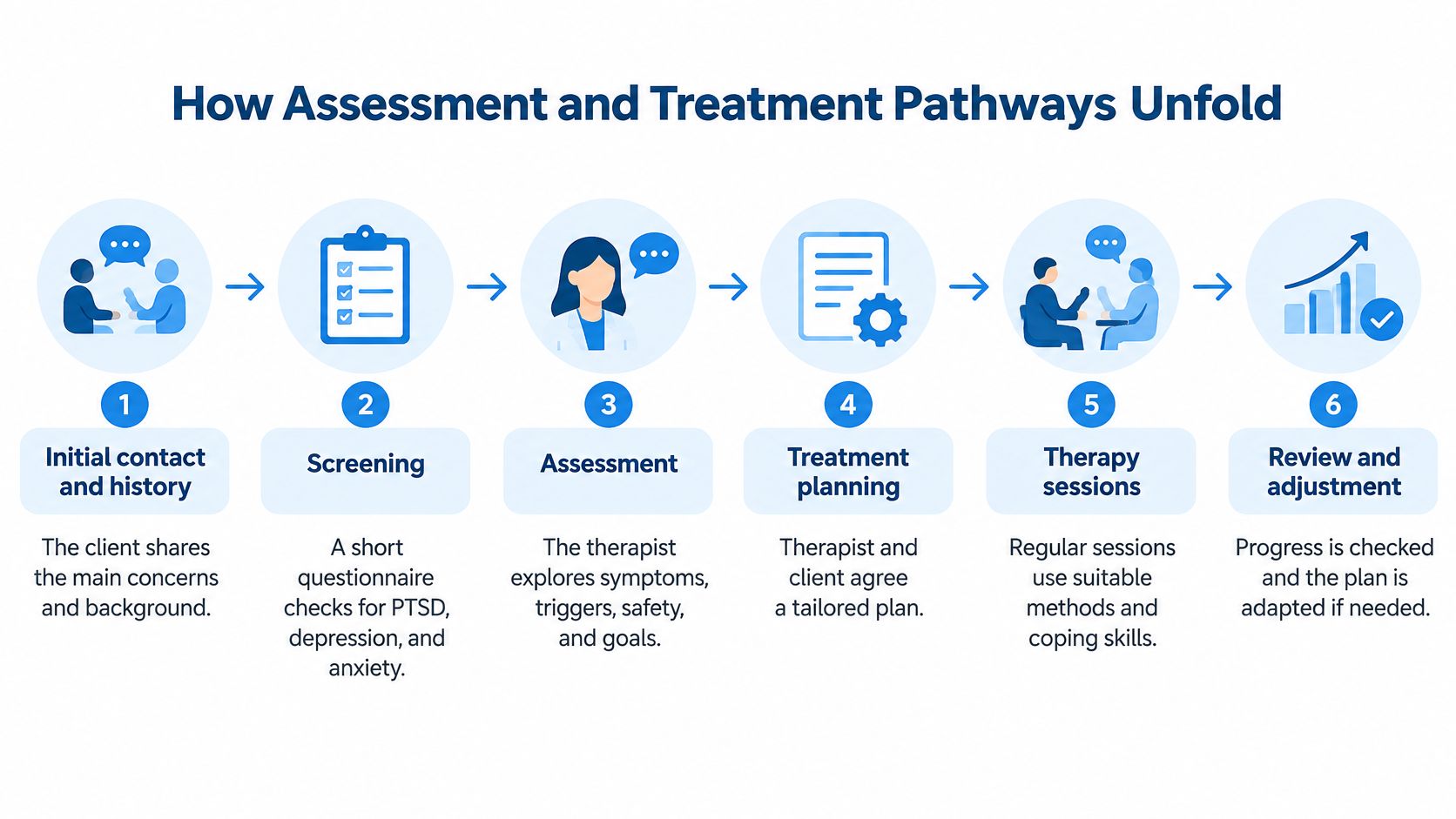
- Initial contact and history. You share the main concerns and a sketch of your background, so the clinician knows what brought you in before anyone names a method.
- Screening. A short questionnaire checks for PTSD, depression, anxiety, substance use, suicidal thoughts, and dissociation, because these problems travel together.
- Clinical assessment. A qualified professional reviews the screening and the history to form a clinical picture. Screening is informational. It does not replace this step.
- Safety and stabilisation planning. Sleep, grounding, a crisis plan, and any medical needs come first, so later work has a floor under it.
- Trauma-focused treatment. The chosen method is delivered at a pace you can manage, with room to pause.
- Consolidation and relapse prevention. Gains are reviewed and a plan for setbacks is built, because a bad week does not erase the work.
Where people enter
A GP or psychiatrist can handle referral and medical needs. A clinical psychologist often provides the trauma-focused therapy. Some people self-refer to a counsellor. The door matters less than whether the next person can assess risk and match the method.
A five-year review of 59,769 psychiatric outpatients, reported in PMC, found only 131 adults with a recorded PTSD diagnosis, and among those receiving psychological intervention, just 18% received evidence-based trauma-focused treatment. In that group the trauma was interpersonal in 75.2% of cases. Those figures are a reason to ask, early, whether the plan is trauma-focused.
Public routes exist alongside private care. As of 31 January 2025, India's Ministry of Women and Child Development reported 812 operational One Stop Centres that had assisted more than 1.08 million women, and the government's trauma-informed Project Stree Manoraksha uses these centres to strengthen mental-health care for survivors of gender-based violence, according to the Press Information Bureau.
A pathway is a guide, not a fixed timetable. Stabilisation may need longer if you are still unsafe or emotions swing hard. Premature exposure can raise distress and dropout.
Safety Steps and Crisis Support to Know Now
Separate danger from distress before you pick a tool. Danger means thoughts of harming yourself or others, violence at home, or a medical emergency. Those need immediate help, not a breathing exercise alone. Distress can be severe and still be something you can ride out with skills and a person on the phone.
| Situation | What to do now |
|---|---|
| Thoughts of harming yourself or others | Call 112 or go to the nearest emergency department, and stay with someone until help arrives |
| Feeling unsafe at home or facing violence | Leave if you safely can, call 112, and use Tele-MANAS on 14416 for free multilingual support |
| Overwhelming distress without immediate danger | Use a grounding step or slow breathing, then call 14416 or your therapist |
| Substance use alongside trauma symptoms | Seek urgent medical advice on withdrawal before starting trauma processing, and tell any therapist about current use |
| Dissociation or feeling unreal for hours | Use grounding steps now and contact a clinician the same day; seek emergency care if it does not ease or you feel unable to keep yourself safe |
Two steps you can use in the moment
For panic or dissociation, try 5-4-3-2-1. Name five things you can see, four you can touch, three you can hear, two you can smell, and one you can taste. Then slow your breathing with a longer exhale than inhale. The longer out-breath tells the body the emergency is easing.
Write a simple safety plan while you are calmer. List warning signs, coping steps, people to contact, professional numbers, and what a safer room looks like. Keep 112 and Tele-MANAS (14416) on that page. As of 7 February 2025, India's Ministry of Health and Family Welfare reported that Tele-MANAS had handled 1,827,951 calls since its 2022 launch, a scale of demand noted by the Press Information Bureau.
Online therapy helps many people with anxiety, low mood, and ongoing trauma symptoms. It is not enough for acute suicidality or severe alcohol or drug withdrawal, where in-person or emergency care comes first.
If you are supporting someone, ask directly whether they are thinking of suicide. Stay with them, and help them reach emergency care. Do not leave them alone to "sleep it off."
What Happens in Your First Few Sessions
Say Meera is 34, a teacher who has avoided driving since a road accident. She is capable at work and frightened in a car park. That mix is common.

In the first session the therapist takes a history, agrees goals, explains why this method might help, and checks consent. Meera learns she can skip a question. The point of session one is a map, not a full retelling of the crash.
Skills before the hard memories
The next few sessions focus on stabilisation. Meera practises breathing and grounding, tidies a sleep routine, and hears, in plain language, how trauma keeps the body on duty. This is not delay. Processing a memory before she can come back to the room would only scare her off.
In the middle phase the chosen method starts at a pace she can manage. She can pause, set limits, and decide what to disclose. Between sessions she tracks triggers and uses one grounding exercise. Homework stays short on purpose.
A clear walk-through of early sessions, including why therapists slow down, sits in this short film.
Later, the therapist reviews progress with simple measures. Meera notices the memory feels less sharp. Setbacks and emotional spikes still happen, and they are named rather than treated as failure. Progress is usually uneven, not a straight line.
You can ask about credentials, stop at any time, and expect each step to be explained. Bring a list of concerns, current medications, and emergency contacts to the first meeting.
Choosing a Qualified Provider and Taking the Next Step
A safe therapist answers direct questions about training, methods, and limits. Use a short checklist before you book.
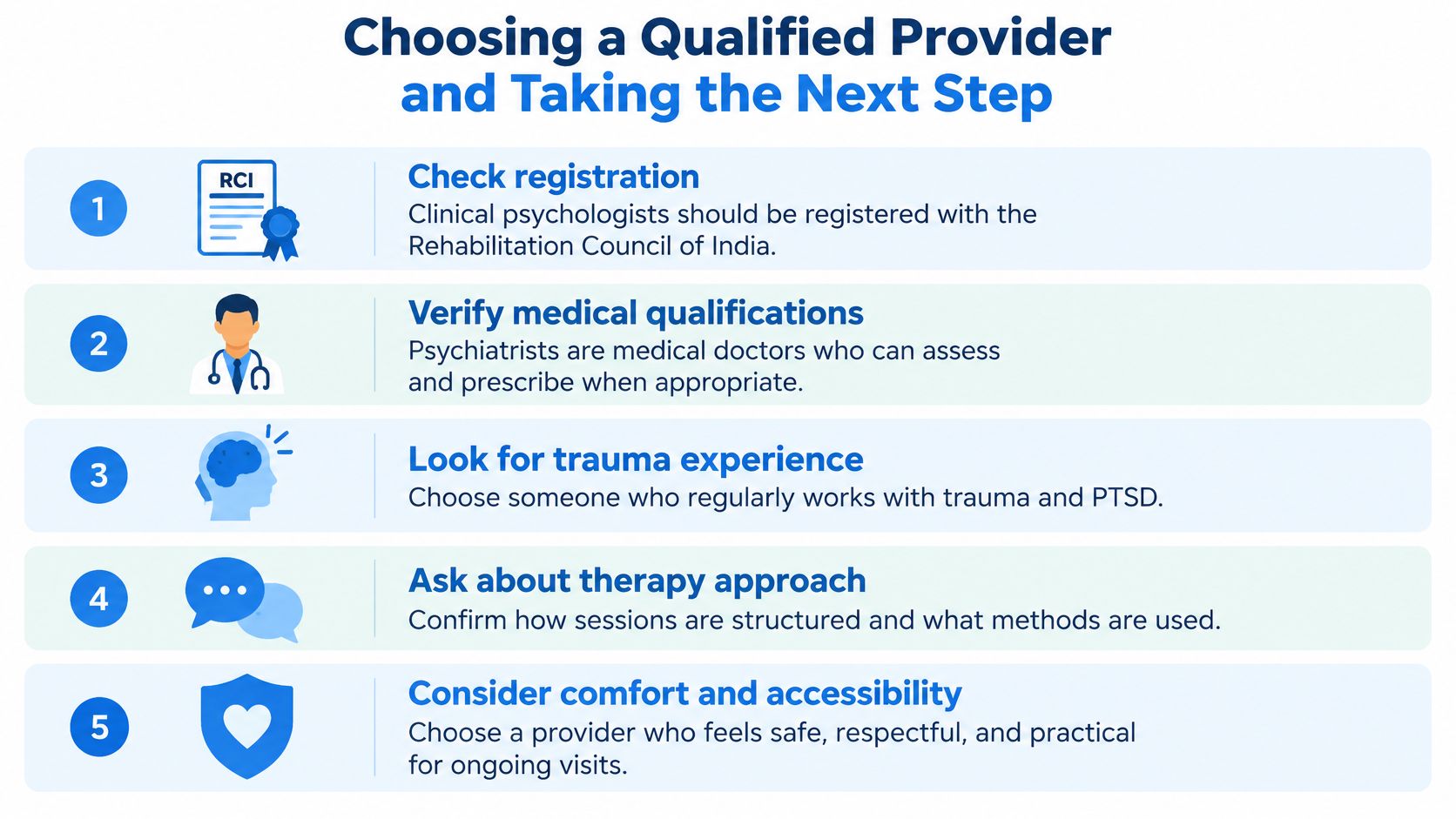
- Check registration. Clinical psychologists should be registered with the Rehabilitation Council of India.
- Know who can prescribe. Psychiatrists are medical doctors. Counsellors should hold recognised training, and they do not replace medical care.
- Look for trauma-specific training. Ask about EMDR, trauma-focused CBT, or prolonged exposure, and about experience with your kind of event.
- Ask about language and respect. Confirm the therapist works in your preferred language, and, if you are LGBTQ+, whether the care is identity-affirming.
- Confirm consent and practicalities. You should hear about pacing, your right to stop, fees, session format, and the emergency plan.
Access remains uneven across India. The Ministry of Health and Family Welfare reports that India has about 0.75 psychiatrists per 100,000 people, against a WHO benchmark of at least 3 per 100,000, and that Tele-MANAS offers support in 20 Indian languages. As of 19 March 2025, the Ministry reported that 36 states and union territories had set up 53 Tele-MANAS cells, according to the Press Information Bureau. Language-matched help may be closer than a big-city clinic. If substance use is in the picture, ask whether trauma care can be sequenced with addiction treatment.
For a plain-language guide to the principles a trauma-informed therapist should be able to explain, see evidence-informed therapy for people experiencing trauma.
DeTalks brings psychologists, therapists, and counsellors into one directory so you can compare profiles and book sessions. The platform's assessments and screening tools give informational insights, not a diagnosis, and curated self-help can sit beside therapy. Resilience and compassion are practices you keep, not a cure someone hands you.
Three small steps are enough for this week. Take one screening tool, shortlist two providers, and book one consultation.
If trauma symptoms, anxiety, or low mood are crowding out your days, DeTalks can help you compare qualified therapists across India and book counselling that fits trauma-focused care. You can also use informational screening tools and self-help while you decide on next steps for your well-being. Visit DeTalks when you are ready to take one clear step.
Leave a Reply