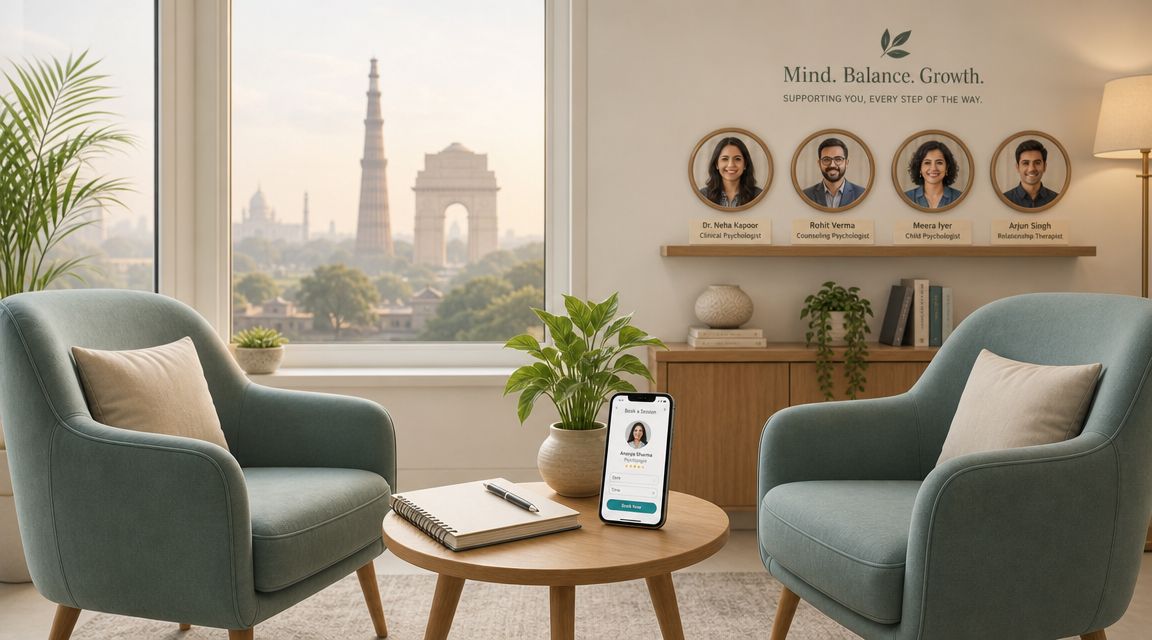
You open your phone, search for a therapist in Delhi, and suddenly you're looking at dozens of profiles, unfamiliar titles, and booking buttons that all seem to promise support. If you're already carrying workplace stress, anxiety, low mood, grief, or simple emotional exhaustion, that much choice can feel like one more burden.
Delhi is a city where people often keep going even when they're overwhelmed. Students push through exam pressure, professionals absorb burnout, parents juggle family demands, and many people wait until things feel unmanageable before seeking therapy or counselling. The hopeful part is that support is easier to access than it once was, especially online.
A useful way to choose is to keep it simple. Start with four questions. Does this provider match your concern, such as anxiety, depression, trauma, relationship conflict, or resilience building? Can you verify the clinician's training and role? Does the format fit your life, online, in person, or both? And does the first interaction feel clear, respectful, and non-judgmental?
That clarity matters in India, where many people still struggle to access mental health care. An India mental-health market review notes that a large share of people with mental disorders do not receive adequate care, and that psychological interventions make up more than 60.52% of the treatment market, which reinforces how central talk-based support is for everyday help-seeking in cities like Delhi (India mental-health market analysis).
If you're also trying to understand the practical side of care delivery, this explainer on understanding mental health practice billing gives helpful background.
1. DeTalks
You open a dozen tabs after a long day in Delhi. One therapist profile sounds warm, another lists degrees you do not fully understand, and a third asks you to book before you even know what kind of help you need. DeTalks fits this early stage well because it brings the first steps into one place. You can read, reflect, use confidential assessments, and then decide whether to book a session.
That matters because choosing a therapist is often less like buying a service and more like finding the right guide for a difficult stretch of road. Before you commit, you usually need help with three things. Understanding your concern. Checking whether the clinician's role and training match that concern. Finding a format you can sustain, especially if your schedule is packed.
DeTalks supports that process with therapist discovery tools, self-help resources, and informational assessments that help you put words to what you are feeling. The assessments are not diagnostic. They work more like a starting map. If your thoughts feel tangled, a simple structure can make the first conversation with a professional much easier.
Why DeTalks works well for Delhi users
People looking for therapy in Delhi often get stuck on one question. Who is the right kind of professional for this problem? A psychologist, counsellor, psychotherapist, or psychiatrist can each play a different role, and the differences are not always explained clearly on directory-style pages. A Psychology Today page discussing therapist search intent in Delhi reflects this confusion and the trust gap many people feel while trying to choose care (Delhi therapist search context).
DeTalks is helpful because it does more than list names. It gives people a way to sort their needs before booking. That is useful for someone dealing with anxiety, depression, trauma, grief, relationship stress, work burnout, or exam pressure. It also suits people who are not in crisis but still want support with resilience, mindfulness, emotional awareness, or day-to-day well-being.
For parents seeking a therapist in Delhi for a child, and for adults trying therapy for the first time, that broader entry point can lower the pressure. You do not need a perfect label for what you are feeling before you start.
Practical rule: If you are unsure what kind of support fits, begin with an informational assessment and then book a first conversation. Clarity often comes from talking things through with a qualified professional, not from trying to solve the whole question alone.
What makes it different
Another useful sign is that DeTalks also serves practitioners. That may sound like a background detail, but it affects the client experience. A platform that pays attention to professional standards, practice operations, legal awareness, and clinician support is more likely to create a clearer and safer process for the people booking sessions.
A few points are worth keeping in mind. Public pricing is not always easy to compare upfront, so you may need to enquire directly before deciding. The platform is also primarily focused on India, which is helpful for local relevance, though broader expansion appears to be a future direction rather than a current core feature.
Best for
- First-time seekers: Helpful if you are still working out what kind of support you need.
- Busy professionals and students: A good fit for online therapy, counselling, and flexible booking.
- Growth-focused users: Useful for support with distress as well as resilience and well-being.
- Practitioners too: Psychologists may appreciate a platform that considers both care quality and practice realities.
2. Sukoon Health

Sukoon Health suits people who want therapy inside a larger, coordinated mental health system. That can be reassuring if you're not sure whether you only need counselling, or whether you may also want psychiatric input, medication support, or a more structured care plan later.
Its setup is especially useful for someone whose situation feels layered. For example, you might be dealing with anxiety and sleep disruption, or burnout that's starting to affect your relationships and work functioning. In those cases, having psychologists, counsellors, and psychiatrists within one provider can make the process feel less fragmented.
Why someone might choose it
Sukoon Health publishes therapist profiles and sample fee ranges for many clinicians, which helps if you prefer more transparency before reaching out. It also offers online and in-person care, so you can start in the format that feels easiest and switch if needed.
A hospital-style or chain-style setting isn't everyone's preference. Some people feel more comfortable in a smaller private clinic because it feels less formal. But if your priority is structure, multidisciplinary oversight, and a provider with clear clinical systems, Sukoon Health is a strong option.
Some people don't want to retell their story to three different providers. Integrated settings can reduce that friction.
Good fit and possible trade-offs
Why it may fit
- Coordinated care: Helpful if therapy and psychiatry may need to work together.
- Multiple access points: Useful for Delhi NCR users who want more than one location option.
- Transparent browsing: Published profiles and fee examples make early comparison easier.
What to watch
- Longer waits for senior clinicians: Popular providers often book up quickly.
- Less boutique feel: If you want a quieter, highly personal private-practice atmosphere, this may feel more institutional.
You can review services and clinician information on Sukoon Health.
3. CIMBS
CIMBS, also known as Cosmos Institute of Mental Health & Behavioural Sciences, is a practical choice if you want a clinic that brings psychiatry and psychology together without the scale of a big hospital network. Many people prefer that middle ground. It feels more focused than a large hospital, but still offers integrated care if your needs shift over time.
Its New Friends Colony presence makes it especially relevant for South and Central Delhi users who want an established centre rather than a broad marketplace. If you already know you're looking for structured psychotherapy, this can be a useful place to start.
What stands out here
CIMBS highlights approaches such as CBT, DBT-informed work, family therapy, and care for both adults and children. That matters because therapy often works best when the method matches the concern. Someone handling panic or repetitive worry may want a structured framework. A family dealing with repeated conflict may need a very different kind of room and conversation.
The centre also offers online and in-person appointments. In a city like Delhi, that flexibility isn't just convenient. It helps people stay consistent when commuting, work hours, or family duties get in the way.
Best matched for
- People who want both therapy and psychiatry available
- Parents seeking one centre for adult and child support
- Clients who prefer a recognised clinic over a marketplace directory
A note on digital convenience
Online therapy in India is no longer a side option. It's becoming a central part of how people access support. An IMARC market projection values the India online mental health market at USD 151.4 million in 2025 and projects growth to USD 464.4 million by 2034, which helps explain why providers with online booking and digital access are increasingly relevant for Delhi users (India online mental health market projection).
CIMBS appears well positioned for that shift. The trade-off is that a busy, established centre can mean premium fees and peak-slot wait times.
You can explore appointments and services through CIMBS.
4. Fortis Healthcare Mental Health & Behavioural Sciences

Fortis is the option many people consider when they want therapy within a large medical network. That can be especially useful if emotional distress overlaps with sleep issues, chronic health concerns, adolescent behavioural changes, or a need for formal reports and medical documentation.
For some people, hospital infrastructure feels too clinical. For others, it feels safer because everything is in one place. If you're someone who likes clear departments, established protocols, and the ability to move between mental health and other medical services, Fortis makes sense.
Where it can help most
Fortis Mental Health & Behavioural Sciences departments across Delhi NCR include psychologists and psychiatrists, with options for individual, couples, and family therapy. That broad network can be helpful if you want a known healthcare brand or if family members may also need support through the same system.
This kind of setting can also be practical when school documentation, workplace paperwork, or coordinated referrals matter. It won't feel as intimate as a small therapy-first clinic, but it may feel more straightforward for people who are used to hospital-based care.
A useful question for your first call: “Will I be seeing a therapist only, or is there a broader care team if I need one later?”
Strengths and limitations
Strengths
- Large network: Easier to find a location across Delhi NCR.
- Medical coordination: Helpful when mental and physical health concerns overlap.
- Structured pathways: Good if you prefer formal systems and referrals.
Limitations
- Pricing can be less transparent online: You may need to call for specifics.
- Hospital feel: Not ideal if you want a softer, more private-practice atmosphere.
One broader reason providers like Fortis matter is that India's specialist supply remains limited. A review in the Indian Journal of Psychiatry reported that India had about 9,000 psychiatrists, or roughly 0.75 psychiatrists per 100,000 people, and estimated that around 36,000 would be needed to reach a benchmark of 3 per 100,000. It also noted that about 700 psychiatrists graduate each year, yet the country remains far below need (Indian psychiatrist workforce review). In practical terms, larger systems often become important access points because demand is high.
You can find locations and mental health services on Fortis Healthcare.
5. VIMHANS

VIMHANS is one of the names many Delhi residents already recognise, especially when the need goes beyond straightforward weekly therapy. It's a dedicated mental health and neuro-allied setting, which makes it relevant for people who may need assessment, psychotherapy, psychiatry, rehabilitation, or multiple services under one roof.
That doesn't mean it's only for severe situations. It can also be a good choice when someone wants a fuller evaluation because the picture is complicated. Maybe a person is experiencing depression along with concentration problems, or a family is trying to understand behavioural changes and needs more than one specialist perspective.
When this setting can be helpful
VIMHANS may suit people who want access to allied therapies and rehabilitation in addition to counselling. That's different from a simple therapist directory. It's more of a campus-style mental health environment, where care can become more extensive if required.
The downside is emotional, not just logistical. Some people feel uneasy entering a hospital-like setting for therapy because they want the experience to feel less clinical and more conversational. That's a valid preference. The best fit often depends on whether you're seeking warmth and privacy first, or breadth of services first.
A strong fit for
- Complex cases: When therapy may need assessment or rehab support alongside it
- Families seeking multidisciplinary input
- People who prefer established referral pathways inside one institution
A simple way to decide
If your main goal is talk therapy for stress, anxiety, relationship issues, or workplace burnout, a platform like DeTalks or a smaller clinic may feel easier to start with. If your concerns seem layered, long-standing, or connected with functioning in several areas of life, VIMHANS may be worth considering.
You can enquire directly through VIMHANS.
6. Children First with Amaha

Children First is the most specialised option on this list. If you're searching for a therapist in Delhi for a child, teenager, or young adult, this is the one to keep near the top. Its work is developmentally informed, which matters because young people don't present distress the same way adults do.
A teenager with anxiety may look irritable rather than frightened. A child under stress may show it through sleep changes, school avoidance, clinginess, or emotional outbursts. General adult therapy services can miss those patterns. Children First is designed for that age-specific reality.
Why families often need this kind of care
The service includes therapy, standardised assessments, parental guidance, family-based work, and school liaison. That broader ecosystem is often what families need. A child doesn't live in isolation. Home routines, school demands, friendships, and parent stress all affect well-being.
The Amaha connection may also help with continuity as a young person grows older and their needs change. That can matter for families who don't want to restart the search every few years.
Children often need support around them, not just support directed at them.
Best fit and limits
Best fit
- Children and teens: Especially for school, emotional, behavioural, or family concerns
- Parents who want guidance too: Useful when adults need help supporting a child at home
- Young adults in transition: Helpful where developmental context matters
Less ideal for
- Adults seeking only individual therapy: Other options on this list are better suited
- People who want instant cost comparison: Pricing isn't clearly listed online
One local signal of online readiness in Delhi comes from a therapist directory page for New Delhi. It reports that listed therapists there average 19 years of experience, and that all listed profiles offer online sessions. The same page shows stress, trauma and PTSD, and loss or grief appearing across the listed profiles, alongside self-esteem, depression, and anxiety or fears (New Delhi therapist listing overview). That doesn't replace direct vetting, but it does show how normal digital access has become.
You can learn more or enquire through Children First.
7. Antarman MHS

Antarman MHS feels different from the hospital and multi-specialty options above. It's more of a therapy-first clinic, which can be exactly what some people want. If a large institution feels intimidating, a smaller setting in Green Park with online continuity may feel easier to approach.
This is the kind of option people often prefer when they want regular psychotherapy without the atmosphere of a hospital. It may appeal to adults dealing with anxiety, depression, trauma, relationship concerns, burnout, or ADHD-related challenges who want a quieter, more focused therapeutic experience.
What stands out in practice
Antarman MHS emphasizes RCI-licensed clinical psychologists, confidentiality, and evidence-based approaches. That's reassuring if you care about clinician qualifications and don't want to sort through a huge directory on your own.
A smaller team has pros and cons. You may get a more personal feel, but you'll usually have fewer on-site add-ons than in a larger centre. If you later need psychiatry, testing, or a highly multidisciplinary setup, you may need an external referral.
Why people choose boutique clinics
- More personal atmosphere: Often feels less formal than a hospital
- Therapy focus: Better if you know talk therapy is your main priority
- Location plus online flexibility: Useful for South Delhi users who want both
One thing to ask before booking
Ask how they handle referrals if your needs change. Good therapy doesn't mean staying in one model forever. It means getting the right level of support at the right time.
You can contact the clinic through Antarman MHS.
Top 7 Therapy Providers in Delhi, Comparison
| Service | Implementation complexity 🔄 | Resource requirements ⚡ | Expected outcomes ⭐ 📊 | Ideal use cases 💡 | Key advantages ⭐ |
|---|---|---|---|---|---|
| DeTalks | Moderate 🔄, digital platform & clinician onboarding | Digital infrastructure, large therapist directory, validated assessments ⚡ | Faster access to vetted care; validated screening → stepped care ⭐⭐⭐ 📊 | Quick therapist search, self-help + referral pathways, clinicians seeking practice support 💡 | Evidence-forward library + practitioner enablement; scalable access ⭐ |
| Sukoon Health | High 🔄, multi-site clinical operations and protocols | Outpatient/inpatient centres, multidisciplinary teams, NABH systems ⚡ | Coordinated therapy + psychiatric care; continuity across settings ⭐⭐⭐ 📊 | Complex cases needing medication + therapy; local in-person care in Delhi NCR 💡 | Strong clinical governance, transparent sample fees, multidisciplinary oversight ⭐ |
| CIMBS | High 🔄, integrated psychiatry/psychology workflows | Psychiatrists + psychologists, structured therapy programs, booking systems ⚡ | Structured CBT/DBT-informed therapy with psychiatric step-up when needed ⭐⭐ 📊 | Clients needing evidence-based psychotherapy with psychiatry access 💡 | Longstanding centre with integrated medical-psychological care ⭐ |
| Fortis Healthcare, MH & BS | High 🔄, hospital-grade processes & cross-referrals | Hospital infrastructure, specialty clinics, multidisciplinary staff ⚡ | Hospital-standard assessments and coordinated medical-psychiatric care ⭐⭐⭐ 📊 | Cases requiring medical work-ups, insurance facilitation, severe presentations 💡 | Strong brand, easier insurance/documentation, broad specialty clinics ⭐ |
| VIMHANS | High 🔄, specialised hospital systems for rehab & neuro care | Dedicated mental health campus, rehab/OT services, multidisciplinary teams ⚡ | Comprehensive assessment, rehab and long-term management for complex needs ⭐⭐ 📊 | Rehabilitation, neuro-related or long-term psychiatric care 💡 | Recognized mental health hospital with broad service lines ⭐ |
| Children First (with Amaha) | Moderate 🔄, child-focused clinical pathways | Child/adolescent psychiatrists, standardized assessments, school liaison ⚡ | Developmentally informed assessments and family-based outcomes ⭐⭐⭐ 📊 | Children, adolescents, transition planning to adult services, school-related issues 💡 | Deep child specialization and family-oriented interventions ⭐ |
| Antarman MHS | Low–Moderate 🔄, boutique clinic + teletherapy workflows | Small RCI-licensed team, secure online platform, clinic space ⚡ | Focused psychotherapy outcomes with continuity and confidentiality ⭐⭐ 📊 | Adults/couples preferring therapy-first boutique care and online sessions 💡 | Therapy-centric model, convenience, strong confidentiality emphasis ⭐ |
Your Path Forward Supportive Steps for Your Well-being
You finally decide to look for a therapist in Delhi after another difficult week. Then the primary question shows up. Who feels qualified, practical to book, and right for your situation?
That is why it helps to use a simple choosing framework instead of relying on guesswork. Start with fit. Are you looking for support with anxiety, low mood, grief, relationship strain, work stress, parenting concerns, or something more medically complex? Then check clarity. A trustworthy provider should make it easy to understand who they serve, what kind of therapy or treatment they offer, and what the first step looks like. Last, check access. In a city like Delhi, timing, travel, privacy, and online options often matter just as much as credentials.
DeTalks can be a practical starting point because it brings these decisions into one place. You can review therapist options, use confidential informational assessments to organize what you have been feeling, and book support without having to sort out every clinical title on your own at the start. Those assessments do not diagnose a condition. They work more like a map. They help you describe where you are before you meet someone trained to guide the next step.
Therapy also serves more than moments of crisis. People reach out to improve communication, build emotional resilience, understand patterns, strengthen self-esteem, or handle stress in healthier ways. That still counts. Support does not need to wait until life feels unmanageable.
Different providers suit different kinds of needs. Larger centres such as Sukoon Health, CIMBS, Fortis, and VIMHANS may be a better match for urgent concerns, psychiatric input, or care that involves several specialists. Children First fits child and adolescent needs more naturally. Antarman MHS may appeal to adults or couples who prefer a smaller therapy-focused setting.
Keep one final point in mind. An article, profile, or screening result can guide your choice, but only a qualified clinician can assess your concerns in context. You do not need perfect language before booking. You only need an honest starting point.
If you'd like another gentle self-care resource alongside therapy, you might also explore music therapy for mindfulness.
One conversation can be enough to begin. For a practical place to start, DeTalks offers a clear way to search, compare, and book a qualified therapist in Delhi while keeping the process private and manageable.
Leave a Reply